2. Experimental Section
All conductive agents (SP, GN, and CNTs) tend to agglomerate, particularly graphene due to strong interlayer van der Waals interactions. To improve dispersion, polyvinylpyrrolidone (PVP, 20 wt% relative to the conductive agents) was introduced as a dispersant to reduce surface tension and enhance stability. A combined dispersion strategy involving ultrasonication, mechanical stirring, and homogenization was employed.
The cathode slurry was prepared with a mass ratio of LiFePO4:conductive agent:PVDF = 90:4:6 and a solid content of 42%. The ternary conductive systems are denoted as SxGCyz, where x represents the weight percentage of SP in the total conductive carbon, and y/z corresponds to the mass ratio of GN to CNTs. Firstly, the conductive agents (SP, GN, CNTs or SxGCyz) were stirred and dispersed in the PVDF solution, with 20 wt% PVP (polyvinylpyrrolidone) added as a dispersant. Ultrasonic treatment for 5 min was performed every 2 h of stirring, and this process was repeated for 24 h. Afterwards, LiFePO4 powder was introduced, and the mixture was further stirred and sonicated for 24 h following the same procedure. Subsequently, the as-prepared slurry was homogenized at 2000 rpm for 10 min, then uniformly coated onto aluminum foil and dried at 120 °C for 30 min. Finally, the electrodes were assembled into coin-type half-cells for subsequent electrochemical testing. To systematically determine the optimal composition of the ternary conductive network, a two-step compositional screening strategy was employed. First, the proportion of SP was varied (10–90 wt%) while maintaining a fixed GN/CNT ratio (1:1). Subsequently, under the optimal SP content, the relative ratio of GN and CNTs was further adjusted. This stepwise optimization enables clarification of the individual and synergistic contributions of zero-, one-, and two-dimensional conductive carbons.
The structural and morphological properties of the conductive agents were characterized by X-ray diffraction (XRD) (Rikagaku Corporation, Tokyo, Japan), Raman spectroscopy, Brunauer–Emmett–Teller (BET) analysis (Beiside Technology Instrument Co., Ltd., Beijing, China), scanning electron microscopy (SEM) (Tasken Trading (Shanghai) Co., Ltd., Shanghai, China), and transmission electron microscopy (TEM) (Field Electron and Ion Company, Hillsboro City, OR, USA). For the electrodes, XRD, SEM, and energy-dispersive spectroscopy (EDS) (Bruker (Beijing) Technology Co., Ltd., Beijing, China) were conducted before and after cycling to evaluate structural evolution and elemental distribution. X-ray photoelectron spectroscopy (XPS) (Thermo Fisher Scientific, Waltham, MA, USA) was performed on cycled electrodes to analyze surface chemical states and polarization behavior. Electrochemical measurements were carried out at 25 °C after cell assembly and aging. Galvanostatic charge–discharge, cycling performance, rate capability, and differential capacity analyses were performed using a Neware battery testing system (Shenzhen Neware Electronics Co., Ltd., Shenzhen, China) within a voltage window of 2.5–4.2 V. Electrochemical impedance spectroscopy (EIS) (Metrohm China Limited, Hong Kong, China) was conducted on an Autolab workstation over a frequency range of 10−2 to 106 Hz.
3. Results and Discussion
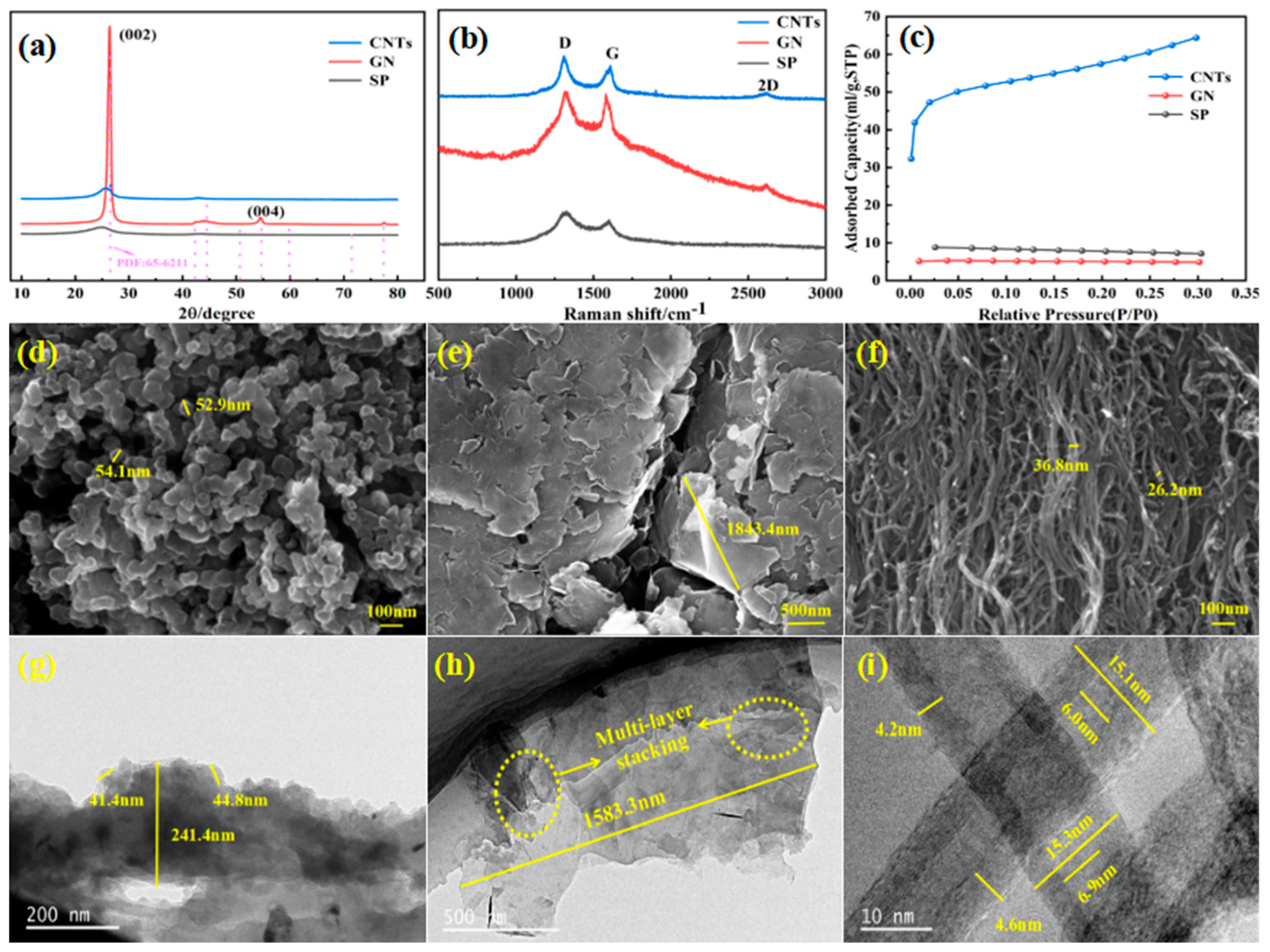
Figure 1a shows the XRD patterns of SP, GN, and CNTs, providing a first comparison of their crystallographic features that are directly related to charge-transport behavior in composite electrodes. GN exhibits a sharp and intense (002) reflection, indicative of high crystallinity and well-ordered graphitic stacking, which is consistent with its superior intrinsic electronic conductivity. The appearance of the (004) peak further supports the presence of an ordered layered structure with relatively low stacking thickness. In contrast, the (002) peaks of SP and CNTs shift toward lower diffraction angles, suggesting enlarged interlayer spacing according to Bragg’s law (2d sinθ = nλ). Such an expanded interlayer distance in SP is generally beneficial for electrolyte wetting and Li
+ insertion/extraction at the electrode interface, thereby promoting ion transport. CNTs, while also showing a low-angle shift, retain comparatively higher crystallinity than SP, implying more efficient electron conduction along the graphitic framework.
Raman spectra in
Figure 1b and
Table S1 further highlight differences in the defect density and graphitization degree among these carbon materials. GN shows the lowest intensity ratio between the D band and G band, indicating fewer structural defects and a higher degree of graphitization, followed by CNTs, whereas SP exhibits the highest defect density. In addition, pronounced 2D bands are observed for GN and CNTs but are absent in SP, consistent with their layered/graphitic structures. The stronger 2D feature of GN reflects a more well-defined layered architecture, which favors in-plane electron transport but may also increase the tendency toward restacking when incorporated into electrodes.
Besides crystallinity and defect structure, the electrolyte accessibility of conductive agents is strongly influenced by their surface area and pore structure. As shown in
Figure 1c, N
2 adsorption measurements yield specific surface areas of 20.9, 14.3, and 195.0 m
2·g
−1 for SP, GN, and CNTs, respectively. The markedly higher surface area of CNTs originates from their porous tubular morphology and provides abundant sites for electrolyte adsorption, which is favorable for interfacial charge transfer and ion migration. By comparison, GN exhibits a relatively low surface area despite its high crystallinity, mainly due to the restacking of graphene sheets that reduces accessible surface and limits electrolyte penetration.
SEM and TEM analyses in
Figure 1d–i provide direct morphological evidence supporting the above interpretations. SP consists of primary nanoparticles (40–55 nm) that aggregate into chain-like secondary structures (
Figure 1d). This particle-chain morphology effectively fills interparticle voids in LiFePO
4 electrodes, which is beneficial for forming short-range conductive contacts and maintaining open diffusion channels for electrolyte infiltration. GN displays stacked lamellar sheets with lateral sizes of ≈2 μm, which can bridge multiple active particles and enhance mechanical integrity (
Figure 1e); however, the tightly stacked nature of the sheets may introduce a steric hindrance effect and locally block Li
+ transport. CNTs exhibit a highly oriented tubular morphology with inner and outer diameters of ≈7 and 15 nm, respectively, and a wall thickness of ≈4 nm (
Figure 1i). Their high aspect ratio enables long-range conductive pathways, but CNTs may also bundle and form sparse junction networks if not well dispersed, which can limit network continuity and stability.
Taken together, the electrochemical roles of SP, GN, and CNTs can be fundamentally understood from their dimensional structures and contact configurations. SP forms a loosely packed particle network with abundant voids that promotes electrolyte accessibility and facilitates Li+ diffusion, yet its point-to-point contacts can lead to discontinuous electron pathways. GN provides efficient in-plane electron conduction through delocalized π-electrons, but its tendency to restack results in dense regions that hinder ion transport. CNTs, acting as one-dimensional conductive units, create continuous electron pathways over long distances; however, limited interconnection density and aggregation behavior may restrict the formation of a robust percolation network. These intrinsic, structure-dependent transport characteristics explain why single-component systems often exhibit trade-offs between electronic conductivity, ion transport, and long-term stability.
Based on the above structural considerations, an important question is how to integrate these conductive agents to maximize both electron transport and Li
+ diffusion while maintaining electrode integrity during cycling. To identify the optimal conductive composition, a systematic electrochemical screening of various SP/GN/CNT ratios was first performed. The performance-guided optimization strategy allows the best-performing composition to be selected for in-depth structural and interfacial characterization, while comparative electrochemical results of other compositions are discussed to validate the selection. The electrochemical results in
Figure S1a–f reveal a non-linear dependence of cell performance on SP content when the GN/CNT ratio is fixed at 1:1. At low SP fractions (10–30%), the electrode lacks sufficient short-range conductive contacts, resulting in incomplete conductive networks and limited capacity retention. As the SP proportion increases, polarization gradually decreases, indicating improved charge transfer and more effective local connectivity. When the SP content reaches 50%, the polarization is minimized (ΔE = 0.09 V), and both rate capability and cycling stability are markedly improved. The S5-GC55 sample delivers an initial discharge-specific capacity of 162.4 mAh·g
−1 with a stable charge–discharge plateau. After 200 cycles at a 3C rate, the capacity remains 112.7 mAh·g
−1 corresponding to a capacity retention of 68.1%. However, excessive SP (>50%) disrupts long-range conductive pathways, since too few one- and two-dimensional conductive components remain to bridge particles and establish continuous networks, leading to increased charge transfer resistance and deteriorated high-rate performance. Notably, the S5GC55 electrode exhibits the lowest charge transfer resistance (Rct) among SP-content series (Rct = 373.7 Ω) and the best overall stability, indicating that 50 wt% SP provides a critical balance between ion diffusion (favored by porous particle packing) and electronic connectivity (requiring long-range bridging).
Under the optimized SP content (50%), the GN/CNT ratio was further tuned to determine the optimal balance between two-dimensional bridging and one-dimensional long-range conduction (
Figure S2). Moderate incorporation of GN initially enhances interparticle connectivity and improves the utilization of active material. However, as GN content increases beyond an optimal level, severe restacking becomes more pronounced, which restricts Li
+ diffusion and increases polarization. Among the investigated compositions, S5GC37 (GN/CNTs = 3/7) delivers the most balanced performance (
Figure S2), exhibiting the lowest polarization (ΔE ≈ 0.1 V) and the smallest charge transfer resistance (Rct = 268.1 Ω). Importantly, it retains 103.6 mAh·g
−1 after 200 cycles at 3C, with a retention rate of 81.4%, demonstrating the robustness of the conductive framework under harsh rate and cycling conditions. In contrast, GN-rich systems (e.g., GC91) suffer from severe capacity decay and extremely poor high-rate performance, which can be attributed to steric hindrance and Li
+ trapping within stacked graphene layers. Therefore, S5GC37 was identified as the optimized ternary composition and selected for detailed structural and mechanistic investigation.
To verify that the optimized composition indeed improves structural stability during cycling, the crystal structure and morphology of LiFePO
4 electrodes with different conductive agents were examined before and after cycling.
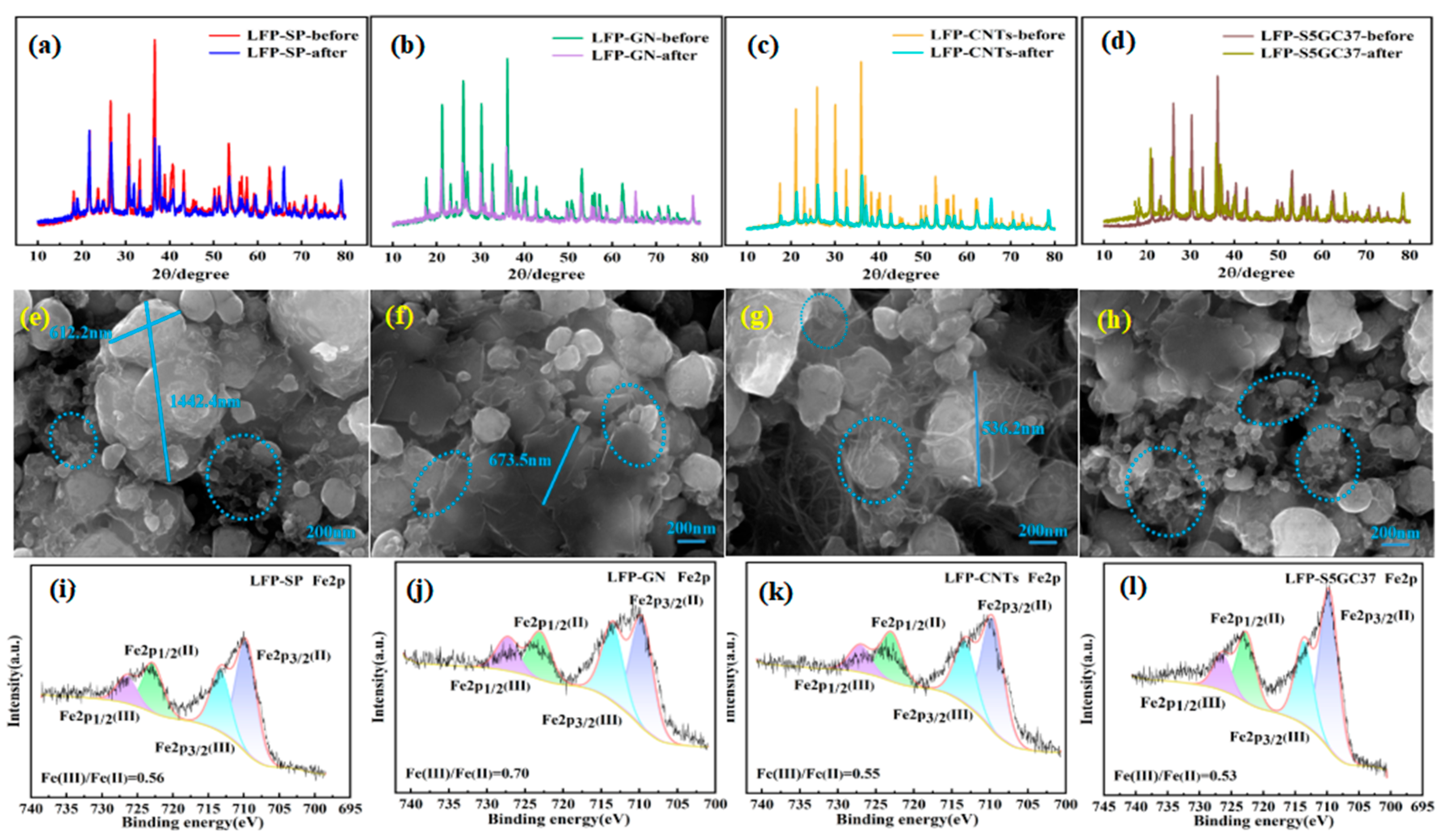
Figure 2a–d presents the XRD patterns of electrodes containing different conductive systems. Prior to cycling, all diffraction peaks can be indexed to the olivine LiFePO
4 phase, confirming that the introduction of conductive additives does not alter the bulk crystal structure. A weak (002) reflection at 26° is observed only in the GN-containing electrode (
Figure 2b), whereas it is absent in SP- and CNTs-based systems due to their amorphous or low-crystallinity nature; this feature is also negligible in S5GC37 because of the reduced GN content. After cycling, peak broadening and decreased intensity are observed for all electrodes, accompanied by a slight shift toward lower angles (
Figure 2a–d). These changes indicate lattice expansion and increased structural disorder caused by repeated Li
+ insertion/extraction and the formation of surface byproducts from electrolyte decomposition. Such evolution is typically associated with capacity fading and increased polarization. Notably, the S5GC37 electrode shows the least attenuation in peak intensity (
Figure 2d) while maintaining a comparable peak shift to other systems, suggesting that the optimized conductive network can better accommodate volume changes and suppress structural degradation during prolonged cycling.
SEM images of the electrodes (
Figure 2e–h and
Figure S3) further illustrate the connection states of LiFePO
4 particles with various conductive agents before and after cycling. SP provides point-to-point contact and fills the interparticle voids. GN forms point-to-plane contact with a large contact area, while CNTs act as point-to-line conductive bridges. In comparison, the S5GC37 ternary composite combines these three contact forms, thus forming a more continuous and compact conductive network (
Figure 2h). EDS mapping in
Figure S4 verifies the above results. Severe carbon agglomeration is observed in the GN-containing electrode, whereas the S5GC37 electrode shows a much more uniform carbon distribution. Such a homogeneous conductive structure can alleviate local current concentration and reduce structural defects, thus helping to maintain better electrode integrity.
To further investigate the surface chemical evolution of the electrodes after cycling, X-ray photoelectron spectroscopy (XPS) was performed (
Figure 2i–l and
Figure S5). The C 1s spectra in
Figure S5 were first analyzed to evaluate the extent of electrolyte decomposition on the electrode surface. The peak corresponding to C=O is mainly attributed to Li
2CO
3, which is a typical decomposition product of the electrolyte. Therefore, the relative intensity of the C=O peak can be used to estimate the degree of electrolyte decomposition and surface oxidation. As summarized in
Table S2, the electrodes containing SP and GN exhibit relatively high proportions of the C=O peak, indicating more severe electrolyte decomposition during cycling. In comparison, the LFP-CNTs electrode shows a noticeably lower C=O peak contribution. Among all samples, the LFP-S5GC37 electrode exhibits the lowest C=O peak proportion of 10.6%, suggesting that the ternary conductive network effectively suppresses electrolyte decomposition and stabilizes the electrode surface. The Fe 2p region provides direct insight into the oxidation state evolution of LiFePO
4, where partial oxidation of Fe
2+ to Fe
3+ during cycling is commonly linked to interfacial degradation and loss of active material. A comparison of Fe
3+/Fe
2+ ratios in
Table S2 reveals pronounced differences among electrodes: the GN-based electrode exhibits the highest oxidation degree, likely due to restacking-induced transport limitations that cause uneven current distribution and local overpotentials. In contrast, the S5GC37 electrode shows the lowest Fe
3+/Fe
2+ ratio (0.5), indicating suppressed surface oxidation and improved reversibility. Overall, these results suggest that the optimized conductive framework not only improves bulk transport but also stabilizes interfacial reactions by reducing polarization and mitigating side reactions.
Electrochemical measurements further corroborate the structural and interfacial advantages of the ternary conductive network. As shown in
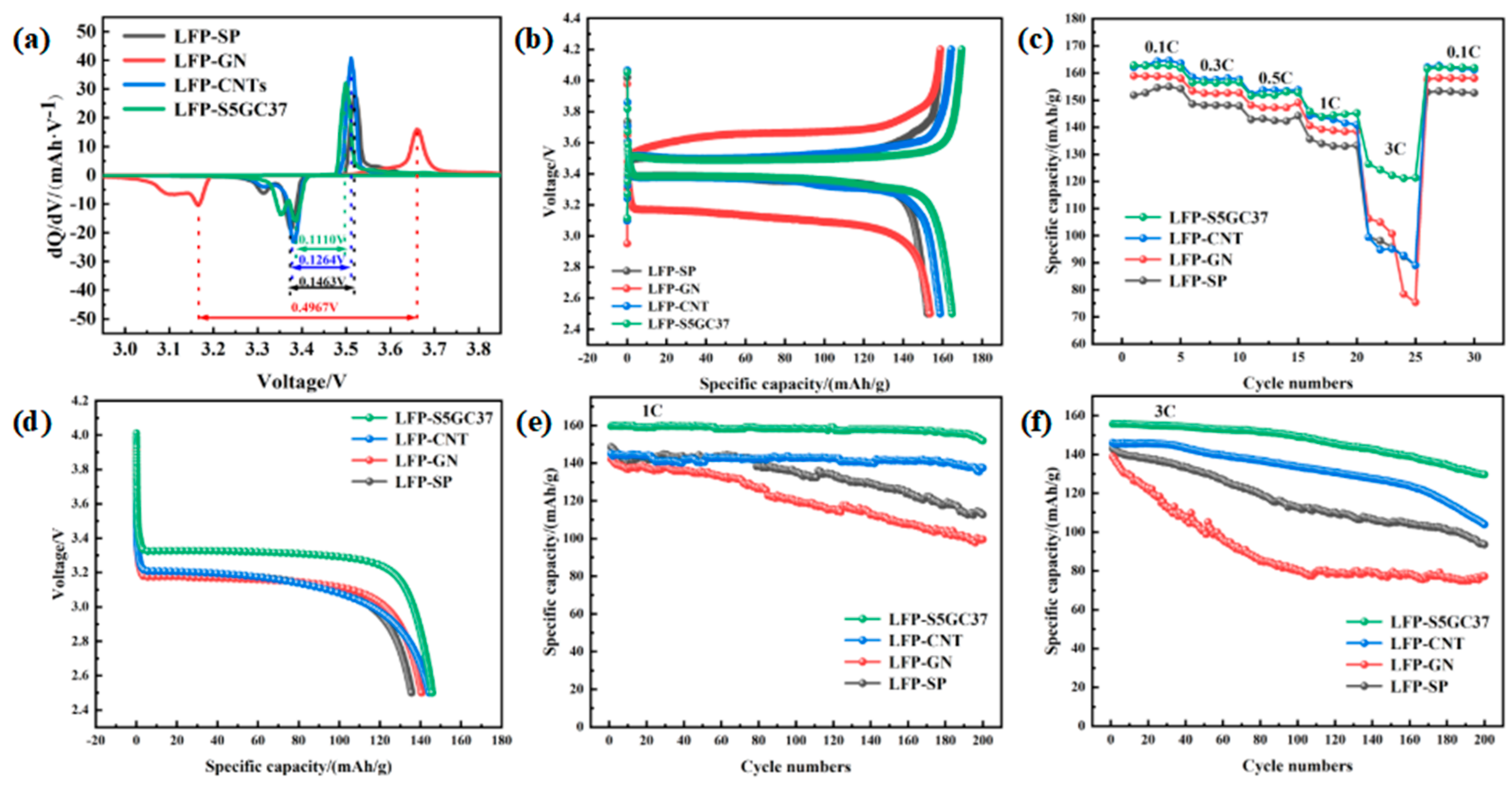
Figure 3a,b, the LFP-S5GC37 electrode exhibits a reduced polarization with the smallest redox potential gap (≈0.1 V) and a stable charge–discharge plateau, indicating improved kinetics and decreased internal resistance. It delivers an initial discharge capacity of 164.8 mAh·g
−1 with a high initial coulombic efficiency of 96.0%, suggesting effective utilization of the active material and a relatively stable initial electrode/electrolyte interface. In comparison, the LFP-GN electrode shows a significantly enlarged voltage hysteresis, consistent with diffusion barriers caused by graphene restacking and Li
+ trapping. The LFP-SP electrode exhibits the lowest capacity, reflecting the limitation of its short-range “point-to-point” conductive pathways that cannot maintain efficient electron transport under high-rate conditions. CNTs-based electrodes perform relatively well at low rates due to their long-range conductive paths; however, their capacity decays rapidly at higher rates, implying that the CNT network alone may be insufficiently dense or mechanically stable to maintain continuous conduction during fast cycling. Rate performance in
Figure 3c further highlights these differences. The LFP-S5GC37 electrode maintains higher capacity and retention across all current densities, delivering 121.3 mAh·g
−1 after 5 cycles at 3C (74.5% retention). These results indicate that the ternary framework effectively reduces transport polarization under high current, where both rapid electron delivery and fast Li
+ redistribution are required.
The first-cycle discharge profiles at 1C (
Figure 3d) provide additional evidence for improved kinetics. The LFP-S5GC37 electrode exhibits a flatter voltage plateau, higher operating voltage, and larger discharge capacity, suggesting reduced ohmic and charge-transfer resistance. These advantages translate to higher practical energy output and improved rate capability. Cycling performance at 1C and 3C (
Figure 3e,f) confirms the long-term stability of the optimized system. The LFP-S5GC37 electrode maintains 151.9 mAh·g
−1 after 200 cycles at 1C and retains 83.2% capacity after 200 cycles at 3C, demonstrating excellent cycling durability. In contrast, the GN-based electrode suffers from rapid decay due to diffusion limitations and aggravated side reactions, while CNT-based electrodes show moderate stability but remain inferior to the ternary system, consistent with the previously discussed network stability limitations. As listed in
Table S3, LFP-S5GC37 significantly outperforms other reported binary conductive network systems in electrochemical performance [
19].
The efficient charge storage capability of LFP-S5GC37 can be ascribed to the synergistic optimization of the two-phase lithiation/delithiation reaction and the three-dimensional conductive network. A “point-line-plane” ternary structure is constructed via the combination of SP, CNTs and graphene, which establishes rapid electron transfer pathways and interconnected Li+ diffusion channels throughout the electrode. This structure not only reinforces interparticle electron conduction but also optimizes interfacial wettability and the stability of the SEI film, thereby accelerating charge transfer and ion migration and realizing highly efficient charge storage in the electrode.
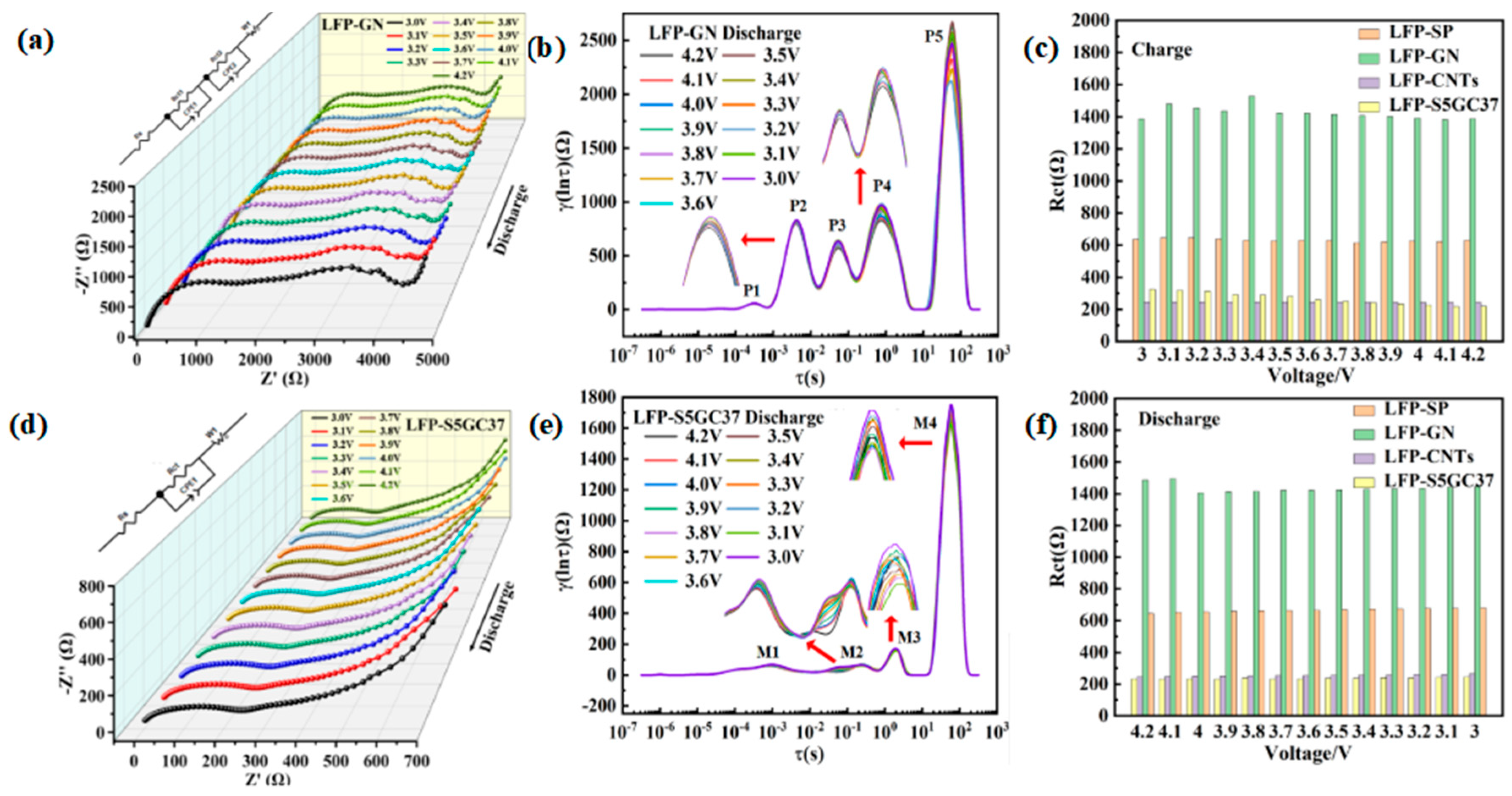
To further evaluate the conductivity of the three single conductive agents and the ternary composite conductive agent S5GC37, in situ electrochemical impedance spectroscopy (EIS) measurements were performed for all cells (
Figure 4 and
Figure S6). The fitted Nyquist plots are shown in
Figure 4a,d. As the discharge voltage decreases, the charge transfer resistance, Rct, gradually increases. This behavior can be attributed to the fact that higher voltages favor Li
+ deintercalation under the electric field, thereby facilitating charge transfer, whereas lower voltages lead to increased interfacial resistance. A distinct difference is observed for the GN-based electrode. Compared with the other systems, the LFP-GN cell exhibits a characteristic double semicircle in the Nyquist plot. This feature originates from the steric hindrance effect caused by the large lateral size and multilayer stacking of graphene sheets. The diffusion of Li
+ ions is severely hindered, leading to the appearance of an additional low-frequency semicircle associated with polarization impedance. In contrast, the LFP-S5GC37 electrode shows a smaller semicircle and lower overall impedance, indicating reduced polarization and improved charge transport.
To further distinguish the electrochemical processes, the distribution of relaxation times (DRT) was calculated for the LFP-GN and LFP-S5GC37 electrodes at different discharge voltages, as shown in
Figure 4b,e. The peaks P1 and M1 appear in the ultra-high-frequency region (10
−5–10
−3 s), corresponding to the contact resistance between electrode components. The peak P2 is unique to the LFP-GN electrode and originates from the steric hindrance effect induced by the large graphene sheets and their multilayer stacking. Peaks P3 and M2 in the high-frequency region correspond to Li
+ transport through the solid electrolyte interphase (SEI) layer (RSEI). Peaks P4 and M3 appear in the intermediate-frequency region and are attributed to the charge transfer resistance (Rct), while peaks P5 and M4 in the low-frequency region are related to Warburg diffusion (diffusion impedance) and ion transport at the electrode/electrolyte interface. Compared with the LFP-S5GC37 electrode, the impedance contributions of the LFP-GN electrode are higher in all regions, particularly in the charge transfer and diffusion processes. The variation in charge transfer resistance with voltage for different conductive systems is shown in
Figure 4e,f. As the state of charge (SOC) increases, Li
+ is gradually extracted from the LiFePO
4 lattice, which enhances electrode activity and slightly enlarges the lattice spacing, while the SEI layer becomes more stable. These factors facilitate charge transfer and result in a decreasing Rct with increasing SOC. Among all electrodes, the LFP-GN electrode shows the highest Rct, followed by LFP-SP, whereas the LFP-CNTs electrode exhibits a value close to that of the ternary system. Benefiting from its well-constructed conductive network and structural stability, the LFP-S5GC37 electrode shows the lowest charge transfer resistance. At a discharge voltage of 3.2 V, the Rct of LFP-S5-GC37 reaches 239.8 Ω; this value was considerably smaller than those of the other three samples. The charge-transfer resistance (Rct) of LFP-SP was 677.2 Ω, whereas that of the GN-based electrode reached the maximum value of 1433.16 Ω. This phenomenon can be attributed to its multilayered structure and the steric hindrance effect caused by severe stacking.
Li
+ diffusion kinetics were further analyzed using EIS data at 3.2 V. In the low-frequency region, the real impedance (Z′) shows a linear relationship with ω
−1/2, from which the Warburg coefficient (σ) can be obtained. As shown in
Figure S7, SP exhibits the smallest σ (61.2), indicating the fastest Li
+ diffusion due to its porous particle network and open diffusion channels. GN shows the largest σ because restacking introduces steric hindrance and blocks ion transport pathways. The S5GC37 electrode exhibits a σ value slightly higher than that of SP but significantly lower than that of GN (
Figure S7), indicating balanced ion transport while maintaining improved electronic connectivity. By integrating multidimensional conductive units, the S5GC37 ternary system balances electron transport and Li
+ diffusion while improving structural stability, thereby enabling high-performance LiFePO
4 electrodes.