Article

The Effect of Microstructure on the Water Embrittlement of Dual-Phase Austempered Ductile Irons

by
Petar Janjatović
1,
Olivera Erić Cekić
2,3,
Sebastian Baloš
1,
Miloš Knežev
1,
Miroslav Dramićanin
1,
Jasmina Grbović Novaković
4 and
Dragan Rajnović
1,*
1
Department of Production Engineering, Faculty of Technical Science, University of Novi Sad, Trg Dositeja Obradovica 6, 21000 Novi Sad, Serbia
2
Faculty of Mechanical and Civil Engineering in Kraljevo, University of Kragujevac, Dositejeva 19, 36000 Kraljevo, Serbia
3
Innovation Centre of the Faculty of Mechanical Engineering, University of Belgrade, Kraljice Marije 16, 11120 Belgrade, Serbia
4
Centre of Excellence for Hydrogen and Renewable Energy—CONVINCE, Vinča Institute of Nuclear Sciences, National Institute of Republic of Serbia, University of Belgrade, Mike Petrovića Alasa 12-14, 11000 Belgrade, Serbia
*
Author to whom correspondence should be addressed.
Metals 2026, 16(4), 364; https://doi.org/10.3390/met16040364
Submission received: 4 February 2026 / Revised: 22 March 2026 / Accepted: 24 March 2026 / Published: 25 March 2026
(This article belongs to the Special Issue Mechanical and Structural Properties of Cast Irons)

Abstract

This study investigates the effect of microstructure on water-induced embrittlement of dual-phase austempered ductile iron (ADI). Dual-phase ADI materials were produced by austenitization at 780, 800, 820, and 840 °C followed by austempering at 400 °C/1 h, resulting in microstructures composed of varying fractions of free ferrite and ausferrite. Tensile properties were evaluated under dry conditions and in distilled water. The embrittlement zones were observed in all samples investigated; however, they were not critical in all cases. The results indicate that free ferrite is less sensitive to water-induced embrittlement, whereas increasing ausferrite content promotes the formation and growth of the embrittlement zone. Elongation was identified as the most sensitive mechanical parameter, showing statistically significant reductions of up to ~80% for microstructures containing more than ~65% ausferrite, while proof strength remained largely unaffected. Fracture surface analysis revealed fatigue-like striation features within the embrittlement zone, indicating cyclic crack initiation and propagation. Based on correlations between tensile behavior, fracture morphology, and microstructural features, a water-induced embrittlement mechanism involving cyclic local chemisorption and surface-initiated crack growth is proposed. These findings highlight the critical roles of phase type, volume fraction, and spatial distribution in controlling the resistance of dual-phase ADI to embrittlement in aqueous environments.

1. Introduction

Dual-phase austempered ductile iron (DP-ADI) represents a modification of conventional austempered ductile iron (ADI) in which the metallic matrix consists of ausferrite and free ferrite. Such microstructures provide additional flexibility in tailoring the balance between strength, ductility, and machinability and are particularly relevant for components operating under simultaneous mechanical loading and exposure to working fluids [1,2,3,4]. In dual-phase ADI, the fraction and distribution of free ferrite and ausferrite are primarily determined by the austenitization temperature and subsequent austempering parameters, which directly control phase transformation kinetics and the resulting microstructure [1,5,6,7].
Austenitization in the intercritical (α + γ) region followed by quenching to the austempering temperature results in a dual-phase microstructure of free ferrite and ausferrite. Increasing austenitization temperature promotes the formation of ausferrite (which consists of ausferritic ferrite and retained austenite), while lower temperatures preserve a higher fraction of free ferrite. Austempering temperature and time further influence the morphology and stability of the ausferritic structure and retained austenite content. Austempering at lower temperatures (approximately 250–325 °C) produces acicular morphology of ausferrite with greater strength, while higher temperatures (approximately 325–400 °C) produce coarser ausferritic microstructure with greater and more stable retained austenite content and thus higher ductility [1,2,3,4]. Consequently, the mechanical properties of dual-phase ADI are governed by the interaction between phase volume fraction, ausferrite morphology, and retained austenite stability [8], all of which are controlled by heat-treatment parameters [1,5,6,7,9,10]. In the dual-phase ADI, ausferrite contributes to higher strength and hardness, whereas free ferrite improves ductility and resistance to crack propagation. Therefore, the tensile behavior and fracture response of ADI depend strongly on the relative proportions and spatial distribution of these phases [2,9,10].
For reference, conventional ADI grades are specified by international standards. In EN 1564:2011 [11], the property range spans from EN-GJS-800-10 (minimum tensile strength/0.2% proof strength/elongation: 800 MPa/500 MPa/10%) to EN-GJS-1400-1 (1400/1100/1%). Similarly, ASTM A897/A897M-16 [12] defines classes ranging from 750-500-11 to 1600-1300-01 (minimum tensile strength/yield strength/elongation in SI units). In practice, fully ausferritic ADI is obtained by austenitizing to a fully austenitic condition (commonly within ~850–950 °C) followed by rapid transfer to an isothermal austempering bath typically in the ~250–400 °C range, where the ausferritic matrix forms during the isothermal hold (as described previously for dual-phase ADI). It should be noted that in the high-ductility ASTM grade 750-500-11, a microstructure consisting of ausferrite with some proeutectoid (free) ferrite is acceptable, i.e., free ferrite may be present.
In this context, different grades and types of ADI materials are attractive because their mechanical performance can be tailored by microstructure optimization through heat treatment (austenitization and austempering) from one starting as-cast ductile iron [13,14,15,16]. As a result, ADI is well suited for structural and functional components that operate under demanding statical and dynamical mechanical loads, where a robust combination of strength and deformation capacity is required [17,18,19].
Moreover, ausferritic matrices have been explored without post-casting austempering treatment (i.e., by alloying-assisted formation of ausferrite), which could in principle eliminate heat treatment [20,21]. However, Stawarz et al. [21] reported that although an ausferrite-containing matrix can be obtained in as-cast alloyed ductile iron, the resulting quality and mechanical performance may be insufficient to meet standard ADI grade requirements due to issues such as graphite degeneration, porosity, and high carbide content.
Despite its aforementioned favorable mechanical properties, ADI is known to exhibit environmentally assisted embrittlement when subjected to tensile loading in the presence of liquids, particularly water. Several studies have reported a pronounced decrease in elongation and, to a lesser extent, tensile strength when ADI is tested in aqueous environments [3,4,22,23,24,25,26]. Even small concentrations of water can initiate the formation of an embrittlement zone near the specimen surface, indicating that the phenomenon is related to microstructure–environment interactions rather than bulk corrosion processes [3,22,23]. The embrittlement effect appears rapidly upon exposure and is reversible after drying, suggesting that localized interactions at the microstructural level dominate the process [22,23,24,25]. Furthermore, Rajnović et al. [4] suggested that hydrogen atoms directly cause embrittlement, while Janjatović et al. [3] showed that increase in water concentration is detrimental.
For conventional ADI, Komatsu et al. [22] reported that tensile strength of approximately 1000 MPa and elongation of about 8% in dry conditions decreased to roughly 700 MPa and 1.5% in the presence of water, corresponding to a reduction in elongation greater than 80%. Similarly, Martínez et al. [23] observed reductions in elongation of 70–80% and decreases in tensile strength of about 20–30% when testing ADI in water compared with dry conditions. Additional studies by Masud et al. [24] confirmed that elongation is the most sensitive mechanical parameter, while proof strength is affected to a considerably smaller extent. Environment-sensitive fracture behavior in aqueous conditions was further analyzed by Caballero et al. [25], who emphasized the role of microstructure and crack initiation near the surface.
In the case of dual-phase ADI, degradation of mechanical properties has been shown to depend strongly on phase volume fraction and microstructure. Caldera et al. [6] demonstrated that dual-phase ADI with a higher ausferrite fraction exhibits a pronounced reduction in elongation when tested in water, whereas microstructures with a higher proportion of free ferrite show significantly lower sensitivity to embrittlement. Similarly, Rajnović et al. [4] reported that exposure to water leads to substantial reductions in ductility and earlier crack initiation, with elongation reductions exceeding 50% in high-strength microstructures, while proof strength remains comparatively stable.
Further investigations by Boeri and Martínez [26] showed that tensile strength in aqueous environments typically decreases by about 10–30%, whereas elongation can decrease by more than 60% depending on microstructure and stress level. Moreover, Fernández Scudeller and Martínez [27] demonstrated that crack initiation in aqueous environments occurs preferentially within ausferritic regions, confirming that the morphology and distribution of ausferrite play a decisive role in embrittlement behavior. Broader studies of environmentally assisted cracking and hydrogen-related fracture mechanisms have emphasized the importance of adsorption-controlled processes and local stress conditions in the development of embrittlement zones [28,29,30,31].
Even very small amounts of water can initiate formation of an embrittled surface zone. As shown by Janjatović et al. [3], concentrations as low as 0.2 vol.% water can produce an embrittlement zone and microcracks at the specimen surface, although the decrease in tensile strength may not yet be statistically significant at such low concentrations. With increasing water concentration, progressive reductions in mechanical properties occur, and at high concentrations rapid fracture with minimal plastic deformation may take place, particularly in microstructures with a higher ausferrite content [3,22].
The influence of microstructure on water-induced embrittlement has also been linked to retained austenite content, phase distribution, and transformation kinetics controlled by heat-treatment parameters [1,2,3,31]. These results indicate that the reduction in mechanical properties of dual-phase ADI in water is governed by the interaction between heat-treatment parameters, resulting microstructure, and phase distribution. Elongation remains the most sensitive parameter, followed by tensile strength, while proof strength is affected to the least extent [1,2,3,4,6,22,23,24,25,26,27,28,29,30,31].
Overall, previous studies indicate that the reduction in mechanical properties of ADI in aqueous environments is strongly influenced by heat-treatment parameters and the resulting microstructure. However, the specific role of the relative fractions and spatial distribution of free ferrite and ausferrite in controlling the formation and growth of embrittlement zones in dual-phase ADI has not been fully clarified. The novelty of the present study lies in the systematic investigation of water-induced embrittlement in dual-phase ADI with controlled variations in phase fractions obtained through intercritical austenitization. By correlating microstructure, tensile behavior, and fracture morphology, this study provides additional insight into the microstructural conditions governing embrittlement in aqueous environments.
Accordingly, the aim of this study is to investigate the influence of different volume fractions of free ferrite and ausferrite in the microstructure of dual-phase ADI on water-induced embrittlement. Particular attention is given to the relationship between phase fraction, tensile properties, and the formation and morphology of the embrittlement zone in order to better understand the mechanisms controlling environmentally assisted embrittlement in these materials.

2. Materials and Methods

2.1. Materials

The chemical composition of starting ductile iron was: 3.5% C, 2.5% Si, 0.35% Mn, 0.05% Ni, 0.06% Cr, 0.031% Mg, 0.018% P, 0.015% S and balance Fe (in wt.%, i.e., mass percent). Microstructure consisted of spherical graphite with more than 90% roundness, with average graphite volume fraction of 12 ± 1.6%, and nodule count of 125 to 175 per mm2, corresponding to nodule size from 15 to 30 µm. The starting metallic matrix was predominantly ferritic with approximately 10% pearlite.
In order to produce dual-phase austempered ductile iron, starting specimens were austenitized at 780, 800, 820 and 840 °C for one hour in the protective argon atmosphere, after which they were rapidly transferred to salt bath and austempered at temperature of 400 °C for one hour. The resulting materials were designated DP-780, DP-800, DP-820, and DP-840, respectively.
Time of austempering was selected on the basis of optimizing the maximum retained austenite volume fraction in ausferrite and obtaining a more plate-like morphology of retained austenite. Furthermore, the higher austempering temperature of 400 °C yielded material with a higher ductility but lower strength.

2.2. Methods

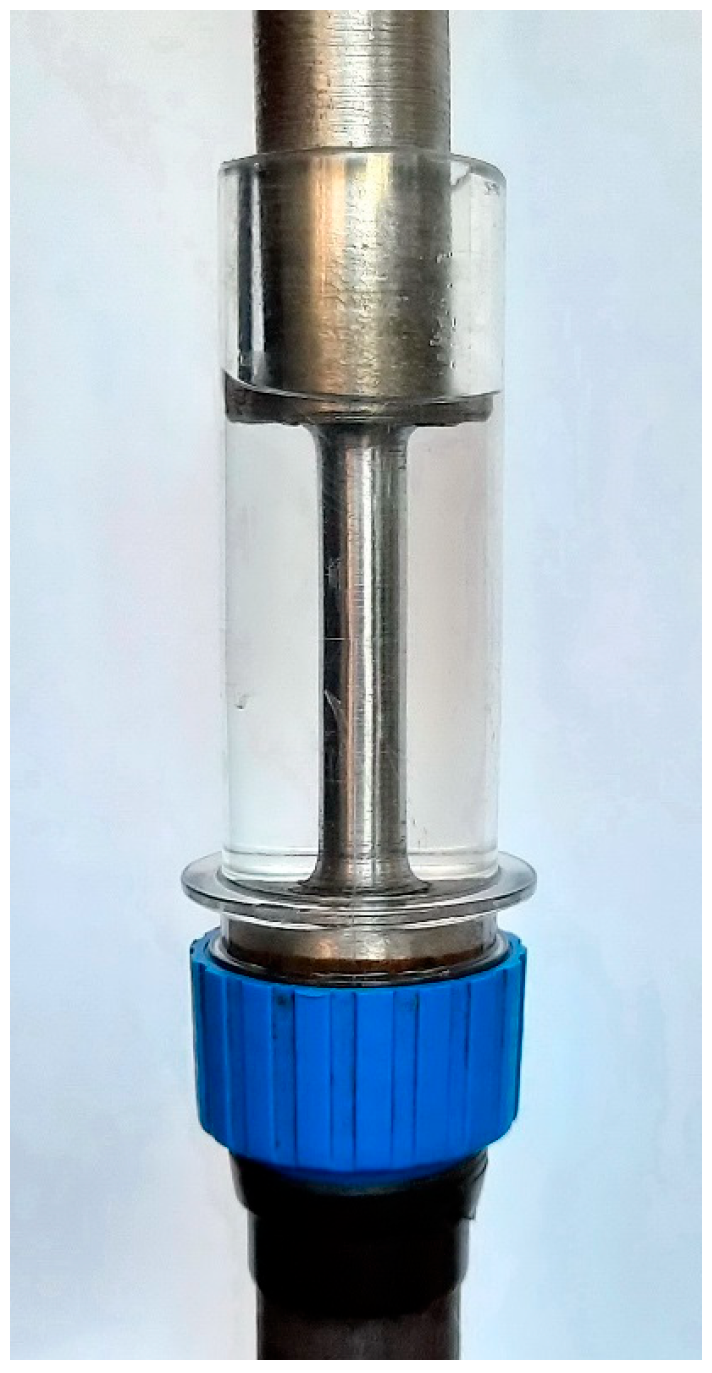
Mechanical properties, namely tensile strength—Rm, proof strength, plastic extension 0.2%—Rp0.2 (often reported as yield strength at 0.2% offset), and percentage elongation after fracture—A, of dual-phase ADI material in dry and water environments were determined by tensile test at ZDM 5/91 machine (WPM, Leipzig, Germany) equipped with load cell and linear displacement sensor (HBM, Darmstadt, Germany), in accordance with the ISO 6892-1:2019 [32] standard. For testing cylindrical samples with a 6 mm diameter, 30 mm gauge length and M10 threaded gripping ends were used. The specimens were tested in dry conditions and in distilled water (designation: D—dry, W—water). Tensile specimens in water (wet) condition were tested using an assembly that consisted of a polymer tube filled with water; see Figure 1. The specimen was immersed in the testing fluid for one minute. The 3 specimens were tested for each condition in accordance with the ISO 6892-1:2019 [32] standard.
Statistical analysis of the tensile test results was performed using a one-way analysis of variance (ANOVA) to determine the significance of the effect of water on the change in properties. For a confidence level of 95%, the effect of water was considered statistically significant when the p-value obtained from the ANOVA test was lower than 0.05.
The chemical composition of starting ductile iron was determined by spark optical emission spectroscopy (OES) using an ARL-3460 spectrometer (Thermo Fisher Scientific, Ecublens, Switzerland) on a white solidification test coupon.
For microstructure study a standard metallographic preparation was applied, including grinding with SiC abrasive papers, polishing with diamond suspensions, and etching in a 3% nital solution. The microstructures were examined using an Orthoplan light microscope (Leitz, Wetzlar, Germany), while fracture surfaces were analyzed by scanning electron microscopy (SEM) using a JEOL JSM-6460LV microscope (JEOL, Tokyo, Japan) operated at an accelerating voltage of 25 kV.
Quantitative image analysis was employed to determine the volume fractions of ausferrite, free ferrite, and graphite. For each dual-phase ADI material, measurements were performed on five fields of view at a magnification of 100× using the point-counting method with 200 randomly distributed points. The reported values represent the average obtained from at least five fields of view per specimen.
X-ray diffraction (XRD) analysis was used to determine the retained austenite content in the investigated ADI materials. Measurements were carried out using a D500 X-ray diffractometer (Siemens, Karlsruhe, Germany) with monochromatic Cu Kα radiation operated at 35 kV and 20 mA. The diffraction intensity was recorded as a function of the 2θ angle in the range from 30° to 100°, with a step size of 0.02° and a dwell time of 2 s per step. Based on the recorded data, the volume fraction of retained austenite (Vγ) in ausferrite was calculated for each material.

3. Results

3.1. Microstructure

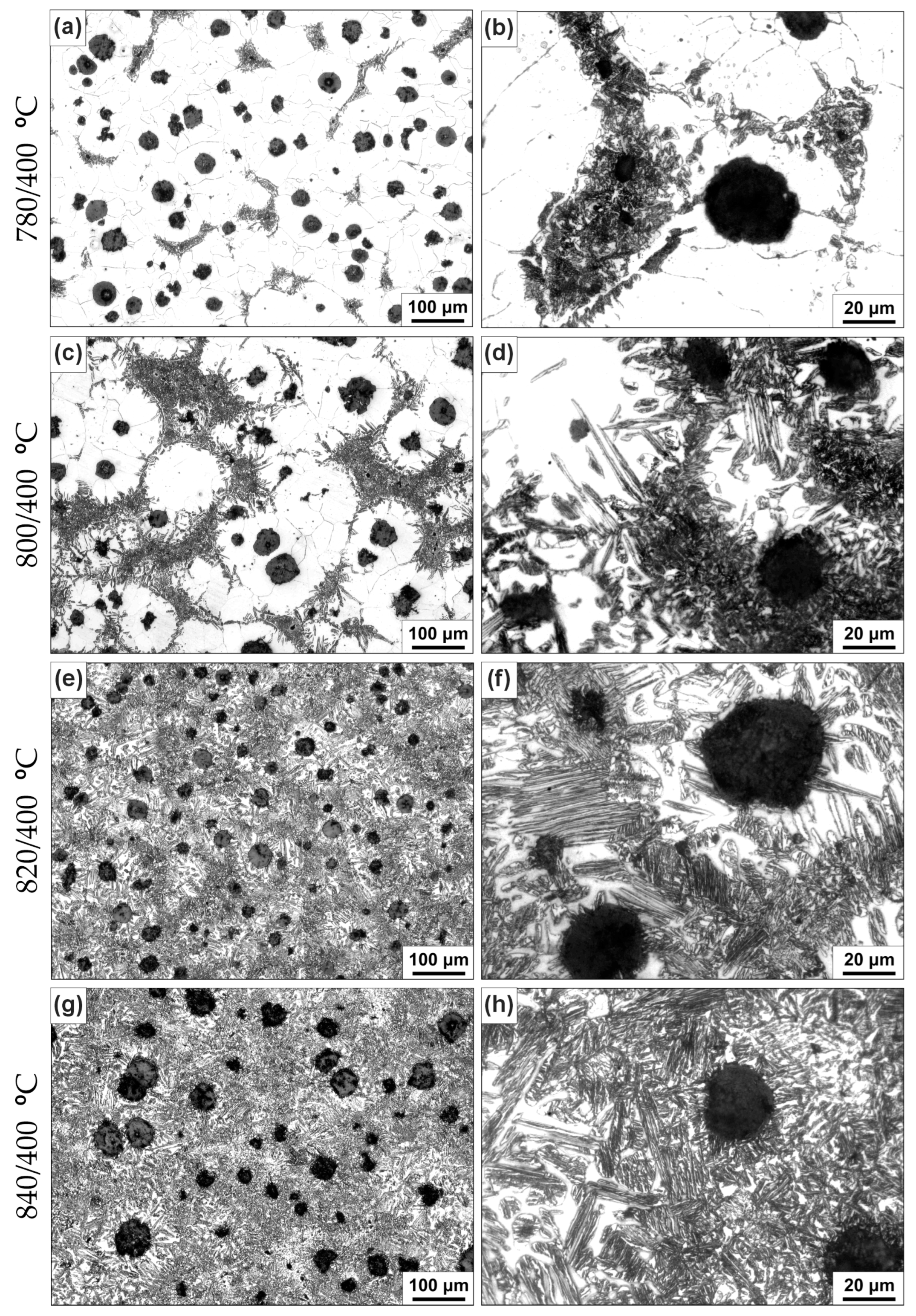
The microstructures of the investigated dual-phase ADI materials austempered at 400 °C after austenitization at different temperatures are shown in Figure 2.
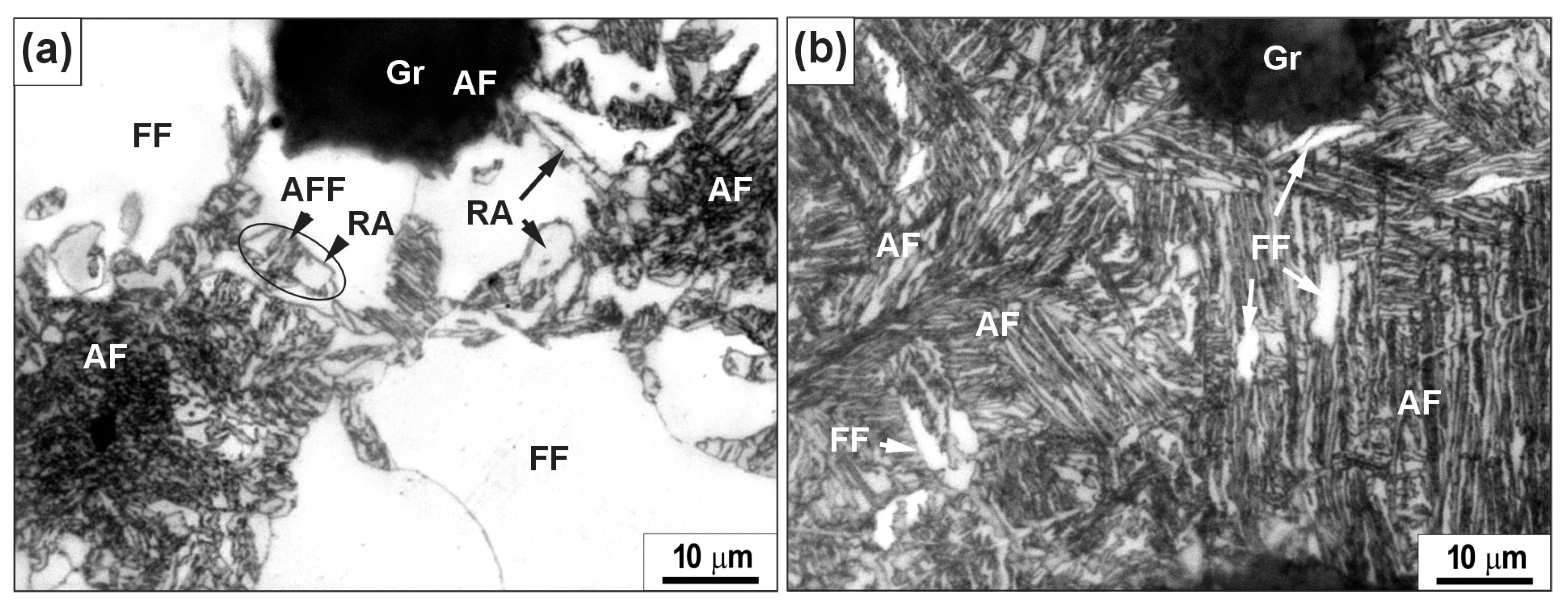
The characteristic microstructures observed in this study are presented in detail in Figure 3, where representative examples corresponding to the austenitization temperatures of 780 and 840 °C are shown. These temperatures were selected as characteristic conditions to clearly illustrate the differences in the resulting microstructural features. Austenitization at 780 °C produces a microstructure with a dominant content of free ferrite (FF) and a lower fraction of ausferrite (AF), as shown in Figure 3a. Further observations indicate that the ausferritic microstructure (AF) consists of ausferritic ferrite (AFF) and retained austenite (RA). Increasing the austenitization temperature to 840 °C leads to the formation of a larger fraction of ausferrite (AF), accompanied by a higher amount of retained austenite (RA), as presented in Figure 3b. In addition, the higher austenitization temperature promotes the development of longer ausferritic ferrite (AFF) plates and a more acicular morphology, whereas at lower temperatures the ausferritic structure appears shorter and wider.
Based on microscopic identification and analysis of the observed phases, a quantitative image analysis of the microstructural constituents presented in Figure 2 was performed. The obtained results, including the volume fractions of the microconstituents in dual-phase ADI after austenitization at 780, 800, 820, and 840 °C, are summarized in Table 1. In addition, Table 1 includes the results of the X-ray diffraction (XRD) analysis used to determine the fraction of retained austenite within the ausferritic structure. The results reveal a clear change in the phase balance with increasing austenitization temperature.
With increasing austenitization temperature, the volume fraction of free ferrite decreases, while the fraction of ausferrite increases. The material austenitized at 780 °C is characterized by a predominantly ferritic matrix (80.4%) with a low ausferrite content (9.0%). At 800 °C, the volume fractions of free ferrite and ausferrite become more balanced (55.0 and 35.7%, respectively). Further increases in austenitization temperature to 820 °C and 840 °C result in a predominantly ausferritic matrix (66.2 and 81.1%) with a significantly reduced free ferrite volume fraction (21.6 and 6.8%). The retained austenite content increases with increasing austenitization temperature. The lowest retained austenite volume fraction is observed for the material austenitized at 780 °C (4.1%), while the highest retained austenite content is obtained for the material austenitized at 840 °C (27.2%). It should be noted that retained austenite is a constituent of ausferrite and is reported in Table 1 as a percentage relative to the total sample volume. As such, it is not included in the phase balance, and therefore the volume fractions of free ferrite, ausferrite, and graphite sum to 100%. The graphite volume fraction remains approximately constant for all investigated materials (9.3 ÷ 12.2%), as expected, since graphite does not undergo phase transformations during heat treatment.
Overall, these results indicate that increasing austenitization temperature leads to a reduction in free ferrite and a concurrent increase in both ausferrite and retained austenite contents in dual-phase ADI.

3.2. Tensile Properties

The tensile properties of the dual-phase ADI materials after austenitization at 780, 800, 820 and 840 °C were determined in dry conditions and in the presence of water. The results for proof strength (Rp0.2), tensile strength (Rm) and elongation (A) are summarized in Table 2, Table 3 and Table 4.
The proof strength values exhibit only minor variations between dry and water testing conditions for all investigated materials. These variations are small, and no statistically significant differences were observed (all p-values > 0.05).
The tensile strength shows limited changes at the lower austenitization temperatures of 780 and 800 °C, whereas a decrease in tensile strength is observed for materials austenitized at 820 and 840 °C. A statistically significant reduction in tensile strength is recorded only for the material austenitized at 840 °C.
The most pronounced changes are observed for elongation. At lower austenitization temperatures (780 and 800 °C), elongation exhibits only moderate variations, while a substantial decrease occurs for materials austenitized at 820 °C and, in particular, at 840 °C. In both cases, the reductions in elongation are statistically significant.

3.3. Fracture Morphology

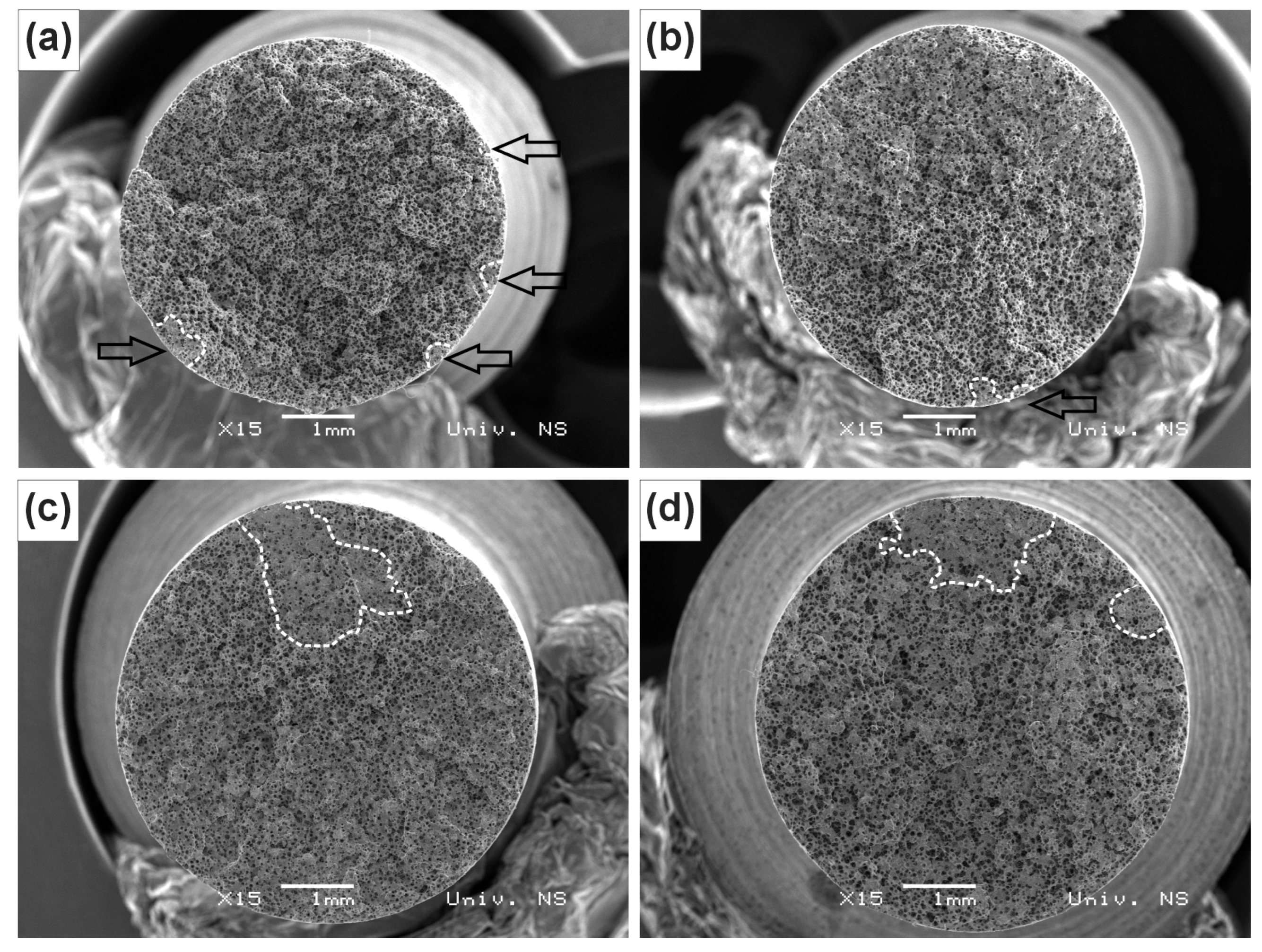
The macro-scale appearance of the fracture surfaces of all dual-phase ADI specimens tested in a water environment is shown in Figure 4. Unlike specimens tested under dry conditions, which exhibit a uniform fracture surface, samples tested in water display heterogeneous fracture surfaces composed of morphologically distinct regions. Specifically, a flat and bright fracture zone is observed near the specimen surface, accompanied by a larger dimpled zone in the remaining cross-section. These flat and bright regions correspond to water-induced embrittlement zones and are indicated in Figure 4 by arrows or enclosed by dashed lines.
In the specimen austenitized at 780 °C (Figure 4a), several small embrittlement zones are present near the specimen surface. The largest zone has a width of approximately 0.8 mm and propagates into the sample to a depth of about 0.45 mm, while the remaining zones are smaller. In the specimen austenitized at 800 °C (Figure 4b), two small embrittlement zones are observed in close proximity, with widths of approximately 0.35 mm and depths of about 0.35 mm and 0.15 mm, respectively. For specimens austenitized at 820 °C and 840 °C (Figure 4c,d), the embrittlement zones are larger and clearly visible to the naked eye. In the case of the specimen austenitized at 820 °C, the embrittlement zone has a width of approximately 0.6 mm and a significant penetration depth of about 2.2 mm. At 840 °C, two embrittlement zones are present: one with a width of approximately 2 mm and a depth of about 1 mm, and a smaller zone measuring approximately 0.7 × 0.7 mm. The remaining fracture surface outside the embrittlement zones appears relatively uniform and homogeneous.
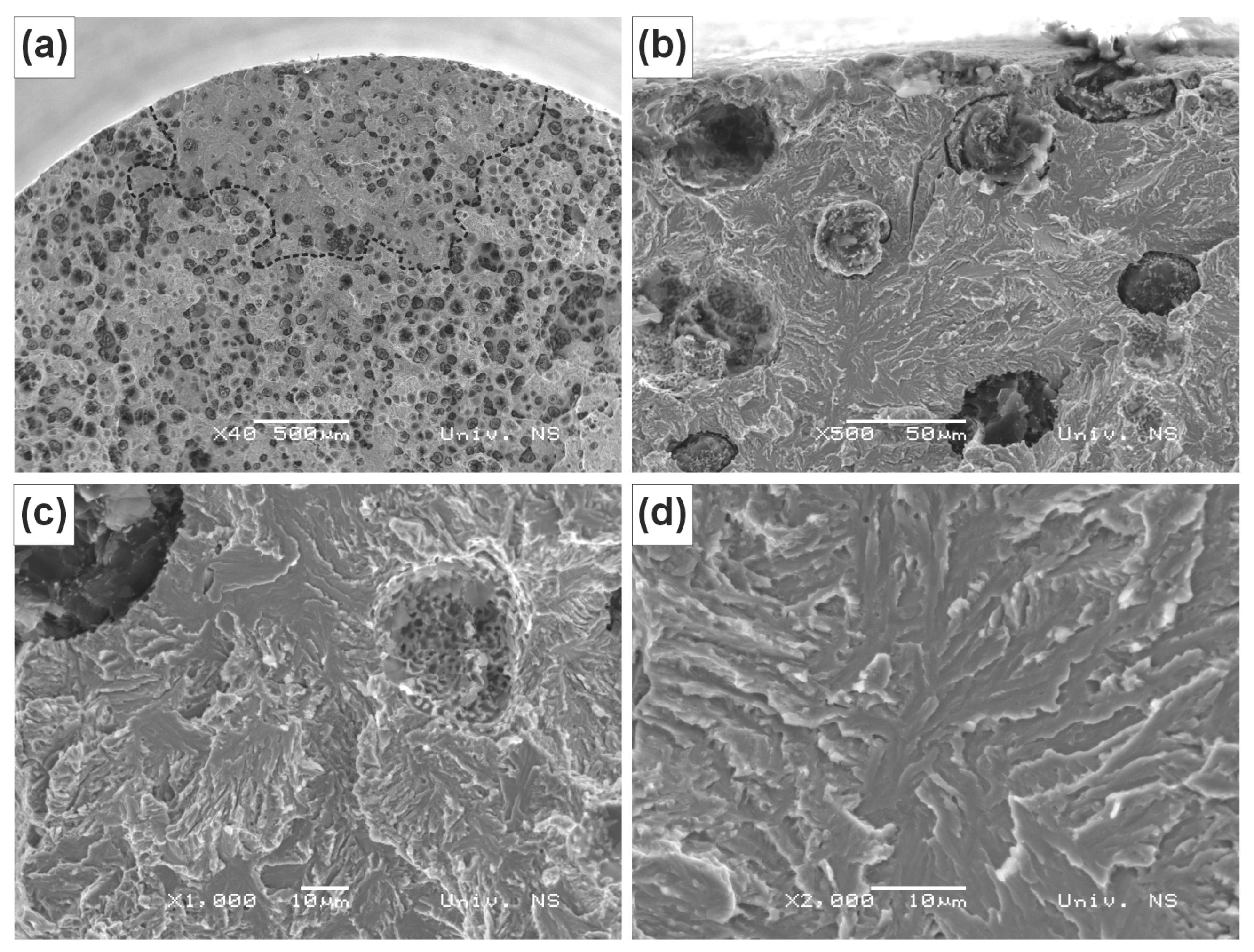
A detailed view of the embrittlement zones for specimens austenitized at 780 °C and 840 °C, selected as characteristic cases, is shown in Figure 5 and Figure 6, respectively.
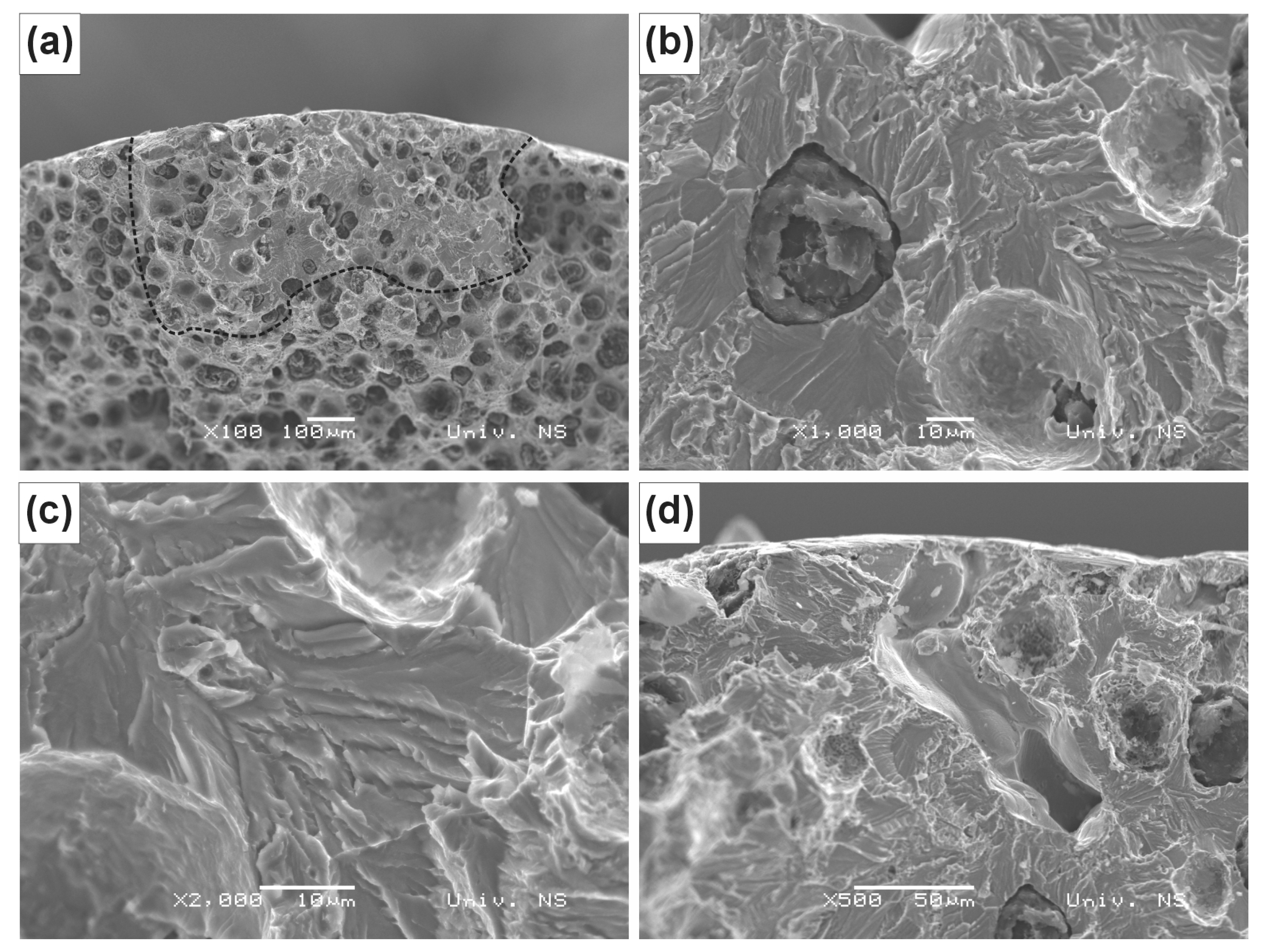
The largest embrittlement zone observed in the DP-780-W specimen (enclosed by a dashed line) has a width of approximately 0.8 mm and a penetration depth of about 0.45 mm (Figure 5a). At higher magnifications (Figure 5b,c), the morphology of the embrittlement zone is characterized by randomly oriented striation lines and flat, smooth regions with weakly pronounced cleavage facets and river-pattern features. The striation lines are relatively short and wide and are arranged in a step-like manner.
Figure 5d shows a pore located within the embrittlement zone. Similar porosity defects were observed in all other investigated samples (DP-800-W, DP-820-W, and DP-840-W). The pore is connected to the specimen surface, which may provide a preferential path for water penetration into the material.
The embrittlement zone of the specimen austenitized at 840 °C is presented in Figure 6. The main embrittlement zone is much larger than that observed for the DP-780-W specimen. It exhibits an irregular shape with a width of approximately 2 mm and a penetration depth of about 1 mm, and is clearly visible to the naked eye (Figure 6a). Morphologically, the embrittlement zone appears relatively uniform and homogeneous (Figure 6b). The fracture surface is characterized by fine serration lines with shorter and wider serrated features (Figure 6c), which become more clearly visible at higher magnifications (Figure 6d).

4. Discussion

4.1. Microstructure of Dual-Phase ADI Materials

Dual-phase ADI materials were produced by austenitization at 780, 800, 820, and 840 °C followed by austempering at 400 °C.
At the lowest austenitization temperature of 780 °C, the microstructure is predominantly ferritic, with free ferrite concentrated around graphite nodules and a low ausferrite volume fraction (~9%). This microstructural state is characteristic of partial austenitization within the intercritical temperature range between Ac1 and Ac3, where the initial ferritic matrix is not fully transformed into austenite, leaving a significant amount of untransformed ferrite [33,34]. The ausferrite formed under these conditions appears as fine, randomly oriented packets located mainly along free ferrite grain boundaries. Such morphology has been attributed to the formation of small prior austenite grains surrounded by a large ferrite fraction, which limits the growth of ausferritic ferrite during subsequent austempering and results in short, randomly oriented ausferritic ferrite plates [33,35].
Increasing the austenitization temperature to 800 °C leads to a marked increase in the ausferrite fraction (~36%). Numerous studies have shown that austenitization temperature strongly affects both the amount and morphology of ausferrite through its influence on the fraction and size of prior austenite grains [33,35]. With increasing austenitization temperature, a larger fraction of austenite is formed, enabling the development of longer ausferritic ferrite plates and a more acicular morphology. Nevertheless, the austempering temperature remains the dominant factor controlling the final ausferritic morphology; at 400 °C, ausferrite typically exhibits a plate-like morphology with wider and shorter plates [36].
Further increases in austenitization temperature to 820 °C and 840 °C result in a predominantly ausferritic microstructure. At 820 °C, the free ferrite fraction decreases to ~22%, while at 840 °C it is reduced to ~7%, approaching near-complete austenitization. The highest ausferrite fraction (~81%) is obtained at 840 °C, where the austenitization temperature approaches the critical temperature for full austenitization, leading to a nearly continuous ausferritic matrix after austempering. Although the measured phase fractions do not vary strictly linearly with austenitization temperature, they follow the expected trend of decreasing free ferrite and increasing ausferrite content. Similar non-linear behavior has been widely reported in the literature, with the most pronounced changes occurring in the 800–820 °C range, corresponding to the mid-region of the intercritical temperature interval for unalloyed ductile iron [37,38].
In addition to free ferrite and ausferrite, graphite remains present in the microstructure. The graphite volume fraction remains approximately constant (~9 ÷ 12%) for all investigated conditions, which is expected since graphite does not undergo phase transformations during heat treatment. However, carbon enrichment of austenite occurs partly from graphite nodules during heat treatment which may lead to a slight decrease in nodule size [39].

4.2. Tensile Properties of Dual-Phase ADI in Dry Conditions

Under dry conditions, the tensile properties of dual-phase ADI vary systematically with austenitization temperature and the associated microstructural changes. Both proof strength and tensile strength increase with increasing austenitization temperature and ausferrite fraction, which is consistent with observations reported by Basso et al. [38]. This behavior is attributed to the progressive replacement of the ferritic matrix by ausferrite, which provides higher strength.
Elongation decreases with increasing austenitization temperature, reflecting the reduction in free ferrite content and the corresponding increase in ausferrite. Higher free ferrite fractions are associated with improved ductility, whereas increased ausferrite content leads to reduced elongation. In addition to phase fraction, ausferrite morphology also influences elongation; a more plate-like morphology obtained at higher austenitization and austempering temperatures promotes higher elongation due to an increased retained austenite fraction [40].

4.3. Effect of Water on Tensile Properties

Proof strength is the least sensitive tensile property to the presence of water. For specimens austempered at 400 °C, no statistically significant effect of water on proof strength is observed. According to the literature, the onset of embrittlement requires a certain level of elastic and plastic deformation to enable hydrogen chemisorption and subsequent crack initiation, which explains the limited sensitivity of proof strength to water exposure [4,22,23].
A significant reduction in tensile strength is observed only for the material austenitized at 840 °C. This material contains the highest ausferrite fraction and the lowest free ferrite fraction, resulting in increased susceptibility to water-induced embrittlement. In this case, the embrittlement zone reaches a critical size that promotes rapid crack propagation, leading to a pronounced decrease in tensile strength compared to dry conditions. For materials austenitized at lower temperatures, the ausferrite fraction is insufficient to produce a similar effect.
The most pronounced effect of water is observed in elongation. A statistically significant decrease in elongation occurs for materials austenitized at 820 and 840 °C, which contain more than 66 and 81% ausferrite, respectively. Their high yield strength is associated with higher stress levels during deformation, which may facilitate hydrogen-assisted processes and crack initiation in aqueous environments, as suggested in previous studies [22,23]. Under these conditions, high stress levels in a water environment promote rapid crack initiation and propagation, while the low free ferrite fraction limits the ability of the microstructure to arrest crack growth within the ausferritic matrix.

4.4. Effect of Water on Fracture Morphology

The fracture morphology of dual-phase ADI specimens tested in dry conditions is uniform and characterized by mixed-mode fracture. The ratio of ductile to brittle fracture depends on phase fraction and morphology, which are controlled by heat-treatment parameters. On the other hand, when tested in water, the fracture surface of dual-phase ADI consists of two distinct regions: an embrittlement zone located near the free surface, and a larger mixed-mode fracture region similar to that observed under dry conditions.
The interpretation of crack propagation behavior is based on the experimentally observed dependence of embrittlement-zone size and morphology on the volume fraction of free ferrite and ausferrite in the investigated materials.
For all specimens, an embrittlement zone forms at the surface and propagates toward the specimen interior, with its size increasing with increasing austenitization temperature, i.e., with increases in ausferrite volume fraction. The irregular morphology of the embrittlement zones in dual-phase ADI, compared to conventional ADI, is attributed to the presence of free ferrite. Ferrite is considered to be relatively insensitive to water-induced embrittlement [6,30,41], and may locally deflect crack propagation, resulting in a serrated and non-uniform embrittlement-zone morphology. This is consistent with the observed morphology of the embrittlement zones and the variations in their size with changing free ferrite fractions. At 780 °C, several small embrittlement zones form along the fracture perimeter, which is associated with the high free ferrite fraction (80.4%). The presence of free ferrite restricts crack propagation, limiting the size of individual embrittlement zones and promoting their fragmentation into multiple smaller regions. The zone consists of short, randomly oriented grooves and smooth flat regions. This kind of morphology observed in the embrittlement zone corresponds to the characteristic fracture appearance reported for plate-like ausferrite structure [4,23,24,25,26], indicating that crack propagation occurs predominantly through the ausferritic regions. With increasing austenitization temperature (800–840 °C), the embrittlement zones become larger and propagate in multiple directions due to the progressive reduction in free ferrite content and the increase in ausferrite fraction. However, even a small free ferrite fraction, as observed at 840 °C (6.8%), remains sufficient to locally deflect crack propagation and influence the embrittlement-zone morphology.
Pores located on the free surface and surface-exposed graphite nodules facilitate fluid penetration and act as preferred crack initiation sites by allowing fluid penetration along the pore–matrix or nodule–matrix interfaces. In contrast, subsurface pores not connected to the free surface are surrounded by mixed-mode fractures, indicating a limited contribution to embrittlement-driven crack initiation.

4.5. Mechanism of Water-Induced Embrittlement of Dual-Phase ADI

Based on the experimental results obtained in this study—specifically microstructural features, tensile behavior, and fracture morphology—together with the previously reported literature data [3,4], the following mechanism and conditions governing the development of embrittlement in dual-phase ADI materials in contact with water can be summarized.
Previous studies have clearly identified water as the primary agent responsible for embrittlement during mechanical testing of ADI materials [24,41,42]. It has been established that even the lowest water concentration (0.2 vol.%) leads to the formation of an embrittlement zone and provides the initial conditions necessary for crack initiation and propagation [3]. However, due to the inherent characteristics of ADI materials, whose microstructure contains graphite nodules that inherently act as stress concentrators or crack-like defects, a small embrittlement zone does not critically affect the overall mechanical properties, such as proof strength, tensile strength, and elongation.
Tensile testing of dual-phase ADI materials in water confirmed the earlier literature findings [6,10,31], demonstrating that sensitivity to embrittlement strongly depends on the relative fractions of free ferrite and ausferrite. In particular, ferrite has been shown to be insensitive to water-induced embrittlement. Among the tensile properties, elongation is most strongly affected by the presence of water. Specimens containing less than approximately 20% free ferrite, corresponding to about 70% ausferrite (with approximately 10% graphite), exhibit pronounced sensitivity to water, whereas specimens with free ferrite fractions exceeding 50% show no significant degradation. These observations suggest that crack initiation and propagation do not occur through the ferritic phase, but rather along interphase boundaries, specifically at interfaces between ausferritic ferrite and retained austenite within the ausferritic microstructure. This interpretation is supported by the fracture morphology of the embrittlement zone, which is characterized by striation-like features whose density and dimensions correlate with the fineness (fine or coarse) of the ausferritic microstructure.
The formation and growth of the embrittlement zone proceed in a cyclic manner, as evidenced by the characteristic morphology of the fracture surface within this zone. When water is in contact with the free metal surface, the conditions are created for the release of hydrogen atoms, a process facilitated by an increased effective contact area. Consequently, embrittlement zones preferentially initiate at locations that enable water penetration beneath the surface, such as graphite nodule–matrix interfaces and surface-connected porosity.
In dual-phase ADI, the presence and spatial distribution of free ferrite further influence the shape and extent of the embrittlement zone by locally deflecting crack propagation.
In the presence of water, hydrogen generated at the metal surface undergoes local chemisorption at interphase boundaries between retained austenite and ausferritic ferrite, promoting crack initiation and cyclic crack propagation. This cyclic process produces fatigue-like striation lines within the embrittlement zone and continues until a critical zone size is reached, leading to final fracture [3,4].

5. Conclusions

The results obtained in this study provide a clearer understanding of the role of phase distribution in controlling water-induced embrittlement in dual-phase ADI. By systematically varying the volume fractions of free ferrite and ausferrite through different austenitization temperatures, a clear correlation between microstructure, tensile behavior, and the development of the embrittlement zone was established.
Thus, based on the experimental results and discussion presented in this study, the following conclusions can be drawn:
  • Dual-phase ADI is successfully produced by intercritical austenitization at 780–840 °C and austempering at 400 °C/1 h, yielding matrices ranging from ferrite-rich to ausferrite-rich. The free ferrite decreases (80.4% → 6.8%), while ausferrite increases (9.0% → 81.1%), accompanied by an increase in overall retained austenite (4.1% → 27.2%).
  • Tensile testing in pure water results in a surface-initiated embrittlement zone in all testing cases, and the zone size increases with increasing ausferrite volume fraction (i.e., decreasing free ferrite).
  • Elongation is the most sensitive to the presence of water, followed by tensile strength, whereas proof strength is affected to the least extent. Proof strength shows no statistically significant change between dry and water conditions for any microstructure (p > 0.05), while a statistically significant decrease in tensile strength occurs only for DP-840 (p = 0.03).
  • A clear microstructure threshold is identified: when ausferrite volume fraction exceeds ~65% (corresponding to free ferrite fraction below ~25%), it results in significant elongation decreases in water (−41.6% for DP-820; −81.3% for DP-840). In contrast, ferrite-rich microstructures containing more than ~50% free ferrite (less than ~35% ausferrite, DP-780 and DP-800) exhibit stable crack propagation, and water-induced embrittlement does not result in a statistically significant degradation of tensile properties.
  • The embrittlement zone is characterized by fatigue-like striation features, indicating cyclic crack initiation and propagation in the presence of water, where free ferrite acts as the relatively less susceptible phase, while ausferrite promotes embrittlement-zone growth. Thus, the embrittlement mechanism is governed by surface-initiated processes involving local chemisorption of hydrogen at interphase boundaries between retained austenite and ausferritic ferrite, followed by cyclic crack growth until a critical embrittlement zone size is reached.
  • The results demonstrate that controlling the volume fraction and spatial distribution of free ferrite and ausferrite is essential for improving the resistance of dual-phase ADI components operating in aqueous environments: higher free-ferrite fractions reduce embrittlement-zone severity and preserve ductility.

Author Contributions

Conceptualization, D.R. and O.E.C.; methodology, P.J. and D.R.; validation, P.J., O.E.C., S.B. and D.R.; formal analysis, P.J.; investigation, P.J., M.K., M.D. and J.G.N.; resources, S.B., M.K., M.D., J.G.N. and D.R.; data curation, P.J., M.K., M.D. and J.G.N.; writing—original draft preparation, P.J. and D.R.; writing—review and editing, P.J. and D.R.; visualization, P.J.; supervision, D.R.; project administration, P.J. and D.R.; funding acquisition, O.E.C., S.B. and D.R. All authors have read and agreed to the published version of the manuscript.

Funding

This work was supported by the Ministry of Science, Technological Development, and Innovation of the Republic of Serbia, Contract No. 451-03-34/2026-03/200156, 451-03-34/2026-03/200108, 451-03-33/2026-03/200213; and by the Faculty of Technical Sciences, University of Novi Sad, through project “Scientific and Artistic Research Work of Researchers in Teaching and Associate Positions at the Faculty of Technical Sciences, University of Novi Sad 2026”, Contract No. 01-3609/1.

Data Availability Statement

The original contributions presented in the study are included in the article. Further inquiries can be directed to the first author (P.J.) and corresponding author (D.R.).

Acknowledgments

The authors gratefully acknowledge the research support by the project entitled “Advanced Materials, Joining and Allied Technologies in Production Engineering” from the Department of Production Engineering, Faculty of Technical Sciences, University of Novi Sad, Serbia.

Conflicts of Interest

The authors declare no conflicts of interest. The funders had no role in the design of the study; in the collection, analyses, or interpretation of data; in the writing of the manuscript; or in the decision to publish the results.

References

  1. Erić, O.; Jovanović, M.; Sidjanin, L.; Rajnović, D. Microstructure and mechanical properties of CuNiMo austempered ductile iron. J. Min. Metall. B 2004, 40, 11–19. [Google Scholar] [CrossRef]
  2. Baloš, S.; Rajnović, D.; Dramićanin, M.; Labus, D.; Erić Cekić, O.; Grbović Novaković, J.; Sidjanin, L. Abrasive wear behaviour of ADI material with various retained austenite content. Int. J. Cast Met. Res. 2016, 29, 187–193. [Google Scholar] [CrossRef]
  3. Janjatović, P.; Erić Cekić, O.; Sidjanin, L.; Baloš, S.; Dramićanin, M.; Grbović Novaković, J.; Rajnović, D. The effect of water concentration in ethyl alcohol on the environmentally assisted embrittlement of austempered ductile irons. Metals 2021, 11, 94. [Google Scholar] [CrossRef]
  4. Rajnović, D.; Baloš, S.; Sidjanin, L.; Erić Cekić, O.; Grbović Novaković, J. Tensile properties of austempered ductile iron in water and gaseous environments. Mater. Charact. 2015, 101, 26–33. [Google Scholar] [CrossRef]
  5. Ratto, P.J.J.; Ansaldi, A.F.; Fierro, V.E.; Agüera, F.R.; Villar, H.N.A.; Sikora, J.A. Low-temperature impact tests in austempered ductile iron. ISIJ Int. 2001, 41, 372–380. [Google Scholar] [CrossRef]
  6. Caldera, M.; Martínez, R.A.; Boeri, R.E.; Sikora, J.A. Evaluation of water embrittlement on ‘dual phase’ austempered ductile iron. Fatigue Fract. Eng. Mater. Struct. 2011, 34, 774–781. [Google Scholar] [CrossRef]
  7. Zhang, X.; Qu, Y.; Li, R. Fracture mechanism of ferritic ductile iron under instrumented impact load. ISIJ Int. 2014, 54, 2309–2313. [Google Scholar] [CrossRef]
  8. Fu, L.; Schiralli, M.; Vedani, M.; Olofsson, J.; Górny, M.; Govahi, P.; Donnini, R.; Losurdo, M.; Angella, G. Effects of Tensile Specimen Geometry and Gripping System on the Mechanical Stability of Ausferrite in Austempered Ductile Irons. Materials 2025, 18, 4359. [Google Scholar] [CrossRef]
  9. Song, Y.H.; Lui, T.S.; Chen, L.H. Effect of silicon content on fracture resistance of ferritic cast iron in aqueous environment. Mater. Trans. 2004, 45, 1461–1468. [Google Scholar] [CrossRef]
  10. Gagne, M.; Hayrynen, K. Environmental embrittlement of ductile irons—A review of available data. Ductile Iron News 2005, 2, 1–6. [Google Scholar]
  11. EN 1564:2011; Founding—Ausferritic Spheroidal Graphite Cast Irons. European Committee for Standardization: Brussels, Belgium, 2011.
  12. ASTM A897/A897M-16; Standard Specification for Austempered Ductile Iron Castings. ASTM International: West Conshohocken, PA, USA, 2016.
  13. Skołek, E.; Skoczylas, P.; Wasiluk, K.; Świątnicki, W.A.; Wieczorek, A.N.; Myszka, D. The Influence of Initial Microstructure on the Microstructure and Mechanical Properties of Ductile Iron After Nanostructurisation Heat Treatment. Nanomaterials 2025, 15, 1710. [Google Scholar] [CrossRef] [PubMed]
  14. Wiktor, T.; Burbelko, A.; Zaczyński, A. Application of the Avrami Equation to the Dilatometric Analysis of ADI Austempering Kinetics. Materials 2025, 18, 5039. [Google Scholar] [CrossRef]
  15. Becerra Mayorga, C.Y.; Vargas Ramírez, M.; Cardoso Legorreta, E.; García Serrano, J.; Martínez Vázquez, J.M.; Morales Cruz, E.U.; Aristeo Domínguez, C. Effect of Austempering Time and Temperature on the Mechanical and Microstructural Properties of a Niobium-Alloyed Austempered Ductile Iron. Metals 2025, 15, 1168. [Google Scholar] [CrossRef]
  16. Krawiec, H.; Lelito, J.; Mróz, M.; Radoń, M. Influence of Heat Treatment Parameters of Austempered Ductile Iron on the Microstructure, Corrosion and Tribological Properties. Materials 2023, 16, 4107. [Google Scholar] [CrossRef]
  17. Poojary, U.R.; Hegde, A.; Hegde, S. Damping Performance of Manganese Alloyed Austempered Ductile Iron. Appl. Sci. 2026, 16, 420. [Google Scholar] [CrossRef]
  18. Wang, L.; Wei, H.; Ho, H.; Hu, B.; Li, Y.; Wang, D. Experimental Study on Bending Fatigue Performance of ADI Gears Under Different Applied Load Levels. Materials 2025, 18, 3922. [Google Scholar] [CrossRef]
  19. Záhon, L.; Kuchař, J.; Horník, J.; Krčil, J.; Kudláček, J. Laser Surface Hardening of Austempered Ductile Iron (ADI). Coatings 2024, 14, 958. [Google Scholar] [CrossRef]
  20. Klimek, L.; Gumienny, G.; Januszewicz, B.; Atraszkiewicz, R.; Buczkowska, K. Structural and Phase Analysis of the Ausferritic Ductile Cast Iron Matrix Obtained by Heat Treatment and in the Raw State. C 2024, 10, 45. [Google Scholar] [CrossRef]
  21. Stawarz, M.; Lenert, M.; Piasecki, K. Difficulties in the Production of Ausferritic Nodular Cast Iron without Heat Treatment. Arch. Foundry Eng. 2023, 23, 5–11. [Google Scholar] [CrossRef]
  22. Komatsu, S.; Osafune, Y.; Tanaka, Y.; Tanigawa, K.; Shibutani, S.; Kyogoku, H. Influence of water embrittlement effect on mechanical properties of austempered ductile iron. Int. J. Cast Met. Res. 2003, 16, 209–214. [Google Scholar] [CrossRef]
  23. Martínez, R.A.; Boeri, R.E.; Sikora, J.A. Embrittlement of austempered ductile iron caused by contact with water and other liquids. Int. J. Cast Met. Res. 2000, 13, 9–15. [Google Scholar] [CrossRef]
  24. Masud, L.; Martínez, R.; Simison, S.; Boeri, R. Embrittlement of austempered ductile iron on contact with water—Testing under applied potential. J. Mater. Sci. 2003, 38, 2971–2977. [Google Scholar] [CrossRef]
  25. Caballero, L.; Elices, M.; Parkins, R.N. Environment-sensitive fracture of austempered ductile iron. Corrosion 2005, 61, 51–57. [Google Scholar] [CrossRef]
  26. Boeri, R.E.; Martínez, R.A. Embrittlement of austempered ductile iron by contact with liquids: Influence of alloy content and preventive methods. Mater. Sci. Technol. 2013, 29, 665–671. [Google Scholar] [CrossRef]
  27. Fernández Scudeller, F.; Martínez, R.A. Evaluation of environmentally assisted fracture of austempered ductile iron under cyclic loading. Fatigue Fract. Eng. Mater. Struct. 2016, 39, 346–356. [Google Scholar] [CrossRef]
  28. Lynch, S.P. Environmentally assisted cracking: Overview of evidence for an adsorption-induced localised-slip process. Acta Metall. 1988, 36, 2639–2661. [Google Scholar] [CrossRef]
  29. Wang, M.; Akiyama, E.; Tsuzaki, K. Effect of hydrogen on the fracture behavior of high-strength steel during slow strain rate testing. Corros. Sci. 2007, 49, 4081–4097. [Google Scholar] [CrossRef]
  30. Druschitz, A.P.; Tenpas, D.J. Effect of Liquid Environments on the Tensile Properties of Ductile Iron; SAE Technical Paper 2004-01-0793; SAE International: Warrendale PA, USA, 2004. [Google Scholar] [CrossRef]
  31. Martínez, R.A.; Simison, S.N.; Boeri, R.E. Environmentally assisted embrittlement of ADI—Current understanding. In Proceedings of the 2002 World Conference on ADI, Louisville, KY, USA, 26–27 September 2002; pp. 1–9. [Google Scholar]
  32. ISO 6892-1:2019; Metallic Materials—Tensile Testing—Part 1: Method of Test at Room Temperature. International Organization for Standardization: Geneva, Switzerland, 2019.
  33. Basso, A.; Martínez, R.; Sikora, J. Influence of chemical composition and holding time on austenite (γ) → ferrite (α) transformation in ductile iron occurring within the intercritical interval. J. Alloys Compd. 2011, 509, 9884–9889. [Google Scholar] [CrossRef]
  34. Fernandino, D.O.; Massone, J.M.; Boeri, R.E. Characterization of the austemperability of partially austenitized ductile iron. J. Mater. Process. Technol. 2013, 213, 1801–1809. [Google Scholar] [CrossRef]
  35. Kilicli, V.; Erdogan, M. Tensile properties of partially austenitised and austempered ductile irons with dual matrix structures. Mater. Sci. Technol. 2006, 22, 919–928. [Google Scholar] [CrossRef]
  36. Ovalia, I.; Mavib, A. Investigating the machinability of austempered ductile irons with dual matrix structures. Int. J. Mater. Res. 2013, 104, 192–198. [Google Scholar] [CrossRef]
  37. Aristizabal, R.; Foley, R.; Druschitz, A. Intercritically austenitized quenched and tempered ductile iron. Int. J. Met. 2012, 6, 7–14. [Google Scholar] [CrossRef]
  38. Basso, A.; Caldera, M.; Chapetti, M.; Sikora, J. Mechanical characterization of dual phase austempered ductile iron. ISIJ Int. 2010, 50, 302–306. [Google Scholar] [CrossRef]
  39. Harding, R.A. The production, properties and automotive applications of austempered ductile iron. Kov. Mater. 2007, 45, 1–16. [Google Scholar]
  40. Aranzabal, J.; Gutierrez, I.; Rodriguez-Ibabe, J.M.; Urcola, J.J. Influence of the amount and morphology of retained austenite on the mechanical properties of an austempered ductile iron. Metall. Mater. Trans. A 1997, 28, 1143–1156. [Google Scholar] [CrossRef]
  41. Cai, Q.Z.; Wei, B.K.; Tanaka, Y. Fatigue properties of austempered ductile iron (ADI) in water environment. Acta Metall. Sin. 2004, 17, 122–130. [Google Scholar]
  42. Komatsu, S.; Zhou, C.Q.; Shibutani, S.; Tanaka, Y. Embrittlement Characteristics of Fracture Toughness in Ductile Iron by Contact with Water. Int. J. Cast Met. Res. 1999, 11, 539–544. [Google Scholar] [CrossRef]
Figure 1. Tensile testing setup for specimens tested in water using a fluid-filled PET tube.
Metals 16 00364 g001
Figure 2. Microstructures of dual-phase ADI samples austempered at 400 °C after austenitization at: (a,b) 780 °C; (c,d) 800 °C; (e,f) 820 °C; (g,h) 840 °C.
Metals 16 00364 g002
Figure 3. Microconstituents of dual-phase ADI samples austempered at 400 °C after austenitization at: (a) 780 °C; (b) 840 °C. FF—free ferrite, AF—ausferrite, AFF—ausferritic ferrite, RA—retained austenite, and Gr—graphite.
Metals 16 00364 g003
Figure 4. Macro appearance of the fracture surfaces of dual-phase ADI specimens tested in water, austenitized at (a) 780 °C, (b) 800 °C, (c) 820 °C and (d) 840 °C (the embrittlement zone is enclosed by a dashed line and indicated by an arrow).
Metals 16 00364 g004
Figure 5. Fracture appearance of the embrittlement zone of the DP-780-W specimen tested in water: (a) embrittlement zone enclosed by a dashed line; (b,c) morphology of the embrittlement zone at different magnifications; (d) pore in contact with the free surface.
Metals 16 00364 g005
Figure 6. Fracture appearance of the embrittlement zone of the DP-840-W specimen tested in water: (a) embrittlement zone enclosed by a dashed line; (b) morphology of the embrittlement zone; (c,d) fine serration lines in the embrittlement zone at different magnifications.
Metals 16 00364 g006
Table 1. Volume fractions of free ferrite, ausferrite, graphite, and retained austenite in dual-phase ADI materials.
Austenitization Temperature [°C]Free Ferrite
[%]
Ausferrite [%]Graphite
[%]
Retained
Austenite * [%]
78080.4 ± 1.839.0 ± 2.7010.6 ± 2.274.1 ± 0.23
80055.0 ± 4.0035.7 ± 4.499.3 ± 1.3610.9 ± 0.81
82021.6 ± 1.3266.2 ± 2.6912.2 ± 1.5021.5 ± 1.14
8406.8 ± 1.9681.1 ± 2.6212.1 ± 1.1127.2 ± 1.42
* Retained austenite is reported as a percentage relative to the total sample volume. As such, it is not included in the phase balance, and therefore the volume fractions of free ferrite, ausferrite, and graphite sum to 100%.
Table 2. Proof strength with standard deviation, value difference between dry and water conditions, and p-values for different dual-phase ADI materials.
Austenitization Temperature [°C]Proof Strength, Rp0.2 [MPa]Difference
[%]
p-Value *
DryWater
780344 ± 7.8343 ± 2.9−0.40.829033
800361 ± 5.6390 ± 30.67.80.266221
820593 ± 23.9566 ± 25−4.50.332876
840726 ± 37.2734 ± 16.710.819028
* p < 0.05 denotes a statistically significant difference in relation to dry environment.
Table 3. Tensile strength with standard deviation, value difference between dry and water conditions, and p-values for different dual-phase ADI materials.
Austenitization Temperature [°C]Tensile Strength, Rm [MPa] Difference
[%]
p-Value
DryWater
780478 ± 8.2486 ± 6.31.70.339307
800515 ± 4.4553 ± 35.77.20.217710
820791 ± 22.6739 ± 26.6−6.60.102155
840953 ± 25859 ± 32.5−9.90.031214 *
* p < 0.05 denotes a statistically significant difference in relation to dry environment.
Table 4. Percentage elongation after fracture with standard deviation, value difference between dry and water conditions, and p-values for different dual-phase ADI materials.
Austenitization Temperature [°C]Elongation, A [%]Difference
[%]
p-Value
DryWater
78016.25 ± 0.418.5 ± 2.013.90.193627
80015.4 ± 0.712.3 ± 2.9–19.90.224471
82013 ± 1.17.6 ± 2.2–41.60.036245 *
84012.7 ± 0.72.4 ± 0.4–81.30.000049 *
* p < 0.05 denotes a statistically significant difference in relation to dry environment.
Disclaimer/Publisher’s Note: The statements, opinions and data contained in all publications are solely those of the individual author(s) and contributor(s) and not of MDPI and/or the editor(s). MDPI and/or the editor(s) disclaim responsibility for any injury to people or property resulting from any ideas, methods, instructions or products referred to in the content.