Article

Unveiling Precipitation Behavior and Strengthening Mechanisms in Ti-Nb-Mo Steels

1
School of Materials Science and Engineering, Northeastern University, Shenyang 110819, China
2
Analytical and Testing Center, Northeastern University, Shenyang 110819, China
3
State Key Lab of Digital Steel, Northeastern University, Shenyang 110819, China
*
Authors to whom correspondence should be addressed.
These authors contributed equally to this work.
Metals 2026, 16(3), 305; https://doi.org/10.3390/met16030305
Submission received: 1 February 2026 / Revised: 26 February 2026 / Accepted: 6 March 2026 / Published: 9 March 2026
(This article belongs to the Special Issue Solidification and Microstructure of Metallic Alloys)

Abstract

In this work, the effects of Nb and Mo additions on the precipitation behavior and strengthening mechanisms of three ultra-low carbon Ti-Mo-Nb steels with a predominantly ferritic microstructure were investigated under two different thermo-mechanical processing (TMP) routes. A water-quenching step after hot rolling followed by furnace cooling was found to refine the average precipitate size and increase their volume fraction, leading to a significant strength improvement. Specifically, this process increased the yield strength by approximately 110~180 MPa, reaching levels above 750 MPa, with the 22Mo-Nb steel achieving a peak ultimate tensile strength of ~790 MPa. The precipitates exhibited dispersed, interphase, and grain boundary morphologies, none of which correlated directly with the TMP route or steel composition. While variations in Mo content showed little influence on precipitate characteristics, the addition of Nb markedly promoted precipitation. The strength of these Ti-Mo-Nb ferritic steels is primarily determined by precipitation strengthening. Through optimized TMP parameters and microalloying additions, the overall precipitation strengthening contribution was elevated to the 300~400 MPa range.

1. Introduction

Automotive lightweighting demands steels that combine superior mechanical properties with enhanced formability. Unlike conventional dual- or multi-phase (DP/MP) steels, single-phase ferritic steels offer improved formability as they prevent strain concentration at the interfaces between soft phases (e.g., ferrite) and hard phases (e.g., bainite or martensite) [1,2,3,4,5,6]. However, the intrinsically low strength of ferrite restricts their use in high-strength structural applications.
A key mechanism, known as interphase precipitation, emerged in 1968 when periodic rows of carbonitrides were discovered forming at the interfaces between austenite (γ) and ferrite (α) during the γα phase transformation [7]. In 2004, a notable advancement was made by Funakawa et al. [8], who developed a 780 MPa Nano-Hiten steel with three μm-sized (Ti, Mo)C precipitates distributed on the ferrite matrix [9]. These precipitates can provide a remarkable yield strength increment of up to ~300 MPa, and this Ti-Mo steel has been widely used for automotive suspension parts and wheels. Recent research has extensively investigated various types of interphase precipitation, including NbC, V (C, N), (V, Cr)C, (V, Nb)C and (Ti, Mo)C, etc. [10,11,12,13,14,15,16,17,18,19,20,21,22,23,24]. For example, while Ti, V and Nb additions are known to accelerate the transformation kinetics, Cr and Mo generally exert the opposite effect. Specifically, Mo has been reported to delay interphase precipitation of (M, Mo)C during the isothermal process [25]. However, studies by Gong et al. and Dong et al. [15,16] on (Ti, Mo) C revealed that Mo significantly increases the number density of interphase precipitates without substantially changing its size [26]. From a processing standpoint, the formation of interphase precipitation after short holding times is highly relevant for industrial steel production. However, most laboratory studies have examined interphase precipitation behavior under prolonged isothermal conditions, in most cases from half an hour to several hours [8,12,13,14,15,16]. Notably, Okamoto et al. demonstrated that Nb microalloying in Ti-Mo-xNb systems can reduce the precipitation time to approximately 10 s [10]. Following this, Yang et al. [23,24] investigated the hot deformation and interphase precipitation behaviors of Ti-Mo-xNb steels and parameters [23]. These findings collectively highlight the critical role of microalloying elements and the inherent complexity of multi-element precipitation in low-alloy steels [12].
In addition to the type and content of microalloying elements, interphase precipitation is strongly controlled by thermo-mechanical processing (TMP) parameters such as finish rolling temperature, coiling temperature and coiling pattern. [19,21]. However, little research has focused on the effect of Mo and Nb on the final microstructure in terms of ferrite grain size, precipitate size, and volume fraction, thereby the final mechanical properties during TMP. In this work, three Ti-Mo-Nb steels are designed and processed under two different TMP conditions. This work systematically investigates their microstructural evolution and mechanical properties through detailed microstructural characterization and tensile testing [27] to elucidate the individual or combined effects of Nb, Mo and cooling pattern.

2. Experimental Procedures

2.1. Materials and Preparation

Three ingots were melted in an induction melting furnace KSL-1100X (Hefei Kejing Material Technology Co. Ltd., Hefei, China) and subsequently forged into slabs with a cross-section of 120 mm × 20 mm. The chemical compositions of the experimental steel are given in Table 1.
Carbon (C) plays roles of both solid solution strengthening and precipitation strengthening in steel. Excessive carbon content raises the precipitation temperature of nanoparticles, coarsening the precipitates and thereby weakening the precipitation strengthening effect [28]. Therefore, the carbon content of the experimental steel used in this study is approximately 0.04%. This not only improves the formability and weldability of the steel but is also conducive to obtaining a single ferritic microstructure.
Silicon (Si) and manganese (Mn) in steel not only contribute to solid solution strengthening but also help control the precipitation timing of carbides, promoting their precipitation during post-rolling holding processes. However, excessively high Si content not only reduces steel toughness [29], but also hinders the formation of nano-scale precipitates. After comprehensive consideration, the Si and Mn contents in the experimental steel are set at 0.2% and 1.5%, respectively.
Titanium (Ti) is a precipitation strengthening element, primarily precipitating as TiC, TiN, and Ti4S2C2. Among these, TiC precipitates are the finest, typically less than 10 nm. Studies [30,31] have shown that for Ti-Mo complex microalloyed steels, a Ti content around 0.1% facilitates obtaining a high volume fraction of fine interphase precipitates, leading to good overall performance.
Niobium (Nb) serves both as a precipitation strengthening element and as a grain refiner. When the Nb content is low (≤0.03%), the yield strength of the steel increases rapidly with increasing Nb content. When the Nb content reaches 0.03%, further increases in Nb content result in a diminished strengthening effect. When the Nb content is ≥0.06%, excess Nb does not contribute to strengthening [32]. In this study, Nb is added to the 22Mo-Nb steel at a content of 0.02%.
Molybdenum (Mo) effectively controls the precipitation behavior in the experimental steel [24,33,34,35,36,37,38]. To investigate the mechanism of Mo, the Mo contents in the 22Mo steel and 50Mo steel in this study are set at 0.22% and 0.5%, respectively.
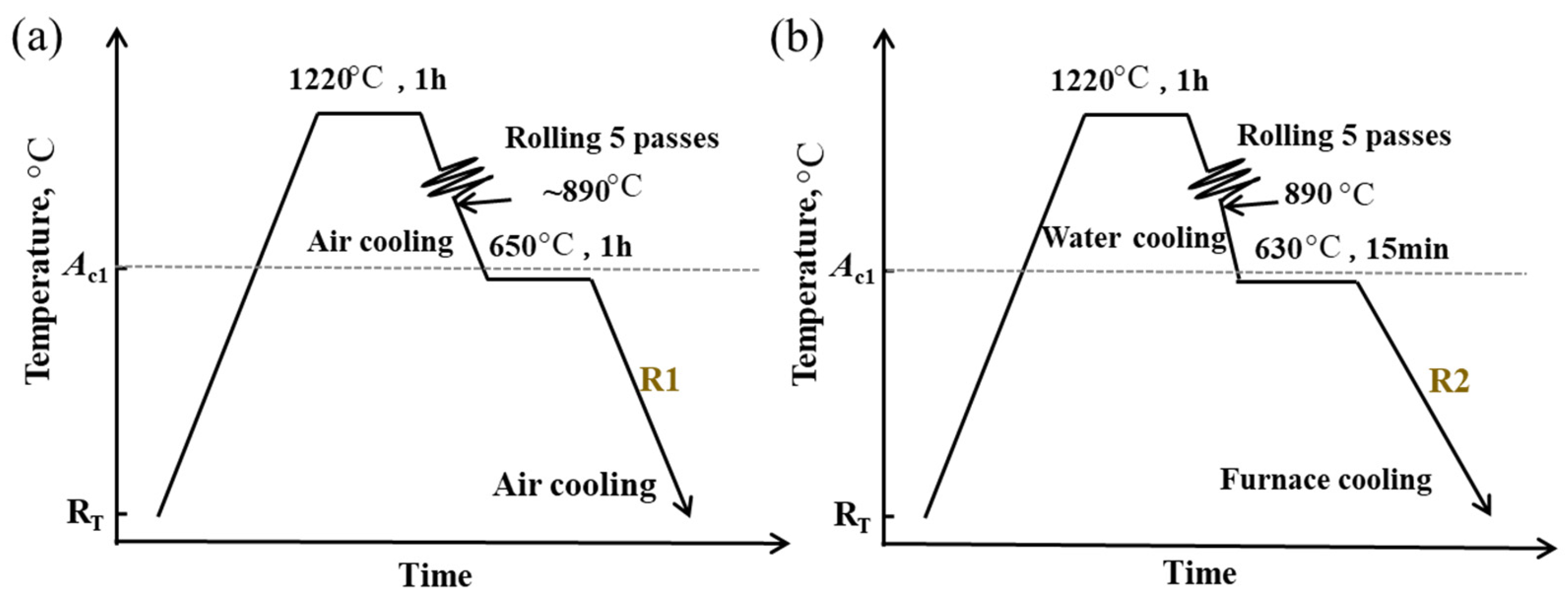
All slabs were homogenized at 1220 °C for 1 h, then hot rolled to the sheets of ~2.5 mm in five passes to gradually achieve a total reduction of 87.5%, preventing excessive deformation in any single pass and ensuring a uniform microstructure throughout the sheet at the finish rolling temperature of 890 °C. In order to compare the precipitation behavior and its influence on the final microstructure and mechanical properties, two different TMP routes were designed, shown schematically in Figure 1. Route R1 involved air cooling the rolled plates to 650 °C, holding for 1 h, and then air cooling them to room temperature. Route R2 involved water cooling the rolled plates to 630 °C, holding for 15 min, and then furnace cooling to room temperature. It is noted that the two TMP routes (R1 and R2) differ simultaneously in cooling rate, holding time, and cooling mode based on the following two important aspects: (1) The faster initial cooling (water quenching in R2) after finish rolling at 890 °C suppresses precipitation at higher temperatures. This process retains more microalloying elements in solution, enabling finer precipitation in subsequent stages. (2) The lower isothermal temperature (630 °C in R2) then provides a stronger driving force for the formation of a high density of fine MC-type precipitates.

2.2. Tensile Testing

Tensile specimens with a gauge section of 25 mm × 6 mm were machined from the rolled sheets in accordance with the ASTM E8/E8M standard [39]. Tensile tests were performed on a SANSCMT-5000 machine (MTS, Shenzhen, China) at an initial strain rate of 5 × 10⁻³ s−1. Triplicate tests were performed for each condition, and the mean values of the tensile properties were employed for comparison.

2.3. Microstructure Characterization

Microstructural analysis was performed utilizing both optical microscopy (OM, OLYMPUS DSX500, Olympus Corporation, Tokyo, Japan) and high-resolution transmission electron microscopy (HR-TEM, JEOL-2010, JEOL Ltd., Beijing, China, operating at an accelerating voltage of 200 kV). For metallographic examination via optical microscopy (OM), the specimens were subjected to mechanical polishing followed by chemical etching using an ethanol-based solution containing 4 vol% nitric acid. Transmission electron microscopy (TEM) specimens were fabricated through mechanical grinding to a thickness of 50–60 μm, followed by twin-jet electropolishing using a Struers Tenupol-5 device (Struers ApS, Ballerup, Denmark). Electropolishing was conducted in a solution consisting of 95 vol.% acetic acid and 5 vol.% perchloric acid, under a voltage of 45 V and at a temperature of approximately 16 °C. The size and volume fraction of nano-precipitates were quantified based on multiple TEM micrographs using the Nano-measurer 1.2.5 software, as detailed in our preliminary work [24].
The dislocation density was determined by high-resolution X-ray diffraction (HR-XRD) using a Rigaku D/Max2250/PC diffractometer (Rigaku Inc., Tokyo, Japan) with Cu-Kα radiation (λ = 1.5405 Å). Measurements were conducted over a 2θ range from 40° to 100° with a step size of 0.02°. The dislocation density was subsequently calculated employing the modified Williamson–Hall (MWH) method [25,40]:
K = 0.9 d + 1 2 π M 2 b 2 · ρ · K 2 C ¯ ,
where Δ K is the full width at half maximum (FWHM) measured at the Bragg angle. K = 2 sin θ / λ is the magnitude of the diffraction vector, where θ denotes the diffraction angle and λ represents the wavelength. b is Burgers vector (~0.248 nm) and d is the average grain size. M is a constant related to the effective outer cut-off radius of dislocations, and C - is an average dislocation contrast accounting for strain anisotropy [41]. The uncertainty in dislocation density was estimated from the standard error of the slope of MWH plot. For all samples, the relative error in ρ was within ±15%, which is typical for this method. The resulting error in the dislocation strengthening contribution σd is correspondingly small and does not affect the comparative analysis.

3. Experimental Results

3.1. Tensile Properties After TMP

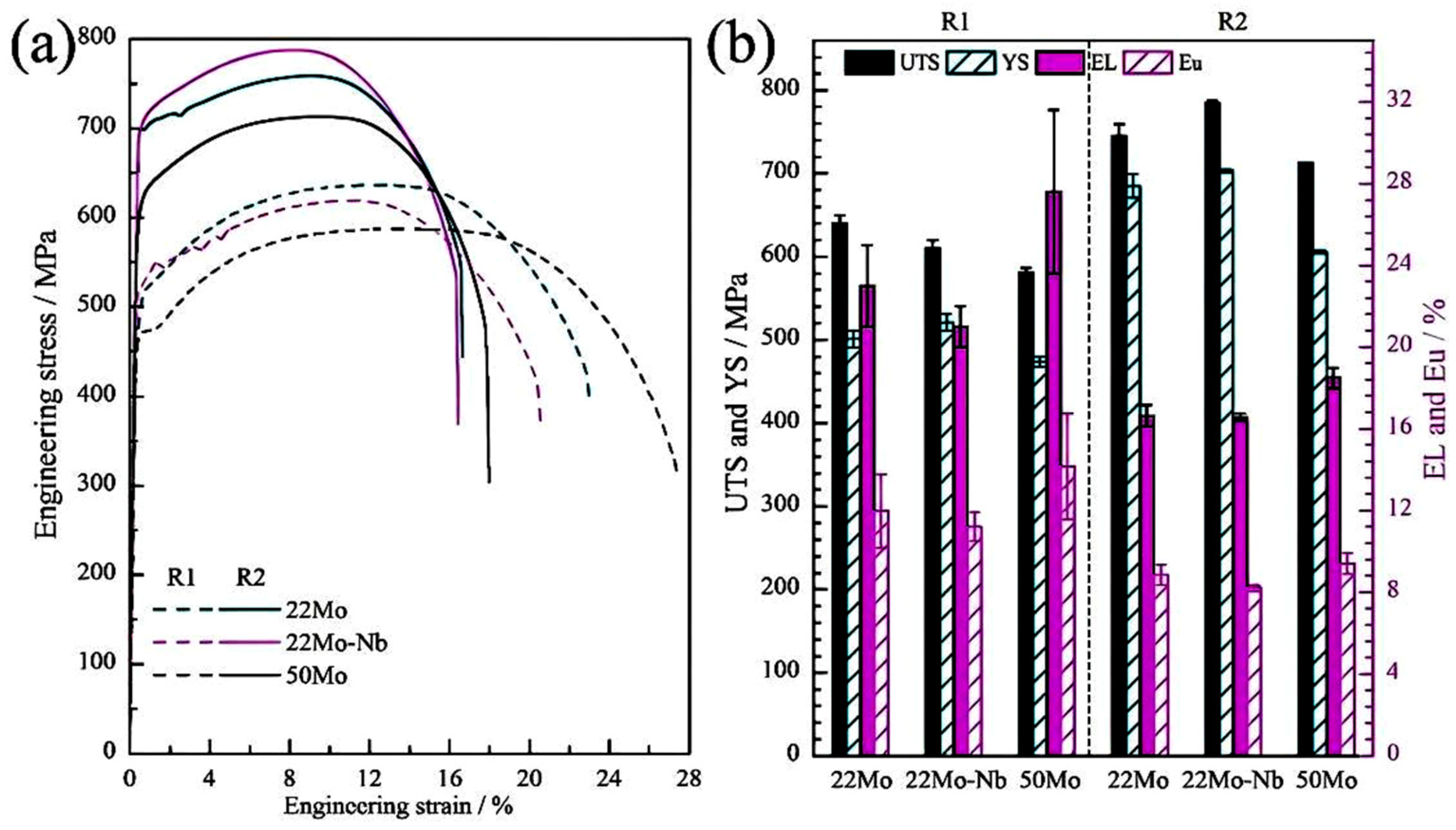
As shown in Figure 2a, the tensile curves of three experimental steels exhibit similar variation trends, which can be divided into four distinct stages: elastic deformation, yield plateau, uniform plastic deformation, and necking. Comparatively, the steels processed under the R1 route demonstrate higher elongation but relatively lower yield strength (YS) and ultimate tensile strength (UTS). In contrast, under the R2 route, the strength of the experimental steels significantly increases while the elongation does not markedly decrease, resulting in an overall more superior combination of mechanical properties. Quantitative results (Figure 2b) indicate that under the R1 route, the three steels exhibit UTS values of approximately 580~650 MPa, YS of 470~520 MPa, total elongation (EL) of 21~28%, and uniform elongation (Eu) of 11~14%. Under the R2 route, the UTS increases by about 110~180 MPa, reaching above 750 MPa.
Comparing the mechanical properties of 22Mo steel and 22Mo-Nb steel shows that the addition of Nb increases YS under both R1 and R2 routes, while the elongation remains largely unaffected. In contrast, the UTS decreases under the R1 route but increases under the R2 route. A comparison between 22Mo steel and 50Mo steel reveals that a higher Mo content improves elongation under both R1 and R2 routes but reduces both YS and UTS. Notably, the 22Mo-Nb steel achieves the UTS of approximately 790 MPa. The YS value also rises by about 130~190 MPa, reaching the 700 MPa level.

3.2. Microstructural Evolution After TMP

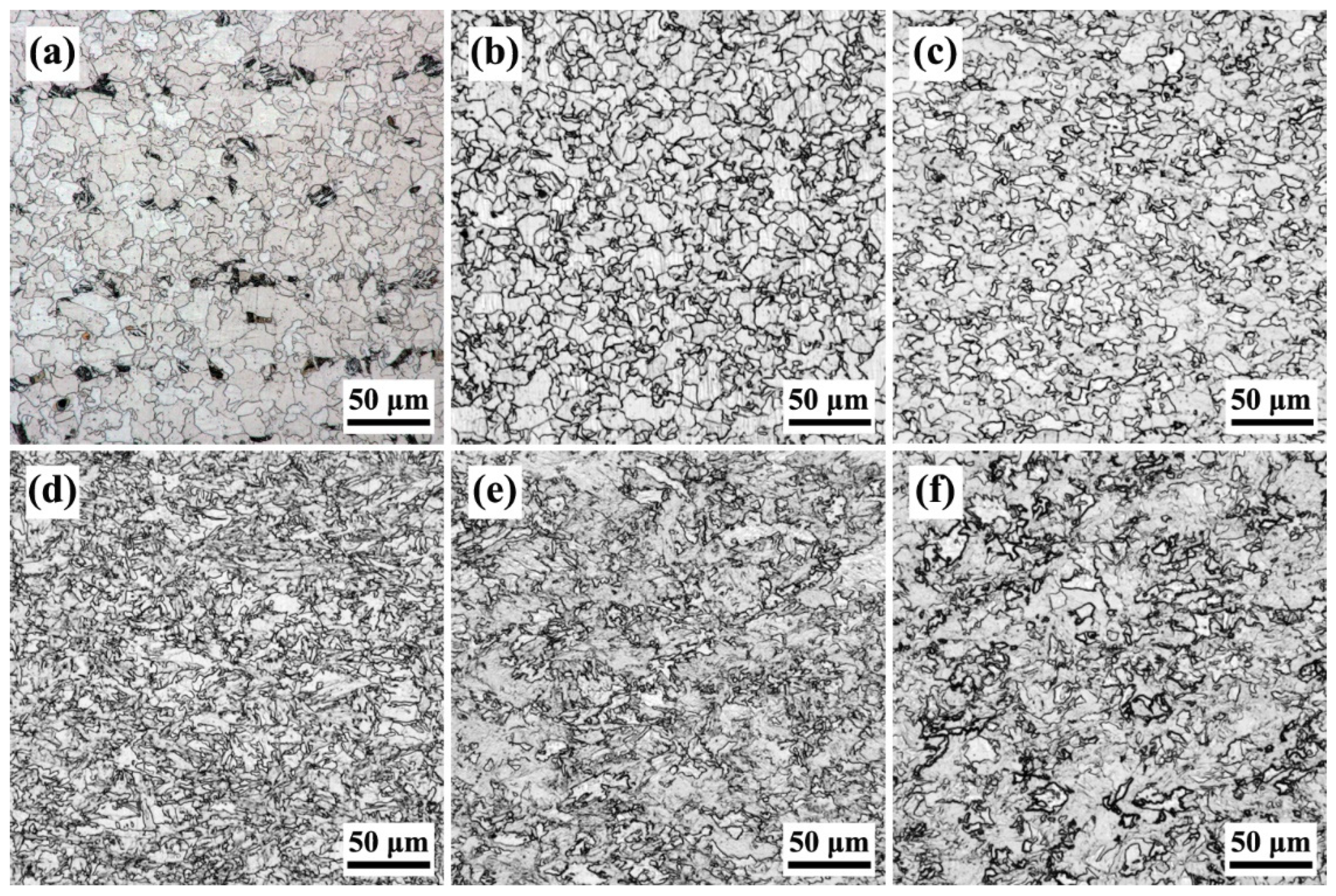
Figure 3 shows the optical micrographs of the experimental steels under the two rolling routes. The white-contrast regions correspond to ferrite, while the black-contrast areas represent pearlite. It can be observed that only the 22Mo steel under the R1 route contains a small amount of pearlite; all other steels consist almost fully of single ferrite phase. This indicates that the addition of Nb or Mo promotes the austenite-to-ferrite phase transformation. The results of statistic grain sizes (Table 2) show that the average ferrite grain size is about 9 µm for steels processed under the R1 route, while it decreases to approximately 6 µm under the R2 route. Thus, water quenching after hot rolling leads to a noticeable refinement of the ferrite grains. In comparison, the effects of Nb and Mo on ferrite grain size are not pronounced, although a slight coarsening is observed with increasing Mo content.
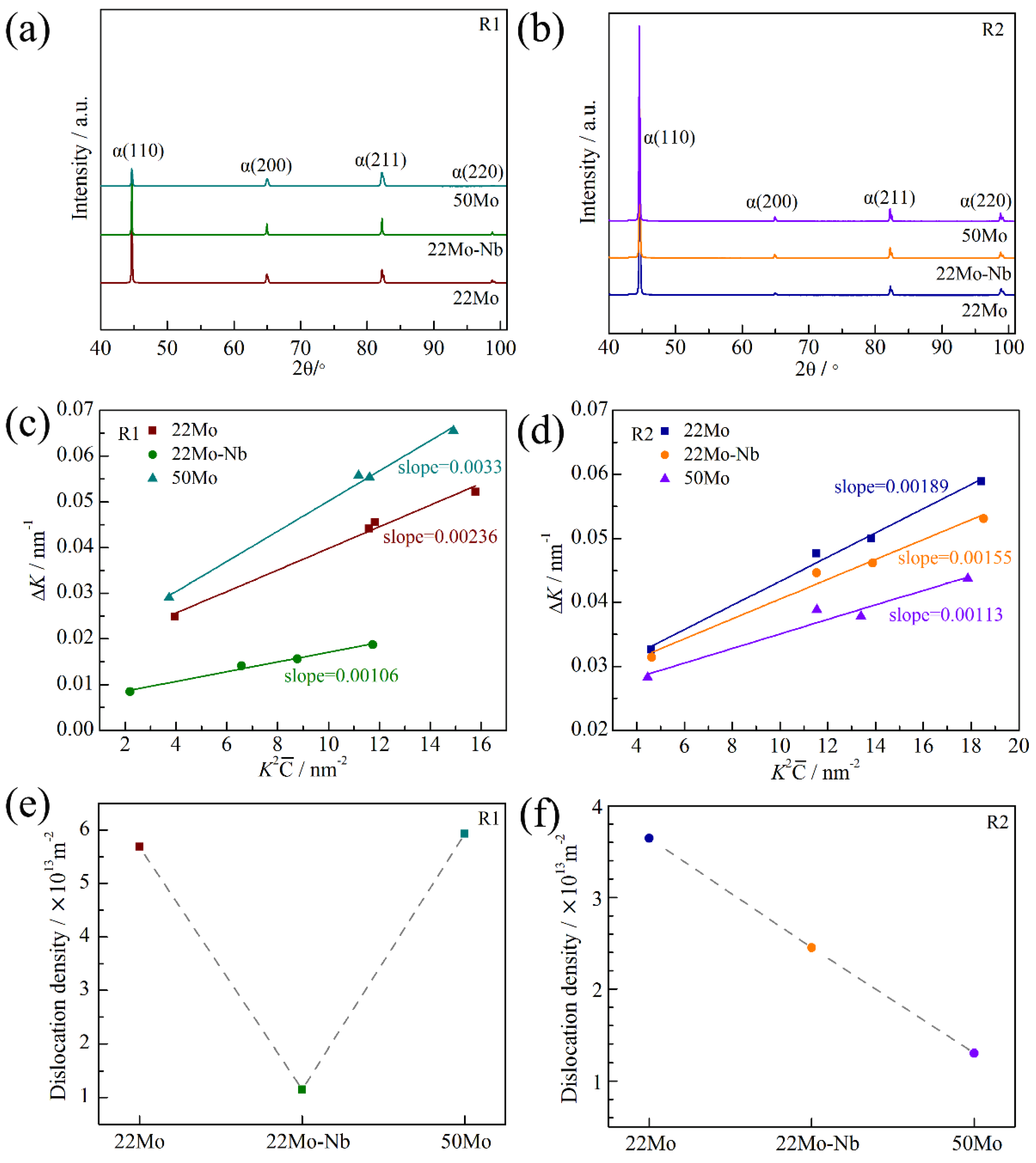
As shown in Figure 4, the ferritic steels exhibit relatively low dislocation densities, ranging from 1 × 10¹³ to 6 × 10¹³ m−2. Under the R1 route, the 22Mo-Nb steel has the lowest dislocation density (1.2 × 10¹³ m−2), while both the 22Mo and 50Mo steels show values around 5.6 × 10¹³ m−2. When processed via the R2 route, the dislocation density of the 22Mo-Nb steel increases by about 0.5 × 10¹³ m−2 compared to the R1 condition, whereas those of the 22Mo and 50Mo steels decrease to approximately 3.6 × 10¹³ m−2 and 1.3 × 10¹³ m−2, respectively. Notably, the differences in reported dislocation density between some samples are relatively small, which can be attributed primarily to the specific TMP route and microstructural features, such as the high finish rolling temperature, slow cooling rate, and single ferritic matrix. In conjunction with Figure 4a,b,e,f, it can be seen that a broader diffraction peak corresponds to a higher dislocation density—the narrowest peak, observed for the 22Mo-Nb sample under the R1 route, aligns with its lowest dislocation density. Therefore, the addition of microalloying elements Nb and Mo does not significantly affect the dislocation density in the experimental steels.
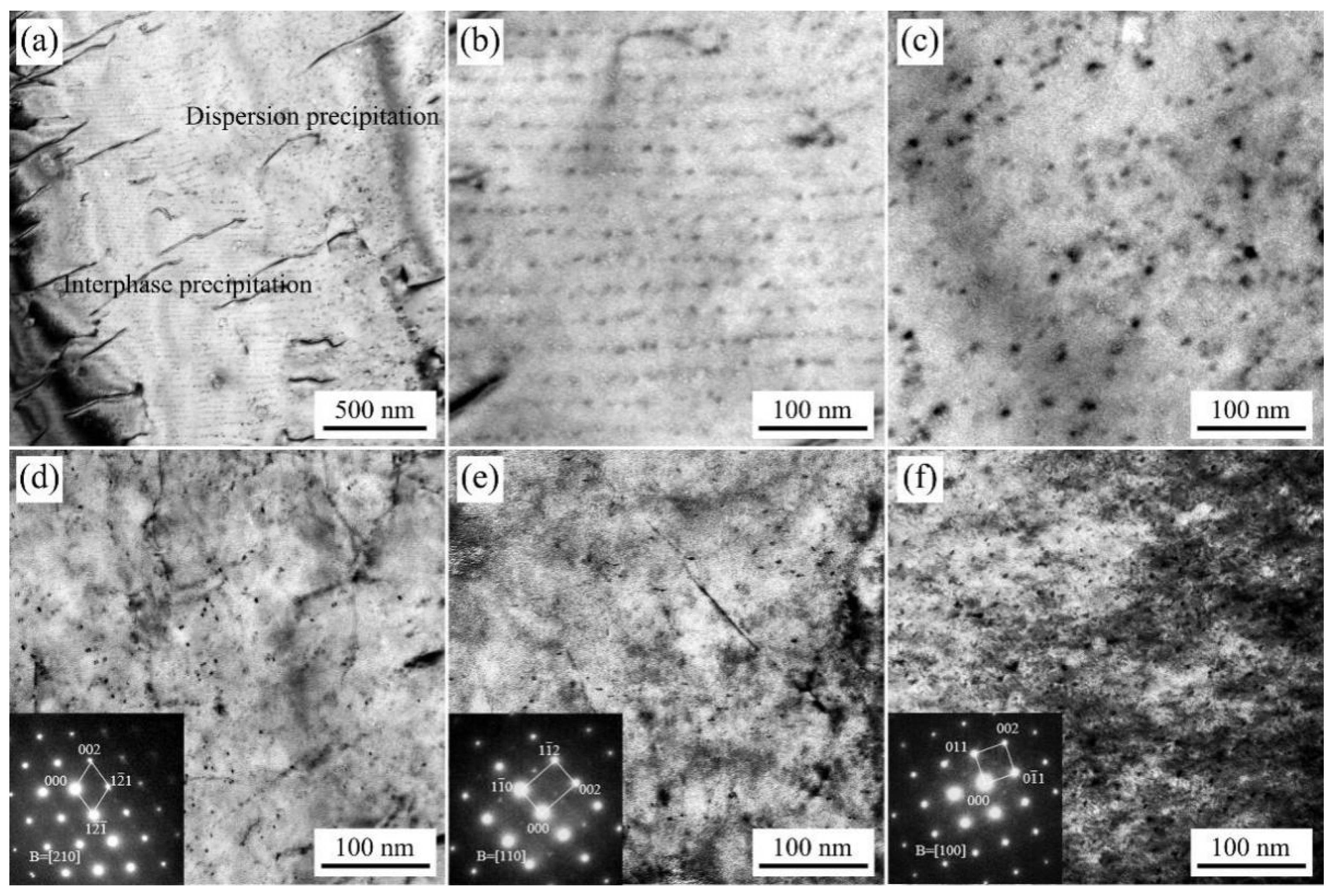
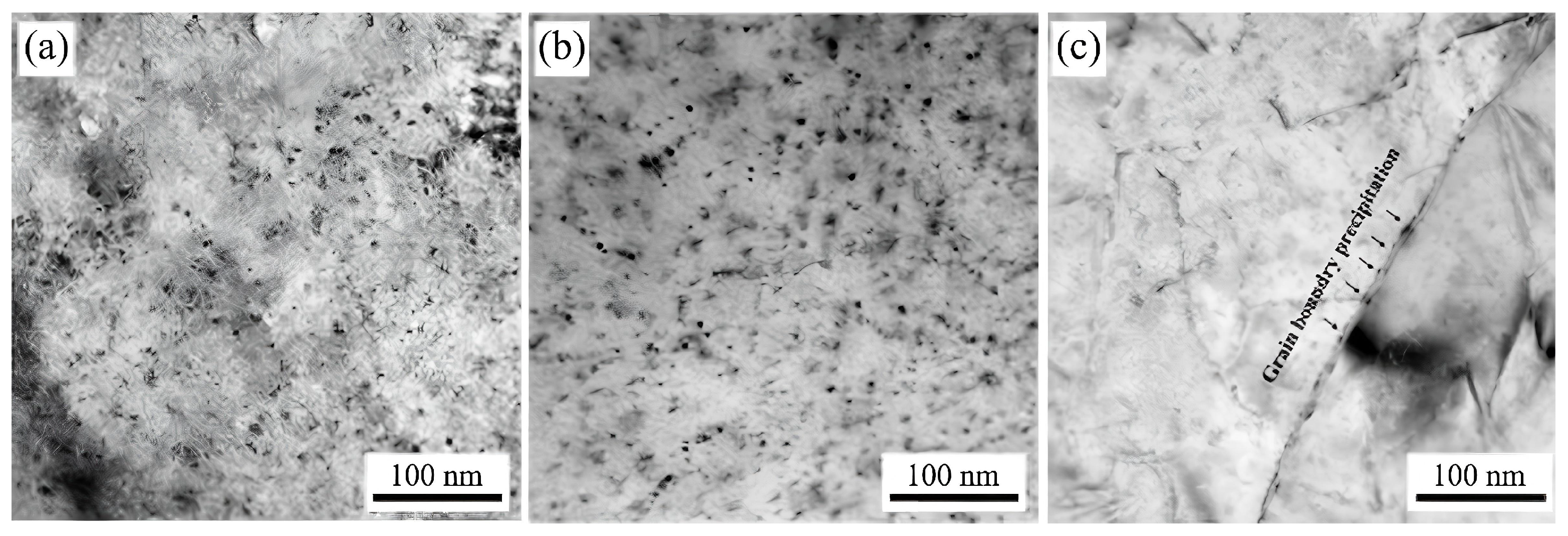
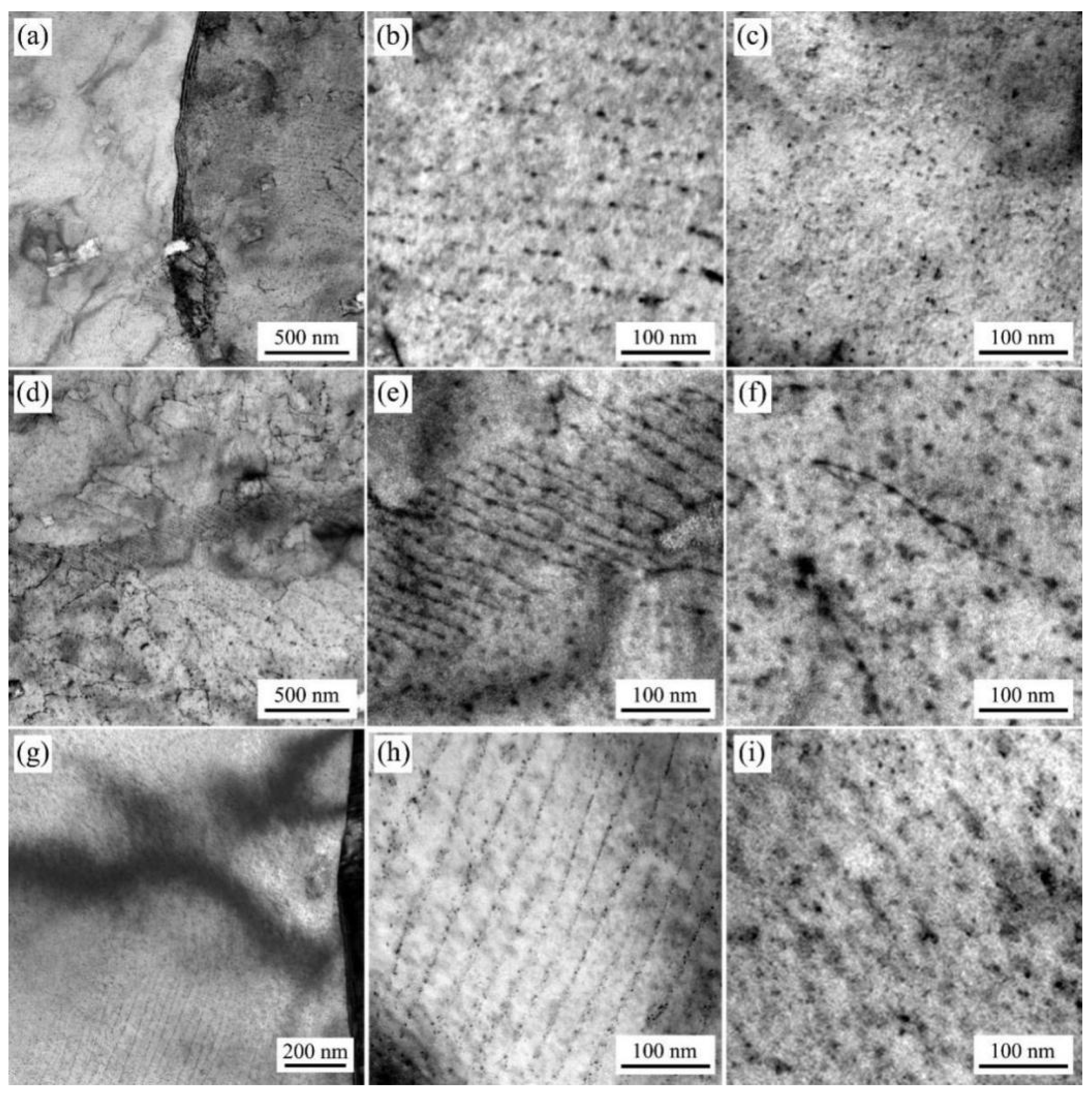
Figure 5, Figure 6, Figure 7 and Figure 8 show the precipitate morphologies of the 22Mo, 22Mo-Nb, and 50Mo experimental steels, under the two rolling processes. For the 22Mo steel, both interphase precipitation and dispersed precipitation morphologies appear under the R1 process. As shown in Figure 5a–c, the dispersed precipitates are generally larger in size than the interphase precipitates. Under the R2 process, only dispersed precipitates are observed along the (210), (110), and (100) zone axes, and the precipitate sizes are generally small (Figure 5d–f). For the 22Mo-Nb steel, only dispersed precipitates are observed under the R1 process (Figure 6a). Under the R2 process, a mixed morphology of dispersed and interphase precipitation coexists within the ferrite matrix, and larger interfacial precipitates appear at the ferrite grain boundaries (Figure 6b,c). For the 50Mo steel, both interphase precipitation and dispersed precipitation are present within the ferrite matrix under both the R1 and R2 processes (Figure 7).
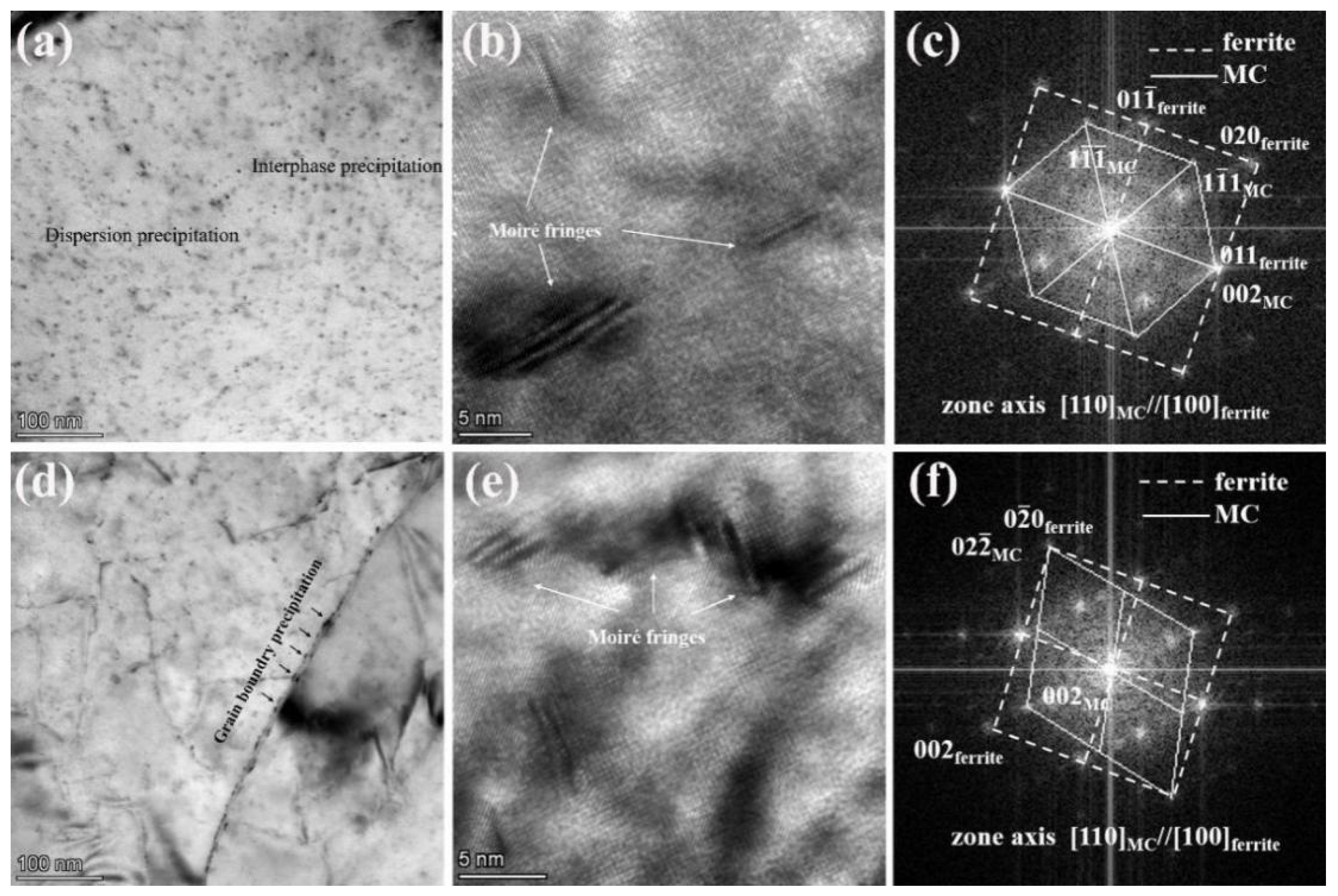
The morphology of nanoscale precipitates was observed using HR-TEM, and the size, crystal structure, lattice constants, and orientation relationship with the matrix were analyzed in detail by combining SAED (Selected Area Electron Diffraction), FFT (Fast Fourier Transform), and IFFT (Inverse Fast Fourier Transform). Figure 8 shows the high-resolution images of the most representative 22Nb-Mo sample under the R2 route. The FFT diffraction patterns of the precipitates reveal that the sample exhibits NaCl-type crystal structures. Due to the small size of many fine precipitates (approximately 5 nm) being fully embedded in the ferrite matrix, the superposition effect between them produces distinct Moiré fringes. These fringes enable precise measurement of precipitate dimensions [31]. Additionally, interphase precipitation, grain boundary precipitation, and the matrix demonstrate a variant of B-N orientation relationships, specifically [110]MC//[100]ferrite. Most dispersed precipitates exhibit orientation relationships with the matrix that do not strictly conform to conventional basic orientation relationships such as B-N, N-W, or P orientations.
Statistical analysis of the average precipitate size, precipitate fraction, and interphase precipitation row spacing from multiple TEM images is presented in Table 2. Compared to the R1 process, the R2 process not only reduces the size of nano-precipitates but also increases their fraction. Under the R1 process, the 22Mo and 50Mo steels show relatively large average particle sizes (~6.5 nm), whereas the 22Mo-Nb steel exhibits a finer size (~4 nm). The precipitate fraction, however, does not differ significantly among the three steels. These results suggest that under R1 conditions, increasing the Mo content has little influence on the precipitate size or fraction, while the addition of Nb partially suppresses the growth of precipitates.
Under the R2 process, both 22Mo and 50Mo steels display markedly smaller average precipitate sizes (~3.3 nm) and lower fractions (~0.3%). The 22Mo-Nb steel, however, retains a larger average size (~4.75 nm) and a notably higher fraction (~0.65%). Hence, the precipitate fraction in the 22Mo steel is significantly lower than in the 22Mo-Nb steel. This indicates that under R2 conditions, varying the Mo content has minimal effect on precipitate characteristics, while Nb strongly promotes precipitate nucleation, leading to a substantial increase in volume fraction.
Additionally, analysis of the precipitate row spacing shows that spacing is wider under the R1 process and narrower under the R2 process, which is consistent with the higher precipitate fraction observed in the R2 process.

4. Discussion

The above experimental results demonstrate that the occurrence of interphase precipitation is governed not only by the Nb and Mo contents but also by the TMP parameters. These factors, in turn, influence the resulting tensile deformation behavior and strengthening mechanisms of experimental steels.

4.1. Influence of TMP Process on Tensile Deformation Behavior

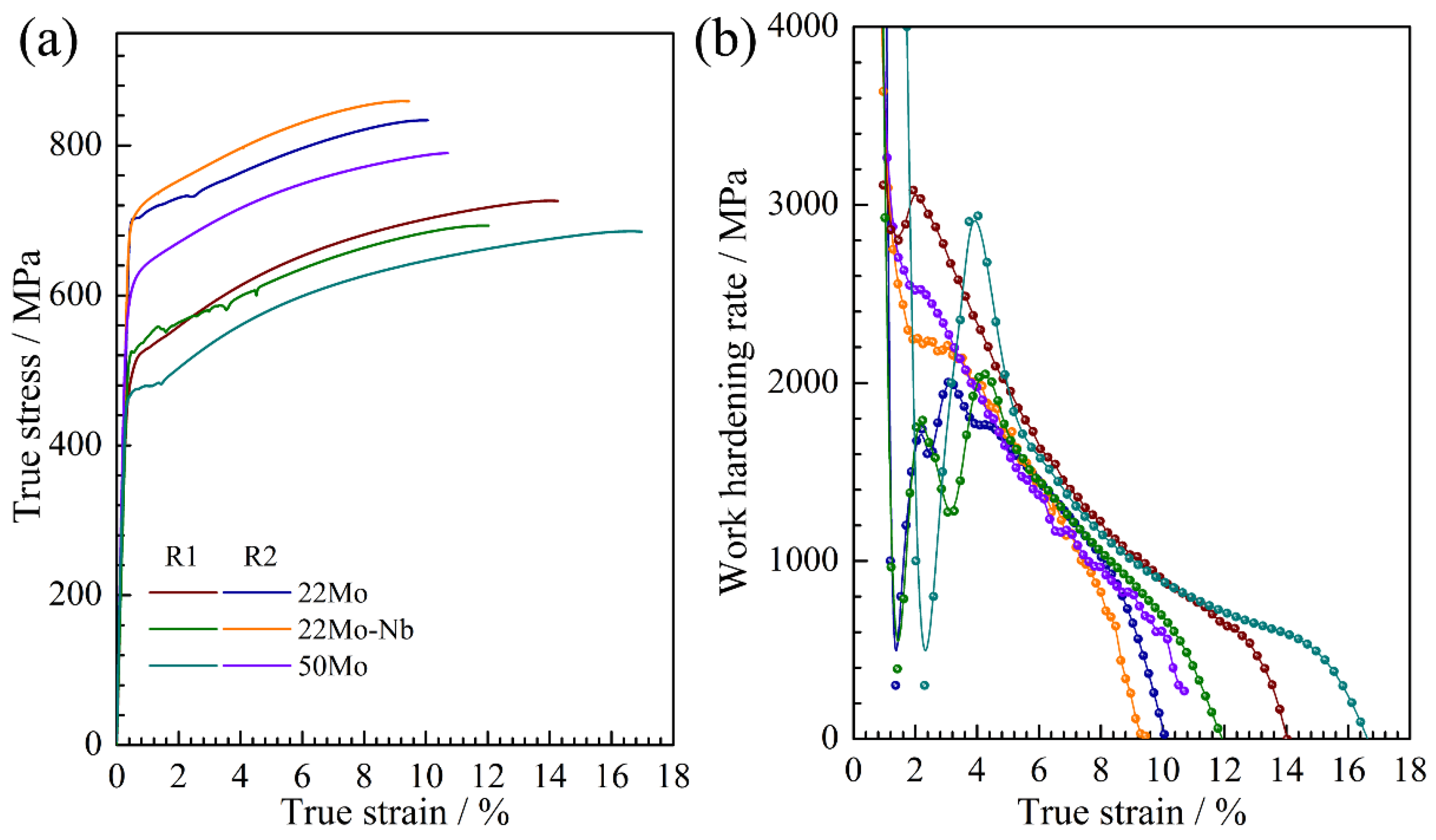
Ferritic steels typically fail by microvoid coalescence, leading to ductile fracture characterized by dimples on the fracture surface. The presence of fine nano-precipitates can influence void nucleation: particles may act as nucleation sites, but if they are small and well-dispersed, they can delay void coalescence by promoting uniform deformation. In our materials, the high density of fine precipitates likely contributes to the observed good ductility by refining the microstructure and suppressing early strain localization. The deformation behavior of the experimental steels was analyzed based on their true stress–true strain curves and work hardening rate–true strain curves, as shown in Figure 9. It can be observed that the work hardening behavior under both rolling processes can be broadly divided into two stages. In the first stage, after yielding, the work hardening rate fluctuates and increases, maintaining a relatively high level over a wide strain range. The work hardening rate rises to a peak and then declines rapidly. In the second stage, the work hardening rate plateaus and decreases more gradually. This phenomenon is similar in shape to the work hardening behavior observed in TRIP-assisted steels, but in the present ferritic steels it is attributed to dynamic interactions between dislocations and fine precipitates, which can temporarily impede dislocation motion and sustain work hardening.
The steels processed under the R1 route exhibit a longer yield plateau and show a higher work hardening rate at high strain levels, with the onset of the decrease in work hardening rate being delayed. A comparison of dislocation densities between the two rolling processes (Figure 4) reveals that the rolling process has a minimal influence, suggesting dislocation density is likely not the primary driver of the observed work hardening behavior. Instead, dislocation motion appears to be the key factor, governed by two main mechanisms: precipitate pinning and dislocation interactions (e.g., multiplication, pile-up). Both mechanisms hinder dislocation motion, resulting in a shortened plateau and a faster decline in the work hardening rate [42].
Compared to the R1 process, the R2 process results in a significantly higher volume fraction of precipitates and a notably smaller average particle size. Consequently, the pinning effect on dislocations is more pronounced, and the greater hindrance to dislocation motion under R2 leads to a shorter plateau and a more rapid decrease in work hardening rate. In addition, since the microstructure of the steels under both processes consists of ferrite, another factor influencing dislocation motion may be the ferrite grain size. The grain size under the R2 process is significantly smaller than under R1. During tensile deformation, on one hand, the presence of grain boundaries makes it difficult for moving dislocations to cross into adjacent grains. On the other hand, due to the orientation differences between grains, multiple slip systems must be activated in each grain to accommodate deformation, which inevitably involves dislocation intersections [43]. Both factors cause dislocations to pile up at grain boundaries, forming dislocation pile-ups, hence causing stress concentrations. The smaller the grain size, the greater the stress concentration, resulting in a shorter work hardening plateau. Therefore, the R2 process exhibits a shorter plateau and an earlier decline in work hardening rate.

4.2. Influence of TMP Process on Strengthening Mechanisms

The strength of the experimental steels is closely related to their microstructure, including the average grain size, average precipitate size, precipitate volume fraction, and dislocation density. The overall strengthening mechanism of the experimental steels can be quantitatively described by the following expression:
σ y = σ 0 + σ s s + σ g b + σ p + σ d ,
where σ 0 is the friction stress of a single crystal of pure iron, which is ~53.9 MPa. σ s s , σ g b , σ p and σ d are the contributions from solid solution strengthening, grain boundary strengthening, precipitation strengthening and dislocation strengthening, respectively.
Since most carbon atoms in microalloyed steels are bound in microalloying compounds as nano-precipitates, their contribution to solid solution strengthening can be neglected. Thus, σ s s is calculated using the following equation [43]:
σ s s = 32.3   M n +   83.2   [ S i ] ,
where [Mn] and [Si] represent the contents of Mn and Si in the three experimental steels, which are 1.5 wt% and 0.2 wt%, respectively.
σ p is primarily determined by the precipitate volume fraction and the average precipitate size, using the Ashby–Orowan equation [44]. It is noted that this model provides an effective or approximate estimate rather than precise physical measurement because it assumes a random distribution of non-shearable spherical particles:
σ p = 1.0771 × 10 4 f d l n ( 2.014 d ) ,
where f is the fraction of precipitates in the examined steels (%), and d is the average size of precipitates (nm). Both parameters were measured from TEM images and are listed in Table 2. σ d can be obtained as [45]:
σ d = α M G b ,
where α is a constant associated with crystal structure (~0.38), M is the Taylor factor (~2.2), G is the shear modulus (~81.6 GPa), b is the Burger’s vector (~0.248 nm), and ρ is the dislocation density (m−2). Here, the value of ρ was obtained from XRD data in Figure 4. σ g b can be estimated by the Hall–Petch equation [46]:
σ g b = k × d 1 / 2 ,
where k is a constant, ~0.21 MPa·m1/2, and d is an average grain size.
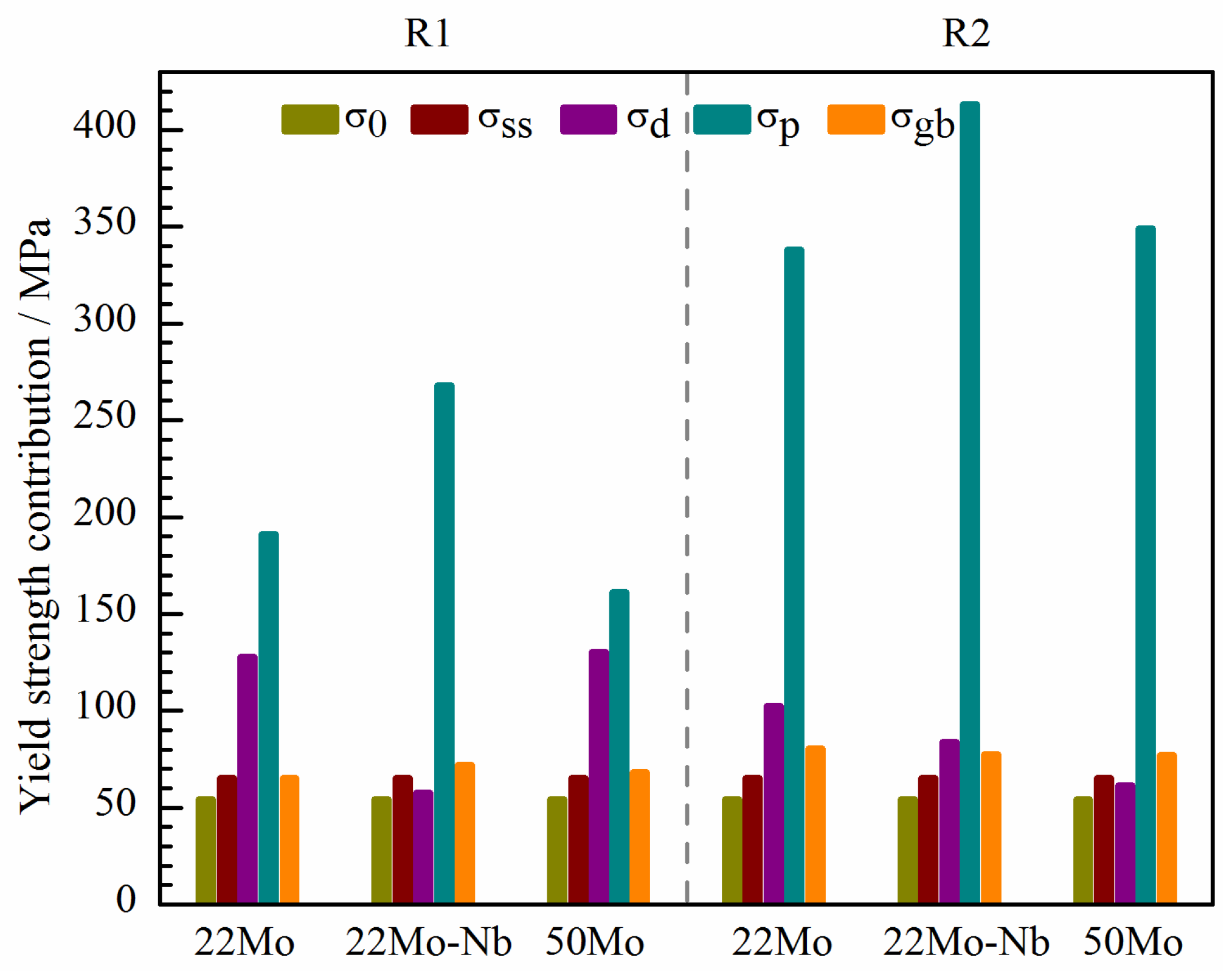
The contributions of multi-strengthening mechanisms to yield strength are plotted in Figure 10. The precipitation strengthening contribution in the R2-processed steels is significantly higher than in those processed via R1, while the grain boundary strengthening contribution shows little difference between the two routes. The dislocation strengthening contribution is slightly lower under R2 compared to R1. Specifically, the precipitation strengthening contributions for the R1-processed 22Mo, 22Mo-Nb, and 50Mo steels are approximately 190 MPa, 260 MPa, and 160 MPa, respectively. Under the R2 process, these values reach the 300~400 MPa range, at about 330 MPa, 410 MPa, and 350 MPa, respectively. Although the ferrite grain size under R2 is notably smaller than under R1, the resulting increase in grain boundary strengthening is only about 10 MPa, contributing minimally to the overall strength increase. The grain boundary strengthening for both processes falls within the range of 60~80 MPa. The slight change in yield strength with grain size is attributed to the combined effects of low carbon concentration, high finish rolling temperature, and slow cooling rate (air cooling or furnace cooling).
Notably, both interphase and dispersed precipitation types are present in the ferrite matrix of R1-22Mo, R1-50Mo, R2-22Mo-Nb, and R2-50Mo steels, whereas only dispersed precipitation is observed in R1-22Mo-Nb and R2-22Mo steels. This indicates that the precipitation type has no significant influence on the strengthening contribution. The enhancement in precipitation strengthening is primarily related to the average precipitate size, volume fraction, and inter-particle spacing. Taking the 50Mo steel (which exhibits interphase precipitation under both processes) as an example, under R2, its precipitate size and inter-particle spacing are significantly reduced, while its volume fraction is increased, leading to a much higher precipitate number density. This results in an increment in yield strength of approximately 130 MPa under R2 compared to R1.

4.3. Influence of Nb and Mo Additions on Microstructure and Mechanical Properties

Under both TMP routes, the 22Mo-Nb steel demonstrates the highest precipitation strengthening contribution (Figure 10), which is the primary reason for the improved yield strength (YS) with Nb addition. Although Nb slightly refines the average ferrite grain size compared to the 22Mo steel, the resulting change in grain boundary strengthening is marginal. Instead, the presence of Nb enhances dislocation–precipitate interactions under both R1 and R2 conditions, increasing the precipitation strengthening contribution by approximately 75 MPa.
Huang et al. [47] combined precipitation kinetics with precipitation–time–temperature curve analysis and concluded that precipitates in Ti-Nb-Mo steels are (Ti, Nb, Mo)C, whereas those in Ti-Mo steels are (Ti, Mo)C. The nucleation driving force for (Ti, Nb, Mo)C is significantly higher than that for (Ti, Mo)C, indicating that Nb promotes precipitate nucleation. Consequently, Nb addition increases the nucleation driving force and leads to a higher precipitate density. As a strong carbide/nitride-former, Nb also enhances the binding of microalloying elements with C and N atoms, facilitating the formation of diverse nanoparticles such as NbC, (Ti,Nb)C, and (Ti,Mo,Nb)C, thereby increasing the precipitate quantity to some extent [10,11,17,18,19,20,21,22,23]. Furthermore, Nb acts synergistically with Mo to reduce the lattice mismatch between precipitates and the matrix, increase nucleation sites, and promote nanoparticle precipitation at α/γ interfaces. Nb also lowers the critical nucleation energy and refines the size of the nano-precipitates.
In contrast, increasing the Mo content improves elongation under both R1 and R2 routes but reduces strength. The slight increase is related to solid-solution effects of Mo, which can influence dislocation mobility and recovery kinetics. Mo is known to delay dynamic recovery, potentially sustaining work hardening to higher strains and delaying the onset of necking [35]. In addition, Jang et al. [24] reported that a Ti/Mo atomic ratio of 1.03 delivers the optimal balance of properties in similar steels; deviation from this ratio reduces either strength or elongation. In these experimental steels, elongation is mainly governed by the average precipitate size, precipitate volume fraction, and ferrite grain size. The 50Mo steel shows slightly coarser ferrite grains than the 22Mo steel under both TMP routes, resulting in slightly lower grain boundary strengthening; however, the differences in precipitate size and volume fraction are minimal, causing negligible effects on strength and elongation. Overall, the present results indicate that the overall mechanical properties are optimized at a Mo content of approximately 0.22%.

5. Conclusions

In this study, three experimental steels—22Mo steel, 22Mo-Nb steel, and 50Mo steel were used to unveil precipitation behavior and strengthening mechanisms in Ti-Nb-Mo steels via two various thermo-mechanical processing (TMP) routes. The main conclusions are as follows:
(1)
All experimental steels consist essentially of single-phase ferrite, except for the 22Mo steel via the R1 route. The additions of Nb and Mo have a negligible effect on ferrite grain size, although a slight coarsening is observed with increasing Mo content.
(2)
Compared with the R1 route, the UTS values of three experimental steels under the R2 route increase by about 110~180 MPa, reaching above 750 MPa. The addition of Nb enhances yield strength while having a negligible effect on ductility, while increasing the Mo content improves elongation at the expense of strength.
(3)
The precipitation morphologies observed include dispersed, interphase, and grain boundary types, none of which show a direct correlation with the TMP route or steel composition. Compared to the R1 process, the R2 route results in both a reduction in average precipitate size and an increase in volume fraction. While variations in Mo content have little effect on these precipitate characteristics, the addition of Nb significantly promotes precipitation.
(4)
The strength of Ti-Mo-Nb ferritic steels is predominantly governed by precipitation strengthening. The corresponding contributions are approximately 190, 260, and 160 MPa for the R1-processed 22Mo, 22Mo-Nb, and 50Mo steels, respectively. Under the R2 process, the overall strengthening increased to the 300~400 MPa range.

Author Contributions

Conceptualization, M.C. and N.X.; methodology, Z.H. and L.C.; investigation, Z.H., Y.J., L.C. and J.Z.; writing—original draft preparation, Z.H., Y.J., J.Z. and M.C.; writing—review and editing, M.C. and N.X.; supervision, M.C., N.X., Z.H. and Y.J. contributed equally to this work, and are equally considered first authors. All authors have read and agreed to the published version of the manuscript.

Funding

The authors acknowledge the support of the National College Student Innovation and Entrepreneurship Training Program (No. 250104), Natural Science Foundation of China (No. 52274379), State Key Laboratory for Special Materials of Rare Metals, Open Project Fund of China Nonferrous Metal (Ningxia) Orient Group Co., Ltd. (No. SKL2025K001), and Science and Technology Major Project of Liaoning province (2024JH1/11700020, 2024JH1/11700028).

Data Availability Statement

The original contributions presented in this study are included in the article. Further inquiries can be directed to the corresponding authors.

Acknowledgments

Zihan He and Yunxuan Jiang contributed equally to this work, and are equally considered first authors.

Conflicts of Interest

The authors declare that this study received funding from Open Project Fund of China Nonferrous Metal (Ningxia) Orient Group Co., Ltd. (No. SKL2025K001). The funder was not involved in the study design, collection, analysis, interpretation of data, the writing of this article or the decision to submit it for publication.

References

  1. Ma, X.D.; Zhang, Y.Q.; Wang, C.C.; Wang, M.; Huang, M.X.; Xu, X. Structure-to-process modeling drives experimentally validated unified dual-phase steel. Acta Mater. 2025, 295, 121167. [Google Scholar] [CrossRef]
  2. Lu, J.; Wang, S.; Yu, H.; Mao, X. Achieving enhanced cryogenic toughness in a 1 GPa grade HSLA steel through reverse transformation of martensite. J. Mater. Res. Technol. 2023, 27, 6696–6708. [Google Scholar] [CrossRef]
  3. Tian, Z.; Shang, C.; Zhang, C.; Zhou, X.; Wu, H.; Wang, S.; Wu, G.; Gao, J.; Zhu, J.; Mao, X. Review of precipitation strengthening in ultrahigh-strength martensitic steel. Int. J. Miner Metall. Mater. 2025, 32, 256–269. [Google Scholar] [CrossRef]
  4. Kumar, S.; Sakalkale, K.; Sudhalkar, B.R.; Giri, S.K.; Balamuralikrishnan, R.; Shah, A.; Karagadde, S.; Samajdar, I. Thermomechanical processing induced lath martensite hierarchy and second phase coherency in a high strength low alloy steel. Mater. Sci. Eng. A 2025, 937, 148450. [Google Scholar] [CrossRef]
  5. DeArdo, A.; Hua, M.; Cho, K.G.; Garcia, C. On strength of microalloyed steels: An interpretive review. Mater. Sci. Technol. 2009, 25, 1074–1082. [Google Scholar] [CrossRef]
  6. Wang, S.Z.; Gao, Z.J.; Wu, G.L.; Mao, X.P. Titanium microalloying of steel: A review of its effects on processing, microstructure and mechanical properties. Int. J. Miner. Metall. Mater. 2022, 29, 645–661. [Google Scholar] [CrossRef]
  7. Gray, J.M.; Yeo, R.B.G. Columbium carbonitride precipitation in low-alloy steels with particular emphasis on precipitate-row formation. Trans. Am. Soc. Met. 1968, 61, 255–269. [Google Scholar]
  8. Funakawa, Y.; Shiozaki, T.; Tomita, K.; Yamamoto, T.; Maeda, E. Development of high strength hot-rolled sheet steel consisting of ferrite and nanometer-sized carbides. ISIJ Int. 2004, 44, 1945–1951. [Google Scholar] [CrossRef]
  9. Okamoto, R.; Borgenstam, A.; Agren, J. Interphase precipitation in niobium-microalloyed steels. Acta Mater. 2010, 58, 4783–4790. [Google Scholar] [CrossRef]
  10. Pereloma, E.; Wang, J.T.; Beladi, H.; Singh, N. Solute segregation, clustering and interphase precipitation in Ti-Mo-Nb microalloyed steel studied by correlated electron backscattering diffraction and atom probe tomography. Mater. Char. 2024, 216, 114273. [Google Scholar] [CrossRef]
  11. Shang, C.L.; Liu, G.; Wu, H.H.; Ma, H.L.; Wang, F.Y.; Wang, S.Z.; Gao, J.H.; Zhao, H.T.; Zhang, C.L.; Mao, X.P. Revealing the influence of niobium addition on interphase precipitation in titanium microalloyed high-strength low alloy steel. J. Mater. Res. Technol. 2025, 39, 87–93. [Google Scholar] [CrossRef]
  12. Rahnama, A.; Clark, S.; Sridhar, S. Machine learning for predicting occurrence of interphase precipitation in HSLA steels. Comput. Mater. Sci. 2018, 154, 169–177. [Google Scholar] [CrossRef]
  13. Li, X.; Jiang, Q.M.; Zhou, X.G.; Wu, S.W.; Cao, G.M.; Liu, Z.Y. Machine learning interphase precipitation behavior of Ti micro-alloyed steel guided by physical metallurgy principle. J. Mater. Res. Technol. 2023, 25, 2641–2653. [Google Scholar] [CrossRef]
  14. Dong, H.K.; Chen, H.; Khorasgani, A.R.; Zhang, B.N.; Zhang, Y.J.; Wang, Z.Q.; Zhou, X.S.; Wang, W.; Wang, H.R.; Li, T.; et al. Revealing the influence of Mo addition on interphase precipitation in Ti-bearing low carbon steels. Acta Mater. 2022, 223, 117475. [Google Scholar] [CrossRef]
  15. Gong, P.; Liu, X.G.; Rijkenberg, A.; Rainforth, W.M. The effect of molybdenum on interphase precipitation and microstructures in microalloyed steels containing titanium and vanadium. Acta Mater. 2018, 161, 374–387. [Google Scholar] [CrossRef]
  16. Zhang, Y.J.; Miyamoto, G.; Furuhara, T. Enhanced hardening by multiple microalloying in low carbon ferritic steels with interphase precipitation. Scripta Mater. 2022, 212, 114558. [Google Scholar] [CrossRef]
  17. Liu, G.; Guo, H.B.; Wang, S.Z.; Wu, H.H.; Ruan, X.Y.; Huang, Y.H.; Li, X.; Mao, X.P. Unveiling the kinetics of interphase and random quaternary Nb-Ti precipitations, and strengthening mechanism of HSLA steel. Mater. Char. 2024, 215, 114238. [Google Scholar] [CrossRef]
  18. Bikmukhametov, I.; Beladi, H.; Wang, J.T.; Hodgson, P.D.; Timokhina, I. The effect of strain on interphase precipitation characteristics in a Ti-Mo steel. Acta Mater. 2019, 170, 75–86. [Google Scholar] [CrossRef]
  19. Timokhina, I.; Miller, M.K.; Wang, J.T.; Beladi, H.; Cizek, P.; Hodgson, P.D. On the Ti-Mo-Fe-C atomic clustering during interphase precipitation in the Ti-Mo steel studied by advanced microscopic techniques. Mater. Design 2016, 111, 222–229. [Google Scholar] [CrossRef]
  20. Bu, F.Z.; Wang, X.M.; Yang, S.W.; Shang, C.J.; Misra, R.D.K. Contribution of interphase precipitation on yield strength in thermo-mechanically simulated Ti-Nb and Ti-Nb-Mo microalloyed steels. Mater. Sci Eng. A 2015, 620, 22–29. [Google Scholar] [CrossRef]
  21. Chen, C.Y.; Chen, C.C.; Yang, J.R. Microstructure characterization of nanometer carbides heterogeneous precipitation in Ti-Nb and Ti-Nb-Mo steel. Mater. Char. 2014, 88, 69–79. [Google Scholar] [CrossRef]
  22. Yang, P.R.; Cai, M.H.; Wu, C.F.; Su, J.H.; Guo, X.P. Strain-rate dependent hot deformation behavior and mechanism of interphase-precipitated Ti-Mo-xNb steels: Physical modeling and characterization. Mater. Sci. Eng. A 2018, 729, 230–240. [Google Scholar] [CrossRef]
  23. Cai, M.H.; Chen, L.G.; Fang, K.; Huang, H.; Hodgson, P. The effects of a ferritic or martensitic matrix on the tensile behavior of a nano-precipitation strengthened ultra-low carbon Ti–Mo–Nb steel. Mater. Sci. Eng. A 2021, 801, 140410. [Google Scholar] [CrossRef]
  24. Jang, J.H.; Lee, C.H.; Heo, Y.U.; Suh, D.W. Stability of (Ti, M)C (M=Nb, V, Mo and W) carbide in steels using first-principles calculations. Acta Mater. 2012, 60, 208–217. [Google Scholar] [CrossRef]
  25. HajyAkbary, F.; Sietsma, J.; Böttger, A.J.; Santofimia, M.J. An improved X-ray diffraction analysis method to characterize dislocation density in lath martensitic structures. Mater. Sci. Eng. A 2015, 639, 208–218. [Google Scholar] [CrossRef]
  26. Jiang, L.; Marceau, R.K.W.; Dorin, T.; Wood, K.; Hodgson, P.D.; Stanford, N. The effect of molybdenum on interphase precipitation at 700 °C in a strip-cast low-carbon niobium steel. Mater. Char. 2020, 166, 110444. [Google Scholar] [CrossRef]
  27. Li, A.X.; Kang, K.W.; Zhang, B.R.; Zhang, J.S.; Huang, D.; Xu, M.K.; Liu, S.K.; Jiang, Y.T.; Li, G. Development and characterization of CoCrFeNi high entropy alloy composites reinforced by B4C ceramic particles. Intermetallics 2025, 181, 108740. [Google Scholar] [CrossRef]
  28. Dong, R.F.; Li, D.G.; Yan, B.; Wang, G.D. Effect of Carbon Equivalent on Microstructure and Properties of C-Mn Hot Rolled Biphasic Steel. Steel Rolling. 2011, 28, 11–13. [Google Scholar]
  29. Huo, X.D.; Xia, J.N.; Li, L.J.; Peng, Z.W.; Chen, S.J. Research and Development of Titanium Microalloyed High Strength Steel. Iron Steel Vanadium Titanium. 2017, 38, 105–112. [Google Scholar] [CrossRef]
  30. Kim, Y.W.; Song, S.W.; Seo, S.J.; Hong, S.G.; Lee, C.S. Development of Ti and Mo micro-alloyed hot rolled high strength sheet steel by controlling thermomechanical controlled processing. Mater. Sci. Eng. A 2013, 565, 430–438. [Google Scholar] [CrossRef]
  31. Mukherjee, S.; Timokhina, I.B.; Zhu, C.; Ringer, S.P.; Hodgson, P.D. Three-dimensional atom probe microscopy study of interphase precipitation and nanoclusters in thermomechanically treated titanium-molybdenum steels. Acta Mater. 2013, 61, 2521–2530. [Google Scholar] [CrossRef]
  32. Han, X.Y. Functions of Nb, V and Ti in Micro-alloyed Steel. Wide Heavy Plate 2006, 12, 39–41. [Google Scholar]
  33. Akben, M.G.; Bacroix, B.; Jonas, J.J. Effect of vanadium and molybdenum addition on high temperature recovery, recrystallization and precipitation behavior of niobium-based microalloyed steels. Acta Metall. 1983, 31, 161–174. [Google Scholar] [CrossRef]
  34. Sharma, R.C.; Lakshmanan, V.K.; Kirkaldy, J.S. Solubility of niobium carbide and niobium carbonitride in alloyed austenite and ferrite. Metall. Trans. A 1984, 15, 545–553. [Google Scholar] [CrossRef]
  35. Lee, W.B.; Hong, S.G.; Park, C.G.; Kim, K.H.; Park, S.H. Influence of Mo on precipitation hardening in hot rolled HSLA steels containing Nb. Scripta Mater. 2000, 43, 319–324. [Google Scholar] [CrossRef]
  36. Uemori, R.; Chijiiwa, R.; Tamehiro, H.; Morikawa, H. AP-FIM study on the effect of Mo addition on microstructure in Ti-Nb steel. Appl. Surf. Sci. 1994, 76, 255–260. [Google Scholar] [CrossRef]
  37. Hansen, S.S.; Sande, J.V.; Cohen, M. Niobium carbonitride precipitation and austenite recrystallization in hot-rolled microalloyed steels. Metall. Trans. A 1980, 11, 387–402. [Google Scholar] [CrossRef]
  38. Wang, Z.; Zhang, H.; Guo, C.; Liu, W.; Yang, Z.; Sun, X.; Zhang, Z.; Jiang, F. Effect of molybdenum addition on the precipitation of carbides in the austenite matrix of titanium micro-alloyed steels. J. Mater. Sci. 2016, 51, 4996–5007. [Google Scholar] [CrossRef]
  39. ASTM E8/E8M-23; Standard Test Methods for Tension Testing of Metallic Materials. ASTM International: West Conshohocken, PA, USA, 2023.
  40. Ungár, T.; Ott, S.; Sanders, P.G.; Borbély, A. Dislocations, grain size and planar faults in nanostructured copper determined by high resolution X-ray diffraction and a new procedure of peak profile analysis. Acta Mater. 1998, 46, 3693–3699. [Google Scholar] [CrossRef]
  41. Ungár, T.; Borbély, A. The effect of dislocation contrast on x-ray line broadening: A new approach to line profile analysis. Appl. Phys. Lett. 1996, 69, 3173–3175. [Google Scholar] [CrossRef]
  42. Nurbanasari, M.; Tsakiropoulos, P.; Palmiere, E.J. A study of carbide precipitation in a H21 tool steel. ISIJ Int. 2014, 54, 1667–1676. [Google Scholar] [CrossRef]
  43. Kamikawa, N.; Sato, K.; Miyamoto, G.; Murayama, M.; Sekido, N.; Tsuzaki, K.; Furuhara, T. Stress-strain behavior of ferrite and bainite with nano-precipitation in low carbon steels. Acta Mater. 2015, 83, 383–396. [Google Scholar] [CrossRef]
  44. Gladman, T. Precipitation hardening in metals. Mater. Sci. Technol. 1999, 15, 30–36. [Google Scholar] [CrossRef]
  45. Shen, Y.F.; Wang, C.M.; Sun, X. A micro-alloyed ferritic steel strengthened by nanoscale precipitates. Mater. Sci. Eng. A 2011, 528, 8150–8156. [Google Scholar] [CrossRef]
  46. Cao, J.C.; Yong, Q.L.; Liu, Q.Y.; Sun, X.J. Precipitation of MC phase and precipitation strengthening in hot rolled Nb-Mo and Nb-Ti steels. J. Mater. Sci. 2007, 42, 10080–10084. [Google Scholar] [CrossRef]
  47. Huang, H.H.; Yang, G.W.; Zhao, G.; Mao, X.P.; Gan, X.L.; Yin, Q.L.; Yi, H. Effect of Nb on the microstructure and properties of Ti-Mo microalloyed high-strength ferritic steel. Mater. Sci. Eng. A 2018, 736, 148–155. [Google Scholar] [CrossRef]
Figure 1. Schematic illustration of thermo-mechanical process routes for experimental steels: (a) Route R1 involves air cooling to 650 °C for 1 h and air cooling to room temperature; (b) route R2 involves water cooling to 630 °C for 15 min and furnace cooling to room temperature. RT represents room temperature.
Metals 16 00305 g001
Figure 2. (a) Engineering stress–strain curves, and (b) index of tensile properties of Ti-Mo-Nb steels under two TMP routes. UTS, YS, EL and Eu are ultimate tensile strength, yield strength, total elongation and uniform elongation, respectively.
Metals 16 00305 g002
Figure 3. OM images of three specimens after different TMCP routes (a) R1-22Mo; (b) R1-22Mo-Nb; (c) R1-50Mo; (d) R2-22Mo; (e) R2-22Mo-Nb; (f) R2-50Mo.
Metals 16 00305 g003
Figure 4. (a,b) XRD patterns of three experimental Ti-Mo-Nb steels under two different TMP routes; (c,d) the fitted lines of K vs. K C ¯ 2 based on the modified Williamson–Hall (MWH); and (e,f) the change in dislocation density with TMP routes.
Metals 16 00305 g004
Figure 5. TEM morphologies of the 22Mo specimen after two TMCP routes. (ac) Route R1; (df) route R2.
Metals 16 00305 g005
Figure 6. TEM morphologies of the 22Mo-Nb specimen after two TMCP routes. (a) TEM morphologies of Route R1; (b,c) Route R2.
Metals 16 00305 g006
Figure 7. TEM morphologies of the 50Mo specimen after two TMCP routes. (af) Route R1; (gi) route R2.
Metals 16 00305 g007
Figure 8. TEM images of 22Mo-Nb experimental steel under R2 process. (a) Morphology of precipitates; (b,e) lattice structures of precipitates; (c,f) corresponding FFT diffraction patterns of (b,e); (d) TEM morphologies.
Metals 16 00305 g008
Figure 9. Changes in (a) true stress and (b) work hardening rate with true strain of three steels under two TMP routes.
Metals 16 00305 g009
Figure 10. Contributions of multiple strengthening mechanisms to yield strength of Ti-Mo-Nb steels under two TMP routes. σ 0 , σ s s , σ g b , σ p and σ d are the lattice friction stress of pure Fe, solid solution strengthening, grain boundary strengthening, precipitation strengthening, and dislocation strengthening, respectively.
Metals 16 00305 g010
Table 1. The chemical compositions of the experimental steel (mass fraction/%).
Sample No.CSiMnAlTiMoNbN(ppm)
22Mo0.040.201.500.030.080.2220
22Mo-Nb0.040.201.500.030.080.220.0220
50Mo0.040.201.500.030.080.5020
Table 2. Statistical results of the average particle size (d), volume fraction (fv) and the row spacing (l) of precipitates in the three specimens under different TMCP routes.
SamplesR1R2
22Mo22Mo-Nb50Mo22Mo22Mo-Nb50Mo
d/nm6.434.106.873.314.753.22
fv/%0.250.230.200.300.650.31
l/nm22.9031.5014.9627.17
Disclaimer/Publisher’s Note: The statements, opinions and data contained in all publications are solely those of the individual author(s) and contributor(s) and not of MDPI and/or the editor(s). MDPI and/or the editor(s) disclaim responsibility for any injury to people or property resulting from any ideas, methods, instructions or products referred to in the content.