Article

Effect of Welding Heat Input on Corrosion Behavior of Duplex Stainless Steel Welding Overlay on Carbon Steel


by
Anael Furquim Junior
1,
Carlos Roberto Camello Lima
1,*,
Alexandre Borghi Cunha
1,
Fabio Henrique Silva Delfino
2,
Francisco Mateus Faria de Almeida Varasquim
3,
Eli Jorge da Cruz Junior
3 and
Givanildo Alves dos Santos
4
1
School of Engineering, Mackenzie Presbyterian University, São Paulo 01302-907, SP, Brazil
2
College of Mechanical Engineering, State University of Campinas (UNICAMP), Campinas 13083-860, SP, Brazil
3
Mechanical Engineering, Federal Institute of Education, Science and Technology of Itapetininga (IFSP-ITP), Itapetininga 18202-000, SP, Brazil
4
Department of Mechanics, Federal Institute of Education, Science and Technology of São Paulo (IFSP), São Paulo 01109-010, SP, Brazil
*
Author to whom correspondence should be addressed.
Metals 2026, 16(2), 207; https://doi.org/10.3390/met16020207
Submission received: 13 January 2026 / Revised: 6 February 2026 / Accepted: 7 February 2026 / Published: 11 February 2026
(This article belongs to the Special Issue Quality Evaluation of Welding Processes for Metals)

Abstract

The present study investigates the effect of welding heat input on the corrosion resistance of duplex stainless steel (DSS) overlays, with particular focus on applications in pressure vessels and clad plates. ER2209 filler metal was deposited onto SA-516 Gr. 70 carbon steel using GMAW, both manually and mechanized, with varying heat inputs. Microstructural characterization included ferrite-content measurement, macrographic analysis, and pitting-corrosion testing according to ASTM G48 Method A. The results indicate that increasing the heat input from 548 J mm−1 to 2319 J mm−1 significantly reduced the ferrite content from 49% to 25%, leading to a corresponding increase in weight loss from 0.55% to 2.5%. Mechanized welding exhibited better arc stability and more consistent phase distribution compared to the manual process. Although we did not detect brittle phases or intermetallic precipitates due to strict interpass temperature control, the microstructural imbalance induced by high-heat-input directly compromised the corrosion resistance. These findings advance understanding of the optimized welding parameters required to ensure the integrity of DSS coatings in aggressive environments.

1. Introduction

Industries extensively employ duplex stainless steels (DSS) in corrosive environments owing to their unique combination of high mechanical strength and excellent corrosion resistance [1,2]. This superior performance arises from a balanced microstructure comprising approximately 50% delta ferrite (δ) and 50% gamma austenite (γ), which synergistically combines the strength of ferrite with the toughness of austenite [3,4]. The addition of alloying elements such as nitrogen and nickel further improves corrosion resistance and weldability [5,6,7]. However, the welding process markedly influences the ferrite-to-austenite ratio, as heat input directly affects cooling rates and phase-transformation kinetics, potentially compromising both mechanical properties and corrosion resistance [4].
Heat input during the welding process significantly affects the corrosion resistance of DSS, as it directly influences the balance between alloy phases. High heat input may cause grain growth and increase the ferrite content, potentially compromising both mechanical properties and corrosion resistance. On the other hand, very low heat input leads to rapid cooling, which can limit austenite formation and result in a microstructure with excessive ferrite, also affecting mechanical and corrosion performance [8,9,10,11].
DSS are not typically post-weld heat-treated (PWHT) as often as other stainless steels. However, research shows that this process can restore phase equilibrium in DSS welds by increasing austenite content and reducing brittle intermetallic phases. Furthermore, the addition of austenite-stabilizing elements, such as nickel, can increase resistance to pitting corrosion by improving the uniformity of alloy distribution and reducing the effect of localized chromium depletion. When welding involves joints rather than cladding, another critical factor comes into play: corrosion tests indicate that the heat-affected zone (HAZ) is the most susceptible to pitting, as pits tend to form and spread more easily there than in the fusion zone.
Recent research has demonstrated that the formation of intermetallic phases, such as the chi (χ) and sigma (σ) phases, is highly dependent on heat input and cooling rates, with the χ phase precipitating after only 15 min of annealing at 800 °C, while the σ phase formed after 120 min, significantly increasing hardness and reducing corrosion resistance [9]. Even in more complex welding processes, this phenomenon occurs. Research on laser beam welding (LBW) has shown that higher welding speeds at high power, which generate greater heating followed by rapid cooling, reduce the elemental segregation of alloying elements important for DSS and promote microstructural refinement. The segregation of alloying elements due to welding energy is so critical that recent studies have emphasized the importance of controlling the microstructure of DSS through advanced welding techniques and post-weld heat treatments (PWHT), where the addition of alloying elements such as nickel (Ni) during welding significantly influences the formation of Widmanstätten austenite, which improves the mechanical properties of DSS welds.
A recent study evaluated the corrosion behavior of duplex stainless steels welded by gas-metal arc welding (GMAW) under real industrial conditions in a petrochemical company. Higher heat inputs yielded the best corrosion resistance by promoting a more homogeneous phase distribution and reducing pitting susceptibility. Although this result may seem contradictory at first glance, it is crucial to distinguish the effects of heat input from those associated with the formation of deleterious phases, which can compromise both the chemical composition and the balance between ferrite and austenite [6,12,13,14]. If heat treatment is considered a form of heat input, the decomposition of delta ferrite (δ) into secondary austenite (γ2) and chromium nitrides (Cr2N) emerges as a common phenomenon. Several studies highlight this behavior and emphasize the importance of controlling heat input to mitigate brittle phase transformations [6,12,13,14].
The intermetallic phases that result from the welding process can be more harmful to the structure than those formed by heat treatments or during manufacturing [15,16,17]. This increased degradation results from the complex grain structure formed in the weld bead and the heat-affected zone (HAZ), a critical region in welding [1,15,16]. The most critical intermetallic phase for DSS is the sigma phase (σ), as some authors mention that this phase can form at initial temperatures of 450 °C with prolonged exposure [1,14,17]. Additionally, depending on the alloy’s chemical composition, it can form a challenging, brittle intermetallic phase that poses a substantial problem in industrial components and requires attention [17,18].
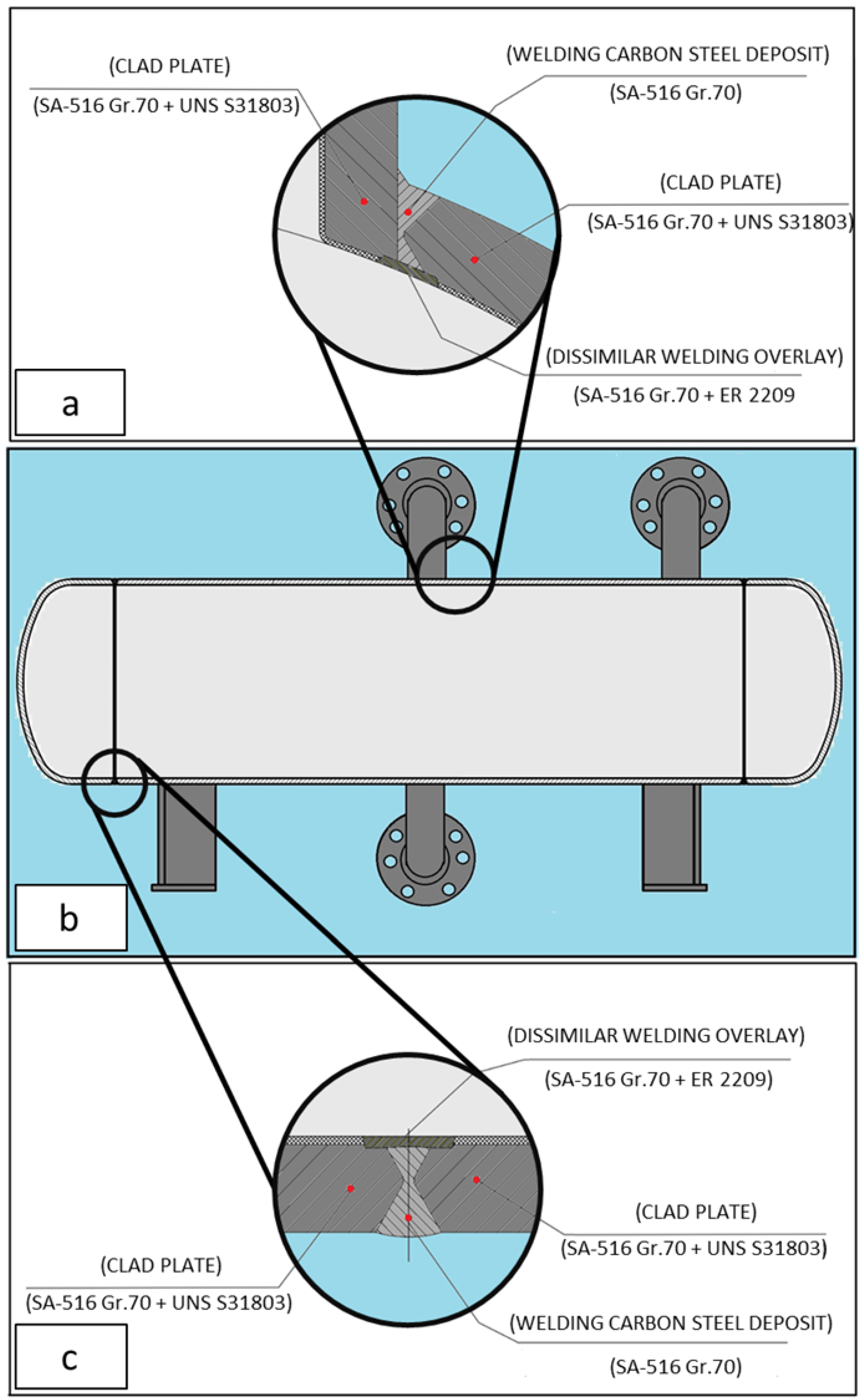
Among various welding processes for producing clad plates, GMAW has gained prominence due to its adaptability and high deposition rate [19]. However, this process requires strict control of welding parameters and operator skill, making it particularly susceptible to variations in heat input [20]. When welding dissimilar materials such as Duplex Stainless Steel (DSS) and Carbon Steel (CS), additional challenges arise, including sensitivity to thermal cycles, the potential formation of detrimental intermetallic phases, and the need to preserve the coating’s corrosion resistance while maintaining the carbon-steel substrate’s structural integrity. In this context, the different joint configurations that require weld cladding are illustrated in Figure 1, highlighting both the process requirements and the joint preparations involved [21,22,23].
Figure 1 presents the main joint configurations typically encountered in pressure vessel applications. Figure 1a illustrates a corner joint configuration, commonly found in internal regions where geometric transitions occur between components, requiring weld overlay to ensure continuity of anticorrosive protection. Figure 1b shows a representative section of a pressure vessel, highlighting the internal cladding applied to the carbon-steel substrate and the flange details, where different joint types coexist under strict structural integrity and corrosion resistance requirements. In Figure 1c, a butt joint with bevel preparation is depicted, a configuration widely used in longitudinal and circumferential welds, in which control of dilution and welding heat input is decisive for the final performance of the cladding.
These joint configurations demonstrate that the weld overlay process extends beyond simple filler material deposition, as it combines the inherent challenges of conventional welding with those associated with DSS metallurgy and the need to meet fundamental overlay criteria [20]. Consequently, a proper understanding of both corner and butt joints becomes essential for controlling heat input, dilution levels, and the resulting microstructure of the cladded layer.
Despite the extensive literature on welding duplex stainless steels (DSS), most studies focus on welding joints. In contrast, the application of welded coatings on carbon steel for pressurized equipment remains underexplored, even though it is a widely adopted industrial alternative for reducing raw material costs. In this context, the influence of welding parameters, especially heat input, on the corrosion behavior of DSS coatings under practical manufacturing conditions remains insufficiently understood. This study seeks to fill this gap by evaluating the effect of variations in heat input during GMAW on the microstructure and corrosion resistance of DSS coatings deposited on carbon steel.
The objectives of this work are: (a) to quantify the ferrite content and corrosion susceptibility as a function of different heat input levels; (b) to compare the behavior of coatings obtained by manual and mechanized welding; (c) to identify the most suitable welding parameter ranges for industrial applications.
The results provide practical insights into the relationship between welding parameters and the anti-corrosion performance of DSS coatings, with a focus on applications in aggressive environments, such as the oil and gas and pressure vessel sectors.

2. Materials and Methods

UNS (Unified Numbering System) S31803 duplex stainless steel (DSS) is one of the most widely used duplex grades in the industrial sector due to its balanced combination of mechanical strength and corrosion resistance. The applicable standards define the chemical composition requirements for this alloy, with the nominal compositional limits summarized in Table 1 [24,25,26]. Table 1 presents the specified and measured chemical compositions of the materials employed in this study, enabling a direct comparison of the base metal, the duplex stainless steel cladding, and the filler metal [24,26].
The filler metal AWS SFA 5.9 ER2209, with its chemical composition presented in Table 1, was chosen for its metallurgical compatibility with UNS S31803 DSS. Its higher nickel content promotes a balanced ferrite–austenite microstructure in the weld metal and cladded layer, compensating for dilution from the carbon-steel substrate. Argon provided stable arc conditions during GMAW due to its inert nature [24,26].
As shown in Table 1, the UNS S31803 alloy exhibits chromium and molybdenum contents within the typical range required to ensure adequate pitting-corrosion resistance. At the same time, the nitrogen addition contributes to phase balance and mechanical strength. The calculated PREn for the duplex stainless steel is approximately 33, confirming its suitability for aggressive chloride-containing environments. In comparison, the ER2209 filler metal exhibits a slightly lower PREn value of approximately 31, which remains compatible with duplex stainless steel cladding applications and is widely used in industrial practice [27].
The base metal used was SA-516 Gr. 70 steel, with its chemical composition presented in Table 1 [26]. This steel has an ultimate tensile strength of 545 to 620 MPa, a minimum yield strength of 260 MPa, and a minimum elongation of 21%. Due to its low carbon content, favorable balance between strength and ductility, and excellent weldability, SA-516 Gr. 70 is widely used in the pressure vessel and heat exchanger industry, particularly in applications involving electric arc welding processes [26]. However, its limited corrosion resistance justifies the application of stainless-steel cladding when service conditions demand enhanced resistance to localized corrosion.

2.1. GMAW Process and Parameters

GMAW is a welding process in which an electric arc forms within a shielding gas atmosphere, while a consumable electrode serves as the filler metal. The quality and productivity of the welded joint depend on parameters such as current, voltage, welding speed, torch angle, and shielding gas flow, as well as external factors, including the base metal joint type [27,28].
GMAW was conducted in both manual and mechanized modes. The heat input, a crucial parameter that affects the material’s thermal exposure, was calculated according to ASME specifications, as shown in Equation (1) [8].
H I = I × V × 60 S
where HI is the welding heat input (J mm−1), I represents the welding current (A), V represents the arc voltage (V), and S represents the welding speed (mm min−1).
The experimental analysis followed these steps: material and equipment definition; preparation of test coupons (TCs); determination of manual and mechanized GMAW parameters; ferrite measurements; macro- and microstructural characterization; corrosion testing; and ferrite evaluation on machined samples. The materials and equipment used in the experiments include: a Lincoln Electric IDEALARC CV 400-I welding machine (Lincoln Electric, Guarulhos, Brazil), operating in direct-current with a current range of 50 A at 7 V to 400 A at 37 V, equipped with a Lincoln LN-742 wire feeder and a self-cooled SBME-506/5 single-wire torch (J.M.C. Welding, Guarulhos, Brazil); a Fluke 600A AC/DC 375-FC digital multimeter; a Fluke 59MAX digital infrared thermometer with laser sight (Fluke, Sao Paulo, Brazil).
To prevent the unwanted precipitation of intermetallic phases, the interpass temperature was strictly controlled at 120 °C or below, and welding was performed at room temperature (20–25 °C) without preheating [29,30,31].
To better contextualize the selected parameters, Table 2 presents a structured comparison with existing literature on heat input ranges for DSS. The heat input values used in this study, ranging from 548 to 2319 J mm−1 are consistent with those reported in prior research, which typically recommends ranges between 0.3 and 2.5 kJ mm−1 to ensure proper phase balance and avoid deleterious precipitates [32,33,34].
Based on this literature context, the parameters for both manual and mechanized welding are summarized in Table 3 and Table 4, including variations in voltage, current, and welding speed to evaluate different heat input conditions. Test Coupons 1 and 4 were used as references and welded under ideal parameters for dissimilar joints between carbon steel (CS) and duplex stainless steel (DSS). These parameters were defined based on technical literature and data sheets, taking into account the base materials and the diameters of the consumables [41,42].
The heat input values used in this study (ranging from 548 to 2319 J mm−1) are consistent with those reported in prior research, which typically recommend ranges between 0.3–2.5 kJ mm−1 to ensure proper phase balance and avoid deleterious precipitates [33,34,35]. The specifications include typical procedural and operational values such as consumable type, diameter, classification, voltage (V), current (A), and shielding gas flow rate. Preheat and interpass temperatures were established based on the literature, while welding energy (heat input) was calculated from the welding parameters. The remaining test specimens were welded using extrapolated reference parameters to evaluate the effects of varying heat input.
To provide a clearer understanding of the experimental conditions, the operational parameters applied during manual GMAW are summarized in Table 3. Three test coupons, identified as TC1, TC2, and TC3, were produced under controlled variations in current and voltage while maintaining a constant welding speed. This strategy enabled investigation of distinct heat input levels under manual operation, simulating typical industrial variability associated with operator-controlled welding.
As shown in Table 3, the selected parameters yielded average heat input values ranging from 548 to 1236 J mm−1. These conditions represent low, intermediate, and high heat-input regimes, allowing evaluation of their influence on bead geometry, dilution behavior, ferrite–austenite phase balance, and corrosion performance of the duplex stainless-steel cladding.
Table 4 presents the operational parameters adopted for mechanized GMAW. An automated system was used to ensure stable arc length, travel speed, and metal transfer mode. Compared with manual welding, the mechanized process provides higher repeatability and improved thermal consistency, allowing for a more accurate assessment of heat input effects.
Two mechanized test coupons, identified as TC4 and TC5, were produced. TC4 was welded using parameters equivalent to the reference condition, whereas TC5 was intentionally welded with significantly higher current and voltage. This approach enabled the generation of an elevated heat-input condition, allowing for the evaluation of its effects on microstructural evolution, dilution level, and corrosion resistance.
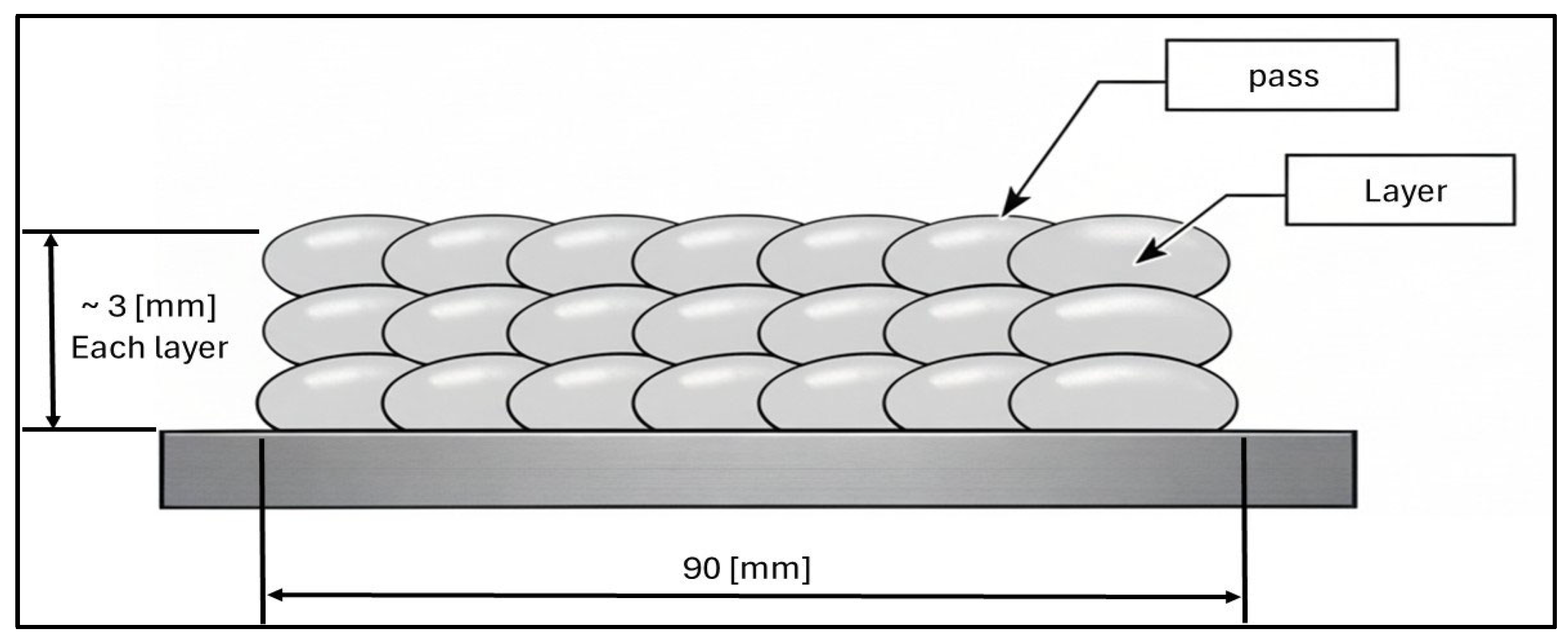
The welding procedure adopted for all test coupons followed a controlled-deposition sequence, as illustrated schematically in Figure 2.
As shown in Figure 2, the ER2209 filler metal was deposited in multiple passes and layers directly onto the SA-516 Gr. 70 carbon-steel substrate. The deposition sequence ensured complete surface coverage, limited excessive dilution from the base metal, and promoted chemical stabilization of the cladded layer. The layer arrangement also reflects typical industrial weld overlay practices, in which successive passes contribute to homogenizing the chemical composition, controlling ferrite content, and stabilizing the duplex microstructure.

2.2. Welded Test Coupon

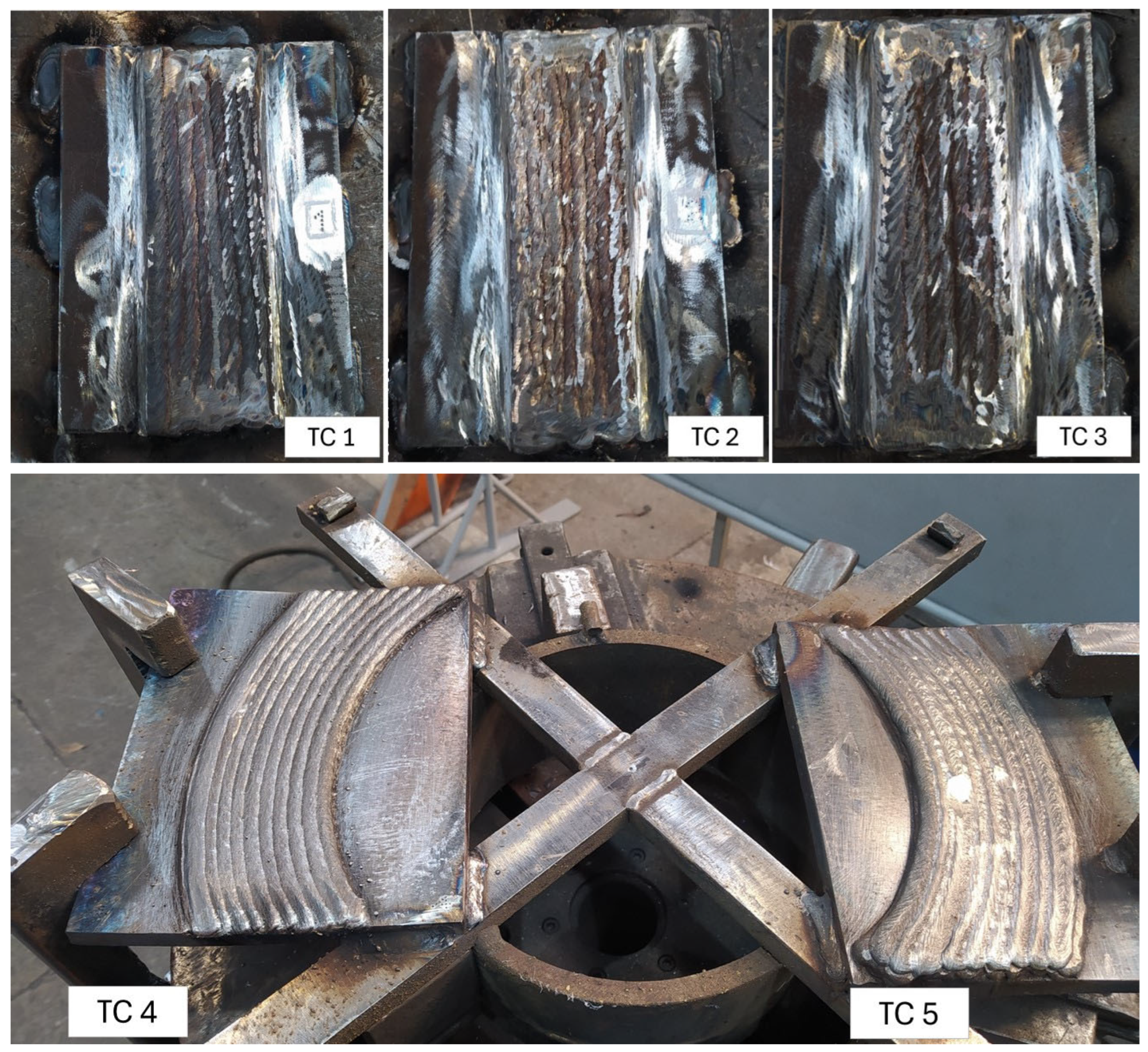
The test coupons (TCs) were welded in accordance with the welding parameters presented in Table 3 and Table 4 and subsequently identified, as illustrated in Figure 3. All coupons were produced under controlled conditions to ensure consistency between manual and mechanized welding procedures.
Since the bench is designed for coating tubes and cylindrical components, a fastening device was required. A dedicated fixture was therefore designed and manufactured to securely position the flat test coupons during welding, ensuring dimensional stability and deposition repeatability. Welding was performed in the flat position (1G), with the torch oriented at 90° to the base metal. This configuration was selected to minimize gravitational effects on molten metal flow and to promote uniform bead geometry.
Thus, the overlay region presented a circular shape, as shown in Figure 3 for test coupons TC4 and TC5. This circular deposition pattern reflects the rotational movement typically used in industrial cladding of cylindrical components, thereby providing a better representation of real manufacturing conditions.
After welding, the test coupons were maintained in the same position until reaching ambient temperature, allowing for natural cooling without external thermal interference. Subsequently, the specimens were removed from the fixture and subjected to surface preparation by light grinding to remove surface irregularities, spatter, and oxide residues prior to metallographic and corrosion analyses.

2.3. Analysis of Ferrite Content

The instrument used was a FERRITOSCOPE® FMP30 Ferritoscope (Helmut Fischer, Piraeus, Greece). This instrument allows quantification of ferrite content, as ferrite is ferromagnetic, and the Ferritoscope exploits this characteristic by performing magnetic induction scanning.
International standards and technical instructions from companies that consume this type of product establish limits for the ferrite content in DSS between 35 and 65% for welded materials and 35–55% for base material [33,34]. In this work, we controlled ferrite using a Ferritoscope under two conditions: as welded and after mechanical removal of the surface layer.

2.4. Cutting and Preparation of Test Coupon

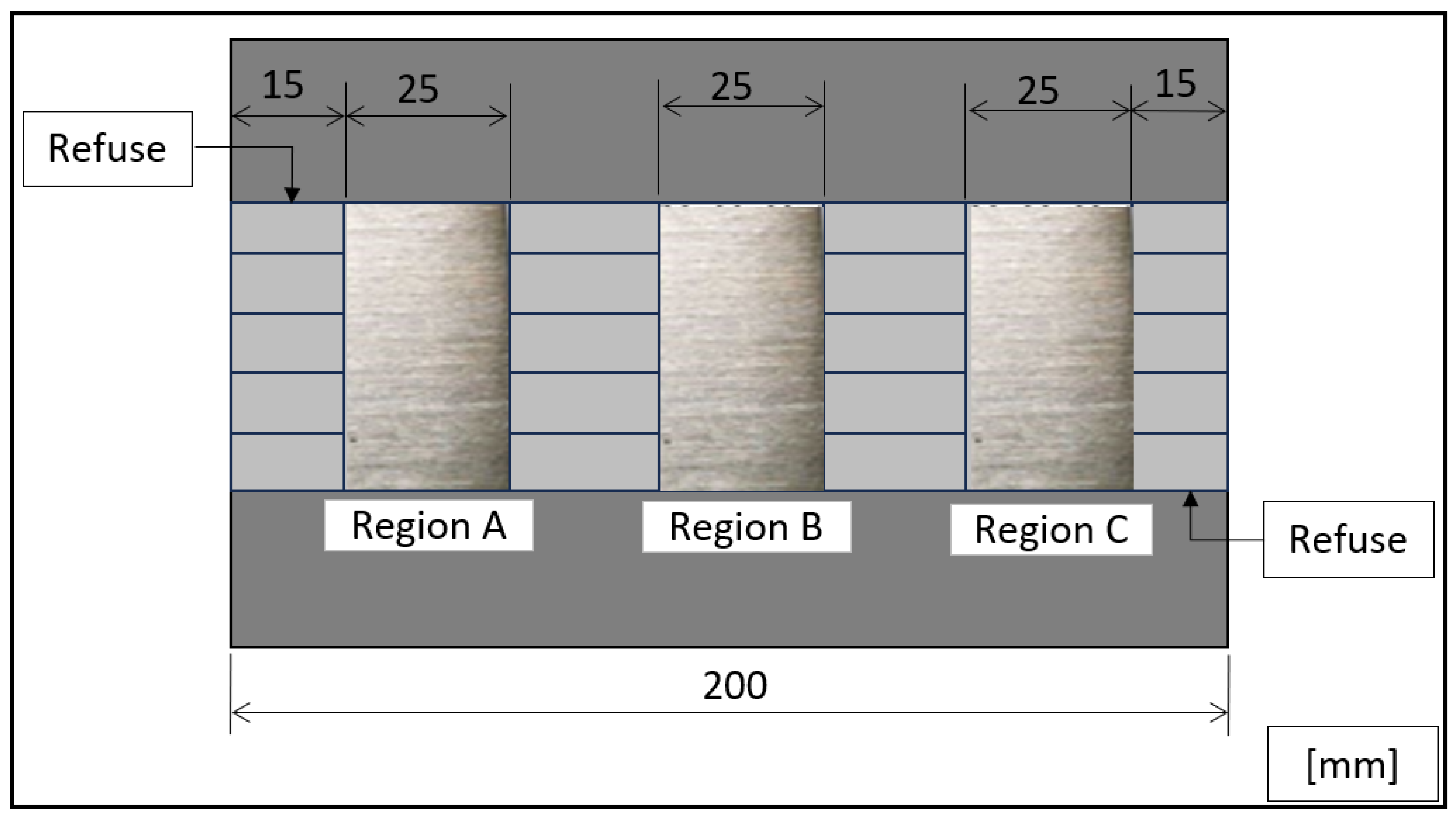
After welding, the TCs were prepared according to the sectioning scheme presented in Figure 4 for both manual and mechanized conditions. The samples were then sectioned into test specimens (TS) for microstructural characterization and corrosion testing. All cutting operations employed a cooling system to prevent localized overheating and avoid thermal alteration of the weld overlay microstructure. Subsequently, the specimens were ground using silicon carbide (SiC) papers up to 1200 grit and polished with diamond paste. This preparation sequence ensured adequate surface quality for reliable metallographic observation and corrosion evaluation.
The sectioning and preparation of the test coupons followed a standardized procedure, described below, to guarantee consistency among all specimens and comparability of the experimental results:
-
The arc initiation and termination regions, corresponding to the first and last 15 mm of each test coupon, were discarded due to their inherent thermal instability and potential variations in bead geometry and dilution.
-
From each test coupon, three test specimens were extracted for corrosion testing and identified as A, B, and C. This approach enabled a statistical evaluation of pitting corrosion behavior under the same welding conditions.
-
The regions located between the corrosion test specimens were used for macrographic and micrographic analyses. These areas were selected to ensure representative observation of weld-bead morphology, dilution profiles, and phase distribution across the clad layer.

2.4.1. Macrographic and Micrographic Analyses

The analysis of the visual appearance of the five TSs was performed after preparation and chemical etching using a stereoscopic microscope (Olympus Optical, Sao Paulo, Brazil) at 5× magnification. Each TS was analyzed for effective coating thickness, discontinuities in the base metal and HAZ, lack of fusion, and general discontinuities. The surface was prepared for macrostructural analysis using a 5% Nital reagent (95% ethyl alcohol, C2H5OH, and 5% nitric acid, HNO3).
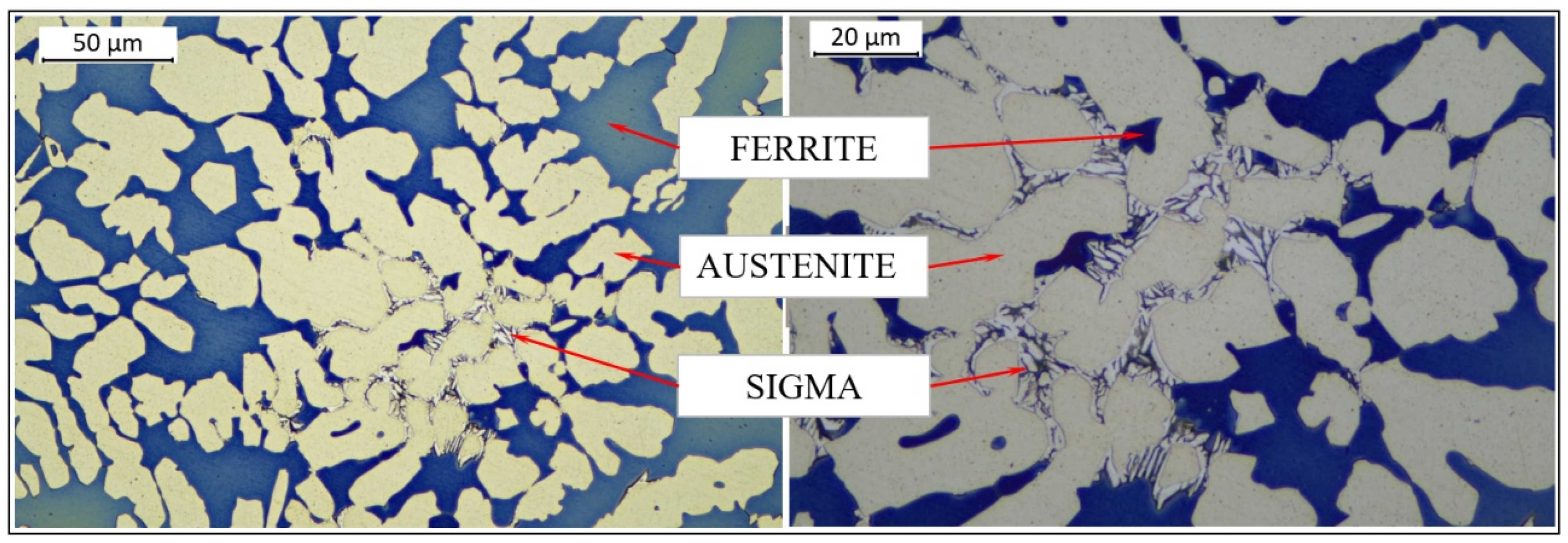
For micrographic analyses to reveal the microstructure, the surface was ground and polished. The Behara II reagent, composed of 0.02 L hydrochloric acid (HCl), 0.08 L water (H2O), and 1 g potassium metabisulfite (K2S2O5), was used. After a 15 s attack, this reagent allows visualization by optical microscopy of the ferrite in blue, the austenite in yellow, and brittle phases, such as sigma (σ) or chi (χ), in white, as shown in Figure 5.
The sigma phase appears white in micrographic analysis because it does not react with the Behara II reagent, unlike ferrite and austenite, which are stained blue and yellow, respectively. The sigma phase is a stable intermetallic phase in stainless steels, making it resistant to chemical attack by the reagent. The resulting absence of color makes the phase highly evident.

2.4.2. Pitting Corrosion Test Procedure (ASTM G48—Method A)

The pitting-corrosion resistance was evaluated using ASTM G48 Method A, which involves exposure to a chloride solution consisting of 100 g of ferric chloride dissolved in 0.9 L of Type IV reagent water, filtered through glass wool or filter paper to remove insoluble particles [42]. The test specimens were exposed to the corrosive medium in an ultrathermostatic bath, remaining in the solution according to ASTM G48 Method A for 24 h at 25 °C.

3. Results

3.1. Control of Ferrite as Welded

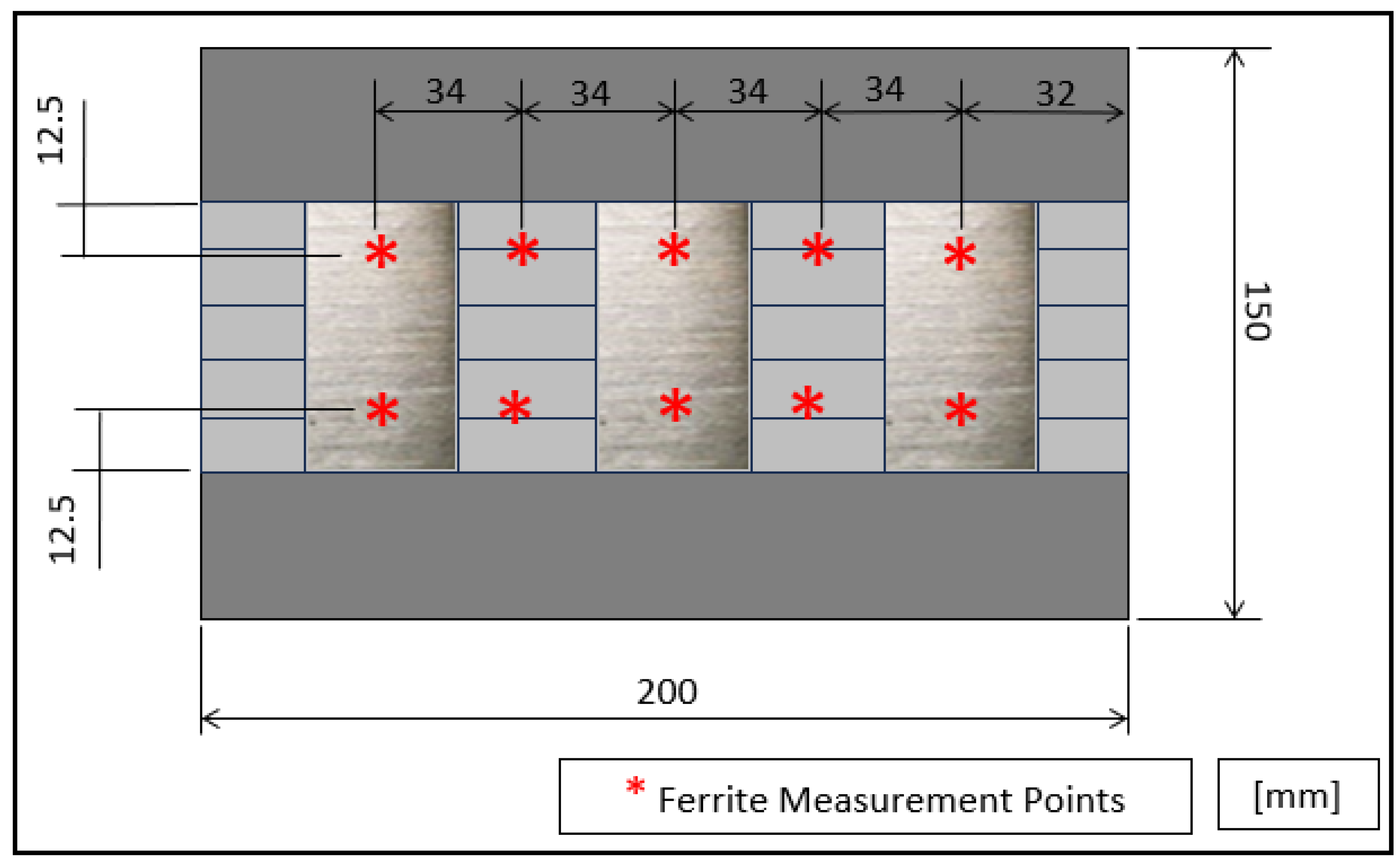
The ferrite fraction analysis was performed on both the as welded and the machined surfaces. The ferrite measurement locations are shown in Figure 6 and were selected to cover different regions of the weld overlay, including central bead areas and adjacent passes, ensuring a representative assessment of phase distribution.
As shown in Figure 6, ferrite measurements were performed at multiple predefined points across the weld overlay surface. This mapping strategy aimed to minimize local heterogeneities associated with bead geometry, overlapping regions, and surface roughness inherent to the as-welded condition.
Based on the measurement positions shown in Figure 6, the ferrite content was quantified at multiple points for each test coupon, and the individual values, along with the corresponding average ferrite content, are presented in Table 5. This approach allowed evaluation of both local variations and the overall ferrite balance resulting from each welding condition.
Table 5 summarizes the individual ferrite measurements obtained at each mapped position, as well as the corresponding average ferrite content calculated for each test coupon. The results reveal distinct ferrite levels among the samples, reflecting the influence of welding parameters and associated heat input on the phase balance of the duplex stainless steel cladding.
Even on rough surfaces, such as in the as-welded condition, ferrite measurements can remain reliable provided that the readings are averaged and deviations caused by improper probe positioning due to weld geometry are excluded. Several studies have supported and used this technique for ferrite-content measurement and have placed their trust in it, since it yields results comparable to quantitative metallography, which precisely and accurately determines the ferrite fraction. These results correlate well with those from studies using DSS processed in various ways [43].
The dispersion observed among individual readings reinforces the importance of using average values rather than isolated measurements when evaluating ferrite content in the as-welded condition.
The preliminary results showed that ferrite levels tend to decrease with increasing welding energy, as observed in measurements across the different test coupons. This tendency is consistent with the expected metallurgical response of duplex stainless steels subjected to higher heat input, which promotes increased austenite formation during cooling.

3.2. Macrographic Analysis of the Test Coupons

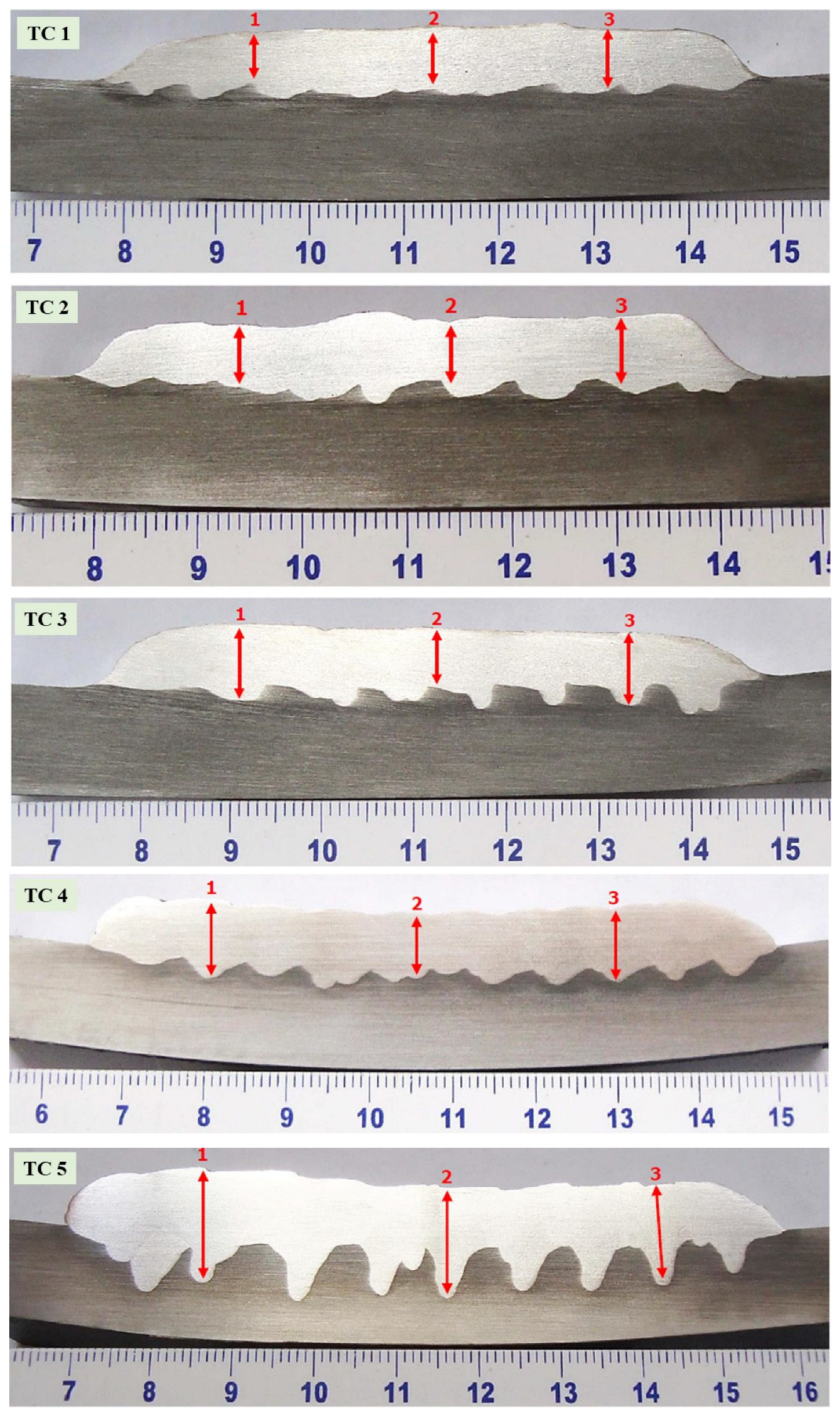
Figure 7 shows the macrographs of the test coupons obtained by optical microscopy after etching with 5% Nital, highlighting three distinct regions: the weld overlay, the HAZ, and the carbon-steel base metal. Macrographic analysis evaluated bead geometry, penetration behavior, dilution profile, and the presence of possible welding discontinuities.
As illustrated in Figure 7, all test coupons exhibited continuous, uniform weld overlays, with clear metallurgical bonding between the cladding layer and the carbon-steel substrate. The etched cross sections allowed clear visualization of fusion boundaries and penetration profiles, enabling reliable measurement of overlay thickness and qualitative inspection for macro-defects.
Based on the macrographs shown in Figure 7, the primary geometric features of the weld beads were assessed, and the welding overlay thickness measurements, as well as the presence or absence of welding discontinuities, are summarized in Table 6. Thickness measurements were performed at three identical locations across all cross sections, always at the same relative position along the weld bead. This approach was employed to ensure consistency and fairness in the comparative analysis, minimize the influence of longitudinal bead variability, and allow a reliable assessment of local geometric dispersion.
Table 6 presents the quantitative results from the macrographic analysis, including individual and average overlay thickness values, as well as a qualitative evaluation of welding discontinuities. The results demonstrate a progressive increase in overlay thickness with increasing welding heat input, reflecting the combined effects of higher deposition rate and deeper penetration.
The macrographic evaluation confirms that variations in welding energy also physically influence weld penetration and the geometry of the weld bead. Table 6 shows that increasing the welding heat input led to greater weld layer thickness, with TC5 showing the highest average value.
Despite variations in weld thickness and penetration, no weld discontinuities such as cracks, lack of fusion, or porosity were detected in any of the test specimens. This finding indicates that all welding parameters adopted in this study produced sound cladded layers with adequate metallurgical integrity, supporting the validity of subsequent microstructural and corrosion analyses.

3.3. Micrographic Analysis of Test Coupon

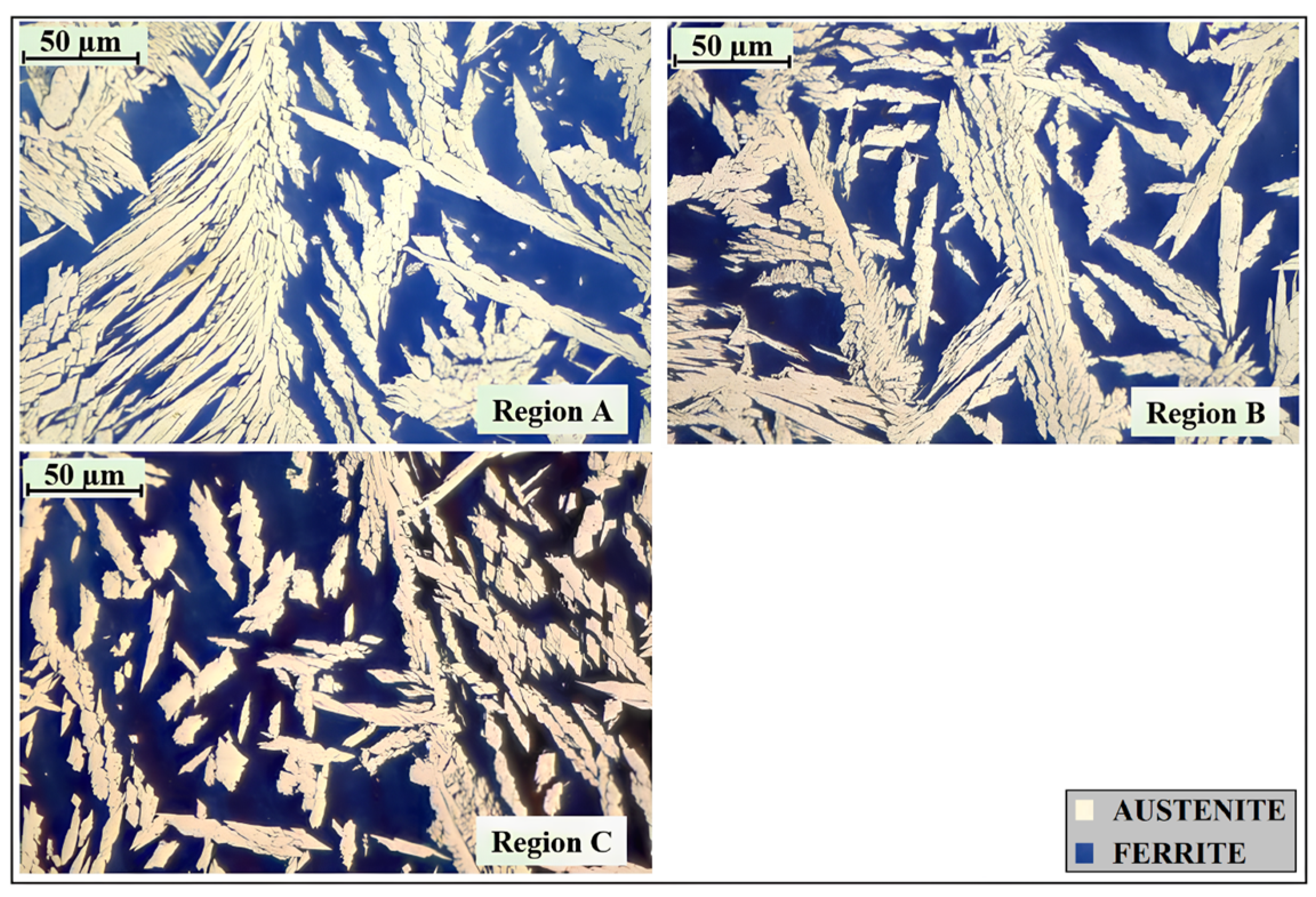
All test coupon (TC) micrographs were taken at 3.0 mm from the fusion line, showing a microstructure composed of an austenitic/ferritic matrix typical of DSS. Ferrite is shown in blue, while austenite appears in yellow. This fixed distance from the fusion line was selected to minimize the influence of dilution gradients and ensure consistent comparisons across all welding conditions. No deleterious phases, such as nitrides, carbides, or sigma phase, were observed. This absence of precipitates confirms the effectiveness of the interpass temperature control and heat-input management adopted during welding [6,13].
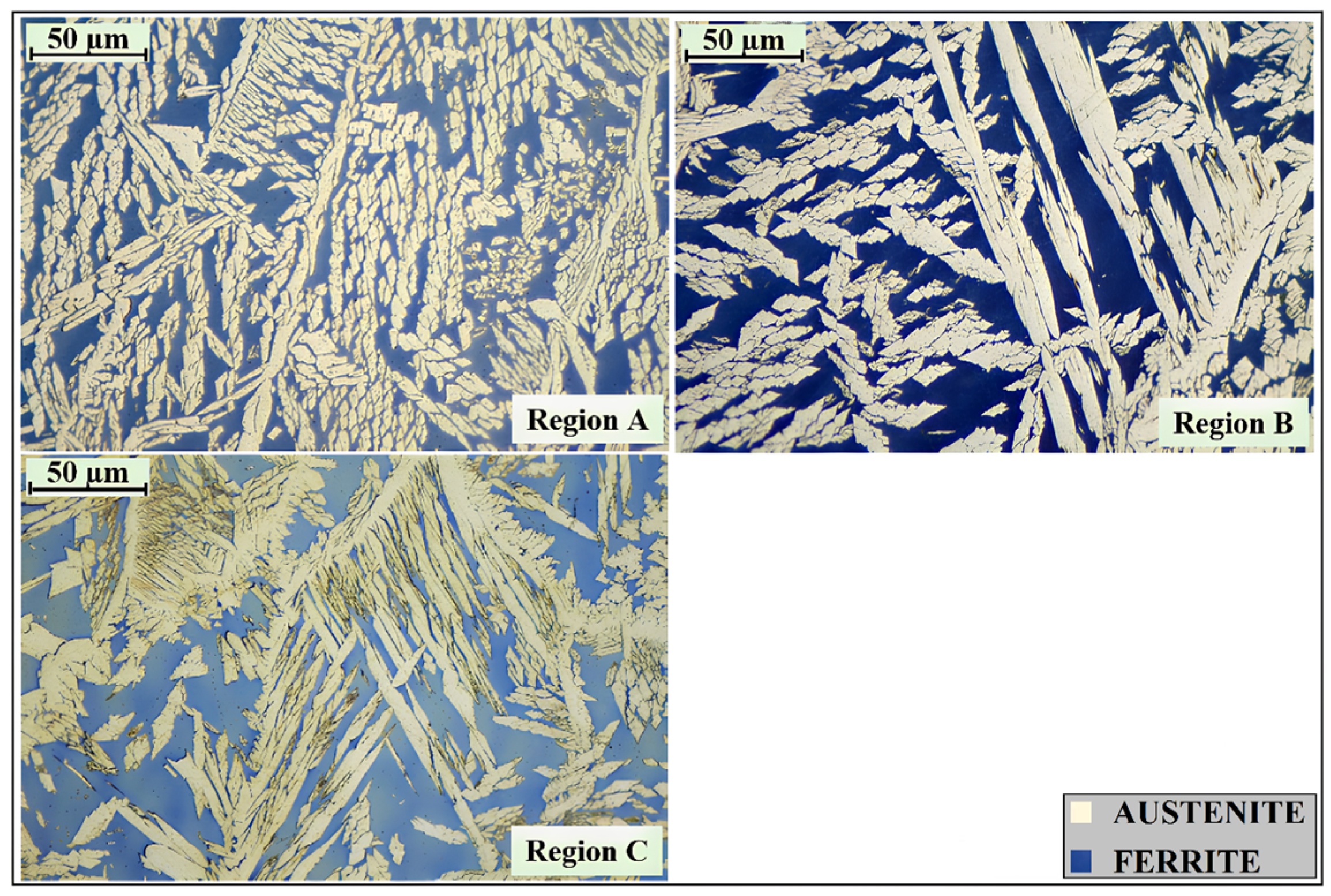
Figure 8 presents the micrographs of three distinct regions of TC1.
The microstructure presented in Figure 8 exhibits a characteristic matrix of DSS, with a ferrite content of 40%, 45%, and 52% in regions A, B, and C, respectively. The average ferrite percentage was 46%, which is close to the expected 50%, confirming the typical microstructure of DSS. The distribution of phases was uniform across all regions analyzed, with no evidence of deleterious phases. No brittle regions were detected [6,13,44].
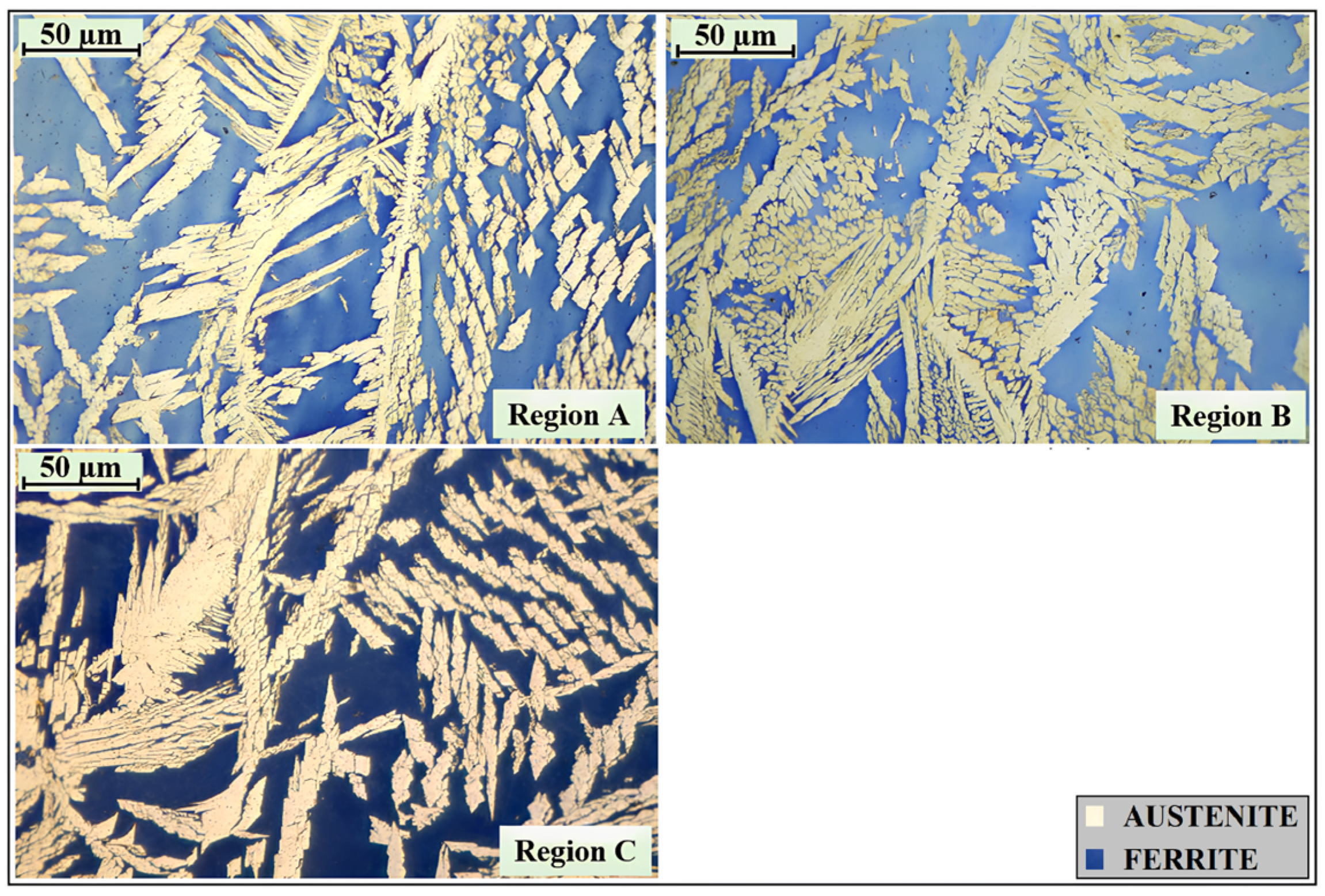
Figure 9 presents the micrograph of three regions of TC2.
Similar to TC1, the ferrite content in TC2 in Figure 9 was 45%, 50%, and 52% in regions A, B, and C, respectively, resulting in an average ferrite content of 49%. This balanced phase distribution confirms the typical microstructure of DSS. Again, no evidence of intermetallic phases or carbide/nitride precipitation was observed [6,13].
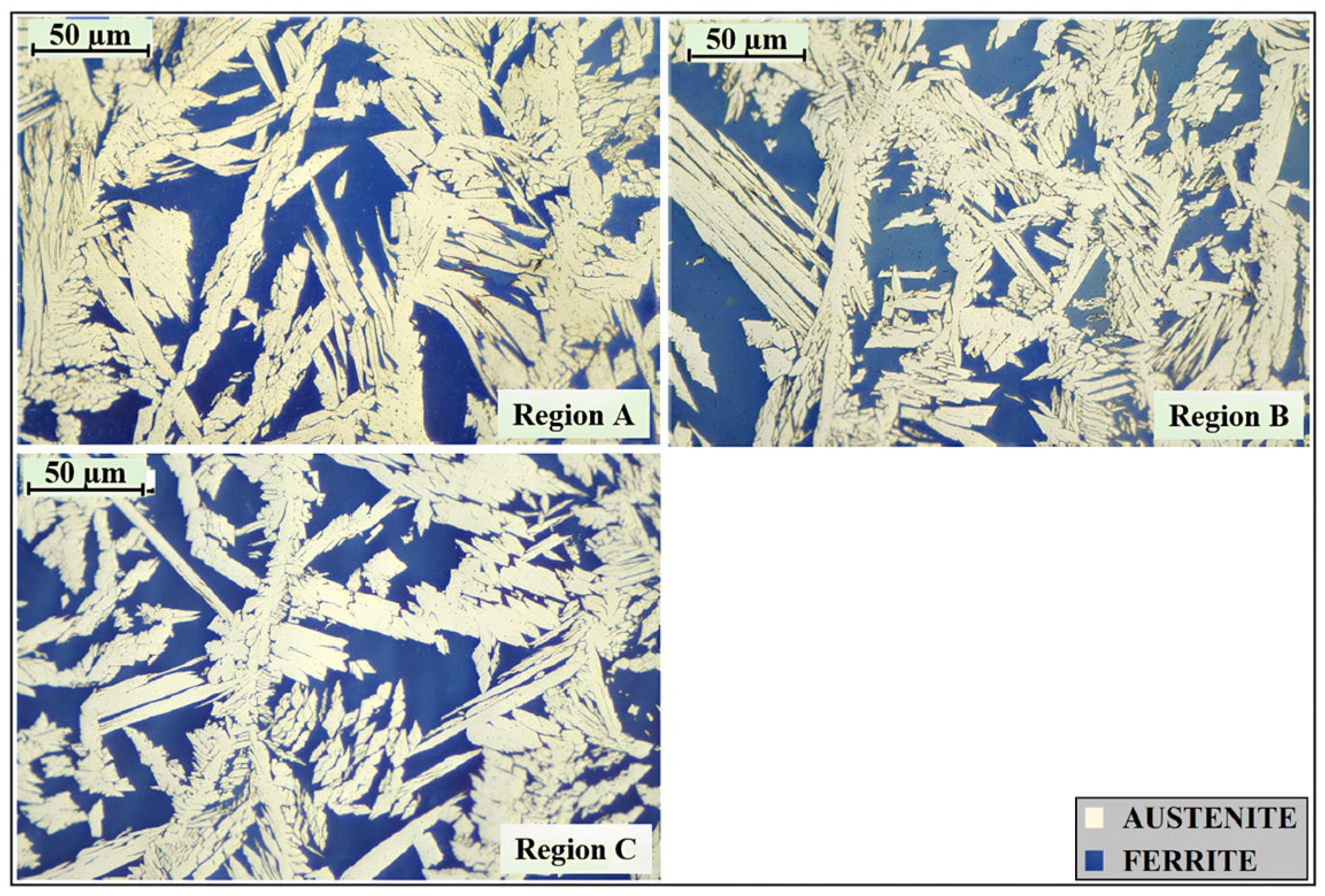
Figure 10 presents the micrograph of three regions of TC3.
The microstructure presented in Figure 10 maintains a balanced DSS composition, with ferrite contents of 50%, 50%, and 48% in regions A, B, and C, respectively. The average ferrite percentage of 49% is within the expected range. The absence of sigma and chi phases further reinforces the effectiveness of interpass temperature control in preventing the formation of these brittle intermetallic compounds [6,13].
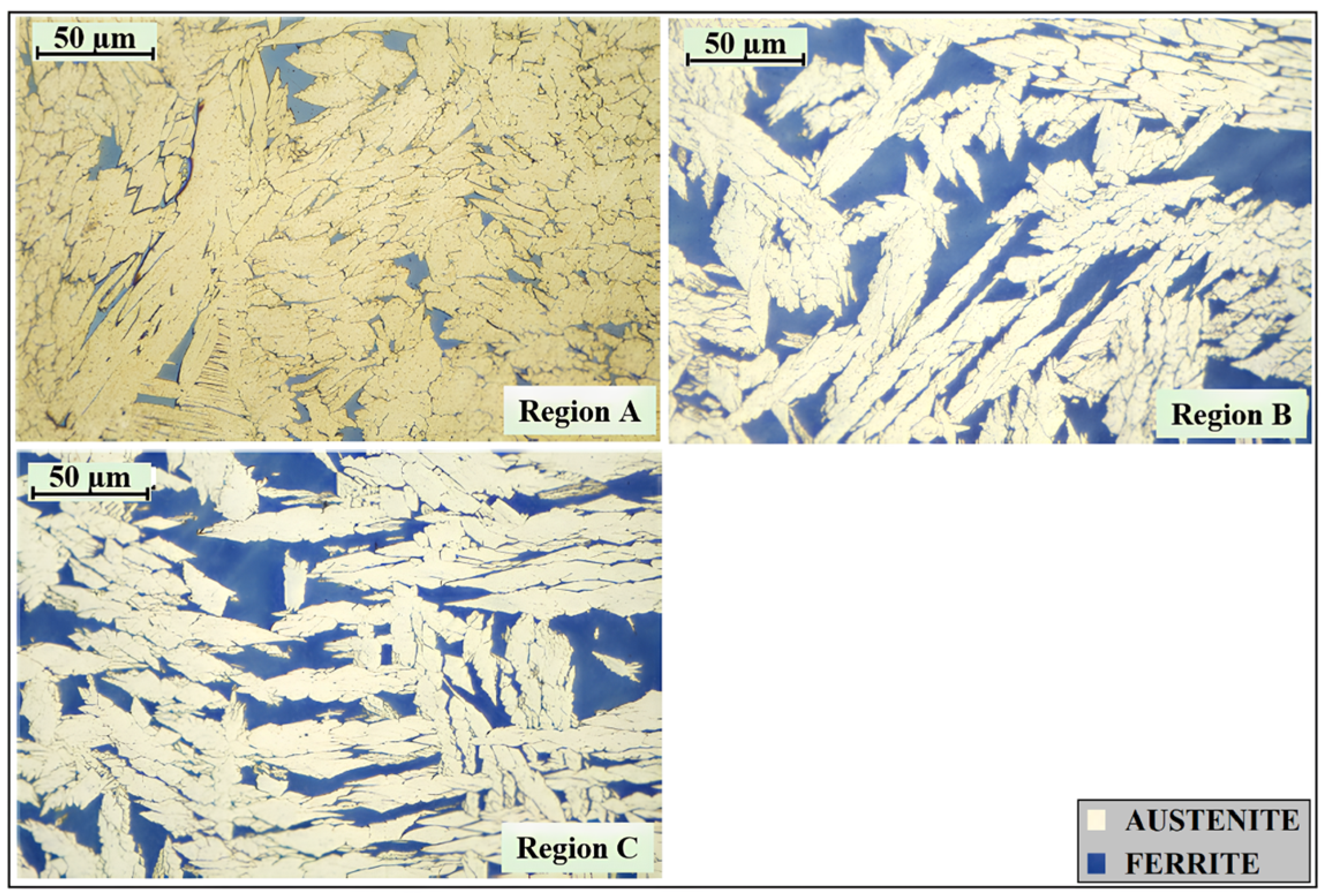
Figure 11 presents the micrograph of three regions of TC4.
The microstructure of TC4 presented in Figure 11 shows ferrite contents in the range of 35%, 38%, and 40% in regions A, B, and C, respectively, resulting in an average ferrite content of 37.6%. Although this is within the acceptable range of 35–65% as per manufacturing standards and procedures, the reduction in ferrite fraction is consistent with the higher heat input applied during mechanized welding, which favors austenite formation during cooling. However, no signs of deleterious phase formation or sensitization were found [6,13].
Figure 12 presents the micrograph of three regions of TC5.
The microstructure of TC5 shown in Figure 12 revealed significantly reduced ferrite contents of 15%, 31%, and 30% in regions A, B, and C, respectively, resulting in an average ferrite content of 25.3%. This value is below the minimum recommended ferrite threshold for duplex stainless steels, indicating a pronounced deviation in phase balance. No brittle regions, precipitates, or intermetallic phases were detected by optical microscopy [6,13,34]. However, the ferrite content observed in TC5 suggests an increased susceptibility to localized corrosion, which will be discussed in greater detail in the corrosion analyses presented in the following sections.

3.4. Corrosion Resistance and Pitting Evaluation

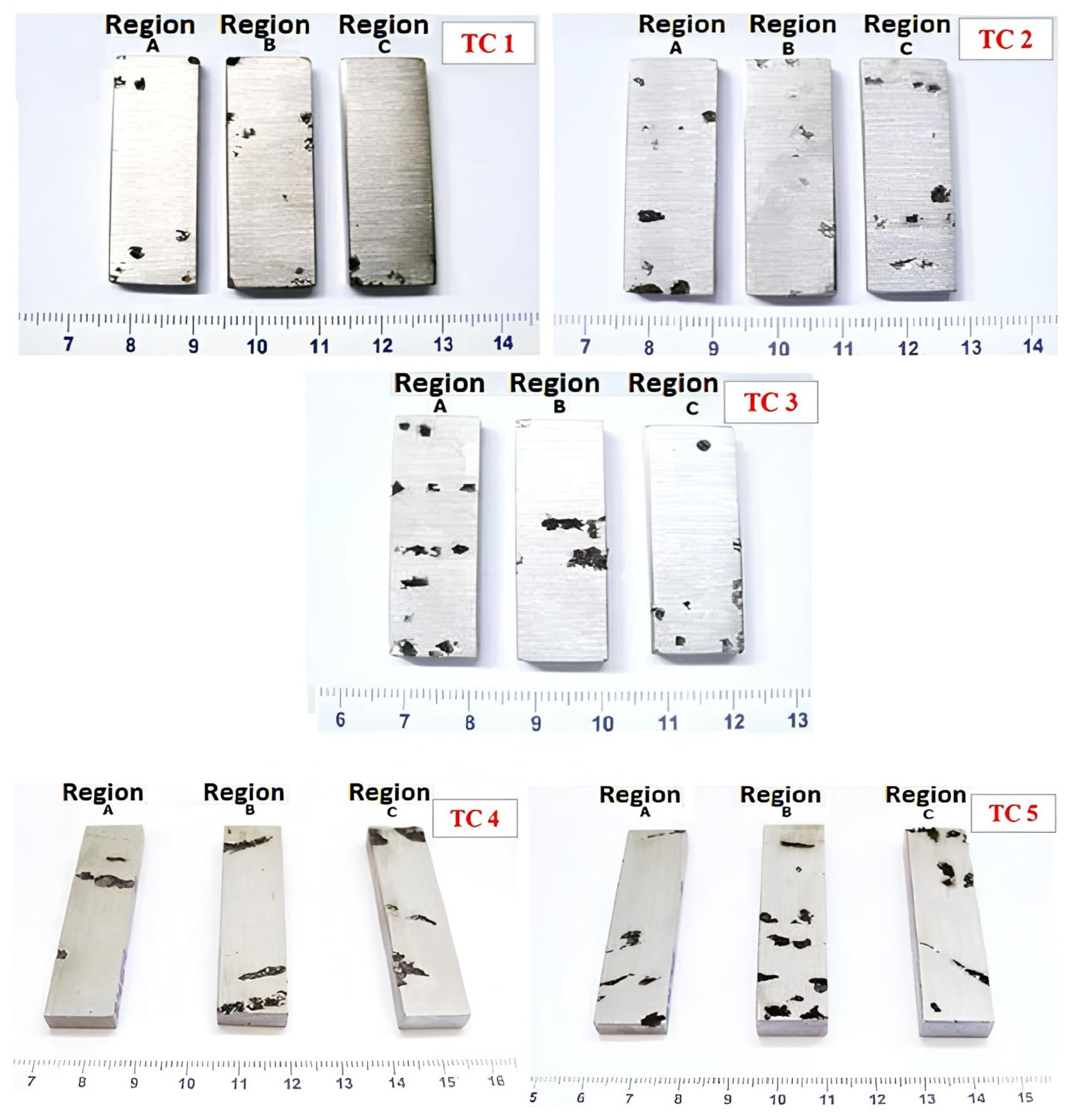
Figure 13 presents the surface condition of the three analyzed regions of each test coupon after exposure to the ASTM G48 Method A corrosion test. After completion of the test, the specimens were cleaned, aligned side by side, and photographed without magnification to enable a direct visual comparison of pitting morphology across different welding heat input conditions.
Based on the macroscopic appearance shown in Figure 13, a quantitative assessment of corrosion behavior was conducted. Specimen dimensions, initial and final masses, percentage mass loss, and corrosion rate (mass loss per unit area) are summarized in Table 7.
The data in Table 7 demonstrate that all samples experienced weight loss and exhibited signs of corrosion, with pitting observed in all analyzed regions. Although all specimens exhibited localized corrosion, significant differences in corrosion severity were detected among the test coupons. Variations in mass loss and corrosion rates indicate a strong dependence on welding conditions, particularly on the applied heat input and the resulting microstructural balance.
To quantitatively evaluate the relationship between ferrite content and corrosion mass loss, a Pearson correlation analysis was conducted. The correlation coefficient (r) was determined using Equation (2), in accordance with the Pearson correlation method [45].
r = ( x i x ¯ ) ( y i ȳ ) ( x i x ¯ ) 2 ( y i ȳ ) 2
where x i and y i represent the ferrite percentage and corrosion mass loss (g m−2) for each test coupon, respectively, and x ¯ and ȳ are their corresponding mean values.
From the data in Table 8, the average ferrite content and average corrosion mass loss were calculated as x ¯ = 40.84 and ȳ = 173.15 respectively. Using these values, the deviations from the mean were calculated for each test coupon. These deviations were then used to calculate the individual products between ferrite content and corrosion mass loss, as well as the squared terms required for the Pearson correlation coefficient, as detailed in Table 9.
The sums of each column are:
  • Σ x i x ¯ y i ȳ = 1674.82
  • Σ x i x ¯ 2 = 330.69
  • Σ y i ȳ 2 = 14,094.99
Substituting these values into the Pearson formula gives:
r   =   1674.82 330.69   × 14,094.99   =   0.776
This result confirms a strong negative correlation between ferrite content and corrosion mass loss. TCs exhibiting excessive ferrite reduction, associated with high welding heat input, tended to present higher corrosion rates. This behavior is ascribed to the loss of phase balance and chemical homogeneity between ferrite and austenite, which compromises passive film stability in duplex stainless steels.

3.5. Ferrite Control on the Machined Surface

The second ferrite measurement was carried out to compare the test results for the as-welded (raw) condition with those for the prepared TSs, which had their surfaces removed by mechanical machining. Table 10 presents the results of ten measurements performed with the Ferritoscope on the intermediate TSs that were not subjected to testing, as shown in Figure 6.
The results shown in Table 10 indicate that the ferrite contents measured on the machined surfaces were consistent with those obtained on the as-welded surface and with those determined by quantitative microstructural analysis. For TC1, TC2, and TC3, the average ferrite contents remained close to the expected values for duplex stainless steels, with relatively low standard deviations, indicating good measurement repeatability after surface preparation. TC4 showed average ferrite values of 38%, within the minimum acceptable limit of 35% commonly specified for DSS weld overlays. In contrast, TC5 exhibited the lowest ferrite content among all test coupons, with an average of 24.8% and the highest standard deviation. This higher dispersion suggests greater local microstructural heterogeneity, consistent with the elevated heat input during welding in this condition.
To provide an integrated interpretation of the experimental results, the main welding parameters, geometric characteristics, and corrosion performance indicators were consolidated and presented in Table 11.
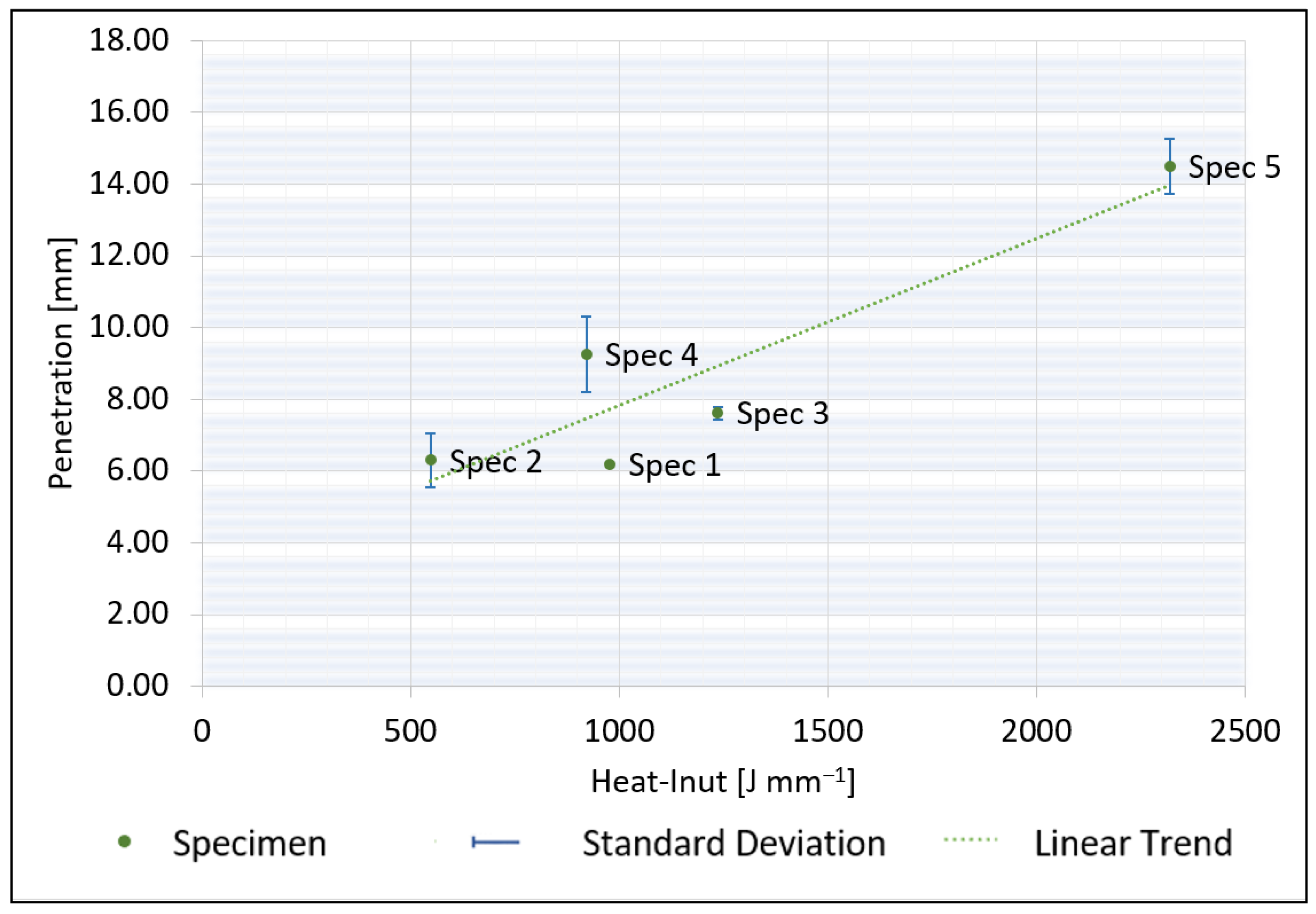
As shown in Table 11, increasing the welding heat input resulted in a marked increase in weld penetration depth. Despite the relatively high dispersion observed in some conditions, a clear trend of increasing penetration with higher heat input is evident. TC1 and TC2, welded under normal and low heat input conditions, had average penetration values of 6.2–6.3 mm, whereas TC5, welded with the highest heat input, exhibited an average penetration of 14.48 mm.
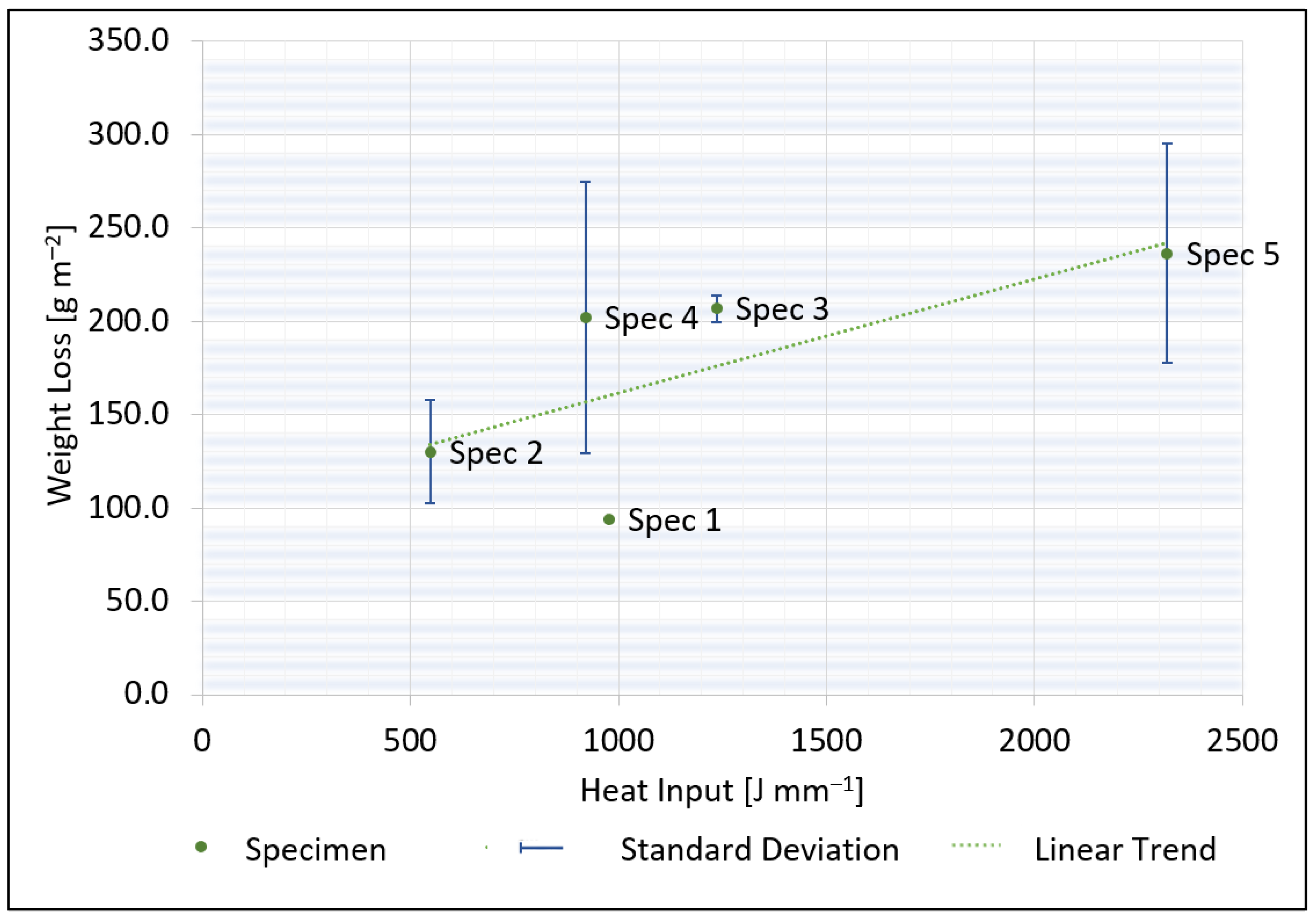
A similar trend was observed for corrosion behavior. Even with the high dispersion associated with the limited number of measurements, the results indicate a clear tendency toward increased corrosion weight loss with increasing heat input. Test coupons welded under higher heat input conditions exhibited significantly greater corrosion mass loss, with TC3, TC4, and TC5 presenting values above 200 g m−2. These results reinforce the strong influence of welding thermal cycles on both geometric dilution and the corrosion performance of the duplex stainless-steel overlay.
To further validate the ferrite measurements and evaluate agreement among different characterization techniques, a comparative analysis was conducted using three independent methods: Ferritoscope measurements on the as-welded surface, quantitative optical microscopy, and Ferritoscope measurements on the machined surface.
The data presented in Table 12 demonstrate good agreement among the three ferrite measurement methods. For TC1, TC2, and TC3, the differences between techniques were minimal, confirming the reliability of magnetic induction measurements even in the as-welded condition. For TC4, all three methods consistently indicated ferrite contents close to 38%, reinforcing the borderline but acceptable phase balance observed in the microstructural analysis. For TC5, all methods confirmed ferrite contents well below the recommended minimum, with average values close to 26%, clearly evidencing the strong effect of excessive heat input on ferrite depletion.
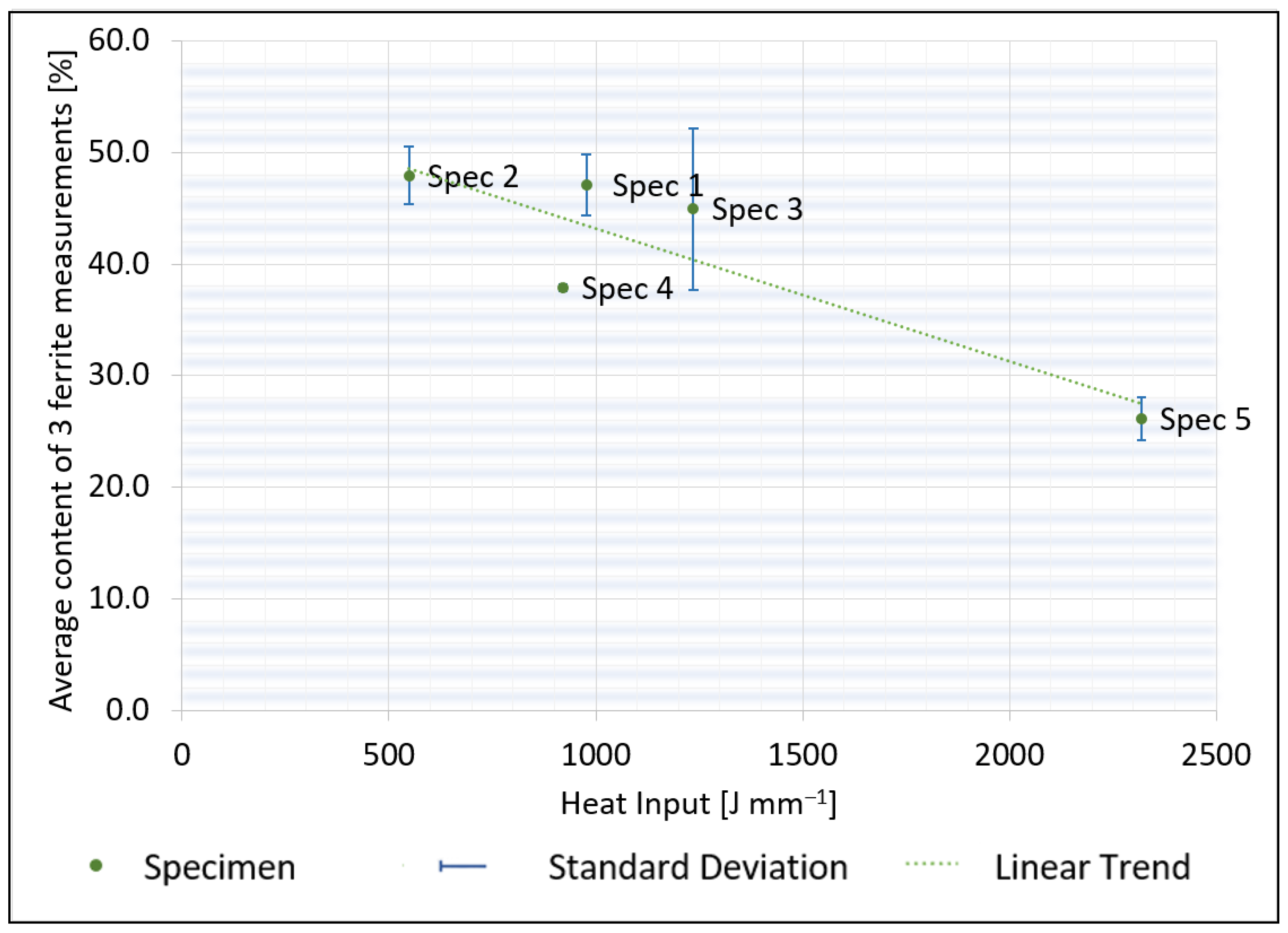
The correlations between welding heat input and the main experimental responses are depicted in Figure 14, Figure 15 and Figure 16, which provide graphical interpretations of the trends identified in the previous tables.
Figure 14 clearly shows that penetration depth increases progressively with heat input. The relationship is nearly linear within the studied range, indicating that higher arc energy promoted deeper melting of the base metal and increased dilution.
As illustrated in Figure 15, ferrite content decreases as heat input increases. The three measurement methods show the same trend, confirming that excessive heat input extends the cooling time and promotes the ferrite-to-austenite transformation during solidification and subsequent cooling.
Figure 16 demonstrates a clear increase in corrosion mass loss with increasing heat input. Test coupons welded with higher thermal energy exhibited greater susceptibility to pitting corrosion, consistent with the observed reduction in ferrite content and increased dilution. Among all evaluated conditions, TC1 presented the lowest average corrosion mass loss, along with moderate penetration depth and highly consistent ferrite content across the three measurement techniques, indicating a more balanced combination of geometric, microstructural, and corrosion performance characteristics.

4. Discussion

4.1. Discussion of Control of Ferrite as Welded

The results indicate a direct relationship between welding energy and microstructural variation. A lower heat input led to a higher ferrite fraction, while excessive heat input promotes the formation of austenite. This behavior is consistent with the phase-transformation kinetics reported for duplex stainless steels, in which prolonged cooling times favor austenite formation, whereas rapid cooling limits it [8].
Heat input plays a key role in the solidification process of duplex stainless steel. Longer diffusion times allow more austenite to form, leading to microsegregation of alloying elements and directly impacting corrosion resistance, as regions with lower levels of elements such as chromium and molybdenum are more vulnerable to corrosion [8,46].
The results confirm that ferrite content decreases with increasing welding energy, a trend consistently observed in experimental studies involving DSS weld overlays and commonly identified through techniques such as ferritoscopy, as reported in previous studies [33,34].
Overlay welding and additive manufacturing share important similarities, particularly regarding the variation in ferrite content resulting from the overlap of successive welding passes. A parallel can be established between cladding welding and additive manufacturing studies, in which ferrite content is significantly influenced by the thermal cycles imposed by the superposition of successive layers. In the present analysis, only the ferrite content of the coating’s outermost layer was evaluated, as this is the most critical region and the one that will be in direct contact with the service fluid during operation. Similar behavior has been reported in DSS subjected to multiple thermal cycles, in which phase-balance variations are observed across successive deposited layers [10,47,48].

4.2. Discussion of Macrographic Analysis of the Test Coupons

The observed increase in weld layer thickness with increasing heat input is consistent with previous studies on this behavior, which indicate that higher heat input promotes greater material deposition and the formation of wider, deeper weld beads due to improved fusion between the filler metal and the substrate [49,50].
This behavior is inherent to welding processes, in which higher heat input increases penetration and modifies the weld bead profile. This phenomenon occurs when higher thermal energy is applied, whether electrical, thermal, or from a laser source, causing the base metal to melt. In cladding welding applications, this allows deep penetration and fusion between the weld metal and the substrate [51]. In this manner, in cladding welding, higher heat input leads to increased penetration, resulting in reduced base-metal thickness and increased dilution [19,52].
Despite variations in weld penetration, no welding discontinuities, such as cracks, lack of fusion, or porosity, were identified in any of the specimens. These results indicate that, even when extrapolated welding parameters were employed, the process remained sufficiently controlled to ensure adequate metallurgical bonding and to prevent the formation of defects in the cladding weld that could compromise structural integrity [22,52,53]. The results align with current research, which highlights the impact of heat input on weld penetration and base-metal integrity.
An increase in heat input enhances penetration; however, excessive values may intensify dilution and thermal distortion, negatively affecting overlay performance. It is important to follow proper welding parameters, as they directly affect heat input, to avoid inhomogeneous weld profiles, solidification defects, and excessive dilution of the base metal, which can compromise the mechanical and corrosion resistance of the welded region [19,22,52].

4.3. Discussion of Micrographic Analysis of Test Coupon

The absence of deleterious phases such as nitrides, carbides, and sigma phase in all test coupons confirms the effectiveness of interpass temperature control during welding [5,14]. The ferrite contents observed in TC1, TC2, and TC3 are close to the ideal DSS phase balance of approximately 50%, ensuring adequate mechanical properties and corrosion resistance [6,13,44].
For TC4, although the average ferrite content of 37.6% is within the acceptable manufacturing range of 35–65%, the lower ferrite fraction indicates a tendency towards austenite enrichment, which may impact corrosion resistance. Even under these conditions, no evidence of deleterious phase formation was detected [6,13].
In contrast, TC5 exhibited a lower average ferrite content of 25.3%, indicating a pronounced deviation from the expected phase equilibrium for DSS. This ferrite level increases susceptibility to localized corrosion and is deemed unacceptable, as it falls below the recommended minimum ferrite content of 35%. This deviation is primarily ascribed to excessive heat input, which prolongs cooling time and promotes austenite formation at the expense of ferrite [6,13,34].
Despite the low ferrite content, no brittle intermetallic phases were identified, indicating that interpass temperature control effectively prevented the precipitation of σ, χ, carbides, and nitrides, which are known to deteriorate the mechanical and corrosion properties of DSS [9,18,52,54].
The results demonstrate that deviations from the recommended ferrite range directly influence corrosion behavior, particularly under high-heat-input conditions. The absence of brittle phases, even under unfavorable phase balance conditions, highlights the effectiveness of interpass temperature control [9,18,52,54].
The interaction between heat input and cooling rate plays a fundamental role in the evolution of the weld microstructure. This relationship has been extensively investigated due to the inherent difficulty in controlling thermal conditions during welding. Slower cooling rates favor the transformation of ferrite to austenite, thereby improving mechanical properties. However, excessive heat input may promote the formation of secondary phases, such as intergranular austenite and sigma phase, leading to reduced mechanical strength, increased brittleness, and decreased corrosion resistance [11,15].
In addition, samples exhibiting greater phase imbalance were more severely affected during corrosion testing, indicating a clear relationship between microstructural instability and increased susceptibility to localized corrosion. This behavior is consistent with the requirement for phase balance in duplex stainless steels, as it ensures a more uniform distribution of alloying elements and enhances resistance to pitting corrosion.

4.4. Discussion of Corrosion Test—ASTM G48 Method A

The chemical composition and content of elements such as chromium, molybdenum, and nitrogen are essential to ensure resistance to pitting corrosion; however, the manufacturing process, specifically welding, is also a determining factor in corrosion behavior, influencing the alloy’s resistance in aggressive environments. This behavior is consistent with previous studies evaluating the corrosion resistance of duplex stainless steels (DSS), which found that increasing welding energy results in greater mass loss and higher corrosion rates, thereby demonstrating the significant influence of welding parameters on the material’s corrosion behavior [55,56,57].
Studies indicate that increased heat input during welding alters the ferrite/austenite ratio, creating a microstructural imbalance that reduces corrosion resistance. A higher energy input can lead to a reduction in ferrite content, which promotes the depletion of chromium and molybdenum in the austenite phase, thereby reducing its corrosion resistance [8,46]. Adequate thermal cycle control was essential to prevent the formation of intermetallic phases such as sigma (σ) and chi (χ), which are recognized as preferential sites for pit initiation and significantly increase mass loss during corrosion testing [8,30,46,57].
The results obtained are consistent with previous studies, particularly those emphasizing mechanized welding processes, notably in TC4 and TC5, which demonstrated better process control and, consequently, greater corrosion resistance. These processes exhibit enhanced stability and reduced thermal gradients due to the elimination of the human factor. This trend is evidenced by the lower average mass loss observed in TC4 (1.05%) and TC5 (1.42%) compared to the manual welding processes. In contrast, manual welding, as seen in TC1, TC2, and TC3, showed greater variability in mass loss, with averages of 0.78%, 1.14%, and 1.76%, respectively, reflecting greater fluctuations in heat input that can induce localized changes in corrosion susceptibility [8,19,30,46,57].
The corrosion behavior observed in this study demonstrates a direct relationship with the microstructure. Test coupons (TCs) with ferrite content near 50%, such as TC1 and TC2, showed the lowest mass loss, while TC5, with the lowest ferrite content, showed the highest mass loss. Although no brittle intermetallic phases were observed due to temperature control between passes, the altered phase equilibrium affected corrosion resistance. Thus, even in the absence of sigma phase or other harmful precipitates, the decrease in ferrite can lead to localized corrosion.
The Pearson correlation coefficient of r = −0.776 confirms a strong negative correlation between ferrite content and corrosion mass loss. Test coupons with lower ferrite contents tended to exhibit higher corrosion rates. This trend is consistent with the established role of ferrite in stabilizing the passive film in duplex stainless steels. It reinforces the importance of controlling heat input during welding to maintain phase equilibrium and corrosion resistance.

4.5. Discussion of Ferrite Control on the Machined Surface

This analysis is not commonly performed during pressure vessel or heat exchanger manufacturing; however, it provides valuable insight into the influence of surface condition on ferrite measurements. Surface irregularities, oxidation, and inadequate probe coupling can affect magnetic measurements, as reported in previous studies and manufacturer recommendations [57,58,59,60].
The ferrite content in DSS directly governs mechanical and corrosion properties. Significant deviations from the ideal 50/50 ferrite–austenite balance caused by welding thermal cycles directly affect performance in aggressive environments [4,10,48].
The results obtained were close to those from micrographic analysis and measurements on the as-welded surface, demonstrating the reliability of the equipment and procedures, even when applied to irregular surfaces. Several methods are available for ferrite quantification in DSS, each presenting specific advantages and limitations [10,48,54]:
-
Image analysis is considered the most accurate technique, as it provides a detailed visualization of the microstructure and enables precise phase quantification. However, this method requires destructive surface preparation, which may not always be feasible.
-
Ferritoscopy offers a non-destructive alternative that can be applied immediately after welding with minimal surface preparation. Although it is not the most precise method, it provides reliable reference values when performed by qualified personnel using appropriate calibration curves.
-
The Magne-Gage, a legacy technique progressively replaced by ferritoscopy, generally yields higher ferrite values and greater data dispersion, despite conceptual similarities with the Ferritoscope.
Non-destructive ferritoscope measurements have shown a strong correlation with metallographic and EBSD analyses, confirming their reliability even on irregular surfaces [10,48,54].
Regarding the corrosion resistance of DSS, previous studies indicate that variations in ferrite content can significantly affect pitting-corrosion resistance, not only because of the intrinsic corrosion behavior of each phase, but mainly due to the combined effects of phase balance and chemical homogeneity between ferrite and austenite. Although ferrite is generally considered less resistant to localized corrosion than austenite in chloride-rich environments, both excessive ferrite reduction and excessive ferrite retention are detrimental. Under such conditions, prolonged thermal exposure, increased dilution, and altered solidification conditions may promote chemical segregation, locally reduce the PREN of the austenite phase, and disrupt the synergistic interaction between ferrite and austenite that is essential for stable passivation. Therefore, maintaining an adequate phase balance within the recommended range is critical to ensure both corrosion resistance and microstructural stability, particularly in surfacing welds applied for corrosion protection where mechanical requirements are secondary. However, corrosion performance is paramount [55,56,61].
TC1 showed the lowest average weight loss and is considered the reference test coupon adopted for overlay welding of this joint type. The penetration obtained was 6.2 (mm), and the ferrite contents measured by the three verification methods were very close, indicating good consistency among the techniques. TC2 showed a greater mass loss than TC1. Even so, the ferrite contents obtained were close to the desired 50%, with penetration close to the first TC.
TC3, with the increase in heat input, had a surface layer with a low ferrite content of 36.6%, approaching the critical content considered by several authors, which is 35%. Furthermore, it exhibited the most significant penetration among the first three manually welded TCs. These results corroborate what some authors claim: in DSS, the ferrite content tends to decrease with increasing welding energy because solidification begins in a ferritic matrix, followed by the formation of austenite in isolated regions (‘islands’). As the cooling rate decreases with higher heat input, more time is available for the ferrite-to-austenite transformation, increasing the austenite content and potentially disrupting the 50/50 phase balance [4]. The ferrite values, both under the microscope and on the prepared surface, were close to the desired levels and to each other, indicating the effectiveness of both methods for verifying the ferrite content [7].
TC4 and TC5 are discussed separately to avoid misleading comparisons. Although other experimental variables were unchanged, the mechanized welding condition must be considered. TC4, welded according to the specified welding procedure, remains suitable for this process. However, its surface layer presented a low ferrite content of 38.2%. The ferrite content under the microscope was 37.6%, and on the prepared surface was 38.0%. It showed penetration greater than TC1, but the change in the consumable diameter can explain this. TC5 had the highest heat input of the five TCs studied, and, in turn, this significant increase resulted in a very low ferrite surface layer of 28.4%. Ferrite values, both by microscopy and on the prepared surface, were very low, close to 25%.
Surface roughness directly affects measurements and cannot be ignored, especially when magnetic induction devices such as the Ferritoscope are employed. Even though corrosion is a chemical or electrochemical process, physical characteristics such as surface roughness can influence and worsen corrosion susceptibility [61,62]. Roughness is inherent in mechanical manufacturing processes such as welding and machining. It consists of microscopic surface irregularities, called peaks and valleys, typically assessed using parameters such as Ra [µm] (mean roughness), which measures the average height of surface deviations from an imaginary centerline [63].
Studies and research show that surface roughness affects the behavior and propagation of corrosion, particularly by influencing passive film stability and facilitating pit nucleation. Smooth surfaces tend to offer better corrosion resistance. In contrast, rougher surfaces, especially those resulting from welding or machining processes, have a larger exposed area due to the increased perimeter associated with surface peaks and valleys, thus providing more preferential sites for pitting initiation. Studies on machining parameters indicate that feed rate and depth of cut affect surface roughness and surface hardening, which, in turn, influence corrosion resistance. In the present study, although surface roughness was not quantitatively measured, all welded specimens were subjected to identical post-welding surface preparation procedures, including grinding and polishing, thereby minimizing variability related to surface condition among the samples [64].
Welding and machining are manufacturing processes that alter surface conditions, which can affect measurement results. For example, in welding, stable torch positioning and travel speed can reduce or increase surface irregularity, while in machining, selecting parameters for fine finishing improves surface quality and reduces mass loss due to pitting corrosion [27,65].
Although consolidated studies show that roughness affects the intensity of pit nucleation and growth, it does not appear to influence the preferential location of pits in the microstructure. There are also studies showing that polishing and surface finishing affect both phases uniformly in DSS, without altering corrosion selectivity [59]. Thus, the differences in ferrite content measurements between raw and machined surfaces can be partially attributed to physical irregularities in the raw weld bead, which interfere with probe coupling but do not invalidate the general phase distribution trends observed.
To ensure the reliability of the ferrite content, the average values of each measurement method (raw surface, machined surface, and microscopic counting) can be compared using the standard deviation as a reference to establish a margin of error and tolerance. This approach allows defining a margin of measurement uncertainty and assessing data consistency [58]. Although some variation was observed, particularly in TC5, the overall trends remained consistent among all measurement methods. It is important to note that industrial procedures and technical standards for DSS welding often allow deviations of up to ±15% from the theoretical ferrite content of 50%, resulting in an acceptable range of 35% to 65% [33,34]. Although not all measurements in this study fall strictly within this window, the observed differences are small relative to the wide industrial tolerance, reinforcing the reliability of the measurement strategy. Regardless of the method adopted to verify ferrite content, there is assurance that the value found is acceptable and within industry practice.
Mechanized welding is important to ensure repeatability and control during surfacing operations, and this research aimed to eliminate the human factor, which is more susceptible to variations in torch angle, travel speed, and arc length. Mechanized welding allows precise control of key parameters such as heat input, wire feed rate, and interpass time. This stability is even more evident when examining the standard deviation in Table 12, where a significant reduction in variation was observed for the mechanized process.
These results suggest that although mechanized welding can achieve deeper penetration and greater dilution with a higher heat input, it also offers advantages in process control, consistency, and repeatability.
The high-heat-input conditions, combined with an increased consumable diameter, resulted in greater penetration, which requires careful control, as the carbon steel substrate must maintain mechanical resistance and should not be excessively diluted or penetrated during the welding process, particularly in high-pressure equipment. Although larger electrodes, which require higher currents, are ideal for high deposition rates, their tendency to increase penetration must be controlled to avoid compromising structural integrity [7,27].
It is important to remember that, during the mechanical calculation stage, pressure vessels and heat exchangers made of clad plates have mechanical resistance provided by the thickness of the CS. Therefore, even if the DSS has superior mechanical properties, this is not considered in the design; the only function of the DSS is to provide corrosion resistance [27].
In Figure 16, a linear trend is apparent in the increase in weight loss with rising heat input. The graphs and results indicate that it is important to follow the specified procedure or recommendation from the consumable supplier to achieve a balance between mechanical properties, such as penetration, and chemical properties, including weight loss and ferrite content. This control is crucial for achieving the desired result.
Among the tested conditions, TC1 (heat input ~977 (J mm−1)) was identified as the optimal welding procedure based on a comprehensive trade-off analysis considering three critical performance criteria:
(i)
corrosion resistance (Corrosion Mass Loss (g m−2));
(ii)
penetration depth and dilution control (Avg Penetration (mm));
(iii)
phase balance stability (Avg Ferrite);
Table 13 summarizes the comparative performance of all test coupons across these criteria.
The selection of welding parameters involves a critical trade-off analysis between metallurgical integrity and operational efficiency. While increasing the heat input enhances productivity through higher deposition rates, it simultaneously elevates the risk of deleterious phase precipitation. Conversely, overly low heat input values, while beneficial for cooling rates in some contexts, may lead to a lack of fusion and an unbalanced ferrite-austenite ratio due to suppressed transformation kinetics.
TC1 exhibited the lowest corrosion mass loss, 93.78 g m−2, which was 28% lower than TC2 and 55% lower than TC3, despite all three being manually welded. This superior corrosion performance is directly linked to its near-ideal ferrite content 47.1%, which remained closest to the target 50/50 phase balance among all specimens. The Pearson correlation r = −0.776 confirms that this phase balance is the dominant factor governing pitting resistance in the tested overlays.
From a geometric standpoint, TC1 achieved adequate penetration of 6.2 mm without excessive dilution of the carbon-steel substrate. In contrast, TC3 7.62 mm and especially TC5 14.48 mm exhibited significantly deeper penetration, which increases the risk of compromising the mechanical integrity of the base metal, a critical concern in pressure vessel applications where the carbon-steel substrate provides structural strength. Excessive penetration also increases the dilution ratio, potentially altering the overlay’s chemical composition and reducing its corrosion resistance.
Additionally, TC1 demonstrated excellent phase balance consistency across multiple measurement methods Ferritoscopy on raw and machined surfaces, and optical microscopy), with a standard deviation of only 2.72%. This consistency indicates good process control and reproducibility, which are essential for industrial qualification and quality assurance.
While TC2 548 J mm−1 achieved slightly higher ferrite content 48.0% and comparable penetration 6.3 mm, its corrosion performance was inferior to TC1 130.09 vs. 93.78 g m−2, likely due to greater variability in heat input during manual welding, standard deviation 7.01 vs. 27.59 g m−2 for TC1. TC4, although mechanized and showing better process stability, exhibited a lower ferrite content of 37.9% and higher corrosion mass loss 201.84 g m−2 due to its proximity to the lower acceptance limit.
Therefore, TC1 represents the optimal balance among the competing requirements of DSS overlay welding: maximizing corrosion resistance through phase balance control, maintaining adequate but not excessive penetration to preserve substrate integrity, and ensuring process reproducibility for industrial implementation. This multi-criteria justification provides more explicit guidance for selecting welding parameters in similar cladding applications for pressure vessels and heat exchangers.

5. Conclusions

This study investigated the influence of welding heat input variation on the microstructure and corrosion resistance of DSS overlays deposited on carbon steel. The main findings are summarized below:
-
A direct relationship between welding energy and ferrite content was observed. A lower heat input of 548 J mm−1 resulted in a near-ideal ferrite content of approximately 49%. In contrast, a higher heat input of 2319 J mm−1 promoted excessive austenite formation, reducing the ferrite content to approximately 25%, a level considered unacceptable according to commonly accepted limits.
-
Mechanized welding provided greater process stability, reducing variations in ferrite content and the variability of corrosion resistance, and exhibited more uniform bead geometry. In contrast, manual welding exhibited greater deviations, increasing the risk of localized corrosion.
-
Corrosion tests (ASTM G48 Method A) show that higher heat inputs tend to increase mass loss, with TC5 showing the highest weight loss of 236.33 g m−2, while TC1, welded with a heat input considered ideal, had the lowest weight loss of 93.78 g m−2.
-
Excessive penetration was observed under high-heat-input conditions, which may compromise the mechanical integrity of the coating, since, in clad plates, the carbon-steel substrate provides the primary mechanical resistance.
-
No intermetallic phases or brittle regions were detected, even with high heat input, confirming that strict control of the interpass temperature below 120 °C effectively prevented the formation of sigma (σ) and chi (χ) phases, ensuring that these phases did not interfere with the corrosion test results.
The importance of optimizing heat input to balance phase distribution, penetration, and corrosion resistance in DSS overlays was demonstrated.
As for future studies, scanning electron microscopy (SEM) (JEOL USA, INC, Peabody, EUA) can be used to examine welds for possible secondary phases, thereby further strengthening the results already obtained. Furthermore, SEM observations of the samples after corrosion testing can provide improved identification of the onset and progression of localized corrosion.
In this context, future investigations should not be limited to mass-loss measurements. However, they should also include a systematic evaluation of pit density, pit depth, and pit morphology, providing a more comprehensive characterization of pitting corrosion behavior. The combination of SEM analysis with energy-dispersive X-ray spectroscopy (EDS) (JEOL USA, INC, Peabody, EUA) would allow the identification of preferential corrosion sites and possible compositional heterogeneities associated with pit initiation and growth.
Future work will also aim to expand the data set and the number of samples, incorporating statistical modeling tools such as analysis of variance (ANOVA) and multivariate analysis to achieve more robust and statistically significant interpretations. Additionally, the application of a structured design-of-experiments (DOE), such as Taguchi methods or response surface methodology (RSM), will be considered to optimize welding parameters and better establish relationships between process variables and performance indicators, while maintaining the use of semi-automatic welding conditions.

Author Contributions

Conceptualization: A.F.J., C.R.C.L. and G.A.d.S.; Data curation: A.F.J., C.R.C.L., A.B.C., F.H.S.D., F.M.F.d.A.V., E.J.d.C.J. and G.A.d.S.; Formal analysis: A.F.J., C.R.C.L. and G.A.d.S.; Funding acquisition: A.F.J.; Investigation and experimental analysis: A.F.J.; Methodology: A.F.J., C.R.C.L. and G.A.d.S.; Project administration: A.F.J., C.R.C.L. and G.A.d.S.; Resources: A.F.J., C.R.C.L., A.B.C., F.H.S.D. and G.A.d.S.; Supervision: C.R.C.L. and G.A.d.S.; Validation: A.F.J., C.R.C.L., A.B.C., F.H.S.D., F.M.F.d.A.V., E.J.d.C.J. and G.A.d.S.; Visualization: A.F.J.; Writing: original draft: A.F.J.; Writing: A.F.J., C.R.C.L. and G.A.d.S. All authors have read and agreed to the published version of the manuscript.

Funding

Coordenação de Aperfeiçoamento de Pessoal de Nível Superior, Brasil (CAPES-PROSUC), grant no. 88887.664075/2022-00.

Institutional Review Board Statement

Not applicable.

Informed Consent Statement

Not applicable.

Data Availability Statement

The data supporting the findings of this study are available from the corresponding author upon reasonable request. Due to the experimental nature of the research and the use of laboratory-generated specimens, the raw datasets (chemical analysis, figures, metallography and images) are not publicly archived.

Acknowledgments

The authors would like to thank the Materials Laboratory at Kelvion Thermal Solutions Company (KVN-FDR Brazil) for providing technical support.

Conflicts of Interest

The authors declare no conflicts of interest.

Abbreviations

The following abbreviations are used in this manuscript:
AbbreviationDescription
1GFlat position (welding position)
AC/DCAlternating current/Direct current
ANOVAAnalysis of variance
ASMEAmerican Society of Mechanical Engineers
ASTM G48Standard Test Method for Pitting and Crevice Corrosion Using Ferric Chloride
AWSAmerican Welding Society
CSCarbon steel
DSSDuplex stainless steel
EBSDElectron backscatter diffraction
EBWElectron beam welding
EDSEnergy-dispersive X-ray spectroscopy
ESWElectroslag welding
EXWExplosion welding
FCAWFlux-cored arc welding
GMAWGas-metal arc welding
GTAWGas tungsten arc welding
HAZHeat-affected zone
HIHeat input
LBWLaser beam welding
NiNickel
PAWPlasma arc welding
PREnPitting resistance equivalent number
PWHTPost-weld heat treatment(s)
RSMResponse surface methodology
SAWSubmerged arc welding
SEMScanning electron microscopy
SMAWShielded metal arc welding
TCTest coupon
TSTest specimen
UNSUnified Numbering System
WPWelding parameters

Symbols and Variables

The following symbols and variables are used in this manuscript:
SymbolDescriptionUnit
IWelding current[A]
VArc voltage[V]
STravel speed[mm min−1]
HIHeat input[J mm−1]
tTime[min] or [h]
TTemperature[°C]
mMass[g]
ΔmMass loss after corrosion test[g]
AExposed area (corrosion test)[mm2]
rCorrosion rate/mass loss per area (ASTM G48)[g m−2]
RaArithmetic mean roughness[µm]
Ferrite fraction (ferrite content)[%]

Chemical Compounds and Phases

The following Chemical Compounds and Phases are used in this manuscript:
Phases and microstructural constituents
ItemNotation
Formula
Description/Context
Austeniteγ\gammaMatrix or island phase in DSS and weld metal.
Behara II HCl + H2O + K2S2O5Color etchant used for phase quantification and intermetallic detection. HCl hydrochloric acid, H2O water, K2S2O5 potassium metabisulfite
Ferriteδ\deltaMatrix phase in DSS; sensitive to heat input and thermal cycles.
Secondary austeniteγ2\gamma2May form at higher heat input and/or interpass temperature; relevant to localized corrosion resistance.
Sigma phaseσ\sigmaBrittle intermetallic phase; risk within critical temperature–time ranges.
Chi phaseχ\chiIntermetallic phase associated with aging; may precede or accompany σ\sigmaσ.
Chromium nitridesCrN/Cr2NPotential precipitates; may impair corrosion resistance and toughness.
Chemical compounds and solutions
Ferric chloride solutionFeCl3Aggressive medium for pitting/crevice corrosion testing (ASTM G48, Method A).
NitalHNO3 + C2H5OHEtchant used for metallographic characterization. C2H5OH ethyl alcohol, HNO3 nitric acid
Shielding gas mixtureAr + CO2Protective atmosphere used in the GMAW process.

References

  1. Fortan, M.; Dejans, A.; Karabulut, B.; Debruyne, D.; Rossi, B. On the strength of stainless steel fillet welds. J. Constr. Steel Res. 2020, 170, 106081. [Google Scholar] [CrossRef]
  2. Júnior, R.C.; Esteves, L.; Santos, N.F.; Oliveira, I.R.; Mendes, D.S.; Lins, V.F.C.; Modenesi, P.J. Influence of Heat Input and Cold Wire Feeding Rate on Pitting Corrosion Resistance of Submerged Arc Welding Duplex Stainless Steel Welds. J. Mater. Eng. Perform. 2019, 28, 1969–1976. [Google Scholar] [CrossRef]
  3. Malandruccolo, A. An Introduction to Stainless Steels. In Superaustenitic Stainless Steels: A Comprehensive Overview, 1st ed.; Springer Nature: Cham, Switzerland, 2024. [Google Scholar] [CrossRef]
  4. Li, S.; Ding, W.; Zhang, Q.; Xiao, X.; Zhou, Q. Experimental Study of the Mechanical Properties of a New Duplex Stainless Steel Exposed to Elevated Temperatures. Case Stud. Constr. Mater. 2022, 17, e01683. [Google Scholar] [CrossRef]
  5. Maurya, A.K.; Pandey, C.; Chhibber, R. Dissimilar welding of duplex stainless steel with Ni alloys: A review. Int. J. Press. Vessel. Pip. 2021, 192, 104439. [Google Scholar] [CrossRef]
  6. Francis, R.; Byrne, G. Duplex Stainless Steels—Alloys for the 21st Century. Metals 2021, 11, 836. [Google Scholar] [CrossRef]
  7. Charles, J. Corrosion Resistance Properties. Duplex Stainless Steels; Wiley: Hoboken, NJ, USA, 2013; Volume 1, pp. 47–114. [Google Scholar] [CrossRef]
  8. Vahman, M.; Shamanian, M.; Golozar, M.A.; Jalali, A.; Sarmadi, M.A.; Kangazian, J. The Effect of Welding Heat Input on the Structure–Property Relationship of a New Grade Super Duplex Stainless Steel. Steel Res. Int. 2020, 91, 1900347. [Google Scholar] [CrossRef]
  9. Orłowska, M.; Pańcikiewicz, K.; Świerczyńska, A.; Landowski, M. Kinetics of Intermetallic Phase Precipitation in Manual Metal Arc Welded Duplex Stainless Steels. Materials 2023, 16, 7628. [Google Scholar] [CrossRef]
  10. Putz, A.; Hosseini, V.A.; Westin, E.M.; Enzinger, N. Microstructure investigation of duplex stainless steel welds using arc heat treatment technique. Weld. World 2020, 64, 1135–1147. [Google Scholar] [CrossRef]
  11. Atia, L.; Bamberger, M. Development of coated electrodes for welding of Super Duplex steel. Heliyon 2020, 6, e02907. [Google Scholar] [CrossRef]
  12. Rodriguez-Vargas, B.R.; Stornelli, G.; Hdz-García, H.M.; Miranda Pérez, A.F.; Di Schino, A. Microstructural assesment of ferrite-austenite ratio and its influence on corrosion and mechanical performance of DSS 2205 welds under H2S-rich real environment. Mat. Today Commun. 2025, 47, 113144. [Google Scholar] [CrossRef]
  13. Patra, S.; Agrawal, A.; Mandal, A.; Podder, A.S. Characteristics and Manufacturability of Duplex Stainless Steel: A Review. Trans. Indian Inst. Met. 2021, 74, 1089–1098. [Google Scholar] [CrossRef]
  14. Yang, Z.; Li, Y.; Xu, Z.; Sun, Y.; Wang, P.; Cui, L.; Wang, T. Characterization of σ-phase precipitation and effect on performance in duplex stainless steel S31803. Eng. Fail. Anal. 2024, 157, 107836. [Google Scholar] [CrossRef]
  15. Paulraj, P.; Garg, R. Effect of Intermetallic Phases on Corrosion Behavior and Mechanical Properties of Duplex Stainless Steel and Super-Duplex Stainless Steel. Adv. Sci. Technol. Res. J. 2015, 9, 87–105. [Google Scholar] [CrossRef]
  16. Nnoka, M.; Alaso Jack, T.; Szpunar, J. Effects of different microstructural parameters on the corrosion and cracking resistance of pipeline steels: A review. Eng. Fail. Anal. 2024, 159, 108065. [Google Scholar] [CrossRef]
  17. Lescur, A.; Stergar, E.; Lim, J.; Hertelé, S.; Petrov, R.H. Microstructural investigation and identification of intermetallic σ-phase in solution annealed 316L-type austenitic stainless steel. Mater. Charact. 2021, 182, 111524. [Google Scholar] [CrossRef]
  18. Biezma, M.V.; Martin, U.; Linhardt, P.; Ress, J.; Rodríguez, C.; Bastidas, D.M. Non-destructive techniques for the detection of sigma phase in duplex stainless steel: A comprehensive review. Eng. Fail. Anal. 2021, 122, 105227. [Google Scholar] [CrossRef]
  19. Luchtenberg, P.; de Campos, P.T.; Soares, P.; Laurindo, C.A.H.; Maranho, O.; Torres, R.D. Effect of welding energy on the corrosion and tribological properties of duplex stainless steel weld overlay deposited by GMAW/CMT process. Surf. Coat. Technol. 2019, 375, 688–693. [Google Scholar] [CrossRef]
  20. Frei, J.; Alexandrov, B.T.; Rethmeier, M. Low heat input gas metal arc welding for dissimilar metal weld overlays part III: Hydrogen-assisted cracking susceptibility. Weld. World 2019, 63, 591–598. [Google Scholar] [CrossRef]
  21. Tukahirwa, G.; Wandera, C. Influence of Process Parameters in Gas-Metal Arc Welding (GMAW) of Carbon Steels. In Welding—Materials, Fabrication Processes, and Industry 5.0; Kumar, S., Ed.; IntechOpen: London, UK, 2023; p. 132. [Google Scholar] [CrossRef]
  22. Luo, J.; Yan, P.; Fan, Y.; Luo, S.; Long, Y. Investigation of corrosion behavior of 2205 duplex stainless steel coiled tubing in complex operation environments of oil and gas wells. Eng. Fail. Anal. 2023, 151, 107355. [Google Scholar] [CrossRef]
  23. Islam, T.; Rashed, H.M.M.A. Classification and Application of Plain Carbon Steels. In Reference Module in Materials Science and Materials Engineering; Elsevier: Amsterdam, The Netherlands, 2019. [Google Scholar] [CrossRef]
  24. ASM. Stainless Steels (ASM Specialty Handbook), 1998th ed.; Davis, J.R., Ed.; ASM International: Materials Park, OH, USA, 1998; ISBN 978-0-87170-503-7. [Google Scholar]
  25. Berezovskaya, V.; Mamchits, K.; Estimirova, S. Formation of the structure of high-nitrogen duplex steel in the process of heat treatment. Mater. Today Proc. 2021, 38, 1845–1848. [Google Scholar] [CrossRef]
  26. ASME. ASME II Boiler and Pressure Vessel Code An International Code—Part B Ferrous Material Specifications, 2025th ed.; ASME—American Society of Mechanical Engineers: New York, NY, USA, 2025. [Google Scholar]
  27. Singh, R. Stainless Steels and Other CRAs. In Applied Welding Engineering; Butterworth-Heinemann: Oxford, UK, 2020; pp. 77–84. [Google Scholar] [CrossRef]
  28. Ibrahim, I.A.; Mohamat, S.A.; Amir, A.; Ghalib, A. The Effect of Gas Metal Arc Welding (GMAW) Processes on Different Welding Parameters. Procedia Eng. 2012, 41, 1502–1506. [Google Scholar] [CrossRef]
  29. Zhai, P.; Xue, S.; Wang, J.; Tao, Y.; Chen, W.; Chen, T.; Ji, S. Comparative Study of Droplet Transfer Modes on Appearance, Microstructure, and Mechanical Properties of Weld during Pulsed GMAW. Metals 2020, 10, 611. [Google Scholar] [CrossRef]
  30. Chan, K.W.; Tjong, S.C. Effect of Secondary Phase Precipitation on the Corrosion Behavior of Duplex Stainless Steels. Materials 2014, 7, 5304. [Google Scholar] [CrossRef] [PubMed]
  31. Silva, D.D.S.; Simões, T.A.; Macedo, D.A.; Bueno, A.H.S.; Torres, S.M.; Gomes, R.M. Microstructural influence of sigma phase on pitting corrosion behavior of duplex stainless steel/NaCl electrolyte couple. Mater. Chem. Phys. 2021, 259, 124056. [Google Scholar] [CrossRef]
  32. Wang, L.; Zhao, P.; Pan, J.; Tan, L.; Zhu, K. Investigation on microstructure and mechanical properties of double-sided synchronous TIP TIG arc butt welded duplex stainless steel. Int. J. Adv. Manuf. Technol. 2021, 112, 303–312. [Google Scholar] [CrossRef]
  33. NORSOK. NORSOK M-630: Material Data Sheets and Element Data Sheets for Piping, 6th ed.; NORSOK Standards: Oslo, Norway, 2013. [Google Scholar]
  34. ASTM G48-11; Standard Test Methods for Pitting and Crevice Corrosion Resistance of Stainless Steels and Related Alloys by Use of Ferric Chloride Solution. American Society for Testing and Materials: West Conshohocken, PA, USA, 2015.
  35. Miranda-Pérez, A.F.; Rodríguez-Vargas, B.R.; Calliari, I.; Pezzato, L. Corrosion Resistance of GMAW Duplex Stainless Steels Welds. Materials 2023, 16, 1847. [Google Scholar] [CrossRef]
  36. Krawczyk, R.; Słania, J.; Golański, G.; Pfeifer, T. Mechanical Properties and Microstructure of Austenite—Ferrite Duplex Stainless Steel Hybrid (Laser + GMAW) and SAW Welded Joint. Materials 2023, 16, 2909. [Google Scholar] [CrossRef] [PubMed]
  37. Chacón-Fernández, S.; Portolés García, A.; Romaní Labanda, G. Analysis of the Influence of GMAW Process Parameters on the Properties and Microstructure of S32001 Steel. Materials 2022, 32, 6498. [Google Scholar] [CrossRef] [PubMed]
  38. Hernández-Trujillo, S.L.; Lopez-Morelos, V.H.; García-Rentería, M.A.; García-Hernández, R.; Ruiz, A.; Curiel-López, F.F. Microstructure and Fatigue Behavior of 2205/316L Stainless Steel Dissimilar Welded Joints. Metals 2021, 11, 93. [Google Scholar] [CrossRef]
  39. Valiente Bermejo, M.A.; Eyzop, D.; Hurtig, K.; Karlsson, L. Welding of Large Thickness Super Duplex Stainless Steel: Microstructure and Properties. Metals 2021, 11, 1184. [Google Scholar] [CrossRef]
  40. Stützer, J.; Totzauer, T.; Wittig, B.; Zinke, M.; Jüttner, S. GMAW Cold Wire Technology for Adjusting the Ferrite–Austenite Ratio of Wire and Arc Additive Manufactured Duplex Stainless Steel Components. Metals 2019, 9, 564. [Google Scholar] [CrossRef]
  41. Ge, G.; Hu, J.; Huo, Y.; Liu, Y.; Tang, S.; Ding, J.; Zhang, K.; Li, J. Effect of arc energy on the microstructure and electrochemical behavior of duplex stainless steel weld overlay deposited by GMAW process. J. Solid State Electrochem. 2024, 28, 2125–2138. [Google Scholar] [CrossRef]
  42. Liu, J.; Yu, P.; Chen, P.; Chen, S.; Lewis, R.; Xu, Z.; Li, P.; He, C. Microstructure, properties and fracture failure mechanism of MAG welded joints of four types of stainless steels. Eng. Fail. Anal. 2023, 150, 107326. [Google Scholar] [CrossRef]
  43. Forgas Junior, A.; Otubo, J.; Magnabosco, R. Ferrite Quantification Methodologies for Duplex Stainless Steel. J. Aerosp. Technol. Manag. 2016, 8, 357–362. [Google Scholar] [CrossRef]
  44. Bonollo, F.; Tiziani, A.; Ferro, P. Welding Processes, Microstructural Evolution and Final Properties of Duplex and Superduplex Stainless Steels. In Duplex Stainless Steels; Wiley: Hoboken, NJ, USA, 2013; pp. 141–159. [Google Scholar] [CrossRef]
  45. Berman, J.J. Understanding Your Data. In Data Simplification; Morgan Kaufmann: Burlington, MA, USA, 2016; pp. 135–187. [Google Scholar] [CrossRef]
  46. Han, L.; Han, T.; Chen, G.; Wang, B.; Sun, J.; Wang, Y. Influence of heat input on microstructure, hardness and pitting corrosion of weld metal in duplex stainless steel welded by keyhole-TIG. Mater. Charact. 2021, 175, 111052. [Google Scholar] [CrossRef]
  47. Dai, P.; Ban, H.; Zhang, L.; Yang, L. Post-Fire Mechanical Properties of Stainless-Clad Bimetallic Steel Butt Welds. J. Constr. Steel Res. 2025, 226, 109201. [Google Scholar] [CrossRef]
  48. Kemény, D.M.; Sándor, B.; Varbai, B.; Katula, L.T. The Effects of ArC Voltage and Shielding Gas Type on the Microstructure of Wire ArC Additively Manufactured 2209 Duplex Stainless Steel. Adv. Mater. Sci. 2023, 23, 62–82. [Google Scholar] [CrossRef]
  49. Mansur, V.M.; de Figueiredo Mansur, R.A.; de Carvalho, S.M.; de Siqueira, R.H.M.; de Lima, M.S.F. Effect of laser welding on microstructure and mechanical behaviour of dual phase 600 steel sheets. Heliyon 2021, 7, e08601. [Google Scholar] [CrossRef] [PubMed]
  50. Singh, V.; Chandrasekaran, M.; Samanta, S. Study on the influence of heat input on mechanical property and microstructure of weld in GMAW of AISI 201LN stainless steel. Adv. Mater. Process. Technol. 2022, 8, 81–91. [Google Scholar] [CrossRef]
  51. Schauenberg, A.S.; Rodríguez, R.Q.; Almeida, D.T.; Zanon, J.E.; Cunha, E.; Lopes, A.P.O.; Tonatto, M.L. Evaluating thermal gradient in GMAW welding process with a novel heat source model: Numerical and experimental approach. Eng. Struct. 2024, 318, 118724. [Google Scholar] [CrossRef]
  52. Fernández, S.C.; García, A.P.; Labanda, G.R. Influence of parameters on the microstructure of a duplex stainless steel joint welded by a GMAW welding process. Prog. Nat. Sci. Mater. Int. 2022, 32, 415–423. [Google Scholar] [CrossRef]
  53. He, G.-Q.; Zhou, S.; Gong, Y.; Wu, Q.; Yang, Z.-G.; Zhang, M.-L.; Zang, Y.-P.; Deng, J.-G.; Wang, Y. Welding process optimization for steam generator divider plate against disbonding of dissimilar metal weld. Eng. Fail. Anal. 2024, 166, 108845. [Google Scholar] [CrossRef]
  54. Straße, A.; Gumenyuk, A.; Rethmeier, M. Study on Duplex Stainless Steel Powder Compositions for the Coating of Thick Plates for Laser Beam Welding. Adv. Eng. Mater. 2022, 24, e2101327. [Google Scholar] [CrossRef]
  55. Müller, P.; Pernica, V.; Kaňa, V. Corrosion Resistance of Cast Duplex Steels. Arch. Foundry Eng. 2022, 22, 5–10. [Google Scholar] [CrossRef]
  56. Matias, J.V.S.; Lourenço, M.J.C.; Jorge, J.C.F.; de Souza, L.F.G.; Farneze, H.N.; Mendes, M.C.; da Silva, C.L.A.; Araújo, L.S. Behavior of a superaustenitic stainless steel weld cladding deposited by the gas metal arc welding process. Mater. Today Commun. 2023, 34, 104978. [Google Scholar] [CrossRef]
  57. Pereira, H.B.; Pimentel, T.H.C.; Silva, C.A.; Panossian, Z.; Azevedo, C.R.F. Influence of Welding Energy on Intergranular and Pitting Corrosion Susceptibility of UNS S32205 Duplex Stainless-steel Joints. Mater. Res. 2022, 25, e20210488. [Google Scholar] [CrossRef]
  58. Putz, A.; Althuber, M.; Zelić, A.; Westin, E.M.; Willidal, T.; Enzinger, N. Methods for the measurement of ferrite content in multipass duplex stainless steel welds. Weld. World 2019, 63, 1075–1086. [Google Scholar] [CrossRef]
  59. Tang, Y.; Dai, N.; Wu, J.; Jiang, Y.; Li, J. Effect of Surface Roughness on Pitting Corrosion of 2205 Duplex Stainless Steel Investigated by Electrochemical Noise Measurements. Materials 2019, 12, 738. [Google Scholar] [CrossRef]
  60. Kadoi, K.; Kogure, M.; Inoue, H. Effect of ferrite morphology on pitting corrosion resistance of austenitic stainless steel weld metals. Corros. Sci. 2023, 221, 111356. [Google Scholar] [CrossRef]
  61. Kölblinger, A.P.; Tavares, S.S.M.; Della Rovere, C.A.; Pimenta, A.R. Failure analysis of a flange of superduplex stainless steel by preferential corrosion of ferrite phase. Eng. Fail. Anal. 2022, 134, 106098. [Google Scholar] [CrossRef]
  62. Marcus, P. Surface science approach of corrosion phenomena. Electrochim. Acta 1998, 43, 109–118. [Google Scholar] [CrossRef]
  63. Pino, A.O.; Pladellorens, J.; Colom, J.F. Method of measure of roughness of paper based in the analysis of the texture of speckle pattern. Spie Digit. Libr. 2010, 7387, 560–566. [Google Scholar] [CrossRef]
  64. Khorasani, A.M.; Yazdi, M.R.S.; Safizadeh, M.S. Analysis of machining parameters effects on surface roughness: A review. Int. J. Comput. Mater. Sci. Surf. Eng. 2012, 5, 68. [Google Scholar] [CrossRef]
  65. Marques, P.V.; Modenesi, P.J. Algumas equações úteis em soldagem. Soldag. Inspeção 2014, 19, 91–101. [Google Scholar] [CrossRef][Green Version]
Figure 1. Schematic representation of joint configurations for weld cladding: (a) corner joint configuration; (b) pressure vessel section showing internal cladding and flange details; (c) butt joint with bevel preparation.
Metals 16 00207 g001
Figure 2. Deposition sequence and layer arrangement of the ER2209 filler metal on the SA-516 Gr. 70 substrate.
Metals 16 00207 g002
Figure 3. Visual appearance of the completed weld overlay test coupons (150 × 200 × 12.5 mm): TC1, TC2, and TC3 produced via manual GMAW; TC4 and TC5 produced via mechanized GMAW.
Metals 16 00207 g003
Figure 4. Sectioning and specimen extraction plan for microstructural characterization and ASTM G48 pitting-corrosion testing [34].
Metals 16 00207 g004
Figure 5. Microstructural reference after Behara II color etching: identification of the ferritic matrix (blue), austenitic phase (yellow), and potential intermetallic precipitates (white).
Metals 16 00207 g005
Figure 6. Mapping of the specific points used for magnetic induction ferrite measurement (Ferritoscope) on the as-welded surface.
Metals 16 00207 g006
Figure 7. Cross-sectional macrographs of test coupons TC1 to TC5 (Nital 5% etch), showing weld bead geometry, penetration depth, and the absence of macro-defects. Red arrows and numbers (1–3) indicate the penetration depth measurements for each test coupon.
Metals 16 00207 g007
Figure 8. Optical micrographs of TC1 (Behara II etch) in regions A, B, and C, showing a balanced ferrite/austenite matrix and the absence of deleterious phases.
Metals 16 00207 g008
Figure 9. Optical micrographs of TC2 (Behara II etch) in regions A, B, and C, showing a balanced ferrite/austenite matrix and the absence of deleterious phases.
Metals 16 00207 g009
Figure 10. Optical micrographs of TC3 (Behara II etch) in regions A, B, and C, showing a balanced ferrite/austenite matrix and the absence of deleterious phases.
Metals 16 00207 g010
Figure 11. Optical micrographs of TC4 (Behara II etch) in regions A, B, and C, showing a balanced ferrite/austenite matrix and the absence of deleterious phases.
Metals 16 00207 g011
Figure 12. Optical micrographs of TC5 (Behara II etch) in regions A, B, and C, showing a balanced ferrite/austenite matrix and the absence of deleterious phases.
Metals 16 00207 g012
Figure 13. Surface morphology of test specimens TC1 to TC5 after ASTM G48 Method A corrosion testing, showing the distribution and severity of pitting across different heat input conditions.
Metals 16 00207 g013
Figure 14. Correlation between welding heat input (J mm−1) and average weld penetration (mm), demonstrating the thermal influence on substrate fusion.
Metals 16 00207 g014
Figure 15. Influence of welding heat input on the final ferrite content (%), comparing results from raw surface, machined surface, and micrographic analysis.
Metals 16 00207 g015
Figure 16. Relationship between welding heat input and corrosion weight loss (g m−2), highlighting the impact of thermal cycles on the corrosion resistance of the DSS overlay.
Metals 16 00207 g016
Table 1. Nominal and measured chemical compositions (wt%) of the base metal, duplex stainless-steel cladding, and filler metal, including the Pitting Resistance Equivalent Number (PREn).
MaterialCMnSPSiCrNiMoNPREn
SA-516 Gr. 700.270.79–1.30.250.0210.13–0.45-----
UNS S318030.032.000.020.031.0021.0–23.04.5–6.52.5–3.50.08–0.2~33
AWS ER22090.030.5–2.0 0.90.030.0321.5–23.57.5–9.52.5–3.50.08–0.2~31
Table 2. Summary of studies on welding heat input ranges for duplex stainless steels, including methods, materials, filler metals, heat input, and conclusions regarding corrosion and mechanical properties.
ReferenceWelding
Method
Base
Material
Filler MetalHeat Input
[kJ mm−1]
Key Findings
Miranda-Pérez [35]
et al.
Robotic
GMAW
DSS 2205ER 22090.43–0.61Robotic GMAW parameters produced sound joints without detrimental phases or discontinuities.
Krawczyk [36]
et al.
Hybrid Laser + GMAW + SAWX2CrNiMo
N22-5-3
OK Autrod 22090.3–1.2High-quality joints; heat input control critical to avoid deleterious phases.
Chacón-Fernández [37]
et al.
Robotic
GMAW
UNSS32001ER 22090.32–0.49Heat input directly affects microstructure and mechanical properties.
Hernández-Trujillo [38]
et al.
GMAW2205/316 LER 22091.2Fatigue life depends on dilution, microstructure, and heat input control.
Valiente Bermejo [39]
et al.
Multi-pass
GMAW
Super
Duplex
ER 25941.18–2.3Heat input influences corrosion resistance and phase balance.
Stützer [40]
et al.
Additive
Manufacturing (WAAM)
-Filler Metal
for 3D printing
0.44Cold wire GMAW adjusts alloy mixing and controls ferrite content.
Present StudyGMAW
(Manual/
Mechanized)
SA-516
Gr 70
ER 22090.54–2.31Optimal trade-off between corrosion, penetration, and dilution.
Table 3. Operational parameters and calculated heat input for manual GMAW test coupons (TC1, TC2, and TC3.
WPTC1TC2TC3
Voltage (V)28–3023–2530–32
Current (A)190–220145–160220–235
Average welding speed (mm min−1)365365365
Maximum temperature between passes (°C)120120120
Heat input (average) (J mm−1)9775481236
Gas and flow in (L min−1)Argon 14–20Argon 14–20Argon 14–20
Specification of welding consumablesER 2209 Ø1.2ER 2209 Ø1.2ER 2209 Ø1.2
Transfer modeSprayGlobularSpray
Table 4. Operational parameters and calculated heat input for mechanized GMAW test coupons (TC4 and TC5).
WPTC4TC5
Voltage (V)26–2734–36
Current (A)190–220360–380
Average welding speed (mm min−1)354354
Maximum temperature between passes (°C)120120
Heat input (average) (J mm−1)9212319
Gas and flow in (L min−1)Argon 14–20Argon 14–20
Specification of welding consumablesER 2209 Ø1.6ER 2209 Ø1.6
Transfer modeSpraySpray
Table 5. Ferrite-content measurements [%] obtained via magnetic induction on the as-welded surface for all test coupons.
Test CouponFerrite Content [%]Average [%]
TC151.154.355.248.547.344.245.748.952.354.150.2
TC244.352.245.740.245.744.849.241.944.142.345.0
TC335.337.138.540.133.436.734.636.736.137.836.6
TC439.938.237.242.135.437.636.737.241.236.238.2
TC528.932.126.928.323.229.130.232.727.225.428.4
Table 6. Quantitative macrographic results: average overlay thickness [mm] and qualitative assessment of welding discontinuities.
Welding Overlay Thickness in [mm]Welding Discontinuities
TC123AverageCracks in Base MetalHAZIncomplete Join PenetrationOthers
TC15.557.046.006.20NoneNoneNoneNone
TC26.256.506.156.30NoneNoneNoneNone
TC38.606.507.757.62NoneNoneNoneNone
TC49.908.409.459.25NoneNoneNoneNone
TC515.1514.7013.6014.48NoneNoneNoneNone
Table 7. Quantitative results of the ASTM G48 Method A pitting-corrosion test, including initial/final mass and calculated weight loss % and g m−2.
TCRegionDimension [mm]Area [mm2]Weight [g]Results
LengthWidthThkInitialFinalWeight Loss [%]PittingWeight Loss [g m−2]
1A39.1513.833.901496.13316.298916.16720.81Present88.03
B39.2313.834.841598.72220.271520.07360.99Present123.79
C39.3513.874.871609.93120.450920.33900.55Present69.51
2A39.2813.914.301550.20318.031817.82091.18Present136.05
B39.1913.794.361542.84518.213518.02471.05Present122.37
C39.2413.844.081519.29617.011916.81161.19Present131.84
3A39.2313.384.291501.18817.450317.02882.48Present280.78
B38.9513.404.541519.19818.537618.22751.70Present204.12
C36.8813.694.841499.29218.848618.64591.09Present135.20
4A59.0514.225.342461.90535.062034.72880.96Present135.34
B58.1514.085.682458.03636.495935.94831.52Present222.78
C59.2914.045.792514.02437.558036.93601.68Present247.41
5A59.7915.045.102561.74935.891635.45751.22Present169.45
B59.5014.927.472887.31452.383751.61291.49Present266.96
C59.7015.037.292884.14551.545450.75921.55Present272.59
Table 8. Average ferrite content [%] and corrosion mass loss [g m−2] per test coupon, used for Pearson correlation analysis.
TC Ferrite   x i [%]Ferrite
Std Deviation
Weight   Loss   y i [g m−2]Weight Loss
Std Deviation
TC147.102.7293.7827.59
TC248.002.61130.097.00
TC345.007.25206.7072.82
TC437.900.31201.8458.89
TC526.201.95236.3357.99
Average40.84-173.15-
Table 9. Intermediate calculations for Pearson correlation coefficient: deviations, products, and squared terms for ferrite content and corrosion mass loss.
TC x i x ¯ y i ȳ ( x i x ¯ ) ( y i ȳ ) ( x i x ¯ ) 2 ( y i ȳ ) 2
TC16.26−79.376.26 × −79.37 = −496.5539.196299.98
TC27.16−43.067.16 × −43.06 = −308.4651.261854.20
TC34.1633.554.16 × 33.55 = 139.5817.301125.52
TC4−2.9428.69−2.94 × 28.69 = −84.368.64823.65
TC5−14.6463.18−14.64 × 63.18 = −925.03214.303991.67
Table 10. Ferrite-content measurements [%] on machined surfaces for each test specimen, including average and standard deviation.
Test
Specimen
Ferrite Content in [%]Average in [%]Standard
Deviation
143.645.849.248.644.642.344.845.342.244.745.12.32
252.250.748.949.348.350.247.951.150.149.949.91.29
348.351.248.850.551.147.647.948.250.249.449.31.35
440.544.435.633.236.738.937.536.940.236.238.03.08
524.517.928.419.322.027.622.630.825.629.824.84.38
Table 11. Consolidated experimental results: heat input [J mm−1], average penetration [mm], and corrosion weight loss [g m−2] with respective standard deviations.
Test CouponHeat Input
[J mm−1]
Avg
Penetration [mm]
Penetration Std
Deviation
Avg Weight Loss
[g m−2]
Weight Loss
Std Deviation
1Normal 9776.20.7693.7827.59
2Low 5486.30.18130.097.01
3High 12367.621.06206.7072.82
4Normal 9219.250.77201.8458.90
5High 231914.480.80236.3357.99
Table 12. Comparative analysis of ferrite content [%] measured by three methods: as-welded (raw), microscopy, and machined surface.
Test
Coupon
Heat Input
[J mm−1]
Avg Ferrite [%]
(In Raw)
Avg Ferrite [%]
(Microscopy)
Avg Ferrite [%]
(Machine Weld)
Avg Ferrite
(3 Measurements)
Std Deviation Ferrite
1Normal 97750.2046.0045.1047.102.72
2Low 54845.0049.0049.9048.002.61
3High 123636.6049.0049.3045.007.23
4Normal 92138.2037.6038.0037.900.30
5High 231928.4025.3024.8026.201.95
Table 13. Multi-criteria evaluation matrix for test coupons based on heat input, ferrite content, penetration, corrosion resistance, phase balance, dilution risk, and industrial applicability.
Manual WeldingMechanized Welding
CriterionTC1TC2TC3TC4TC5Comments (TC1)
Heat Input [J mm−1]97754812369212319Variable
Avg Ferrite Content [%]* 47.1* 48.0* 45.0* 37.9*** 26.2* Near-ideal 50 [%]
Avg Ferrite [%] (in Raw) * 50.20* 45.00** 36.60* 38.20*** 28.40* ideal 50 [%]
Avg Ferrite [%] (Microscopy) * 46.00* 49.00* 49.00* 37.60*** 25.30* Near-ideal 50 [%]
Avg Ferrite [%]
(Machine surface)
* 45.10* 49.90* 49.30* 38.00*** 24.80* Near-ideal 50 [%]
Avg Penetration [mm]* 6.2* 6.3*** 7.62* 9.25*** 14.48* Adequate depth
Corrosion Mass Loss [g m−2]* 93.78** 130.09*** 206.70** 201.84*** 236.33* Lowest
Phase Balance StatusNear-idealNear-idealBorderlineLow ferriteUnacceptable* Optimal
Dilution RiskLowLowModerateModerate*** High* Controlled
Industrial Applicability**********
* Acceptable ** Warning *** Unacceptable.
Disclaimer/Publisher’s Note: The statements, opinions and data contained in all publications are solely those of the individual author(s) and contributor(s) and not of MDPI and/or the editor(s). MDPI and/or the editor(s) disclaim responsibility for any injury to people or property resulting from any ideas, methods, instructions or products referred to in the content.