Article

Thermodynamic Description of the Co-Nb-V Ternary System

1
Fujian Key Laboratory of Surface and Interface Engineering for High Performance Materials, College of Materials, Xiamen University, Xiamen 361005, China
2
Xiamen Key Laboratory of High Performance Metals and Materials, Xiamen University, Xiamen 361005, China
3
School of Metallurgy and Energy Engineering, Kunming University of Science and Technology, Kunming 650093, China
4
Department of Materials Science and Engineering, Harbin Institute of Technology, Shenzhen 518055, China
*
Authors to whom correspondence should be addressed.
These authors contributed equally to this work.
Metals 2026, 16(2), 209; https://doi.org/10.3390/met16020209
Submission received: 30 November 2025 / Revised: 24 December 2025 / Accepted: 26 December 2025 / Published: 12 February 2026

Abstract

Thermodynamic calculations were performed in the Co-Nb-V ternary system on the isothermal sections at 1000 °C and 1200 °C, and several vertical sections at different compositional ranges were constructed using the CALPHAD methodology, drawing upon published experimental measurements. An internally consistent set of thermodynamic parameters describing the Gibbs free energies of the individual phases in the Co-Nb-V ternary system was established, yielding strong agreement between the calculated phase equilibria and reported experimental data. Furthermore, isothermal sections at other temperatures, along with the liquidus surface of the Co-Nb-V system, were subsequently calculated.

1. Introduction

Following the identification of the ordered γ′-Co3(Al,W) phase possessing an L12 crystal structure [1], a new class of Co-based superalloys strengthened by γ′ precipitates has attracted considerable attention. These alloys are regarded as promising candidates for substituting conventional Ni-based superalloys in aircraft turbine and combustor applications, primarily because of their elevated solidus and liquidus temperatures, excellent resistance to high-temperature corrosion, and superior performance under thermal fatigue conditions [2]. However, the γ′ phase is metastable in the alloys. Appropriate amounts of alloying elements, such as Ta, Nb, Ti, Ni, and V, are commonly introduced to enhance the overall performance characteristics of Co-based superalloys [3,4,5]. Among them, Nb element can significantly increase the solid solution temperature of γ′ phase, but at the same time will lower the melting point of the alloy [3,6,7]. V element can enhance the thermal stability of the γ′ phase, as well as reduce the density and lattice mismatch of the alloy [8]. To effectively support compositional optimization in the development of advanced Co-based superalloys, dependable information regarding the phase equilibria of the Co-Nb-V ternary system is essential.
In the Co-Nb-V systems, research on phase equilibrium is scarce. Wang et al. [9] conducted an experimental investigation of the phase equilibria in the Co-Nb-V ternary system at 1000 °C and 1200 °C by employing electron probe microanalysis in conjunction with X-ray diffraction methods, and subsequently established two corresponding isothermal phase diagrams. Reyes Tirado et al. [10] observed the existence of metastable γ′ phase in Co-6Nb-6V alloy aged at 900 °C for 2 h. Subsequently, researchers successfully designed some novel Co-based superalloys with stable γ′ phases based on the experimental phase relations of the Co-Nb-V system by adding appropriate amounts of Ni, Al, Ti, and Cr [11,12,13]. These alloys are characterized by their relatively low density, with outstanding resistance to oxidation and creep deformation at elevated temperatures [11,12,13]. Consequently, the Co-Nb-V ternary system has become an important and promising base system for the design of new γ′ phase-strengthened Co-based superalloys.
The traditional “trial and error” method of alloy development is time-consuming and costly. Phase diagram calculation is recognized as a promising approach for materials design [14]. The interaction between elements and the formation of phases at different temperatures, as well as the optimal addition amount of relevant alloy elements, can be clearly understood. Therefore, the objective of the present work is to carry out the thermodynamic assessment of the Co-Nb-V ternary system based on the experimental data [9,10] utilizing the CALPHAD technique. The obtained thermodynamic parameters are expected to promote the establishment of the Co-based superalloy database.

2. Literature Reviews

2.1. Co-Nb System

Multiple thermodynamic investigations of the Co-Nb binary system have been reported in the literature. Pargeter and colleagues [15] identified three intermetallic phases, namely Co3Nb, Co2Nb, and CoNb, and established the liquidus curve across the entire compositional domain. Subsequently, Bataleva et al. [16] reported the homogeneity ranges of these compounds, with the exception of Co3Nb. A more detailed examination was later carried out by Stein et al. [17], who refined the phase boundary limits of both the intermetallic compounds and the associated solid solution regions. In parallel, several additional assessments of the Co-Nb system have been conducted. For example, Kumar et al. [18] performed a thermodynamic optimization in which the C14 and C36 Laves phases were treated as stoichiometric compounds with compositions Co19Nb9 and Co3Nb, respectively. More recently, He et al. [19] revisited the Co-Nb system and described the C14 and C36 phases using a two-sublattice model of the form (Co, Nb)2(Co, Nb)1. The thermodynamic parameters proposed by He et al. [19] were therefore employed in the present study.

2.2. Co-V System

The early thermodynamic assessments of the Co-V system [20,21] show deviations with the experimental results from Wang et al. [22]. Based on their experimental results, Wang et al. [22] thermodynamically optimized the Co-V binary system and obtained more reasonable thermodynamic parameters. Wang et al. [22] used the model of (Co, V)3(Co, V)1 and (Co)8(V)4(Co, V)18 to describe the Co3V and σ phase, respectively. In 2020, Wang et al. [23] used an ordered-disordered model to describe the Gibbs energy of the σ phase. However, their applications in multi-component systems are limited due to the compatibility of thermodynamic models. In this work, the parameters evaluated by Wang et al. [22] were adopted.

2.3. Nb-V System

The Nb-V binary phase diagram is relatively simple, consisting only of Bcc and Liquid phases. Kumar et al. [24] assessed the Nb-V system, and the parameters were adopted in the present work.

2.4. Co-Nb-V System

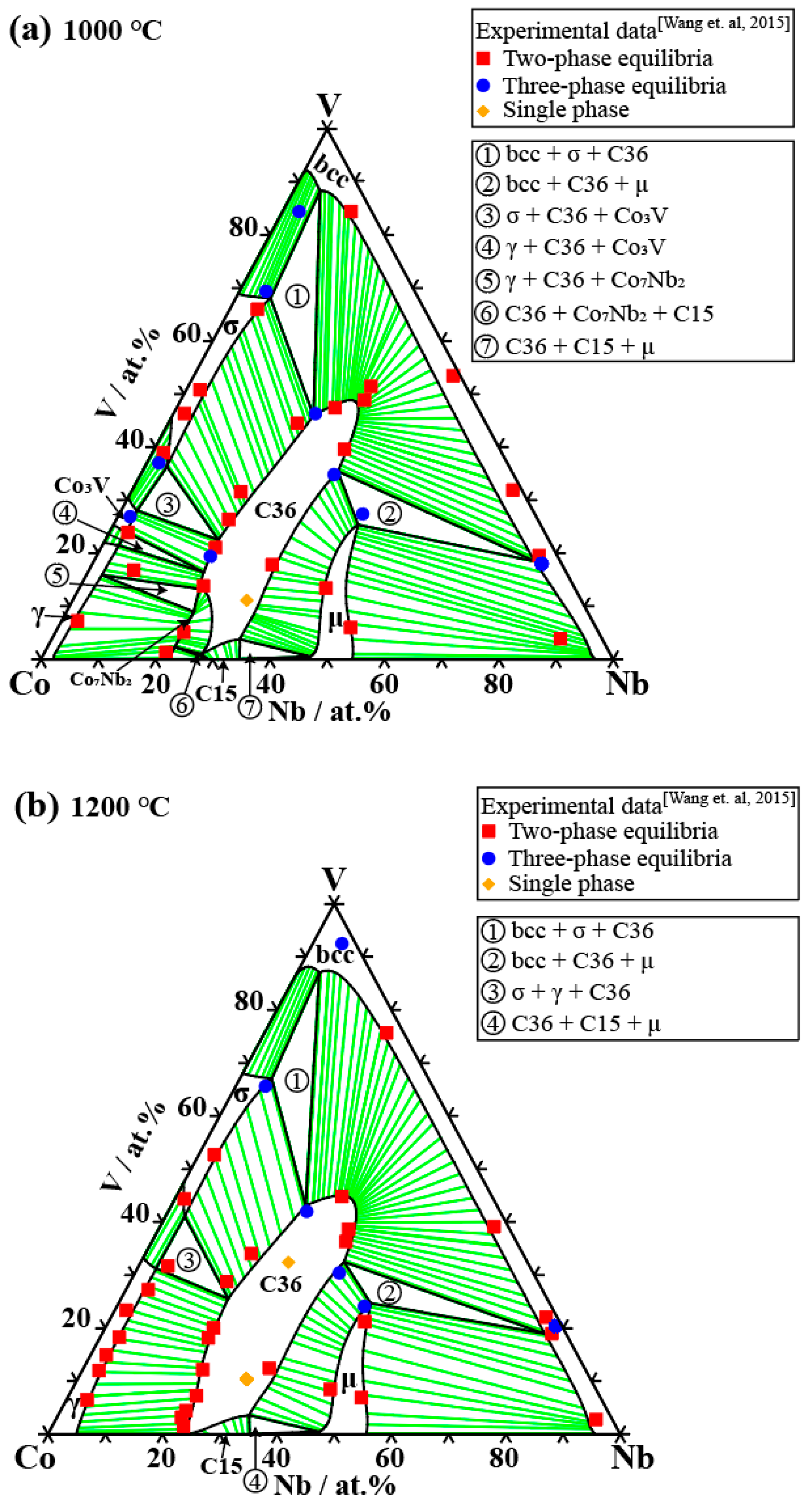
In the experimental isothermal section of the Co-Nb-V ternary system at 1000 °C, there are two solid solution phases of Bcc and Fcc structure, and six compound phases of C36, C15, Co3V, σ, Co7Nb2, and μ [9]. In the isothermal section of 1200 °C, the Co3V and Co7Nb2 phases disappear and only four compound phases, σ, C36, C15, and μ phases, are present [9]. The C36 phase has a large region in the experimentally determined isothermal cross-sectional phase diagrams at both 1000 °C and 1200 °C. The phase region of the C36 phase tends to be parallel to the Co-V axis in the isothermal sections of the Co-Nb-V ternary system, so Wang et al. [9] concluded that the element V tends to replace mainly the occupancy of Co in the C36 phase.
Reyes Tirado et al. [10] aged Co-6Nb-6V alloy at 900 °C for 2 h after solution treatment at 1250 °C for 48 h. The presence of γ/γ′ two-phase organization was first observed in the Co-Nb-V ternary alloy by techniques such as scanning electron microscopy and atom probe chromatography, and the measured γ and γ′ compositions are Co89.79Nb3.77V6.43 and Co77.17Nb14.87V7.95, respectively. With the increase of aging time, the γ′ phase grains coarsened gradually and transformed to Co3(Nb0.81V0.19) phase, implying that the γ′ phase in the Co-Nb-V ternary system is metastable at 900 °C.
The calculated phase diagrams of Co-Nb [19], Co-V [22], and Nb-V [24] binary systems are shown in Figure 1a–c, respectively. The crystal structures and thermodynamic models of all phases in the ternary system are listed in Table 1.

3. Experimental Procedures and Theory Calculations

3.1. Experimental Procedures

High-purity Co (99.8 wt.%), Nb (99.8 wt.%), and V (99.8 wt.%) were employed as starting materials. The bulk alloys were synthesized by arc melting in a water-cooled copper crucible using a non-consumable W electrode under a purified argon atmosphere. Prior to melting the sample alloys, a Ti ingot was used as an arc strike and getter to minimize potential oxidation. Each ingot, weighing approximately 15 g, was remelted five times to ensure chemical homogeneity, with the melting loss carefully maintained at 0.5%. The phase transformation temperatures of the as-aged alloys were subsequently measured using a NETZSCH 404 F3 differential scanning calorimeter (DSC) at a heating rate of 10 °C per minute (Selb, Germany).

3.2. Thermodynamic Models

3.2.1. Solution Phases

The sub-regular solution model is used to describe the molar Gibbs free energy of the Liquid, Fcc, and Bcc solution phases, defined as:
G m φ = i = C o , N b , V x i G i φ 0 + R T i = C o , N b , V x i l n x i φ + G m φ E + G m φ m g
where G i φ 0 is defined as the molar Gibbs free energy of pure element i (Co, Nb, or V) in the φ (Liquid, Fcc, Bcc, or Hcp) phase. G m φ m g is the magnetic contribution to the molar Gibbs energy and is generally given by the Hillert-Jarl function [25]:
G m φ m g = RTln β φ + 1 f τ φ
where β φ is the Bohr magneton number, τ φ is defined as T / T c φ with T c φ being the Curie temperature, and f τ φ is the integral of a function describing the magnetic contribution to the heat capacity. A more detailed description of G m φ m g can be found in Ref. [25]. G m φ E is the excess Gibbs free energy, which is expressed by the Redlich-Kister polynomials [26] and Hillert [27] as follows:
G φ E = x C o x N b L C o , N b φ + x C o x V L C o , V φ + x N b x V L N b , V φ + x C o x N b x V L C o , N b , V φ L i , j φ = m = 0 n L i , j φ m ( x i x j ) m L C o , N b , V φ = x C o L C o , N b , V φ 0 + x N b L C o , N b , V φ 1 + x V L C o , N b , V φ 2
where L i , j φ is the interaction energy in the i - j (any two of Co, Nb, or V) binary system. The parameters of L C o , N b φ , L C o , V φ , and L N b , V φ are taken from the assessments of He et al. [19], Wang et al. [22], and Kumar et al. [24], respectively. The ternary parameter L C o , N b , V φ will be optimized in the present work.

3.2.2. Intermetallic Compounds

Two-sublattice model
In the literature [19,22], the intermetallic compounds C14, C15, C36, and Co3V phases were described by two-sublattice solution model. Taking the C36 phase as an example, the Gibbs energy function can be expressed as follows [28]:
G m C 36 = i j y i y j G i : j C 36 0 ( i = C o , N b , V ; j = C o , N b , V ) + R T ( 0.6667 i y i l n y i + 0.3333 j y j l n y j ) ( i = C o , N b , V ; j = C o , N b , V ) + i , j k y i y j y k L i , j : k C 36 ( i , j = C o , N b , V ; i j ; k = C o , N b , V ) + i j , k y i y j y k L i : j , k C 36 ( i = C o , N b , V ; j , k = C o , N b , V ; j k ) + i , j k , l y i y j y k y l L i , j : k , l C 36 ( i , j = C o , N b , V ; i j ; k , l = C o , N b , V ; k l ) + i j , k , l y i y j y k y l L i : j , k , l C 36 ( i = C o , N b , V ; j , k , l = C o , N b , V ; j k l ) + i , j , k l y i y j y k y l L i , j , k : l C 36 ( i , j , k = C o , N b , V ; l = C o , N b , V ; i j k )
where y i and y j are the site fractions of components i and j on the first and second sublattices. G i : j C 36 0 is the Gibbs free energy of a hypothetical compound when the element i occupies the first sublattice and the element j occupies the second one. L i , j : k C 36 is the interaction energy when the first sublattice is occupied by i and j , while the second one is filled with k ; L i : j , k C 36 is the interaction energy between j and k in the second sublattice when the first one is occupied by the element i . L i , j : k , l C 36 represents the interaction energy between i and j in the first sublattice, while the second one is occupied by the element k and l . L i : j , k , l C 36 is the interaction energy when the second sublattice is occupied by j , k , and l , and the first one is occupied by the element i . L i , j , k : l C 36 is the interaction parameter when the first sublattice is occupied by i , j , and k , while the second one is occupied by l . These parameters will be assessed in this work.
Three-sublattice model
The model of σ phase is described by a three-sublattice model (Co, Nb)8(V)4(Co, V)18 based on the thermodynamic model introduced by Wang et al. [22]. Its Gibbs energy is expressed by the following:
G m σ = i j y i y j G i : V : j σ 0 ( i = C o , N b ; j = C o , V ) + R T ( 0.2667 i y i l n y i + 0.6 j y j l n y j ) ( i = C o , N b ; j = C o , V ) + j y C o y N b y j L C o , N b : V : j σ ( j = C o , V ) + i y i y C o y V L i : V : C o , V σ ( i = C o , N b )
where y i and y j are the site fractions of components i and j on the first and second sublattices. G i : V : j σ 0 is the Gibbs free energy of hypothetical compound when the element i occupies the first sublattice and the element j occupies the third one. L C o , N b : V : j σ is the interaction energy that the first sublattice is occupied by Co and Nb, while the third one is filled with j ; L i : V : C o , V σ is the interaction energy between Co and V in the third sublattice when the first one is occupied by the element i .
Four-sublattice model
From the experimental results, it can be concluded that the V is likely to predominately replace the position of the Co in the μ phase. Therefore, the thermodynamic model (Co)1(Co, Nb, V)2(Nb)4(Co, Nb, V)6 is employed to describe the ordered μ phase. The molar Gibbs free energy is expressed as:
G m μ = s t y s y t G C o : s : N b : t μ 0 ( s = C o , N b , V ; t = C o , N b , V ) + R T ( 0.1539 s y s l n y s + 0.4615 t y t l n y t ) ( s = C o , N b , V ; t = C o , N b , V ) + s y s y C o y N b L C o : s : N b : C o , N b μ ( s = C o , N b , V ) + s y s y C o y V L C o : s : N b : C o , V μ ( s = C o , N b , V ) + s y s y N b y V L C o : s : N b : N b , V μ ( s = C o , N b , V ) + t y C o y N b y t L C o : C o , N b : N b : t μ ( t = C o , N b , V ) + t y C o y V y t L C o : C o , V : N b : t μ ( t = C o , N b , V ) + t y N b y V y t L C o : N b , V : N b : t μ ( t = C o , N b , V ) + s y s y C o y N b y V L C o : s : N b : C o , N b , V μ ( s = C o , N b , V ) + t y C o y N b y V y t L C o : C o , N b , V : N b : t μ ( t = C o , N b , V )
where s represents elements Co, Nb, and V, and t represents elements Co, Nb, and V. The symbols in the function express similar meanings as Equation (4).

3.2.3. Stoichiometric Compounds

The Co7Nb2 and CoV3 phases were treated as stoichiometric compounds in the literature [19,22]. Taking the CoV3 phase as an example, the Gibbs energy per mole of formula unit CoV3 is described as:
G m C o V 3 = 0.25 G C o H S E R 0 + 0.75 G V H S E R 0 + a + b T
where G C o H S E R 0 and G V H S E R 0 are the molar Gibbs energy of Hcp Co and Bcc V, respectively. The parameters a and b need to be evaluated.

4. Results and Discussion

4.1. Experimental Phase Transition Temperatures

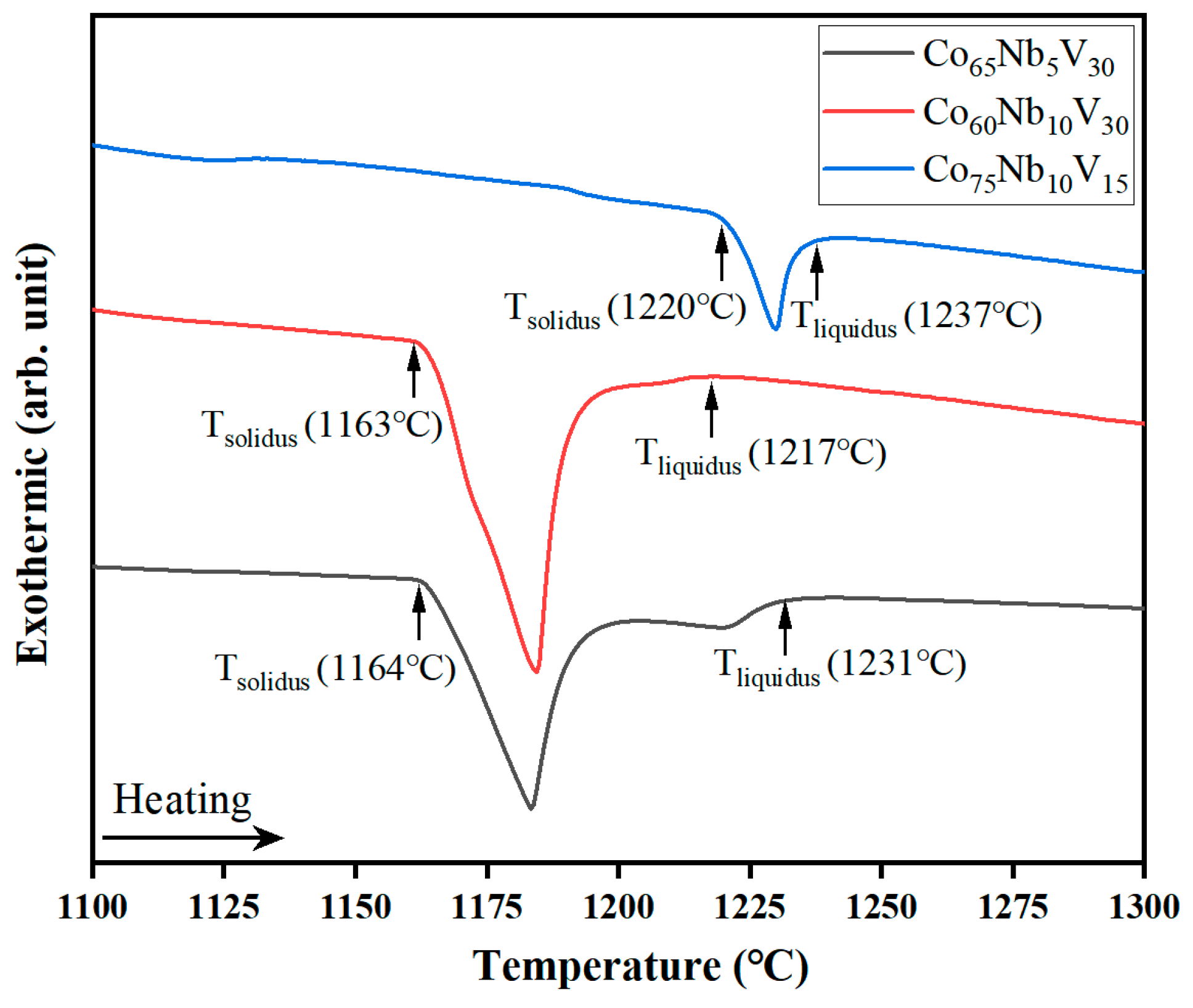
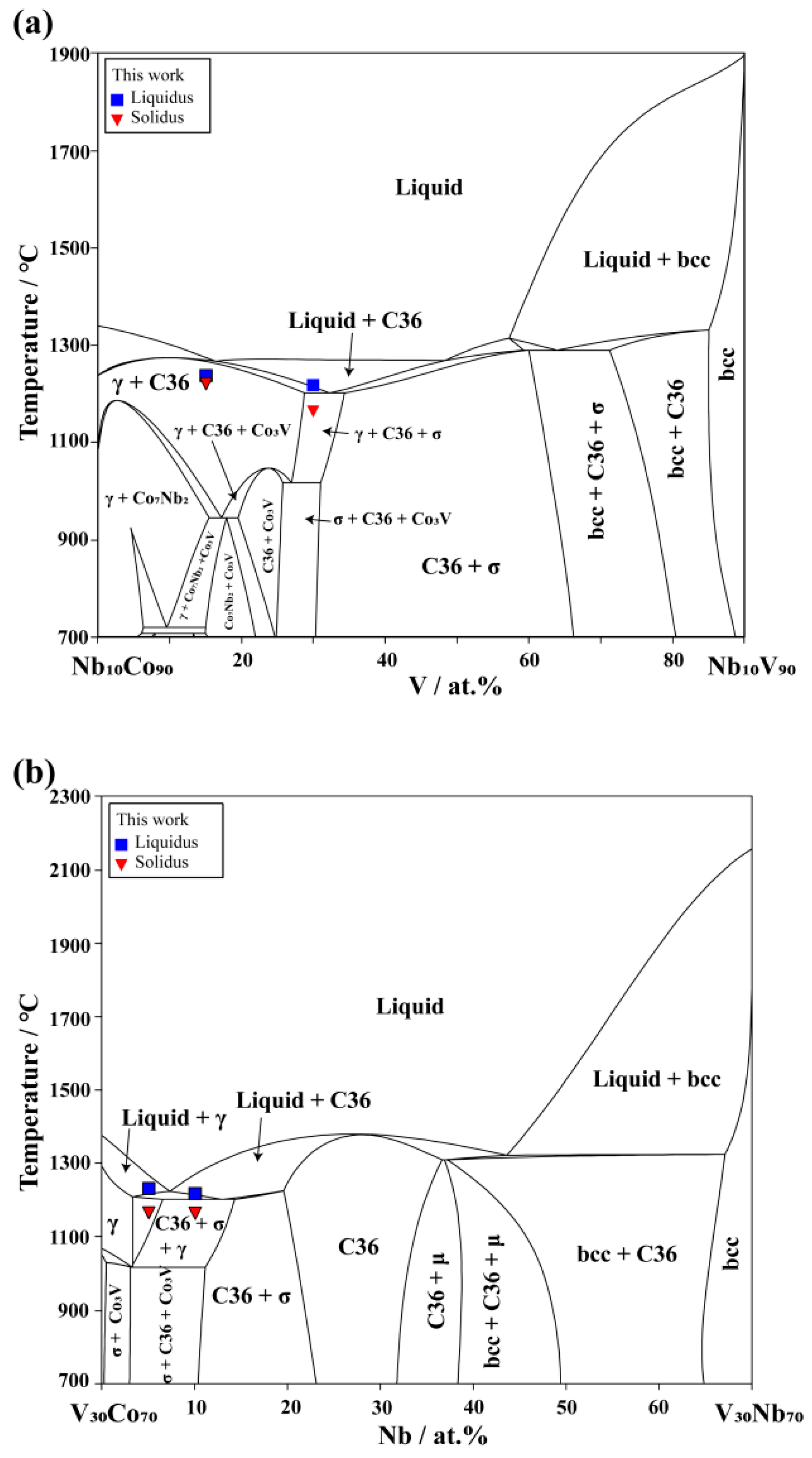
To verify the accuracy of the calculated phase diagrams obtained from the thermodynamic description in this study, the phase transformation temperatures of three Co-Nb-V alloys with compositions of Co65Nb5V30 (at.%), Co60Nb10V30 (at.%), and Co75Nb10V15 (at.%) were experimentally determined. Figure 2 and Table 2 present the DSC heating curves and corresponding phase transformation temperatures for these alloys. The solidus temperatures are 1220 °C, 1163 °C, and 1164 °C, while the liquidus temperatures are 1237 °C, 1217 °C, and 1231 °C, respectively.

4.2. Thermodynamic Calculation Results

Based on the experimental data and the published thermodynamic parameters of the Co-Nb [19], Co-V [22], and Nb-V [24] binary systems, a thermodynamic assessment of the Co-Nb-V ternary system was carried out. The thermodynamic parameters of each phase were optimized by fitting to experimental equilibrium data and measured thermodynamic properties of alloys using the PARROT module in the THERMO-CALC software (version 2025b) [29]. During the optimization process, all relevant literature data were initially incorporated. Each data point was assigned a weight according to its significance, and adjustments were made iteratively through trial and error until the majority of the selected data were reproduced within the expected uncertainty limits.
In alloy systems, interactions among constituent elements lead to the formation of various compound phases, whose solid solubilities generally vary with temperature. Consequently, the corresponding thermodynamic parameters exhibit both temperature and compositional dependence. In the present system, the temperature and compositional dependencies of the interaction parameters were evaluated based on experimental results obtained at 1000 °C and 1200 °C, and their rationality was further validated using longitudinal section phase diagrams. Moreover, the established thermodynamic database enables subsequent extrapolative calculations, allowing the identification of phases with high solid solubility and the prediction of possible phase equilibria at different temperatures, thereby providing clearer guidance for determining suitable alloy composition ranges during alloy design.
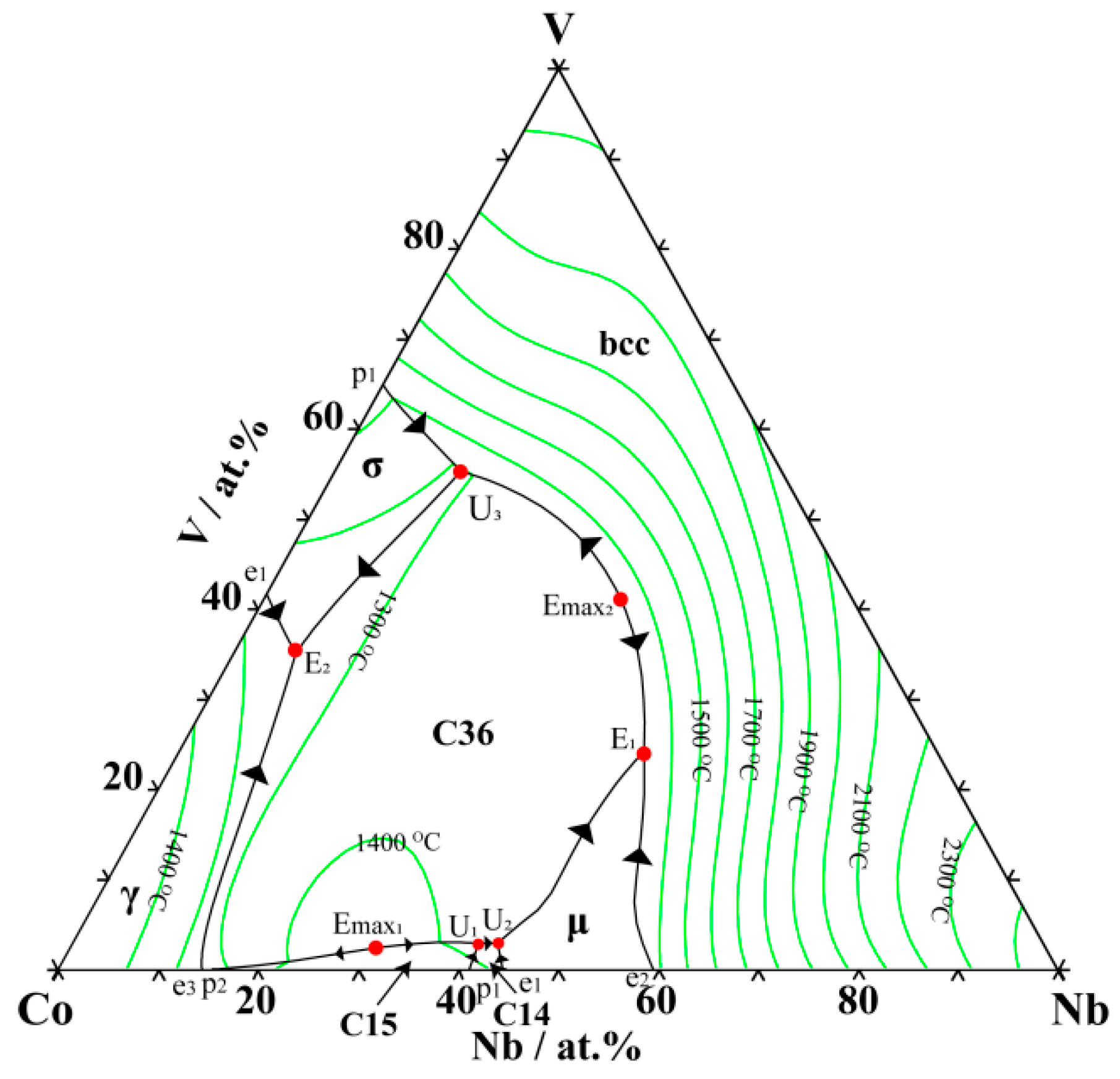
All thermodynamic parameters obtained in this study are summarized in Table 3. The calculated isothermal sections at 1000 °C and 1200 °C, together with the corresponding experimental data, are shown in Figure 3a,b. The thermodynamic calculations reproduce nearly all experimental observations, with only minor and acceptable deviations. Additionally, the results reveal the presence of three-phase regions that were not identified in the experimental investigations. The calculated solid solutions of the C36 phase range from about 19.7 to 34.4 at.% Nb, 1.0 to 48.7 at.% V, and 20.5 to 71.4 at.% Co in the 1000 °C isothermal cross section, and from about 18.9 to 35.9 at.% Nb, 0 to 45.5 at.% V, and 24.0 to 76.2 at.% Co in the 1200 °C isothermal cross section. The solid solution of element V in the μ-phase is about 25.9 at.% at 1000 °C and decreases to 24.1 at.% at 1200 °C. The solid solution of element Nb in the σ-phase is not significant and is about 5.7 at.% in both isothermal sections. In the calculated isothermal cross section at 1000 °C, the solid solution of Nb element in Co3V and γ phase is about 3.6 at.% and 3.3 at.%, respectively. In addition, the solid solution of element V in the Co7Nb2 phase reaches 11.1 at.%. In general, the calculated results reproduce the experimental data well.
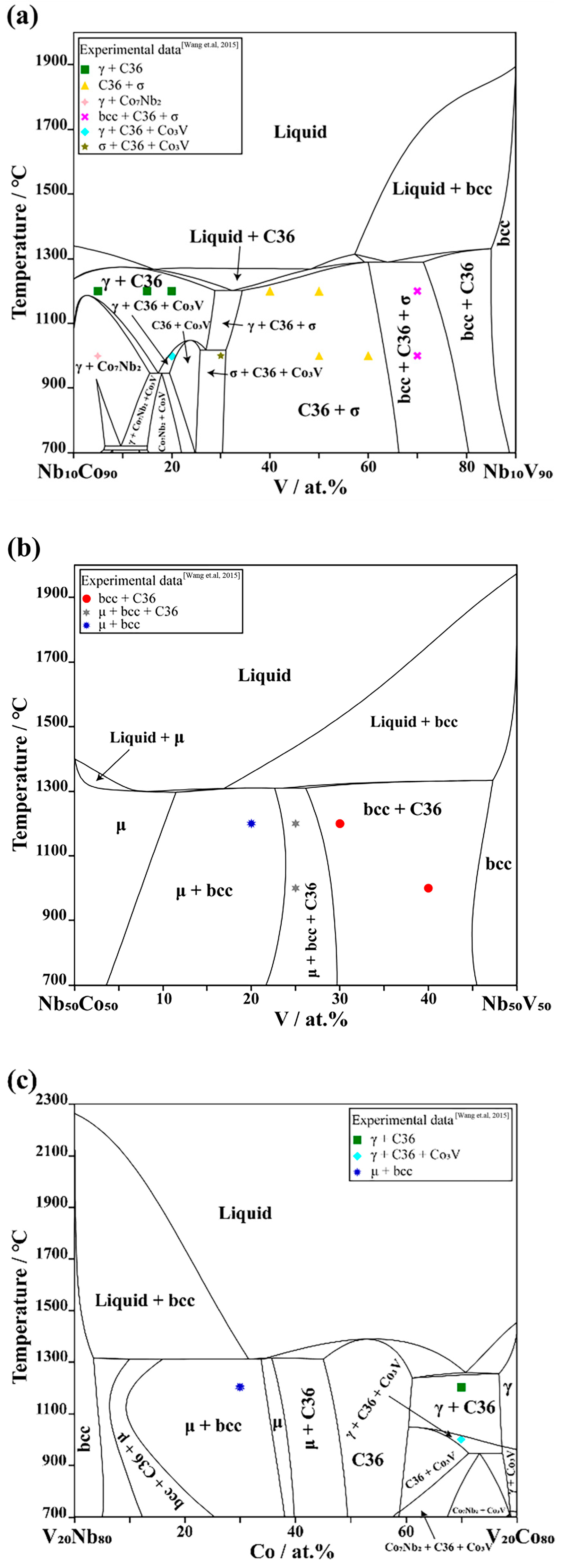
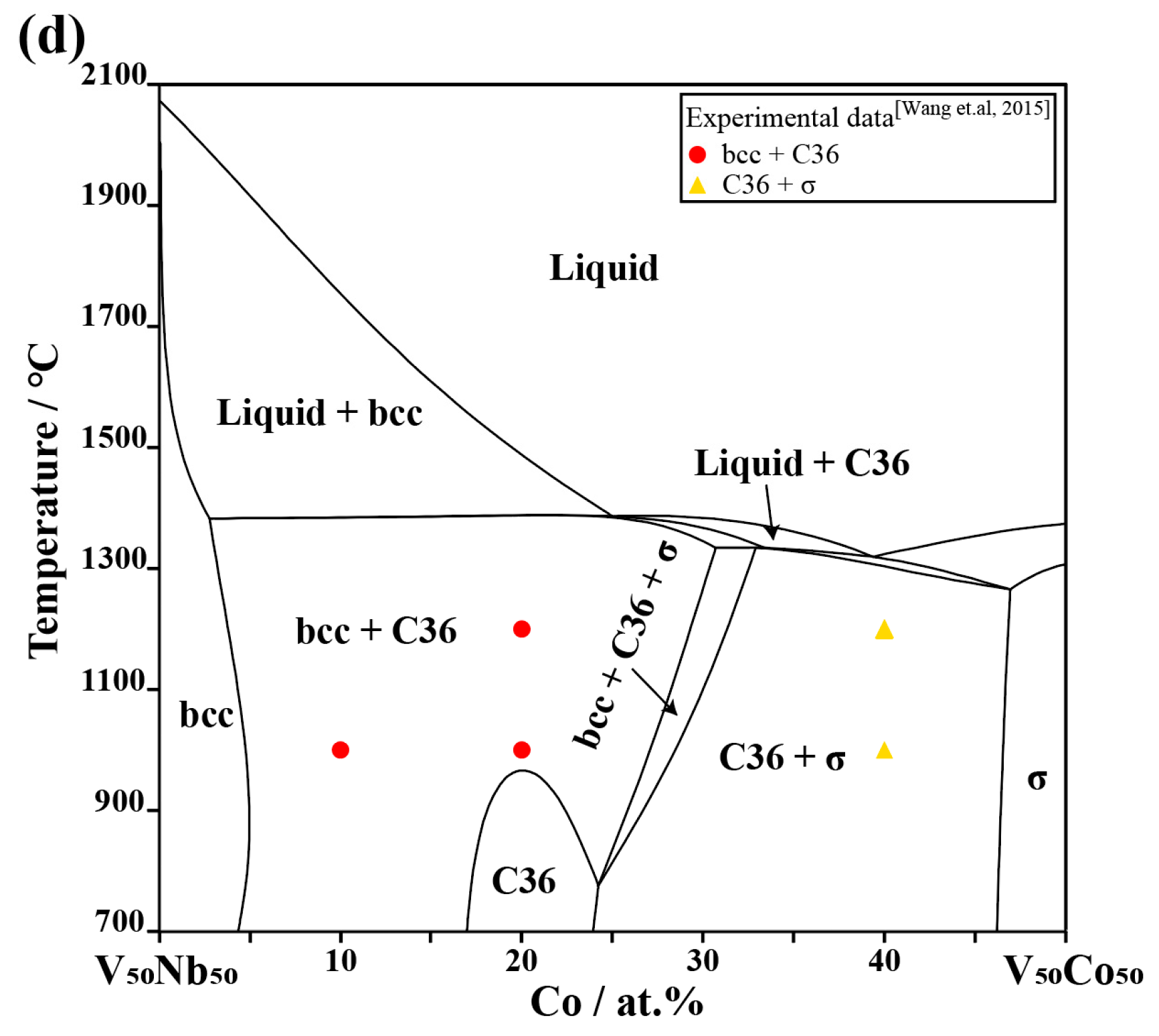
To ensure the rationality of the optimized thermodynamic parameters in Table 3, the vertical sections of the Co-Nb-V system at 10 at.% Nb, 50 at.% Nb, 20 at.% V, and 50 at.% V were calculated with the experimental data, as shown in Figure 4a–d. Obviously, the calculated results are in good agreement with the experimental information. Figure 5 present the calculated vertical sections of the Co-Nb-V system at (a) 10 at.% Nb and (b) 30 at.% V with the experimental data of DSC testing liquidus and solidus temperature from this work, which can well reproduce the experimental data with a few acceptable discrepancies. The DSC measurements validate the reliability of the optimized thermodynamic parameters by comparing the experimentally determined phase transformation temperatures with the calculated values. The good agreement between experimental and calculated solidus and liquidus temperatures provides strong evidence for the accuracy of the present thermodynamic description in the Co-Nb-V ternary system.
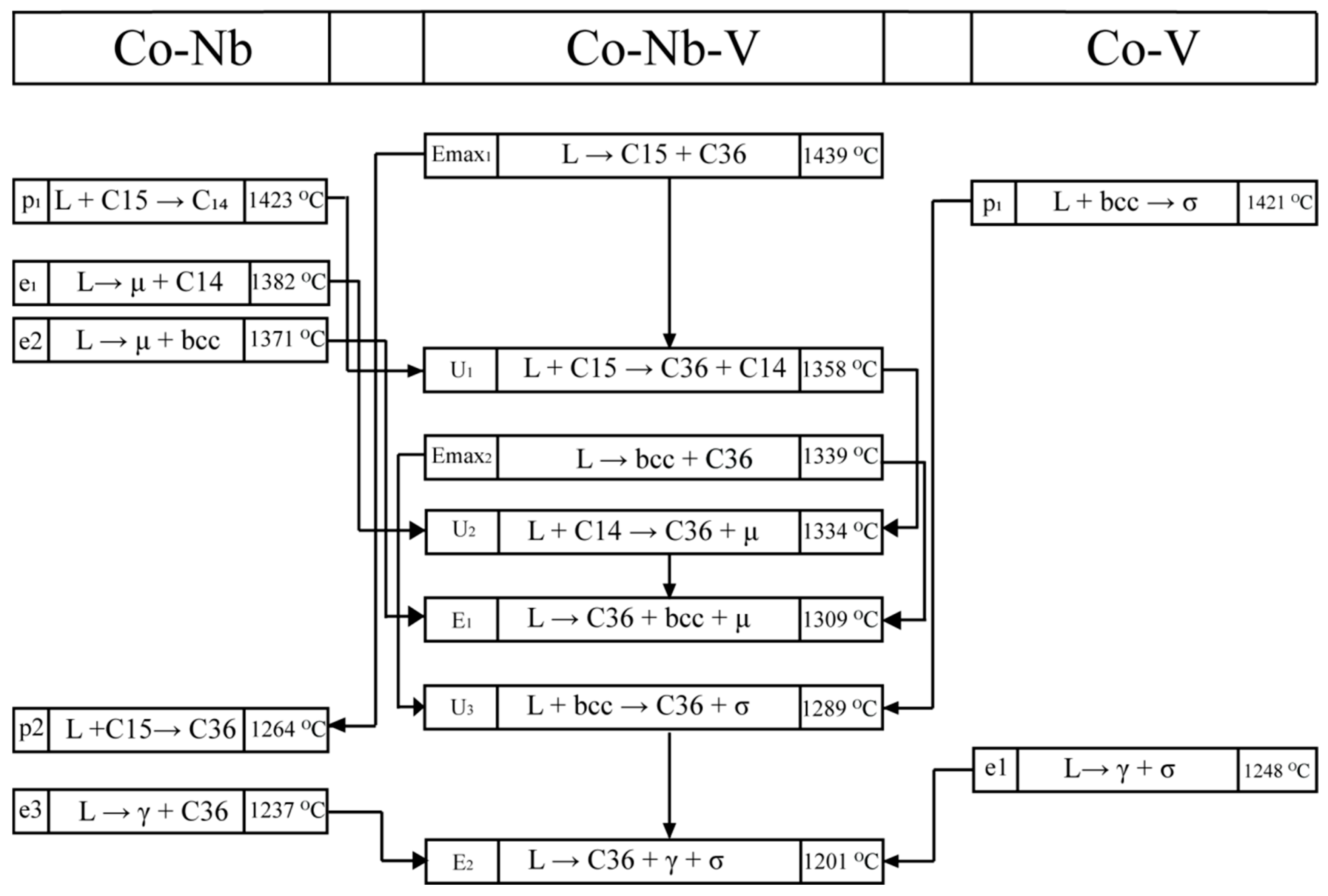
The calculated liquidus projection of the entire composition range in the Co-Nb-V ternary system are presented in Figure 6. The complete ternary invariant reactions and temperatures were calculated in Figure 7 and summarized in Table 4. In general, two maxima (Emaxi), two ternary eutectic reaction, and three U-type reactions (Ui) are included in the reaction scheme.

5. Conclusions

In this work, a comprehensive thermodynamic assessment of the Co-Nb-V ternary system was carried out using the CALPHAD methodology based on available experimental data. Isothermal sections at 1000 °C and 1200 °C, as well as multiple vertical sections over different compositional ranges, were calculated and show good agreement with reported experimental phase equilibria, demonstrating the reliability of the present thermodynamic description. An internally consistent set of thermodynamic parameters for all stable phases in the Co-Nb-V system was established, enabling accurate prediction of phase stability over a wide temperature and composition range. On this basis, additional isothermal sections at other temperatures, together with the liquidus surface and invariant reaction scheme of the ternary system, were successfully calculated, providing a complete thermodynamic overview of the system. The present thermodynamic parameters can be directly applied to thermodynamic calculations relevant to alloy design and solidification behavior, and they are expected to serve as an important contribution toward the development and refinement of Co-based superalloy databases for both fundamental research and practical alloy development.

Author Contributions

Conceptualization, C.W. and Y.L.; methodology, X.L.; software, Y.L. and Y.H.; validation, Y.H. and J.Z.; formal analysis, Y.G.; investigation, X.C.; resources, J.Z. and Y.H.; data curation, X.C.; writing—original draft preparation, Y.G. and X.Y.; writing—review and editing, Y.G. and X.Y.; visualization, Y.G.; supervision, C.W. and Y.L.; project administration, X.L.; funding acquisition, C.W. and X.L. All authors have read and agreed to the published version of the manuscript.

Funding

This study was supported by the Guangdong Provincial Science and Technology Program (grant number 2023B0909050001) and the National Natural Science Foundation of China (grant number 52371007).

Data Availability Statement

The original contributions presented in this study are included in the article. Further inquiries can be directed to the corresponding authors.

Conflicts of Interest

The authors declare no conflict of interest.

References

  1. Sato, J.; Omori, T.; Oikawa, K.; Ohnuma, I.; Kainuma, R.; Ishida, K. Cobalt-base high-temperature alloys. Science 2006, 312, 90–91. [Google Scholar] [CrossRef]
  2. Reed, R.C. The Superalloys: Fundamentals and Applications; Cambridge University Press: New York, NY, USA, 2008. [Google Scholar]
  3. Suzuki, A.; Inui, H.; Pollock, T.M. L12-strengthened cobalt-base superalloys. Annu. Rev. Mater. Res. 2015, 45, 345–368. [Google Scholar] [CrossRef]
  4. Omori, T.; Oikawa, K.; Sato, J.; Ohnuma, I.; Kattner, U.R.; Kainuma, R.; Ishida, K. Partition behavior of alloying elements and phase transformation temperatures in Co–Al–W-base quaternary systems. Intermetallics 2013, 32, 274–283. [Google Scholar] [CrossRef]
  5. Lass, E.A.; Sauza, D.J.; Dunand, D.C.; Seidman, D.N. Multicomponent γ’-strengthened Co-based superalloys with increased solvus temperatures and reduced mass densities. Acta Mater. 2018, 147, 284–295. [Google Scholar] [CrossRef]
  6. Ooshima, M.; Tanaka, K.; Okamoto, N.L.; Kishida, K.; Inui, H. Effects of quaternary alloying elements on the γ′ solvus temperature of Co–Al–W based alloys with fcc/L12 two-phase microstructures. J. Alloys Compd. 2010, 508, 71–78. [Google Scholar] [CrossRef]
  7. Makineni, S.K.; Nithin, B.; Chattopadhyay, K. Synthesis of a new tungsten-free γ–γ′ cobalt-based superalloy by tuning alloying additions. Acta Mater. 2015, 85, 85–94. [Google Scholar] [CrossRef]
  8. Chen, Y.; Wang, C.; Ruan, J.; Omori, T.; Kainuma, R.; Ishida, K.; Liu, X. High-strength Co–Al–V-base superalloys strengthened by γ′-Co3(Al,V) with high solvus temperature. Acta Mater. 2019, 170, 62–74. [Google Scholar] [CrossRef]
  9. Wang, C.P.; Yang, S.; Yang, S.Y.; Wang, D.; Ruan, J.J.; Li, J.; Liu, X.J. Experimental investigation of the phase equilibria in the Co-Nb-V ternary system. J. Phase Equilibria Diffus. 2015, 36, 592–598. [Google Scholar] [CrossRef]
  10. Reyes Tirado, F.L.; Perrin Toinin, J.; Dunand, D.C. γ + γ′ microstructures in the Co-Ta-V and Co-Nb-V ternary systems. Acta Mater. 2018, 151, 137–148. [Google Scholar] [CrossRef]
  11. Reyes Tirado, F.L.; Taylor, S.V.; Dunand, D.C. Low-density, W-free Co–Nb–V–Al-based superalloys with γ/γ’ microstructure. Mater. Sci. Eng. A 2020, 796, 139977. [Google Scholar] [CrossRef]
  12. Reyes Tirado, F.L.; Dunand, D.C. Increasing γ’ volume fraction in Co–Nb–V- and Co–Ta–V-based superalloys. J. Mater. Res. Technol. 2021, 11, 2305–2313. [Google Scholar] [CrossRef]
  13. Ohl, B.; Dunand, D.C. Effects of Ni and Cr additions on γ + γ’ microstructure and mechanical properties of W-free Co–Al–V–Nb–Ta-based superalloys. Mater. Sci. Eng. A 2022, 849, 143401. [Google Scholar] [CrossRef]
  14. Kattner, U.R. The CALPHAD method and its role in material and process development. Tecnol. Metal. Mater. Min. 2016, 13, 3–15. [Google Scholar] [CrossRef] [PubMed]
  15. Pargeter, J.K.; Hume-Rothery, W. The constitution of niobium-cobalt alloys. J. Less Common Met. 1967, 12, 366–374. [Google Scholar] [CrossRef]
  16. Bataleva, S.K.; Kuprina, V.V.; Markiv, V.Y. Cobalt–niobium phase diagram. Mosc. Univ. Chem. Bull. 1970, 25, 37–40. [Google Scholar]
  17. Stein, F.; Jiang, D.; Palm, M.; Sauthoff, G.; Grüner, D.; Kreiner, G. Experimental reinvestigation of the Co–Nb phase diagram. Intermetallics 2008, 16, 785–792. [Google Scholar] [CrossRef]
  18. Kumar, K.C.H.; Ansara, I.; Wollants, P.; Delaey, L. Thermodynamic optimisation of the Co–Nb system. J. Alloys Compd. 1998, 267, 105–112. [Google Scholar] [CrossRef]
  19. He, C.; Stein, F.; Palm, M. Thermodynamic description of the systems Co–Nb, Al–Nb and Co–Al–Nb. J. Alloys Compd. 2015, 637, 361–375. [Google Scholar] [CrossRef]
  20. Bratberg, J.; Sundman, B. A thermodynamic assessment of the Co–V system. J. Phase Equilibria Diffus. 2003, 24, 495–503. [Google Scholar] [CrossRef]
  21. Huang, S.; Li, L.; der Biest, O.V.; Vleugels, J. Thermodynamic assessment of the Co–V and Co–V–C system. J. Alloys Compd. 2004, 385, 114–118. [Google Scholar] [CrossRef]
  22. Wang, C.; Zhao, C.; Lu, Y.; Li, T.; Peng, D.; Shi, J.; Liu, X. Experimental observation of magnetically induced phase separation and thermodynamic assessment in the Co–V binary system. Mater. Chem. Phys. 2015, 162, 555–560. [Google Scholar] [CrossRef]
  23. Wang, P.; Hammerschmidt, T.; Kattner, U.R.; Olson, G.B. Structural stability of Co–V intermetallic phases and thermodynamic description of the Co–V system. Calphad 2020, 68, 101729. [Google Scholar] [CrossRef]
  24. Kumar, K.C.H.; Wollants, P.; Delaey, L. Thermodynamic calculation of Nb-Ti-V phase diagram. Calphad 1994, 18, 71–79. [Google Scholar] [CrossRef]
  25. Hillert, M.; Jarl, M. A model for alloying in ferromagnetic metals. Calphad 1978, 2, 227–238. [Google Scholar] [CrossRef]
  26. Redlich, O.; Kister, A.T. Algebraic representation of thermodynamic properties and the classification of solutions. Ind. Eng. Chem. 1948, 40, 345–348. [Google Scholar] [CrossRef]
  27. Hillert, M. Empirical methods of predicting and representing thermodynamic properties of ternary solution phases. Calphad 1980, 4, 1–12. [Google Scholar] [CrossRef]
  28. Hillert, M.; Staffansson, L.I. Regular-solution model for stoichiometric phases and ionic melts. Acta Chem. Scand. 1970, 24, 3618–3626. [Google Scholar] [CrossRef]
  29. Andersson, O.; Helander, T.; Hoglund, L.; Shi, P.; Sundman, B. Thermo-Calc & DICTRA, computational tools for materials science. Calphad 2002, 26, 273–312. [Google Scholar] [CrossRef]
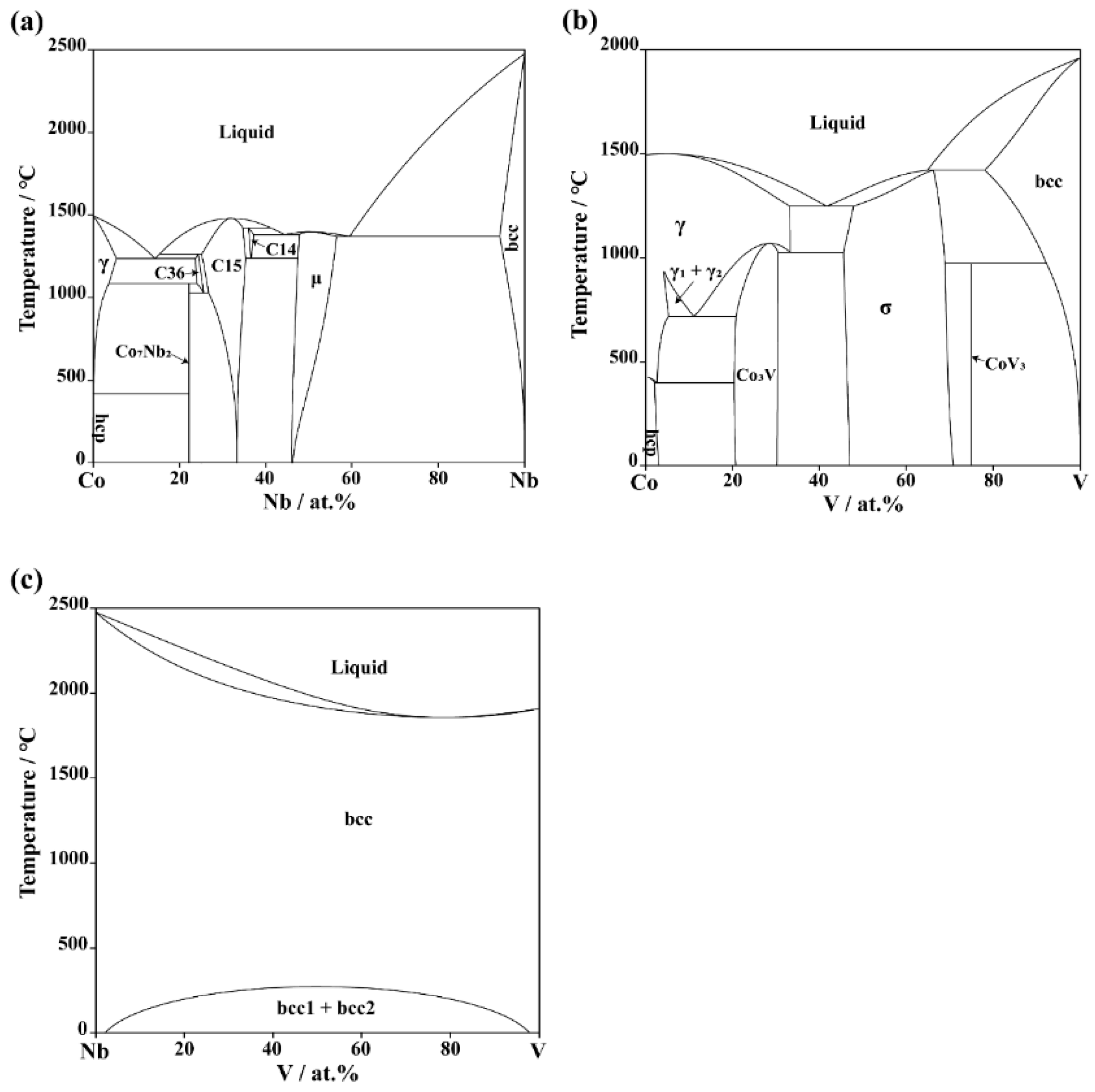
Figure 1. Calculated binary phase diagrams in the Co-Nb-V ternary system: (a) Co-Nb system, data from ref. [19]. (b) Co-V system, data from ref. [22], and (c) Nb-V system, data from ref. [24].
Metals 16 00209 g001
Figure 2. DSC curves of Co65Nb5V30 (at.%), Co60Nb10V30 (at.%), and Co75Nb10V15 (at.%) alloys, respectively.
Metals 16 00209 g002
Figure 3. Calculated isothermal sections of the Co-Nb-V system at (a) 1000 °C and (b) 1200 °C compared with the experimental data, Reprinted with permission from ref. [9].
Metals 16 00209 g003
Figure 4. Calculated vertical sections of the Co-Nb-V system at (a) 10 at.% Nb, (b) 50 at.% Nb, (c) 20 at.% V, and (d) 50 at.% V with the experimental data.
Metals 16 00209 g004aMetals 16 00209 g004b
Figure 5. Calculated vertical sections of the Co-Nb-V system at (a) 10 at.% Nb and (b) 30 at.% V with the experimental data from this work.
Metals 16 00209 g005
Figure 6. Calculated liquidus projection of the Co-Nb-V system with the isothermal line over the whole composition range.
Metals 16 00209 g006
Figure 7. Calculated invariant reaction scheme in the Co-Nb-V system.
Metals 16 00209 g007
Table 1. Crystal structures and thermodynamic models of all phases in the Co-Nb-V system.
PhaseStructure DesignationPearson SymbolPrototypeThermodynamic Model
Liquid---(Co, Nb, V)1
γA1cF4Cu(Co, Nb, V)1
BccA2cI2W(Co, Nb, V)1
HcpA3hP2Mg(Co, Nb, V)1
Co3V-hP24Co3V(Co, Nb, V)3(Co, Nb, V)1
σD8btP30σCrFe(Co, Nb)8(V)4(Co, V)18
CoV3A15cP8Cr3Si(Co)1(V)3
Co7Nb2---(Co, V)7(Nb)2
C36C36hP24MgNi2(Co, Nb, V)2(Co, Nb, V)1
C15C15cF24MgCu2(Co, Nb)2(Co, Nb)1
C14C14hP12MgZn2(Co, Nb)2(Co, Nb)1
μD85hR13Fe7W6(Co)1(Co, Nb, V)2(Nb)4(Co, Nb, V)6
Table 2. Phase transition temperatures of Co65Nb5V30 (at.%), Co60Nb10V30 (at.%), and Co75Nb10V15 (at.%) alloys, respectively.
Alloy (at.%)Solidus Temperature (°C)Liquidus Temperature (°C)
Co65Nb5V3011641231
Co60Nb10V3011631217
Co75Nb10V1512201237
Table 3. The optimized parameters of the ternary Co-Nb-V system in this work, J mol−1.
PhaseParameters
Liquid(Co, Nb, V)
L C o , N b , V L iquid 0 = 422000 333 T
L C o , N b , V L iquid 1 = 332800 267 T
L C o , N b , V L iquid 2 = 262600 200 T
Bcc(Co, Nb, V)
L C o , N b , V b c c 0 = 118250 + 250 T
L C o , N b , V b c c 1 = 470090 + 275 T
L C o , N b , V b c c 2 = 416003 + 260 T
γ(Co, Nb, V)
L C o , N b , V γ 0 = 280950 + 150 T
L C o , N b , V γ 1 = 143650 + 50 T
L C o , N b , V γ 2 = 26275 50 T
C36(Co, Nb, V)2(Co, Nb, V)1
G V : C o C 36 0 = 2 G V H S E R + G C o H S E R
G V : N b C 36 0 = 2 G V H S E R + G N b H S E R 1155.65 + 3.5 T
G C o : V C 36 0 = 2 G C o H S E R + G V H S E R
G N b : V C 36 0 = 2 G N b H S E R + G V H S E R + 500
G V : V C 36 0 = 3 G V H S E R + G C o H S E R + 12268.5 + 10 T
L C o , V : N b C 36 0 = 108464 + 20 T
L C o , V : N b C 36 1 = 120484 85 T
L C o , V : N b C 36 2 = 136854 + 110 T
L C o , N b , V : N b C 36 0 = 73650 50 T
L C o : N b , V C 36 0 = 68635 5 T
L C o : N b , V C 36 1 = 15000
L C o : C o , N b , V C 36 0 = 125475 75 T
L C o , V : N b , V C 36 0 = 53673.9 + 50.02 T
Co7Nb2(Co, V)7(Nb)2
G V : N b C o 7 N b 2 0 = 7 G V H S E R + 2 G V H S E R
L C o , V : N b C o 7 N b 2 0 = 90690 + 30 T
L C o , V : N b C o 7 N b 2 1 = 342570 + 90 T
L C o , V : N b C o 7 N b 2 2 = 390950 + 150 T
μ(Co)1(Co, Nb, V)2(Nb)4(Co, Nb, V)6
G C o : C o : N b : V μ 0 = G C o F C C + 2 G C o B C C + 4 G N b H S E R + 6 G V H S E R
G C o : N b : N b : V μ 0 = G C o F C C + 6 G N b H S E R + 6 G V H S E R + 8000
G C o : V : N b : C o μ 0 = 7 G C o F C C + 2 G V H S E R + 4 G N b H S E R 47365 + 5 T
G C o : V : N b : N b μ 0 = G C o F C C + 2 G V H S E R + 10 G N b H S E R
G C o : V : N b : V μ 0 = G C o F C C + 8 G V H S E R + 4 G N b H S E R
L C o : N b , V : N b : C o μ 0 = 206825 + 25 T
L C o : N b , V : N b : C o μ 1 = 137300 100 T
L C o : N b , V : N b : C o , V μ 0 = 1594600 + 200 T
L C o : N b , V : N b : C o , V μ 1 = 504600 + 200 T
σ(Co, Nb)8(V)4(Co, V)18
G N b : V : C o σ 0 = 8 G N b H S E R + 4 G V H S E R + 18 G C o B C C + 1000
G N b : V : V σ 0 = 8 G N b H S E R + 22 G V H S E R
L C o , N b : V : C o σ 0 = 826825 + 25 T
L C o , N b : V : C o σ 1 = 314600 + 200 T
L C o , N b : V : V σ 0 = 267300 + 100 T
L C o , N b : V : V σ 0 = 60000
Co3V(Co, Nb, V)3(Co, Nb, V)1
G N b : C o C o 3 V 0 = 3 G N b H S E R + G C o H S E R
G N b : N b C o 3 V 0 = 4 G N b H S E R + 8000
G N b : V C o 3 V 0 = 3 G N b H S E R + G V H S E R + 6000
G C o : N b C o 3 V 0 = 3 G C o H S E R + G N b H S E R + 4000
G V : N b C o 3 V 0 = G V H S E R + 3 G N b H S E R + 4800
L C o , N b : V C o 3 V 0 = 108000
L C o : C o , N b , V C o 3 V 0 = 540000
Table 4. Predicted invariant reactions involving the liquid phase in the Co-Nb-V system.
ReactionT (°C)TypeLiquid Compositions
Nb (at.%)V (at.%)
L + C15 → C36 + C141358U140.582.88
L + C14 → C36 + μ1334.35U242.432.86
L → C36 + Bcc + μ1308.75E146.4624.12
L + Bcc → C36 + σ1288.83U312.5755.26
L → C36 + γ + σ1201E26.1635.17
Disclaimer/Publisher’s Note: The statements, opinions and data contained in all publications are solely those of the individual author(s) and contributor(s) and not of MDPI and/or the editor(s). MDPI and/or the editor(s) disclaim responsibility for any injury to people or property resulting from any ideas, methods, instructions or products referred to in the content.