Article

Maritime Applications as Motivation for Analytical Calculation of Thermal History in Low-Carbon Mild Steel WAAM Cylinders


by
Eleftherios Lampros
and
Anna D. Zervaki
*
Shipbuilding Technology Laboratory, School of Naval Architecture and Marine Engineering, National Technical University of Athens, Zografou, 157 80 Athens, Greece
*
Author to whom correspondence should be addressed.
Metals 2026, 16(2), 192; https://doi.org/10.3390/met16020192
Submission received: 31 December 2025 / Revised: 26 January 2026 / Accepted: 31 January 2026 / Published: 5 February 2026
(This article belongs to the Special Issue Advanced Additive Manufacturing of Metallic Materials)

Abstract

This study reviews the application of wire arc additive manufacturing (WAAM) technology in maritime engineering and investigates an experimentally driven analytical approach for prediction of thermal distributions based on the Rosenthal solution. Two ER70S-6 low-carbon steel WAAM cylinders were fabricated using gas metal arc welding (GMAW) and plasma arc welding (PAW) processes, with interlayer temperatures of 453 °C and 250 °C, respectively. Accurately measuring the temperature field to tailor the microstructure has long been a challenge. The results indicated a significant deviation between the analytical predictions and the experimental data. To address this discrepancy, a hybrid approach combining analytical and experimental results was implemented. Time intervals between layers, extracted from the experimental data, were incorporated into the Rosenthal equation to improve the accuracy of temperature field predictions. The microstructure at the bottom, middle, and top regions of the WAAM components was examined using optical microscopy. Tensile testing and Vickers microhardness measurements were conducted to evaluate mechanical properties. Scanning electron microscopy (SEM) was used to analyze fracture surfaces and identify fracture modes. The results were consistent with those reported for other ER70S-6 cylindrical WAAM components. This work highlights limitations of the Rosenthal solution and emphasizes the need for thermal models in WAAM applications.

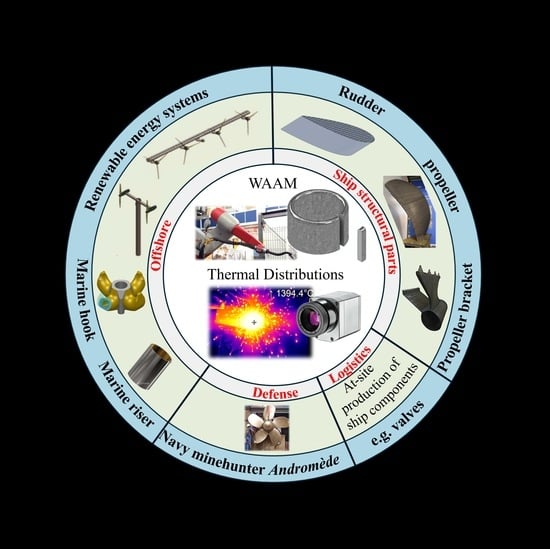
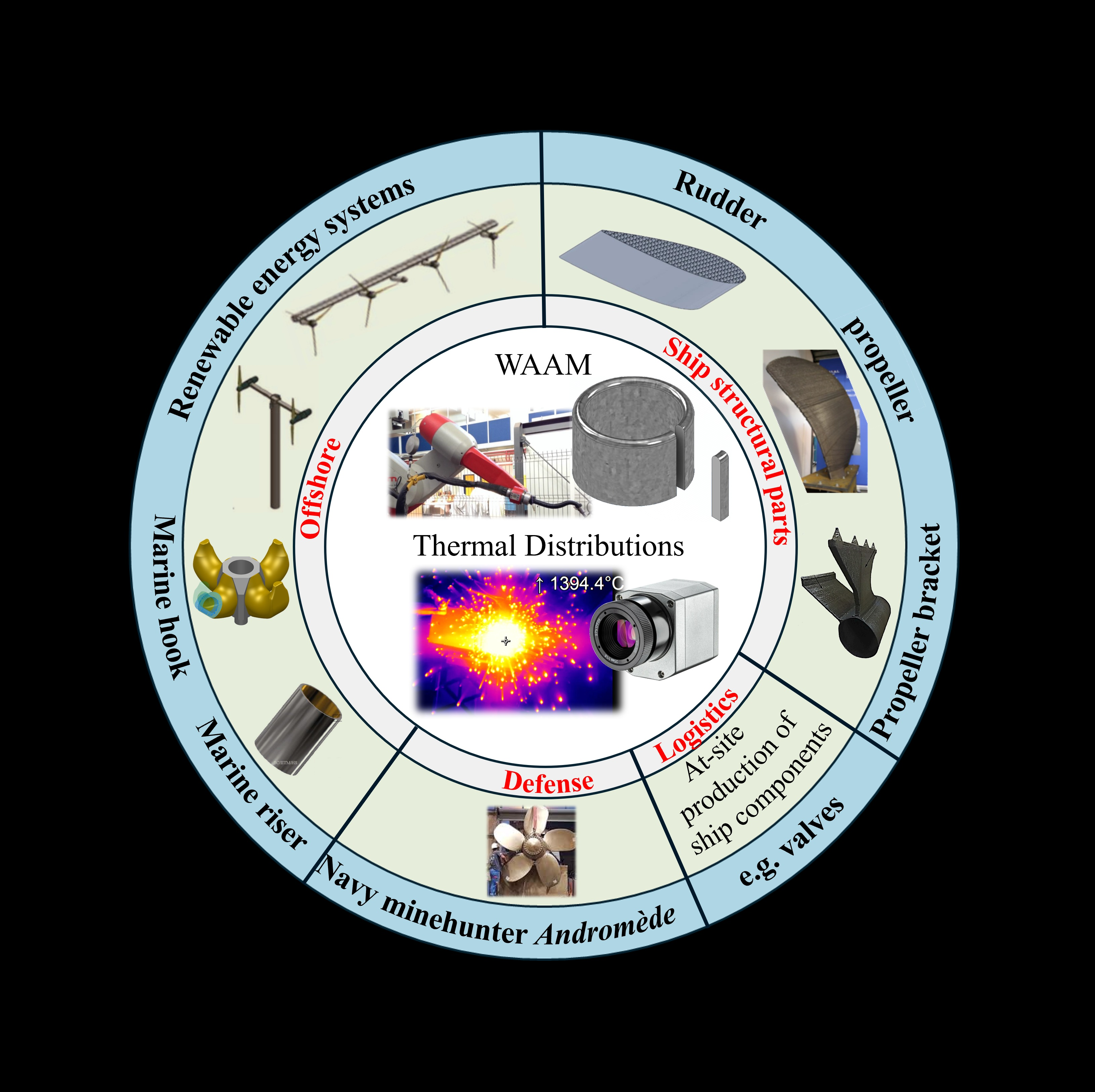
Graphical Abstract

1. Introduction

1.1. WAAM Technology in Marine Applications

Additive manufacturing (AM) serves as an umbrella term describing the rapid developing technology by which three-dimensional parts are built by sequentially adding and depositing fine layers of metal, polymer, ceramic powders or wires [1]. AM processes can be subdivided into seven categories, four of which are used to fabricate metal parts. Direct energy deposition (DED) is one such category, in which metal parts are produced by feeding powder or wire through a nozzle, that is melted at the point of deposition. Wire arc additive manufacturing (WAAM) is a subset of DED methods that utilizes a welding process, such as gas metal arc welding (GMAW) or plasma arc welding (PAW), as a heat source [2].
In particular, AM technology and its prospects in the maritime industry could help overcome existing limitations. Thousands of devices and components, consisting of hundreds of individual parts, are delivered daily to meet the operational needs of the ships. As a result, an extensive supply chain has been established, requiring coordination among several companies and entities to address challenges related to international geopolitical and legal conditions. To mitigate the risk of long delivery times, AM technology can be utilized. AM systems installed at major ports and logistics centers enable customized, large-scale production of small-series components, contributing to a sustainable future by reducing both delivery times and greenhouse gas emissions [3].
Several WAAM applications in the maritime industry have been successfully implemented or experimentally studied, including the production of propellers [4,5,6], propeller brackets [7,8], marine crane hooks [9], and marine risers [10]. Additionally, WAAM has been proposed for various marine applications, such as offshore structures in renewable energy [11,12], and hollow structures for ship rudders and bows [1]. The growing interest in WAAM applications within the maritime industry highlights the need for further research focused on marine environments [1].
The propulsion system is of critical importance for seaworthiness, as its failure or loss can have severe consequences. The propeller is a core component of the propulsion system, and its design directly affects fuel consumption [4]. Due to its complex geometry, conventional manufacturing methods such as casting, which involve mold fabrication, material melting, casting, and computed numerical control (CNC) machining, are time-consuming and expensive. Typically, a propeller is composed of a hub and multiple blades [6].
Materials used for marine applications must meet specific requirements related to design lifetime and service conditions, including good repairability, excellent resistance to seawater fatigue crack and high resistance to galvanic and crevice corrosion, cavitation, erosion, and impingement attack [4]. As a result, nickel aluminum bronze is the most commonly used material for marine propellers [4,5,6].
Several researchers have fabricated WAAM propellers [4,5,6]. However, slicing has been a common challenge in such applications. Tianying et al. [6] produced both the hub, and the blades, by proposing a cylindrical surface slicing method, a conformal slicing that uses a cylindrical surface coaxial with the hub to slice the propeller blades and approach the deposition path. Many researchers have observed that mechanical properties of the WAAM fabricated propeller components are superior to those of cast components with the same chemical composition [5,6].
An emblematic example of a WAAM propeller application is the production of spare blades for the propeller of the French Navy minehunter “Andromède” (Figure 1a), which meets military quality requirements. This achievement resulted from a collaboration between the Naval Group and Centrale Nantes, with Bureau Veritas Marine & Offshore overseeing the certification process, to ensure the proper performance and conformity of each blade. The mechanical and corrosion-resistant properties of the WAAM-produced blades were demonstrated to be equal to or superior to those required for cast components [5].
Another complex component with a vital role in large ships is the propeller bracket (Figure 1b). This structure consists of three distinct parts; the hub, the support arm, and the cross arm, which work together to support the high-speed rotation of the propeller. High precision and reliability are essential for this application. The conventional manufacturing process involves a combination of casting and welding. However, casting can lead to shrinkage, resulting in dimensional deviations. In addition, in welded regions, the heat-affected zone (HAZ) often experiences grain coarsening, which deteriorates local mechanical properties. To meet dimensional accuracy and mechanical requirements, WAAM technology has been deployed, effectively mitigating coarse grains and performance degradation in the HAZ [7]. A more complex propeller bracket has also been fabricated using a five-arc cooperative WAAM system. In this setup, the two front welding torches form the contour of the depositing layer, while the three rear arcs of the third torch fill the interior of the contour [8].
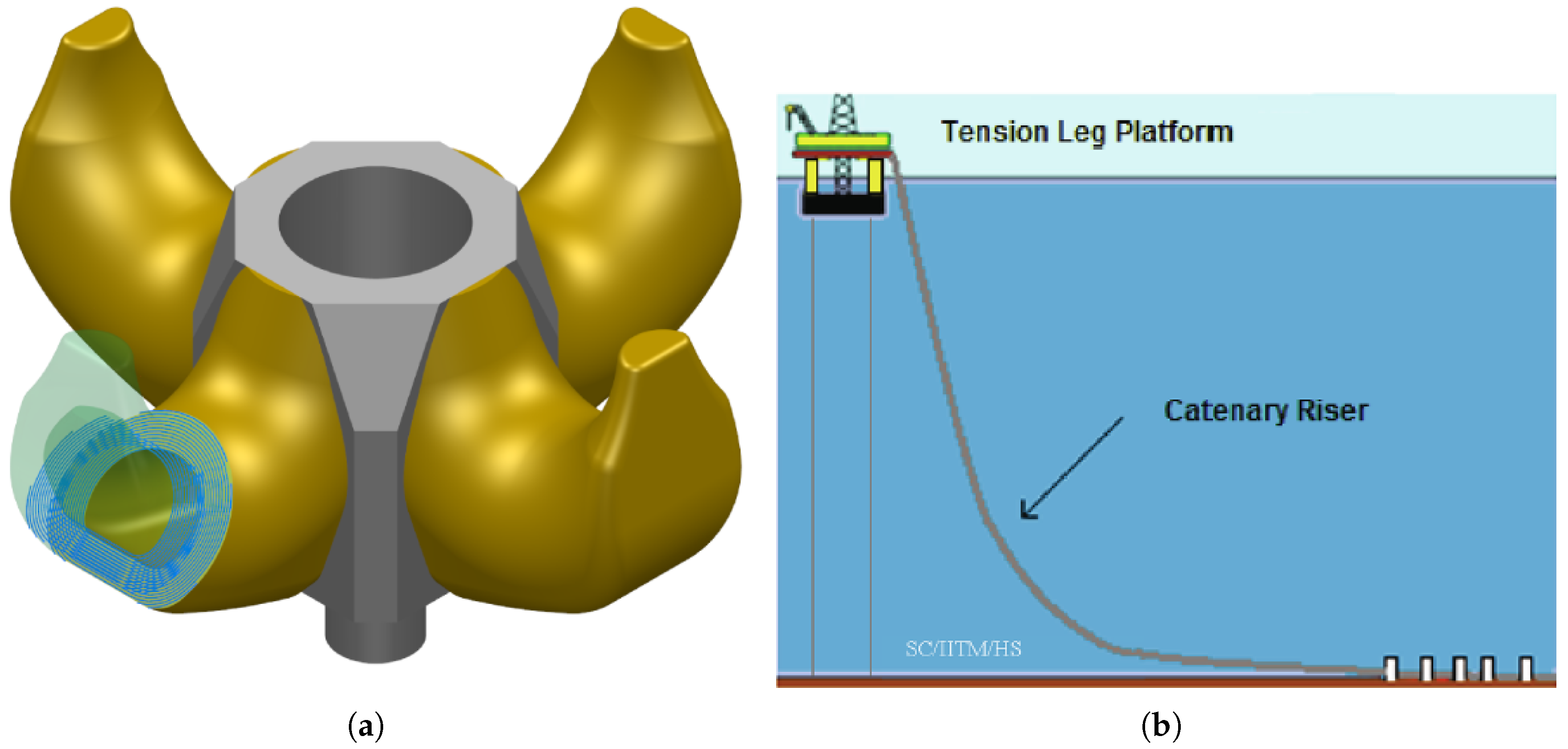
The large offshore crane hook is based on a Huisman 4-prong hook (Huisman Equipment B.V., Schiedam, The Netherlands) design (Figure 2). The hook exploits the benefits of 3D printing, such as the ability to produce hollow structures, significantly reducing material usage and production lead time. This project was carried out in collaboration with classification societies including DNV GL (Bærum, Norway), Bureau Veritas (Neuilly-sur-Seine, France), and ABS (Houston, TX, USA), contributing to the development of rules for WAAM products in the maritime and offshore industries. The crane hook spans 1 m, weighs 1 ton, and has a lifting capacity of 325 metric tons [9].
A notable marine application is the marine riser, which transports hydrocarbons from the seabed to the offshore platform (Figure 2). The requirements for this component are both structural and functional. In deep-water environments, marine risers are subjected to high pressures of up to 140 MPa, high temperatures reaching 180 °C, and significant environmental loads caused by axial tension, waves, and currents. Additionally, adverse marine conditions and continuous contact with hydrocarbons expose marine risers to a constant risk of corrosion. To address these challenges, functionally graded materials (FGM) are employed. The WAAM method represents a technological advancement that serves as an alternative to conventional methods for FGM fabrication. X-ray tomography has confirmed that this manufacturing process is suitable for producing fully dense FGM materials. Tensile testing on WAAM-fabricated FGM samples demonstrated satisfactory results [10].
Beyond current applications in the marine environment, several new proposals have been suggested, including the WAAM fabrication of the ship rudders and bulbous bows, and marine energy components. In a ship, the rudder is an essential component of the propulsion and steer system, used for navigation and maneuvering. It is positioned at the stern, behind the propeller, where it generates hydrodynamic forces and steering moments. Implementing a hollow WAAM rudder can eliminate welding points, thereby reducing manufacturing complexity and welding cost. Similarly, the complex design and manufacturing challenges associated with a bulbous bow make WAAM a strong alternative [1].
In the field of marine renewable energy, wave energy converters (WECs) are a notable example that could benefit from WAAM. Reference models include tidal, river, and ocean current turbines, wave point absorbers, oscillating surge flaps and oscillating water columns. However, to date no WEC components have been produced using WAAM. Choi et al. demonstrated that WAAM fabricated samples meet or exceed the mechanical properties of wrought materials, exhibiting reduced property degradation in properties after corrosion exposure [12]. The use of WAAM in the offshore renewable energy (ORE) industry has been widely discussed. In addition to the advantages mentioned above, the ability to manufacture components near the site can significantly reduce the supply chain lead times [11].

1.2. Current Challenges in Wire Arc Additive Manufacturing (WAAM)

Despite its promising potential, WAAM technology has not yet been widely adopted in heavy industry. Neill and Mehmament [11] outlined several notable advantages alongside certain limitations. WAAM enables the fabrication of complex parts and near-net-shape components, thereby reducing material wastage and overall material costs. It also allows material mixing to tailor properties, supports the production of functionally graded materials (FGMs), and enables manufacturing close to the point of use, thereby shortening supply chain lead times. Due to repeated thermal cycles, higher hardness values, and in some cases, improved fatigue life compared to wrought materials can be achieved. Additionally, WAAM can be used for coating and repair applications, exhibits relatively low emissions compared to conventional manufacturing processes, may offer enhanced corrosion resistance through hybrid material fabrication, imposes virtually no size constraints on manufactured components, and is associated with low energy consumption. Furthermore, Taşdemir and Nohut [1] highlighted that WAAM offers lower buy-to-fly (BTF) ratios compared to traditional methods, a metric that quantifies the efficient use of raw material.
On the other hand, WAAM is associated with several inherent drawbacks. The process involves high costs, including significant capital expenditure (CAPEX) for equipment, and often requires longer manufacturing times compared to some conventional processes. Porosity and related defects can occur in the deposited components, necessitating post-manufacturing machining. Furthermore, WAAM is prone to unpredictable residual stress profiles throughout the build, and the residual stress distribution can be significantly affected when components are separated from the base plate.
Many of WAAM’s inherent advantages and disadvantages are also discussed in the maritime section, along with additional considerations specific to the maritime industry. The need to accommodate complex geometries and operational requirements, combined with the necessity to withstand harsh marine environments, further increases existing challenges. The demand for customized solutions, particularly in this increasingly decarbonized industrial sector, is directly linked to the mechanical properties of the components and, consequently, to their microstructural features. WAAM emerges as a promising and sustainable solution for purpose-oriented (customized) manufacturing. However, the diversity of operational requirements, together with the selection of appropriate steel grades for specific applications, increases the complexity of WAAM fabrication. Microstructural features result from the local thermal history experienced by the material, and WAAM is inherently characterized by successive thermal cycles. Therefore, to tailor the microstructure, and consequently the desired properties, it is essential to determine the thermal history at each region of the component a priori.
As stated by Zhonghao Chen et al., a cost-effective alternative to traditional trial-and-error approaches is process modeling, which enables researchers to investigate the underlying physical mechanisms in AM processes [13]. Modeling in AM is inherently complex due to the involvement of multiple physical phenomena across different length scales. To manage this complexity, a three-scale modeling framework—macro-, meso-, and micro-scale—is commonly adopted, with each scale designed to capture specific physical mechanisms. At the macroscale, phenomena such as temperature field evolution and residual stress formation are typically addressed. The mesoscale focuses on melt pool dynamics [14], while the microscale provides deeper insight into the kinetics of solidification and microstructural morphological evolution [13].
Among the most widely used approaches for macroscale modeling are numerical simulations, particularly those based on the finite element method (FEM). In welding science, however, the temperature field has also been evaluated analytically since the 1930s. Although analytical and numerical approaches solve the same governing partial differential equation (PDE), they differ significantly in their formulation and scope. Numerical simulations are well suited for complex geometries and nonlinearities, such as temperature-dependent material properties, and are therefore primarily aimed at achieving quantitative accuracy for industrial applications, with their reliability strongly dependent on mesh density and element type. In contrast, analytical solutions are based on linearized assumptions and simplified geometries, making them extremely fast in terms of computational cost, easy to implement, and mainly suitable for qualitative trend analysis. Nevertheless, for both approaches, calibration of the simulated temperature field against experimental data remains a critical and often time-consuming task [15].
In this study, the widely used analytical Rosenthal solution in welding is evaluated for its comparative advantages relative to numerical models. However, Rosenthal’s equation relies on several simplification assumptions (a) it neglects the temperature dependence of specific heat (c), density (ϱ), and thermal conductivity (k), (b) it does not account for the latent heat associated with the liquidus–solidus phase transformation, (c) it neglects heat losses due to radiation and convection to the environment and, and (d) it assumes a point heat source. Sampaio et al. outlined the limitations of using the Rosenthal equation to model the thermal cycle and melt pool geometry in WAAM. First, the equation predicts infinite temperatures at the origin of the heat source. Second, it assumes conduction-based heat transfer, neglecting the dominant role of convection within the melt pool, which leads to discrepancies between analytical predictions and experimental results. Third, differences in the melt pool cross-sections of arc welding and WAAM result in varying melting efficiencies due to differences in heat transfer to the solid metal and heat loss to the environment [2].
For the reasons discussed above, many researchers have attempted to apply the Rosenthal solution in WAAM by altering its structure. For instance, Bendia et al. [16] developed a model based on the Rosenthal solution to control layer geometry and optimize GMAW-WAAM process. Rios et al. [17] also successfully modeled layer geometry, this time in pulsed tungsten inert gas (pulsed-TIG) and plasma deposition, by combining Rosenthal’s equation with capillarity analysis. Pinkerton and Li [18] proposed a Rosenthal-based model based on one-dimensional heat conduction to the substrate. The model was successfully applied in direct energy deposition-laser powder (DED-LP). A study which presents thermal cycles comparable to those investigated in this work, and extending the simulation further to predict microstructure evolution, was conducted by Shah et al. They proposed a workflow to accelerate material design in AM. In addition to using the Rosenthal solution for thermal cycle prediction, Thermo-Calc 2022a (Thermo-Calc Software AB, Stockholm, Sweden) was employed to predict the equilibrium phases, while MICRESS 7.1 (MICRESS GmbH, Aachen, Germany) ® software was used for microstructural simulations [19].
As for the experimental procedure, two ER70S-6 low-carbon steel cylindrical components were fabricated using WAAM techniques was carried out with GMAW and PAW employed as heat sources. Experimental data obtained from the thermal camera (PI Model 1M 13° × 8°, Optris GmbH & Co.KG, Berlin, Germany) and a pyrometer (Model CTL-SF75-C3, Micro-Epsilon, Ortenburg, Germany) were used to generate temperature-time histories. Based on the calculated dwell times between successive passes, the Rosenthal solution was applied to predict the corresponding thermal cycles. Microstructural characterization of the cylindrical components was performed in three distinct regions. Specimens extracted from the components were subjected to tensile testing and microhardness measurements and fracture surface were examined using scanning electron microscopy (SEM) (Jeol 6390 223, Jeol Ltd., Tokyo, Japan). In terms of simulation modeling, this study employs the Rosenthal solution in its original form, aiming to provide a deeper understanding of its qualitative use in WAAM. In addition to the experimental work, the analytical solution is used as a preliminary, fast, and efficient tool to assess the influence of process type (GMAW vs. PAW)—which differ significantly in deposition techniques and heat accumulation—on microstructural evolution. Within this framework, the Rosenthal solution is further evaluated for its ability to predict the experimentally measured temperature field by incorporating experimental data. Lastly, the expected quantitative variations are analyzed in detail, emphasizing the efficiency of the solution.

2. Materials and Methods

2.1. Material and Experimental Procedure

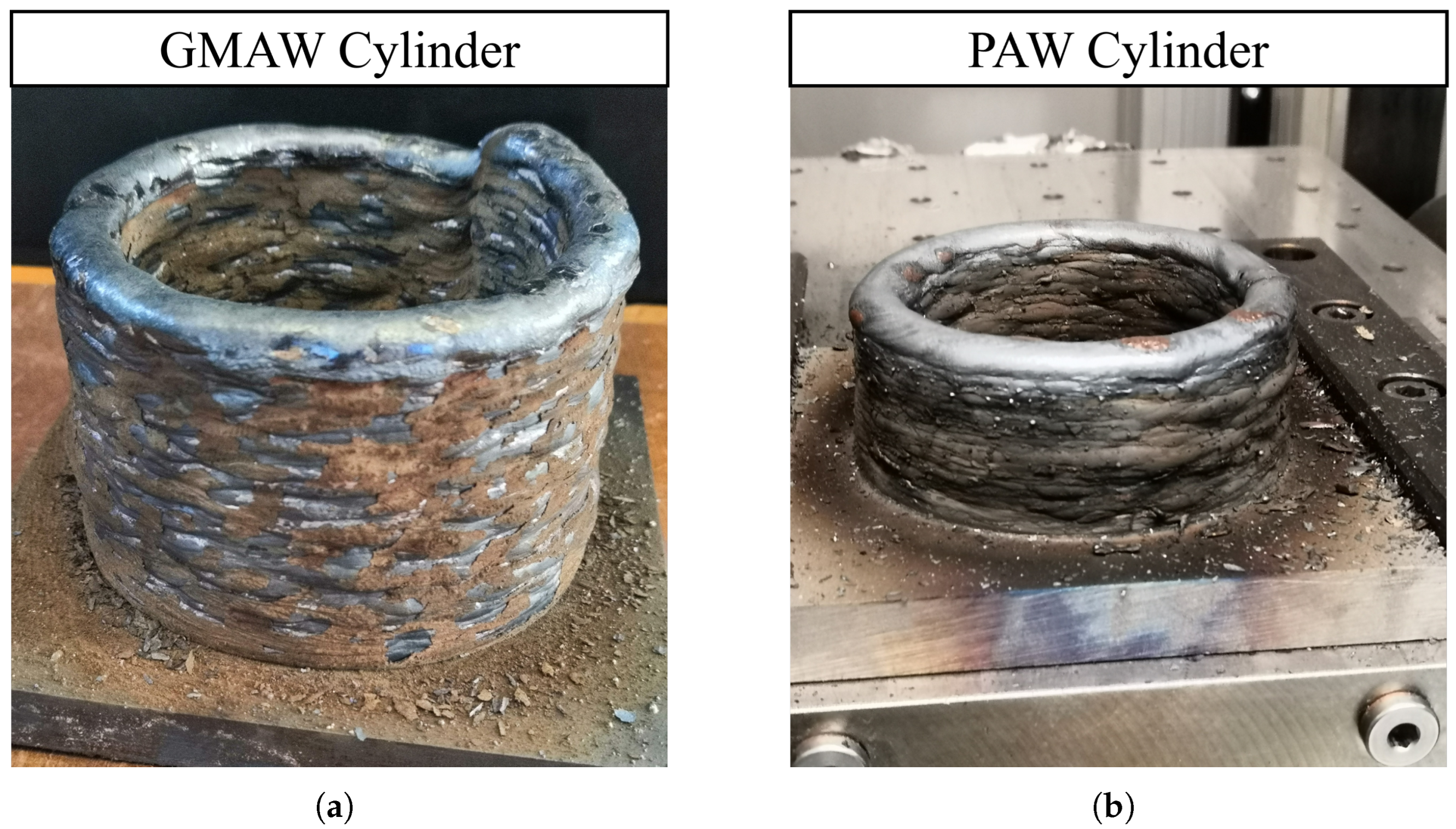
Table 1 presents the chemical composition of the AWS A5.18 ER70S-6 welding wires with diameters of 1.2 mm and 1 mm, used for the GMAW and PAW experiments, respectively [20,21]. The process parameters for the GMAW and PAW cylinders are summarized in Table 2. The PAW parameters were selected to achieve a melting rate similar to that of GMAW; however, an exact match was not possible due to system limitations. Table 3 presents the measured dimensions of the fabricated cylinders, while photographs of the resulting cylinders are shown in Figure 3.
The GMAW cylinder was fabricated using a “Fronius TPS 330” welding power source (Fronius International GmbH, Pettenbach, Austria) with an “IGM K4 System” robotic arm (igm Robotersysteme AG, Wiener Neudorf, Austria). Temperature distributions in the GMAW cylinder were measured using an Optris® PI 1M thermal camera (PI Model 1M 13° x 8°, Optris GmbH & Co.KG, Berlin, Germany) featuring a resolution of 382 × 288 pixels, a frame rate of 10 Hz, thermal sensitivity (noise-equivalent temperature difference—NETD) < 4 K and a system accuracy of ±2.5% for temperatures below 1600 °C. A new layer was deposited once the surface temperature decreased to 453 °C. Minor variations in current and voltage values were attributed to the deposition technique employed. The position of the robot’s nozzle, specifically the contact-to-work distance (CTWD) parameter, was re-adjusted every 8–10 deposited layers. As the number of layers increases, a rise in current and voltage values was observed, leading to an increase in heat input. This effect is attributed to the decreasing length of the welding wire extending beyond the nozzle [22].
Similarly, for the PAW cylinder, the machine’s working chamber was equipped with a “PMW 450” torch (SBI GmbH, Ziersdorf, Austria), and a “MicroEpsilon thermoMETER CTLaser” pyrometer (Model CTL-SF75-C3, Micro-Epsilon, Ortenburg, Germany), which moved synchronously with the torch. The interlayer temperature was set to 250 °C. Throughout the entire process, a cooling system supplied water at 22 °C on a baseplate, on which the substrate was mechanically constrained.
It should be clearly stated that the use of a thermal camera for the GMAW cylinder and a pyrometer for the PAW cylinder was determined by the availability of equipment at the locations where each experiment was conducted. In addition, although different measurement tools were used, both served to record the temperature of the last deposited layer.
Before fabricating the two WAAM cylinders, an experimental trial of eight layers was conducted. In this preliminary experiment, layers were deposited with zero dwell time between successive passes, and the GMAW process was employed.
Prior to deposition, mild steel substrates measuring 100 × 100 × 10 mm for GMAW and 130 × 130 × 11 mm for PAW were sandblasted, cleaned with ethanol, and prepared for welding. The welding torch was cleaned and positioned vertically to the substrate plate.
The heat input (h) was calculated using Equation (1).
h [ kJ / mm ] = η × V × I × 60 u × 1000
where
η is the thermal efficiency (%), I (A) the arc current, V (V) the arc voltage, and u is the travel speed in mm/min.
Additional parameters required for the calculations include the melting rate (MR) and the heat generated by the welding arc, given by Equations (2) and (3).
M R [ mm 3 / s ] = π × d 2 × W F S × 1000 4 × 60
where d [mm] is the wire diameter, and WFS [m/min] the wire feed speed.
Q [ W ] = η × V × I
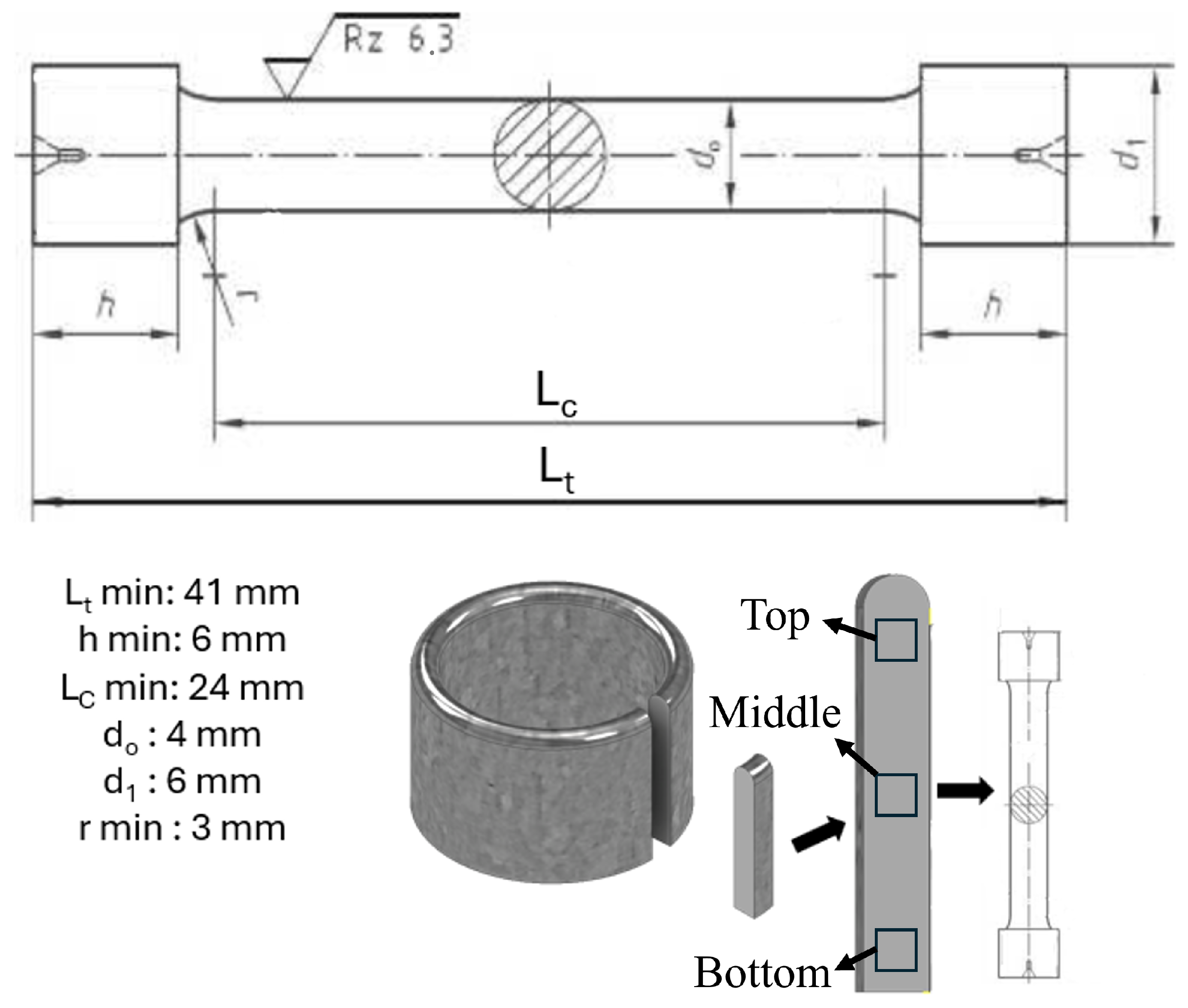
Figure 4 illustrates a schematic diagram of the fabricated component along with the locations from which specimens were extracted for metallurgical characterization and tensile testing. The illustration was created using the Autodesk Inventor software package (Version 2025, Autodesk, Mill Valley, CA, USA).
Tensile properties were measured using an Instron 4482 hydraulic testing machine (Instron®, Norwood, MA, USA) with a load capacity of 100 kN. According to the ISO 6892-1 standard [23], the tensile samples were extracted vertically to the deposition direction, as shown in Figure 4. The yield strength (YS) was determined to 0.2% of elongation. Fracture analysis was performed to identify the fracture mode using a JSM 6390 scanning electron microscope (SEM) (Jeol Ltd., Tokyo, Japan). The fracture behavior was further evaluated using the reduction of area (RA) factor (Equation (4)), which indicates whether the material exhibits brittle or ductile behavior. Microhardness measurements on the two cylinders were performed using the 402MVD Wolpert Wilson micro-hardness tester (Wilson Instruments, Norwood, MA, USA), in accordance with the Vickers testing method. The microhardness was recorded with a load set of 0.3 kg and a dwell time of 10 s across the middle section of the low-carbon steel cylinders. The distance between two adjacent indentations in each region was 1 mm, and the average value of indentations in each region was used to calculate the hardness value. Microstructural examination was conducted on mirror polished metallurgical samples of the low-carbon steel cylinders at 10, 20 and 43 mm from the substrate for the GMAW cylinder, as well as 10, 20, 29 mm for the PAW cylinder. A 2% Nital reagent was used to reveal the morphologies of the samples. The Leica DM ILM optical microscope and Leica MZ26 stereomicroscope (Leica Microsystems, Wetzlar, Germany) were employed to examine the morphologies of ER70S-6 steel cylinders. The images were captured using Leica Application Suite software V3.7.0 (Leica Microsystems, Wetzlar, Germany).
R A = A o A f A o
where Ao is the original cross-sectional area of the specimen, and Af is the final cross-sectional area at the point of fracture.

2.2. Computational Procedure

The Rosenthal solution (Equations (5)–(7)) for a semi-infinite solid was employed to predict the temperature field distributions as a function of time. It was implemented using Matlab® (Version R2025b, Mathworks, Natick, MA, USA). A moving coordinate system (w, y, z) traveling at the same speed as the welding arc was used [24]. Despite the various assumptions discussed in the introduction, the Rosenthal solution remains a useful and rapid tool for qualitative trend analysis rather than for quantitative prediction of the temperature field.
Considering that the Rosenthal solution is a first-order approximation for estimating the temperature field, the parameters used are assumed to be constant, thereby neglecting their temperature-dependent behavior, in order to provide a quick estimation of the temperature. These parameters are summarized in Table 4. However, it should be clearly stated that incorporating temperature-dependent physical and thermal properties would improve the accuracy of the calculations.
T ( C ) T o = Q 2 × p i × k × e u 2 × α × w × e u 2 × α × R R
w = x u × t
R = w 2 + y 2 + z 2
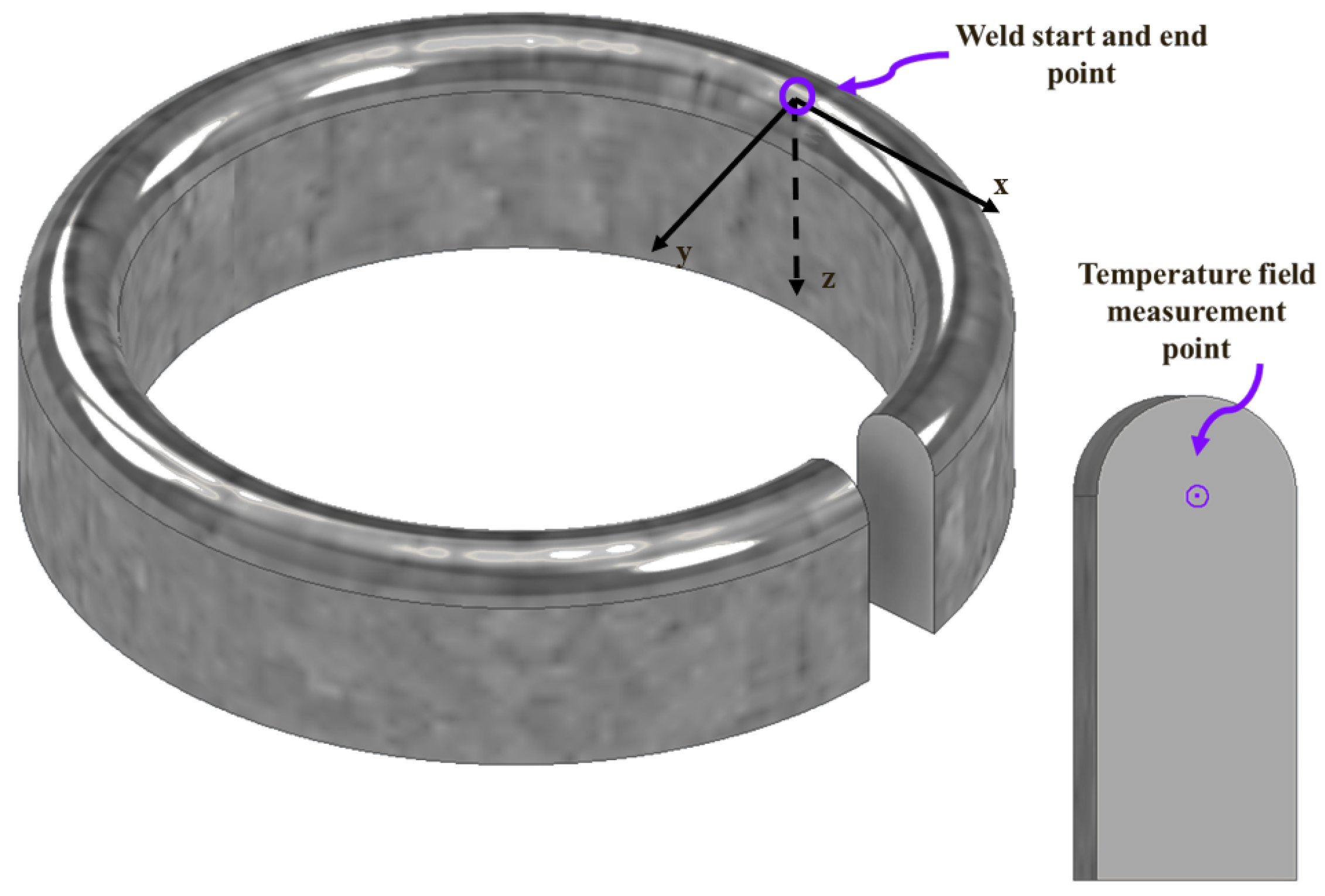
Equation (5) contains several variables: the temperature T, the initial temperature To, the spatial coordinates (x, y, z), and time t. To generate the temperature–time plots, the values of To, x, y, z must be specified. Here, To represents the initial temperature at the beginning of each deposition pass, which is expected to increase as successive layers are deposited. The spatial coordinates selected for analysis are (0,0,0.6), approximately at the middle of the last deposited layer. A schematic illustration in Figure 5 depicts the selected point together with the coordinate reference system, positioned on the surface of last deposited layer at each time step.
In this study, the Rosenthal Solution was applied in conjunction with experimental data using two different approaches. The first approach focuses on the fabrication of the two low-carbon steel cylinders, where each new layer was deposited considering the corresponding interlayer temperature. Based on the time intervals extracted from the thermal camera and pyrometer data for GMAW and PAW cylinder, respectively, the Rosenthal solution was applied using the interlayer temperature as the initial temperature equal To. In contrast, the second approach refers to the eight-pass experimental trial, in which the time interval between successive layers was constant and equal to 0 s. In this case, the initial temperature was defined as the temperature obtained from the previous Rosenthal curve 1 s prior to the expected passage of the heat source at the specified point.

3. Results

3.1. Analytical and Experimental Results

3.1.1. Experimental Trial

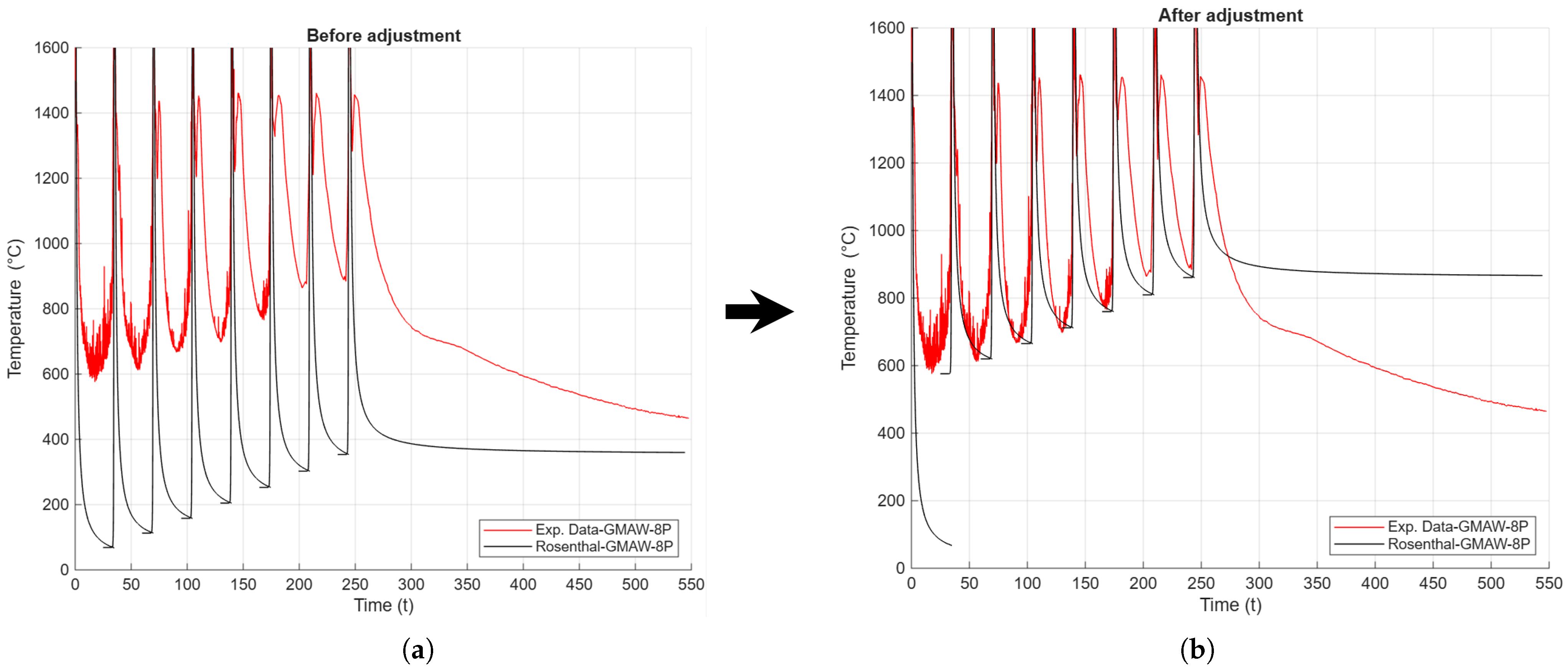
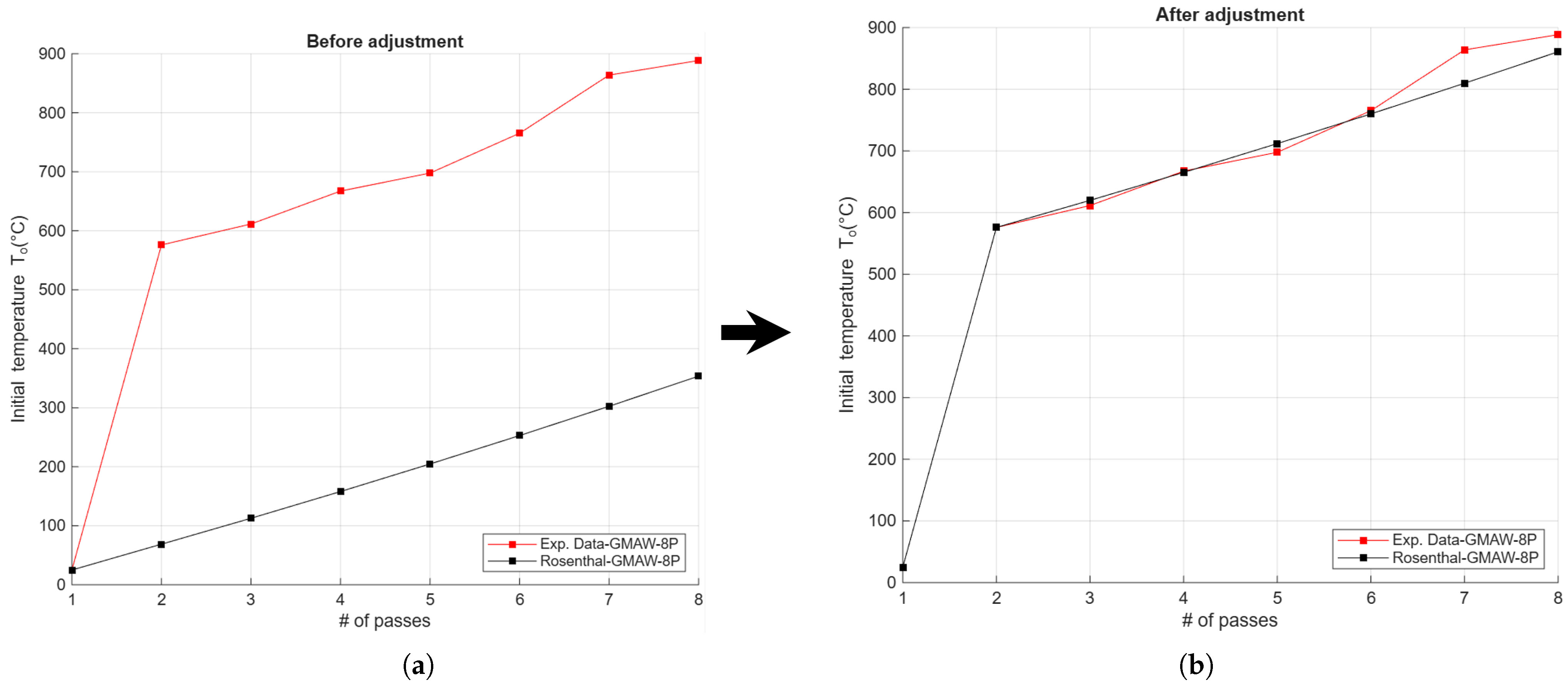
The eight-pass GMAW experiment aims to compare experimental data with analytical results in terms different from the subsequent cylindrical experiments. In this case, prediction of the thermal distribution follows the procedure explained and relies solely on Rosenthal solution. The experimental and analytical results are presented in Figure 6 and Figure 7. Specifically, Figure 6a depicts the thermal cycles recorded by the thermal camera alongside the distribution calculated using the Rosenthal equation following the described approach. A significant deviation of the temperatures developing throughout the process is clearly observed. Similarly, this deviation is evident in the initial temperatures shown in Figure 7a. Despite the deviation, both figures show that the initial temperature exhibits progressively increasing valley values in both curves.
Given the fact that the rate of increase appears to be the same in both experimental and analytical results, a parallel displacement of the Rosenthal results would improve the prediction. Indeed, aligning the initial temperature of only the second pass in the Rosenthal solution with the corresponding experimental temperature (576 °C) led to remarkable outcome (Figure 6b and Figure 7b). From this experiment, it can be concluded that while the Rosenthal equation did not accurately predict the initial temperatures, it effectively and accurately captured the rate of increase in the initial temperatures.
The observed delay in the Rosenthal solution’s ability to predict the increasing initial temperature in multipass welding can be attributed to the fact that the Rosenthal solution is not suitable for multipass welding, as the initial temperature corresponds to a hypothetical heat-treatment scenario. Rosenthal originally proposed the equation by considering the deposition of a single layer on either a heat-treated or untreated substrate. Under these conditions, the substrate is assumed to be uniformly heated, and the initial temperature influences the cooling rate of the weld. In contrast, in WAAM processes, the Rosenthal solution is unable to accurately predict the inherently unstable thermal distribution, particularly the true initial temperature values. With repeated application of the Rosenthal model, the initial temperature would continuously increase without bound. Physically, this does not make sense, as an actual experiment with an infinite number of passes would show a plateau after a certain number of depositions. For this reason, the proposed adjustment appears to serve as an illustrative convergence rather than a rigorous modeling approach.

3.1.2. GMAW Cylinder

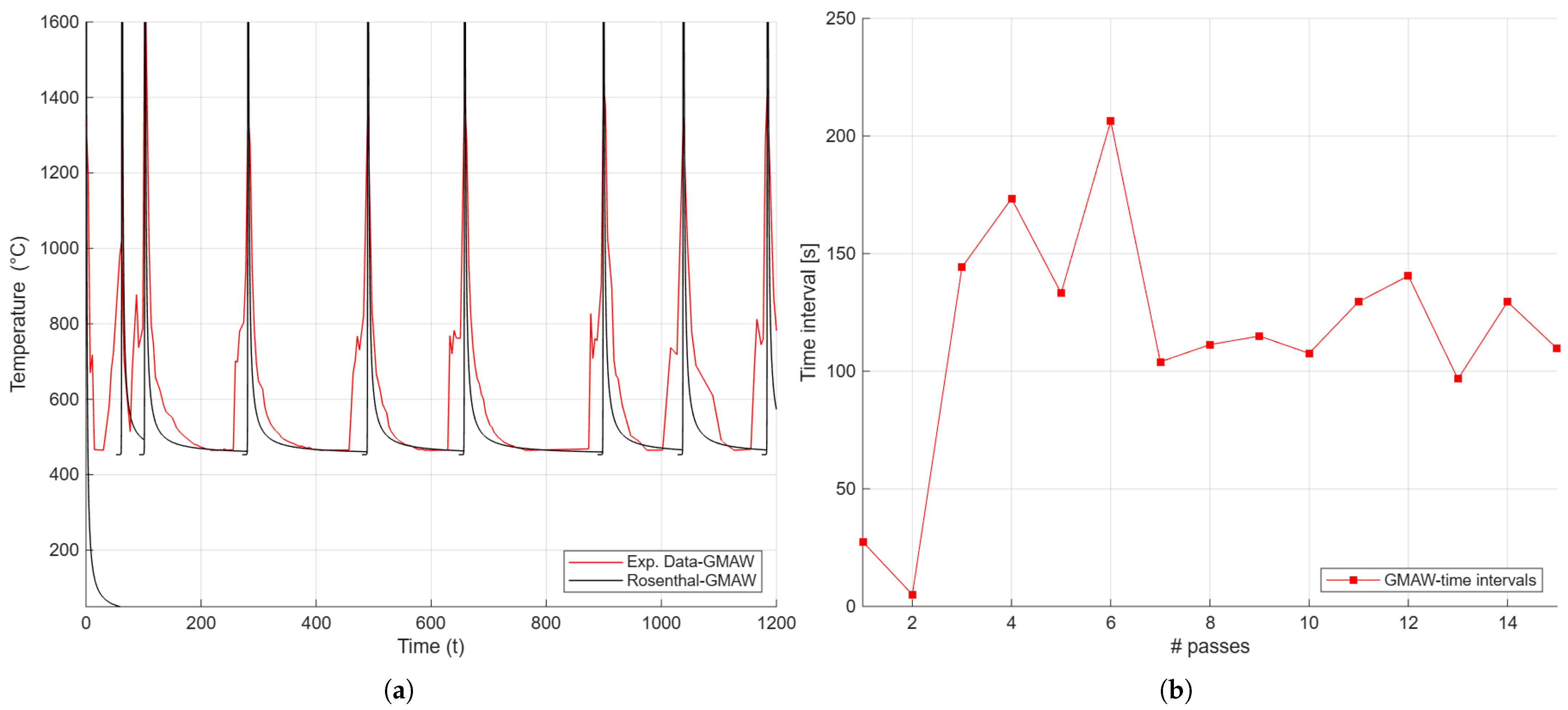
The GMAW-WAAM cylinder was fabricated with an interlayer temperature of 453 °C. Prior to this, three layers were initially deposited on the substrate with a zero-second time interval, increasing the surface temperature to approximately the interlayer temperature and allowing the formation of a wider base. The experimental results for the first nine layers are given in Figure 8a. The average time interval after the 7th layer, where time intervals stabilized was found to be 116 s. Subsequently, the Rosenthal equation was applied after calculating the time intervals (Figure 8b). These time intervals were used as input for the Rosenthal equation along with the interlayer temperature of 453 °C. The analytical results in Figure 8a show partial convergence with the experimental data.
The cooling rate remains rapid and follows the same trend as observed in the Figure 6. However, the Rosenthal solution was unable to predict the rate of temperature increase and decrease during the preheating and cooling phases of each curve before and after the heat source passes, respectively. Regarding the initial temperatures, the Rosenthal solution accurately forecasts the initial temperature at the interlayer temperature, as when time approaches , To tends to the interlayer temperature.

3.1.3. PAW Cylinder

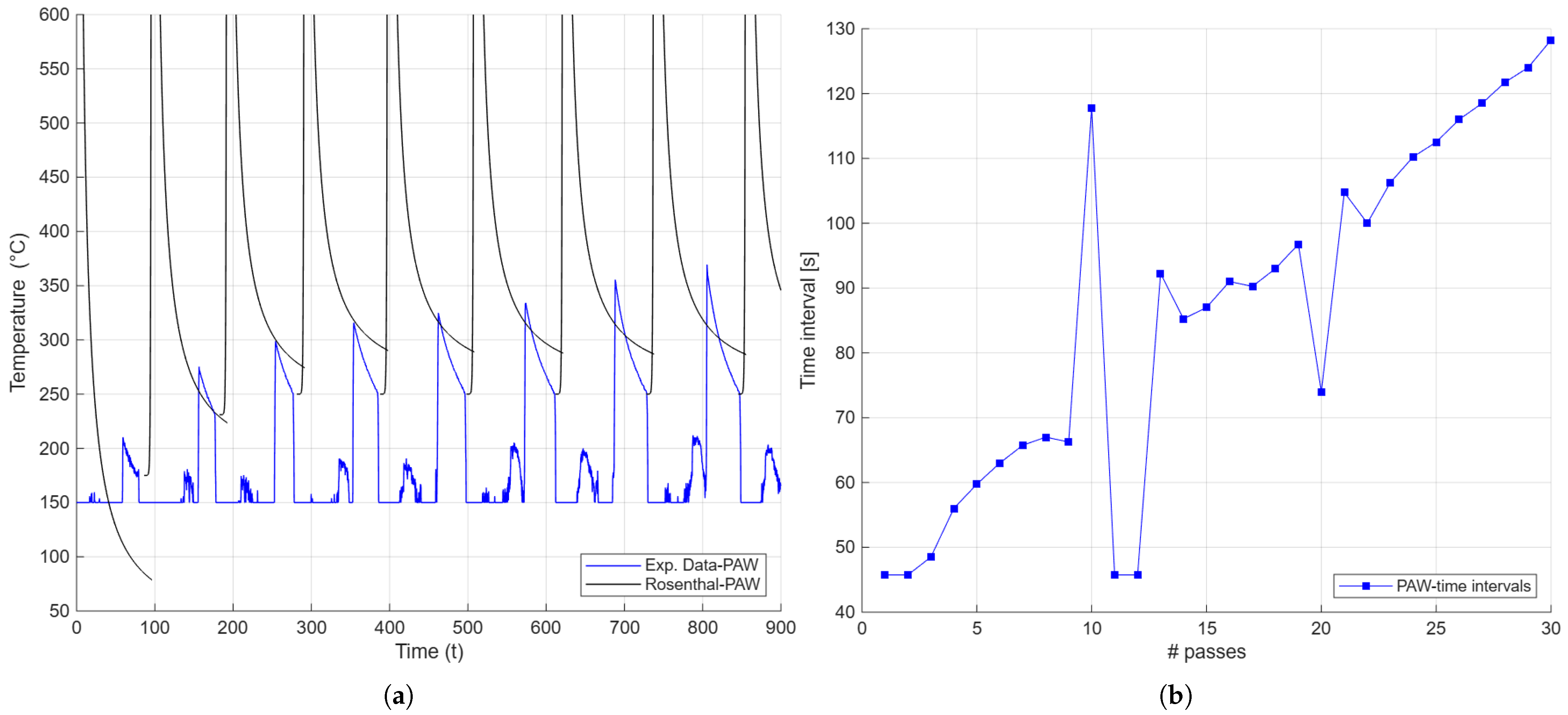
The PAW-WAAM cylinder was fabricated similarly to the GMAW-WAAM cylinder, with the primary difference being the interlayer temperature of 250 °C. Likewise, three layers of material were deposited with a 20 s time break between them, following by the construction of the remaining cylinder. Figure 9a depicts the thermal distribution as recorded by the pyrometer and as calculated using the Rosenthal equation for the first nine layers of the PAW-WAAM cylinder. In Figure 9a, each new layer is deposited when the pyrometer records a temperature drop to 250 °C. Since the pyrometer was mounted on the torch and moved along with it, direct measurement of the temperature field during the welding process was not feasible. Furthermore, the minimum detectable temperature of the pyrometer is 150 °C, which explains why the recorded temperature does not fall below this value.
In contrast to the GMAW cylinder, the time intervals appear to increase with number of the layers deposited (Figure 9b). In case of calculating the initial temperature based on the intercept point of two successive Rosenthal curves, the initial temperature would exhibit increasing values.

3.2. Microstructural Characterization

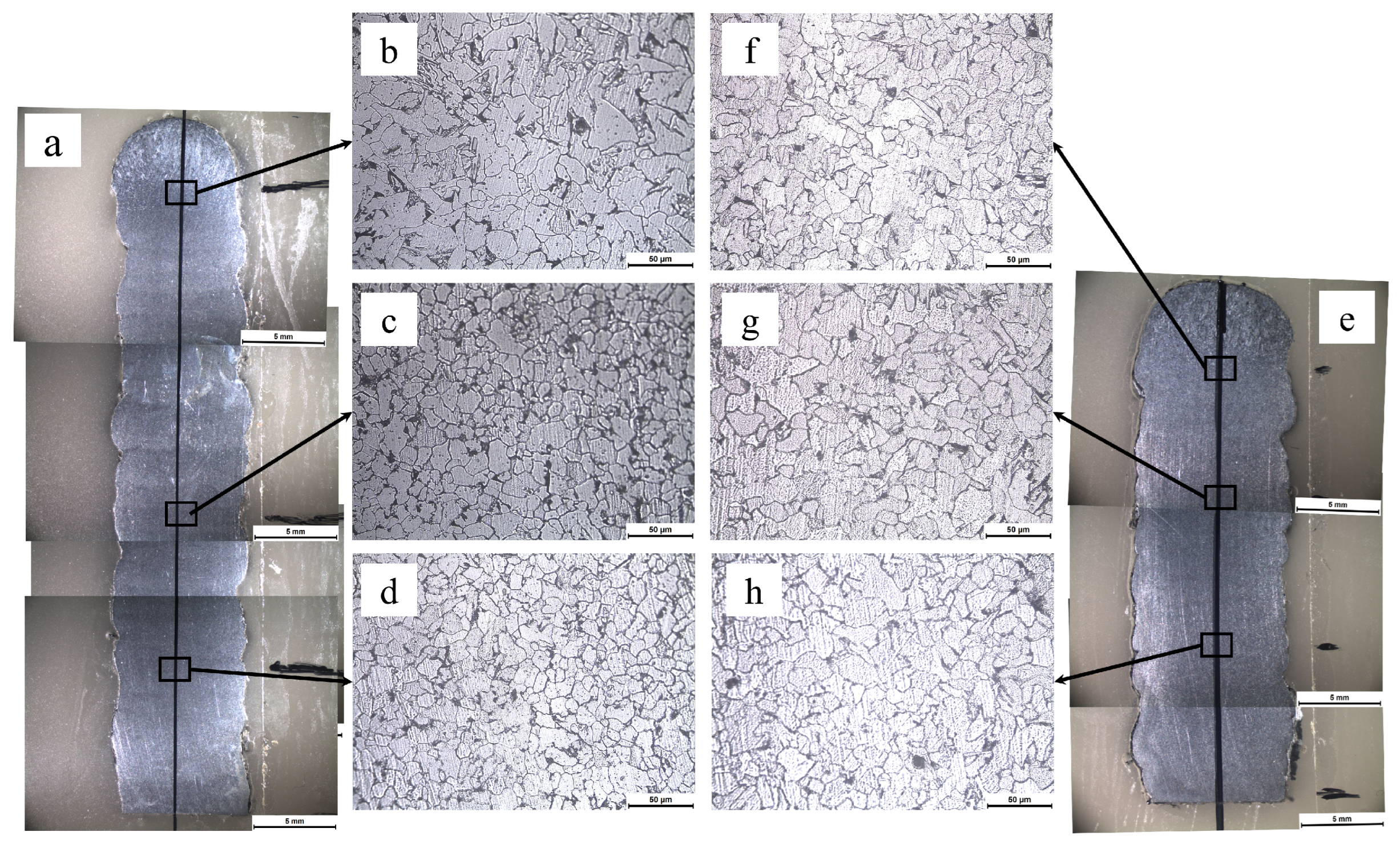
Without significant variation, the cylindrical components exhibit similar microstructural features. Figure 10 presents the microstructural analysis of WAAM ER70S-6 low-carbon cylinders, produced by GMAW and PAW, at their transverse cross-sections. Optical observations reveal a typical low-carbon steel microstructure with a reduced amount of secondary pearlite phase, as expected after an arc welding process [25,26]. The presence of ferrite and pearlite grains is confirmed by white regions and black areas within the grains at the grain boundaries. The area between the bottom and middle regions displays nearly identical microstructures throughout, while the morphological changes become evident in the upper regions. A higher pearlite content was observed in the GMAW cylinders compared to the PAW cylinders.
It is evident that different regions were subjected to different thermal cycles. The last deposited layer underwent only one thermal cycle, whereas the first layer, positioned on the substrate, experienced multiple cycles. The solidified deposited layers are subjected to several post-solidification phenomena, including thermally induced deformation, solid-state phase transformations, as well as microstructural coarsening and recrystallization [27]. However, while optical microscopy cannot detect thermally induced deformation, it can observe the latter two phenomena.
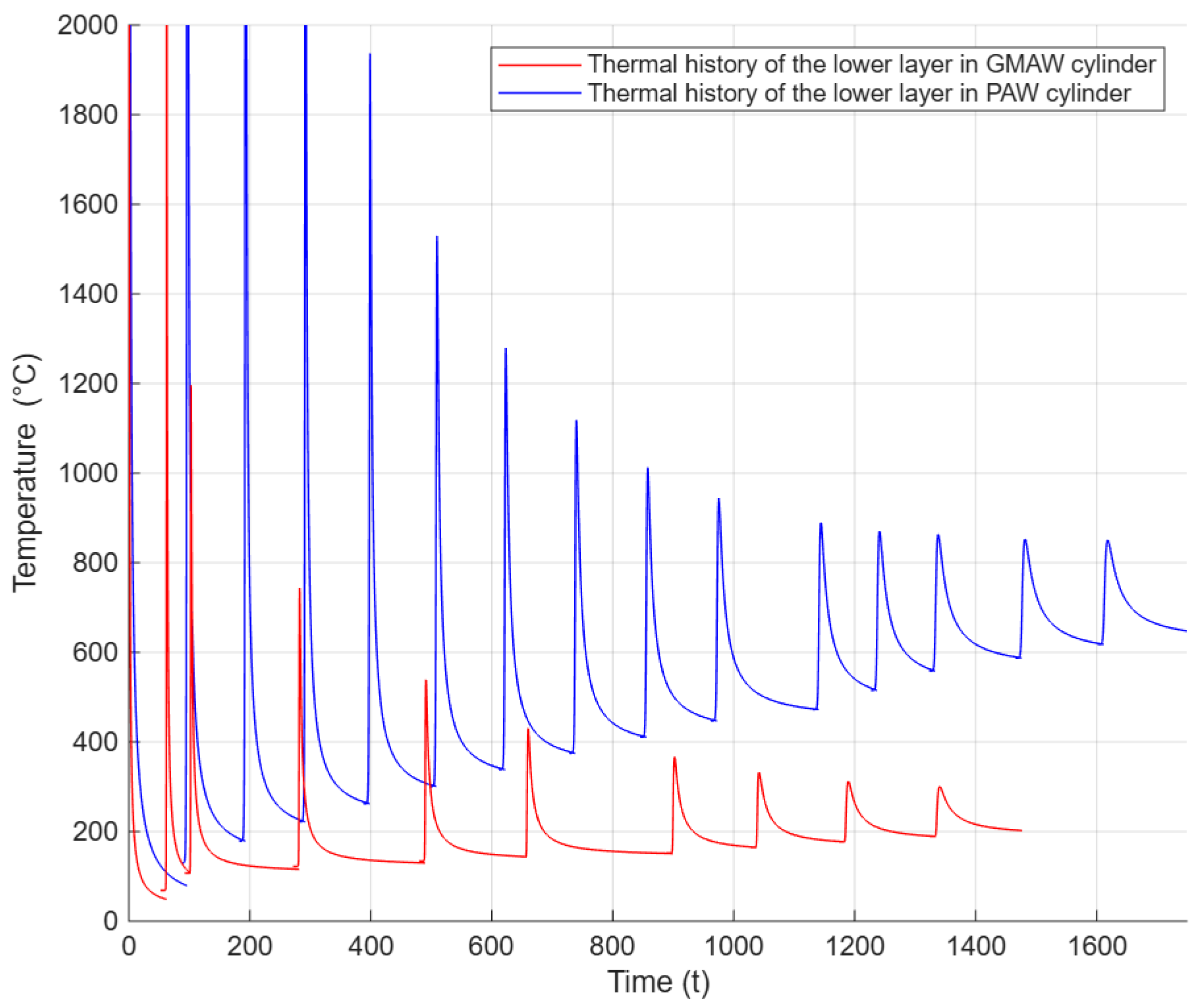
Solid-state phase transformations in austenitized S355 include ferrite–pearlite, bainite, or martensite depending on the cooling rate from 800 °C to 500 °C (Δt8/5 time). As the cooling rate increases, the austenitzed microstructure transforms into ferrite–pearlite, bainite, or to martensite [28]. Figure 11 presents a prediction of the thermal history at a small location near the first layer of the GMAW and PAW cylinders, influenced by the subsequent 10 and 15 deposited layers, respectively. The thermal history results from heat transfer from the newly deposited layer to the previously solidified layers [27]. For this calculation, the Rosenthal equation was applied once more, with the time intervals between layers taken from the experimental measurements, while the initial temperature at each deposition was estimated based on the approach used in the experimental trial involving eight passes. The increasing initial temperatures before each pass appear unrealistic, highlighting an inherent limitation of the Rosenthal equation: it cannot predict temperatures below the specified initial temperature. Additionally, the peak temperatures do not reflect the actual peak values, due to the point heat source assumption in Rosenthal’s model. When the initial temperature of the second pass is aligned with the corresponding experimental value, the cooling rate results for cylinder GMAW and PAW would be quantitatively identical since their primary difference lies in the heat input rate. Cooling rates for Δt8/5 time for the aforementioned spot decrease as the number of passes increases and are presented in Table 5 for the GMAW and PAW cylinders. The lower cooling rates observed in the PAW cylinder, compared to the GMAW cylinder, are attributed to the higher heat input of the plasma technique. In some cases, the calculation of the cooling rate was not feasible because either peak or lower temperature fell within the 800–500 °C range.
Cooling rates, together with the continuous cooling transformation (CCT) diagram of S355 steel [29], are commonly used as a first-order approximation to estimate phase composition. Applying the cooling rates of both WAAM cylinders to the CCT diagram clearly indicated the formation of a ferrite–pearlite microstructure; however, this approach was not able to accurately predict the corresponding phase volume fractions. While Gonzaga [30] reported that slower cooling rates favor ferrite formation and faster cooling rates promote pearlite formation, this trend is not fully observed in the present study. In contrast, Noradila et al. [31] suggested that pearlite content is primarily governed by carbon content, whereas the cooling rate mainly influences the coarseness or fineness of the microstructure. Given the discrepancy between the predicted cooling rates and the experimentally observed microstructures, it is more conservative to consider CCT diagrams as a qualitative tool for identifying phase constituents rather than for accurately determining phase fractions.
In terms of physical explanation, higher heat input rate in WAAM leads to a greater amount of thermal energy being introduced and stored in a layer. This increased thermal energy prolongs the heat diffusion into the material, resulting in a longer cooling time and, consequently, a lower cooling rate. In contrast, lower heat input introduces less energy into the material and allows heat to be extracted more rapidly, which shortens the cooling time and produces a higher cooling rate.
The heat transfer distributed in the subsequent layers in WAAM creates a phenomenon similarly to the annealing effect in multipass welding. Recrystallization occurs when temperature is sufficiently high (approximately 0.4 times the melting temperature) for a sufficient duration [28]. The repeated thermal cycles experienced at a given location within a layer as a consequence of the WAAM process (Figure 11) fulfill the conditions for an annealing effect. As a result, the grains in both cylinders exhibit similar size and morphology throughout the height. In the top regions of each cylinder, the combination of high cooling rates and reduced annealing effect has led to formation of a distinct dendritic microstructure. The grains in PAW cylinder were observed to be larger than those in GMAW cylinders, due to the higher heat input or lower cooling rate, which promote further grain growth. The coarser grains can also be validated from the modeling results, as shown in Table 5.
A similar correlation between heat input, cooling rate and grain size is confirmed by Bellasmkonda et al. [26], who compared ER70S-6 p-GMAW and pulsed cold metal transfer (p-CMT) WAAM cylinders.

3.3. Mechanical Properties

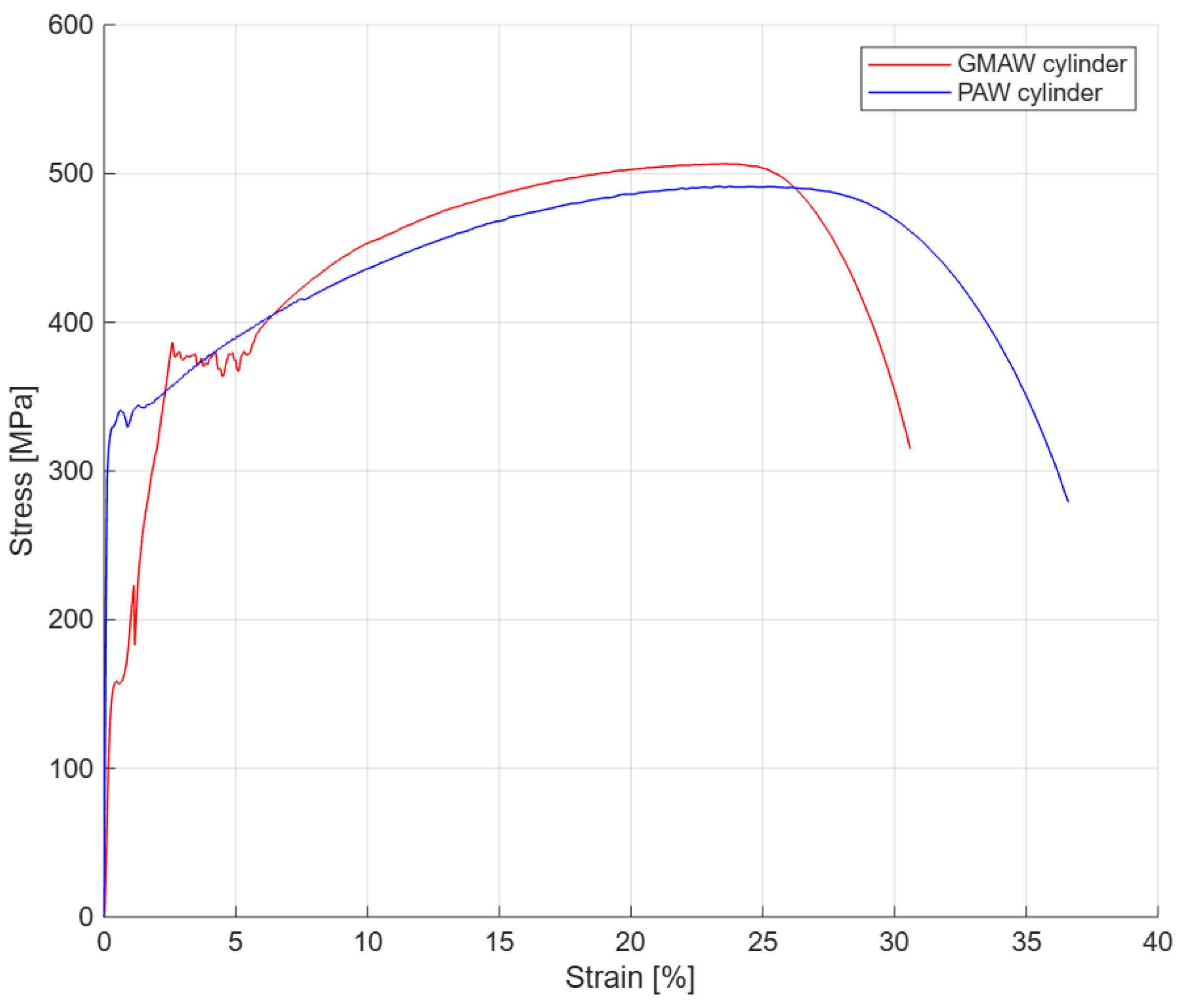
Tensile testing was conducted to evaluate the mechanical properties. The tensile machine subjected the samples under 2 mm/min nominal strain rate at room temperature. Both elastic and plastic deformations were recorded for each sample, and the results were plotted as shown in Figure 12. The values of ultimate tensile strength, yield strength and elongation to fracture for each cylinder were obtained, as presented in Table 6. To validate and compare the results, the typical mechanical properties provided by the supplier ESAB [20] were considered, along with experimental results from similar GMAW [25], pulsed-GMAW and pulsed-CMT WAAM-cylinders [26].
An increase in pearlite content leads to higher strength but reduced ductility, since ferrite is a relatively soft and ductile phase, while pearlite, composed of alternating layers of ferrite and cementite, is harder and less ductile [30,32]. This results in lower elongation but higher strength for the GMAW cylinder. In addition to this, the slightly finer grain size in the GMAW cylinder contributes to the enhanced strength compared to PAW cylinder. The same observation was reported in the case of p-GMAW and p-CMT WAAM cylindrical fabrication [26].
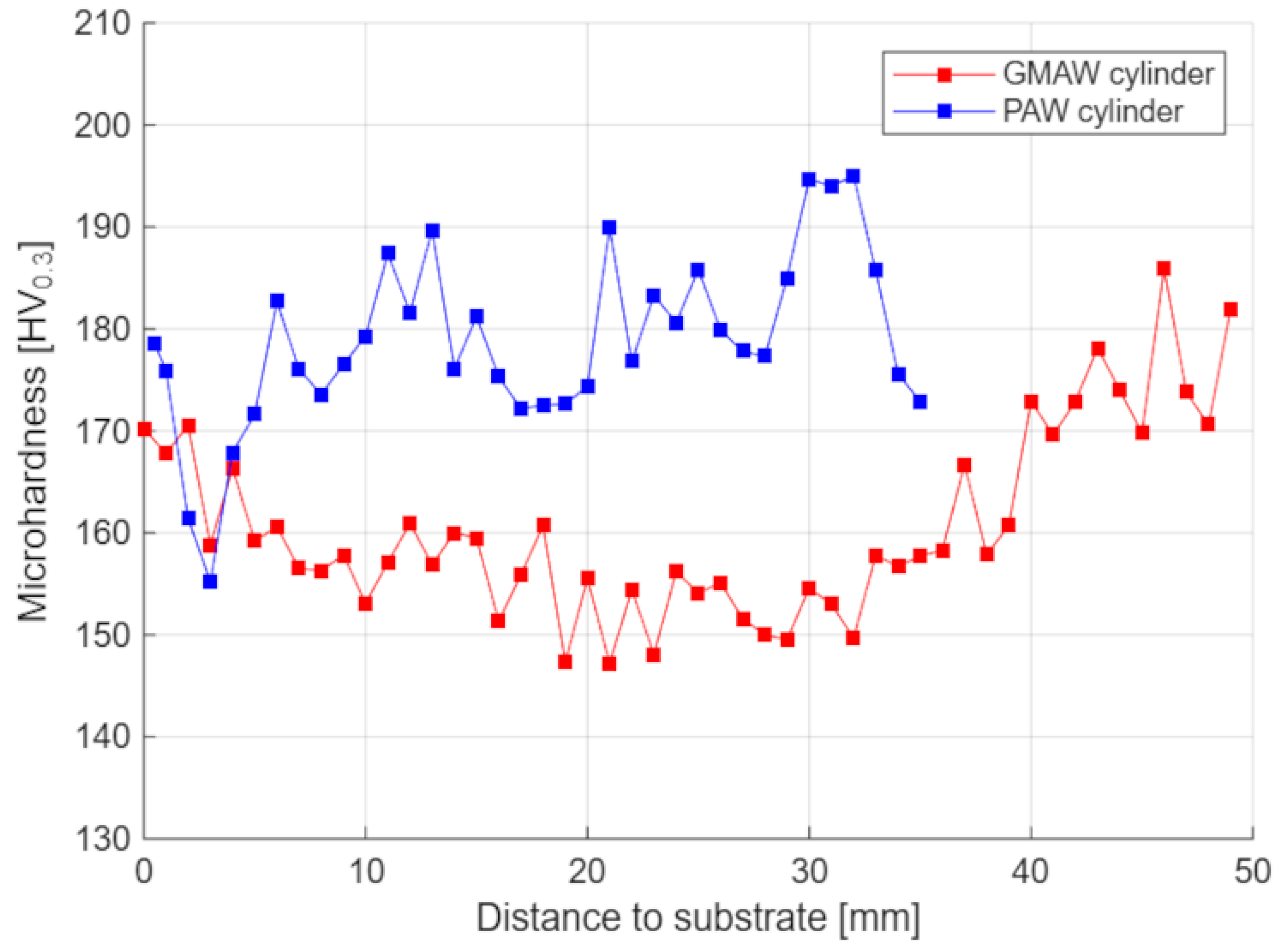
Figure 13 presents the microhardness profiles of the extracted samples. The average microhardness values for the GMAW and PAW cylinders are 160 HV0.3 and 180 HV0.3, respectively. It is well established that the presence of a pearlitic phase increases hardness compared to a ferritic matrix [30]. Pearlite in PAW exhibits a finer lamellar structure, which contributes to the slightly higher microhardness measured. This can be attributed to the higher supercooling during PAW processing, which allows the pearlitic transformation to evolve well below the eutectoid temperature.

3.4. Fractography

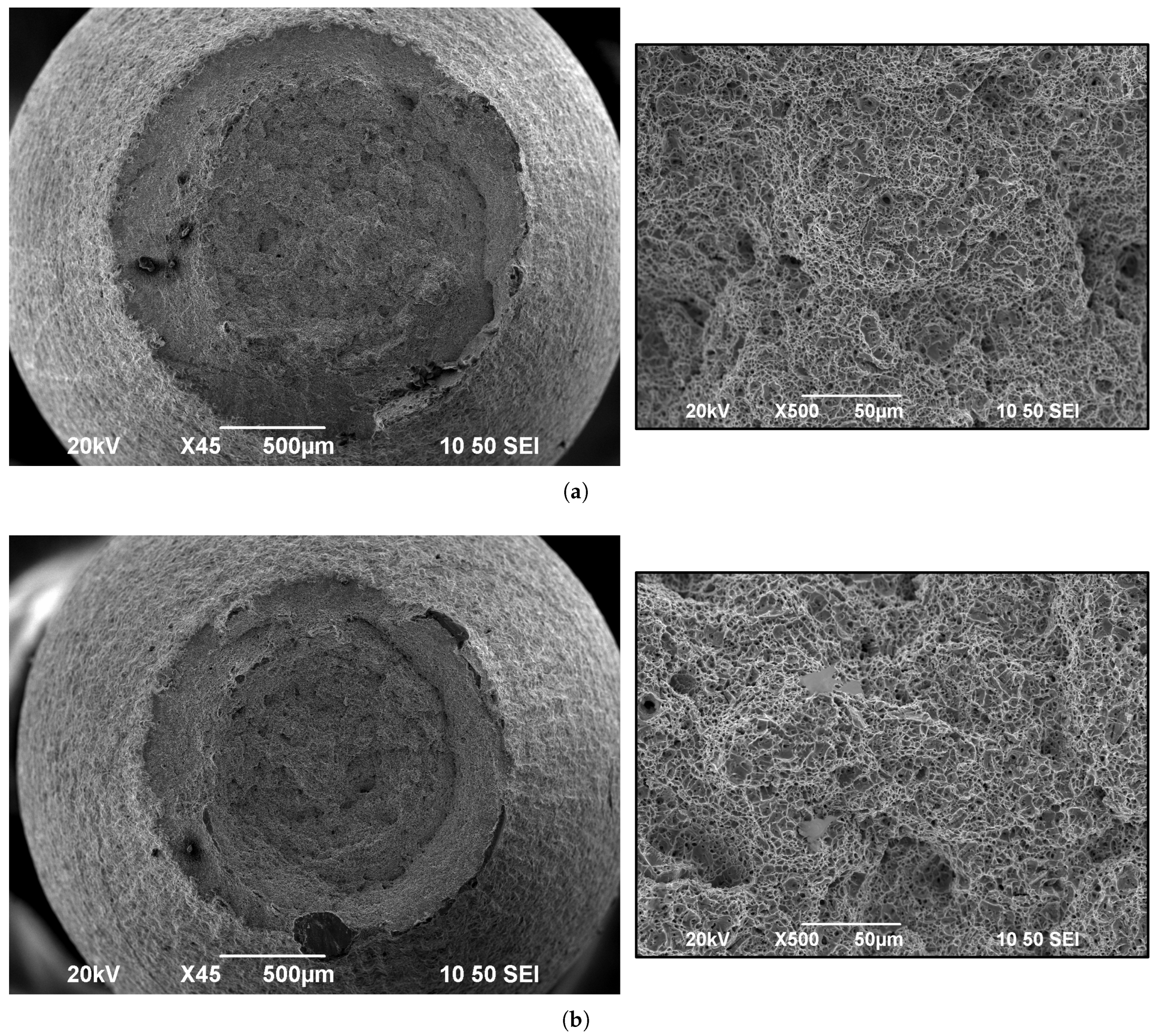
The fracture surfaces of both cylinders exhibited equiaxed dimples with a relatively uniform distribution, indicating a ductile fracture mode (cup-and-cone fracture) (Figure 14a,b). This observation is consistent with the high reduction of area (RA) values measured. To quantify ductility, RA was evaluated and found to be 77.14% and 81.81% for the GMAW and PAW cylinders, respectively. Higher RA values indicate greater ductility, confirmed by the tensile testing. The increased ductility of the PAW cylinder can be attributed to its higher ferrite content.

4. Discussion

The Rosenthal equation is an analytical solution employed to describe the temperature field in welding science. This study attempts to apply the Rosenthal solution in WAAM without changing its original structure. However, an analytical solution would never bring accurate results in the same manner that a numerical solution would.
A total of three WAAM experiments were conducted, including an initial experimental trial and the fabrication of a GMAW-WAAM and PAW-WAAM cylinders.
  • Experimental trial: No time interval was maintained between the deposition of eight layers. The Rosenthal solution was unsuccessful in accurately predicting the absolute temperature. However, it effectively identified the increasing trend of initial temperatures from layer to layer, aligning the experimental results. It should be emphasized that this adjustment is not derived from rigorous mathematical or physical modeling; instead, it is an illustrative approach that happens to be consistent with the experimental data;
  • Fabrication of the GMAW and PAW cylinders: The fabrication process for both cylinders was based on a similar melting rate, with interlayer temperatures set at 453 °C and 250 °C. A key distinction was the higher heat input of PAW, which influenced the microstructure evolution. Both cylinders exhibited microstructures comparable to other WAAM ER70S-6 cylinders and demonstrated similar mechanical properties [25,26];
  • Application of the Rosenthal Equation: The Rosenthal equation was applied to the cylinders, using the time intervals between layers based on the experimental results. The different degrees of fit to the experimental results for the GMAW and PAW cylinders, as shown in Figure 8a and Figure 9a, are attributed to differences in the experimental measurement of the temperature field. For the GMAW cylinder, the thermal camera continuously measured a specific point during deposition. In contrast, during PAW, the pyrometer was mounted on the torch and therefore did not record solely the temperature of the deposited layer. The analytically calculated thermal history of a spot near the substrate indicated higher cooling rates in the GMAW cylinder, predicting finer grain size. The predicted cooling rate is inconsistent with the observed pearlite content and the microhardness measurements, and these discrepancies are discussed in detail accordingly;
  • Use of the Rosenthal solution in WAAM: The study concluded that the absolute temperatures developed during WAAM process cannot be accurately predicted using the Rosenthal equation. However, the equation was a useful tool for forecasting the relative variation in the temperature and consequently the cooling rates. This limitation arises from the inherent characteristics and assumptions of the Rosenthal formulation as outlined below:
    • Heat transfer in the Rosenthal equation considers only two-dimensional thermal conduction, neglecting thermal convection and radiation. In the WAAM process, heat conduction primarily occurs in one dimension, while convection and radiation play equally significant roles [2];
    • The preheating temperature To in Rosenthal equation is derived from a homogeneous heat treatment of the base metal. As a result, the equation cannot predict temperatures lower than the initial temperature, as it does not account for heat transfer from the heat-treated substrate.
Based on the discussion above, it is clear that accurate simulations are required to reliably correlate macro-scale properties with micro-scale features. In maritime applications, the demand for customized products is more critical than ever. Accurate simulation models contribute to sustainability by saving important resources and reducing implementation time.

5. Conclusions

The aim of this study was to apply the original Rosenthal solution to the WAAM process in order to correlate predicted outcomes—such as the temperature field, microstructure, and mechanical characteristics—with corresponding experimental observations from two WAAM experiments. Considering the known limitations of the Rosenthal equation when applied to WAAM, the observed discrepancies between modeling results and experimental data are expected. These discrepancies are primarily attributed to the assumption of a point heat source and to an inaccurate representation of heat transfer mechanisms. While the dominant roles of convection and radiation are neglected, heat conduction in WAAM effectively occurs in one principal direction rather than in two directions, as assumed in the original formulation.
Despite these limitations, the application of the Rosenthal solution to temperature distribution prediction showed promising results when experimental data were incorporated, indicating its potential usefulness in WAAM after careful structural adjustments for rapid temperature field assessment. Furthermore, the derived thermal histories—and consequently the cooling rates—were successfully used to forecast phase composition. Overall, the Rosenthal solution proved to be an adequate tool for qualitatively capturing key microstructural features and mechanical trends in WAAM. Further investigation is required to assess whether the equation can be adapted for WAAM-specific applications; however, analytical solutions are inherently unable to fully replace numerical models in terms of quantitative accuracy.

Author Contributions

Conceptualization, A.D.Z.; methodology, A.D.Z. and E.L.; software, E.L.; validation, A.D.Z. and E.L.; formal analysis, E.L.; investigation, E.L.; resources, A.D.Z.; data curation, A.D.Z. and E.L.; writing—original draft preparation, E.L.; writing—review and editing, A.D.Z.; visualization, E.L.; supervision, A.D.Z.; project administration, A.D.Z.; funding acquisition, A.D.Z. All authors have read and agreed to the published version of the manuscript.

Funding

This research received no external funding. The APC was funded by the Shipbuilding Technology Laboratory (STL), School of Naval Architecture and Marine Engineering (SNAME), National Technical University of Athens (NTUA).

Data Availability Statement

The original contributions presented in this study are included in the article. Further inquiries can be directed to the corresponding author.

Acknowledgments

The authors acknowledge the support of Matthias Moschinger and Norbert Enzinger, AddLab, and the Technical University of Graz (TUGraz) for the production of the PAW cylinder, and Dimitra Ioannidou and Petros Tsakiridis, Laboratory of Physical Metallurgy, School of Mining and Metallurgical Engineering (SMME), NTUA, for their contribution to the temperature monitoring.

Conflicts of Interest

The authors declare no conflicts of interest.

Abbreviations

The following abbreviations are used in this manuscript:
AMAdditive Manufacturing
BTFbuy-to-fly
CAPEXCapital Expenditure
CCTContinuous Cooling Transformation
CMTCold Metal Tranfer
CNCComputed Numerical Control
CTWDContact to Work Distance
DEDDirect Energy Deposition
DED-LPDirect Energy Deposition-Laser Powder
FGMFunctionally Graded Material
FEMFinite Element Method
GMAWGas Metal Arc Welding
HAZHeat Affected Zone
HIHeat Input
MRMelting rate
NETDNoise Equivalent Temperature Difference
OREOffshore renewable energy
PAWPlasma Arc Welding
PDEpartial differential equation
pulsed-TIGPulsed Tungsten Inert Gas
RAReduction of Area
SEMScanning Electron Microscopy
WAAMWire Arc Additive Manufacturing
WECWave Energy Converter
WFSWire Feed Speed

References

  1. Taşdemir, A.; Nohut, S. An overview of wire arc additive manufacturing (WAAM) in shipbuilding industry. Ships Offshore Struct. 2021, 16, 797–814. [Google Scholar] [CrossRef]
  2. Sampaio, R.F.V.; Pragana, J.P.M.; Bragança, I.M.F.; Silva, C.M.A.; Nielsen, C.V.; Martins, P.A.F. Modelling of wire-arc additive manufacturing—A review. Adv. Ind. Manuf. Eng. 2023, 6, 100121. [Google Scholar] [CrossRef]
  3. Ziółkowski, M.; Dyl, T. Possible applications of additive manufacturing technologies in shipbuilding: A review. Machines 2020, 8, 84. [Google Scholar] [CrossRef]
  4. Govindaraj, R.B.; Junghans, E.; Andersen, I.; ki Lim, Y.; Lindström, P. Additive manufactured marine component – Ni Al bronze propeller. Procedia Struct. Integr. 2021, 34, 20–25. [Google Scholar] [CrossRef]
  5. Nota, C.; Rückert, G.; Heuzé, J.L.; Carlino, L.; Quenez, J.M.; Courregelongue, L. A first feedback on manufacturing and in-service behaviour of a WAAM-made propeller for naval application. Weld. World 2023, 67, 1113–1121. [Google Scholar] [CrossRef]
  6. He, T.; Yu, S.; Shi, Y.; Dai, Y. High-accuracy and high-performance WAAM propeller manufacture by cylindrical surface slicing method. Int. J. Adv. Manuf. Technol. 2019, 105, 4773–4782. [Google Scholar] [CrossRef]
  7. He, T.; Yu, S.; Shi, Y.; Huang, A. Forming and mechanical properties of wire arc additive manufacture for marine propeller bracket. J. Manuf. Process. 2020, 52, 96–105. [Google Scholar] [CrossRef]
  8. He, T.; Yu, S.; Huang, A.; Yu, G. Path planning and forming of wire multi-arc additive collaborative manufacture for marine propeller bracket. J. Manuf. Process. 2021, 68, 1191–1201. [Google Scholar] [CrossRef]
  9. Vincent. RAMLAB & Huisman Initiate Consortium to Produce 3D Printed Steel Hook—Ramlab.com. 2018. Available online: https://www.ramlab.com/updates/ramlab-huisman-initiate-consortium-produce-worlds-heaviest-3d-printed-steel-crane-hook/ (accessed on 10 November 2025).
  10. Chandrasekaran, S.; Hari, S.; Amirthalingam, M. Functionally graded materials for marine risers by additive manufacturing for high-temperature applications: Experimental investigations. Structures 2022, 35, 931–938. [Google Scholar] [CrossRef]
  11. O’Neill, F.; Mehmanparast, A. A review of additive manufacturing capabilities for potential application in offshore renewable energy structures. Forces Mech. 2024, 14, 100255. [Google Scholar] [CrossRef]
  12. Choi, H.; Adamczyk, J.M.; Hernandez-Sanchez, B.A.; Koss, E.K.; Noell, P.J.; Spiak, S.R.; Pucket, R.V.; Escarcega-Herrera, K.; Love, A.S.; Karasz, E.; et al. Wire arc additive manufactured A36 steel performance formarine renewable energy systems. Int. J. Adv. Manuf. Technol. 2024, 132, 4677–4688. [Google Scholar] [CrossRef]
  13. Chen, Z.; Yuan, L.; Pan, Z.; Zhu, H.; Ma, N.; Ding, D.; Li, H. A comprehensive review and future perspectives of simulation approaches in wire arc additive manufacturing (WAAM). Int. J. Extrem. Manuf. 2025, 7, 022016. [Google Scholar] [CrossRef]
  14. Love, A.; Valdez Pastrana, O.A.; Behseresht, S.; Park, Y.H. Advancing Metal Additive Manufacturing: A Review of Numerical Methods in DED, WAAM, and PBF. Metrology 2025, 5, 30. [Google Scholar] [CrossRef]
  15. Perret, W.; Schwenk, C.; Rethmeier, M. Comparison of analytical and numerical welding temperature field calculation. Comput. Mater. Sci. 2010, 47, 1005–1015. [Google Scholar] [CrossRef]
  16. Bendia, R.M.; Lizarralde, F.; Passos, A.V.; Oliveira, V.H.P.M. Dynamic GMAW process model for layer geometry control in wire arc additive manufacturing. In Proceedings of the CHT-21 ICHMT International Symposium on Advances in Computational Heat Transfer, Rio de Janeiro, Brazil, 15–19 August 2021. [Google Scholar] [CrossRef]
  17. Ríos, S.; Colegrove, P.A.; Martina, F.; Williams, S.W. Analytical process model for wire + arc additive manufacturing. Addit. Manuf. 2018, 21, 651–657. [Google Scholar] [CrossRef]
  18. Pinkerton, A.J.; Li, L. Modelling the geometry of a moving laser melt pool and deposition track via energy and mass balances. J. Phys. D Appl. Phys. 2004, 37, 1885–1895. [Google Scholar] [CrossRef]
  19. Shah, N.; Deepu, M.J.; Rahul, M.R.; Phanikumar, G. Microstructure prediction of eutectic high entropy alloy using physical and computer simulation for additive manufacturing condition. J. Alloys Compd. 2022, 929, 167268. [Google Scholar] [CrossRef]
  20. OK AristoRod 12.50—Esab.com. Available online: https://esab.com/lv/eur_en/products-solutions/product/filler-metals/mild-steel/mig-wires-tig-rods-gmaw-gtaw/ok-aristorod-12-50/ (accessed on 24 January 2025).
  21. Solid Wires-Voestalpine Böhler Welding—Voestalpine.com. Available online: https://www.voestalpine.com/welding/global-en/products/product-search/solid-wires/#MildSteel4 (accessed on 8 February 2025).
  22. Henckell, P.; Gierth, M.; Ali, Y.; Reimann, J.; Bergmann, J.P. Reduction of energy input in wire arc additive manufacturing (WAAM) with gas metal arc welding (GMAW). Materials 2020, 13, 2491. [Google Scholar] [CrossRef]
  23. ISO 6892-1:2019; Metallic Materials — Tensile Testing — Part 1: Method of Test at Room Temperature. International Organization for Standardization (ISO): Geneva, Switzerland, 2019.
  24. Rosenthal, D. The theory of moving sources of heat and its application to metal treatments. J. Fluids Eng. 1946, 68, 849–865. [Google Scholar] [CrossRef]
  25. Ron, T.; Levy, G.K.; Dolev, O.; Leon, A.; Shirizly, A.; Aghion, E. Environmental behavior of low carbon steel produced by a wire arc additive manufacturing process. Metals 2019, 9, 888. [Google Scholar] [CrossRef]
  26. Bellamkonda, P.N.; Sudersanan, M.; Visvalingam, B. A study on tensile properties and microstructural characteristics of wire arc additive manufactured low carbon steel cylindrical components. Weld. Int. 2022, 36, 443–454. [Google Scholar] [CrossRef]
  27. Thapliyal, S.; Cheng, J.; Mayeur, J.; Yamamoto, Y.; Fernandez-Zelaia, P.; Nycz, A.; Kirka, M.M. Outlook on texture evolution in additively manufactured stainless steels: Prospects for hydrogen embrittlement resistance, overview of mechanical, and solidification behavior. J. Mater. Res. 2024, 39, 48–62. [Google Scholar] [CrossRef]
  28. Sun, J.; Hensel, J.; Klassen, J.; Nitschke-Pagel, T.; Dilger, K. Solid-state phase transformation and strain hardening on the residual stresses in S355 steel weldments. J. Mater. Process. Technol. 2019, 265, 173–184. [Google Scholar] [CrossRef]
  29. Piekarska, W.; Goszczyńska, D.; Saternus, Z. Application of analytical methods for predicting the structures of steel phase transformations in welded joints. J. Appl. Math. Comput. Mech. 2015, 14, 61–72. [Google Scholar] [CrossRef]
  30. Gonzaga, R.A. Influence of ferrite and pearlite content on mechanical properties of ductile cast irons. Mater. Sci. Eng. A Struct. Mater. 2013, 567, 1–8. [Google Scholar] [CrossRef]
  31. Abdullah, S.N.; Sazali, N.; Jamaludin, A.S. Study of Low Carbon Steel in Rapid Cooling Process: A Short Review. J. Mod. Manuf. Syst. Technol. 2020, 4, 52–59. [Google Scholar] [CrossRef]
  32. Gladshtein, L.I.; Larionova, N.P.; Belyaev, B.F. Effect of ferrite-pearlite microstructure on structural steel properties. Metallurgist (USSR) 2012, 56, 579–590. [Google Scholar] [CrossRef]
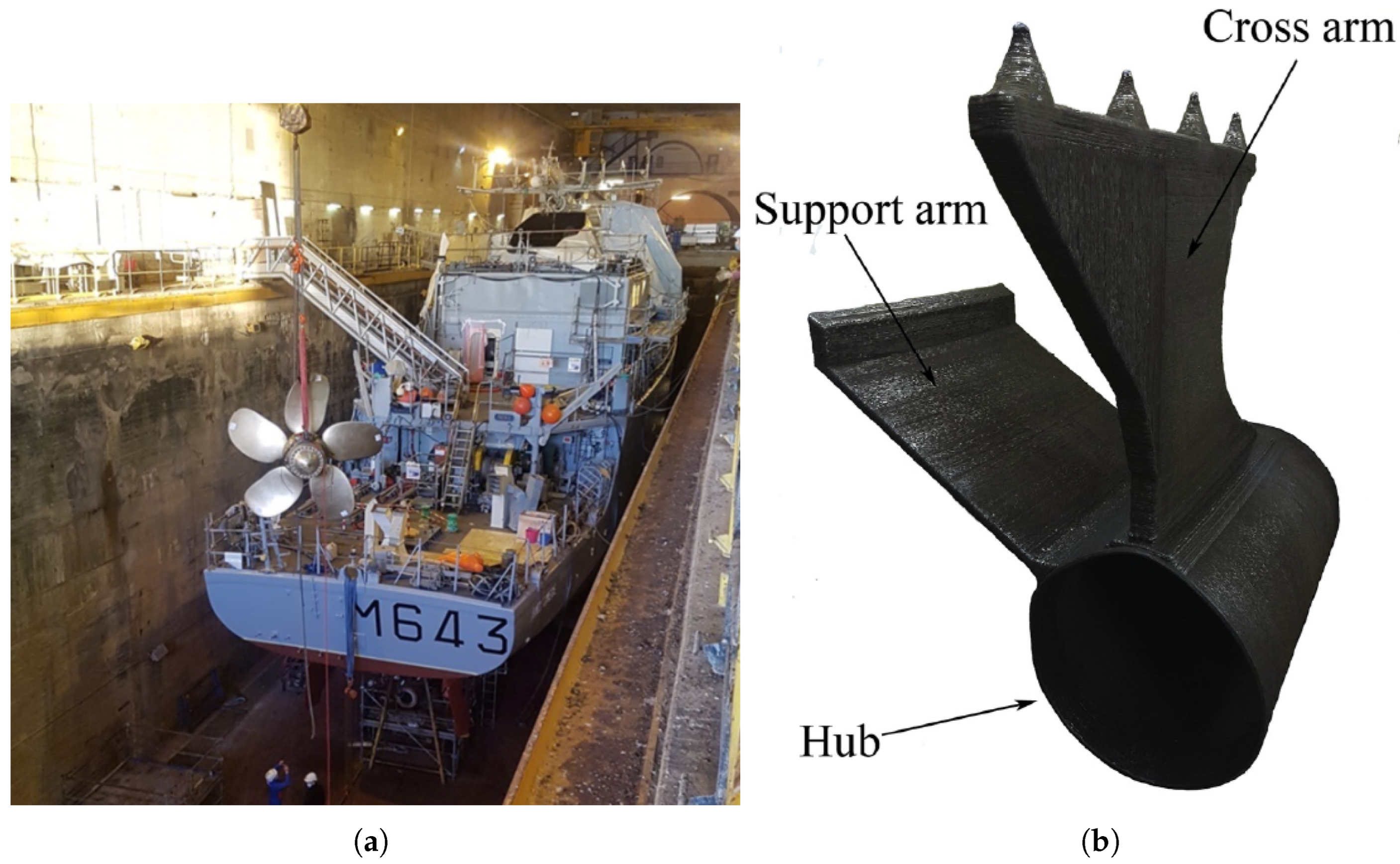
Figure 1. (a) Assembly of the blades on the hub and installation of the propeller on the Andromède [5]. Reprinted with permission from [5], 2023, Springer Nature. (b) Wire arc additive manufactured (WAAM) propeller bracket [7]. Reprinted with permission from [7], 2020, Elsevier.
Metals 16 00192 g001
Figure 2. (a) Render of the 4 prong hollow WAAM hook in Autodesk Powermill Additive [9]. Reprinted with permission from [9], 2018, RAMLAB. (b) A catenary riser attached to a tension leg platform [10]. Reprinted with permission from [10], 2022, Elsevier.
Metals 16 00192 g002
Figure 3. Photographs of the WAAM cylinders: (a) Gas Metal Arc Welding (GMAW) cylinder. (b) Plasma Arc Welding (PAW) cylinder.
Metals 16 00192 g003
Figure 4. Regions extracted for metallurgical analysis and dimensions of the tensile specimens.
Metals 16 00192 g004
Figure 5. Representation of the measurement point along with the reference system.
Metals 16 00192 g005
Figure 6. Thermal distributions (a) before, and (b) after adjustment in the Rosenthal solution.
Metals 16 00192 g006
Figure 7. Initial temperature for each layer (a) before, and (b) after adjustment.
Metals 16 00192 g007
Figure 8. GMAW Cylinder: (a) thermal distribution (b) time interval between layers.
Metals 16 00192 g008
Figure 9. PAW Cylinder: (a) thermal distribution and (b) time interval between layers.
Metals 16 00192 g009
Figure 10. Microstructure of WAAM cylinders (a) overall cross-sectional structure of GMAW cylinder (b) top region (c) middle region (d) bottom region (e) overall cross-sectional structure of PAW cylinder (f) top region (g) middle region (h) bottom region.
Metals 16 00192 g010
Figure 11. Thermal history of a spot area near the substrate.
Metals 16 00192 g011
Figure 12. Tensile test results of the WAAM cylinders.
Metals 16 00192 g012
Figure 13. Microhardness profile of the WAAM cylinders.
Metals 16 00192 g013
Figure 14. Fracture surface morphology of ER70S-6 WAAM cylinders produced by (a) GMAW and (b) PAW.
Metals 16 00192 g014
Table 1. Chemical Composition of ER70S-6 (wt%).
MaterialCMnSiFe
GMAW cyl. [20]ER70S-60.081.460.85Bal.
PAW cyl. [21]ER70S-60.081.450.9Bal.
Table 2. Process parameters used to fabricate the cylinders.
ParametersGMAW CylinderPAW Cylinder
Wire feed speed [m/min]54.8
Current [A]160–190280
Voltage [V]20.4–22.527.5
Travel speed [mm/min]400240
Wire width [mm]1.21
Efficiency0.80.6
82% Ar + 18% CO2 [L/min]1815
Heat input [kJ/mm]0.3917–0.51301.134
Melting rate [mm3/s]94.2462.8
Arc Thermal Power [W]2611.2–34204620
Table 3. Dimensions of the fabricated cylinders.
FeatureGMAW CylinderPAW Cylinder
Height above substrate [mm]48.1533.50
Average wall thickness [mm]10.9012.60
Average layer height [mm]1.161.8
Cylinder diameter [mm]80.2089.60
Table 4. Model parameters and their numerical values.
Model Parameters [Unit]SymbolNumerical Value
Temperature [°C]TCalculated
Initial Temperature [°C]ToDefined as described
Arc Thermal Power [W]QSee Table 2
Thermal Conductivity [W/mm °C]k0.042
Thermal Diffusivity [mm2/s]α11.45
Travel speed [m/s]uSee Table 2
Coordinates [mm, mm, mm](x, y, z)(0, 0, 0.6)
Table 5. Cooling rates of GMAW and PAW cylinders.
Layer1234567
GMAW Cyl. [ °C/s]247.82203.52163.77----
PAW Cyl. [ °C/s]70.3952.3545.8536.4128.7222.0816.38
Table 6. Tensile results of the WAAM cylinders.
YS (MPa)UTS (MPa)Elongation (%)
GMAW cyl.377506.630.6
PAW cyl.338491.436.6
Wire [20]43053030
GMAW cyl. [25]365.9475.734.6
pulsed-GMAW cyl. [26]39950654.6
pulsed-CMT cyl. [26]43756330.3
Disclaimer/Publisher’s Note: The statements, opinions and data contained in all publications are solely those of the individual author(s) and contributor(s) and not of MDPI and/or the editor(s). MDPI and/or the editor(s) disclaim responsibility for any injury to people or property resulting from any ideas, methods, instructions or products referred to in the content.