Article

Ductility Control in Laser Powder Bed Fusion (LPBF) AlSi10Mg via Silicon Precipitation and Coarsening During Heat Treatment


1
School of Mechanical and Electrical Engineering, Xuzhou University of Technology, Xuzhou 221018, China
2
School of Intelligent Manufacturing, Guangdong Technology College, Zhaoqing 526100, China
3
School of Mechanical and Electrical Engineering, Guilin University of Electronic Technology, Guilin 541010, China
4
Department of Mechanical and Manufacturing Engineering, Trinity College Dublin, The University of Dublin, Parsons Building, D02 PN40 Dublin, Ireland
*
Authors to whom correspondence should be addressed.
Metals 2026, 16(2), 193; https://doi.org/10.3390/met16020193
Submission received: 30 December 2025 / Revised: 25 January 2026 / Accepted: 2 February 2026 / Published: 6 February 2026
(This article belongs to the Special Issue Advances in 3D Printing Technologies of Metals—3rd Edition)

Abstract

Laser powder bed fusion (LPBF) was adopted to manufacture AlSi10Mg, and two post-processing schedules, T4 (510 °C/2 h + water quench) and T6 (T4 + 180 °C/6 h), were applied to elucidate how Si precipitation size controls ductility. The as-built alloy consisted of an α-Al matrix with a grid-like eutectic Si network and achieved UTS > 480 MPa but exhibited build-direction-dependent tensile anisotropy. Heat treatment promoted Si precipitation from the supersaturated α-Al matrix and transformed the eutectic network via fragmentation, spheroidization, and Ostwald ripening, leading to pronounced softening and improved elongation. After T4, the yield strength and UTS decreased by >50%, while elongation increased from 10.9% to 22.27%; T6 provided a slight strength recovery accompanied by a marginal ductility reduction. Mechanistically, a high number density of fine Si precipitates enhances dislocation storage and delays damage accumulation, whereas coarse, non-shearable Si particles intensify local strain gradients, facilitate void nucleation at the matrix/particle interface, and accelerate fracture. Overall, tailoring Si precipitation/coarsening offers an effective route to improve ductility and mitigate anisotropy in LPBF AlSi10Mg.

1. Introduction

AlSi10Mg alloys are widely used in the automotive and aerospace sectors owing to their low density, excellent corrosion resistance, and high specific strength [1,2,3]. Compared with conventional manufacturing routes such as casting and forging, laser powder bed fusion (LPBF) offers near-net-shape capability and enables the fabrication of geometrically complex components through rapid melting/solidification and layer-by-layer building [4,5,6,7]. The steep thermal gradients and high cooling rates inherent to LPBF give rise to a distinct cellular-eutectic microstructure, which is largely responsible for the enhanced strength of LPBF-processed AlSi10Mg alloys.
Extensive research has therefore focused on optimizing LPBF process parameters for AlSi10Mg, including laser power [8], scanning speed [9], layer thickness [10], hatch spacing [11], scanning strategy [12], and build orientation [13], in order to control anisotropy [14], relative density [15], and defect formation [12]. By tailoring these parameters, relative densities approaching 99.9% and high tensile strengths have been achieved [16,17]. Nevertheless, LPBF-fabricated AlSi10Mg components generally suffer from insufficient ductility, which often fails to satisfy engineering design requirements and restricts broader structural application. Post-processing heat treatments can effectively relieve residual stresses and decompose the eutectic Si network, thereby improving elongation at the expense of strength. This trade-off highlights the importance of understanding how heat treatment modifies the microstructure and, in particular, how it influences the ductility of LPBF AlSi10Mg alloys.
Previous studies have shown that the morphology, size, and distribution of Si exert a critical influence on the mechanical response of Al-Si alloys before and after heat treatment. In conventionally cast Al-Si alloys, early cracking and poor ductility are typically associated with coarse, acicular Si particles [18]. Ductility can be improved by converting Si into a coral-like interconnected network through chemical modification (e.g., Sr or Na additions) or by spheroidizing the Si phase via solution heat treatment [19]. The cooling rate has been identified as a key factor controlling Si coarsening and thus governs the alloy softening behavior during heat treatment [20]. Moreover, changes in Si supersaturation and the resulting precipitate dimensions during ageing have been linked to increases in yield strength [21]. For wrought Al-Si-Mg-Mn alloys, spheroidization of eutectic Si and a reduction in particle number density during solution treatment have been reported to significantly enhance ductility [22].
In summary, numerous investigations have established a strong correlation between Si morphology and the mechanical properties of Al-Si alloys. However, most of these studies have focused on conventionally cast materials, and the relationship between Si precipitation size and ductility has been primarily explored in that context. In contrast, systematic insight is still lacking into how the evolution of Si particle size and morphology during post-heat treatment affects the ductility of LPBF-fabricated AlSi10Mg alloys, whose as-built microstructure and residual stress state differ substantially from those of cast alloys.
The present work aims to clarify the role of Si precipitate size in controlling the ductility of LPBF-fabricated AlSi10Mg alloys after heat treatment, an aspect that has rarely been addressed. Two heat-treatment schedules were designed: a solution treatment at 510 °C for 2 h (T4) and a solution plus artificial ageing treatment at 510 °C for 2 h followed by 180 °C for 6 h (T6). A comparative study was conducted on the size and distribution of Si precipitates in the as-built and heat-treated conditions. X-ray diffraction (XRD) was employed to monitor Si precipitation from the supersaturated α-Al solid solution and to evaluate changes in lattice parameter and grain size. Laser scanning confocal microscopy (LSCM) and scanning electron microscopy (SEM) were used to characterize the morphology and size distribution of Si precipitates. Finally, uniaxial tensile tests were carried out to assess macroscopic ductility and to elucidate how the evolution of Si precipitate size governs the deformation and fracture behavior of LPBF AlSi10Mg alloys after T4 and T6 treatments.

2. Materials and Methods

2.1. Raw Materials

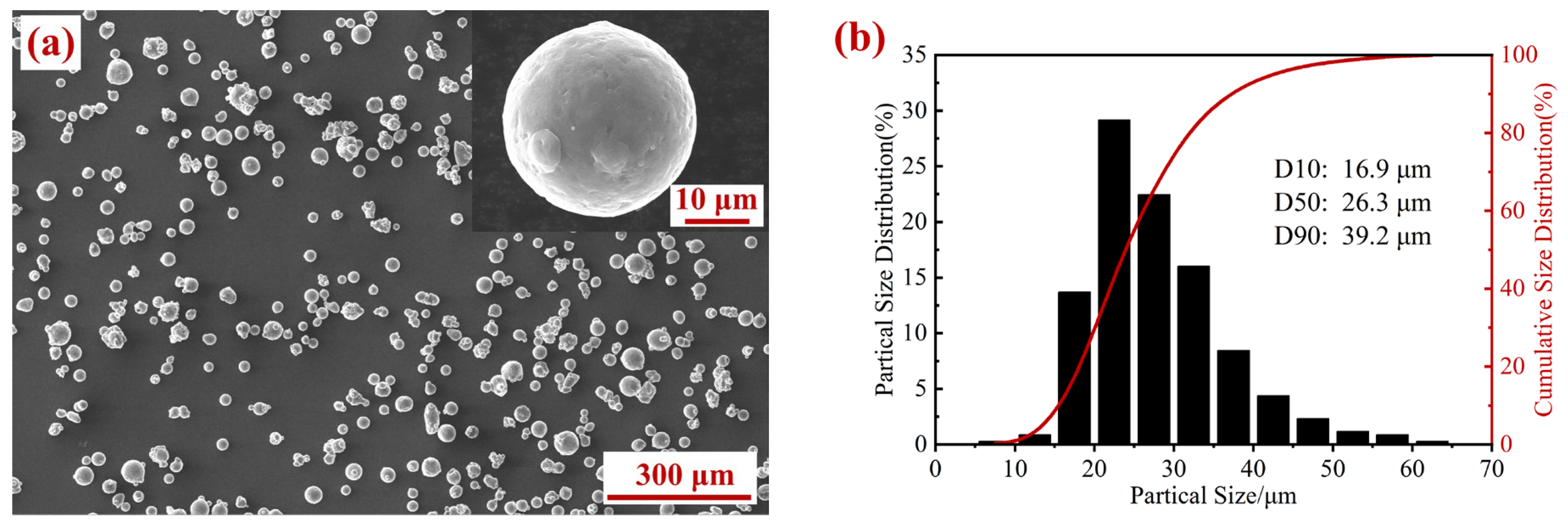
The feedstock used in this study was a gas-atomized AlSi10Mg powder supplied by Shandong Lianhong New Material Technology Co., Ltd. (Tengzhou, China). The powder morphology, shown in Figure 1a, was examined by scanning electron microscopy (SEM). The particles were predominantly spherical, with a small fraction of fine satellite particles adhering to the surfaces of larger ones, which is typical of gas-atomized Al-based powders. The particle size distribution was measured using a laser particle size analyzer (FBS6100-B, Shenzhen Fubosi Instruments Co., Ltd., Shenzhen, China), as presented in Figure 1b. The powder exhibited an approximately log-normal size distribution, with characteristic particle diameters of D10 = 16.9 μm, D50 = 26.3 μm, and D90 = 39.2 μm, indicating a relatively narrow and well-controlled particle size range suitable for LPBF processing. The powder exhibited an approximately log-normal distribution with an average particle size of 26.3 µm. The chemical composition of the AlSi10Mg powder, determined by the supplier and verified by inductively coupled plasma-optical emission spectroscopy (ICP-OES), is summarized in Table 1.

2.2. Sample Preparation

To minimize moisture absorption and ensure stable processing conditions, the AlSi10Mg powder was dried under vacuum at 140 °C for 4 h prior to LPBF. Cuboidal AlSi10Mg specimens were fabricated on an EOS M290 LPBF system (EOS GmbH, Krailling, Germany) under a high-purity argon atmosphere in order to limit oxidation and minimize oxygen pickup during processing. The system is equipped with a standard, manufacturer-specified infrared ytterbium-doped fiber laser with a nominal beam spot diameter of approximately 100 μm.
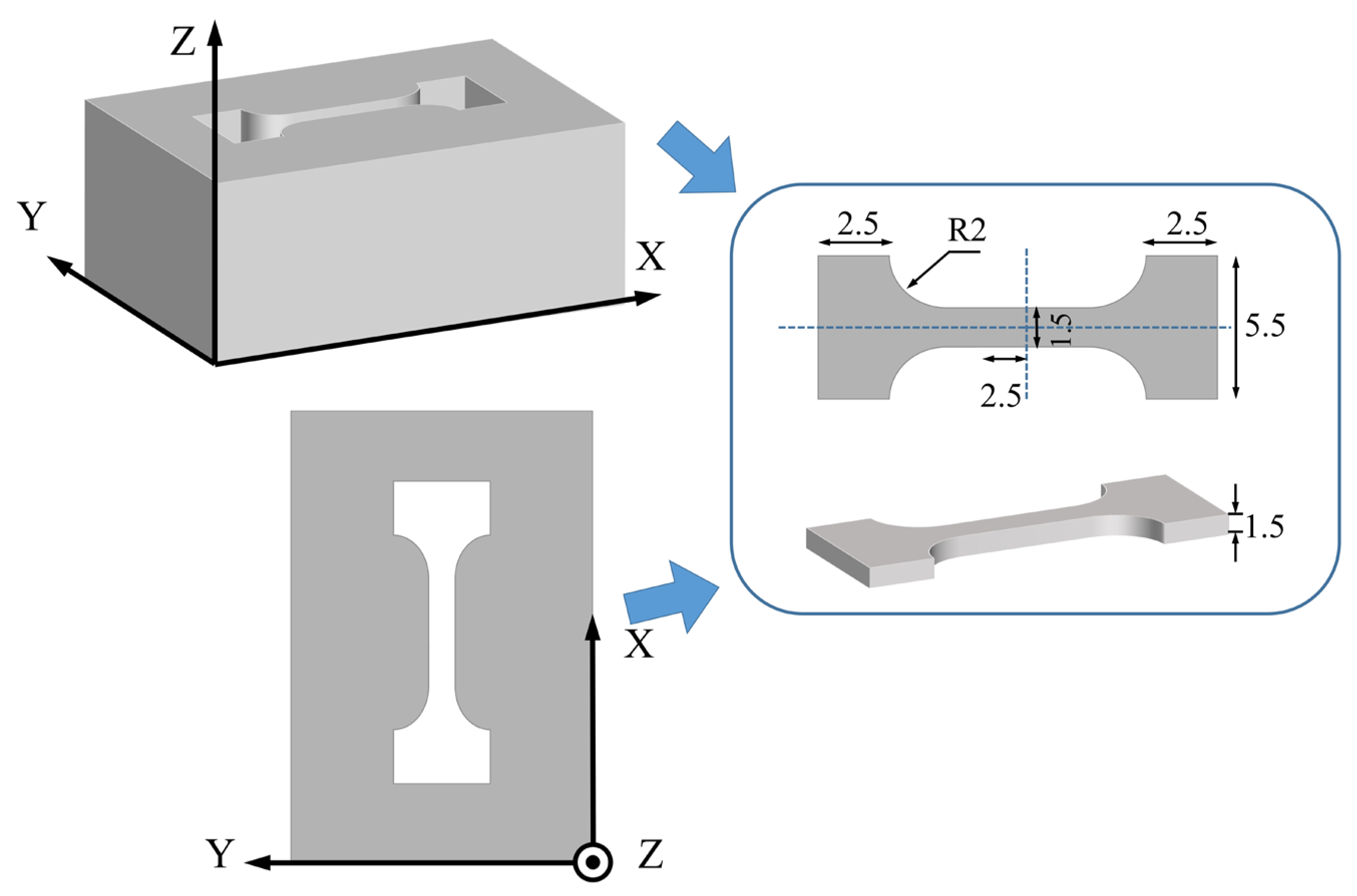
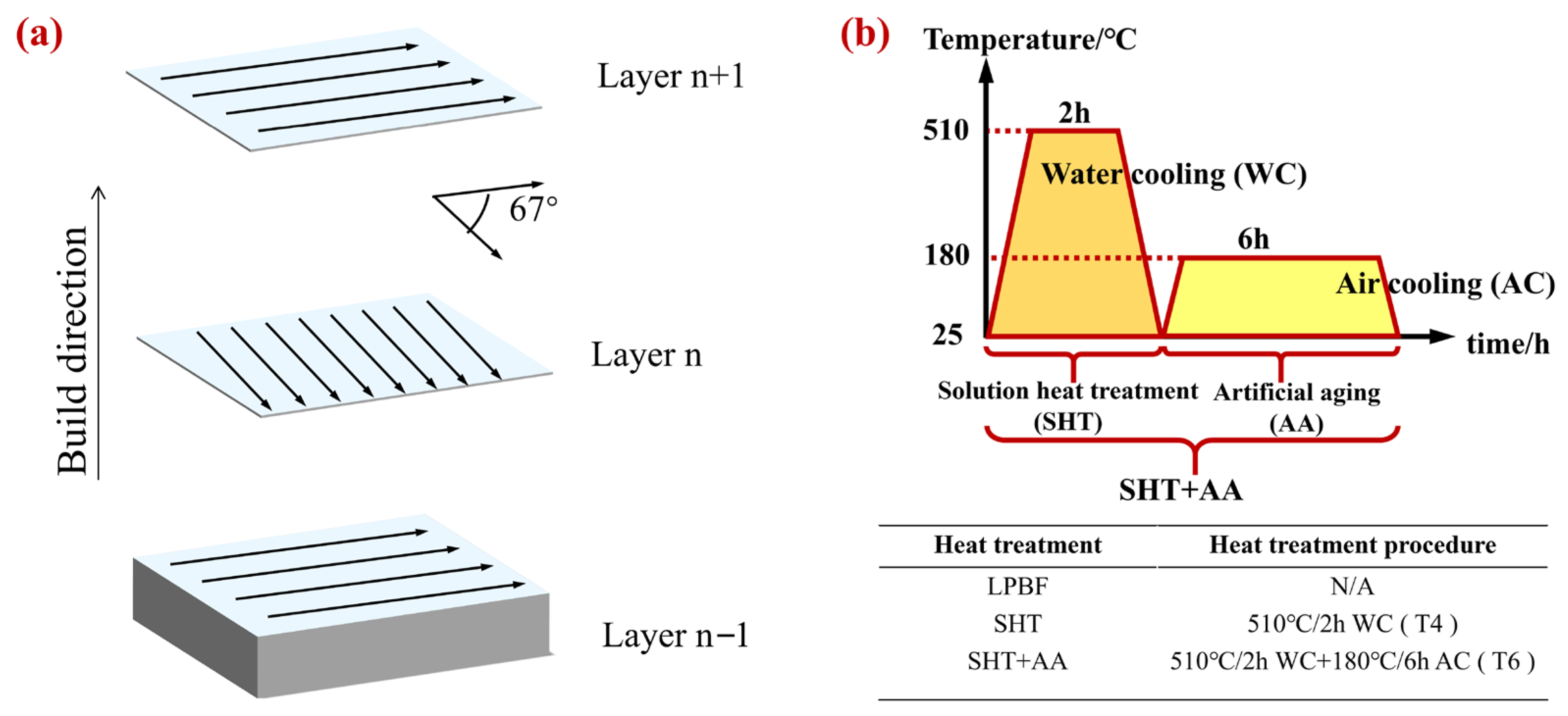
The LPBF process parameters were selected based on preliminary optimization and previous studies. The laser power was set to 360 W, with a scanning speed of 1100 mm/s, hatch spacing of 0.19 mm, and layer thickness of 0.03 mm. The build platform was preheated to 100 °C to reduce thermal gradients and associated residual stresses. As illustrated in Figure 2a, a stripe scanning strategy was adopted, and the scanning direction of each successive layer was rotated by 67° relative to the previous layer. This rotation is commonly employed to mitigate anisotropy and further reduce the accumulation of internal residual stress.
The as-built AlSi10Mg deposits were subjected to two different post-processing heat treatments: solution treatment (T4) and solution plus artificial ageing (T6). For the T4 condition, samples were solution-treated at 510 °C for 2 h, followed by immediate quenching in water at room temperature to retain a supersaturated α-Al solid solution. For the T6 condition, the solution-treated specimens were subsequently aged at 180 °C for 6 h to promote controlled precipitation of silicon from the supersaturated matrix. The schematic diagrams of the T4 and T6 heat-treatment schedules are presented in Figure 2b.

2.3. Microstructural Characterization

The LPBF-fabricated AlSi10Mg specimens were first sectioned to expose the desired planes and then prepared for microstructural examination. The samples were sequentially ground with silicon carbide (SiC) abrasive papers of 150, 400, 800, 1000, and 1200 grit, followed by polishing to a mirror-like finish using 1 μm and 2.5 μm diamond suspensions. After polishing, the specimens were ultrasonically cleaned in ethanol for 15 min to remove surface contaminants and residual polishing media.
Phase identification was carried out using X-ray diffraction (XRD) with Cu Kα radiation (SmartLab, Rigaku, Tokyo, Japan). The XRD scans were performed at an acceleration voltage of 40 kV over a 2θ range of 20–90°, with a step size of 0.01° and a scanning speed of 5°/min. These conditions allowed for accurate detection of the α-Al matrix peaks and the precipitation of Si. For optical and electron microscopy, the polished cross-sections were etched with Keller’s reagent (1% HF + 1.5% HCl + 2.5% HNO3 + 95% H2O) for 5 s to reveal the microstructural features. The etched microstructures were examined by laser scanning confocal microscopy (LSCM) and SEM (Quanta FEG 450, Thermo Fisher Scientific, Waltham, MA, USA).
The elemental distribution within the as-built and heat-treated AlSi10Mg samples was analyzed using energy-dispersive X-ray spectroscopy (EDS, X-Max20, Oxford Instruments, High Wycombe, UK) attached to the SEM. The size and morphology of Si precipitates after T4 and T6 heat treatments were quantified using the Image-Pro Plus 6.0 image analysis software. At least several representative fields of view were analyzed for each condition to obtain statistically meaningful precipitate size distributions.

2.4. Mechanical Testing

Dog-bone-shaped tensile specimens were machined from the LPBF-produced bulk using wire electrical discharge machining (EDM). The geometry and dimensions of the tensile samples are shown in Figure 3, and the loading direction was chosen parallel to the build direction unless otherwise specified. Uniaxial tensile tests were conducted at room temperature on a universal testing machine at a constant crosshead speed corresponding to an initial strain rate of approximately 1 mm/min. For each processing and heat-treatment condition, at least three specimens were tested to ensure reproducibility, and the reported mechanical properties represent the average values.
Following tensile testing, the fracture surfaces were examined by SEM to elucidate the fracture mechanisms and to correlate the macroscopic ductility with microstructural features, such as Si precipitate size, distribution, and the presence of defects. This combined mechanical and microstructural characterization provides a comprehensive basis for assessing the influence of Si precipitation and coarsening on the ductility of LPBF-fabricated AlSi10Mg alloys after T4 and T6 heat treatments.

3. Results

3.1. Phase Analysis

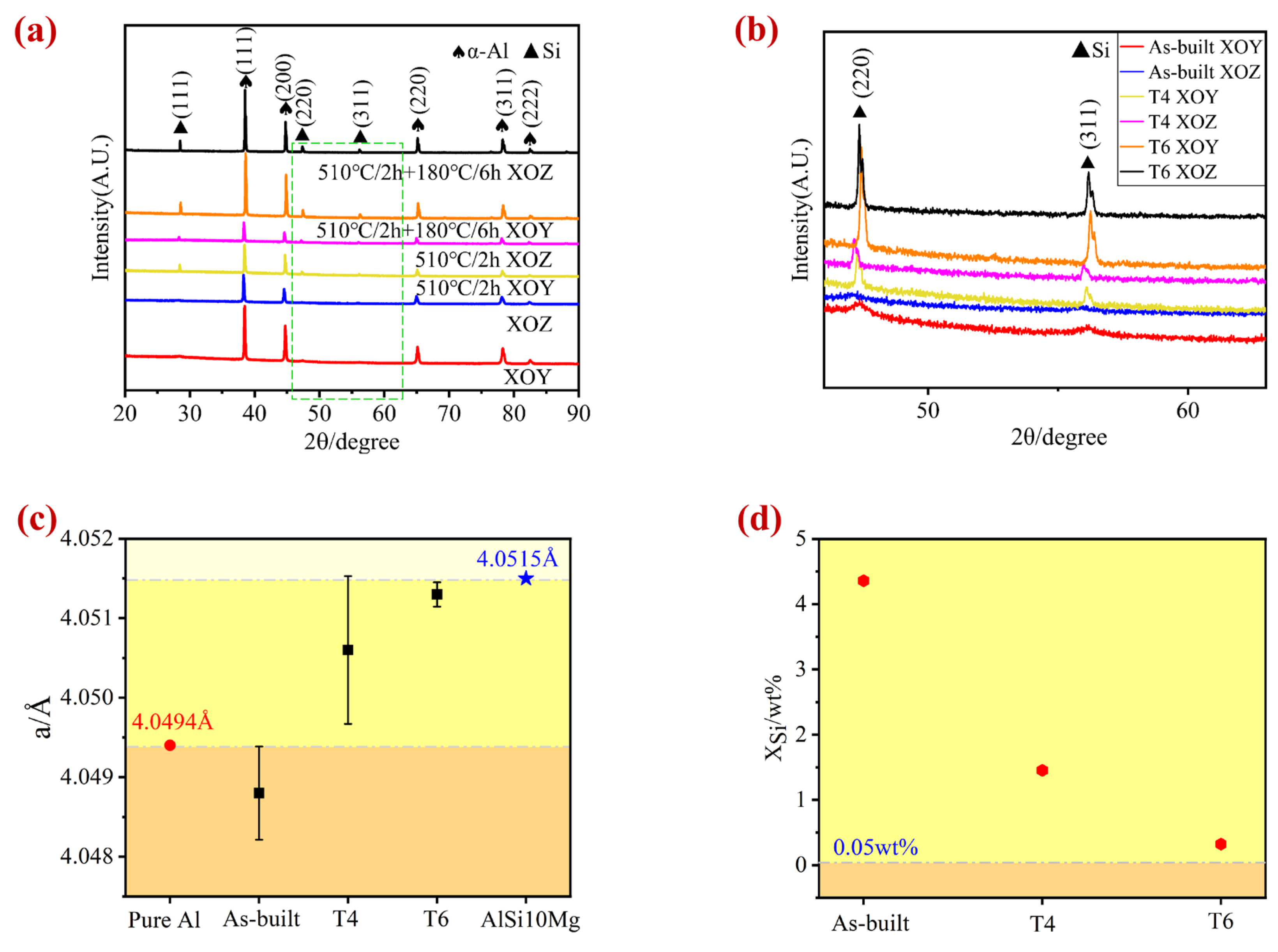
The XRD patterns of the as-fabricated and heat-treated AlSi10Mg parts are shown in Figure 4a,b. The lattice parameters of the α-Al matrix were determined from the XRD data using the Nelson–Riley correction method, as illustrated in Figure 4c. The solid solubility of Si in the α-Al matrix was then calculated according to A. Bendijk’s method, which was modified by Vegard’s law [23,24]. In this approach, the influence of solute Si on the lattice parameter is expressed by Equation (1). In addition, because the presence of Mg in a solid solution also increases the Al lattice parameter, the equilibrium lattice parameter of the AlSi10Mg alloy (4.0515 Å) was used in the calculation instead of that of pure Al (4.0494 Å) [25,26]:
a = 0.0174 X si + 4.0515   Å
where a is the aluminum lattice parameter (in Å), while XSi is the solubility of Si atoms in aluminum (wt.% or at.% as defined in the original calibration). The diffraction peaks corresponding to the Al and Si phases are clearly identified in Figure 4a,b. No distinct Mg2Si peaks were detected in either the as-fabricated or heat-treated conditions, which is most likely due to the relatively low Mg content in the alloy, rendering the volume fraction of Mg2Si too small to be resolved by XRD under the present conditions.
As shown in Figure 4c, a slight variation in the lattice parameter was observed after the heat treatment. Considering the resolution of the XRD measurements, this variation should be interpreted as a general trend rather than an absolute quantitative change. This reduction is attributed to the lattice contraction caused by supersaturated Si atoms trapped in the α-Al matrix, a characteristic feature of the extremely high cooling rates inherent to LPBF processing [25,27]. Using Equation (1), the corresponding solid solubility of Si in the as-fabricated samples is calculated to be about 4.2 wt.%, which is significantly higher than the equilibrium solubility at room temperature (~0.05 wt.%), as indicated in Figure 4d [28,29,30]. The presence of such a high Si supersaturation in the α-Al matrix indicates that the as-built AlSi10Mg is in a metastable state.
After T4 heat treatment, the XRD pattern exhibits a sharper and more intense Si peak, while the lattice parameter of the α-Al matrix increases to 4.0506 Å, as shown in Figure 4c. This increase is consistent with a reduction in the amount of Si remaining in solid solution, which is calculated to be 1.45 wt.% using Equation (1). The change from the as-built value reflects the precipitation of Si from the supersaturated α-Al matrix during solution treatment and subsequent quenching [31]. After T6 heat treatment, the Si peak intensity is further enhanced, indicating a more pronounced depletion of supersaturated Si from the matrix and an increase in the volume fraction of precipitated Si. Concurrently, the calculated lattice parameter of the α-Al matrix approaches the value associated with the equilibrium solid solution, confirming that the system evolves toward a more stable state with reduced supersaturation.
The diffraction peaks of the as-fabricated samples are relatively broad and of low intensity, which is indicative of small grain size and possible microstrain, in agreement with Scherrer’s equation. Notably, in the enlarged view of Si reflections (Figure 4b), the Si (311) peak in the artificial aging condition shows an apparent splitting feature. This behavior is attributed to peak overlap together with residual microstrain and slight compositional heterogeneity introduced during ageing, rather than to the formation of an additional phase. In contrast, after T4 and T6 heat treatments, the XRD peaks become narrower and more intense, reflecting a reduction in lattice strain and a coarsening of grains. This peak sharpening is consistent with the grain growth expected during solution and ageing treatments and further supports the microstructural evolution inferred from the lattice parameter and Si precipitation behavior. The observed orientation-dependent differences in peak intensity after heat treatment are mainly associated with residual crystallographic texture inherited from the LPBF process and incomplete texture randomization. Although mechanical testing indicates a significant reduction in macroscopic anisotropy after heat treatment, XRD remains sensitive to subtle texture effects. This distinction has now been clarified in the revised manuscript.

3.2. Microstructure Characterization

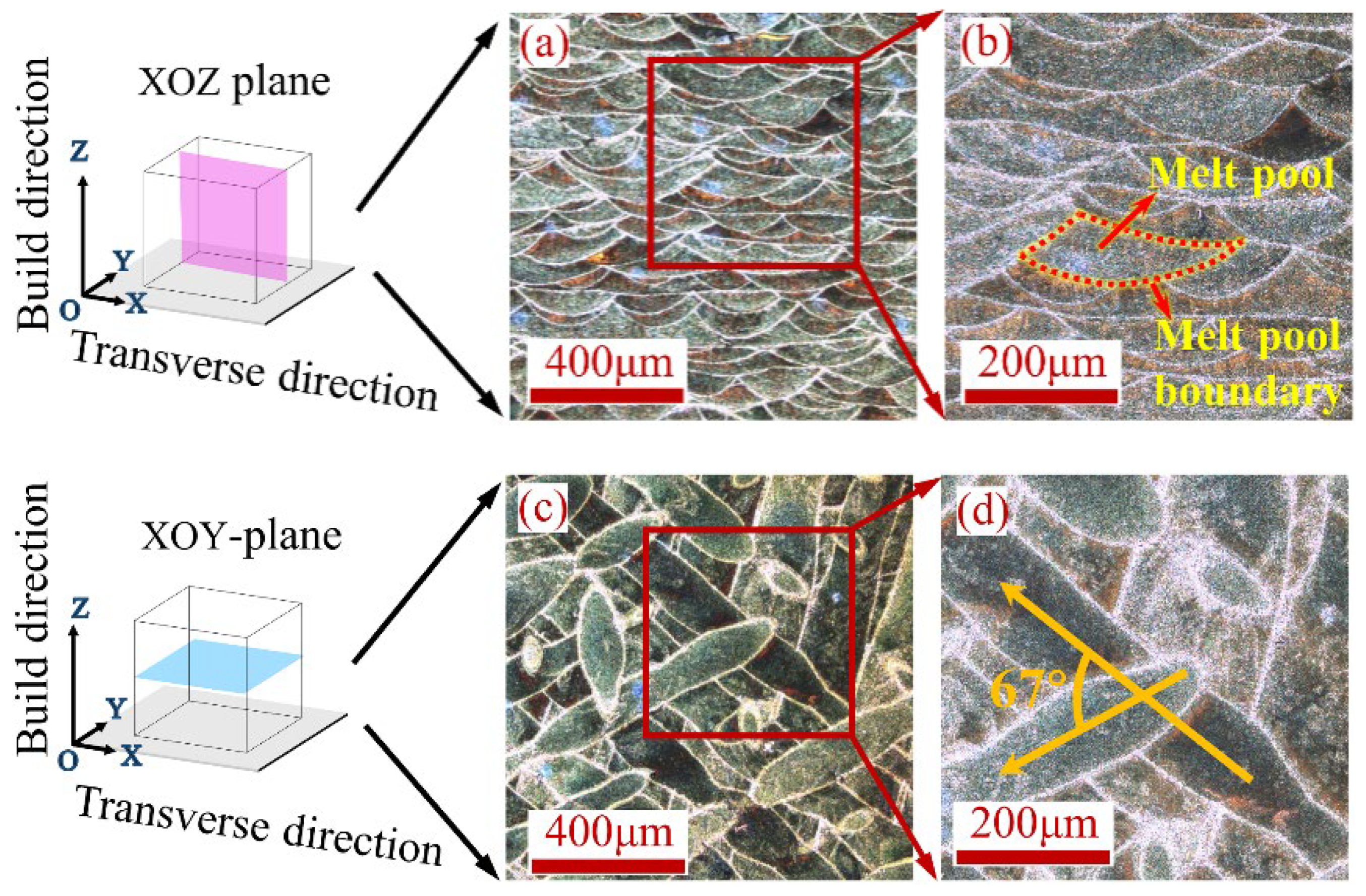
Figure 5 shows low-magnification micrographs of the as-fabricated AlSi10Mg parts. In the XOZ plane, parallel to the build (deposition) direction, the melt pools appear as overlapping, fish-scale-like bands stacked layer by layer, which is attributed to the Gaussian intensity distribution of the laser beam [20], as seen in Figure 5a,b. In the XOY plane, perpendicular to the build direction, the melt pools exhibit an interwoven columnar morphology with widths of approximately 100–150 μm, as determined by the laser scan tracks and shown in Figure 5c,d. The scan vector was rotated by 67° between successive layers; consequently, the columnar melt pool’s traces also display an angular difference of about 67° between adjacent layers. No obvious cracks or lack-of-fusion voids were observed in either the XOZ or XOY sections, indicating a high-quality LPBF build with good consolidation.
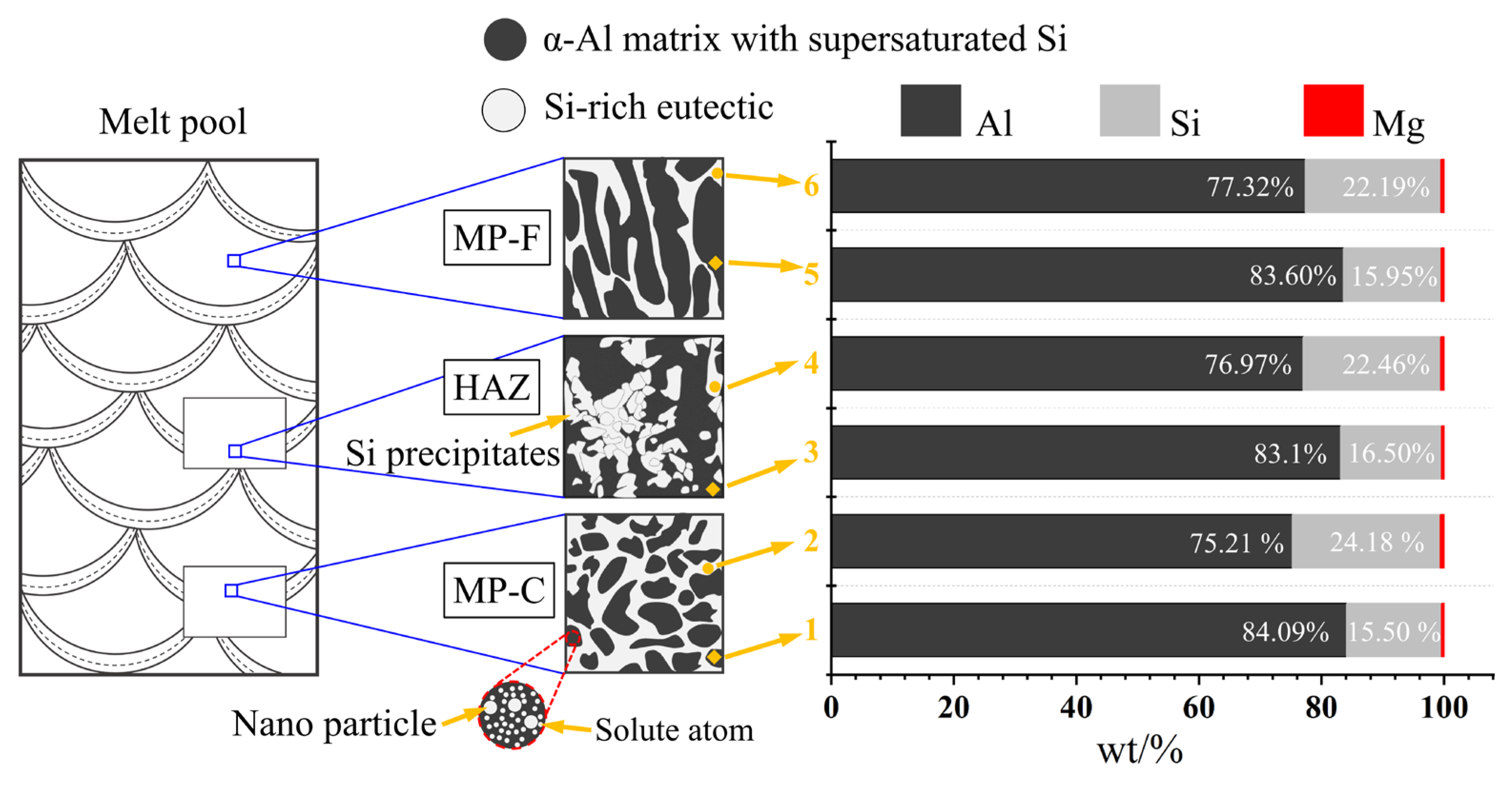
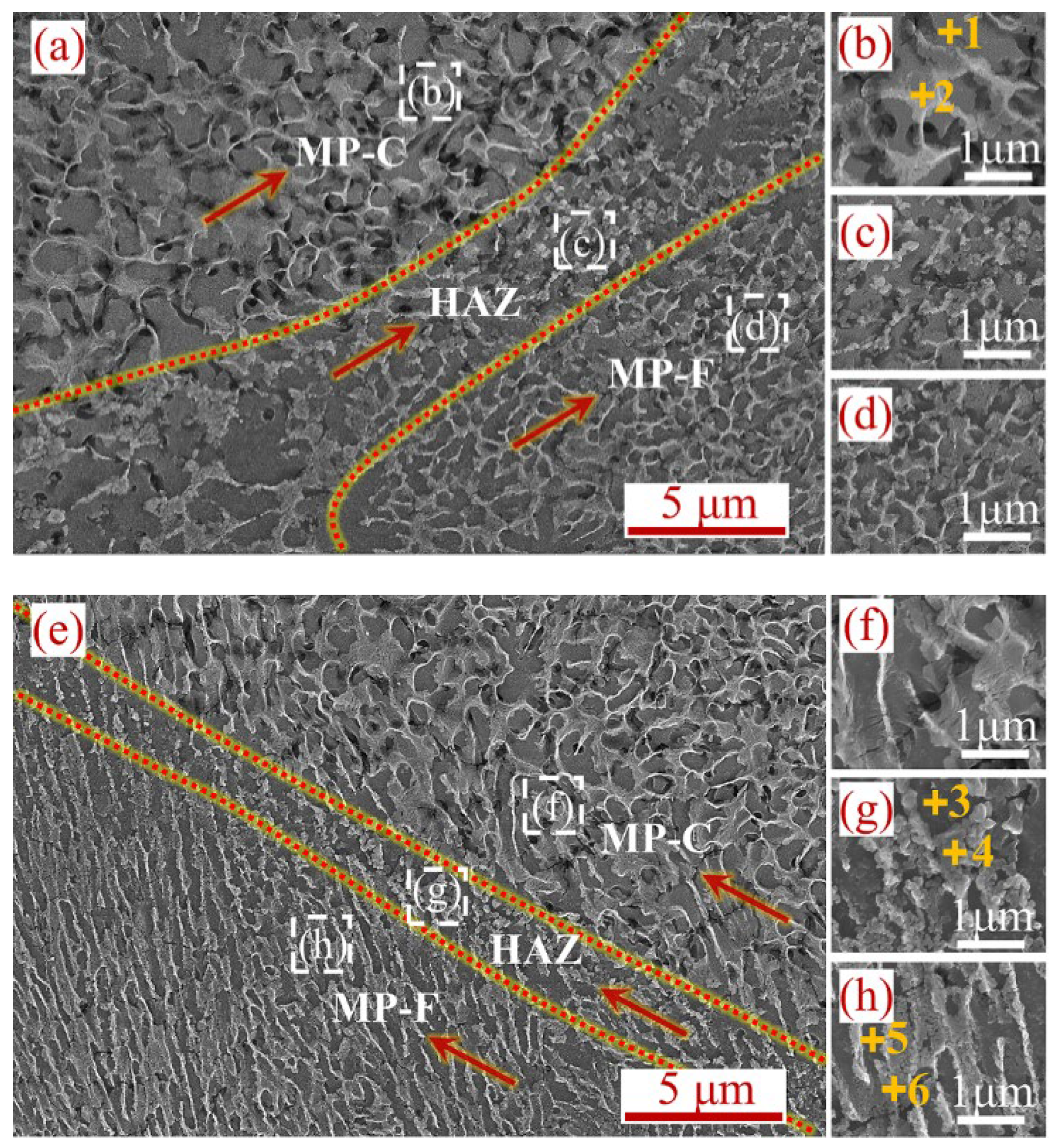
Figure 6 presents the microstructure of the as-fabricated AlSi10Mg alloy on the XOY and XOZ planes. It should be noted that the apparent absence of a continuous Si network in Figure 6 is mainly attributed to the selected magnification and the focus of the present study on post-heat-treatment microstructural refinement, rather than to a fundamental deviation from the typical LPBF microstructures widely reported in the literature. In these images, the dark regions correspond to α-Al cells, whereas the brighter grid-like regions surrounding them correspond to α-Al/Si eutectic networks. Based on the morphology and scale of the eutectic Si, the as-built microstructure can be categorized into three characteristic regions: fine melt pool (MP-F), heat-affected zone (HAZ), and coarse melt pool (MP-C) [32]. These regions develop as a result of the different thermal histories experienced during repeated laser scanning and reheating, as indicated in Figure 6b–d,f–h.
In the MP-F region, the eutectic Si network is well developed and continuous, with a minimum feature size on the order of 0.1–0.5 μm. The HAZ appears as a transition zone between MP-F and MP-C, characterized by a broken and inhomogeneous eutectic network formed by fragmented dendritic Si. In this region, the α-Al cells are relatively coarse, with a maximum cell diameter of approximately 2.3 μm. The eutectic Si morphology in the MP-C region is similar in shape to that in MP-F; however, the eutectic in MP-C is distinctly coarser, with typical Si feature sizes in the range of 1–2 μm [31,33]. Furthermore, the appearance of MP-F differs between planes: in the XOY plane, MP-F is predominantly equiaxed, as shown in Figure 6a, whereas in the XOZ plane, MP-F is arranged in elongated columnar bands, aligned with the build direction due to epitaxial growth, as shown in Figure 6e [20].
A schematic representation of the hierarchical microstructure and the corresponding EDS elemental distributions for the as-fabricated condition is provided in Figure 7, which complements the micrographs in Figure 6. In this schematic, positions marked with odd numbers correspond to the centers of α-Al cells, while even-numbered positions correspond to the eutectic Si network. EDS analysis indicates that the cell centers are enriched in Al with only a small amount of Si, consistent with an α-Al matrix containing supersaturated Si. In contrast, the reticular eutectic regions contain a higher fraction of Si than the cell centers, although Al remains the predominant element. The measured Mg content in both the cell centers and eutectic regions is approximately 0.5 wt.%, confirming that Mg is present only in minor amounts and is not strongly segregated.
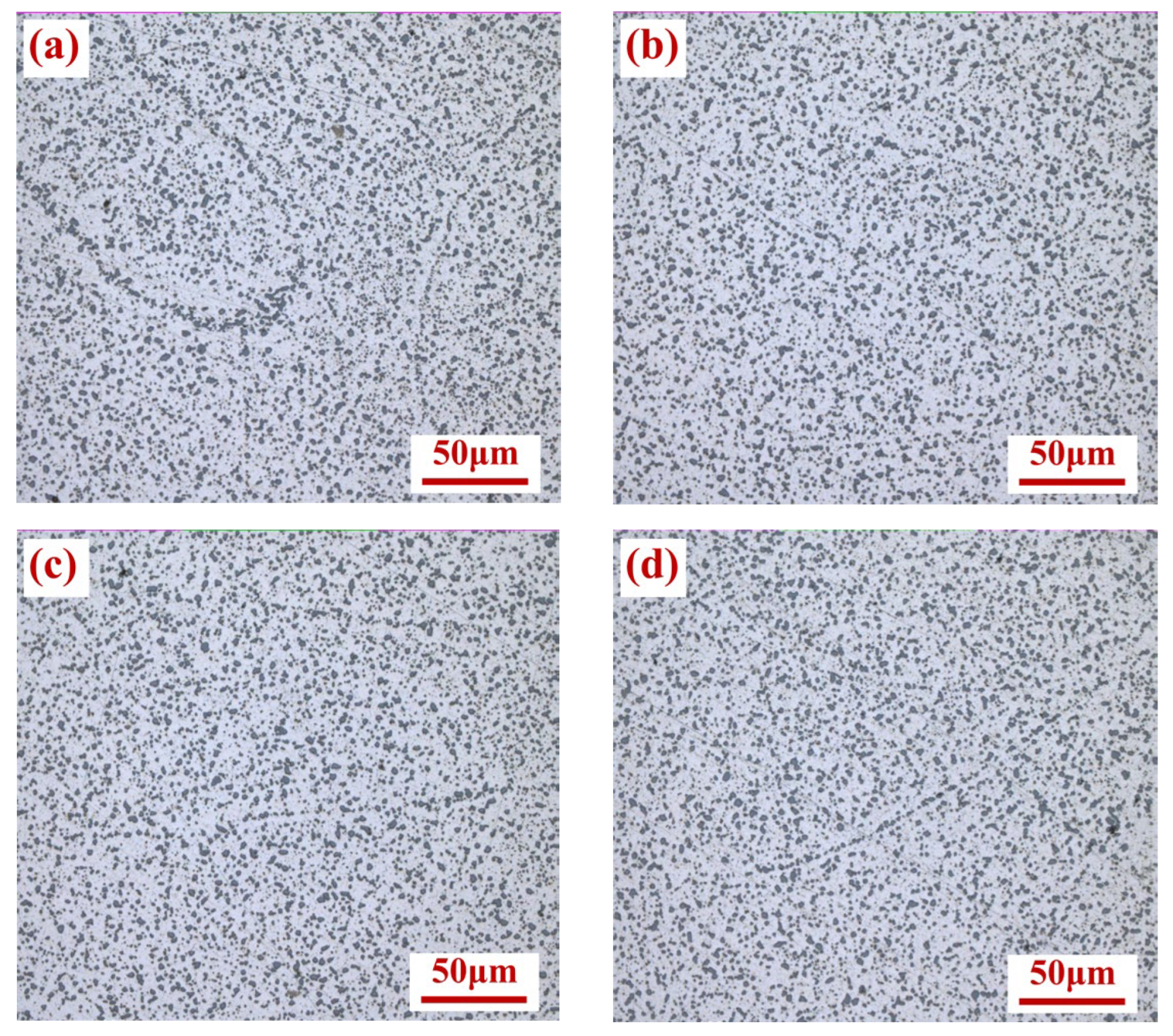
Figure 8 shows LSCM micrographs of the AlSi10Mg parts after heat treatment. Compared with the as-fabricated condition, the continuous eutectic Si network has fragmented, and the melt pool boundaries have largely faded, indicating homogenization of the microstructure during T4 and T6 treatments. The broken eutectic Si fragments tend to be located near the positions that previously corresponded to the interconnected network before heat treatment. Moreover, the ultrafine Si particles originally located at the centers of the α-Al cells have undergone pronounced coarsening and are now more uniformly distributed within the matrix.
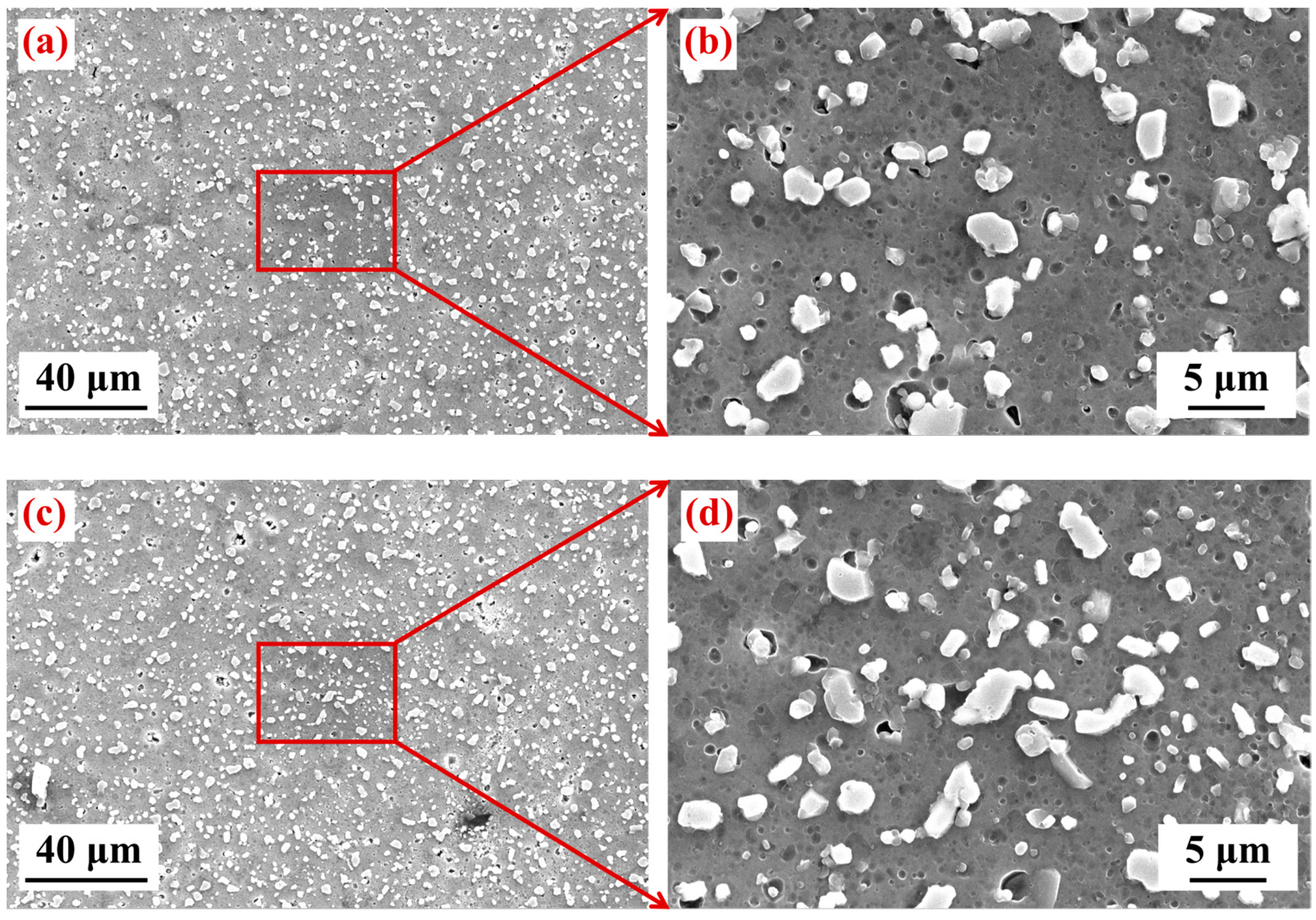
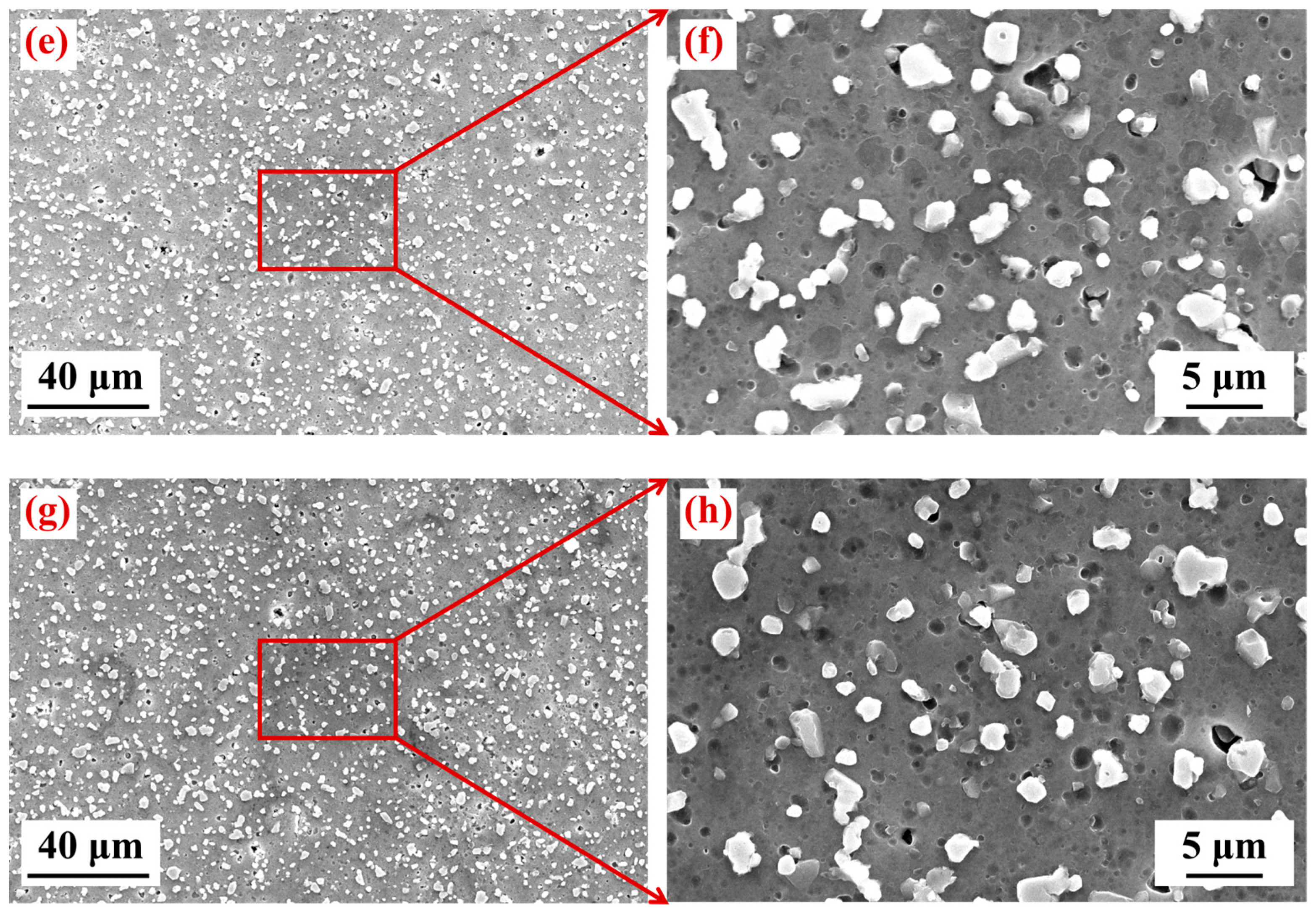
The SEM images in Figure 9 further confirm the presence of significantly coarsened Si particles with a non-uniform spatial distribution after heat treatment. Following T4 heat treatment, the average size of the Si phase in the XOY and XOZ planes is measured to be 2.28 μm and 2.41 μm, respectively. After subsequent T6 heat treatment, these average sizes increase slightly to 2.39 μm and 2.47 μm in the XOY and XOZ planes, respectively, indicating continued coarsening during ageing. It should be noted that although T6 heat treatment promotes spheroidization, complete particle rounding can be limited by particle coalescence, local composition gradients, and diffusion constraints. As a result, some non-spherical particles remain even after T6 treatment. This explanation has been added to the revised manuscript.
After T4 treatment, the precipitation of Si particles in the XOZ plane tends to form stripe-like clusters with an aspect ratio greater than 2, reflecting directional coarsening along certain crystallographic or thermal gradients. In contrast, in the XOY plane, the Si particles tend to adopt a more equiaxed morphology, with aspect ratios less than 2. As the heat treatment proceeds to the T6 condition, both planes show a tendency toward smaller aspect ratios and a more isometric, equiaxed morphology compared with the T4 condition, suggesting that prolonged ageing promotes shape equilibration and reduces anisotropy in particle morphology.
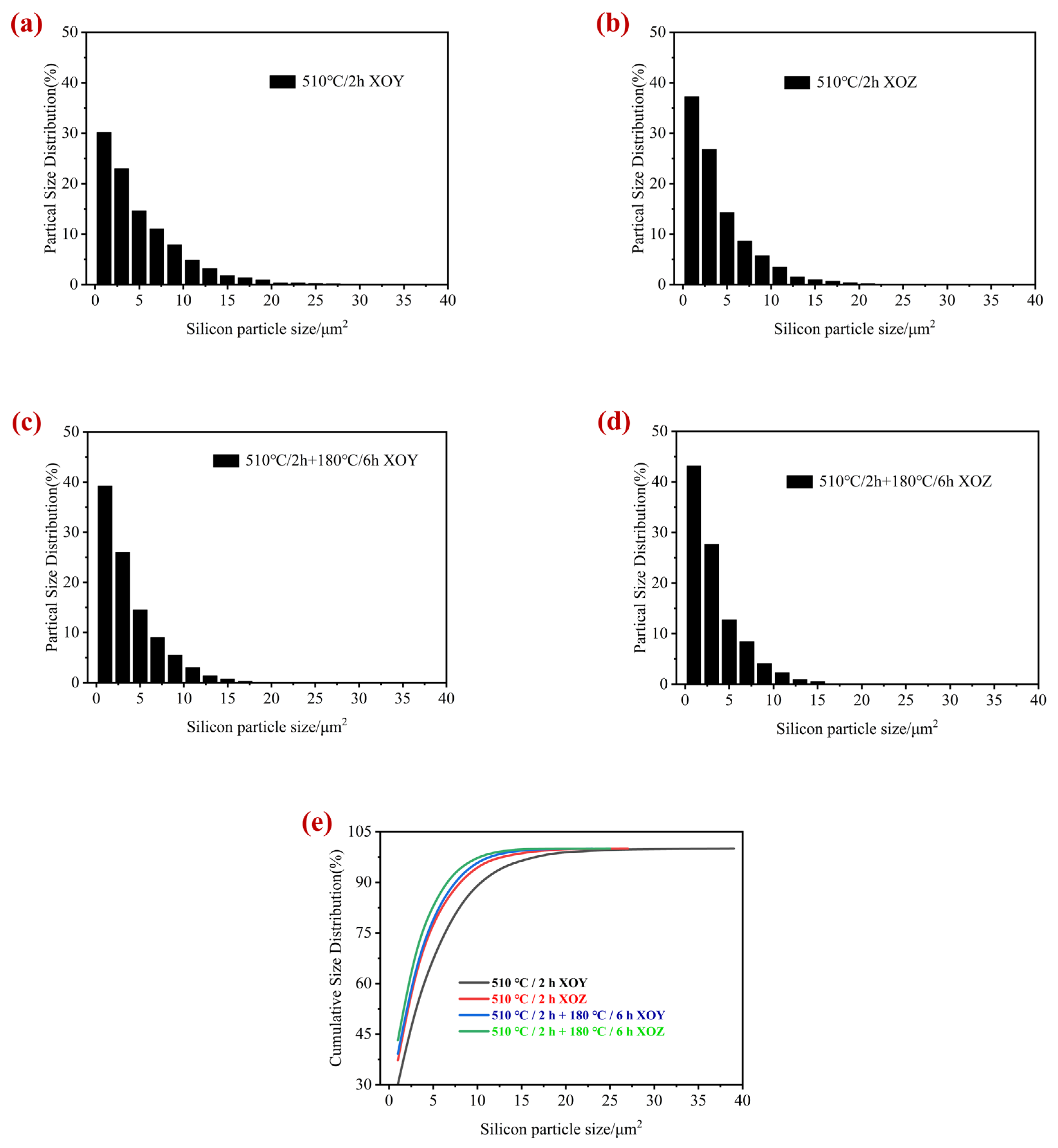
The SEM images of the heat-treated samples also reveal the presence of micro-pores. During LPBF, partially melted or solid metallic particles may be surrounded by a liquid matrix with relatively high viscosity in the melt pool [34]. In some regions, insufficient feeding of liquid metal between adjacent solid or semi-solid regions can lead to the entrapment of voids at their interfaces, ultimately forming pores upon solidification. The size of these pores is comparable to that of the Si particles observed in Figure 9, making it challenging to unambiguously distinguish pores from Si particles in SEM images and to quantify their areas with high accuracy. For this reason, LSCM images in Figure 8 were used as the primary basis for the quantitative measurement of Si precipitate size, which was carried out using the ImageJ software (Version 1.54i). The statistical results are summarized in Figure 10. It should be noted that although T6 treatment promotes spheroidization and coarsening of Si particles, the morphological differences between T4 and T6 can be subtle at the selected magnification due to overlapping size ranges and particle coalescence effects. Considering that the Si precipitates after heat treatment exhibit irregular shapes, using only an equivalent diameter could introduce substantial error. Therefore, in Figure 10, the projected area of each individual Si particle is reported as the characteristic size. Ultrafine Si particles with dimensions below the spatial resolution of LSCM were excluded from the analysis.
The statistical distributions in Figure 10 show that the Si particles experience marked coarsening during heat treatment, with the largest particle areas exceeding 10 μm2, as a consequence of reticular eutectic fragmentation combined with Ostwald ripening. After T4 treatment, the fraction of Si particles with areas smaller than 1 μm2 in the XOY direction is the highest, exceeding 35%, indicating that a substantial population of relatively fine particles still remains. In contrast, after T6 treatment, the fraction of Si particles smaller than 1 μm2 is the lowest among all conditions. This behavior can be rationalized by considering that, during T6 ageing, the Si solubility in the α-Al matrix approaches its equilibrium level, and supersaturation is further reduced, driving additional Si precipitation. At the same time, Ostwald ripening causes fine particles to dissolve and re-precipitate onto larger ones, leading to the continued growth and coalescence of Si particles [35]. Consequently, the overall size distribution shifts toward larger particles and lower number fractions of sub-micrometer Si, especially in the T6 condition.

3.3. Mechanical Property Characterization

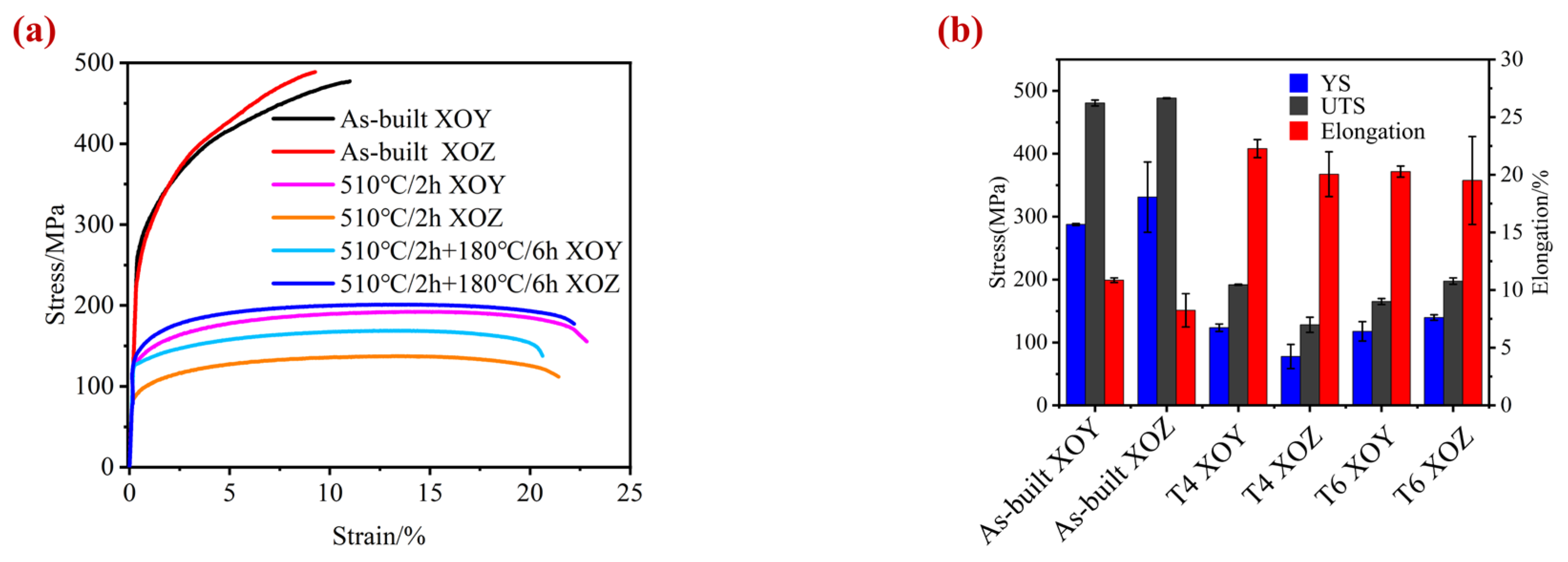
As shown in Figure 11a, the mechanical response of the LPBF-fabricated AlSi10Mg alloy under different post-heat-treatment conditions was evaluated by room-temperature uniaxial tensile testing. The corresponding engineering stress–strain curves and the extracted tensile properties are summarized in Figure 11b, enabling a direct comparison between the as-fabricated state and the heat-treated states.
The as-fabricated AlSi10Mg parts exhibited high strength, which is primarily attributed to the characteristic LPBF microstructure featuring a hyperfine cellular α-Al matrix bounded by a continuous reticular eutectic Si network. The average yield strength (YS) and ultimate tensile strength (UTS) measured on the XOY and XOZ planes were 288 MPa and 331 MPa, and 481 MPa and 488 MPa, respectively, while the corresponding elongations were 10.9% (XOY) and 8.2% (XOZ). The tensile anisotropy is mainly associated with build-direction-dependent melt pool morphology and microstructural heterogeneity resulting from the layer-wise thermal history and laser scanning trajectories, which affect strain partitioning and damage evolution during deformation [36].
After T4 heat treatment, both YS and UTS decreased substantially by more than 50%, whereas the elongation increased dramatically from 10.9% to 22.27%, i.e., approximately two times that of the as-fabricated condition. This pronounced strength reduction is consistent with the microstructural changes observed in Figure 5 and Figure 8, where the melt pool contrast becomes less distinct and the reticular eutectic Si network progressively fragments and coarsens. Simultaneously, Si particles grow at the expense of nearby finer precipitates through Ostwald ripening, resulting in a marked reduction in the density of fine microstructural barriers. Consequently, the strengthening effect arising from microstructural refinement, typically described by Hall-Petch-type behavior related to sub-grain and cellular features, becomes markedly weaker, leading to the observed strength reduction [27]. In parallel, solution treatment effectively relieves the residual stresses introduced during LPBF processing, which promotes more homogeneous plastic deformation and contributes to the large increase in ductility [37]. Therefore, the mechanical response after T4 treatment is governed by the combined effects of eutectic network decomposition, precipitate coarsening, and residual-stress relaxation.
Following T6 heat treatment, further evolution of the Si precipitates resulted in a slight increase in strength and a marginal decrease in ductility compared with the T4 condition. This change is again linked to Ostwald ripening, whereby smaller Si particles gradually dissolve and larger particles continue to grow. The coarser Si particles can act as stronger obstacles to dislocation motion, which contributes to modest strength recovery. Meanwhile, the more rounded morphology of matured particles reduces sharp stress concentrators, which may partially mitigate local stress intensification; however, the larger particle size also facilitates interfacial decohesion and void nucleation under tensile loading, thereby slightly reducing plasticity. Overall, the T6 condition reflects a precipitation–coarsening-controlled trade-off, where modest strengthening is obtained at the expense of a small reduction in elongation [35].
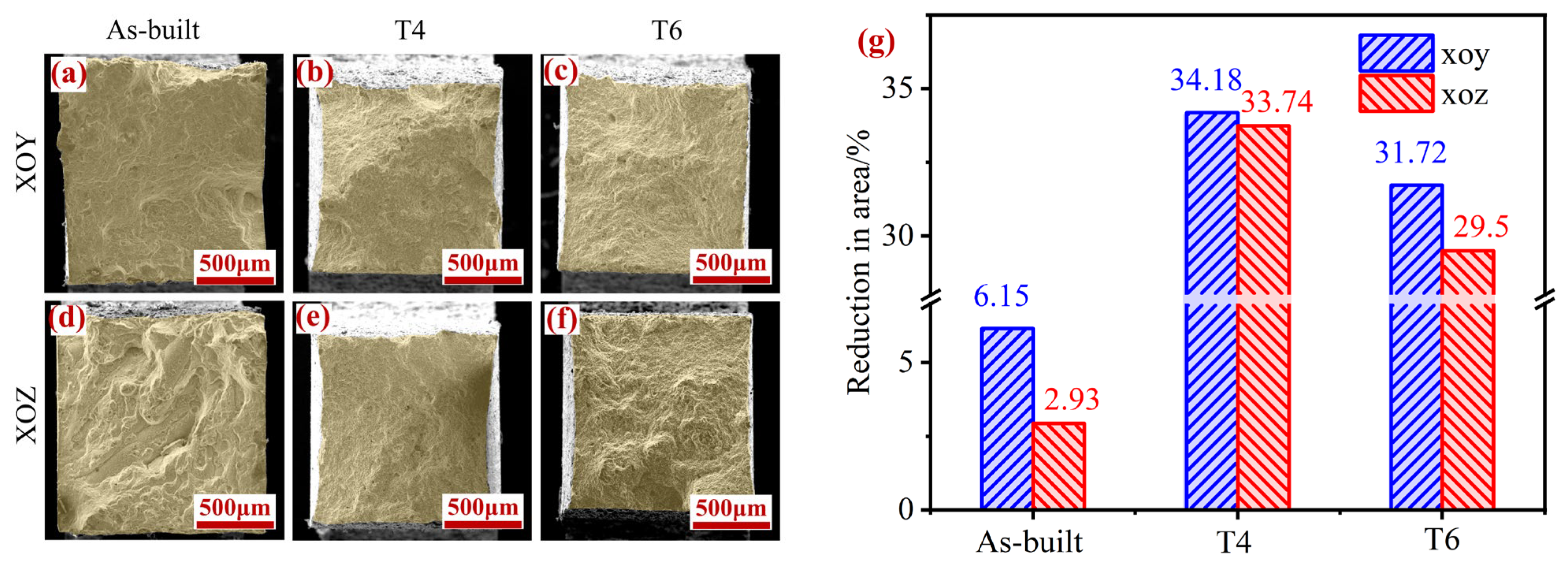
The macroscopic fracture appearances of the LPBF-fabricated AlSi10Mg specimens after tensile testing are shown in Figure 12a–f. The fracture cross-sections are highlighted (yellow-marked regions), and the corresponding section shrinkage is quantified in Figure 12g. In the as-fabricated condition, only limited necking was observed, with section shrinkage values of 6.15% and 2.93% for the XOY and XOZ planes, respectively, consistent with an elongation below 10% and with build-direction-dependent deformation behavior.
After heat treatment, the fracture cross-sectional area decreased more noticeably, indicating enhanced plastic deformation capability. Importantly, the fracture characteristics became more similar between the XOY and XOZ directions, suggesting that heat treatment effectively reduced anisotropy. This improvement can be attributed to the fading of melt pool boundaries and the homogenization of the microstructure after heat treatment, which diminishes directional differences in strain localization and damage initiation. Quantitatively, the shrinkage in the XOY and XOZ planes after heat treatment fell within 0.44–2.2%, demonstrating that improved ductility was achieved in both transverse and longitudinal directions and that the fracture morphology became more uniform.
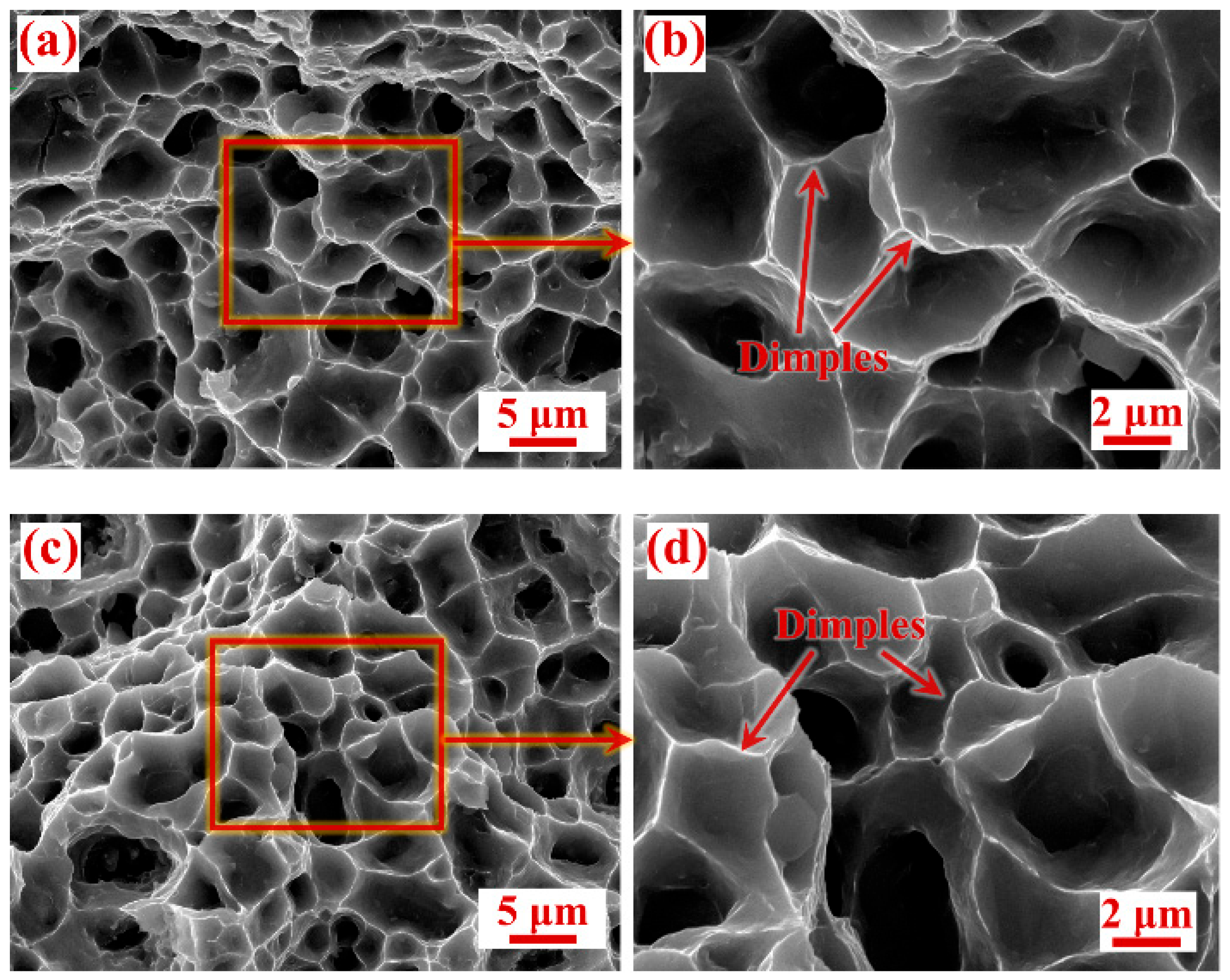
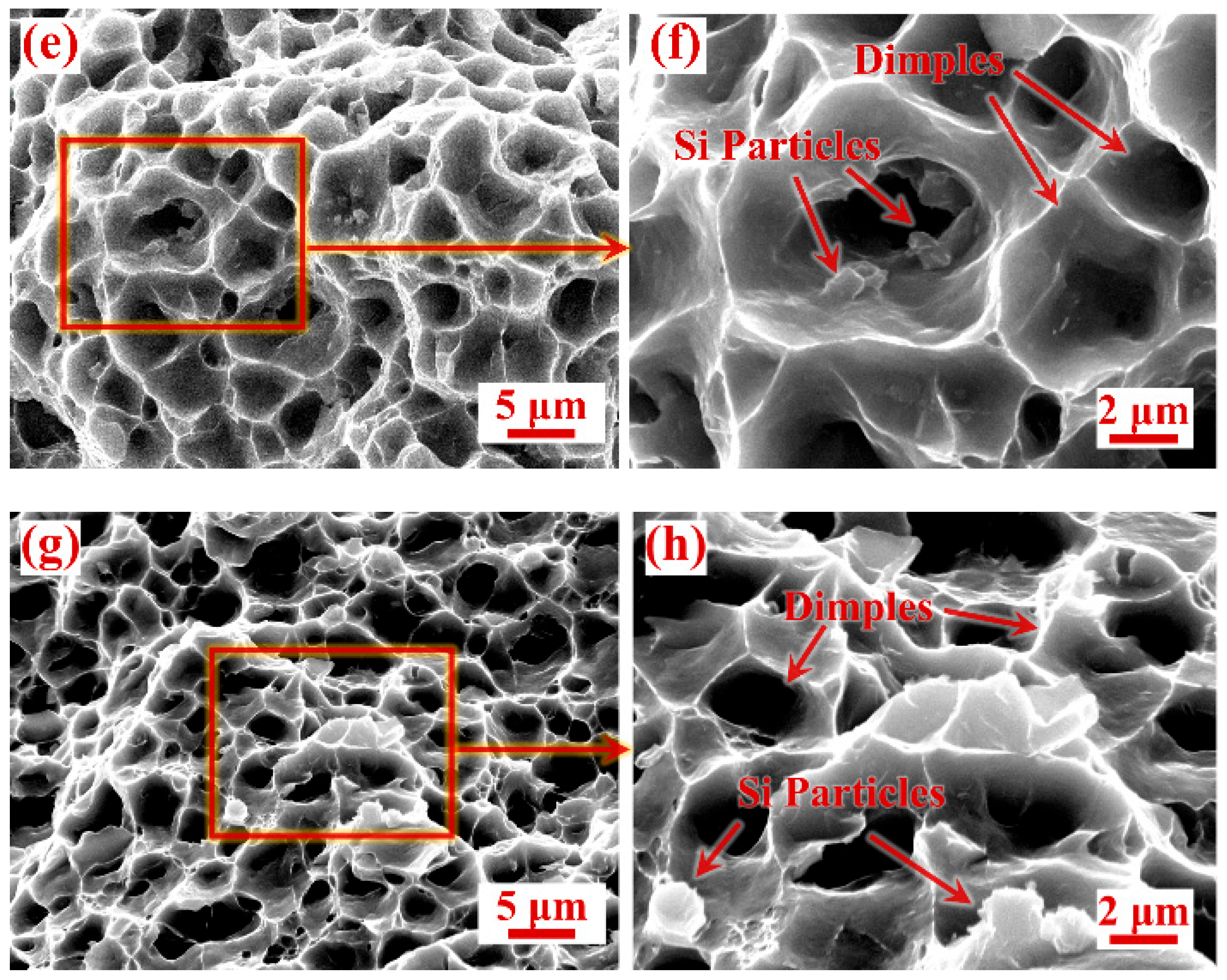
The fracture surface morphologies are presented in Figure 13. Compared with the as-fabricated samples, the heat-treated specimens exhibit larger and deeper dimples, indicating a more ductile fracture mode. The dimple sizes in the T4- and T6-treated specimens are broadly comparable, ranging from approximately 1.2 to 9.9 μm. The significant increase in dimple size after heat treatment correlates strongly with the marked coarsening and redistribution of Si particles [38]. Moreover, Si particles are frequently observed at dimple bottoms or along dimple edges, indicating that void nucleation and growth are closely associated with particle–matrix interfacial decohesion and subsequent particle fracture/fragmentation during plastic deformation. These observations confirm that the evolution of Si precipitate size and morphology plays a central role in controlling the ductility and fracture behavior of LPBF-fabricated AlSi10Mg after T4 and T6 treatments.

4. Discussion

4.1. Evolution of Silicon Dimensions After Heat Treatment

The evolution of the morphology and characteristic dimensions of the reticular eutectic Si network was analyzed to clarify the microstructural origin of the pronounced ductility improvement observed after heat treatment. Particular attention was paid to the fragmentation, spheroidization, and coarsening behavior of eutectic Si and to the precipitation of Si from the supersaturated α-Al matrix, as these processes jointly govern strain accommodation and damage initiation in heat-treated LPBF AlSi10Mg alloys.
During the T4 solution treatment, a positive temperature gradient inevitably develops from the specimen surface toward the interior, giving rise to thermal misfit stresses. Because the coefficient of thermal expansion of the α-Al phase is approximately an order of magnitude larger than that of the Si phase, the tensile stress generated in the Al lattice during heating is substantially greater than the compressive stress accommodated by the Si network; consequently, these stresses cannot mutually compensate [27,39]. The resulting internal stress field promotes the preferential fracture of the “fine necks” within the interconnected eutectic Si network, leading to network breakup into discrete fragments and particles, as evidenced by the post-heat-treatment microstructures in Figure 8 and Figure 9. In parallel, Si retained in the supersaturated α-Al solid solution, which forms during rapid solidification in LPBF, exhibits increased thermodynamic activity at elevated temperatures, thereby promoting the continuous precipitation of fine nanoscale Si particles, and potentially Mg2Si precipitates, during solution treatment and subsequent quenching or early-stage redistribution. As a result, a bimodal particle size distribution may form, consisting of fragmented/coarsened eutectic Si particles and newly precipitated fine Si dispersoids [40,41].
In addition to stress-assisted fragmentation, the solution treatment also triggers spheroidization and curvature-driven dissolution of eutectic Si. Changes in local curvature generate surface tension on the eutectic Si interface, such that regions with smaller radii of curvature exhibit higher interfacial free energy and are therefore thermodynamically more prone to dissolution. Consequently, eutectic Si fragments containing concave depressions, sharp edges, or highly curved features dissolve preferentially, leading to progressive blunting and rounding of particle corners. Meanwhile, the newly precipitated Si particles from the supersaturated α-Al matrix are initially small and therefore thermodynamically unstable; these fine particles tend to diffuse, dissolve, and subsequently redeposit onto larger eutectic Si fragments. This redistribution promotes continuous coarsening of eutectic Si through Ostwald ripening, ultimately shifting the particle population toward larger characteristic sizes and more rounded morphologies [42].
Furthermore, precipitation of Si from the supersaturated α-Al matrix during solution treatment reduces the concentration of Si solute atoms in solid solution. This decreases solute-dislocation interactions, thereby weakening the contribution of solid-solution strengthening compared with the as-fabricated condition [37]. The reduction in solid-solution strengthening, together with the disappearance of the ultrafine cellular/eutectic constraint, provides a consistent microstructural explanation for the observed strength decrease after T4, while simultaneously facilitating more homogeneous plastic flow and improved ductility.
After T6 treatment (solution + artificial ageing), the fine Si particles located within the α-Al matrix undergo additional coarsening, and the edges of the coarsened Si particles become increasingly rounded. This morphological equilibration reduces the severity of local stress concentration at particle corners and sharp features, which may delay crack initiation associated with particle fracture or particle–matrix decohesion. At the same time, neighbouring large Si particles continue to absorb smaller precipitates through ongoing Ostwald ripening, further increasing the mean particle size and reducing the fraction of very fine Si dispersoids. These coupled processes, including continued coarsening, edge rounding, and redistribution of Si mass toward larger particles, provide a mechanistic basis for the microstructural trends observed after T6 and for the corresponding changes in mechanical response relative to the T4 condition [35].

4.2. Effects of Si Size Evolution on Ductility and Fracture Mechanisms

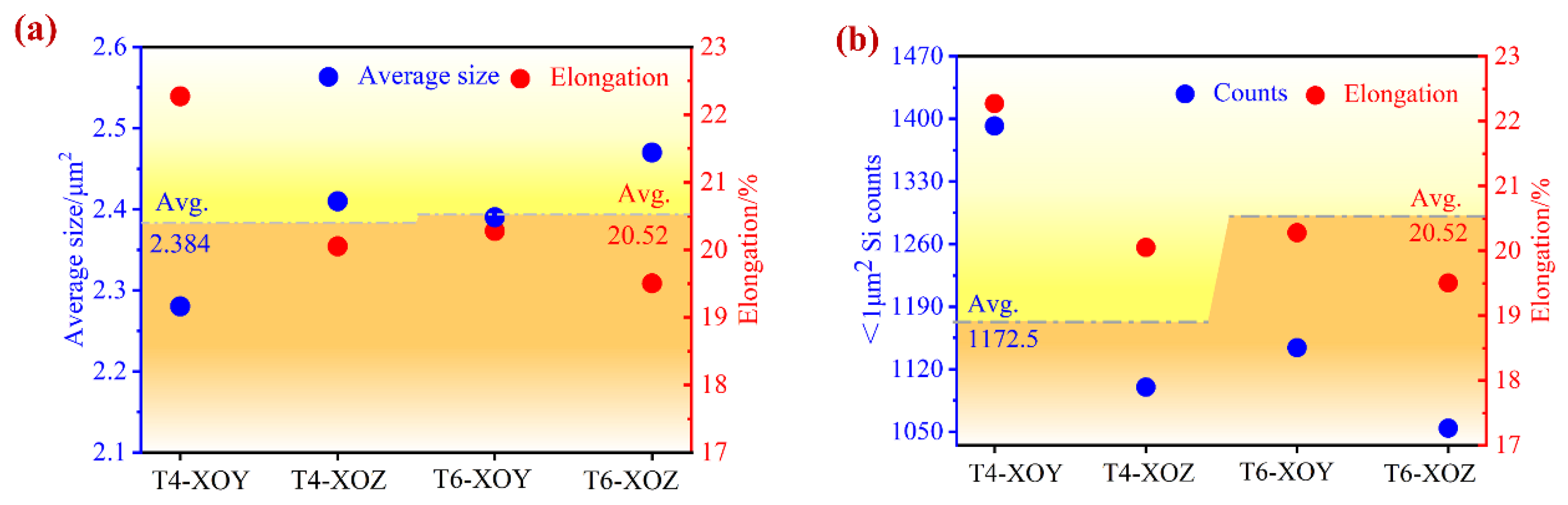
After heat treatment, most Si particles underwent pronounced coarsening; nevertheless, the statistical analysis reveals a clear positive correlation between the fraction (number density) of finer Si particles and tensile elongation (Figure 14a). Specifically, as shown in Figure 14a, the specimen exhibiting the highest post-heat-treatment elongation (T4 condition, XOY plane) also contains the largest fraction of Si particles with sizes below 1 μm2, exceeding 35% of the measured population. In contrast, the specimen showing the poorest ductility after heat treatment contains the lowest fraction of Si particles in this fine-size regime. Consistently, the specimen with relatively inferior ductility (T6 condition, XOZ plane) also presents the smallest proportion of Si particles smaller than 1 μm2. Notably, two specimens with nearly identical elongation, namely the T4 condition in the XOZ plane (20.1%) and the T6 condition in the XOY plane (20.3%), exhibit very similar fractions of Si particles smaller than 1 μm2, which further supports the robustness of this correlation. Therefore, the present results indicate that, after heat treatment, a higher number density of fine Si precipitates is associated with improved ductility. Similar size-ductility correlations have also been reported for age-hardenable Al alloys, where the precipitate size distribution governs the balance between work hardening and damage initiation [35].
At the microscale, macroscopic plastic strain arises from the collective motion of dislocations, which must traverse or overcome obstacles on active slip planes. When the precipitates are sufficiently small, they can behave as shearable obstacles to moving dislocations. In this regime, resistance is associated with dislocation shearing of Si precipitates during heat treatment [43,44].
In the presence of a high density of fine precipitates, dislocations are repeatedly impeded and stored, leading to increased dislocation interactions, slip entanglement, and a higher strain-hardening capacity. The accumulation of dislocations around dispersed precipitates therefore facilitates the development of substantial plastic strain prior to instability. In addition, the presence of numerous fine precipitates promotes a higher dislocation density and enhances strain accommodation associated with thermal shrinkage mismatch and local plastic incompatibility, which collectively contribute to improved macroscopic elongation [40].
In contrast, as the Si precipitates coarsen, the associated strain field near the precipitate/matrix interface expands because of the lattice-parameter and elastic mismatch between Si and Al. Moreover, coarse Si particles tend to progressively lose coherency with the α-Al matrix [45]. Both effects increase the local driving force for interfacial damage, thereby reducing the work required to nucleate voids at the matrix/precipitate interface and ultimately degrading ductility. When precipitates become sufficiently large, they are no longer shearable by dislocations and instead act as non-shearable obstacles, forcing dislocations to bypass them by the Orowan looping mechanism [38,46].
The coarse precipitates promote the formation of dislocation loops, which increases the local elastic/plastic incompatibility and facilitates strain localization. Importantly, the smaller the spacing between two neighbouring coarse precipitates, the stronger their combined hindrance to dislocation motion, which accelerates local stress concentration and reduces ductility. In addition, the predominance of non-shearable precipitates modifies dislocation storage and dynamic recovery behavior, thereby lowering plasticity [4,37].
Taken together, these results indicate that high elongation requires a precipitate population dominated by fine Si particles together with a minimized fraction (or reduced clustering) of coarse Si particles, consistent with previous observations in Al-Si-Mg systems [22,43]. Therefore, when evaluating or tailoring the ductility of heat-treated LPBF AlSi10Mg, it is essential to consider not only the mean Si particle size but also the full size distribution, number density, and effective interparticle spacing, since these microstructural descriptors collectively govern dislocation–precipitate interactions and void nucleation propensity. Further work is still needed to quantitatively establish the coupling between precipitate statistics and damage evolution, particularly under the combined influence of residual defects and microstructural anisotropy inherited from LPBF.

5. Conclusions

In this study, LPBF-fabricated AlSi10Mg alloys were subjected to T4 and T6 heat treatments to elucidate the role of Si precipitation size and distribution in controlling ductility and tensile anisotropy. The main conclusions can be summarized as follows:
(1)
XRD analysis revealed that, in the as-fabricated condition, Si was retained in a supersaturated solid solution within the α-Al matrix, indicating a metastable microstructural state induced by the high cooling rate of LPBF. Solution treatment (T4) promoted Si precipitation from the α-Al matrix, while subsequent ageing (T6) further reduced the supersaturated Si content, driving the alloy toward an equilibrium solid-solution condition.
(2)
The as-fabricated deposits consisted of an α-Al matrix surrounded by a grid-like α-Al/Si eutectic network. Heat treatment caused the eutectic network to fragment and decompose, accompanied by a substantial attenuation of melt-pool contrast. Fragmented Si particles underwent spheroidization/passivation driven by interfacial energy minimization, whereas fine Si precipitates progressively diffused and redeposited onto larger particles through Ostwald ripening, resulting in an overall coarsening and redistribution of the Si phase.
(3)
The as-fabricated AlSi10Mg deposits exhibited high strength originating from the ultrafine cellular-eutectic microstructure; however, a clear tensile anisotropy was observed. Following T4 heat treatment, YS and UTS decreased markedly, whereas elongation increased substantially, which is primarily attributed to residual-stress relaxation together with eutectic network decomposition and microstructural coarsening. After T6 heat treatment, a modest strength recovery accompanied by a slight reduction in ductility was obtained, consistent with additional Si particle coarsening during ageing. Overall, post-heat treatment significantly improved ductility and mitigated anisotropy in LPBF-fabricated AlSi10Mg alloys.
(4)
Ductility evolution is strongly controlled by the Si precipitate size distribution. A higher population of fine Si precipitates promotes more distributed plastic deformation by increasing dislocation storage and work-hardening capability, leading to enhanced elongation; accordingly, ductility shows a positive correlation with the fraction of small Si precipitates. In contrast, coarsened Si particles intensify local dislocation pile-ups and promote earlier damage initiation by particle–matrix decohesion/void nucleation, thereby reducing plasticity. Moreover, as the interparticle spacing between coarse Si particles decreases, their combined obstruction effect on dislocation motion becomes more pronounced, accelerating strain localization and further degrading the ductility of AlSi10Mg alloys.

Author Contributions

Data curation, Y.W. and J.G.; investigation, C.H. and B.Y.; methodology, N.Z., B.Y. and Y.C.; project administration, Y.C.; software, Y.W.; supervision, J.G.; validation, N.Z.; visualization, C.H.; writing—original draft, Y.W.; writing—review & editing, N.Z. and J.G. All authors have read and agreed to the published version of the manuscript.

Funding

This research was financially supported by the Xuzhou Municipal Science and Technology Plan Project (KC23313, KC23404), Universities in Xuzhou Serve the “343” Industrial Development Project (gx2024026), the EU’s Horizon 2021–2027 Research and Innovation Programme under the Marie Sklodowska-Curie (101204673), China Postdoctoral Science Foundation (2024M750584), and Guangxi Key Research and Development Program (GuiKe AB25069423, GuiKe AB25069231).

Data Availability Statement

The original contributions presented in this study are included in the article. Further inquiries can be directed to the corresponding authors.

Conflicts of Interest

The authors declare no conflicts of interest.

References

  1. Ou, B.; Lu, L.; Meng, X.; He, Q.; Xie, Y.; Yan, J. Response surface analysis, tensile properties, and microstructure of Ti-6.5Al-3.5Mo-1.5Zr-0.3Si fabricated by laser powder bed fusion. J. Laser Appl. 2023, 35, 032015. [Google Scholar] [CrossRef]
  2. Mansoura, A.; Dehghan, S.; Barka, N.; Kangranroudi, S.S. Investigation into the effect of process parameters on density, surface roughness, and mechanical properties of 316L stainless steel fabricated by selective laser melting. Int. J. Adv. Manuf. Technol. 2023, 130, 2547–2562. [Google Scholar] [CrossRef]
  3. Li, Y.; Sun, Z.; Qi, X.; Gong, P.; Ji, S.; Wang, B.; Zhang, Z.; Zhang, J. Improving the tensile strength of non-keyhole friction stir lap welding joint of 2024-T4 Al alloy by radial basis function neural network and improved particle swarm optimization algorithm. Front. Mater. 2022, 9, 1039580. [Google Scholar] [CrossRef]
  4. Yan, X.; Yue, S.; Ge, J.; Chen, C.; Lupoi, R.; Yin, S. Microstructural and mechanical optimization of selective laser melted Ti6Al4V lattices: Effect of hot isostatic pressing. J. Manuf. Process. 2022, 77, 151–162. [Google Scholar] [CrossRef]
  5. Dong, H.; Lu, H.; Zhao, C.; Liu, L. Additive manufacturing of alloys and composites. Materials 2023, 16, 992. [Google Scholar] [CrossRef]
  6. Ge, J.; Chen, C.; Zhao, R.; Liu, Q.; Long, Y.; Wang, J.; Ren, Z.; Yin, S. Strength–ductility synergy of CoCrNi medium-entropy alloy processed with laser powder bed fusion. Mater. Des. 2022, 219, 110774. [Google Scholar] [CrossRef]
  7. Ge, J.; Huang, Q.; Wang, Y.; Zhang, C.; Liu, Q.; Lu, Z.; Yin, S. Microstructural optimization and mechanical enhancement of SLM Ti6Al4V TPMS scaffolds through vacuum annealing treatment. J. Alloys Compd. 2023, 934, 167524. [Google Scholar] [CrossRef]
  8. Qiu, C.; Yue, S.; Adkins, N.J.; Ward, M.; Hassanin, H.; Lee, P.D.; Withers, P.J.; Attallah, M.M. Influence of processing conditions on strut structure and compressive properties of cellular lattice structures fabricated by selective laser melting. Mater. Sci. Eng. A 2015, 628, 188–197. [Google Scholar] [CrossRef]
  9. Liu, Y.; Liu, C.; Liu, W.; Ma, Y.; Tang, S.; Liang, C.; Cai, Q.; Zhang, C. Optimization of parameters in laser powder deposition AlSi10Mg alloy using Taguchi method. Opt. Laser Technol. 2019, 111, 470–480. [Google Scholar] [CrossRef]
  10. Liu, M.; Wei, K.; Zeng, X. High power laser powder bed fusion of AlSi10Mg alloy: Effect of layer thickness on defect, microstructure and mechanical property. Mater. Sci. Eng. A 2022, 842, 143107. [Google Scholar] [CrossRef]
  11. Eskin, D.G.; Katgerman, L. A quest for a new hot tearing criterion. Metall. Mater. Trans. A 2007, 38, 1511–1519. [Google Scholar] [CrossRef]
  12. Englert, L.; Czink, S.; Dietrich, S.; Schulze, V. How defects depend on geometry and scanning strategy in additively manufactured AlSi10Mg. J. Mater. Process. Technol. 2022, 299, 117331. [Google Scholar] [CrossRef]
  13. Wang, C.; Zhu, J.; Wang, G.; Qin, Y.; Sun, M.; Yang, J.; Shen, X.; Huang, S. Effect of building orientation and heat treatment on the anisotropic tensile properties of AlSi10Mg fabricated by selective laser melting. J. Alloys Compd. 2022, 895, 162665. [Google Scholar] [CrossRef]
  14. Galy, C.; Le Guen, E.; Lacoste, E.; Arvieu, C. Main defects observed in aluminum alloy parts produced by SLM: From causes to consequences. Addit. Manuf. 2018, 22, 165–175. [Google Scholar] [CrossRef]
  15. Aboulkhair, N.T.; Everitt, N.M.; Ashcroft, I.; Tuck, C. Reducing porosity in AlSi10Mg parts processed by selective laser melting. Addit. Manuf. 2014, 1–4, 77–86. [Google Scholar] [CrossRef]
  16. Subramaniyan, A.K.; Reddy, A.S.; Mathias, S.; Shrivastava, A.; Raghupatruni, P. Influence of post-processing techniques on the microstructure, properties and surface integrity of Al-Si-Mg alloy processed by laser powder bed fusion technique. Surf. Coat. Technol. 2021, 425, 127679. [Google Scholar] [CrossRef]
  17. Zhuo, L.; Wang, Z.; Zhang, H.; Yin, E.; Wang, Y.; Xu, T.; Li, C. Effect of post-process heat treatment on microstructure and properties of selective laser melted AlSi10Mg alloy. Mater. Lett. 2019, 234, 196–200. [Google Scholar] [CrossRef]
  18. Yan, Q.; Song, B.; Shi, Y. Comparative study of performance of AlSi10Mg alloy prepared by selective laser melting and casting. J. Mater. Sci. Technol. 2020, 41, 199–208. [Google Scholar] [CrossRef]
  19. McDonald, S.D.; Nogita, K.; Dahle, A.K. Eutectic nucleation in Al–Si alloys. Acta Mater. 2004, 52, 4273–4280. [Google Scholar] [CrossRef]
  20. Alghamdi, F.; Song, X.; Hadadzadeh, A.; Shalchi-Amirkhiz, B.; Mohammadi, M.; Haghshenas, M. Post heat treatment of additive manufactured AlSi10Mg: On silicon morphology, texture and small-scale properties. Mater. Sci. Eng. A 2020, 783, 139296. [Google Scholar] [CrossRef]
  21. Fang, N.; Zou, C.; Wei, Z.; Wang, H.; Chang, T.; Chen, J. Enhanced tensile properties in a high-pressure synthesized Al-Si-Cu-Ge-Mg alloy with nano-sized Al particles in eutectic Si. Mater. Sci. Eng. A 2022, 839, 142850. [Google Scholar] [CrossRef]
  22. Engler, O.; Marioara, C.; Aruga, Y.; Kozuka, M.; Myhr, O. Effect of natural ageing or pre-ageing on precipitate evolution and strength of Al-Mg-Si alloy AA6016. Mater. Sci. Eng. A 2019, 759, 520–529. [Google Scholar] [CrossRef]
  23. Li, W.; Li, S.; Liu, J.; Zhang, A.; Zhou, Y.; Wei, Q.; Yan, C.; Shi, Y. Effect of heat treatment on AlSi10Mg alloy fabricated by selective laser melting. Mater. Sci. Eng. A 2016, 663, 116–125. [Google Scholar] [CrossRef]
  24. Bendijk, A.; Delhez, R.; Katgerman, L.; De Keijser, T.H.; Mittemeijer, E.J.; Van Der Pers, N.M. Characterization of Al–Si alloys rapidly quenched from the melt. J. Mater. Sci. 1980, 15, 2803–2810. [Google Scholar] [CrossRef]
  25. Marola, S.; Manfredi, D.; Fiore, G.; Poletti, M.G.; Lombardi, M.; Fino, P.; Battezzati, L. Comparison of selective laser melting with bulk rapid solidification of AlSi10Mg alloy. J. Alloys Compd. 2018, 742, 271–279. [Google Scholar] [CrossRef]
  26. Lubarda, V.A. On the effective lattice parameter of binary alloys. Mech. Mater. 2003, 35, 53–68. [Google Scholar] [CrossRef]
  27. Fite, J.; Eswarappa Prameela, S.; Slotwinski, J.A.; Weihs, T.P. Evolution of microstructure and mechanical properties of additively manufactured AlSi10Mg during room temperature holds. Addit. Manuf. 2020, 36, 101429. [Google Scholar] [CrossRef]
  28. Ma, P.; Prashanth, K.G.; Scudino, S.; Jia, Y.; Wang, H.; Zou, C.; Wei, Z.; Eckert, J. Influence of annealing on mechanical properties of Al-20Si processed by selective laser melting. Metals 2014, 4, 28–36. [Google Scholar] [CrossRef]
  29. Milligan, J.; Vintila, R.; Brochu, M. Nanocrystalline eutectic Al–Si alloy produced by cryomilling. Mater. Sci. Eng. A 2009, 508, 43–49. [Google Scholar] [CrossRef]
  30. Cahn, R.W. Binary Alloy Phase Diagrams–Second edition. T. B. Massalski, Editor-in-Chief; H. Okamoto, P. R. Subramanian, L. Kacprzak, Editors. ASM International, Materials Park, Ohio, USA. December 1990. xxii, 3589 pp., 3 vol., hard- back. $995.00 the set. Adv. Mater. 1991, 3, 628–629. [Google Scholar] [CrossRef]
  31. Li, D.; Qin, R.; Xu, J.; Chen, B.; Niu, X. Effect of heat treatment on AlSi10Mg lattice structures manufactured by selective laser melting. Mater. Charact. 2022, 187, 111882. [Google Scholar] [CrossRef]
  32. Thijs, L.; Kempen, K.; Kruth, J.-P.; Van Humbeeck, J. Fine-structured aluminium products with controllable texture by selective laser melting. Acta Mater. 2013, 61, 1809–1819. [Google Scholar] [CrossRef]
  33. Liu, X.; Zhao, C.; Zhou, X.; Shen, Z.; Liu, W. Microstructure of selective laser melted AlSi10Mg alloy. Mater. Des. 2019, 168, 107677. [Google Scholar] [CrossRef]
  34. Gu, D.; Shen, Y. Balling phenomena in direct laser sintering of stainless steel powder. Mater. Des. 2009, 30, 2903–2910. [Google Scholar] [CrossRef]
  35. Zhang, G.; Wang, Z.; Xu, C.; Xu, H.; Wang, C. Age hardening of Al-7Si-0.5Mg alloy: Role of Si size and distribution. J. Alloys Compd. 2023, 933, 167797. [Google Scholar] [CrossRef]
  36. Zhang, J.; Song, B.; Wei, Q.; Bourell, D.; Shi, Y. A review of selective laser melting of aluminum alloys. J. Mater. Sci. Technol. 2019, 35, 270–284. [Google Scholar] [CrossRef]
  37. Zhu, L.; Guo, M.; Zhang, J. Effect of silicon content on precipitate evolution in Al-Mg-Si-Cu-Zn alloys. Mater. Sci. Eng. A 2022, 841, 143016. [Google Scholar] [CrossRef]
  38. Chen, B.; Moon, S.; Yao, X.; Bi, G.; Shen, J.; Umeda, J.; Kondoh, K. Strength and strain hardening of a selective laser melted AlSi10Mg alloy. Scr. Mater. 2017, 141, 45–49. [Google Scholar] [CrossRef]
  39. Hopcroft, M.A.; Nix, W.D.; Kenny, T.W. What is the Young’s modulus of silicon? J. Microelectromech. Syst. 2010, 19, 229–238. [Google Scholar] [CrossRef]
  40. Pogatscher, S.; Antrekowitsch, H.; Leitner, H.; Sologubenko, A.; Uggowitzer, P. Influence of thermal route on peak-aged microstructures in Al-Mg-Si alloy. Scr. Mater. 2013, 68, 158–161. [Google Scholar] [CrossRef]
  41. Liu, X.; Beausir, B.; Zhang, W.; Gan, W.; Yuan, F.; Yu, F.; Esling, C.; Zhao, X.; Zuo, L. Heat-treatment induced defect formation in α-Al matrix in eutectic Al–Si alloy. J. Alloys Compd. 2018, 730, 208–218. [Google Scholar] [CrossRef]
  42. Takata, N.; Kodaira, H.; Sekizawa, K.; Suzuki, A.; Kobashi, M. Microstructure evolution of SLM AlSi10Mg with heat treatment. Mater. Sci. Eng. A 2017, 704, 218–228. [Google Scholar] [CrossRef]
  43. Gao, R.; Li, Y.; Li, Z.; Li, X.; Wen, K.; Zhang, Y.; Xiong, B. Quantitative relationship between microstructure and tensile properties of Al-Zn-Mg-Cu alloys. J. Mater. Res. Technol. 2022, 18, 5394–5405. [Google Scholar] [CrossRef]
  44. Thevenet, D.; Mliha-Touati, M.; Zeghloul, A. Effect of precipitation on Portevin–Le Chatelier effect in Al-Zn-Mg-Cu alloy. Mater. Sci. Eng. A 1999, 266, 175–182. [Google Scholar] [CrossRef]
  45. Delahaye, J.; Tchuindjang, J.T.; Lecomte-Beckers, J.; Rigo, O.; Habraken, A.M.; Mertens, A. Influence of Si precipitates on fracture mechanisms of SLM AlSi10Mg. Acta Mater. 2019, 175, 160–170. [Google Scholar] [CrossRef]
  46. Li, Z.; Li, Z.; Tan, Z.; Xiong, D.-B.; Guo, Q. Stress relaxation and cellular structure dependence of plastic deformation in AM AlSi10Mg. Int. J. Plast. 2020, 127, 102640. [Google Scholar] [CrossRef]
Figure 1. (a) SEM morphology of gas-atomized AlSi10Mg powder; (b) particle size distribution of the AlSi10Mg powder.
Metals 16 00193 g001
Figure 2. Experimental details: (a) LPBF scanning strategy (67° rotation between adjacent layers); (b) schematic of the post-heat-treatment schedules, including solution treatment (T4) and solution + artificial ageing (T6).
Metals 16 00193 g002
Figure 3. Geometry and dimensions of the LPBF-fabricated AlSi10Mg tensile specimens. (Unit: mm).
Metals 16 00193 g003
Figure 4. Phase analysis of AlSi10Mg under different conditions: (a) XRD patterns; (b) enlarged view of the Si diffraction peaks; (c) lattice parameter of the α-Al matrix; (d) calculated mass fraction of Si dissolved in the α-Al matrix, Xsi. Here, XOY denotes the plane perpendicular to the build direction, and XOZ denotes the plane parallel to the build direction.
Metals 16 00193 g004
Figure 5. Low-magnification LSCM micrographs of the as-fabricated LPBF AlSi10Mg showing melt pool morphologies: (a,b) XOZ plane; (c,d) XOY plane.
Metals 16 00193 g005
Figure 6. SEM microstructures of the as-fabricated LPBF AlSi10Mg: (a) overview in the XOY plane; (b) coarse melt pool (MP-C); (c) heat-affected zone (HAZ); (d) fine melt pool (MP-F); (e) overview in the XOZ plane; (f) MP-C; (g) HAZ; (h) MP-F. (The numbered markers indicate the locations selected for EDS analysis, and the labels correspond one-to-one with the EDS spectra/quantification presented in Figure 7).
Metals 16 00193 g006
Figure 7. Schematic illustration of the hierarchical microstructure of LPBF AlSi10Mg and the corresponding EDS-measured elemental weight percentages in representative regions. (The EDS results labeled 1–6 were acquired from the correspondingly numbered locations in Figure 6).
Metals 16 00193 g007
Figure 8. LSCM micrographs of heat-treated LPBF AlSi10Mg: (a) T4, XOY plane; (b) T4, XOZ plane; (c) T6, XOY plane; (d) T6, XOZ plane.
Metals 16 00193 g008
Figure 9. SEM microstructures of heat-treated LPBF AlSi10Mg: (a,b) T4, XOY plane; (c,d) T4, XOZ plane; (e,f) T6, XOY plane; (g,h) T6, XOZ plane.
Metals 16 00193 g009aMetals 16 00193 g009b
Figure 10. Statistical analysis of Si precipitate size (projected area) after heat treatment: (a) T4 (510 °C/2 h), XOY plane; (b) T4 (510 °C/2 h), XOZ plane; (c) T6 (510 °C/2 h + 180 °C/6 h), XOY plane; (d) T6 (510 °C/2 h + 180 °C/6 h), XOZ plane; (e) cumulative size distribution of Si precipitates for all samples.
Metals 16 00193 g010
Figure 11. Tensile properties of LPBF AlSi10Mg: (a) engineering stress–strain curves; (b) yield strength (YS), ultimate tensile strength (UTS), and elongation under different conditions.
Metals 16 00193 g011
Figure 12. Macroscopic tensile fracture morphologies of LPBF AlSi10Mg: (a) as-fabricated, XOY plane; (b) T4 (510 °C/2 h), XOY plane; (c) T6 (510 °C/2 h + 180 °C/6 h), XOY plane; (d) as-fabricated, XOZ plane; (e) T4 (510 °C/2 h), XOZ plane; (f) T6 (510 °C/2 h + 180 °C/6 h), XOZ plane; (g) reduction in area of the tensile fracture cross-sections under different conditions.
Metals 16 00193 g012
Figure 13. SEM fracture surface morphologies of heat-treated LPBF AlSi10Mg: (a,b) T4 (510 °C/2 h), XOY plane; (c,d) T4 (510 °C/2 h), XOZ plane; (e,f) T6 (510 °C/2 h + 180 °C/6 h), XOY plane; (g,h) T6 (510 °C/2 h + 180 °C/6 h), XOZ plane.
Metals 16 00193 g013aMetals 16 00193 g013b
Figure 14. Correlation between Si precipitate statistics and ductility: (a) relationship between average Si particle size and elongation; (b) number fraction of Si particles smaller than 1 μm2 versus elongation.
Metals 16 00193 g014
Table 1. Chemical compositions of the as-received AlSi10Mg powders (weight percent).
ElementAlSiMgFeCuMnZnNi
AlSi10MgBal.10.250.4180.1450.0230.0050.0050.02
Disclaimer/Publisher’s Note: The statements, opinions and data contained in all publications are solely those of the individual author(s) and contributor(s) and not of MDPI and/or the editor(s). MDPI and/or the editor(s) disclaim responsibility for any injury to people or property resulting from any ideas, methods, instructions or products referred to in the content.