Article

Simultaneous Enhancement of Strength and Ductility in a CoCrFeNiAl0.5Ti0.1 Alloy via Quenching-Induced Solid-State Phase Transformation
School of Mechanical Engineering, University of Science and Technology Beijing, Beijing 100083, China
*
Authors to whom correspondence should be addressed.
Metals 2026, 16(10), 1074; https://doi.org/10.3390/met16101074
Submission received: 12 August 2026 / Revised: 23 September 2026 / Accepted: 28 September 2026 / Published: 29 September 2026
(This article belongs to the Special Issue Mechanical Properties and Preparation of High-Entropy Alloys)

Abstract

Alloys often face a well-known trade-off: enhancing strength typically results in a reduction in ductility, and vice versa. This inherent limitation poses a significant challenge in materials engineering, particularly in applications requiring both high strength and adequate deformability. In this study, we investigate the effects of different heat treatments on the microstructures and mechanical properties of a CoCrFeNiAl0.5Ti0.1 high-entropy alloy (HEA). Our findings demonstrate that with the appropriate heat treatment, it is possible to simultaneously enhance both strength and ductility. The as-rolled CoCrFeNiAl0.5Ti0.1 HEA sheet exhibits mechanical properties with a tensile strength of 987 MPa, a yield strength of 769 MPa, and an elongation of 20.2%. After annealing treatments at 700 °C and 900 °C followed by water quenching, the alloy demonstrates simultaneous improvements in both strength and ductility. Specifically, the alloy annealed at 700 °C achieves a tensile strength of 1314 MPa, a yield strength of 970 MPa, and an elongation of 20.3%. Similarly, annealing at 900 °C results in a tensile strength of 1208 MPa, a yield strength of 727 MPa, and an elongation of 18.3%. The enhancements in mechanical properties are due to the reduction in internal stress and the occurrence of recrystallization. Additionally, the formation of fine and uniformly distributed precipitates during the heat treatment process further contributes to improvements.

1. Introduction

The pursuit of materials with exceptional mechanical properties has been a longstanding goal in the field of materials science and engineering. Recently, HEAs have emerged as a promising class of materials with excellent mechanical properties, which have attracted increasing attention in both academic and industrial fields [1,2,3,4,5]. HEAs are composed of multiple elements in approximately equal atomic percentages [6,7,8], which leads to a unique combination of high strength [9,10,11], ductility [8,12,13], fracture toughness [14,15,16], etc.
Among various HEA systems, the CoCrFeNiAlxTix alloy has shown exceptional mechanical properties [17], making it an attractive candidate for various applications in extreme environments. The addition of aluminum [18] and titanium [19,20] to the CoCrFeNi matrix can enhance the solid solution strengthening effect, increase the resistance to deformation, and improve the high-temperature stability of the alloy. The microstructure of the CoCrFeNiAl0.5Ti0.1 alloy in the as-cast state is characterized by a simple face-centered-cubic (FCC) solid solution phase. However, the mechanical properties of this alloy can be further improved by thermomechanical processing [21], such as hot forging [22,23,24] and cold rolling [25,26,27,28], which can promote the formation of a refined microstructure and induce precipitation strengthening.
Heat treatment is a pivotal process that can enhance the mechanical properties of HEAs by refining the microstructure, controlling phase transformations, and promoting the precipitation of strengthening phases [29,30,31]. Recent studies have demonstrated that appropriate heat treatment techniques, such as quenching [32], aging [33,34,35], and annealing [36,37,38], can significantly improve the mechanical behavior of HEAs. For instance, Zhao et al. [39] examined the impact of aging time on the microstructures of precipitates in the CoCrFeNiTi0.6 HEA. It identifies the evolution of γ’ precipitates from spheroidal to cuboidal shapes and provides insights for optimizing precipitate structures in L12-strengthened HEAs. He et al. [40] investigated the influence of simple thermo-mechanical processing, such as cold rolling and subsequent annealing, on the microstructures and mechanical properties of an Al0.25CoCrFeNi alloy. The microstructures and mechanical properties of the alloy can be comprehensively tuned over a wide range. These processes significantly reduce the grain size from hundreds of micrometers to tens of micrometers, enhancing yield and tensile strengths. The observed strengthening mechanisms are linked to the refined grain size and nanoscale precipitates at grain boundaries.
Although precipitation hardening has been widely explored in high-entropy alloys, a strength-ductility trade-off often limits their structural applications, and multi-step heat treatments are frequently required. The scientific novelty of this work lies in achieving a simultaneous enhancement of both strength and ductility in the CoCrFeNiAl0.5Ti0.1 HEA through a thermo-mechanical processing route. Specifically, we will analyze the grain size and phase composition of the alloy using scanning electron microscopy (SEM) and X-ray diffraction (XRD). The mechanical properties of the alloy, including the tensile strength, yield strength, and fracture toughness, will also be evaluated using mechanical testing techniques. The results will provide a better understanding of the relationship between microstructures and mechanical properties in HEAs and facilitate the development of advanced materials with exceptional properties.

2. Materials and Methods

2.1. Material

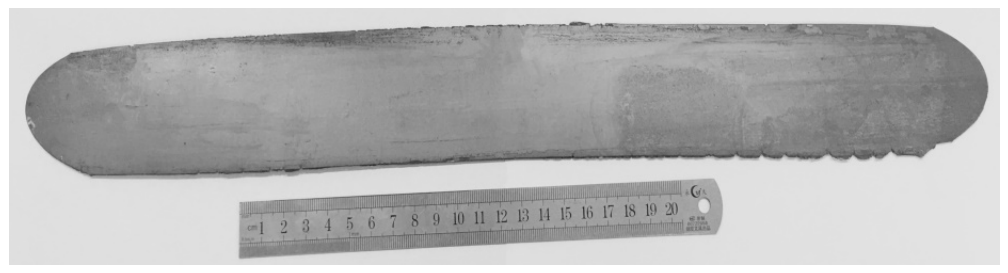
A 3 kg CoCrFeNiAl0.5Ti0.1 HEA ingot, with elemental purity exceeding 99.9%, was fabricated using the vacuum arc melting method four times. The alloy ingot was annealed at 1100 °C for 4 h. The hot rolling process was carried out at 900 °C, with a reduction ratio of approximately 80%, resulting in thin sheets with a thickness of 2 mm. Figure 1 illustrates the macroscopic morphology of the CoCrFeNiAl0.5Ti0.1 HEA sheets, indicating good quality of the sheets under high-temperature rolling conditions.

2.2. Methods

2.2.1. Microstructure

The thermal behavior of the as-rolled CoCrFeNiAl0.5Ti0.1 HEA was investigated using differential scanning calorimetry (DSC) (Q20, TA Instruments, New Castle, DE, USA) with a temperature range set from 25 °C to 1300 °C, maintaining a heating rate of 10 °C/min. The sample mass was approximately 10 mg. The phase structure of the CoCrFeNiAl0.5Ti0.1 HEA sheet was characterized by an X-ray diffractometer (XRD, Ultima-IV, Rigaku Corporation, Akishima, Tokyo, Japan) employing Cu-Kα radiation at a scan speed of 5°/min. Microstructural and fractographic analyses were performed utilizing a Zeiss Supra 55 scanning electron microscope (SEM, LEO1450, ZEISS, Beijing, China) at 20 keV, accompanied by energy-dispersive spectrometry (EDS, Oxford Instruments, Beijing, China). Detailed grain structures and phase distributions within the cross-sections of the rods were examined using electron backscatter diffraction (EBSD, Oxford Instruments NordlysMax2 detector, Beijing, China). The EBSD analysis was conducted with a step size of 0.2 μm. Transmission electron microscopy (TEM) analyses were conducted at 200 kV on a JEM2010 microscope (JEOL Ltd., Beijing, China). TEM samples were first mechanically ground to a thickness of 30 μm, then twin-jet electro-polished using a solution of HNO3:CH4O = 1:4. Quantitative analysis of the precipitation fraction was performed using image analysis software Image—Pro Plus 6.0.

2.2.2. Mechanical Properties Test

Sheet tensile specimens, 15 mm in gage length and 3 mm in width, were machined from sheets. These specimens were then polished using SiC paper up to 2000 grit. The mechanical properties of the samples were evaluated employing the MTS SANS CMT 5000 system, with tensile tests conducted at a strain rate of 1 × 10⁻³ s−1. Each test was replicated three times to ensure consistency.

3. Results

3.1. Microstructural Characterization

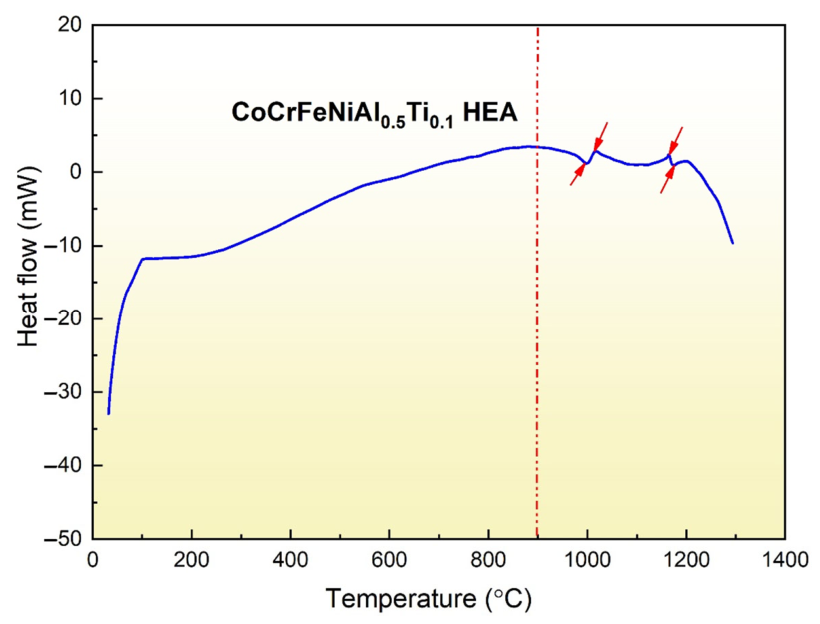
DSC analysis was conducted on the as-rolled CoCrFeNiAl0.5Ti0.1 sheets. As shown in Figure 2, when the heating temperature was below 900 °C, the phase structure of the HEA remained relatively stable without significant phase transformations. However, upon reaching temperatures of 900 °C and 1200 °C, exothermic and endothermic peaks appeared in the curve, indicating the formation and re-melting of new phases within the alloy at these temperatures. To further study the phase structure changes in the alloy at high temperatures, the alloy was subjected to various heat treatments, and its microstructures and mechanical properties were analyzed. Table 1 lists eight heat treatment processes for the as-rolled CoCrFeNiAl0.5Ti0.1 HEA thin sheets, which involved quenching after holding at temperatures ranging from 600 °C to 1300 °C for 1 h, as well as quenching after holding at 1300 °C for 1 h, followed by aging at 700 °C for 4 h. This process was done to analyze the evolution of the microstructure during the heat treatment and its effect on mechanical properties.
After hot rolling, the alloy sheets exhibited significant internal stress and high densities of dislocation tangles due to severe plastic deformation. To alleviate these defects and optimize the microstructure, a specific heat treatment followed by rapid quenching was designed. The heating process provided the necessary thermal activation energy to drive recovery, complete recrystallization, and induce the uniform precipitation of nanoscale strengthening phases, thereby effectively relieving the deformation-induced internal stress. Subsequently, the rapid quenching process was employed to freeze and retain this optimized high-temperature microstructure down to room temperature, preventing undesirable grain growth and suppressing the formation of detrimental brittle phases that typically occur during slow cooling.
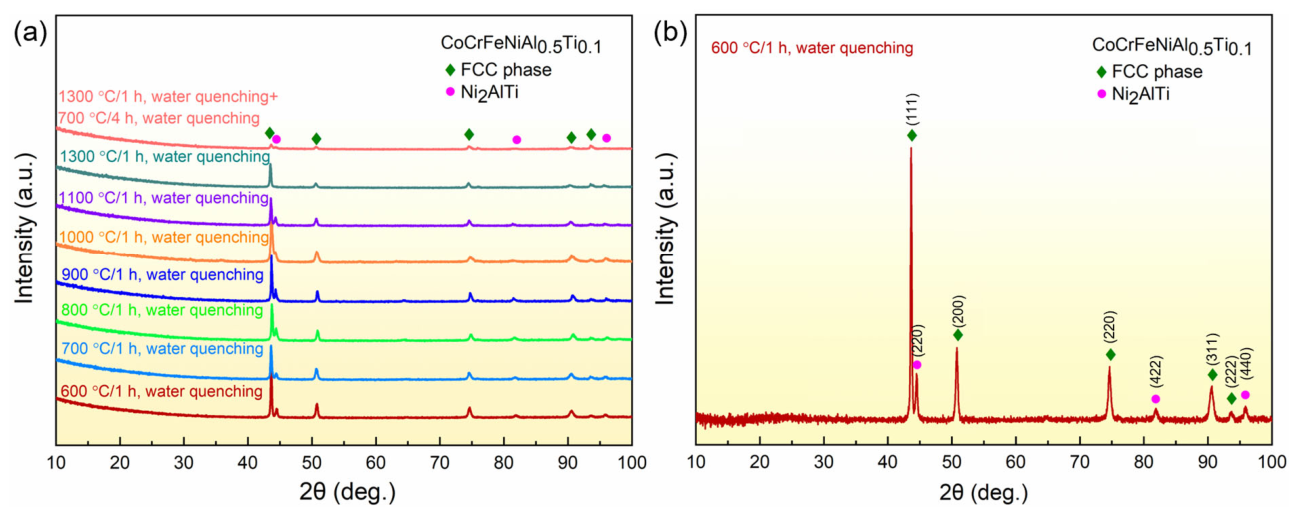
Figure 3 presents the XRD analysis of the CoCrFeNiAl0.5Ti0.1 HEA thin sheets after the heat treatment. The main phase structure of the alloy remained stable after various heat treatments, consisting primarily of an FCC matrix and a Ni2AlTi second phase. Additionally, the diffraction peaks corresponding to the Ni2AlTi phase exhibit relatively low intensities, which is attributable to the moderate total fraction of this second phase combined with peak-broadening effects associated with the fine nanoscale constituents. This stability could be attributed to the inherent high-temperature phase stability of HEAs. According to the Gibbs free-energy equation: ΔG = Hmix − TΔSmix, the competition between the mixing entropy and enthalpy leads to entropy dominance at higher temperatures, stabilizing the alloy’s phase structure.
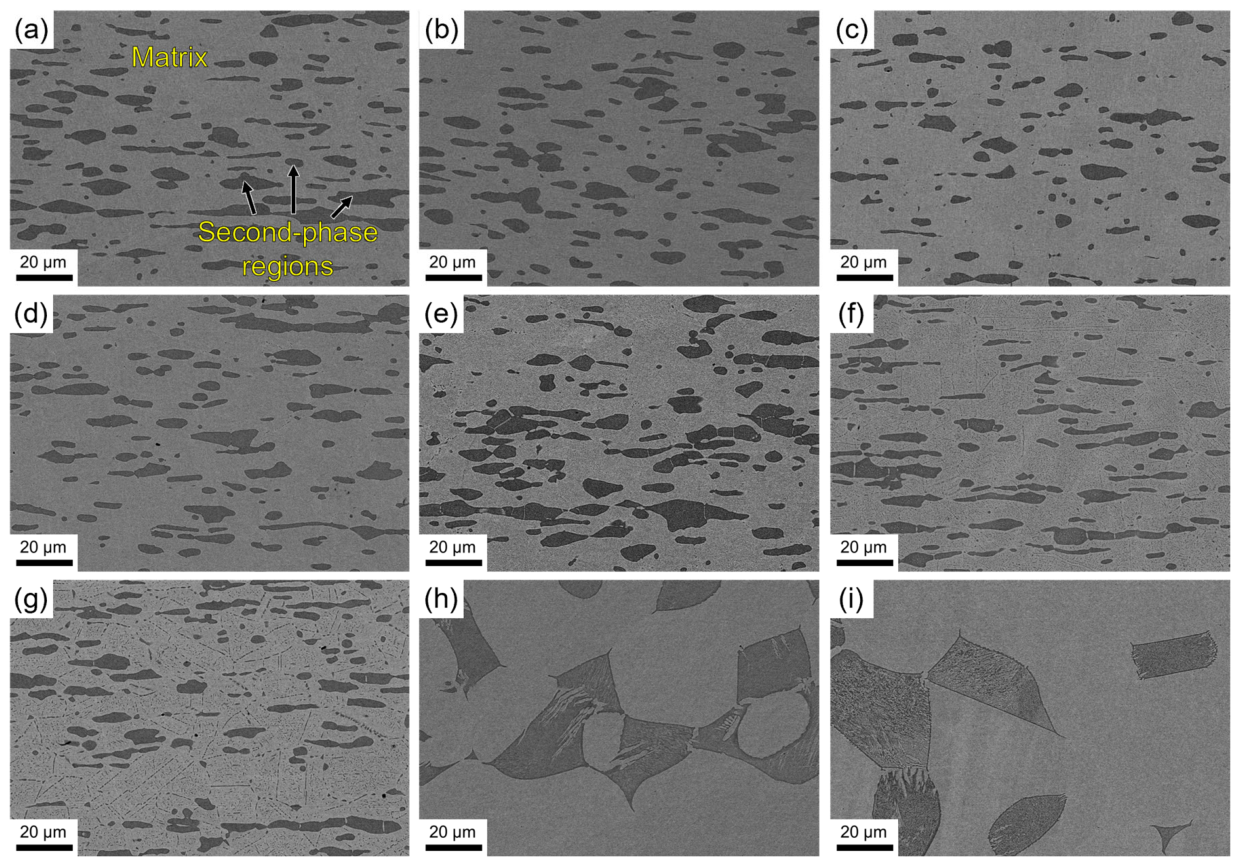
Subsequently, the microstructure evolution of the heat-treated CoCrFeNiAl0.5Ti0.1 HEA thin sheets was analyzed. As shown in Figure 4, the heat treatment temperatures significantly impacted the alloy’s microstructure. The microstructure of the as-rolled state [Figure 4a] and that of the samples annealed and water-quenched at 600 °C [Figure 4b], 700 °C [Figure 4c], and 800 °C [Figure 4d] showed minor differences, maintaining the primary dual-phase characteristics. However, when the annealing temperature exceeded 900 °C, the morphology of the bulky second-phase regions changed noticeably, and finer precipitates gradually appeared [Figure 4e,f]. It should be explicitly noted that these newly formed fine precipitates are the Ni2AlTi phase. At 1100 °C, short rod-shaped precipitates along the grain boundaries were evident [Figure 4g]. When the annealing temperature reached 1300 °C, driven by the high thermal energy approaching the solidus temperature, the phases underwent extensive thermodynamic equilibration and grain boundary migration. Crucially, because 1300 °C exceeds the solvus temperature of the fine matrix precipitates, the smaller Ni2AlTi particles completely dissolved back into the FCC matrix, while the remaining bulky Ni2AlTi regions coarsened and spheroidized to minimize interfacial energy, resulting in a distinct equiaxed two-phase structure [Figure 4h,i].
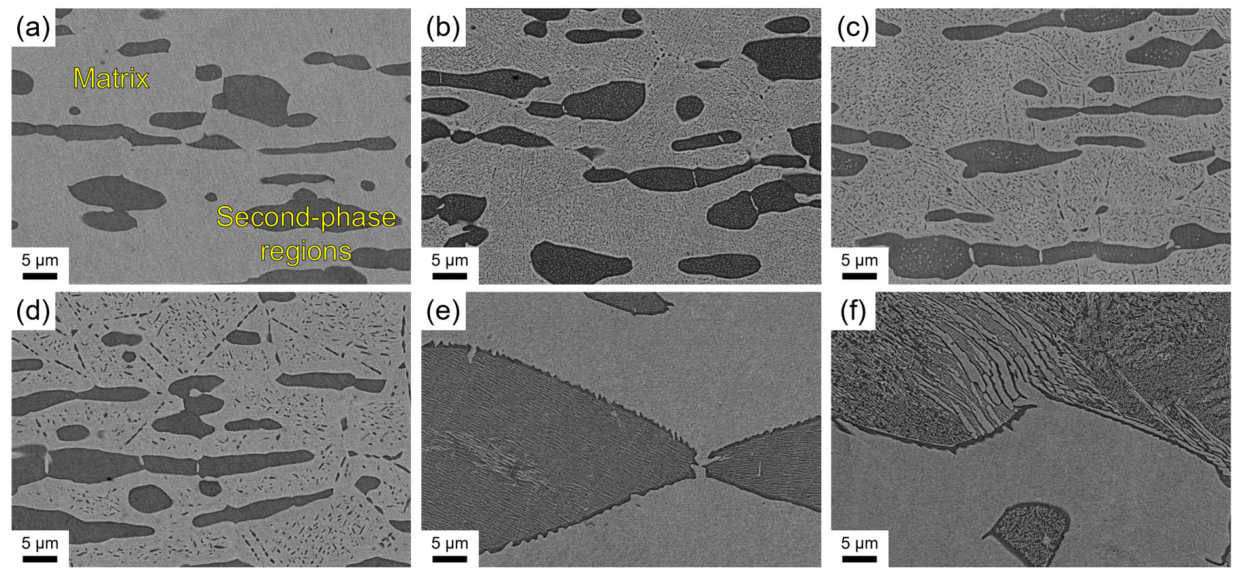
To elucidate these morphology changes, Figure 5 shows the high-magnification details: rolled state [Figure 5a], quenched at 900 °C [Figure 5b], 1000 °C [Figure 5c], 1100 °C [Figure 5d], 1300 °C [Figure 5e], and 1300 °C + 700 °C [Figure 5f]. Due to differences in the elemental content between the second-phase regions and the matrix, the contrast in the scanning images varied. The microstructure was divided into dark-gray and light-gray regions, as indicated by the yellow font in Figure 5a.
After annealing at 900 °C, small spherical Ni2AlTi precipitates formed uniformly within the light-gray matrix [Figure 5b]. Increasing the temperature to 1000 °C [Figure 5c] and 1100 °C [Figure 5d] caused these spherical precipitates to coarsen into short rod-shaped precipitates and distribute along the grain boundaries. Upon further increasing the temperature to 1300 °C [Figure 5e], the dispersed fine precipitates observed at 900–1100 °C completely disappeared due to dissolution into the matrix, leaving behind coarsened dark-gray Ni2AlTi and light-gray FCC equiaxed grains. Meanwhile, minor amounts of light-gray precipitates appeared inside the dark-gray regions. This occurs because the Ni2AlTi phase becomes supersaturated with matrix elements at 1300 °C; upon cooling, the solubility decreases, driving the secondary precipitation of the FCC phase. For samples annealed at 1300 °C and subsequently aged at 700 °C for 4 h [Figure 5f], this precipitation is significantly intensified, developing into a distinct stripe-like structure. The 700 °C aging treatment provided sufficient thermal activation for these secondary light-gray lamellae to grow and coarsen within the dark-gray Ni2AlTi regions.
The evolution of the precipitates in Figure 5 indicates their sensitivity to the heat- treatment temperature. With increasing temperature, the precipitates in the light-gray regions exhibited a slight growth trend, and the short rod-shaped precipitates became more evident. As the temperature and holding time increased, new light-gray precipitates gradually formed within the dark-gray regions.
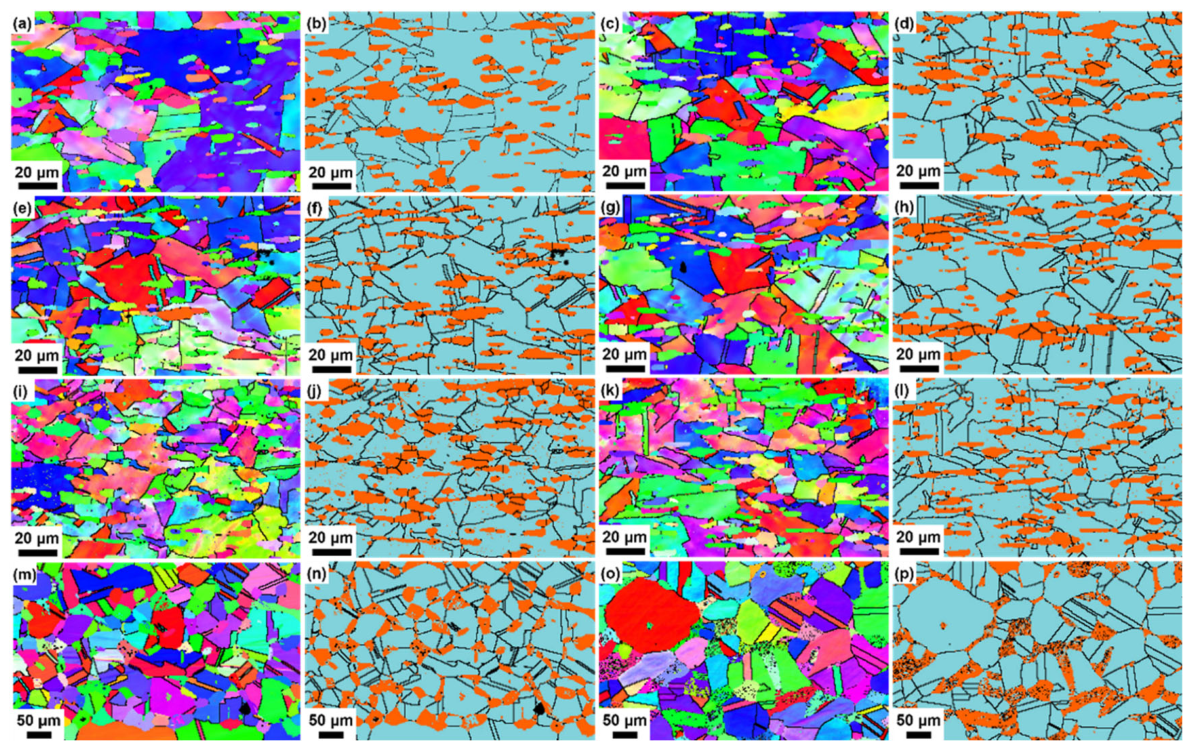
Figure 6 shows the IPF maps and phase structures of the CoCrFeNiAl0.5Ti0.1 HEA under different conditions. In the as-rolled state, both work hardening and dynamic softening occurred during the severe hot rolling deformation, leading to a partially deformed matrix containing some dynamically recrystallized grains. Following the heat treatments (from 700 °C to 1100 °C), the microstructures underwent complete static recrystallization, exhibiting fully recrystallized grains. In addition, the formation of numerous annealing twins and ellipsoidal precipitates occurred both at the grain boundaries and within the grains. As the heat treatment temperature increased from 700 °C to 1100 °C, the size and structure of the precipitates remained relatively unchanged, indicating their good structural and thermal stability. This characteristic makes the alloy suitable for high-temperature applications.
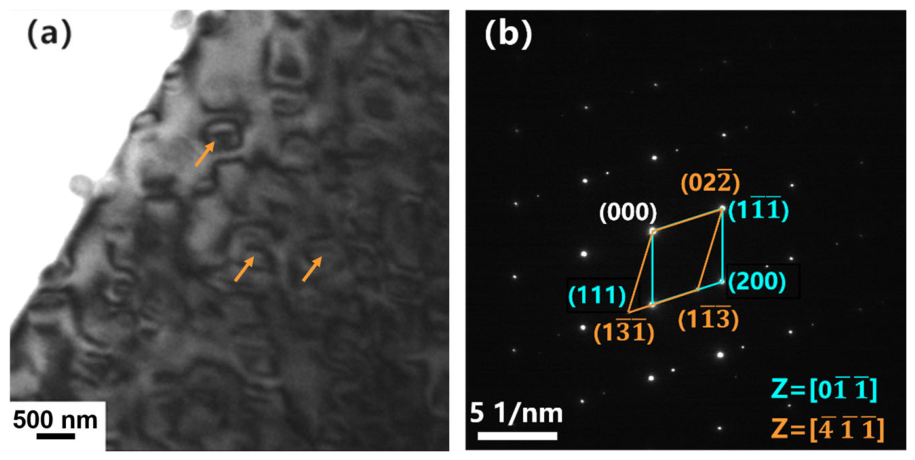
Figure 7 presents the microstructural morphology and diffraction patterns of the as-rolled CoCrFeNiAl0.5Ti0.1 alloy. In Figure 7a, apart from the bulky primary phases discussed earlier, the FCC matrix also contains some finely distributed nanoscale Ni2AlTi precipitates. These fine particles are believed to have dynamically precipitated during the high-temperature hot rolling process. Figure 7b shows diffraction spots for both the matrix (blue) and the Ni2AlTi precipitates (orange), confirming the coexistence of distinct phases with different crystallographic orientations. These dispersed Ni2AlTi precipitates play a vital role in precipitation hardening, effectively hindering dislocation movement during deformation, thereby significantly enhancing the macroscopic strength of the alloy.

3.2. Tensile Properties

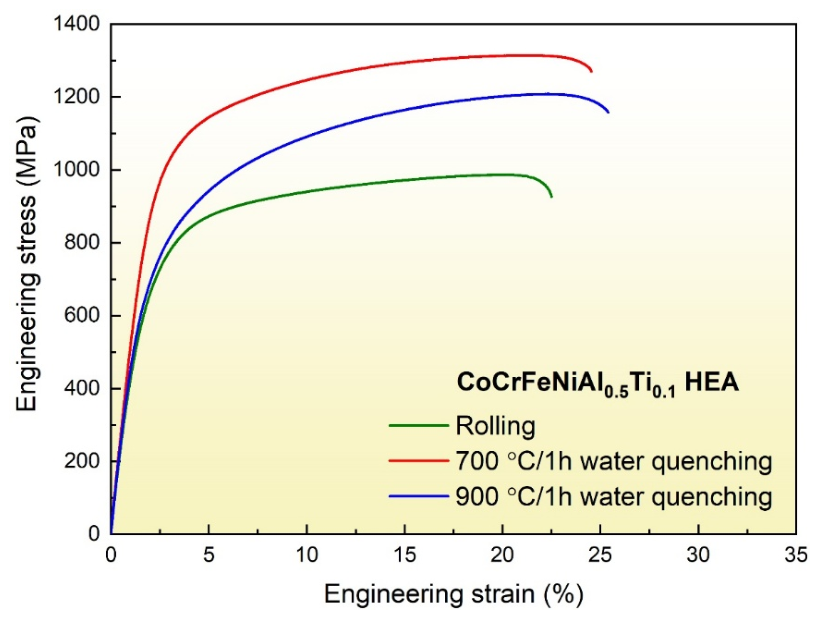
After quenching at 700 °C and 900 °C, the tensile and yield strengths of the as-rolled CoCrFeNiAl0.5Ti0.1 HEA are significantly improved, along with a certain degree of improvement in plasticity (Figure 8). This trend indicates that the heat treatment process not only reduces the internal stress of the rolled alloy but also causes changes in the size of the precipitates. The precipitate strengthening effect results in a marked increase in the alloy’s strength. To ensure data reliability, each mechanical property was evaluated using at least three independent samples, and the average values along with standard deviations are presented as measurement errors. The specific values of the tensile strength, yield strength, and elongation after fracture are listed in Table 2.

4. Discussion

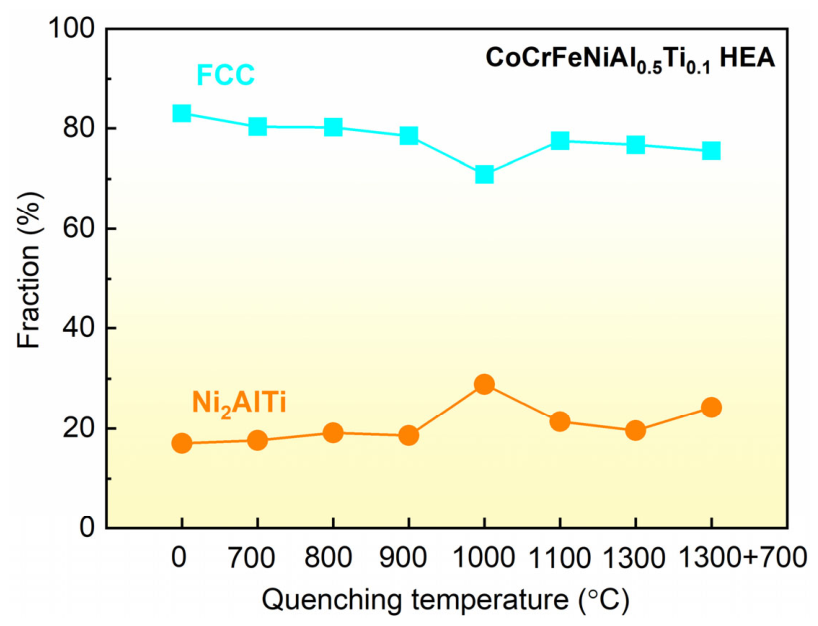
To study the coarsening kinetics of the precipitates and their impact on the alloy’s microstructure and performance, Figure 9 summarizes the phase-content changes in the CoCrFeNiAl0.5Ti0.1 HEA after heat treatment. As the heat treatment temperature increased from 700 °C to 900 °C, the total content of precipitates remained relatively constant, indicating that the precipitates had undergone nucleation and coarsening stages and reached an equilibrium volume fraction. When the temperature exceeded 1000 °C, the precipitate content showed a slight increase.
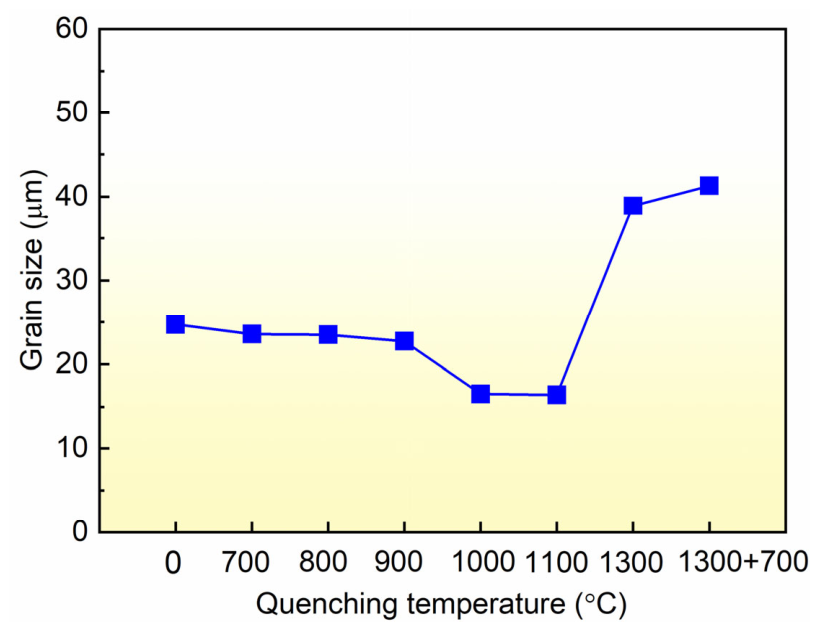
Figure 10 presents the grain size changes in the CoCrFeNiAl0.5Ti0.1 HEA after heat treatment. The grain size changes occurred in two stages. From 700 °C to 1100 °C, the average grain size decreased slightly due to static recrystallization, with a higher density of recrystallization nucleation with increasing temperature within the alloy. When the heat treatment temperature increased to 1300 °C, the grain size significantly increased, with an average size of approximately 40 μm. Table 3 lists the specific values of grain size and phase content after heat treatment.
Compared to the as-rolled CoCrFeNiAl0.5Ti0.1 HEA before heat treatment, the overall mechanical properties of the alloy after heat treatment exhibit significant improvement, characterized by an effective combination of plasticity and strength. Specifically, the yield strength, tensile strength, and elongation of the alloy are markedly enhanced. This improvement is primarily due to the large amount of internal stresses generated during the rolling process, which are released during the heat treatment. Notably, the sample annealed at 700 °C exhibits the peak strength. This exceptional strengthening effect is likely related to the formation of a high density of nanoscale Ni2AlTi precipitates at this temperature, a phenomenon that has been widely observed and verified in similar CoCrFeNi-based HEA systems under comparable annealing conditions [41,42]. However, as the annealing temperature increases to 900 °C, these precipitates undergo significant coarsening and partial dissolution. This morphological evolution increases the inter-particle spacing, thereby drastically weakening the Orowan strengthening mechanism. Consequently, the overall hardness and strength decrease. Both the 700 °C and 900 °C samples possess a fully recrystallized FCC matrix, which inherently provides a high baseline ductility. Although the weakened precipitation strengthening at 900 °C softens the matrix, the coarsened precipitates can act as potential sites for localized stress concentration and micro-crack initiation during tensile deformation. This localized damage effect effectively compromises any further gain in overall ductility.
The mechanical performance of the CoCrFeNiAl0.5Ti0.1 HEA after the 700 °C annealing process and quenching treatment demonstrates a compelling advantage when compared to previously published works on similar HEA systems [17,43]. Conventional CoCrFeNi-based HEAs typically face a severe strength-ductility trade-off, where precipitation hardening significantly sacrifices matrix ductility [44]. In the present study, the post-rolling heat treatment increases the yield strength while retaining tensile elongation relative to the as-rolled condition. These results suggest that balancing matrix recrystallization with Ni2AlTi precipitation is a promising strategy for improving strength while preserving ductility.
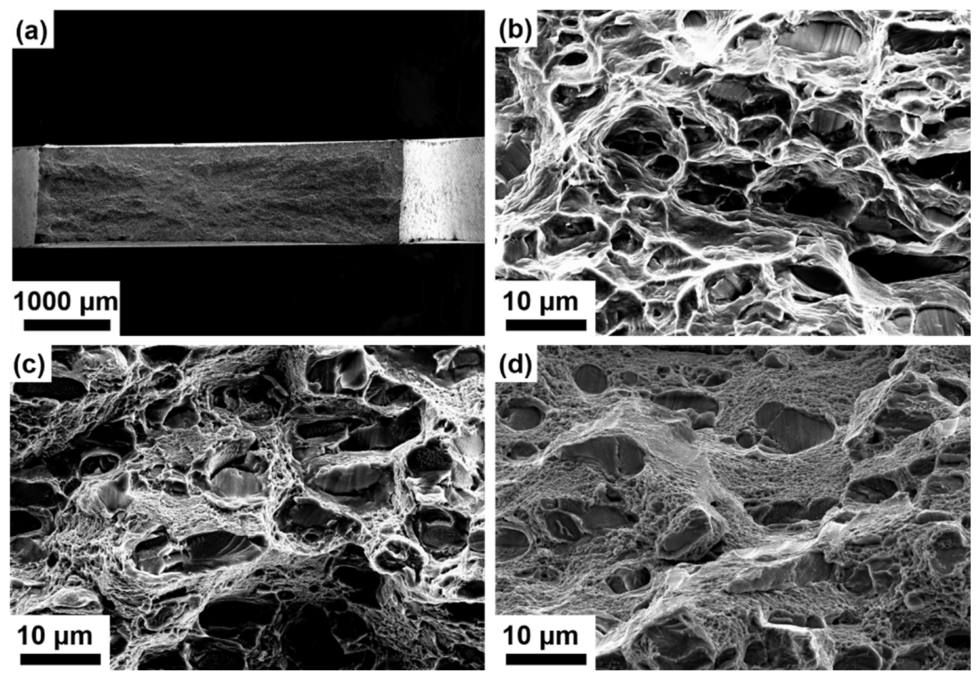
Figure 11a presents the macroscopic morphology of the tensile fracture of the CoCrFeNiAl0.5Ti0.1 HEA after heat treatment, indicating a typical ductile fracture with some degree of necking. Figure 11b illustrates the tensile fracture of the as-rolled alloy, where large dimples are observed on the fracture surface. Additionally, transgranular fracture is noted within the bulky primary second-phase regions, highlighting the higher brittleness of these primary phases compared to the FCC matrix. Figure 11c shows the tensile fracture of the alloy annealed at 700 °C for 1 h followed by quenching, where the dimples are deeper than those of the as-rolled alloy. Finer dimples are distributed along the tear ridges, indicating that the fracture surface of the alloy after heat treatment requires more fracture energy, thus improving plasticity. Figure 11d displays the tensile fracture of the CoCrFeNiAl0.5Ti0.1 HEA annealed at 900 °C for 1 h, where the dimples are smaller and shallower, with the precipitates still undergoing typical transgranular fracture. This morphological feature at 900 °C corroborates the mechanical analysis: the coarsened precipitates are more prone to cracking and acting as micro-void initiators during tensile deformation, which triggers early local failure and restricts the macroscopic elongation from further increasing. Overall, the strength and plasticity of the alloy treated at 900 °C are superior to those of the as-rolled state, although inferior to the alloy treated at 700 °C.

5. Conclusions

The microstructures and mechanical properties of the CoCrFeNiAl0.5Ti0.1 HEA in both as-rolled and heat-treated states were systematically studied in this paper. The conclusions drawn are described as follows:
(1)
The phase structure of the CoCrFeNaAl0.5Ti0.1 HEA, in both the as-rolled and heat-treated states, is relatively stable, consisting mainly of an FCC matrix and a Ni2AlTi phase, in the form of a Ni2AlTi bulky phase and fine Ni2AlTi precipitates.
(2)
Annealing at 700 °C promotes a dense distribution of nanoscale precipitates. At 900–1100 °C, these precipitates significantly coarsen and form short rod-like structures along grain boundaries. When the temperature reaches 1300 °C, the alloy evolves into a completely equiaxed two-phase structure, accompanied by the secondary precipitation of lamellar FCC phases within the Ni2AlTi grains during subsequent cooling or aging.
(3)
Compared to the as-rolled state, the alloy achieves a simultaneous enhancement of both tensile strength and plasticity after annealing at 700 °C and 900 °C followed by water quenching. The peak mechanical performance is obtained at 700 °C, exhibiting the most effective combination of yield strength, ultimate tensile strength, and elongation.

Author Contributions

Conceptualization, D.L. and W.W.; methodology, D.L.; software, J.Q. and D.L.; validation, J.Q., D.L. and L.X.; formal analysis, D.L. and L.X.; investigation, J.Q. and D.L.; resources, D.L.; data curation, J.Q. and D.L.; writing—original draft preparation, J.Q.; writing—review and editing, D.L. and W.W.; visualization, J.Q.; supervision, W.W.; project administration, W.W.; funding acquisition, W.W. All authors have read and agreed to the published version of the manuscript.

Funding

This research was funded by the National Natural Science Foundation of China, grant number of 52101189; China Postdoctoral Science Foundation, grant number of 2020M680343 and the Fundamental Research Funds for the Central Universities, grant number of FRF-TP-20-050A1.

Data Availability Statement

The original contributions presented in the study are included in the article, further inquiries can be directed to the corresponding authors.

Conflicts of Interest

The authors have no conflicts of interest to declare that are relevant to the content of this article.

References

  1. George, E.P.; Raabe, D.; Ritchie, R.O. High-entropy alloys. Nat. Rev. Mater. 2019, 4, 515–534. [Google Scholar]
  2. Li, W.; Xie, D.; Li, D.; Zhang, Y.; Gao, Y.; Liaw, P.K. Mechanical behavior of high-entropy alloys. Prog. Mater. Sci. 2021, 118, 100777. [Google Scholar] [CrossRef] [Scilit]
  3. Liu, X.; Zhang, J.; Pei, Z. Machine learning for high-entropy alloys: Progress, challenges and opportunities. Prog. Mater. Sci. 2023, 131, 101018. [Google Scholar] [CrossRef] [Scilit]
  4. Li, D.; Liaw, P.K.; Xie, L.; Zhang, Y.; Wang, W. Advanced high-entropy alloys breaking the property limits of current materials. J. Mater. Sci. Technol. 2024, 186, 219–230. [Google Scholar] [CrossRef] [Scilit]
  5. Tang, Y.; Wang, R.; Xiao, B.; Zhang, Z.; Li, S.; Qiao, J.; Bai, S.; Zhang, Y.; Liaw, P.K. A review on the dynamic-mechanical behaviors of high-entropy alloys. Prog. Mater. Sci. 2023, 135, 101090. [Google Scholar] [CrossRef] [Scilit]
  6. Murty, B.S.; Ranganathan, S.; Yeh, J.W.; Bhattacharjee, P.P. High-Entropy Alloys; Elsevier: Amsterdam, The Netherlands, 2019. [Google Scholar]
  7. Chang, X.; Zeng, M.; Liu, K.; Fu, L. Phase engineering of high-entropy alloys. Adv. Mater. 2020, 32, 1907226. [Google Scholar] [CrossRef] [Scilit]
  8. Ren, J.; Zhang, Y.; Zhao, D.; Chen, Y.; Guan, S.; Liu, Y.; Liu, L.; Peng, S.; Kong, F.; Poplawsky, J.D.; et al. Strong yet ductile nanolamellar high-entropy alloys by additive manufacturing. Nature 2022, 608, 62–68. [Google Scholar] [CrossRef] [Scilit]
  9. Chen, Y.; Fang, Y.; Wang, R.; Tang, Y.; Bai, S.; Yu, Q. Achieving high strength and ductility in high-entropy alloys via spinodal decomposition-induced compositional heterogeneity. J. Mater. Sci. Technol. 2023, 141, 149–154. [Google Scholar] [CrossRef] [Scilit]
  10. Liu, L.; Zhang, Y.; Han, J.; Wang, X.; Jiang, W.; Liu, C.; Zhang, Z.; Liaw, P.K. Nanoprecipitate-strengthened high-entropy alloys. Adv. Sci. 2021, 8, 2100870. [Google Scholar] [CrossRef] [Scilit]
  11. Zhu, Z.; Wang, M.; He, T.; Li, T.; Di, Y.; Yan, H.; Zhang, Y.; Lu, Y. Ultrastrong High-Ductility Ni35Co35Fe10Al10Ti8B2 High-Entropy Alloy Strengthened with Super-High Concentration L12 Precipitates. Adv. Eng. Mater. 2023, 25, 2300689. [Google Scholar] [CrossRef] [Scilit]
  12. Xiong, T.; Zheng, S.; Pang, J.; Ma, X. High-strength and high-ductility AlCoCrFeNi2.1 eutectic high-entropy alloy achieved via precipitation strengthening in a heterogeneous structure. Scr. Mater. 2020, 186, 336–340. [Google Scholar] [CrossRef] [Scilit]
  13. Chen, H.; Lu, T.; Wang, Y.; Liu, Y.; Shi, T.; Prashanth, K.G.; Kosiba, K. Laser additive manufacturing of nano-TiC particles reinforced CoCrFeMnNi high-entropy alloy matrix composites with high strength and ductility. Mater. Sci. Eng. A 2022, 833, 142512. [Google Scholar] [CrossRef] [Scilit]
  14. Liu, D.; Yu, Q.; Kabra, S.; Jiang, M.; Forna-Kreutzer, P.; Zhang, R.; Payne, M.; Walsh, F.; Gludovatz, B.; Asta, M.; et al. Exceptional fracture toughness of CrCoNi-based medium-and high-entropy alloys at 20 kelvin. Science 2022, 378, 978–983. [Google Scholar] [CrossRef] [Scilit]
  15. Fan, X.; Qu, R.; Zhang, Z. Remarkably high fracture toughness of HfNbTaTiZr refractory high-entropy alloy. J. Mater. Sci. Technol. 2022, 123, 70–77. [Google Scholar] [CrossRef] [Scilit]
  16. Li, D.; Wu, C.; Xie, L.; Zhang, Y.; Liaw, P.K.; Wang, W. Improving tensile and impact properties of Fe50Mn30Co10Cr10 high entropy alloy via microstructural engineering. Intermetallics 2024, 170, 108314. [Google Scholar] [CrossRef] [Scilit]
  17. Li, D.; Wu, C.; Liaw, P.K.; Xie, L.; Zhang, Y.; Wang, W. Microstructure and mechanical properties of CoCrFeNiAl0.5Ti0.1 high entropy alloy rod. Mater. Sci. Eng. A 2024, 913, 147015. [Google Scholar] [CrossRef] [Scilit]
  18. Jiang, S.; Lin, Z.; Xu, H.; Sun, Y. Studies on the microstructure and properties of AlxCoCrFeNiTi1−x high entropy alloys. J. Alloys Compd. 2018, 741, 826–833. [Google Scholar] [CrossRef] [Scilit]
  19. Shahmir, H.; Nili-Ahmadabadi, M.; Shafiee, A.; Andrzejczuk, M.; Lewandowska, M.; Langdon, T.G. Effect of Ti on phase stability and strengthening mechanisms of a nanocrystalline CoCrFeMnNi high-entropy alloy. Mater. Sci. Eng. A 2018, 725, 196–206. [Google Scholar] [CrossRef] [Scilit]
  20. Löbel, M.; Lindner, T.; Mehner, T.; Lampke, T. Influence of Titanium on Microstructure, Phase Formation and Wear Behaviour of AlCoCrFeNiTix High-Entropy Alloy. Entropy 2018, 20, 505. [Google Scholar] [CrossRef] [Scilit]
  21. Wang, Y.; Chan, K. A super strong high entropy alloy with discontinuous precipitation and fine grains by additive manufacturing and thermomechanical treatment. Mater. Sci. Eng. A 2023, 876, 145164. [Google Scholar] [CrossRef] [Scilit]
  22. Zhou, J.; Liao, H.; Chen, H.; Huang, A. Effects of hot-forging and subsequent annealing on microstructure and mechanical behaviors of Fe35Ni35Cr20Mn10 high-entropy alloy. Mater. Charact. 2021, 178, 111251. [Google Scholar] [CrossRef] [Scilit]
  23. Sajadi, S.A.; Toroghinejad, M.R.; Rezaeian, A.; Wu, Z. Effect of annealing treatment on microstructural and mechanical properties of a hot-forged FeCrCuMn2Ni2 high-entropy alloy. Materialia 2022, 26, 101618. [Google Scholar] [CrossRef] [Scilit]
  24. Sourav, A.; Yebaji, S.; Thangaraju, S. Structure-property relationships in hot forged AlxCoCrFeNi high entropy alloys. Mater. Sci. Eng. A 2020, 793, 139877. [Google Scholar] [CrossRef] [Scilit]
  25. Zou, Y.; Li, S.; Liu, S.; Li, J.; Li, Y. Improved mechanical and corrosion properties of CrMnFeCoNi high entropy alloy with cold rolling and post deformation annealing process. J. Alloys Compd. 2021, 887, 161416. [Google Scholar] [CrossRef] [Scilit]
  26. Semenyuk, A.; Klimova, M.; Shaysultanov, D.; Salishchev, G.; Zherebtsov, S.; Stepanov, N. Effect of nitrogen on microstructure and mechanical properties of the CoCrFeMnNi high-entropy alloy after cold rolling and subsequent annealing. J. Alloys Compd. 2021, 888, 161452. [Google Scholar] [CrossRef] [Scilit]
  27. Hou, J.; Qiao, J.; Lian, J.; Liaw, P.K. Revealing the relationship between microstructures, textures, and mechanical behaviors of cold-rolled Al0.1CoCrFeNi high-entropy alloys. Mater. Sci. Eng. A 2021, 804, 140752. [Google Scholar] [CrossRef] [Scilit]
  28. Ma, Z.; Zhang, W.; Zhao, H.; Lu, F.; Zhang, Z.; Zhou, L.; Ren, L. Enhanced strength and slightly reduced ductility in a high entropy alloy via cold rolling and annealing. J. Alloys Compd. 2020, 817, 152709. [Google Scholar] [CrossRef] [Scilit]
  29. Zhang, X.; Liu, L.; Yao, K.; Duan, K.; Wu, F.; Zhao, R.; Zhang, Y.; Shang, J.; Chen, M. The phase composition characteristics of AlCoCrFeNi high entropy alloy heat-treated by simple normalizing treatment and its effects on mechanical properties. J. Alloys Compd. 2022, 926, 166896. [Google Scholar] [CrossRef] [Scilit]
  30. Guo, W.; Li, J.; Qi, M.; Xu, Y.; Ezatpour, H.R. Effects of heat treatment on the microstructure, mechanical properties and corrosion resistance of AlCoCrFeNiTi0.5 high-entropy alloy. J. Alloys Compd. 2021, 884, 161026. [Google Scholar] [CrossRef] [Scilit]
  31. Peng, P.; Feng, X.; Li, S.; Wei, B.; Zhang, M.; Xu, Y.; Zhang, X.; Ma, Z.; Wang, J. Effect of heat treatment on microstructure and mechanical properties of as-cast AlCoCrFeNi2.1 eutectic high entropy alloy. J. Alloys Compd. 2023, 939, 168843. [Google Scholar] [CrossRef] [Scilit]
  32. Tanimoto, H.; Hozumi, R.; Kawamura, M. Electrical resistivity and short-range order in rapid-quenched CrMnFeCoNi high-entropy alloy. J. Alloys Compd. 2022, 896, 163059. [Google Scholar] [CrossRef] [Scilit]
  33. Yin, Y.; Chen, Z.; Mo, N.; Kent, D.; Candella, A.R.; Koey, K.E.; Tan, Q.; Bermingham, M.; Zhang, M.-X. High-temperature age-hardening of a novel cost-effective Fe45Ni25Cr25Mo5 high entropy alloy. Mater. Sci. Eng. A 2020, 788, 139580. [Google Scholar] [CrossRef] [Scilit]
  34. Zheng, T.; Hu, X.; He, F.; Wu, Q.; Han, B.; Chen, D.; Li, J.; Wang, Z.; Wang, J.; Kai, J.-J.; et al. Tailoring nanoprecipitates for ultra-strong high-entropy alloys via machine learning and prestrain aging. J. Mater. Sci. Technol. 2021, 69, 156–167. [Google Scholar] [CrossRef] [Scilit]
  35. Nandal, V.; Hariharan, K.; Sarvesha, R.; Singh, S.S.; Huang, E.-W.; Chang, Y.-J.; Yeh, A.-C.; Neelakantan, S.; Jain, J. Aging temperature role on precipitation hardening in a non-equiatomic AlCoCrFeNiTi high-entropy alloy. Mater. Sci. Technol. 2021, 37, 1270–1279. [Google Scholar] [CrossRef] [Scilit]
  36. Li, D.; Gao, M.C.; Hawk, J.A.; Zhang, Y. Annealing effect for the Al0.3CoCrFeNi high-entropy alloy fibers. J. Alloys Compd. 2019, 778, 23–29. [Google Scholar] [CrossRef] [Scilit]
  37. Gu, J.; Song, M. Annealing-induced abnormal hardening in a cold rolled CrMnFeCoNi high entropy alloy. Scr. Mater. 2019, 162, 345–349. [Google Scholar] [CrossRef] [Scilit]
  38. Wang, P.; Chen, J.; Sun, B.; Zhu, D.; Cao, Y. Effects of annealing process parameters on microstructural evolution and strength-ductility combination of CoCrFeMnNi high-entropy alloy. Mater. Sci. Eng. A 2022, 840, 142880. [Google Scholar] [CrossRef] [Scilit]
  39. Zhao, Y.; Chen, Z.; Yan, K.; Le, W.; Naseem, S. Effects of aging treatment on the evolution of precipitated phase in CoCrFeNiTi0.6 high entropy alloys. J. Alloys Compd. 2021, 887, 161407. [Google Scholar] [CrossRef] [Scilit]
  40. He, Y.; Yang, H.; Zhao, C.; Zhang, Y.; Pan, X.; Li, J.; Wang, J. Enhancing mechanical properties of Al0.25CoCrFeNi high-entropy alloy via cold rolling and subsequent annealing. J. Alloys Compd. 2020, 830, 154645. [Google Scholar] [CrossRef] [Scilit]
  41. Park, K.; Iftikhar, H.; Shin, S.; Jung, Y.; Lee, K.; Lee, C.; Song, G. Balanced mechanical properties of Al0.5CoCrFeNiTi0.1 high entropy alloy under extreme environments from cryogenic temperature to 800 °C. J. Alloys Compd. 2025, 1010, 178199. [Google Scholar] [CrossRef] [Scilit]
  42. Biermair, F.; Mendez-Martin, F.; Razumovskiy, V.I.; Moitzi, F.; Ressel, G. Microstructure-Property Correlation and Its Evolution during Aging in an Al4.4Co26Cr19Fe18Ni27Ti5.6 High-Entropy Alloy. Materials 2023, 16, 2821. [Google Scholar] [CrossRef] [Scilit]
  43. Gwalani, B.; Gorsse, S.; Soni, V.; Carl, M.; Ley, N.; Smith, J.; Ayyagari, A.V.; Zheng, Y.; Young, M.; Mishra, R.S.; et al. Role of copper on L12 precipitation strengthened fcc based high entropy alloy. Materialia 2019, 6, 100282. [Google Scholar] [CrossRef] [Scilit]
  44. He, J.Y.; Wang, H.; Wu, Y.; Liu, X.; Mao, H.; Nieh, T.; Lu, Z. Precipitation behavior and its effects on tensile properties of FeCoNiCr high-entropy alloys. Intermetallics 2016, 79, 41–52. [Google Scholar] [CrossRef] [Scilit]
Figure 1. Macroscopic morphology of the CoCrFeNiAl0.5Ti0.1 HEA sheet.
Metals 16 01074 g001
Figure 2. DSC analysis of the as-rolled CoCrFeNiAl0.5Ti0.1 HEA.
Metals 16 01074 g002
Figure 3. X-ray diffraction patterns of the CoCrFeNiAl0.5Ti0.1 HEA after heat treatment: (a) overall XRD patterns from 20° to 100°, (b) the magnified view.
Metals 16 01074 g003
Figure 4. Low-magnification SEM images of CoCrFeNiAl0.5Ti0.1 HEA after heat treatment. (a) Microstructures of the as-rolled alloy; (b–h) represent the microstructures after holding at 600 °C, 700 °C, 800 °C, 900 °C, 1000 °C, 1100 °C, and 1300 °C for 1 h, followed by water quenching; (i) microstructure after holding at 1300 °C for 1 h, followed by water quenching and subsequently holding at 700 °C for 4 h, followed by water quenching.
Metals 16 01074 g004
Figure 5. Magnified microstructure of the CoCrFeNiAl0.5Ti0.1 HEA after heat treatment. (a) Magnified microstructure of the as-rolled alloy; (b–e) represent the magnified microstructures after holding at 900 °C, 1000 °C, 1100 °C, and 1300 °C for 1 h, respectively, followed by water quenching; (f) magnified microstructure after holding at 1300 °C for 1 h, followed by water quenching and subsequently holding at 700 °C for 4 h, followed by water quenching.
Metals 16 01074 g005
Figure 6. IPF and phase structure diagrams of the heat-treated rolled CoCrFeNiAl0.5Ti0.1 HEA. (a,b) represent the as-rolled state; (c,d) after holding at 700 °C for 1 h, followed by water quenching; (e,f) after holding at 800 °C for 1 h, followed by water quenching; (g,h) after holding at 900 °C for 1 h, followed by water quenching; (i,j) after holding at 1000 °C for 1 h, followed by water quenching; (k,l) after holding at 1100 °C for 1 h, followed by water quenching; (m,n) after holding at 1300 °C for 1 h, followed by water quenching; (o,p) after holding at 1300 °C for 1 h, followed by water quenching and subsequently holding at 700 °C for 4 h, followed by water quenching. The black lines indicate high-angle grain boundaries with misorientation angles greater than 15°. In the phase structure diagrams, the cyan color represents the FCC matrix, and the orange color represents the Ni2AlTi phase.
Metals 16 01074 g006
Figure 7. TEM of the as-rolled CoCrFeNiAl0.5Ti0.1 alloy: (a) morphology; (b) SAED pattern. The orange arrow represents the Ni2AlTi phase.
Metals 16 01074 g007
Figure 8. Tensile properties of the CoCrFeNiAl0.5Ti0.1 HEA after heat treatment.
Metals 16 01074 g008
Figure 9. Phase content changes in the CoCrFeNiAl0.5Ti0.1 HEA after heat treatment.
Metals 16 01074 g009
Figure 10. Grain size changes in CoCrFeNiAl0.5Ti0.1 HEA after heat treatment.
Metals 16 01074 g010
Figure 11. Illustration of the tensile fractures of the CoCrFeNiAl0.5Ti0.1 HEA after heat treatment: (a) macroscopic morphology of the fracture; (b) tensile fracture of the as-rolled alloy; (c) tensile fracture after quenching at 700 °C; and (d) tensile fracture after quenching at 900 °C.
Metals 16 01074 g011
Table 1. Heat treatment processes for as-rolled CoCrFeNiAl0.5Ti0.1 HEA thin sheets.
No.Heat Treatment Temperature (°C)Holding Time (h)Cooling Method
16001water quenching
27001water quenching
38001water quenching
49001water quenching
510001water quenching
611001water quenching
713001water quenching
81300 + 7001 + 4water quenching
Table 2. The tensile strength, yield strength, and elongation of the CoCrFeNiAl0.5Ti0.1 HEA after heat treatment.
Alloy StateTensile Strength (MPa)Yield Strength (MPa)Elongation (%)
As-rolled987 ± 12769 ± 720.2 ± 3.4
700 °C/1 h/water quenching1314 ± 15970 ± 1220.3 ± 3.9
900 °C/1 h/water quenching1208 ± 14727 ± 1318.3 ± 2.5
Table 3. Grain size and phase content of the CoCrFeNiAl0.5Ti0.1 HEA after heat treatment.
Alloy StateGrain Size (μm)FCC (%)Ni2AlTi (%)
As-rolled24.78317
700 °C/1 h Quench23.680.317.6
800 °C/1 h water quenching23.580.219.1
900 °C/1 h water quenching22.778.518.6
1000 °C/1 h water quenching16.570.928.9
1100 °C/1 h water quenching1677.521.4
1300 °C/1 h water quenching38.976.719.6
1300 °C/1 h water quenching +700 °C/4 h water quenching41.375.524.3
Disclaimer/Publisher’s Note: The statements, opinions and data contained in all publications are solely those of the individual author(s) and contributor(s) and not of MDPI and/or the editor(s). MDPI and/or the editor(s) disclaim responsibility for any injury to people or property resulting from any ideas, methods, instructions or products referred to in the content.