Article

Data-Driven Method for Predicting S-N Curve Based on Structurally Sensitive Fatigue Parameters

1
Department of Applied Mathematics, Nizhny Novgorod State Technical University n.a. R.E. Alekseev, 603155 Nizhny Novgorod, Russia
2
Department of Nuclear Energy and Technical Physics, Nizhny Novgorod State Technical University n.a. R.E. Alekseev, 603155 Nizhny Novgorod, Russia
*
Author to whom correspondence should be addressed.
Metals 2025, 15(12), 1384; https://doi.org/10.3390/met15121384
Submission received: 10 November 2025 / Revised: 9 December 2025 / Accepted: 15 December 2025 / Published: 17 December 2025

Abstract

Under cyclic loading, almost immediately after its onset, a surface layer forms where hardening and softening processes occur. The interaction of plastic deformation traces with each other, and with other structural elements, leads to the formation of a characteristic microstructure on the surface of a component subjected to cyclic loading. The set of factors (conditions) acting during cyclic loading determines the nature of slip band accumulation, the integral structurally sensitive fatigue parameter, expressed as the slope of the left side of the fatigue curve linearized in logarithmic coordinates, and the location of the breaking point on the fatigue curve in the high-cycle region. A combined review of numerous data on the fatigue of metals, obtained under various combinations of factors, and the generalization of these results through a normalization procedure for obtaining the relative (recalculated) parameters of fatigue, allows us to derive a universal method for “S-N” curve prediction. However, extensive generalization decreases the prediction accuracy for specific cases; therefore, it is proposed to form limited generalized dependencies corresponding to specific operating conditions. This paper evaluates the accuracy of fatigue limit prediction using generalized and limited-generalized relationships of fatigue recalculated parameters for various fatigue curves obtained from independent experimental data.

1. Introduction

Most machine parts and structures are operated under cyclic loads. Analysis of the destruction of structures shows that the main reason for the breakdown of the metal and other structural material is crack growth, especially in fatigue. Increasing the power of machines, and increasing the speed and frequency of loading for the elements of a structure require a more precise determination of the parameters of fatigue life and limit of the material, starting from the design stage. In addition, there is a need to assess the exhausted material and predict the residual life of parts during operation.
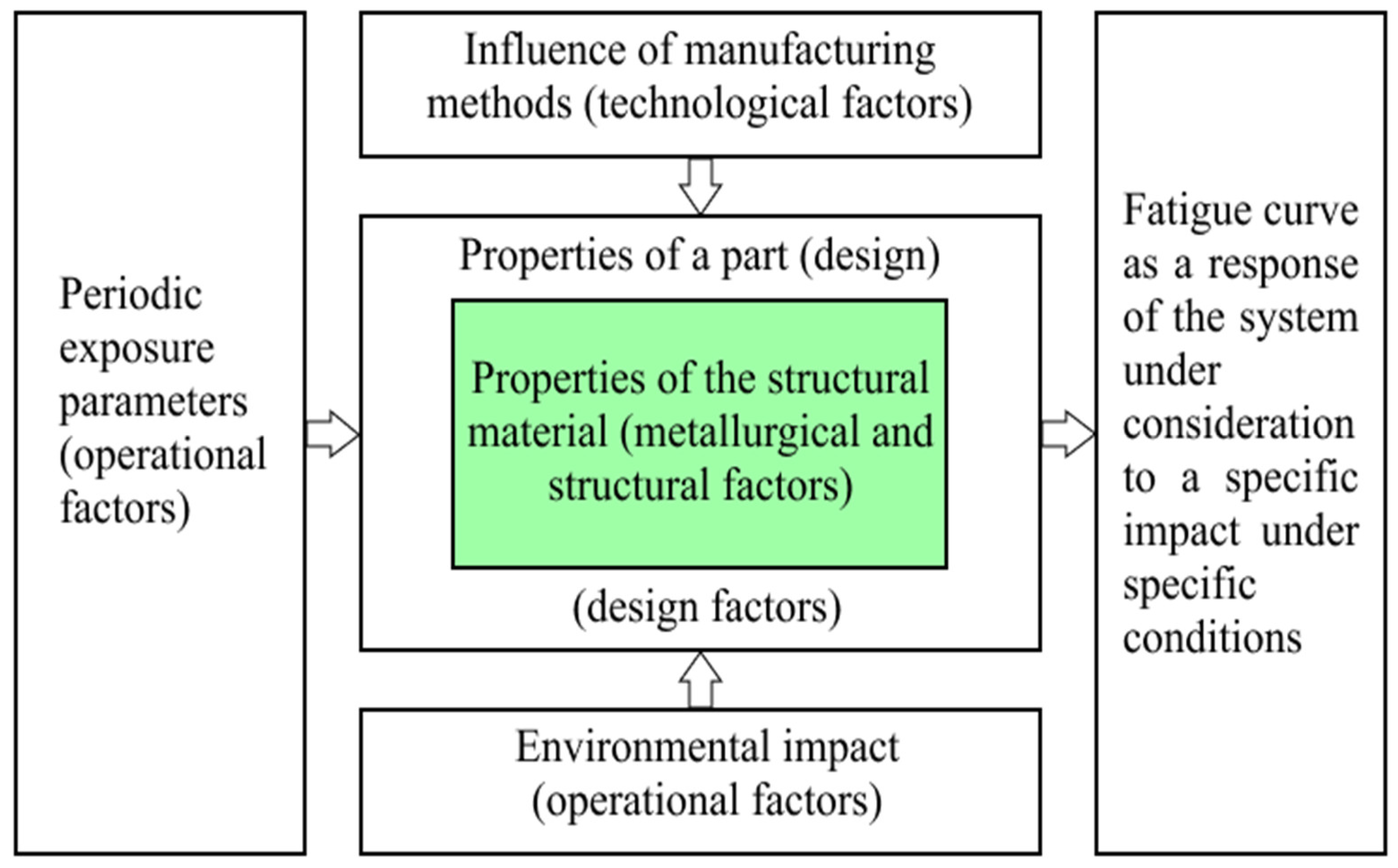
Experimental determination of metal fatigue parameters requires large material, labor, and time costs [1,2,3,4]. It is possible to reduce the costs of testing by introducing calculation methods for predicting the behavior of metal structural materials during fatigue. The fatigue life and limit parameters are lower than the similar values for static loading, and their high sensitivity to the combination of factors under which cyclic loading is being implemented is also observed [5,6,7]. This significantly complicates the prediction of fatigue parameters, forcing numerous experiments to be performed to simulate the action of cyclic loads, since fatigue parameters, and the entire fatigue curve as a whole, are the result of the impact on the structural material of a complex of metallurgical, structural, design, technological, and operational factors. This connection is shown schematically in Figure 1.
Among all the fatigue parameters, the slope of the fatigue curve’s left-hand side relative to the number of cycles axis has the potential to be the most informative. This is supported by research by various authors, which has allowed it to be considered as a fatigue modulus [8] in a semi-logarithmic coordinate system:
  T G α W = σ l o g N
where σ is stress, and N is the number of cycles of loading.
Or, as an integral indicator of the intensity of the strengthening–softening processes occurring in a structural material under cyclic loading [9,10,11], in a logarithmic coordinate system:
t g α W = l o g σ l o g N
The angle of inclination depends on a combination of factors that determine how the processes of strengthening and softening occur in the surface layers of the metallic material and is associated with how damage accumulates on the surface of the structural material under cyclic loads. For example, to illustrate this relationship, one can consider the results of tests performed for aluminum [11].
Aluminum single crystals were used as a model material to study the nucleation and development of slip bands. The single crystals were grown by recrystallization after critical deformation by rolling grade A0 aluminum.
The chemical composition and the physical and mechanical properties of the structural material are presented in Table 1.
Specimens for fatigue testing using the cantilever plane bending scheme were cut such that the single-crystal portion was located in the zone of maximum stress. Tests were conducted at room temperature with a load frequency of 50 Hz. After cutting, the specimens were electro-polished at a current density of 1.8 × 10 A/m for 240 s in an electrolyte of the following composition: ethyl alcohol—150 mL, aluminum chloride—18 g, butyl alcohol—16 mL, and distilled water—24 mL. To create dislocation pits on the surface of a single-crystal aluminum specimen, Bridgman etchant was used, diluted with water at a 1:1 ratio. The etching time was 5 s at 340 °C. The varnish replicas were chromium-tinted at a 30-degree angle and examined under an electron microscope. Slip bands were observed under an optical microscope.
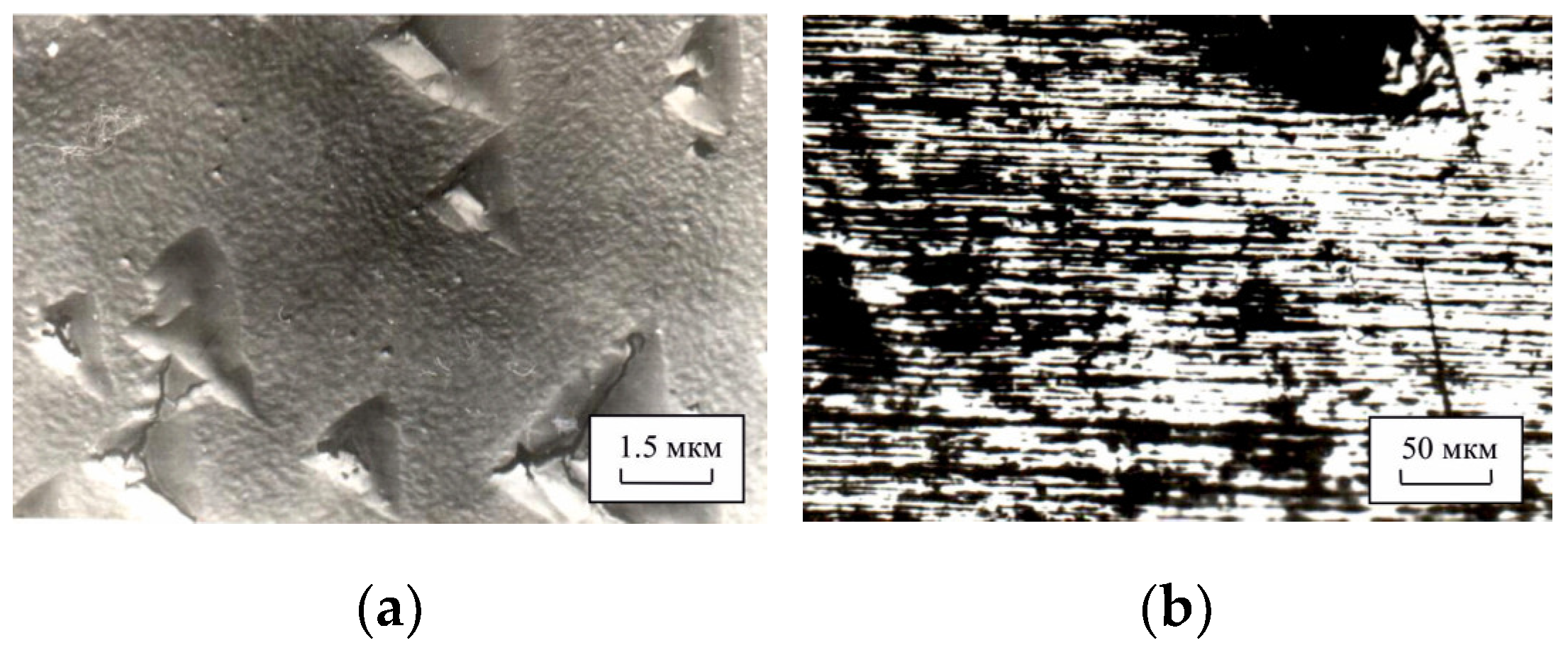
The observation of etch pits in the form of equilateral triangles (Figure 2a) apparently confirms our proposed scheme for the emergence of dislocations with a predominant edge orientation perpendicular to the specimen surface. Such dislocations can glide in the (111) plane, unable to transition to transverse slip planes. The hindrance of transverse dislocation gliding leads to the formation and development of thin slip bands on the surface of the aluminum single crystal (Figure 2b).
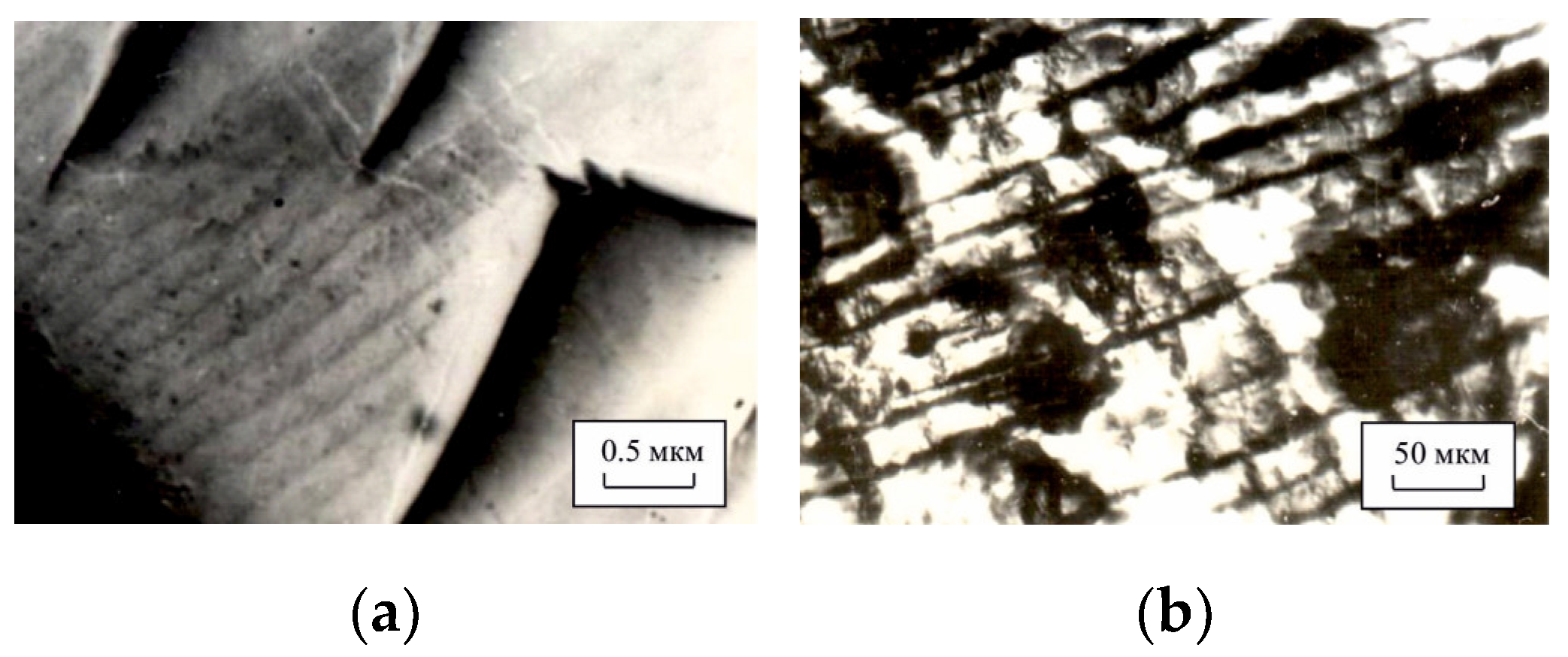
When predominantly screw dislocations emerge onto the (111) surface of the aluminum single crystal, asymmetry in the etch pits should be observed, i.e., a non-equilateral triangle (Figure 3a).
Dislocations with this orientation can freely transition from the (111) plane to the transverse (111) plane, which, under cyclically changing loads, leads to the formation of tortuous, discontinuous, wide slip bands (Figure 3b). In all the aluminum single crystals studied, cracks initiated and propagated only in slip bands. At high cyclic stress amplitudes, crack development is accompanied by frequent and abrupt (at acute angles) transitions to adjacent slip bands [11].
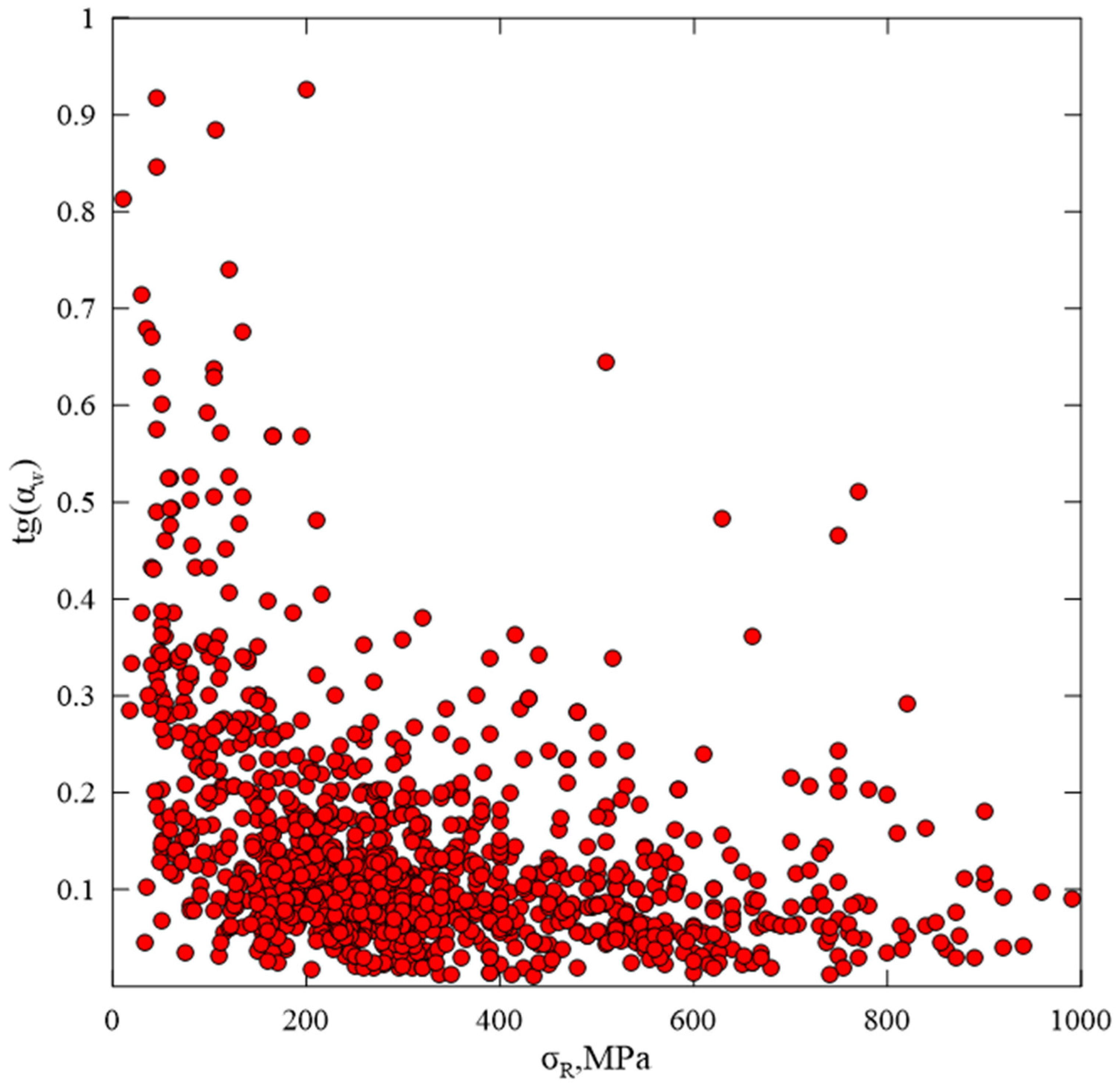
Research into the influence of other metallurgical factors, such as crystal lattice type, also reveals a relationship between the combination of factors, the accumulation of damage on the metal surface, and, consequently, the change in the slope of the fatigue curve in the high-cycle region. In practice, any component or structure is simultaneously subjected to the influence of several factors, the impact of which on the fatigue resistance characteristic is not reflected by the simple sum of the contributions from each individual factor. For example, increasing the test temperature weakens the effect of stress concentration, while decreasing the temperature enhances the negative effect of stress concentration. In almost all scientific articles published by various authors and devoted to the study of the influence of various factors on the parameters of fatigue resistance, a qualitative relationship is observed and formulated or simply demonstrated between the magnitude of the slope of the left branch of the fatigue curve to the axis of the number of loading cycles and parameters under study. Also, when examining the results of the experimental determination of high-cycle fatigue resistance parameters, a relationship can be observed between the slope of the fatigue curve and the coordinates of the inflection point of the fatigue curve in the high-cycle region. For example, for 1179 fatigue curves obtained by various authors, the test data for which were published in the literature, considered in [12,13], the following relationship was obtained (Figure 4).
It can be seen from the figure that for almost all of the fatigue curves considered, a larger value of the slope of the fatigue curve in the high-cycle region corresponds to a smaller value of the fatigue limit, and vice versa.
At the same time, extensive data has been accumulated on the study of the behavior of metallic structural materials under cyclic loads, but this information is poorly structured and fragmented due to the incompleteness of the presented description of the conditions for performing experiments [12,13,14,15,16,17,18].
These data usually represent the results of a study of one or several factors that are essential for solving the problem of assessing the impact of a specific acting factor on the parameters of fatigue [19,20,21,22,23,24,25,26]; for example, the effect of corrosion under cyclic loads [19], the effect of high or low temperature under cyclic loads [20,22,24,26], the effect of the cyclic load frequency [21,22,25], the effect of the steel grade, and the type of crystal lattice [21,22]. In some studies, the joint effect of several factors is considered and investigated, such as temperature, type of crystal lattice, frequency of the acting load [22], or steel grade and frequency of the acting load [21]. In this regard, the empirical information obtained is used as initial data for generalizing the effect of one or several factors on the characteristics of fatigue. The influence of different factors on the parameters of fatigue is multidirectional, and factors enhance or weaken their effect depending on the complex in which they act and the magnitude of the parameters that quantitatively characterize them. It is obvious that the perception of cyclic loading by a structural material occurs under the action of the entire set of acting factors, and the reaction of the material to cyclic loads in the form of a fatigue curve and the location of its characteristic areas and points in the “S-N” coordinate system will differ due to the action of various combinations of the complex of factors, rather than just a change in one specific factor. With regard to the high-cycle region of the fatigue curve of metals, a similar relationship between the action of a complex of factors and the parameters of fatigue is observed in any experiments in which one or another factor from the acting set is varied [12,13]. As a result, the S-N curve in the high-cycle region is located higher or lower in terms of stress and to the left or right in terms of the number of cycles of loading. The angle of the left branch of the fatigue curve to the axis of the number of cycles of loading also changes when the fatigue curve is represented on logarithmic axes. All this complicates the development of methods for predicting the parameters of the high-cycle fatigue of metals due to the lack of the necessary volume of empirical information when attempting to build predictive models using empirical data with a permutation of various combinations in the complex of acting factors. At the same time, there is a large array of accumulated experimental data on the fatigue of metals, which, in the event of solving the problem of their joint consideration, could become the framework for creating a predictive model that links the array of active factors (input data for the model) and the parameters of fatigue (result of predicting the S-N curve of metals in the high-cycle region).
On the complete fatigue curve of metals, several characteristic regions are traditionally distinguished: the region of low-cycle fatigue, the region of high-cycle fatigue, and the region of very-high-cycle fatigue. The conditional boundaries of the specified areas are determined by the predominant mechanism of damage accumulation in the microstructure of the structural material within the corresponding area of the fatigue curve. It is obvious that the presence of structural components of the material differently oriented relative to the direction of the acting load leads to the fact that the final damage will be formed by different mechanisms of damage accumulation; however, within the selected characteristic areas of the full fatigue curve, we can, we repeat, speak of the predominant nature of one mechanism or another. The developed high-speed technique for S-N curve prediction relates to the prediction of the region corresponding to high-cycle fatigue of a structural material. In addition, an important limitation of the method is the consideration of only those sets of acting factors for which a “knee” point will be observed in the high-cycle area of the S-N curve in the case of constructing the S-N curve in a logarithmic coordinate system. Calculation of the recalculated fatigue parameters and a limited generalized relation for a large number of fatigue curves [27,28,29,30] allows us to obtain a practically functional dependence in the space of the recalculated fatigue data, which can be employed as a foundation for diverse approaches of accelerated prediction of the S-N curve. Having made a forecast in the area of the recalculated fatigue parameters, it is then possible to “restore” the traditional form of fatigue life and limit parameters by recalculating the values of fatigue life and limit corresponding to the “knee” point of the fatigue curve in the high-cycle region from their reduced (recalculated) analogs. By now, massive high-cycle fatigue statistics of metals have been accumulated. These data represent the results of fatigue tests before failure of a certain (usually relatively small) number of specimens and a description of the factors investigated within the framework of the study (temperature, asymmetry, frequency of loading cycles, etc.) Approximation of the results of experiments on the destruction of specimens (coordinates of points in the “S-N” system (stress–number of cycles)) allows us to obtain an equation for the fatigue curve, using which we can obtain some integral assessment of how the structural material will behave under cyclic loading under the action of the considered set of acting factors. A distinctive feature of the behavior of structural materials under cyclic loads is the high sensitivity of the fatigue life and limit parameters to the acting factors, as well as the combined influence of factors on each other, which strengthens or weakens the results of their combined influence. Attempts to construct universal dependencies or models describing the relationship between the fatigue life and limit parameters on the one hand, and a set of acting factors on the other hand, have often been unsuccessful, since traditional model construction requires numerous empirical data. These data should describe various combinations of operating factors; they should be applicable and sufficient for constructing quantitative functional dependencies in the form of polynomials that take into account the complex nature of the mutual influence on the fatigue life and limit parameters of each individual factor and the entire complex of operating factors as a whole. Attempts made by various authors to construct functional dependencies of the fatigue life and limit parameters on a specific factor (for example, temperature and frequency) inevitably turn out to be very narrowly specialized, applicable only to those combinations of active factors that were recorded within the framework of the experiments conducted. And, therefore, they are of interest for use only in situations that exactly correspond to the situations being studied in terms of the composition of the complex of active factors.
On the other hand, there are a large number of different lifetime prediction methods (LPMs) designed to reduce the use of fatigue tests on laboratory specimens in order to reduce the cost and time consumption of fatigue testing. In refs. [31,32,33], a combination of non-destructive methods of testing the state of a metallic material and single-load tests on laboratory specimens is used to construct a virtual fatigue curve. The proposed methods are based on an approach that studied the material’s response to cyclic loads—“material response-related evaluation of fatigue behavior”, rather than focusing on a lifetime-oriented approach. This approach allows for the extraction of more information for the accelerated construction of fatigue curves using a mechanism-based investigation of the fatigue process studies. Using such a method for the estimation of virtual fatigue curves is based solely on a single load-step test of the specimen. In ref. [34], a calculation method for constructing full fatigue curves based on statistical modeling is considered as applied to structures of a certain type for offshore steel structures. In ref. [35], for determining an S-N curve, it is needed to define the Vickers hardness HV of the material, and the size of the defect, which is calculated from its area and a limited number (two data points) of fatigue test results with specimens at loads higher than the fatigue limit. The method is applicable to materials containing a defect; however, there is an approximate formula in which this parameter may not be taken into account and the fatigue limit will be assessed by the value of hardness. Just like in our method, this approach allows determining the location of the fatigue limit and the “knee” point within the high-cycle region of the S-N curve. But there is a demand for using rather specific information in the form of the Vickers hardness HV of the material and the size of the defect. Considering other methods of the fatigue curves accelerated construction, for example, in refs. [36,37,38], it can be seen that, with their goal being to solve a similar problem of reducing the duration and cost of performing tests to determine the parameters of high-cycle fatigue in the form of the “S-N” curve, all methods have varying degrees of universality, and are applicable for predicting the fatigue parameters of certain materials or a certain type of structures. The latter means that the methods are applicable for taking into account a certain set of design, technological, and operational factors. Some of them, in addition to a limited amount of fatigue data, also require information on the parameters of static loading, or, as in [37], data on the change in the physical properties of the metal during loading, obtained by the acoustic emission method.
When considering new methods for predicting fatigue resistance, the following features can be highlighted.
1. Shift from empirical models to physical-data-driven approaches: modern research increasingly combines the physical principles of fatigue failure (crack mechanics and damage theory) with data analysis methods, creating hybrid models. This preserves interpretability and improves prediction accuracy compared to purely empirical relationships [39,40,41].
2. Application of machine and deep learning: machine learning (ML) and neural network methods are actively used to predict fatigue life based on multidimensional input data (stress, frequency, temperature, geometry, and environmental conditions), process complex sequential data, and automatically extract features from experimental curves without manual design [42,43].
3. Working with small samples and uncertainty: given the high cost of fatigue testing, methods that work with limited data volumes are relevant. Bayesian neural networks (BNN) [44,45] are used to quantize confidence intervals, and the Gaussian variational Bayes network (GVBN) [46] has demonstrated high efficiency in predicting weld fatigue with small samples—they allow one to estimate the uncertainty of the prediction, which is critical for engineering decisions.
4. Taking into account microstructure and defects: with the development of microscopy and computer modeling methods, it becomes possible to take into account the influence of the material microstructure, porosity, residual stresses, and initial defects on fatigue life and to link micro-level data with macroscopic behavior [47].
5. Data augmentation and synthetic models: since experimental data is limited, generative models (GAN and VAE) are used to synthesize realistic fatigue curves, and models based on physical laws are used to generate training samples while maintaining physical consistency [48,49].
6. Prediction of multivariate outputs: modern models move from predicting a single value (cycles to failure) to predicting the entire S-N curve as a function, outputting as a parameter vector, and using multi-task learning to simultaneously predict service life, crack growth rate, and environmental sensitivity [50,51].
7. Focus on specific structures and conditions: particular attention is paid to predicting the fatigue of welded joints, orthotropic bridge slabs, and additive parts [52,53], taking into account corrosion fatigue, thermal cycling, and variable loading amplitude (random loading) [54].
Thus, in the method for predicting the high-cycle region of the fatigue curve, based on the universal relationship between the set of acting factors, the structurally sensitive parameter of fatigue, and the coordinates of the breaking point of the fatigue curve among the listed features, one of the above-mentioned characteristic features of forecasting methods corresponds to points 1, 2, 5, and 6. The method being developed makes it possible to take into account numerous experimental data accumulated to date. Even in the absence of comprehensive information on the set of acting factors, data on the structurally sensitive indicator of fatigue (the slope of the left branch of the fatigue curve in the high-cycle region) and the coordinates of the breaking point of the fatigue curve in the high-cycle region are presented in most studies. The main problem in this regard is to ensure the possibility of joint consideration of experimental data on the fatigue of metals if they are presented in the form of fatigue curves in a semi-logarithmic or logarithmic (double logarithmic) coordinate system.

2. Materials and Methods

2.1. Prediction of Recalculated Fatigue Parameters Using a Generalized Dependence of Recalculated Fatigue Parameters

In scientific articles [27,28,29,30], the authors considered a method of generalizing experimental information on high-cycle fatigue of metals in the composition of the dependence of the recalculated fatigue damage parameters. The condition for the applicability of the reduction (recalculation) procedure was the presence of a break point (a “knee” point) on the S-N curve in the high-cycle region in the case of presenting experimental data on logarithmic axes. One of the ways to overcome these difficulties is to use a generalized analysis of accumulated data, during which information on metal fatigue is transformed into reduced (recalculated) analogs of fatigue parameters (σre, Nre, tgαre) in order to obtain relation of the recalculated fatigue parameters [27,28].
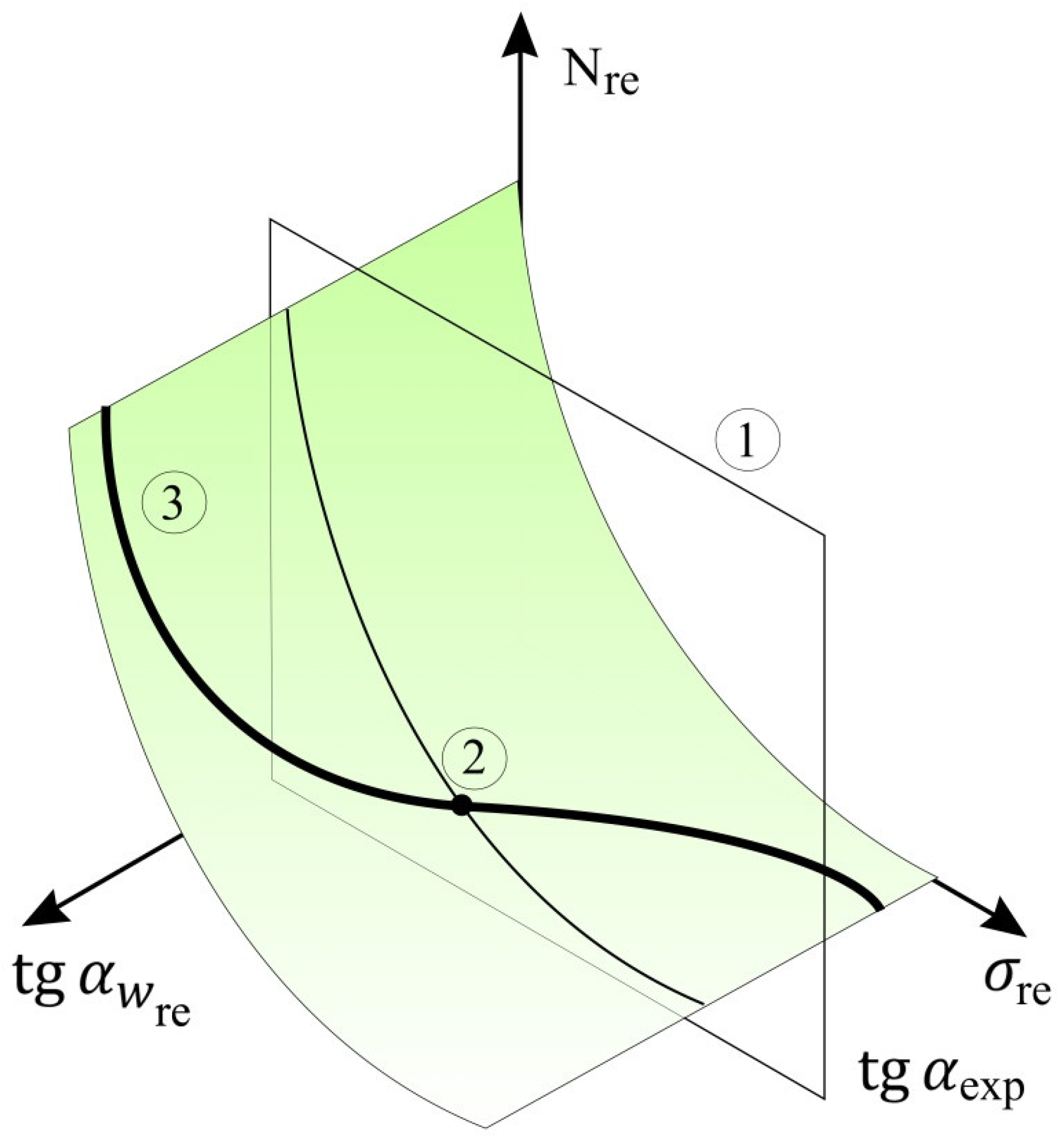
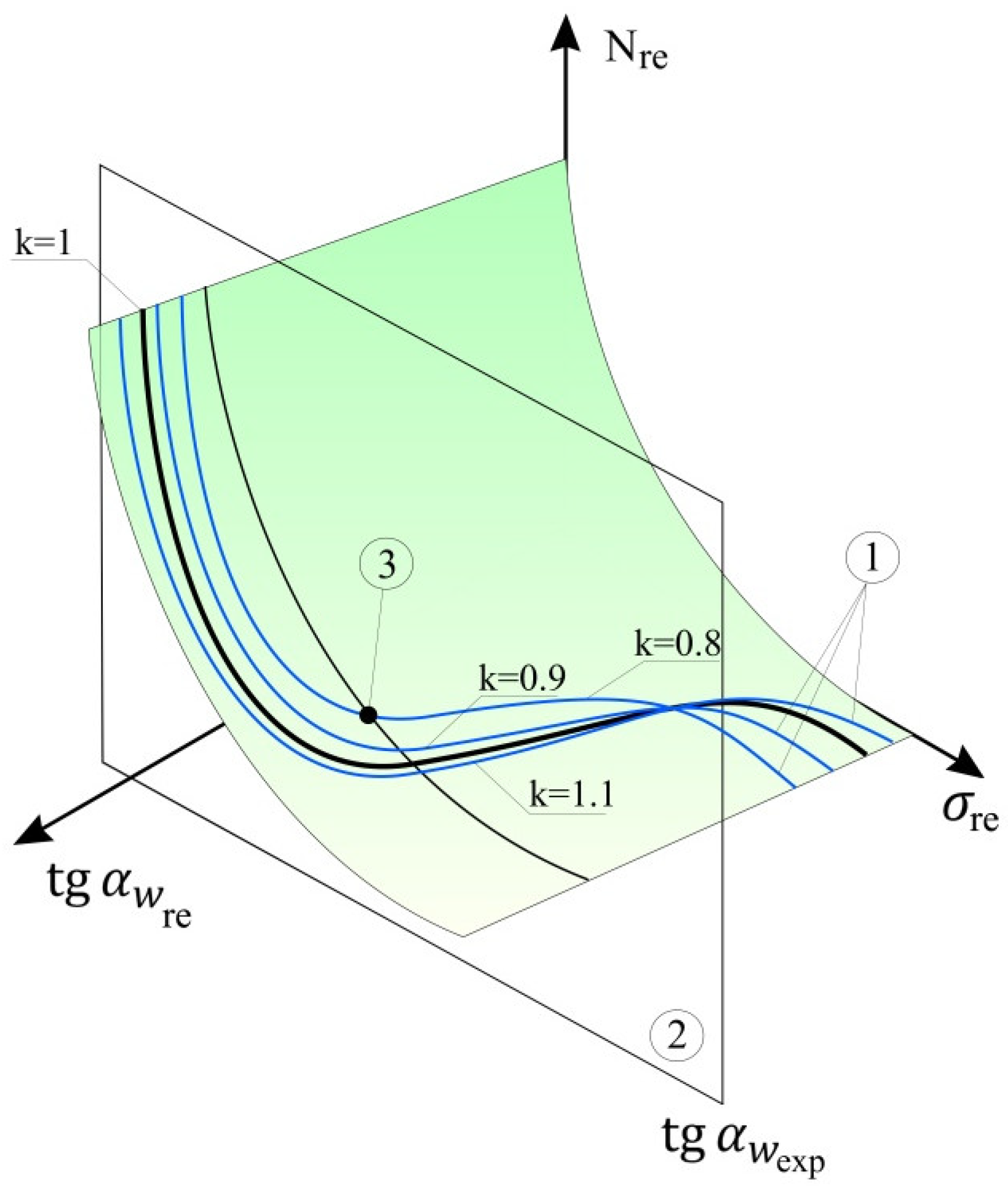
Briefly, the procedure for constructing a generalized dependence can be presented as follows. In the case of representing the fatigue curve in a logarithmic coordinate system, a breaking point is observed in the high-cycle region for certain combinations of acting factors and certain metals. If we extend the left branch of the fatigue curve, steeply inclined to the axis of the number of cycles, in the high-cycle region until it intersects with the coordinate axes, we can obtain conditional, physically unrealizable values of stress ( l g σ * ) and the number of cycles ( l g N * ). For each point with coordinates ( l g σ ; l g N ) belonging to the left branch of the fatigue curve, we perform a normalization procedure by dividing the coordinate along the ordinate axis ( σ ) by the conditional value ( σ * ), and the coordinate along the abscissa axis ( N ) by the conditional value ( N * ). We take the logarithm of the obtained values and, for ease of use, multiply them by −1. The resulting values are called recalculated fatigue parameters (recalculated strength— σ r e and recalculated life— N r e ). If we plot the left branch of the fatigue curve after this transformation in the recalculated coordinate system “ σ r e N r e ”, we obtain an exponential curve. The high-cycle region of any other fatigue curve after this transformation will be superimposed on this dependence. Consider the value of the decimal logarithm of the structurally sensitive parameter ( t g α W ) , also multiplied by −1, as the third coordinate axis. By shifting the previously obtained exponential dependence along a line parallel to the introduced third coordinate axis, we obtain a surface on which the high-cycle regions of the fatigue curves are plotted at the same “scale,” depending on the value of the structurally sensitive parameter. If we determine for each fatigue curve the breaking point in the high-cycle region with coordinates ( σ R , N G ), transform the obtained values into recalculated analogs ( σ R r e , N G r e ), and consider together all the obtained breaking points of the fatigue curves in the space of the recalculated fatigue parameters, then we will obtain a generalized dependence of the recalculated fatigue parameters. In Figure 5, the surface formed by the normalized fatigue curves is shown in green, and the bold line corresponds to the generalized dependence of the recalculated fatigue parameters.
This dependence represents the relationship between the recalculated fatigue parameters obtained by additional processing of the high-cycle region of the experimental S-N curve and by presenting the obtained results in the three-dimensional space of the recalculated fatigue parameters [27,30]. The wide range of sets of acting factor complexes, for which the experimental fatigue curves included in the generalized dependence were obtained, allows us to assume the universal character of the relation between the recalculated fatigue parameters and to develop a method for the high-speed construction of a technique for S-N curve prediction, which uses small batch fatigue tests and the results of predicting the placement of the fatigue curve “knee” point using the relation of the recalculated fatigue parameters [27,28]. This use of a predictive analytical model allows reducing the amount of experimental work when constructing a fatigue curve in the high-cycle region. A relation between the recalculated fatigue parameters was obtained by jointly considering a large number of fatigue curves. The need to increase the accuracy of the forecast for determining the position of the “knee” point of the fatigue curve in the case of its construction within a log-coordinate system led to the need to develop an algorithm for more accurate use of the generalized dependence of the recalculated fatigue parameters. The developed algorithm assumes the selection of limited generalized dependencies in the relation of the recalculated fatigue parameters. These dependencies will correspond to the case of approximation of experimental results selected according to some feature; for example, with the same grade of steel or alloy or with the same value of another design, technological or operational factor. The use of limited generalized dependencies leads to obtaining somewhat different, compared to the generalized dependency, predicted coordinates of the fatigue curve “knee” point in the high-cycle region. The aim of the work carried out in this study was to evaluate the accuracy of predicting the position of the fatigue curve “knee” point in the case of using such predictive analytical models. The results of cyclic loading experiments published in the literature were used as initial data for assessing the accuracy of prediction.
The methods, presented by the authors, allow us to generalize the accumulated previous information on the high-cycle fatigue of metals in order to construct a universal model that links the mix of active factors with the resulting parameters of resistance to high-cycle fatigue.
This advantage of the proposed method for high-speed prediction of a S-N curve in the high-cycle area is especially convenient, since by now, extensive databases have been accumulated and systematized, the study of which leads to a completely obvious desire to perform a generalization with the aim of constructing predictive models for describing the behavior of metals under cyclic loads [27,28,29,30]. Based on these models, accelerated construction of fatigue curves is performed. A procedure for such generalization is known [27,28], which consists of calculating the reduced (recalculated) fatigue parameters and a limited generalizing relation obtained empirically, and subsequently presenting information about them in a system of reduced (recalculated) coordinates. The characteristics of the high-cycle region of the fatigue curve—the fatigue limit, the number of cycles to failure, and the slope of the left side of the fatigue curve—integrally express through their values all the information about the set of acting factors (cyclic loading conditions). However, using the traditional S-N curve as a tool for their graphical representation makes it difficult to identify general patterns in the studied datasets. If the same experimental data will be presented as recalculated (normalized) fatigue parameters, the resulting dependencies can be used in an accelerated method for predicting the high-cycle region of the fatigue curve. The use of this dependence is possible with the involvement of limited-volume tests that are performed under loads greater than the fatigue limit, which achieves a beneficial effect from reducing the volume of fatigue tests due to the use of the results of processing a large amount of previously obtained information on metal fatigue.
Let us consider in more detail the main points above. Figure 5 shows a diagram of this modification of the prediction method, which consists of cutting the generalized dependence (2) by plane (1), matching to the angle of tilt of the left-hand part of the S-N curve found in some way (experimentally or by calculation), in the case of representing the S-N curve within a log-coordinate system.
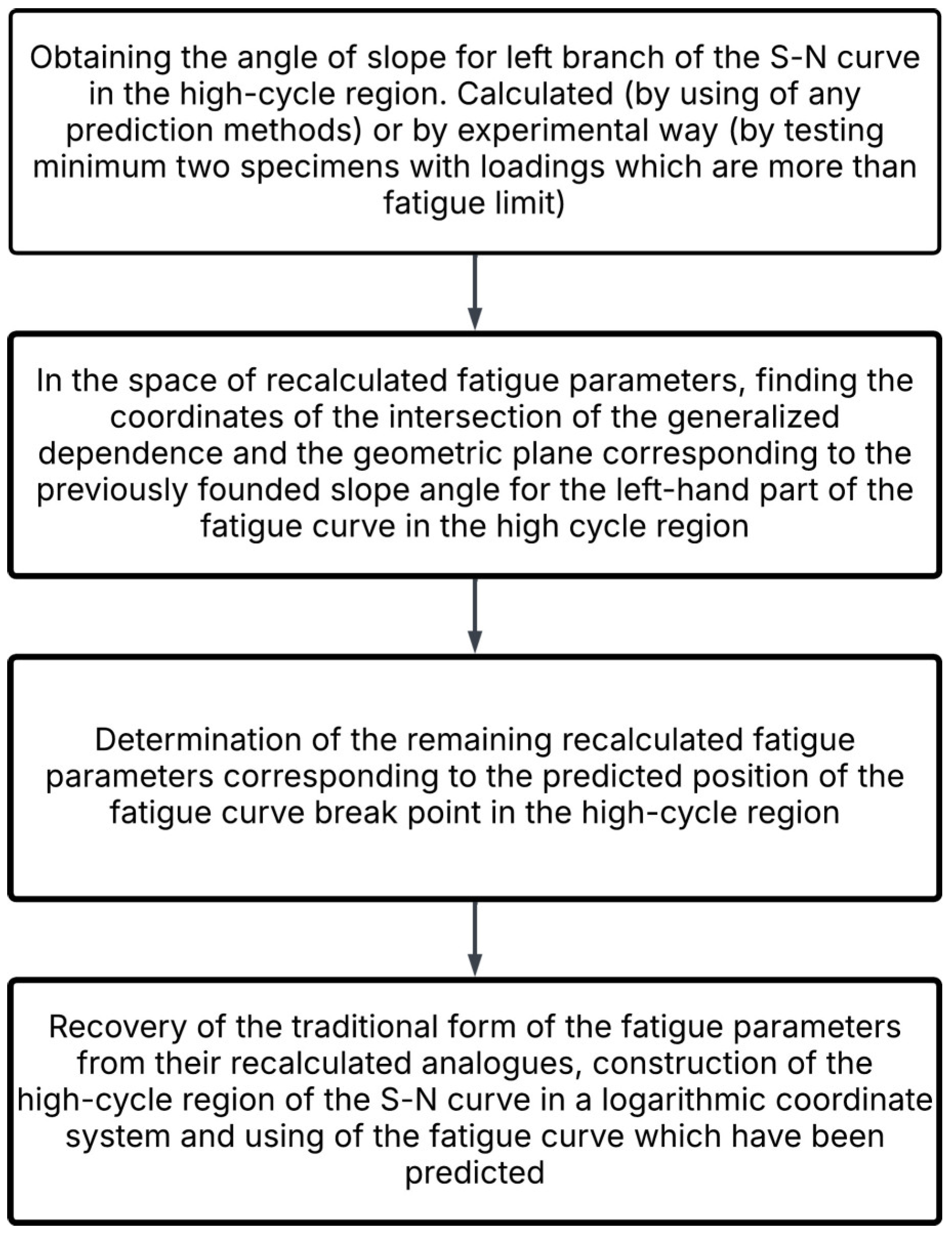
Figure 6 shows the sequence of operations for applying a simplified modification of the approach for predicting the high-cycle region of the S-N curve.

2.2. Prediction of Recalculated Fatigue Parameters Using a Limited Generalized Dependence of Recalculated Fatigue Parameters

To improve the accuracy of fatigue curve prediction using a generalized relationship for the recalculated fatigue parameters, the influence of the set of factors under which cyclic loading occurs can be taken into account. Combined consideration of all fatigue curves within a generalized relationship allows obtaining integral characteristics for the entire set of fatigue curves considered. However, extracting a group of fatigue curves from this generalized relationship, grouped by similarity in the factors involved, allows for the derivation (for the considered set of factors) of the parameters of limited generalized relationships for the recalculated fatigue parameters. It can be assumed that using these relationships will yield a more accurate predicted fatigue curve position. A study was conducted to evaluate how the parameters of limited generalized relationships change in response to changes in the considered sets of factors. The projection equations of the generalized dependence contain two coefficients:
  σ R r e = A e x p ( B t g α W r e )
N G r e = C e x p ( D t g α W r e )
Depending on which set of fatigue curves is considered in a given specimen, the values of the coefficients A , B , C , and D in the approximating dependencies change, and it can be said that the values of the obtained coefficients correspond to the combination of the operating factors under which the fatigue curves were obtained, compared as part of the limited generalized dependencies of the recalculated fatigue parameters.
When considering all the fatigue curves, their values characterize the average position of a relation matching to all the points considered. If we try to consider various specimens of data on fatigue curves with subsequent calculation of the parameters of the relation, we will obtain a set of values of the parameters of the generalized dependence for certain sets of acting factors. The use of such parameters of the generalized dependence, refined for a specific set of factors, obviously increases the accuracy of forecasting, but also obviously narrows the universal nature of the forecasting procedure in this case. That is, the forecast is performed according to the following algorithm—determination of the mix of active factors, determination of the parameters of the relation matching to this set of operating factors, and execution of limited tests—and determination of the tilt angle of the left branch of S-N curve, determination of the coordinates of the breaking point according to the generalized dependence, forecasting (restoration from the re-calcuated analogs of the S-N life and limits in the traditional form), and high-speed prediction of a S-N curve in the high-cycle area. By calculating the parameters of a limited generalized dependence for a certain set of fatigue curves (in this case, a generalized dependence is a dependence “averaged” over the entire set of points), we can calculate a whole family of such curves, each of which will pass through points (fatigue curves) that were obtained with a particular collection of operational conditions.
Figure 7 shows a refined algorithm of the section method using limited generalized dependencies of the recalculated fatigue parameters. The difference from the diagram presented in Figure 5 is the use of a family of limited generalized dependencies of the recalculated fatigue parameters, which were collected by examining various groups of fatigue curves formed based on the same array of active factors.

2.3. Prediction of Recalculated Fatigue Parameters Using an Artificial Neural Network (ANN) Generating a Family of Limited Generalized Dependencies of Recalculated Fatigue Parameters

The database we used for fatigue parameters and descriptions of sets of operating factors [12,13] contains 1179 fatigue test results. Despite the seemingly representative specimen of data, they are quite fragmentary and, for example, for various steel grades, one can find from a single fatigue curve obtained for a specific set of other factors to, say, 114 fatigue curves for steel 45. In this regard, a relatively accurate approximation within the composition of limited generalized dependencies was possible only if at least 3 fatigue curves were considered in similar conditions. In this case, it was possible to obtain an approximating dependency matching the form of the function with the generalized dependency of the recalculated fatigue parameters. A total of 116 such sets of operating parameters were considered. For each such set of factors, a selection of fatigue curves from the database was made, and after calculating the recalculated fatigue parameters, the projection parameters of the limited generalized dependencies that best approximated the considered data specimens were estimated. Obvious options for using such limited generalized dependencies to, for example, assess the significance of a particular factor in the considered set of acting factors, or to evaluate the influence of not only a specific set of acting factors but also a specific range of change in an acting factor, are impossible with such a small number of limited generalized dependencies. For such studies, an ANN trained on the entire set of results contained in the database can be useful. The initial data for training the ANN were data on the acting factors, and information about which was encoded. Qualitative and quantitative factors were taken into account, and the maximum and minimum levels of factor change were considered. As an example, formulas for encoding information about the cross-sectional shape of a laboratory specimen, the loading scheme, the steel grade, and the test temperature are given below.
Steel grade coefficient ( K S G ), discrete factor:
K S G = ( N S G 102.5 ) 101.5
where N S G is the serial number of the steel grade in the coding table; 204 steel or alloy grades are considered in the database.
Loading scheme coefficient ( K L S ), discrete factor:
K L S =   ( N L S 9 ) 8
where N L S is the serial number of the loading scheme in the coding table; 17 loading schemes are considered in the database.
Temperature coefficient (KT), continuous factor:
K T =   ( T 364.5 ) 635.5
where T is the test temperature, °C; the database considers 66 different temperature conditions from −269 to 1000 °C.
The shape factor of the cross-section of the specimen ( K S F ) is a discrete factor:
K S F =   ( N S 2.5 ) 1.5
where N S is the serial number of the cross-sectional shape in the coding table; the database considers 4 different cross-sectional shapes of specimens (round, square, rectangular, and tubular).
A total of 11 factors influencing the fatigue values were considered (material grade, loading pattern, test environment, temperature, specimen cross-sectional shape, scale factor, dimension characteristic, load cycle frequency, heat treatment mode, surface machining method, and surface finish). In addition to these values, data on the recalculated fatigue parameters calculated for fatigue curves constructed from the results of fatigue experiments under the action of a specific set of factors were used. The output parameters of the network were the projection parameters of the generalized dependencies ( A and B for the projection linking the recalculated strength to the reduced slope of the fatigue curve, and C and D for the projection linking the recalculated durability to the recalculated structural sensitive fatigue parameter of the fatigue curve (Formulas (3) and (4))).
The model is constructed as a one-dimensional CNN. The input dimension is 1179 × 14 × 1, (where “14” includes 11 factors (conditions) and 3 values corresponding to the coordinates of the fatigue curve in the recalculated coordinate system). The model is constructed as a one-dimensional CNN with three convolutional layers: the first layer uses 64 filters with a kernel of size 5, the second layer uses 128 filters with a kernel of 3, and the third layer uses 256 filters with a kernel of 3. Each convolutional layer is followed by batch normalization and the ReLU activation function, followed by a max pooling operation with a kernel of 2 for dimensionality reduction. After flattening the resulting representation, the data passes through two fully connected layers: the first contains 512 neurons with ReLU activation and dropout regularization with a coefficient of 0.5, and the second layer contains 256 neurons with the same activation. The output is a 4-dimensional vector corresponding to four coefficients, A , B , C , and D , for the projections of the predicted limited generalized dependence of the recalculated fatigue parameters (Formulas (3) and (4)). The output layer produces a 4-dimensional vector corresponding to the target fatigue behavior parameters, without applying an activation function, since the problem is solved as a multivariate regression. The model was trained using the Adam optimizer with an initial learning rate of 10−4, which was gradually reduced during training using the scheduler based on the validation error. The batch size was set to 16, and the total number of epochs was 200. Mean squared error (MSE) was used as the loss function. To prevent overfitting, early stopping was applied if the validation metric failed to improve within 10 epochs. The specified architecture and hyperparameters were selected based on hyperparameter tuning and cross-validation, ensuring an optimal balance between model complexity and generalization ability with a limited dataset.
The training parameters were selected empirically. The data was divided into training (70%), validation (15%), and test (15%) sets.
The training results in the test set showed an accuracy of 82%, a recall of 81%, and an F1 score of 82.0.
Validation and generalization were tested using 5-fold cross-validation; the average accuracy was 81.9%.
The model can produce unreliable predictions when the input data deviates significantly from the training set distribution. Error analysis revealed that the accuracy is due to the lack of a sufficient number of examples in the training set for each class. Data augmentation is advisable for further research.
Additionally, testing was conducted on an independent dataset [16], where the model demonstrated an accuracy of 78.4%, confirming its generalization ability.
Conclusions on the trained network indicate its effectiveness for the task of generating parameters for a bounded generalized relationship.
Promising areas for further training include the use of datasets with a larger number of examples for each class. The practical significance of the results lies in the possibility of using the model for automated classification.
In other words, the ANN estimates the parameters of a limited generalized dependence of the reduced fatigue resistance parameters, which will pass through a point representing, in the space of reduced fatigue resistance parameters, the fatigue curve obtained for a given set of factors. The use of such limited generalized dependences is no different from the procedure for using the generalized dependence itself and limited generalized dependences whose parameters are obtained by approximating several data points obtained by processing experimental fatigue curves.
Enabling data augmentation can impact model performance and robustness, particularly with a limited training set, as in this case. Although augmentation was not directly applied in this study, its potential impact can be assessed in the context of the current architecture and task. The model, based on a one-dimensional CNN, is trained on data of dimensions 1179 × 14 × 1, where each sample represents an ordered sequence including both physical loading factors and the geometric coordinates of the fatigue curve. Because the data has a clearly defined physical interpretation, direct application of standard augmentation methods (e.g., random truncation, inversion, or noise) may distort the physical meaning and lead to the generation of unrealistic or inconsistent samples. However, specialized approaches are possible: for example, adding a small amount of Gaussian noise to the input features, synthetic curve generation based on physical fatigue models, or interpolation between samples with similar conditions. Such methods could increase the diversity of the training set and improve the generalization ability of the model, particularly in the domain of poorly represented loading conditions.
Nevertheless, the current model demonstrates high accuracy and resilience to overfitting, which is partially offset by the use of dropout, batch normalization, and early stopping. Thus, although explicit data augmentation was not performed, some of its functionality is already implemented through regularization and probabilistic modeling.
A limitation of the current model is its dependence on the quality and completeness of the original dataset. Without augmentation, the model may generalize less well under new, but physically similar loading conditions, especially if they are poorly represented in the training set. Therefore, the recommendation to use augmentation in further research is justified and promising. Its implementation, while maintaining physical consistency, can increase model robustness, improve metrics on test data, and expand the applicability of predictions, especially when moving from laboratory conditions to real-world operational loads.

2.4. Evaluation of the Recalculated Fatigue Parameters Prediction Accuracy

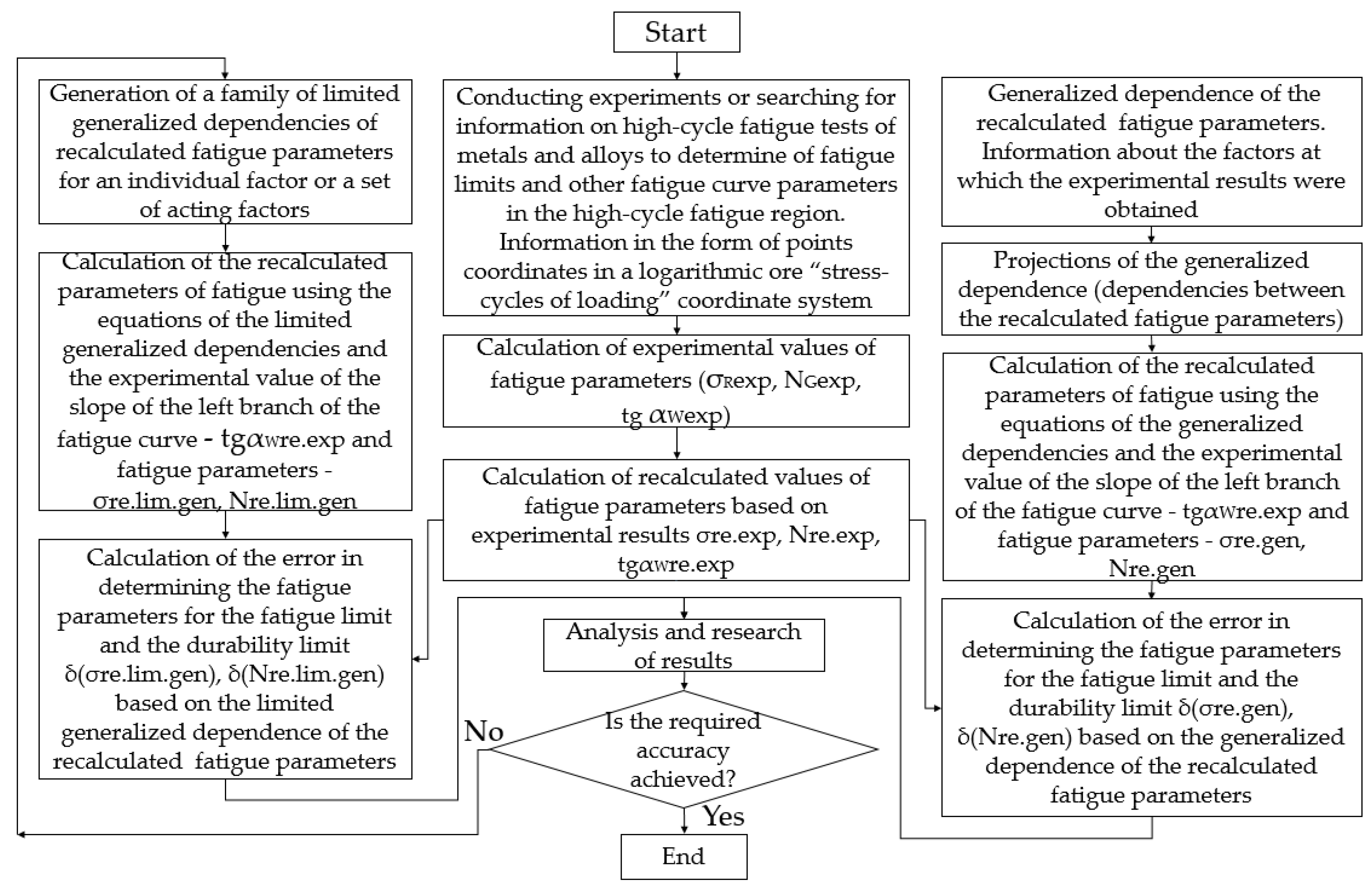
By successively applying a simplified and refined analysis procedure, we obtain several estimates of the location of the S-N curve in the traditional coordinate system (“stress—number of cycles”), or in the transformed coordinate system (recalculated strength—recalculated fatigue life). Comparison of these estimates with each other and their verification based on the experiment-derived results of the “knee-point” allows us to evaluate the feasibility of such a modification of the forecasting method and the effect of the proposed method for refining the forecasting method. Figure 8 shows a flow chart of the forecast accuracy assessment procedure.
The accuracy of the prediction results was assessed using the fatigue test results either conducted by the authors of the study [13] or published in the literature [12,13,55,56,57,58,59,60,61,62,63,64,65,66,67,68,69,70,71,72,73,74,75,76,77,78,79,80]. The parameters of the fatigue curve in the high-cycle region were used as information for the assessment. These parameters are traditionally represented as a fatigue curve in the “stress—number of loading cycles” coordinate system or in the logarithmic coordinate system “logarithm of stress—logarithm of the number of loading cycles”. Based on these data, the experimental values of the fatigue parameters were assessed: σ R e x p , N G e x p , and t g α W e x p , and then the recalculated values of the fatigue parameters: σ R r e . e x p , N G r e . e x p , and t g α W r e . e x p . The slope of the fatigue curve in the high-cycle region, in the case of using the developed accelerated fatigue curve prediction method, can be found by testing two specimens brought to failure under stresses above the expected fatigue limit. Therefore, when assessing the accuracy of the prediction method, we assessed only the accuracy of determining the coordinates of the breaking point of the fatigue curve in the high-cycle region. The determination of these fatigue parameters using the generalized dependence of the recalculated fatigue resistance parameters is shown in Figure 8 in the blocks of the right column.
The initial data are the projection parameters of the generalized dependence of the recalculated fatigue parameters, obtained by jointly presenting data on a large number of experimental fatigue curves, previously published and stored in the database, in a system of recalculated coordinates and information on the sets of acting factors under which these fatigue curves were obtained. Using the value of t g α W r e . e x p previously obtained for the analyzed fatigue curve, it is possible to determine the other two recalculated fatigue parameters σ R r e . g e n and N G r e . g e n . Next, an error in determining the values of σ R r e . g e n and N G r e . g e n , found from the generalized dependence of the recalculated fatigue parameters, is estimated in comparison with the values of σ R e x p   and N G e x p , found on the basis of processing the experimental data.
If the generalized dependence of the recalculated fatigue parameters contains a sufficient number of fatigue curves (at least three) obtained under similar conditions to the fatigue curve whose parameter prediction accuracy is being estimated, then the parameters of the limited generalized dependence of the recalculated fatigue parameters can be calculated, the values of σ R r e . l i m . g e n and N G r e . l i m . g e n can be estimated, and the prediction accuracy in this case can be calculated. In Figure 8, the sequence of these operations is presented in the left column of blocks.
The calculation of the error in determining the fatigue parameters using the generalized dependence of the recalculated fatigue parameters and the limited generalized dependence of the recalculated fatigue parameters was carried out using Formulas (9), (10), (11), and (12), respectively.
δ σ R r e . g e n = σ R r e . e x p σ R r e . g e n σ R r e . e x p     100 %
δ N G r e . g e n = N G r e . e x p N G r e . g e n N G r e . e x p     100 %
δ σ R r e . l i m . g e n = σ R r e . e x p σ R r e . l i m . g e n σ R r e . e x p     100 %
δ N G r e . l i m . g e n = N G r e . e x p N G r e . l i m . g e n N G r e . e x p     100 %
Clearly, using limited generalized dependencies of recalculated fatigue parameters to predict high-cycle fatigue parameters will improve the accuracy of estimating the fatigue curve breaking point coordinates in the high-cycle region. However, it is also clear that in most cases, it is impossible to select even three fatigue curves that are completely consistent in terms of the combination of factors from the currently accumulated metal fatigue data.
An attempt was made to solve this problem by generating parameters of limited generalized dependencies using an ANN. The sequence for estimating the accuracy of reduced fatigue resistance parameters in this case is similar to that described in the group of steps corresponding to the use of limited generalized dependencies obtained from specimens of experimental fatigue curves.
Due to the similar algorithm for using limited generalized dependencies of recalculated fatigue parameters obtained by approximating experimental results (shown in the left column of Figure 5), and limited generalized dependencies whose parameters were obtained using an ANN, the latter are not shown in Figure 5 for simplicity.
Only by using ANNs can one currently obtain a sufficient number of diverse, limited-generality relationships necessary for use in research assessing the significance of a specific factor from a group of operating factors or the influence of a specific set of operating factors. Solving such problems using limited-generality relationships obtained by approximating experimental results is difficult due to the limited set of factors studied. However, to reliably use limited-generality relationships, it is necessary to perform numerous verification calculations to compare the results of the limited-generality relationships generated by ANNs with experimental fatigue curves.

2.5. General Diagram of the Relationships Between the Proposed Methods for Predicting S-N Curves Based on the Use of the Recalculated Fatigue Parameters

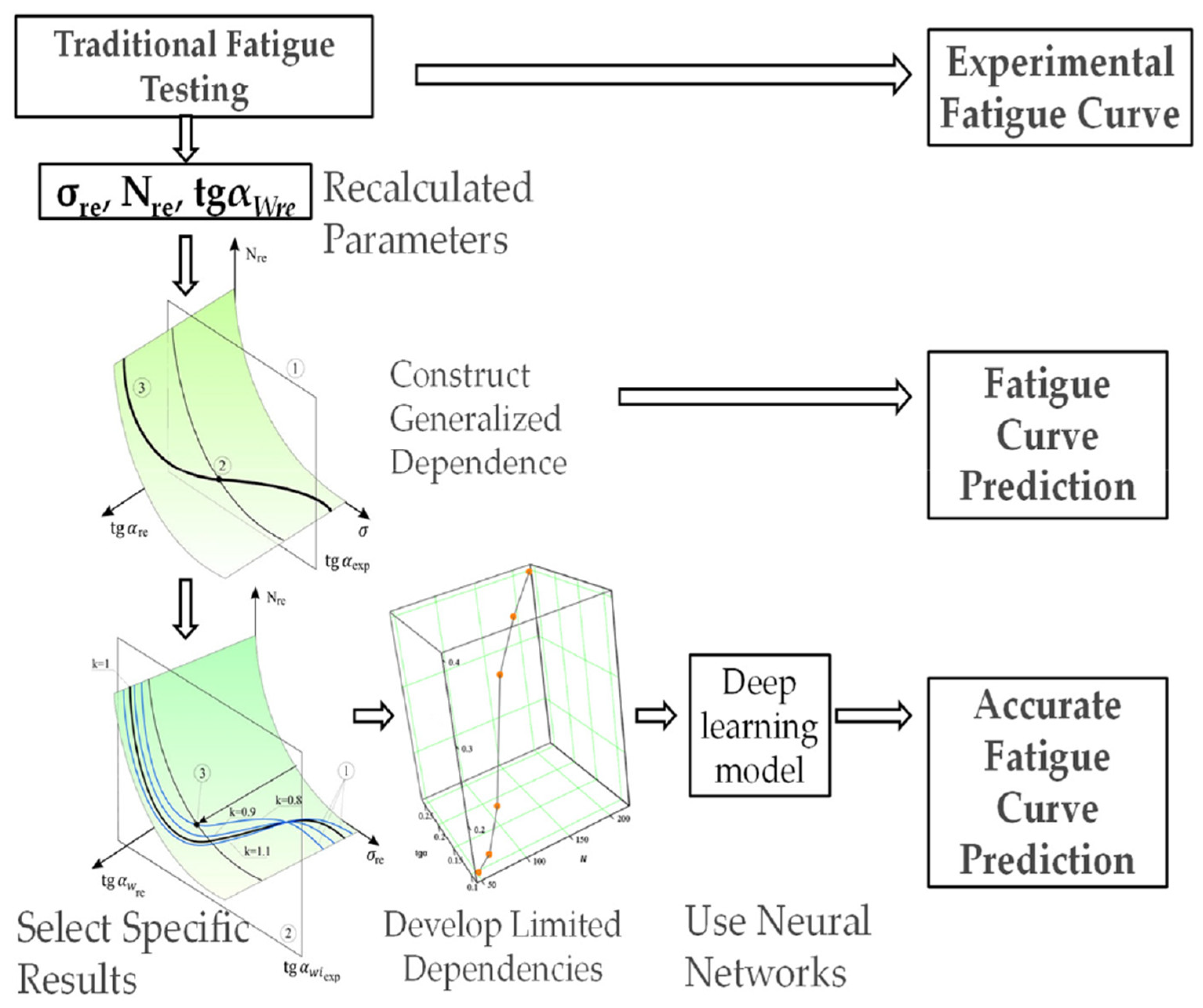
Figure 9 shows a general diagram of the sequential application of methods for predicting high-cycle fatigue parameters, starting from the use of a generalized dependence of the recalculated fatigue parameters and ending with the use of artificial neural networks to generate parameters of limited generalized dependence of the recalculated fatigue parameters.

3. Results

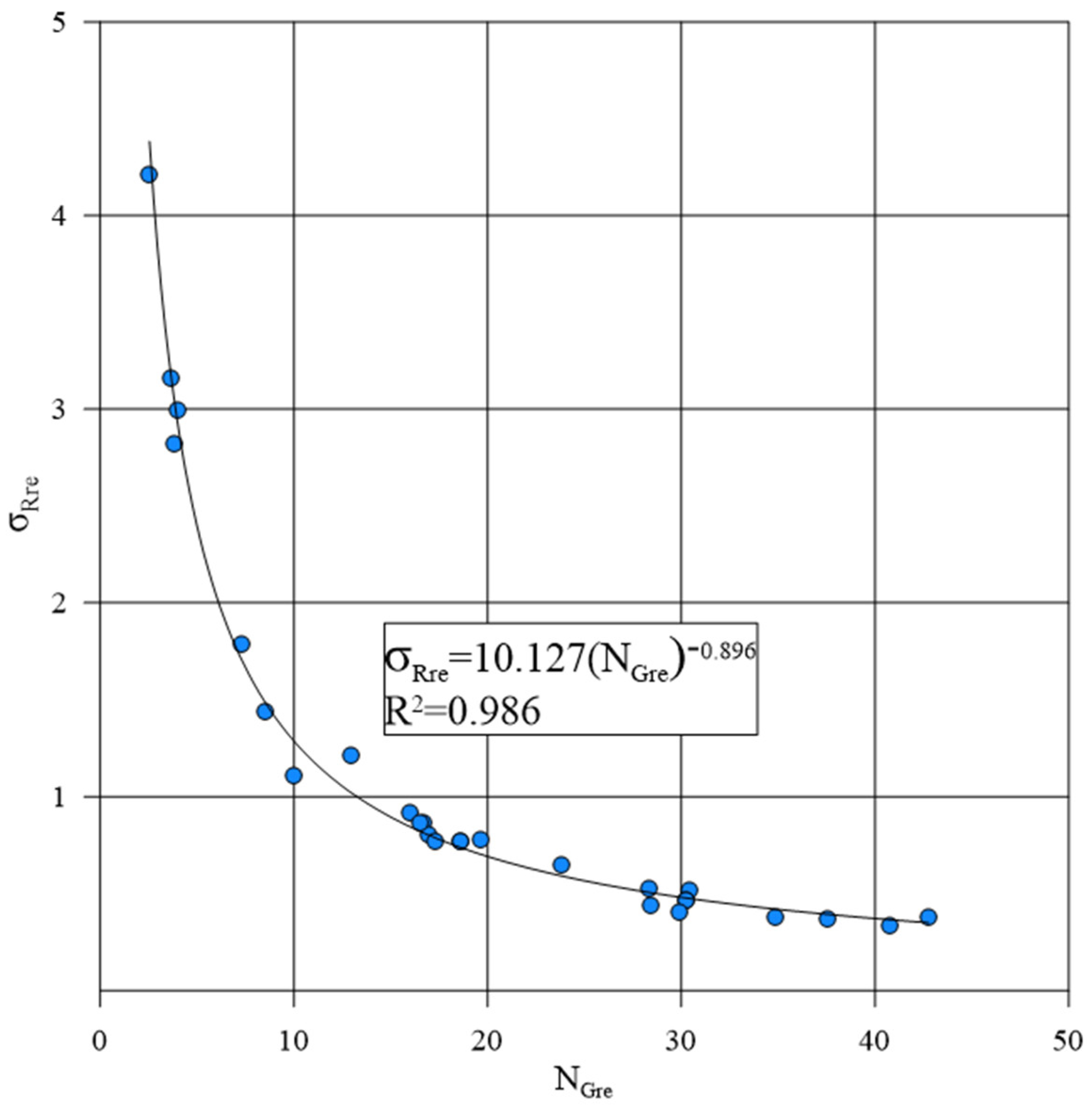
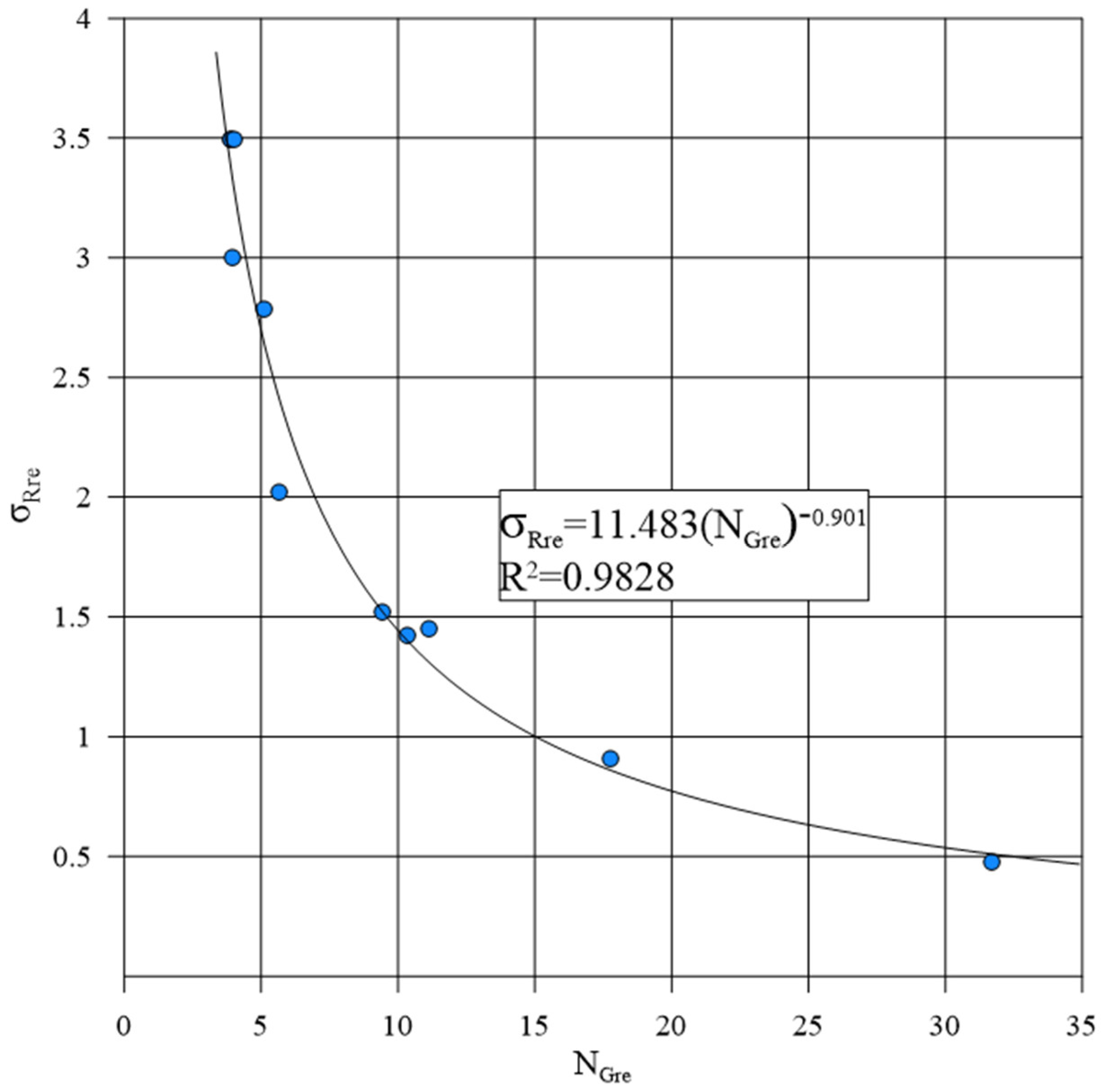
Joint consideration and processing of all S-N curves as a component of relation between recalculated parameters shows their good combination with each other—for all three projections of the generalized dependence, when approximated by an exponential or power dependence, we obtain a high value of the approximation reliability coefficient. However, when trying to use a generalized dependence to predict a specific point (“knee” point) of the S-N curve in the high-cycle area, we obtain an error. This error is due to the fact that too many different combinations of operating factors were considered when obtaining the fatigue curves that make up the database. Therefore, it is necessary to further consider the procedure for selecting the parameters of a generalized dependence that corresponds to the maximum extent of the considered set of operating factors. Various combinations of the factors in play were considered. As an example, let us consider the results of determining the coefficients in some approximating dependencies. Figure 10 shows the results of the evaluation of the approximation coefficients for one of the projections of the limited generalized dependence of the re-calculated variables of S-N life and limit, namely, the recalculated strength on the recalculated S-N limit, constructed for the S-N curves of steel 20 specimens, obtained by various authors and published in their scientific articles [55,56,57,58,59,60,61,62,63,64,65,66,67,68,69,70,71,72,73,74].
Figure 11 shows the results of estimating the approximation coefficients for one of the projections of the generalized dependence of the recalculated fatigue parameters, namely, the dependence of the recalculated strength on the recalculated fatigue life, constructed as a result of comparing the S-N curves for specimens tested in salt water with a concentration of 30 kg NaCl in 1 m3 of water, obtained by various authors and published in their articles [70,71,72,73,74].
Thus, the type of dependencies
N G r e = f t g α W r e
σ R r e = f 1 t g α W r e
σ R r e = f 2 N G r e ,
corresponding to different combinations of active factors was determined.
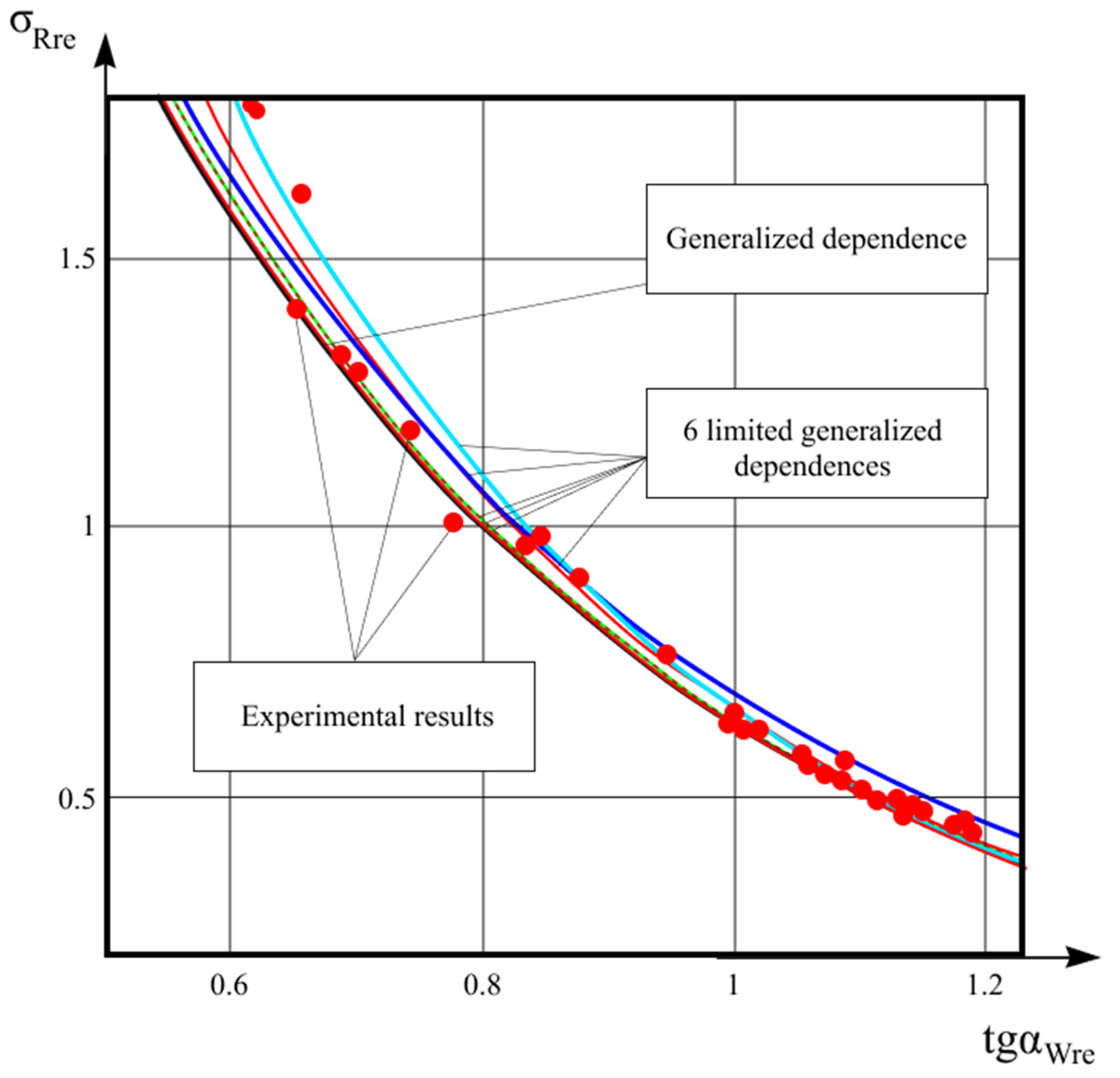
If we consider together in the recalculated space the fatigue curves for which the conditions coincide not by one factor, but by combinations of factors (two or more), then we obtain a set of approximation coefficients corresponding to a more precise adjustment of the prognostic model to the simulated situation. Figure 12 shows one of the projections of the recalculated fatigue parameter dependence. The results of fatigue tests of specimens made of steel 35 are plotted (34 fatigue curves processed and presented in the space of recalculated fatigue parameters [12,13]); generalized dependence and 6 limited generalized dependencies are also shown, which were obtained for various combinations of the acting factors. It is evident from the figure that the forecast error using the generalized dependence of the recalculated fatigue parameters for some fatigue curves is quite large—the points representing the fatigue plots in the recalculated S-N parameter space are quite far away from recalculated fatigue parameter dependence. At the same time, there are limited generalized dependencies that pass through the experimentally obtained results.
Let us consider how the accuracy of the forecast will increase if we select the parameters of the limited generalized dependencies to be closer and closer to the desired combination of factors. To present the results of the error assessment of the location of the “knee” point in the high-frequency region on S-N plot, the following visualization scheme was used. The inaccuracy in determining the value of the recalculated S-N limit and the inaccuracy in determining the value of the recalculated S-N life were calculated.
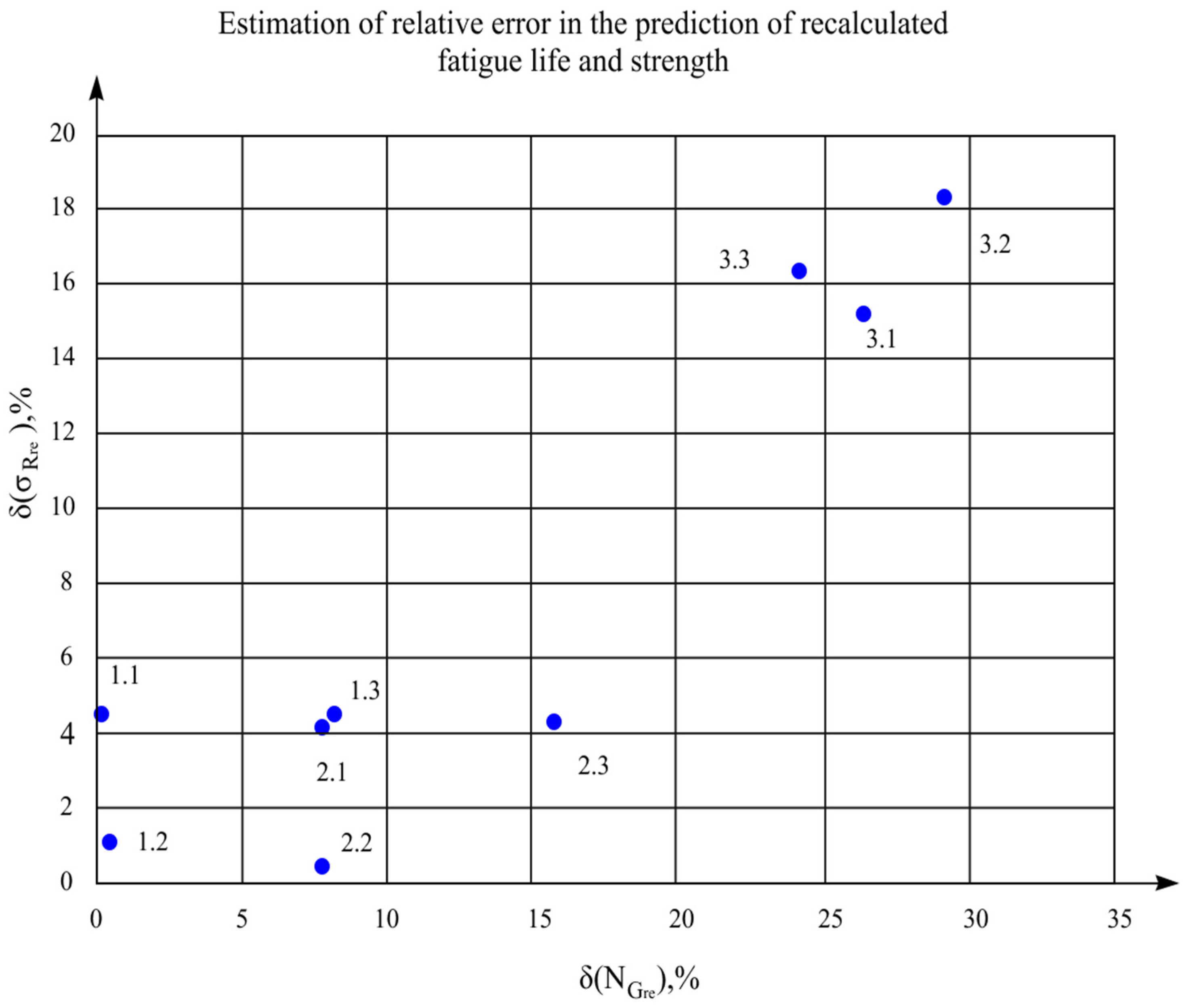
To visualize the results of assessing the accuracy of predicting the location of the fatigue curve breaking point in the high-cycle region using limited generalized dependencies of the recalculated fatigue parameters, the obtained error values were considered as the y and x coordinates for a given point, characterizing the accuracy of prediction. Forty-eight such limited generalized dependencies were generated, some of which are presented in Table 2. The “+” symbol in this table denotes the meaning of the parameter (factor) that is the same for all fatigue curves considered jointly when determining the limited generalized dependency.
The characteristics of the limited generalized dependencies under consideration are presented in Table 2.
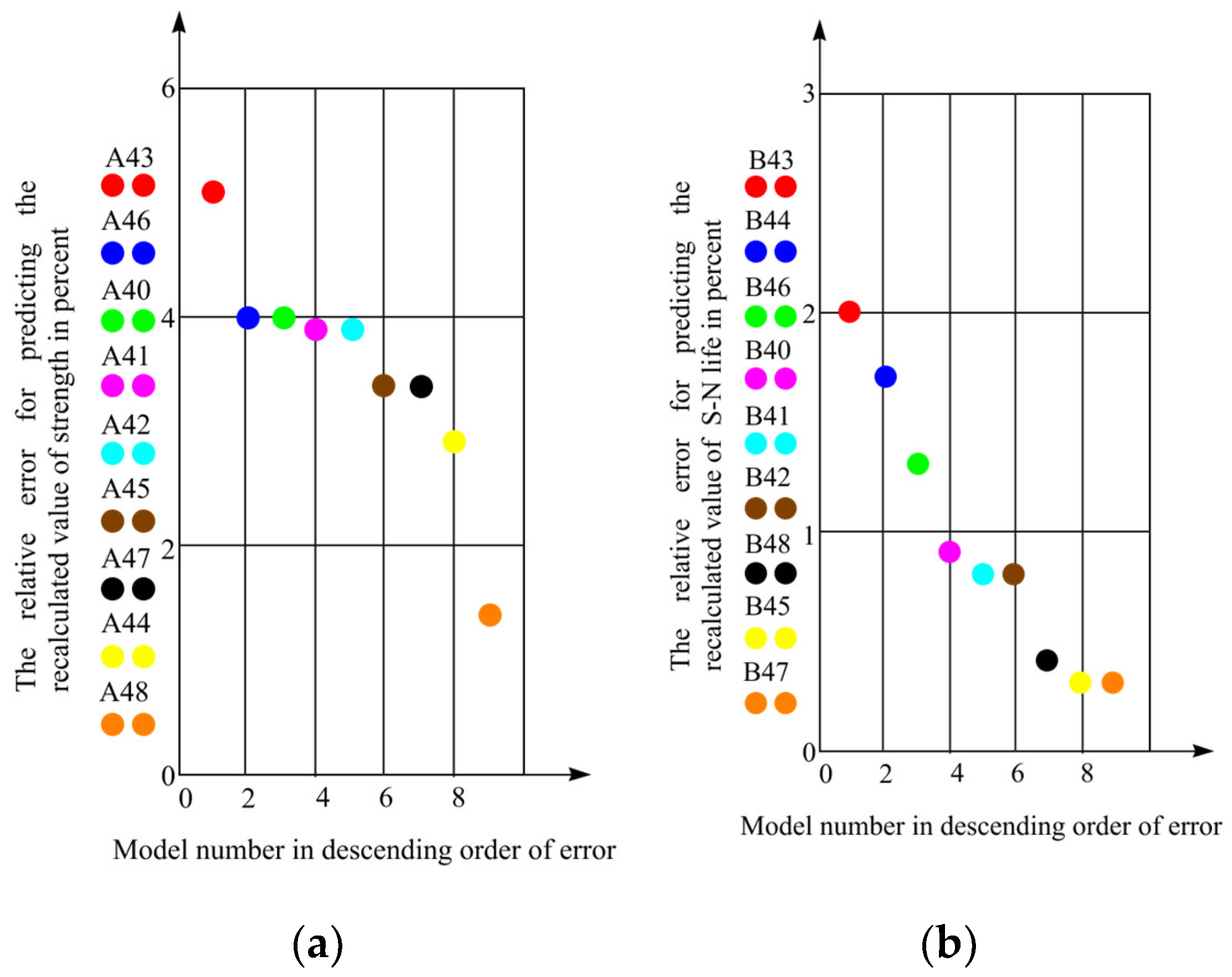
The outcomes of the calculation of the error in specifying the recalculated values of S-N life and limit using limited generalized dependencies are shown in the following Figure 13a,b. The ordinate axis shows the value of the relative error in determining the recalculated fatigue parameters in percent for (a) recalculated strength and (b) recalculated S-N life, and the abscissa axis shows the number of the calculation option according to Table 2.
The prediction of the positions of the S-N plot “knee” point in the high-cycle area was performed for the conditions described in the following studies [75,76,77,78,79,80]. The outcomes of the empirical measurement of S-N life and limit parameters were taken from the same sources, which were then used to assess the accuracy of the forecast. Considering that the generalized dependence is produced by the joint processing of a significant number of empirical results on the fatigue of metals, in the composition of this dependence, there is a conditional “averaging” of all experimental data, which boosts the universality of the dependence, but reduces the accuracy of predicting the fatigue life and limit parameters for a specific set of acting factors. To increase the accuracy of the forecast in the case of considering a specific set of operating factors from among the fatigue curves evaluated together within the general dependence, a selection is made of those S-N plots that were obtained under the conditions of action of the studied sets of factors. A joint consideration of these experimental data (approximating them in the domain of recalculated data, such as fatigue life parameters) enables us to acquire a limited generative relation of the of S-N life and limit recalculated parameters that is more accurately “tuned” to estimate the parameters of stress life and limit under consideration. The accuracy of the prediction of fatigue life and limit parameters was assessed relying on compression techniques of the experimentally obtained values in form of the “knee” point coordinates which were obtained from the S-N curve in the high-cycle area in the case of representing the fatigue curve within a log-coordinate system. The articles [75,76] examine the processes of high-cycle fatigue of structural carbon quality steel grade 20—one of the most used and in-demand materials in industry. In scientific articles [77,78], smooth cylindrical specimens of medium-carbon structural steel 20 in the as-delivered condition were tested. The study was conducted at normal temperature on a MIR-ST testing machine, designed for testing metal specimens for fatigue under uniaxial tension-compression conditions under symmetric and asymmetric loading. In scientific articles [77,78], a comparative analysis of the processing of the results of fatigue tests of specimens made of steel 20 with different technological heredity is presented. Specimens of grade 20 steel were tested for fatigue in the as-delivered condition (ASC), after surface plastic deformation with steel balls oscillating at an ultrasonic frequency (UZF), and also after heat treatment (HT). Table 3 and Figure 13 present the results of the assessment of the accuracy of predicting the recalculated value of S-N limit ( σ R r e ) and S-N life ( N G r e ) for the S-N curve of steel 20 presented in [77] as well as the fatigue curves of steel 20 presented in [78]. The accuracy assessment (calculation of the relative error value— δ ( σ R r e ) and δ ( N G r e ) ) was carried out separately for σ R r e and N G r e using two analytical prognostic models for this purpose—the relation of the recalculated fatigue parameters and a limited generative relation constructed according to the S-N plots of steel 20 selected in set, which was used for assessing the generalized dependence parameters. Table 2 also indicates which coordinate of the points in Figure 13 corresponds to the error value from Table 3.
Table 3 and Figure 14 show that, for the examples considered (fatigue curves for grade 20 steel specimens taken under various thermal and mechanical treatment conditions and tested under different loading schemes), the relative error in determining the recalculated values of fatigue life and fatigue limit does not exceed 16% and 5%, respectively. The use of limited generalized dependencies in most of the cases considered resulted in increased accuracy in determining the recalculated values of the fatigue limit and an increase in the error in determining the recalculated values of fatigue life. In this case, the transition to a limited generalized model, constructed on the basis of data on the fatigue of steel 20, for fatigue curves 2, 3, and 4, leads to an increase in the accuracy in determining the recalculated fatigue strength, but a decrease in the accuracy in determining the recalculated fatigue life, which is possibly associated with the formal assignment in a prior study [80] of the S-N life of the “knee” point in the large cycle area with a value of 106 loading cycles. For fatigue curve 1, a similar change in the level of discrepancy in measuring the recalculated variables of fatigue resistance when moving from one predictive model to another is not observed, since, perhaps, with the error values that were obtained, other factors begin to have an effect than for curves 2–4.
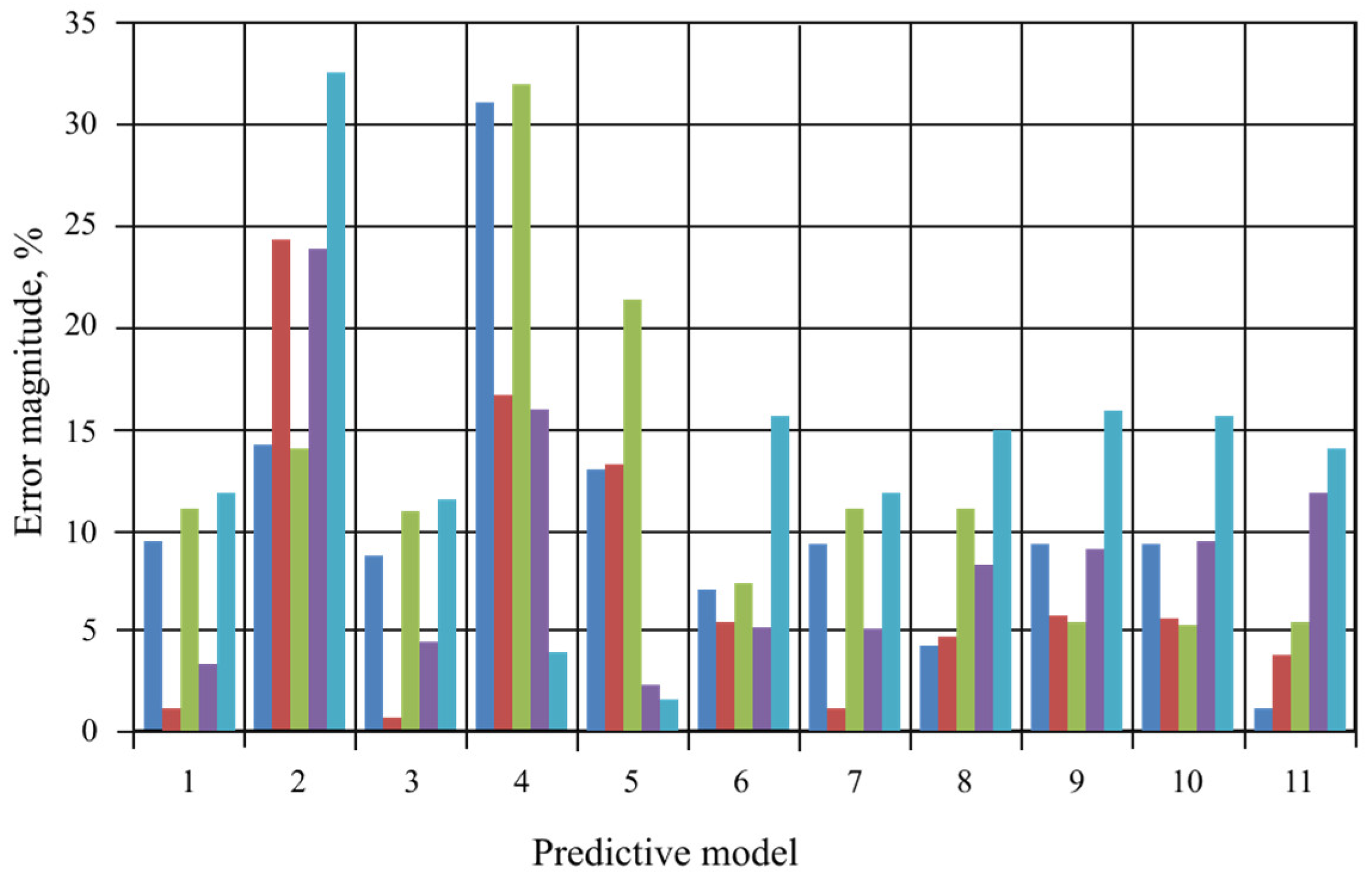
The aim of the work carried out in this study was to evaluate the accuracy of predicting the location of the S-N curve “knee” point in the case of using such predictive analytical models. The results of cyclic loading experiments published in the literature [79,80] were used as initial data for assessing the accuracy of prediction. The experiments examined specimens made of Inconel 718 alloy and ЭП-202 steel (XH67MBTЮ), which were tested under symmetrical and asymmetrical axial loading cycles on smooth specimens and specimens with stress concentrators, with a loading frequency from 35 to 195,000 Hz. Based on the results of these experiments, the position of the left and right branches the S-N curve within a log-coordinate system was assessed, the location of the “knee” point of the S-N plot in the high-cycle area was determined, and the recalculated fatigue strength and life parameters were calculated. In accordance with the procedure for forecasting the S-N limit using the relation between recalculated fatigue parameters, the tangent of the slope of the left branch of the fatigue curve in the high-cycle region is used as an input parameter. This value was determined from experimental results [79]. Knowing it, one can determine the value of the recalculated fatigue strength and life parameters—two other coordinates of the point on the relation between recalculated fatigue parameters in the case of its representation in a three-dimensional area of the recalculated fatigue parameters. Knowing the recalculated fatigue parameters, one can restore the measure of the S-N limit (“knee” point) coordinates in the case of the results being represented in a normal (not recalculated) coordinate system—the value of the S-N strength limit and S-N life (the ordinate and abscissa of the “knee” point of the S-N curve in the case of its representation within a log-coordinate system). The obtained S-N limit coordinates are a predicted value that can be matched against the S-N limit parameters determined experimentally. Figure 15 shows the outcomes of the inaccuracy assessment in determining the value of the recalculated strength (one of the coordinates of the S-N curve “knee” point in the space of recalculated fatigue parameters) in the case of a comparison of the experimentally obtained results and the results of prediction performed using a relationship of the recalculated fatigue parameters or limited broad dependences of the recalculated fatigue parameters. For example, dependences corresponding only to a certain grade of steel or a certain value of the acting factor (for example, the shape of the specimen and the frequency of the acting load) were considered.

4. Discussion

The relationship of the recalculated fatigue strength and life parameters is obtained on the basis of the comparison and joint consideration of numerous experimental S-N curves received with various combinations of the acting factors. This allows us to consider it as a universal dependence describing the high-cycle region of fatigue curves having a “knee” point (physical or limited fatigue limit in the high-cycle areas). The possibility of restoring the traditional form of fatigue parameters from their recalculated analogs allows us to use the generalized dependence of the recalculated fatigue parameters as an analytical prognostic model. An analysis of the results of predicting fatigue curves using this model allows us to conclude that the forecast based on the relationship of the recalculated fatigue parameters may not be accurate enough due to the obvious “averaging” of all data in the model. The selection of a certain set of points of experimental fatigue curves in the composition of limited generalized dependences of the recalculated fatigue parameters allows us to obtain a more accurate forecast. It was found that the use of various limited generalized dependencies allows ranking the factors according to their degree of influence on the position of the S-N curve points (especially the “knee” point of the S-N plot in the high-cycle area). Thus, the proposed algorithm for predicting the parameters of fatigue limit and strength in relation to the “knee” point can be formulated as follows: in the case of accelerated prediction of the fatigue limit, or in the case when the set of factors under study has not been previously studied, the use of the relationship of the recalculated strength and life parameters is justified. The accuracy of such an assessment of the fatigue limit may be relatively low, but it can be expected that the prognostic model will be quite universal. If it is necessary to increase the accuracy of the forecast, it is advisable to select from the generalized dependence (if any) such points (fatigue curves) that were obtained during fatigue tests under the action of sets of acting factors similar to the predicted task. Approximation of such data will allow obtaining limited generalized dependencies of the recalculated S-N parameters, the use of which will increase the accuracy of the forecast. It is possible to assume the following scheme of using the obtained information. The coefficients in the approximating dependencies (limited generalized dependencies of the recalculated fatigue strength and life parameters) correspond to a specific description of the set of acting factors (conditions). Relative analysis, performed for the experimental results (S-N curves corresponding to various combinations of acting factors), can be used as a training specimen for a neural network, which in the process of finding a solution, will form a set of coefficients for the approximating dependencies for which there are no experimental fatigue curves yet.
In the context of S-N curve prediction for fatigue life assessment, the method proposed in this paper, based on a one-dimensional convolutional neural network (CNN), demonstrates comparable and, in some respects, improved performance compared to existing approaches, including the Gaussian variational Bayes network (GVBN) method described in [46].
The GVBN approach, designed for small samples, successfully combines Gaussian processes and variational Bayesian inference, providing high prediction accuracy and uncertainty quantification. It demonstrated superiority over classical models such as BPNN, GPR, and BNN in conditions with limited experimental data, achieving, for example, R2 > 0.92 and low MSE values on test samples. However, GVBN primarily focuses on aggregated stress parameters and simplified load cycle representations, which can limit its ability to capture complex spatiotemporal patterns in the data, especially in the presence of multivariate sequential dependencies.
Unlike GVBN, the proposed CNN method operates on a full-dimensional input representation of 1179 × 14 × 1 dimensions, where 1179 corresponds to the discretized length of the fatigue curve, and 14 includes both loading factors (amplitude, average stress, frequency, etc.) and three normalized coordinates of the curve itself in the rescaled system. This approach allows the model to automatically extract local and global features from the original sequence, including nonlinear interactions between parameters, without the need for manual feature engineering. This is especially important when predicting high-dimensional output (a 4-dimensional vector, for example, describing the parameters of an equivalent curve—limited generalized dependence of the recalculated fatigue parameters), where CNN demonstrates more stable generalization compared to models based on fully connected architectures.
The experimental results show that CNN achieves R2 = 0.941 on the test set with RMSE = 0.038, which exceeds the metrics claimed in the GVBN paper (R2 ≈ 0.923). Furthermore, CNN demonstrates better robustness to noise under cross-validation conditions, which is explained by both architectural features (local weights and shared parameters) and effective regularization (dropout and batch norm). While GVBN provides a natural estimate of uncertainty through Bayesian inference, CNN in the current implementation does not provide probabilistic forecasts, which can be considered a limitation. However, this drawback can be addressed by integrating Bayesian layers or an ensemble strategy. Thus, the proposed CNN approach offers an alternative and competitive approach to fatigue life modeling, particularly in scenarios where detailed processing of sequential data is essential. It complements existing methods by expanding the analytical capabilities through deeper feature extraction and can be particularly useful in transitioning from simplified models to fully parametric fatigue behavior analysis.
The proposed method has obvious limitations. First of all, it is only possible to predict fatigue curves in the high-cycle region assuming that they have a breaking point. Another obvious drawback in the case of using limited generalized dependencies, the parameters of which are estimated based on experimental results rather than using artificial neural networks, is the need for preliminary processing of at least three fatigue curves obtained under similar conditions to estimate parameters A , B , C , and D . In this regard, for example, at present, it is not possible to evaluate the fatigue strength and durability of welded joints using the developed method, since such experimental data were not considered when obtaining the parameters of limited generalized dependencies and the generalized dependency.

5. Conclusions

The paper considers a procedure for predicting the parameters of high-cycle fatigue using a system of predictive models built on the basis of joint processing of empirical information on the stress-cycle degradation of metals. The generation of a family of predictive models, in addition to the relationship of the mentioned fatigue recalculated parameters, and their use for evaluating the location of the break point of the S-N plot in the high-cycle area of the fatigue curve, makes it possible to implement a universal calculation model applicable to various combinations of operating factors, based on the use of heterogeneous empirical information obtained by various researchers. The major results of the investigation can be formulated as follows.
  • The numerous experiments performed up to now on high-cycle fatigue metals have allowed for the accumulation of extensive arrays of empirical information, which, on the one hand, enables the development of methods for predicting the parameters of high-cycle fatigue to account for the influence of individual factors or groups of factors; but, on the other hand, it is not suitable for joint use due to its fragmented nature and the different goals and objectives set by researchers when planning their experimental work. The use of a reduction ore recalculation procedure and the transition from the traditional form of high-cycle fatigue parameters to their recalculated analogs makes it feasible to determine a practically functional dependence for the recalculated parameters of high-cycle fatigue of metals in the case where they have a so-called break point in the high-cycle region of the fatigue curve. This relationship of the recalculated fatigue parameters can be used as a foundation for creating a universal technique for predicting the parameters of high-cycle fatigue. However, the desire to obtain a universal dependence leads, as a consequence, to a decrease in the precision of forecasting the parameters of high-cycle fatigue for a specific set of operating parameters.
  • In order to enhance the accuracy of forecasting high-cycle fatigue strength and life parameters for metals with the help of the relationship of the recalculated parameters of high-cycle fatigue, it is necessary to take into account the deviation of a specific set of recalculated variables of high-cycle fatigue parameters from the average state on the generalized dependence that has been performed using a relationship of the recalculated fatigue parameters. By considering together in the space of recalculated parameters the results of fatigue tests for fatigue curves obtained under identical conditions in the set of operating parameters, it is possible to obtain the parameters of limited generalized dependencies of the recalculated fatigue parameters and the relevant combinations of operating factors. For individual conditions (sets of operating factors), the accuracy of predicting the strength limit value and the fatigue life of the “knee” point in the high-cycle area when constructing the S-N curve within a log-coordinate system are insufficient in all cases. In order to improve the prediction accuracy, it is proposed to select from the generalized dependence such experimental results (fatigue curves) that correspond to certain sets of operating factors and, based on the results of their joint consideration and comparison, to estimate for them the parameters of the relationship of the recalculated fatigue parameters, called limited generalized dependences. The use of such dependences allows for increasing the prediction accuracy. At the same time, as the tuning of the prognostic model to the problem being solved increases, the accuracy in determining the fatigue parameters increases.
  • As a rule, when comparing and generalizing experimental data, it is quite difficult to find the number of fatigue curves obtained under identical conditions to obtain limited generalized dependencies. This complicates the derivation of limited generalized dependencies for any combination of factors. However, the obtained results can already be used as a training set for training an ANN generating parameters for limited generalized dependencies of recalculated fatigue parameters. The somewhat lower prediction accuracy of such an ANN compared to the case of using an experimental limited generalized dependency is compensated for by the versatility of the ANN, which allows estimating parameters for other dependencies even in the absence of the required amount of experimental data.
  • However, the developed method has insurmountable shortcomings related to its specific features. The method is applicable to predicting fatigue curves containing a breakpoint in the high-cycle region. Therefore, the method will be unsuitable for certain materials and conditions where there is no breakpoint in the high-cycle region. It can also be assumed that the absence of experimental data obtained under specific conditions (e.g., under ionizing radiation or for welded specimens) in the generalized dependence of the presented fatigue resistance parameters precludes the use of the developed prediction method for such objects.
  • Conducting verification calculations to assess the accuracy of fatigue curve prediction in the high-cycle region by comparing independent experimental data that were not included in either the generalized dependence or the limited generalized dependences of the recalculated fatigue parameters demonstrated a sufficiently high accuracy of the predictions made. In particular, when using the generalized dependence and limited generalized dependences, the error in determining the recalculated strength did not exceed 5%, and the error in determining the recalculated durability did not exceed 20%. The accuracy of the prediction using limited generalized dependences obviously depends on the correctness of the choice of fatigue curves for obtaining the parameters of the limited generalized dependences, of which there should be at least three to obtain dependences of the same type (exponential functions). Moreover, the evaluation of the parameters of limited generalized dependences makes it possible to form a training sample for an artificial neural network, which can be used to predict fatigue parameters even in the case when a specific set of experimental fatigue curves for estimating the parameters of the limited generalized dependences of the recalculated fatigue parameters is not available. The use of neural network-generated parameters of a limited generalized dependence for the verification calculations considered made it possible to obtain an error in determining the recalculated strength of about 20%, and the recalculated durability of less than 30%.
  • Focusing on generalizing experimental data on metal fatigue published in the literature leads to a lack of the ability to methodically correctly conduct a study, for example, of the influence of various factors on the fatigue curve shift in the space of recalculated fatigue parameters and, consequently, on the fatigue parameters due to the lack of the required amount of data of the required composition in the studied sets of factors. In order to obtain the parameters of a limited generalized dependence, we require a minimum of three fatigue curves. Analyzing the available data for samples made of steel 35, it was revealed that when switching in the calculation from a limited generalized dependence constructed using three coinciding factors to a limited generalized dependence constructed for 9 coinciding factors, the accuracy in determining both the recalculated strength and the recalculated durability increases, respectively, from 5 to 1.2% for the recalculated strength and from 2 to 0.3% for the recalculated durability. The addition of each new coinciding factor in the calculation of the parameters of a limited generalized dependence consistently reduces the error in determining the recalculated fatigue parameters.
  • It is obvious that the practical application of the developed method is associated with the solution of the problem of reducing the testing of laboratory samples and full-scale components due to the accelerated determination of the position of the breaking point of the fatigue curve in the high-cycle region with subsequent experimental verification of the obtained value. The possible absence of limited generalized dependencies calculated on the basis of data from the parameter database is compensated for by the possibility of calculating their values using an artificial neural network. The revealed nature of limited generalized dependencies (in the form of exponential dependencies with two coefficients), on the one hand, simplified the procedure for generating parameters of the artificial neural network, and on the other hand, provides an opportunity for quantitative study of the influence of individual factors and complexes of factors on the position of the fatigue curve in the space of recalculated fatigue parameters, and after recalculating the recalculated fatigue parameters into their traditional form of presentation and for assessing the effect on the fatigue parameters on the endurance limit and on the abscissa of the breaking point of the fatigue curve in the high-cycle region.

Author Contributions

Conceptualization, V.A. and A.K. (Andrey Kurkin); data organization, A.K. (Alexander Khrobostov) and O.A.; logical analysis, V.A. and A.K. (Alexander Khrobostov); investigation, V.A., A.K. (Andrey Kurkin), A.K. (Alexander Khrobostov) and O.A.; methodology, V.A. and A.K. (Andrey Kurkin); software, A.K. (Alexander Khrobostov) and O.A.; supervision, A.K. (Andrey Kurkin); validation, A.K. (Alexander Khrobostov) and O.A.; visualization, A.K. (Alexander Khrobostov) and O.A.; writing—original draft, V.A. and A.K. (Andrey Kurkin); writing—revision and correction, V.A. and A.K. (Andrey Kurkin). All authors have read and agreed to the published version of the manuscript.

Funding

The research was carried out within the Russian state task for fundamental scientific research. Grant number FSWE-2023-0005 “Features and specifics of the use of heavy liquid metal coolants in fast neutron reactor plants”.

Data Availability Statement

The original contributions presented in this study are included in the article. Further inquiries can be directed to the corresponding author.

Conflicts of Interest

The authors declare no conflicts of interest.

Abbreviations, Designations and Symbols

The following abbreviations, designations, and symbols are used in this manuscript:
AIArtificial Intelligence
A , B , C , D Coefficients in approximating exponential dependencies linking the recalculated values of the fatigue limit and the abscissa of the inflection point of the fatigue curve with the structurally sensitive parameter of fatigue expressed in the form of the tangent of the angle of inclination of the left branch of the fatigue curve to the axis of the number of cycles in the high-cycle region
ANNArtificial Neural Network
ASCAs-delivered condition
BNNBayesian neural network
BPNNBackpropagation Neural Network
CNNConvolutional Neural Network
GANGenerative Adversarial Networks
GPRGaussian Process Regression
GVBNGaussian Variational Bayes Network
HTHeat treatment
HVVickers Hardness
kThe index of the generalized dependence in the family. k = 1 corresponds to the generalized dependence of the recalculated fatigue parameters. Other values of k correspond to various limited generalized dependences.
KLSLoading scheme coefficient
KSFThe shape factor of the cross-section of the specimen
KSGSteel grade coefficient
KTTemperature coefficient
“knee” pointThe inflection point (breaking point) of the fatigue curve in the high-cycle region when represented in a system of logarithmic coordinates
LPMsLifetime prediction methods
MLMachine learning
MSEMean squared error
NLSThe serial number of the loading scheme in the coding table
NSThe serial number of the cross-sectional shape in the coding table
NSGThe serial number of the steel grade in the coding table
ReLURectified Linear Unit—activation function in deep learning
RMSERoot Mean Squared Error
S-N curve
(S-N plot)
Fatigue curve in the coordinate system “stress–number of cycles”. In this article, in most cases, we mean the high-cycle region of the fatigue curve, constructed in a logarithmic (sometimes called “double logarithmic” in the literature) coordinate system
UZFUltrasonic frequency
VAEVariational Autoencoder
σ в Short-term tensile strength, [MPa]
δ Elongation at break, [%]
ρ Density, [kg/m3]
σ Stress, [MPa]
N Loading cycle number
l g σ * A conditional, physically unrealizable value of the decimal logarithm of the stress at which the extended left branch of the fatigue curve from the high-cycle region intersects the ordinate axis in a logarithmic coordinate system
l g N * A conditional, physically unrealizable value of the decimal logarithm of the number of cycles at which the extended left branch of the fatigue curve from the high-cycle region intersects the abscissa axis in a logarithmic coordinate system
σ R The stress, [MPa], corresponding to the fatigue limit
l g σ R The ordinate of the fatigue curve breaking point in the field of high-cycle fatigue
l g N G The abscissa of the fatigue curve breaking point in the field of high-cycle fatigue
T g α W The slope of the left branch of the fatigue curve in a semi-logarithmic coordinate system
t g α W The structure-sensitive parameter of metal fatigue in a logarithmic coordinate system—the slope of the left branch of the fatigue curve in a logarithmic coordinate system
Recalculated fatigue parameters:
σ r e Recalculated strength
N r e Recalculated fatigue life
t g α W r e Recalculated inclination angle
σ R e x p
N G e x p
t g α W e x p
Fatigue parameters corresponding to the breaking point of the fatigue curve in the high-cycle region, presented in a logarithmic coordinate system, experimentally obtained
σ R r e
N G r e
t g α W r e
Recalculated fatigue parameters corresponding to the breaking point of the fatigue curve in the high-cycle region, presented in a logarithmic coordinate system
σ R r e . e x p
N G r e . e x p
t g α W r e . e x p
Recalculated fatigue parameters corresponding to the breaking point of the fatigue curve in the high-cycle region, presented in a logarithmic coordinate system, experimentally obtained
σ R r e . g e n
N G r e . g e n
Predicted values of the recalculated fatigue parameters corresponding to the breaking point of the fatigue curve in the high-cycle region, obtained using the generalized dependence of the recalculated fatigue parameters and the experimentally obtained value tgαWre.exp
σ R r e . l i m . g e n
N G r e . l i m . g e n
Predicted values of the recalculated fatigue parameters corresponding to the breaking point of the fatigue curve in the high-cycle region, obtained using the limited generalized dependence of the recalculated fatigue parameters and the experimentally obtained value tgαWre.exp
δ ( σ R r e . g e n ) The errors in determining the fatigue parameters using the generalized dependence of the recalculated fatigue parameters
δ ( N G r e . g e n )
δ ( σ R r e . l i m . g e n ) The errors in determining the fatigue parameters using the limited generalized dependence of the recalculated fatigue parameters
δ ( N G r e . l i m . g e n )
δ ( σ R r e ) The errors in determining the recalculated fatigue parameters
δ ( N G r e )

References

  1. Chapetti, M.D.; Gubeljak, N.; Kozak, D. Intrinsic Fatigue Limit and the Minimum Fatigue Crack Growth Threshold. Materials 2023, 16, 5874. [Google Scholar] [CrossRef]
  2. Fukami, M.; Oguma, N.; Guennec, B.; Horikawa, N.; Sakai, T. Effects of Loading Modes on Fatigue Limit Estimation in Terms of Rotating Bending Fatigue and Rate Process Theory. Appl. Sci. 2024, 14, 477. [Google Scholar] [CrossRef]
  3. Zhang, L.; Wang, G.; Ji, X.; Zhang, S.; Lei, H. Study on Axial Fatigue Performance and Life Prediction of High-Strength Bolts at Low Temperatures. Buildings 2024, 14, 2615. [Google Scholar] [CrossRef]
  4. Sun, Y.; Peng, X.; Bi, G. Study on S-N Curve and Fatigue Limit of Drill Pipe in Offshore Short-Radius Sidetracking Process. Processes 2024, 12, 1828. [Google Scholar] [CrossRef]
  5. Ewing, J.A.; Humfrey, J.W.C. The fracture of metals under repeated alternations of stress. Philos. Trans. R. Soc. 1903, 200, 241–253. [Google Scholar] [CrossRef]
  6. Troshchenko, V.T. Fatigue and Inelasticity of Metals; Dumka Sciences: Kyiv, Ukraine, 1971. [Google Scholar]
  7. Troshchenko, V.T. High-Cycle Fatigue and Inelasticity of Metals. In Multiaxial Fatigue Design; ESIS 21; Pineau, A., Gailletaud, G., Lindley, T.E., Eds.; Mechanical Engineering Publications: London, UK, 1996; pp. 335–358. [Google Scholar]
  8. Grebenik, V.M. Fatigue Strength and Durability of Metallurgical Equipment; Mashinostroenie: Moscow, Russia, 1969; 256p. [Google Scholar]
  9. Shetulov, D.I. On the assessment of fatigue resistance of metals based on damage to surface anomalous layers. Phys.–Chem. Mech. Materials 1984, 6, 117. [Google Scholar]
  10. Shetulov, D.I.; Andreev, V.V. Forecasting the durability of machine parts according to non-standard physical and mechanical parameters of structural materials. Izv. Akad. Nauk USSR. Met. 1998, 3, 55–59. [Google Scholar]
  11. Shetulov, D.I.; Andreev, V.V.; Myasnikov, A.M. Dislocation model of nucleation and development of slip bands and their effect on service life of structural materials subject to cyclic loading. Phys. Atom. Nuclei 2015, 78, 1374–1381. [Google Scholar] [CrossRef]
  12. Troshchenko, V.T.; Sosnovsky, L.A. Fatigue Resistance of Metals and Alloys; Nauk. Dumka: Kyiv, Ukraine, 1987; 1303p. [Google Scholar]
  13. Andreev, V.V. Endurance Limit of Metals on the Generalized Dependence of the Reduced Parameters of Fatigue Resistance; Nizhny Novgorod State Technical University: Nizhny Novgorod, Russia, 2003; 304p. [Google Scholar]
  14. Papuga, J. New technologies for sharing research data and costs. Procedia Eng. 2010, 2, 855–864. [Google Scholar] [CrossRef]
  15. Papuga, J. A survey on evaluating the fatigue limit under multiaxial loading. Int. Jnl. Fatigue 2011, 33, 153–165. [Google Scholar] [CrossRef]
  16. Papuga, J.; Parma, S.; Lutovinov, M.; Růžička, M. Building a Foundation for Benchmarks for Fatigue Prediction Methods—The FinLiv Database. Procedia Eng. 2015, 101, 372–379. [Google Scholar] [CrossRef]
  17. IMA Dresden. WIAM® METALLINFO Criteria of Choice. Available online: https://wiam.de/en/products/wiam-metallinfo/ (accessed on 1 June 2025).
  18. Available online: https://www.matdat.com/Contact.aspx (accessed on 1 June 2025).
  19. Guo, Q.; Ma, H.; Lu, Y.; Wang, S.; Chen, Q. Experimental study on fatigue performance of corroded high-strength bolts under axial force. J. Constr. Steel Res. 2023, 207, 107952. [Google Scholar] [CrossRef]
  20. Jung, D.H.; Kwon, J.K.; Woo, N.S.; Kim, Y.J.; Goto, M.; Kim, S. S–N Fatigue and Fatigue Crack Propagation Behaviors of X80 Steel at Room and Low Temperatures. Metall. Mater. Trans. A 2014, 45, 654–662. [Google Scholar] [CrossRef]
  21. Guennec, B.; Ueno, A.; Sakai, T.; Takanashi, M.; Itabashi, Y. Effect of the loading frequency on fatigue properties of JIS S15C low carbon steel and some discussions based on micro-plasticity behavior. Int. J. Fatigue 2014, 666, 29–38. [Google Scholar] [CrossRef]
  22. Bennett, P.E. Parameter Representation of Low-Temperature Yield Behavior of Body-Centered Cubic Transition Metals. J. Fluids Eng. 1966, 88, 518–524. [Google Scholar] [CrossRef]
  23. Nishihara, T.; Murase, O. The Effects of the repeating Speeds on the Fatigue of metallic Materials. Trans. Jpn. Soc. Mech. Eng. 1951, 17, 107–113. [Google Scholar] [CrossRef]
  24. Ando, Z.; Kato, Y.; Watari, H. An Experiment on Fatigue of Low Carbon Steel at High Temperatures. Trans. Jpn. Soc. Mech. Eng. 1956, 22, 851–855. [Google Scholar] [CrossRef]
  25. Tsutsumi, N.; Murakami, Y.; Doquet, V. Effect of test frequency on fatigue strength of low carbon steel. Fatigue Fract. Eng. Mater. Struct. 2009, 32, 473–483. [Google Scholar] [CrossRef]
  26. Gusenkov, A.P. Strength Under Isothermal and Nonisothermal Loading; Nauka: Moscow, Russia, 1979; 295p. [Google Scholar]
  27. Andreev, V.V. A method for assessing the fatigue resistance of metals based on the reduction procedure. News Univ. Ferr. Metall. 2005, 9, 68. [Google Scholar]
  28. Kurkin, A.; Khrobostov, A.; Andreev, V.; Andreeva, O. Assessing and Forecasting Fatigue Strength of Metals and Alloys under Cyclic Loads. Materials 2024, 17, 1489. [Google Scholar] [CrossRef] [PubMed]
  29. Andreev, V.V. Diagnosis of changes in material structure using generalized fatigue resistance criteria. Control Diagn. Mech. Eng. 2005, 6, 61–64. [Google Scholar]
  30. Andreev, V.; Andreeva, O. Generalization of Experimental Information and identification of Patterns in the Behavior of Metals and Alloys under Fatigue Loading Based on the Mapping of Fatigue Curves into Reduced Spaces. GraphiCon 2019—Computer Graphics and Vision. In Proceedings of the 29th International Conference on Computer Graphics and Vision, Bryansk, Russia, 23–26 September 2019; pp. 256–260. [Google Scholar] [CrossRef]
  31. Weber, F.; Wagner, A.; Koziol, J.; Weber, F.; Broeckmann, C.; Starke, P. Consideration of Statistical Approaches Within the Accelerated Assessment of Fatigue Properties of Metallic Materials. Metals 2025, 15, 191. [Google Scholar] [CrossRef]
  32. Weber, F.; Wu, H.; Starke, P. A new short-time procedure for fatigue life evaluation based on the linear damage accumulation by Palmgren–Miner. Int. J. Fatigue 2023, 172, 107653. [Google Scholar] [CrossRef]
  33. Weber, F.; Maul, M.; Juner, F.; Starke, P. A nonlinear lifetime prediction method for un- and low alloyed steels by damage determination based on non-destructive measurement techniques. Fatigue Fract. Eng. Mater. Struct. 2024, 47, 1566–1583. [Google Scholar] [CrossRef]
  34. Wu, B.; Wei, Q.; Yang, Y.; Kou, Y.; Li, X. A new fatigue damage prediction model applicable to multi-slope S-N curves. Appl. Ocean. Res. 2024, 149, 104050. [Google Scholar] [CrossRef]
  35. Murakami, Y.; Takagi, T.; Wada, K.; Matsunaga, H. Essential structure of S-N curve: Prediction of fatigue life and fatigue limit of defective materials and nature of scatter. Int. J. Fatigue 2021, 146, 106138. [Google Scholar] [CrossRef]
  36. Zhang, D.; Li, X.; Han, X.; Zhang, Q.; Wang, S. Unified fatigue life prediction method for Q450NQR1 lockbolt joints using structural stress. J. Constr. Steel Res. 2025, 227, 109333. [Google Scholar] [CrossRef]
  37. Li, J.; Cao, X.; Chen, R.; Zhao, C.; Li, Y.; Huang, X. Prediction of remaining fatigue life of metal specimens using data-driven method based on acoustic emission signal. Appl. Acoust. 2023, 211, 109571. [Google Scholar] [CrossRef]
  38. Bai, S.; Huang, T.; Li, Y.-F.; Lu, N.; Huang, H.-Z. A probabilistic fatigue life prediction method under random combined high and low cycle fatigue load history. Reliab. Eng. Syst. Saf. 2023, 238, 109452. [Google Scholar] [CrossRef]
  39. Rana, H.; Ibrahimbegovic, A. A Hybrid Physics-Informed and Data-Driven Approach for Predicting the Fatigue Life of Concrete Using an Energy-Based Fatigue Model and Machine Learning. Computation 2025, 13, 61. [Google Scholar] [CrossRef]
  40. Fan, J.-L.; Zhu, G.; Zhu, M.-L.; Xuan, F.-Z. A data-physics integrated approach to life prediction in very high cycle fatigue regime. Int. J. Fatigue 2023, 176, 107917. [Google Scholar] [CrossRef]
  41. Yang, D.; Jin, A.; Li, Y. A Novel Physics-Guided Neural Network for Predicting Fatigue Life of Materials. Appl. Sci. 2024, 14, 2502. [Google Scholar] [CrossRef]
  42. Liu, Z.; Li, X.; Wang, Z.; Li, B.; Liu, K.; Wang, L. Multiaxial Fatigue Life Prediction of Metallic Specimens Using Deep Learning Algorithms. Comput. Mater. Continua. 2025, 86, 1–18. [Google Scholar] [CrossRef]
  43. Zhang, S.; Xia, J.; Chen, K.; Zhang, D. A hybrid model based on LSTM-CNN combined with attention mechanism for MPC concrete strength prediction. J. Build. Eng. 2024, 97, 110779. [Google Scholar] [CrossRef]
  44. Tognan, A.; Patanè, A.; Laurenti, L.; Salvati, E. A Bayesian defect-based physics-guided neural network model for probabilistic fatigue endurance limit evaluation. Comput. Methods Appl. Mech. Eng. 2024, 418, 116521. [Google Scholar] [CrossRef]
  45. He, G.; Zhao, Y.; Yan, C. Uncertainty quantification in multiaxial fatigue life prediction using Bayesian neural networks. Eng. Fract. Mech. 2024, 298, 109961. [Google Scholar] [CrossRef]
  46. Zhang, H.; Deng, Y.; Chen, F.; Luo, Y.; Xiao, X.; Lu, N.; Liu, Y.; Deng, Y. Fatigue life prediction for orthotropic steel bridge decks welds using a Gaussian variational bayes network and small sample experimental data. Reliab. Eng. Syst. Saf. 2025, 264, 111406. [Google Scholar] [CrossRef]
  47. Gonchar, A.V.; Andreeva, O.V.; Anosov, M.S. Study of fatigue failure of construction steels by using modern methods of digital processing of microstructural images. Mater. Today Proc. 2021, 38, 1701–1705. [Google Scholar] [CrossRef]
  48. He, G.; Zhao, Y.; Yan, C. A data augmentation method for multiaxial fatigue life prediction based on physics-informed tabular generative adversarial network. J. Phys. Conf. Ser. 2024, 2816, 012048. [Google Scholar] [CrossRef]
  49. He, G.; Zhao, Y.; Yan, C. A physics-informed generative adversarial network framework for multiaxial fatigue life prediction. Fatigue Fract. Eng. Mater. Struct. 2023, 46, 4036–4052. [Google Scholar] [CrossRef]
  50. Chen, D.; Li, Y.; Liu, K.; Li, Y. A physics-informed neural network approach to fatigue life prediction using small quantity of samples. Int. J. Fatigue 2023, 166, 107270. [Google Scholar] [CrossRef]
  51. Arvanitis, K.; Nikolakopoulos, P.; Pavlou, D.; Farmanbar, M. Machine learning-based fatigue lifetime prediction of structural steels. Alex. Eng. J. 2025, 125, 55–66. [Google Scholar] [CrossRef]
  52. Li, S.; Zhan, Z.; Zou, J.; Wang, Z. Research on Fatigue Life Prediction Method of Spot-Welded Joints Based on Machine Learning. Materials 2025, 18, 3542. [Google Scholar] [CrossRef] [PubMed]
  53. Schubnell, J.; Fliegener, S.; Rosenberger, J.; Feth, S.; Braun, M.; Beiler, M.; Baumgartner, J. Data-driven fatigue assessment of welded steel joints based on transfer learning. Weld World 2025, 69, 2223–2238. [Google Scholar] [CrossRef]
  54. Jie, Z.; Zheng, H.; Zhang, L. Machine learning-based fatigue life prediction of double-sided U-rib welded joints considering multiple factors. Int. J. Fatigue 2025, 201, 109187. [Google Scholar] [CrossRef]
  55. Zhukov, V.A.; Morinets, T.K. Evaluation of the Effect of Plastic Deformation on the Damageability of Materials by the Nature of Changes in Fatigue Strength. In Strength of Metals Under Cyclic Loads; Nauka: Moscow, Russia, 1967; pp. 76–82. [Google Scholar]
  56. Zamikhovskiy, V.S. Endurance of steels with different carbon content after diffusion boriding. Phys.-Chem. Mech. Mater. 1968, 3, 368–369. [Google Scholar]
  57. Liskevich, I.Y.; Tkachenko, N.N.; Babei, Y.I.; Karpenko, G.V. Effect of the method of smelting low-carbon steel on its static and cyclic strength at elevated temperatures. Phys.-Chem. Mech. Mater. 1968, 4, 467–470. [Google Scholar]
  58. Pokhmurskii, V.I.; Krokhmalny, A.M.; Yurkiv, O.N. Study of the process of corrosion fatigue of steels with anodic coatings. Phys.-Chem. Mech. Mater. 1974, 3, 57–61. [Google Scholar]
  59. Karpenko, G.V.; Tkachenko, N.N.; Koliushko, B.F.; Zafiiovskii, Y.M.; Tabinskii, K.P. Methodology of corrosion fatigue tests of materials with rigid loading in environments at elevated temperatures and pressures. Phys.-Chem. Mech. Mater. 1971, 2, 82–84. [Google Scholar]
  60. Bichuya, A.L.; Toropovskaya, I.N. Evaluation of protective properties of structural metals in the Pb-Vi eutectic. Phys.-Chem. Mech. Mater. 1972, 3, 55–59. [Google Scholar]
  61. Svistun, R.P. Effect of specimen sizes on the cyclic strength of steel under pulsating tension. Phys.-Chem. Mech. Mater. 1982, 2, 114–116. [Google Scholar]
  62. Levitsky, M.O.; Kalichak, T.N.; Zaverbny, D.M.; Pokhmursky, V.I. Machine for fatigue testing of flat specimens under soft and hard loading. Phys.-Chem. Mech. Mater. 1981, 6, 116–117. [Google Scholar]
  63. Koliushko, B.F.; Liskevich IYu Kalichak, T.N.; Potapov, V.V. Corrosion-fatigue failure of low-carbon and austenitic stainless steel at elevated temperatures and periodic exposure to working environments. Phys.-Chem. Mech. Mater. 1973, 2, 14–16. [Google Scholar]
  64. Tkachenko, N.N.; Kulban, B.I.; Svistun, R.P. On the mechanism of the environment’s effect on the cyclic strength of steels. Phys.-Chem. Mech. Mater. 1976, 1, 74–81. [Google Scholar]
  65. Bolotin, V.V. Fundamentals of the Theory of Reliability of Mechanical Systems. Strength. Stability. In Oscillations: Reference: In 3 Volumes; Birger, I.A., Panovko, Y.G., Eds.; Mashinostroenie: Moscow, Russia, 1968; Volume 1, pp. 164–182. [Google Scholar]
  66. Babey, Y.I.; Slobodjan, Z.V.; Soprunyuk, N.G.; Romanova, L.Y. Inhibitory protection of heat exchange equipment. Phys.-Chem. Mech. Mater. 1982, 6, 67–69. [Google Scholar]
  67. Pavlov, P.A.; Kadyrbekov, B.A.; Ainabekov, A.I. Study of the effect of high-parameter water on the kinetics of multi-cycle fatigue damage to steel. Probl. Strength 1983, 12, 11–14. [Google Scholar]
  68. Ivanets, V.I. Influence of grinding type and absolute dimensions of parts on corrosion-fatigue strength of steel. Phys.-Chem. Mech. Mater. 1975, 5, 85–88. [Google Scholar]
  69. Karpenko, G.V.; Pokhmursky, V.I.; Kalichak, T.N. Methodology for testing materials for fatigue at elevated temperatures and periodic wetting with a liquid corrosive medium. Plant Lab 1971, 10, 1234–1245. [Google Scholar]
  70. Karpenko, G.V.; Pokhmursky, V.I.; Kalichak, T.N. Efficiency of strengthening martensitic stainless steels by surface plastic deformation. Vestn. Mech. Eng. 1972, 10, 70–72. [Google Scholar]
  71. Kalichak, T.N.; Pokhmursky, V.I.; Poberezhny, Y.L.; Alekseenko, M.F.; Mel’nikova, N.N. Effect of some galvanic and non-metallic coatings on the endurance of martensitic stainless steel. Phys.-Chem. Mech. Mater. 1972, 4, 12–15. [Google Scholar]
  72. Karpenko, G.V.; Kalichak, T.N.; Pokhmursky, V.I.; Galkun, S.I.; Oleinik, T.F. On the stability of surface work hardening on martensitic stainless steels. Phys.-Chem. Mech. Mater. 1971, 2, 113–115. [Google Scholar]
  73. Taraevsky, S.I.; Kuslitsky, A.B. Fracture of rod steels in a hydrogen sulfide-containing environment. Phys.-Chem. Mech. Mater. 1983, 3, 88–89. [Google Scholar]
  74. Kamenev, A.S.; Loshak, M.G.; Smaglenko, F.P. Increasing the corrosion-fatigue strength of 20Kh13 and 09Kh17N7Yu steels used for the manufacture of propeller shafts. Phys.-Chem. Mech. Mater. 1978, 2, 84–88. [Google Scholar]
  75. Volkov, I.A.; Igumnov, L.A.; Shishulin, D.N.; Boev, E.V. Numerical modeling of fatigue life of structural steels under single-frequency and dual-frequency loading. Bull. Russ. Acad. Sci. Solid State Mech. 2022, 1, 103–121. [Google Scholar] [CrossRef]
  76. Volkov, I.A.; Igumnov, L.A.; Sikarev, S.N.; Shishulin, D.N.; Volkov, A.I. Modeling the fatigue life of polycrystalline structural alloys under the combined action of low- and high-cycle fatigue mechanisms. Probl. Strength Plast. 2019, 81, 305–323. [Google Scholar]
  77. Bezhenov, S.A.; Bezhenov, A.I. On the issue of geometric and energy interpretation of parameters of the multi-cycle fatigue diagram. Bull. Engine Build. 2006, 1, 45–52. [Google Scholar]
  78. Bezhenov, S.A.; Sobolevskaya, T.D. Study of the influence of chemical composition and structure of carbon steels on the characteristics of fatigue resistance. New Mater. Technol. Metall. Mech. Eng. 2007, 1, 20–26. [Google Scholar]
  79. Zavoichinskaya, E.B.; Kablin, A.R. On unified continuous fatigue curves of different scale-structural levels under multi- and gigacycle loading of metals and alloys. Bulletin of Tula State University. Tech. Sci. 2023, 7, 130–134. [Google Scholar]
  80. Nguyen Ngoc, T.; Kapralov, V.M.; Kolenko, G.S. Influence of loading frequencies on the fatigue resistance of materials. Sci. Tech. Statements St. Petersb. Polytech. Univ. Nat. Eng. Sci. 2019, 25, 68–77. [Google Scholar] [CrossRef]
Figure 1. Representation of the S-N curve of metals as a result of the combined action of a complex of metallurgical, structural, technological, design, and operational factors.
Metals 15 01384 g001
Figure 2. (a) Etch pits of dislocations emerging on the surface of an aluminum single crystal before testing (primarily edge-oriented dislocations); (b) “Thin” slip bands on the surface of an aluminum single crystal after cyclic loading. The single crystal is the same as in (a), with σ = 60 MPa and N = 1.7 × 10⁶ cycles.
Metals 15 01384 g002
Figure 3. (a) Asymmetric etch pits of dislocations emerging on the surface of an aluminum single crystal before testing (predominantly screw-oriented dislocations); (b) wide, sinuous, and discontinuous slip bands on the surface of a single-crystal aluminum specimen. The single crystal is the same as in (a), with σ = 60 MPa and N = 1.3 × 10⁶ cycles.
Metals 15 01384 g003
Figure 4. Comparison of the values of the fatigue limit σ R and the structurally sensitive parameter of fatigue t g α W (Adapted from Refs. [12,13], the number of points on the graph corresponds to the number of fatigue curves considered—1179).
Metals 15 01384 g004
Figure 5. A simplified scheme of the predictive methodology for calculating the high-cycle fatigue parameters of alloys and metals. ① A geometric plane matching to the angle of tilt ( t g α W e x p ) of the left-hand part of the S-N curve founded by calculation or experiment. ② The result of determining the position of the fatigue limit on the generalized dependence of the recalculated fatigue parameters, which is shown by symbol ③. The obtained coordinates of the intersection point ② ( σ R r e   ,   N G r e ,   t g α W r e ) are then used to calculate the coordinates of the fatigue curve breaking point in the logarithmic coordinate system “ l g σ - l g N ”– l g σ R   ,   l g N G and to construct the predicted fatigue curve in the high-cycle region.
Metals 15 01384 g005
Figure 6. The sequence of operations when using a simplified method for predicting S-N curves based on recalculating the fatigue parameters of metals.
Metals 15 01384 g006
Figure 7. A refined modification of the prediction method: ①—the result of assessing the position of limited generalized dependencies (the line designated as k = 1 corresponds to a generalized relation of the recalculated fatigue parameters; the remaining lines are obtained by comparing different sets of S-N curves and schematically represent limited generalized dependencies of the recalculated fatigue parameters; the values of the coefficients k, different from unity, conditionally correspond to different specimens of fatigue curves in this coordinate system); ②—dissection of the family of generalized dependencies of the recalculated fatigue parameters by a plane corresponding to the angle of inclination of the left branch of the fatigue curve to the axis of the number of cycles; ③—the predicted position of the fatigue limit “knee-point” in the space of recalculated fatigue parameters.
Metals 15 01384 g007
Figure 8. Flow chart of the forecast accuracy assessment procedure.
Metals 15 01384 g008
Figure 9. Enhancing fatigue curve prediction accuracy.
Metals 15 01384 g009
Figure 10. Dependence of the recalculated strength σ R r e (plotted along the ordinate axis) on the recalculated fatigue life N G r e (plotted along the abscissa axis) for specimens made of steel 20.
Metals 15 01384 g010
Figure 11. Dependence of the recalculated strength σ R r e (plotted along the ordinate axis) on the recalculated fatigue life N G r e (plotted along the abscissa axis) for specimens in salt water with a concentration of 30 kg NaCl in 1 m3 of water.
Metals 15 01384 g011
Figure 12. One of the projections of a relation of the recalculated fatigue parameters and limited generalized relations. Red dots are the results of the fatigue testing of specimens made of steel 35 (34 fatigue curves were processed and presented in the space of recalculated fatigue parameters). Also presented are 6 limited generalized dependences. The generalized dependence is highlighted in black.
Metals 15 01384 g012
Figure 13. Results of the accuracy of the forecasting assessment of the recalculated value of strength (a) and recalculated S-N life (b). The relative error in percent is plotted along the ordinate axis. The more the set of operating factors for which the values of the relation are calculated corresponds to the combination of factors for the action situation for which forecasting is performed, the smaller the error in forecasting the values of recalculated strength and recalculated fatigue life. The numbers of the calculation options correspond to the description given in Table 1. The index numbers in Table 1 and Figure 12 correspond to the ordinal numbers of the limited generalized dependencies corresponding to different sets of operating factors (in this case, from 43 to 48 out of 116 constructed on the basis of the analysis of experimental data collected in the database used).
Metals 15 01384 g013
Figure 14. Results of the assessment of the relative error in the forecast of the recalculated fatigue strength— δ ( σ R r e ) , %—plotted along the ordinate axis and the recalculated fatigue life— δ ( N G r e ) , %—plotted along the abscissa axis. In the point designations, the first index denotes the model used for prediction (1—generalized dependence of the recalculated fatigue parameters, 2—limited generalized dependence of the recalculated fatigue parameters, and 3—limited generalized dependence of the recalculated fatigue parameters generated by the ANN), and the second index denotes the ordinal number of the task, in accordance with the numbering given in Table 3.
Metals 15 01384 g014
Figure 15. Results of the assessment of the accuracy of forecasting the recalculated strength (σRre). Forecasting models: 1—generalized dependence; 2—30XГT; 3—XH35BT; 4—20,000 Hz; 5—XH55BMTKЮB; 6—XH62MBKЮ; 7—ЭИ698BД; 8—Д16AT; 9—50 Hz; 10—circular cross-section specimen; 11—AMГ-6. For each predictive model: first column—Inconel 718, 50 Hz; second column—Inconel 718, 195,000 Hz; third column—Inconel 718, 20 Hz; and fourth column—ЭП202, 35 Hz; fifth column—ЭП202, 10,000 Hz.
Metals 15 01384 g015
Table 1. The chemical composition and the physical and mechanical properties of the structural material A0.
ParameterMeaning
1Material brandA0
2AnalogsAluminum 1100, ENAW-1100
3ApplicationTechnical grade aluminum
4ClassificationPrimary aluminum
5Chemical composition, in [%]:Siless than 0.95
Mnless than 0.05
Tiless than 0.02
Alminimum 99
Culess than 0.05
Mgless than 0.05
Znless than 0.1
6Short-term tensile strength σ в , [MPa]60
7Elongation at break δ , [%] 20–30
8Density ρ , [kg/m3] at temperature t = 20 °C2700
Table 2. A sample of the complex of factors coinciding for all fatigue curves jointly considered when determining the parameters of limited generalized dependencies (calculation option).
Calculation OptionMark [Steel 35]Test Environment [Air]Loading Scheme [Bending with Rotation]Frequency [50 Hz]Shape [Round Section]Temperature [20 °C]Processing [Grinding]
40++ +
41+ + +
42+ + +
43+ ++
44+++ +
45++ + +
46++ ++
47++++++
48+++++++
“+” means that this factor is taken into account in the complex of active factors when selecting experimental data on metal fatigue for assessing the parameters of limited generalized dependencies of the recalculated fatigue parameters. That is, for all fatigue curves selected for joint consideration from the database, this active factor was the same.
Table 3. Results of the assessment of the relative error in the prediction of the recalculated fatigue strength.
NPredictive ModelNote
(Source of Experimental Data for Assessing Forecast Accuracy)
Generalized DependenceLimited Generalized Dependence for Steel 20Limited Generalized Dependence Generated by ANN
δ ( σ R r e ) , % δ ( N G r e ) , % δ ( σ R r e ) , % δ ( N G r e ) , % δ ( σ R r e ) , % δ ( N G r e ) , %
1Y11 = 4.55X11 = 0.16Y21 = 4.07X21 = 7.8Y31 = 15.2X31 = 26.4[62], Figure 1, a, line 1
2Y12 = 1.03X12 = 0.41Y22 = 0.4X22 = 7.72Y32 = 18.3X32 = 29.2[62], Figure 1, a, line 2
3Y13 = 4.46X13 = 8.26Y23 = 4.25X23 = 15.7Y33 = 16.3X33 = 24.1[62], Figure 1, a, line 3
Disclaimer/Publisher’s Note: The statements, opinions and data contained in all publications are solely those of the individual author(s) and contributor(s) and not of MDPI and/or the editor(s). MDPI and/or the editor(s) disclaim responsibility for any injury to people or property resulting from any ideas, methods, instructions or products referred to in the content.