Research Progress on Application of Machine Learning in Continuous Casting

Abstract
1. Introduction
2. Application of Machine Learning in Continuous Casting Process
2.1. Core Process Steps and Key Control Objectives of Continuous Casting
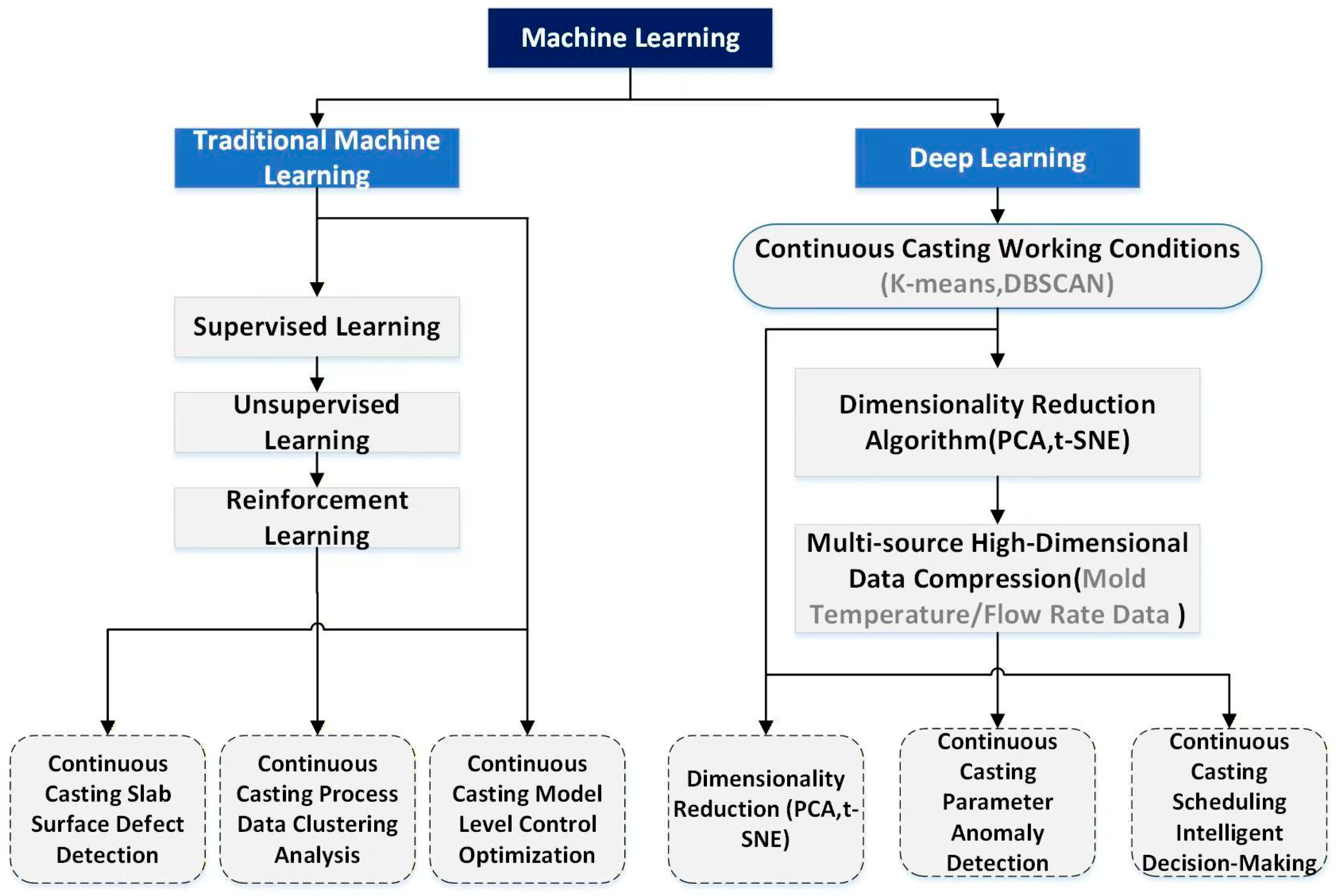
2.2. Classification of Machine Learning Algorithms Adapted to Continuous Casting Scenario
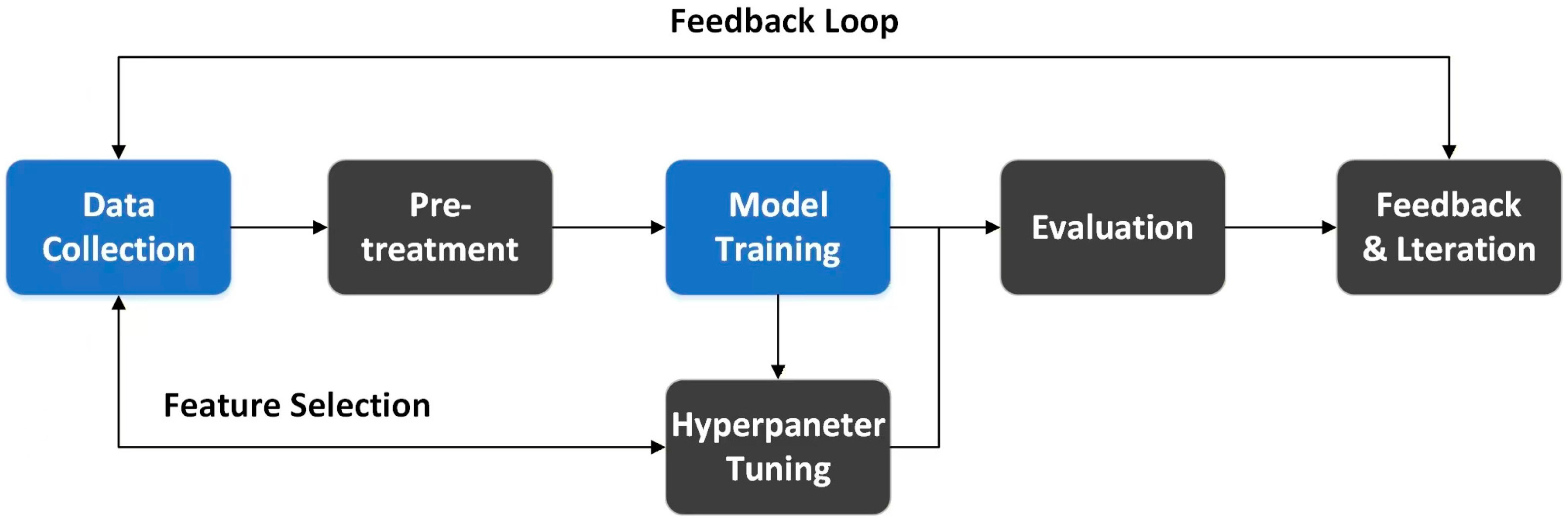
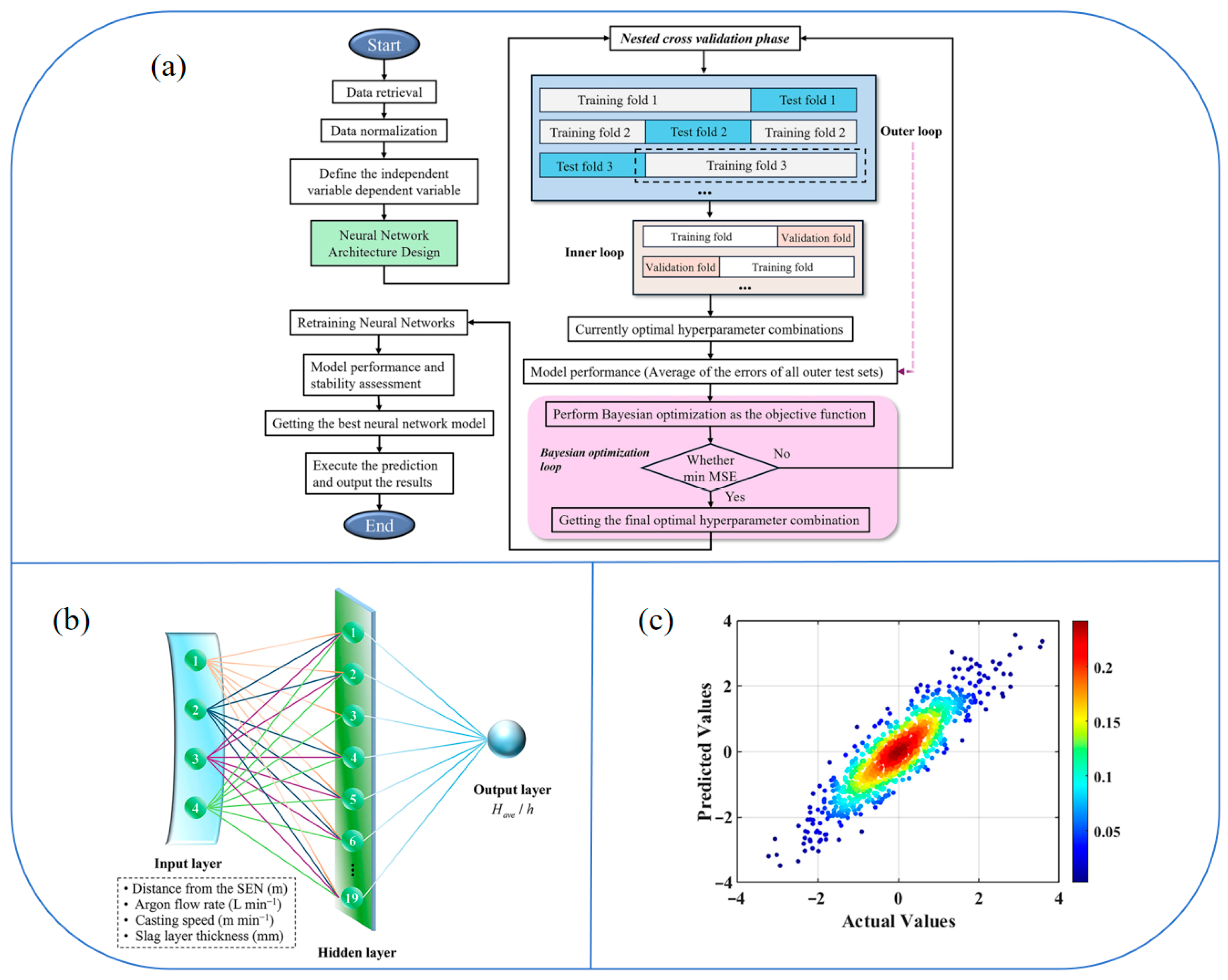
2.3. Complete Process of Data-Driven Modeling for Continuous Casting
3. Application of Machine Learning in Abnormal Prediction of Continuous Casting
3.1. Breakout Prediction
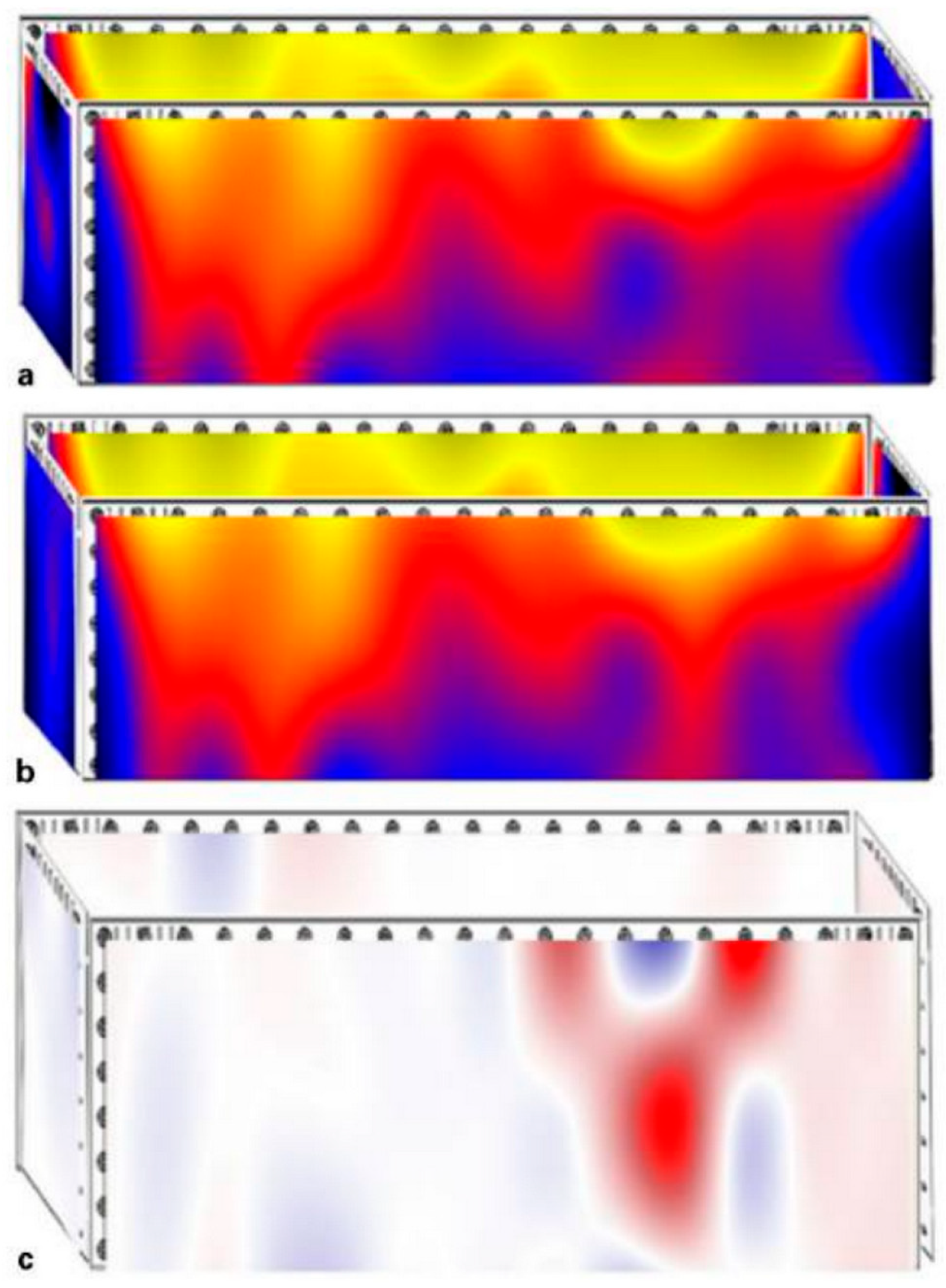
3.2. Detection of Liquid Level Fluctuation
3.3. Detection of SEN Clogging
4. Application of Machine Learning in Slab Quality Inspection
4.1. Crack Defect Detection
4.2. Segregation Defect Detection
4.3. Inclusion Detection
5. Application of Machine Learning in Optimization of Continuous Casting Process Parameters
5.1. Casting Speed Optimization
5.2. Cooling Parameters Optimization
5.3. Mold Operation and Molten Steel Composition Optimization
6. Dataset and Algorithm Comparative Analysis
6.1. Dataset Characteristics
6.2. Algorithm Comparison
7. Summary and Outlook
Author Contributions
Funding
Data Availability Statement
Conflicts of Interest
Abbreviations
| GA-BPNN | Genetic Algorithm—Back Propagation Neural Network |
| DBSCAN-DTW | Density-Based Spatial Clustering of Applications with Noise—Dynamic Time Warping |
| FNN | Feedforward Neural Network |
| VMD-SVR | Variational Mode Decomposition—Support Vector Regression |
| GA-CNN | Genetic Algorithm—Convolutional Neural Network |
| EMD-SVR-GA | Empirical Mode Decomposition—Support Vector Regression—Genetic Algorithm |
| LSTM | Long Short-Term Memory |
| DNN | Deep Neural Network |
| ANFIS-LSTM | Adaptive Neuro-Fuzzy Inference System—Long Short-Term Memory |
| ACWGAN-GP | Auxiliary Classifier Wasserstein Generative Adversarial Network—Gradient Penalty |
| SVM | Support Vector Machine |
| LWOA-TSVR | Gray Wolf Optimization—Twin Support Vector Regression |
| SAC | Soft Actor–Critic |
| NN-FL | Neural Network—Fuzzy Logic |
| PCA-DNN | Principal Component Analysis—Deep Neural Network |
| RF-K-Means | Random Forest—K-Means |
| PCA-PSO-XGBoost | Principal Component Analysis—Particle Swarm Optimization—eXtreme Gradient Boosting |
| PCA-SVM | Principal Component Analysis—Support Vector Machine |
| PSO-SVM | Particle Swarm Optimization—Support Vector Machine |
| R-ELM | Regularized Extreme Learning Machine |
| ORF | Optimized Random Forest |
| BO-XGBoost | Bayesian Optimization—eXtreme Gradient Boosting |
| CNN-LSTM | Convolutional Neural Network—Long Short-Term Memory |
| BP | Back Propagation Neural Network |
References
- Sheng, Y.W.; Zhou, Z.Q.; Meng, X.N.; Ru, J.S. Numerical simulation of non-uniform solidified structure growth of continuous casting slab based on cellular automaton finite-element model. Can. Metall. Q. 2024, 64, 2639–2648. [Google Scholar] [CrossRef]
- Shen, Y.Y.; Yan, W.; Zhao, X.Y.; Chen, S.J.; Shi, C.B.; Yang, C.W.; Wang, K.P.; Wang, Y.Y. Development and application of mold flux for high-speed continuous casting of high-carbon steel billets. J. Iron Steel Res. Int. 2025, 32, 2794–2807. [Google Scholar] [CrossRef]
- Wang, P.; Wang, H.; Chen, L.; Zhang, Z.; Chen, G.; Fan, D.G.; Zhang, J.Q. Continuous casting soft reduction control of macro-/semimacro synergistic homogeneity of bloom and rod for CF53 camshaft steel. Steel Res. Int. 2025, 96, 284–298. [Google Scholar] [CrossRef]
- Thomas, B.G. Review on modeling and simulation of continuous casting. Steel Res. Int. 2018, 89, 1700312. [Google Scholar] [CrossRef]
- Wang, H.J.; Zhang, Z.; Fan, D.G.; Jiang, C.H.; Zhang, B.B.; Wang, P.; Zhang, J.Q. Soft reduction control investigation of spot segregation in continuous casting bloom for 42CrMoA crankshaft steel. J. Iron Steel Res. Int. 2025, 32, 695–706. [Google Scholar] [CrossRef]
- Cho, S.M.; Thomas, B.G. Electromagnetic effects on solidification defect formation in continuous steel casting. JOM 2020, 72, 3610–3620. [Google Scholar] [CrossRef]
- Pan, Q.H.; Jin, W.; Huang, S.Z.; Guo, Y.F.; Jiang, M.Y.; Li, X. Simulation and study of influencing factors on the solidification microstructure of Hazelett continuous casting slabs using CAFE model. Materials 2024, 17, 1869. [Google Scholar] [CrossRef]
- Zhang, B.G.; Wu, H.; Yu, H.C.; Zhang, R.Z.; Fan, L.F. Application of deep learning and attention mechanisms in continuous casting breakout prediction. Metall. Res. Technol. 2025, 122, 307–316. [Google Scholar] [CrossRef]
- Li, J.; Nian, Y.; Liu, X.; Zong, Y.C.; Tang, X.Y.; Zhang, C.J.; Zhang, L.Q. Application of electromagnetic metallurgy in continuous casting: A review. Prog. Nat. Sci. Mater. Int. 2024, 34, 1–11. [Google Scholar] [CrossRef]
- Kulkarni, M.S.; Babu, A.S. Managing quality in continuous casting process using product quality model and simulated annealing. J. Mater. Process. Technol. 2005, 166, 294–306. [Google Scholar] [CrossRef]
- Shi, C.; Guo, S.; Chen, J.; Zhong, R.X.; Wang, B.S.; Sun, P.; Ma, Z.C. Breakout prediction based on twin support vector machine of improved whale optimization algorithm. ISIJ Int. 2023, 63, 880–888. [Google Scholar] [CrossRef]
- Thomas, B.G.; Yuan, Q. Transport and entrapment of particles in steel continuous casting. Metall. Mater. Trans. B 2014, 45, 1245–1262. [Google Scholar] [CrossRef]
- Hayakawa, K.; Matsui, I.; Hamaguchi, T.; Maeguchi, T. Regular article machine learning algorithm for prediction of iron loss of electrical steel under stress. J. Jpn. Inst. Met. 2024, 88, 385–393. [Google Scholar] [CrossRef]
- Lee, S.Y.; Tama, B.A.; Choi, C.; Hwang, J.Y.; Bang, J.; Lee, S. Spatial and sequential deep learning approach for predicting temperature distribution in a steel-making continuous casting process. IEEE Access 2020, 8, 21953–21965. [Google Scholar] [CrossRef]
- Zong, N.; Jing, T.; Gebelin, J.C. Machine learning techniques for the comprehensive analysis of the continuous casting processes: Slab defects. Ironmak. Steelmak. 2025; Online first. [Google Scholar]
- Cemernek, D.; Cemernek, S.; Gursch, H.; Pandeshwar, A.; Leitner, T.; Berger, M.; Klösch, G.; Kern, R. Machine learning in continuous casting of steel: A state-of-the-art survey. J. Intell. Manuf. 2022, 33, 1561–1583. [Google Scholar] [CrossRef]
- Lian, G.; Liu, X.; Wang, Q.; Shen, C.; Wang, Y.; Mu, W. Artificial intelligence-assisted non-metallic inclusion particles analysis in advanced steels using machine learning: A review. Int. J. Miner. Metall. Mater. 2025, 32, 3239. [Google Scholar]
- Varfolomeev, I.A.; Ershov, E.V.; Vinogradova, L.N. Statistical control of defects in a continuously cast billet based on machinelearning and data analysis methods. Autom. Remote Control 2018, 79, 1450–1457. [Google Scholar] [CrossRef]
- Wang, Z.F.; Wang, X.D.; Liu, F.B.; Yao, M.; Zhang, X.B.; Yang, L.S.; Lu, H.Z.; Wang, X. Vibration method to detect liquid–solid fraction and final solidifying end for continuous casting slab. Steel Res. Int. 2013, 84, 724–731. [Google Scholar] [CrossRef]
- Liu, D.W.; Zhang, G.F.; Zeng, J.H.; Xie, X. Numerical simulation of segregation in slabs under different secondary cooling electromagnetic stirring modes. Materials 2024, 17, 2721. [Google Scholar] [CrossRef]
- Wang, Z.F.; Yao, M.; Wang, X.D.; Zhang, X.B.; Yang, L.S.; Lu, H.Z.; Wang, X. Inverse problem-coupled heat transfer model for steel continuous casting. J. Mater. Process. Technol. 2014, 214, 44–49. [Google Scholar] [CrossRef]
- Toledo, G.A.; Lainez, J.; Cirion, J.C. Model optimization of continuous casting steel secondary cooling. Mater. Sci. Eng. A 1993, 173, 287–291. [Google Scholar] [CrossRef]
- Hardin, R.A.; Liu, K.; Kapoor, A.; Beckermann, C. Transient simulation and dynamic spray cooling control model for continuous steel casting. Metall. Mater. Trans. B 2003, 34, 297–306. [Google Scholar] [CrossRef]
- Savage, J.; Pritchard, W.H. Problem of rupture of the billet in the continuous casting of steel. Iron Steel Inst. 1954, 178, 269–277. [Google Scholar]
- Zhang, C.; Li, T.; Wang, B. Dynamic modeling method for the scheduling problem in steelmaking-continuous casting with disturbance of product quality. Energy Procedia 2011, 13, 253–261. [Google Scholar] [CrossRef]
- Qin, Q.; Wang, X.; Dai, S.; Zhong, Y.; Wei, S. Machine learning-based prediction of mechanical properties for large bearing housing castings. Materials 2025, 18, 4036. [Google Scholar] [CrossRef]
- Wei, C.H.; Song, Z.H. Real-time forecasting of subsurface inclusion defects for continuous casting slabs: A data-driven comparative study. Sensors 2023, 23, 5415. [Google Scholar] [CrossRef]
- Liu, J.S.; Long, H.S.; Chen, D.Y.; Song, H.W.; Zhang, S.H.; Piccininni, A.; Chen, C.L. Machine learning-assisted process prediction of horizontal continuous casting for copper tubular billets. J. Mater. Eng. Perform. 2025, 34, 9187–9197. [Google Scholar] [CrossRef]
- He, Y.B.; Zhou, H.L.; Li, Y.H.; Zhang, T.; Li, B.Z.; Ren, Z.F.; Zhu, Q. Multi-task learning model of continuous casting slab temperature based on DNNs and SHAP analysis. Metall. Mater. Trans. B 2024, 55, 5120–5132. [Google Scholar] [CrossRef]
- Song, G.W.; Tama, B.A.; Park, J.; Hwang, J.Y.; Lee, S. Temperature control optimization in a steel-making continuous casting process using a multimodal deep learning approach. Steel Res. Int. 2019, 90, 1900321. [Google Scholar] [CrossRef]
- Wu, X.; Jin, H.; Ye, X.; Wang, J.; Lei, Z.S.; Liu, Y.; Wang, J.; Guo, Y. Multiscale convolutional and recurrent neural network for quality prediction of continuous casting slabs. Processes 2021, 9, 33. [Google Scholar] [CrossRef]
- He, F.; Zhang, L.Y. Mold breakout prediction in slab continuous casting based on combined method of GA-BP neural network and logic rules. Int. J. Adv. Manuf. Technol. 2018, 95, 4081–4089. [Google Scholar] [CrossRef]
- Wang, R.R.; Wang, M.; Wang, Z.L.; Xing, L.D.; Ai, X.G.; Bao, Y.P. Mechanism and forecast model of sticker breakout in continuous casting. China Metall. 2023, 33, 138. [Google Scholar]
- Duan, H.Y.; Wang, X.D.; Bai, Y.; Yao, M.; Guo, Q.T. Integrated approach to density-based spatial clustering of applications with noise and dynamic time warping for breakout prediction in slab continuous casting. Metall. Mater. Trans. B 2019, 50, 2343. [Google Scholar] [CrossRef]
- Liu, Y.; Wang, X.D.; Du, F.M.; Kong, L.W.; Yao, M.; Zhang, X.B. Visual detection based on computer vision for sticker breakout in slab continuous casting. IronMak. SteelMak. 2015, 42, 417. [Google Scholar] [CrossRef]
- Sun, Y.; Liu, Z.Q.; Xiong, Y.T.; Yang, J.; Xu, G.D.; Li, B.K. A novel feedforward neural network model for predicting the level fluctuation in continuous casting mold. Metall. Mater. Trans. B 2025, 56, 5009–5026. [Google Scholar] [CrossRef]
- Su, W.B.; Lei, Z.F.; Yang, L.D.; Hu, Q. Mold-level prediction for continuous casting using VMD–SVR. Metals 2019, 9, 458. [Google Scholar] [CrossRef]
- He, Y.B.; Zhou, H.L.; Zhang, B.Q.; Guo, H.; Li, B.Z.; Zhang, T.; Yang, K.; Li, Y.H. Prediction model of liquid level fluctuation in continuous casting mold based on GA-CNN. Metall. Mater. Trans. B 2024, 55, 1414–1425. [Google Scholar] [CrossRef]
- Tirian, G.O.; Filip, I.; Prostean, G. Adaptive control system for continuous steel casting based on neural networks and fuzzy logic. Neurocomputing 2014, 125, 236. [Google Scholar] [CrossRef]
- Lei, Z.F.; Su, W.B. Mold level predict of continuous casting using hybrid EMD-SVR-GA algorithm. Processes 2019, 7, 177. [Google Scholar] [CrossRef]
- Yang, W.; Zhang, L.F.; Ren, Y.; Chen, W.; Liu, F.G. Formation and prevention of nozzle clogging during the continuous casting of steels: A review. ISIJ Int. 2024, 64, 1. [Google Scholar] [CrossRef]
- Wang, R.B.; Li, H.; Guerra, F.; Cathcart, C.; Chattopadhyay, K. Predicting quantitative indices for SEN clogging in continuous casting using long short term memory time series model. ISIJ Int. 2022, 62, 2311. [Google Scholar] [CrossRef]
- Girase, N.U.; Basu, S.; Choudhary, S.K. Development of indices for quantification of nozzle clogging during continuous slab casting. Ironmak. Steelmak. 2013, 34, 506–512. [Google Scholar] [CrossRef]
- Diniz, A.P.M.; Ciarelli, P.M.; Salles, E.O.T. Use of deep neural networks for clogging detection in the submerged entry nozzle of the continuous casting. Expert Syst. Appl. 2024, 238, 121963. [Google Scholar] [CrossRef]
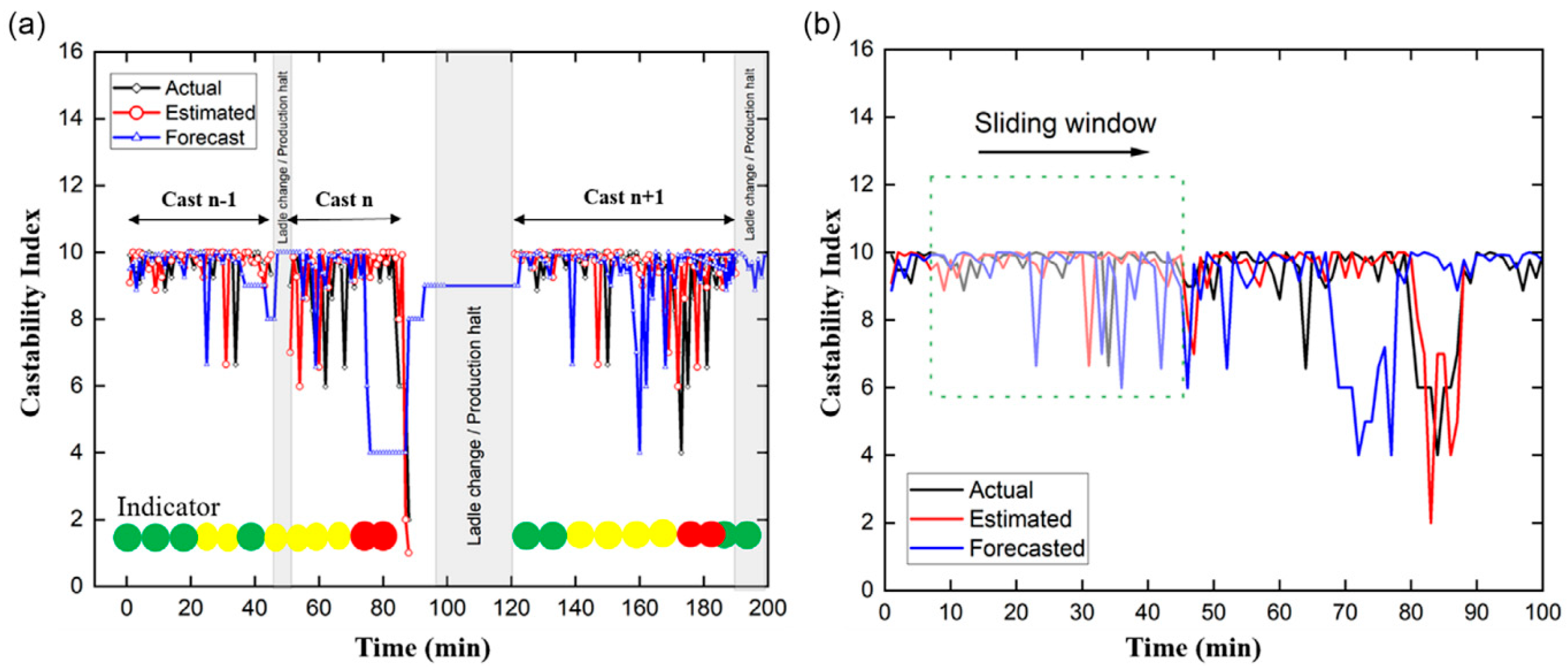
- Kuthe, S.; Ona, I.A.; Glaser, B. Adaptive neuro-fuzzy inference system long short-term memory hybrid model to forecast castability of Al-killed steel prior to continuous casting. Steel Res. Int. 2024, 95, 2400220. [Google Scholar] [CrossRef]
- Wang, Y.Y.; Wang, X.D.; Yao, M. Integrated model of ACWGAN-GP and computer vision for breakout prediction in continuous casting. Metall. Mater. Trans. B 2022, 53, 2873–2885. [Google Scholar] [CrossRef]
- Salah, B.; Zoheir, M.; Slimane, Z.; Jurgen, B. Inferential sensor-based adaptive principal components analysis of mould bath level for breakout defect detection and evaluation in continuous casting. Appl. Soft Comput. 2015, 34, 120–128. [Google Scholar] [CrossRef]
- Wu, X.J.; Kang, H.J.; Yuan, S.; Jiang, W.Z.; Gao, Q.; Mi, J.Z. Anomaly detection of liquid level in mold during continuous casting by using forecasting and error generation. Appl. Sci. 2023, 13, 7457. [Google Scholar] [CrossRef]
- Vannucci, M.; Colla, V. Novel classification method for sensitive problems and uneven datasets based on neural networks and fuzzy logic. Appl. Soft Comput. 2011, 11, 2383–2390. [Google Scholar] [CrossRef]
- Brimacombe, J.K.; Hawbolt, E.B.; Weinberg, F. Formation of off-corner internal cracks in continuously-cast billets. Can. Metall. Q. 1980, 19, 215. [Google Scholar] [CrossRef]
- Brimacombe, J.K.; Weinberg, F.; Hawbolt, E.B. Formation of longitudinal, midface cracks in continuously-cast slabs. Metall. Mater. Trans. B 1979, 10, 279. [Google Scholar] [CrossRef]
- Thomas, B.G.; Samarasekera, I.V.; Brimacombe, J.K. Investigation of panel crack formation in steel ingots: Part 1. Off-corner panel cracks. Metall. Mater. Trans. B 1988, 19, 289. [Google Scholar] [CrossRef]
- Brimacombe, J.K.; Sorimachi, K. Crack formation in the continuous casting of steel. Metall. Mater. Trans. B 1977, 8, 489. [Google Scholar] [CrossRef]
- Sala, D.A.; Van Yperen-De Deyne, A.; Mannens, E.; Jalalvand, A. Hybrid-input FCN-CNN-SE for industrial applications: Classification of longitudinal cracks during continuous casting. Metals 2023, 13, 1699. [Google Scholar] [CrossRef]
- Zou, L.L.; Huang, J.X.; Li, Q.H.; Zhang, J.S.; Liu, Q. Research progress on the crack and segregation prediction of continuous casting strand. Contin. Cast. 2022, 2, 2–9. [Google Scholar]
- Zou, L.L.; Zhang, J.S.; Han, Y.S.; Zeng, F.Z.; Li, Q.H.; Liu, Q. Internal crack prediction of continuous casting billet based on principal component analysis and deep neural network. Metals 2021, 11, 1976. [Google Scholar] [CrossRef]
- Zhang, H.; Duan, H.Y.; Wang, X.D.; YAO, M. Longitudinal crack prediction method of continuous cast slab based on random forest and clustering. Contin. Cast. 2022, 6, 21–28. [Google Scholar]
- Liu, Y.; Jiang, L.; Shi, J.; Liu, J.B.; Li, G.H.; Wang, Z.F.; Zhang, Z. Recognition of longitudinal cracks on slab surfaces based on particle swarm optimization and eXtreme gradient boosting model. Processes 2024, 12, 1087. [Google Scholar] [CrossRef]
- Kong, Y.W.; Chen, D.F.; Liu, Q.; Long, M.J. A prediction model for internal cracks during slab continuous casting. Metals 2019, 9, 587. [Google Scholar] [CrossRef]
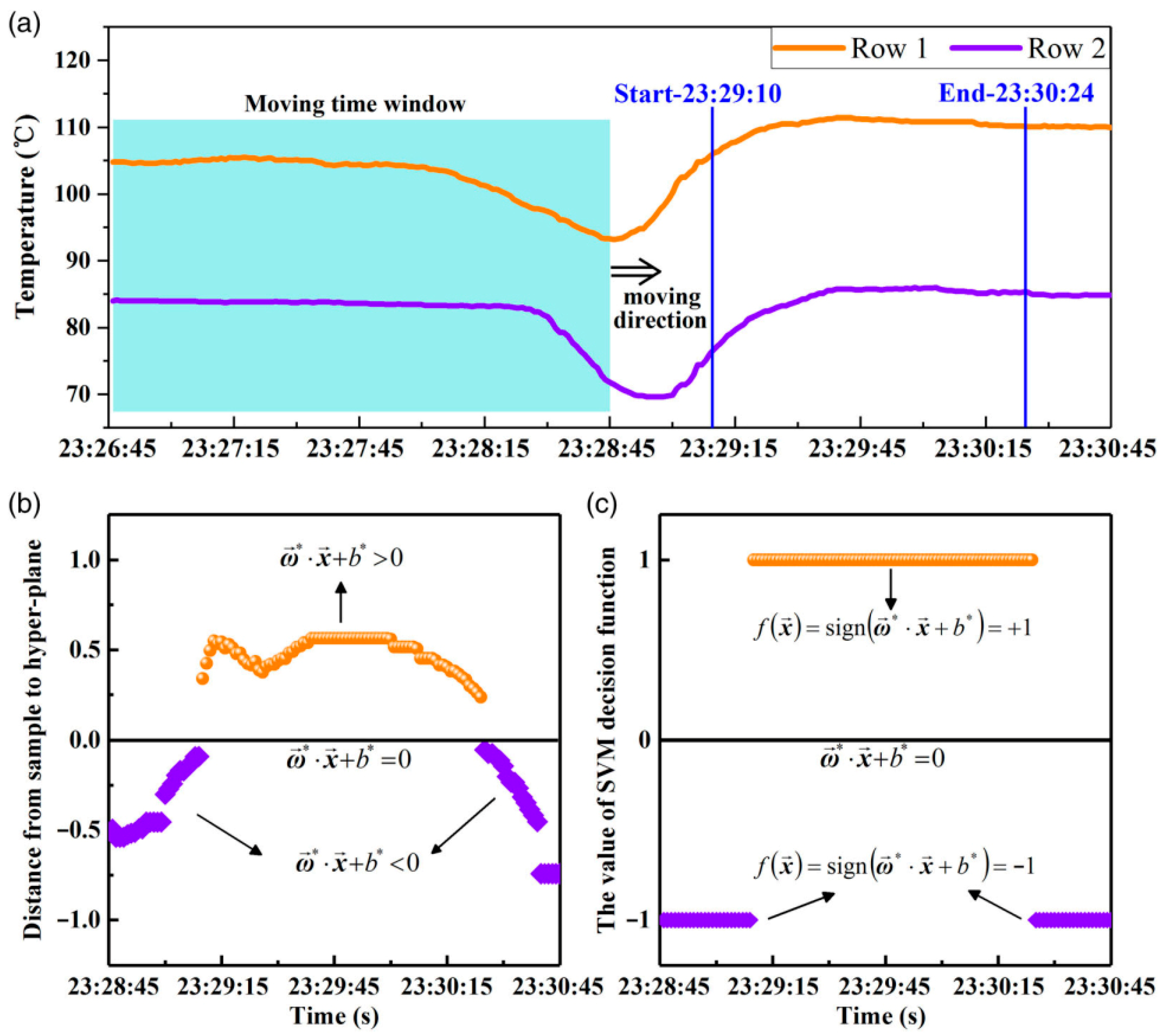
- Duan, H.Y.; Wei, J.J.; Qi, L.; Wang, X.D.; Liu, Y.; Yao, M. Longitudinal crack detection approach based on principal component analysis and support vector machine for slab continuous casting. Steel Res. Int. 2021, 92, 2100168. [Google Scholar] [CrossRef]
- Singh, A.K.; Basu, B.; Ghosh, A. Role of appropriate permeability model on numerical prediction of macrosegregation. Metall. Mater. Trans. B 2006, 37, 799. [Google Scholar] [CrossRef]
- Han, Y.S.; Yan, W.; Zhang, J.S.; Chen, J.; Chen, W.Q.; Liu, Q. Comparison and integration of final electromagnetic stirring and thermal soft reduction on continuous casting billet. J. Iron Steel Res. Int. 2021, 28, 160. [Google Scholar]
- Combeau, H.; Zaloznik, M.; Hans, S.; Richy, P.E. Prediction of macrosegregation in steel ingots: Influence of the motion and the morphology of equiaxed grains. Metall. Mater. Trans. B 2009, 40, 289. [Google Scholar]
- Han, Y.; Yan, W.; Zhang, J.; Chen, W.Q.; Chen, J.; Liu, Q. Optimization of thermal soft reduction on continuous casting billet. ISIJ Int. 2020, 60, 106. [Google Scholar] [CrossRef]
- Vušanović, I.; Vertnik, R.; Šarler, B. A simple slice model for prediction of macrosegregation in continuously cast billets. IOP Conf. Ser. Mater. Sci. Eng. 2012, 27, 12056. [Google Scholar] [CrossRef]
- Luo, S.; Li, K.K.; Wang, W.L.; Zhu, M.Y. Numerical simulation of macrosegregation in continuously cast slab with application of S−EMS and MR. J. Mater. Res. Technol. 2023, 24, 6893−6907. [Google Scholar] [CrossRef]
- Li, P.Z. Online quality prediction system of bloom castings based on BP neural network. Ironmak. Steelmak. 2011, 46, 33−37. [Google Scholar]
- Liu, G.L.; Lu, H.B.; Li, B.; Ji, C.X.; Zhang, J.S.; Liu, Q.; Lei, Z.S. Influence of M-EMS on fluid flow and initial solidification in slab continuous casting. Materials 2021, 14, 3681. [Google Scholar] [CrossRef]
- Nieto, P.J.G.; Suárez, V.M.G.; Antón, J.C.A.; Bayón, R.M.; Blanco, J.A.S.; Fernández, A.M.D. A new predictive model of centerline segregation in continuous cast steel slabs by using multivariate adaptive regression splines approach. Materials 2015, 8, 3562. [Google Scholar] [CrossRef]
- Nieto, P.J.G.; Garcia-Gonzalo, E.; Antón, J.C.A.; Suárez, V.M.G.; Bayón, R.M.; Martín, F.M. A comparison of several machine learning techniques for the centerline segregation prediction in continuous cast steel slabs and evaluation of its performance. J. Comput. Appl. Math. 2018, 330, 877–895. [Google Scholar] [CrossRef]
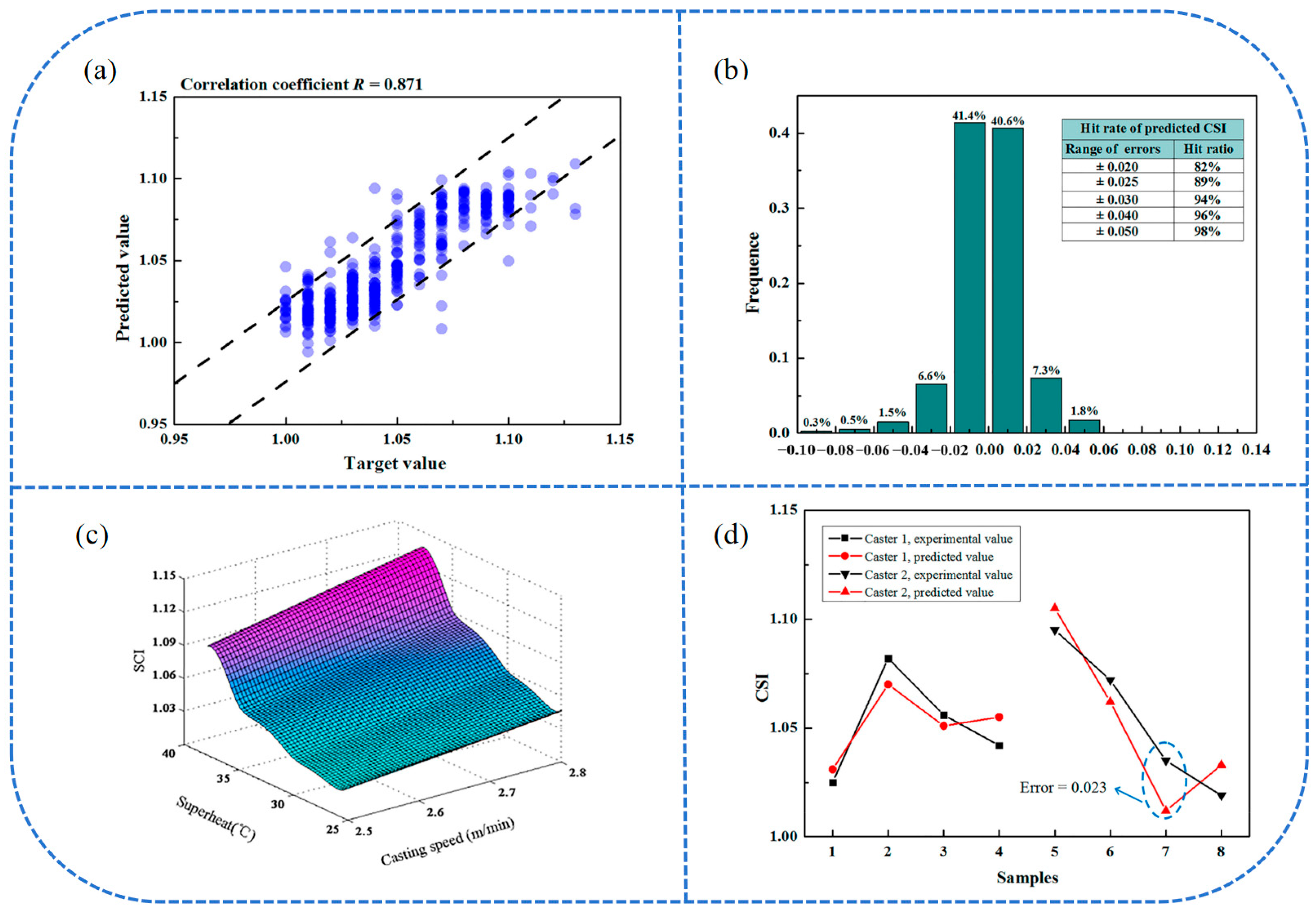
- Zou, L.; Zhang, J.; Liu, Q.; Zeng, F.Z.; Chen, J.; Guan, M. Prediction of central carbon segregation in continuous casting billet using a regularized extreme learning machine model. Metals 2019, 9, 1312. [Google Scholar] [CrossRef]
- Zhang, J.; Lee, H.G. Numerical modeling of nucleation and growth of inclusions in molten steel based on mean processing parameters. ISIJ Int. 2004, 44, 1629–1638. [Google Scholar] [CrossRef]
- Dai, W.B.; Yu, J.K.; Du, C.M.; Zhang, L.; Wang, X.L. Refinement of inclusions in molten steel by electric current pulse. Mater. Sci. Technol. 2015, 31, 1555–1559. [Google Scholar] [CrossRef]
- Wang, L.T.; Peng, S.H.; Zhang, Q.Y.; Li, Z.B. Mathematical model for growth and removal of inclusions in molten steel under gas-stirring conditions. Steel Res. Int. 2006, 77, 25–31. [Google Scholar] [CrossRef]
- Chen, M.C.; Yen, S.Y.; Lin, Y.F.; Tsai, M.Y.; Chuang, T.H. Intelligent casting quality inspection method integrating anomaly detection and semantic segmentation. Machines 2025, 13, 317. [Google Scholar] [CrossRef]
- Zhao, J.; Zhu, H.; Luo, J.Z.Z. Motion behaviour of solid inclusions at the steel-slag interface in high-Al steel. Ironmak. Steelmak. 2023, 50, 1749–1757. [Google Scholar] [CrossRef]
- Sowa, T.; Seki, Y.; Suzuki, T.; Tanaka, S. Evaluation of deoxidation state in molten steel using image recognition technique of reduction slag by machine learning. Metall. Ital. 2024, 115, 6. [Google Scholar]
- Wang, Y.; Zang, X.; Liu, C.; Liang, Z.G.; Liu, C.J. Evaluation of inclusion agglomeration behavior in molten steel based on the modified model of cavity bridge force. J. Mater. Res. Technol. 2024, 31, 512–519. [Google Scholar] [CrossRef]
- Zhang, Y.X.; Gao, Z.G.; Sun, J.C.; Liu, L.L. Machine-learning algorithms for process condition data-based inclusion prediction in continuous-casting process: A case study. Sensors 2023, 23, 6719. [Google Scholar] [CrossRef]
- Ji, Y.; Wang, W.L.; Zhou, L.J. Prediction and feature analysis of entrapped slag defect on casting slab based on optimized XGBoost model. Metall. Mater. Trans. B 2024, 55, 2026–2036. [Google Scholar] [CrossRef]
- Zhou, Y.J.; Xu, K.; He, F.; Zhang, Z.Y. Application of time series data anomaly detection based on deep learning in continuous casting process. ISIJ Int. 2022, 62, 689–698. [Google Scholar] [CrossRef]
- Zhou, S.Y.; Chen, Y.P.; Zhang, D.L.; Xie, J.M.; Zhou, Y.F. Classification of surface defects on steel sheet using convolutional neural networks. Mater. Technol. 2017, 51, 123. [Google Scholar]
- Wu, Y.; Zhang, H.; Jian, L.; Lv, Z.M. A quantitative causal analysis and optimization framework for inclusions of steel products. Adv. Eng. Inform. 2024, 62, 102629. [Google Scholar] [CrossRef]
- Norrena, J.; Louhenkilpi, S.; Visuri, V.V.; Alatarvas, T.; Bogdanoff, A.; Fabritius, T. Coupling of solidification and heat transfer simulations with interpretable machine learning algorithms to predict transverse cracks in continuous casting of steel. Steel Res. Int. 2024, 95, 2300529. [Google Scholar] [CrossRef]
- Cho, K.; Kim, G.; Kwon, S.H.; Yim, C.H.; Hong, D.G. Prevention of thermal crack in steel slab using neural networks model to predict impact absorption energy. Steel Res. Int. 2024, 95, 2300732. [Google Scholar] [CrossRef]
- Miriyala, S.S.; Subramanian, V.R.; Mitra, K. TRANSFORM-ANN for online optimization of complex industrial processes: Casting process as case study. Eur. J. Oper. Res. 2018, 264, 294–308. [Google Scholar] [CrossRef]
- Grešovnik, I.; Kodelja, T.; Vertnik, R.; Sencic, B.; Kovacic, M.; Sarler, B. Application of artificial neural networks in design of steel production path. Comput. Mater. Contin. 2012, 30, 19–38. [Google Scholar]
- Grešovnik, I.; Kodelja, T.; Vertnik, R. A software framework for optimization of process parameters in material production. Appl. Mech. Mater. 2012, 101, 838. [Google Scholar] [CrossRef]
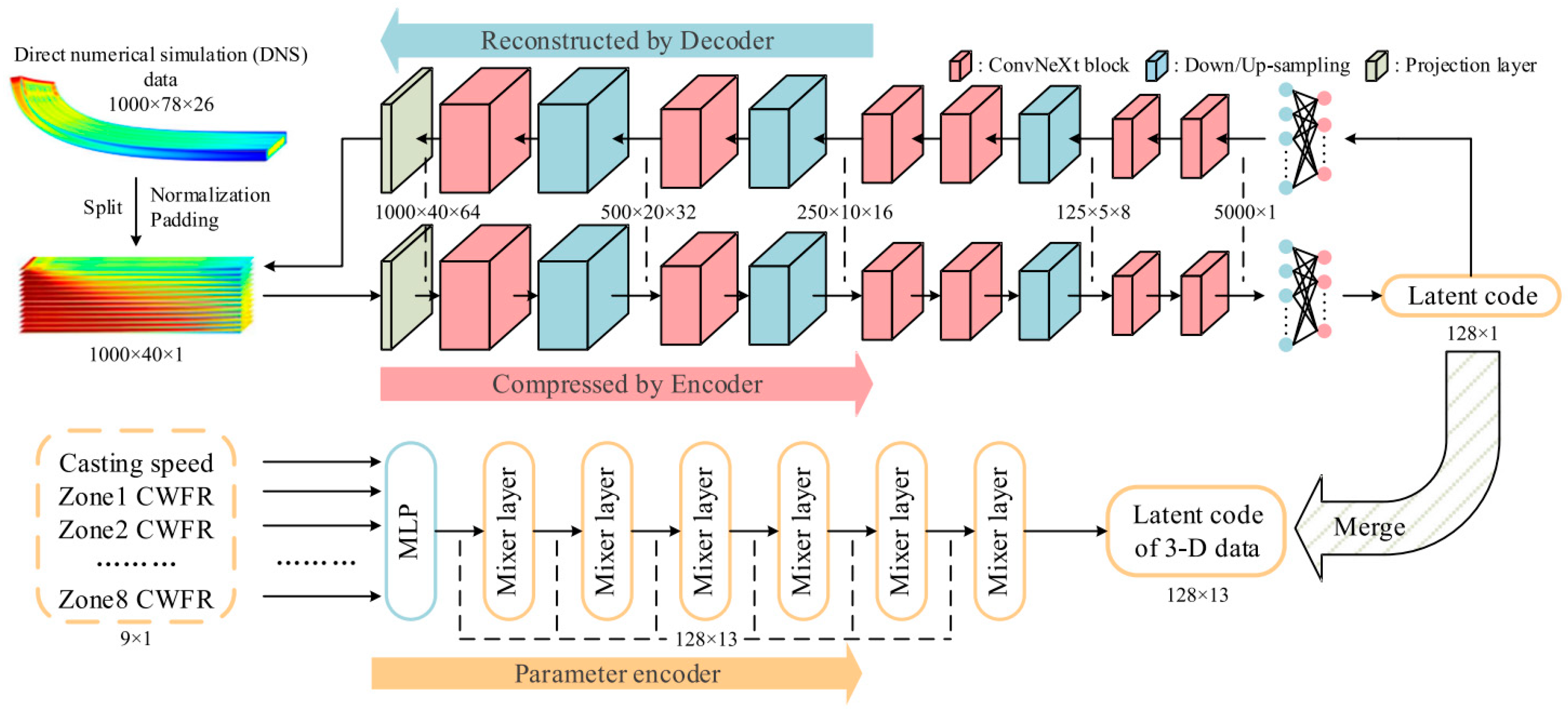
- Lu, Z.; Ren, N.; Xu, X. Real-time prediction and adaptive adjustment of continuous casting based on deep learning. Commun. Eng. 2023, 2, 34. [Google Scholar] [CrossRef]
- Logunova, O.S.; Matsko, I.I.; Posohov, I.A.; Luk’ynov, S.I. Automatic system for intelligent support of continuous cast billet production control processes. Int. J. Adv. Manuf. Technol. 2014, 74, 1407–1418. [Google Scholar] [CrossRef]
- Matsko, I.I. Adaptive fuzzy decision tree with dynamic structure for automatic process control system of continuous cast billet production. IOSR J. Eng. 2012, 2, 53–55. [Google Scholar] [CrossRef]
- Takalo-Mattila, J.; Heiskanen, M.; Kyllönen, V. Explainable steel quality prediction system based on gradient boosting decision trees. IEEE Access 2022, 10, 68099. [Google Scholar] [CrossRef]



| Process Link | Core Function | Key Process Parameters | Control Objectives |
|---|---|---|---|
| Ladle casting | Molten steel transfer and temperature maintenance | Ladle preheating temperature, casting time | Molten steel temperature drop < 5 °C/h, avoiding secondary oxidation |
| Tundish metallurgy | Molten steel buffering and inclusion removal | Tundish temperature, argon flow rate, residence time | Inclusion removal rate > 80%, temperature uniformity ±3 °C |
| Mold solidification | Initial slab shell formation | Mold level, cooling water flow rate, vibration parameters | Slab shell thickness ≥ 10 mm (when exiting the mold), mold level fluctuation < ±3 mm |
| Secondary cooling | Slab shell thickening and complete solidification | Cooling water flow rate of each section, cooling intensity | Avoiding cracks (thermal stress < critical stress), solidification end controlled before straightening |
| Straightening and cutting | Slab fixed-length cutting and quality screening | Straightening temperature, cutting length | Straightening temperature > 900 °C (for low-carbon steel), fixed-length error < ±5 mm |
| Authors | Intelligent Algorithms | Applications | Data Type | Evaluation Metric | Optimization Effect | Reference |
|---|---|---|---|---|---|---|
| He et al. | GA-BPNN | Breakout prediction | Mold level signal (collected by eddy current sensor) | CC, RMSE, MAE, MAPE | Optimizes the model by combining logical rules, improves the reliability of breakout prediction, and provides an effective method for continuous casting breakout early warning | [32] |
| Duan et al. | DBSCAN-DTW | Breakout prediction | Mold temperature and vibration parameters (collected by thermocouples and vibration sensors) | Accuracy, Recall, F1-Score, False Alarm Rate | Processes data through clustering and dynamic time warping, enhances the reliability of breakout prediction data, and optimizes the model input for prediction | [34] |
| Sun et al. | FNN | Mold level fluctuation | Molten steel chemical composition and billet size data (collected by composition analyzer and size measuring instrument) | RMSE, R2, MAE | Constructs a new feedforward neural network model, realizes effective prediction of mold level fluctuation, and provides support for stable mold level control | [36] |
| Su et al. | VMD-SVR | Mold level fluctuation | Mold cooling water flow rate and copper plate temperature data (collected by flow sensors and thermocouples) | Precision, Recall, Accuracy, MSE | Uses VMD to process signals, improves the prediction accuracy of SVR, optimizes the mold level prediction effect, and assists in mold level regulation | [37] |
| He et al. | GA-CNN | Mold level fluctuation | Continuous casting speed and tundish level time-series data (collected by speed sensors and level sensors) | MAPE, RMSE, CC | Optimizes the CNN structure with GA, enhances the accuracy of mold level fluctuation prediction, and adapts to signal fluctuations under complex working conditions | [38] |
| Lei et al. | EMD-SVR-GA | Mold level fluctuation | Process parameter time-series data (mold level, width, argon pressure/flow, stopper rod position, etc.) | NRMSE | Integrates the advantages of multiple algorithms, optimizes the mold level prediction model, and improves prediction accuracy and stability | [40] |
| Wang et al. | LSTM | Nozzle clogging | Process variable data (slide gate opening, mold level, drawing speed, tundish operation status) | Accuracy, Precision, Recall, F1-Score, MCC | Realizes the prediction of the nozzle clogging index (QI) for the next 48 s and achieves visual index distribution | [42] |
| Diniz | DNN | Nozzle clogging | Molten steel chemical composition data (Al, Si, Ca, Mn, S, etc.) and stopper rod position data | RMSE | Realizes binary classification detection directly through process parameters without metallurgical prior knowledge | [44] |
| Kuthe et al. | ANFIS-LSTM | Nozzle clogging | Mold copper plate temperature data (collected by thermocouple array) | Model classification performance (distinguishing true/false sticker breakout) | Accurately quantifies the influence weights of components such as Al, Ca, and Si on clogging, and achieves high accuracy in castability prediction for the next 24 min | [45] |
| Wang et al. | ACWGAN-GP | Breakout prediction | Mold level, drawing speed, tundish stopper control signal | MSE | Integrates generative adversarial network and visual detection, enhances the ability to extract precursor features of breakout, and improves the adaptability of breakout prediction | [46] |
| Salah et al. | SVM | Breakout prediction | 9 types of key parameters including tundish molten steel temperature, mold copper plate temperature, drawing speed, mold level, etc. | Prediction Accuracy, Alarm Rate, MSE, RMSE, R2 | Combines adaptive PCA to handle data fluctuations, improves the accuracy of mold level anomaly identification, and assists in the evaluation and prevention of breakout defects | [47] |
| Shi et al. | LWOA-TSVR | Breakout prediction | Mold level time-series data (collected by sensor) | Precision, Recall, F1-Score | Enhances the generalization ability of the model, improves the stability of breakout prediction, and provides a reliable model for breakout risk prediction | [11] |
| Wu et al. | SAC | Mold level fluctuation | Molten steel chemical composition (S, Al, Ca), tundish temperature, molten steel stirring time | Correct %, Unf. detected %, False Alarms | Captures the trend of abnormal mold level changes, improves the sensitivity of mold level anomaly detection, and assists in stable mold level control | [48] |
| Vannucci et al. | NN-FL | Nozzle clogging | Slab surface defect images and process parameter data (collected by visual sensors and process sensors) | Detection Accuracy, IoU, Recall | Optimizes the classification method for non-uniform data and improves the model’s adaptability to sensitive working conditions | [49] |
| Authors | Intelligent Algorithms | Applications | Optimization Effect | Reference |
|---|---|---|---|---|
| Zou et al. | PCA-DNN | Crack defect detection | The accuracy is superior to traditional algorithms, with high computational efficiency, supporting online decision-making | [56] |
| Zhang et al. | RF-K-Means | Crack defect detection | Reduces feature dimensions and achieves zero missed alarms and false alarms for longitudinal cracks | [57] |
| Liu et al. | PCA-PSO-XGBoost | Crack defect detection | High accuracy and low false alarm rate, adapting to complex production conditions | [58] |
| Kong et al. | Improved BPNN | Crack defect detection | High overall recognition rate, excellent identification of severe cracks, consistent with production rules | [59] |
| Duan et al. | PCA-SVM | Crack defect detection | High-accuracy detection of longitudinal cracks with no missed alarms under specific conditions | [60] |
| Nieto et al. | PSO-SVM | Segregation detection | The goodness of fit R2 reaches 0.98, realizing quantitative prediction of segregation degree | [70] |
| Zou et al. | R-ELM | Segregation detection | The prediction hit rate within the error range of ±0.03 reaches 94%, adapting to multi-steel grade detection | [71] |
| Kuthe et al. | ANFIS-LSTM | Inclusion detection | Visualizes the mechanism of component influence, realizes performance prediction, and provides a basis for process adjustment | [45] |
| Zhang et al. | ORF | Inclusion detection | Integrates multi-dimensional parameters, improves detection accuracy, and assists in molten steel cleanliness control | [79] |
| Ji et al. | BO-XGBoost | Inclusion detection | Selects key features, adapts to data imbalance scenarios, and guides process parameter optimization | [80] |
| Zhou et al. | CNN-LSTM | Inclusion detection | Fuses time-varying parameters and multi-variable strategies to improve the recall rate of defect identification | [81] |
| Li et al. | BP | Segregation detection | Establishes a multi-dimensional feature dataset, realizes predictive analysis of quality defects, and provides data support for continuous casting process optimization | [67] |
| Zhou et al. | CNN | Crack defect detection | Classifies useful features from low-level to high-level; this method is simple, effective, and robust for classifying surface defects of steel plates | [82] |
Disclaimer/Publisher’s Note: The statements, opinions and data contained in all publications are solely those of the individual author(s) and contributor(s) and not of MDPI and/or the editor(s). MDPI and/or the editor(s) disclaim responsibility for any injury to people or property resulting from any ideas, methods, instructions or products referred to in the content. |
© 2025 by the authors. Licensee MDPI, Basel, Switzerland. This article is an open access article distributed under the terms and conditions of the Creative Commons Attribution (CC BY) license (https://creativecommons.org/licenses/by/4.0/).
Share and Cite
Wang, Z.; Shao, J.; Zhang, S.; Zhang, J.; Pang, Y. Research Progress on Application of Machine Learning in Continuous Casting. Metals 2025, 15, 1383. https://doi.org/10.3390/met15121383
Wang Z, Shao J, Zhang S, Zhang J, Pang Y. Research Progress on Application of Machine Learning in Continuous Casting. Metals. 2025; 15(12):1383. https://doi.org/10.3390/met15121383
Chicago/Turabian StyleWang, Zhaofeng, Jinghao Shao, Shuai Zhang, Jiahui Zhang, and Yuqi Pang. 2025. "Research Progress on Application of Machine Learning in Continuous Casting" Metals 15, no. 12: 1383. https://doi.org/10.3390/met15121383
APA StyleWang, Z., Shao, J., Zhang, S., Zhang, J., & Pang, Y. (2025). Research Progress on Application of Machine Learning in Continuous Casting. Metals, 15(12), 1383. https://doi.org/10.3390/met15121383