Article

Analysis of the Regulatory Effect of Semi-Solid Isothermal Treatment Time on Crystallization and Plasticity of Amorphous Composites

1
School of Material, Electricity and Intelligent Manufacturing, Huaihua University, Huaihua 330031, China
2
Hunan Renewable Aluminum Innovation Research Center, Huaihua University, Huaihua 330031, China
*
Author to whom correspondence should be addressed.
Metals 2025, 15(12), 1363; https://doi.org/10.3390/met15121363
Submission received: 29 October 2025 / Revised: 1 December 2025 / Accepted: 9 December 2025 / Published: 11 December 2025
(This article belongs to the Special Issue Research Progress of Crystal in Metallic Materials)

Abstract

Ti48Zr27Cu6Nb5Be14 amorphous composites were prepared by copper mold suction casting to obtain as-cast specimens. Subsequently, the as-cast specimens were held at 900 °C for different durations (5, 10, 20, 30, and 40 min) and then water quenched to cool, yielding treated specimens. Room-temperature compression tests were conducted to characterize the mechanical properties of the materials before and after the treatment. X-ray diffraction (XRD), optical microscopy (OM), and scanning electron microscopy (SEM) were used to detect and observe the microstructure of the specimens (before and after treatment) as well as the morphology of the side surface of compressed fractured specimens. Results show that the as-cast specimens are amorphous matrix composites, with dendrites (identified as β-Ti) predominantly distributed in the amorphous matrix. When the treatment duration increased from 5 to 40 min, two key phenomena were observed. The dendrites gradually disappeared and evolved into curved crystals first; subsequently, the curved crystals transformed into elongated crystals. Finally, the elongated crystals evolved into short and thick rod-like crystals, which further transformed into near-spherical crystals or spherical crystals. Furthermore, as the treatment duration prolonged, the average equivalent size of the crystals increased continuously, reaching 23.1 μm. Additionally, the plasticity of the specimens first increased, reached a maximum value of 16.2% when held for 30 min, and then decreased.

1. Introduction

As a new type of material with great potential for future engineering fields, amorphous alloys exhibit ultra-high hardness, high strength, and excellent corrosion resistance due to their disordered atomic arrangement [1]. They also possess outstanding magnetic properties and good workability, which can meet the requirements of precision manufacturing, showing broad application prospects in electronics, aerospace, and other fields [2,3]. However, this type of alloy has extremely poor plasticity at room temperature. So it tends to undergo brittle fracture due to the rapid propagation of a single shear band under load, resulting in poor impact resistance [4]. Additionally, amorphous alloys have poor thermal stability and easily undergo crystallization when in long-term service or heated in a medium-low temperature environment [5], which leads to significant deterioration of properties such as hardness and corrosion resistance. These limit their applications in engineering fields. Several studies on the effect of heat treatment on the structural evolution and mechanical properties of amorphous alloys have been reported. Nevertheless, heat treatment processes have a significant impact on material properties. When Cu-based amorphous composites are subjected to annealing treatment at low temperatures (room temperature ~Tg − 100 K, where Tg is the glass transition temperature), it is found that local structural relaxation in localized regions occurs after treatment, which is caused by short-range order [6,7]. When treated at higher temperatures (Tg − 100 K ~ Tg), the internal energy of the material decreases and the free volume rapidly reduces, triggering long-range cooperative structural relaxation [8]. When isothermal annealing is performed at temperatures in the supercooled liquid region (Tg ~ Tx, where Tx is the crystallization temperature), nanocrystalline phases precipitate in the amorphous matrix [9]. When the annealing temperature is above the crystallization temperature (Tx), crystalline phases precipitate and grow rapidly, and crystallization occurs, destroying the original amorphous structure [10,11].
When annealing at the temperature of the solid–liquid two-phase region, at the microstructural level, atoms preferentially nucleate in free volume-enriched regions and interfacial defects during annealing, precipitating nanocrystalline phases with sizes mostly ranging from 10 to 100 nm [12]. Studies have reported that Mg-Zn-Ca-based amorphous alloys tend to precipitate Mg2Zn11 crystals [13], and Cu-Zr-Al-based ones are prone to forming CuZr2 phases [14]. As the holding time extends, the crystalline phases continue to grow through the rapid diffusion of atoms in the liquid phase, and the solid–liquid interface gradually blurs due to the enhanced fluidity of the liquid phase [15]. When the annealing temperature is close to Tm (liquidus temperature), the proportion of the liquid phase increases, making the crystalline phases prone to agglomeration [16]. For example, when Zr-based amorphous alloys are heated near Tm, the Zr2Cu phase may agglomerate into micron-sized blocks, damaging the microstructural uniformity [17]. Regarding material strength, when the annealing temperature is in the low-temperature segment of the solid–liquid two-phase region, the atomic diffusion rate is low, and only 10–50 nm dispersed crystalline phases (such as the Zr2Cu phase in Zr-based alloys) precipitate at defects like free volume-enriched regions [18]. During this process, the “topological disorder strengthening” effect of the amorphous matrix is only slightly impaired, and the fine crystals do not cause significant interfacial stress, resulting in a small decrease in strength, usually less than 15% [19]. For instance, the compressive strength of the Zr55Cu35Al10 amorphous alloy decreases from 1800 MPa to 1530 MPa [20]. As the temperature rises to the medium-to-high temperature segment of the solid–liquid two-phase region, accelerated atomic diffusion promotes the growth of crystalline phases to 50–100 nm. Meanwhile, the formation of a small amount of liquid phase reduces the deformation resistance of the matrix. Under the combined effect of these two factors, the strength decrease expands to 15–30% [21]. When the temperature is close to Tm, the sharp increase in the proportion of the liquid phase leads to the agglomeration of crystalline phases into micron-sized blocks, which not only severely damages the amorphous strengthening structure but also causes microcracks due to stress concentration at the phase interfaces. This results in a significant drop in strength and even a reduction of more than 30% compared to the amorphous state, seriously deteriorating the material’s load-bearing capacity [22]. In terms of plasticity, when the annealing temperature is in the low-temperature segment of the solid–liquid two-phase region, the atomic diffusion rate is moderate, and fine dispersed crystalline phases precipitate at defects [23]. These crystalline phases can act as “obstacles” to the propagation of shear bands, causing the shear bands to bend and branch under stress, and preventing the rapid penetration of a single shear band, thus greatly improving plasticity [24]. Studies have reported that the fracture elongation of Zr-based amorphous composites increases from 1.5% to 6–7% [25], and that of Fe-based ones rises from 0.8% to 4–5% [26]. As the temperature increases to the medium-to-high temperature segment of the solid–liquid two-phase region, the sizes of crystalline phases reach to 50–100 nm. Although the crystalline phases can still hinder the propagation of shear bands, liquid phase infiltration occurs in some regions, weakening the phase interface bonding force. Consequently, the improvement in plasticity is reduced, and the fracture elongation is maintained at 5–6% [27]. When the temperature is close to Tm, the sharp increase in the proportion of the liquid phase leads to the agglomeration of crystalline phases into micron-sized blocks, causing severe stress concentration at the phase interfaces and easily triggering microcracks [28]. This instead destroys the shear band hindrance mechanism, resulting in a sharp drop in plasticity to 2–3%, and even a tendency towards brittle fracture, leading to the loss of the material’s deformability [29].
At the temperature of the solid–liquid two-phase region, only fine and dispersed crystal nuclei can form in a short time, while a long time will lead to the continuous growth of crystalline phases. However, there is still a lack of systematic understanding of the quantitative correlation law between “time and crystalline phase size/distribution” at present. Most existing studies focus on the influence of temperature, and there is insufficient research on the precise regulation mechanism of holding time, which cannot provide process support for achieving the synergy of “high strength and high plasticity”. It can be seen that it is significantly necessary to study the influence of annealing holding time on the microstructure and properties of amorphous composites at the temperature of the solid–liquid two-phase region.

2. Experiment

High-purity metallic raw materials, including Ti (99.96%), Zr (99.95%), Nb (99.94%), Cu (99.94%), and Be (99.93%), were proportionally mixed to fabricate an alloy with the molar composition Ti48Zr27Cu6Nb5Be14. Alloy ingots were synthesized via arc melting in a high-vacuum furnace (10−4 Pa) under a protective atmosphere of high-purity Ar. To guarantee uniform chemical composition, the Ti48Zr27Cu6Nb5Be14 ingots were remelted 4–5 times. Subsequently, the ingots were cast into cylindrical specimens (4 mm in diameter, 70 mm in length) using a water-cooled copper mold. To prevent high-temperature oxidation, these specimens were vacuum-sealed in quartz tubes. The sealed specimens were then placed in an electric furnace (model: YFFG40/13G-YC, manufactured by Shanghai Yifeng Electric Furnace Co., Ltd., Shanghai, China) and preheated to designated semi-solid treatment temperatures at 900 °C for a 30 min holding period. Afterward, the specimens were subjected to isothermal holding at 900 °C for varying durations (5, 10, 20, 30 and 40 min). Immediately after the holding process, the specimens were taken out of the furnace and quenched in water to obtain semi-solid specimens.
The semi-solid isothermal treatment protocol consists of four sequential steps: First, as-cast Ti48Zr27Cu6Nb5Be14 amorphous composite specimens were prepared by copper mold suction casting; second, the as-cast specimens were vacuum-encapsulated in quartz tubes; Third, the encapsulated specimens were transferred to the electric heating furnace for semi-solid isothermal treatment; Finally, the treated specimens were removed from the furnace and instantly water-quenched (as illustrated in Figure 1), yielding semi-solid specimens.
Phase identification of the as-cast and semi-solid amorphous composite specimens was conducted using a D8 Advance X-ray diffractometer (XRD, Cu Kα radiation), manufactured by Bruker Corporation, Billerica, Germany. The mechanical properties of the specimens were determined via compression tests conducted on a universal testing machine at a strain rate of 5 × 10⁻⁵ s−1. The microstructures of the specimens were observed by scanning electron microscopy (SEM, model: FEI quanta200F, manufactured by thermo Fisher Scientific/FEI, Hillsboro, OR, USA) and optical microscopy (OM, model: Axio Scope A1). Additionally, the fracture morphology and side surface morphology of the compression-fractured specimens after the compressive test were also observed by SEM. Based on the microstructure diagrams of as-cast samples and annealed samples observed by optical microscopy (OM), Image Pro Plus 6.0 (IPP6.0) software was utilized to determine the volume fraction (φ) of crystalline phases, equivalent crystal size (D), and shape factor (SF), with calculations performed using Equations (1)–(3), respectively [30,31].
φ = i = 1 N A i A
D = i = 1 N A i / π N
S F = i = 1 N 4 π A i / p i 2 N
where Ai is the area of the i-th grain, Pi is the circumference of the i-th grain, A is the field area, and N is the number of grains to be measured.

3. Results

3.1. Microstructure of As-Cast Specimen

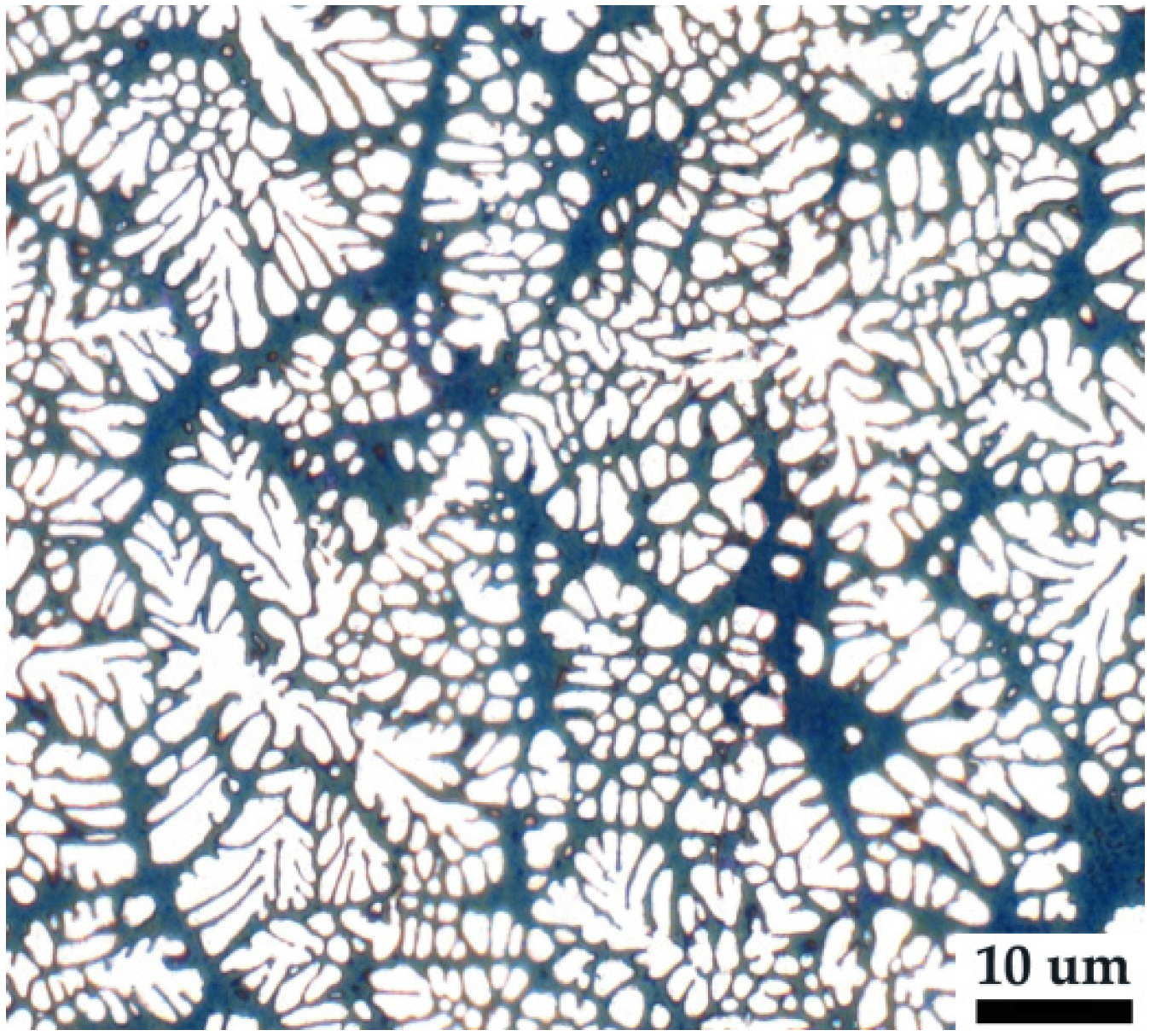
The microstructures of the as-cast specimens are observed by optical microscopy (OM), as shown in Figure 2. It can be seen from the figure that the microstructure of the amorphous composite exhibits significant dendritic morphology characteristics. The dark blue regions are the amorphous matrix phase in which the crystalline phases are embedded. The crystals are mainly dendritic, with a small amount of granular crystals. The water-cooled copper mold suction casting method can provide a high cooling rate, which promotes the formation of the amorphous phase. Also, due to the fast cooling rate, the dendrites have no time to grow, so their sizes are small. Statistically analyzed by Image Pro Plus 6.0 (IPP6.0) software, the average spacing of secondary dendrite arms is about 1.1 μm, and the volume fraction of crystalline phases is about 62.3 ± 0.3%.

3.2. Microstructure of Annealed Specimens

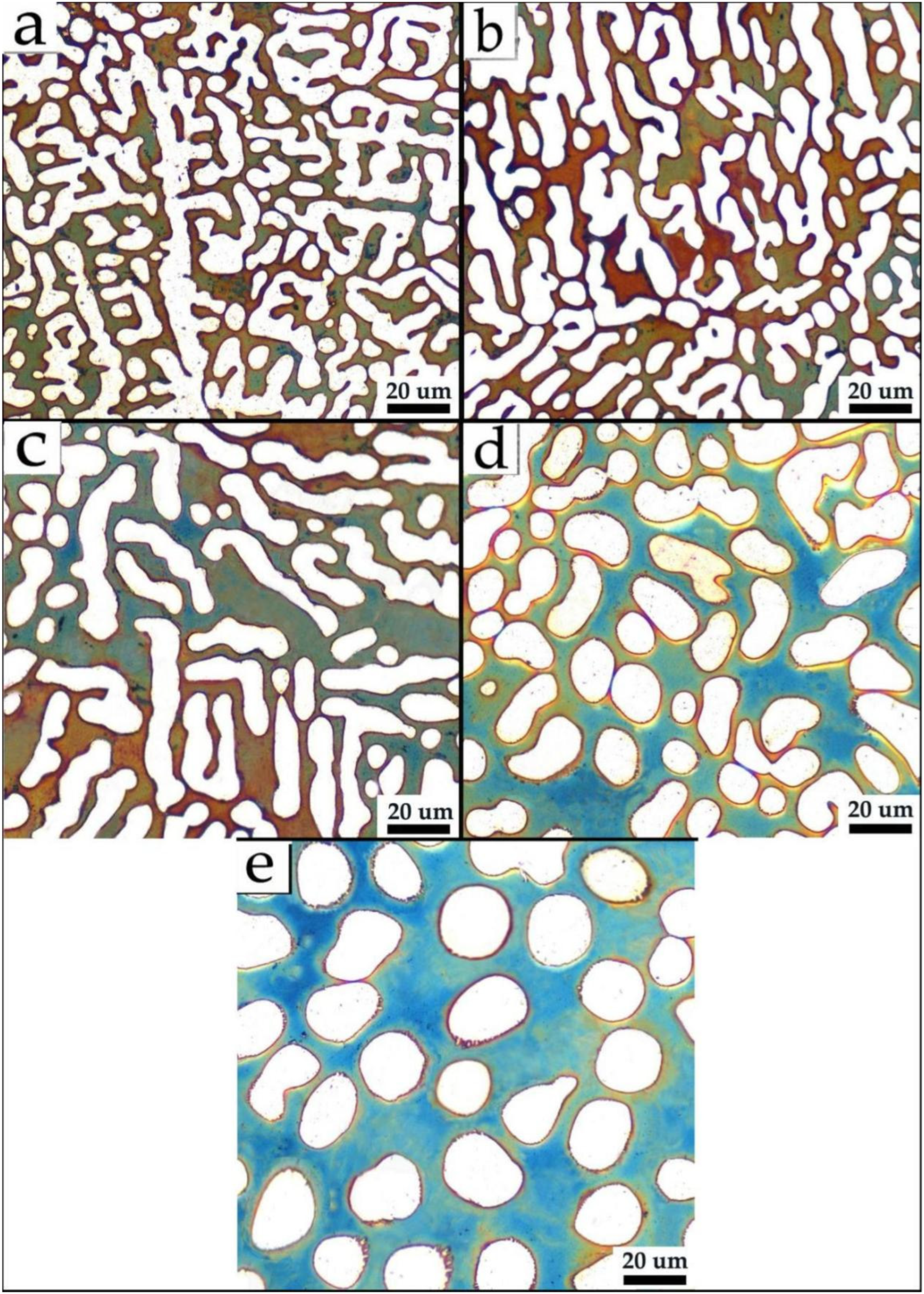
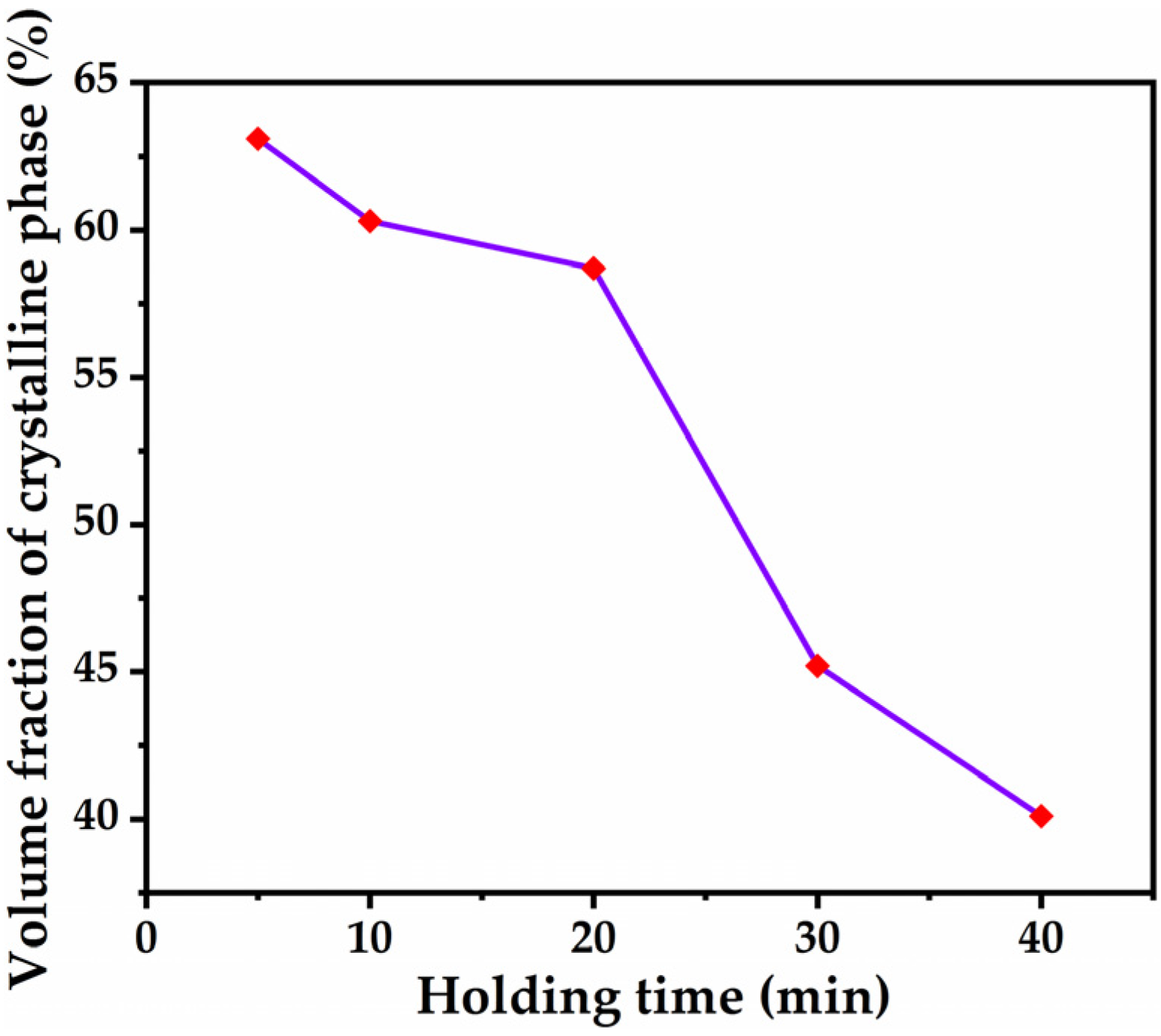
As-cast amorphous composites were annealed at 900 °C for 5, 10, 20, 30, and 40 min, respectively, obtaining five groups of annealed specimens. Their microstructure are observed by optical microscopy (OM), as shown in Figure 3. Figure 3a corresponds to the annealed specimen with 5 min of heat preservation. It can be seen from the figure that the dendrite arms at all levels grow and extend, intertwine, or overlap with each other forming crystals with an interwoven structure. These crystals are dendritic, with relatively thick primary dendrite arms serving as the skeleton of the entire interwoven structure. The secondary dendrite arms are relatively slender and grow attached to the primary dendrite arms. This interwoven crystal structure makes the crystals present an interwoven and curved shape. Then, the secondary dendrite arms extend from the primary dendrite arms, continuously branching and expanding, and finally connecting and intertwining with each other to form a network, resulting in an overall network crystal structure. Calculated by IPP6.0 software, the crystal volume fraction is 63.1 ± 0.3%. Due to the crystal structure, the shape factor and average equivalent diameter of the crystals cannot be counted and calculated. When the holding time is 10 min (corresponding to Figure 3b), it can be seen that the tough phases are mainly composed of independent curved strip-shaped crystals and a small amount of interwoven crystals, with no network-structured crystals. These curved strip-shaped crystals exhibit an irregular curved morphology in the amorphous matrix instead of extending straight. Some crystals even have a certain degree of undulation and small branches. The crystal length may range from tens of micrometers to hundreds of micrometers, while the width is relatively small, mostly on the order of several micrometers. Its crystal volume fraction is 60.3 ± 0.2%, and the shape factor and average equivalent diameter of the crystals are 0.59 and 15.2 μm, respectively. After holding for 20 min (corresponding to Figure 3c), from the overall morphology, the structure is dominated by typical thin–long rod-shaped crystals. Their overall outline morphology is regular, no longer the original thin–long curved crystals. The crystal volume fraction, shape factor, and average equivalent diameter are 58.7 ± 0.1%, 0.73, and 18.4 μm, respectively. Compared with the specimen treated for 10 min, the crystal morphology is more regular. The crystals are not only coarser but also have a smaller aspect ratio (ratio of length to diameter) and higher morphological consistency. When the holding time is extended to 30 min (corresponding to Figure 3d), the tough phase is dominated by short–thick rod-shaped crystals, with a small amount of near-spherical crystals. The rod-shaped crystals are thicker, with increased roundness at both ends and regular side contours, without obvious distortion or branching. The crystal volume fraction, shape factor, and average equivalent diameter are 45.2 ± 0.1%, 0.81, and 21.2 μm, respectively. Compared with the specimen held for 20 min, the crystal morphology has a higher roundness and larger size, but the crystal content decreases significantly. When the holding time is 40 min (corresponding to Figure 3e), the crystal growth has no obvious directionality and no aspect ratio difference in short–thick rod-shaped crystals. The crystal phase is dominated by near-spherical or spherical crystals, with a small amount of rod-shaped crystals. The average equivalent diameter of the crystals increases to 23.1 μm, the volume fraction decreases to 40.1 ± 0.1%, and the shape factor is as high as 0.86. Compared with the specimen treated for 30 min, the crystal morphology is more regular and the size is larger, but the crystal content decreases sharply. In general, with the extension of annealing time, although the crystal size gradually increases, the crystal volume fraction still decreases, and the curve of their variation relationship is shown in Figure 4.

3.3. Phase Composition of As-Cast Specimens

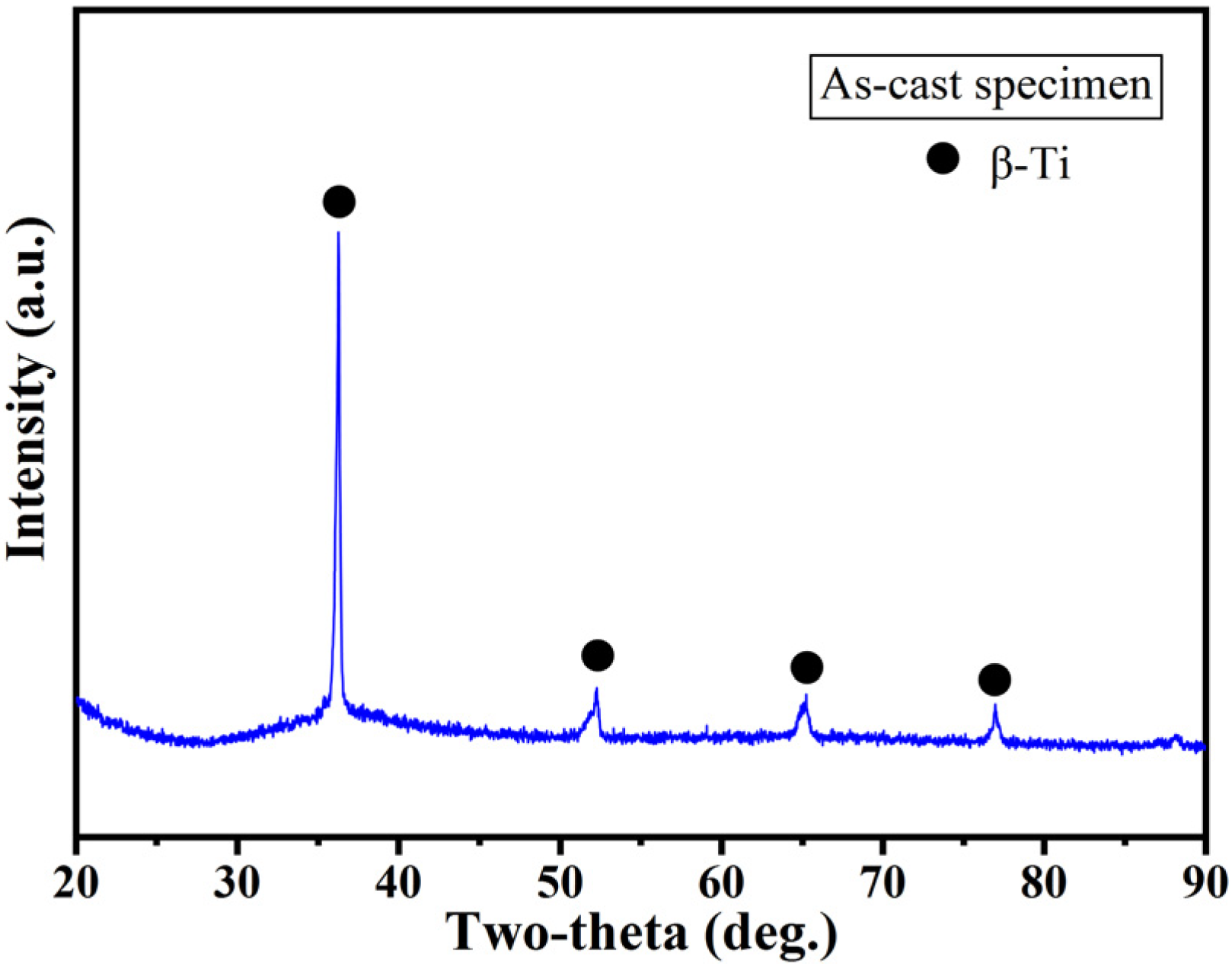
The phase composition of as-cast specimens was analyzed via XRD, at room temperature (25 ± 2 °C) without additional heat treatment. The test parameters were as follows: scanning range of 20–90°, scanning speed of 5°/min, and total test duration of 30 min. The corresponding XRD patterns are presented in Figure 5. The XRD pattern exhibits typical characteristics of amorphous composites, consisting of broad humps and sharp high-intensity peaks which correspond to diffuse scattering and crystalline diffraction, respectively. Analysis indicates that the broad humps are attributed to the amorphous matrix, while the sharp diffraction peaks correspond to the β-Ti crystalline phase [32].

3.4. Phase Composition of Processed Specimens

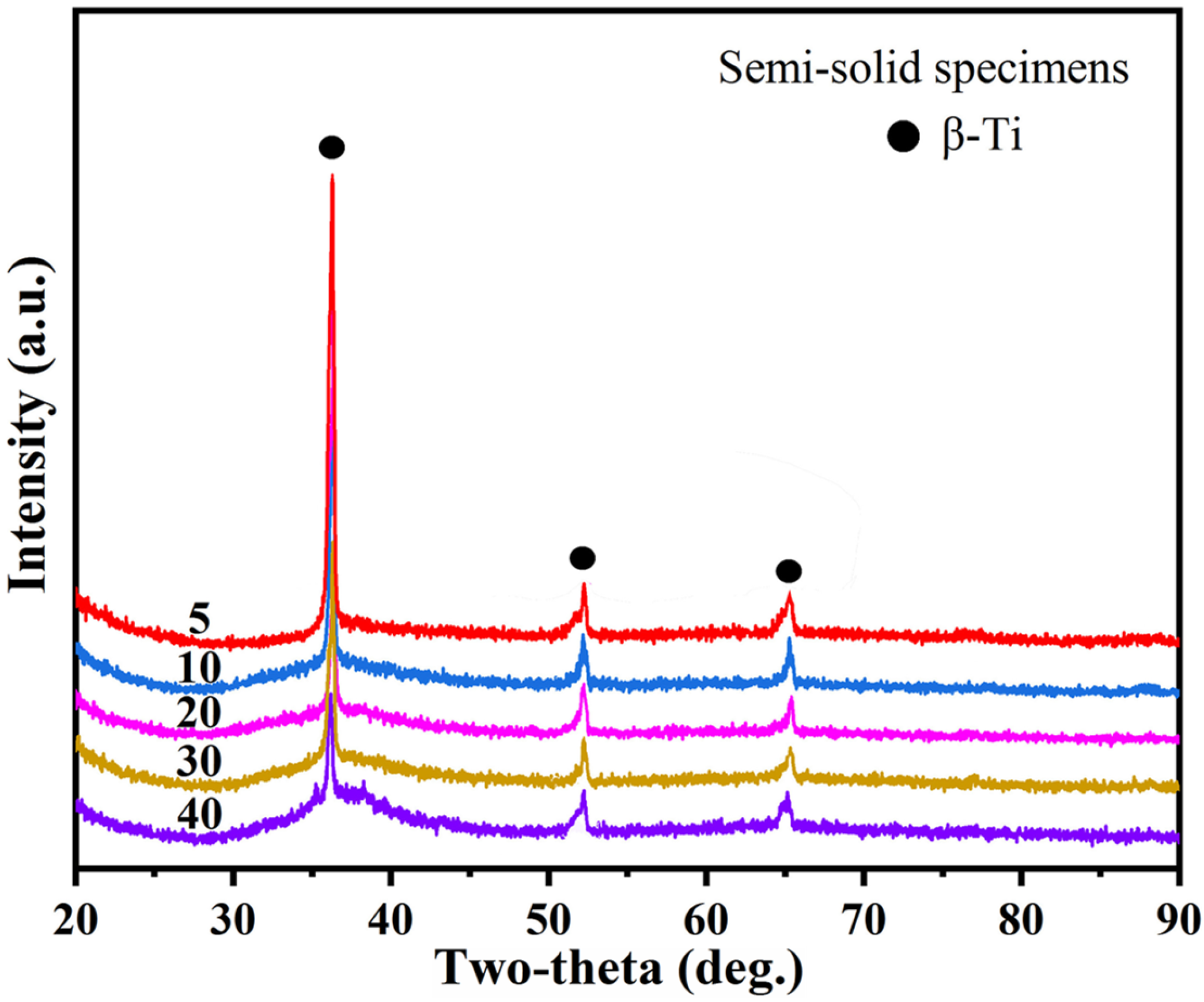
Figure 6 shows the X-ray diffraction (XRD) patterns of five groups of annealed specimens prepared by holding at 900 °C for 5, 10, 20, 30, and 40 min, respectively, to detect phase composition. From these patterns, it can be clearly seen that diffraction curves share common characteristics. Sharp diffraction peaks corresponding to β-Ti crystals are superimposed on the broadened diffuse peaks with typical amorphous material features. This phenomenon clearly indicates that after annealing, both β-Ti crystals and amorphous phases still coexist. It shows that the high-temperature environment of 900 °C will not cause phase transformation. A detailed comparative analysis of the patterns under different annealing times reveals that as the annealing time prolongs, there is no obvious change in the positions of either the diffuse peaks or the sharp diffraction peaks. Thus, a clear conclusion can be drawn: the extension of annealing time neither causes phase transformation nor changes the phase composition of the specimens. In other words, this annealing process has no effect on the original phase composition of the specimens.
From these XRD pattern, it can be observed that with the holding time increasing, the intensity of the diffraction peaks corresponding to the β-Ti crystals gradually decreases, indicating a gradual reduction in the crystalline phase content. This variation trend is consistent with that of the volume fraction of crystalline phase calculated in Section 3.2.

3.5. Mechanical Properties

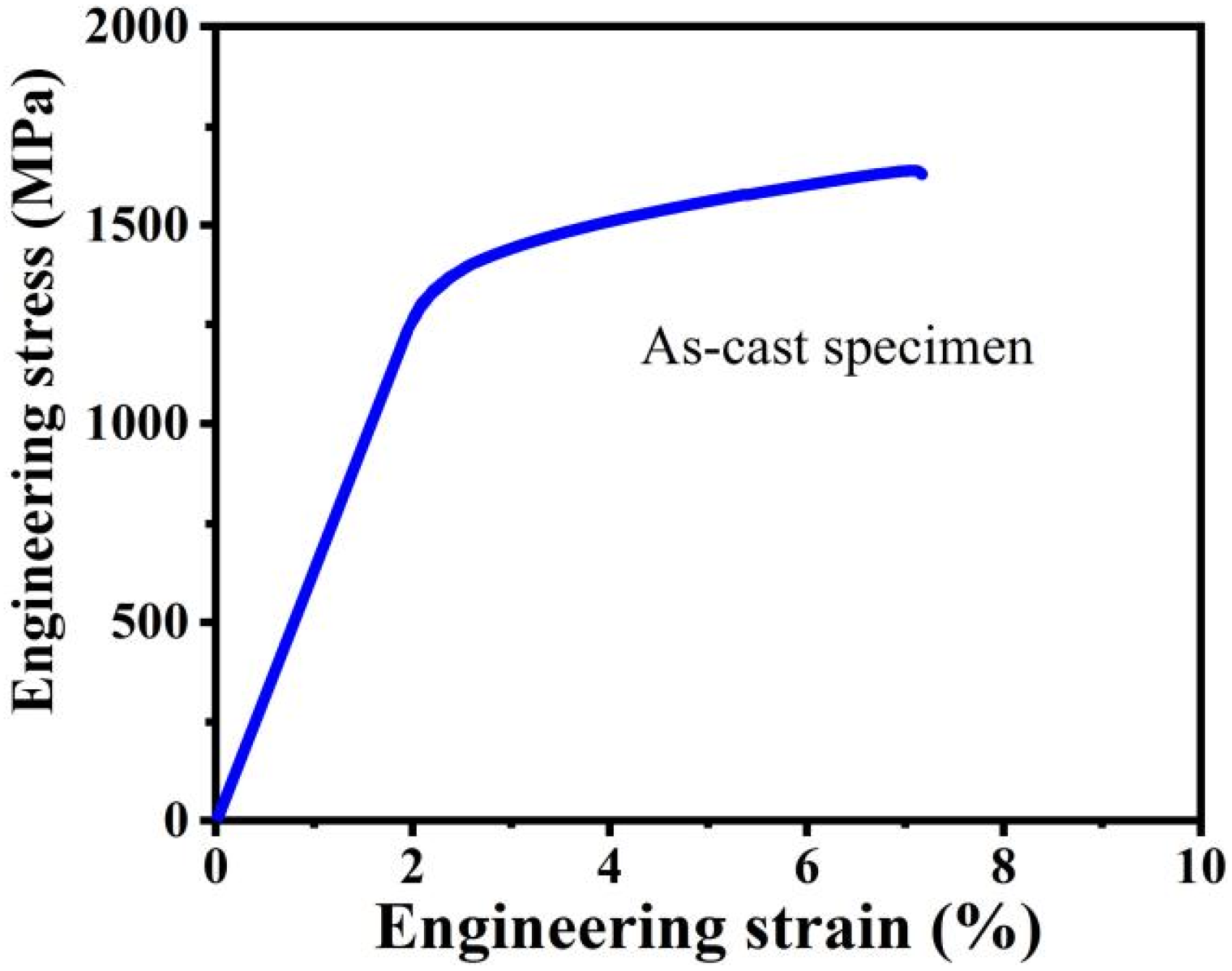
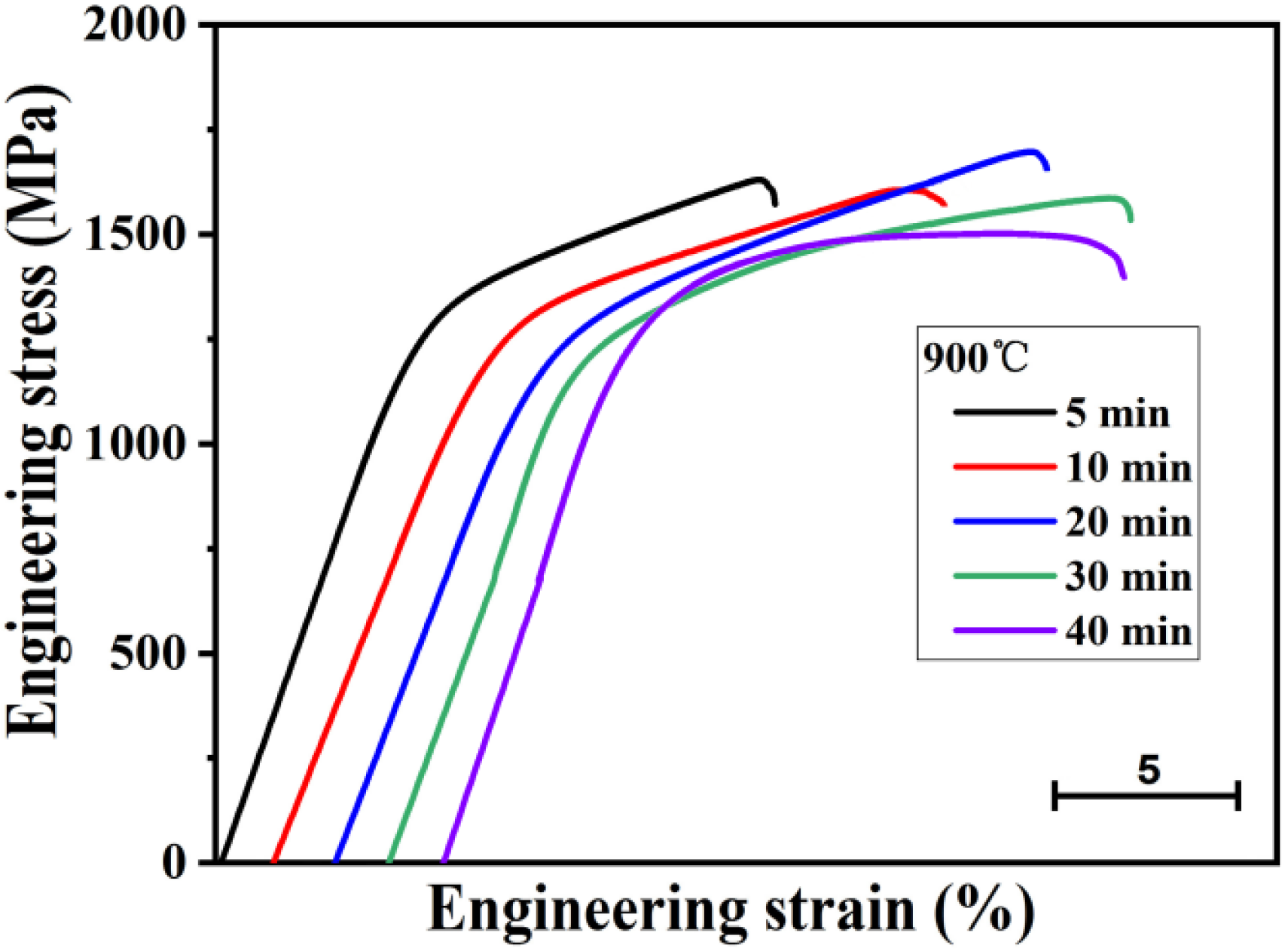
To evaluate the effect of annealing on the mechanical properties of amorphous composite materials, room-temperature compression tests were conducted on as-cast specimens and five groups of processed specimens with different holding times. The stress–strain curves of as-cast specimens and processed specimens are shown in Figure 7 and Figure 8, respectively. Based on these curves, key performance parameters such as yield strength (σy), compressive strength (σmax), and plasticity (εp) were obtained, and the specific data are shown in Table 1. It can be seen from the table that the as-cast specimen has the highest yield strength, reaching 1372 MPa; while the specimen annealed for 30 min shows the best performance, with its plasticity reaching a maximum of 16.2%. Overall, the yield strength of the as-cast specimen is significantly higher than that of the five groups of annealed specimens, but its plasticity is significantly lower than all annealed specimens, indicating that annealing reduces the yield strength but effectively improves the plasticity of the material. For the five groups of annealed specimens, their properties show a regular change with the extension of annealing time: ① The yield strength shows an overall trend of decreasing first and then increasing, dropping to the minimum value of 1201 MPa after 30 min of annealing; ② In contrast, the plasticity exhibits a characteristic of increasing first and then decreasing, and also reaches the maximum value after 30 min of annealing.

3.6. Observation of Lateral Surface of Fractured Specimens

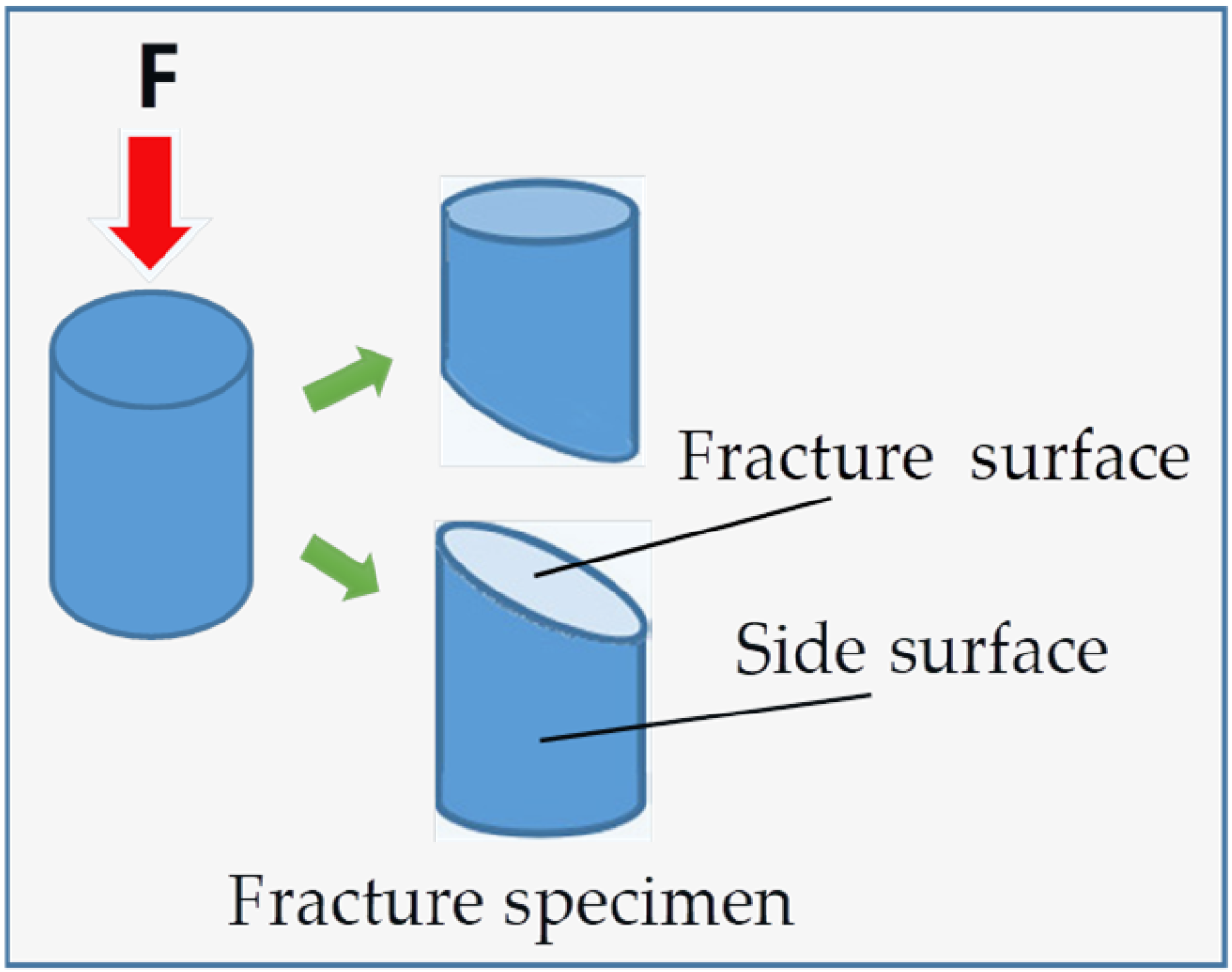
Shear bands are important indicators of plastic deformation in amorphous composite materials. Their characteristics (including morphology, spacing, quantity, distribution density, width, etc.) directly reflect the initiation and deformation state of the material’s plastic deformation. The evolution behaviors of shear bands (such as changes in propagation direction, bending, deflection, bifurcation, multiplication, etc.) further reveal the sustainability of plastic deformation. Usually, by observing these characteristics and evolution behaviors of shear bands on the lateral surface, the degree of plastic deformation of amorphous composite materials is reflected, and thus the plastic deformation capacity of the materials is evaluated. The schematic diagram of the lateral surface of the compression-fractured specimen is shown in Figure 9.
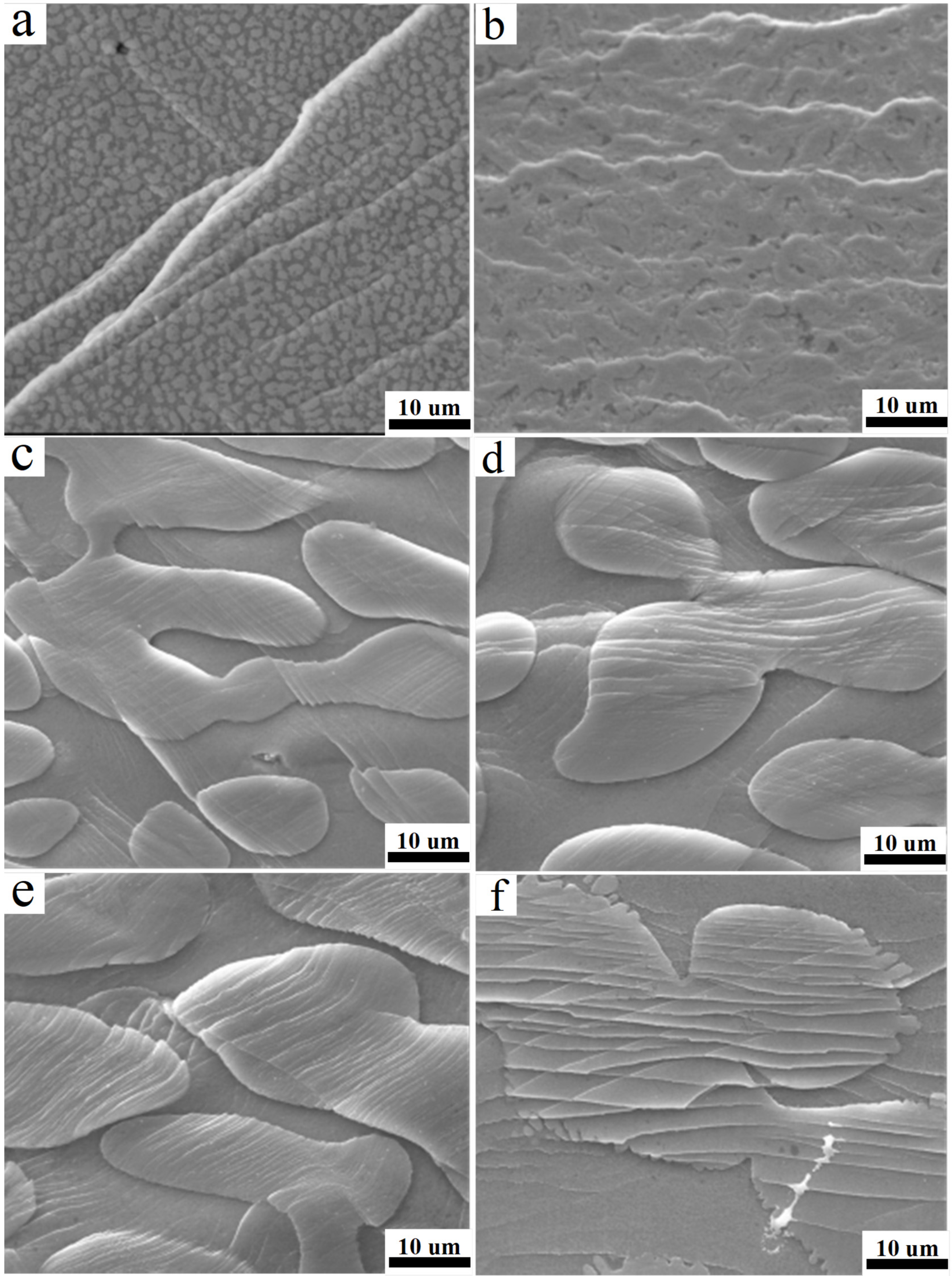
After the as-cast specimen and five groups of treated specimens fractured in the compression test, their side surface morphologies were observed using a Scanning Electron Microscope (SEM), as shown in Figure 10. Figure 10a corresponds to the as-cast specimen. Observations show that there are parallel shear bands on the surface of the compressed specimen, with an average spacing of approximately 4.5 μm. Almost all these shear bands are long and straight, without obvious bending or deviation, which means they propagate linearly along the direction of the maximum shear stress. In addition, the small number and sparse distribution of shear bands indicate that after the plastic deformation of the as-cast specimen initiates, the propagation path of shear bands is single, resulting in limited plastic deformation capacity. From Figure 10b (corresponding to the specimen annealed for 5 min), parallel shear bands can also be observed on the specimen surface. They initiate along the shear stress direction, then continue to propagate linearly, and finally form regular parallel shear bands. For the specimen annealed for 10 min, as shown in Figure 10c, a large number of dense shear bands are distributed on the side surface. The average spacing of the parallel shear bands is about 1.4 μm. Compared with the specimen annealed for 5 min, they have a larger quantity, smaller size, and higher distribution density. This indicates that with the extension of annealing time, internal atomic diffusion intensifies, and the nucleation efficiency of shear bands increases. Thus, the number of shear bands increases, improving the plastic deformation capacity. When the annealing time is 20 min (corresponding to Figure 10d), the spacing of parallel shear bands is reduced to 0.9 μm. Compared with the specimen annealed for 10 min, the total number of shear bands further increases, and the distribution density also rises. The evolution behavior of shear bands begins to stand out—some shear bands no longer maintain a straight shape, showing bending and deviation in the propagation direction. These features indicate that the internal plastic deformation mechanism of the material is more active. It shows that the morphology and evolution behavior of the shear bands on the specimen surface have changed significantly. When the annealing time is 30 min (corresponding to Figure 10e), the spacing of parallel shear bands is further reduced to 0.5 μm. Compared with the specimen annealed for 20 min, the shear bands have a higher distribution density and a significantly increased quantity, and the number of shear bands in the amorphous matrix region also increases. This means the specimen can achieve large plastic deformation. When the annealing time is extended to 40 min (corresponding to Figure 10f), the parallel spacing increases to 0.8 μm, and the distribution density decreases. However, the shear bands are no longer limited to a single direction but generate along multiple different directions. Some shear bands intersect with each other after propagation, making the surface of the crystalline phase region present a typical “pineapple-like” appearance. The multi-directional propagation and evolution of shear bands effectively relieve local stress concentration [33]. These characteristics of shear bands are beneficial to improving plasticity. Although the plastic deformation of crystals increases, the reduction in crystal content limits the plastic deformation potential of the specimen.

4. Discussion and Analysis

4.1. Crystal Evolution Process and Mechanism

When held at temperature for 5 min, the system is in a metastable equilibrium state. Dendritic arms at all levels grow and extend, intertwining with each other to form interwoven or network-like crystals. When the holding time is extended to 10 min, some dendritic arms in the previous network structure continue to grow, while some fine crystals stop growing and gradually dissolve due to their large specific surface area and high surface energy [34]. The connections between some dendritic arms gradually break, and finally the network structure collapses, forming curved strip-shaped crystals. Within the holding time of 10–20 min, in the early stage, selective dissolution starts, and atomic dissociation occurs first at the bending inflection points and convex sides of the crystals [35]. This leads to the appearance of tiny dissolution pits on the surface, which expand slowly perpendicular to the long axis of the crystals. In the middle stage, the dissolution zones expand, and the pits penetrate the cross-section of the crystals, dividing the elongated strip-shaped crystals into multiple long rod-shaped crystals. As the holding time is extended to 30 min, the surface energy of the long rod-shaped crystals is significantly lower than that of the original elongated strip-shaped crystals. However, the entire process follows the principle of minimum surface energy, and the crystals need to evolve into a low-energy short rod state [36]. In this way, more atoms migrate radially to increase the radial size and reduce the system energy, which means the long rod-shaped crystals evolve into short and thick rod-shaped crystals. When the holding time is extended to 40 min, the rod-shaped crystals still have relatively high surface energy. According to the principle that crystal surfaces tend to have minimum surface energy, atoms will spontaneously move in the direction of reducing surface energy. Moreover, through grain boundary migration, grain rotation, and other methods, the edges and corners of the short and thick rod-shaped crystals are gradually “smoothed” [37]. The aspect ratio of the crystals continues to decrease, and finally near-spherical crystals or spherical crystals with lower surface energy are formed.

4.2. Mechanism of Holding Time on Plasticity

When the treatment time is 5–30 min, the network-like crystals gradually evolve into rod-shaped crystals with regular morphology, which becomes increasingly uniform, and the crystal size continues to increase. At this stage, the crystals can act as “obstacles” to the propagation of shear bands, and the number of shear band nucleation sites inside the crystals increases [24]. The number and distribution density of shear bands increase significantly. As the crystal size continues to increase, their hindering effect on the propagation of shear bands is enhanced, while promoting the initiation of new shear bands, leading to an increase in the number and density of shear bands. Accordingly, the plasticity is greatly improved and jumps to the peak value of 16.2%. The improvement of plasticity at this stage is mainly achieved by increasing the number and density of shear bands. When the treatment time is extended to 40 min, the crystals are transformed into near-spherical or spherical crystals. Their average equivalent diameter and surface roundness both reach the maximum values, and the hindering effect on the propagation of shear bands is continuously enhanced. This makes the shear bands break through a single direction, form and propagate in multiple directions, and at the same time induce evolutionary behaviors such as crossing, bending, deviation, and bifurcation, forming a “pineapple-like” crystalline phase region. This phenomenon increases the degree of crystal deformation, which is beneficial to the improvement of plasticity. However, the crystal content in the specimen is low, dominated by the amorphous matrix. With the extension of processing time, the crystal size increases accompanied by a rise in the shape factor, leading to a gradual increase in the plasticity of the crystals and a gradual decrease in the yield strength. In contrast, when the processing time is extended to 40 min, the plasticity decreases while the yield strength increases. This means that even if the plastic deformation of a single crystal is large, due to the low crystal content, high amorphous content, and brittleness of the amorphous phase, the plastic-enhancing effect of crystals competes with the plastic-weakening effect of the amorphous phase. As a result, the potential for plasticity improvement is limited, and it is difficult to achieve continuous growth of plasticity. This is exactly the reason why the plasticity of the specimen decreases when the treatment time is extended from 30 to 40 min.

5. Future Outlook

Future research may center on investigating whether microstructural regulation can further enhance the plasticity of Ti48Zr27Cu6Nb5Be14 amorphous composites, building on the observed phenomenon that dendritic disappearance and rod-like/spherical crystal formation during isothermal holding exert a notable influence on plasticity. Priority could be given to optimizing crystal size, volume fraction, and shape factor through precise control of holding time and temperature. The intrinsic link between tailored microstructures and improved plasticity would yield critical insights.

6. Conclusions

The β-Ti dendrites of Ti48Zr27Cu6Nb5Be14 amorphous composites evolve into near-spherical/spherical crystals as the holding time increases from 5 to 40 min at 900 °C, with the average crystal size continuously rising to 23.1 μm and the crystal volume fraction gradually dropping.
The plasticity of amorphous composites first increases to a maximum of 16.2% at 30 min then decreases to 12.5% at 40 min, while yield strength first falls to 1201 MPa at 30 min then rises, showing an opposite trend.
As the treatment time extends, the crystal size gradually increases, and these crystals improve plasticity by increasing the number of shear bands. When treated for 40 min, the large-sized crystals also promote evolutionary behaviors of shear bands such as crossing, bending and deviation, further improving plasticity. However, the low crystal content causes the plasticity to decrease instead of increasing.

Author Contributions

Conceptualization, X.H.; Methodology, B.C., C.W., J.Z., L.W. and Q.L.; Software, X.H., C.W., J.Z., L.W. and Q.L.; Validation, L.W. and Q.L.; Formal analysis, G.W. and B.C.; Investigation, G.W., B.C., C.W. and J.Z.; Resources, X.H. and Y.O.; Data curation, Y.O.; Writing—original draft, X.H. and G.W.; Writing—review and editing, X.H. and Y.O.; Visualization, Y.O. All authors have read and agreed to the published version of the manuscript.

Funding

This research was funded by Natural Science Foundation of Hunan Province (Grant No. 2023JJ50453), Science Research Excellent Youth Project of Hunan Educational Department (Grant No. 24B0709), and Social Science Foundation of Hunan Province (Grant No. 23ZDB033).

Data Availability Statement

The original contributions presented in this study are included in the article. Further inquiries can be directed to the corresponding author.

Conflicts of Interest

The authors declare no financial or commercial conflicts of interest.

References

  1. Xu, T.; Pang, S.; Li, H.; Zhang, T. Corrosion resistant Cr-based bulk metallic glasses with high strength and hardness. J. Non-Cryst. Solids 2015, 410, 20–25. [Google Scholar] [CrossRef]
  2. Gan, K.F.; Jiang, S.S.; Huang, Y.J.; Yin, H.B.C.; Sun, J.F.; Ngan, A.H.W. Elucidating how correlated operation of shear transformation zones leads to shear localization and fracture in metallic glasses: Tensile tests on CuZr based metallic-glass microwires, molecular dynamics simulations, and modelling. Int. J. Plast. 2019, 119, 1–20. [Google Scholar] [CrossRef]
  3. Zeng, F.; Jiang, M.Q.; Dai, L.H. Dilatancy induced ductile–brittle transition of shear band in metallic glasses. Proc. R. Soc. A-Math. Phys. Eng. Sci. 2018, 474, 20170836. [Google Scholar] [CrossRef] [PubMed]
  4. Wen, S.; Dai, C.; Mao, W.; Zhao, Y.; Han, G.; Wang, X. Effects of Ag and Co microalloying on glass-forming abilities and plasticity of Cu-Zr-Al based bulk metallic glasses. Mater Design 2022, 220, 110896. [Google Scholar] [CrossRef]
  5. Zhang, P.C.; Hu, Y.J.; Chang, J.; Wang, H.P. Microscopic hardness and dynamic mechanical analysis of rapidly solidified Fe-based amorphous alloys. J. Alloys Compd. 2021, 861, 157957. [Google Scholar] [CrossRef]
  6. Zhang, B.; Chen, Y.G.; Guo, H.B. Effects of annealing on structures and properties of Cu–Hf–Al amorphous thin films. J. Alloys Compd. 2014, 582, 496–499. [Google Scholar] [CrossRef]
  7. Han, X.; Kaban, I.; Orava, J.; Cheng, Q.; Sun, Y.H.; Soldatov, I.; Nielsch, K. Phase-formation maps of CuZrAlCo metallic glass explored by in situ ultrafast techniques. Acta Mater. 2022, 241, 118371. [Google Scholar] [CrossRef]
  8. Novikov, V.N.; Sokolov, A.P. Temperature dependence of structural relaxation in glass-forming liquids and polymers. Entropy 2022, 24, 1101. [Google Scholar] [CrossRef]
  9. Romo-Uribe, A.; Reyes-Mayer, A.; Rodriguez, M.C.; Sarmiento-Bustos, E. On the influence of thermal annealing on molecular relaxations and structure in thermotropic liquid crystalline polymer. Polymer 2022, 240, 124506. [Google Scholar] [CrossRef]
  10. Bradtmüller, H.; Gaddam, A.; Eckert, H.; Zanotto, E.D. Structural rearrangements during sub-Tg relaxation and nucleation in lithium disilicate glass revealed by a solid-state NMR and MD strategy. Acta Mater. 2022, 240, 118318. [Google Scholar] [CrossRef]
  11. Riechers, B.; Das, A.; Dufresne, E.; Derlet, P.M.; Maaß, R. Intermittent cluster dynamics and temporal fractional diffusion in a bulk metallic glass. Nat. Commun. 2024, 15, 6595. [Google Scholar] [CrossRef]
  12. Hai, Y.; Cao, Z.; Chen, H.; Bao, H.; Zhang, J.; Xie, C.X.; Ke, Y.B.; Zhou, Z.R.; Guo, J.W.; Sun, Z.Z.; et al. Microstructure and mechanical properties of Zr46Cu46Al8 bulk metallic glass after annealing treatment. J. Non-Cryst. Solids 2023, 621, 122636. [Google Scholar] [CrossRef]
  13. Manne, B.; Bontha, S.; Ramesh, M.R.; Krishna, M.; Balla, V.K. Solid state amorphization of Mg-Zn-Ca system via mechanical alloying and characterization. Adv. Powder Technol. 2017, 28, 223–229. [Google Scholar] [CrossRef]
  14. Leimeroth, N.; Rohrer, J.; Albe, K. General purpose potential for glassy and crystalline phases of Cu-Zr alloys based on the ACE formalism. Phys. Rev. Mater. 2024, 8, 043602. [Google Scholar] [CrossRef]
  15. Zhang, J.; Shi, Q.; Tao, J.; Peng, Y.; Cai, T. Impact of polymer enrichment at the crystal–liquid interface on crystallization kinetics of amorphous solid dispersions. Mol. Pharm. 2019, 16, 1385–1396. [Google Scholar] [CrossRef] [PubMed]
  16. Zhou, F.; Lück, R.; Lu, K.; Lavernia, E.J.; Rühle, M. Amorphous-to-crystalline transformation induced by thermal annealing of a metastable Al90Fe10 composite. Philos. Mag. A 2002, 82, 1003–1015. [Google Scholar] [CrossRef]
  17. Song, X.; Wu, X.; Dai, L.; Jiang, M. Comparative study of amorphous and crystalline Zr-based alloys in response to nanosecond pulse laser ablation. Acta Mech. Sin. 2002, 38, 221480. [Google Scholar] [CrossRef]
  18. Sun, L.; Wang, J.; Kou, H.; Li, J.; Zhang, P. Phase separation and microstructure evolution of Zr48Cu36Ag8Al8 bulk metallic glass in the supercooled liquid region. Rare Met. Mater. Eng. 2016, 45, 567–570. [Google Scholar] [CrossRef]
  19. Izumi, S.; Hara, S.; Kumagai, T.; Sakai, S. Structural and mechanical properties of well-relaxed amorphous–crystal interface in silicon: Molecular dynamics study. Comput. Mater. Sci. 2004, 31, 279–286. [Google Scholar] [CrossRef]
  20. Chang, Z.; Yao, G.; Ge, Y.; Yue, X. Tunable rejuvenation behavior of Zr55Cu35Al10 metallic glass at the atomic scale during recovery annealing and pressure treatment. Mater. Today Commun. 2024, 41, 110646. [Google Scholar] [CrossRef]
  21. Zhao, J.; Tang, Z.; Kelton, K.F.; Liu, C.T.; Liaw, P.K.; Inoue, A.; Fan, C. Evolution of the atomic structure of a supercooled Zr55Cu35Al10 liquid. Intermetallics 2017, 82, 53–58. [Google Scholar] [CrossRef]
  22. Fu, X.; Wang, G.; Wu, Y.; Song, W.; Shek, C.H.; Zhang, Y.; Ritchie, R.O. Compressive ductility and fracture resistance in CuZr-based shape-memory metallic-glass composites. Int. J. Plast. 2020, 128, 102687. [Google Scholar] [CrossRef]
  23. Wang, X.H.; Inoue, A.; Kong, F.L.; Zhu, S.L.; Stoica, M.; Kaban, I.; Eckert, J. Influence of ejection temperature on structure and glass transition behavior for Zr-based rapidly quenched disordered alloys. Acta Mater. 2016, 116, 370–381. [Google Scholar] [CrossRef]
  24. Duan, G.H.; Jiang, M.Q.; Liu, X.F.; Dai, L.H.; Li, J.X. In-situ observations on shear-banding process during tension of a Zr-based bulk metallic glass composite with dendrites. J. Non-Cryst. Solids 2021, 565, 120841. [Google Scholar] [CrossRef]
  25. Sohrabi, N.; Parrilli, A.; Jhabvala, J.; Neels, A.; Logé, R.E. Tensile and impact toughness properties of a Zr-based bulk metallic glass fabricated via laser powder-bed fusion. Materials 2021, 14, 5627. [Google Scholar] [CrossRef]
  26. Xie, F.; Chen, Q.; Gao, J. Brittle-ductile transition in laser 3D printing of Fe-based bulk metallic glass composites. Metals 2019, 9, 78. [Google Scholar] [CrossRef]
  27. Xue, H.; Wang, Z.; Meng, Q.; Ke, C.; Luo, J. Microstructure evolution and mechanical properties for oxygen-rich ZrTiAlV alloy during in-situ semi-solid processing. J. Alloys Compd. 2024, 993, 174654. [Google Scholar] [CrossRef]
  28. Ding, H.P.; Bao, X.Q.; Jamili-Shirvan, Z.; Jin, J.S.; Deng, L.; Yao, K.F.; Gong, P.; Wang, X.Y. Enhancing strength-ductility synergy in an ex situ Zr-based metallic glass composite via nanocrystal formation within high-entropy alloy particles. Mater. Design 2021, 210, 110108. [Google Scholar] [CrossRef]
  29. Zhang, P.C.; Wang, H.P. Phase selection and characterization of Fe-based multi-component amorphous composite. Mat. Sci. Eng. A 2022, 839, 142840. [Google Scholar] [CrossRef]
  30. Wang, J.Q.; Song, L.J.; Huo, J.T.; Gao, M.; Zhang, Y. Designing advanced amorphous/nanocrystalline alloys by controlling the energy state. Adv. Mater. 2024, 36, 2311406. [Google Scholar] [CrossRef]
  31. Hofmann, D.C.; Suh, J.Y.; Wiest, A.; Lind, M.L.; Demetriou, M.D.; Johnson, W.L. Development of tough, low-density titanium-based bulk metallic glass matrix composites with tensile ductility. Proc. Natl. Acad. Sci. USA 2008, 105, 20136. [Google Scholar] [CrossRef]
  32. Mu, J.; Zhu, Z.; Su, R.; Wang, Y.; Zhang, H.; Ren, Y. In situ high-energy X-Ray diffraction studies of deformation-induced phase transformation in Ti-based amorphous alloy composites containing ductile dendrites. Acta Mater. 2013, 61, 5008–5017. [Google Scholar] [CrossRef]
  33. Du, Y.; Han, W.; Zhou, Q.; Xu, Y.; Zhai, H.; Bhardwaj, V.; Wang, H. Enhancing the plasticity of a Ti-based bulk metallic glass composite by cryogenic cycling treatments. J. Alloys Compd. 2020, 835, 155247. [Google Scholar] [CrossRef]
  34. Zhang, Q.; Shen, X.; Wang, Z.; Zhang, S.; Zhu, M. Microstructure evolution during dendrite coarsening in an isothermal environment: 3-D cellular automaton modeling and experiments. J. Mater. Sci. 2021, 56, 10393–10405. [Google Scholar] [CrossRef]
  35. Shi, H.; Tang, C.; Zhao, X.; Ding, Y.; Ma, L.; Shen, X. Effect of isothermal annealing on mechanical performance and corrosion resistance of Ni-free Zr59Ti6Cu17.5Fe10Al7.5 bulk metallic glass. J. Non-Cryst. Solids 2020, 537, 120013. [Google Scholar] [CrossRef]
  36. Sun, G.Y.; Li, P.; Chen, W.; Song, X.D. Spheroidization behavior of dendritic bcc phase in Zr-based β-phase composite. China Foundry 2013, 10, 99–103. [Google Scholar]
  37. Sun, H.; Flores, K.M. Spherulitic crystallization behavior of a metallic glass at high heating rates. Intermetallics 2011, 19, 1538–1545. [Google Scholar] [CrossRef]
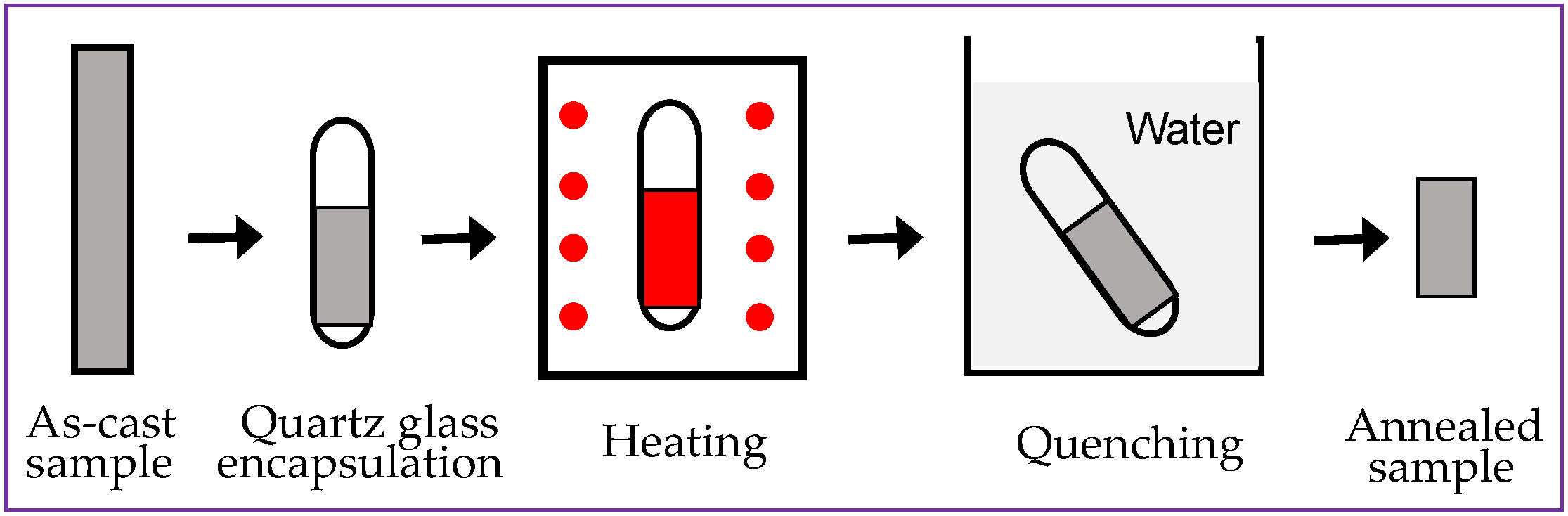
Figure 1. Scheme of the annealing treatment process.
Metals 15 01363 g001
Figure 2. The microstructure observation of as-cast specimens by optical microscopy (OM).
Metals 15 01363 g002
Figure 3. The microstructure observation of five groups of annealed specimens by optical microscopy (OM): (a) 5 min; (b) 10 min; (c) 20 min; (d) 30 min; (e) 40 min.
Metals 15 01363 g003
Figure 4. The relationship between the volume fraction of β-Ti crystals in the treated specimen and the processing time.
Metals 15 01363 g004
Figure 5. XRD curve diagram of amorphous composite detected by phase composition test.
Metals 15 01363 g005
Figure 6. XRD patterns for phase composition detection of annealed specimens prepared by holding at 900 °C for 5, 10, 20, 30 and 40 min, respectively.
Metals 15 01363 g006
Figure 7. The compression stress–strain curves of as-cast specimens.
Metals 15 01363 g007
Figure 8. The compression stress–strain curves of processed specimens with different holding times.
Metals 15 01363 g008
Figure 9. Schematic diagram of specimens with different compressive deformations and fractured specimens.
Metals 15 01363 g009
Figure 10. The appearance of side surface of fractured specimens after compression fracture: (a) as-cast, (b) 5 min, (c) 10 min, (d) 20 min, (e) 30 min, (f) 40 min.
Metals 15 01363 g010
Table 1. The compression properties of as-cast to annealed specimen BMGMCs specimens.
SpecimensYield Strength σy/MPaPlasticity εp/%Maximum Strength
σmax/MPa
As-cast13724.91641
513099.31645
10126411.61611
20123513.91695
30120116.21580
40132512.51498
Disclaimer/Publisher’s Note: The statements, opinions and data contained in all publications are solely those of the individual author(s) and contributor(s) and not of MDPI and/or the editor(s). MDPI and/or the editor(s) disclaim responsibility for any injury to people or property resulting from any ideas, methods, instructions or products referred to in the content.