Article

Thermodynamic Optimization of the Ternary Ga-Sn-Te System Using Modified Quasichemical Model
1
Department of Metallurgical and Materials Engineering, Indian Institute of Technology Kharagpur, Kharagpur 721302, West Bengal, India
2
Research Institute of Engineering and Technology, Hanyang University, Ansan 15588, Korea
*
Author to whom correspondence should be addressed.
Metals 2021, 11(9), 1363; https://doi.org/10.3390/met11091363
Submission received: 2 August 2021 / Revised: 25 August 2021 / Accepted: 26 August 2021 / Published: 30 August 2021
(This article belongs to the Special Issue Thermodynamic Modeling of Metallurgical Processes)

Abstract

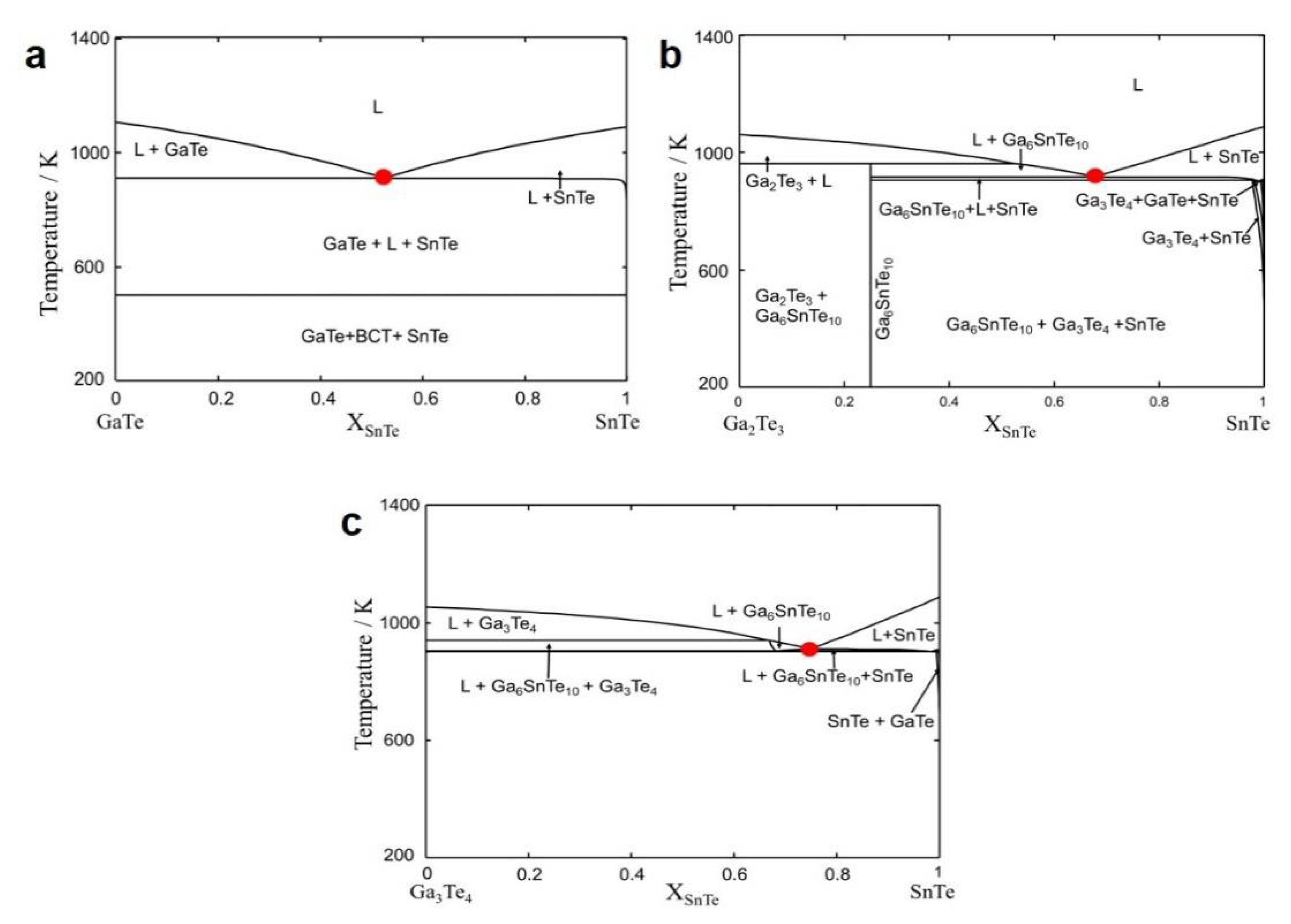
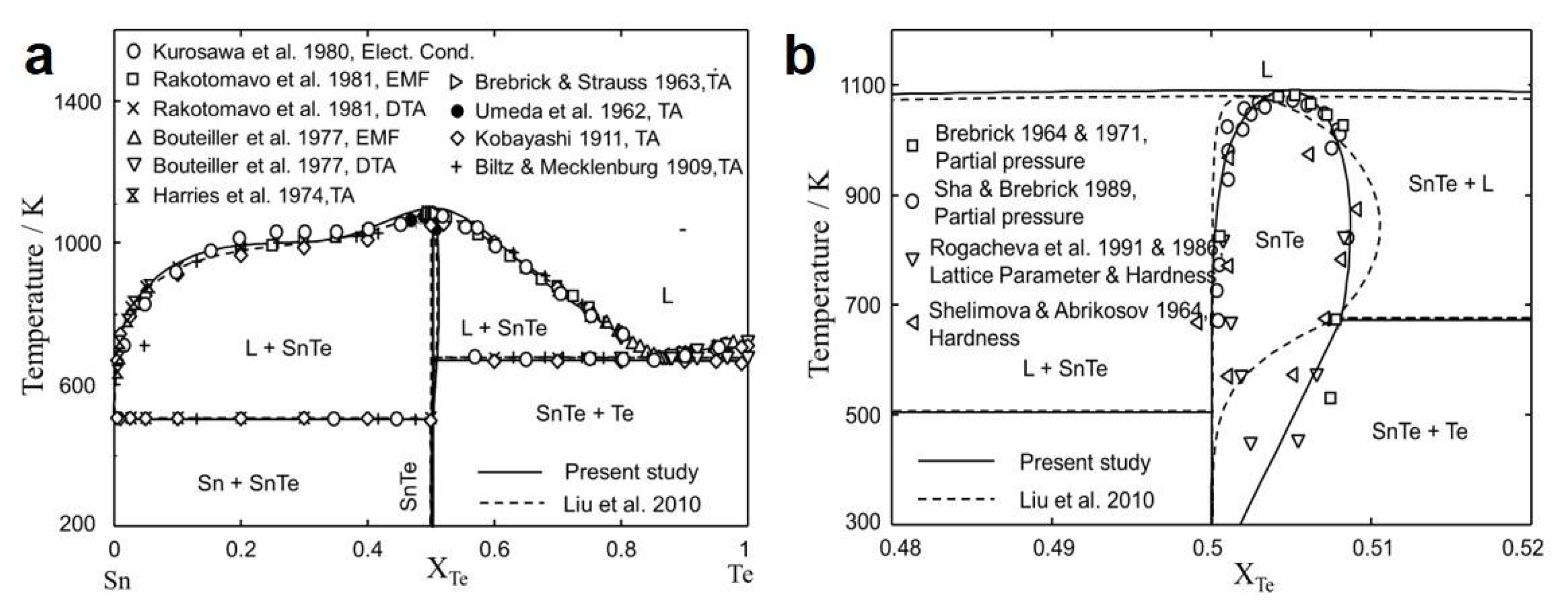
Thermoelectric (TE) materials are of great interest to many researchers because they directly convert electric and thermal energy in a solid state. Various materials such as chalcogenides, clathrates, skutterudites, eutectic alloys, and intermetallic alloys have been explored for TE applications. The Ga-Sn-Te system exhibits promising potential as an alternative to the lead telluride (PbTe) based alloys, which are harmful to environments because of Pb toxicity. Therefore, in this study, thermodynamic optimization and critical evaluation of binary Ga-Sn, binary Sn-Te, and ternary Ga-Sn-Te systems have been carried out over the whole composition range from room temperature to above liquidus temperature using the CALPHAD method. It is observed that Sn-Te and Ga-Te liquids show the strong negative deviation from the ideal solution behavior. In contrast, the Ga-Sn liquid solution has a positive mixing enthalpy. These different thermodynamic properties of liquid solution were explicitly described using Modified Quasichemical Model (MQM) in the pair approximation. The asymmetry of ternary liquid solution in the Ga-Sn-Te system was considered by adopting the toop-like interpolation method based on the intrinsic property of each binary. The solid phase of SnTe was optimized using Compound Energy Formalism (CEF) to explain the high temperature homogeneity range, whereas solid solution, Body-Centered Tetragonal (BCT) was optimized using a regular solution model. Thermodynamic properties and phase diagram in the Ga-Sn-Te and its sub-systems were reproduced successfully by the optimized model parameters. Using the developed database, we also suggested several ternary eutectic compositions for designing TE alloy with improved properties.
Keywords: thermoelectric materials; eutectic alloy; telluride; CALPHAD; thermodynamic modeling thermoelectric materials; eutectic alloy; telluride; CALPHAD; thermodynamic modeling