2. Materials and Methods
2.1. Participants
The study included 86 released fraud offenders (all males) aged 20–75 years (M = 41.29, SD = 12.74), divided into two groups based on participation in a rehabilitation program. The broad age range was intentionally retained to capture variability within the released fraud offender population and its relevance to post-release outcomes. Eligibility criteria were: (a) conviction for a fraud-related offense, (b) release from prison within five years prior to data collection, and (c) residence in the community at the time of the study. The five-year post-release window ensured sufficient community exposure while minimizing recall bias and long-term confounding effects. Group classification was based on actual post-release status: the rehabilitation group had completed a structured program approved by the Prisoner Rehabilitation Authority as a condition for early release, whereas the non-rehabilitation group had not participated in such a program and therefore completed their sentence without parole. Participants in the rehabilitation group were recruited through the Prisoner Rehabilitation Authority following program completion, while participants in the non-rehabilitation group were recruited via community service frameworks and snowball sampling.
The rehabilitation group consisted of 42 participants who completed a rehabilitation program administered by the Prisoner Rehabilitation Authority or a private provider. The non-rehabilitation group included 44 participants who had not participated in such programs and therefore did not receive parole, as program participation is a mandatory condition for parole.
Participants completed a brief background questionnaire assessing country of birth, sector affiliation, religiosity, education level, marital status, parenthood, post-release employment status, and occupational scope. These variables were collected to contextualize post-release circumstances and to control for established social and structural factors associated with post-release adjustment, including social stability and routine. Additional demographic indicators (e.g., age, education, sector affiliation, and years of residence in Israel) were included to capture heterogeneity in life experiences and socio-cultural exposure rather than to test specific a priori hypotheses. Accordingly, all background variables were treated as control variables in the analyses to facilitate the interpretation of group differences beyond individual contextual factors.
Table 1 presents background characteristics by group.
As shown in
Table 1, most participants were born in Israel, with a slightly higher proportion in the non-rehabilitation group (90.9%) than in the rehabilitation group (76.2%), although this difference was not significant. A significantly greater proportion of rehabilitated participants were from the Jewish sector (83.3% vs. 52.3%). No group differences were found in religiosity. Educational attainment was higher among rehabilitated participants, with 35.7% holding an academic degree compared to 13.6% in the non-rehabilitated group. Marital status differed between groups: rehabilitated participants were more often married (50.0% vs. 22.7%), whereas non-rehabilitated participants were more often single (43.2% vs. 14.3%); no differences were observed for divorce, widowhood, or being in a relationship. A higher proportion of rehabilitated participants had children (76.2% vs. 56.8%). Employment rates were also higher in the rehabilitation group (92.9% vs. 75.0%), and among employed participants, full-time employment was more common (73.7% vs. 41.9%). No group differences were found in perceived likelihood of reoffending or returning to prison, with over 80% of participants in both groups reporting low likelihood.
Participants also reported age, years of education, years of residence in Israel (for those not born in Israel), number of children, and time spent in prison.
Table 2 presents group means, standard deviations, and
t-tests for these variables.
As shown in
Table 2, rehabilitated participants were significantly older than non-rehabilitated participants and had more years of education. Among participants not born in Israel (
n = 14), rehabilitated individuals had lived in Israel longer than non-rehabilitated individuals. No significant group differences were found in the number of children or years spent in prison.
Overall, rehabilitated and non-rehabilitated participants differed significantly across several background characteristics, including age, education, marital status, employment status, and sector affiliation.
2.2. Materials
Participants completed three validated and widely used self-report questionnaires. Self-report measures were selected because the study’s primary outcomes (sense of community, perceived self-efficacy, and belief in community integration) represent subjective experiences that are central to the reintegration process.
2.2.1. Fraud Offenders’ Sense of Community
Participants’ sense of community was measured using the Sense of Classroom Community Index (SCCI) [
36]. The original questionnaire includes 20 items rated on a 5-point Likert scale. Ten items assess the participant’s sense of connectedness to the community, while the remaining ten assess perceptions of the learning environment. In the present study, only the 10 items related to social connectedness were used, as they align more directly with the study’s focus on interpersonal belonging and integration. The SCCI questionnaire was translated and culturally adapted for the study population using the double-blind translation and back-translation method. Reliability coefficients reported by Rovai [
36] were α = 0.82 for the connectedness subscale, α = 0.83 for the learning subscale, and α = 0.85 for the overall scale. The reliability of Cronbach’s alpha in the current study for the connectedness subscale was α = 0.92.
2.2.2. Fraud Offenders’ Self-Efficacy
Self-efficacy was assessed using the New General Self-Efficacy Scale (NGSE) [
37]. This scale consists of 8 items rated on a 5-point Likert scale (1 = strongly disagree to 5 = strongly agree), assessing individuals’ global confidence in their ability to successfully perform across various achievement-related situations. A principal components analysis of the original scale yielded a single-factor solution, with high internal consistency reliability ranging from α = 0.85 to α = 0.87. The reliability of Cronbach’s alpha in the current study was α = 0.89.
2.2.3. Belief in the Ability to Integrate into the Community
The belief in one’s ability to integrate into the community was assessed using the Community Integration Questionnaire–Revised (CIQ-R) [
38]. The original CIQ-R consists of 18 items across four subscales: home integration, social integration, productivity, and electronic social networking. For the purposes of this study, the three items from the electronic social networking subscale were excluded. Test–retest reliability reported in the original validation study demonstrated acceptable stability: r = 0.94 for the home integration subscale, r = 0.66 for the social integration subscale, and r = 0.78 for the productivity subscale. The reliability of Cronbach’s alpha for the 15 items that were used in the current study was α = 0.72.
2.3. Procedure
The study was approved by the university’s institutional ethics committee, and all participants provided informed consent prior to participation. At the time of data collection, all participants had completed their prison sentences and were fully released, and were therefore no longer under the authority of the Israeli Prison Service. Formal permission was obtained from the Prisoner Rehabilitation Authority to access released prisoners’ details and recruit individuals who had completed a formal rehabilitation program. Data were collected individually from each participant.
A non-probability, purposive sampling design was employed whereby participants were intentionally selected based on characteristics relevant to the study objectives, namely, being released fraud offenders with or without participation in a rehabilitation program [
39]. Random assignment was not feasible due to ethical and practical constraints in correctional research; therefore, a comparative design was used to examine naturally occurring group differences in a real-world post-release context. Participants in the rehabilitation group were recruited through the Prisoner Rehabilitation Authority, whereas participants in the non-rehabilitation group were recruited via snowball sampling and directly through community service programs administered by the Israeli Prison Service. Individuals who had previously been incarcerated and were subsequently assigned to community service were invited to voluntarily complete the questionnaire. All questionnaires were administered individually in a quiet and private setting to minimize social desirability bias and to allow participants to reflect on their post-release experiences in a safe, non-judgmental environment. Questionnaires were administered in Hebrew, and all translated instruments underwent double-blind translation procedures to ensure linguistic and cultural validity. Data collection included a demographic questionnaire and three validated measures: the Sense of Classroom Community Index (connectedness subscale only), the New General Self-Efficacy Scale, and the modified Community Integration Questionnaire–Revised (CIQ-R). Participation was voluntary and anonymous. Prior to data collection, participants received a detailed explanation of the study’s objectives, procedures, and their rights, and signed an informed consent form. Given the vulnerability of the study population, additional precautions were taken to prevent harm, protect participants’ dignity, and avoid the collection of identifying information. Participants were informed that they could withdraw from the study at any time without consequence and that all data would be used exclusively for research purposes.
All data were stored securely and were accessible only to the researcher. The researcher adhered to principles of objectivity and minimized bias by basing interpretations solely on questionnaire data. Participants were treated with respect throughout the study. The average completion time for the full set of questionnaires was approximately 20 min.
2.4. Data Analysis
Data was analyzed using IBM SPSS Statistics (version 29). Descriptive statistics (means, SDs, medians, skewness, and kurtosis) were computed for all study variables (sense of community, self-efficacy, and community integration). Normality was assessed using skewness (±1) and kurtosis (±2) criteria [
40,
41]. To ensure robust group comparisons, both parametric and non-parametric tests were applied. To test the first hypothesis, group differences associated with rehabilitation program participation were examined using independent-samples
t-tests and Mann–Whitney U tests for sense of community, self-efficacy, and community integration, including total scores and subscales (home integration, social integration, and productivity). For the second hypothesis, Pearson correlation coefficients were calculated separately for rehabilitated and non-rehabilitated participants to examine associations among the three variables. Fisher’s r-to-z transformations were used to compare correlation coefficients between groups.
To address the third hypothesis, hierarchical multiple regression analyses were conducted to evaluate the contribution of background characteristics and rehabilitation program participation. Background variables (e.g., age, marital status, sector, employment) were entered in Block 1 using a stepwise method, followed by group affiliation (rehabilitated vs. non-rehabilitated) in Block 2 to assess the unique effect of program participation. Mediation analysis was conducted to test whether self-efficacy mediated the association between sense of community and community integration. This analysis was performed only for the rehabilitation group, based on theoretical considerations and observed correlations. The PROCESS macro for SPSS (Model 4) [
42] was used with 5000 bias-corrected bootstrap samples. Sector (Jewish) and parenthood (having children) were included as covariates based on their significance in the regression analyses. An alternative model with reversed mediation direction was also tested. All analyses were two-tailed with α = 0.05.
Although the sample size was modest (
N = 86), the use of hierarchical regression and mediation analyses was considered appropriate given the limited number of explanatory variables entered at each step and the presence of moderate-to-large effect sizes. Methodological guidelines indicate that regression models are adequate with approximately 10–15 observations per explanatory variable when model complexity is constrained [
43,
44]. In addition, mediation was tested using bias-corrected bootstrapping with 5000 resamples (PROCESS Model 4), a procedure specifically recommended for small to medium samples because it does not rely on normality assumptions and provides more accurate estimates of indirect effects [
42].
3. Results
3.1. Descriptive Statistics
Descriptive statistics were calculated for the study measures (see
Table 3).
As shown in
Table 3, skewness and kurtosis values were within the acceptable ±2 range [
41], supporting the use of parametric tests. To ensure robustness and address stricter normality criteria (±1) [
40], both parametric (
t-tests) and non-parametric (Mann–Whitney U) tests were conducted to compare rehabilitated and non-rehabilitated offenders on sense of community, self-efficacy, and community integration. Overall, the mean sense of community score was 2.79 (SD = 0.85) on a 5-point scale, indicating a moderate level of connectedness. Self-efficacy was relatively high (M = 3.78, SD = 0.70), suggesting confidence in managing post-release demands. Community integration averaged 14.48 (SD = 5.11) out of 27, reflecting a moderate degree of perceived integration across home, social, and productive domains.
3.2. Differences in Sense of Community, Self-Efficacy and Ability to Integrate into the Community
The first hypothesis stated that rehabilitated released fraud offenders would report higher sense of community, greater self-efficacy, and more positive perceptions of community integration than non-rehabilitated offenders. This hypothesis was tested using both parametric (
t-tests) and non-parametric (Mann–Whitney U) analyses (see
Table 4).
As shown in
Table 4, rehabilitated participants reported significantly higher sense of community than non-participants, as confirmed by both
t-test and Mann–Whitney U analyses. Self-efficacy was also higher among rehabilitated offenders compared to non-participants, with both tests yielding significant results. The large effect size indicates a strong association between rehabilitation participation and perceived ability to cope with post-release challenges.
No significant group differences were observed in home integration. However, rehabilitated offenders scored higher on social integration and productivity. Total community integration was also significantly higher in the rehabilitation group than in the non-rehabilitation group, as supported by both parametric and non-parametric analyses. Overall, these findings support the hypothesis that rehabilitation participation is associated with higher perceived community integration, particularly in social and productive domains.
3.3. Correlations Between the Released Fraud Offenders’ Sense of Community, Self-Efficacy and Their Ability to Integrate into the Community
The second hypothesis stated that sense of community and self-efficacy would correlate positively with community integration beliefs. Pearson correlations were calculated separately for rehabilitation participants and non-participants to examine group differences (see
Table 5).
As shown in
Table 5, among participants in the rehabilitation program, sense of community was positively associated with self-efficacy, social integration, productivity, and the total community integration score. These four associations were not significant among participants who did not take part in a rehabilitation program. A Fisher r-to-z transformation comparing the correlation coefficients between the two groups revealed significant differences in the associations between sense of community and self-efficacy [Z = 2.01,
p = 0.044], as well as between sense of community and the total community integration score [Z = 2.22,
p = 0.026]. The differences in the correlations between the sense of community and social integration subscales [Z = 1.65,
p = 0.100] and between the sense of community and productivity subscales [Z = 1.82,
p = 0.069] did not reach statistical significance. The sense of community was not significantly correlated with home integration among participants who did and did not participate in the rehabilitation program.
Self-efficacy was positively correlated with the social integration subscale, the productivity subscale, and the total community integration score among participants in the rehabilitation program. Among participants who did not participate in a rehabilitation program, only the association between self-efficacy and the social integration subscale reached statistical significance. A Fisher r-to-z transformation comparing the correlation coefficients indicated that the differences in correlations between self-efficacy and the social integration subscale [Z = 1.73, p = 0.084], the productivity subscale [Z = 0.95, p = 0.342], and the total community integration score [Z = 1.52, p = 0.128] did not reach statistical significance. Self-efficacy was not significantly correlated with home integration among participants who did and did not participate in the rehabilitation program. Overall, the Pearson and Fisher r-to-z transformation results suggest stronger and more consistent correlations between sense of community, self-efficacy, and the total community integration score for those who participated in the rehabilitation program compared to those who did not.
3.4. The Contribution of Released Fraud Offenders’ Background Characteristics and Participation in a Rehabilitation Program to Explaining Their Sense of Community, Self-Efficacy, and Belief in Their Ability to Integrate into the Community
Hierarchical regression analyses were conducted to examine the unique effects of released fraud offenders’ demographics and the additional impact of group (rehabilitated vs. non-rehabilitated) on sense of community, self-efficacy, and community integration (total and subscales). In Block 1, background characteristics were entered stepwise to control for their influence, and only variables that significantly contributed to the explained variance were included. This control is particularly important given that significant differences were found between the rehabilitated and non-rehabilitated groups on several demographic variables (sector, education, marital status, employment status, position scope, age, and years in Israel; see
Table 1 and
Table 2). In Block 2, group (rehabilitated, non-rehabilitated) was entered using a stepwise method to assess whether participation in the rehabilitation program explained additional variance after accounting for background characteristics (see
Table 6).
Sense of community: In Block 1, being married significantly explained 21.1% of the variance (β = 0.46, p < 0.001), with religiosity adding 8.6% (β = 0.30, p = 0.002), totaling 29.7%. Group affiliation did not improve the model in block 2.
Self-efficacy: Being Jewish (sector) and marital status explained 26.1% in block 1 (β = 0.32, p < 0.001; β = 0.31, p = 0.002; β = 0.26, p = 0.009). Group affiliation added 11.5% in block 2 (β = 0.38, p < 0.001). The positive β coefficient indicated that self-efficacy was greater among rehabilitated participants than non-participants. The final model explained 37.6%.
Integration into the community—total score: Being Jewish and having children explained 19.5% in block 1 (β = 0.31, p < 0.01). Group affiliation added 4.7% in block 2 (β = 0.24, p = 0.026), also with a positive β coefficient. The final model explained 24.2%.
Home Integration: Divorce status and older age explained 21.1% in block 1 (β = 0.38, p < 0.001; β = 0.22, p = 0.027). Group affiliation did not improve the model.
Social Integration: Years of education explained 7.1% in block 1 (β = 0.27, p = 0.013). Group affiliation added 6.5% in block 2 (β = 0.27, p = 0.014), also with a positive β coefficient. The final model explained 13.7%.
Productivity: Employment status was the strongest explanatory variable, explaining 33.4% (β = 0.51, p < 0.001); marital status, being Jewish, and relationship status added to a total of 49.3%. Group affiliation did not improve the model.
Overall, these findings underscore the value of rehabilitation programs in supporting the psychological and social adjustment of released fraud offenders. While background characteristics (especially marital status, employment, and sector) play a significant role in shaping post-release sense of community, self-efficacy and community integration, participation in a rehabilitation program contributes uniquely to enhancing self-efficacy and community integration, two crucial components of successful rehabilitation.
3.5. Further Analysis—Mediation Analysis
A mediation analysis was conducted to examine whether self-efficacy mediates the association between sense of community and community integration. This analysis was performed only among participants who had undergone a rehabilitation program, based on prior correlation analyses. The decision to restrict the mediation to this group was due to the absence of significant associations between sense of community, self-efficacy, and community integration among fraud offenders who did not participate in a rehabilitation program. Without such associations, the key assumptions required for mediation analysis are not met [
42,
45]. Following Baron and Kenny’s [
45] and Hayes’ [
42] guidelines, mediation was tested only where significant associations existed between the independent variable (sense of community), the mediator (self-efficacy), and the dependent variable (community integration). The mediation analysis was conducted using the PROCESS macro for SPSS (Model 4) [
42], with 5000 bootstrap resamples to estimate the indirect effects and construct bias-corrected 95% confidence intervals. Bootstrapping is a non-parametric resampling procedure that provides robust estimates of indirect effects, even when normality assumptions are violated [
42,
46]. Importantly, this analysis was conducted only on the total community integration score, rather than on the individual subscales (home integration, social integration, and productivity). This decision was based on both theoretical and statistical considerations. The total score represents a more holistic and psychometrically stable indicator of an individual’s perceived integration into community life after release, and prior correlation analyses showed more consistent and significant associations between the total score and sense of community and self-efficacy. In contrast, the home integration subscale did not associate significantly with sense of community or self-efficacy, which would limit the interpretability and statistical validity of the mediation models. Sector (Jewish) and having children were added as covariates, based on their significant contribution in the hierarchical regression. This helped isolate the unique indirect effect of sense of community on community integration through self-efficacy.
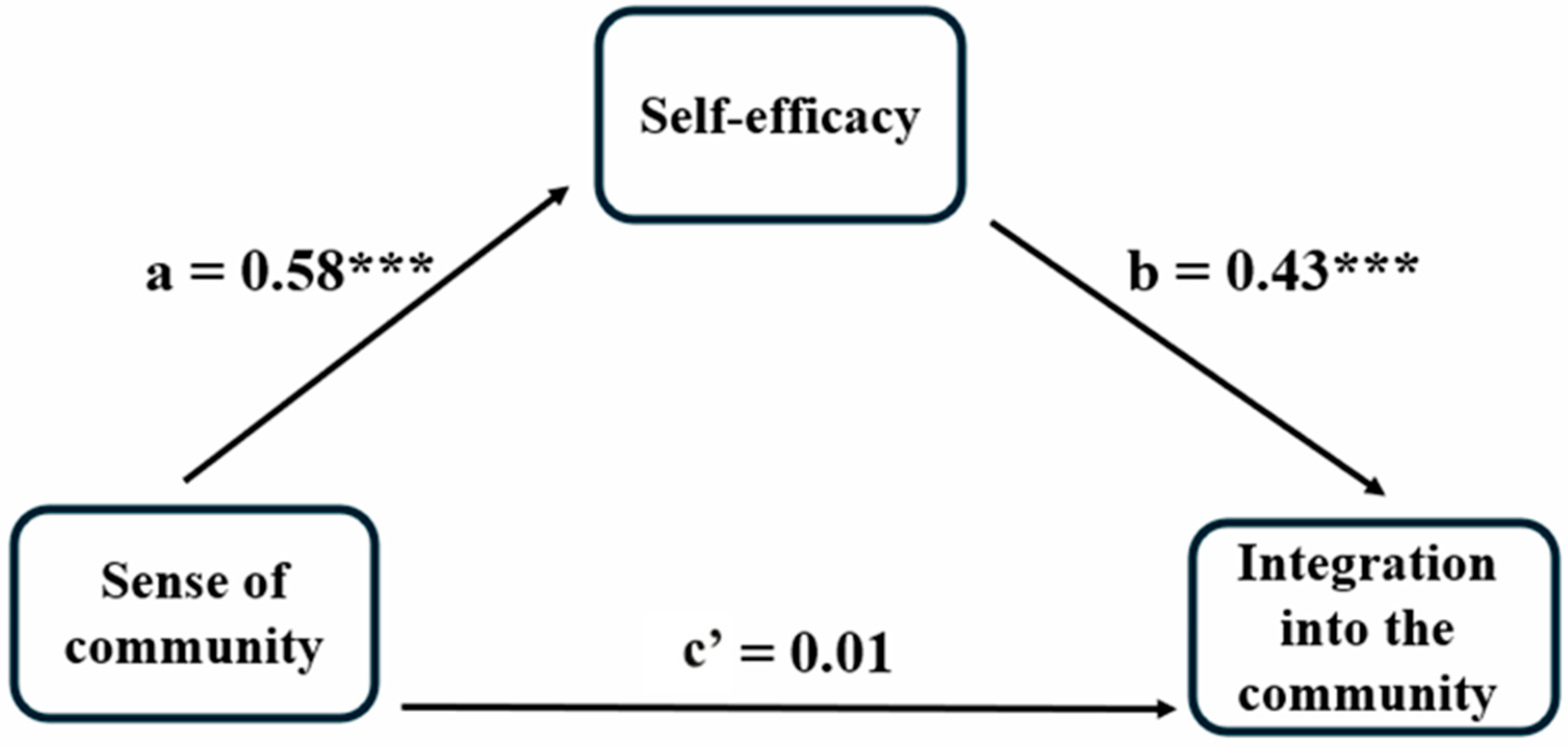
The results indicated that sense of community was a significant positive explanatory variable of self-efficacy (a = 0.58,
p < 0.001, LLCI = 0.18, ULCI = 0.49), and that self-efficacy was a significant positive explanatory variable of community integration (b = 0.43,
p < 0.001, LLCI = 1.02, ULCI = 6.48). When controlling for the mediator, the direct effect of sense of community on community integration was no longer significant (c′ = 0.01,
p = 0.959, LLCI = −1.56, ULCI = 1.64), indicating full mediation. The indirect effect of sense of community on community integration via self-efficacy was statistically significant, based on 5000 samples, and the confidence interval did not include zero (LLCI = 0.21, ULCI = 2.29; see
Figure 1).
To further examine the directionality of the mediation, an alternative model was tested in which self-efficacy served as the independent variable, community integration remained the dependent variable, and sense of community served as the mediator. This reversed model did not yield a significant indirect effect, and the confidence interval included zero (LLCI = −0.16, ULCI = 0.26), indicating no mediation. In this alternative model, self-efficacy was significantly associated with sense of community (a = 0.57, p < 0.001, LLCI = 0.52, ULCI = 1.43), but sense of community did not significantly associate with community integration when controlling for self-efficacy (b = 0.01, p = 0.959, LLCI = −1.56, ULCI = 6.48). The direct effect of self-efficacy on community integration remained significant (c′ = 0.43, p = 0.008, LLCI = 1.02, ULCI = 6.48).
It should be noted that the study employed a cross-sectional design, in which all three self-report questionnaires were administered at the same time to the fraud offenders, and causal relationships cannot be determined. However, mediation analysis remains an acceptable exploratory approach to test theoretical models [
42,
46]. Importantly, the results of the first model with self-efficacy mediating the association between sense of community and community integration were statistically supported, while the reverse model was not.
4. Discussion
This study examined the influence of rehabilitation programs on the sense of community, self-efficacy, and beliefs regarding community integration among released fraud offenders. The findings provide insights into the psychological and social benefits of pre-planned rehabilitation interventions, helping to understand specific areas of emphasis for successful community reintegration of fraud offenders. The results of the current study extend beyond documenting group differences by identifying psychosocial mechanisms through which rehabilitation participation is associated with reintegration outcomes.
One of the key insights that emerged was that the rehabilitation process for this population cannot be examined solely in formal terms of participating in a therapeutic program or receiving assistance services, but requires a broader examination, including dimensions of personal experience, sense of self-efficacy, and connection to the surrounding community.
Studies conducted in the U.S.A. and Europe (e.g., [
47]). showed that although white-collar criminals are relatively unlikely to reoffend, they do have unique reintegration difficulties, such as damaged social standing, economic restrictions, and community distrust. Released offenders in Israel also struggle with these challenges, but the unique socio-economic characteristics in Israel exacerbate these difficulties—the relatively small employment market and more closed communities increase offenders’ exposure to social stigma and ongoing public condemnation.
The PRA’s rehabilitation programs operated in Israel focus mainly on providing initial support for aspects of employment, housing, and social worker-accompanied personal and group discussions [
10]. Research findings have shown that these programs indeed make a significant contribution to boosting the confidence of released prisoners in their first steps outside prison [
48]. However, content and tools appear to require more accurate adaptations for fraud offenders due to this group’s unique social and economic characteristics.
4.1. Differences in Sense of Community and Self-Efficacy Based on Participation in a Rehabilitation Program
The findings of the current study strongly supported the first hypothesis, demonstrating that released fraud offenders who participated in rehabilitation programs reported significantly higher sense of community, self-efficacy, and overall belief in successful community reintegration than those who did not participate in these programs. These findings are consistent with previous research on offenders’ rehabilitation, which consistently demonstrates the positive effects of rehabilitation programs on post-release outcomes, particularly those that emphasize community support, professional training, and personal empowerment [
49,
50,
51].
The medium to large effect sizes observed, particularly for self-efficacy and overall community integration, suggest that rehabilitation programs produce meaningful and practically significant improvements in these key psychological and social aspects. The powerful effect on self-efficacy is noteworthy, as it has been identified as a crucial factor in successful desistance from crime and positive community adjustment [
52,
53]. Self-efficacy theory suggests that individuals with higher confidence in their abilities are more likely to address challenges and pursue pro-social goals [
20]. For released fraud offenders, the rehabilitation program’s self-efficacy enhancement appears to be particularly beneficial for their reintegration, as they feel an active part of their community, having a worthy and belonging place within the social fabric.
The current research also highlights another component that deserves attention: a sense of connectedness to the community. It appears that released individuals who participated in the rehabilitation program feel a stronger sense of reconnection to their community. This holds significant importance, given the international research literature indicating the importance of supportive social connections in reducing the likelihood of recidivism [
54].
Interestingly, while overall community integration was significantly higher among rehabilitated participants, the analysis of subscales yielded differential effects across domains. Both social integration and productivity showed significant group differences, while home integration did not. This pattern suggests that rehabilitation programs may be particularly effective at addressing interpersonal relationships in the wider circle and work-related integration, which are often central concerns for fraud offenders who may have lost professional credibility and social standing. The lack of difference in home integration may reflect that factors beyond program participation, such as family status, structure, and acceptance, influence the home situation.
4.2. Correlational Patterns and Program Effects
The second hypothesis regarding positive correlations between sense of community, self-efficacy, and community integration was supported. However, that is only the case for released offenders who participated in a rehabilitation program. This finding is probably one of this study’s most theoretically significant results. It suggests that rehabilitation participation may shape the way psychosocial resources are organized in the reintegration process.
Data analysis revealed differences in the relationships between sense of self-efficacy and other variables, based on participation in the rehabilitation program. For those who participated, their self-efficacy is closely tied to their sense of connection to their community and to their belief in community reintegration, particularly in the social and productivity dimensions. In contrast, for those who did not participate in such a program, self-efficacy was only related to their home integration. It appears that rehabilitation programs help to expand support networks beyond the immediate family circle following release. Without a rehabilitation program, post-release self-efficacy is associated with household adjustment and reintegration within the family. Those who participate in rehabilitation programs are exposed to broader and richer social connections. Studies on social discrimination and criminal labels indicate that reduced social stigma significantly facilitates the reintegration process of released offenders, including success in employment and improved social conduct [
28,
29].
This differential correlation pattern has important theoretical implications. The finding that these relationships only emerged following rehabilitation suggests that structured interventions may help individuals develop a more coherent and integrated psychological framework by both improving these constructs separately and strengthening their links. Social cognitive theory predicts that sense of community and self-efficacy should have potential synergistic effects on reintegration outcomes when interconnected [
55]. However, without such intervention, these constructs may remain disconnected, limiting their positive behavioral effect.
The mediation analysis, which shed more light on these interactions, found that the correlation between rehabilitated fraud offenders’ sense of community and community integration was completely mediated by self-efficacy. According to this study, having a sense of belonging to one’s community is vital, but it takes more self-confidence to turn the feeling into successful integration. This is consistent with the focus of social cognitive theory on self-efficacy as a crucial mechanism by which social and environmental influences affect behavior [
52].
4.3. Background Characteristics and Individual Differences
The third hypothesis regarding the contribution of background characteristics to study outcomes was partially supported, with important variations across different measures. The hierarchical regression analyses revealed that demographic factors such as marital status, employment, and religious sector explained significant variance in most outcomes. This finding aligns with previous studies that report differences in the reintegration of released prisoners by gender, age, and socio-economic background [
25,
27].
In the current regression analyses, marital status was consistently found to be a significant predictor across several results, highlighting the importance of family and personal support networks for post-release reintegration. According to abundant data, solid relationships have a beneficial impact on recidivism and community adjustment [
56,
57]. Nevertheless, the regression analysis in the current research revealed that participation in the rehabilitation program has a positive effect on the sense of self-efficacy even beyond the influence of the released offender’s marital status, emphasizing its importance for successful reintegration.
Interestingly, the contribution of involvement in rehabilitation programs varies depending on the outcome measure. Despite the considerable impact on self-efficacy, the program had a moderate impact on overall community integration and no discernible effect on productivity or home integration beyond background factors. It emerged that employment status has a considerable influence, especially in predicting productivity ratings, which supports the need for financial security to achieve an effective return to society. Furthermore, the differential effects observed across outcome measures suggest that program-related factors, alongside background characteristics, warrant closer examination, which may indicate that more personally adapted rehabilitation programs are potentially more effective than general, standardized interventions.
Current PRA rehabilitation programs, while comprehensive, are largely misaligned with fraud offenders’ needs, primarily focusing on group-based community treatment, assistance with debt repayment and rights realization, and vocational rehabilitation/professional training [
10]. Although therapeutic groups tailored for fraud offenders are available, their content may not sufficiently address the specific post-release challenges faced by this population beyond acknowledging the offense category. Optional enrichment groups focusing on emotional or psychosocial processes (e.g., mindfulness, psychodrama, and family-related issues) may also be potentially less relevant for some fraud offenders, whose reintegration challenges are often less related to emotional regulation and more to identity reconstruction and social legitimacy. Nonetheless, participation in rehabilitation programs was found to positively contribute to the sense of self-efficacy among released prisoners, indicating that structured group-based frameworks may hold rehabilitative value even when content alignment is partial.
Similarly, assistance with rights realization and individualized debt repayment—while essential for many released prisoners—may offer limited added value for fraud offenders, who are often professionally established and possess substantial pre-incarceration economic expertise. These individuals may therefore require less navigation of basic rights and perceive financial counseling as less directly relevant to their reintegration needs, potentially limiting the impact of these components on practical post-release outcomes. Finally, vocational rehabilitation services, including employment needs assessments, multidisciplinary guidance, and work-skills workshops, are typically designed to facilitate labor market entry for individuals with limited employment histories. For many fraud offenders, however, such interventions may be less impactful due to their established professional backgrounds and prior integration into high-status occupational roles.
Taken together, these findings suggest that while existing rehabilitation programs provide important structural support, their standardized design may not fully correspond to the specific reintegration trajectories of fraud offenders. More differentiated and precisely tailored rehabilitation models may therefore enhance program effectiveness by aligning intervention components with offense-specific needs and capacities.
4.4. Limitations
The current study has several limitations that should be noted. First, the purposive and snowball sampling methods are likely to skew the sample and reduce its representation. In addition, the relatively small sample size may limit the generalizability of the findings. For example, because of the only male sample, it is impossible to rely on the findings regarding female offenders who experience unique challenges of a lack of job security, supportive social networks, and the need to care for children. Likewise, the sample focused on fraud offenders. Second, the data relied on participants’ self-reporting questionnaires, which are likely to be subject to memory biases, social desirability, and even conscious or subconscious inaccuracies. This barrier may explain why most subjects claimed they were unlikely to reoffend in the future, although some are likely to remain at risk of doing so. Moreover, participants were not asked about their history of imprisonment (including the number of imprisonments, type of offense in each, dates, etc.). Therefore, it is not possible to know exactly how long it had been since their last release, whether they had been in prison for other offenses before, and whether they had completed any rehabilitation programs after previous releases, if any. Lastly, it was found that the groups differed significantly in terms of sector, education, employment, and marital status. Although statistical controls were carried out, it is impossible to rule out the possibility that the differences in these variables influenced the sense of community and self-efficacy, in addition to participation in the rehabilitation program.
4.5. Recommendations for Future Research
It is recommended that the sample be expanded to include female offenders, various types of offenses, and additional ethnic groups. This will enable us to examine whether the findings persist or change across different genders or socio-cultural contexts. Future research should also include objective measurements, such as actual employment data, re-imprisonment data, recidivism rates, and professional evaluations. These measures will likely reduce reporting biases and deepen the reliability of findings. Furthermore, it is recommended that longitudinal research studies be conducted to examine the effect of rehabilitation programs over time, for example, by measuring outcomes before, during, and after participation in a program. Such studies will enable empirical investigation of changes over time and facilitate the drawing of causal conclusions.
4.6. Implications for Practice
The findings of this study are consistent with international literature, highlighting the necessity of systemic integration that encompasses rehabilitation services, psychological support, housing, and employment opportunities [
13,
14,
19]. At the same time, this study raises critical questions concerning how rehabilitation programs in Israel conceptualize and measure success. Is success defined narrowly as the prevention of recidivism, or more broadly as the complete social reintegration of former prisoners as productive and contributing citizens? This distinction is not merely semantic; it fundamentally shapes the design of rehabilitation programs and the allocation of resources. If success is limited to reducing reoffending, minimal supervision and support may be considered sufficient. However, if the goal is to foster full integration into society—enabling former prisoners to enter the labor market, contribute to the economy, and take an active role in community life—significantly greater investment in individually tailored programs is required. Furthermore, the findings suggest that successful outcomes rely not only on individual motivation but also on the structure and responsiveness of the surrounding community, underscoring the importance of interventions aimed at reshaping social attitudes and creating supportive environments [
24,
34].
5. Conclusions
In conclusion, the current study shows the important established system of rehabilitation programs in Israel, which assist released fraud offenders by providing them with organizational anchors, accompaniment, and support. On the other hand, significant gaps and challenges arise, necessitating a reevaluation of the nature of these programs. Findings support a holistic approach based on social and cognitive theories, combining institution, community, and home components, together with constructing and nurturing a coherent, integrated pro-social identity. Rehabilitation success does not depend solely on the official system, but on a range of factors, including sense of efficacy, community belonging, family support, and socioeconomic opportunities. Integrating all these elements is likely to be a meaningful mechanism for reducing the risk of reoffending and ensuring positive integration into society. Further academic and practical consideration of this topic is essential to reducing cycles of crime, fostering a sense of social security, and building a more just and equitable society.