4.1. Growth Performance and Somatic Responses
The present study showed that partial replacement of the control diet by
Tenebrio molitor and/or
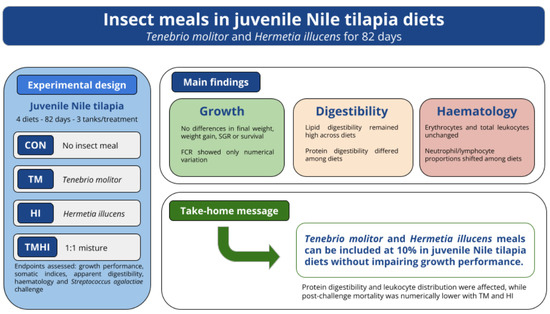
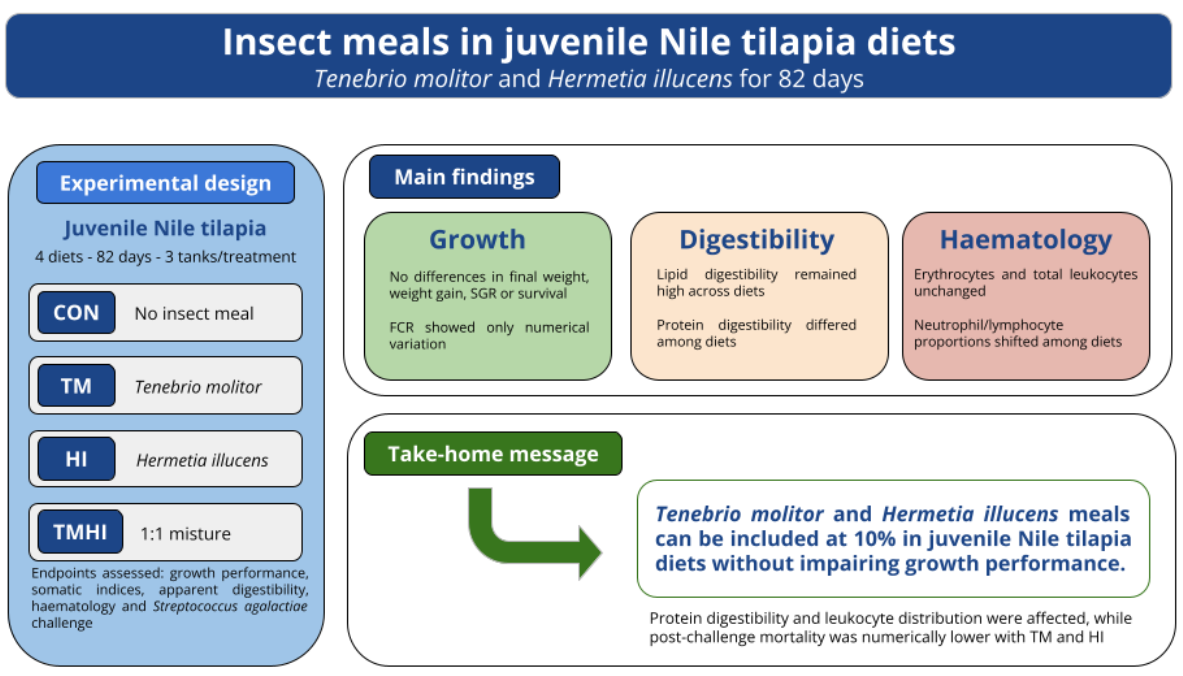
Hermetia illucens larvae meals at 10% inclusion did not impair growth performance of Nile tilapia juveniles under the present experimental conditions. Final body weight, weight gain, specific growth rate (SGR), feed intake and feed conversion ratio (FCR) did not differ among diets (
p > 0.05) (
Table 5). Overall, fish showed strong productive responses across treatments, with SGR values of approximately 2.76–2.82% day
−1, FCR values of 1.15–1.25 and survival above 93%. These values indicate efficient growth and feed utilization for juvenile Nile tilapia under controlled feeding conditions and support the nutritional adequacy of the experimental diets.
These findings are consistent with previous studies showing that
T. molitor and
H. illucens meals can be incorporated into tilapia feeds without compromising growth performance when inclusion levels are appropriate and diets are properly balanced [
4,
10,
31,
32,
33,
34]. In Nile tilapia,
H. illucens larvae meal has been tested as a fishmeal replacer without detrimental effects on growth and feed utilization [
10,
31], while graded substitution designs further support its feasibility in nutritionally balanced diets [
32]. Similarly, studies using
T. molitor in tilapia diets, including biofloc systems and digestibility-focused trials, indicate that this ingredient can support adequate productive performance when formulation constraints are addressed [
34,
35]. Therefore, the absence of negative effects in the present study suggests that, at 10% inclusion, both insect meals acted as nutritionally compatible ingredients rather than as performance-enhancing additives, as also indicated in broader syntheses on insect meal use in aquafeeds [
33,
36,
37,
38].
Somatic indices further support the hypothesis that insect meal inclusion at 10% did not induce major alterations in body condition, organ allocation or visceral fat deposition. Condition factor, viscerosomatic index (VSI), hepatosomatic index (HSI) and liposomatic index (LSI) were not affected by dietary treatment (
p > 0.05) (
Table 6). This pattern is consistent with tilapia trials using
H. illucens meal that reported stable body condition and somatic responses under practical formulations [
10,
33]. Although mean LSI values varied among treatments, this response remained below the significance threshold and should therefore be interpreted as descriptive. Overall, the growth and somatic responses observed here add to the evidence that
T. molitor and
H. illucens meals are technically feasible ingredients for juvenile Nile tilapia feeds at low-to-moderate inclusion levels, provided that diets are formulated to meet nutrient requirements and maintain adequate amino acid balance and digestible energy [
4,
10,
32,
34]. However, because only one inclusion level was evaluated, future studies using graded inclusion levels are warranted to establish optimal inclusion thresholds and to determine whether higher dietary incorporation may elicit more pronounced physiological, immunological or productive responses in Nile tilapia.
4.2. Nutrient Digestibility of Tenebrio molitor and Hermetia illucens Meals
The apparent digestibility coefficients (ADC) obtained in the present study indicate that both insect meals supported high nutrient utilization by Nile tilapia. Protein digestibility was more sensitive to diet and ingredient differences than lipid digestibility, a pattern commonly observed when comparing protein-rich ingredients that differ in non-protein fractions, processing history and nutrient accessibility [
35,
39]. It is important to note that insect meals were included at 10% in the growth trial; whereas, ingredient ADC values were estimated using the substitution method [
27]. Therefore, diet-level ADC values are more directly related to the growth trial; whereas, ingredient-level ADC values provide comparative information on the digestibility of each insect meal.
At the diet level, ADC-CP differed among treatments, with the TM diet showing lower protein digestibility than CON, HI and TMHI; whereas, ADC-EE did not differ among diets and remained high across treatments (
Table 7). This indicates that Nile tilapia maintained a consistent capacity to digest dietary lipids across formulations, as also reported in studies evaluating practical diets and insect-derived ingredients in tilapia [
10,
40,
41,
42]. The lower ADC-CP observed for the TM diet did not result in impaired growth performance or poorer FCR at 10% inclusion, suggesting that the overall digestible nutrient supply remained adequate when diets were properly formulated. Conversely, although the HI diet presented a higher mean FCR, this response was not accompanied by lower ADC-CP or ADC-EE values. Therefore, the FCR pattern observed in HI cannot be explained solely by the apparent digestibility of crude protein or ether extract. If confirmed in adequately powered studies, a higher FCR in fish fed HI could indicate lower overall feed efficiency, potentially related to factors not fully captured by the digestibility assay, such as amino acid balance, nutrient availability, ingredient matrix effects, energy partitioning, or other aspects of nutrient utilization. Importantly, FCR did not differ significantly among diets, and this interpretation should therefore be considered descriptive rather than evidence of a treatment effect.
At the ingredient level, ADC-CP also differed among insect meals.
H. illucens meal showed the highest protein digestibility,
T. molitor meal the lowest, and the mixed insect meal an intermediate value (
Table 7). In contrast, ingredient ADC-EE did not differ among insect meals and remained high. These findings support the interpretation that protein digestibility is a major source of variation among insect ingredients, while lipid utilization may remain consistently high across insect sources when diets are balanced. Similar patterns have been reported in tilapia digestibility screening assays and feeding trials including
H. illucens meal [
10,
34,
35,
42].
Variation in insect-meal protein digestibility may be related to ingredient composition and processing, including non-protein fractions such as chitin, degree of defatting and physicochemical properties that can influence nutrient accessibility and enzyme–substrate interactions [
43,
44]. In Nile tilapia, chitin can be digested to some extent, but its effects on nutrient digestibility may vary according to inclusion level, processing and dietary context [
44]. In this sense, the lower ADC-CP observed for TM does not preclude its use in tilapia feeds, particularly because growth performance was maintained in the present study. However, it highlights the importance of ingredient characterization and formulation adjustments, including amino acid balancing and consideration of processing effects, when insect meals are used as feed ingredients [
39]. Overall, the high ADC values observed, especially for lipid digestibility, are consistent with the capacity of Nile tilapia to utilize insect-derived nutrients and support the inclusion of
T. molitor and
H. illucens meals at 10% in balanced juvenile tilapia diets.
4.3. Hematological Responses and Immunomodulation
Hematological profiles are widely used as practical indicators of fish health and can reflect nutritional adequacy and general physiological status [
45]. In the present study, erythrocyte counts and total leukocyte counts were not affected by dietary treatment (
p > 0.05;
Table 8), indicating that inclusion of
T. molitor and
H. illucens meals at 10% did not compromise basic hematological homeostasis in Nile tilapia juveniles. Comparable outcomes have been reported for Nile tilapia fed
T. molitor meal under intensive rearing conditions, where baseline hematological parameters remained within physiological ranges at similar inclusion levels [
34]. Similar responses have also been described in tilapia trials using
H. illucens meal in balanced formulations [
10].
Although total leukocyte counts did not differ among treatments, the differential leukocyte profile showed diet-related differences in the relative proportions of neutrophils and lymphocytes (
Table 9). Fish fed the control diet had higher neutrophil percentages and lower lymphocyte percentages than fish fed HI and TMHI; whereas, TM showed an intermediate profile. No significant differences were observed for monocytes, eosinophils or basophils (
p > 0.05). Because these changes occurred without differences in total leukocyte counts, they suggest a shift in leukocyte distribution rather than generalized leukocytosis or leukopenia.
This pattern may indicate a modest diet-associated modulation of leukocyte profiles under basal conditions, but it should not be interpreted as direct evidence of improved immune competence. Previous studies and reviews have reported that insect-derived ingredients can influence immune-related endpoints in fish, including hematological and mucosal responses, without necessarily altering core hematological variables [
4,
5,
10,
46]. Such effects have been partly attributed to non-protein fractions and bioactive components of insect meals, including chitin-related compounds and lipid fractions, although their responses depend on insect species, processing, inclusion level and diet formulation [
4,
43,
46,
47,
48].
Therefore, the hematological results of the present study support the safety of 10% inclusion of
T. molitor and
H. illucens meals and suggest limited effects on leukocyte distribution. However, because functional immune assays, oxidative-stress biomarkers, cytokine or gene-expression analyses and microbiota assessments were not performed, the biological relevance of these leukocyte shifts remains uncertain. Future studies combining differential leukocyte profiles with functional and molecular endpoints would help clarify whether these changes translate into measurable immunological benefits or improved disease resistance [
4,
5,
43,
46].
4.4. Resistance to Streptococcus agalactiae
Streptococcosis caused by
Streptococcus agalactiae is among the most relevant bacterial diseases affecting Nile tilapia production and is frequently associated with acute outbreaks, high mortality and substantial economic losses to producers [
49,
50]. Beyond pathogen factors, host outcomes are strongly modulated by farming conditions, such as temperature and stocking density, pathogen strain and virulence, challenge model and the baseline physiological and immune status of the fish, which helps explain why mortality can vary considerably among studies and production settings [
49,
51]. Consequently, nutritional strategies that support fish robustness and post-challenge resilience are of practical interest as complementary tools alongside vaccination, biosecurity and husbandry adjustments [
50,
52].
In the present study, pre-challenge feeding with insect-based diets did not significantly affect survival after
S. agalactiae challenge, as indicated by Kaplan–Meier analysis and the log-rank test (
p = 0.592). Although cumulative mortality was lower in TM and HI than in CON, these differences were not statistically significant and should therefore be interpreted descriptively. The difference in cumulative mortality between CON and the individual insect-meal diets was approximately 13–15 percentage points, with 65.2% mortality in CON compared with 52.2% in TM and 50.0% in HI; whereas, TMHI showed an intermediate value of 60.9%. These descriptive differences may warrant confirmation in adequately powered challenge trials, particularly because even modest reductions in cumulative mortality can translate into meaningful gains in harvestable biomass and lower unit production costs in intensive systems where disease events can rapidly erode margins [
50,
53,
54]. Farm-level economic appraisals of streptococcosis control strategies illustrate how shifts in mortality can materially affect profitability at the production-cycle level [
50,
53].
The descriptive mortality pattern observed here is consistent with previous studies showing that dietary strategies can modulate immune responses and disease outcomes in Nile tilapia exposed to
Streptococcus spp. Diets supplemented with functional ingredients, including yeast-derived compounds, plant-based additives, organic acids and other immunonutritional strategies, have been evaluated in tilapia challenged with
S. agalactiae, with reported effects on inflammatory responses, hematological variables, intestinal morphology and/or survival depending on the additive and experimental model [
53,
54]. These studies support the general concept that nutrition can influence host condition during streptococcosis, but they also show that post-challenge survival is a multifactorial endpoint and may not respond consistently across dietary interventions.
Evidence specifically involving insect meals further supports their potential to modulate immune-related endpoints in fish. In Nile tilapia, Tippayadara et al. [
10] reported that replacement of fish meal by
H. illucens larvae meal was associated with stable growth, survival and core hematological variables, while improving skin mucus lysozyme and peroxidase activities. Similarly, Alves et al. [
18] showed that Nile tilapia fed
Zophobas morio meal under lipopolysaccharide challenge maintained growth performance and showed modulation of innate immune indicators, including lysozyme activity and the alternative complement system, before and after immune stimulation. Agbohessou et al. [
55] also reported that fatty acid-enriched dipteran-based meals affected digestive and immunological responses in Nile tilapia juveniles, suggesting that insect-derived ingredients may influence immune physiology beyond their role as protein sources. Together, these studies indicate that insect meals can affect systemic and mucosal immune-related responses in tilapia, although the magnitude and direction of these effects depend on insect species, processing, inclusion level, formulation and immune stimulus.
More directly related to bacterial challenge, Abd El-Gawad et al. [
14] reported that defatted
H. illucens meal improved hemato-immunological, antioxidant and inflammatory-related responses in Nile tilapia challenged with
Streptococcus iniae. Although
S. iniae is not the same pathogen used in the present study, both agents are important causes of systemic streptococcosis in tilapia and involve overlapping host-response pathways [
49]. Therefore, that study provides relevant support for the biological plausibility that
H. illucens meal may influence host condition under streptococcal infection pressure, while still requiring caution when extrapolating to
S. agalactiae.
Evidence across other fish models also indicates that
T. molitor meal can modulate innate immune effectors and antibacterial activities that may be relevant to bacterial-disease outcomes. Feeding European sea bass diets containing
T. molitor larvae meal increased lysozyme antibacterial activity and altered humoral inflammatory-related markers, including myeloperoxidase and nitric oxide, consistent with mild immunostimulation rather than immunosuppression [
56]. Likewise, in juvenile yellow catfish, graded inclusion of
T. molitor meal enhanced immune and antioxidant indicators and was evaluated in the context of disease-resistance responses, supporting the concept that mealworm-based formulations can influence host defense readiness under infection pressure [
57]. In mandarin fish, dietary
T. molitor inclusion has also been associated with changes in lysozyme activity and antioxidant enzyme activity, reinforcing that mealworm meal may affect innate immune and oxidative-status markers in fish [
58]. In red seabream, defatted T. molitor larvae meal also improved growth performance and disease resistance after bacterial challenge, further supporting the potential functional relevance of mealworm-based diets in fish [
59]. These studies provide biological support for the descriptive mortality pattern observed for TM in the present work, but they do not demonstrate a causal protective effect against
S. agalactiae.
The leukocyte shifts observed before challenge may also support a cautious interpretation of diet-associated immune modulation. Fish fed HI and TMHI showed higher lymphocyte proportions and lower neutrophil proportions than CON; whereas, TM showed an intermediate profile. In the context of the descriptive mortality pattern, these changes are compatible with the broader idea that insect meals can influence basal immune status [
4,
46]. However, because total leukocyte counts were not affected and the present study did not measure lysozyme or complement activity, oxidative-stress biomarkers, cytokine expression, microbiota composition, pathogen load or tissue-level pathology, mechanistic links among diet composition, leukocyte distribution and survival outcomes remain hypothetical.
Several insect-derived components have been proposed as contributors to immune-related responses in fish. Chitin and chitin-derived fractions may interact with innate and mucosal immune pathways, while
H. illucens-derived lipid fractions, including medium-chain fatty acids such as lauric acid, have been discussed in relation to antimicrobial activity and host–microbe interactions [
4,
43,
46,
47,
60,
61,
62]. In vitro studies have also reported antimicrobial activity of lipids extracted from
H. illucens and
T. molitor, supporting the plausibility that insect lipid fractions may contribute to microbial modulation under some conditions [
61,
62]. Nevertheless, the present study did not evaluate chitin fractions, lipid bioactivity, gut microbiota or pathogen load. Therefore, these mechanisms should be regarded as plausible explanations based on previous literature, but not as mechanisms demonstrated in the present experiment.
The intermediate cumulative mortality observed in TMHI should not be interpreted as evidence of antagonism or reduced efficacy of the blend, because survival curves did not differ statistically and the experiment was not designed or powered to resolve small differences among insect-based diets. A mixed-insect formulation may generate responses that differ from single-source meals because the relative contribution of functional fractions, nutrient profile and non-protein components can change when ingredients are blended. However, without direct measurements of immune function, gut microbiota, pathogen burden or intestinal responses, the intermediate TMHI outcome should be considered descriptive rather than mechanistically explained.
Accordingly, the present evidence supports a neutral effect of 10% insect meal inclusion on
S. agalactiae resistance, with descriptive mortality patterns that may justify further investigation. Future work should combine challenge trials with integrated immune and microbiological endpoints, including lysozyme and complement activity, mucosal markers, gut histology, microbiota profiling, pathogen-load quantification and tissue pathology. Given the economic relevance of streptococcosis, future studies should also consider sample sizes powered to detect smaller but commercially meaningful differences in survival [
50,
53].




 ,
,