Neurological Responses to Scented Insects via Olfactory Stimulation: A Controlled fMRI Study

 , , , , , and
Simple Summary
Abstract
1. Introduction
2. Methods
2.1. Study Design and Participants
2.2. Demographic Data and Psychometric Assessment
2.3. Scented Insects
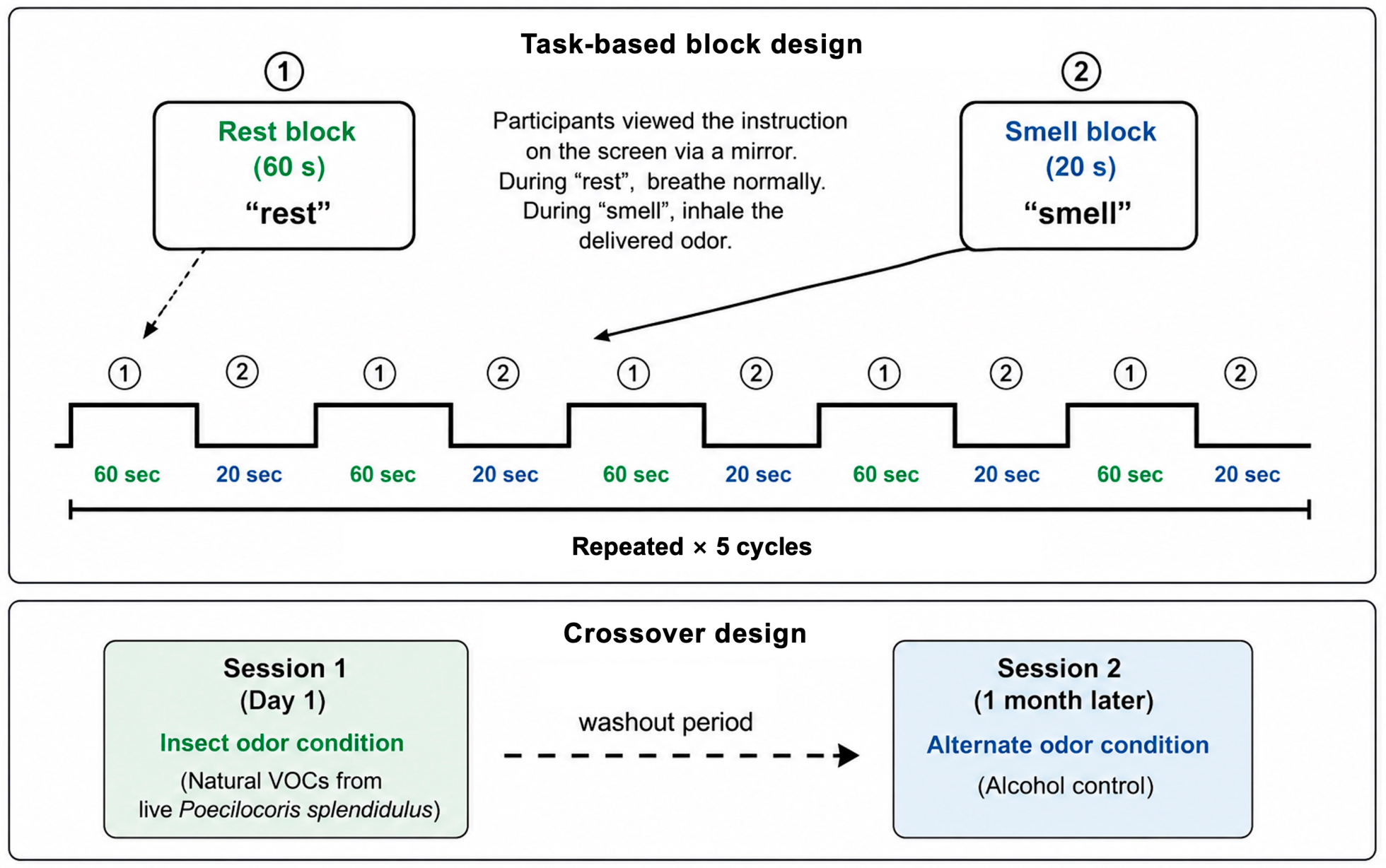
2.4. Olfactory Stimulation Method
2.5. MRI Data Acquisition
2.6. MRI Data Analysis and Statistical Analysis
2.6.1. Preprocessing Pipeline
- Slice Timing Correction: Corrected for temporal differences in slice acquisition.
- Realignment: Corrected for head motion by rigid-body transformation. Participants with head displacement > 2.0 mm or rotation > 2.0° were excluded.
- Co-registration: The realigned functional images were co-registered to each participant’s high-resolution T1-weighted structural image.
- Segmentation and Normalization: Structural T1 images were segmented into gray matter, white matter, and cerebrospinal fluid using CAT12. The estimated parameters were subsequently applied to normalize the functional images into the Montreal Neurological Institute (MNI) standard space.
- Spatial Smoothing: Normalized images were smoothed using an 8-mm full-width at half-maximum (FWHM) Gaussian kernel to improve the signal-to-noise ratio.
2.6.2. First-Level and Second-Level Statistical Analysis
- First-level (Individual) Analysis: A General Linear Model (GLM) was applied to each participant. The design matrix modeled the smell blocks (20 s) and rest blocks (60 s) using a box-car function convolved with the canonical hemodynamic response function (HRF). Six head-motion parameters were included as nuisance regressors to minimize residual motion-related effects. Individual contrast maps (Scented Insect > Rest and Control Scent > Rest) were generated for each participant.
- Second-level One-sample t-test: Individual contrast maps were entered into voxel-wise one-sample t-tests separately for the scented insect and control scent conditions to identify brain regions significantly activated within each condition.
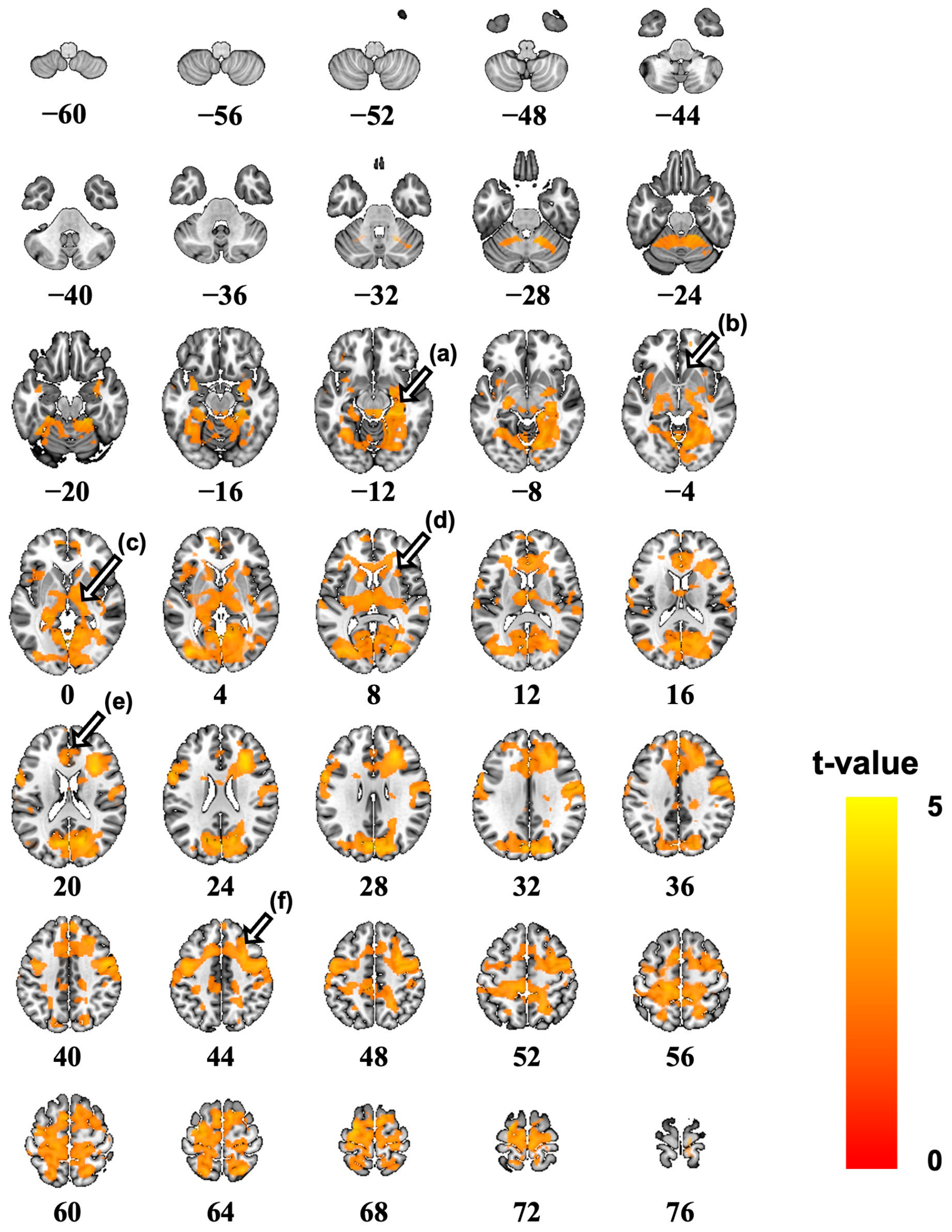
- Second-level Paired t-test: To identify brain regions showing greater activation during exposure to the scented insect odor than during the control scent, individual contrast maps from the two conditions were entered into a voxel-wise paired t-test (Scented Insect > Control Scent). Statistical significance was determined using a false discovery rate (FDR)-corrected threshold of p < 0.05.
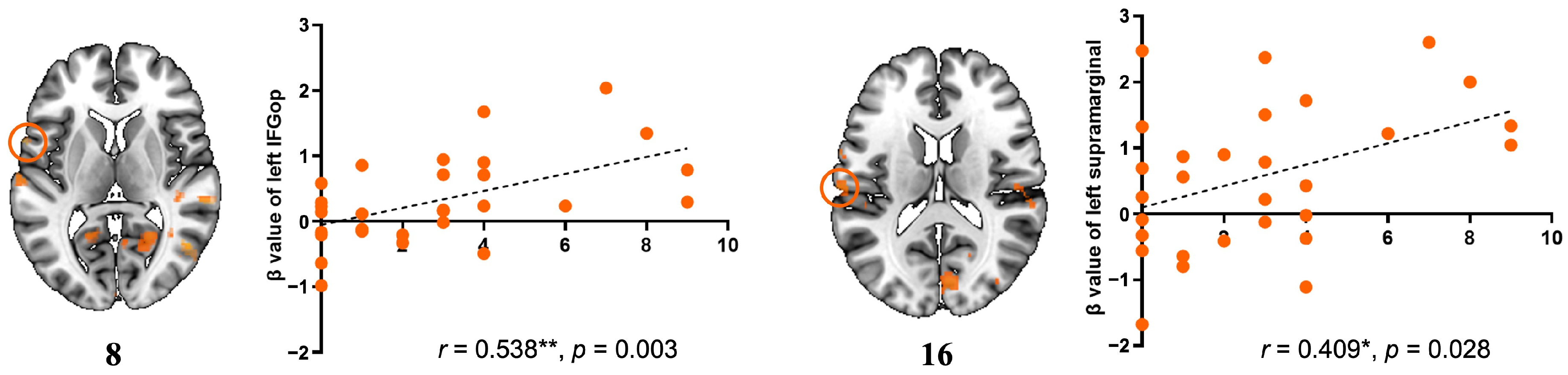
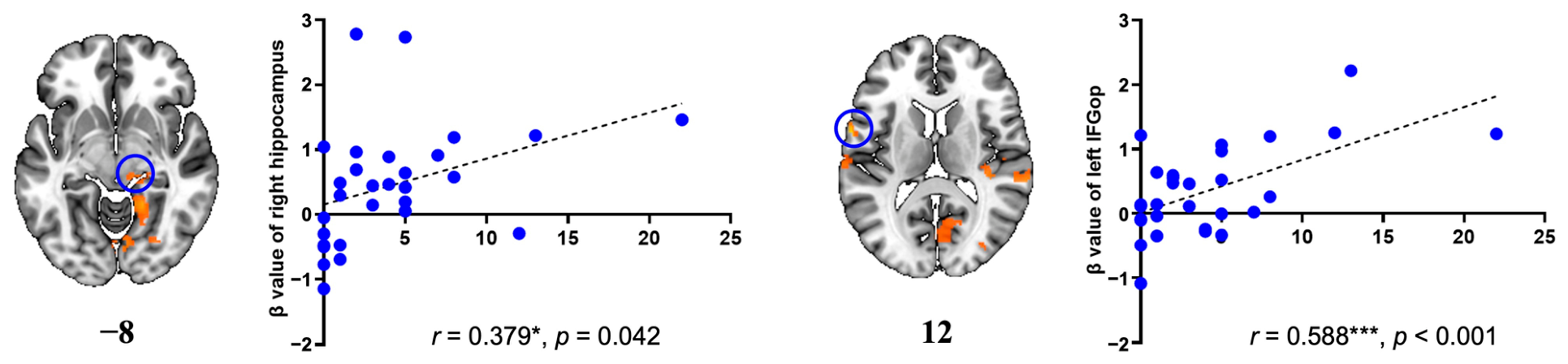
- Multiple Regression Analysis: Multiple regression analyses were subsequently performed using PHQ-9, BEPSI, BAI, and ISI scores as covariates. Each psychometric score was entered separately into an individual regression model. The resulting statistical maps were masked using the paired t-test activation map (FDR-corrected, p < 0.05), and only voxels overlapping with the paired t-test results were retained. Statistical significance within the masked regions was assessed at an uncorrected threshold of p < 0.05. Regions of interest (ROIs) were defined as 4-mm-radius spheres centered at the peak t-value of each significant cluster from the masked multiple regression results. Beta values extracted from these ROIs were subsequently used for correlation analyses with the psychometric assessment scores.
3. Results
3.1. Participant Characteristics and Scent Preference Ratings
3.2. Brain Activation in Response to Scented Insect Versus Control Scent
3.3. Associations Between Brain Activation and Psychometric Scores
4. Discussion
4.1. Emerging Role of Animal-Derived Olfaction in Human Neuroscience
4.2. Neural Activation Patterns Induced by Insect-Derived Scents
4.3. Symptom-Dependent Neural Sensitivity
4.4. Limitations
4.5. Strengths of the Study
5. Conclusions
Supplementary Materials
Author Contributions
Funding
Institutional Review Board Statement
Informed Consent Statement
Data Availability Statement
Acknowledgments
Conflicts of Interest
Abbreviations
| AAI | Animal-Assisted Intervention |
| ACC | Anterior Cingulate Cortex |
| BAI | Beck Anxiety Inventory |
| BEPSI | Brief Encounter Psychosocial Instrument |
| BOLD | Blood Oxygenation Level–Dependent |
| CAT12 | Computational Anatomy Toolbox |
| EPI | Echo Planar Imaging |
| FA | Flip Angle |
| FDR | False Discovery Rate |
| FOV | Field of View |
| fMRI | Functional Magnetic Resonance Imaging |
| FWHM | Full Width at Half Maximum |
| GLM | General Linear Model |
| IFG | Inferior Frontal Gyrus |
| IFGop | Inferior Frontal Gyrus, Opercular Part |
| IFGtr | Inferior Frontal Gyrus, Triangular Part |
| ISI | Insomnia Severity Index |
| MFG | Middle Frontal Gyrus |
| MNI | Montreal Neurological Institute |
| MRI | Magnetic Resonance Imaging |
| PHQ-9 | Patient Health Questionnaire-9 |
| ROI | Region of Interest |
| SMG | Supramarginal Gyrus |
| SPM12 | Statistical Parametric Mapping (version 12) |
| TE | Echo Time |
References
- Kruger, K.A.; Serpell, J.A. Animal-assisted interventions in mental health: Definitions and theoretical foundations. In Handbook on Animal-Assisted Therapy: Theoretical Foundations and Guidelines for Practice, 2nd ed.; Academic Press: San Diego, CA, USA, 2006; pp. 21–38. [Google Scholar]
- Lundqvist, M.; Carlsson, P.; Sjödahl, R.; Theodorsson, E.; Levin, L.Å. Patient benefit of dog-assisted interventions in health care: A systematic review. BMC Complement. Altern. Med. 2017, 17, 358. [Google Scholar] [CrossRef] [Scilit] [PubMed]
- Xiao, N.; Shinwari, K.; Kiselev, S.; Huang, X.; Li, B.; Qi, J. Effects of Equine-Assisted Activities and Therapies for Individuals with Autism Spectrum Disorder: Systematic Review and Meta-Analysis. Int. J. Environ. Res. Public Health 2023, 20, 2630. [Google Scholar] [CrossRef] [Scilit] [PubMed]
- Maber-Aleksandrowicz, S.; Avent, C.; Hassiotis, A. A Systematic Review of Animal-Assisted Therapy on Psychosocial Outcomes in People with Intellectual Disability. Res. Dev. Disabil. 2016, 49–50, 322–338. [Google Scholar] [CrossRef] [Scilit] [PubMed]
- Park, J.Y.; Ko, H.-J.; Song, J.-E.; Ji, S.-M.; Kim, S.-Y. Pet Insects May Improve Physical Performance and Sleep in Community-Dwelling Frail Elderly People with Chronic Diseases: A Single-Arm Interventional Pilot Study. Clin. Interv. Aging 2022, 17, 1919–1929. [Google Scholar] [CrossRef] [Scilit] [PubMed]
- Ko, H.J.; Youn, C.-H.; Kim, S.-H.; Kim, S.-Y. Effect of Pet Insects on the Psychological Health of Community-Dwelling Elderly People: A Single-Blinded, Randomized, Controlled Trial. Gerontology 2016, 62, 200–209. [Google Scholar] [PubMed]
- Park, J.Y.; Ko, H.-J.; Kim, A.-S.; Moon, H.-N.; Choi, H.-I.; Kim, J.-H.; Chang, Y.; Kim, S.-H. Effects of Pet Insects on Cognitive Function among the Elderly: An fMRI Study. J. Clin. Med. 2019, 8, 1705. [Google Scholar] [CrossRef] [Scilit] [PubMed]
- Fjaeldstad, A.; Fernandes, H.M.; Van Hartevelt, T.J.; Gleesborg, C.; Møller, A.; Ovesen, T.; Kringelbach, M.L. Brain fingerprints of olfaction: A novel structural method for assessing olfactory cortical networks in health and disease. Sci. Rep. 2017, 7, 42534. [Google Scholar] [CrossRef] [Scilit] [PubMed]
- Kadohisa, M. Effects of odor on emotion, with implications. Front. Syst. Neurosci. 2013, 7, 66. [Google Scholar] [CrossRef] [Scilit] [PubMed]
- Kontaris, I.; East, B.S.; Wilson, D.A. Behavioral and Neurobiological Convergence of Odor, Mood and Emotion: A Review. Front. Behav. Neurosci. 2020, 14, 35. [Google Scholar] [CrossRef] [Scilit] [PubMed]
- Chamine, I.; Oken, B.S. Aroma Effects on Physiologic and Cognitive Function Following Acute Stress: A Mechanism Investigation. J. Altern. Complement. Med. 2016, 22, 713–721. [Google Scholar] [CrossRef] [Scilit] [PubMed]
- Herz, R.S. Aromatherapy facts and fictions: A scientific analysis of olfactory effects on mood, physiology and behavior. Int. J. Neurosci. 2009, 119, 263–290. [Google Scholar] [CrossRef] [Scilit] [PubMed]
- Moss, M.; Cook, J.; Wesnes, K.; Duckett, P. Aromas of rosemary and lavender essential oils differentially affect cognition and mood in healthy adults. Int. J. Neurosci. 2003, 113, 15–38. [Google Scholar] [CrossRef] [Scilit] [PubMed]
- Yoo, O.; Park, S.A. Anxiety-Reducing Effects of Lavender Essential Oil Inhalation: A Systematic Review. Healthcare 2023, 11, 2978. [Google Scholar] [CrossRef] [Scilit] [PubMed]
- Kuroda, K.; Inoue, N.; Ito, Y.; Kubota, K.; Sugimoto, A.; Kakuda, T.; Fushiki, T. Sedative effects of the jasmine tea odor and (R)-(-)-linalool, one of its major odor components, on autonomic nerve activity and mood states. Eur. J. Appl. Physiol. 2005, 95, 107–114. [Google Scholar] [CrossRef] [Scilit] [PubMed]
- Glass, S.T.; Heuberger, E. Effects of a Pleasant Natural Odor on Mood: No Influence of Age. Nat. Prod. Commun. 2016, 11, 1555–1559. [Google Scholar] [CrossRef] [Scilit] [PubMed]
- Le Bihan, D.; Karni, A. Applications of magnetic resonance imaging to the study of human brain function. Curr. Opin. Neurobiol. 1995, 5, 231–237. [Google Scholar] [CrossRef] [Scilit] [PubMed]
- Desmond, J.E.; Glover, G.H. Estimating sample size in functional MRI (fMRI) neuroimaging studies: Statistical power analyses. J. Neurosci. Methods 2002, 118, 115–128. [Google Scholar] [CrossRef] [Scilit] [PubMed]
- Manea, L.; Gilbody, S.; McMillan, D. Optimal cut-off score for diagnosing depression with the Patient Health Questionnaire (PHQ-9): A meta-analysis. CMAJ 2012, 184, E191–E196. [Google Scholar]
- Frank, S.H.; Zyzanski, S.J. Stress in the clinical setting: The Brief Encounter Psychosocial Instrument. J. Fam. Pract. 1988, 26, 533–539. [Google Scholar] [PubMed]
- Yim, J.H.; Bae, J.M.; Choi, S.S.; Kim, S.W.; Hwang, H.S.; Huh, B.Y. The validity of modified Korean-translated BEPSI (Brief Encounter Psychosocial Instrument) as instrument of stress measurement in outpatient clinic. J. Korean Acad. Fam. Med. 1996, 17, 42–53. [Google Scholar]
- Fydrich, T.; Dowdall, D.; Chambless, D.L. Reliability and validity of the beck anxiety inventory. J. Anxiety Disord. 1992, 6, 55–61. [Google Scholar] [CrossRef] [Scilit]
- Beck, A.T.; Epstein, N.; Brown, G.; Steer, R.A. An inventory for measuring clinical anxiety: Psychometric properties. J. Consult. Clin. Psychol. 1988, 56, 893–897. [Google Scholar] [CrossRef] [PubMed]
- Bastien, C.H.; Vallières, A.; Morin, C.M. Validation of the Insomnia Severity Index as an outcome measure for insomnia research. Sleep Med. 2001, 2, 297–307. [Google Scholar] [CrossRef] [Scilit] [PubMed]
- van Hees, V.T.; Sabia, S.; Anderson, K.N.; Denton, S.J.; Oliver, J.; Catt, M.; Abell, J.G.; Kivimäki, M.; Trenell, M.I.; Singh-Manoux, A. A Novel, Open Access Method to Assess Sleep Duration Using a Wrist-Worn Accelerometer. PLoS ONE 2015, 10, e0142533. [Google Scholar] [CrossRef] [Scilit] [PubMed]
- Herrmann, T.; Koeppel, C.; Linn, J.; Croy, I.; Hummel, T. Olfactory brain activations in patients with Major Depressive Disorder. Sci. Rep. 2023, 13, 10072. [Google Scholar] [CrossRef] [Scilit] [PubMed]
- Croy, I.; Hummel, T. Olfaction as a marker for depression. J. Neurol. 2017, 264, 631–638. [Google Scholar] [PubMed]
- Krusemark, E.A.; Novak, L.R.; Gitelman, D.R.; Li, W. When the sense of smell meets emotion: Anxiety-state-dependent olfactory processing and neural circuitry adaptation. J. Neurosci. 2013, 33, 15324–15332. [Google Scholar] [CrossRef] [Scilit] [PubMed]
- Detailed Information on the Great Clown Stink Bug (Poecilocoris splendidulus Esaki, 1935). Available online: https://species.nibr.go.kr/home/mainHome.do?cont_link=009&subMenu=009002&contCd=009002&ktsn=120000027132 (accessed on 21 July 2026).
- Martin, J.P.; Beyerlein, A.; Dacks, A.M.; Reisenman, C.E.; Riffell, J.A.; Lei, H.; Hildebrand, J.G. The neurobiology of insect olfaction: Sensory processing in a comparative context. Prog. Neurobiol. 2011, 95, 427–447. [Google Scholar] [CrossRef] [Scilit] [PubMed]
- Sato, K.; Touhara, K. Insect olfaction: Receptors, signal transduction, and behavior. Results Probl. Cell Differ. 2009, 47, 121–138. [Google Scholar]
- Kim, C.W.; Choi, S.-Y.; Park, J.-W.; Hong, C.-S. Respiratory allergy to the indoor ant (Monomorium pharaonis) not related to sting allergy. Ann. Allergy Asthma Immunol. 2005, 94, 301–306. [Google Scholar] [CrossRef] [Scilit] [PubMed]
- Faridzadeh, A.; Salimi, Y.; Ghasemirad, H.; Kargar, M.; Rashtchian, A.; Mahmoudvand, G.; Karimi, M.A.; Zerangian, N.; Jahani, N.; Masoudi, A.; et al. Neuroprotective Potential of Aromatic Herbs: Rosemary, Sage, and Lavender. Front. Neurosci. 2022, 16, 909833. [Google Scholar] [CrossRef] [Scilit] [PubMed]
- Morin, A.; Hamper, B. Self-reflection and the inner voice: Activation of the left inferior frontal gyrus during perceptual and conceptual self-referential thinking. Open Neuroimaging J. 2012, 6, 78–89. [Google Scholar] [CrossRef] [Scilit]
- Shi, Y.; Shi, G.; Zhao, S.; Wang, B.; Yang, Y.; Li, H.; Zhang, J.; Wang, J.; Li, X.; O’connor, M.-F. Atrophy in the supramarginal gyrus associated with impaired cognitive inhibition in grieving Chinese Shidu parents. Eur. J. Psychotraumatol. 2024, 15, 2403250. [Google Scholar] [CrossRef] [Scilit] [PubMed]
- Satpute, A.B.; Lindquist, K.A. At the Neural Intersection Between Language and Emotion. Affect. Sci. 2021, 2, 207–220. [Google Scholar] [CrossRef] [Scilit] [PubMed]
- Keller, M.; Mendoza-Quiñones, R.; Muñoz, A.C.; Iglesias-Fuster, J.; Virués, A.V.; Zvyagintsev, M.; Edgar, J.C.; Zweerings, J.; Mathiak, K. Transdiagnostic alterations in neural emotion regulation circuits—Neural substrates of cognitive reappraisal in patients with depression and post-traumatic stress disorder. BMC Psychiatry 2022, 22, 173. [Google Scholar] [CrossRef] [Scilit] [PubMed]
- Zhu, Y.; Gao, H.; Tong, L.; Li, Z.; Wang, L.; Zhang, C.; Yang, Q.; Yan, B. Emotion Regulation of Hippocampus Using Real-Time fMRI Neurofeedback in Healthy Human. Front. Hum. Neurosci. 2019, 13, 242. [Google Scholar] [CrossRef] [Scilit] [PubMed]
- Cutuli, D. Cognitive reappraisal and expressive suppression strategies role in the emotion regulation: An overview on their modulatory effects and neural correlates. Front. Syst. Neurosci. 2014, 8, 175. [Google Scholar] [CrossRef] [Scilit] [PubMed]
- Papazacharias, A.; Taurisano, P.; Fazio, L.; Gelao, B.; Di Giorgio, A.; Bianco, L.L.; Quarto, T.; Mancini, M.; Porcelli, A.; Romano, R.; et al. Aversive emotional interference impacts behavior and prefronto-striatal activity during increasing attentional control. Front. Behav. Neurosci. 2015, 9, 97. [Google Scholar] [CrossRef] [Scilit] [PubMed]
- Chang, J.; Yu, R. Hippocampal connectivity in the aftermath of acute social stress. Neurobiol. Stress 2019, 11, 100195. [Google Scholar] [CrossRef] [Scilit] [PubMed]
- Tops, M.; Boksem, M.A. A potential role of the inferior frontal gyrus and anterior insula in cognitive control, brain rhythms, and event-related potentials. Front. Psychol. 2011, 2, 330. [Google Scholar] [CrossRef] [Scilit] [PubMed]
- Hermans, E.J.; Henckens, M.J.; Joels, M.; Fernández, G. Dynamic adaptation of large-scale brain networks in response to acute stressors. Trends Neurosci. 2014, 37, 304–314. [Google Scholar] [CrossRef] [Scilit] [PubMed]
- Zlomuzica, A.; Preusser, F.; Schneider, S.; Margraf, J. Increased perceived self-efficacy facilitates the extinction of fear in healthy participants. Front. Behav. Neurosci. 2015, 9, 270. [Google Scholar] [CrossRef] [Scilit] [PubMed]
- Davidson, R.J.; Pizzagalli, D.; Nitschke, J.B.; Putnam, K. Depression: Perspectives from affective neuroscience. Annu. Rev. Psychol. 2002, 53, 545–574. [Google Scholar] [CrossRef] [Scilit] [PubMed]




| Characteristic | Mean | |
|---|---|---|
| Total | 29 | |
| Gender | ||
| Male | 8 (27.6%) | |
| Female | 21 (72.4%) | |
| Age | 28.2 ± 6.1 | |
| PHQ-9 | 2.8 ± 2.8 | |
| BEPSI | 1.6 ± 0.7 | |
| BAI | 3.9 ± 4.1 | |
| ISI | 4.5 ± 4.0 | |
| Sleep duration | 7.2 ± 1.1 | |
| Preference for scent * | ||
| Scented insects | 4.0 ± 0.8 | |
| Control | 2.8 ± 0.9 | |
| Brain Region | Side | Cluster Size | MNI Coordinates | Peak T | ||
|---|---|---|---|---|---|---|
| x | y | z | ||||
| Covariate: PHQ-9 | ||||||
| Anterior cingulate cortex | L | 14 | −4 | 44 | 4 | 2.83 |
| Inferior frontal gyrus, opercular part | L | 16 | −60 | 6 | 8 | 3.45 |
| Supramarginal | L | 15 | −66 | −22 | 16 | 2.37 |
| Covariate: BEPSI | ||||||
| Caudate | R | 17 | 22 | 8 | 22 | 2.34 |
| Hippocampus | R | 28 | 22 | −26 | −12 | 2.86 |
| Inferior frontal gyrus, opercular part | L | 20 | −60 | 6 | 8 | 4.27 |
| Inferior frontal gyrus, triangular part | L | 23 | −42 | 24 | 26 | 2.78 |
| Middle frontal gyrus | L | 14 | −30 | −6 | 50 | 2.50 |
| Rolandic operculum | R | 19 | 50 | −16 | 14 | 2.46 |
| Covariate: BAI | ||||||
| Hippocampus | R | 26 | 16 | −28 | −8 | 2.26 |
| Inferior frontal gyrus, opercular part | L | 21 | −62 | 6 | 10 | 3.81 |
| Covariate: ISI | ||||||
| Caudate | R | 51 | 22 | 6 | 22 | 3.12 |
| Hippocampus | L | 18 | −24 | −26 | −12 | 2.22 |
| R | 47 | 22 | −24 | −12 | 3.26 | |
| Inferior frontal gyrus, opercular part | L | 19 | −62 | 8 | 8 | 4.69 |
| Insula | L | 21 | −40 | −14 | 8 | 2.44 |
| R | 44 | 38 | −20 | 8 | 2.90 | |
| Middle frontal gyrus | L | 27 | −30 | −6 | 52 | 2.74 |
| R | 103 | 36 | −2 | 60 | 2.18 | |
| Parahippocampal | L | 22 | −20 | −34 | −12 | 2.71 |
| R | 137 | 30 | −42 | −8 | 3.24 | |
| Rolandic operculum | R | 84 | 50 | −20 | 16 | 3.72 |
| Supramarginal | L | 16 | −60 | −22 | 16 | 2.82 |
| R | 103 | 48 | −30 | 26 | 2.59 | |
| Brain Region | Side | MNI Coordinates | r | p | ||
|---|---|---|---|---|---|---|
| x | y | z | ||||
| Covariate: PHQ-9 | ||||||
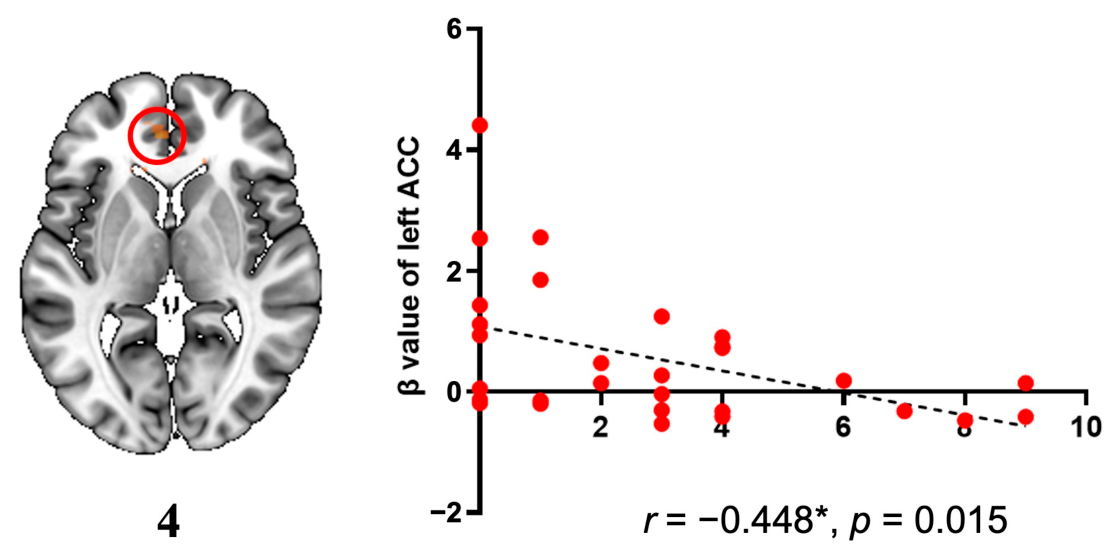
| Anterior cingulate cortex | L | −4 | 44 | 4 | −0.448 | 0.015 |
| Inferior frontal gyrus, opercular part | L | −60 | 6 | 8 | 0.538 | 0.003 |
| Supramarginal | L | −66 | −22 | 16 | 0.409 | 0.028 |
| Covariate: BEPSI | ||||||
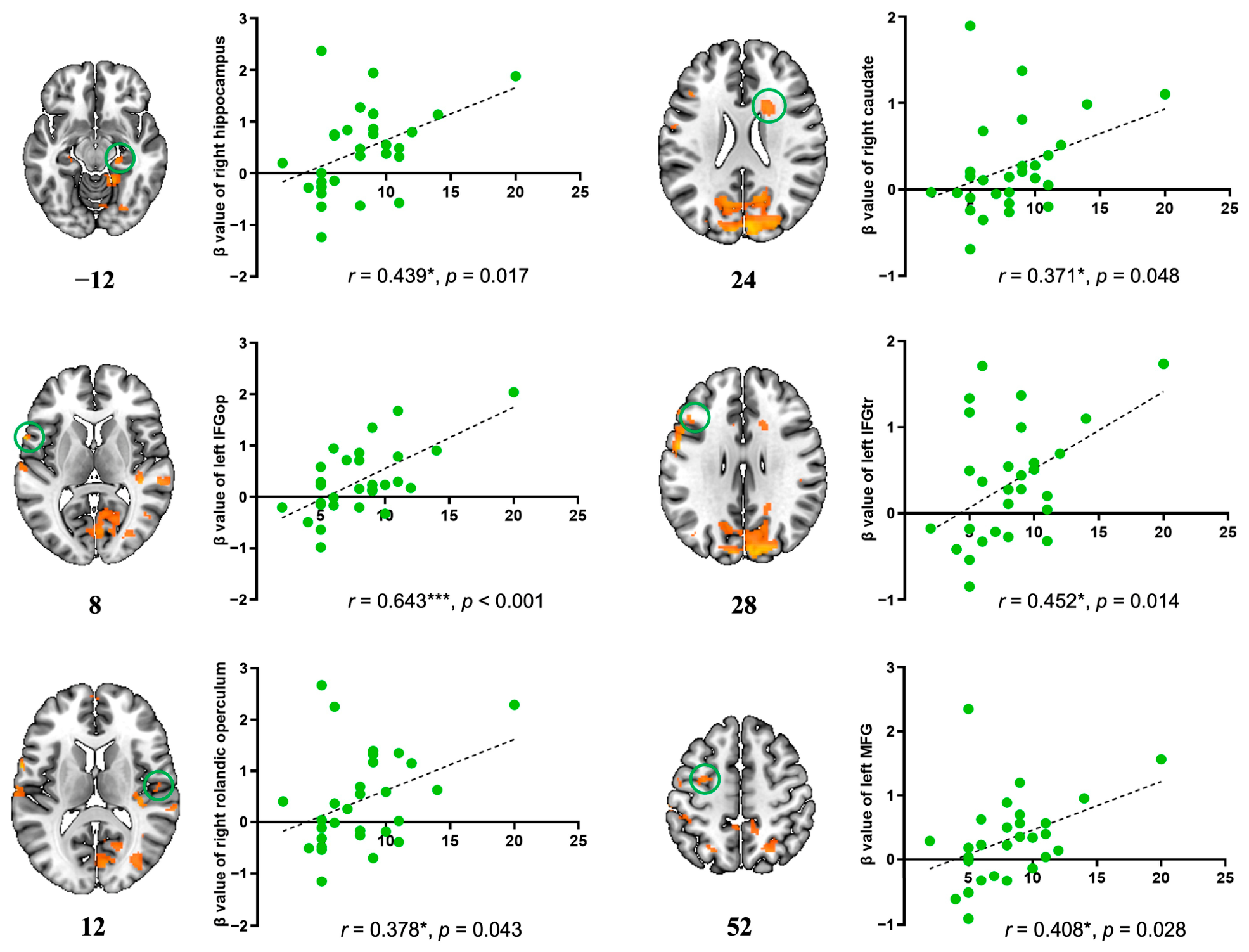
| Caudate | R | 22 | 8 | 22 | 0.371 | 0.048 |
| Hippocampus | R | 22 | −26 | −12 | 0.439 | 0.017 |
| Inferior frontal gyrus, opercular part | L | −60 | 6 | 8 | 0.643 | <0.001 |
| Inferior frontal gyrus, triangular part | L | −42 | 24 | 26 | 0.452 | 0.014 |
| Middle frontal gyrus | L | −30 | −6 | 50 | 0.408 | 0.028 |
| Rolandic operculum | R | 50 | −16 | 14 | 0.378 | 0.043 |
| Covariate: BAI | ||||||
| Hippocampus | R | 16 | −28 | −8 | 0.379 | 0.042 |
| Inferior frontal gyrus, opercular part | L | −62 | 6 | 10 | 0.588 | <0.001 |
| Covariate: ISI | ||||||
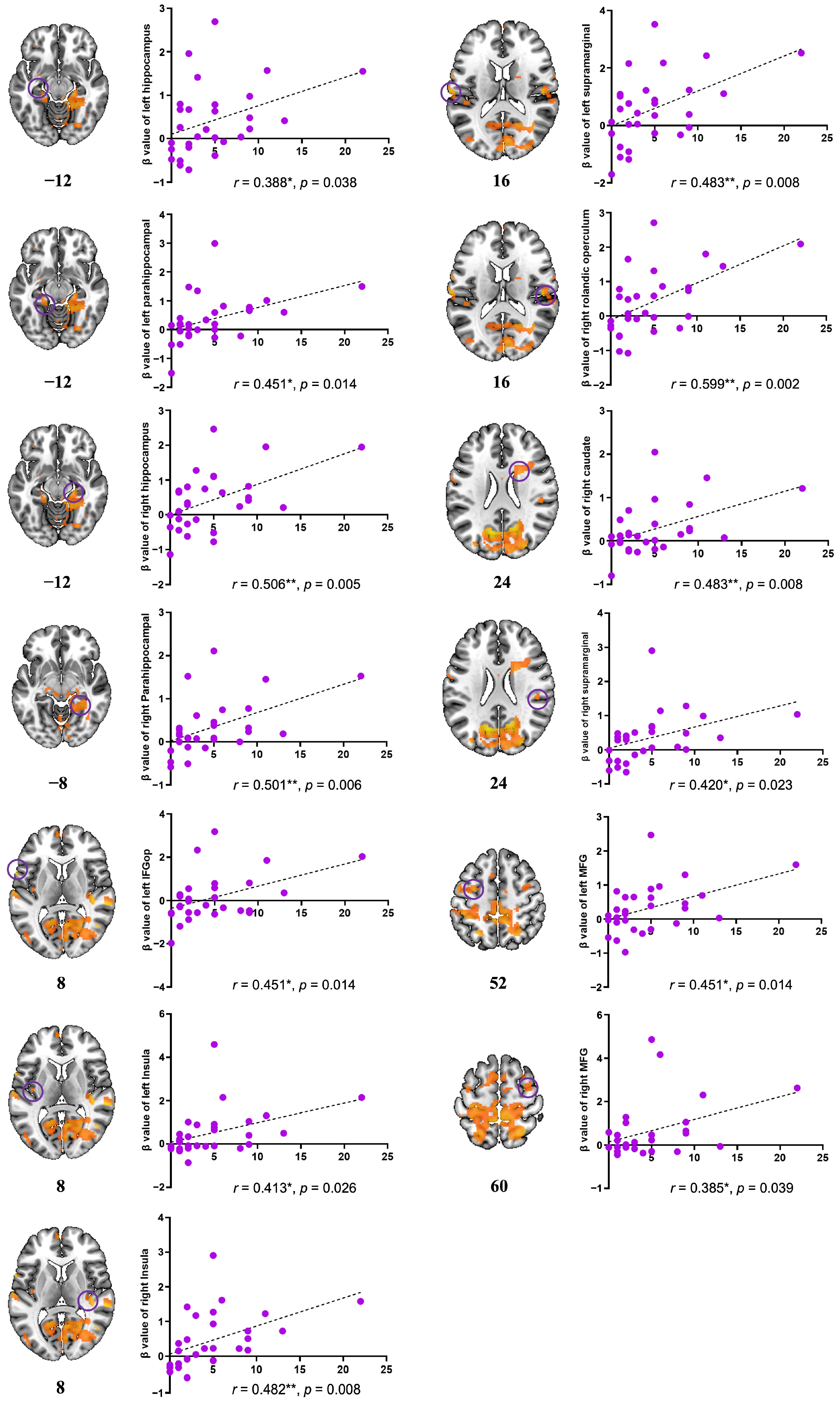
| Caudate | R | 22 | 6 | 22 | 0.483 | 0.008 |
| Hippocampus | L | −24 | −26 | −12 | 0.388 | 0.038 |
| R | 22 | −24 | −12 | 0.506 | 0.005 | |
| Inferior frontal gyrus, opercular part | L | −62 | 8 | 8 | 0.451 | 0.014 |
| Insula | L | −40 | −14 | 8 | 0.413 | 0.026 |
| R | 38 | −20 | 8 | 0.482 | 0.008 | |
| Middle frontal gyrus | L | −30 | −6 | 52 | 0.451 | 0.014 |
| R | 36 | −2 | 60 | 0.385 | 0.039 | |
| Parahippocampal | L | −20 | −34 | −12 | 0.451 | 0.014 |
| R | 30 | −42 | −8 | 0.501 | 0.006 | |
| Rolandic operculum | R | 50 | −20 | 16 | 0.599 | 0.002 |
| Supramarginal | L | −60 | −22 | 16 | 0.483 | 0.008 |
| R | 48 | −30 | 26 | 0.420 | 0.023 | |
Disclaimer/Publisher’s Note: The statements, opinions and data contained in all publications are solely those of the individual author(s) and contributor(s) and not of MDPI and/or the editor(s). MDPI and/or the editor(s) disclaim responsibility for any injury to people or property resulting from any ideas, methods, instructions or products referred to in the content. |
© 2026 by the authors. Licensee MDPI, Basel, Switzerland. This article is an open access article distributed under the terms and conditions of the Creative Commons Attribution (CC BY) license.
Share and Cite
Hong, H.-E.; Lee, H.; Ko, H.-J.; Park, J.-Y.; Kim, A.-S.; Song, J.-E.; Chang, Y.; Ji, S.; Park, K. Neurological Responses to Scented Insects via Olfactory Stimulation: A Controlled fMRI Study. Insects 2026, 17, 761. https://doi.org/10.3390/insects17080761
Hong H-E, Lee H, Ko H-J, Park J-Y, Kim A-S, Song J-E, Chang Y, Ji S, Park K. Neurological Responses to Scented Insects via Olfactory Stimulation: A Controlled fMRI Study. Insects. 2026; 17(8):761. https://doi.org/10.3390/insects17080761
Chicago/Turabian StyleHong, Hee-Eun, Hansol Lee, Hae-Jin Ko, Ji-Yeon Park, A-Sol Kim, Ji-Eun Song, Yongmin Chang, Sangmin Ji, and Kwanho Park. 2026. "Neurological Responses to Scented Insects via Olfactory Stimulation: A Controlled fMRI Study" Insects 17, no. 8: 761. https://doi.org/10.3390/insects17080761
APA StyleHong, H.-E., Lee, H., Ko, H.-J., Park, J.-Y., Kim, A.-S., Song, J.-E., Chang, Y., Ji, S., & Park, K. (2026). Neurological Responses to Scented Insects via Olfactory Stimulation: A Controlled fMRI Study. Insects, 17(8), 761. https://doi.org/10.3390/insects17080761