New Fossil Megalopteran and Megalopteran-like Larvae, a First Extinct Larval Morphology of Megaloptera, and Possible Larvae of Myxophagan Beetles
 ,
,  , , and
Simple Summary
Abstract
1. Introduction
2. Material and Methods
2.1. Material
2.2. Ethical Backgrounds
2.3. Documentation of Material
2.4. Shape Analysis
3. Results
3.1. Description of Triassic Specimens
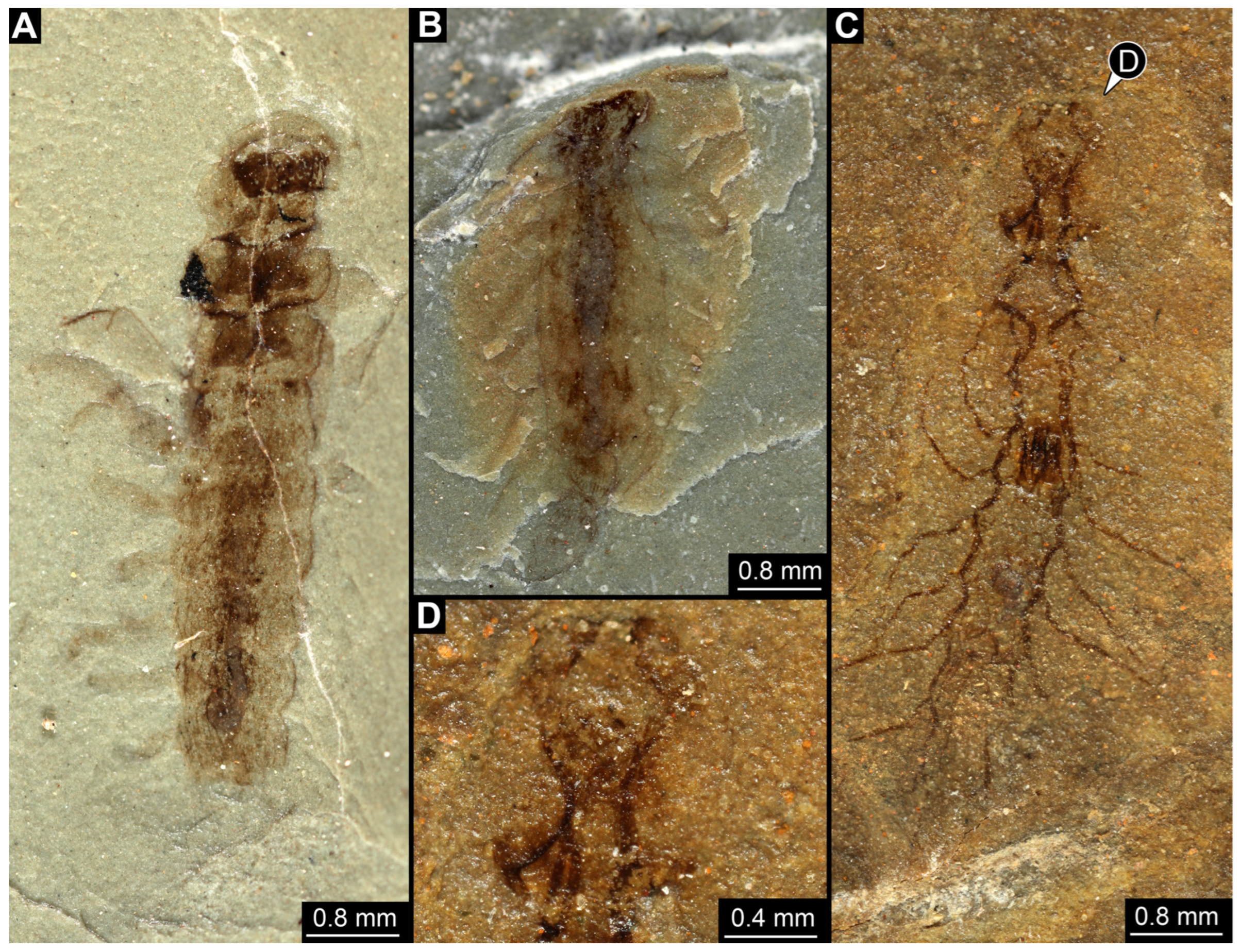
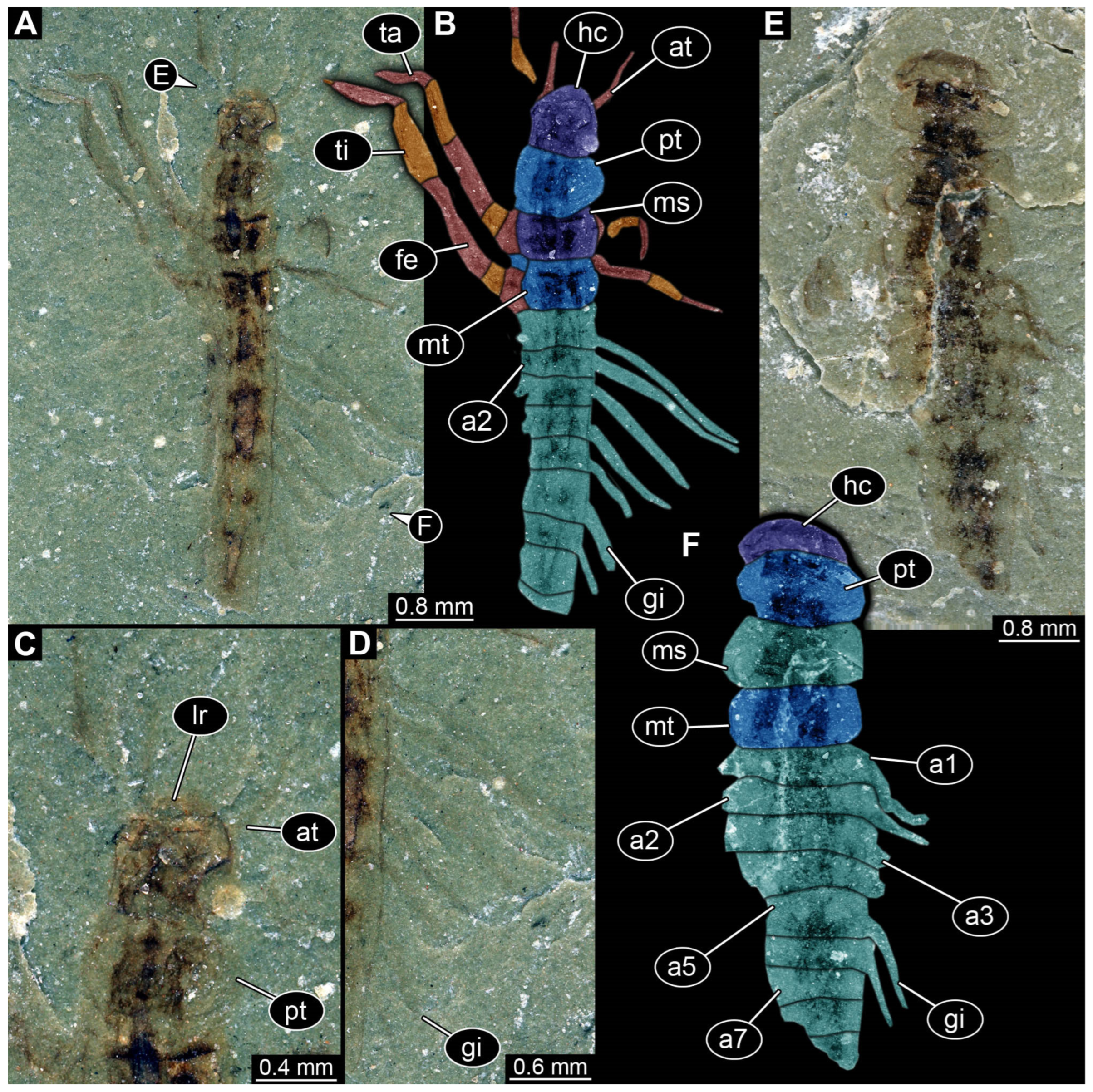
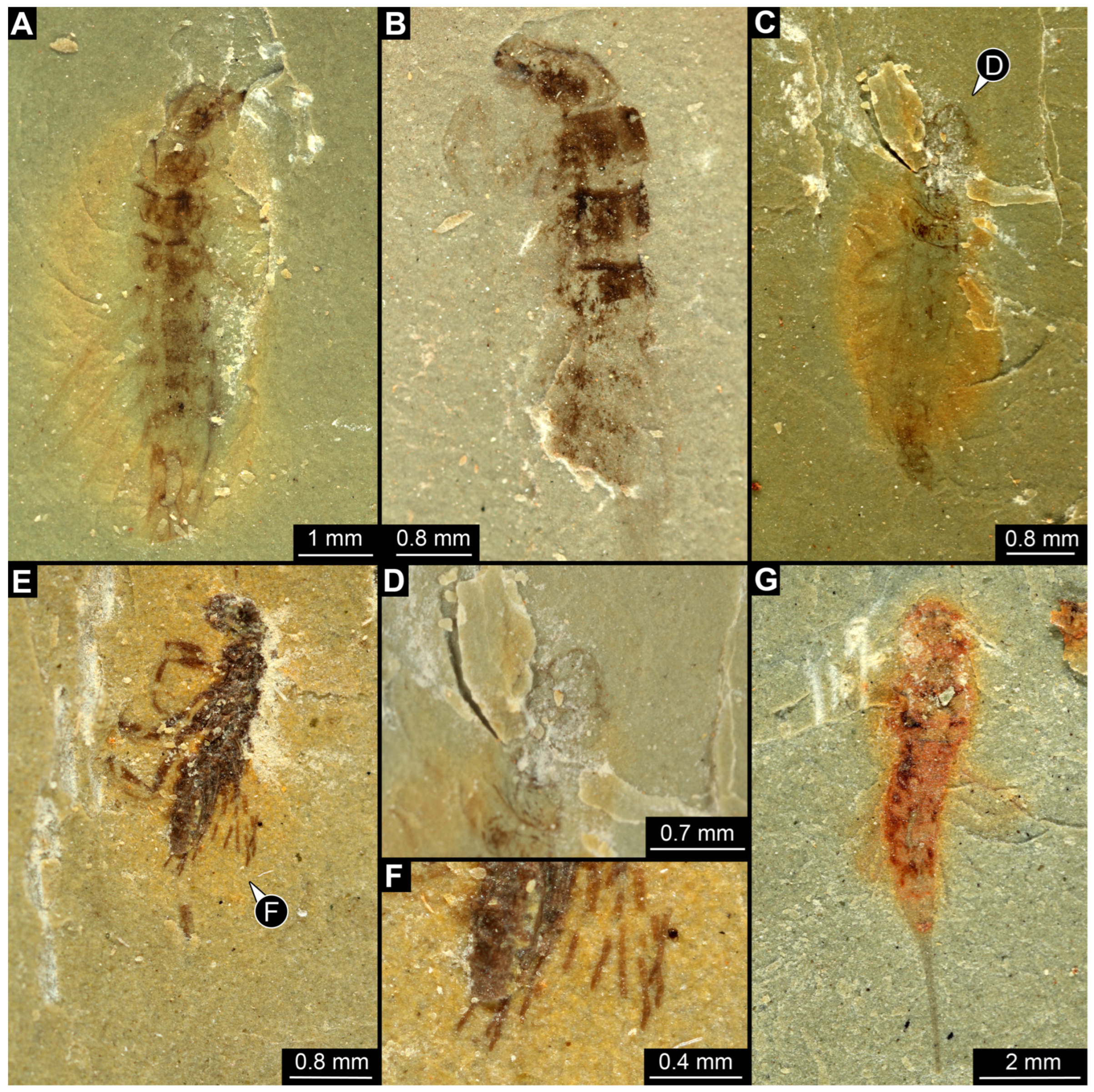
- SMNS-P-75650-1 (Figure 1A–D): Single specimen preserved in dorsal view, with a body length of ca. 5.3 mm (Figure 1A). Head capsule about as long as wide (~0.6 mm; Figure 1C). Antennae present, as long as head capsule. Labrum vaguely discernible, but possibly an artefact due to poor preservation. Thorax with three segments (pro-, meso- and metathorax). All thorax segments discernible, appearing wider than long with the prothorax ca. 1.3× longer than the meso- and metathorax. Walking legs partly preserved, with remnants of the left walking leg of the prothorax present close to the left top of the head capsule. Left walking legs of meso- and metathorax appear as long as the thorax. Right walking legs only partly preserved. Lateral filamentous structures along abdomen, appear to get shorter from anterior to posterior (Figure 1D). Most anterior lateral filament on the right side appears of similar length to the walking legs of meso- and metathorax (~1.8 mm), while most posterior preserved lateral filament measures ~0.45 mm. Posterior end appears incomplete.
- SMNS-P-75650-2 (Figure 1E,F): Single specimen preserved in dorsal view, with a body length of ca. 5.5 mm (Figure 1E). Head capsule appears partly concealed by prothorax, no antennae or mouthparts discernible. Thorax with three segments (pro-, meso- and metathorax). Thorax segments discernible, no walking legs preserved. Thorax segments all wider than long, of equal length (~0.6 mm) and appear to have tergites with round lateral edges. Abdomen segments with partly preserved lateral filamentous structures, most about as long as a thorax segment; the longest (abdomen segment 5) measuring ca. 0.8 mm. Posterior end appears incomplete.
- SMNS-P-75650-3 (Figure 2A): Single specimen preserved in dorso-lateral view, with a body length of ca. 6.2 mm (Figure 2A). Head capsule as long as wide (~0.75 mm). Right antenna possible preserved, but not protruding the outline of head capsule. Right mandible discernible and appears forward protruding. Thorax with three segments (pro-, meso- and metathorax). All thorax segments discernible and wider than long of close to equal length, with the prothorax only slightly longer (~1.1×) than the meso- and metathorax. Lateral filamentous structures along abdomen, appear to get shorter from anterior to posterior, mostly preserved on the left body side. Most anterior lateral filament close to equal to the thorax length (~2 mm), while most posterior preserved filament measures ca. 0.5 mm. Posterior end possibly incomplete.
- SMNS-P-75650-4 (Figure 2B): Single specimen preserved in dorso-lateral view, measuring ca. 4.3 mm (Figure 2B). Head oriented more in a lateral view, width not clearly discernible, length ca. 1.2 mm). Left antenna possible preserved, but not protruding outline of the head capsule. Left mandible discernible and appears forward protruding (~0.44 mm length). Thorax with three segments (pro-, meso- and metathorax). All thorax segments discernible and wider than long of close to equal length, with the prothorax only slightly longer (~1.1×) than the meso- and metathorax. Only one walking leg present, while all other walking legs missing; possibly coxae of second and third pair of walking legs present on the left side protruding posteriorly. Tarsus of preserved walking leg appears not subdivided. Few anterior abdomen segments preserved, appearing to bear lateral filamentous structures. Filaments of the first abdomen segment close to equal in length to the thorax (~2 mm). Posterior end of the abdomen clearly missing.
- SMNS-P-75650-5 (Figure 2C,D): Single specimen preserved in dorsal view, with a body length of ca. 4.6 mm (Figure 2C). Head capsule slightly longer than wide, 1.15× (length ~0.73 mm). Labrum appears long and forward protruding (Figure 2D). Other mouthparts or antennae not discernible. Prothorax and anterior part of mesothorax not clearly discernible, metathorax discernible (length ~0.26 mm). Lateral filamentous structures along abdomen, appear to get shorter from anterior to posterior. Left filament of the first abdomen segment measures ca. 0.8 mm. Lateral filaments preserved on both sides but not always clearly discernible. Posterior end of the abdomen pointy in shape, possibly missing parts.
- SMNS-P-75650-6 (Figure 2E,F): Single specimen preserved in lateral view, with a body length of ca. 4.4 mm (Figure 2E). Head capsule measures ca. 0.75 mm, width not discernible due to lateral preservation. Thorax segments not clearly discernible. All walking legs preserved, all appearing close to equal in size and measuring ca. 1.5 mm Lateral filamentous structures along abdomen, appear to get shorter from anterior to posterior. Lateral filament of the first abdomen segment measures ca. 1.5 mm, most posterior lateral filament measure ca. 0.2 mm. Posterior end not completely preserved with possible traces of a terminal unpaired filamentous structure (Figure 2F).
- SMNS-P-75650-7 (Figure 2G): Single specimen preserved in dorsal or ventral view, with a body length of ca. 9.5 mm (Figure 2G). Anterior body region poorly preserved, head capsule and thorax segments not clearly discernible. Lateral filamentous structures along abdomen, appear to get shorter from anterior to posterior. Filament of the first abdomen segment measures ca. 1.8 mm, most posterior filament measures ca. 0.35 mm. Trunk end with a single median process oriented posteriorly (length ~2.9 mm).
- SMNS-P-75650-8 (Figure 3A): Single specimen preserved in dorsal view, with a body length of ca. 5.8 mm (Figure 3A). Head capsule slightly wider than long, 1.2× (width ~0.9 mm). Thorax with three segments (pro-, meso- and metathorax) all wider than long, close to equal length, prothorax only slightly longer (~1.2×) than meso- and metathorax. First trunk tergite (pronotum) appears to have round lateral edges, tergites of meso- and metathorax appear more angular. Remnants of left second third walking legs appear to be present, but poorly preserved. Abdomen segments bear lateral filamentous structures, but poorly preserved. Longest visible lateral filament protrudes from the left side of abdomen segment 3 and measures ca. 1 mm. Posterior end of abdomen clearly missing.
- SMNS-P-75650-9 (Figure 3B): Single specimen preserved in dorsal or ventral view, with a body length of ca. 4.8 mm (Figure 3B). Most of the anterior body region not preserved. Mesothorax partly preserved, metathorax present. Both appearing wider than long, tergites appear to have round edges. Lateral filamentous structures along abdomen, appear to get shorter from anterior to posterior. Abdomen appears wide in the middle, widest abdomen segment 4 (width ~1.25 mm). Left filament of the first abdominal segment represents the longest preserved filament with a length of ca. 1.6 mm; distal end curls back towards the body. Posterior end of abdomen possibly incomplete.
- SMNS-P-75650-10 (Figure 3C,D): Single specimen preserved in dorsal or ventral view, with a body length of ca. 6.7 mm (Figure 3C). Unusual type of preservation with most structures discernible but only few remnants of the cuticle. Most of the visibly preserved structures appear to resemble the remnants of the trachea (compare discussion). Head capsule close to equal length to width ratio (length ~0.77 mm), but much slimmer in posterior region. No eyes, antennae or mouth parts discernible (Figure 3D). Remnants of thorax segments present but thorax segments not clearly distinguishable. Abdomen segments bear lateral filamentous structures. Right filament protruding from abdomen segment 2 appears to be longest present filament measuring ca. 1.4 mm in length. Posterior end possibly incomplete.
3.2. Description of Amber Specimens
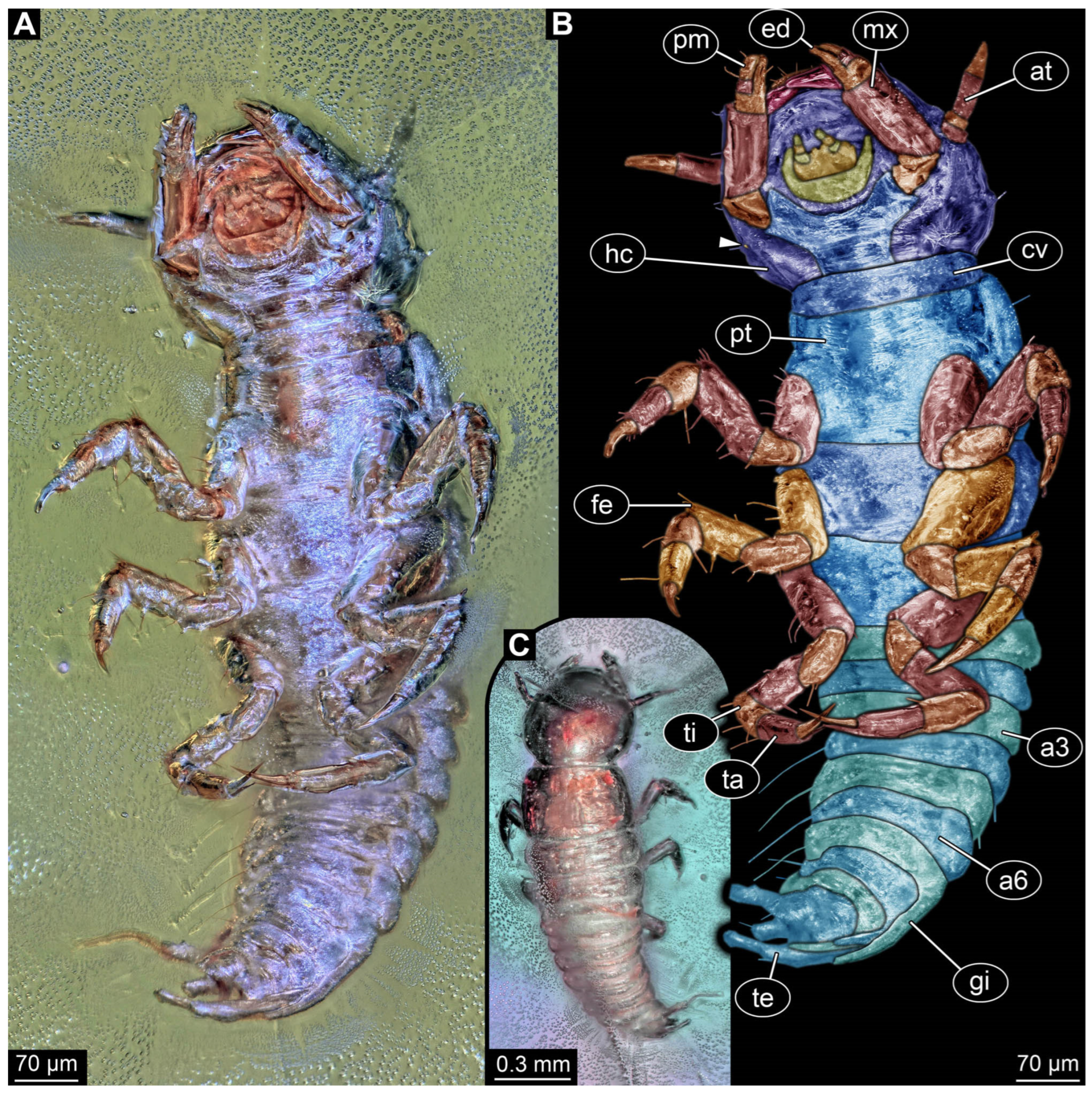
- PED 0529 (Figure 4): Single larval specimen preserved in Baltic amber. Specimen available in ventral (Figure 4A) and dorsal (Figure 4C) view. Total body length around 1 mm. Head capsule wider than long, 1.3× (width ~0.29 mm; Figure 4B). Possible single stemma discernible in ventral view (Figure 4B: arrow), several additional stemmata presumed. Both antennae discernible, with four elements each (Figure 4B). Antennae around 0.12 mm long, in total shorter than head capsule. Mouthparts partially accessible, directed anteriorly (Figure 4B,C): mandibles partially discernible with no additional teeth recognisable, maxillae longer than wide, 3.7× (at widest ~0.05 mm wide). Each maxilla with elongated stipes, longer than wide, endite and palp. Each palp with at least three elements (palpomeres). Labium semi-circular in ventral view, with indented ligula and a pair of palps with three elements each (palpomeres) of approximately same length.
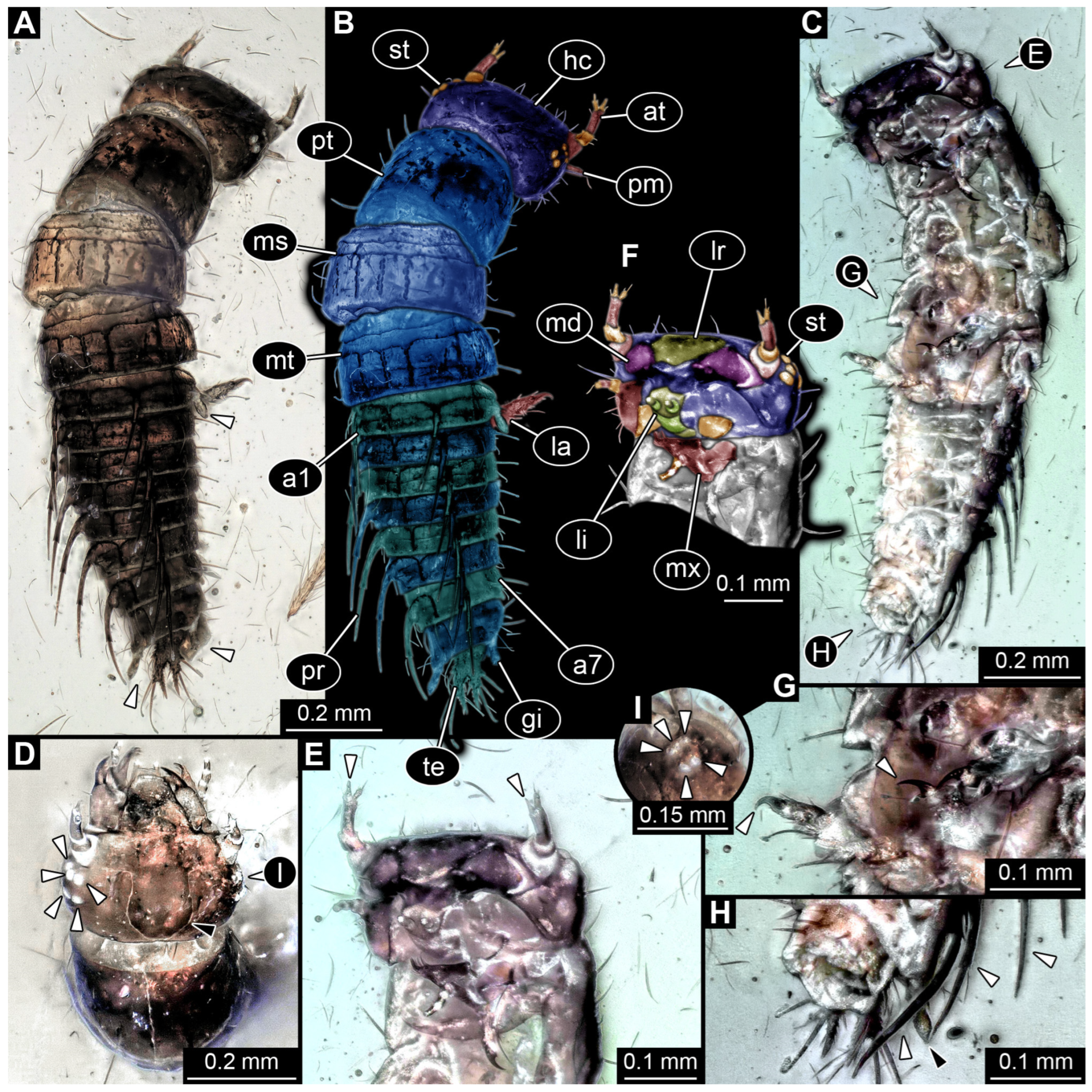
- PED 1556 (Figure 5): Single larval specimen preserved in Kachin amber. Specimen available in dorsal (Figure 5A) and ventral (Figure 5C) view. Total body length around 1.35 mm. Head capsule wider than long, 1.1× (width ~0.33 mm (including labrum); Figure 5D), moulting structure on dorsal side discernible (Figure 5D: black arrow). Labrum drawn out anteriorly. Five stemmata discernible on both sides (Figure 5D,I: white arrows). Both antennae discernible, with four elements and sensory structure on the second distal element each (Figure 5E). Antennae around 0.14 mm long in total shorter than head capsule. Mouthparts accessible, directed anteriorly (Figure 5D): mandibles partly discernible with three teeth plus tip (Figure 5D), maxillae longer than broad, 1.8× (at widest ~0.05 mm width). Each maxilla with massive endite (longer and broader than palp) and palp (Figure 5E,F). Each endite with bended, tapering end and numerous (at least 4) setae distal, each palp with three elements (Figure 5E,F). Labium with ligula, prementum and mentum and with a pair of palps. Each palp with two elements (Figure 5E,F).
- PED 1669 (Figure 6): Single larval specimen preserved in Kachin amber (Figure 6). Specimen available in dorso-lateral (Figure 6A) and head also in ventral (Figure 6C) view. Total body length around 1 mm. Head capsule as long as wide (width ~0.19 mm; Figure 6C,D), partially retracted under thorax (Figure 6B). Stemmata due to bubbles in amber not clearly discernible. Both antennae discernible, exact number of elements not discernible due to taphonomy (Figure 6B,D). Antennae around 0.11 mm long, in total shorter than head capsule. Mouthparts partially accessible (Figure 6B), directed anteriorly (Figure 6B): mandibles partially discernible, each with one tooth plus tip (Figure 6B), maxillae longer than wide, 3.6× (at widest ~0.04 mm wide). Each maxilla with elongated stipes, longer than wide, endite and palp. Each maxillary palp with at least four elements (palpomeres). Labium semi-circular in ventral view, without recognisable ligula and with a pair of palps with two elements each (palpomeres) of approximately same length.
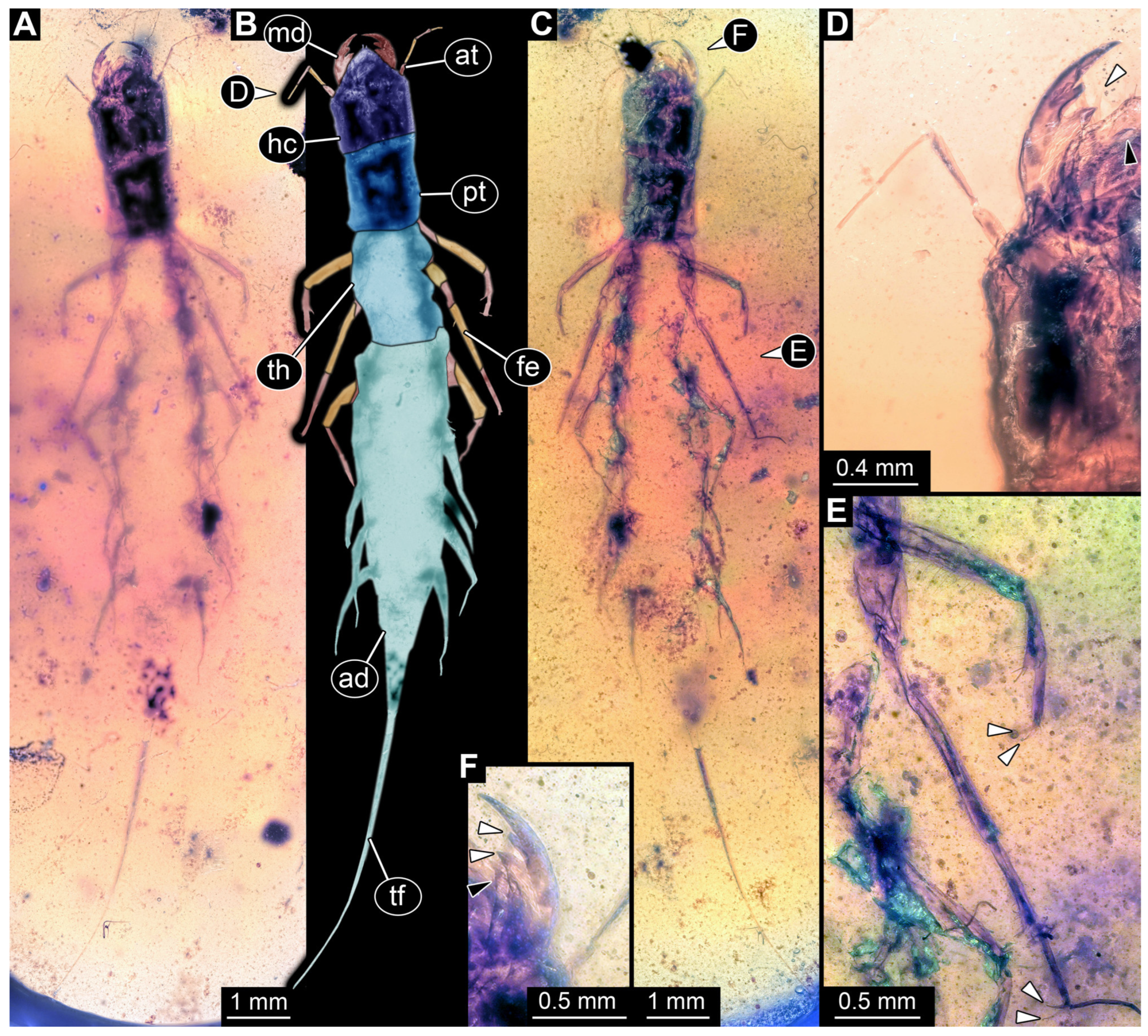
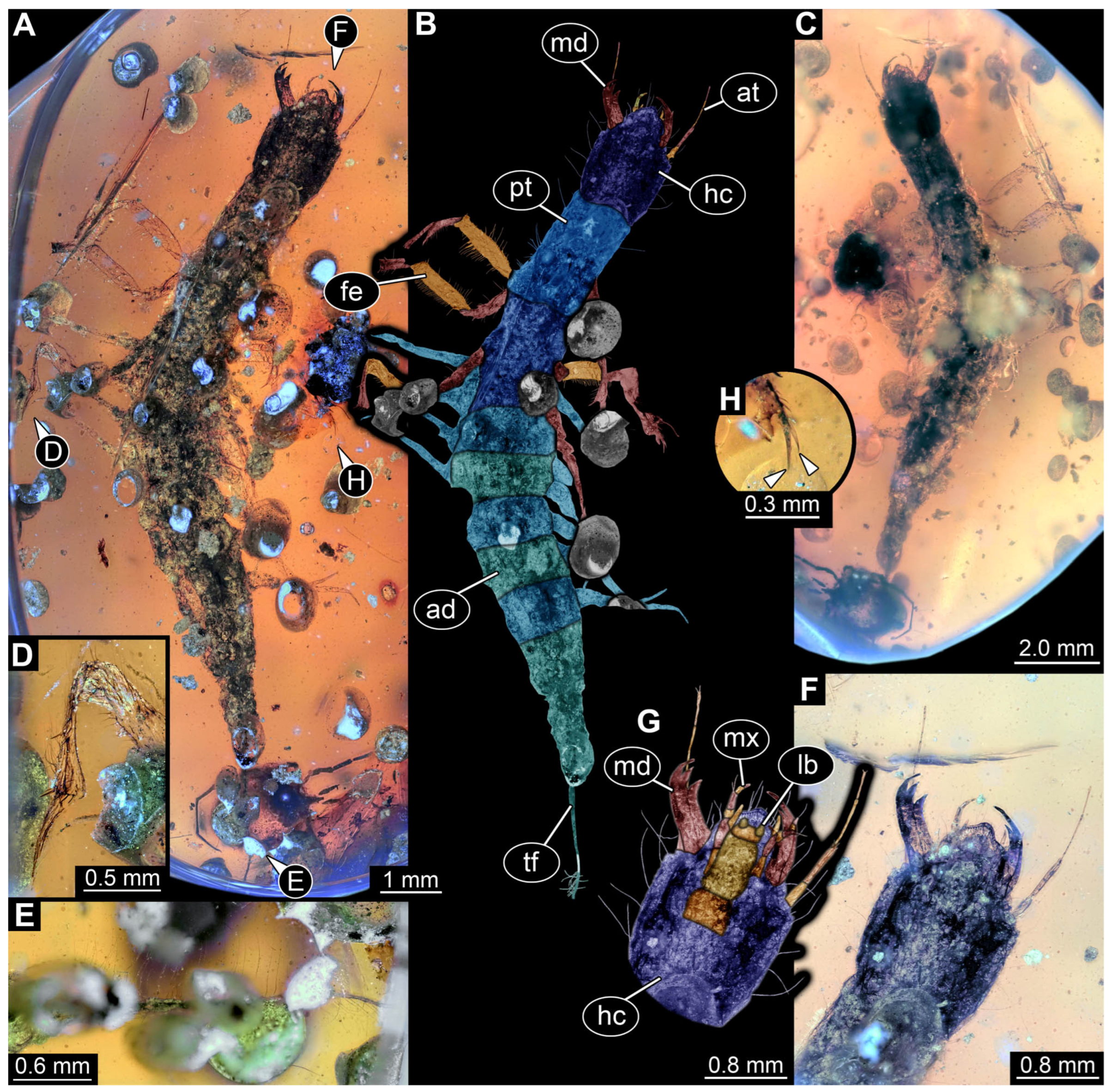
- PED 2821 (Figure 7): Single larval specimen preserved in Kachin amber. Specimen available in dorsal (Figure 7A) and ventral (Figure 7C) view. Total body length around 15.2 mm (including the terminal filament). Head capsule longer than wide, 1.3× (width ~1.25 mm; Figure 7C,D), labrum drawn out anteriorly, clypeo-labral structure discernible. Stemmata due to preservation not clearly discernible. Both antennae discernible, with four elements (Figure 7B,D). Antennae around 1.26 mm long, in total shorter than head capsule. Mouthparts partially accessible (Figure 7B), directed anteriorly (Figure 7B): mandibles partially discernible, at least one supposedly with three teeth plus tip (Figure 7F: arrows). Maxilla partially covered by syn-inclusions and other mouthparts, only partial maxillary palp and endite discernible (Figure 7C,D: arrow). Labium not discernible.
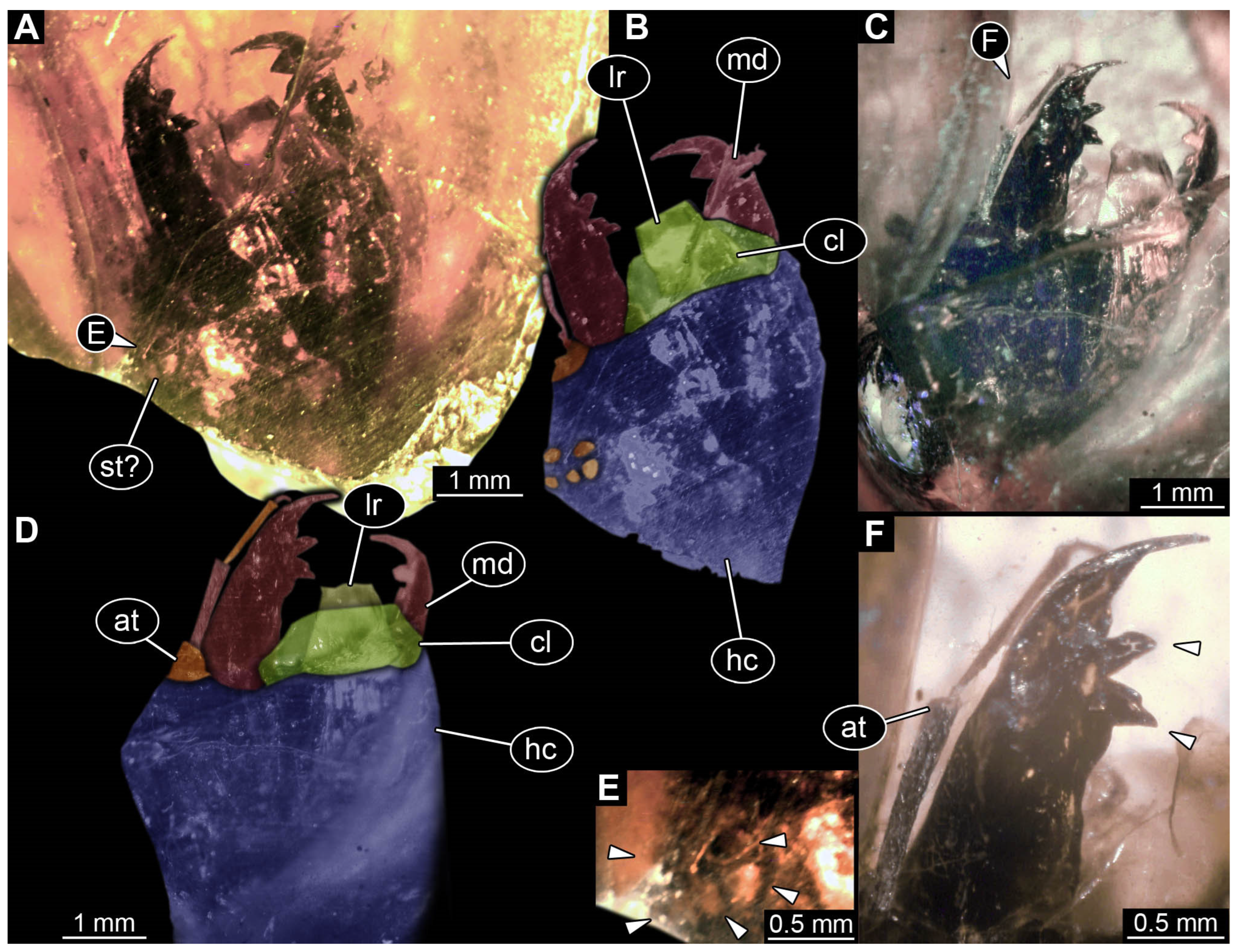
- PED 4796 (Figure 8): Single larval head preserved in Kachin amber. Specimen available in dorso-lateral view (Figure 8A,C). Head capsule longer than wide, 1.2× (width ~3.74 mm; Figure 8C,D), trapezoid-shaped labrum in dorsal view drawn out anteriorly, partially covered with semi-transparent clypeus (Figure 8B,D). Five ovaloid structures discernible laterally on the head capsule in dorso-lateral view (possibly stemmata; Figure 8A,B,E). Single antenna discernible, with four elements (Figure 8D,F). Antennae around 2.75 mm long, in total shorter than head capsule. Mouthparts partially accessible (Figure 8B), directed anteriorly (Figure 8B): large sclerotised mandibles discernible, each with three teeth (Figure 8F). Maxillae and labium not discernible.
- BUB 5274 (Figure 9): Single larval specimen preserved in Kachin amber. Specimen available in dorsal (Figure 9A) and ventral (Figure 9C) view. Total body length around 13.5 mm (including the terminal filament). Head capsule longer than wide, 1.3× (width ~1.29 mm; Figure 9F,G), labrum drawn out anteriorly. Stemmata due to preservation not clearly discernible. Both antennae discernible, with four elements (Figure 9F,G). Antennae around 1.37 mm long, in total shorter than head capsule. Mouthparts partially accessible (Figure 9F,G), directed anteriorly (Figure 9F): mandibles discernible, each with two teeth (Figure 9F). Each maxilla with endite and palp. Each maxillary palp with four elements. Labium semi-circular in ventral view, prementum, mentum and ligula with a pair of palps, number of elements not discernible.
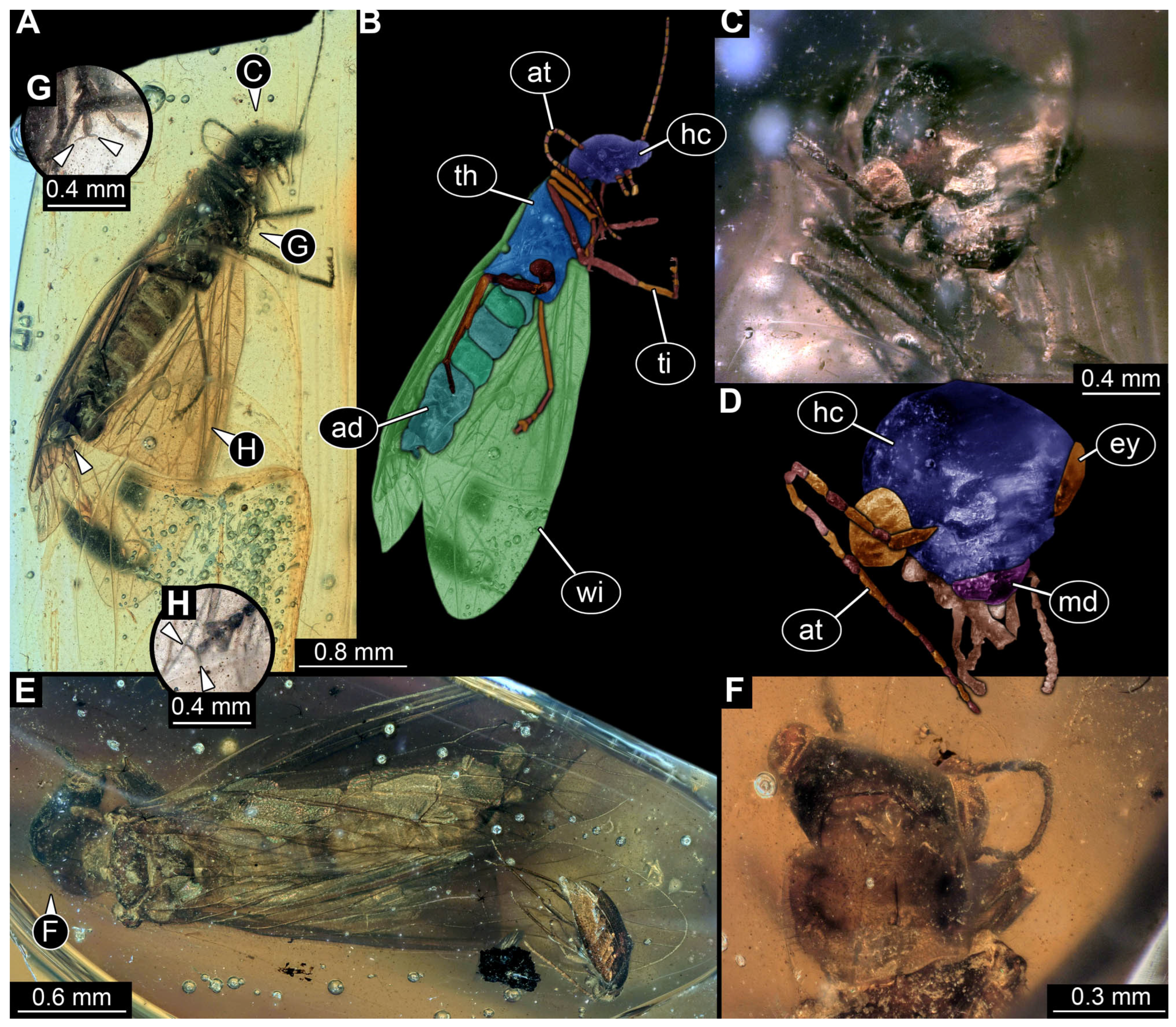
- BUB 5196 (Figure 10): Single adult specimen preserved in Kachin amber. Specimen available in ventro-lateral (Figure 10A) and dorsal (Figure 10E,F) view. Total body length around 2.79 mm (without wings). Head capsule wider than long, 1.3× (width including the eyes ~1.28 mm; Figure 10C,D). Two complex eyes are discernible. Both antennae discernible, with numerous elements (Figure 10A,B). Antennae around 2.5 mm long, in total longer than head capsule. Mouthparts partially accessible (Figure 10C,D): mandibles partially discernible, each with two teeth (Figure 10C,D). Maxilla partly discernible by maxillary palp, number of elements not discernible. Labium partly discernible.
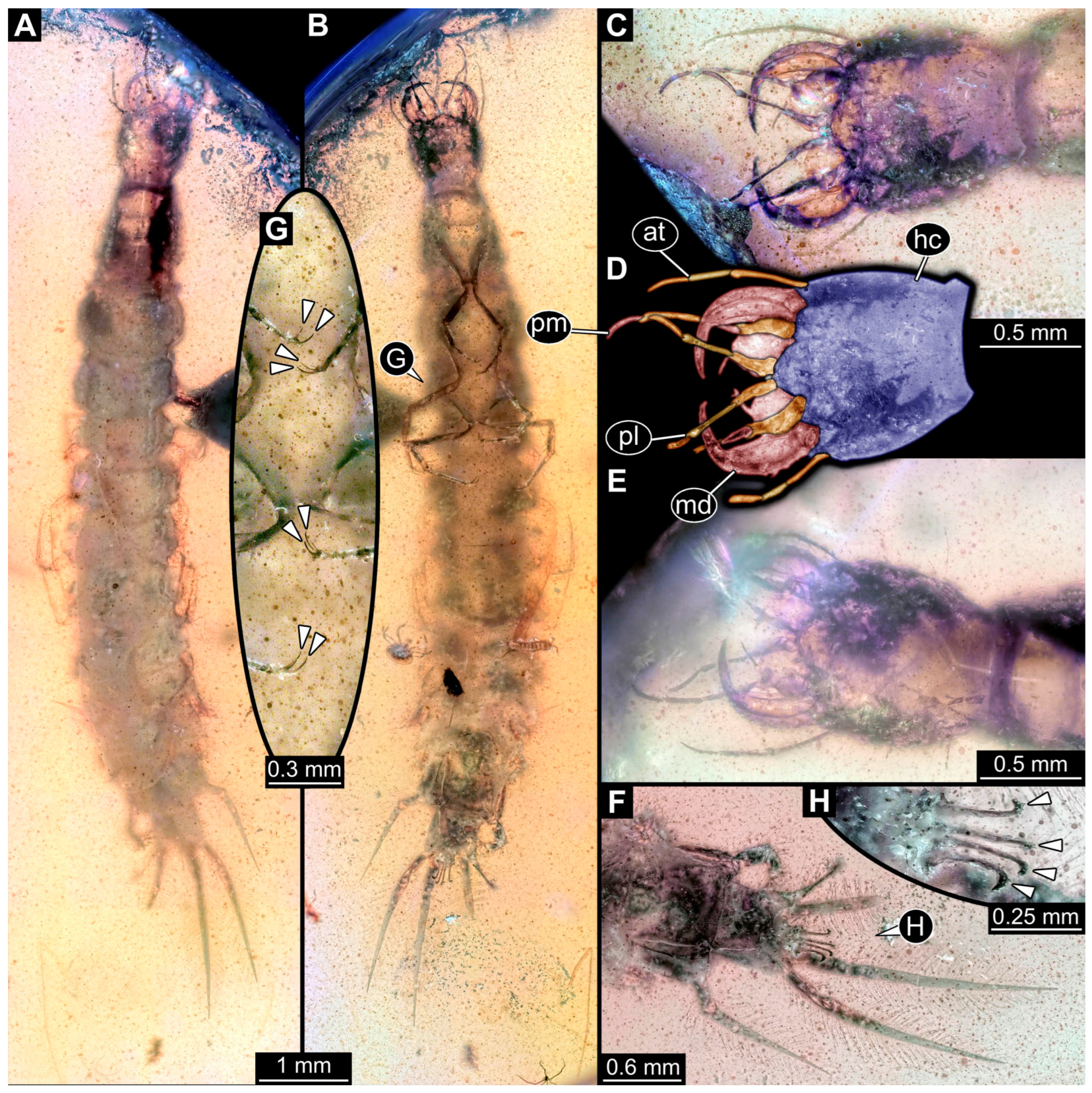
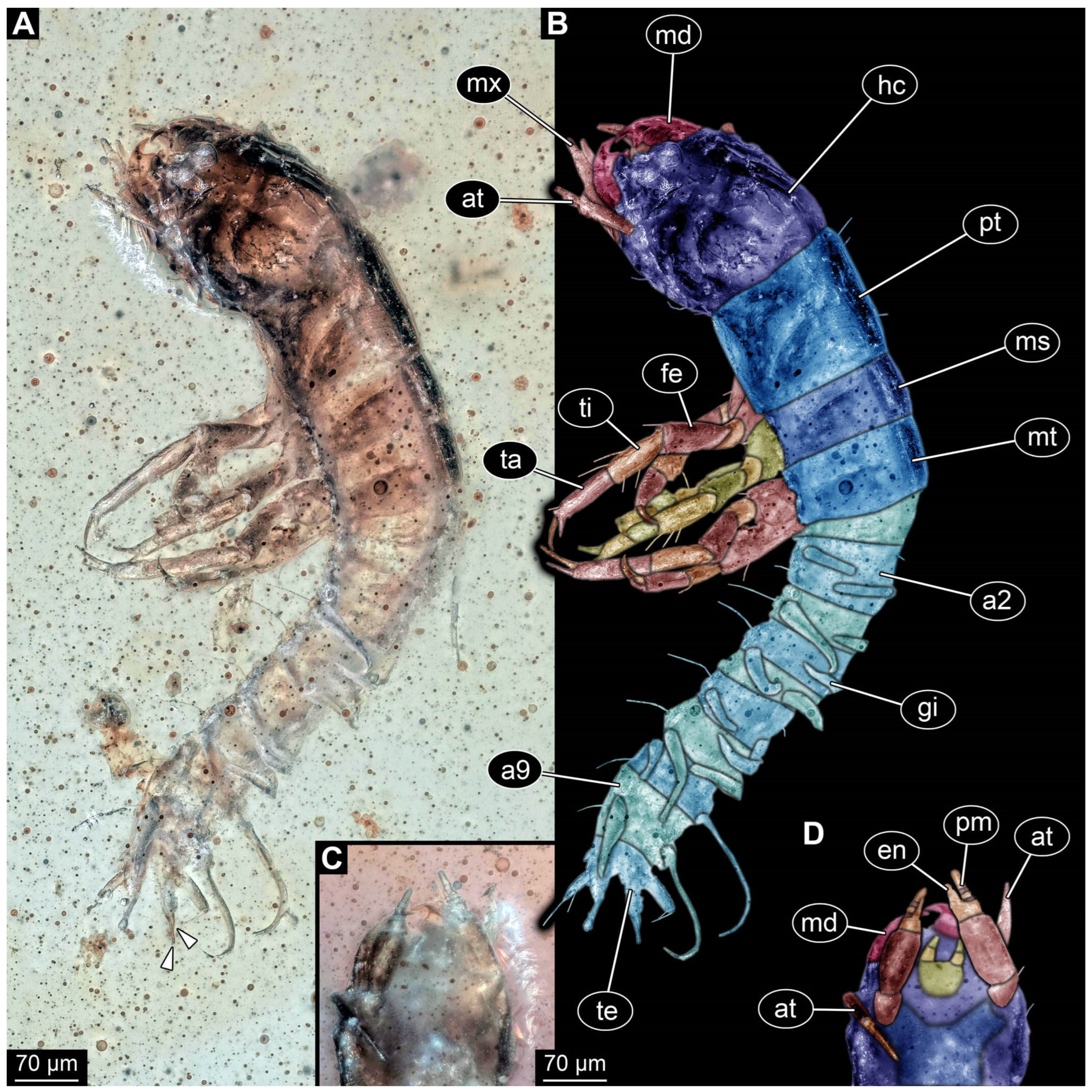
- BUB 5220 (Figure 11): Single larval specimen preserved in Kachin amber. Specimen available in dorsal (Figure 11A) and ventral (Figure 11B) view. Prominent mouthparts are present: elongated antennae of three elements, bended toothless mandibles, elongated maxillary and labial palps. Maxilla with prominent proximal part and endite (Figure 11C–E). Three most anterior trunk segments (thorax) each with a pair of locomotory appendages (legs) (Figure 11B). Each leg bears two distal claws (Figure 11G). Posterior trunk segments (abdomen) with lateral “feathery” gills (Figure 11A,B,F). Posterior end of trunk with four hook-shaped protrusions (Figure 11H).
3.3. Description of Cretaceous Sedimentary Specimen
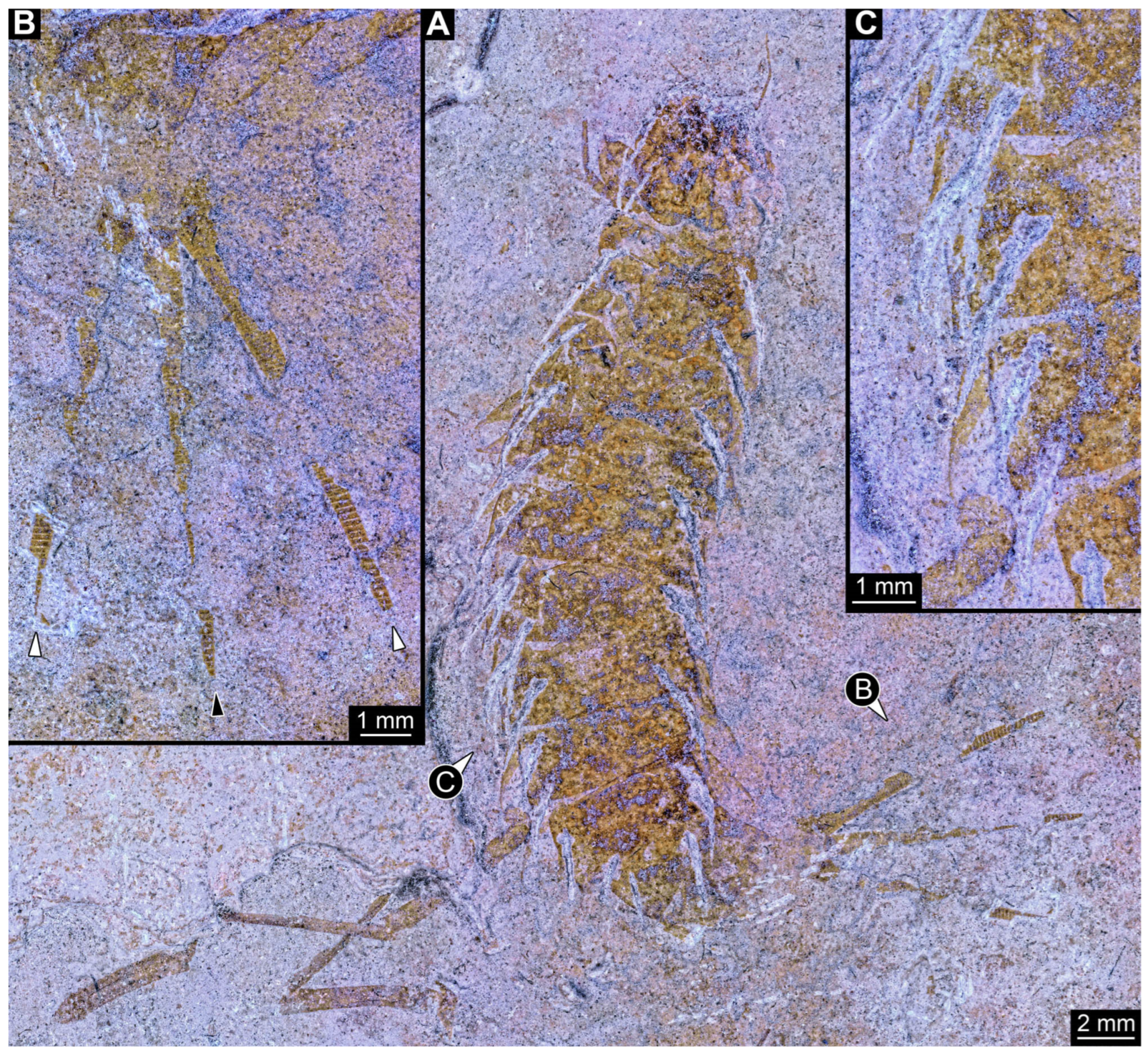
- PED 4797 (Figure 12): Single specimen preserved in dorsal or ventral view, with a body length of ca. 32.7 mm (Figure 12A). Head capsule present, eyes not discernible, antennae discernible above the head capsule. Mouthparts vaguely discernible but not clearly distinguishable. On the left side of the shown head capsule possibly the maxilla is discernible. Walking legs not present, possible remnants of the walking legs preserved on the bottom left of the trunk. Thorax tergites and abdomen tergites show lateral posteriorly bend extensions (Figure 12C). Lateral filamentous structures along trunk present (Figure 12C). At the posterior end cerci present (~8.5 mm long; Figure 12B) as well as one terminal unpaired filamentous structure (~8.5 mm long; Figure 12B), both cerci and terminal filamentous structure possibly distally incomplete.
3.4. Results of Shape Analyses
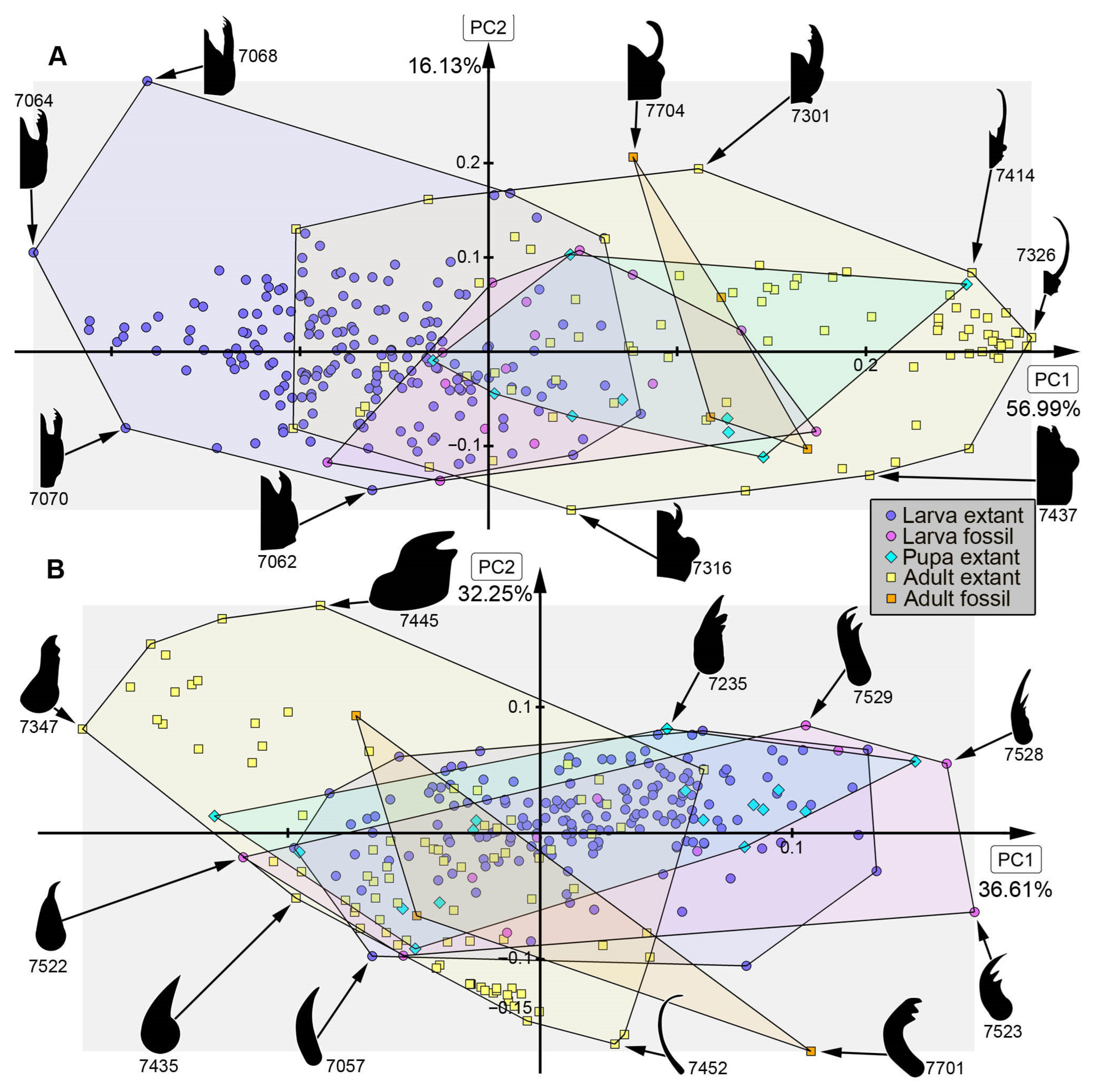
- Analysis of head capsule and mandibles, without Gyrinidae: The analysis resulted in six effective PCs together explaining over 91.3% of the overall variation. PC1 and PC2 together explain 73.1%. PC1 explains 57.0% of the overall variation. It describes the relative length of the labrum and the relative proximal width of the mandibles. Negative values indicate a proportionally long labrum and proximally slimmer mandibles, while positive values indicate a proportionally short labrum and proximally broader mandibles. PC2 explains 16.1% of the overall variation. It describes the distal width and relative length of the mandibles. Negative values indicate proportionally short and distally slim mandibles, while positive values indicate proportionally long and distally wide mandibles.
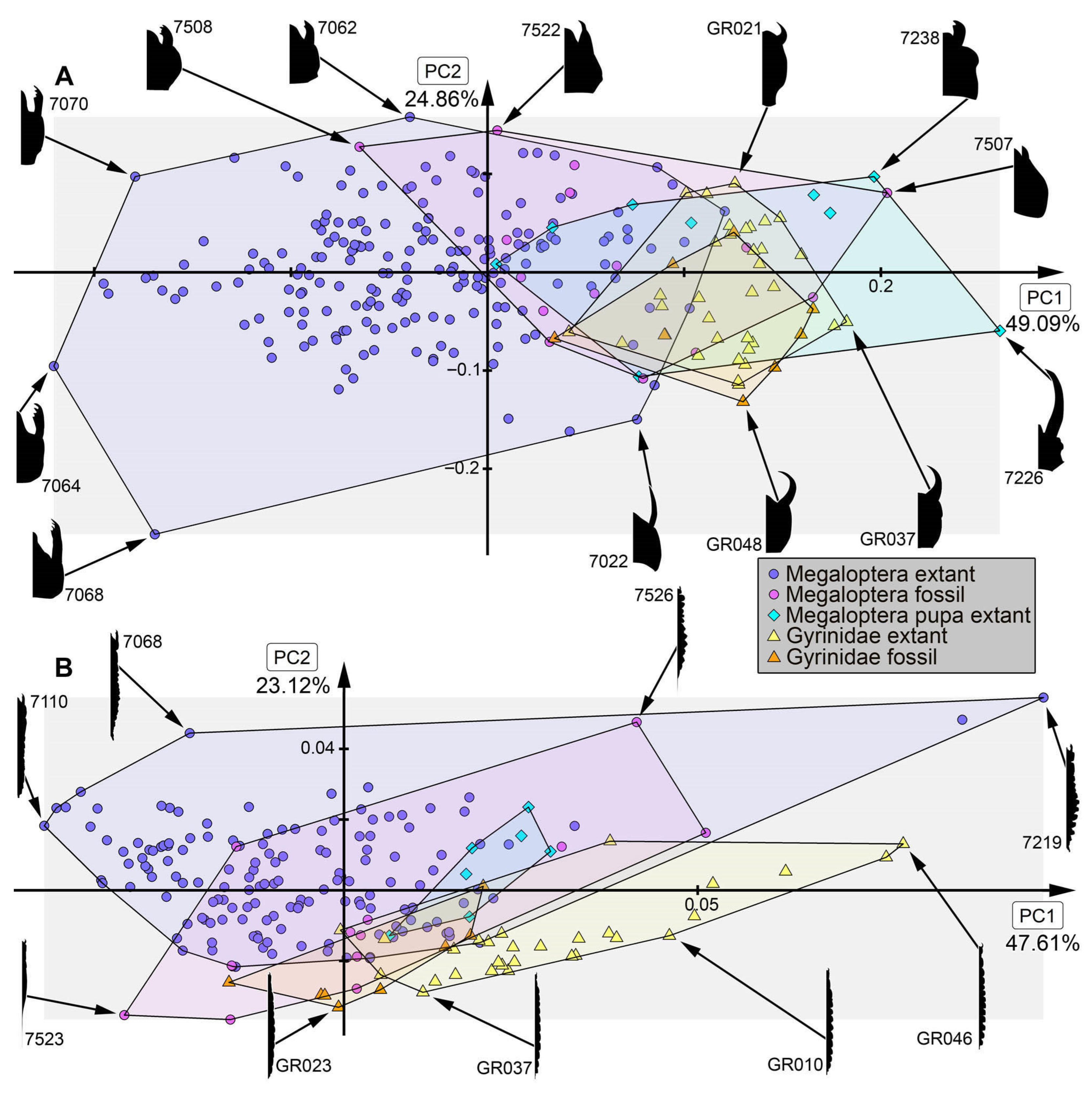
- Analysis of head capsule and mandibles, including larvae of Gyrinidae: The analysis resulted in seven effective PCs together explaining over 92.7% of the overall variation. PC1 and PC2 together explain 74.0%. PC1 explains 49.1% of the overall variation. It describes the relative length of the labrum and the relative proximal width and curvature of the mandibles. Negative values indicate a proportionally long labrum and proximally narrower and straighter mandibles, while positive values indicate a proportionally short labrum and proximally broader and more curved mandibles. PC2 explains 24.9% of the overall variation. It describes the distal width and relative length of the mandibles. Negative values indicate proportionally long and distally broader mandibles, while positive values indicate proportionally short and distally narrower mandibles.
- Analysis of mandibles, without Gyrinidae: The analysis resulted in seven effective PCs together explaining over 90.9% of the overall variation. PC1 and PC2 together explain 68.9%. PC1 explains 36.6% of the overall variation. It describes the curvature, distal width and dentition of the mandibles. Negative values indicate straight, distally slim, pointy mandibles with no dentition, while positive values indicate curved, distally broad mandibles with dentition. PC2 explains 32.3% of the overall variation. It describes the curvature and dentition mandibles. Negative values indicate highly curved mandibles with no dentition, while positive values indicate more straight mandibles with strong dentition.
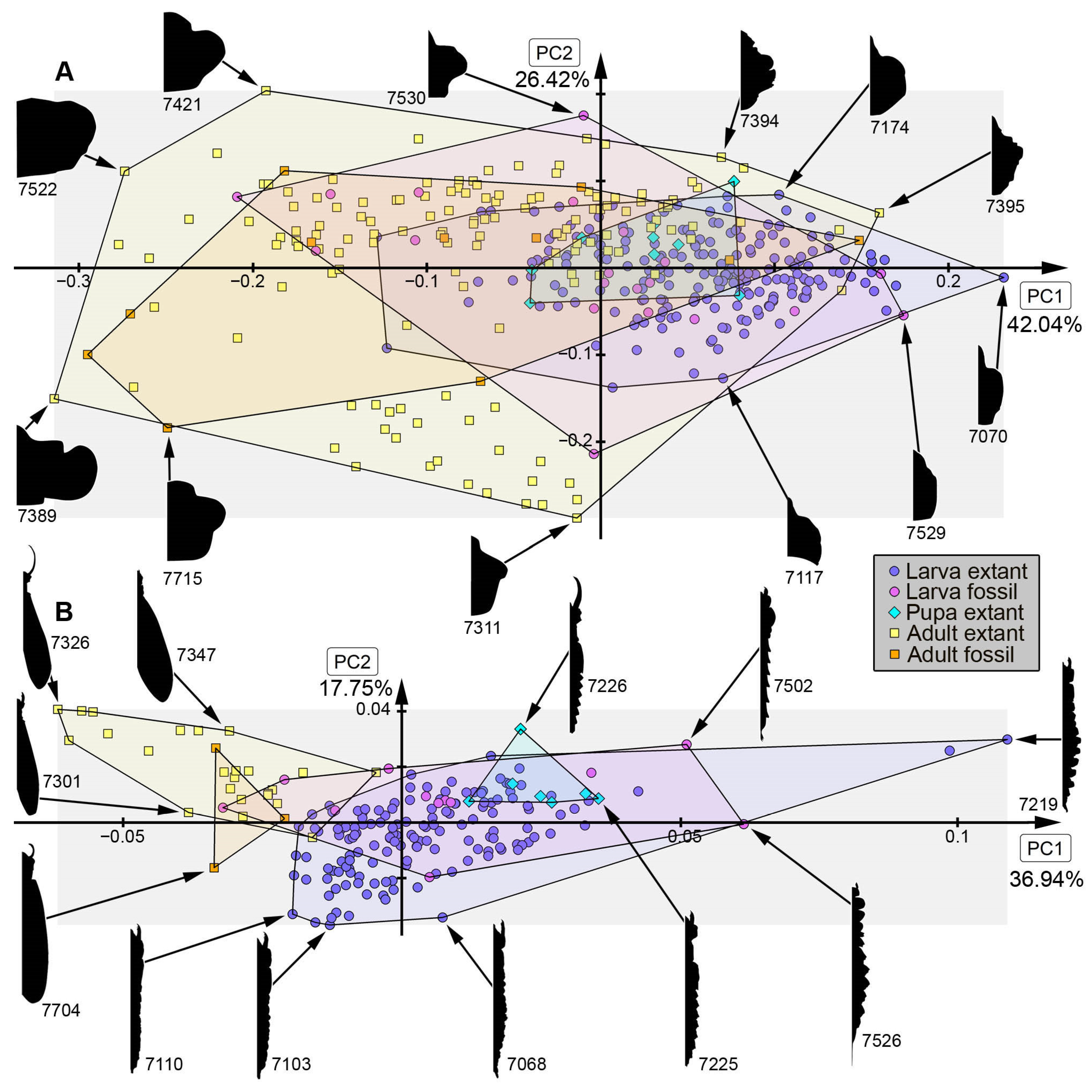
- Analysis of head capsule, without Gyrinidae: The analysis resulted in seven effective PCs together explaining over 92.6% of the overall variation. PC1 and PC2 together explain 66.4%. PC1 explains 42.0% of the overall variation. It describes the relative length and width of the labrum and relative width of the head capsule. Negative values indicate a proportionally short, broad labrum and a proportionally broad head capsule, while positive values indicate a proportionally long, slim labrum and a proportionally slim head capsule. PC2 explains 26.4% of the overall variation. It describes the relative length and width of the labrum and proportions of the head capsule. Negative values indicate a proportionally short, broad labrum and posteriorly broad head capsule, while positive values indicate a proportionally long, slim labrum and anteriorly broad head capsule.
- Analysis of whole body, without Gyrinidae: The analysis resulted in eight effective PCs together explaining over 91.7% of the overall variation. PC1 and PC2 together explain 54.7%. PC1 explains 36.9% of the overall variation. It describes the relative length of the labrum and the relative width of the posterior body region. Negative values indicate a proportionally short labrum, while positive values indicate a proportionally long labrum. PC2 explains 17.8% of the overall variation. It describes the relative length of the labrum and the relative distal width of the mandibles. Negative values indicate a proportionally long labrum and distally broader mandibles, while positive values indicate a proportionally short labrum and distally narrower mandibles.
- Analysis of whole body, including larvae of Gyrinidae: The analysis resulted in seven effective PCs together explaining over 89.8% of the overall variation. PC1 and PC2 together explain 70.7%. PC1 explains 47.6% of the overall variation. It describes the relative length of the labrum and the relative width of the mandibles. Negative values indicate a proportionally long labrum and proportionally broader mandibles, while positive values indicate a proportionally short labrum and proportionally narrower mandibles. PC2 explains 23.1% of the overall variation. It describes the relative length of the labrum and the curvature of the mandibles. Negative values indicate a proportionally short labrum and straighter mandibles, while positive values indicate a proportionally long labrum and more curved mandibles.
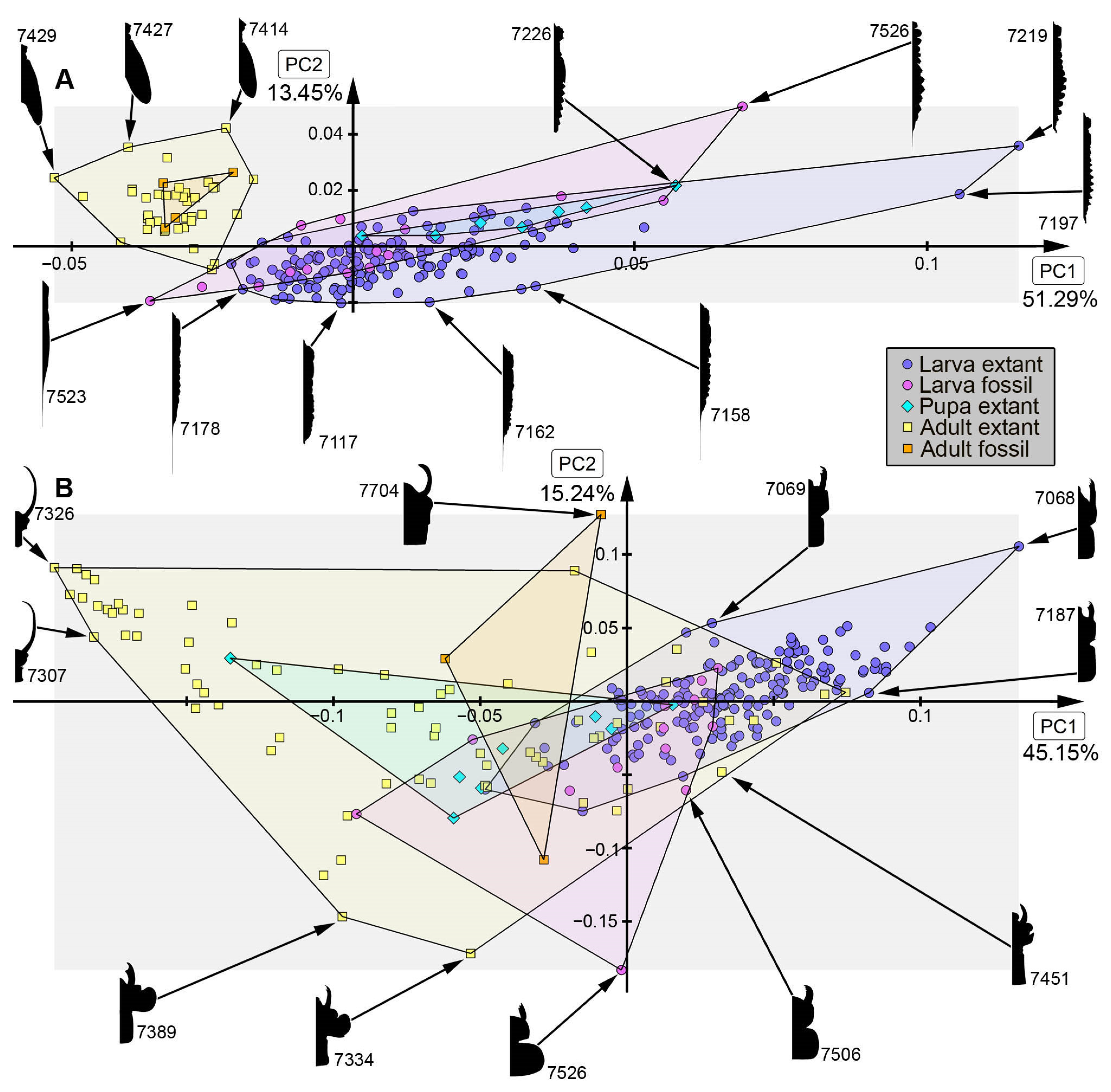
- Analysis of whole body without mandibles, without Gyrinidae: The analysis resulted in six effective PCs together explaining over 89.1% of the overall variation. PC1 and PC2 together explain 64.7%. PC1 explains 51.3% of the overall variation. It describes the relative length and distal width of the labrum. Negative values indicate a proportionally short and distally broad labrum, while positive values indicate a proportionally long and distally narrow labrum. PC2 explains 13.5% of the overall variation. It describes the relative length and distal width of the labrum and the relative width of head capsule. Negative values indicate a proportionally long and distally narrow labrum and a proportionally narrower head capsule, while positive values indicate a proportionally short and distally broad labrum and a proportionally broader head capsule.
- Analysis of head capsule, mandibles and prothorax, without Gyrinidae: The analysis resulted in seven effective PCs together explaining over 89.9% of the overall variation. PC1 and PC2 together explain 60.4%. PC1 explains 45.1% of the overall variation. It describes the relative length of the labrum, the relative proximal width of the mandibles and the relative width of the prothorax. Negative values indicate a proportionally short labrum, proximally broader mandibles and a proportionally narrow prothorax, while positive values indicate a proportionally long labrum, proximally narrower mandibles and a proportionally broad prothorax. PC2 explains 15.2% of the overall variation. It describes the relative length of the labrum and the relative length and width of the mandibles. Negative values indicate a proportionally short labrum and proportionally shorter and narrower mandibles, while positive values indicate a proportionally long labrum and proportionally longer and broader mandibles.
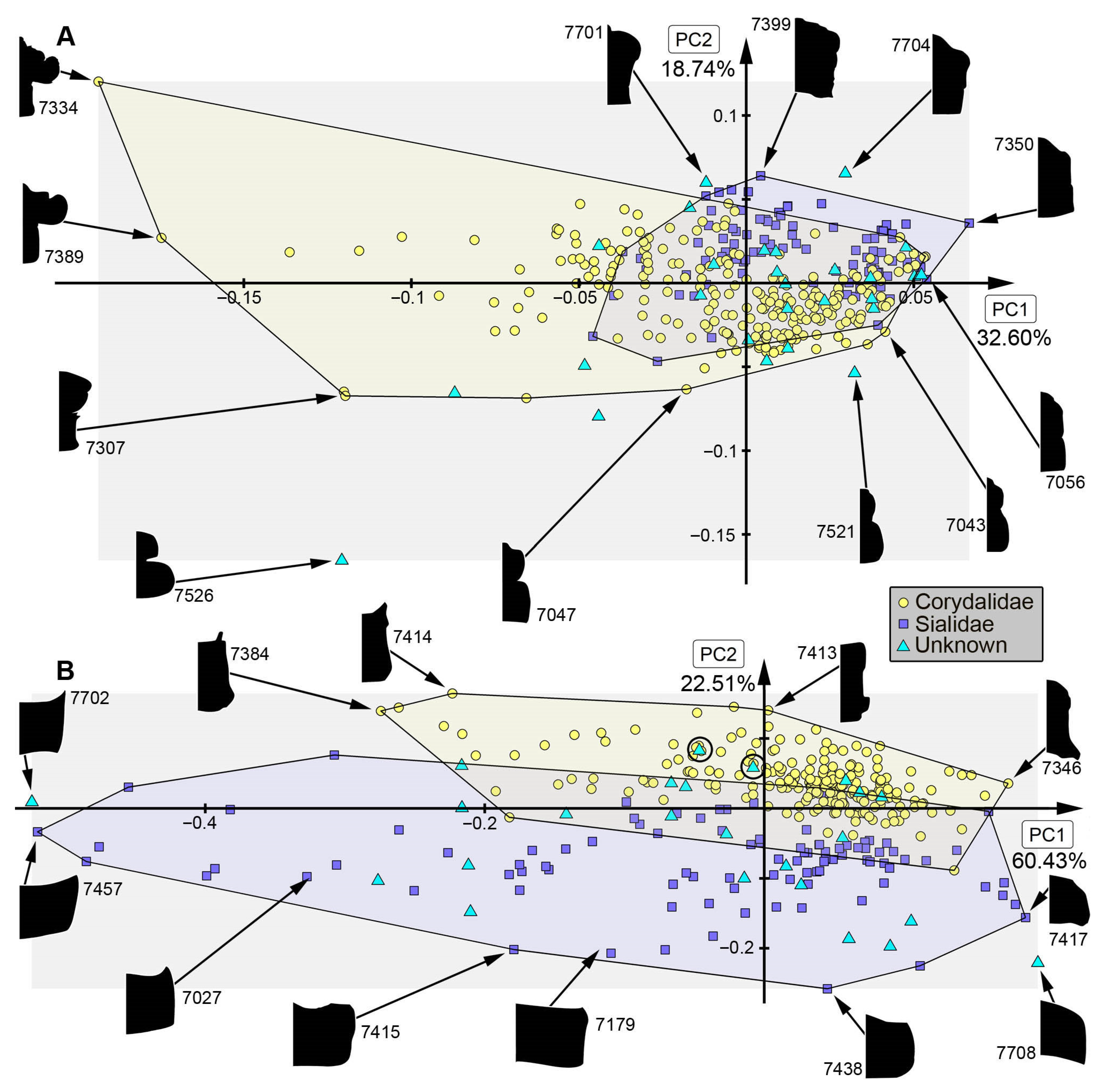
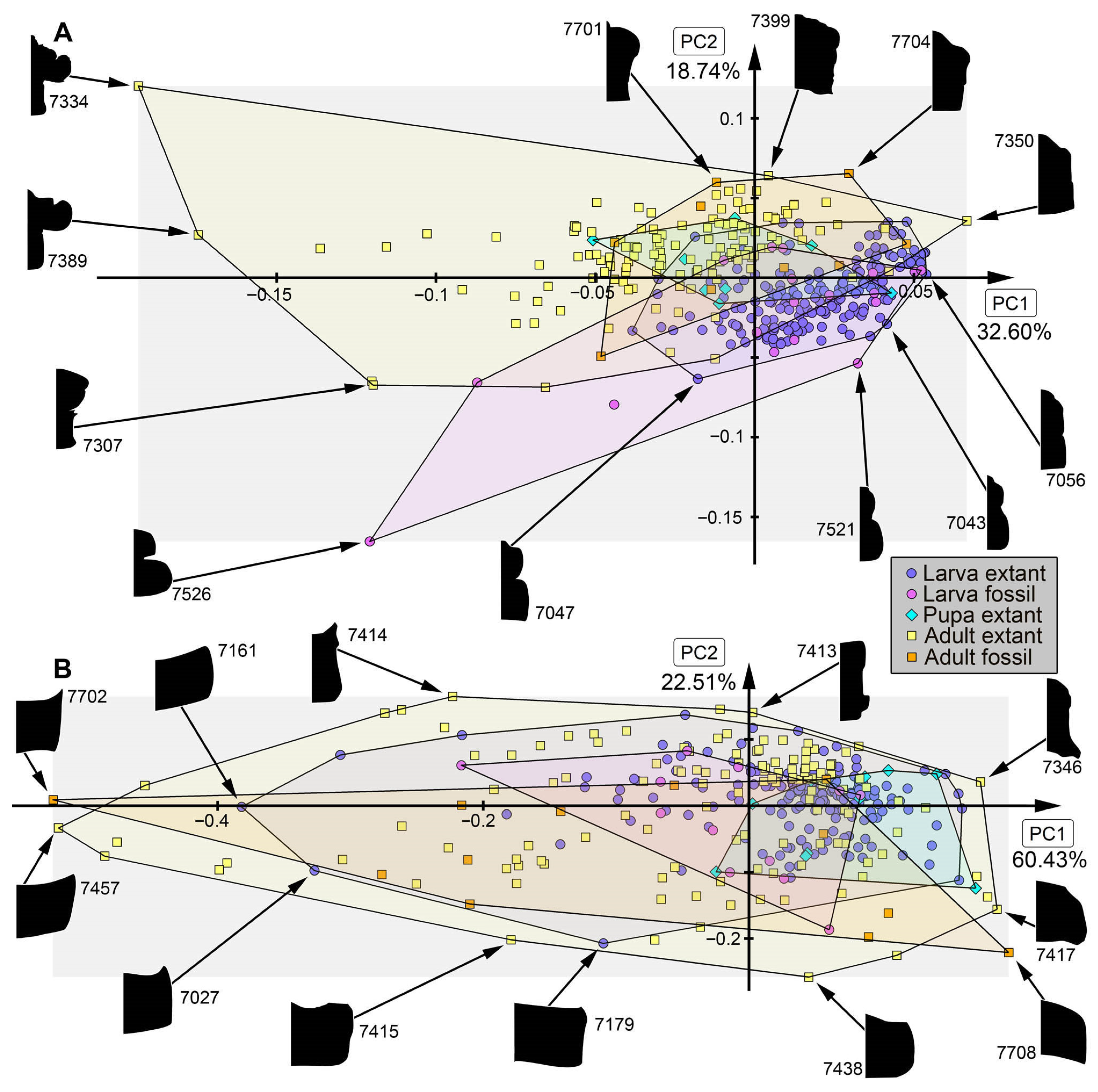
- Analysis of head capsule and prothorax, without Gyrinidae: The analysis resulted in eight effective PCs together explaining over 90.0% of the overall variation. PC1 and PC2 together explain 51.3%. PC1 explains 32.6% of the overall variation. It describes the relative proximal width of the labrum and relative width of the clypeus and the proportions of the prothorax. Negative values indicate a proportionally proximally broad labrum and proportionally broad clypeus and a proportionally posteriorly broader prothorax, while positive values indicate a proportionally proximally narrow labrum and proportionally narrow clypeus and a proportionally anteriorly broader prothorax. PC2 explains 18.7% of the overall variation. It describes the relative length of the labrum, the proportions of the head capsule and relative width of the prothorax. Negative values indicate a proportionally short labrum, round head capsule and proportionally broad prothorax, while positive values indicate a proportionally long labrum, a proportionally posteriorly narrower head capsule and a proportionally narrow prothorax.
- Analysis of prothorax, without Gyrinidae: The analysis resulted in four effective PCs together explaining over 93.6% of the overall variation. PC1 and PC2 together explain 82.9%. PC1 explains 60.4% of the overall variation. It describes the relative length and proportions of the prothorax. Negative values indicate a proportionally long prothorax that has a uniform width along the anterior-posterior body axis and is anteriorly curved, while positive values indicate a proportionally short prothorax that is proportionally anteriorly narrower and posteriorly broader. PC2 explains 22.5% of the overall variation. It describes the proportions of the prothorax antero-lateral and postero-lateral edges of the prothorax. Negative values indicate more angular antero-lateral and postero-lateral edges of the prothorax and a laterally more posteriorly curved anterior edge of the prothorax, while positive values indicate rounder antero-lateral and postero-lateral edges of the prothorax and a laterally more anteriorly curved anterior edge of the prothorax.
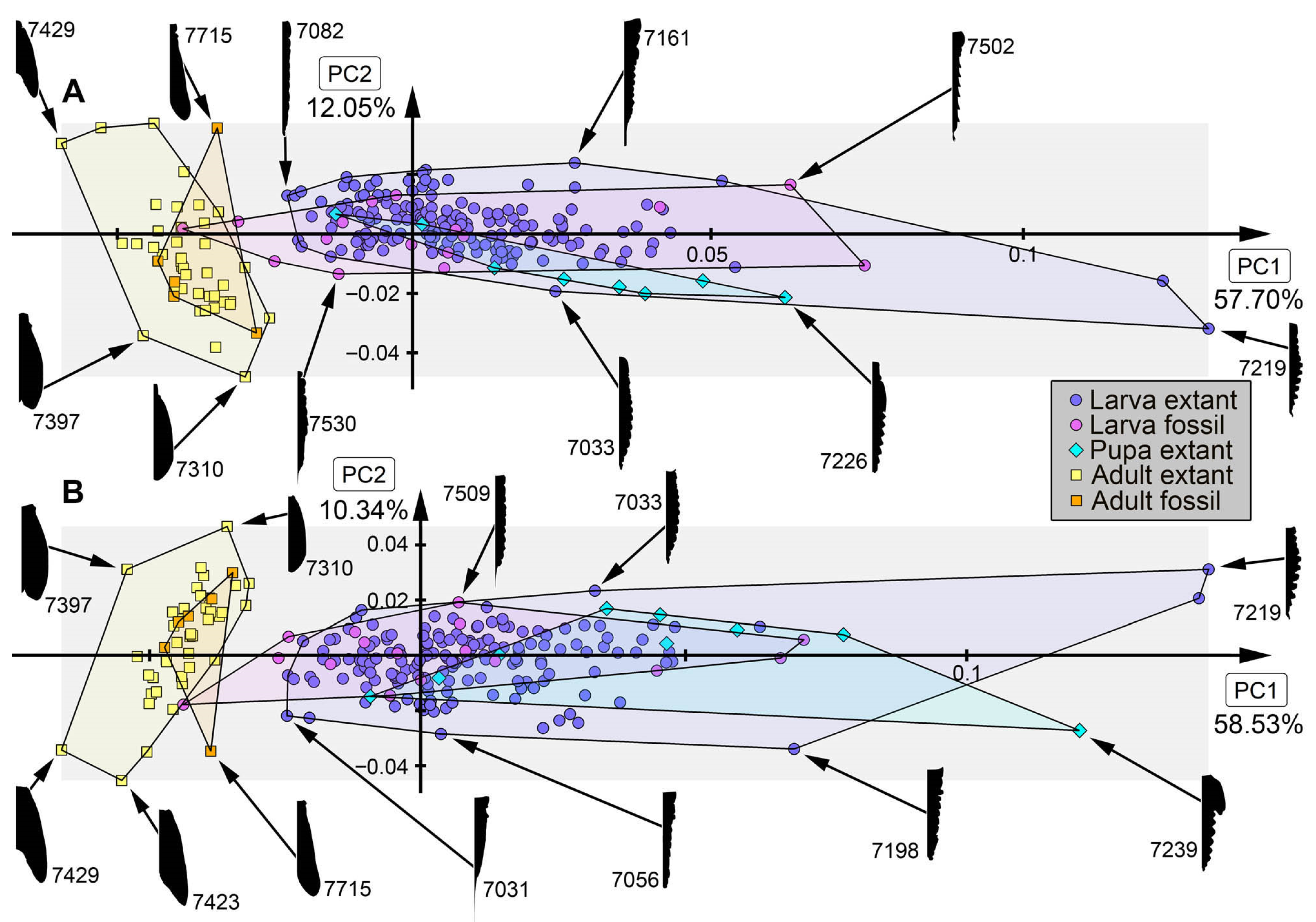
- Analysis of the trunk, without Gyrinidae: The analysis resulted in seven effective PCs together explaining over 92.0% of the overall variation. PC1 and PC2 together explain 69.8%. PC1 explains 57.7% of the overall variation. It describes the relative width of the prothorax. Negative values indicate a proportionally narrower prothorax, while positive values indicate a proportionally broader prothorax. PC2 explains 12.1% of the overall variation. It describes how distinct the prothorax is set off from the mesothorax. Negative values indicate a more distinct set-off prothorax from the mesothorax, while positive values indicate a less distinct set-off prothorax from the mesothorax.
- Analysis of the trunk without prothorax, without Gyrinidae: The analysis resulted in six effective PCs together explaining over 90.2% of the overall variation. PC1 and PC2 together explain 68.9%. PC1 explains 58.5% of the overall variation. It describes the relative width of meso- and metathorax and how distinct the abdomen segments are. Negative values indicate a proportionally narrow meso- and metathorax and no or less distinct abdomen segments, while positive values indicate a proportionally broad meso- and metathorax and strongly distinct abdominal segments. PC2 explains 10.3% of the overall variation. It describes the relative width of meso- and metathorax and the relative width of the posterior body region. Negative values indicate a proportionally broad meso- and metathorax and proportionally broad posterior body region, while positive values indicate a proportionally narrow meso- and metathorax and proportionally narrow posterior body region.
4. Discussion
4.1. Identity of Specimens
- Identity of new fossils: problems with the identification of fossil megalopteran-like larvae
- Identity of Triassic sedimentary fossils
- Identity of specimens PED 0529 and PED 1669
- Identity of specimen PED 4796
- Identity of specimens PED 2821 and BUB 5274
- Identity of specimen PED 1556 and morphotype 4 [9]
- Identity of specimen BUB 5196
- Identity of specimen BUB 5220
4.2. Shape Analyses over Time
4.3. Discussion of Trialarva Coburgensis
4.4. Ontogeny
4.5. Corydalidae vs. Sialidae
4.6. Larvae of Megaloptera and Gyrinidae
5. Conclusions
Supplementary Materials
Author Contributions
Funding
Data Availability Statement
Acknowledgments
Conflicts of Interest
References
- Martins, C.C.; Ardila-Camacho, A.; Rivera-Gasperín, S.L.; Oswald, J.D.; Liu, X.; Contreras-Ramos, A. A world checklist of extant and extinct species of Megaloptera (Insecta: Neuropterida). Eur. J. Taxon. 2022, 812, 1–93. [Google Scholar] [CrossRef] [Scilit]
- Heckman, C.W. Neuroptera (Including Megaloptera). In Encyclopedia of South American Aquatic Insects; Springer International Publishing: Cham, Switzerland, 2017; pp. 75–119. [Google Scholar] [CrossRef] [Scilit]
- Cover, M.R.; Resh, V.H. Global diversity of dobsonflies, fishflies, and alderflies (Megaloptera; Insecta) and spongillaflies, nevrorthids, and osmylids (Neuroptera; Insecta) in freshwater. Hydrobiologia 2007, 595, 409–417. [Google Scholar] [CrossRef] [Scilit]
- Cover, M.R.; Bogan, M.T. Minor Insect Orders. In Thorp and Covich’s Freshwater Invertebrates; Thorp, J.H., Covich, A.P., Eds.; Academic Press: Cambridge, MA, USA, 2015; pp. 1059–1072. [Google Scholar] [CrossRef] [Scilit]
- New, T.R.; Theischinger, G. Megaloptera (Adlerflies, Dobsonflies); Walter de Gruyter GmbH & Co KG: Berlin, Germany, 1993. [Google Scholar] [CrossRef] [Scilit]
- Grimaldi, D.; Engel, M.S. Evolution of the Insects; Cambridge University Press: Cambridge, UK, 2005. [Google Scholar]
- Kristensen, N.P. Phylogeny of endopterygote insects, the most successful lineage of living organisms. Eur. J. Entomol. 1999, 96, 237–253. [Google Scholar]
- Hershey, A.E.; Lamberti, G.A.; Chaloner, D.T.; Northington, R.M. Aquatic insect ecology. In Ecology and Classification of North American Freshwater Invertebrates; Throp, J.H., Covich, A.P., Eds.; Academic Press: Cambridge, MA, USA, 2010; pp. 659–694. [Google Scholar] [CrossRef] [Scilit]
- Baranov, V.; Haug, C.; Fowler, M.; Kaulfuss, U.; Müller, P.; Haug, J.T. Summary of the fossil record of megalopteran and megalopteran-like larvae, with a report of new specimens. Bull. Geosci. 2022, 97, 89–108. [Google Scholar] [CrossRef] [Scilit]
- Grauvogel-Stamm, L.; Kelber, K.P. Plant-insect interactions and coevolution during the Triassic in western Europe. Paleont. Lomb. 1996, 5, 5–23. [Google Scholar]
- Marchal-Papier, F. Les insectes du Buntsandstein des Vosges (NE de la France). Biodiversité et contribution aux modalités de la crise biologique du Permo-Trias. Doctoral Dissertation, Université Louis Pasteur, Strasbourg, France, 1998. [Google Scholar]
- Prokin, A.A.; Bashkuev, A.S. The oldest known larvae of Megaloptera (Insecta) from the Triassic of Ukraine. Palaeoentomology 2023, 6, 155–164. [Google Scholar] [CrossRef] [Scilit]
- Wang, B.; Zhang, H. Earliest evidence of fishflies (Megaloptera: Corydalidae): An exquisitely preserved larva from the Middle Jurassic of China. J. Paleontol. 2010, 84, 774–780. [Google Scholar] [CrossRef] [Scilit]
- Ponomarenko, A.G. Supposed alderfly larva (Insecta, Megaloptera) from the Jurassic locality Shar-Teg, south-western Mongolia. Paleontol. J. 2012, 46, 378–382. [Google Scholar] [CrossRef] [Scilit]
- Ponomarenko, A.G. Corydalidae (Megaloptera) from the Cretaceous of northern Asia. Entomol. Rev. 1976, 55, 114–122. [Google Scholar]
- Wichard, W.; Weitschat, W. Wasserinsekten im Bernstein: Eine paläobiologische Studie; Löbbecke-Museum und Aquazoo: Düsseldorf, Germany, 1996; Volume 4. [Google Scholar]
- Gröhn, C. Einschlüsse im Baltischen Bernstein; Wachholtz Verlag—Murmann Publishers: Kiel, Germany, 2015. [Google Scholar]
- Nel, A. Nouveaux insectes neuroptéroïdes fossiles de l’Oligocène de France (Neuroptera et Megaloptera). Bull. Mus. Natl. Hist. Nat. Sect. C Sci. Terre Paléontol. Géol. Minér. 1991, 12, 327–349. [Google Scholar]
- Baranov, V.; Frese, M.; Beattie, R.; Djokic, T.; McCurry, M.R. New aquatic insects from the Miocene of Australia with notes on the ecology and ontogeny of a new species of Chaoborus (Diptera, Chaoboridae). Papers Palaeontol. 2024, 10, e1580. [Google Scholar] [CrossRef] [Scilit]
- Haug, J.T.; Labandeira, C.C.; Santiago-Blay, J.A.; Haug, C.; Brown, S. Life habits, hox genes, and affinities of a 311 million-year-old holometabolan larva. BMC Evol. Biol. 2015, 15, 208. [Google Scholar] [CrossRef] [Scilit]
- Prokin, A.A.; Ponomarenko, A.G.; Kirejtshuk, A.G. Description of a larva of Kargalarva permosialis gen. et sp. nov. (Coleoptera: Schizophoromorpha) from the Kargala fossil site. Paleontol. J. 2019, 53, 282–286. [Google Scholar] [CrossRef] [Scilit]
- Prokin, A.A.; Bashkuev, A.S. Trialarva coburgensis gen. et sp. nov., a remarkable fossil holometabolan larva (Insecta: Coleoptera) from the Triassic of Germany. PalZ 2021, 95, 55–60. [Google Scholar] [CrossRef] [Scilit]
- Cruickshank, R.D.; Ko, K. Geology of an amber locality in the Hukawng Valley, northern Myanmar. J. Asian Earth Sci. 2003, 21, 441–455. [Google Scholar] [CrossRef] [Scilit]
- Shi, G.; Grimaldi, D.A.; Harlow, G.E.; Wang, J.; Wang, J.; Yang, M.; Lei, W.; Li, Q.; Li, X. Age constraint on Burmese amber based on U–Pb dating of zircons. Cretac. Res. 2012, 37, 155–163. [Google Scholar] [CrossRef] [Scilit]
- Yu, T.; Kelly, R.; Mu, L.; Ross, A.; Kennedy, J.; Broly, P.; Xia, F.; Zhang, H.; Wang, B.; Dilcher, D. An ammonite trapped in Burmese amber. Proc. Natl. Acad. Sci. USA 2019, 116, 11345–11350. [Google Scholar] [CrossRef] [Scilit] [PubMed]
- Chen, P.; Wang, Q.; Zhang, H.; Cao, M.; Li, W.; Wu, S.; Shen, Y. Jianshangou Bed of the Yixian Formation in West Liaoning, China. Sci. China Ser. D-Earth Sci. 2005, 48, 298–312. [Google Scholar] [CrossRef] [Scilit]
- Wang, T.; Gong, E.; Liang, Y.; Cui, Y.; Huang, W. Varves in the Yixian Formation, western Liaoning: Constraining the palaeoclimate in the Early Cretaceous. Geol. J. 2021, 57, 166–185. [Google Scholar] [CrossRef] [Scilit]
- Durand, M.; Jurain, G. Eléments paléontologiques nouveaux du Trias des Vosges méridionales. C. R. Acad. Sci. 1969, 269, 1047–1049. [Google Scholar]
- Barnard, K.H. The Cape Alder-Flies. Trans. R. Soc. S. Afr. 1931, 19, 169–184. [Google Scholar] [CrossRef] [Scilit]
- Ross, H.; Frison, T. Studies of Nearctic Aquatic Insects: I. Nearctic Alder Flies of the Genus Sialis (Megaloptera, Sialidae); II. Descriptions of Plecoptera. Bull. Ill. Nat. Hist. Surv. 1937, 21, 57–99. [Google Scholar]
- Kramer, S. The musculature of the head of the Corydalus larva (Neuroptera, Sialidae). J. Morphol. 1955, 96, 1–30. [Google Scholar] [CrossRef] [Scilit]
- Cuyler, R.D. The Larvae of Chauliodes Latreille (Megaloptera: Corydalidae). Ann. Entomol. Soc. Am. 1958, 51, 582–586. [Google Scholar] [CrossRef] [Scilit]
- Illies, J. Megaloptera and Plecoptera (Ins.) aus den jungpliozänen Süßwassermergeln von Willershausen. Ber. Nathist. Ges. Hann. 1967, 111, 47–55. [Google Scholar]
- Azam, K.M. Life History and Production Studies of Sialis californica Banks and Sialis rotunda Banks (Megaloptera: Sialidae). Ph.D. Thesis, Oregon State University, Corvallis, OR, USA, 1968. [Google Scholar]
- Azam, K.M.; Anderson, N.H. Life history and habits of Sialis rotunda and S. californica in Western Oregon. Ann. Entomol. Soc. Am. 1969, 62, 549–558. [Google Scholar] [CrossRef] [Scilit]
- Evans, E.D. A Study of the Megaloptera of the Pacific Coastal Region of the United States. Ph.D. Thesis, Oregon State University, Corvallis, OR, USA, 1972. [Google Scholar]
- Flint, O.S., Jr. The Megaloptera of Chile. Rev. Chil. Entomol. 1973, 7, 31–45. [Google Scholar]
- Lehmkuhl, D.M. Alderflies. Blue Jay 1975, 33, 152–154. [Google Scholar] [CrossRef] [Scilit]
- Glorioso, M.J. Systematics of the Dobsonfly Subfamily Corydalinae (Megaloptera: Corydalidae). Master’s Thesis, Ohio State University, Columbus, OH, USA, 1980. [Google Scholar]
- Geijskes, D.C. Notes on Megaloptera from the Guyanas, S. Am. In Progress in World’s Neuropterology; Eigenverlag: Graz, Austria, 1984; pp. 79–84. [Google Scholar]
- Gepp, J. Erforschungsstand der Neuropteren. Larven der Erde (mit einem Schlüssel zur Larvaldiagnose der Familien, einer Übersicht von 340 beschriebenen Larven und 600 Literaturzitaten). In Progress in World’s Neuropterology; Eigenverlag: Graz, Austria, 1984; pp. 183–239. [Google Scholar]
- Glorioso, M.J.; Flint, O.S., Jr. A review of the genus Platyneuromus (Insecta: Neuroptera: Corydalidae). Proc. Biol. Soc. Wash. 1984, 97, 601–614. [Google Scholar]
- Hayashi, F.; Nakane, M. Radio tracking and activity monitoring of the dobsonfly larva, Protohermes grandis (Megaloptera: Corydalidae). Oecologia 1989, 78, 468–472. [Google Scholar] [CrossRef] [Scilit]
- Wichard, W. Schlammfliegen aus Baltischen Bernstein (Megaloptera, Sialidae). Mitt. Geol.-Paläontol. Inst. Univ. Hamburg 1997, 80, 197–211. [Google Scholar]
- Contreras-Ramos, A.; Harris, S.C. The Immature Stages of Platyneuromus (Corydalidae), with a Key to the Genera of Larval Megaloptera of Mexico. J. N. Am. Benthol. Soc. 1998, 17, 489–517. [Google Scholar] [CrossRef] [Scilit]
- Rasmussen, A.K.; Pescador, M.L. A Guide to the Megaloptera and Aquatic Neuroptera of Florida; Department of Environmental Protection, State of Florida: Tallahassee, FL, USA, 2002.
- Weitschat, W.; Wichard, W. Atlas of Plants and Animals in Baltic Amber; Verlag Dr. Friedrich Pfeil: Munich, Germany, 2002. [Google Scholar]
- De Azevêdo, C.A.S. Taxonomia e bionomia de imaturos de Megaloptera (Insecta) na Amazônia Central, Brasil. Master’s Thesis, Universidade Federal do Amazonas, Manaus, Brazil, 2003. [Google Scholar]
- Contreras-Ramos, A. Is the family Corydalidae (Neuropterida, Megaloptera) a monophylum? Denisia 2004, 13, 135–140. [Google Scholar]
- Wichard, W.; Weitschat, W. Im Bernsteinwald; Gerstenberg Verlag: Hildesheim, Germany, 2004. [Google Scholar]
- Contreras-Ramos, A.; Fiorentin, G.L.; Urakami, Y. A new species of alderfly (Megaloptera: Sialidae) from Rio Grande do Sul, Brazil. Amazoniana 2005, 18, 267–272. [Google Scholar]
- Contreras-Ramos, A. Protosialis ranchograndis, a new species of alderfly from Venezuela, with a redescription of P. brasiliensis Navás (Megaloptera: Sialidae). Proc. Entomol. Soc. Wash. 2006, 108, 977. [Google Scholar]
- Kovács, T. Data to the distribution of Sialis species in Hungary, based on larvae (Megaloptera: Sialidae). Folia Hist. Nat. Mus. Matr. 2006, 30, 227–230. [Google Scholar]
- Wichard, W.; Engel, M.S. A New Alderfly in Baltic Amber (Megaloptera: Sialidae). Am. Mus. Novit. 2006, 2006, 1–9. [Google Scholar] [CrossRef] [Scilit]
- Aspöck, U.; Aspöck, H. Verbliebene Vielfalt vergangener Blüte. Zur Evolution, Phylogenie und Biodiversität der Neuropterida (Insecta: Endopterygota). Denisia 2007, 20, 451–516. [Google Scholar]
- Martins-Neto, R.G.; Heads, S.W.; Bechly, G. 11.16 Neuropterida: Snakeflies, dobsonflies and lacewings. In The Crato Fossil Beds of Brazil: Window into an Ancient World; Cambridge University Press: Cambridge, UK, 2007; pp. 328–340. [Google Scholar]
- De Azevêdo, C.A.S.; Hamada, N. Ordem Megaloptera Latreille, 1802 (Arthropoda: Insecta). In Guia On-Line: Identificação de larvas de Insetos Aquáticos do Estado de São Paulo; Froehlich, C.G., Ed.; Universidade de São Paulo: São Paulo, Brazil, 2008. [Google Scholar]
- Beutel, R.G.; Friedrich, F. Comparative study of larval head structures of Megaloptera (Hexapoda). Eur. J. Entomol. 2008, 105, 917–938. [Google Scholar] [CrossRef] [Scilit]
- Contreras-Ramos, A. Notes on Some Neotropical Alderflies (Sialidae: Megaloptera). Ann. Entomol. Soc. Am. 2008, 101, 808–814. [Google Scholar] [CrossRef]
- Anderson, N.H. Megaloptera: Alderflies, fishflies, hellgrammites, dobsonflies. In Encyclopedia of Insects; Academic Press: Cambridge, MA, USA, 2009; pp. 620–623. [Google Scholar]
- de Azevêdo, C.A.S. Taxonomia, bionomia e estrutura da comunidade de larvas de Megaloptera (Insecta) em igarapés nos estados do amazonas e Roraima, Brasil. Ph.D. Thesis, Instituto National de Pesquisas da Amazonia, Manaus, Brazil, 2009. [Google Scholar]
- Liu, X.; Hayashi, F.; Yang, D. Sialis navasi, a new alderfly species from China (Megaloptera: Sialidae). Zootaxa 2009, 2230, 64–68. [Google Scholar] [CrossRef] [Scilit]
- Wichard, W.; Gröhn, C.; Seredszus, F. Aquatic Insects in Baltic Amber; Kessel: Remagen, Germany, 2009. [Google Scholar]
- Hanson, P.; Springer, M.; Ramirez, A. Capítulo 1: Introducción a los grupos de macroinvertebrados acuáticos. Rev. Biol. Trop. 2010, 58, 3–37. [Google Scholar]
- Weitschat, W.; Wichard, W. Baltic amber. In Biodiversity of Fossils in Amber from the Major World Deposits; Penney, D., Ed.; Siri Scientific Press: Manchester, UK, 2010; pp. 80–115. [Google Scholar]
- Liu, X.; Price, B.W.; Hayashi, F.; Yang, D. Revision of the fishfly genus Platychauliodes Esben-Petersen (Megaloptera: Corydalidae) endemic to South Africa. Zootaxa 2011, 2909, 1–13. [Google Scholar] [CrossRef] [Scilit]
- Hayashi, F. Insecta: Introduction. In Freshwater Invertebrates of the Malaysian Region; Yule, C.M., Sen, Y.H., Eds.; Academy of Sciences Malaysia: Kuala Lumpur, Malaysia, 2012; pp. 372–383. [Google Scholar]
- Jung, S.W.; Bae, Y.J. Taxonomic review of the Korean Megaloptera with description of Sialis koreana, new species. Bull. Entomol. Res. 2012, 28, 3–13. [Google Scholar]
- Liu, X.; Wang, Y.; Shih, C.; Ren, D.; Yang, D. Early Evolution and Historical Biogeography of Fishflies (Megaloptera: Chauliodinae): Implications from a Phylogeny Combining Fossil and Extant Taxa. PLoS ONE 2012, 7, e40345. [Google Scholar] [CrossRef] [Scilit] [PubMed]
- Price, B.W.; Liu, X.; De Moor, F.C.; Villet, M.H. A review of the alderfly genus Leptosialis Esben-Petersen (Megaloptera, Sialidae) with description of a new species from South Africa. ZooKeys 2012, 201, 27–41. [Google Scholar] [CrossRef] [Scilit]
- Cao, C.; Liu, X. Description of the final-instar larva and pupa of Acanthacorydalis orientalis (McLachlan, 1899) (Megaloptera: Corydalidae) with some life history notes. Zootaxa 2013, 3691, 145–152. [Google Scholar] [CrossRef] [Scilit]
- Hall, D.W. Eastern dobsonfly (adult), hellgrammite (larva) Corydalus cornutus (Linnaeus) (Insecta: Megaloptera: Corydalidae: Corydalinae). EDIS 2013, 2013, 1–4. [Google Scholar] [CrossRef] [Scilit]
- Liu, X.; Price, B.; Hayashi, F.; De Moor, F.; Yang, D. Systematic revision reveals underestimated diversity of the South African endemic fishfly genus Taeniochauliodes Esben-Petersen (Megaloptera: Corydalidae). Syst. Entomol. 2013, 38, 543–560. [Google Scholar] [CrossRef] [Scilit]
- Ardila-Camacho, A. A new species of Corydalus Latreille, 1802 (Megaloptera, Corydalidae) and first record of C. clavijoi Contreras-Ramos, 2002 and C. nubilus Erichson, 1848 from Colombia. Zootaxa 2014, 3811, 107–118. [Google Scholar] [CrossRef] [Scilit]
- Contreras-Ramos, A.; Rosas Echeverria, M.V. Biodiversidad de Megaloptera y Raphidioptera en México. Rev. Mex. Biodivers. 2014, 85, 257–263. [Google Scholar] [CrossRef] [Scilit]
- Liu, X.Y.; Price, B.W.; Hayashi, F.; De Moor, F.; Yang, D. Revision of the Megaloptera (Insecta: Neuropterida) of Madagascar. Zootaxa 2014, 3796, 320–336. [Google Scholar] [CrossRef] [Scilit] [PubMed]
- Monserrat, V.J. Los megalópteros de la Península Ibérica (Insecta, Neuropterida, Megaloptera, Sialidae). Graellsia 2014, 70, e009. [Google Scholar] [CrossRef] [Scilit]
- Bowles, D.E.; Sites, R.W. Alderflies, Fishflies and Dobsonflies (Insecta: Megaloptera) of the Interior Highlands, USA. Trans. Am. Entomol. Soc. 2015, 141, 405–429. [Google Scholar] [CrossRef] [Scilit]
- Cover, M.R.; Seo, J.H.; Resh, V.H. Life History, Burrowing Behavior, and Distribution of Neohermes filicornis (Megaloptera: Corydalidae), a Long-Lived Aquatic Insect in Intermittent Streams. West. N. Am. Nat. 2015, 75, 474. [Google Scholar] [CrossRef] [Scilit]
- Liu, X.; Hayashi, F.; Yang, D. Phylogeny of the family Sialidae (Insecta: Megaloptera) inferred from morphological data, with implications for generic classification and historical biogeography. Cladistics 2015, 31, 18–49. [Google Scholar] [CrossRef] [Scilit]
- Liu, X.; Hayashi, F.; Yang, D. Taxonomic notes of the Neotropical alderfly genus Ilyobius Enderlein, 1910 (Megaloptera, Sialidae), with description of a new species. Dtsch. Entomol. Z. 2015, 62, 55–63. [Google Scholar] [CrossRef] [Scilit]
- Bowles, D.E.; Contreras-Ramos, A. First record of the family Sialidae (Megaloptera) from Thailand and description of the female and putative larva of Indosialis bannaensis. Zootaxa 2016, 4114, 485–491. [Google Scholar] [CrossRef] [Scilit]
- Cao, C.; Tong, C.; Chen, S.; Liu, Z.; Xu, F.; Liu, Q.; Liu, X. First description and bionomic notes for the final-instar larva and pupa of an Oriental dobsonfly species, Neoneuromus sikkimmensis (van der Weele, 1907) (Megaloptera: Corydalidae). Zootaxa 2016, 4179, 288–294. [Google Scholar] [CrossRef] [Scilit]
- Ferreira, R.N. Two combined abnormalities in a male of Corydalus cornutus (Linnaeus, 1758)(Megaloptera: Corydalidae) from Connecticut (USA). Arq. Entomol. 2016, 15, 119–120. [Google Scholar]
- Henry, C.S.; Penny, N.; Adams, P.A. The neuropteroid orders of Central America (Neuroptera and Megaloptera). In Insects of Panama and Mesoamerica; Oxford University Press: Oxford, UK, 1992; pp. 432–458. [Google Scholar] [CrossRef] [Scilit]
- Huang, D.; Azar, D.; Engel, M.S.; Cai, C.; Garrouste, R.; Nel, A. A new genus of alderflies (Megaloptera: Sialidae) in Upper Cretaceous Burmese amber. Cretac. Res. 2016, 64, 7–11. [Google Scholar] [CrossRef] [Scilit]
- Archangelsky, M.; Pessacq, P.; Berrondo, M. Description of the larva of Ilyobius chilensis (McLachlan) (Megaloptera: Sialidae) and notes on the adult morphology. Zootaxa 2017, 4318, 177–186. [Google Scholar] [CrossRef] [Scilit]
- Glime, J.M. Aquatic insects: Holometabola—Coleoptera, Suborder Adephaga. Chapter 11-9. In Bryophyte Ecology. Volume 2. Bryological Interaction; Glime, J.M., Ed.; Ebook sponsored by Michigan Technological University and the International Association of Bryologists; Springer: Berlin/Heidelberg, Germany, 2017. [Google Scholar]
- Liu, X.; Lu, X.; Xia, F.; Wang, B. First description of female of Haplosialodes liui Huang et al., 2016 (Megaloptera: Sialidae) from Cretaceous Burmese amber. Zootaxa 2017, 4254, 593–598. [Google Scholar] [CrossRef] [Scilit]
- Villagomez, F.; Contreras-Ramos, A. First records of adult feeding in Megaloptera (Corydalidae, Corydalinae) from Mexico and their possible relationship with the increase in life span. Zootaxa 2017, 4341, 287–290. [Google Scholar] [CrossRef] [Scilit] [PubMed]
- Ardila-Camacho, A.; Contreras-Ramos, A. The Megaloptera (Insecta: Neuropterida) of Colombia. Aquat. Insects 2018, 39, 297–353. [Google Scholar] [CrossRef] [Scilit]
- Ardila-Camacho, A.; Contreras-Ramos, A. Order Megaloptera. In Thorp and Covich’s Freshwater Invertebrates; Thorp, J.H., Covich, A.P., Eds.; Academic Press: Cambridge, MA, USA, 2018; pp. 217–227. [Google Scholar] [CrossRef] [Scilit]
- Cao, C.; Liu, F.; Tong, C.; Fang, Y.; Xu, H.; Li, X.; Liu, X. Description of the final-instar larva and pupa of Neoneuromus ignobilis Navás, 1932 (Megaloptera: Corydalidae). Zootaxa 2018, 4378, 581–588. [Google Scholar] [CrossRef] [Scilit]
- Mahama, F.; Hanjavanit, C.; Sangpradub, N. Adult of Neochauliodes puntatolosus Liu and Yang, 2006 and life history of Neochauliodes sp. (Megaloptera: Corydalidae) in headwater streams, Thailand. KKU Sci. J. 2018, 46, 664–677. [Google Scholar]
- Pereira, E.B. Taxonomia e Biologia de Ilyobius Enderlein, 1910 (Megaloptera: Sialidae) no Brasil. Ph.D. Thesis, Instituto Nacional de Pesquisas da Amazonia, Manaus, Brazil, 2019. [Google Scholar]
- Rivera-Gasperín, S.L.; Ardila-Camacho, A.; Contreras-Ramos, A. Bionomics and Ecological Services of Megaloptera Larvae (Dobsonflies, Fishflies, Alderflies). Insects 2019, 10, 86. [Google Scholar] [CrossRef] [Scilit] [PubMed]
- Zhao, X.; Zhao, X.; Jarzembowski, E.A.; Wang, B. The first whirligig beetle larva from mid-Cretaceous Burmese amber (Coleoptera: Adephaga: Gyrinidae). Cretac. Res. 2019, 99, 41–45. [Google Scholar] [CrossRef] [Scilit]
- Bowles, D.E.; Courtney, G.W. The Aquatic Neuropterida of Iowa. Proc. Entomol. Soc. Wash. 2020, 122, 556. [Google Scholar] [CrossRef] [Scilit]
- Martins, C.C.; Contreras-Ramos, A. Redescription of larva of the South African endemic dobsonfly genus Chloroniella Esben-Petersen, 1924 (Megaloptera, Corydalidae), with a proposed terminology for Corydalidae larval sclerites. Zootaxa 2020, 4820, 134–146. [Google Scholar] [CrossRef] [Scilit]
- Piraonapicha, K.; Sangpradub, N.; Jaitrong, W.; Liu, X.Y. The alderfly genus Indosialis Lestage, 1927 (Megaloptera: Sialidae) in Thailand and Laos, with a description of a new species. Zootaxa 2020, 4786, 233–253. [Google Scholar] [CrossRef] [Scilit]
- Ardila-Camacho, A.; Rivera-Gasperín, S.L.; Martins, C.C.; Contreras-Ramos, A. A reappraisal of the taxonomy of Neotropical Sialidae (Insecta: Megaloptera): With the description of a new genus from Cuba. Eur. J. Taxon. 2021, 782, 21–54. [Google Scholar] [CrossRef] [Scilit]
- Piraonapicha, K.; Jaitrong, W.; Liu, X.; Sangpradub, N. The Dobsonfly Genus Nevromus Rambur, 1842 (Megaloptera: Corydalidae: Corydalinae) from Thailand, with Description of a New Species. Trop. Nat. Hist. 2021, 21, 94–118. [Google Scholar] [CrossRef] [Scilit]
- Álvarez, H.A.; de Figueroa, J.M.T.; Cebada-Ruiz, J.A. Do Neotropical adult dobsonflies (Megaloptera, Corydalidae) feed on solid material in the nature? Information from a gut content study. Aquat. Insects 2022, 44, 205–212. [Google Scholar] [CrossRef] [Scilit]
- Jiang, Y.; Yue, L.; Yang, F.; Gillung, J.P.; Winterton, S.L.; Price, B.W.; Contreras-Ramos, A.; Hayashi, F.; Aspöck, U.; Aspöck, H.; et al. Similar pattern, different paths: Tracing the biogeographical history of Megaloptera (Insecta: Neuropterida) using mitochondrial phylogenomics. Cladistics 2022, 38, 374–391. [Google Scholar] [CrossRef] [Scilit]
- Martins, C.C.; de Azevêdo, C.A.S.; Hamada, N.; Grillet, M.E.; Contreras-Ramos, A. After a decade, a new Venezuelan species of Corydalus Latreille (Megaloptera, Corydalidae, Corydalinae) is discovered. ZooKeys 2022, 1111, 339–353. [Google Scholar] [CrossRef] [Scilit]
- Mendes, G. Sistemática de Ilyobius Enderlein, 1910 (Megaloptera: Sialidae). Ph.D. Thesis, Istituto Nacional de Pesquisas da Amazonia, Manaus, Brazil, 2022. [Google Scholar]
- Mendes, G.C.; Nascimento, J.M.C.D.; Fusari, L.M.; Santos, M.R.D.; Hamada, N. A new species of Ilyobius Enderlein, 1910 (Megaloptera: Sialidae) from a threatened region in the Mantiqueira Mountain range (Brazil). Zootaxa 2022, 5165, 346–364. [Google Scholar] [CrossRef] [Scilit]
- Yu, P.; Cao, C.; Liu, X.; Hayashi, F. Adults of Alderflies, Fishflies, and Dobsonflies (Megaloptera) Expel Meconial Fluid When Disturbed. Insects 2023, 14, 86. [Google Scholar] [CrossRef] [Scilit]
- Martins, C.C.; Câmara, J.T.; Rafael, J.A. The state of the art of the Brazilian Megaloptera (Insecta: Neuropterida). Zoologia 2024, 41, e23095. [Google Scholar] [CrossRef] [Scilit]
- Haug, J.T.; Fu, Y.; Mueller, P.; Haug, G.T.; Haug, C. Quantitative morphology of fossil adephagan beetle larvae including a first record from the Jehol biota does not indicate major diversity losses over time. Zootaxa 2024, 5562, 76–93. [Google Scholar] [CrossRef] [Scilit]
- Arndt, E.; Beutel, R.G.; Joost, W. Description of the larva of Andogyrus buqueti (Aubé, 1838) (Coleoptera, Gyrinidae). Stud. Neotrop. Fauna Environ. 1993, 28, 139–144. [Google Scholar] [CrossRef] [Scilit]
- Beutel, R.G.; Roughley, R.E. Phylogenetic analysis of Gyrinidae based on characters of the larval head (Coleoptera: Adephaga). Insect Syst. Evol. 1993, 24, 459–468. [Google Scholar] [CrossRef] [Scilit]
- Lawrence, J.F.; Hastings, A.; Dallwitz, M.; Paine, T. Beetle larvae of the world. In Interactive Identification and Information Retrieve for Families and Subfamilies, CD-ROM, version 1.0 for MS-DOS; CSIRO Information Services: Victoria, Australia, 1995. [Google Scholar]
- Gerber, A.; Gabriel, M.J.M. Aquatic Invertebrates of South African Rivers: Field Guide; Department of Water Affairs and Forestry, Resource Quality Services: Pretoria, South Africa, 2002.
- Archangelsky, M.; Michat, M.C. Morphology and chaetotaxy of the larval stages of Andogyrus seriatopunctatus Régimbart (Coleoptera: Adephaga: Gyrinidae). Zootaxa 2007, 1645, 19–33. [Google Scholar] [CrossRef] [Scilit]
- Cooper, M.J.; Uzarski, D.G.; Burton, T.M. Benthic invertebrate fauna, wetland ecosystems. In Encyclopedia of Inland Waters; Likens, G.E., Ed.; Elsevier: Amsterdam, The Netherlands, 2009; pp. 232–241. [Google Scholar] [CrossRef] [Scilit]
- White, D.S. Coleoptera (beetles) in aquatic ecosystems. In Encyclopedia of Inland Waters; Likens, G.E., Ed.; Elsevier: Amsterdam, The Netherlands, 2009; pp. 144–156. [Google Scholar] [CrossRef] [Scilit]
- Michat, M.C.; Archangelsky, M.; Fernandez, L.A. Larval description and chaetotaxic analysis of Gyrinus monrosi Mouchamps, 1957 (Coleoptera: Gyrinidae). Koleopterol. Rundsch. 2010, 80, 1–14. [Google Scholar]
- Lawrence, J.F.; Ślipiński, A.; Seago, A.E.; Thayer, M.K.; Newton, A.F.; Marvaldi, A.E. Phylogeny of the Coleoptera Based on Morphological Characters of Adults and Larvae. Ann. Zool. 2011, 61, 1–217. [Google Scholar] [CrossRef] [Scilit]
- Segura, M.O.; Valente-Neto, F.; Fonseca-Gessner, A.A. Chave de famílias de Coleoptera aquáticos (Insecta) do Estado de São Paulo, Brasil. Biota Neotrop. 2011, 11, 393–412. [Google Scholar] [CrossRef] [Scilit]
- Komatsu, S.; Kobayashi, Y. Embryonic development of a whirligig beetle, Dineutus mellyi, with special reference to external morphology (insecta: Coleoptera, Gyrinidae). J. Morphol. 2012, 273, 541–560. [Google Scholar] [CrossRef] [Scilit]
- Lin, C.; Strausfeld, N.J. A precocious adult visual center in the larva defines the unique optic lobe of the split-eyed whirligig beetle Dineutus sublineatus. Front. Zool. 2013, 10, 7. [Google Scholar] [CrossRef] [Scilit]
- Michat, M.C.; Archangelsky, M. Coleoptera: Gyrinidae. In Biodiversidad de Artrópodos Argentinos, vol. 3; Roig-Juñent, S.A., Claps, L.E., Morrone, J.J., Eds.; Editorial INSUE—Universidad Nacional de Tucumán: San Miguel de Tucumán, Argentina, 2014; pp. 455–465. [Google Scholar]
- Xia, F.; Yang, G.; Zhang, Q.; Shi, G.; Wang, B. Amber: Life Through Time and Space; Science Press: Beijing, China, 2015. [Google Scholar]
- Yee, D.A.; Kehl, S. Order Coleoptera. In Thorp and Covich’s Freshwater Invertebrates; Thorp, J.H., Rogers, D.C., Eds.; Academic Press: London, UK; Oxford, UK; San Diego, CA, USA, 2015; pp. 1003–1042. [Google Scholar] [CrossRef] [Scilit]
- Michat, M.C.; Alvarenga, T.M.; Silva, M.S.; Alarie, Y. First larval description and chaetotaxic analysis of the neotropical whirligig beetle genus Enhydrus Laporte (Coleoptera, Gyrinidae). Rev. Bras. Entomol. 2016, 60, 231–237. [Google Scholar] [CrossRef] [Scilit]
- Michat, M.C.; Gustafson, G.T. Larval morphology and chaetotaxy of Macrogyrus oblongus (Boisduval, 1835) (Coleoptera: Gyrinidae). Aquat. Insects 2016, 37, 87–98. [Google Scholar] [CrossRef] [Scilit]
- Michat, M.C.; Gustafson, G.T.; Bergsten, J. Larval description and chaetotaxic analysis of Dineutus sinuosipennis Laporte, 1840, with a key for the identification of larvae of the tribe Dineutini (Coleoptera, Gyrinidae). ZooKeys 2017, 718, 95–114. [Google Scholar] [CrossRef] [Scilit]
- Zhang, W.W. Frozen Dimensions. In The Fossil Insects and Other Invertebrates in Amber; Chongqing University Press: Chongqing, China, 2017. [Google Scholar]
- Colpani, D.; Benetti, C.J.; Hamada, N.; Andrade-Souza, V.; Schoeninger, K.; Michat, M.C. Description of the immature stages of the Neotropical whirligig beetle Gyrinus (Neogyrinus) rozei Ochs, 1953 (Coleoptera: Gyrinidae) and first report of the parasitoid wasp Melanosmicra sp. (Hymenoptera: Chalcididae) on a Gyrinus species. Zootaxa 2020, 4732, 099–116. [Google Scholar] [CrossRef] [Scilit]
- Zin-Maung-Maung-Thei; Zaw, K. Parachute research is another ethical problem for Myanmar amber. Nat. Ecol. Evol. 2021, 5, 707. [Google Scholar] [CrossRef] [Scilit]
- Dunne, E.M.; Chattopadhyay, D.; Dean, C.D.; Dillon, E.M.; Dowding, E.M.; Godoy, P.L.; Smith, J.A.; Raja, N.B. Data equity in paleobiology: Progress, challenges, and future outlook. Paleobiology 2025, 51, 237–249. [Google Scholar] [CrossRef] [Scilit]
- Haug, C.; Tun, K.L.; Mon, T.L.; Hnin, W.W.; Haug, J.T. The strange holometabolan beak larva from about 100 million years old Kachin amber was physogastric and possibly wood-associated. Palaeoentomology 2023, 6, 372–384. [Google Scholar] [CrossRef] [Scilit]
- Haug, J.T.; Tun, K.L.; Haug, G.T.; Than, K.N.; Haug, C.; Hörnig, M.K. A hatching aphidlion-like lacewing larva in 100 million years old Kachin amber. Insect Sci. 2023, 30, 880–886. [Google Scholar] [CrossRef] [Scilit]
- Shevchuk, O.A.; Boyarina, N.; Sukhov, O.; Shevchuk, O.I.; Vajda, V.; McLoughlin, S. The palaeobotanical heritage of Ukraine and its endangered status following the Russian military invasion. Rev. Palaeobot. Palynol. 2024, 331, 105201. [Google Scholar] [CrossRef] [Scilit]
- Haug, J.T.; Haug, C.; Ehrlich, M. First fossil stomatopod larva (Arthropoda: Crustacea) and a new way of documenting Solnhofen fossils (Upper Jurassic, Southern Germany). Palaeodiversity 2008, 1, 103–109. [Google Scholar]
- Haug, C.; Haug, J.T.; Waloszek, D.; Maas, A.; Frattigiani, R.; Liebau, S. New methods to document fossils from lithographic limestones of southern Germany and Lebanon. Palaeontol. Electron. 2009, 12, 12. [Google Scholar]
- Haug, C.; Mayer, G.; Kutschera, V.; Waloszek, D.; Maas, A.; Haug, J.T. Imaging and documenting gammarideans. Int. J. Zool. 2011, 2011, 380829. [Google Scholar] [CrossRef] [Scilit]
- Kerp, H.; Bomfleur, B. Photography of plant fossils—New techniques, old tricks. Rev. Palaeobot. Palynol. 2011, 166, 117–151. [Google Scholar] [CrossRef] [Scilit]
- Hörnig, M.K.; Haug, C.; Herd, K.J.; Haug, J.T. New insights into dictyopteran early development: Smallest Palaeozoic roachoid nymph found so far. Palaeodiversity 2014, 7, 159–165. [Google Scholar]
- Iwata, H.; Ukai, Y. SHAPE: A computer program package for quantitative evaluation of biological shapes based on elliptic Fourier descriptors. J. Hered. 2002, 93, 384–385. [Google Scholar] [CrossRef] [Scilit]
- Bonhomme, V.; Picq, S.; Gaucherel, C.; Claude, J. Momocs: Outline analysis—Using R. J. Stat. Softw. 2014, 56, 1–24. [Google Scholar] [CrossRef] [Scilit]
- Hassenbach, C. R Package, Version 0.1.0; HaugShapeV2: Morphometric Shape Analysis and Visualization Tools; LMU Munich: Munich, Germany, 2025; Available online: https://github.com/TestoKlaus/HaugShape_v2 (accessed on 4 February 2026).
- Haug, C.; Haug, J.T. Developmental paleontology and paleo-evo-devo. In Encyclopedia of Evolutionary Biology; Kliman, R.M., Ed.; Academic Press: Oxford, UK, 2016; Volume 1, pp. 420–429. [Google Scholar]
- Haug, C.; Haug, J.T. Methods and Practices in Paleo-Evo-Devo. In Evolutionary Developmental Biology; Nuño de la Rosa, L., Müller, G.B., Eds.; Springer International Publishing: Cham, Switzerland, 2017; pp. 1–14. [Google Scholar]
- Minoshima, Y.; Hayashi, M. Larval morphology of the Japanese species of the tribes Acidocerini, Hydrobiusini and Hydrophilini (Coleoptera: Hydrophilidae). Acta Entomol. Musei Natl. Pragae 2011, 51, 1. [Google Scholar]
- Colpani, D.; Benetti, C.J.; Hamada, N.; Andrade Souza, V.; Michat, M.C. Gyretes Brullé (Coleoptera: Gyrinidae) from Brazil: Morphology of eggs and early instars. Zootaxa 2018, 4526, 331–346. [Google Scholar] [CrossRef] [Scilit]
- Sartori, M.; Brittain, J.E. Order Ephemeroptera. In Thorp and Covich’s Freshwater Invertebrates; Thorp, J.H., Covich, A.P., Eds.; Academic Press: Cambridge, MA, USA, 2015; pp. 873–891. [Google Scholar] [CrossRef] [Scilit]
- Haug, J.T.; Hädicke, C.W.; Haug, C.; Hörnig, M.K. A possible hatchling of a jumping bristletail in 50 million years old amber; A possible hatchling of a jumping bristletail in 50 million years old amber. Neues Jahrb. Für Geol. Und Paläontologie-Abh. 2015, 278, 191–199. [Google Scholar] [CrossRef] [Scilit]
- Schädel, M.; Müller, P.; Haug, J.T. Two remarkable fossil insect larvae from Burmese amber suggest the presence of a terminal filum in the direct stem lineage of dragonflies and damselflies (Odonata). Riv. Ital. Paleontol. Stratigr. 2020, 126, 13–35. [Google Scholar] [CrossRef]
- Jung, S.W.; Vshivkova, T.S.; Bae, Y.J. DNA-based identification of South Korean Megaloptera larvae with taxonomic notes. Can. Entomol. 2016, 148, 123–139. [Google Scholar] [CrossRef] [Scilit]
- Li, Y.T.; Dai, Y.M.; Cao, C.Q. Morphological diversity of the sensilla of the larval mouthparts among three species of Corydalidae (Insecta, Megaloptera) with reference to their possible functions. Zoomorphology 2025, 144, 12. [Google Scholar] [CrossRef] [Scilit]
- Hinton, H.E. Spiracular Gills. In Advances in Insect Physiology; Beament, J.W.L., Treherne, J.E., Wigglesworth, V.B., Eds.; Academic Press: Cambridge, MA, USA, 1968; Volume 5, pp. 65–162. [Google Scholar] [CrossRef] [Scilit]
- Beutel, R.G. Myxophaga Crowson, 1955. In Handbook of Zoology, vol. IV Arthropoda: Insecta, 1st ed.; Leschen, R.A.B., Beutel, R.G., Lawrence, J.F., Eds.; Part 38. Coleoptera, vol. 1: Morphology and systematics (Archostemata, Adephaga, Myxophaga, Polyphaga (partim); Walter De Gruyter: Berlin, Germany, 2005; pp. 43–44. [Google Scholar]
- Arce-Pérez, R.; Navarrete-Heredia, J.L.; Beutel, R.G. Lepiceridae Hinton, 1936 (=Cyathoceridae). In Coleoptera, Beetles. Volume 1, Morphology and Systematics (Archostemata, Adephaga, Myxophaga, Polyphaga Partim); Leschen, R.A.B., Beutel, R.G., Lawrence, J.F., Eds.; In Handbook of zoology. A natural history of the phyla of the animal kingdom. Volume IV Arthropoda: Insecta. Part 38; Kristensen, N.P.; Beutel, R.G., Eds.; Walter de Gruyter: Berlin, Germany, 2010; p. 45. [Google Scholar]
- Fikáček, M.; Yamamoto, S.; Matsumoto, K.; Beutel, R.G.; Maddison, D.R. Phylogeny and systematics of Sphaeriusidae (Coleoptera: Myxophaga): Minute living fossils with underestimated past and present-day diversity. Syst. Entomol. 2023, 48, 233–249. [Google Scholar] [CrossRef] [Scilit]
- Li, Y.D.; Ślipiński, A.; Huang, D.Y.; Cai, C.Y. New fossils of Sphaeriusidae from mid-Cretaceous Burmese amber revealed by confocal microscopy (Coleoptera: Myxophaga). Front. Earth Sci. 2023, 10, 901573. [Google Scholar] [CrossRef] [Scilit]
- Jałoszyński, P.; Yamamoto, S.; Takahashi, Y. Discovery of a new Mesozoic species of the ancient genus Lepicerus (Coleoptera: Myxophaga: Lepiceridae), with implications for the systematic placement of all previously described extinct ‘lepiceroids’. Cretac. Res. 2017, 78, 95–102. [Google Scholar] [CrossRef] [Scilit]
- Lawrence, J.F.; Ślipiński, A.; Beutel, R.G.; Newton, A.F. A Possible Larva of Lepicerus inaequalis Motschulsky (Coleoptera: Myxophaga: Lepiceridae) from Panama. Zootaxa 2013, 3701, 393–400. [Google Scholar] [CrossRef] [Scilit]
- Shcherbakov, D.E.; Ponomarenko, A.G. The first known fossil hygropetric beetle larva related to Myxophaga (Coleoptera) from the Permian of European Russia. Russ. Entomol. J. 2023, 32, 261–270. [Google Scholar] [CrossRef] [Scilit]
- Makarov, K.V. On the systematic position of Circularva reichardti Shcherbakov et Ponomarenko, 2023. Euroasian Entomol. J. 2024, 33, 39–42. [Google Scholar] [CrossRef] [Scilit]
- Gustafson, G.T.; Michat, M.C.; Balke, M. Burmese amber reveals a new stem lineage of whirligig beetle (Coleoptera: Gyrinidae) based on the larval stage. Zool. J. Linn. Soc. 2020, 189, 1232–1248. [Google Scholar] [CrossRef] [Scilit]
- Beutel, R.G.; Yavorskaya, M. Structure and Evolution of Mouthparts in Coleoptera. In Insect Mouthparts Form, Function, Development and Performance; Krenn, H.W., Ed.; Springer: Cham, Switzerland, 2019; pp. 387–418. [Google Scholar] [CrossRef] [Scilit]
- Haug, J.T. Why the term “larva” is ambiguous, or what makes a larva? Acta Zool. 2020, 101, 167–188. [Google Scholar] [CrossRef] [Scilit]
- Haug, J.T.; Engel, M.S.; Mendes dos Santos, P.; Haug, G.T.; Müller, P.; Haug, C. Declining morphological diversity in snakefly larvae during last 100 million years. PalZ 2022, 96, 749–780. [Google Scholar] [CrossRef] [Scilit]
- Haug, C.; Braig, F.; Haug, J.T. Quantitative analysis of lacewing larvae over more than 100 million years reveals a complex pattern of loss of morphological diversity. Sci. Rep. 2023, 13, 6127. [Google Scholar] [CrossRef] [Scilit]
- Buchner, L.; Linhart, S.; Braig, F.; Haug, G.T.; Weiterschan, T.; Haug, C.; Haug, J.T. New Data Indicate Larger Decline in Morphological Diversity in Split-Footed Lacewing Larvae than Previously Estimated. Insects 2025, 16, 125. [Google Scholar] [CrossRef] [Scilit]
- Haug, J.T.; Zippel, A.; Haug, G.T.; Haug, C. Possible Fossil Larvae of Staphylinidae from Kachin Amber and a Quantitative Morphological Comparison Indicate That Rove Beetle Larvae Partly Replaced Lacewing Larvae. Insects 2025, 16, 910. [Google Scholar] [CrossRef] [Scilit]






Disclaimer/Publisher’s Note: The statements, opinions and data contained in all publications are solely those of the individual author(s) and contributor(s) and not of MDPI and/or the editor(s). MDPI and/or the editor(s) disclaim responsibility for any injury to people or property resulting from any ideas, methods, instructions or products referred to in the content. |
© 2026 by the authors. Licensee MDPI, Basel, Switzerland. This article is an open access article distributed under the terms and conditions of the Creative Commons Attribution (CC BY) license.
Share and Cite
Stahlecker, C.F.; Zippel, A.; Haug, C.; Haug, G.T.; Anderson, S.R.; Baranov, V.; Knapp, P.; Müller, P.; Haug, J.T.; Linhart, S.J. New Fossil Megalopteran and Megalopteran-like Larvae, a First Extinct Larval Morphology of Megaloptera, and Possible Larvae of Myxophagan Beetles. Insects 2026, 17, 197. https://doi.org/10.3390/insects17020197
Stahlecker CF, Zippel A, Haug C, Haug GT, Anderson SR, Baranov V, Knapp P, Müller P, Haug JT, Linhart SJ. New Fossil Megalopteran and Megalopteran-like Larvae, a First Extinct Larval Morphology of Megaloptera, and Possible Larvae of Myxophagan Beetles. Insects. 2026; 17(2):197. https://doi.org/10.3390/insects17020197
Chicago/Turabian StyleStahlecker, Corleone F., Ana Zippel, Carolin Haug, Gideon T. Haug, Scott R. Anderson, Viktor Baranov, Pepe Knapp, Patrick Müller, Joachim T. Haug, and Simon J. Linhart. 2026. "New Fossil Megalopteran and Megalopteran-like Larvae, a First Extinct Larval Morphology of Megaloptera, and Possible Larvae of Myxophagan Beetles" Insects 17, no. 2: 197. https://doi.org/10.3390/insects17020197
APA StyleStahlecker, C. F., Zippel, A., Haug, C., Haug, G. T., Anderson, S. R., Baranov, V., Knapp, P., Müller, P., Haug, J. T., & Linhart, S. J. (2026). New Fossil Megalopteran and Megalopteran-like Larvae, a First Extinct Larval Morphology of Megaloptera, and Possible Larvae of Myxophagan Beetles. Insects, 17(2), 197. https://doi.org/10.3390/insects17020197