Chitosan as a Control Tool for Insect Pest Management: A Review



Department of Agriculture, Food and Environment, University of Pisa, Via del Borghetto 80, 56124 Pisa, Italy
*
Author to whom correspondence should be addressed.
Insects 2023, 14(12), 949; https://doi.org/10.3390/insects14120949
Submission received: 20 November 2023
/
Revised: 12 December 2023
/
Accepted: 14 December 2023
/
Published: 15 December 2023
(This article belongs to the Special Issue New Formulations of Natural Substances against Insect Pests)
Simple Summary
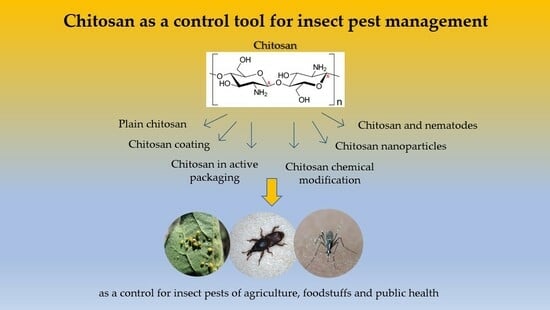
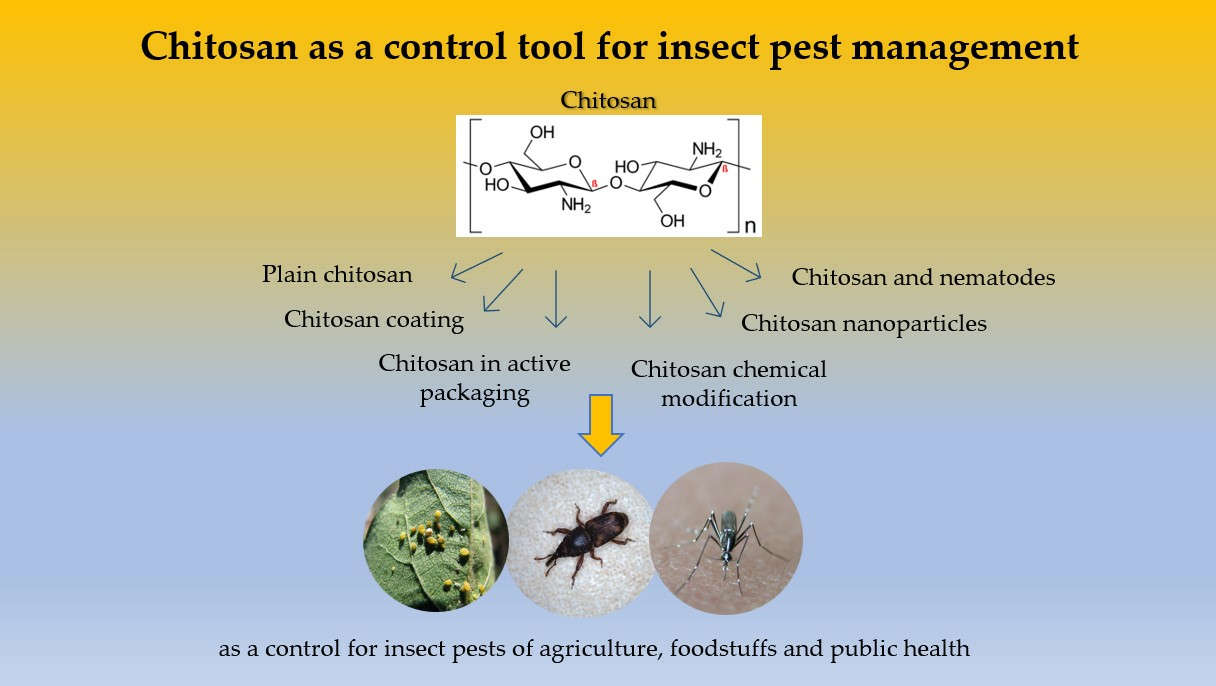
Chitosan is a biopolymer derived from chitin that has gained much attention due to its biological activities. Chitosan can be produced by the exoskeleton of arthropods (crustaceans and insects) and the structural membranes and spores of fungi. Its application has spread to many sectors, including the pharmaceutical, medical, veterinary, food, and agricultural sectors. In the latter one, chitosan is applied to improve the interaction between plants and microorganisms and the metabolisms of plants, fruits, and germination. In addition, chitosan has been demonstrated to enhance the availability and stabilization of insecticides and essential oils. Several chitosan formulations have been studied as tools for insect pest control. This review aims to focus on the role of chitosan as a pest management tool by examining all possible chitosan formulations.
Abstract
Chitosan, a polysaccharide derived from the deacetylation of chitin, is a versatile and eco-friendly biopolymer with several applications. Chitosan is recognized for its biodegradability, biocompatibility, and non-toxicity, beyond its antimicrobial, antioxidant, and antitumoral activities. Thanks to its properties, chitosan is used in many fields including medicine, pharmacy, cosmetics, textile, nutrition, and agriculture. This review focuses on chitosan’s role as a tool in insect pest control, particularly for agriculture, foodstuff, and public health pests. Different formulations, including plain chitosan, chitosan coating, chitosan with nematodes, chitosan’s modifications, and chitosan nanoparticles, are explored. Biological assays using these formulations highlighted the use of chitosan–essential oil nanoparticles as an effective tool for pest control, due to their enhanced mobility and essential oils’ prolonged release over time. Chitosan’s derivatives with alkyl, benzyl, and acyl groups showed good activity against insect pests due to improved solubility and enhanced activity compared to plain chitosan. Thus, the purpose of this review is to provide the reader with updated information concerning the use and potential applications of chitosan formulations as pest control tools.