Review

A Comprehensive Review of Rolling Bearing Life Prediction: From Fatigue Life Model to Data-Driven Remaining Useful Life Prognostic

1
School of Mechanical and Automotive Engineering, Qingdao University of Technology, Qingdao 266520, China
2
Beijing Institute of Control Engineering, Beijing 100190, China
3
State Key Laboratory of Tribology in Advanced Equipment, Tsinghua University, Beijing 100084, China
*
Author to whom correspondence should be addressed.
Lubricants 2026, 14(8), 292; https://doi.org/10.3390/lubricants14080292
Submission received: 8 July 2026 / Revised: 26 July 2026 / Accepted: 27 July 2026 / Published: 29 July 2026
(This article belongs to the Special Issue Oneness in Tribology of Mechanical Components)

Abstract

Rolling bearings serve as core rotating components in high-end equipment such as aerospace systems, wind turbines, and high-speed electric multiple units, and their service life directly affects the operational reliability and service life of the host machinery. To clarify the research landscape of rolling bearing life prediction, summarize existing prediction techniques, and identify future development trends, this paper systematically reviews the major research advances in this field. The review first traces the evolution of bearing life models, with particular emphasis on the roles of key influencing factors, including stress thresholds, material defects, and lubrication conditions, in their development. Second, it presents a comparative analysis between conventional life calculation methods and those that account for dynamic variations in lubrication conditions, thereby revealing the influence patterns and underlying mechanisms through which surface topography and oil-film characteristics affect fatigue life. Third, it discusses methods for assessing bearing system life, with special attention given to accelerated life testing techniques and bearing condition monitoring approaches. Finally, it summarizes the state of the art in data-driven bearing life prediction and identifies online sensing of lubrication states, system-level reliability design, and improvements in the interpretability and robustness of AI-based prediction models as important future research directions in rolling bearing life prediction.

1. Introduction

Rolling bearings are widely used in the core rotating systems of high-end equipment, such as aerospace, wind power, and high-speed railways, owing to their advantages of high operating efficiency and low friction loss. Their service life directly affects the reliability and longevity of the host machinery [1,2]. To ensure the operational reliability of rolling bearings and to avoid unexpected shutdowns caused by bearing failures, life prediction of bearings is of significant scientific and engineering importance.
In recent years, domestic and foreign scholars have carried out many studies on the life prediction of rolling bearings. Based on the classical Lundberg–Palmgren (L-P) bearing life model, the Ioannides–Harris (I-H) bearing life model, the Tallian model and the modified series of the International Organization for Standardization (ISO) have been gradually developed [3,4]. By continuously integrating the actual influencing factors such as the stress threshold, material defects and lubrication conditions into the model, life prediction is more accurate. At the same time, significant progress has also been made in the dynamic evolution of lubrication state based on rolling bearing life prediction, reliability evaluation of multi-bearing systems, the bearing accelerated life test, bearing fault diagnosis and condition monitoring, and data-driven bearing life prediction.
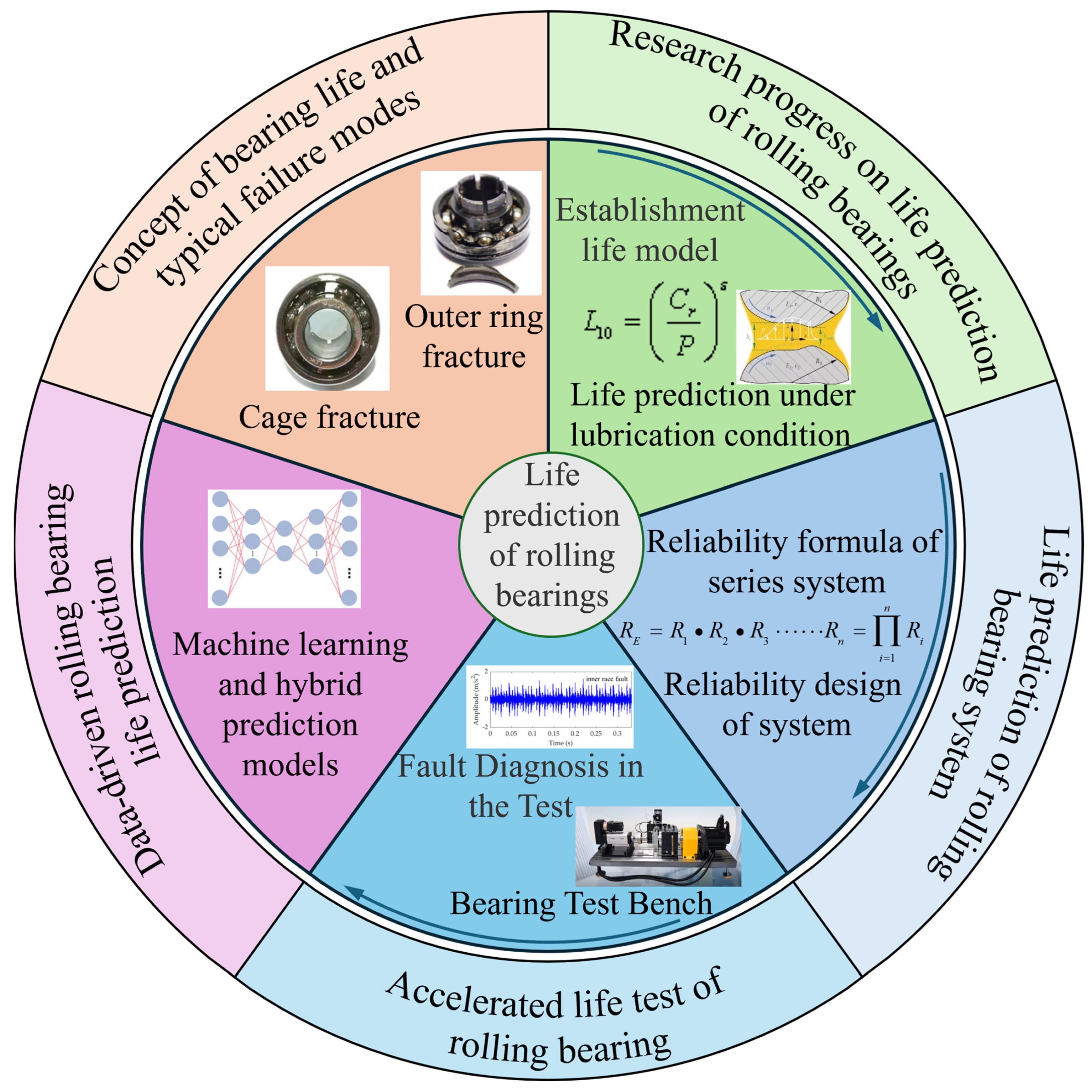
Existing reviews of rolling bearing life prediction have generally focused either on the evolution of classical rating-life models and their correction factors or on data-driven prognostics and remaining useful life prediction (RUL). Consequently, the interrelationships among life modeling, lubrication-state evolution, the acquisition of failure and degradation data, accelerated life testing, condition monitoring, and intelligent prognostics have not been sufficiently integrated within a unified framework. However, reliable rolling bearing life prediction depends not only on the selection of an appropriate life model but also on the accurate characterization of time-varying lubrication conditions, the acquisition of representative degradation and failure data, the rational design of accelerated life tests, and the extraction of effective health indicators from condition-monitoring signals. A comprehensive review integrating these closely related research areas is therefore needed to clarify the development of rolling bearing life-prediction methods and identify the major challenges that remain. To address this need, this paper provides a systematic review of the major advances in rolling bearing life prediction within an integrated framework. It traces the establishment and evolution of bearing life models, analyses the dynamic effects of lubrication conditions on bearing life, and highlights the important roles of surface topography and oil-film characteristics in fatigue-life prediction. It further discusses system-level reliability assessment based on Weibull distributions and series-system models as well as the combined application of accelerated life testing and condition monitoring. Finally, recent advances in data-driven life prediction including traditional machine learning, deep learning, and hybrid prediction models are reviewed and the principal directions for future research are identified. The overall framework of this review is illustrated in Figure 1.

2. Bearing Life and Typical Failure Modes

2.1. Concept of Bearing Life

According to different application scenarios, the concepts used to describe the life of rolling bearings are fatigue life, rated life, modified rating life and service life. Among them, fatigue life is the theoretical origin of all life studies, providing the core support for the subsequent life definition. Rated life is a standardized quantification of fatigue life and a unified reference basis for engineering applications. Based on the fatigue life, rated life is corrected by introducing the working condition correction coefficient, which makes life prediction more suitable as the actual basis. Service life is the actual use time of the bearing after it is put into field operation, and it is the final manifestation of various theoretical lives in engineering practice. The specific description of different lives is as follows.
(1)
Fatigue life: This refers to the running time of the bearing before the fatigue spalling of the material due to cyclic stress under standard working conditions. It is a theoretical calculation value based on ideal conditions and related to the inherent properties of the material.
(2)
Rated life: This refers to the total running time or total revolution that 90% of the same batch of bearings can reach or exceed before fatigue failure [5].
(3)
Modified rating life: This considers the modified value of the basic rated life ( L 10 ) when the actual working condition deviates from the ideal condition under unconventional conditions such as contaminated lubricants or special bearing performance [6].
(4)
Service life: This refers to the total operating time of the bearing from assembly to equipment to ultimate failure in actual use, which is based on the actual observation value of the actual working condition.

2.2. Typical Failure Modes of Bearings

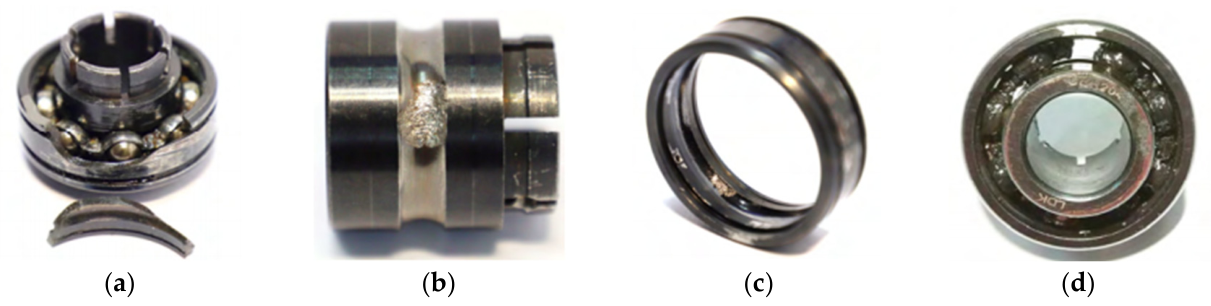
Bearing life is based on bearing failure as an intuitive judgment basis. Typical bearing failure modes include outer ring fracture, inner ring wear, outer ring wear and cage fracture [7] (Figure 2). Different failure types correspond to different life evaluation criteria. The core criterion of fatigue life and rated life is contact fatigue failure. For example, the failure of outer ring fracture is the result of fatigue damage accumulation of materials under cyclic contact stress. The wear failure of the inner ring and the outer ring can be ignored under the ideal lubrication and impurity-free conditions set for the rated life. However, in practical operation, poor lubrication and impurity invasion will significantly aggravate the wear, resulting in early failure of the bearing. This kind of failure is the working condition factor considered by the correction coefficient of lubrication and pollution in the modified rating life, and it is also an important incentive for the actual service life to be shorter than the rated life. The cause of cage fracture is often related to the coupling of assembly error, impact load and lubrication failure. It has strong randomness and working condition dependence. It neither belongs to the theoretical hypothesis category of fatigue life, nor can it be fully reflected in the modified rating life through the conventional correction coefficient. This kind of unexpected failure is the key source of deviation between service life and theoretical predicted life.

3. Research on Life Prediction of Rolling Bearings

3.1. Establishment and Progress of Rolling Bearing Life Model

Since the 1950s, scholars have carried out many studies on the life prediction of rolling bearings in terms of model construction, experimental verification, influencing factor analysis and calculation for life optimization. At present, the bearing life model mainly includes two types: life model based on statistical analysis and life model based on fracture mechanics analysis. In the field of rolling bearing life prediction, statistical models occupy the primary status.

3.1.1. Statistical Model for Bearing Life

Statistical models for bearing life are established based on mechanical models and failure mechanisms, which comprehensively incorporate the effects of various operating conditions including material properties, applied load, lubrication conditions, temperature and rotational speed [8]. Weibull believes that even a batch of the same materials do not have the same fatigue life under the same test conditions; that is, the dispersion of material life is inherent and inevitable. At the same time, he found that the durability fatigue of materials must be described by statistical distribution theory, rather than constant values [9]. This theory laid the fundamental theoretical foundation for the development of statistical models for bearing life.
In 1952, Lundberg and Palmgren modified and extended the Weibull statistical theory of failure and the Hertz contact fatigue strength theory, and proposed a life model based on the subsurface stress hypothesis [10]. This model considers that the crack initiation site in bearing fatigue failure is not on the surface, but is located at the maximum subsurface orthogonal shear stress, and that the fatigue fracture probability of the bearing depends on the depth of the most dangerous stress.
ln 1 S = N e τ 0 c V z 0 h
where S is the survival probability, N is the number of cycles, c and h are material parameters, e is the Weibull slope, τ0 is the maximum orthogonal shear stress, V is the volume of material subjected to stress, and z0 is the depth at which τ0 occurs.
The Lundberg–Palmgren bearing life model (L-P model) assumes that materials have no fatigue limit, implying that any small stress will cause cumulative damage. This inevitably leads to overly conservative life predictions under light-load conditions and fails to account for the infinite-life phenomenon observed in bearing fatigue tests. To address this limitation, Ioannides and Harris proposed a stress-life threshold based on the L-P model, which is defined as the maximum stress value below which a material will not experience fatigue failure even after an infinite number of stress cycles. When the stress in the loaded region is less than the material’s endurance fatigue limit, no fatigue damage will occur in that region, thus explaining the infinite life phenomenon observed in bearing fatigue life tests. Furthermore, in contrast to the L-P model which considers only a fixed volume at the location of maximum shear stress, the Ioannides–Harris model integrates the failure risk of each individual volume element to obtain the overall failure risk of the contact. The rolling bearing life model proposed by Ioannides and Harris is given by [11]
ln 1 S = A N e V ( σ σ u ) c z h d V , σ > σ u
where S is the survival probability, A is an empirical constant, N is the number of cycles corresponding to a survival probability of S, e is the life exponent, σ is the stress value at depth z, σu is the fatigue limit, c is the stress criterion exponent, and h is the depth exponent.
Although the Ioannides–Harris bearing life model, commonly referred to as the I-H model, accounts for the effect of the fatigue limit on the basis of the L-P model, it does not consider the effects of surface topography, friction, lubrication, and contamination on bearing life. By incorporating a large amount of life test data, Tallian [12] introduced factors such as material properties, surface defects, and roughness into the L-P and I-H model frameworks, and proposed a bearing life model expressed using probabilistic coefficients rather than life modification factors, as described in Equation (3).
ln S ( N ) = ( Φ 0 1 / β ε N 1 / ε + τ 0 ) β ε Φ T
where S(N) is the survival probability, β is the dispersion exponent, τ0 is the fatigue limit stress, Φ0 is the material fatigue probability factor, and ΦT is the probability coefficient.
Φ T = Φ 4 i = b , f , a Φ 1 i Φ 2 i Φ 3 i
where Φ4 is the overall stress level parameter of the contact elements during operation, and Φ1b, Φ1f, and Φ1a are model constants, which characterize the influence of subsurface defects, local surface defects and surface micro-fatigue spalling on bearing life, respectively. Φ2b, Φ2f, and Φ2a are used to quantify the severity of these defect categories, and Φ3b, Φ3f, and Φ3a are used to distinguish the influence of stress field on the three defect types.
Although the Tallian bearing life model incorporates numerous influencing factors such as material properties, surface defects, and surface roughness, it does not take into account the effects of surface modification factors, including surface treatment processes. To overcome this limitation, Zhang et al. [13] considered the effects of residual stress and various surface treatment processes, and for the first time predicted the bearing life under artificial surface strengthening treatments such as shot peening and superfinishing. The bearing life prediction model proposed by Zhang et al., which accounts for surface modification factors, is given as follows:
N 50 = 1.12 × 10 63 ln ln 1 0.5 z 0 2.33 [ τ 0 ( a 1 S a + a 2 + a 3 σ r ] 17.57 V 1 / 2.5 . exp ( m ( S H a 4 ) )
where N50 is the fatigue life corresponding to a 50% survival probability, z0 is the depth of the maximum subsurface orthogonal shear stress, τ0 is the maximum subsurface orthogonal shear stress, a1 and a2 are surface integrity indices characterizing the effect of surface roughness, Sa is the arithmetic mean roughness of the regional topography, a3 is the surface integrity index characterizing the effect of residual stress, σr is the residual stress at depth z0, V is the volume of material subjected to stress, m is an empirical exponent taken as 0.1, SH is the surface micro-hardness, and a4 is the surface integrity index characterizing the effect of surface hardness.
In the field of rolling bearing life prediction, statistical models of bearing life occupy a primary position. The basic statistical models and modified versions are presented in Table 1.
For ease of computation in engineering applications, the simplified L-P model is often used to calculate bearing life. Accordingly, Lundberg and Palmgren converted the microscopic parameters, such as the stress-affected volume in Equation (1), into macroscopic load parameters that can be directly measured in engineering practice, and thereby derived the simplified formula for rolling bearing life as follows:
L 10 = C r P ε
where L10 is the basic rated life, P is the dynamic equivalent load, Cr is the basic dynamic load rating, and ε is the life exponent. The value of ε varies with the type of rolling bearing: for pure line contact, it is 4; for roller bearings, it is 10/3; and for ball bearings, it is 3.
In 1990, the International Organization for Standardization (ISO) introduced the reliability parameter (a1), the material parameter (a2), and the application parameter (a3) to account for the effects of actual service conditions, thereby modifying the simplified L-P model and proposing a modified version of it as follows:
L n a = a 1 a 2 a 3 C r P ε
where Lna is the modified rating life, a1 is the life modification factor for reliability, a2 is the material parameter, a3 is the application parameter, P is the dynamic equivalent load, Cr is the basic dynamic load rating, and ε is the life exponent. The value of ε varies with the type of rolling bearing: for pure line contact, it is 4; for roller bearings, it is 10/3; and for ball bearings, it is 3 [14].
In 2007, the ISO further modified the simplified L-P model by introducing a unified parameter (aISO) that accounts for material properties, lubrication conditions, particulate contamination, and the fatigue limit. The resulting modified version of the simplified L-P model is given as follows.
L n m = a 1 a I S O L 10
where Lnm is the extended modified rating life, a1 is the life modification factor for reliability, aISO is the life modification factor, based on a systems approach of life calculation, and L10 is the basic rated life.
The simplified modified L-P models described above do not account for the effects of rolling element spin, load distribution, oil-film thickness, or bearing internal clearance on bearing life. To incorporate these factors, researchers have developed a series of modified models. Based on the simplified L-P model, Chen [15] established a calculation model that considers the influence of ball spin on the basic dynamic load rating, thereby improving the prediction accuracy of bearing life. Ye [16] developed a quasi-dynamic-analysis-based method capable of quantifying life differences caused by variations in the azimuthal positions of rolling elements and by the discreteness of an individual rolling element, which improved the accuracy of bearing fatigue life prediction. Wang [17] considered the time-varying number of loaded rolling elements in ball bearings and proposed a more accurate load distribution calculation model. Under operating conditions in which both rings rotate simultaneously, the life calculated using this model is approximately 50% lower than that predicted by the standard L-P life model, making it more consistent with bearing life under actual operating conditions. Lin [18,19] accounted for the effects of bearing load distribution, oil-film thickness, and temperature on bearing internal clearance, corrected the parameters in the simplified modified L-P model, and experimentally verified the accuracy of the proposed model. The simplified L-P model and its modified versions for bearing life prediction are summarized in Table 2.

3.1.2. Mechanical Model of Bearing Life

In contrast to the statistical models of bearing life, the mechanical models are rooted in the microscopic mechanism of crack propagation, and they hold that the fatigue life of a bearing is primarily governed by the entire process from the initial crack development to the critical size fracture.
In 1983, Keer et al. [20] analyzed the interaction between Hertzian contact and an inclined surface crack, and proposed a crack propagation model based on rolling Hertzian contact. This model was the first to systematically apply fracture mechanics to the prediction of contact fatigue life in rolling bearings. The life model proposed by Keer et al. is given as follows:
N = N 0 + 1 2 β 0 b 0 b d b Δ K m
where N is the number of cycles and N0 is the initial number of cycles (which can be obtained through crack initiation analysis). ΔK is the difference between the maximum and minimum stress intensity factors during a cycle, b0 is the initial crack length, b is the critical crack length, and m and β0 are material constants.
Although the Keer bearing life model was the first to apply fracture mechanics to rolling contact fatigue analysis, it neglected the effects of surface roughness, lubrication conditions, and crack initiation mechanisms on bearing life. To address this deficiency, Zhou et al. [21] considered the effects of lubrication conditions and surface roughness, described the mechanisms of microcrack initiation, and proposed that spalling life is the sum of crack initiation life and crack propagation life. On this basis, they proposed the Zhou–Cheng–Mura bearing life model, as shown in Equation (10).
N = A W e Δ σ 2 σ k 2 D + a i a f 1 C Δ K n d a
where A, C and n are material parameters; We is the fracture energy per unit area of the material; Δσ is the local shear stress amplitude; σk is the critical friction force of the material; D is the cumulative damage coefficient of the material; ai and af are the initial and final crack lengths; a is the crack length; and ΔK is the stress intensity factor range at the crack tip.
The aforementioned Keer and Zhou–Cheng–Mura bearing life models have improved the analytical framework for bearing fatigue life to some extent. However, they are still based on the idealized assumption of homogeneous materials and do not consider the effects of material elastoplastic deformation, microstructural randomness, and cumulative damage evolution. As a result, they have difficulty in accurately characterizing the actual service state of bearings. To improve prediction accuracy, researchers have developed a series of refined bearing life prediction models by focusing on key factors such as plastic deformation, microstructural randomness, and multi-stage damage evolution. Gang Xu et al. [22] established a line-contact spalling initiation model based on cumulative plastic strain and damage mechanics, and investigated the effects of dents on spalling initiation and propagation. Their results showed that dents and surface defects accelerate crack initiation and spalling propagation, thereby reducing the fatigue life of bearings. Jing Qiu et al. [23] integrated vibration response analysis with cumulative damage mechanics and developed a stiffness-based bearing life prediction model. This model enables real-time prediction of bearing life through measured vibration signals, and its effectiveness was validated through experiments. Nihar Raje et al. [24] considered the effects of topological randomness induced by geometric fluctuations in material microstructure, as well as inhomogeneous material distribution, on the subsurface stress field under rolling-element line contact. They established a damage-mechanics-based fatigue life model, and their results showed that topological randomness and inhomogeneous material properties lead to nonuniform stress distributions, thereby reducing the accuracy of bearing life prediction. Anurag Warhadpande et al. [25] developed an elastic–plastic Voronoi finite element (EPVFE) model for Hertzian line-contact rolling fatigue. Their study showed that the rolling contact fatigue life of bearings decreases when local plastic deformation is considered. For rolling bearings in high-speed electric multiple units (EMUs) operating under complex service environments, Chen [26] comprehensively considered the three stages of crack initiation, crack propagation, and spalling, and developed a fatigue life prediction model for EMU rolling bearings. This model enabled life prediction for EMU rolling bearings, with a relative error of less than 1% compared with the experimentally measured fatigue life, thereby greatly improving prediction accuracy. Overall, these studies have moved beyond the idealized homogeneous-material assumption of traditional life models by considering the effects of damage evolution, elastoplastic deformation, and microstructural randomness on bearing fatigue life, effectively reducing the discrepancy between life model calculations and experimental measurements.
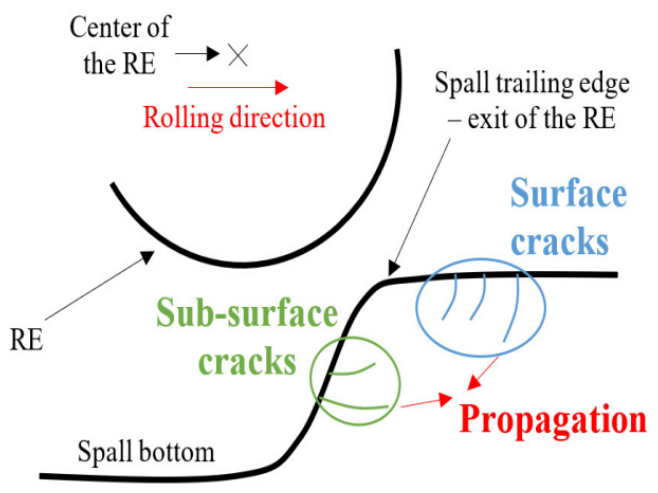
The bearing life mechanical models established above generally adopt a single surface spalling as the failure criterion for bearing fatigue life. However, during actual engineering service, a single spalling event merely represents the occurrence of local initial damage and does not directly lead to complete bearing failure. The actual spalling process is illustrated in Figure 3. Specifically, after the formation of an initial spalling pit, the rolling elements continue to move across the pit. When a rolling element passes over the trailing edge of the initial spalling pit, contact impact and subsurface shear stress are concentrated within the material beneath the pit and on the trailing-edge surface, respectively, thereby initiating fatigue cracks. Under cyclic loading, these two types of cracks grow and intersect along fracture paths. Once the cracks propagate to a critical size for fracture, the edge material spalls off, causing the spalling pit to expand progressively and eventually leading to bearing failure [27].
Existing rolling bearing life models are founded upon L-P theory and have been progressively refined through the I-H model, the Tallian model, and successive ISO standards, gradually incorporating practical factors such as stress thresholds, material defects, surface roughness, load distribution, temperature, and internal clearance. This evolutionary process has led to a transition from the idealized subsurface fatigue hypothesis to a comprehensive multi-factor consideration. The combination of statistical models based on the L-P framework and mechanical models rooted in fracture mechanics has established a complete theoretical system for life prediction, providing core support for rolling bearing life assessment. However, current life models are largely based on assumptions of homogeneous materials and constant operating conditions, resulting in poor adaptability to dynamic loads. Moreover, they generally consider only a single failure mode and have not yet achieved a unified characterization of multiple failure modes, such as fatigue, wear, and corrosion.

3.2. Life Prediction of Rolling Bearings Considering Dynamic Variations in Lubrication Condition

The friction and wear characteristics and service life of rolling bearings are highly correlated with lubrication conditions. Traditional rolling bearing life prediction models are mostly based on idealized lubrication assumptions, neglecting the dynamic variations in lubrication conditions under actual operating conditions, which leads to considerable discrepancies between predicted results and engineering practice. Incorporating the dynamic changes in lubrication conditions into rolling bearing life prediction and establishing the intrinsic relationship between the crack initiation process of bearing fatigue life and lubrication conditions [28] are of critical importance for improving the accuracy of bearing life prediction.
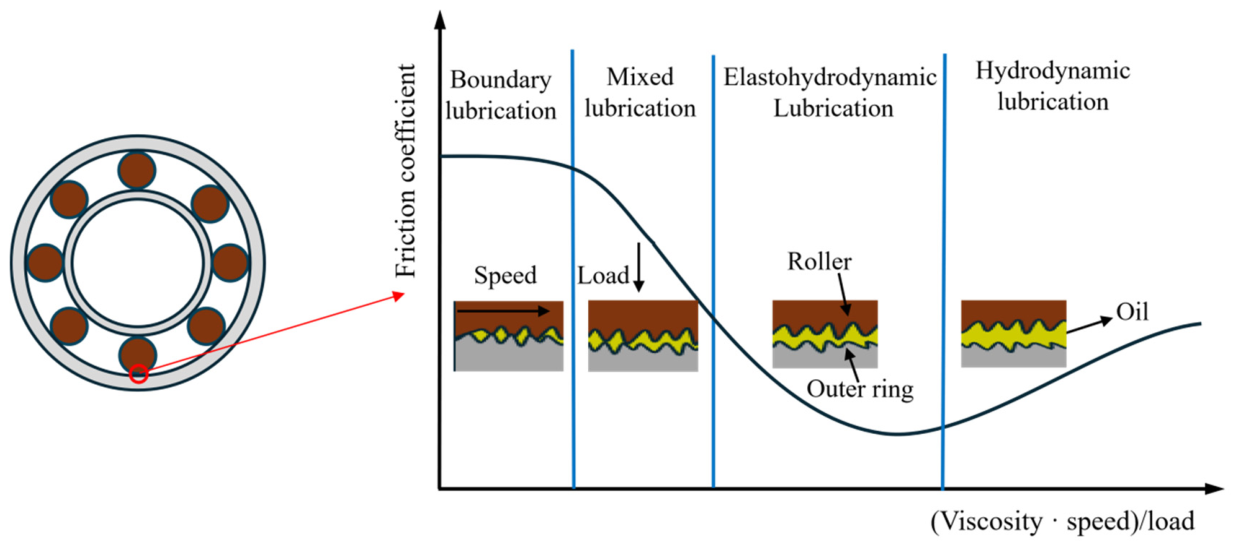
When operating under steady-state conditions characterized by rated speed, sufficient oil supply, and an appropriate temperature, rolling bearings are generally in the elastohydrodynamic lubrication (EHL) regime. However, under operating conditions such as start-up and shutdown, excessive temperature rise, oil starvation, and grease leakage, the integrity of the oil film is disrupted, and the lubrication regime gradually transitions from EHL to mixed lubrication or even boundary lubrication, thereby accelerating bearing wear and failure (Figure 4). In recent years, researchers worldwide have further investigated bearing life prediction under EHL conditions by focusing on the contact fatigue and life characteristics of bearings from the perspectives of material surface topography, microstructure, operating state, surface topographical defects, and intrinsic mechanical properties of materials.
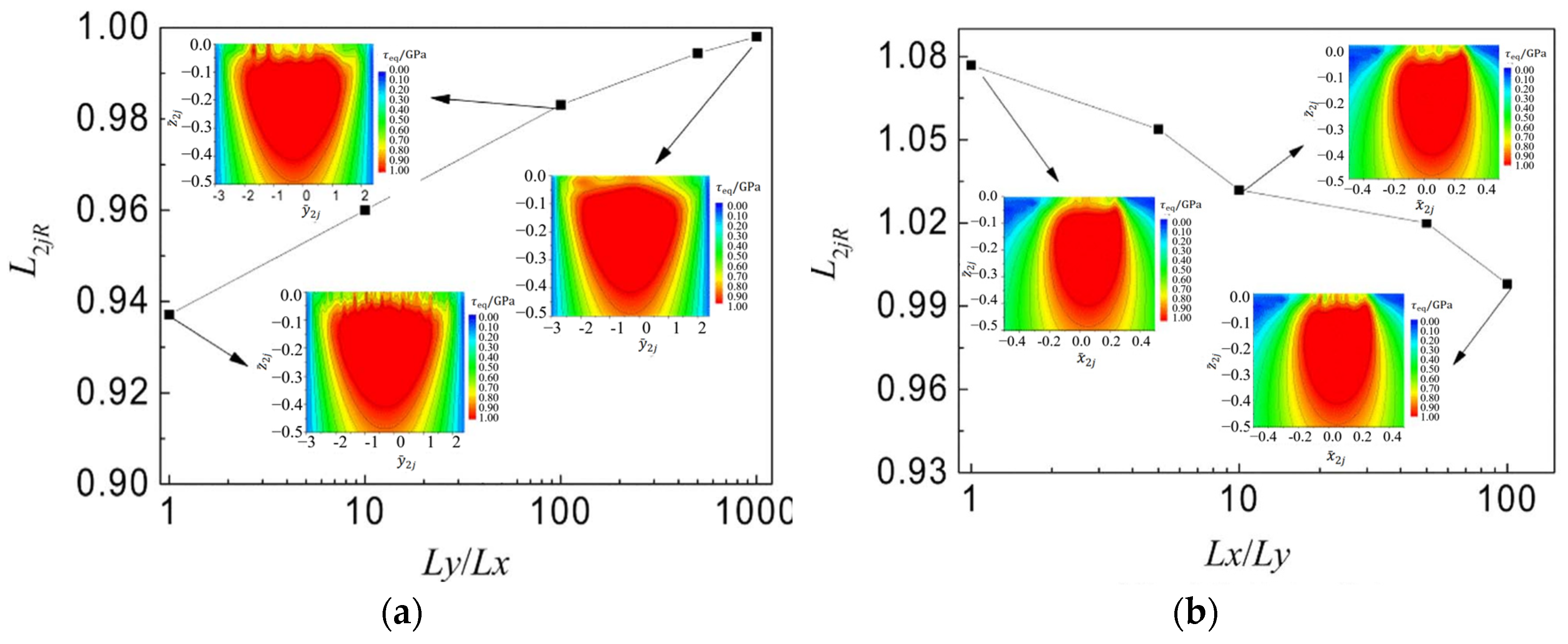
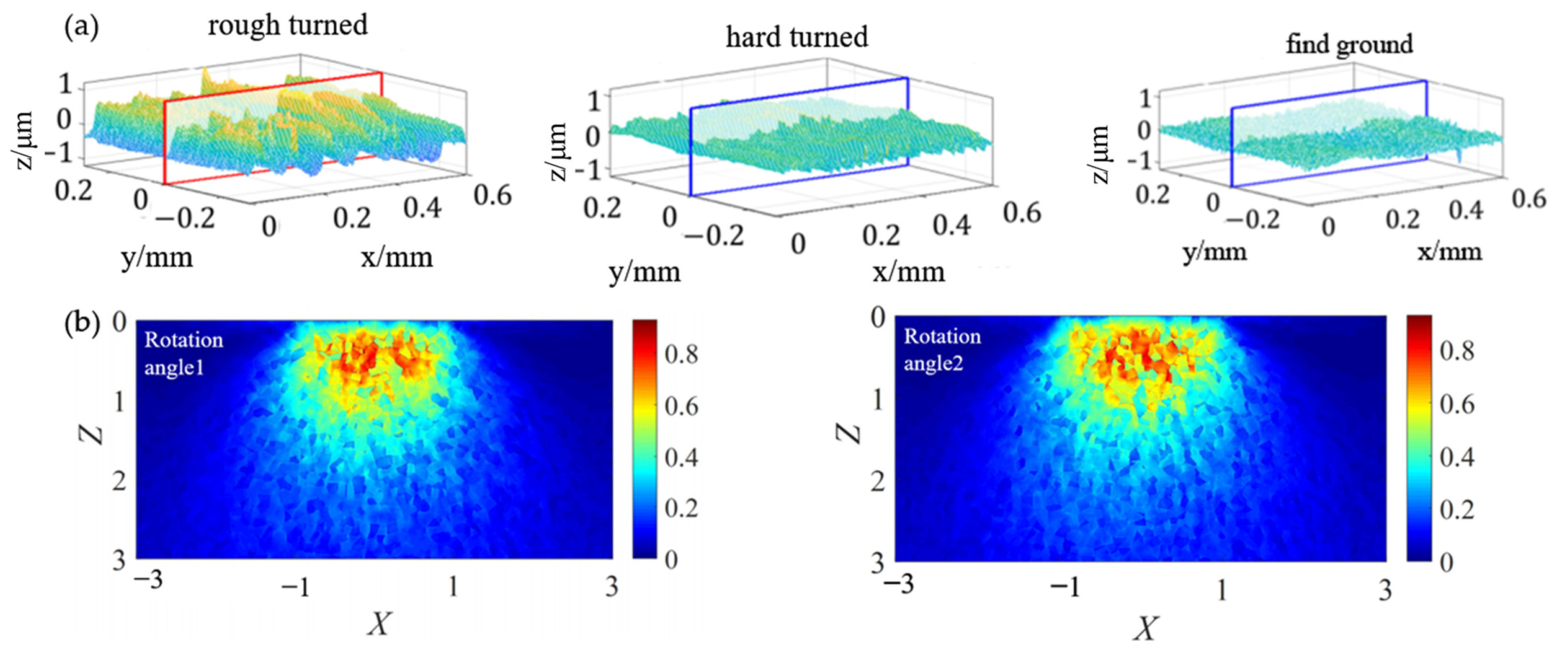
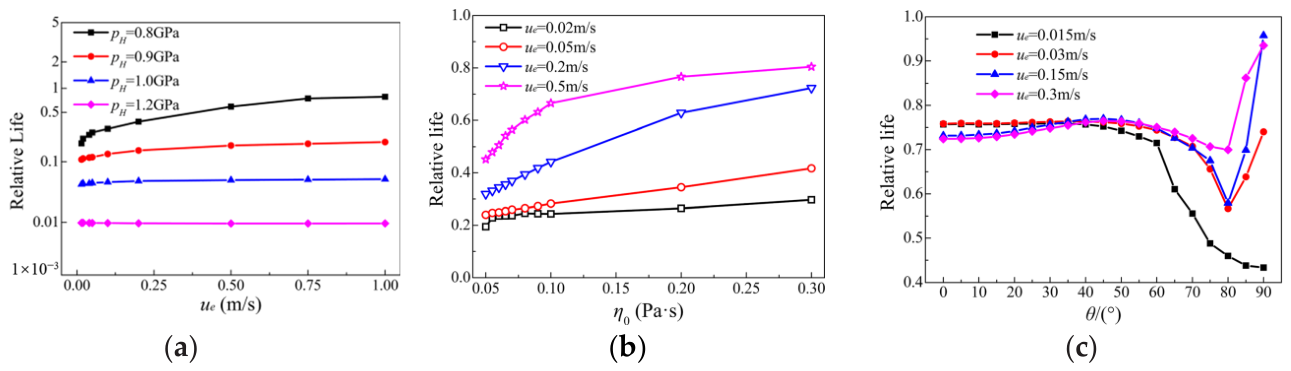
The establishment of an EHL model incorporating surface topography has laid a foundation for life prediction of bearings under different lubrication regimes [29,30,31]. Studies have shown that surface topography is one of the critical factors affecting bearing fatigue life. Proper control of lubricated surface roughness, texture directions, and topographical features can effectively reduce contact stress and significantly improve the lubrication state, thereby serving as an effective approach to prolonging bearing fatigue life. To account for the influence of surface topography, measures such as optimizing surface waviness, reducing roughness fluctuation amplitudes, and applying running-in processes to lower the radius of surface asperity peaks have been demonstrated to effectively extend the contact fatigue life of bearings [32,33,34]. Moreover, the relative fatigue life of rolling bearings—defined as the ratio of fatigue life under rough surface conditions to that under smooth surface conditions—increases with enhanced transverse texture, while it decreases with enhanced longitudinal texture [35] (Figure 5). Meanwhile, different machining processes produce distinctly different surface topographies. Figure 6a presents the measured surface topographies of actual bearing inner-ring raceways produced by rough ground, hard turned, and fine ground. Significant differences can be observed in roughness amplitude, peak-valley distribution, and texture directionality. These topographical characteristics further affect lubricant film formation, local pressure distribution, and rolling contact fatigue life within the contact region.
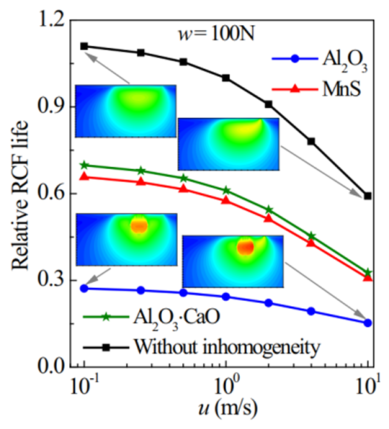
As shown in Figure 6b, under identical grain topology and loading conditions, variations in random crystallographic orientations alter the effective stiffness of individual grains in the global coordinate system, thereby changing the magnitude, location, and spatial distribution of the subsurface von Mises stress. These variations consequently increase the scatter in the rolling contact fatigue life of bearings. Moreover, stiffness differences among grains in heterogeneous polycrystalline materials can induce significant pressure fluctuations and stress concentrations, which serve as preferential sites for crack initiation, thereby accelerating damage accumulation and substantially shortening fatigue life [36,37]. Figure 7 illustrates the effect of heterogeneous inclusions on rolling contact fatigue (RCF) life under EHL [38,39].
Figure 6. Multidimensional factors of rolling bearing life prediction are included: (a) Measured real inner ring surfaces under rough ground, hard turned, and fine ground conditions [40]. (b) Effect of rotation angles on the stress field for heterogeneous anisotropic material [41].
Lubricants 14 00292 g006
Figure 7. Influences of the inhomogeneity type on the relative RCF life [38].
Lubricants 14 00292 g007
In addition to conventional surface roughness and surface texture, defect-related surface topographies also exert a particularly significant influence on bearing fatigue life. Investigations into the effects of surface dents caused by particle contaminants on rolling bearing fatigue life under EHL have shown that more severe lubricant contamination, along with larger dent sizes and greater dent densities, leads to more pronounced life reduction. Life studies conducted on roller bearings and ball bearings with pre-indentations on the raceway, incorporating EHL effects, revealed that spalling in ball bearings initially occurs at the trailing edge of the pre-indented raceway, forming a characteristic V-shaped spalling zone. In contrast, spalling in roller bearings tends to propagate slowly along the raceway surface before spreading along the rolling path. These observations elucidate the bearing failure process and provide references for extending bearing life and optimizing bearing materials [42]. Meanwhile, under EHL conditions, crack interactions in rolling/sliding line contacts also affect the pressure distribution in the contact zone. Smaller crack tip radii and steeper crack inclination angles result in more severe stress concentrations and consequently shorter rolling contact fatigue life [43]. These studies on defect-related surface topographies demonstrate that defects such as dents, pre-indentations, and microcracks alter lubricant flow characteristics and contact stress distributions, thereby intensifying stress concentrations and ultimately reducing the fatigue life of rolling bearings.
Bearing kinematic characteristics, such as ball spinning and the variation in the relative position between the raceway curvature center and the rolling element geometric center, also modify the lubrication and contact states, thereby influencing wear behavior and fatigue life. Through the development of a lubrication calculation model that incorporates spinning effects under EHL conditions, it was found that the predicted axial deformation is smaller when spinning is considered, leading to different life predictions compared with those obtained without considering spinning [44]. During bearing operation, variations in lubricating film thickness induce changes in the relative position between the raceway curvature center and the rolling element geometric center. Based on this observation, a bearing life model that accounts for lubrication conditions was established by coupling a quasi-static model with a mixed thermal elastohydrodynamic lubrication (TEHL) model. The calculated results showed good agreement with experimental data in both magnitude and trend [45]. These findings indicate that it is essential to consider the influence of bearing kinematic characteristics on bearing life.
Multi-field coupling models that account for material mechanical properties—including thermal effects, plastic deformation, and damage evolution—have confirmed that temperature variations, plastic deformation, and progressive damage can alter the contact stress state and accelerate crack initiation, thereby reducing the fatigue life of rolling bearings. Paulson et al. [46] combined a finite element EHL model with continuum damage mechanics to analyze the influence of damage variables on rolling contact fatigue life. Their results indicated that the critical damage level significantly affects pressure distribution and consequently fatigue life, highlighting the importance of properly defining the critical damage level of the material. He Zhiyuan et al. [47] developed a bearing crack initiation and damage evolution model coupling EHL pressure based on continuum damage mechanics and finite element analysis, which effectively simulates the damage progression in bearings and provides a theoretical basis for improving the reliability of life prediction. Liang et al. [48] established a mixed TEHL model that for the first time couples thermal effects, non-Newtonian rheological characteristics, and surface roughness, and investigated the influences of entrainment speed, lubricant viscosity, and three-dimensional sinusoidal surface texture orientation on lubrication performance and point-contact fatigue life, as shown in Figure 8a–c. Li et al. [49] developed a coupled model incorporating thermoplasticity, EHL, wear, and contact fatigue. Their results showed that wear intensifies subsurface stress concentrations and consequently reduces fatigue life. Experimental validation demonstrated that the maximum relative error between the life predictions obtained by the proposed model and the experimental results was less than 15%, indicating high accuracy. Vijay et al. [50] considered material anisotropy under EHL conditions and employed continuum damage mechanics combined with the cohesive zone method to simulate grain boundary crack initiation and propagation for bearing fatigue life prediction. This approach enabled real-time observation of crack initiation and propagation in bearing materials, revealing the fatigue failure mechanisms at the microscopic level, and providing intuitive evidence for model validation and material optimization.
The life prediction of rolling bearings based on EHL has broken through the traditional idealized lubrication assumptions; quantified the influence mechanisms of surface topography, oil film characteristics, material anisotropy, inclusions, and running-in processes on contact fatigue; and established the correlation between lubrication conditions and life evolution, thereby substantially improving the rationality of predictions under complex interfacial conditions. However, current multi-field coupling models that incorporate thermal effects, rheological characteristics, and microscopic behavior remain incomplete, and the accuracy of bearing life predictions still requires further enhancement. Moreover, there is a lack of established high-precision bearing life test rigs for direct validation of the proposed life prediction models.

4. Life Prediction of Rolling Bearing Systems

4.1. Reliability and Life of Systems

As a core component of machinery, a rolling bearing does not exist in isolation within a transmission system but operates in conjunction with other bearings in the system. In transmission systems composed of multiple rolling bearings, the most common configuration is the series system, in which failure of any single bearing leads to complete system failure. For a given operating life, the overall reliability of the system is inevitably lower than that of any individual component. This characteristic necessitates that, during system design, particular efforts be made to eliminate or strengthen the weakest link in the system [51,52].
For a series system of mutually independent rolling bearings, where the failure of any one bearing is independent of the others, the total system reliability is equal to the product of the individual bearing reliabilities [53].
R E = R 1 R 2 R 3 R n = i = 1 n R i
where RE is the system reliability, Ri is the reliability of the i-th component in the system (1 ≤ in), and n is the number of components in the system.
In reliability engineering, according to Weibull’s findings, the life distribution of rolling bearings follows a Weibull distribution. The two-parameter Weibull distribution function is given as follows [54]:
F ( t ) = 1 exp ( t η β )
where F(t) is the failure probability, t is the bearing life, β is the shape parameter, and η is the scale parameter.
From the relationship between failure probability and the reliability of bearing life, we obtain
R = exp ( t η β )
Setting F(t) = 0.1, the corresponding reliability is R = 0.9, and the associated t is defined as the rating life (L10). Consequently, we obtain
1 η β = L n 1 0.9 L 10 β
Substituting this expression into the two-parameter Weibull distribution function yields the reliability of each individual bearing in the system as
R i = exp ( 0.105 ( t i L i , 10 ) β i )
where Ri is the reliability of the i-th subsystem bearing, ti is the life of the i-th subsystem bearing, Li,10 is the rated life of the i-th subsystem bearing, and βi is the shape parameter of the i-th subsystem bearing.
The reliability of a rolling bearing system can be expressed as
R E = exp ( 0.105 ( t E L E , 10 ) β E )
where RE is the reliability of the bearing system, tE is the life of the bearing system, and βE is the shape parameter of the bearing system.
Since the total system reliability is equal to the product of the reliabilities of all individual rolling bearings, an alternative expression for the system life reliability can be derived as
R E = exp ( 0.105 i = 1 n ( t E L i , 10 ) β i )
Based on the two life reliability formulas for the rolling bearing system, the system life can be derived as
L E , 10 = ( i = 1 n ( L i , 10 ) β i ) 1 β i
However, for bearings with a survival probability in the range of R > 0.9, the bearing life calculated using the two-parameter Weibull distribution suffers from insufficient accuracy. In such cases, the three-parameter Weibull distribution is more suitable for rolling bearing life calculation [55].

4.2. Uncertainty Quantification and Reliability Design

As a numerical approach for bearing life and reliability assessment, the Monte Carlo method relies on random sampling and statistical analysis. By randomly sampling and statistically analyzing bearing operating parameters, material parameters, and structural parameters, this method can quantify the influence of various parameters on the failure probability of bearings [56,57]. It can not only effectively obtain the approximate distribution of bearing radial vibration displacement, but also improve the accuracy and reliability of distribution fitting by increasing the number of samples [58]. In terms of reliability design, Liu et al. [59] established a bearing contact fatigue reliability assessment model based on the stress–strength interference theory and the distribution of fatigue contact stress. This model exhibits substantially higher computational efficiency than conventional stochastic finite element methods, while maintaining very small numerical errors. In addition, this method is also applicable to the reliability assessment of bearings under static overload conditions, and can systematically analyze the effects of parameters such as turbulence intensity, material properties, and bearing dimensions on failure probability, thereby providing a comprehensive, efficient, and accurate quantitative approach for bearing life prediction [60].
The above-mentioned studies on reliability calculation and life assessment of multi-bearing systems have laid a foundation for the reliability design of transmission systems. However, existing bearing system models have not yet fully considered the complex interactions among bearings. Therefore, moving beyond the independent failure assumption and establishing system-level dynamic–life-coupled models that account for mechanical coupling, heat transfer, and lubricant sharing among bearings represents a key direction for further improving the credibility of transmission system life prediction and the accuracy of reliability design.

5. Accelerated Life Testing of Rolling Bearings

5.1. Standard Accelerated Life Testing Methods

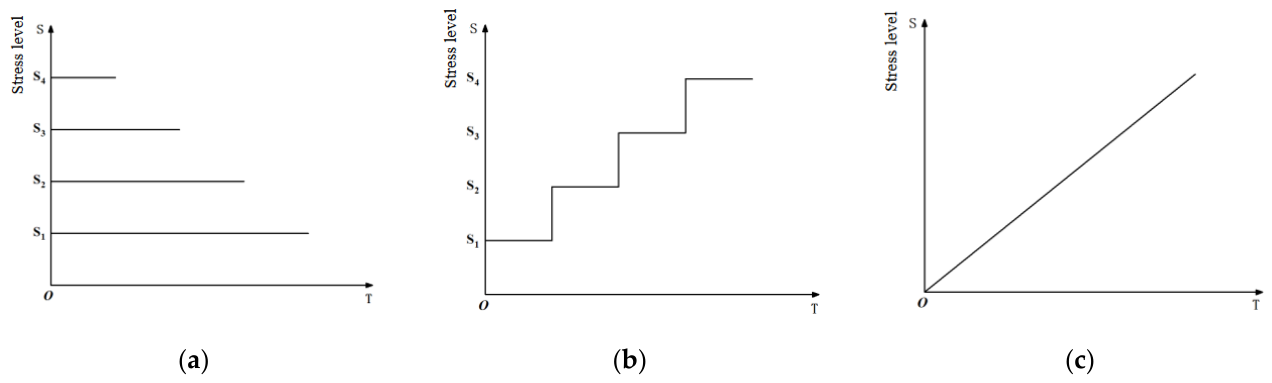
Accelerated life testing of bearings is conducted under stress conditions more severe than normal service conditions without altering the underlying failure mechanisms, thereby allowing bearing failure to occur within a shorter period. The life and reliability of bearings under normal operating conditions can then be extrapolated using appropriate life models [61,62]. Compared with conventional testing methods, accelerated life testing can substantially reduce test duration and cost, thereby supporting more efficient product development and iteration [62,63]. According to the stress loading mode, accelerated life testing can be classified into three categories: constant-stress accelerated life testing, step-stress accelerated life testing, and progressive-stress accelerated life testing [64]. The time-dependent variation in stress level for these three commonly used accelerated life testing methods is shown in Figure 9.
(1)
Constant Stress Accelerated Life Testing
This testing method involves dividing a batch of samples into several groups, with each group being subjected to a constant stress level that is fixed but higher than normal operating conditions, until the majority of samples in that group fail. Researchers have not only validated the effectiveness of eight classical estimation methods for constant-stress accelerated life testing through case studies using constant-stress accelerated life test data [65], but have also transformed zero-failure data obtained under accelerated conditions to the normal stress level, and subsequently utilized the transformed data to achieve reliability assessment of the product.
(2)
Step Stress Acceleration Test
The step-stress accelerated testing method involves subjecting the same group of samples to a sequence of progressively increasing stress steps, with each stress level maintained for a certain duration before being raised to the next higher level. In contrast to constant-stress accelerated testing, step-stress accelerated testing can accelerate sample failure more rapidly, offering the significant advantage of shorter test durations [66,67].
(3)
Progressive Stress Accelerated Test
Progressive-stress accelerated life testing is a method in which the applied stress level increases over time according to a specified pattern, such as linear stress ramp tests, simple ramp tests with two stress rates [68], and progressive-stress accelerated life testing based on the inverse power law model [69], among others.
In addition to the three commonly used accelerated life testing methods described above, researchers have developed other accelerated life testing approaches. For example, Zhang et al. [70] proposed a step-down-stress accelerated life testing method and experimentally demonstrated that the test duration was only 65 h, which was substantially shorter than the 213 h required for step-stress testing, highlighting its high efficiency. Zhang et al. [71] proposed a variable-stress accelerated life testing analysis method based on competing failure modes following a three-parameter Weibull distribution, and verified its feasibility using simulated data. At present, the accelerating stresses used in accelerated life testing mainly focus on parameters such as load, rotational speed, and temperature. However, existing methods still lack the capability for independent control and synergistic simulation of multi-physics-coupled loading conditions involving lubrication, humidity, and electric fields. Moreover, although accelerated life testing assumes that the failure mechanism remains unchanged, mechanism distortion may occur under extreme stress conditions, potentially compromising the accuracy of the measured life. To date, mature improvement strategies and correction methods have not yet been established, either domestically or internationally, making it difficult to effectively address prediction accuracy deviations caused by simplified test conditions and mechanism distortion.

5.2. Condition Monitoring and Failure Diagnosis in Testing

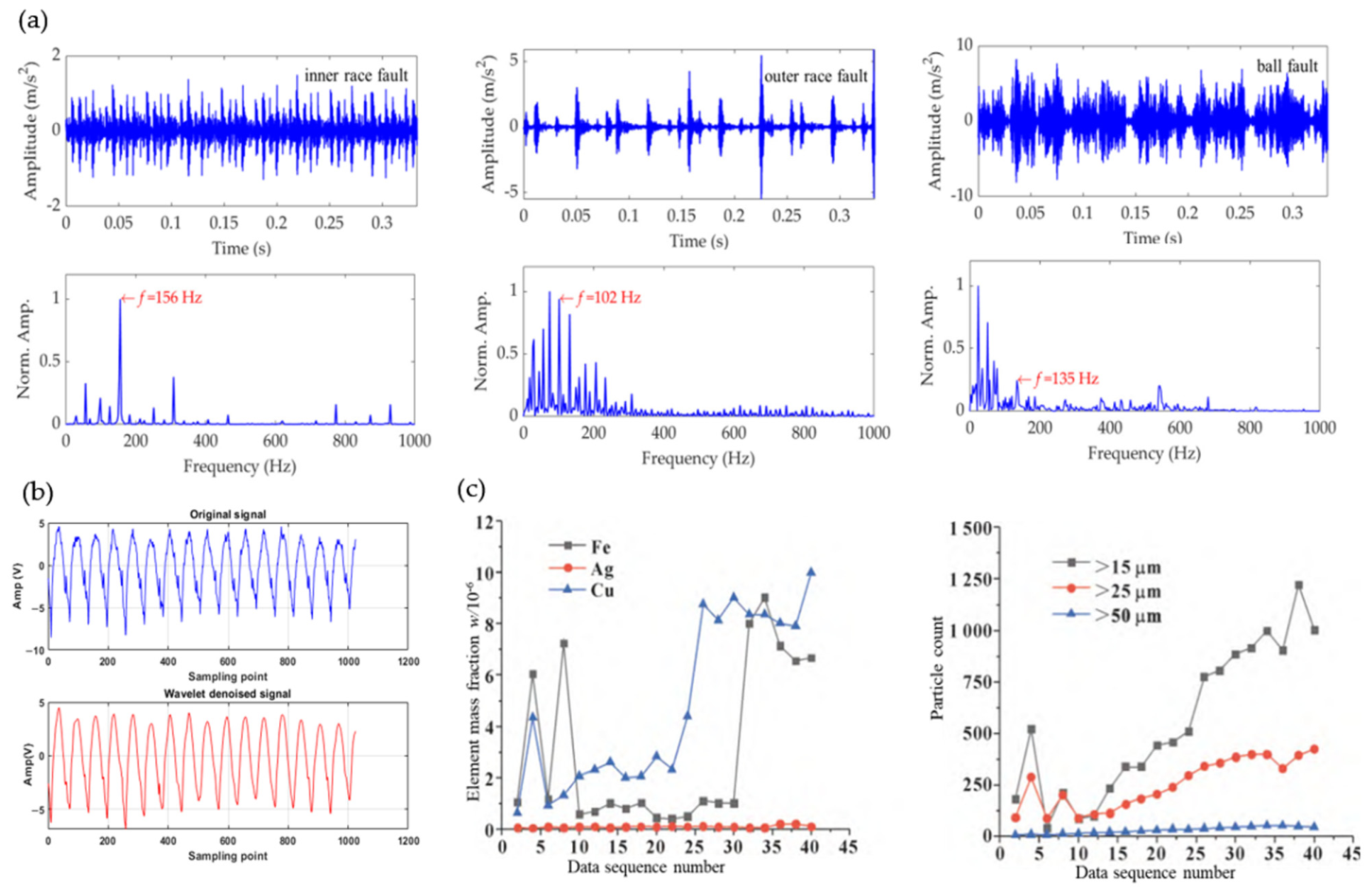
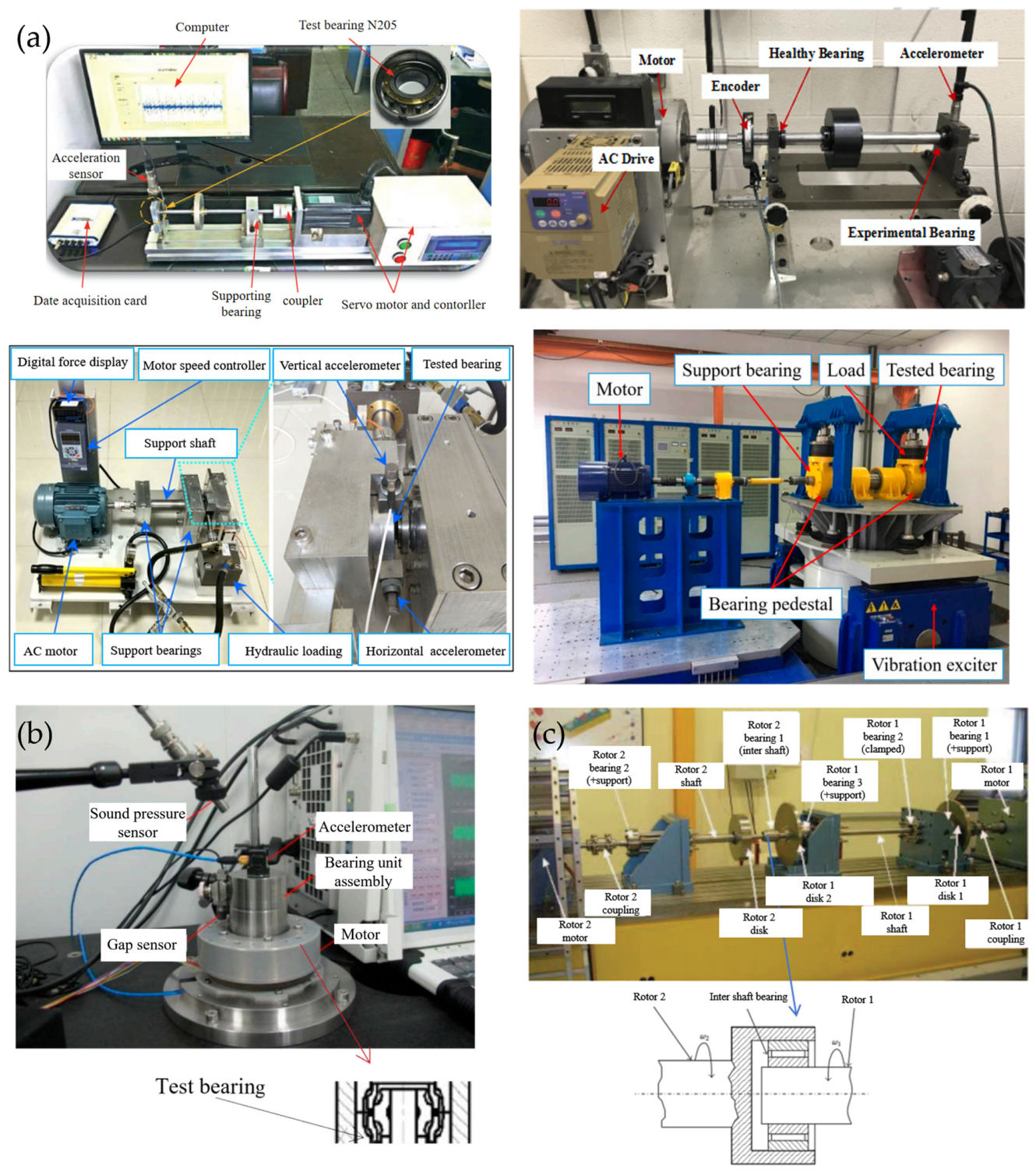
Accelerated life test rigs provide hardware support for validating rolling bearing life prediction models through functions such as precise control of load and rotational speed, as well as real-time acquisition of condition monitoring data. According to the rotational state of the bearing rings, rolling bearing accelerated life test rigs can be classified into inner-ring-rotation test rigs, outer-ring-rotation test rigs, and intermediate bearing test rigs in which both the inner and outer rings rotate simultaneously. Their typical configurations are shown in Figure 10. Based on bearing operating condition data collected from accelerated life test rigs, researchers worldwide have developed various methods for bearing condition monitoring and fault diagnosis, mainly including vibration analysis technology, acoustic emission diagnosis technology, and oil analysis method.
(1)
Vibration analysis technology
In bearing life testing, vibration analysis is one of the most important condition monitoring techniques. This method extracts features from bearing vibration signals collected by the test rig in the time domain, frequency domain, or time–frequency domain, thereby identifying the damage location and degradation degree of bearings. Owing to its ease of data acquisition and high sensitivity, vibration analysis has become one of the most widely used monitoring techniques in bearing life testing. To verify the reliability of various vibration analysis algorithms and life prediction models, publicly available datasets are commonly used in the industry for simulation studies and experimental comparisons. Among them, the Case Western Reserve University (CWRU) bearing dataset is regarded as a benchmark dataset in the field of bearing fault diagnosis and life prediction, and has been widely used to validate the effectiveness of fault diagnosis algorithms and prediction models. Figure 11a shows the time-domain waveforms and squared envelope spectra of inner race, outer race, and rolling element faults provided by the CWRU Bearing Data Center, visually illustrating the differences in vibration responses caused by faults at different locations.
For fault diagnosis based on vibration signals, extensive studies have been conducted to optimize and improve analysis methods in the time domain, frequency domain, and time–frequency domain. Zhang et al. [78] obtained the envelope spectrum through frequency-domain analysis and identified the bearing fault location. To address the difficulty of extracting fault features using conventional spectral analysis, Jia et al. [79] proposed a method in which the original signal is first processed using band-pass filtering, followed by demodulation analysis based on second-order cyclic statistics, thereby enabling fault feature extraction. Zhang et al. [80] developed a time–wavelet energy spectrum signal processing method, which can not only effectively extract the characteristic fault frequency of outer race faults in rolling bearings, but also capture weak characteristic fault frequencies associated with inner race and ball faults. Feng et al. [81] defined the concept of wavelet correlation permutation entropy and extracted feature values after processing vibration signals using wavelet filtering, thereby realizing early fault detection in rolling bearings. Ren et al. [82] proposed an envelope demodulation method based on wavelet packet decomposition and the kurtosis criterion. Compared with the conventional wavelet packet energy method, this approach exhibits stronger noise suppression capability and higher fault diagnosis accuracy.
The above studies have continuously improved the bearing fault diagnosis framework from the perspective of vibration signal processing. By integrating advanced signal processing algorithms such as wavelet analysis, cyclic statistics, and permutation entropy, these studies have effectively overcome the limitations of conventional methods, which are often insensitive to nonstationary and weak fault signals, thereby improving the sensitivity and accuracy of bearing fault diagnosis.
(2)
Acoustic emission diagnosis technology
Acoustic emission diagnosis is a technique that utilizes elastic waves generated by the rapid release of localized energy within materials for bearing condition monitoring and fault diagnosis. Owing to the inherently weak amplitude of acoustic emission signals and their susceptibility to electromagnetic and environmental noise, the acquired signals generally require denoising processing. Figure 11b presents the acoustic emission signals before and after denoising. Li Xuejun et al. [83] developed a novel wavelet analysis function tailored for extracting fault features from acoustic emission signals, building upon the fundamentals of acoustic emission fault diagnosis and wavelet analysis. Experimental validation demonstrated that the newly constructed wavelet function enables more clear and accurate identification of rolling bearing fault features compared with the conventional wavelet functions commonly used in the past.
In bearing life testing, acoustic emission diagnosis is a condition monitoring and fault diagnosis technique based on elastic waves generated by the rapid release of localized energy within materials, such as local plastic deformation and crack propagation. However, acoustic emission signals usually have low amplitudes and are strongly affected by electromagnetic and environmental noise. Therefore, the measured acoustic emission signals generally require denoising processing, and Figure 11b shows a comparison of acoustic emission signals before and after denoising. To address the difficulty of feature extraction, Li et al. [83] combined acoustic emission with wavelet analysis and developed a new wavelet analysis function. Experimental validation showed that, compared with conventional wavelet functions, the proposed function can identify the fault features of rolling bearings more clearly and accurately, thereby significantly improving the ability to distinguish bearing damage.
More importantly, acoustic emission can directly monitor the complete evolution of internal fatigue damage in bearings, from initiation and propagation to final failure. This provides continuously updated condition inputs for remaining useful life prediction, thereby effectively improving the accuracy and engineering applicability of life prediction models.
(3)
Oil analysis method
In bearing life testing, oil analysis is also a commonly used condition monitoring method. This technique evaluates the lubrication state of equipment, identifies abnormal bearing wear, and enables early fault warning by detecting the physicochemical properties of lubricating oil, wear debris, and contamination levels. Common oil analysis methods include spectral analysis for determining the types and concentrations of elements, as well as particle counting for analyzing the size and quantity of wear debris. Figure 11c shows typical examples of spectral analysis and particle counting analysis.
To address the limited diagnostic accuracy of single oil analysis methods, many researchers have optimized oil analysis techniques by integrating multiple types of oil condition monitoring approaches. Xia et al. [84] pointed out that a single bearing fault analysis method is insufficient for accurately determining fault location and severity. Therefore, they proposed a rolling bearing fault detection method combining vibration analysis and oil analysis, which jointly enhances fault discrimination capability. Chen et al. [85] further introduced Dempster–Shafer (D–S) evidence theory and integrated wear debris monitoring with spectral monitoring to achieve comprehensive fault diagnosis of rolling bearings in engines. The accuracy of the fusion method was verified through a case study. Cao et al. [86] combined multiple oil analysis methods, including spectral analysis, ferrographic analysis, particle counting analysis, and physicochemical analysis, and proposed a fuzzy fusion diagnosis method based on D–S evidence theory. Simulated oil analysis results demonstrated that this method significantly improves both diagnostic sensitivity and diagnostic accuracy.
Among the three bearing fault diagnosis methods discussed above, vibration analysis is the most mature and widely used technique. Its advantage lies in its ability to accurately locate damaged components and assess fault severity during the middle and late stages of failure. However, it is relatively insensitive to incipient minor damage and is susceptible to interference from background vibration. Therefore, vibration analysis is mainly used for fault inspection and diagnosis in the middle and late stages of bearing degradation. In contrast, acoustic emission is highly sensitive to material microcracks and early pitting, enabling the earliest warning signals to be obtained at the incipient stage of failure. Nevertheless, acoustic emission signals are weak and high-frequency in nature, are easily affected by environmental noise, and are difficult to directly correlate with damage size. Thus, acoustic emission is more suitable for early fault detection in accelerated life testing. Oil analysis can directly reflect wear types and lubrication conditions through the detection of wear debris, and is not affected by vibration or acoustic noise. However, it cannot localize the fault position, has a delayed response, and is unable to capture sudden transient faults. Therefore, it is suitable for bearing operating conditions with well-established lubrication systems and wear-dominated failure modes. In system-level tests for bearing life prediction, a single method often provides insufficient information. Accordingly, a reasonable strategy is to fuse these three methods to improve the reliability of the results.
Figure 11. Rolling bearing fault diagnosis analysis: (a) Time-domain waveform and SES of bearing, inner and outer ring, and ball fault vibration datasets [87]. (b) Acoustic emission signals before and after noise reduction [88]. (c) Spectroscopic analysis and particle count analysis example diagram [86].
Lubricants 14 00292 g011

6. Data-Driven Life Prediction Methods for Rolling Bearings

The traditional rolling bearing life prediction models based on fatigue mechanisms and contact mechanics, as described above, rely on well-established mathematical formulations to establish a predictive framework. Under constant operating conditions and idealized structural assumptions, they can provide fundamental life estimation. However, in actual industrial scenarios, rolling bearings are susceptible to the coupled effects of multiple factors, such as alternating loads, lubrication degradation, and environmental disturbances. With the advancement of data acquisition technologies, bearing test rigs are now capable of collecting vast amounts of degradation data. Artificial intelligence, with its excellent nonlinear fitting capabilities, can extract degradation patterns from measured data, thereby effectively compensating for the limitations of traditional approaches.
The data-driven bearing life prediction method based on artificial intelligence refers to a methodology that directly utilizes monitoring data collected during the actual operation of bearings, and employs algorithms such as machine learning, deep learning, and transfer learning to learn the mapping relationship between data features and bearing life or remaining useful life (RUL), thereby achieving bearing life prediction.

6.1. Bearing Life Prediction Based on Traditional Machine Learning

In the field of bearing life prediction and fault diagnosis, traditional machine learning methods generally involve manually extracting time-domain, frequency-domain, or time–frequency-domain features from monitoring signals such as vibration and temperature signals. These features are then used to establish mapping relationships between the feature space and the remaining useful life or fault categories through methods such as support vector machines (SVMs), random forests, artificial neural networks, and K-nearest neighbors (KNNs), thereby enabling bearing life prediction. This type of method has the advantages of simple model structures, fast training speed, and strong interpretability, and therefore offers considerable engineering applicability in scenarios with small samples and relatively stable operating conditions.
Researchers in China and abroad have continuously improved rolling bearing fault diagnosis and life prediction models based on traditional machine learning methods, with particular emphasis on algorithm optimization and feature signal preprocessing. In terms of algorithm improvement, to address the tendency of the original SVM-based fault diagnosis model to overfit, the radial basis function (RBF) kernel was introduced, thereby improving the accuracy and generalization performance of rolling bearing fault diagnosis [89]. In addition, a two-stage SVM method was developed to effectively reduce the dependence on field fault experimental data [90]. To further improve the accuracy of bearing life prediction, a multivariable support vector machine approach was proposed to overcome the limitations of single-variable SVM models in predicting rolling bearing life [1]. In the KNN method, the enhanced k-nearest neighbor (EKNN) classifier, which integrates a two-dimensional computation mechanism based on distance and density, achieved higher classification accuracy in the early fault identification of rolling bearings [91]. In terms of feature signal preprocessing, the combination of the random forest (RF) method and wavelet packet denoising effectively improved the accuracy of rolling bearing fault classification [92]. In addition, the combination of wavelet principal component analysis and the fuzzy K-nearest neighbor (FKNN) algorithm enabled efficient extraction of fault features and further improved the classification accuracy of FKNN in rolling bearing fault diagnosis [93]. Taken together, these studies indicate that the integration of algorithm improvement and feature signal preprocessing allows traditional machine learning methods to remain effective for fault identification and life prediction in bearing tests under limited-sample conditions, thereby enhancing both bearing fault diagnosis capability and life prediction accuracy.

6.2. Bearing Life Prediction Based on Deep Learning

The introduction of deep learning methods has reduced the reliance of bearing fault diagnosis and life prediction on manual expertise and complex signal processing techniques. By integrating intelligent diagnosis with feature extraction, these methods can automatically learn high-level fault feature representations directly from raw monitoring data, thereby significantly improving diagnostic accuracy and model generalization performance. Representative models include autoencoders, deep belief networks, convolutional neural networks, recurrent neural networks and graph neural networks [94].

6.2.1. Autoencoder (AE) and Stacked Autoencoder (SAE)

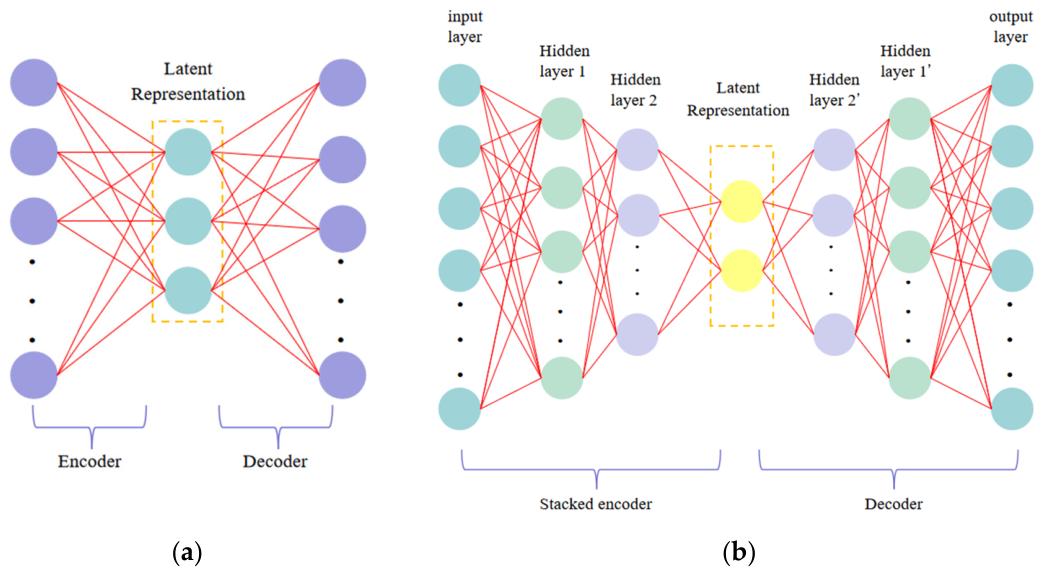
An autoencoder (AE) consists of an input layer, a hidden layer, and an output layer [95]. When its encoding structure is stacked layer by layer and a classifier is added at the end of the network, a stacked autoencoder (SAE) can be constructed [96]. In bearing life prediction, both AE and SAE can directly extract latent degradation features from high-dimensional vibration signals. Variants such as stacked and denoising forms are often used as front-end feature extraction modules, allowing unsupervised feature learning through the encoder–decoder architecture. Even so, AE and SAE do not possess temporal modeling capability and therefore have difficulty in capturing the time-series dependence in the bearing degradation process. For this reason, they are usually combined with recurrent networks or related architectures to accomplish life prediction tasks. Schematic diagrams of the AE and SAE structures are shown in Figure 12.
Focusing on the application of autoencoders in bearing fault diagnosis, researchers have optimized both network structures and learning algorithms. In terms of structural optimization, the discriminative stacked autoencoder (D-SAE) based on feature integration and enhancement can extract more representative fault features from rolling bearings and improve fault recognition performance [97]. Hou et al. [98] proposed a stacked denoising autoencoder (SDAE)-based diagnosis method optimized by particle swarm optimization (PSO). In this approach, the time-domain and frequency-domain features extracted from rolling bearing vibration signals are learned through the PSO-SDAE network, enabling the model to obtain deeper representations of bearing fault states and further improving its ability to identify fault features under noisy conditions. By combining structural improvement with intelligent optimization algorithms, these studies enhanced the model’s noise robustness and deep feature extraction capability, thereby significantly improving the accuracy of bearing fault diagnosis.
Figure 12. AE network and SAE network: (a) Autoencoders [99]. (b) Stacked Autoencoders.
Lubricants 14 00292 g012

6.2.2. Deep Belief Network (DBN)

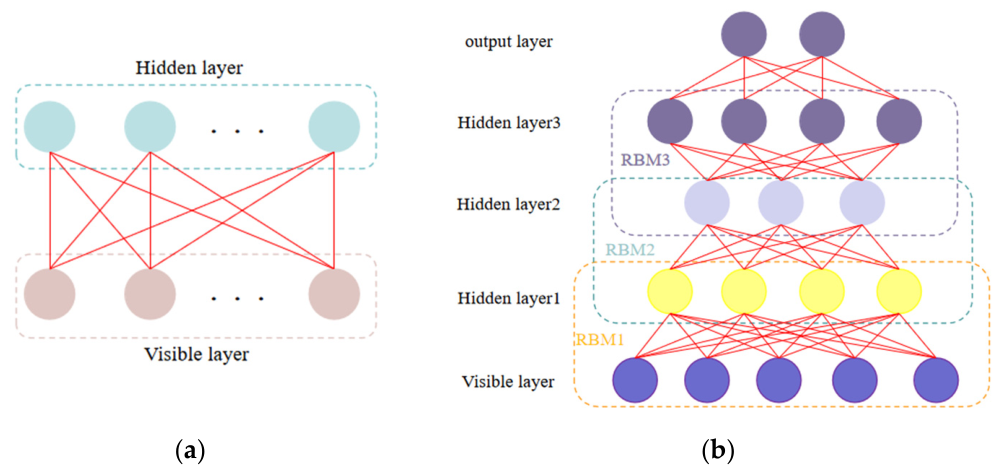
A deep belief network (DBN) is composed of the intermediate layers of multiple restricted Boltzmann machines (RBMs) [100]. It is trained by combining layer-wise unsupervised pretraining with supervised fine-tuning. In rolling bearing life prediction, this training strategy allows DBNs to make full use of unlabeled monitoring data, while requiring only a small amount of labeled degradation-state data for model adaptation, which fits well with the practical industrial situation where labeled life data are often scarce. Even so, the training process remains relatively cumbersome, and the model is unable to capture the temporal dependence of the degradation process. Schematic diagrams of the RBM and DBN structures are shown in Figure 13.
Focusing on the application of DBN in bearing fault diagnosis, researchers have carried out extensive optimization studies from the perspectives of domain adaptation, multi-sensor information fusion, and signal preprocessing. In terms of domain adaptation, a domain-adaptive deep belief network (DA-DBN) was developed to calculate the maximum mean discrepancy using multiple kernels, thereby improving the generalization ability and diagnostic accuracy of the deep belief network [101]. In terms of multi-sensor information fusion, the improved multi-sensor deep belief network can extract complementary and informative health-state features from different sensor data sources, addressing the limitation of traditional deep learning methods in rolling bearing fault diagnosis under small-sample conditions [102]. In terms of signal preprocessing, the cross-scale data adaptability of vibration imaging was combined with the unsupervised automatic feature extraction capability of DBN to further improve the accuracy and generalization performance of rolling bearing fault diagnosis [103]. Overall, these studies enhanced the DBN framework, alleviated diagnostic challenges caused by limited samples and large variations in working conditions, and improved both the accuracy and generalization ability of fault diagnosis.

6.2.3. Convolutional Neural Network (CNN)

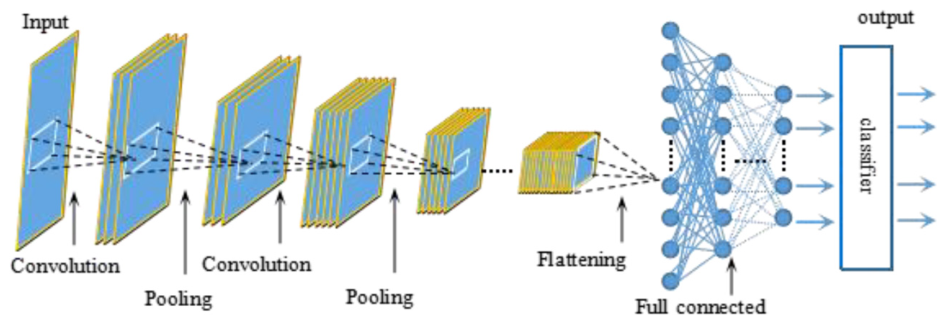
Convolutional neural networks (CNNs) are well suited for extracting local spatial features in bearing life prediction. Owing to their highly parallel convolution and pooling architecture, they also offer high efficiency in both training and inference. A schematic diagram of the CNN structure is shown in Figure 14. In this architecture, convolutional layers use multiple kernels to extract local features from the input data and gradually transform low-level features into higher-level representations. Pooling layers downsample the feature maps to reduce the number of computational parameters, while fully connected layers integrate local features into global features and produce the final classification results [104].
To improve the accuracy of CNN in bearing fault diagnosis, researchers have continuously optimized CNN-based models in terms of signal-to-image conversion, multi-source information fusion, and preprocessing-based noise reduction. For example, by using Gramian Angular Difference Field coding technology to transform the time-domain signals of rolling bearings into image features, CNNs can more effectively capture the correlation characteristics of the signals and improve the generalization performance of fault diagnosis [105]. In addition, one-dimensional CNNs can simultaneously take raw vibration and acoustic signals as inputs and achieve multi-source feature extraction, fusion, and final fault identification through the automatic learning capability of convolutional layers [106]. CNN architectures have also been developed for vibration signal denoising to enhance diagnostic performance under noisy conditions [107]. It should be noted, however, that although these improvements enhance the generalization ability of bearing fault diagnosis, CNNs are inherently less sensitive to temporal dependencies in the data and therefore have limited capability for directly modeling the long-term dependence of the bearing degradation process.
Figure 14. CNN basic structure [108].
Lubricants 14 00292 g014

6.2.4. Recurrent Neural Network (RNN)

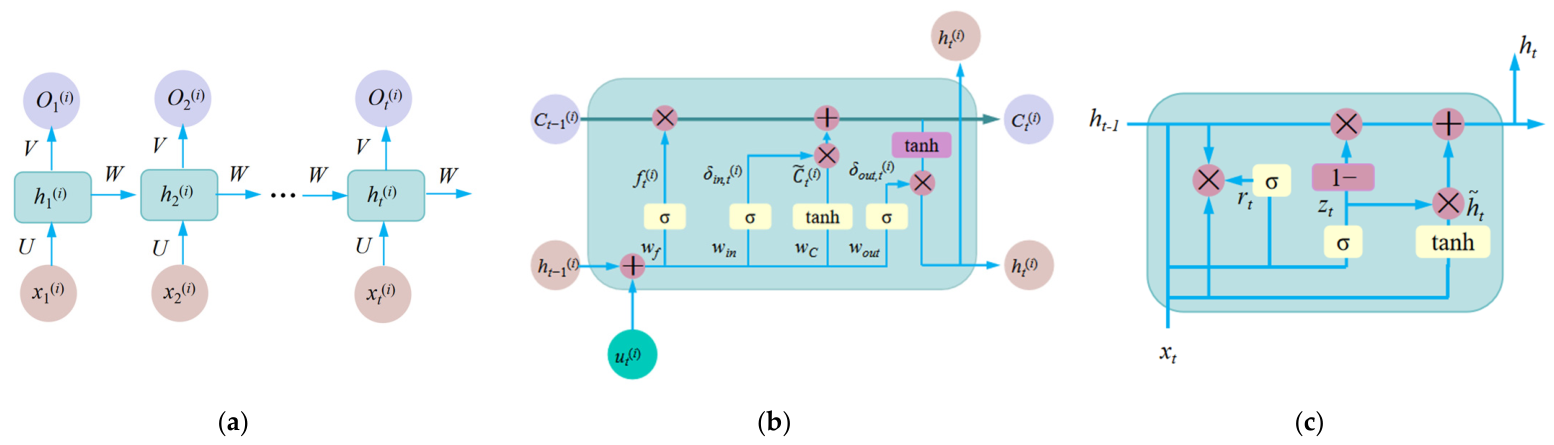
Recurrent neural networks (RNNs) and their variants, including gated recurrent units (GRUs) and long short-term memory (LSTM) networks, have attracted considerable attention in bearing life prediction because of their inherent ability to model temporal sequences [109]. GRUs enable useful information to be retained while irrelevant information is discarded, whereas LSTM networks are designed to selectively regulate and update information flow. Owing to these characteristics, RNNs and their variants can effectively capture the long-term dependencies and nonlinear degradation trends reflected in monitoring parameters such as vibration and temperature over the full life cycle of bearings. A schematic illustration of the RNN architecture and its variants is shown in Figure 15.
Researchers in China and abroad have carried out extensive studies on the optimization and extension of RNN-based models for bearing fault diagnosis. An et al. [110] proposed an intelligent fault diagnosis framework for rolling bearings operating under time-varying speeds based on long short-term memory (LSTM), which outperformed traditional methods in both architecture and diagnostic accuracy. Chen et al. [111] developed an automatic feature-learning neural network based on raw rolling bearing vibration signals. In this method, multi-scale local features are first extracted from the vibration signals, and then LSTM is used to identify fault types with high accuracy. Chen et al. [112] further proposed a rolling bearing fault diagnosis method that integrates a multi-scale convolutional neural network (MSCNN) with a gated recurrent unit (GRU), enabling more effective extraction of time-series features from vibration signals at different scales. These studies demonstrate that such deep learning models can jointly capture spatial local features and temporal correlation information, and they can also be combined with convolutional neural networks to further improve the accuracy of bearing fault diagnosis. However, these models still suffer from low training efficiency and may encounter vanishing or exploding gradients when dealing with long sequences. In addition, their prediction stability can be adversely affected under high-noise conditions.

6.2.5. Graph Neural Networks (GNNs)

Although existing deep learning methods have achieved promising performance in RUL prediction, different architectures still exhibit limitations in modeling degradation information. GRUs and LSTM networks are effective in capturing temporal dependencies but have relatively limited capability to model spatial correlations. CNNs can efficiently extract local features but have difficulty in explicitly representing complex and irregular topological relationships. Graph neural networks (GNNs) provide a promising solution to these limitations. By representing system components, sensors, or degradation features as graph nodes and using graph structures to characterize the relationships among these nodes, GNNs can effectively extract topological dependencies from degradation data. Furthermore, the integration of GNNs with temporal modeling modules enables the simultaneous characterization of spatial relationships and their temporal evolution [113], thereby facilitating the extraction of complex dependencies and interactions from degradation data and improving the accuracy of RUL prediction.
In recent years, GNNs have emerged as an important research direction for rolling bearing RUL prediction because of their ability to effectively characterize complex relationships among degradation features obtained at different time points or from multiple sensors. Wei et al. [114] addressed the limited ability of conventional deep learning methods to adequately capture correlations among bearing degradation features across different time points, as well as the low training efficiency of recurrent architectures, such as RNNs and LSTM networks when processing long sequences. They proposed a rolling bearing RUL prediction method integrating degradation stage classification, a self-adaptive graph convolutional network, and a self-attention mechanism. The proposed method can adaptively capture cross-temporal dependencies among degradation features and emphasize critical degradation information, thereby improving the accuracy and robustness of RUL prediction. Xiao et al. [115] addressed the inability of conventional homogeneous graph neural networks to fully represent multiple types of node relationships in bearing degradation data, which may lead to the loss of degradation information. They proposed a multiplex aggregation heterogeneous graph neural network (MAHGNN) driven by heterogeneous graph representation. By constructing spatial and temporal meta-paths and introducing a hierarchical aggregation mechanism comprising node-level, path-level, and time-level aggregation, the method effectively captures heterogeneous spatial relationships and temporal dependencies among bearing degradation features, thereby improving the accuracy and adaptability of bearing RUL prediction. Liu et al. [116] addressed the dependence of existing graph learning-based RUL prediction methods on predefined structural priors, their limited ability to characterize complex dependencies among multi-sensor signals, and their tendency to retain redundant connections. They proposed a graph learning framework with a variational graph structural information bottleneck (GL-VGSIB). Through probabilistic graph structure learning, feature masking, and a reparameterization mechanism, the framework adaptively preserves degradation-relevant dependencies while suppressing noisy and redundant information, thereby improving the accuracy and generalization capability of multi-sensor machinery RUL prediction.

6.3. Bearing Life Prediction Based on Hybrid Prediction Models

6.3.1. Hybrid Physics-Based and Data-Driven Model

To address the shortcomings of purely data-driven models, such as the lack of physical constraints and limited generalization ability, hybrid prediction models have been developed by combining the physical mechanisms of bearing degradation with deep learning methods. Such models can effectively overcome the low prediction accuracy and poor robustness of single models under complex operating conditions. For example, the relationship between bearing degradation indicators and remaining useful life was incorporated into an LSTM network as prior physical knowledge in a physics-guided LSTM model, making the predicted results more consistent with physical laws while also improving prediction accuracy [117]. In addition, the degradation-consistency recurrent neural network (DcRNN), which embeds monotonic degradation knowledge into both the RNN architecture and the loss function, further improved the accuracy and reliability of prediction [118]. These studies show that physics-informed hybrid models introduce prior constraints based on bearing damage and degradation mechanisms, thereby compensating for the limitations of purely data-driven methods, which often depend heavily on large sample sizes and may produce predictions inconsistent with the actual degradation behavior of equipment. As a result, such hybrid models can effectively enhance both the interpretability and generalization ability of bearing life prediction.

6.3.2. Hybrid Statistical and Data-Driven Model

To overcome the limitations of single data-driven models, such as poor noise robustness and weak interpretability, hybrid prediction models that combine statistical approaches with data-driven methods have been developed by integrating probabilistic statistical theory with intelligent algorithms. These models combine the interpretability of traditional statistical models with the flexible fitting capability of data-driven methods, thereby improving prediction accuracy while retaining result interpretability. For example, the Weibull hazard rate function has been used to fit the root mean square and kurtosis features extracted from rolling bearing vibration signals before they are fed into a neural network, which reduces the interference of external noise and improves prediction interpretability and accuracy [119]. In another study, Weibull hazard function fitting was employed during the training process to suppress time-domain fluctuations, and the rolling bearing life prediction method constructed by combining this strategy with the strong nonlinear time-series learning capability of the Simplified Fuzzy Adaptive Resonance Theory Map (SFAM) significantly improved the prediction interpretability and generalization ability of the model [120]. In addition, a method was proposed in which raw rolling bearing vibration data are transformed into graph-structured data and a neural network is used to simultaneously capture spatial and temporal evolution. By combining regression shapelets with a neural network, this method not only ensured the accuracy of rolling bearing life prediction but also addressed the insufficient interpretability of deep learning methods [121]. These studies indicate that hybrid models combining statistics and data-driven methods can optimize feature representation, reduce the effects of noise and time-domain fluctuations, and effectively improve both the interpretability and prediction accuracy of the model.
These studies suggest that hybrid statistical and data-driven models can optimize feature representations, thereby reducing the effects of noise and time-domain fluctuations while improving both model interpretability and prediction accuracy.
In recent years, AI-based rolling bearing life prediction has advanced from traditional machine learning to deep learning and further to physics–data hybrid models. Because hybrid models offer a better balance between predictive accuracy and interpretability, they have gradually become a major direction in AI-based life prediction. Even so, several challenges remain unresolved. In particular, data standardization, together with further improvement in the generalization ability and interpretability of AI-based prediction models, will continue to be key issues in future research.

6.4. Comparison of Different Life Prediction Methods

Different approaches to rolling bearing life prediction have distinct advantages, limitations, and application scenarios. The main characteristics of these approaches are summarized in Table 3. Physics-based models provide clear physical interpretability and are well suited to bearing design and life estimation when loading, material, contact and lubrication parameters are well defined. However, their predictive accuracy depends strongly on the underlying model assumptions and the reliability of parameter identification. Data-driven models can automatically learn complex nonlinear degradation patterns from monitoring data and are therefore particularly suitable for online condition monitoring and RUL prediction. Nevertheless, they generally require large and representative datasets and may be limited by poor interpretability and insufficient generalization across operating conditions. Hybrid physics-data-driven models integrate mechanistic constraints with nonlinear learning capabilities, thereby improving physical consistency, robustness, and interpretability. However, their performance depends on the validity of the incorporated physical knowledge and the appropriate selection of constraint weights. Hybrid statistical-data-driven models can reduce the effects of noise and temporal fluctuations while retaining a statistical basis for prediction, although they may be sensitive to assumptions regarding probability distributions and the selection of degradation indicators. Therefore, no single prediction approach is universally applicable and model selection should account for data availability, variations in operating conditions, knowledge of degradation mechanisms, computational cost and interpretability requirements.

7. Summary and Research Prospects

This paper summarizes the major research progress in the field of rolling bearing life prediction and presents an outlook on future developments. In terms of life models, from the L-P theory to the I-H model, the Tallian model, and the ISO modified series, factors such as stress thresholds, material defects, and lubrication conditions have been progressively incorporated. Combined with analyses of wear, crack propagation, and damage mechanics, these developments have significantly enhanced the prediction accuracy of bearing life. With regard to life prediction under lubricated conditions, this paper reviews the research progress from ideal lubrication assumptions to dynamic coupling approaches. By integrating elastohydrodynamic lubrication with finite element and damage mechanics methods, the influences of surface topography and oil film characteristics on contact fatigue life have been revealed. In the area of system-level life prediction, system reliability methods based on the Weibull distribution and the series model have been employed to achieve life assessment of multi-bearing systems. Concerning life testing, this paper introduces accelerated life testing techniques under constant, step-stress, and progressive stress profiles, which are further integrated with condition monitoring techniques including vibration analysis, acoustic emission, and oil analysis, thereby providing a basis for fault diagnosis and life prediction of rolling bearings. In the domain of AI-based life prediction, this paper summarizes the research progress in bearing life prediction methods driven by data, including traditional machine learning, deep learning, and hybrid models, revealing that bearing life prediction is continuously advancing toward a data-driven paradigm.
Future research on rolling bearing life prediction will advance toward deeper multidisciplinary integration and engineering practicality, aiming to more realistically simulate bearing service behavior under complex operating conditions. In bearing life prediction, breakthroughs are needed in online sensing and dynamic embedding of lubrication states to enable real-time and accurate life assessment. Meanwhile, system-level life prediction of bearings should further consider the coupling of multiple failure modes to support reliability-oriented design and intelligent maintenance of high-end equipment. In accelerated life testing, coupled loading of multiple stress fields, including temperature, lubrication, humidity, and electric fields, should be incorporated to enable life prediction under various extreme conditions. AI-based life prediction should achieve a deeper integration of physical mechanisms and data-driven approaches, along with data standardization, to enhance the interpretability and robustness of predictive models.

Author Contributions

Writing—original draft preparation, X.S.; supervision, writing—review and editing, L.B. and H.C.; resources, L.B. and L.M.; supervision, Y.H. All authors have read and agreed to the published version of the manuscript.

Funding

This research was supported by the National Science Foundation of China (No. 52005279), the Natural Science Foundation of Shandong Province (No. ZR2020QE159) and the Tribology Science Fund of the State Key Laboratory of Tribology in Advanced Equipment (No. SKLTKF24A02).

Data Availability Statement

No new data were created or analyzed in this study. Data sharing is not applicable to this study.

Conflicts of Interest

The authors declare no conflicts of interest.

References

  1. Shen, Z.; Chen, X.; He, Z.; Sun, C.; Zhang, X.; Liu, Z. Remaining Life Predictions of Rolling Bearing Based on Relative Features and Multivariable Support Vector Machine. J. Mech. Eng. 2013, 49, 183–189. [Google Scholar] [CrossRef] [Scilit]
  2. Sharma, A.; Sharma, S.; Pandey, R.K. A review on the recent development in rolling bearings for improvement of tribodynamic performance. AIP Conf. Proc. 2025, 3330, 020023. [Google Scholar] [CrossRef] [Scilit]
  3. Cong, T.; Wang, J.; He, J.; Liu, Y.; Chen, Y.; Liu, F.; Li, L. Microstructure evolution and fatigue crack initiation life prediction of actual failed bearings under GRCF conditions. Eng. Fail. Anal. 2025, 169, 109148. [Google Scholar] [CrossRef] [Scilit]
  4. Gabelli, A.; Morales-Espejel, G.E.; Ioannides, E. Particle Damage in Hertzian Contacts and Life Ratings of Rolling Bearings. Tribol. Trans. 2008, 51, 428–445. [Google Scholar] [CrossRef] [Scilit]
  5. Shimizu, S. A New Life Theory for Rolling Bearings—By Linkage between Rolling Contact Fatigue and Structural Fatigue. Tribol. Trans. 2012, 55, 558–570. [Google Scholar] [CrossRef] [Scilit]
  6. Zhu, L.; Lin, S.; Ji, X. Research and analysis of development of life calculation method for rolling bearing. J. Harbin Bear. 2014, 35, 3–6. [Google Scholar]
  7. Lei, Y.; Han, T.; Wang, B.; Li, N.; Yan, T.; Yang, J. XJTU-SY Rolling Element Bearing Accelerated Life Test Datasets: A Tutorial. J. Mech. Eng. 2019, 55, 1–6. [Google Scholar] [CrossRef] [Scilit]
  8. Zhang, X.; Wang, B.; Ma, M. A Review of Life Prediction for Roller Bearing. Mach. Des. Manuf. 2015, 221–224. [Google Scholar] [CrossRef]
  9. Waloddi, W. A Statistical Distribution Function of Wide Applicability. J. Appl. Mech. 1951, 18, 293–297. [Google Scholar] [CrossRef] [Scilit]
  10. Gustaf, L.; Arvid, P. Dynamic Capacity of Rolling Bearings. J. Appl. Mech. 1949, 16, 165–172. [Google Scholar] [CrossRef] [Scilit]
  11. Ioannides, E.; Harris, T.A. A New Fatigue Life Model for Rolling Bearings. J. Tribol. 1985, 107, 367–377. [Google Scholar] [CrossRef] [Scilit]
  12. Tallian, T.E. Data Fitted Bearing Life Prediction Model for Variable Operating Conditions. Tribol. Trans. 1999, 42, 241–249. [Google Scholar] [CrossRef] [Scilit]
  13. Zhang, B.; Liu, H.; Wei, P.; Guagliano, M.; Hou, S. A modified model of Lundberg-Palmgren rolling contact fatigue formula considering the effects of surface treatments. Friction 2023, 11, 1922–1938. [Google Scholar] [CrossRef] [Scilit]
  14. ISO 281:2007; Rolling Bearings—Dynamic Load Ratings and Rating Life. ISO: Geneva, Switzerland, 2007; Volume 58.
  15. Chen, Y.; Xiao, S.; Li, J.; Chen, Y.; Xiao, S.; Li, J. Influencing Factors on Fatigue Life of Angular Contact Ball Bearing. Mach. Tool Hydraul. 2013, 41, 85–87. [Google Scholar] [CrossRef]
  16. Ye, Z.; Zhu, Z.; Zhang, Q.; Jiang, Y. Fatigue life calculation method of angular contact ball bearing based on equivalent contact load. Mech. Electr. Technol. 2016, 39, 17–19. [Google Scholar]
  17. Wang, J.; Xu, H. Load Sequence and Life Analysis of Deep Groove Ball Bearing. J. Mech. Eng. 2017, 53, 131–140. [Google Scholar] [CrossRef] [Scilit]
  18. Lin, F.; Tang, J.; Zhao, Y.; Li, J.; Zang, L.; Chen, Y. Load Distribution and Bending Fatigue Life Analysis of Hub Bearings Based on Modified L-P Model. China Mech. Eng. 2020, 31, 898–906. [Google Scholar] [CrossRef]
  19. Lin, F.; Chai, J.; Cao, Y.; Yang, D.; Zang, L. Prediction and Analysis of Bending Fatigue Life of Hub BearingConsidering Oil Film Lubrication. Lubr. Eng. 2022, 47, 7–14. [Google Scholar] [CrossRef]
  20. Keer, L.M.; Bryant, M.D. A Pitting Model for Rolling Contact Fatigue. J. Lubr. Technol. 1983, 105, 198–205. [Google Scholar] [CrossRef] [Scilit]
  21. Zhou, R.S.; Cheng, H.S.; Mura, T. Micropitting in Rolling and Sliding Contact Under Mixed Lubrication. J. Tribol. 1989, 111, 605–613. [Google Scholar] [CrossRef] [Scilit]
  22. Xu, G.; Sadeghi, F.; Hoeprich, M.R. Dent Initiated Spall Formation in EHL Rolling/Sliding Contact. J. Tribol. 1998, 120, 453–462. [Google Scholar] [CrossRef] [Scilit]
  23. Qiu, J.; Zhang, C.; Seth, B.; Liang, S. Damage mechanics approach for bearing lifetime prognostics. Mech. Syst. Signal Process. 2002, 16, 817–829. [Google Scholar] [CrossRef] [Scilit]
  24. Raje, N.; Sadeghi, F.; Rateick, R.G., Jr. A Statistical Damage Mechanics Model for Subsurface Initiated Spalling in Rolling Contacts. J. Tribol. 2008, 130, 042201. [Google Scholar] [CrossRef] [Scilit]
  25. Warhadpande, A.; Sadeghi, F.; Kotzalas, M.N.; Doll, G. Effects of plasticity on subsurface initiated spalling in rolling contact fatigue. Int. J. Fatigue 2012, 36, 80–95. [Google Scholar] [CrossRef] [Scilit]
  26. Chen, J. Research on fatigue life prediction method of rolling bearing for high-speed EMU. Theory Res. 2025, 8, 21–24. [Google Scholar]
  27. Ohana, R.; Klein, R.; Shneck, R.; Bortman, J. New Damage Accumulation Model for Spall Propagation Mechanism in Bearing Raceways. Materials 2023, 16, 1750. [Google Scholar] [CrossRef] [Scilit] [PubMed]
  28. Zhao, J.; Jiang, C.; Li, W.; Liu, H.; Li, X. Micro-Pitting: Research Progress and Prospects. Tribology 2024, 44, 715–728. [Google Scholar] [CrossRef]
  29. Zhu, D.; Ren, N.; Wang, Q.J. Pitting Life Prediction Based on a 3D Line Contact Mixed EHL Analysis and Subsurface von Mises Stress Calculation. J. Tribol. 2009, 131, 041501. [Google Scholar] [CrossRef] [Scilit]
  30. Liu, M.; Wu, C.; Yan, C. Predicting fatigue life for finite roller contacts based on a mixed EHL model using realistic surface roughness. J. Mech. Sci. Technol. 2017, 31, 3419–3428. [Google Scholar] [CrossRef] [Scilit]
  31. Wang, X.; Liu, Y.; Zhu, D. Numerical Solution of Mixed Thermal Elastohydrodynamic Lubrication in Point Contacts with Three-Dimensional Surface Roughness. J. Tribol.-Trans. Asme 2017, 139, 011501. [Google Scholar] [CrossRef] [Scilit]
  32. Pu, W.; Zhu, D.; Wang, J.; Wang, Q. Rolling-sliding contact fatigue of surfaces with sinusoidal roughness. Int. J. Fatigue 2016, 90, 57–68. [Google Scholar] [CrossRef] [Scilit]
  33. Lorenz, S.; Sadeghi, F.; Trivedi, H.; Rosado, L.; Kirsch, M.; Wang, C. A continuum damage mechanics finite element model for investigating effects of surface roughness on rolling contact fatigue. Int. J. Fatigue 2021, 143, 105986. [Google Scholar] [CrossRef] [Scilit]
  34. Cao, H.; Khan, Z.; Meng, Y. Comparison of rolling contact fatigue life between elastohydrodynamic lubricated point contacts pre and post running-in treatment. Tribol. Int. 2020, 144, 106089. [Google Scholar] [CrossRef] [Scilit]
  35. Shi, X.J. Coupling Analysis of Dynamic Performance and Tehl State of Aeroengine Main Shaft Bearing. Ph.D. Thesis, Harbin Institute of Technology, Harbin, China, 2018. [Google Scholar]
  36. Zhang, B.; Liu, H.; Quiñonez, A.; Venner, C. Effects of 3D anisotropic heterogeneous subsurface topology on film thickness, pressure, and subsurface stresses in an elasto-hydrodynamically lubricated point contact. Tribol. Int. 2020, 151, 106471. [Google Scholar] [CrossRef] [Scilit]
  37. Guan, J.; Wang, L.; Li, Y.; Zhang, C.; Gu, L. Influence of rough surface on damage evolution and fatigue life of M50-bearing steel containing a spherical inclusion. Int. J. Damage Mech. 2019, 28, 1580–1604. [Google Scholar] [CrossRef] [Scilit]
  38. Zhang, Y.; Yan, X.; Zhang, X.; Li, J.; Cheng, F. Effects of inhomogeneity on rolling contact fatigue life in elastohydrodynamically lubricated point contacts. Ind. Lubr. Tribol. 2019, 71, 697–701. [Google Scholar] [CrossRef] [Scilit]
  39. Paulson, N.; Sadeghi, F. EHL modeling of nonhomogeneous materials: The effects of polycrystalline anisotropy on RCF. Tribol. Int. 2017, 112, 137–146. [Google Scholar] [CrossRef] [Scilit]
  40. Foko, F.F.; Rüth, L.; Koch, O.; Sauer, B. Study of the Plastic Behavior of Rough Bearing Surfaces Using a Half-Space Contact Model and the Fatigue Life Estimation According to the Fatemi–Socie Model. Lubricants 2023, 11, 133. [Google Scholar] [CrossRef] [Scilit]
  41. Zhang, B.; Quiñonez, A.F.; Venner, C.H. Effect of material anisotropy on rolling contact fatigue life under dry and lubricated point contact conditions: A numerical study. Tribol. Int. 2020, 152, 106584. [Google Scholar] [CrossRef] [Scilit]
  42. Morales-Espejel, G.; Gabelli, A. The Progression of Surface Rolling Contact Fatigue Damage of Rolling Bearings with Artificial Dents. Tribol. Trans. 2015, 58, 418–431. [Google Scholar] [CrossRef] [Scilit]
  43. Singh, K.; Sadeghi, F.; Peterson, W.; Lorenz, S.; Villarreal, J.; Jinmon, T. A CFD-FEM based partitioned fluid structure interaction model to investigate surface cracks in elastohydrodynamic lubricated line contacts. Tribol. Int. 2022, 171, 107532. [Google Scholar] [CrossRef] [Scilit]
  44. Guo, K.; Yuan, S.; Zhang, Y.; Wang, X. Study on the Calculation Method of Ball Bearing Mechanical Characteristics ConsideringElastohydrodynamic Lubrication with Spinning. J. Mech. Eng. 2013, 49, 62–67. [Google Scholar] [CrossRef] [Scilit]
  45. Liu, H.; Chen, Y.; Guo, Y.; Shi, Y.; Chen, X. Precision Lifetime Analysis of High-Speed Machine Tool Bearings Based on Quasi-Static and Mixed Thermal Elastohydrodynamic Lubrication Models. Tribology 2025, 45, 873–888. [Google Scholar] [CrossRef]
  46. Paulson, N.; Sadeghi, F.; Habchi, W. A coupled finite element EHL and continuum damage mechanics model for rolling contact fatigue. Tribol. Int. 2017, 107, 173–183. [Google Scholar] [CrossRef] [Scilit]
  47. He, Z.; Chen, G.; Chen, J.; Liu, Y.; Sheng, J.; Wer, X. Crack Initiation and Evolution Model for Rolling Bearings Considering Elastohydrodynamic Lubrication. J. Mech. Eng. 2024, 60, 164–176. [Google Scholar] [CrossRef] [Scilit]
  48. Liang, Y.X.; Yan, Z.Y.; Xin, X.G.; Qiong, D.X.; Fen, Q. Effects of Texture Orientation on the Mixed Thermal Elastohydrodynamic Lubrication and Fatigue Life in Point Contacts. J. Tribol. 2019, 141, 011501. [Google Scholar] [CrossRef] [Scilit]
  49. Li, X.; Chen, J.; Tang, J.; Lv, L.; You, S.; Shao, W. Thermal plasto-elastohydrodynamic lubrication-wear-contact fatigue coupled modeling in mixed lubrication rolling-sliding contact. Int. J. Fatigue 2026, 203, 109298. [Google Scholar] [CrossRef] [Scilit]
  50. Vijay, A.; Sadeghi, F. Rolling contact fatigue of coupled EHL and anisotropic polycrystalline materials. Tribol. Int. 2022, 169, 107479. [Google Scholar] [CrossRef] [Scilit]
  51. Liu, C. Reliability and life design of rolling bearing system. Min. Mech. 1988, 11–14. [Google Scholar]
  52. Kissling, U.; Bae, I.; Stangl, M. From the Single Component Safety Factor to the System Reliability Rating. In Proceedings of the JSME International Conference on Motion and Power Transmissions, Kyoto, Japan, 28 February–3 March 2017; Volume 2017, p. 08-01. [Google Scholar] [CrossRef] [Scilit]
  53. Xie, J. Life and reliability for the system of rolling bearings. Mach. Des. Manuf. 2000, 3–5. [Google Scholar]
  54. Wang, J. Reliability and life calculation of rolling bearing system. Bearing 1982, 16–23+57. [Google Scholar] [CrossRef]
  55. Zhao, Y.X.; Liu, H.B. Weibull modeling of the probabilistic S-N curves for rolling contact fatigue. Int. J. Fatigue 2014, 66, 47–54. [Google Scholar] [CrossRef] [Scilit]
  56. O’Connor, P.D.T.; Andre, K. Practical Reliability Engineering; John Wiley & Sons, Ltd.: Hoboken, NJ, USA, 2011. [Google Scholar]
  57. Singh, E.; Thakre, G.; Arya, P.; Shukla, B. Prediction of Useful Life of Rolling Contact Bearings Using Monte Carlo Simulation Technique. In Proceedings of International Conference on Advances in Tribology and Engineering Systems; Springer: Chennai, India, 2014; Volume 12, pp. 369–373. [Google Scholar] [CrossRef] [Scilit]
  58. Hu, M.; Li, C.; Han, X.; Li, Y.; Chen, Y. Reliability Analysis on Nonlinear Random Vibration of Rolling Bearing -Rotor System Based on Monte-Carlo Method. Bearing 2018, 27–31+48. [Google Scholar] [CrossRef]
  59. Liu, S.; Lu, C. Contact Fatigue Reliability Assessment Method of High Speed Four-Point Contact Ball Bearing of Helicopter. J. Aerosp. Power 2017, 32, 130–137. [Google Scholar] [CrossRef]
  60. Rezaei, A.; Nejad, A.R. Probability assessment of static overload in wind turbine blade bearings considering turbulence, design, and manufacturing variability. Wind Energ. Sci. 2025, 10, 2947–2963. [Google Scholar] [CrossRef] [Scilit]
  61. Zhang, C.; Wen, X.; Chen, X. Summary of accelerated life test technology. Acta Armamentarii 2004, 25, 485–490. [Google Scholar]
  62. Wang, J.; Zhong, Z.; Wu, X. Research on reliability accelerated life test of rolling bearing. Bearing 1996, 23–28+45. [Google Scholar] [CrossRef]
  63. Xu, D.; Xu, Y.; Chen, X.; Li, X.; Yong, Y. Research on Accelerated Life Test for Rolling Element Bearings. J. Natl. Univ. Def. Technol. 2010, 32, 122–129. [Google Scholar]
  64. Liu, Z.; Li, X.; Yu, J. Accelerated life test method for long-life spacecraft mechanisms. Chin. Space Sci. Technol. 2008, 28, 65–71. [Google Scholar]
  65. Nassar, M.; Dey, S.; Nadarajah, S. Reliability analysis of exponentiated Poisson-exponential constant stress accelerated life test model. Qual. Reliab. Eng. Int. 2021, 37, 2853–2874. [Google Scholar] [CrossRef] [Scilit]
  66. Chen, W.; Yang, F.; Liu, J.; Qian, P.; Pan, J. Theory and Method for Simulation Evaluation of Accelerated Life Test Plan under Step-stress. J. Mech. Eng. 2012, 48, 177–181+188. [Google Scholar] [CrossRef] [Scilit]
  67. Han, D. Optimal accelerated life tests under a cost constraint with non-uniform stress durations. Qual. Eng. 2017, 29, 409–430. [Google Scholar] [CrossRef] [Scilit]
  68. Bai, D.S.; Cha, M.S.; Chung, S.W. Optimum simple ramp-tests for the Weibull distribution and type-I censoring. IEEE Trans. Reliab. 1992, 41, 407–413. [Google Scholar] [CrossRef] [Scilit]
  69. He, L.; Xu, X. Statistical Analysis of Frechet Progressive Stress Accelerated Life Test for Inverse Power Law Model with Linear Relation Between the Stress and Time. J. Weapon Equip. Eng. 2018, 39, 194–198. [Google Scholar] [CrossRef]
  70. Zhang, C.; Chen, X.; Wen, X. Step-down-stress accelerated life test (Part I)—Method. Acta Armamentarii 2005, 26, 661–665. [Google Scholar]
  71. Zhang, X.; Shang, J.; Chen, X.; Zhang, C. Statistical Inference of Varying-stress Accelerated Life Test with Competing Failures Based on Three-parameter Weibull Distribution. J. Mech. Eng. 2014, 50, 42–49. [Google Scholar] [CrossRef] [Scilit]
  72. Zhang, L.; Cai, B.; Xiong, G.; Zhou, J.; Tu, W.; Yu, Y. Multistage Fault Feature Extraction of Consistent Optimization for Rolling Bearings Based on Correlated Kurtosis. Shock Vib. 2020, 2020, 8846156. [Google Scholar] [CrossRef] [Scilit]
  73. Huang, H.; Baddour, N. Bearing vibration data collected under time-varying rotational speed conditions. Data Brief. 2018, 21, 1745–1749. [Google Scholar] [CrossRef] [Scilit] [PubMed]
  74. Liao, Z.; Cai, R.; Yan, Z.; Chen, P.; Song, X. Bearing-Weak-Fault Signal Enhancement and Diagnosis Based on Multivariate Statistical Hilbert Differential TEO. Machines 2025, 13, 722. [Google Scholar] [CrossRef] [Scilit]
  75. Wang, Z.; Xu, X.; Song, D.; Zheng, Z.; Li, W. A Novel Bearing Fault Diagnosis Method Based on Improved Convolutional Neural Network and Multi-Sensor Fusion. Machines 2025, 13, 216. [Google Scholar] [CrossRef] [Scilit]
  76. Wu, D.; Wang, J.; Wang, H.; Liu, H.; Lai, L.; He, T.; Xie, T. An Automatic Bearing Fault Diagnosis Method Based on Characteristics Frequency Ratio. Sensors 2020, 20, 1519. [Google Scholar] [CrossRef] [Scilit] [PubMed]
  77. Guskov, M.; Sinou, J.-J.; Thouverez, F.; Naraikin, O.S. Experimental and Numerical Investigations of a Dual-Shaft Test Rig with Intershaft Bearing. Int. J. Rotating Mach. 2007, 2007, 075762. [Google Scholar] [CrossRef] [Scilit]
  78. Zhang, Z.X.N.; Wang, C.; Chen, H.; Zhang, R. Rolling bearing fault diagnosis analysis based on vibration signal. Railw. Qual. Control 2022, 50, 21–24. [Google Scholar]
  79. Jia, M.; Yang, J. Periodic stability analysis and fault diagnosis of rolling bearing vibration. J. Mech. Eng. 2007, 43, 144–146+151. [Google Scholar] [CrossRef] [Scilit]
  80. Zhang, J.; Feng, Z.; Chu, F. Extraction of Rolling Bearing Fault Feature Based on Time-wavelet Energy Spectrum. J. Mech. Eng. 2011, 47, 44–49. [Google Scholar] [CrossRef] [Scilit]
  81. Feng, F.; Si, A.; Rao, G. Early Fault Diagnosis Technology for Bearing Based on Wavelet Correlation Permutation Entropy. J. Mech. Eng. 2012, 48, 73–79. [Google Scholar] [CrossRef] [Scilit]
  82. Ren, X.; Pang, Z.; Xin, X.; Xing, Y. Analysis on Early Fault of Bearings by Wavelet Packet and Kurtosis. Bearing 2014, 45–48. [Google Scholar] [CrossRef]
  83. Li, X.; Liao, C.; Chu, F. Wavelet Function Suitable for Fault Feature Extraction of Acoustic Emission Signal. J. Mech. Eng. 2008, 44, 177–181. [Google Scholar] [CrossRef] [Scilit]
  84. Xia, F.; Liu, R.; Wang, Z.; Wei, T.; Chang, J. Use Combined Diagnosis Techniques to Monitor the Working Condition of High-speed Motor Bearing. Lubr. Eng. 2004, 29, 53–55. [Google Scholar]
  85. Chen, L.; Song, L.; Chen, G. Study on fusion diagnosis techniques of wear faults in synthesized monitoring of aero-engine. J. Aerosp. Power 2009, 24, 169–175. [Google Scholar] [CrossRef]
  86. Cao, G.; Ma, J.; Miao, H.; Wang, Y.; Kang, G.; Chen, G. A Fuzzy Fusion Diagnosis Method for Aero Engine Wear Fault. Lubr. Eng. 2022, 47, 150–156. [Google Scholar] [CrossRef]
  87. Guo, Y.; Yang, Y.; Jiang, S.; Jin, X.; Wei, Y. Rolling Bearing Fault Diagnosis Based on Successive Variational Mode Decomposition and the EP Index. Sensors 2022, 22, 3889. [Google Scholar] [CrossRef] [Scilit] [PubMed]
  88. Li, J.; Sheng, H.; Liu, B.; Liu, X. Fault Diagnosis and Classification of Rolling Bearings Using ICEEMDAN-CNN-BiLSTM and Acoustic Emission. Sensors 2026, 26, 507. [Google Scholar] [CrossRef] [Scilit] [PubMed]
  89. Jack, L.B.; Nandi, A.K. Fault detection using support vector machines and artificial neural networks augmented by genetic algorithms. Mech. Syst. Signal Process. 2002, 16, 373–390. [Google Scholar] [CrossRef] [Scilit]
  90. Gryllias, K.; Antoniadis, I. A Support Vector Machine approach based on physical model training for rolling element bearing fault detection in industrial environments. Eng. Appl. Artif. Intell. 2012, 25, 326–344. [Google Scholar] [CrossRef] [Scilit]
  91. Peng, C.; He, J.; Tang, Z.; Chen, Q.; Gui, W. Rolling bearing early fault classification algorithm based on two-dimensional. Comput. Integr. Manuf. Syst. 2021, 27, 90–101. [Google Scholar] [CrossRef]
  92. Wang, Z.; Zhang, Q.; Xiong, J.; Xiao, M.; Sun, G.; He, J. Fault Diagnosis of a Rolling Bearing Using Wavelet Packet Denoising and Random Forests. IEEE Sens. J. 2017, 17, 5581–5588. [Google Scholar] [CrossRef] [Scilit]
  93. Chen, X.; Zeng, H.; Li, Z. A Multi-Fault Diagnosis Method of Rolling Bearing Based on Wavelet-PCA and Fuzzy K-Nearest Neighbor. Appl. Mech. Mater. 2010, 29–32, 1602. [Google Scholar] [CrossRef] [Scilit]
  94. Chen, P. Review on Fault Diagnosis Methods for Rolling Bearings Based on Vibration Signals. Bearing 2022, 6, 1–6. [Google Scholar] [CrossRef]
  95. Huang, Y.; Pu, Y.; Wu, H. Radar emitter signal recognition based on stacked auto-encoder and ambiguity function main ridge. Chin. J. Radio Sci. 2020, 35, 689–698. [Google Scholar] [CrossRef]
  96. Zhang, X.; Xiang, Y.; Xia, X.; Li, L. Optimization of Stacking Auto-Encoder with Applications in Bearing Fault Diagnosis. J. Xi’an Jiaotong Univ. 2018, 52, 49–56+87. [Google Scholar]
  97. Liu, S.; He, J.; Chen, Z.; Chen, D.; Chen, Y. Discriminative Stacked Autoencoder: Feature-Integration Boosting for Bearing Fault Diagnosis. IEEE Sens. J. 2023, 23, 27549–27558. [Google Scholar] [CrossRef] [Scilit]
  98. Hou, W.; Ye, M.; Li, W. Rolling Element Bearing Fault Classification Using Improved Stacked De-noising Auto-encoders. J. Mech. Eng. 2018, 54, 87–96. [Google Scholar] [CrossRef] [Scilit]
  99. Ding, S.; Wu, W.; Liu, F.; Chen, R. Overview of Fault Diagnosis Methods for Rolling Bearings. Mach. Tool Hydraul. 2026, 54, 1–20. [Google Scholar] [CrossRef]
  100. Zhang, X.; Guo, S.; Li, Y.; Jiang, L. Semi-supervised Fault Identification Based on Laplacian Eigenmap and Deep Belief Networks. J. Mech. Eng. 2020, 56, 69–81. [Google Scholar] [CrossRef] [Scilit]
  101. Che, C.; Wang, H.; Ni, X.; Fu, Q. Domain adaptive deep belief network for rolling bearing fault diagnosis. Comput. Ind. Eng. 2020, 143, 106427. [Google Scholar] [CrossRef] [Scilit]
  102. Yu, Y.; Shi, P.; Tian, J.; Xu, X.; Hua, C. Rolling mill health states diagnosing method based on multi-sensor information fusion and improved DBNs under limited datasets. ISA Trans. 2023, 134, 529–547. [Google Scholar] [CrossRef] [Scilit] [PubMed]
  103. Oh, H.; Jung, J.H.; Jeon, B.C.; Youn, B.D. Scalable and Unsupervised Feature Engineering Using Vibration-Imaging and Deep Learning for Rotor System Diagnosis. IEEE Trans. Ind. Electron. 2018, 65, 3539–3549. [Google Scholar] [CrossRef] [Scilit]
  104. Xue, Y.; Shen, N.; Dou, D. Fault Degree Diagnosis of Rolling Bearings Based on One-Dimensional Convolutional Neural Network. Bearing 2021, 48–54. [Google Scholar] [CrossRef]
  105. Guo, P.; Zhang, W.; Cui, B.; Guo, Z.; Zhao, C.; Yin, Z.; Liu, B. Multi-condition fault diagnosis method of rolling bearing based on enhanced deep convolutional neural network. J. Vib. Eng. 2025, 38, 96–108. [Google Scholar] [CrossRef]
  106. Wang, X.; Mao, D.; Li, X. Bearing fault diagnosis based on vibro-acoustic data fusion and 1D-CNN network. Measurement 2021, 173, 108518. [Google Scholar] [CrossRef] [Scilit]
  107. Han, H.; Wang, H.; Liu, Z.; Wang, J. Intelligent vibration signal denoising method based on non-local fully convolutional neural network for rolling bearings. ISA Trans. 2022, 122, 13–23. [Google Scholar] [CrossRef] [Scilit]
  108. Wu, C.; Jiang, R.; Wu, X.; Zhong, C.; Huang, C. A Time–Frequency Residual Convolution Neural Network for the Fault Diagnosis of Rolling Bearings. Processes 2024, 12, 54. [Google Scholar] [CrossRef] [Scilit]
  109. Tu, C.; Jin, L.; Wang, Z. Speech recognition technology and application review. Ji Shu Ying Yong 2025, 43, 179–181. [Google Scholar]
  110. An, Z.; Li, S.; Wang, J.; Jiang, X. A novel bearing intelligent fault diagnosis framework under time-varying working conditions using recurrent neural network. ISA Trans. 2020, 100, 155–170. [Google Scholar] [CrossRef] [Scilit] [PubMed]
  111. Chen, X.; Zhang, B.; Gao, D. Bearing fault diagnosis base on multi-scale CNN and LSTM model. J. Intell. Manuf. 2020, 32, 971–987. [Google Scholar] [CrossRef] [Scilit]
  112. Chen, C.; Guo, J.; Qu, H.; Wang, F.; Wang, P. Fault diagnosis for rolling bearings based on multi-scale convolutional neural network and gate recurrent unit. Bearing 2025, 109–119. [Google Scholar] [CrossRef]
  113. Wang, Y.; Wu, M.; Li, X.; Xie, L.; Chen, Z. A survey on graph neural networks for remaining useful life prediction: Methodologies, evaluation and future trends. Mech. Syst. Signal Process. 2025, 229, 112449. [Google Scholar] [CrossRef] [Scilit]
  114. Wei, Y.; Wu, D.; Terpenny, J. Bearing remaining useful life prediction using self-adaptive graph convolutional networks with self-attention mechanism. Mech. Syst. Signal Process. 2023, 188, 110010. [Google Scholar] [CrossRef] [Scilit]
  115. Xiao, Y.; Liu, D.; Cui, L.; Wang, H. Heterogeneous graph representation-driven multiplex aggregation graph neural network for remaining useful life prediction of bearings. Mech. Syst. Signal Process. 2024, 220, 111679. [Google Scholar] [CrossRef] [Scilit]
  116. Liu, D.; Li, Y.; Xiao, Y.; Zhang, J.; Cui, L. Graph learning with variational graph structural information bottleneck for multi-sensor machinery remaining useful life prediction. Reliab. Eng. Syst. Saf. 2026, 272, 112465. [Google Scholar] [CrossRef] [Scilit]
  117. Lu, W.; Wang, Y.; Zhang, M.; Gu, J. Physics guided neural network: Remaining useful life prediction of rolling bearings using long short-term memory network through dynamic weighting of degradation process. Eng. Appl. Artif. Intell. 2024, 127, 107350. [Google Scholar] [CrossRef] [Scilit]
  118. Chen, X.; Ma, M.; Zhao, Z.; Zhai, Z.; Mao, Z. Physics-Informed Deep Neural Network for Bearing Prognosis with Multisensory Signals. J. Dyn. Monit. Diagn. 2022, 1, 200–207. [Google Scholar] [CrossRef] [Scilit]
  119. Mahamad, A.; Saon, S.; Hiyama, T. Predicting remaining useful life of rotating machinery based artificial neural network. Comput. Math. Appl. 2010, 60, 1078–1087. [Google Scholar] [CrossRef] [Scilit]
  120. Ben Ali, J.; Chebel-Morello, B.; Saidi, L.; Malinowski, S.; Fnaiech, F. Accurate bearing remaining useful life prediction based on Weibull distribution and artificial neural network. Mech. Syst. Signal Process. 2015, 56–57, 150–172. [Google Scholar] [CrossRef] [Scilit]
  121. Yang, X.; Zheng, Y.; Zhang, Y.; Wong, D.; Yang, W. Bearing Remaining Useful Life Prediction Based on Regression Shapalet and Graph Neural Network. IEEE Trans. Instrum. Meas. 2022, 71, 3505712. [Google Scholar] [CrossRef] [Scilit]
Figure 1. Overall framework of the review.
Lubricants 14 00292 g001
Figure 2. Typical failure modes of rolling bearings [7]: (a) Outer ring fracture. (b) Inner ring wear. (c) Outer ring wear. (d) Cage fracture.
Lubricants 14 00292 g002
Figure 3. Principle of the spalling propagation process [27].
Lubricants 14 00292 g003
Figure 4. Lubrication condition curve.
Lubricants 14 00292 g004
Figure 5. Texture directions effects on rolling relative life: [35] (a) Transverse texture effect. (b) Longitudinal texture effect.
Lubricants 14 00292 g005
Figure 8. Effects of different parameters on fatigue life [48]: (a) The effect of entraining velocity on fatigue life at different loads. (b) Effect of lubricant viscosity on relative fatigue life. (c) The effect of texture orientation on fatigue life.
Lubricants 14 00292 g008
Figure 9. Three common accelerated life test methods: (a) Constant stress accelerated test. (b) Step stress accelerated test. (c) Progressive stress accelerated test.
Lubricants 14 00292 g009
Figure 10. Three bearing accelerated life test rigs: (a) Inner ring rotation test rig [72,73,74,75]. (b) Outer ring rotating test rig [76]. (c) Inter-shaft bearing test rig [77].
Lubricants 14 00292 g010
Figure 13. Structures of RBM and DBN: (a) Restricted Boltzmann machine. (b) Deep belief network.
Lubricants 14 00292 g013
Figure 15. Structures of the RNN: (a) Basic recurrent neural network. (b) Structure of the LSTM cell. (c) Gated recurrent unit.
Lubricants 14 00292 g015
Table 1. Presentation and correction of statistical model.
ModelModified Model FormulaModel Modification
L-P bearing life model ln 1 S = N e τ 0 c V z 0 h Initial model
I-H bearing life model ln 1 S = A N e V ( σ σ u ) c z h d V , σ > σ u Introduction of the stress-life threshold concept, explaining the infinite-life phenomenon in life tests
Tallian bearing life model ln S ( N ) = ( Φ 0 1 / β ε N 1 / ε + τ 0 ) β ε Φ T Incorporation of influencing factors such as material properties, surface defects, and surface roughness
Bearing life model proposed by Zhang et al. N 50 = 1.12 × 10 63 ln ln 1 0.5 z 0 2.33 [ τ 0 ( a 1 S a + a 2 + a 3 σ r ] 17.57 V 1 / 2.5 . exp ( m ( S H a 4 ) ) Consideration of the effects of surface modification factors, such as different surface treatment processes
Table 2. Modification of L-P model.
ModelModified Model FormulaParameters Introduced
Simplified L-P model [10] L 10 = C r P ε Without modification parameters
1990 ISO-modified model [8] L n a = a 1 a 2 a 3 C r P ε Introduction of three parameters, namely the life modification factor for reliability (a1), material coefficient (a2), and application parameter (a3), to modify the model
2007 ISO-modified model [14] L n m = a 1 a I S O L 10 Incorporation of material properties, lubrication conditions, particulate contamination, and the fatigue limit into a unified parameter (aISO) to further modify the model
Modified model by Lin Fen [18] (2020) L n m = a 1 a I S O L 10 Consideration of bearing load distribution and oil film thickness, among other factors, to modify the aISO parameter in the 2007 ISO modified model
Further modified model by Lin Fen [19] (2022) L n m = a 1 a I S O L 10 Further consideration of the effect of temperature on bearing internal clearance to modify the aISO parameter in the 2007 ISO modified model
Table 3. Comparison of rolling bearing life prediction approaches.
Prediction ApproachAdvantagesLimitationsApplication ScenariosKey Challenges
Physics-based modelsHigh interpretability, low data dependenceSensitive to model assumptions and parameter identificationBearing design and life estimation under well-defined operating conditionsModeling time-varying lubrication, surface degradation, and coupled effects
Data-driven modelsStrong nonlinear modeling and feature extraction capabilitiesHigh data dependence; limited interpretability and cross-condition generalizationOnline condition monitoring and RUL predictionImproving cross-condition generalization, interpretability, and uncertainty quantification
Hybrid physics-data-driven modelsImproved physical consistency, robustness, and interpretabilityDependence on physical priors and the selection of constraint weightsLife prediction under variable operating conditions when physical knowledge is availableAchieving effective physics–data coupling and appropriate constraint formulation
Hybrid statistical-data-driven modelsNoise suppression, probabilistic prediction capabilitySensitive to distributional assumptions and the selection of degradation indicatorsReliability assessment and uncertainty-aware life predictionModeling nonstationary degradation and prediction uncertainty
Disclaimer/Publisher’s Note: The statements, opinions and data contained in all publications are solely those of the individual author(s) and contributor(s) and not of MDPI and/or the editor(s). MDPI and/or the editor(s) disclaim responsibility for any injury to people or property resulting from any ideas, methods, instructions or products referred to in the content.