From Friction Control to Dynamic Ratcheting and Actuation by Combined Normal and Tangential Oscillations




Abstract
1. Introduction
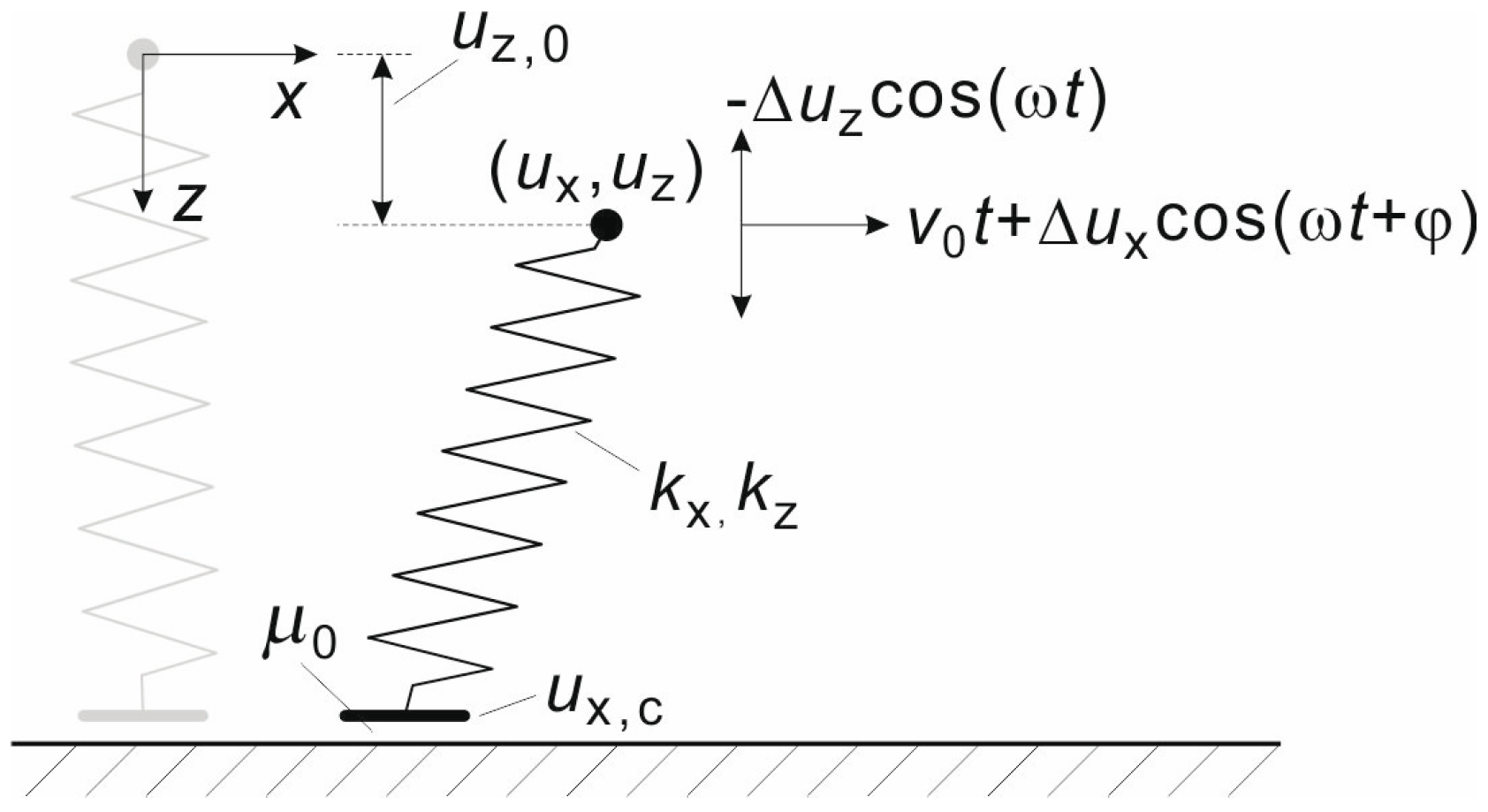
2. Method
3. Numerical Simulation and Results
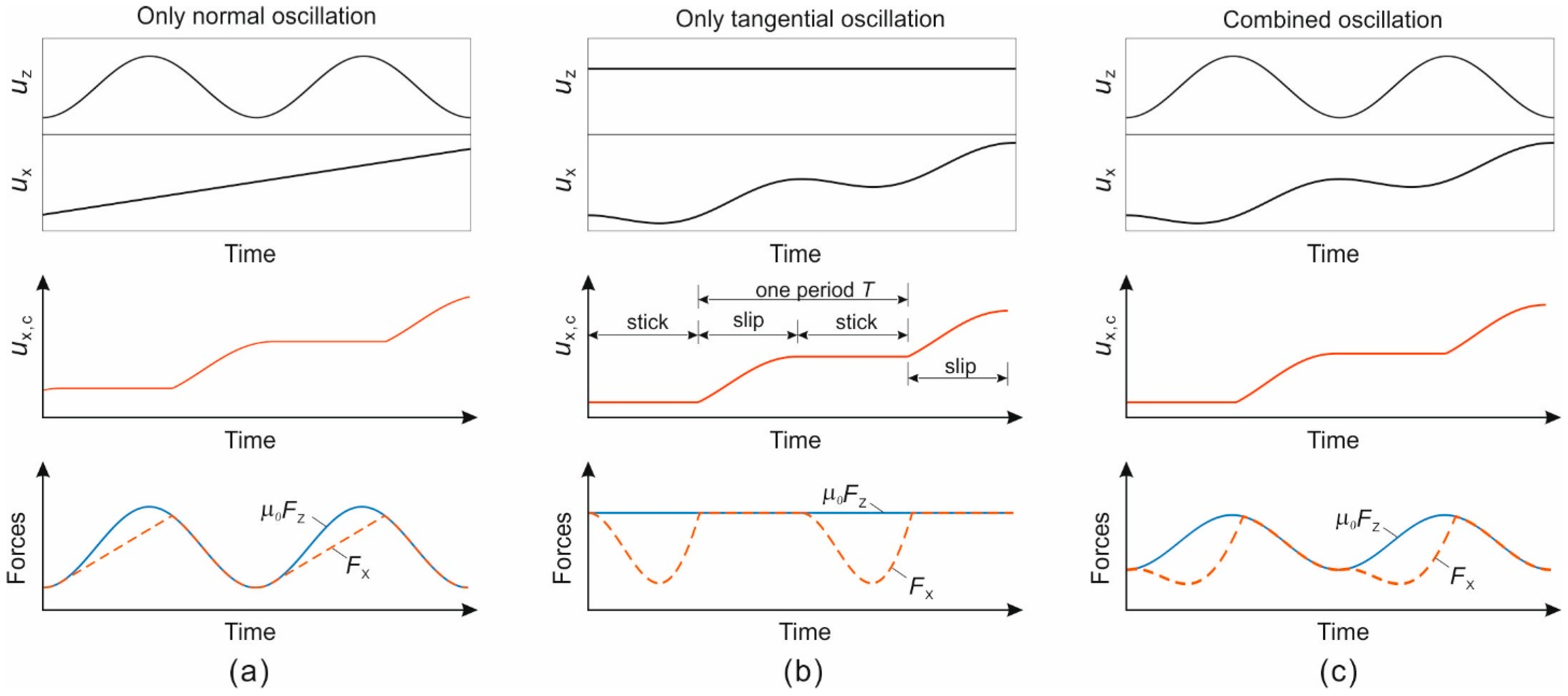
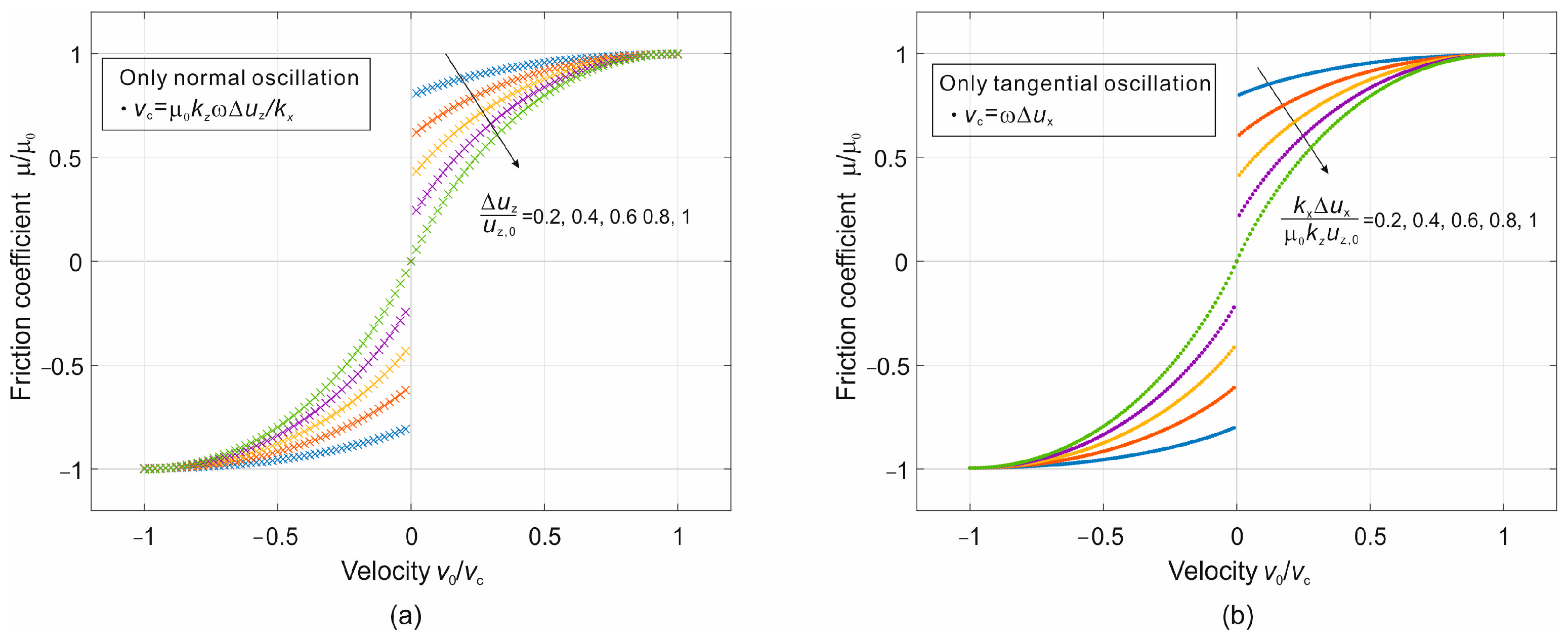
3.1. Review of Single-Mode Oscillation
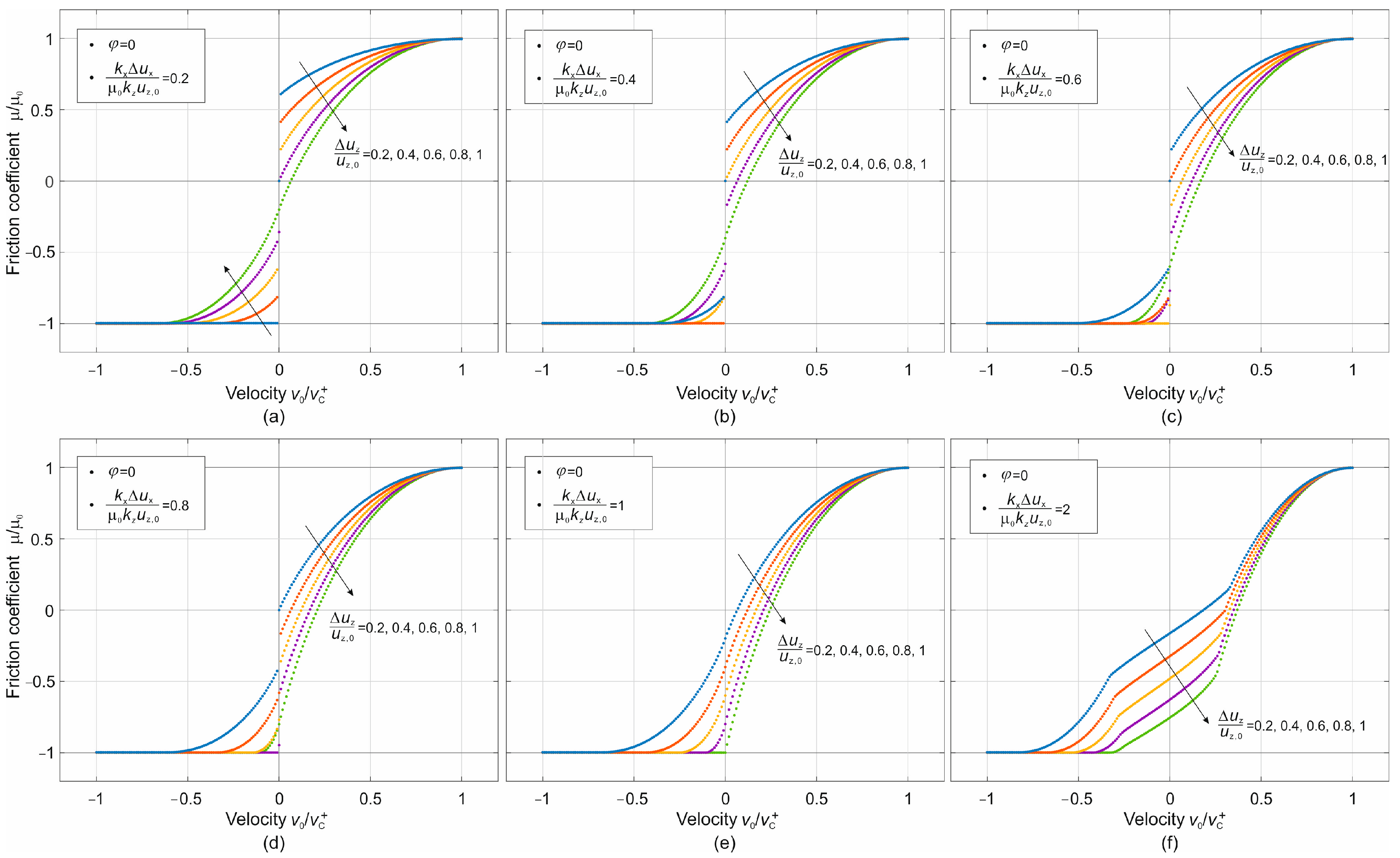
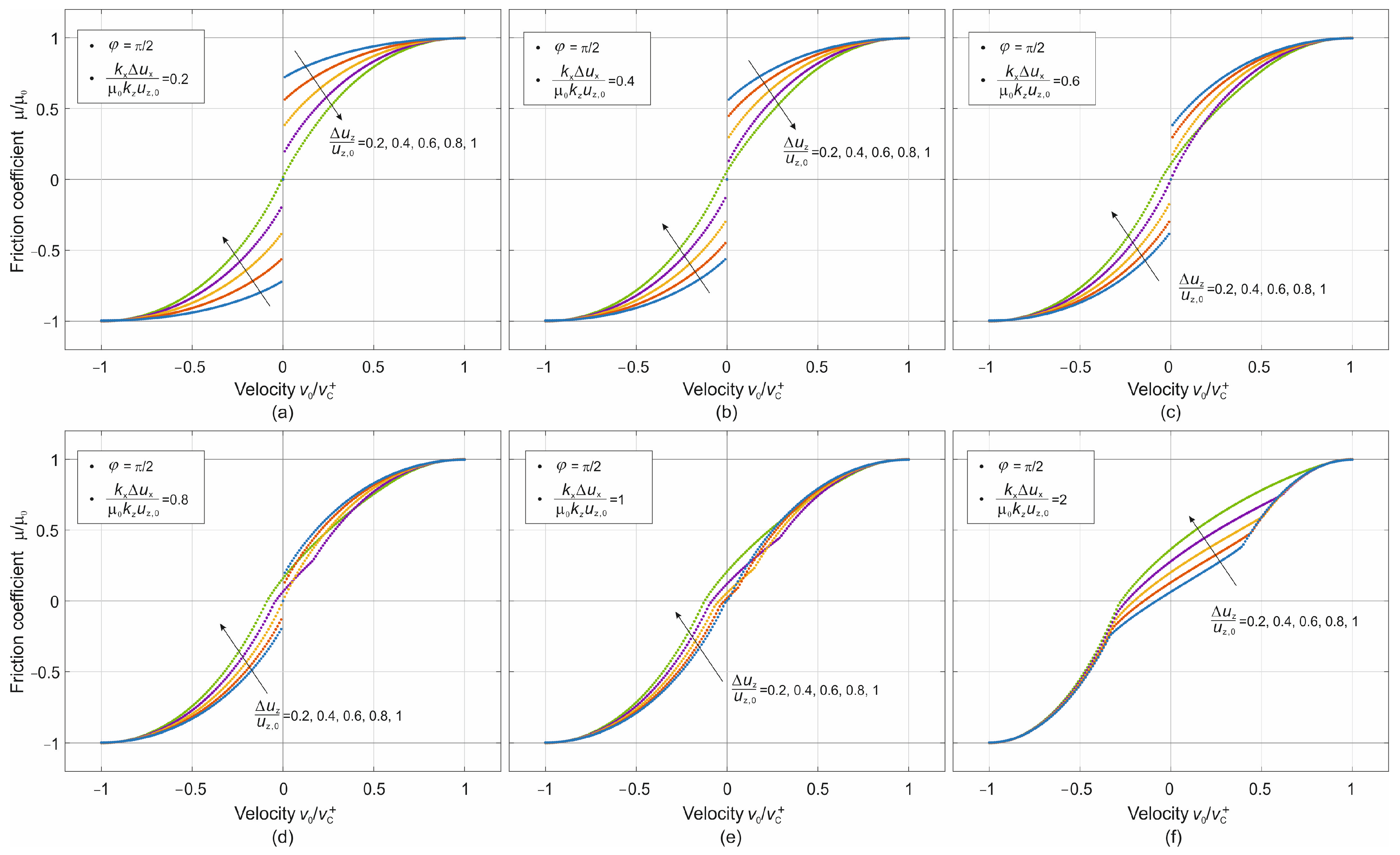
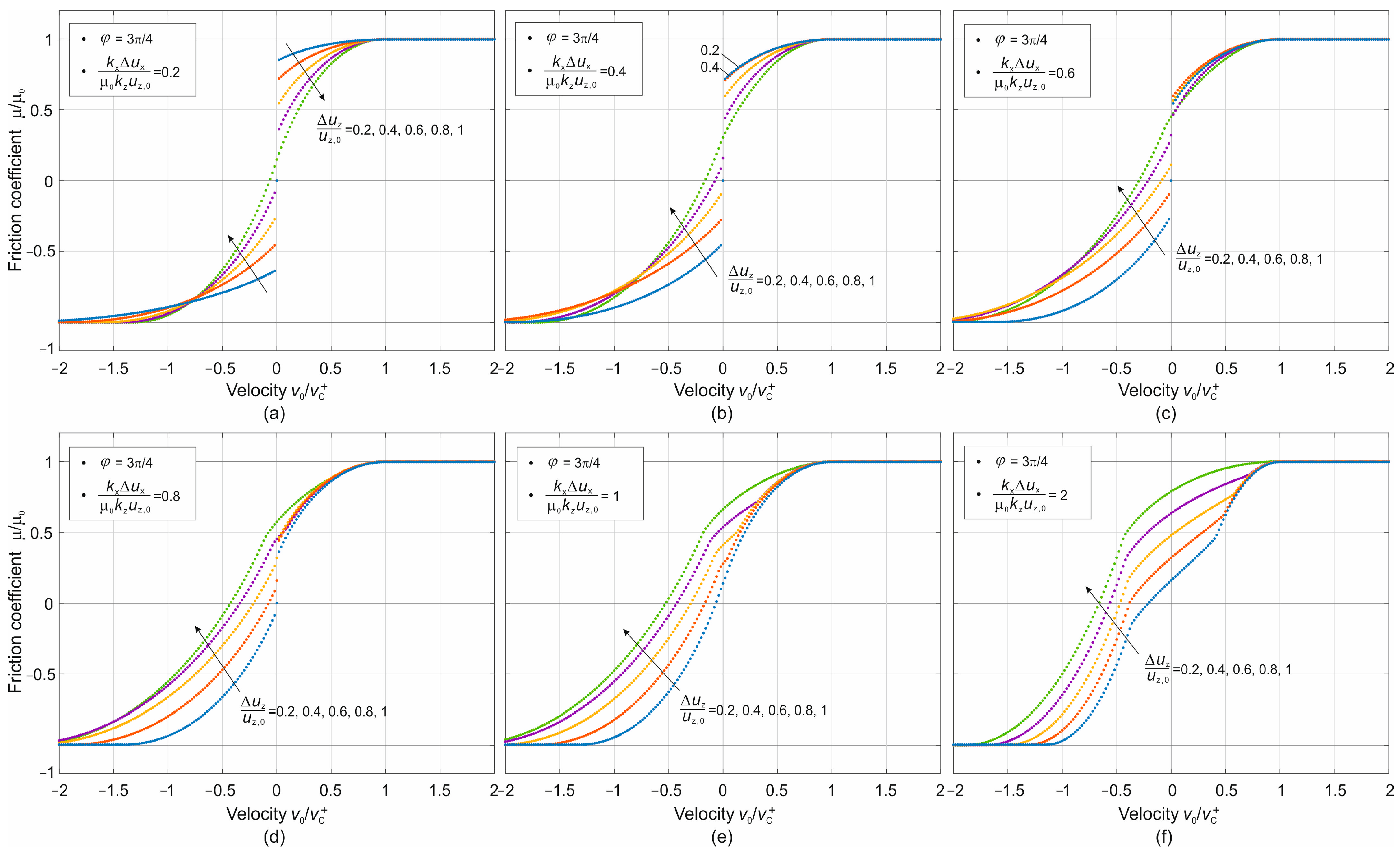
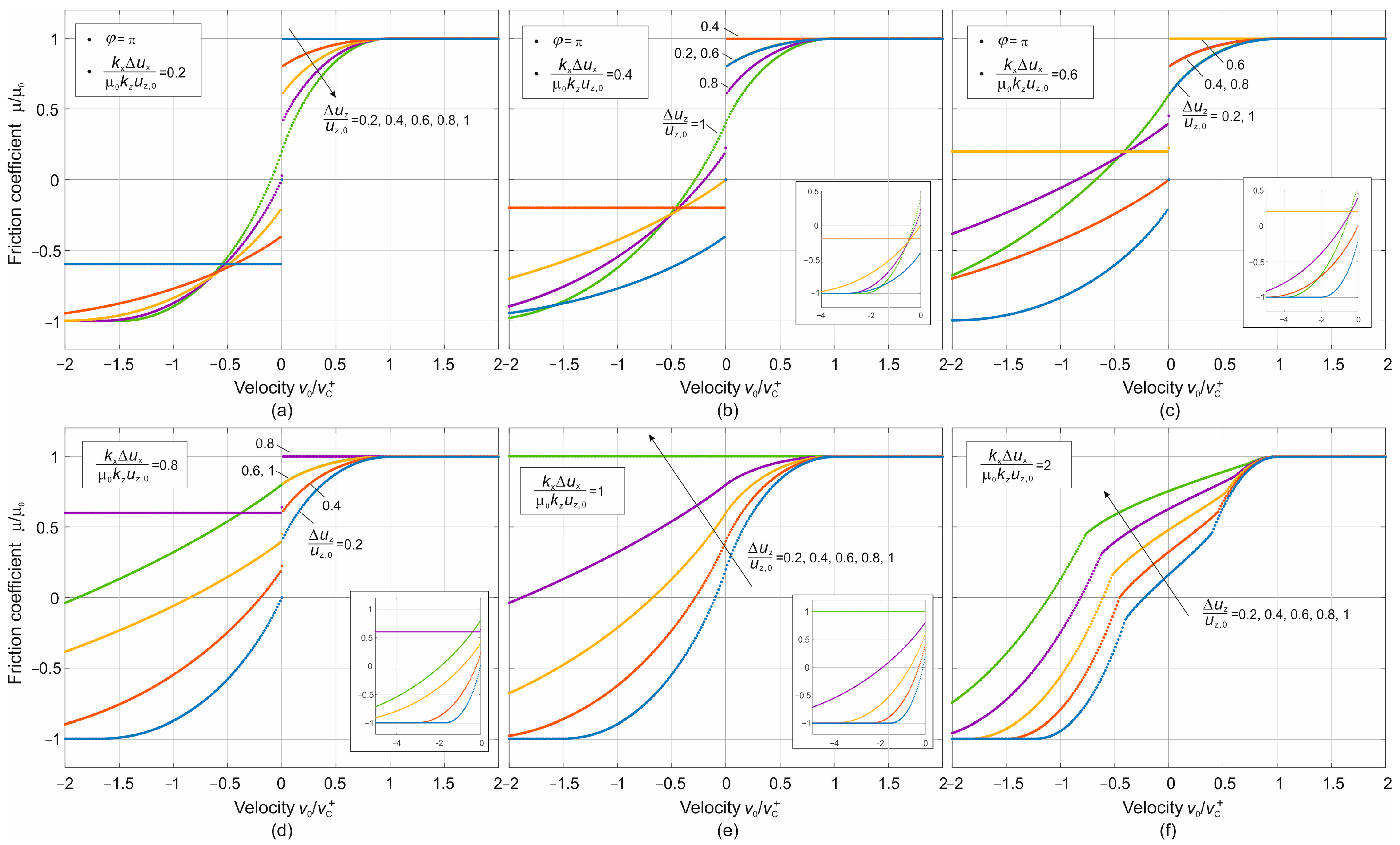
3.2. Results of Dual-Mode Oscillation
3.3. Two-Dimensional Projections of the Regime Space
4. Discussion
5. Conclusions
- −
- Purely normal and purely tangential oscillations produce qualitatively identical friction–reduction behavior when expressed in terms of the appropriate dimensionless parameters.
- −
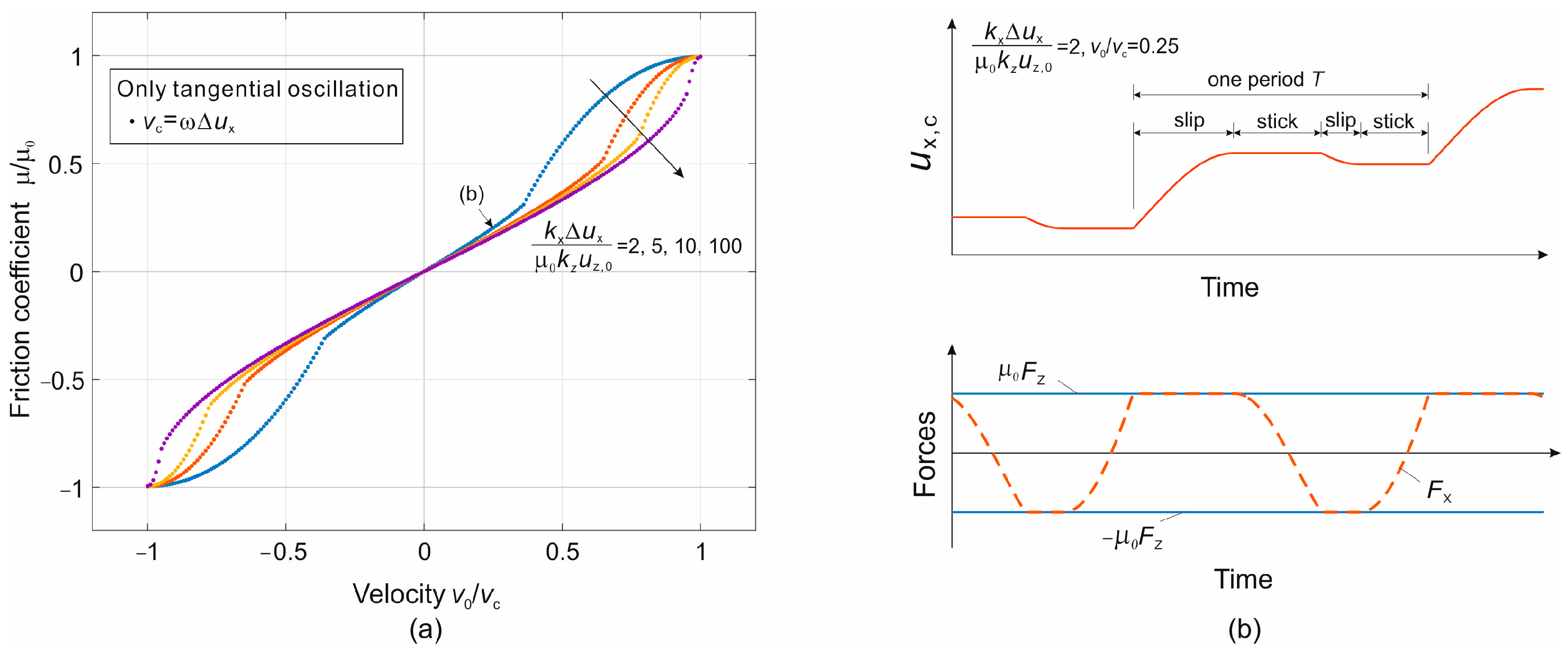
- For sufficiently large tangential oscillation amplitudes, a transition occurs from a conventional stick–slip state to a bidirectional stick–slip regime characterized by two sticking and two sliding phases within one oscillation cycle.
- −
- Under dual-mode excitation, the effective friction coefficient is governed by four dimensionless parameters: the normalized sliding velocity, the normal oscillation ratio, the tangential oscillation parameter, and the phase shift between the oscillation modes.
- −
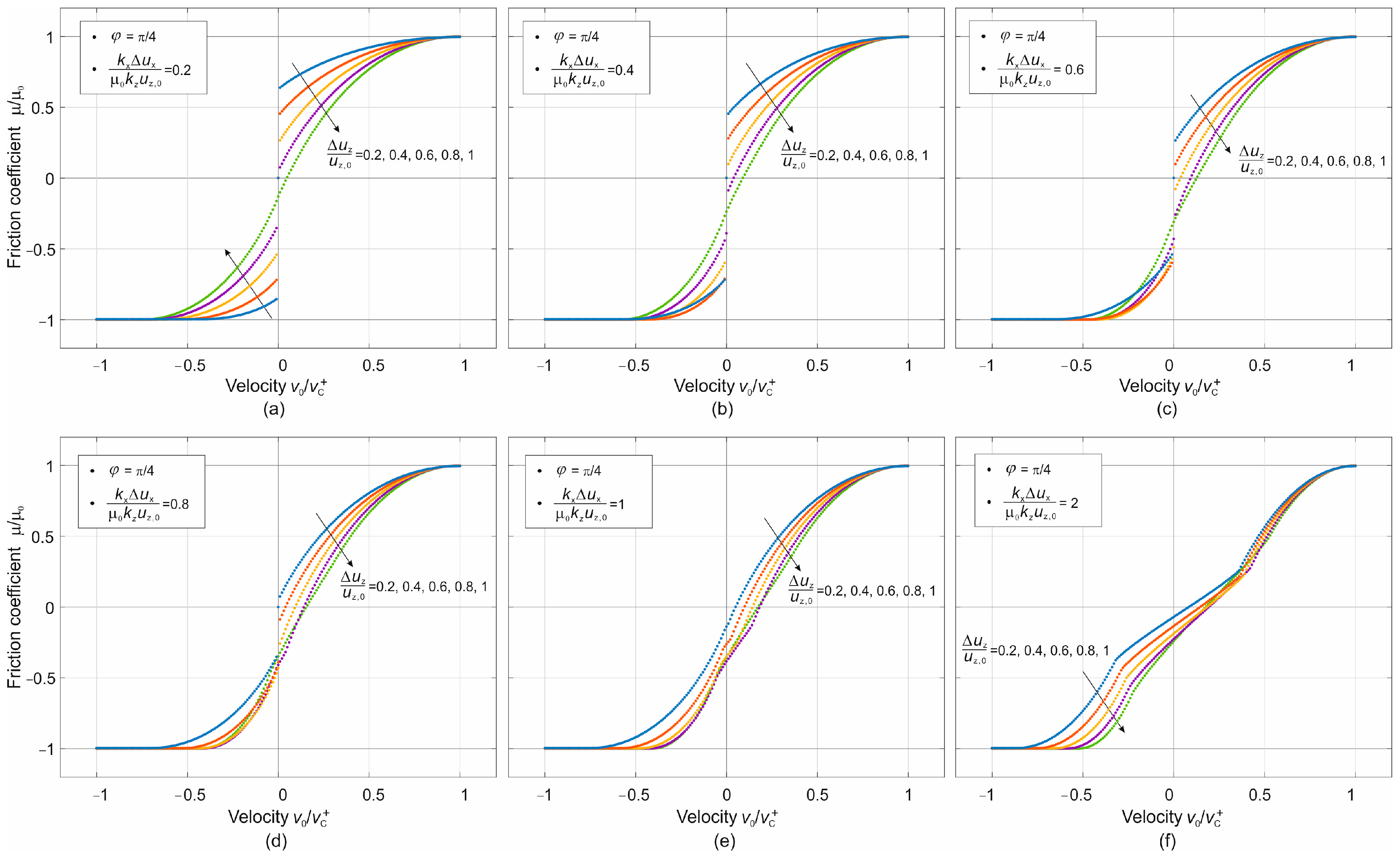
- The superposition of normal and tangential oscillations breaks the symmetry of the friction law with respect to the direction of motion, leading to different critical velocities and friction coefficients for positive and negative sliding directions.
- −
- Depending on the parameter combination, the system can operate as a friction-control system, a dynamic ratchet, or an actuator. The transition between these regimes follows from the continuous change in the averaged friction–velocity law.
- −
- Negative effective friction occurs for some parameter combinations. It means that energy supplied by the oscillations is converted into directed mechanical work. The local Coulomb friction itself remains dissipative.
Author Contributions
Funding
Data Availability Statement
Conflicts of Interest
References
- Hagedorn, P. Mechanical Vibrations and Vibration Control. In Passive and Active Structural Vibration Control in Civil Engineering; Soong, T.T., Costantinou, M.C., Eds.; Springer: Vienna, Austria, 1994. [Google Scholar] [CrossRef] [Scilit]
- Gee, R.; Hanley, C.; Hussain, R.; Canuel, L.; Martinez, J. Axial Oscillation Tools vs. Lateral Vibration Tools for Friction Reduction—What’s the Best Way to Shake the Pipe? In SPE/IADC Drilling Conference and Exhibition; SPIE: Cergy-Pontoise, France, 2015; Volume D021S012R006. [Google Scholar] [CrossRef] [Scilit]
- Du, C.; Xie, L. Modeling and Control of Vibration in Mechanical Systems; CRC Press: Boca Raton, FL, USA, 2010. [Google Scholar] [CrossRef] [Scilit]
- Popov, V.L. Oscillation-based methods for actuation and manipulation of nano-objects. AIP Conf. Proc. 2017, 1882, 020056. [Google Scholar] [CrossRef] [Scilit]
- Wang, H.; Chen, M.Z.Q. Relationships between vibrations of main device and mechanical network in a classical vibration control system. J. Sound Vib. 2023, 565, 117887. [Google Scholar] [CrossRef] [Scilit]
- Sato, K.; Hisamatsu, R.; Akamatsu, K. Controller design for high-speed, ultra-precision positioning of a linear motion stage on a vibrating machine base stage control on a vibrating base. Precis. Eng. 2023, 80, 10–19. [Google Scholar] [CrossRef] [Scilit]
- Dong, Z.; Yang, M.; Chen, Z.; Xu, L.; Meng, F.; Ou, W. Design and performance analysis of a rotary traveling wave ultrasonic motor with double vibrators. Ultrasonics 2016, 71, 134–141. [Google Scholar] [CrossRef] [Scilit] [PubMed]
- Teidelt, E.; Starcevic, J.; Popov, V.L. Influence of ultrasonic oscillation on static and sliding friction. Tribol. Lett. 2012, 48, 51–62. [Google Scholar] [CrossRef] [Scilit]
- Liu, Y.; Chen, P.; Ma, T.; Wang, X. An evaluation method for friction-reducing performance of hydraulic oscillator. J. Pet. Sci. Eng. 2017, 157, 107–116. [Google Scholar] [CrossRef] [Scilit]
- Pasternak, E.; Dyskin, A.; Karachevtseva, I. Oscillations in sliding with dry friction. Friction reduction by imposing synchronised normal load oscillations. Int. J. Eng. Sci. 2020, 154, 103313. [Google Scholar] [CrossRef] [Scilit]
- Gutowski, P.; Leus, M. The effect of longitudinal tangential vibrations on friction and driving forces in sliding motion. Tribol. Int. 2012, 55, 108–118. [Google Scholar] [CrossRef] [Scilit]
- Popov, M.; Popov, V.L.; Popov, N.V. Reduction of friction by normal oscillations. I. Influence of contact stiffness. Friction 2017, 5, 45–55. [Google Scholar] [CrossRef] [Scilit]
- Leus, M.; Gutowski, P.; Bachtiak-Radka, E. The effect of contact compliance of sliding pair on friction force reduction at longitudinal tangential vibrations. Tribol. Int. 2023, 187, 108701. [Google Scholar] [CrossRef] [Scilit]
- Popov, M.; Li, Q. Multimode active control of friction, dynamic ratchets and actuators. Phys. Mesomech. 2018, 21, 24–31. [Google Scholar] [CrossRef] [Scilit]
- Madatov, I.; Li, Q.; Popov, V.L. Actuators based on superposition of normal and tangential oscillations. AIP Conf. Proc. 2025, 3177, 40004. [Google Scholar] [CrossRef] [Scilit]
- Mao, X.; Popov, V.L.; Starcevic, J.; Popov, M. Reduction of friction by normal oscillations. II. In-plane system dynamics. Friction 2017, 5, 194–206. [Google Scholar] [CrossRef] [Scilit]
- Teidelt, E.; Willert, E.; Filippov, A.E.; Popov, V.L. Modeling of the dynamic contact in stick-slip microdrives using the method of reduction of dimensionality. Phys. Mesomech. 2012, 15, 287–292. [Google Scholar] [CrossRef] [Scilit]
- Papangelo, A.; Ciavarella, M. On the limits of quasi-static analysis for a simple Coulomb frictional oscillator in response to harmonic loads. J. Sound Vib. 2015, 339, 280–289. [Google Scholar] [CrossRef] [Scilit]
- Benad, J.; Popov, M.; Nakano, K.; Popov, V.L. Stiff and soft active control of friction by vibrations and their energy efficiency. Forsch. Ingenieurwesen 2018, 82, 331–339. [Google Scholar] [CrossRef] [Scilit]





| Regime | Characteristic Feature | Representative Figures |
|---|---|---|
| Friction control | Symmetric friction reduction | Figure 3 and Figure 4a |
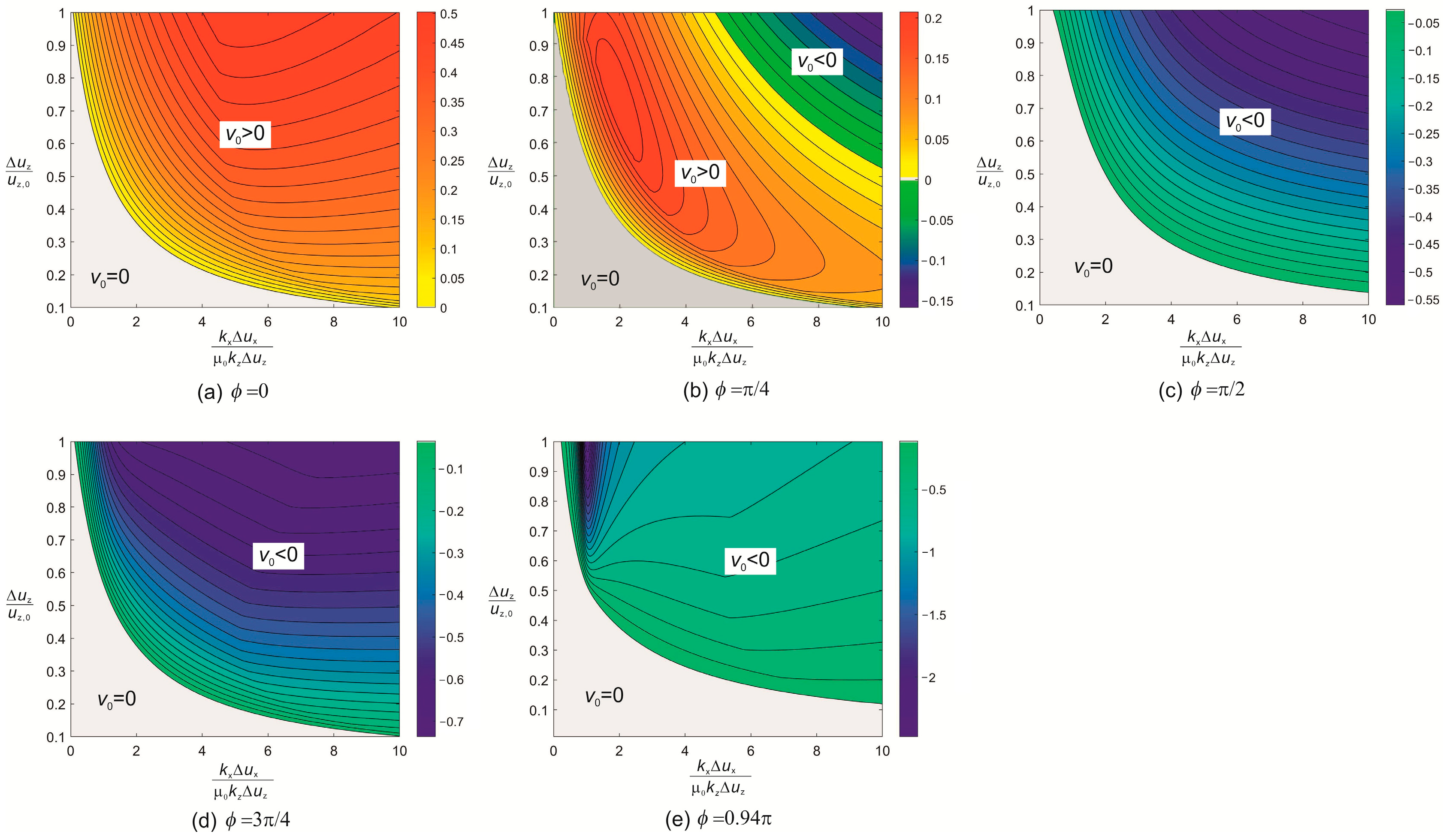
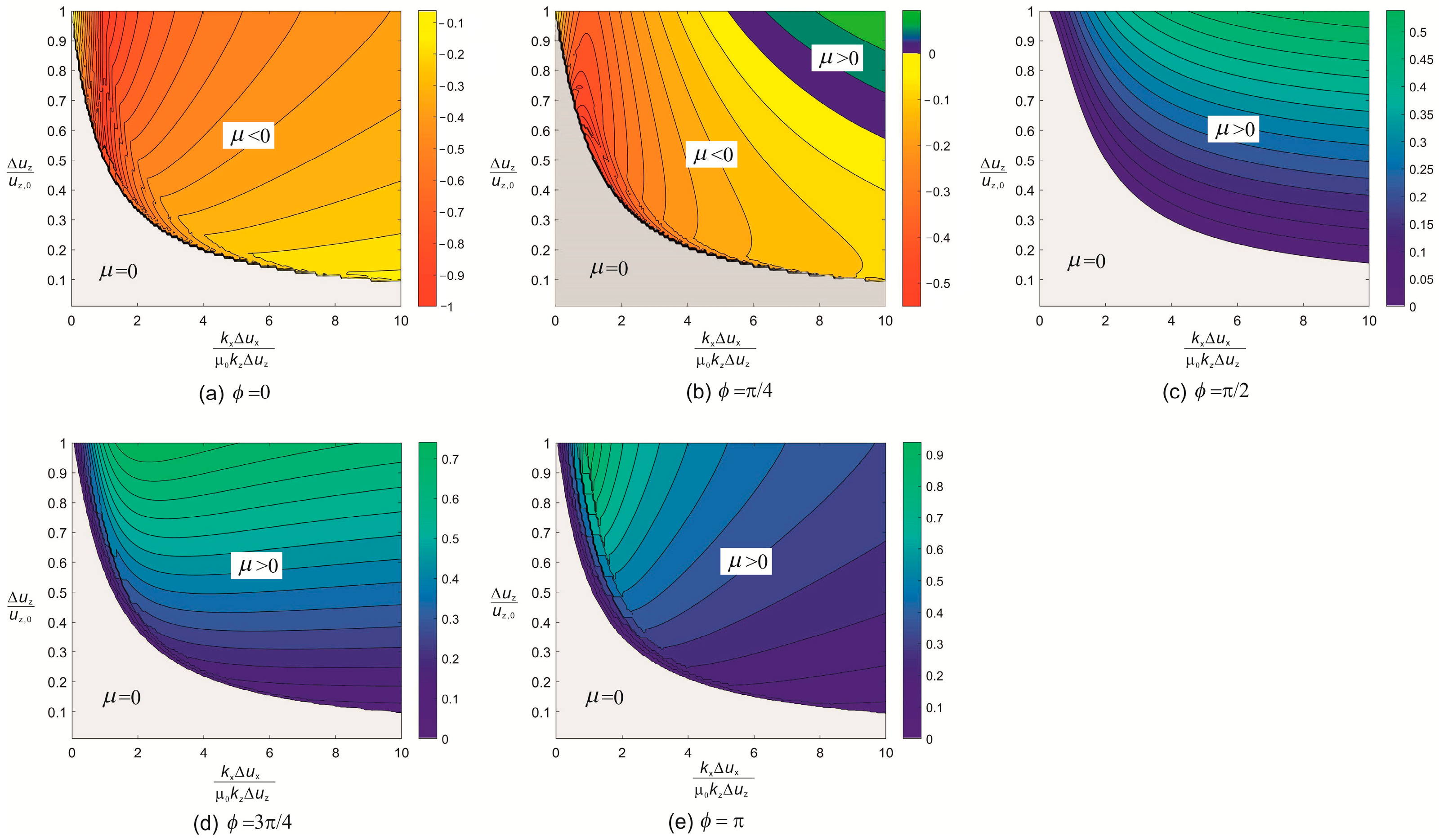
| Dynamic ratcheting | Asymmetric friction law, μ remains positive | Figure 8c–e and Figure 9b–d |
| Vibrational actuation | Oscillatory energy converted into mechanical work; characterized by free-running velocity and stall force | Figure 8f and Figure 9f |
Disclaimer/Publisher’s Note: The statements, opinions and data contained in all publications are solely those of the individual author(s) and contributor(s) and not of MDPI and/or the editor(s). MDPI and/or the editor(s) disclaim responsibility for any injury to people or property resulting from any ideas, methods, instructions or products referred to in the content. |
© 2026 by the authors. Licensee MDPI, Basel, Switzerland. This article is an open access article distributed under the terms and conditions of the Creative Commons Attribution (CC BY) license.
Share and Cite
Madatov, I.; Li, Q.; Popov, V.L. From Friction Control to Dynamic Ratcheting and Actuation by Combined Normal and Tangential Oscillations. Lubricants 2026, 14, 286. https://doi.org/10.3390/lubricants14080286
Madatov I, Li Q, Popov VL. From Friction Control to Dynamic Ratcheting and Actuation by Combined Normal and Tangential Oscillations. Lubricants. 2026; 14(8):286. https://doi.org/10.3390/lubricants14080286
Chicago/Turabian StyleMadatov, Ibrohim, Qiang Li, and Valentin L. Popov. 2026. "From Friction Control to Dynamic Ratcheting and Actuation by Combined Normal and Tangential Oscillations" Lubricants 14, no. 8: 286. https://doi.org/10.3390/lubricants14080286
APA StyleMadatov, I., Li, Q., & Popov, V. L. (2026). From Friction Control to Dynamic Ratcheting and Actuation by Combined Normal and Tangential Oscillations. Lubricants, 14(8), 286. https://doi.org/10.3390/lubricants14080286