Tribological Performance Evolution of Circular-Textured Surface Embedded with Paraffin Regulated by Texture Geometric Dimensions



Abstract
1. Introduction
2. Materials and Methodology
2.1. Fabrication of the Composite Surface
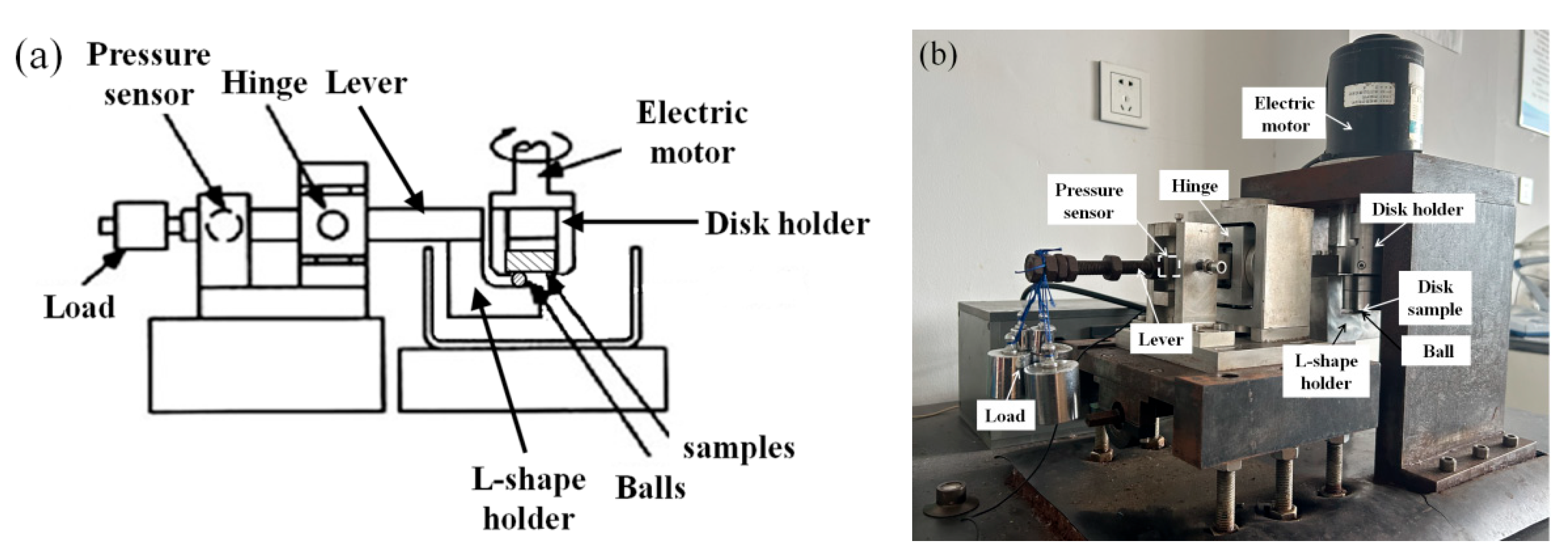
2.2. Characterization of Tribological Properties
2.3. Measurement of Temperature at Friction Interface
2.4. Simulation of Pressure and Flow Velocity
3. Results
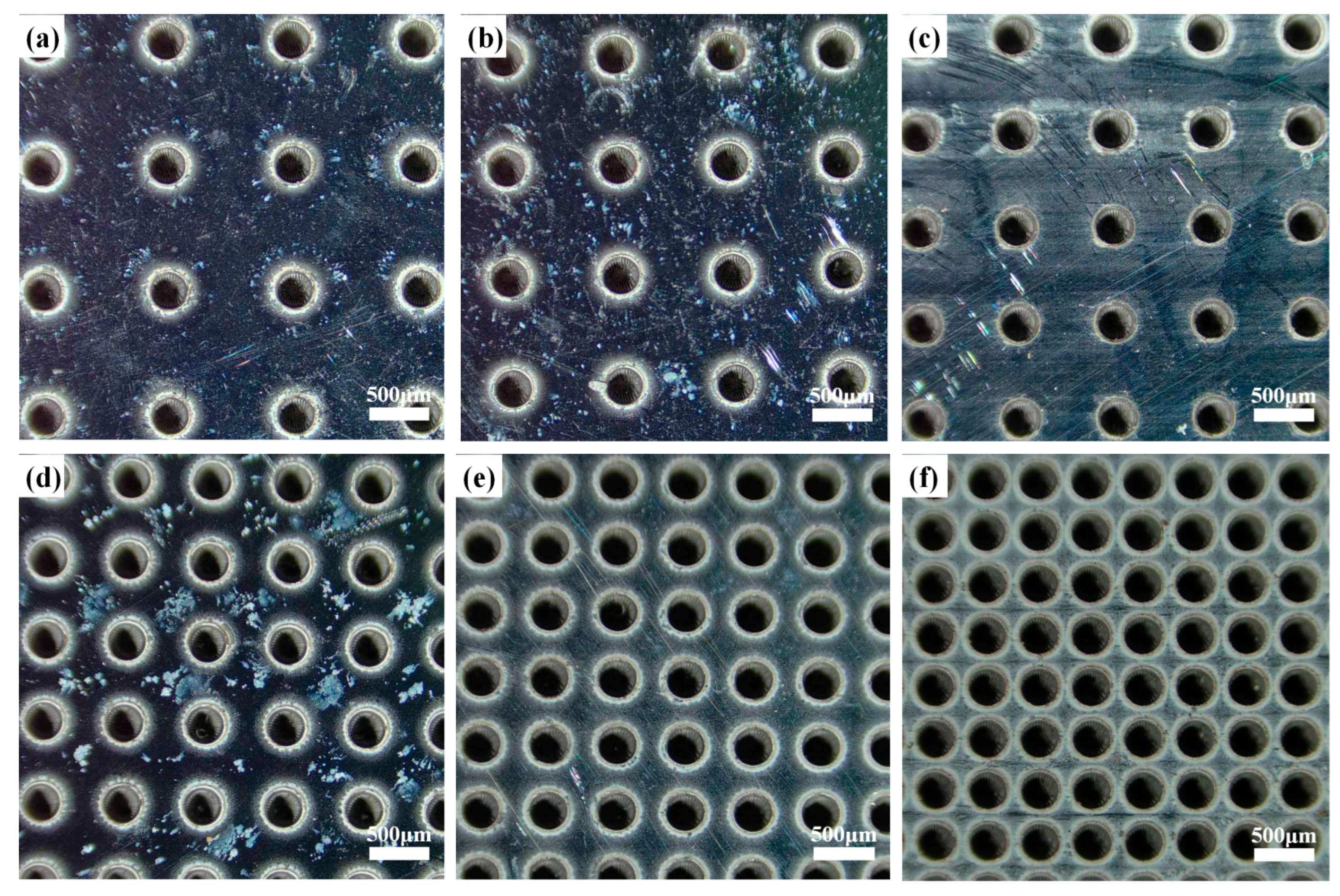
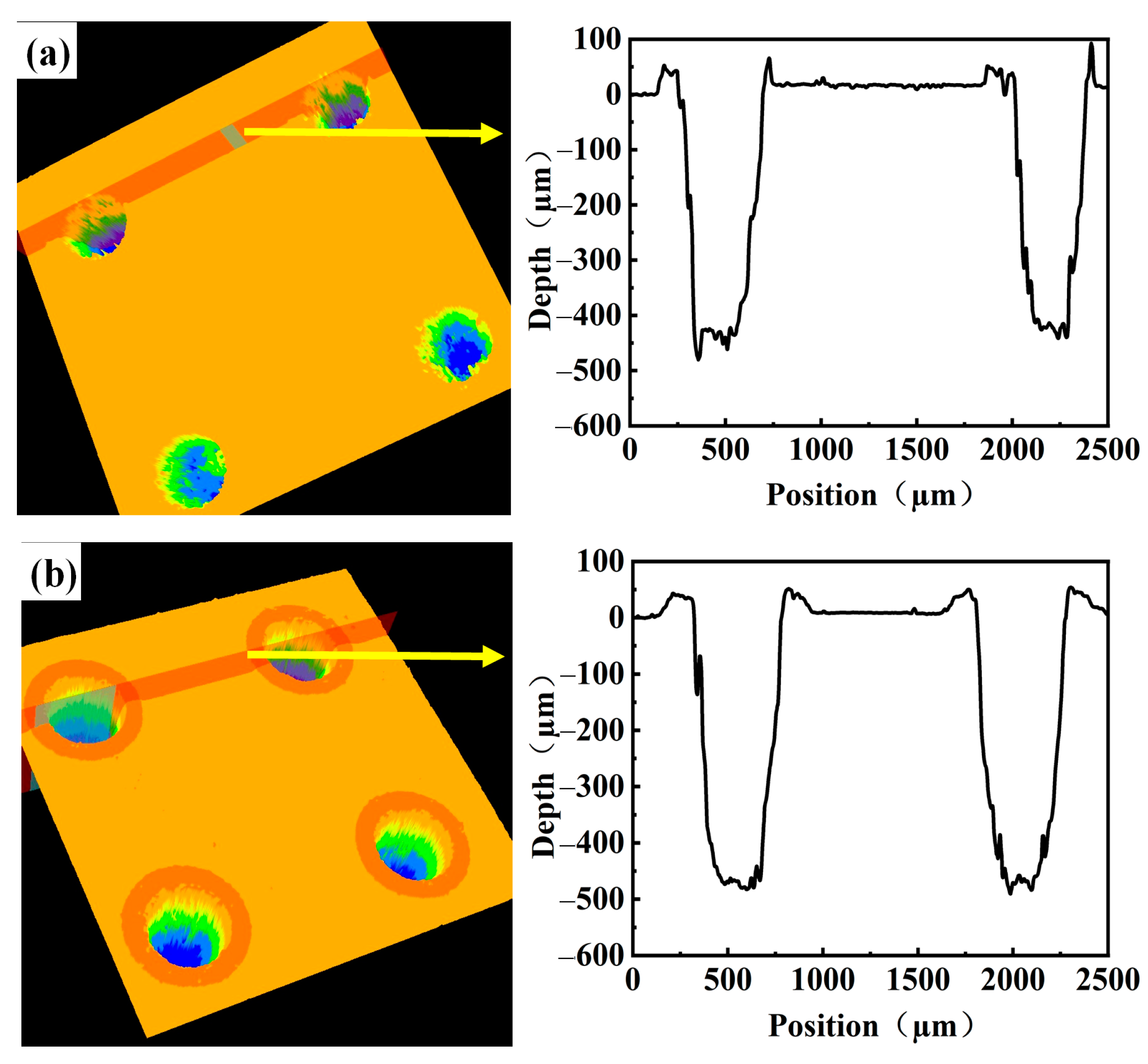
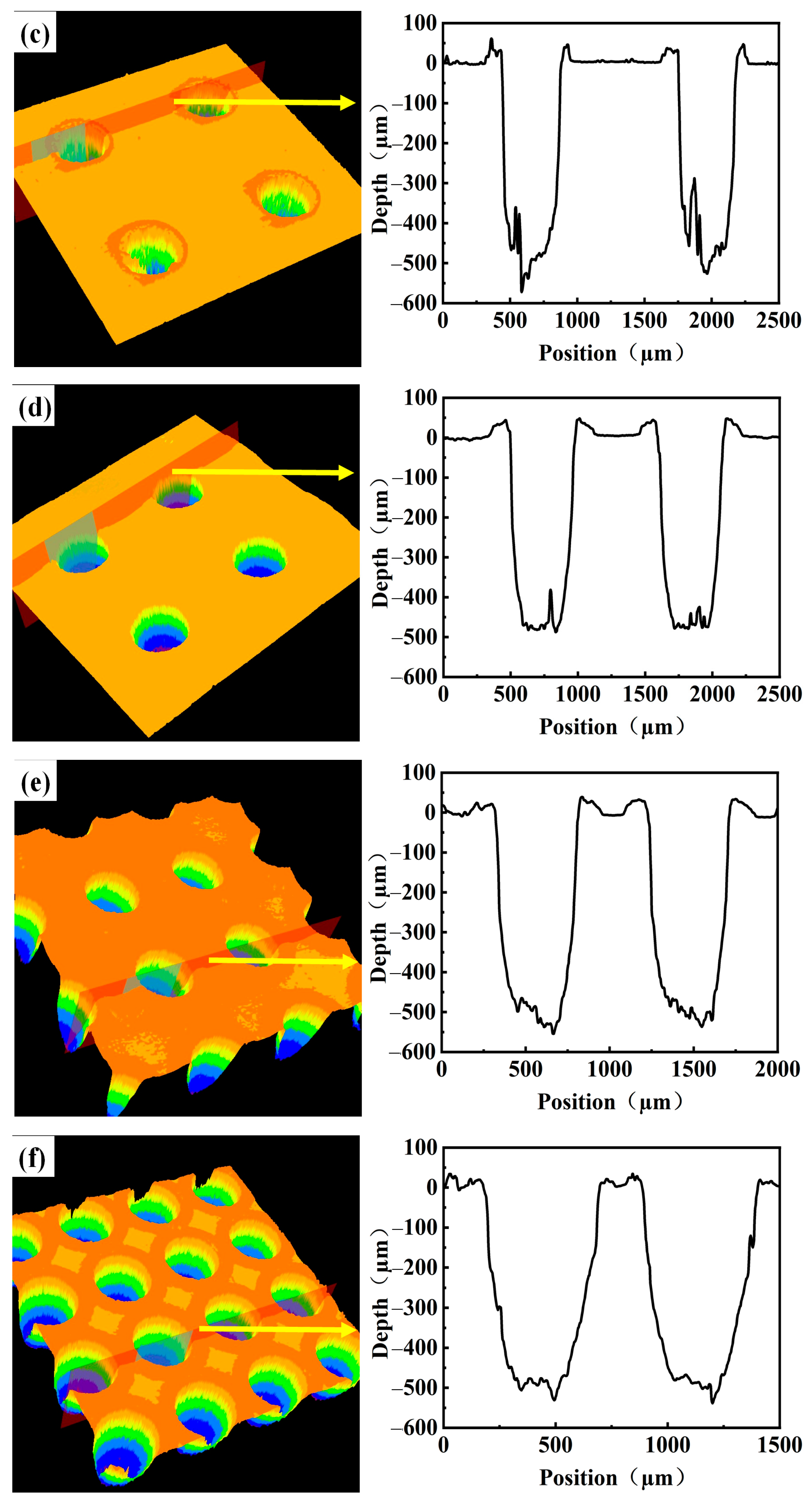
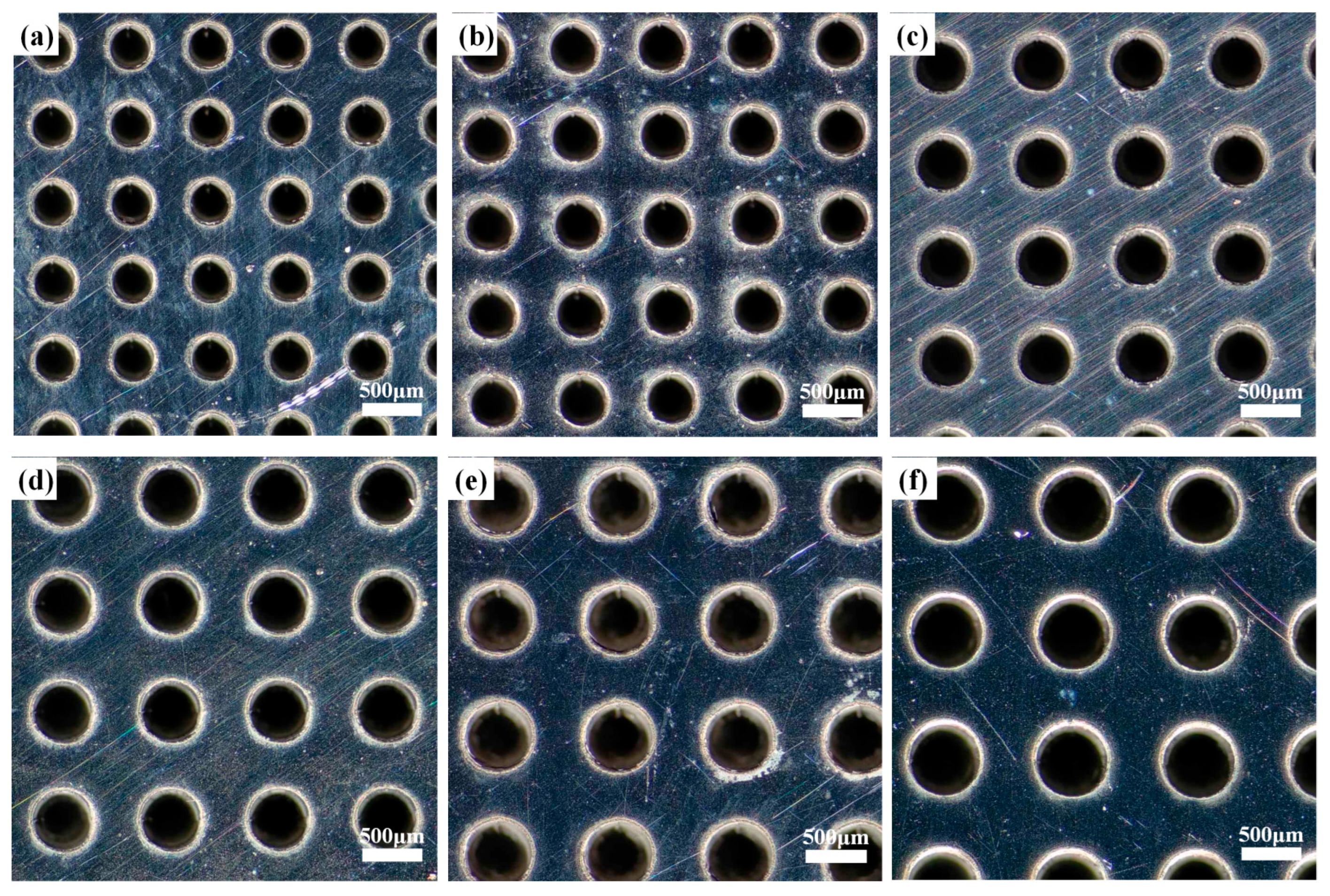
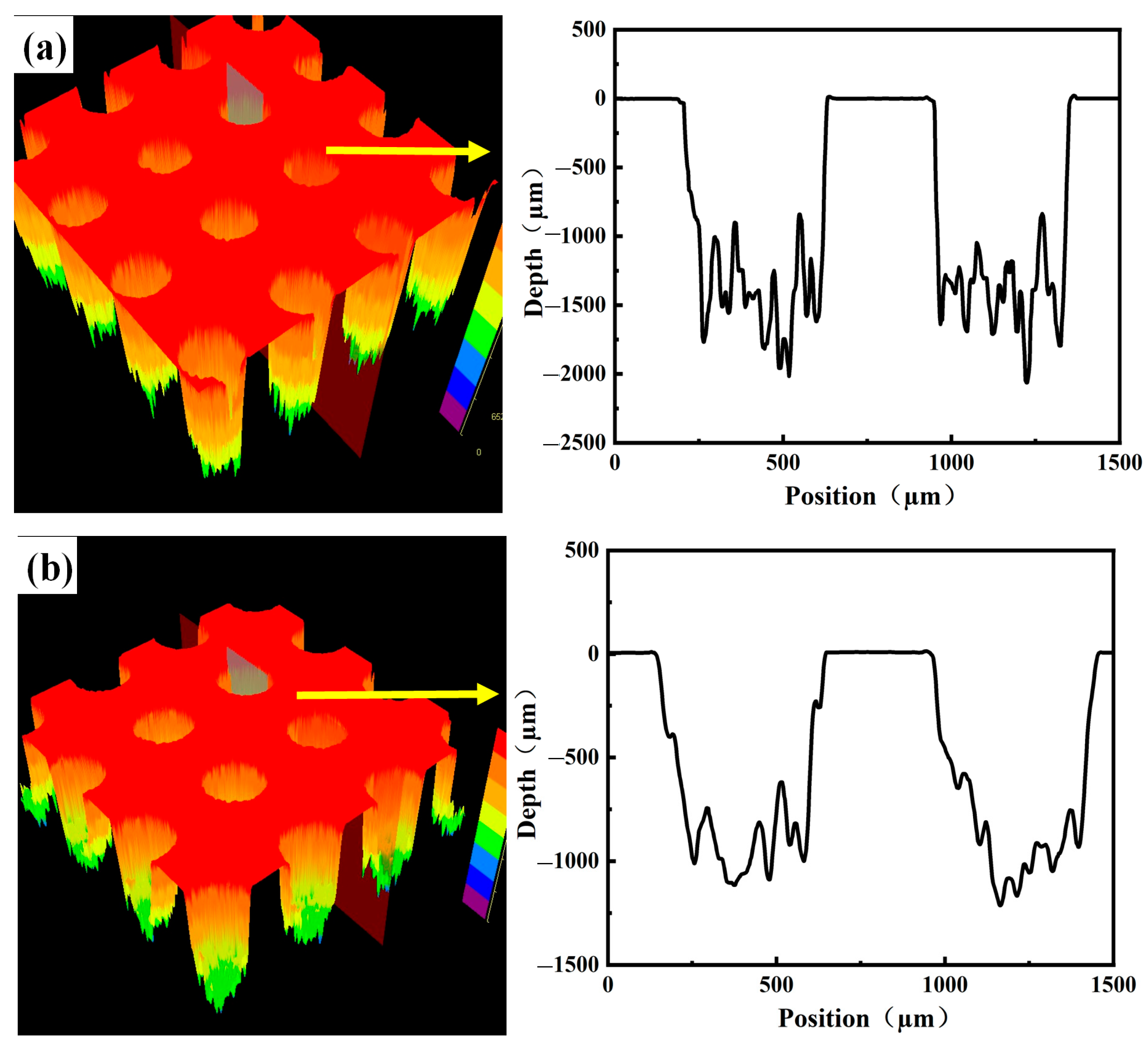
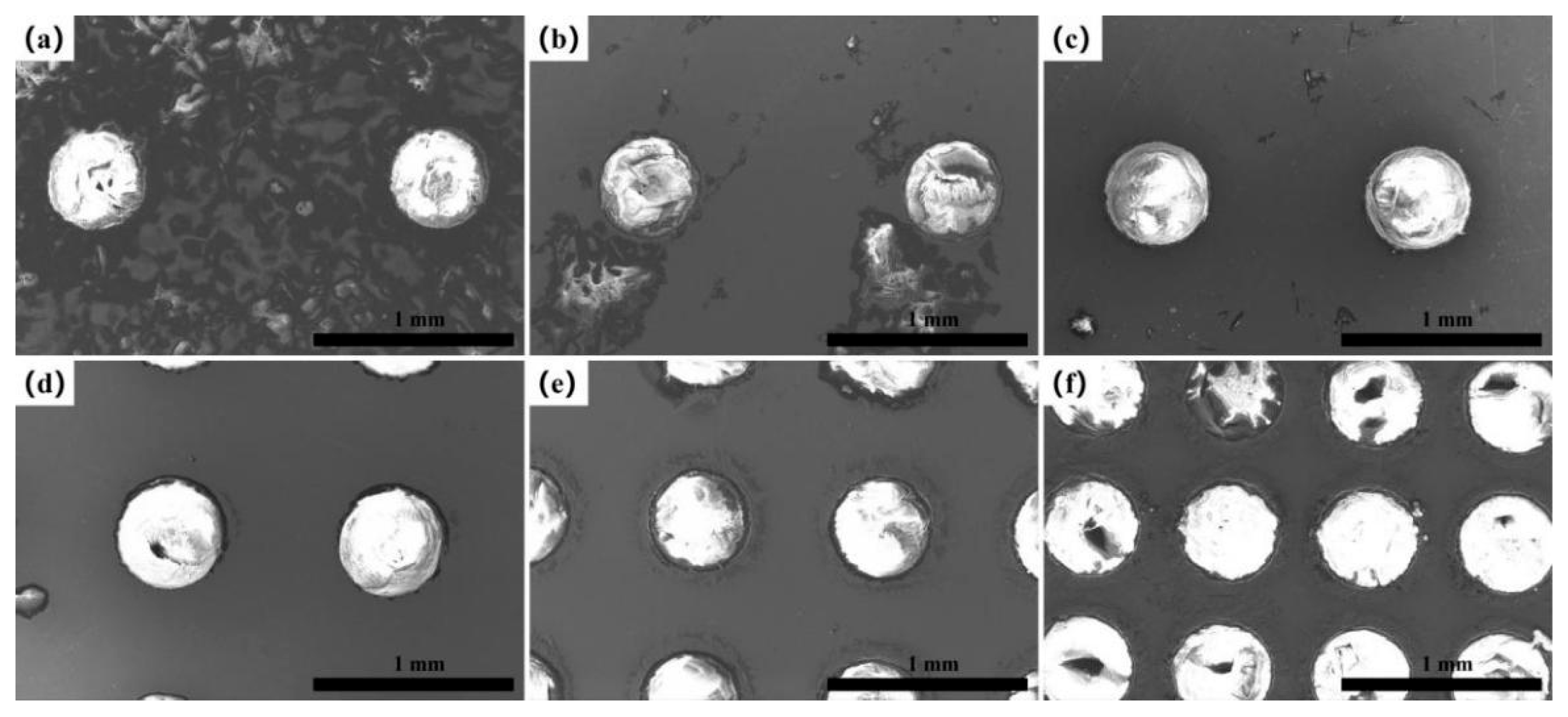
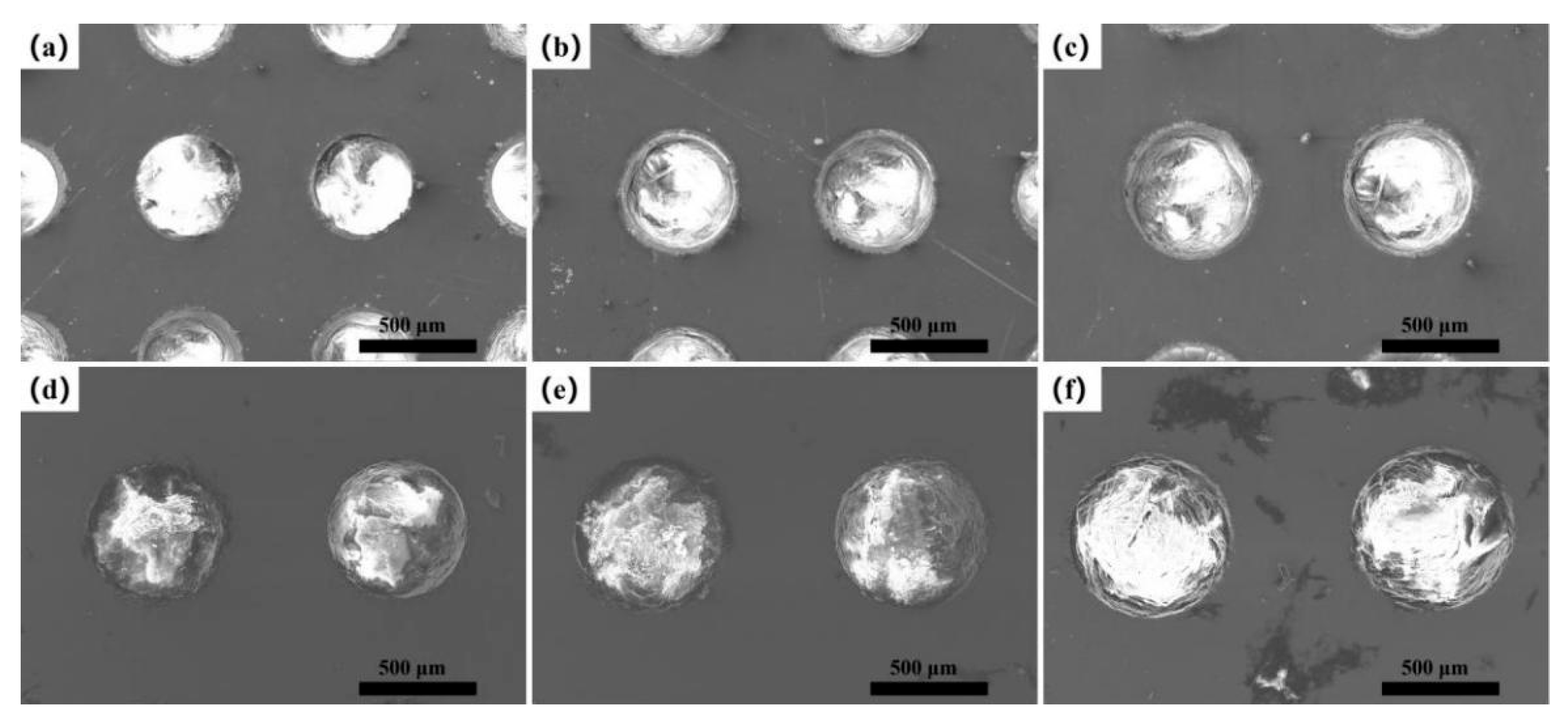
3.1. Morphologies of the Textured and Composite Surfaces
3.2. Temperatures of the Composite Surfaces with Different Surface Densities
3.3. Tribological Properties of the Composite Surface with Different Surface Densities
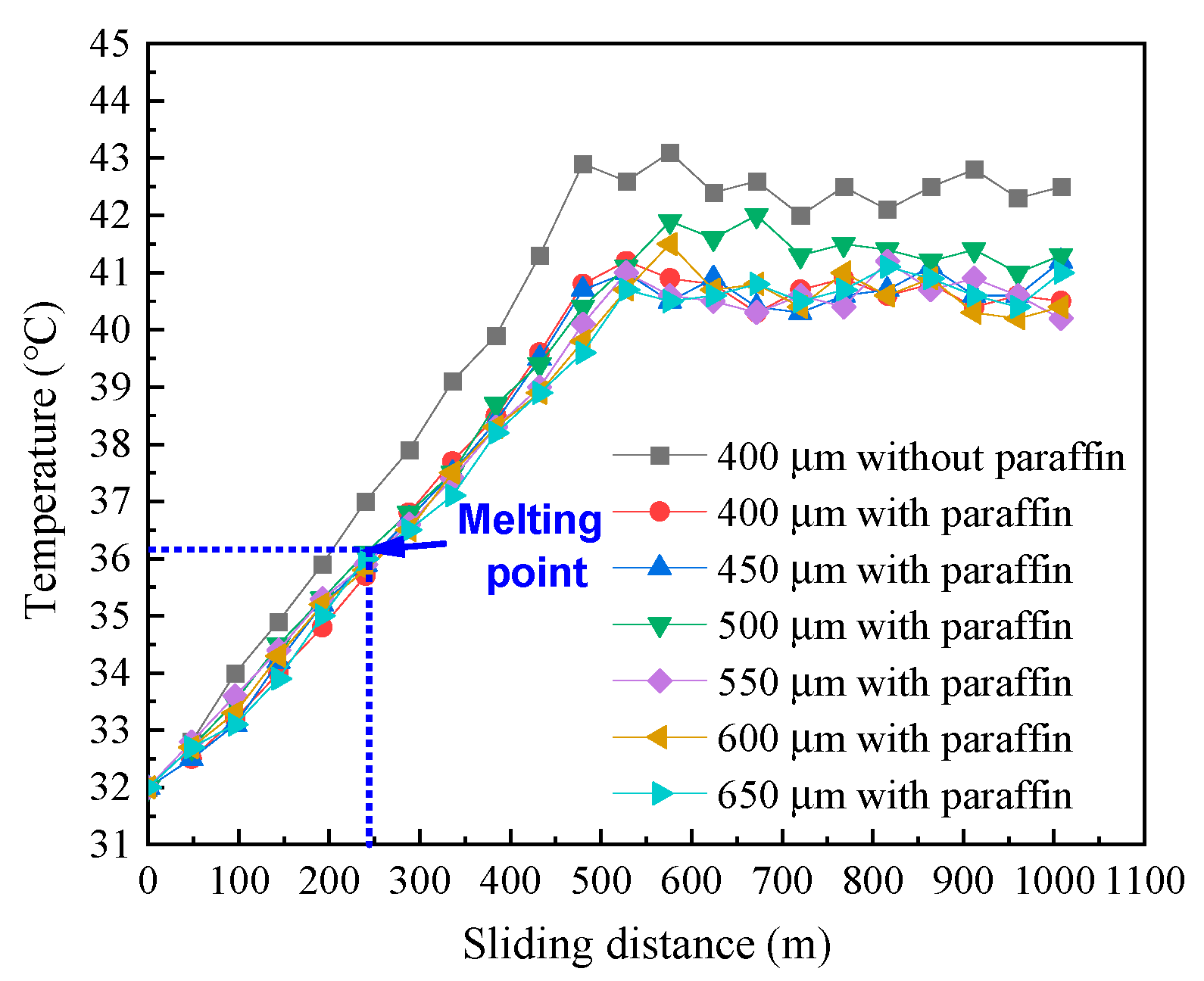
3.4. Temperatures of the Composite Surfaces with Different Circular Diameters
3.5. Tribological Properties of the Composite Surface with Different Circular Diameters
4. Discussion
4.1. Effect of Surface Density on Tribological Properties
4.2. Effect of Circular Diameter on Tribological Properties
5. Conclusions
- (1)
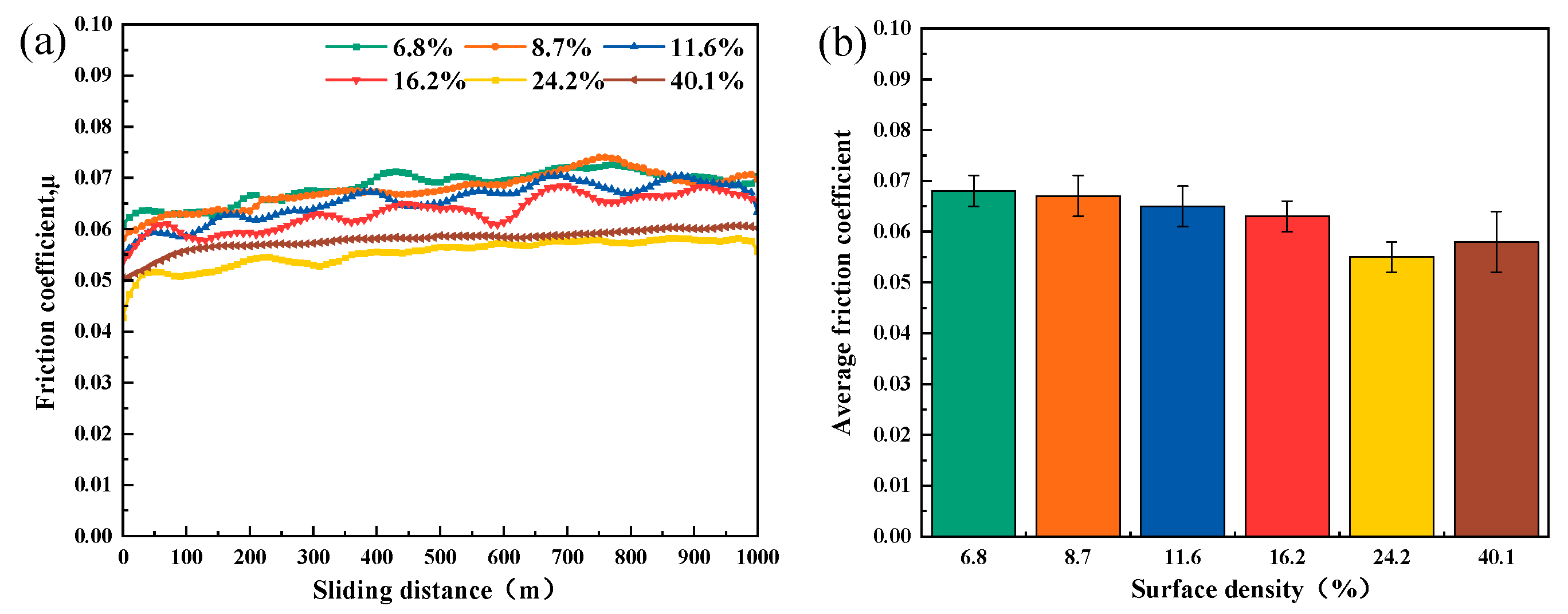
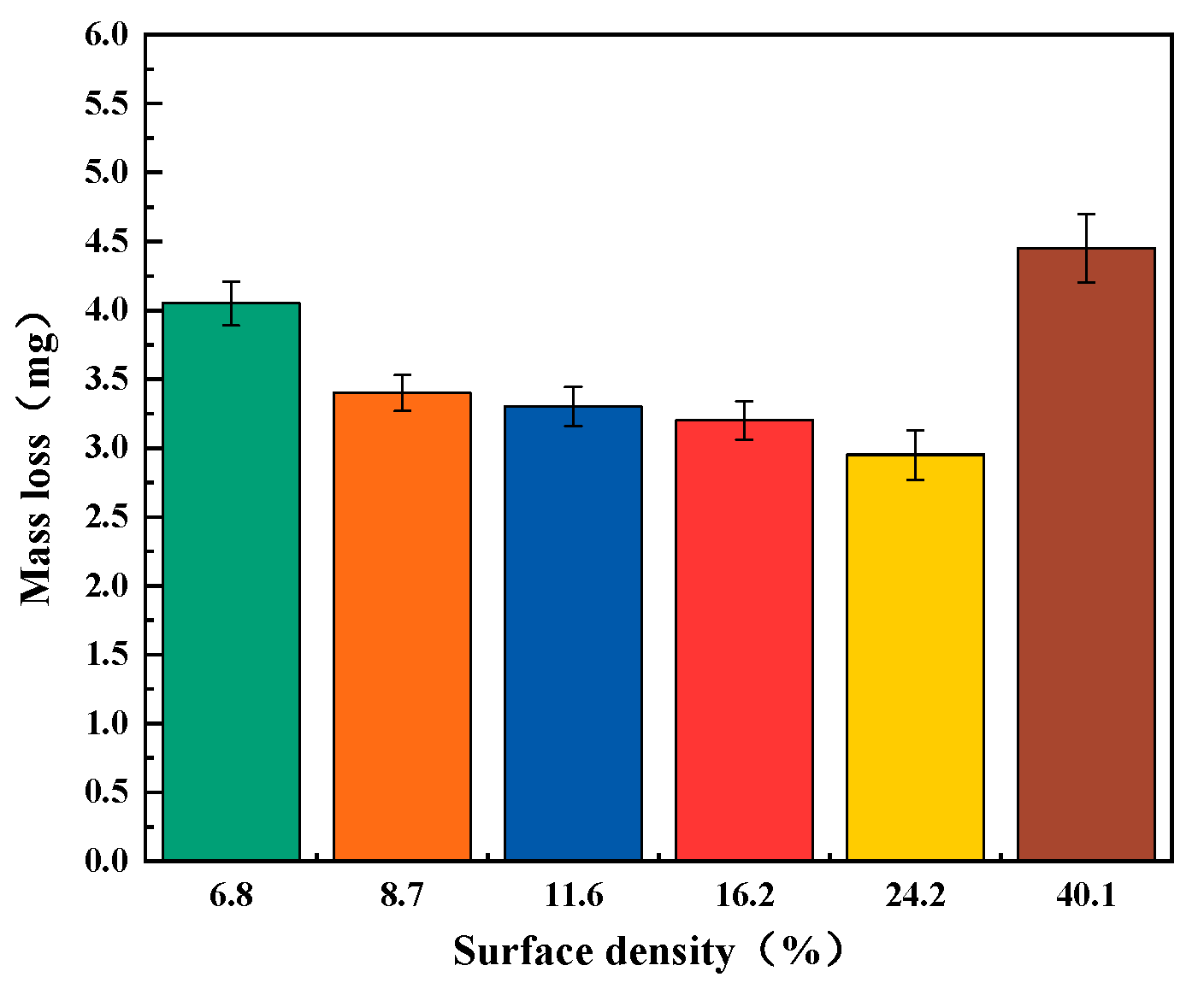
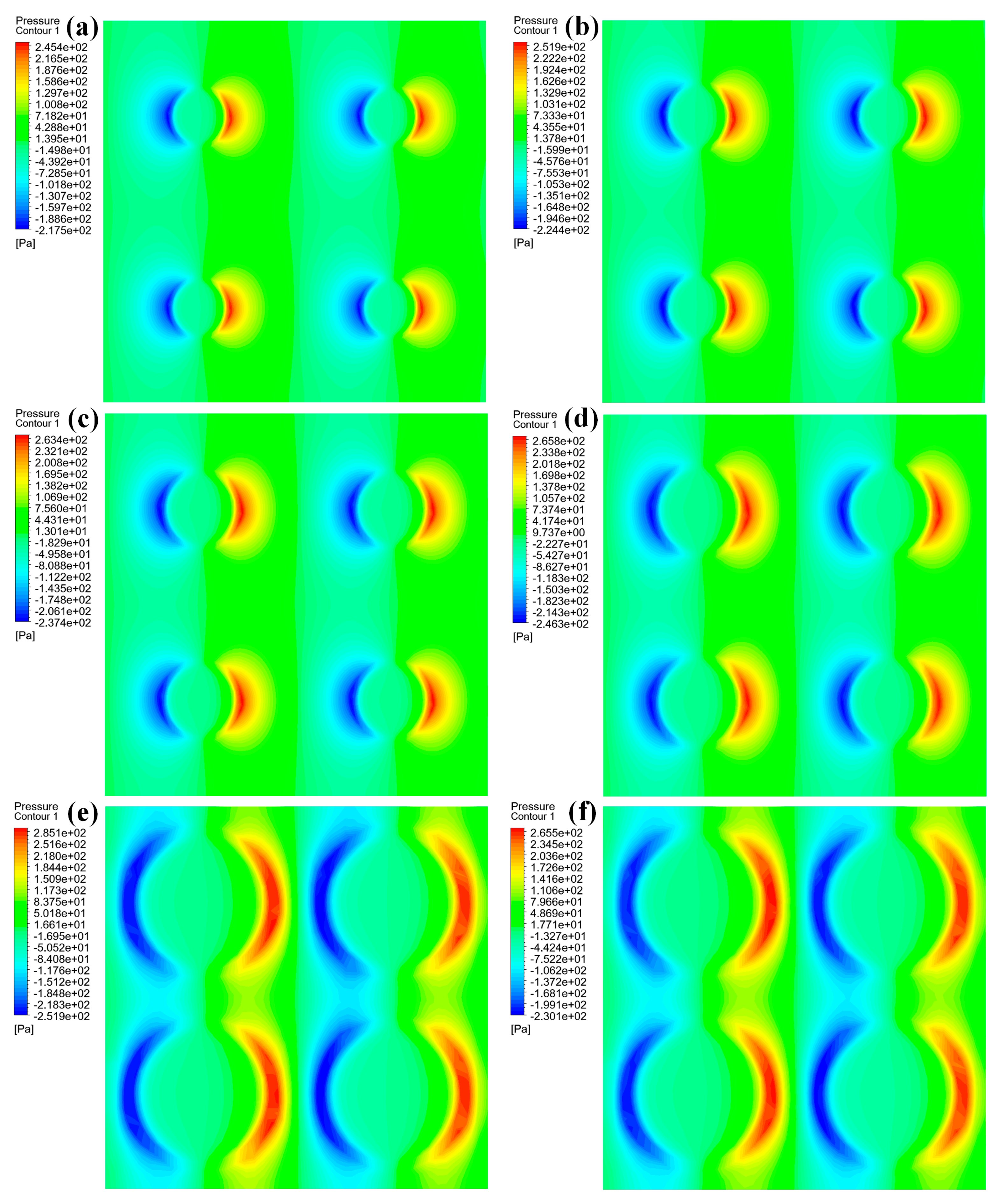
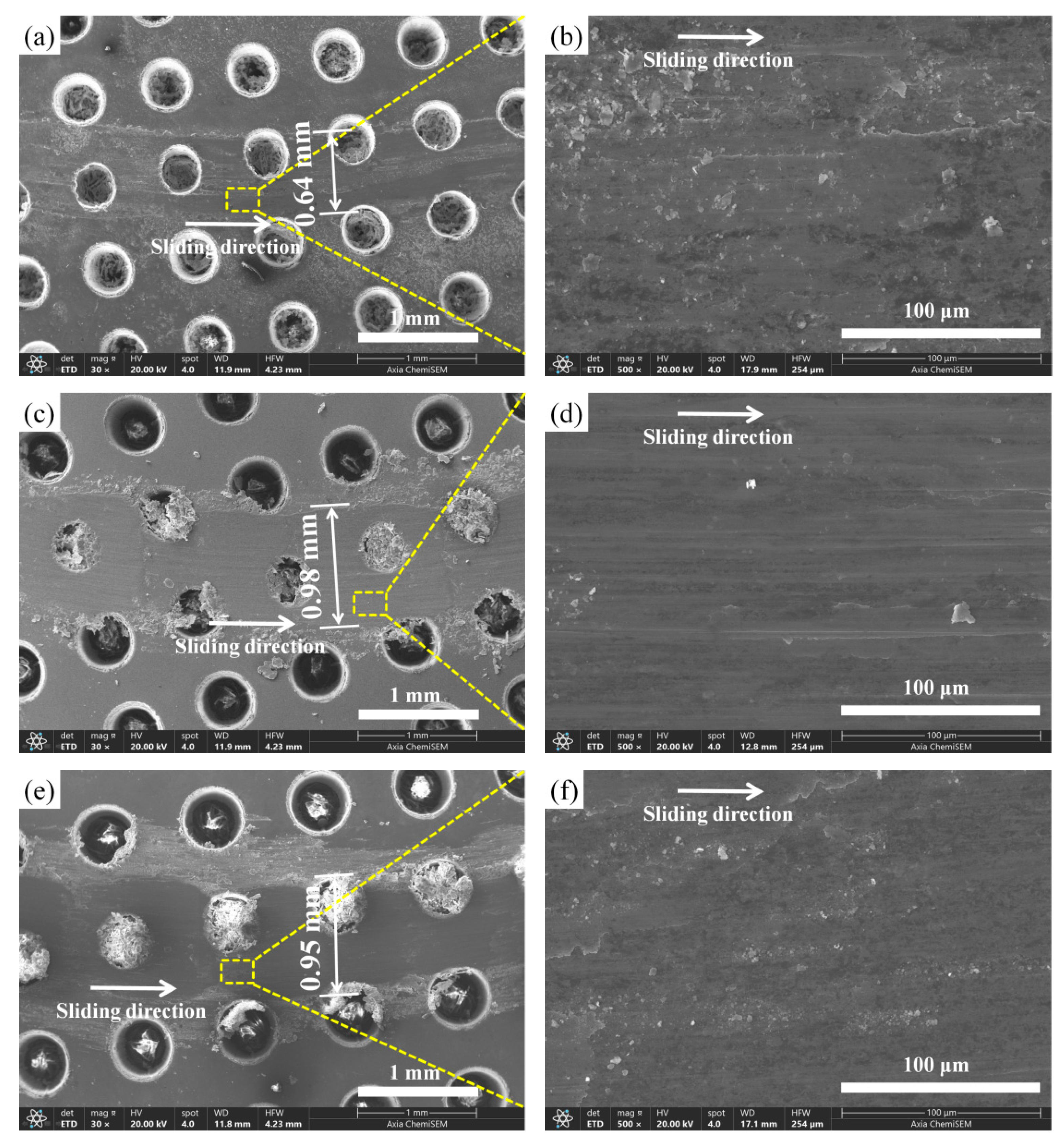
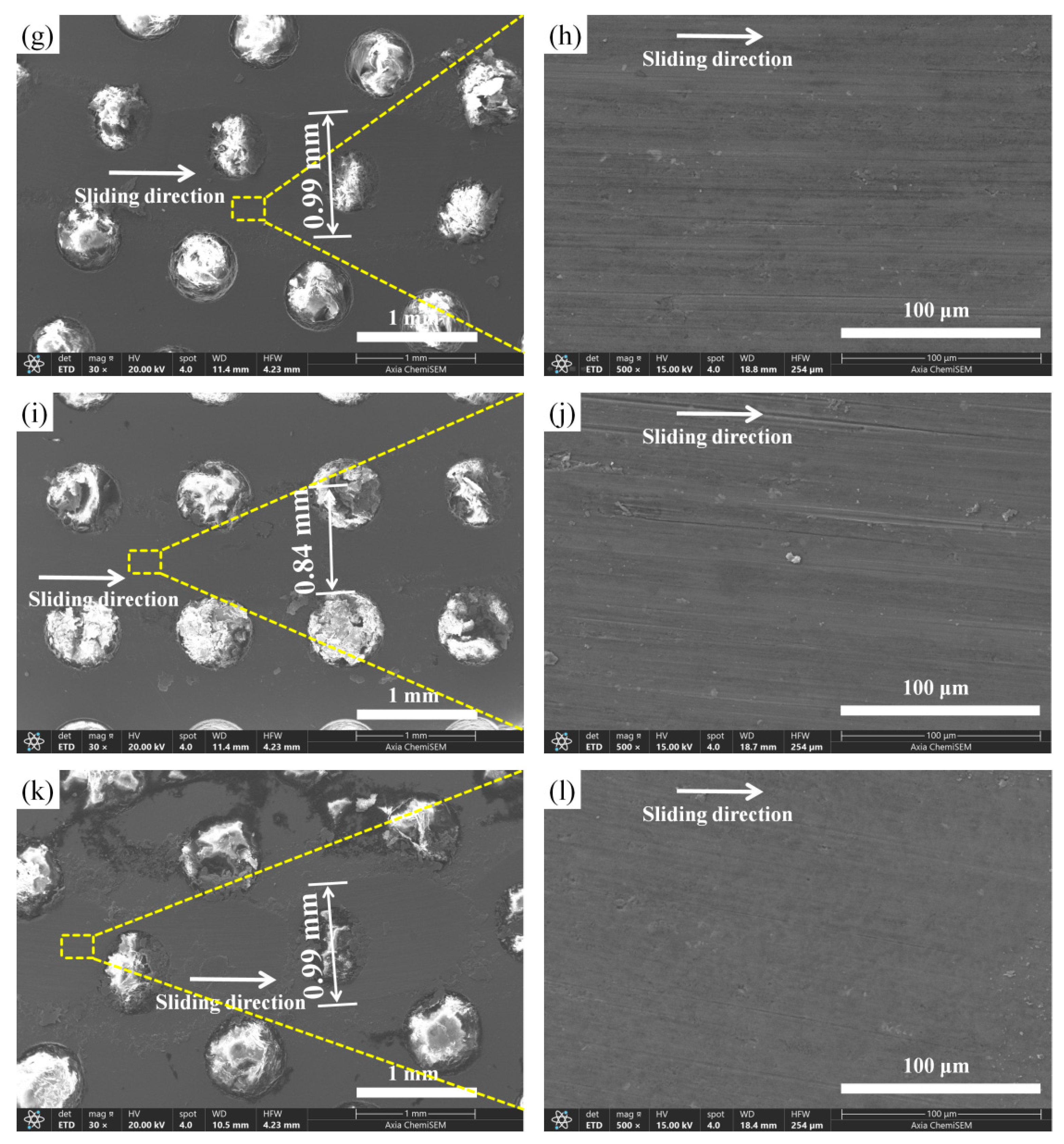
- It was found that increasing the surface density could enhance the hydrodynamic pressure from 245 Pa to 285 Pa, but reduce the contact area so as to lower the load-bearing capacity. As a result, the friction coefficient and wear loss exhibit first a decreasing and then an increasing variation trend. The composite surface with a surface density of 24.2% presents the lowest friction coefficient and wear loss of 0.055 and 2.95 mg.
- (2)
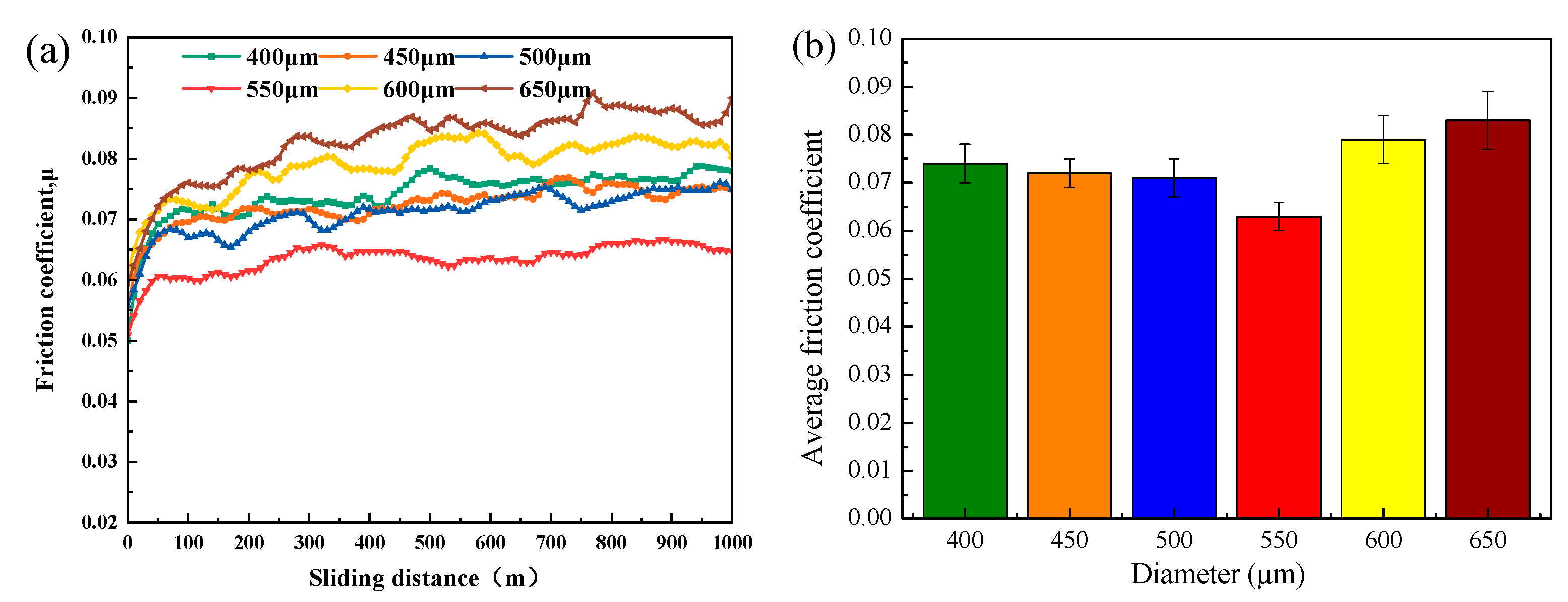
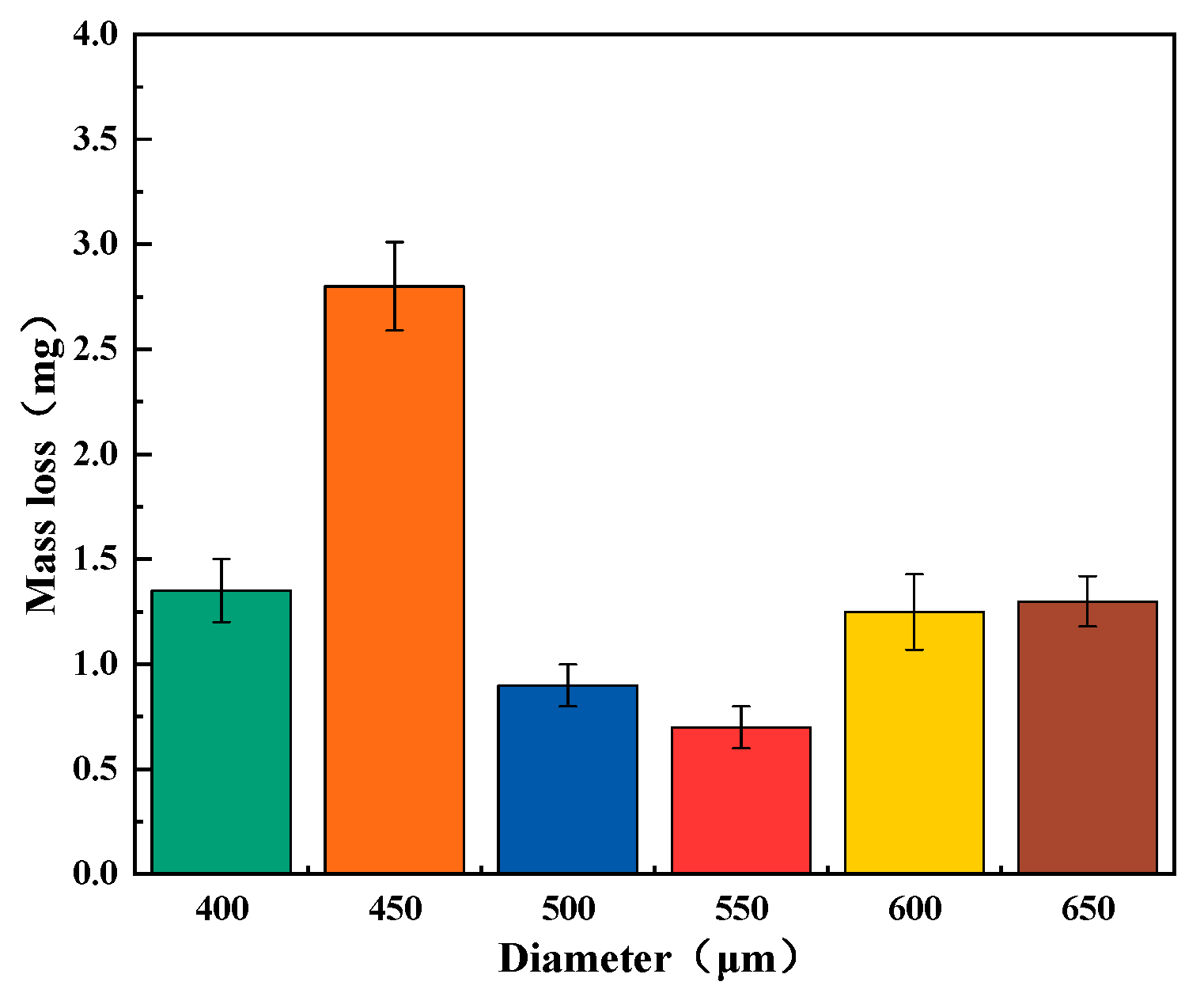
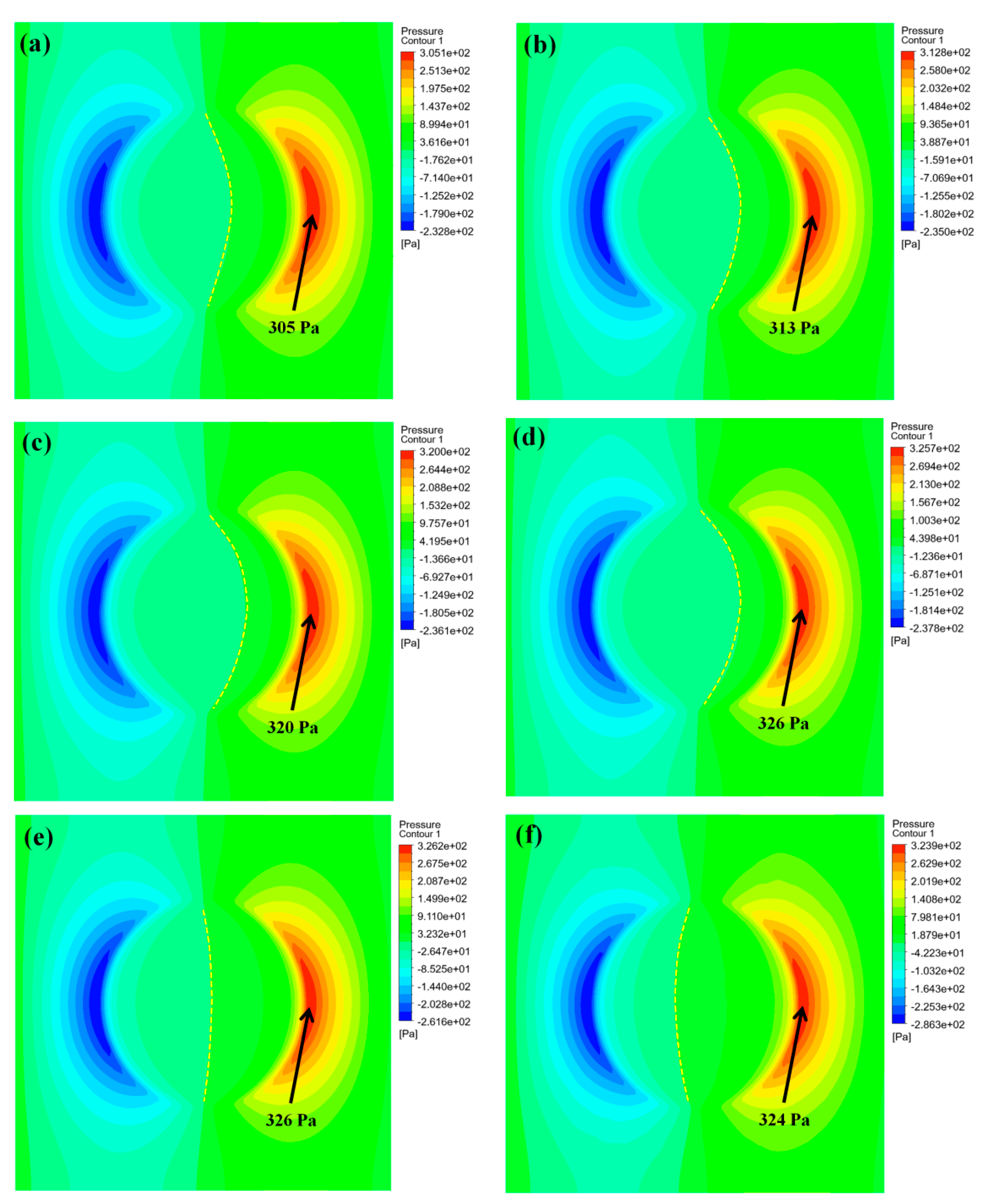
- The increasing circular diameter could enhance the hydrodynamic pressure from 305 Pa to 326 Pa and the debris storage function, but lower the minimum pressure, thus leading to a low average pressure from the hydrodynamic effect. The composite surface with a circular diameter of 550 μm presents the lowest friction coefficient and wear loss of 0.063 and 0.70 mg.
- (3)
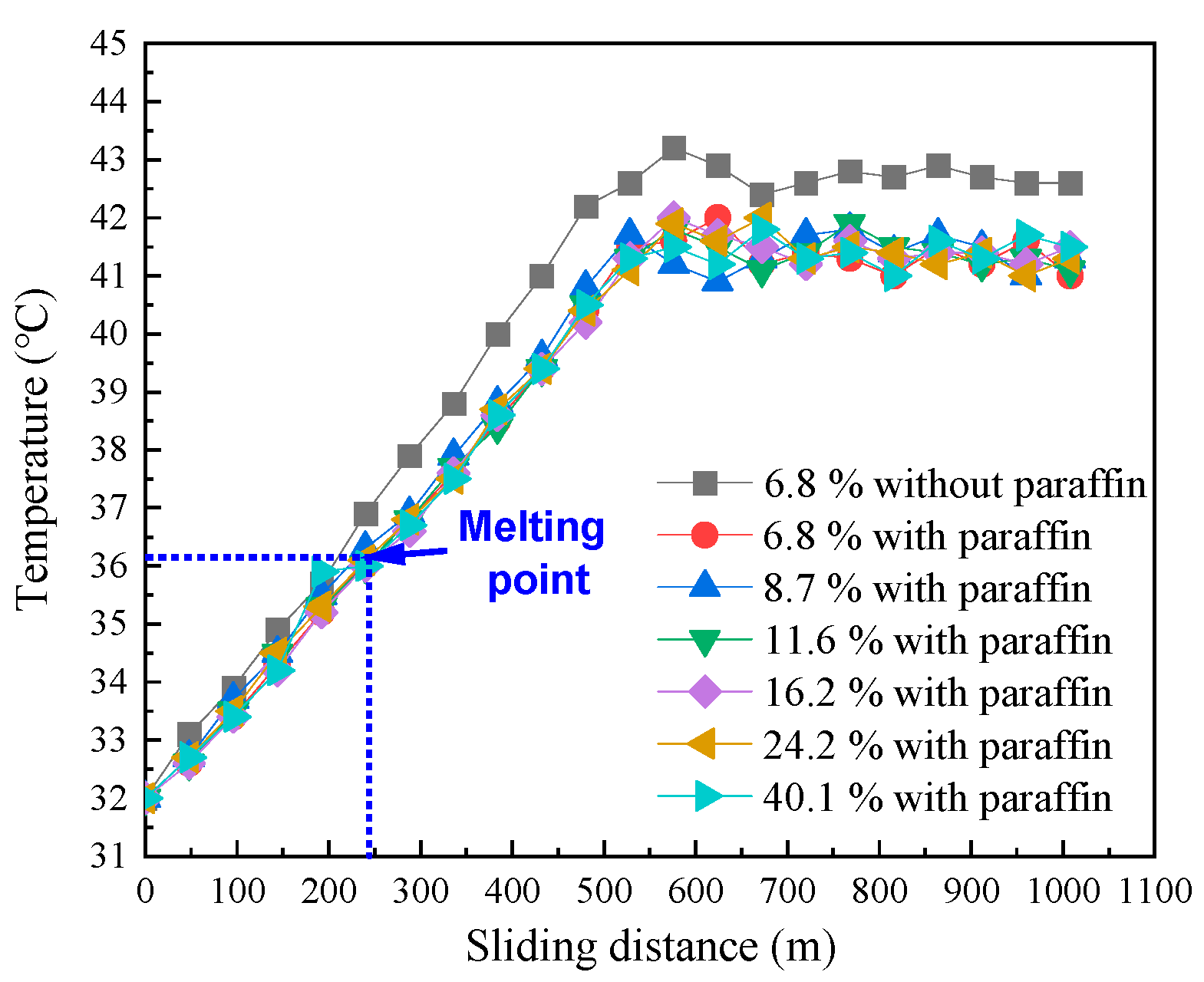
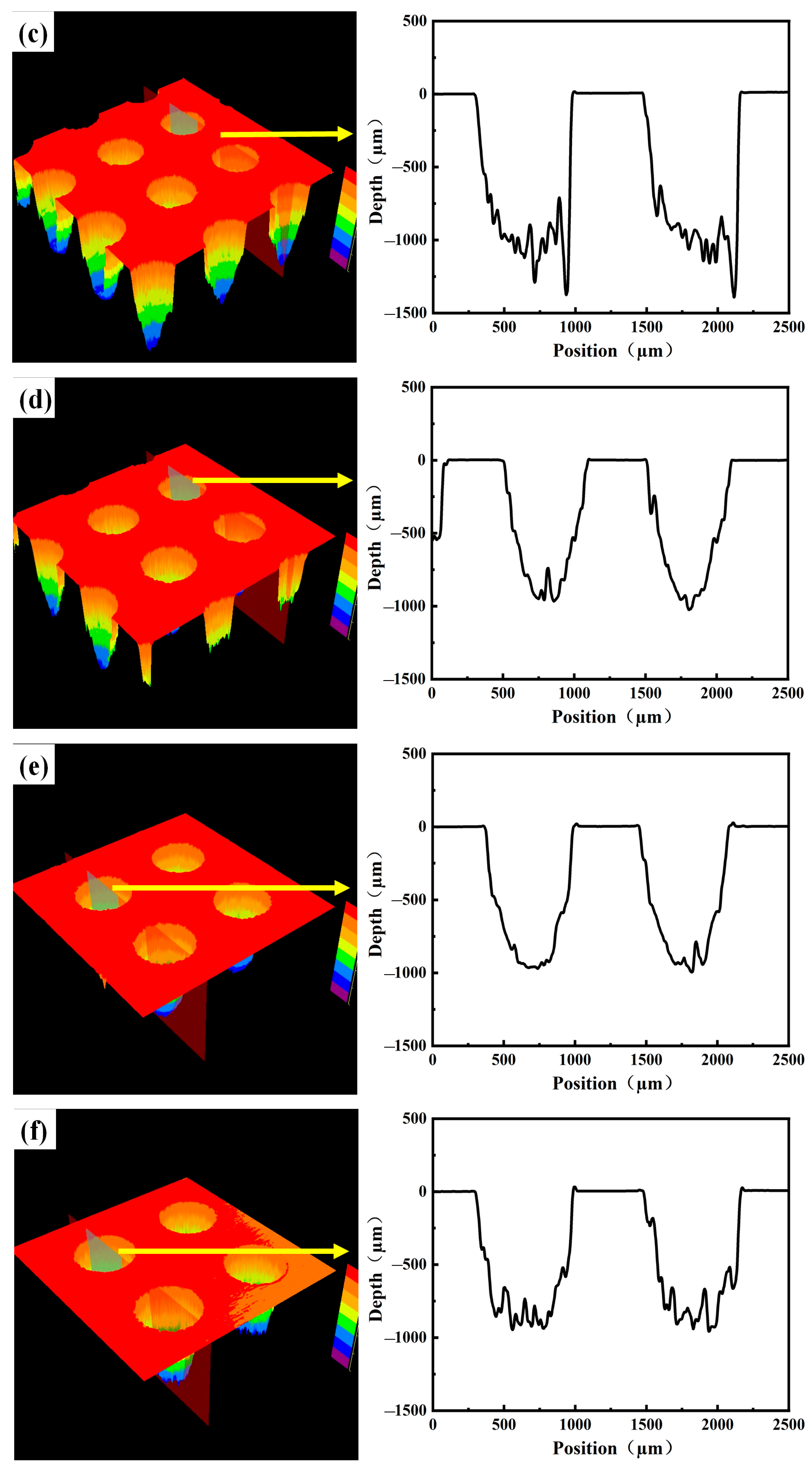
- The greater depth of 1000 μm for circular texture could store more paraffin to enhance the cooling effect. The maximum temperature reduction reaches 2.08 °C.
Author Contributions
Funding
Data Availability Statement
Acknowledgments
Conflicts of Interest
References
- Diyoke, G.; Rath, L.; Chafle, R.; Ben, K.; Semann, B. Numerical Simulation of Friction Extrusion: Process Characteristics and Material Deformation due to Friction. Int. J. Mater. Form. 2024, 17, 26. [Google Scholar] [CrossRef] [Scilit]
- Tong, Z.; Li, S.; Ruan, X.; Bao, H. Comprehensive First-Principles Analysis of Phonon Thermal Conductivity and Electron-Phonon Coupling in Different Metals. Phys. Rev. B 2019, 100, 144306. [Google Scholar] [CrossRef] [Scilit]
- Fernandes, C.; Rocha, D.; Martins, R.; Magalhaes, L.; Seabra, J. Finite Element Method Model to Predict Bulk and Flash Temperatures on Polymer gears. Tribol. Int. 2018, 120, 255–268. [Google Scholar] [CrossRef] [Scilit]
- Yu, J.; Zhu, S.; Yuan, W.; Chen, X.; He, L.; Guo, Q. Investigation on the Friction Heat Generation Rate of Ball Bearings at Ultra-high Rotation Speed. Int. J. Adv. Manuf. Technol. 2023, 128, 57–79. [Google Scholar] [CrossRef] [Scilit]
- Gunda, K.; Narala, R. Evaluation of Friction and Wear Characteristics of Electrostatic Solid Lubricant at Different Sliding Conditions. Surf. Coat. Technol. 2017, 332, 341–350. [Google Scholar] [CrossRef] [Scilit]
- Gao, S.; Xue, W.; Duan, D.; Li, S. Tribological Behaviors of Turbofan Seal Couples from Friction Heat Perspective Under High-Speed Rubbing Condition. Friction 2016, 4, 176–190. [Google Scholar] [CrossRef] [Scilit]
- Tian, H.; Wang, D.; Li, G. Influence of Frictional Power Loss on the Thermo-Mechanical Behavior of a High-Speed Ultra-Precision Machine Tool Spindle Bearing. Lubricants 2026, 14, 182. [Google Scholar] [CrossRef] [Scilit]
- Awwad, K.; Yousif, B.; Fallahnezhad, K.; Saleh, K.; Zeng, X. Influence of Graphene Nanoplatelets on Mechanical Properties and Adhesive Wear Performance of Epoxy-Based Composites. Friction 2021, 9, 856–875. [Google Scholar] [CrossRef] [Scilit]
- Chen, C.; Xie, Y.; Xie, X.; Yan, X.; Huang, R.; Wang, J.; Ren, Z.; Deng, S.; Liao, H. Effects of Substrate Heat Accumulation on the Cold Sprayed Ni Coating Quality: Microstructure Evolution and Tribological Performance. Surf. Coat. Technol. 2019, 371, 185–193. [Google Scholar] [CrossRef] [Scilit]
- Li, D.; Ye, J.; Chen, G.; Hu, L.; Wang, Z.; Qian, T.; Zhang, J.; Zi, M.; Liang, C. Performance Evaluation of a Halbach Permanent Magnet Axial Protection Bearing Under Vertical Magnetic Levitation Flywheel Rotor Drop. Lubricants 2026, 14, 40. [Google Scholar] [CrossRef] [Scilit]
- Wang, Q.; Jin, X.; Zhou, F. Comparison of Mechanical and Tribological Properties of CrBN Coatings Modified by Ni or Cu Incorporation. Friction 2022, 10, 516–529. [Google Scholar] [CrossRef] [Scilit]
- Cong, S.; Li, N.; Zhu, Z.; Wu, L.; Xue, P.; Wang, Z.; Ni, D.; Xiao, B.; Ma, Z. A Comparative Study of Conventional, Dynamic Rotation and Heat-Assisted Friction Stir Welding of Ti-6Al-4V Plates to Reduce Welding Defects. J. Mater. Process. Technol. 2024, 323, 118217. [Google Scholar] [CrossRef] [Scilit]
- Gou, X.; Qi, C.; Chen, D. Nonlinear Dynamic Modelling and Analysis of Gear System with Tooth Contact Temperature. J. Mech. Eng. 2015, 51, 71–77. [Google Scholar] [CrossRef] [Scilit]
- Gao, Q.; Fan, Y.; Wu, Y.; Li, L. A Harmonic Balance-Based Method to Predict Nonlinear Forced Response and Temperature Rise of Dry Friction Systems Including Frictional Heat Transfer. Nonlinear Dyn. 2023, 111, 14263–14291. [Google Scholar] [CrossRef] [Scilit]
- Yang, Y.; Yang, W.; Zhang, B.; Song, Z.; Mi, Z. Influence of Friction Temperature on Radial Crack Formation Inturbine Blade Crown Fins. Acta Aeronaut. Astronaut. Sin. 2025, 46, 292–302. [Google Scholar] [CrossRef]
- Abdullah, O.; Schlattmann, J. Thermal Behavior of Friction Clutch Disc Based on Uniform Pressure and Uniform Wear Assumptions. Friction 2016, 4, 228–237. [Google Scholar] [CrossRef] [Scilit]
- Zhang, Z.; Feng, W.; Lu, W.; Du, X. Preparation and Tribological Properties of Micro-Textured Diamond/WSx Coatings. Surf. Coat. Technol. 2020, 403, 126369. [Google Scholar] [CrossRef] [Scilit]
- Inoue, H.; Kamada, T. Structural Instability of Friction-Induced Vibration by Characteristic Polynomial Plane Applied to Brake Squeal. J. Adv. Mech. Des. Syst. Manuf. 2020, 14, JAMDSM0014. [Google Scholar] [CrossRef] [Scilit]
- Zhao, J.; Zhao, B.; Ding, W.; Wu, B.; Han, M.; Xu, J.; Liu, G. Grinding Characteristics of MoS2-Coated Brazed CBN Grinding Wheels in Dry Grinding of Titanium Alloy. Chin. J. Mech. Eng. 2023, 36, 109. [Google Scholar] [CrossRef] [Scilit]
- Zheng, Y.; Gou, S.; Feng, X.; Wang, K.; Zhao, M.; Zhang, K.; Zhou, H.; Li, L. Microstructure and Vacuum Tribological Properties of Metal Doped MoS2 Composite Films. Mater. Rep. 2025, 39, 46–52. [Google Scholar] [CrossRef]
- Luo, Z.; Liu, T. Preparation and Tribological Properties of AT13/WS2 Composite Coating. J. Anhui Univ. Technol. (Nat. Sci.) 2023, 40, 388–393. [Google Scholar] [CrossRef]
- Tang, Z.; Wang, Z.; Xu, L.; Zhang, L.; Han, Z.; Liu, J. Thermal and Tribological Properties of MoS2 Doped Graphite/Copper Composites by Microwave Sintering. J. Mater. Res. Technol. 2021, 15, 6001–6010. [Google Scholar] [CrossRef] [Scilit]
- Chen, H.; Meng, Z.; Yi, S. Tribological and Heat Transfer Investigation of Graphene Oxide Coatings on Nylon Rotating Bands in an Artillery System. Nanomaterials 2024, 14, 1943. [Google Scholar] [CrossRef] [Scilit] [PubMed]
- Rosenkranz, A.; Marian, M. Combining Surface Textures and MXene Coatings-Towards Enhanced Wear-Resistance and Durability. Surf. Topogr. Metrol. Prop. 2022, 10, 033001. [Google Scholar] [CrossRef] [Scilit]
- Marian, M.; Zambrano, D.; Rothammer, B.; Waltenberger, V.; Boidi, G.; Krapf, A.; Merle, B.; Stampfl, J.; Rosenkranz, A.; Gachot, C. Combining Multi-Scale Surface Texturing and DLC Coatings for Improved Tribological Performance of 3D Printed Polymers. Surf. Coat. Technol. 2023, 466, 129682. [Google Scholar] [CrossRef] [Scilit]
- Xiao, H.; Yang, D.; Ou, Y.; Zhang, J.; Hu, Y.; Ma, L. Laser Texturing to Improve Wear Resistance of 65Mn Steel Rotary Tiller Blades: Effects of Scanning Speed. Lubricants 2005, 13, 224. [Google Scholar] [CrossRef] [Scilit]
- Zhang, H.; Pei, X.; Jiang, X. Anti-Wear Property of Laser Textured 42CrMo Steel Surface. Lubricants 2023, 11, 353. [Google Scholar] [CrossRef] [Scilit]
- Zhang, N.; Li, Z.; Hao, M.; Liu, Y.; Ren, B.; Wang, Z. Numerical Simulation and Experimental Investigation on Tribological Performance of SiC Surface with Squamous Groove Micro Texture. Lubr. Sci. 2022, 34, 547–562. [Google Scholar] [CrossRef] [Scilit]
- Wang, Y.; Liu, Z. Tribological Properties of High Temperature Self-Lubrication Metal Ceramics with an Interpenetrating Network. Wear 2008, 265, 1720–1726. [Google Scholar] [CrossRef] [Scilit]
- Wang, Y.; Yang, Z.; Han, L.; Yang, T.; Wang, S. Wear Behavior and Self Tribofilm Formation of Infiltration-Type TiC/FeCrWMoV Metal Ceramics Under Dry Sliding Conditions. Tribol. Online 2015, 10, 121–126. [Google Scholar] [CrossRef] [Scilit]
- Zhang, Y.; Xing, D.; Liu, Z. The Study of High-Temperature Self-lubricating Materials Pore Structure and Lubricants Driven. Lubr. Eng. 2009, 34, 5–8. [Google Scholar] [CrossRef]
- Wang, J.; Chang, Y.; Chou, H.; Chu, L. A Study on the Properties of Heat Conduction and Tribology for the Pair of Copper and AlN Film with Phase Change Materials. In Proceedings of the 2017 International Conference on Applied System Innovation; IEEE: New York, NY, USA, 2017; pp. 1587–1590. [Google Scholar] [CrossRef] [Scilit]
- Gheisari, R.; Vazquez, M.; Tsigkis, V.; Erdemir, A.; Wooley, K.; Polycarpou, A. Microencapsulated Paraffin as a Tribological Additive for Advanced Polymeric Coatings. Friction 2023, 11, 1939–1952. [Google Scholar] [CrossRef] [Scilit]
- Yin, H.; Wang, Q.; Weng, Z.Y.; Wang, Z.; Zhou, Z. Synergistic Lubrication Mechanism of Friction-Induced Melting of Paraffin on the Textured Surface. J. Tribol. 2025, 148, 024604. [Google Scholar] [CrossRef] [Scilit]
- Yin, H.; Wang, Q.; Wang, C.; Wu, X. Lubrication of Phase Change of Paraffin Driven by Friction Heat and Its Tribological Properties on Texture Surface. Surf. Technol. 2025, 54, 251–262. [Google Scholar] [CrossRef]
- Wang, Q.; Wu, X.; Yin, H.; Zhou, F.; Zhou, Z. Tribology Dependence of Circular Textured Surface on Paraffin and Thermal Conductive Particle Types. Tribol. Int. 2026, 221, 112002. [Google Scholar] [CrossRef] [Scilit]
- Tang, J.; Huang, R.; Huang, S.; Qin, Y.; Fan, H. Analysis and Optimization of Thermoelastohydrodynamic Lubrication Characteristics of Tooth Surfaces with Different Micro-Texture Configurations. Lubricants 2026, 14, 159. [Google Scholar] [CrossRef] [Scilit]
- Amanov, A.; Watabe, T.; Tsuboi, R.; Sasaki, S. Improvement in the Tribological Characteristics of Si-DLC coating by Laser Surface Texturing Under Oil-Lubricated Point Contacts at Various Temperatures. Surf. Coat. Technol. 2013, 232, 549–560. [Google Scholar] [CrossRef] [Scilit]
- Wang, D.; Zhang, W.; Dong, H.; Wei, X.; Hao, W.; Yao, X. Influence of Alumina Abrasive Particles on Wear Behavior of Textured Surfaces Under Heavy-Load Conditions. Lubricants 2025, 13, 553. [Google Scholar] [CrossRef] [Scilit]
- Siddaiah, A.; Kasar, A.; Manoj, A.; Menezes, P. Influence of Environmental Friendly Multiphase Lubricants on the Friction and Transfer Layer Formation During Sliding Against Textured Surfaces. J. Clean. Prod. 2019, 209, 1245–1251. [Google Scholar] [CrossRef] [Scilit]







| Element | Al | Zn | Mg | Cu | Fe | Si | Cr | Mn | Ti |
|---|---|---|---|---|---|---|---|---|---|
| wt% | 89.09 | 5.61 | 2.60 | 1.74 | 0.30 | 0.29 | 0.21 | 0.11 | 0.05 |
| Samples Code | Surface Density/% | Diameter/μm | Depth/μm |
|---|---|---|---|
| S1 | 6.8 | 500 | 500 |
| S2 | 8.7 | 500 | 500 |
| S3 | 11.6 | 500 | 500 |
| S4 | 16.2 | 500 | 500 |
| S5 | 24.2 | 500 | 500 |
| S6 | 40.1 | 500 | 500 |
| D1 | 24.2 | 400 | 1000 |
| D2 | 24.2 | 450 | 1000 |
| D3 | 24.2 | 500 | 1000 |
| D4 | 24.2 | 550 | 1000 |
| D5 | 24.2 | 600 | 1000 |
| D6 | 24.2 | 650 | 1000 |
| Characteristic | Value |
|---|---|
| Density/kg·m−3 (at 293.15 K) | 880 |
| Specific heat/J·kg−1·K−1 | 2000 |
| Thermal conductivity/W·m−1·K−1 | 0.2 |
| Dynamic viscosity/Pa·s (at 310.15 K) | 0.0044 |
| Kinematic viscosity/cSt | 0.571 |
| Thermal expansion coefficient/K−1 | 0.00583 |
| Latent heat of dissolution/J·kg−1 | 262,370 |
| Melting temperature/K | 309.24 |
| Samples Code | S1 | S2 | S3 | S4 | S5 | S6 | D1 | D2 | D3 | D4 | D5 | D6 |
|---|---|---|---|---|---|---|---|---|---|---|---|---|
| Maximum pressure (Pa) | 245 | 252 | 263 | 266 | 285 | 266 | 305 | 313 | 320 | 326 | 326 | 324 |
Disclaimer/Publisher’s Note: The statements, opinions and data contained in all publications are solely those of the individual author(s) and contributor(s) and not of MDPI and/or the editor(s). MDPI and/or the editor(s) disclaim responsibility for any injury to people or property resulting from any ideas, methods, instructions or products referred to in the content. |
© 2026 by the authors. Licensee MDPI, Basel, Switzerland. This article is an open access article distributed under the terms and conditions of the Creative Commons Attribution (CC BY) license.
Share and Cite
Wang, Q.; Yin, H.; Zhou, Z. Tribological Performance Evolution of Circular-Textured Surface Embedded with Paraffin Regulated by Texture Geometric Dimensions. Lubricants 2026, 14, 282. https://doi.org/10.3390/lubricants14070282
Wang Q, Yin H, Zhou Z. Tribological Performance Evolution of Circular-Textured Surface Embedded with Paraffin Regulated by Texture Geometric Dimensions. Lubricants. 2026; 14(7):282. https://doi.org/10.3390/lubricants14070282
Chicago/Turabian StyleWang, Qianzhi, Haofeng Yin, and Zhifeng Zhou. 2026. "Tribological Performance Evolution of Circular-Textured Surface Embedded with Paraffin Regulated by Texture Geometric Dimensions" Lubricants 14, no. 7: 282. https://doi.org/10.3390/lubricants14070282
APA StyleWang, Q., Yin, H., & Zhou, Z. (2026). Tribological Performance Evolution of Circular-Textured Surface Embedded with Paraffin Regulated by Texture Geometric Dimensions. Lubricants, 14(7), 282. https://doi.org/10.3390/lubricants14070282