Article

Micro vs. Nano: Effect of BN Additives on the Rheological and Tribological Properties of Lithium Grease


1
College of Chemistry and Materials Engineering, Zhejiang A&F University, Hangzhou 311300, China
2
Zhejiang Key Laboratory of Green and Low-Carbon Utilization Technology of Agriculture and Forestry Biomass, Hangzhou 311300, China
3
Huzhou Wanma Polymer Materials Co., Ltd., Huzhou 311300, China
*
Authors to whom correspondence should be addressed.
Lubricants 2026, 14(7), 250; https://doi.org/10.3390/lubricants14070250 (registering DOI)
Submission received: 27 May 2026 / Revised: 19 June 2026 / Accepted: 22 June 2026 / Published: 24 June 2026

Abstract

The influence of BN particle size on lithium grease performance was systematically compared among a base grease (Li), a micro-BN (3 µm, 0.1 wt%) modified grease (Li + 0.1% mBN), and a nano-BN (50 nm, 0.1 wt%) modified grease (Li + 0.1% nBN). SEM shows that addition nano-BN leads to a more compact soap fiber networks, whereas micro-BN tends to agglomerate and provides limited reinforcement, leaving the base grease with a loose, porous network. Consequently, Li + 0.1% nBN outperforms both Li and Li + 0.1% mBN in dropping point (199.5 °C vs. 194.9 °C and 198.6 °C), oil separation (0.39% vs. 0.64% and 0.44%), and flow point (49% vs. 45% and 47%). Its plateau modulus is significantly higher, reflecting stronger network entanglement. However, Li + 0.1% nBN shows lower structural recovery (61.0%) than Li (65.8%) and Li + 0.1% mBN (67.2%) due to rigid particle–fiber junctions. Notably, Li + 0.1% mBN exhibits a unique frequency-dependent viscoelasticity: higher tanδ at low frequencies but lower tanδ at high frequencies relative to Li. Tribologically, Li + 0.1% nBN reduces friction coefficient by 35% and wear scar diameter by 12.7% compared with Li, outperforming Li + 0.1% mBN. XPS confirms a protective hybrid tribofilm (BN + organic nitrogen species + iron oxides) on the nano-BN lubricated surface. Particle size critically governs BN–fiber interactions and the resulting rheological and tribological performance.

1. Introduction

Friction and wear are ubiquitous in mechanical systems, consuming approximately one-third of the world‘s primary energy and causing substantial material loss and equipment failure [1,2,3]. Proper lubrication is the cornerstone strategy for minimizing friction-induced energy losses and extending equipment lifetime [4]. As modern machinery advances toward higher precision, heavier loads, longer service life, and more extreme operating conditions, the performance of lubricants has become a critical factor determining operational efficiency, reliability, and safety [5,6].
Among the various forms of lubrication, grease offers distinct advantages over liquid oils. Grease is a semi-solid colloidal dispersion of a thickener (e.g., metal soap fibers) in a base oil [7,8,9]. It does not leak easily, provides better sealing against contaminants, adheres to vertical surfaces, and enables long-term lubrication under harsh conditions such as high temperature, impact loading, or intermittent operation [10]. Lithium-based greases, in particular, are the most widely used general-purpose greases due to their excellent water resistance, mechanical stability, and favorable rheological properties [11,12,13]. However, conventional lithium greases still suffer from oil separation, structural breakdown under high shear, and insufficient extreme-pressure capacity, especially under high-speed or starved lubrication conditions [14,15,16]. Improving these properties without compromising other performance indicators remains a key challenge.
Additive modification is one of the most economical and effective routes to enhance grease performance. By introducing small amounts of solid lubricants or nanomaterials, the microstructure, rheological behavior, and tribological properties of grease can be significantly altered [17]. In particular, nano-sized additives (e.g., graphene [18,19,20,21,22], MoS2 [23,24,25,26], BN [27,28,29,30,31,32,33], CaCO3 [34,35,36,37], SiO2 [38,39,40], Al2O3 [41,42,43], CNT [44,45,46,47]) have attracted growing interest because of their high surface activity, small size effect, and ability to penetrate the friction contact zone, where they can form protective films or trigger tribochemical reactions, thereby reducing friction and wear [48]. For instance, Wang et al. [49] reported that graphene as a grease additive significantly improved antiwear and friction reduction performance under different contact forms by forming a protective deposition film and catalyzing the formation of Fe2O3 and Li2O tribofilms, while its easy shear capability promoted interlayer slip and reduced the friction coefficient.
Among solid lubricant additives, hexagonal boron nitride (h-BN) stands out due to its unique layered crystal structure (similar to graphite), excellent thermal stability (oxidation resistance up to ~800 °C in air), chemical inertness, and high thermal conductivity [50,51,52]. The weak van der Waals forces between BN layers facilitate easy shearing, providing low friction. Compared to conventional extreme-pressure additives containing sulfur or phosphorus, BN is environmentally friendly and does not corrode metals. In recent years, BN has been extensively studied as an additive in liquid lubricants, where it significantly reduces friction and wear in base oils [53,54]. Previous studies have demonstrated that BN nanoparticles can enhance the tribological performance of lithium grease. However, the influence of BN particle size on the microstructural evolution of the soap fiber network, the frequency-dependent viscoelastic response, and the trade-off between network rigidity and structural recovery remains poorly understood. In particular, it is unclear whether micro-BN and nano-BN particles simply differ in dispersion quality or fundamentally alter the fiber-particle interfacial interactions, leading to distinct rheological signatures.
Based on the above background, in this work we prepared three types of lithium greases: a base grease (Li), a micro-BN modified grease (Li + 0.1% mBN), and a nano-BN modified grease (Li + 0.1% nBN), using a high-temperature dispersion–quenching–milling process. The microstructure, physicochemical properties (cone penetration, dropping point, oil separation), rheological behavior (steady shear, strain sweep, frequency sweep), thermal stability (TGA), and tribological performance (four-ball tests) of the three samples were systematically characterized. The main objective is to elucidate how BN particle size influences the soap fiber network of lithium grease and, consequently, the macroscopic performance. The results are expected to provide both mechanistic insights and practical guidance for developing high-performance, long-life BN-based lithium greases.

2. Materials and Methods

2.1. Materials

Micron BN and lithium hydroxide monohydrate (LiOH·H2O, ≧98%) are purchased from the Aladdin Reagent Co., Ltd. (Shanghai, China). Nano BN are purchased from Hebei Metallurgical Research Institute (Shijiazhuang, Hebei, China). 12-hydroxy stearic acid (97%) are purchased from Shanghai Macklin Biochemical Co., Ltd. (Shanghai, China). Mineral oil (Grade: 150N) is provided by Hangzhou Derunbao Grease Co., Ltd. (Hangzhou, China). All reagents were used as received without further purification.

2.2. Preparation of Lithium 12-Hydroxystearic Thickener

The lithium 12-hydroxystearate soap was synthesized via a neutralization titration method. First, 15.0 g of 12-hydroxystearic acid was dissolved in 500 mL of anhydrous ethanol under magnetic stirring until completely dissolved. Separately, 5.0 g of lithium hydroxide monohydrate was dissolved in 400 mL of anhydrous ethanol. After both solutions became clear and transparent, the lithium hydroxide ethanol solution was slowly added dropwise to the 12-hydroxystearic acid solution using a constant-pressure dropping funnel at room temperature under continuous stirring. During the addition, the pH of the reaction mixture was monitored in real time until the system became weakly alkaline (pH approximately 8–9 as indicated by pH test paper) and no obvious phase separation was observed, indicating that the 12-hydroxystearic acid had been completely neutralized and stop dropping the lithium hydroxide ethanol solution, and stirring was continued until a white soap precipitate formed. The resulting mixture was allowed to stand for aging, and then the white solid was collected by vacuum filtration. The product was washed three times with cold ethanol. Finally, the product was dried in a vacuum oven at 100 °C for 12 h. After grinding, a white powder of lithium 12-hydroxystearate thickener was obtained and stored in a desiccator for later use.

2.3. Synthesis of the Greases

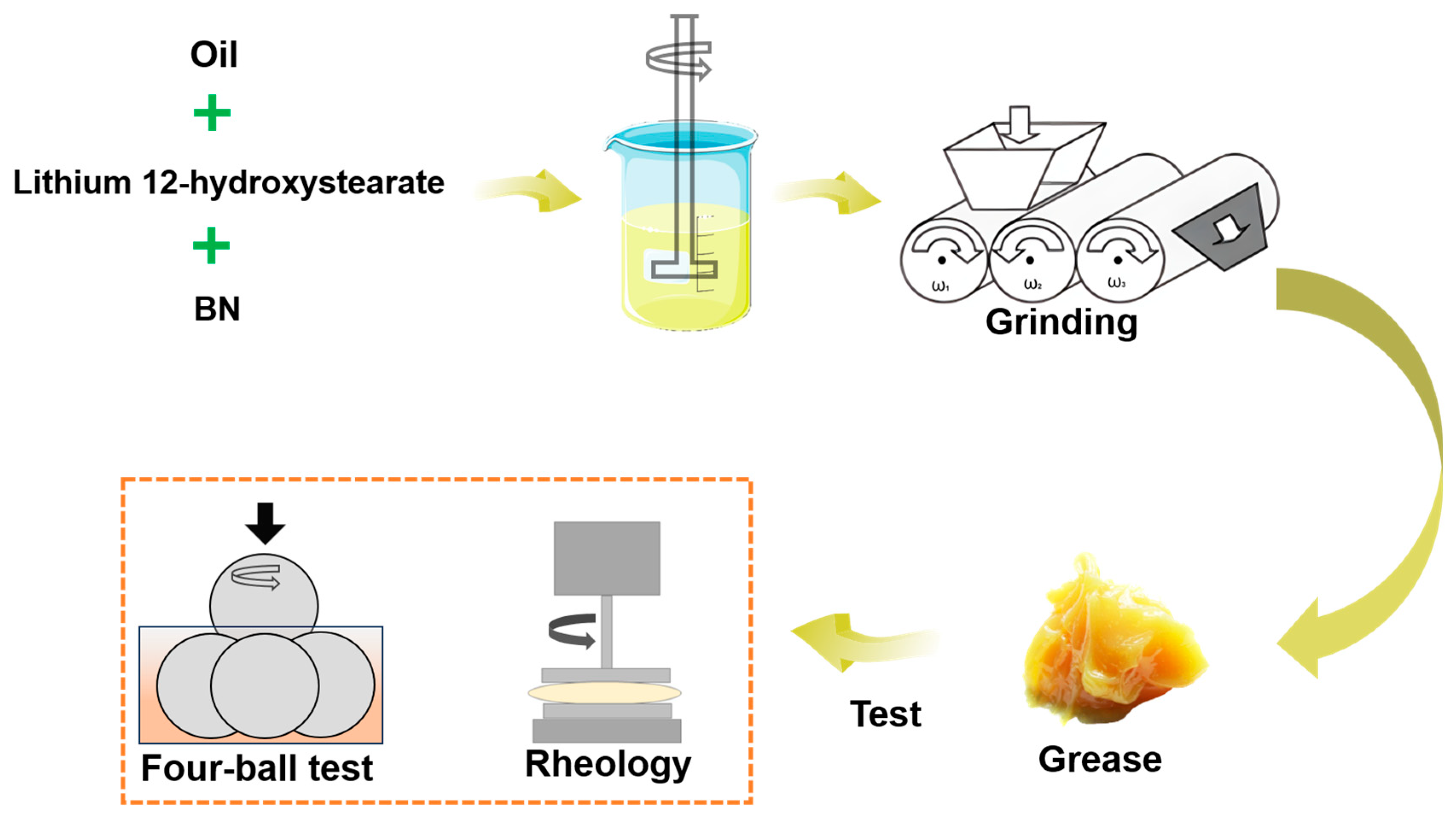
The boron nitride modified grease was prepared via a high-temperature refining method. The specific steps are as follows: exactly 45.0 g of mineral base oil was weighed into a beaker and heated to 150 °C in an oil bath under mechanical stirring (rotation speed of approximately 330 rpm). Next, 4.95 g of the previously prepared lithium 12-hydroxystearate thickener powder and 0.05 g of boron nitride particles (micro-sized or nano-sized, accounting for 0.1 wt% of the total mass) were slowly added to the oil. And the mixture was heated to 210 °C. At this temperature, the thickener completely dissolved and dispersed in the base oil, and the system gradually changed from turbid to a clear sol state. The mixture was held at 210 °C for 30 min to ensure full swelling of the soap fibers and the formation of a stable network. The reaction vessel was then quickly removed from the oil bath and quenched to room temperature in an ethanol bath, allowing the soap fiber structure to be instantly fixed and the base oil to be partially released, forming a gel-like grease. The cooled sample was subjected to homogenization: the grease was transferred to a three-roll mill and milled three times until a fine, uniform, smooth paste was obtained. The resulting boron nitride modified lithium grease was designated as Li-0.1% mBN (for micro-BN) or Li-0.1% nBN (for nano-BN). The base grease was prepared following the same procedure without the addition of BN. The schematic diagram is shown in Figure 1.

2.4. Characterization

The scanning electron microscopy (SEM, Hitachi SU 8010, Tokyo, Japan) was used to observe the morphology of lithium soap. The lithium soap was ahead extracted from the colloid system of grease by petroleum ether. The transmission electron microscope (TEM, JEOL JEM-2100F, Tokyo, Japan) was employed to observe the size of BN particles. The thermal stability of the greases was evaluated using a TA Q500 thermogravimetric analyzer (TA Instruments, New Castle, DE, USA) under N2 atmosphere by heating from 30 to 800 °C with a ramp rate of 10 °C/min. The X-ray photoelectron spectroscopy (XPS, Thermo Scientific ESCALAAB 250Xi, Waltham, MA, USA) was employed to investigate the elemental compositions of wear scar surfaces.

2.5. Physicochemical Measurement

The cone penetration of the greases was determined using a lubricating grease cone penetrometer (SYD-2801 C, Shanghai Changji Geological Instrument Co., Ltd., Shanghai, China) following ASTM D217. The dropping point was measured with a drop point tester (WQD-1A, Shanghai INESA Physico-Optical Instrument Co., Ltd., Shanghai, China) in accordance with ASTM D566. The oil separation rate was evaluated by the cone net method as specified in NB/SH/T 0324-2010.

2.6. Rheological Measurement

The rheological behavior of the greases was characterized using a rotational rheometer (ARES-G2, TA Instruments, New Castle, DE, USA) equipped with parallel plates (25 mm diameter, 1 mm gap). Dynamic viscosity was measured under rotational mode over a shear rate range of 0.1–100 s−1. A recovery test was performed to examine the influence of strain on viscoelasticity, consisting of three consecutive phases: first, a strain of 0.01% (within the linear viscoelastic region) was applied for 300 s; second, the sample was subjected to a strain of 5% for another 300 s; finally, the conditions were returned to those of the initial phase. Viscoelastic properties were evaluated via oscillation mode by applying a shear strain of 0.01–100% and an angular frequency of 10 rad/s. Small amplitude oscillatory shear (SAOS) tests were conducted at angular frequencies from 0.01 to 100 rad/s with a shear strain of 0.01%.

2.7. Tribological Measurement

A four-ball tester (Hengxu SGW-10A, Jinan HengXu Testing Machine Technology Co., Ltd., Jinan, Shandong, China) was used to evaluate the tribological properties of the greases. In the four-ball configuration, the upper ball was fixed to the spindle and rotated against three identical stationary balls under a load of 147 N, a rotational speed of 1200 r/min, and a test duration of 3600 s. The wear scar diameter (WSD) was measured using the built-in optical microscope with a precision of 0.001 mm. To minimize experimental error, each test was repeated three times under identical conditions. The extreme pressure properties of greases were evaluated in accordance with the GB/T 3142-2019 standard [55]. For each sample, the upper ball was rotated at 1450 ± 50 r/min at 25 °C for 10 s under a gradually increased load until welding occurred. Triplicate measurements were performed at each load to determine the last non-seizure load (PB) and the weld point (PD). The PB is defined as the highest applied load at which no seizure occurs, while the PD is the lowest load at which welding takes place.

3. Results and Discussion

3.1. Characterization and Physicochemical Properties

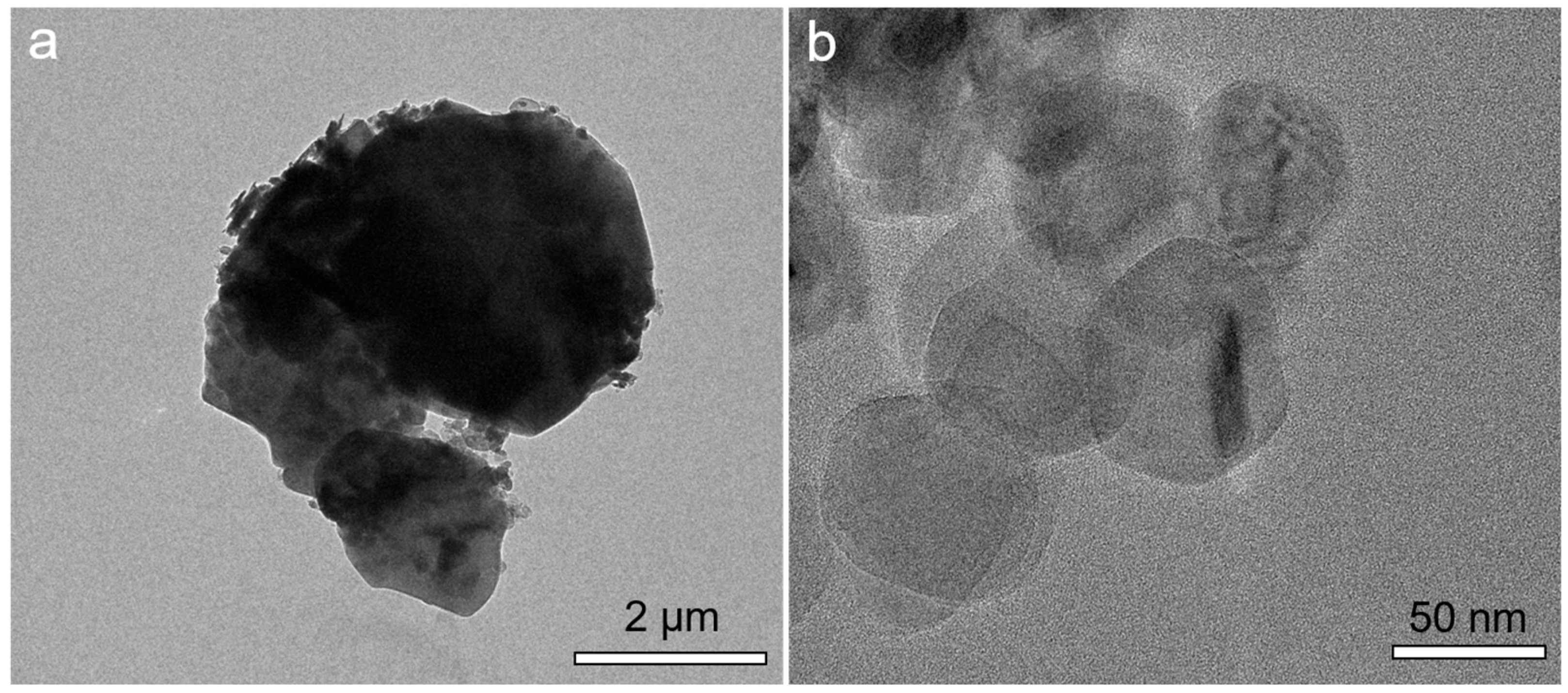
The morphologies and sizes of the BN particles were characterized by TEM, as shown in Figure 2. Figure 2a reveals that the micro-BN (mBN) particles exhibit irregular flake-like shapes with lateral dimensions around 3 µm, consistent with the supplier’s specification. In contrast, the nano-BN (nBN) particles (Figure 2b) display a more uniform granular morphology with sizes around 50 nm. The significant difference in particle size between the two BN additives is expected to influence their dispersion behavior, interfacial interactions with the soap fibers, and ultimately the rheological and tribological properties of the resulting greases.
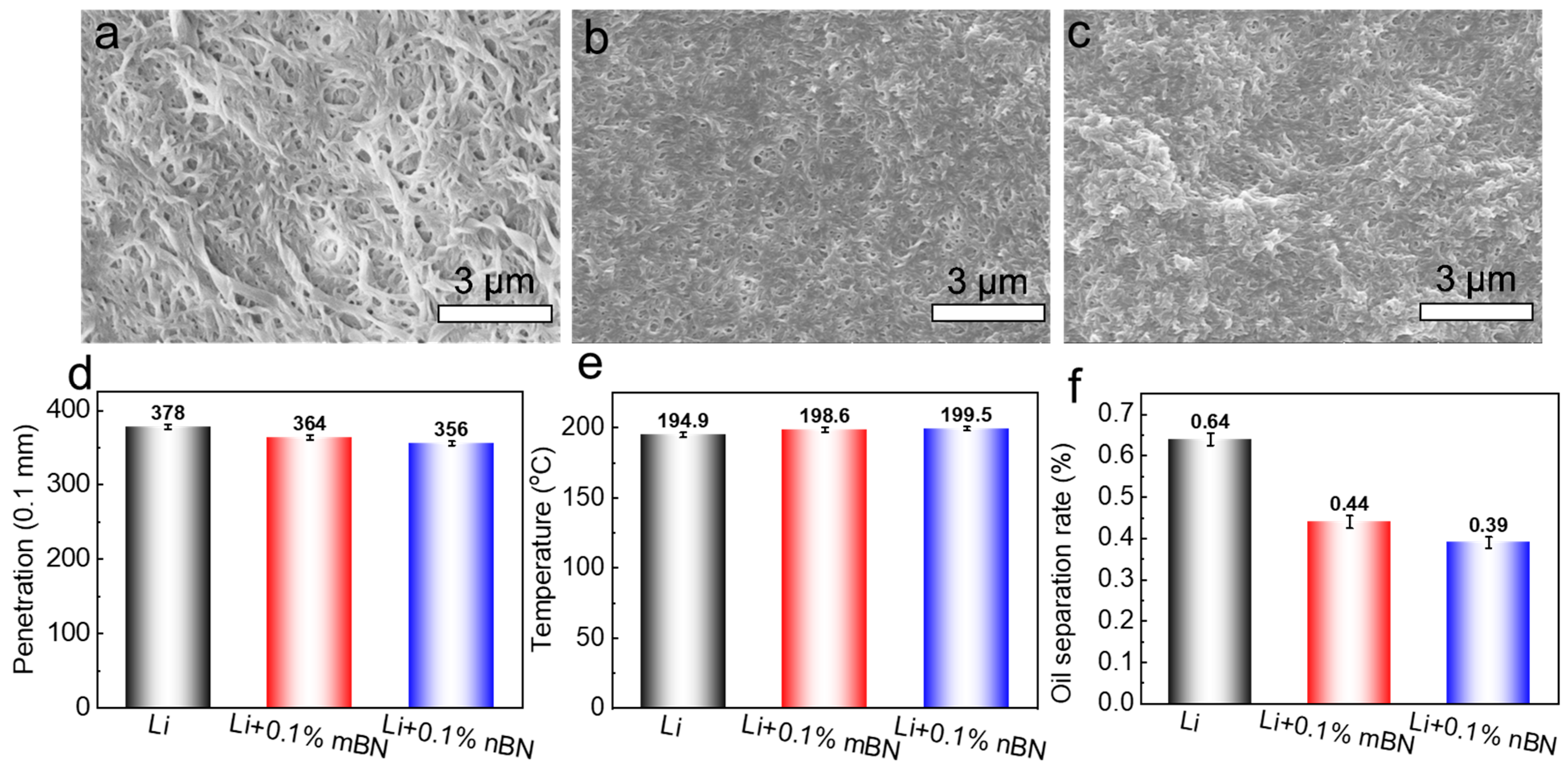
The morphology of the lithium soap fibers was examined by SEM, and the corresponding physicochemical properties (cone penetration, dropping point, and oil separation rate) are presented in Figure 3. As shown in Figure 3a, the base grease (Li) exhibits a relatively loose and porous soap fiber network with irregular voids. After adding micro-BN (Li + 0.1% mBN, Figure 3b), the fiber network becomes somewhat more compact, although some localized agglomerates of BN particles are still observable. In contrast, the nano-BN modified grease (Li + 0.1% nBN, Figure 3c) displays a dense and uniform fiber-particle composite network, significantly enhancing the network integrity. These microstructural differences directly translate into the macroscopic physicochemical properties. The cone penetration decreases from 378 for the base grease to 364 for Li + 0.1% mBN and further to 356 for Li + 0.1% nBN, indicating increased consistency (Figure 3d). The dropping point rises from 194.9 °C (Li) to 198.6 °C (Li + 0.1% mBN) and 199.5 °C (Li + 0.1% nBN), reflecting improved thermal resistance (Figure 3e). The oil separation rate drops from 0.64% (Li) to 0.44% (Li + 0.1% mBN) and 0.39% (Li + 0.1% nBN), demonstrating better colloidal stability (Figure 3f).
The superior performance of the nano-BN modified grease can be attributed to its ability to form a compact “fiber–particle” network, which physically restricts oil migration and raises the thermal collapse temperature of the thickener structure. Conversely, the micro-BN particles, due to their larger size and weaker interfacial interaction, provide only limited reinforcement.
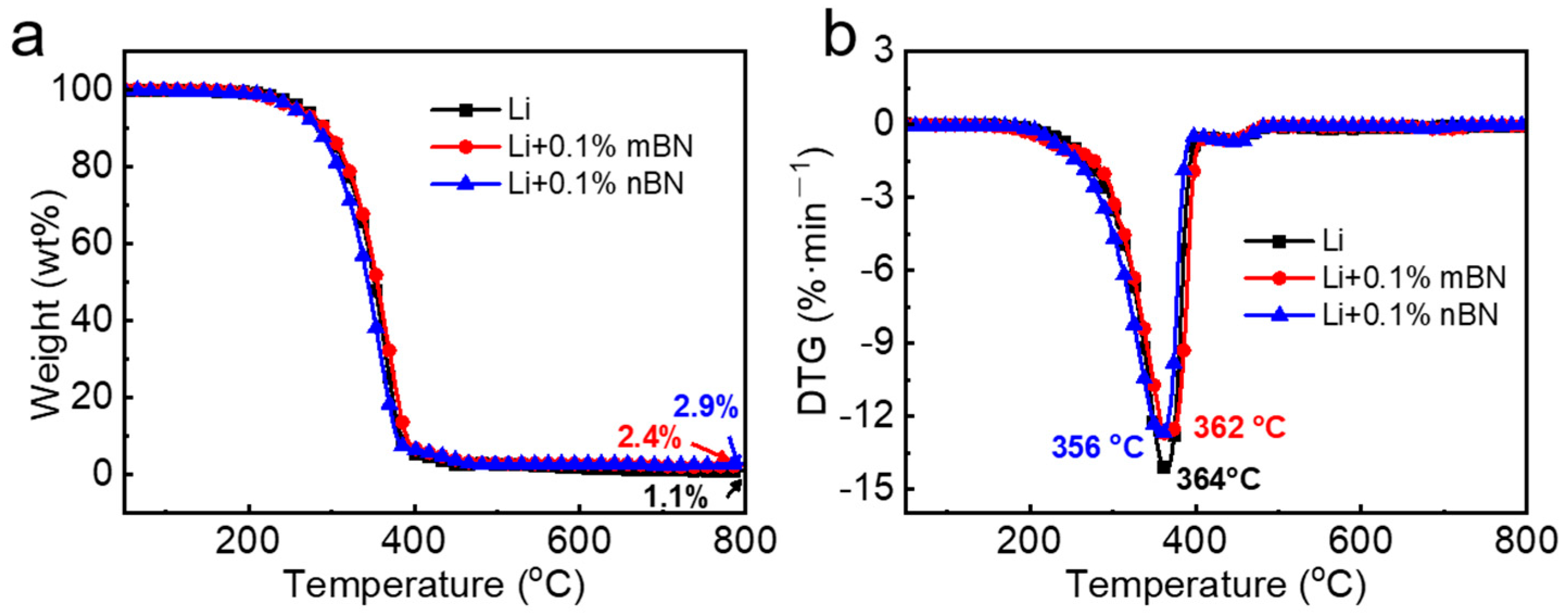
The thermal stability of the greases was evaluated by TGA under N2 atmosphere (Figure 4), and the relevant data are listed in Table 1. Compared to the base grease (Li), the BN-modified greases exhibited slightly lower initial decomposition temperature (T5%) and maximum decomposition temperature (Tmax), which may be attributed to the high surface energy of BN nanoparticles, which could promote localized degradation initiation. In contrast, the residual char yield (Yc) increased significantly with BN addition, especially for nano-BN (Li + 0.1% nBN: 2.9% vs. 1.1% for base grease). This enhancement is ascribed to the thermal stability of BN particles and the formation of a compact fiber–particle network that hinders complete volatilization. Overall, nano-BN improves the high-temperature structural integrity of lithium grease.

3.2. Rheological Properties

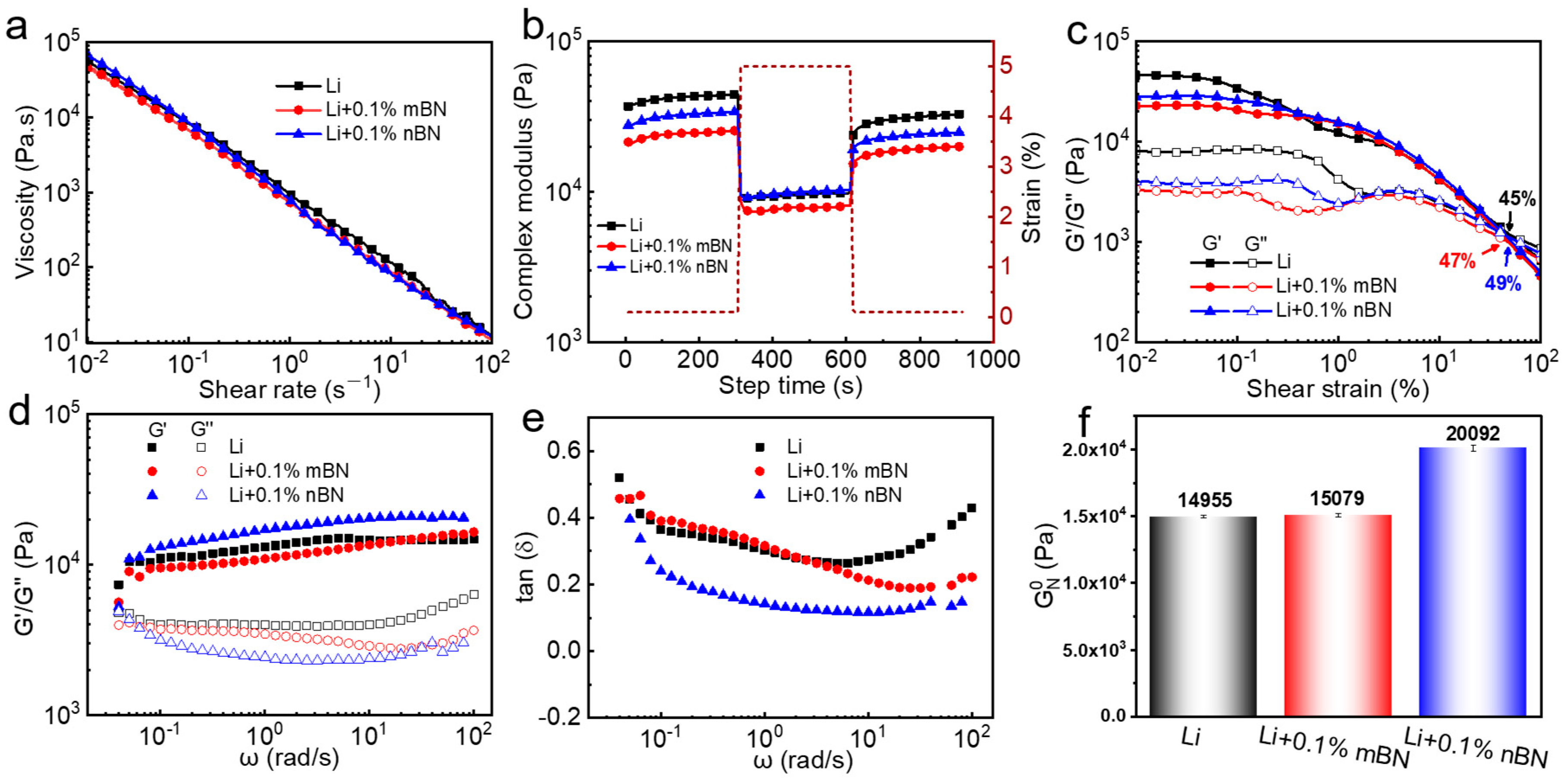
The rheological behavior of the three greases was systematically characterized, as shown in Figure 5.
Steady shear behavior (Figure 5a): All greases exhibit typical shear-thinning (pseudoplastic) behavior, with viscosity decreasing sharply from ~80,000 Pa·s at low shear rates to ~4000 Pa·s at 100 s−1. However, the three viscosity curves nearly overlap, indicating that the addition of BN at 0.1 wt% does not significantly alter the steady-shear viscosity. This suggests that under continuous flow, the BN particles have limited contribution to the macroscopic viscosity.
Structural recovery (Figure 5b): Structural recovery tests were performed to evaluate the ability of the grease to rebuild its internal network after large deformation. A three-step protocol was applied: first, a low strain (0.01%, within the linear viscoelastic region) was applied for 300 s to establish the initial complex modulus (G*); second, a high strain (5%) was applied for 300 s to deliberately disrupt the soap fiber network; finally, the strain was reduced back to 0.01% for another 300 s, during which the recovery of G* was monitored. The G* is a key rheological parameter that characterizes the viscoelastic behavior of greases. It reflects the combined contributions of the storage modulus (G′) and loss modulus (G″), and can be calculated by Equation (1). The extent of structural destruction and recovery during this process can be quantitatively assessed using Equations (2) and (3) [56,57], and the relevant results are shown in Table 2.
G * = G 2 + G 2
Destruction = G 0 * G 1 * G 0 * × 100
Recovery = G 2 * G 1 * G 0 * G 1 * × 100
The base grease (Li) shows a destruction rate of 77.7% and a recovery rate of 65.8%. Li + 0.1% mBN exhibits a lower destruction rate (67.7%) but a slightly higher recovery rate (67.2%), indicating that micro-BN particles reduce the extent of network disruption, possibly by acting as physical barriers. However, Li + 0.1% nBN shows a destruction rate of 69.4% and a recovery rate of only 61.0%, which is lower than that of the base grease. This seemingly inferior recovery of nano-BN might be explained by the strong interfacial adhesion between nano-BN and soap fibers, which, while enhancing the initial network strength, also imposes greater resistance to re-entanglement after severe disruption. The rigid particle–fiber junctions may partially restrict the reformation of the original network topology, leading to a lower recovery percentage despite a lower destruction rate. Overall, nano-BN provides superior initial rigidity but compromises full structural recovery after large deformation, whereas micro-BN offers a balanced improvement in both destruction resistance and recovery.
Strain sweep (Figure 5c): Strain sweep results show that the storage modulus (G′) remains constant at low strains within the linear viscoelastic region (LVR), then decreases beyond a critical strain, indicating progressive network breakdown [58]. The flow point, defined as the strain at which G′ = G″, marks the transition from solid-like to liquid-like behavior. For the base grease (Li), the flow point is approximately 45%. Both BN-modified greases exhibit higher flow points: Li + 0.1% mBN reaches 47%, while Li + 0.1% nBN reaches 49%. This demonstrates that BN particles, regardless of size, delay structural collapse, with nano-BN providing the greatest enhancement. The improvement originates from physical reinforcement of the soap fiber network. Micro-BN particles, though larger and less integrated, act as physical barriers that modestly restrict fiber disentanglement under strain. In contrast, nano-BN particles uniformly coat or embed within the soap fibers, forming a dense “fiber–particle” composite network with abundant additional crosslinking points. This robust structure enables the nano-BN grease to withstand larger deformation before catastrophic failure, consistent with its highest flow point.
Frequency sweep (Figure 5d–f): In the frequency sweep tests, all greases exhibit G′ > G″ over the entire angular frequency range, confirming solid-like elastic behavior [59]. The nano-BN modified grease (Li + 0.1% nBN) shows the highest G′ and the lowest tanδ across all frequencies, demonstrating the strongest network reinforcement, consistent with its dense fiber–particle composite morphology (Figure 3c). For the micro-BN modified grease (Li + 0.1% mBN), the tanδ exhibits a clear frequency-dependent crossover relative to the base grease. At low frequencies (0.1–1 rad/s), tanδ of Li + 0.1% mBN is higher than that of the base grease, indicating a more pronounced viscous contribution. This behavior can be attributed to the relatively large size of micro-BN particles, which act as physical defects or local stress concentrators within the soap fiber network. Under slow oscillatory deformation, these particles facilitate localized sliding or disentanglement of soap fibers, leading to increased energy dissipation. In contrast, at high frequencies (>10 rad/s), tanδ of Li + 0.1% mBN becomes lower than that of the base grease, implying an enhanced elastic response. This transition likely arises from the inability of the larger micro-BN platelets to fully relax within the short oscillation period; they become dynamically trapped, thereby reinforcing the network under rapid deformation. Such frequency-dependent behavior is not observed for the nano-BN grease, where the much smaller particles are more uniformly integrated into the fiber network and respond consistently across frequencies.
The plateau modulus ( G N O ) is a characteristic rheological parameter derived from the frequency sweep in the linear viscoelastic region, typically taken as the value of the storage modulus (G′) at the frequency where tanδ reaches a minimum or within the rubbery plateau region [60]. It reflects the entanglement density and the strength of the physical crosslinking network in viscoelastic materials, such as grease. A higher G N O indicates a more tightly connected and structurally robust network. Figure 5f shows that Li + 0.1% mBN and the base grease (Li) have comparable values, whereas Li + 0.1% nBN exhibits a significantly higher G N O . This indicates that the static network connectivity of the micro-BN grease is similar to that of the base grease, suggesting that the addition of 0.1 wt% micro-BN does not substantially alter the overall entanglement density of the soap fibers. The micro-BN particles, being larger and less interactive with the fibers, simply occupy interstitial spaces without forming strong junctions, thus neither enhancing nor severely disrupting the network. In contrast, nano-BN particles, due to their high surface area and strong interfacial adhesion, actively participate in the fiber network, creating additional crosslinking points and a more rigid structure. This reinforcement is reflected in the significantly higher plateau modulus of the nano-BN grease. Overall, nano-BN is superior for static and low-frequency network reinforcement, while micro-BN offers a unique frequency-adaptive rheological response—more dissipative at low frequencies but more elastic at high frequencies—with a static network strength comparable to that of the base grease.

3.3. Tribological Properties

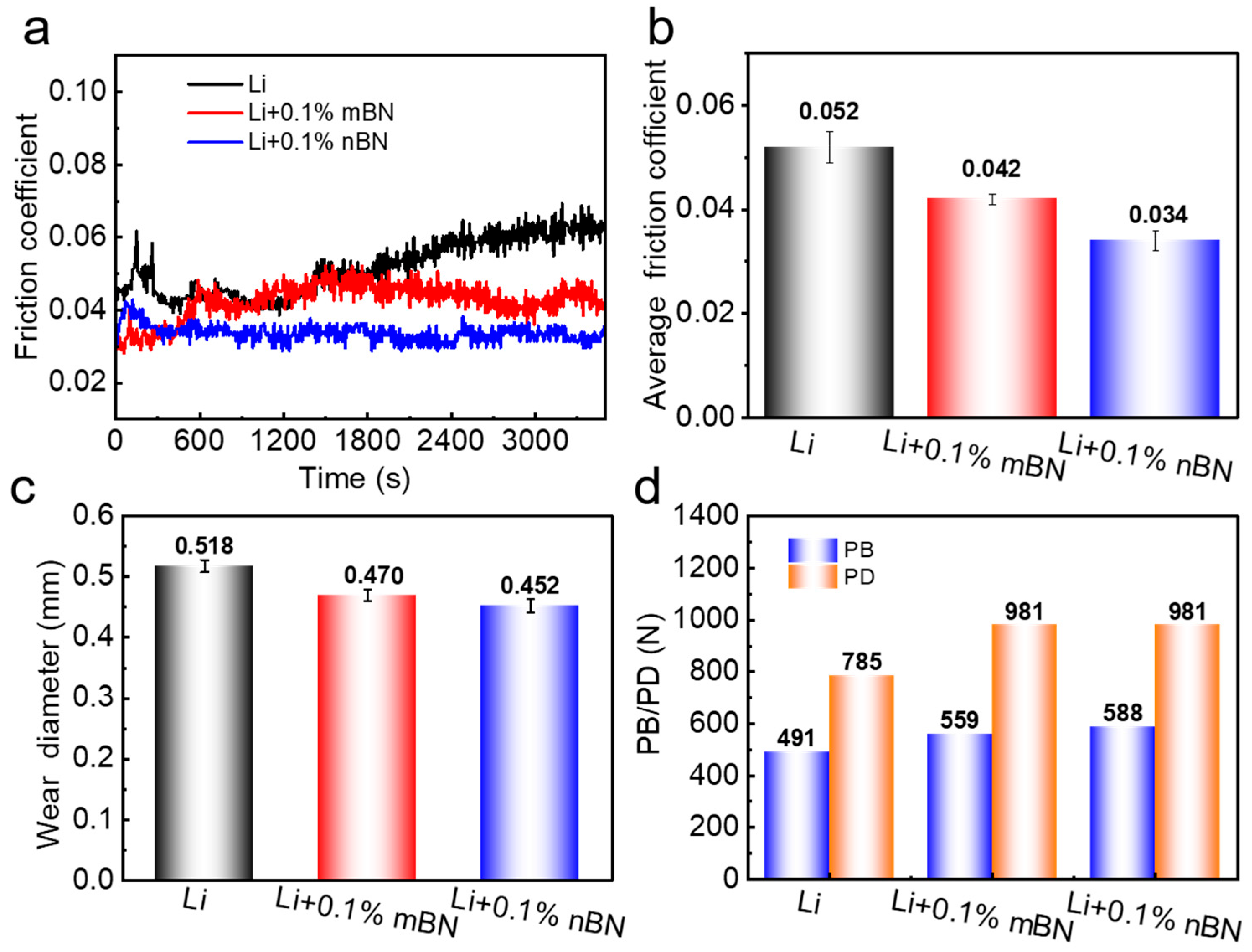
The tribological performance of the three greases was evaluated using a four-ball tester, and the results are summarized in Figure 6. As shown in Figure 6a, the base grease (Li) exhibits the highest friction coefficient with significant fluctuations, indicating unstable lubricant film formation under boundary lubrication conditions. In contrast, the BN-modified greases show lower and more stable friction curves, especially for Li + 0.1% nBN, which maintains the lowest and smoothest friction coefficient throughout the test. The average friction coefficients (Figure 6b) are 0.052, 0.042, and 0.034 for Li, Li + 0.1% mBN, and Li + 0.1% nBN, respectively. The wear scar diameters (WSD, Figure 6c) follow the same trend: 0.518 mm (Li), 0.470 mm (mBN), and 0.452 mm (nBN). The nano-BN modified grease achieves a 12.7% reduction in WSD compared to the base grease. The improved anti-wear and friction-reducing performance can be attributed to the formation of a protective BN-rich tribofilm on the steel surfaces, which prevents direct metal-to-metal contact. Moreover, the layered structure of BN facilitates easy shearing, contributing to low friction. The extreme-pressure properties (Figure 6d) show that both PB (last non-seizure load) and PD (weld point) increase upon BN addition, with nano-BN exhibiting the highest values. This further confirms that nano-BN effectively enhances the load-carrying capacity of lithium grease, likely due to its uniform dispersion and strong interfacial adhesion to the soap network, which enables continuous delivery of BN particles into the contact zone. Overall, nano-BN demonstrates superior tribological performance compared to micro-BN, making it a promising additive for high-performance lithium greases.
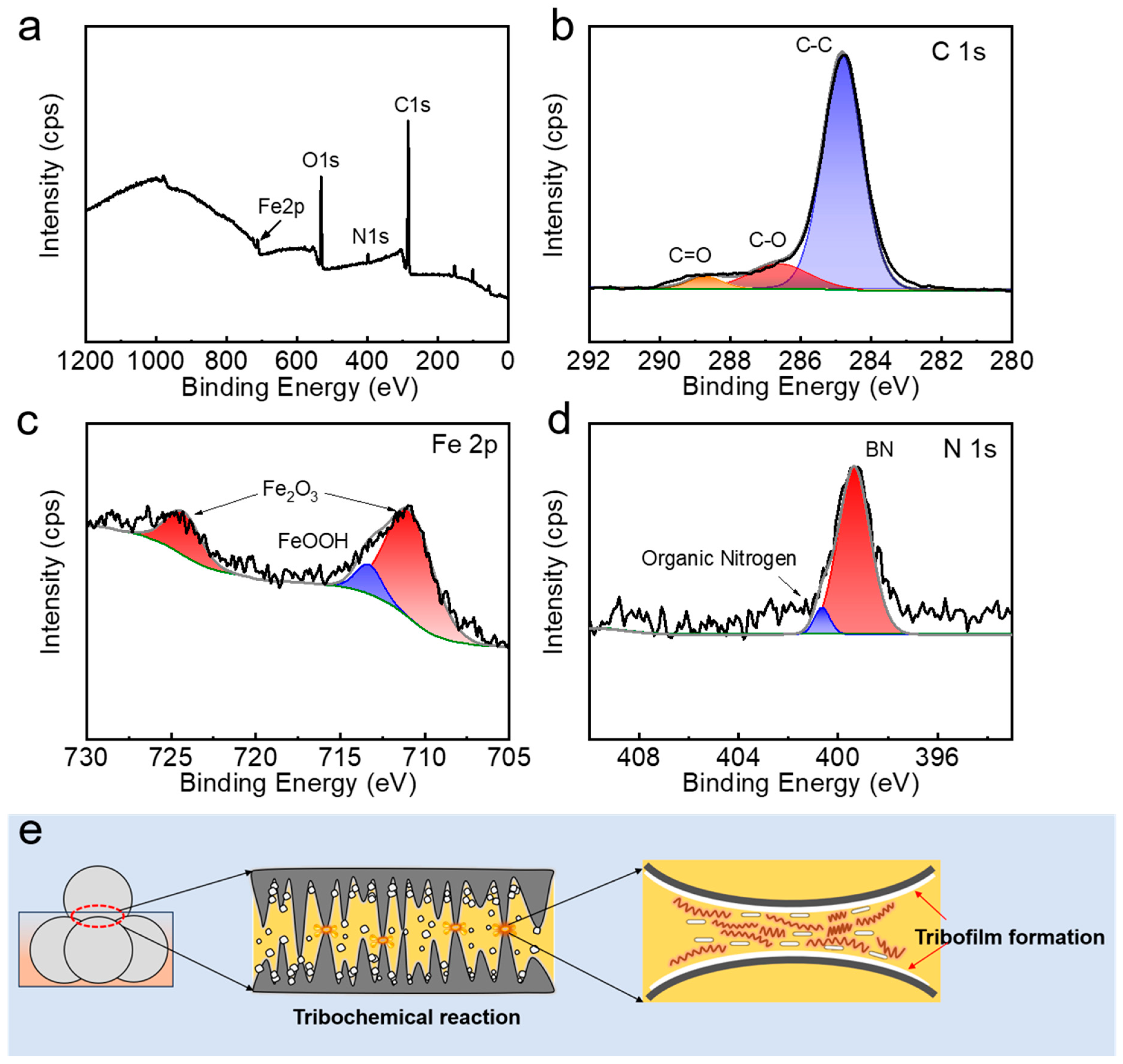
To further elucidate the lubrication mechanism of the BN-modified greases, XPS analysis was performed on the wear scars of steel balls lubricated by Li + 0.1% nBN, which exhibited the best tribological performance. The survey spectrum (Figure 7a) shows characteristic peaks of C 1s, O 1s, Fe 2p, and N 1s, indicating the presence of organic species, iron oxides, and BN-derived species on the worn surface. The high-resolution C 1s spectrum (Figure 7b) can be deconvoluted into three components: C–C at 284.8 eV, C–O at 286.6 eV, and O–C=O at 288.7 eV [61], which originate from the base oil and thickener residues adsorbed on the surface. The Fe 2p spectrum (Figure 7c) exhibits peaks at 711.1 eV (Fe 2p3/2) and 724.6 eV (Fe 2p1/2) with a satellite peak at 713.4 eV, characteristic of Fe2O3 and FeOOH [62], suggesting that mild oxidative wear occurred during the friction process. Moreover, the N 1s spectrum (Figure 7d) reveals two distinct peaks at 399.4 eV and 400.7 eV [63], The peak at 399.4 eV is assigned to the B–N bond in hexagonal boron nitride (h-BN), confirming that BN particles were transferred onto the steel surface and formed a protective tribofilm. The peak at 400.7 eV is attributed to organic nitrogen species, the appearance of this organic nitrogen peak strongly suggests that a tribochemical reaction occurred between BN and the organic components (base oil and/or thickener) under the high-pressure, high-temperature, and shearing conditions of the friction test. These results demonstrate that nano-BN effectively builds a protective hybrid film (BN + organic nitrogen species + iron oxides) on the contact surface, leading to superior friction reduction and anti-wear performance, the mechanism is shown in Figure 7e.

4. Conclusions

This work systematically compared the effects of micro-BN and nano-BN additives on the rheological and tribological properties of lithium grease. The main conclusions are as follows:
(1)
The addition of BN leads to a more compact soap fiber network, significantly enhancing structural integrity. In contrast, micro-BN tends to agglomerate and provides only limited reinforcement, while the base grease exhibits a loose, porous network.
(2)
Nano-BN markedly improves physicochemical and static rheological properties: compared with the base grease and micro-BN grease, it achieves the lowest cone penetration (356), highest dropping point (199.5 °C), lowest oil separation (0.39%), highest flow point (49%), and highest plateau modulus, indicating stronger entanglement density.
(3)
Nano-BN provides superior initial network rigidity but compromises structural recovery after large deformation (61.0% vs. 65.8% for base grease and 67.2% for micro-BN grease) due to rigid particle–fiber junctions. Micro-BN exhibits a unique frequency-dependent viscoelastic response: higher tanδ at low frequencies (energy dissipation) but lower tanδ at high frequencies (elastic trapping).
(4)
Tribologically, nano-BN outperforms both base grease and micro-BN grease, reducing the friction coefficient by 35% and the wear scar diameter by 12.7%, with higher extreme-pressure capacity (PB and PD). XPS reveals a protective hybrid tribofilm composed of BN, tribochemically formed organic nitrogen species, and iron oxides. The particle size of BN is thus a critical factor governing its interaction with the soap fiber network and the resulting macroscopic performance.

Author Contributions

Conceptualization, methodology, validation, formal analysis, investigation, writing—original draft, supervision, project administration, and funding acquisition, G.L.; formal analysis, investigation, and data curation, X.Y.; conceptualization, methodology, and validation, Y.F.; writing—review and editing, and funding acquisition, Y.C.; All authors have read and agreed to the published version of the manuscript.

Funding

This research was funded by the Talent Start-up Project of Zhejiang A&F University (2022LFR103).

Data Availability Statement

The original contributions presented in the study are included in the article, further inquiries can be directed to the corresponding author.

Conflicts of Interest

Xiaoling Yao was employed by the company Huzhou Wanma Polymer Materials Co., Ltd. The remaining authors declare that the research was conducted in the absence of any commercial or financial relationships that could be construed as a potential conflict of interest.

References

  1. Kharanzhevskiy, E.V.; Ipatov, A.G.; Makarov, A.V.; Gil’mutdinov, F.Z. Towards eliminating friction and wear in plain bearings operating without lubrication. Sci. Rep. 2023, 13, 17362. [Google Scholar] [CrossRef] [PubMed]
  2. Peng, H.; Zhang, H.; Shangguan, L.; Fan, Y. Review of tribological failure analysis and lubrication technology research of wind power bearings. Polymers 2022, 14, 3041. [Google Scholar] [CrossRef] [PubMed]
  3. Waqas, M.; Zahid, R.; Bhutta, M.U.; Khan, Z.A.; Saeed, A. A review of friction performance of lubricants with nano additives. Materials 2021, 14, 6310. [Google Scholar] [CrossRef] [PubMed]
  4. Holmberg, K.; Erdemir, A. Influence of tribology on global energy consumption, costs and emissions. Friction 2017, 5, 263–284. [Google Scholar] [CrossRef]
  5. Teng, Y.; Ma, J.; Xie, L. A survey of research on vibration friction reduction technologies in aero-engines. Materials 2025, 18, 535. [Google Scholar] [CrossRef] [PubMed]
  6. Ahmed Abdalglil Mustafa, W.; Dassenoy, F.; Sarno, M.; Senatore, A. A review on potentials and challenges of nanolubricants as promising lubricants for electric vehicles. Lubr. Sci. 2022, 34, 1–29. [Google Scholar] [CrossRef]
  7. Saxena, A.; Kumar, D.; Tandon, N. Development of lubricious environmentally friendly greases using synergistic natural resources: A potential alternative to mineral oil-based greases. J. Clean. Prod. 2022, 380, 135047. [Google Scholar] [CrossRef]
  8. Fang, Y.; Lou, G.; Wu, Q.; Cheng, X.; Chen, Y. Bio-based grease from agricultural waste: Modified cellulose from corn stover for sustainable lubrication. Materials 2025, 18, 4413. [Google Scholar] [CrossRef] [PubMed]
  9. Chen, Y.; Yao, X.; Yu, H.; Lou, G. Sustainable polyurea greases based on epoxidized soybean oil: Influence of ureido structure on performance. Molecules 2026, 31, 1484. [Google Scholar] [CrossRef] [PubMed]
  10. Li, S.; Gao, M.; Liu, X.; Lou, W.; Zhao, Y.; Venner, C.H.; Liu, H. Friction in grease lubricated rolling/sliding contacts—Influence of thickener type and a comparison among grease, bled oil, and base oil. Tribol. Int. 2026, 220, 111933. [Google Scholar] [CrossRef]
  11. Tang, G.; Liu, Z.; Qin, C.; Pan, Y.; Liang, Z.; Su, F. Atomic-scale insights into degradation mechanisms of lithium-based grease at high temperatures. Surf. Interfaces 2025, 56, 105692. [Google Scholar] [CrossRef]
  12. Wang, Y.; Zhang, P.; Lin, J.; Gao, X. Rheological and tribological properties of lithium grease and polyurea grease with different consistencies. Coatings 2022, 12, 527. [Google Scholar] [CrossRef]
  13. Zheng, B.; Zhou, J.; Jia, X.; He, Q. Friction and wear property of lithium grease contained with copper oxide nanoparticles. Appl. Nanosci. 2020, 10, 1355–1367. [Google Scholar] [CrossRef]
  14. Li, K.; Zhang, Y.; Tan, W.; Wang, J.; Xu, Z.; Li, Z.; He, Q. Investigation of friction and vibration performance of lithium complex grease containing candle soot on aviation electrical machine. Wear 2024, 550–551, 205401. [Google Scholar] [CrossRef]
  15. Zhao, Q.; Zhao, Q.; Zhang, E.; Jiang, C.; Wang, Y.; Lou, W.; Zhang, R.; Wang, X. Research on the relationship between thermal aging of lubricating grease outside the contact area of bearing rolling elements and bearing lubrication failure. Eng. Fail. Anal. 2025, 168, 109127. [Google Scholar] [CrossRef]
  16. Reddy, A.B.; Black, J.J.; Leckner, J.; Rutland, M.W.; Harper, J.B.; Glavatskih, S. The extravagance of the Lithium paradigm in lubrication: Mechanochemistry reveals weaknesses and alternative strategies. Appl. Mater. Today 2026, 48, 103109. [Google Scholar] [CrossRef]
  17. Wang, W.; Yang, J.; Yi, X.; Wan, G. Synergistic mechanism of two-dimensional layered G/MoS2/h-BN ternary composite additives on the tribological properties of lubricating grease. ACS Omega 2025, 10, 41089–41103. [Google Scholar] [CrossRef] [PubMed]
  18. Wang, Y.; Gao, X.; Lin, J.; Zhang, P. Rheological and frictional properties of lithium complex grease with graphene additives. Lubricants 2022, 10, 57. [Google Scholar] [CrossRef]
  19. Kumar, N.; Saini, V.; Bijwe, J. Tribological investigations of nano and micro-sized graphite particles as an additive in lithium-based grease. Tribol. Lett. 2020, 68, 124. [Google Scholar] [CrossRef]
  20. Wang, Y.; Liu, Z.; Gao, X.; Qiu, Q.; Wang, M. Influence of few-layer graphene on frictional properties of lithium compound grease. Coatings 2024, 14, 561. [Google Scholar] [CrossRef]
  21. Nassef, M.G.A.; Soliman, M.; Nassef, B.G.; Daha, M.A.; Nassef, G.A. Impact of graphene nano-additives to lithium grease on the dynamic and tribological behavior of rolling bearings. Lubricants 2022, 10, 29. [Google Scholar] [CrossRef]
  22. Lin, K.; Zhao, Z.; Li, Y.; Zeng, Z.; Wei, X.; Fan, X.; Zhu, M. Well-dispersed graphene enhanced lithium complex grease toward high-efficient lubrication. Chin. J. Mech. Eng. 2023, 36, 133. [Google Scholar] [CrossRef]
  23. Sahoo, R.R.; Biswas, S.K. Effect of layered MoS2 nanoparticles on the frictional behavior and microstructure of lubricating greases. Tribol. Lett. 2014, 53, 157–171. [Google Scholar] [CrossRef]
  24. Tajedini, M.; Kabir, M.H.; Azhdari, R.; Bahrami, R.; Sue, H.-J.; Liang, H. MoS2 additives in lithium grease for electrified systems. Lubricants 2025, 13, 106. [Google Scholar] [CrossRef]
  25. Zhu, S.; Xiang, S.; Yang, X.; Yang, X.; Bao, H.; He, H.; Du, X.; Zhang, Q.; Zhang, J.; Ma, K. Lubrication-enhanced mechanisms of bentonite grease using 2D MoS2 with narrow lateral size and thickness distributions. Lubricants 2024, 12, 447. [Google Scholar] [CrossRef]
  26. Zhu, C.; He, Z.; Xiong, L.; Li, J.; Wu, Y.; Li, L. Study on the influence of the MoS2 addition method on the tribological and corrosion properties of greases. Lubricants 2023, 11, 517. [Google Scholar] [CrossRef]
  27. Chen, Y.; Li, C.; Wang, X.; Zhang, L.; Tan, X.; Peng, Y.; Xu, X. Preparation and tribological performance of the Ag/BN nanocomposite as additives for lithium-based grease. Lubricants 2025, 13, 30. [Google Scholar] [CrossRef]
  28. Wang, T.; Li, Z.; Li, J.; He, Q. Impact of boron nitride nanoparticles on the wear property of lithium base grease. J. Mater. Eng. Perform. 2020, 29, 4991–5000. [Google Scholar] [CrossRef]
  29. Kumar, N.; Saini, V.; Bijwe, J. Dependency of lithium complex grease on the size of hBN particles for enhanced performance. Tribol. Lett. 2023, 71, 20. [Google Scholar] [CrossRef]
  30. Senyk, S.; Gocman, K.; Skolniak, M.; Białecki, T.; Kałdoński, T. Effect of nanoparticles and microparticles of hexagonal boron nitride on structure, thermal and mechanical stability of lithium and calcium greases. Tribol. Lett. 2024, 72, 107. [Google Scholar] [CrossRef]
  31. Senyk, S.; Gocman, K.; Wachowski, M.; Kałdoński, T. Role of base grease type on the lubrication performance of hexagonal boron nitride nanoparticles and microparticles. Materials 2025, 18, 2196. [Google Scholar] [CrossRef] [PubMed]
  32. Wu, C.; Hong, Y.; Ni, J.; Teal, P.D.; Yao, L.; Li, X. Investigation of mixed hBN/Al2O3 nanoparticles as additives on grease performance in rolling bearing under limited lubricant supply. Colloids Surf. A 2023, 659, 130811. [Google Scholar] [CrossRef]
  33. Zhao, Y.; Zhang, S.; Yu, X.; Luo, C.; Wei, M.; Luo, D.; Bai, C. h-BN bulk-to-nanosheet in-situ achieved in polyurea for boosting its thermal stability, friction, and corrosion resistance. Colloids Surf. A 2026, 736, 139687. [Google Scholar] [CrossRef]
  34. Razavi, S.; Sabbaghi, S.; Rasouli, K. Comparative investigation of the influence of CaCO3 and SiO2 nanoparticles on lithium-based grease: Physical, tribological, and rheological properties. Inorg. Chem. Commun. 2022, 142, 109601. [Google Scholar] [CrossRef]
  35. Ji, X.; Chen, Y.; Zhao, G.; Wang, X.; Liu, W. Tribological properties of CaCO3 nanoparticles as an additive in lithium grease. Tribol. Lett. 2011, 41, 113–119. [Google Scholar] [CrossRef]
  36. Gong, L.; Qian, S.; Wang, W.; Ni, Z.; Tang, L. Influence of nano-additives (nano-PTFE and nano-CaCO3) on tribological properties of food-grade aluminum-based grease. Tribol. Int. 2021, 160, 107014. [Google Scholar] [CrossRef]
  37. Sun, L.; Ma, W.; Zhao, Q.; Guo, F.; Lai, B.; Zhao, G.; Wang, X. Influence of nano-sized CaCO3 and micro-sized graphite blends on the tribological properties of calcium sulfonate grease. Tribol. Lett. 2025, 73, 99. [Google Scholar] [CrossRef]
  38. Liu, H.; Wang, X.; Yang, T.; Su, H.; Wang, X.; Zhang, S.; Lou, W. Rheological behaviors and tribological properties of nano-silica grease: A study compared with lithium grease and polyurea grease. Tribol. Int. 2023, 186, 108657. [Google Scholar] [CrossRef]
  39. Wu, C.; Li, S.; Chen, Y.; Yao, L.; Li, X.; Ni, J. Tribological properties of chemical composite and physical mixture of ZnO and SiO2 nanoparticles as grease additives. Appl. Surf. Sci. 2023, 612, 155932. [Google Scholar] [CrossRef]
  40. Sun, W.; Zhou, W.; Liu, J.; Fu, X.; Chen, G.; Yao, S. The size effect of SiO2 particles on friction mechanisms of a composite friction material. Tribol. Lett. 2018, 66, 35. [Google Scholar] [CrossRef]
  41. Nabhan, A.; Rashed, A.; Ghazaly, N.M.; Abdo, J.; Haneef, M.D. Tribological properties of Al2O3 nanoparticles as lithium grease additives. Lubricants 2021, 9, 9. [Google Scholar] [CrossRef]
  42. Qiang, H.; Wang, T.; Qu, H.; Zhang, Y.; Li, A.; Kong, L. Tribological and rheological properties of nanorods–Al2O3 as additives in grease. Proc. Inst. Mech. Eng. Part J J. Eng. Tribol. 2019, 233, 605–614. [Google Scholar] [CrossRef]
  43. He, Q.; Wang, Z.; Li, A.; Guo, Y.; Liu, S. Tribological properties of nanometer Al2O3 and nanometer ZnO as additives in lithium-based grease. Ind. Lubr. Tribol. 2018, 70, 953–960. [Google Scholar] [CrossRef]
  44. Skrzypek, M.; Wojciechowski, Ł.; Kałużny, J.; Boncel, S.; Marek, A.A.; Runka, T.; Nowicki, M.; Jędrysiak, R.; Ruczka, S.; Błaszkiewicz, P. Carbon nanotubes decorated with nickel or copper as anti-wear and extreme-pressure additives for greases. Lubricants 2024, 12, 448. [Google Scholar] [CrossRef]
  45. Mohamed, A.; Osman, T.A.; Khattab, A.; Zaki, M. Tribological behavior of carbon nanotubes as an additive on lithium grease. J. Tribol.-Trans. Asme 2014, 137, 011801. [Google Scholar] [CrossRef]
  46. Ashour, M.; Mohamed, A.; Elshalakany, A.B.; Osman, T.; Khatab, A. Rheological behavior of lithium grease with CNTs/GNPs hybrid nanocomposite as an additive. Ind. Lubr. Tribol. 2018, 70, 331–338. [Google Scholar] [CrossRef]
  47. Mohamed, A.; Khattab, A.A.; Osman, T.A.S.; Zaki, M. Rheological behavior of carbon nanotubes as an additive on lithium grease. J. Nanotechnol. 2013, 2013, 279090. [Google Scholar] [CrossRef]
  48. Chang, H.; Lan, C.-W.; Chen, C.-H.; Kao, M.-J.; Guo, J.-B. Anti-wear and friction properties of nanoparticles as additives in the lithium grease. Int. J. Precis. Eng. Manuf. 2014, 15, 2059–2063. [Google Scholar] [CrossRef]
  49. Wang, J.; Guo, X.; He, Y.; Jiang, M.; Gu, K. Tribological characteristics of graphene as grease additive under different contact forms. Tribol. Int. 2018, 127, 457–469. [Google Scholar] [CrossRef]
  50. Cheng, Y.; Bu, Y.; Guan, P.; Yang, Y.; Qing, J. Tribological properties of hexagonal boron nitride nanoparticles as a lubricating grease additive. Lubr. Sci. 2023, 35, 449–458. [Google Scholar] [CrossRef]
  51. Eichler, J.; Lesniak, C. Boron nitride (BN) and BN composites for high-temperature applications. J. Eur. Ceram. Soc. 2008, 28, 1105–1109. [Google Scholar] [CrossRef]
  52. Nugroho, A.; Daud, S.; Puranto, P.; Mamat, R.; Bo, Z.; Ghazali, M.F. Next-generation thermal spray coatings for military use: Innovations, challenges, and applications (Bibliometric Review 2015–2025). Digit. Chem. Eng. 2025, 17, 100259. [Google Scholar] [CrossRef]
  53. Urbaniak, W.; Majewski, T.; Powązka, I.; Śmigielski, G.; Petelska, A.D. Study of nano h-BN impact on lubricating properties of selected oil mixtures. Materials 2022, 15, 2052. [Google Scholar] [CrossRef] [PubMed]
  54. Zhao, Y.; Luo, C.; Zhang, J.; Zhang, X.; Wang, F.; Bai, C. A strategy of hexagonal boron nitride endowing lubricant oil with steady superlubricity. Appl. Surf. Sci. 2025, 697, 163060. [Google Scholar] [CrossRef]
  55. GB/T 3142-2019; Standard test method for determination of load-carrying capacity of lubricants—Four-ball method. National Standardization Administration: Beijing, China, 2019.
  56. Martín-Alfonso, J.E.; Martín-Alfonso, M.J.; Valencia, C.; Cuberes, M.T. Rheological and tribological approaches as a tool for the development of sustainable lubricating greases based on nano-montmorillonite and castor oil. Friction 2021, 9, 415–428. [Google Scholar] [CrossRef]
  57. Martín-Alfonso, J.E.; Martín-Alfonso, M.J.; Franco, J.M. Tunable rheological-tribological performance of “green” gel-like dispersions based on sepiolite and castor oil for lubricant applications. Appl. Clay Sci. 2020, 192, 105632. [Google Scholar] [CrossRef]
  58. Ilyin, S.O.; Gorbacheva, S.N.; Yadykova, A.Y. Rheology and tribology of nanocellulose-based biodegradable greases: Wear and friction protection mechanisms of cellulose microfibrils. Tribol. Int. 2023, 178, 108080. [Google Scholar] [CrossRef]
  59. Martín-Alfonso, J.E.; Núñez, N.; Valencia, C.; Franco, J.M.; Díaz, M.J. Formulation of new biodegradable lubricating greases using ethylated cellulose pulp as thickener agent. J. Ind. Eng. Chem. 2011, 17, 818–823. [Google Scholar] [CrossRef]
  60. Martín-Alfonso, J.E.; Valencia, C.; Franco, J.M. Composition-property relationship of gel-like dispersions based on organo-bentonite, recycled polypropylene and mineral oil for lubricant purposes. Appl. Clay Sci. 2014, 87, 265–271. [Google Scholar] [CrossRef]
  61. Liu, L.; Jiao, S.; Peng, Y.; Zhou, W. A green design for lubrication: Multifunctional system containing Fe3O4@MoS2 nanohybrid. ACS Sustain. Chem. Eng. 2018, 6, 7372–7379. [Google Scholar] [CrossRef]
  62. Qin, Y.; Wu, M.; Yang, G.; Yang, Y.; Zhao, L. Tribological performance of magnesium silicate hydroxide/Ni composite as an oil-based additive for steel–steel contact. Tribol. Lett. 2021, 69, 19. [Google Scholar] [CrossRef]
  63. Liu, J.; Xiang, S.; Zhou, X.; Lin, S.; Dong, K.; Liu, Y.; He, D.; Fan, Y.; Liu, Y.; Xiong, B.; et al. Lubrication performance promotion of GTL base oil by BN nanosheets via cascade centrifugation-assisted liquid-phase exfoliation. Lubricants 2025, 13, 281. [Google Scholar] [CrossRef]
Figure 1. Schematic diagram of grease preparation.
Lubricants 14 00250 g001
Figure 2. The TEM images of (a) mBN and (b) nBN.
Lubricants 14 00250 g002
Figure 3. The SEM images of lithium soap of (a) Li, (b) Li + 0.1% mBN and (c) Li + 0.1% nBN, the (d) penetration, (e) drop point and (f) oil separation rate of greases.
Lubricants 14 00250 g003
Figure 4. The (a) TG and (b) DTG curves of the greases.
Lubricants 14 00250 g004
Figure 5. The (a) variation in viscosity with shear rate, (b) structure recovery and (c) strain sweep for greases, evolution of (d) G′, G″ and (e) tan δ for greases versus frequency, (f) G N O of greases.
Lubricants 14 00250 g005
Figure 6. The (a) representative friction coefficient curves, (b) average friction coefficient, (c) wear scar diameter and (d) PB and PD values of greases.
Lubricants 14 00250 g006
Figure 7. XPS analysis of the steel ball wear surfaces lubricated by grease of Li + 0.1% nBN. (a) Survey spectra, (b) fitted C 1s spectra, (c) fitted Fe 2p spectra, and (d) fitted N 1s spectra, (e) schematic diagram of the friction mechanism.
Lubricants 14 00250 g007
Table 1. TG data for three greases.
SamplesT5% (°C)Tmax (°C)Yc (%)
Li2663641.1
Li + 0.1% mBN2543622.4
Li + 0.1% nBN2563562.9
Table 2. Structural recovery rate and damage rate of the three greases.
SamplesDestruction (%)Recovery (%)
Li77.765.8
Li + 0.1% mBN67.767.2
Li + 0.1% nBN69.461.0
Disclaimer/Publisher’s Note: The statements, opinions and data contained in all publications are solely those of the individual author(s) and contributor(s) and not of MDPI and/or the editor(s). MDPI and/or the editor(s) disclaim responsibility for any injury to people or property resulting from any ideas, methods, instructions or products referred to in the content.