1. Introduction
Effective lubrication is essential for the longevity and reliability of sliding bearings. Prolonged lubrication starvation in usually lubricated systems leads to wear and ultimately failure, underlined for instance by FVA 987-I “Fettanwesenheit” (Grease Presence), which details the impact of lubricant displacement on machine performance [
1]. The ability to detect changes in lubrication in real time is therefore critical for predictive maintenance (PdM) programmes. For example, in the wind energy sector, the gearboxes of offshore wind turbines are classic PdM targets due to their relatively high risk of severe faults, lengthy repair times, and expensive components. Current advances in artificial intelligence and machine learning have opened new opportunities in tribology for improved condition monitoring and failure prediction [
2]. Machine Learning (ML) models built on sensor data can detect subtle changes in friction and wear before catastrophic failure is imminent. ML in tribology has been applied in various contexts, including online condition monitoring, anomaly detection, and remaining useful life (RUL) prediction of components [
3]. Particularly high-frequency acoustic emission (AE) is seen as a high-contrast technique for monitoring tribological systems. AE sensors capture elastic waves moving through material, generated by transient events such as asperity contact, making them well-suited to differentiate between full hydrodynamics or the onset of mixed or boundary lubrication of, for example, the hydrodynamic journal bearing.
Prior research has shown that vibration and AE signals carry abundant pattern information. Hassin (2017) used vibration analysis and clustering techniques to classify lubrication conditions in journal bearings for PdM applications [
4]. Bote-Garcia et al. (2020) demonstrated that AE measurements can be used to classify different friction regimes and even identify beginning defects in journal bearings for wear monitoring [
5]. Mokhtari (2020) similarly found that AE features could be used to successfully differentiate hydrodynamic versus mixed-friction states under varying oil viscosities [
6]. These studies show that as a bearing transitions from full-film lubrication to mixed or starved lubrication, the characteristics of the AE signals (such as intensity variations, number of events and frequency content), including their extractable features (meaning statistical transformations like means and standard deviations), change in a detectable way. ML algorithms have been implemented to utilise this feature space for automated classification and anomaly detection in tribological systems. Mokhtari’s work employed conventional classifiers (e.g., k-Nearest Neighbours and Support Vector Machines) to classify friction states from AE features, reporting good separation between lubrication conditions. In contrast to traditional vibration monitoring, which typically operates in lower frequency ranges, AE offers the ability to detect microscopic-scale surface interactions that are believed to take place at an earlier stage of system degradation, as compared by Al-Shorman (2021) [
7]. More recently, deep learning approaches have been explored, with König et al. (2021), for instance, combining an autoencoder and a convolutional neural network to first detect and then classify anomalous acoustic emission events in a sliding bearing [
8]. Despite this progress, most studies to date have focused on specific bearings and operating conditions. Singular systems are evaluated for their ML-model suitability in isolation, with alternative bearing materials or lubricants remaining untested. Consequently, the transferability of trained models to neighbouring or similar systems has been largely unexplored. This gap is problematic when designing PdM strategies for real-world applications, where understanding model generalisability across comparable systems is essential. This single-system research approach implicitly necessitates that real-world implementations draw upon historical operational data, yet such data is rarely available in the quality and quantity necessary for effective model training and validation [
9].
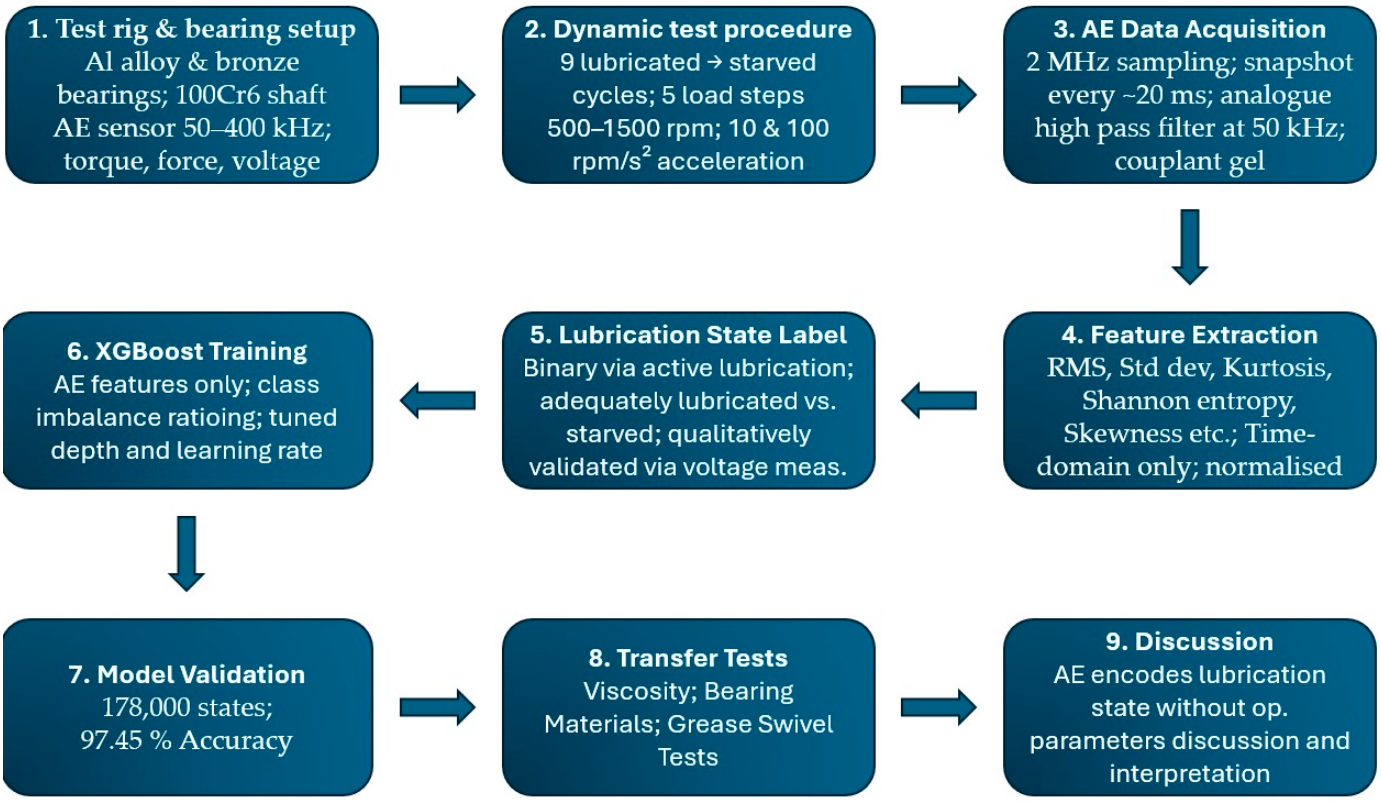
Thus, there is a need to evaluate how well ML models trained on one tribological system generalise to others, and to develop robust expert systems that can handle variations in materials and lubricants to be used in practice. A lubrication monitoring system should be able to detect lubricant starvation or the need for re-lubrication across a range of operating scenarios, despite changes in system and environment. The present work addresses this gap by investigating an AE-based machine learning classifier for lubrication state recognition using data garnered from a dynamic test procedure with multiple test conditions for quick generation of class representation. The paper details an experimental programme depicted as a flow chart in
Figure 1 involving two bearing material types and three lubricant viscosities, with the aim of testing the classifier’s performance and transferability. An Extreme Gradient Boosting (XGBoost) model is trained to classify the bearing’s lubrication state using only AE-derived features, without explicitly providing the model with operating parameters such as load or speed. The model’s accuracy is assessed on the same bearing type and is then challenged with unseen conditions as well as a greased bearing case to simulate various predictive maintenance scenarios.
Figure 1.
Flowchart of presented study.
Figure 1.
Flowchart of presented study.
This paper is structured as follows: Firstly, the test bench, experimental setup, data processing and ML methods are described, then the results of the classification analysis are presented. Their significance is discussed in the context of the existing literature. The paper concludes with the feasibility of an AE/ML-based expert system for lubrication monitoring and outlines directions for future work.
2. Methodology
2.1. Test Rig and Bearing
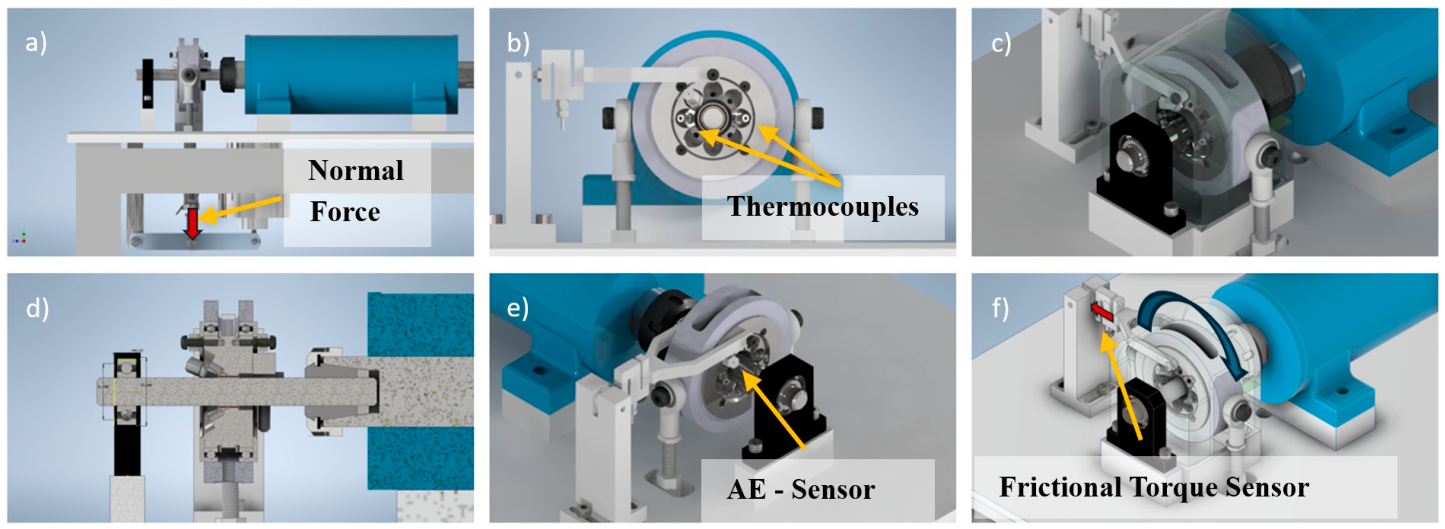
Experiments were conducted on a sliding bearing test rig designed specifically for the presented dynamic lubrication study. The test rig is shown in
Figure 2. The test bearing is pulled onto the rotatory shaft by a pivot ball pulley system, reducing the risk of edge carrying. The rig is equipped with two thermocouples, torque and normal force measurement, a displacement sensor monitoring bearing holder movement, an AE sensor (Kistler 8152C0050500, Winterthur, Switzerland, with 5125C3 amplifier, 50–400 kHz measurement range) and a voltage measurement allowing for monitoring of the friction state between bearing and shaft by indicating when bearing and shaft are separated by lubricant and when they are in direct contact.
Tests were performed with two different bearing materials (one aluminium alloy-lined bearing and a phosphor bronze bearing) to examine the impact of material effects. The rotating shaft was made of hardened roller bearing steel (100Cr6, 1.3505) finished for a clearance of roughly 0.2% of bearing diameter. Lubrication was provided through a recirculating oil system with controlled temperature. Mineral oils of two base ISO VG viscosity grades were heated to 40 °C and 60 °C each to ensure stable and known viscosity of 16.7, 32 and 68 mm2/s during tests.
Figure 2.
Journal Bearing Tester in Different Views: (a) front view showing pivot ball pulley system; (b) thermocouple positions; (c) torque and force measurement; (d) rear view; (e) AE sensor location; (f) overall assembly.
Figure 2.
Journal Bearing Tester in Different Views: (a) front view showing pivot ball pulley system; (b) thermocouple positions; (c) torque and force measurement; (d) rear view; (e) AE sensor location; (f) overall assembly.
To account for heat dissipation, the bearing holder itself was conditioned to the testing temperature via two heating cartridges in the cassette. In addition, grease lubrication was explored to simulate conditions of restricted oil supply (this involved packing the bearing with a multipurpose lithium grease).
2.2. Dynamic Test Parameters and Lubrication
The bearing is loaded via pneumatic muscles, allowing for stepless alteration of rotational speed and normal force. A series of test runs was systematically conducted across a spectrum of loads and speeds to induce diverse lubrication states and comprehensively capture the tribological behaviour of the bearing under varying operating conditions. The experimental setup enabled the efficient acquisition of the data foundation necessary to develop a reliable and generalisable predictive model. It is seen as a given, that the more correctly labelled data is used to create a ML-model, the more reliable the model is going to be [
10]. Usually in Anomaly Detection or RUL calculation this refers to datasets (breakdown or otherwise) consisting of time series and the class or result (for example length of test, wear scar depth, material etc.) being needed to train the model, making it difficult to attain the amount of data needed [
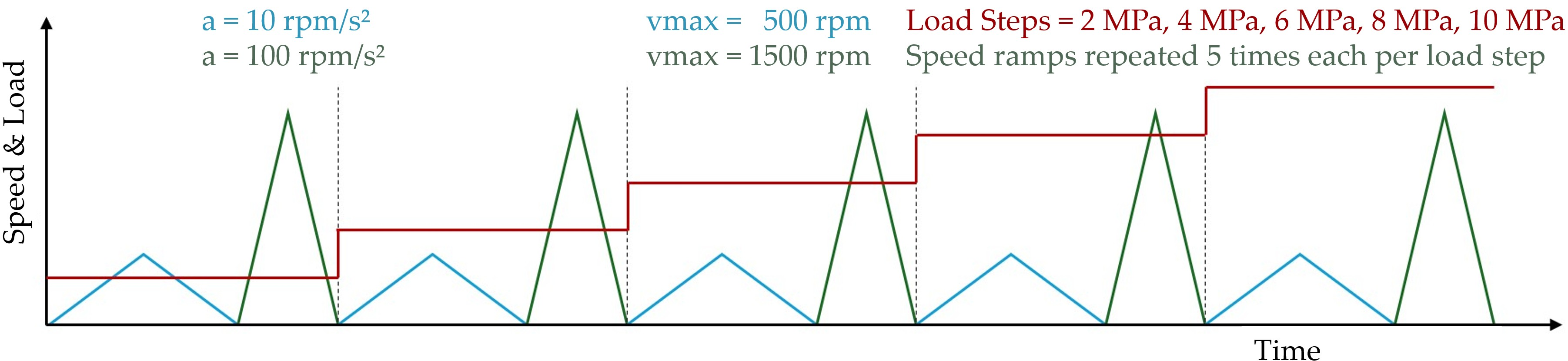
11]. For the classification of lubrication status, essentially every individual measurement of the lubricated bearing is a class example consisting of input values like rotational speed, oil temperature or normal force and output values like frictional torque or AE derived at that point. Thus, a statistically significant amount of class examples can be collected in a short amount of time. Each test represents 9 cycles of load/speed ramps. A cycle consists of 5 load steps ranging from 2 to 10 MPa during which ascending and descending speed ramps alternating between 500 rpm (at 10 rpm/s
2 acceleration) and 1500 rpm (at 100 rpm/s
2 acceleration) are repeated multiple times. The cycles are iterated on the same bearing to receive data at various stages of system wear and running-in; different accelerations were chosen to account for fluid inertia effects on fluid film formation [
12].
Figure 3 gives an overview of the test parameters.
Figure 3.
Test parameters overview: Load collective with speed ramps and load steps.
Figure 3.
Test parameters overview: Load collective with speed ramps and load steps.
After a bearing has been run for 9 cycles, lubrication is switched off, and cycles are repeated until a shut-off temperature is reached. Additionally, in some tests, lubrication was switched off after a single cycle to simulate a lack of lubrication during run-in. With this setup, many characteristic measurement combinations for the normal, lubricated state and the anomalous state are collected. Load steps and speeds were chosen so that tests would mostly run in mixed friction and only occasionally or after prolonged run-in cross over into full hydrodynamic friction, with voltage measurement being used to validate mixed-friction state.
Table 1 provides an overview of the number of cycles run per viscosity and bearing material, and how they factor into the later model-building evaluation and transfer. At the same time, all cycles are intended to have the same runtime; some cycles, especially for the Starved condition, run short due to the safety shut-off criterion being triggered. Cycles were excluded from further evaluation for the following reasons: Collet fretting (some early tests showed clear collet fretting and slipping which was found to have a strong impact on AE measurement), high frequency measurement sync (some cycles had to be discarded because AE measurement did not sync up with regular measurement due to an error in H5 file writing), failure in Lubricated state (some bearings failed in lubricated state, probably due to faulty setup).
2.3. Acoustic Emission Sensing and Data Acquisition
A spring-loaded piezoelectric acoustic emission sensor was attached to the bearing cassette to capture high-frequency structure-borne sound emitted by the tribosystem during tests. The sensor was a broadband AE transducer with an analogue high-pass filter, yielding a measured frequency range from 50 kHz up to 400 kHz. High-pass filtering ensures that the highest measurement intensity is seen in the range of relevant high-frequency vibrations [
13] and not in the low-frequency range of ambient machine vibrations. A couplant gel was used between the sensor and bearing cassette to ensure good transmission. The conditioned AE signals were sampled at 2 MHz via a portable oscilloscope (Digilent Analog Discovery 3), ensuring that transient AE events were captured without aliasing effects [
14]. AE has been deemed one of the premier non-invasive measurement technologies when friction processes or surface damage is concerned, with sensitivity to these processes being higher than frictional force or torque transduction [
15] or vibration measurement [
16].
The AE signal was recorded intermittently, approximately every 20 ms, as a full spectrum, meaning AE snapshots were made at about 50 Hz. For each segment, a set of descriptive features characterising the acoustic emission activity was computed. Common time-domain AE features used by other researchers [
17,
18], such as Intensity Maximum (Amax), Kurtosis, Root-Mean-Square (RMS), Standard Deviation and Shannon Entropy, were extracted for a total of 12 AE features.
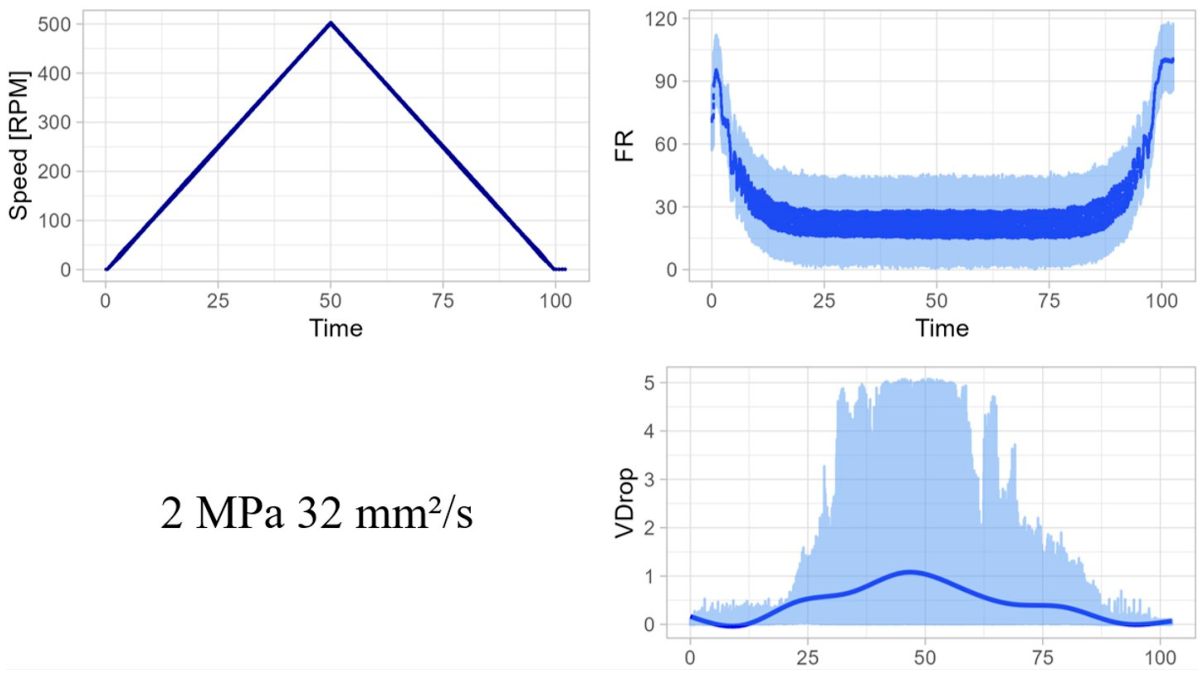
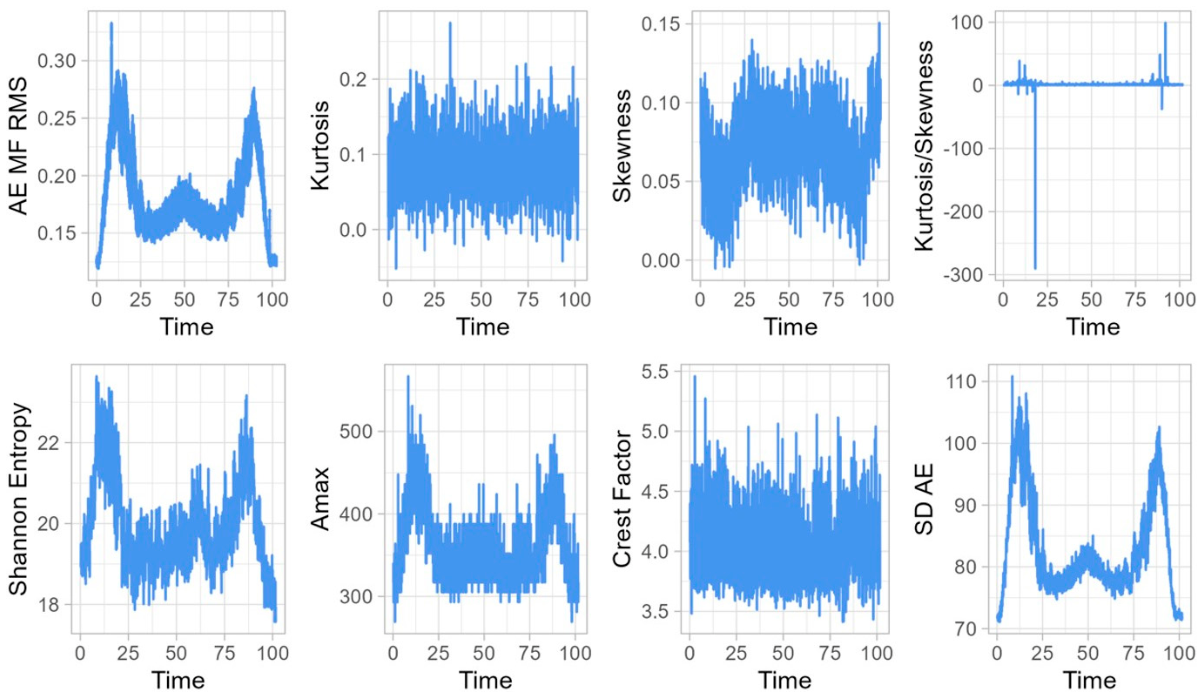
Figure 4 provides an overview of some of the AE features plotted next to a speed ramp at 2 MPa normal force and also shows the auxiliary measurements like frictional torque (FR) and contact voltage (VDrop) used to monitor the friction state.
Spectral features were also calculated by performing a fast Fourier transformation on each AE measurement to capture frequency-domain signatures; however, initial analysis showed that simple time-domain features were sufficiently discriminative for the lubrication state classification and were also deemed more target-oriented. A PdM tool should ideally be compact, and AE features can be extracted with less computational power than FFT spectral analysis during data acquisition. The decision to focus on time-domain AE features was further influenced by studies indicating feature correlation with frictional regimes [
19]. All extracted features were normalised to account for differences in sensor sensitivity and experimental duration as well as to improve classification results [
20].
2.4. Labelling of Lubrication States
Ground-truth labels for the lubrication state were assigned based on the known test conditions: whether lubrication was active or not. Two classes were defined for classification: “Lubricated”, corresponding to a bearing receiving continuous lubrication, and “Starved”, corresponding to the lubricant pump being switched off. The fully hydrodynamic regime has been differentiated from mixed friction in past publications sufficiently [
21]. Hydrodynamic journal bearings are designed to safely run in transient mixed friction [
22], mixed friction during start-up or operation with dynamic loads [
23], and are regularly subjected to mixed friction operating conditions in real-world applications [
24,
25,
26]; thus, differentiating normal—benign and anomalous—from malign system behaviour within mixed friction should be the target of research. During testing, clear differences in friction behaviour were observed between these states: switching off the bearing oil supply was followed by an initially delayed surge in AE activity (more frequent bursts) and higher AE RMS levels due to metal-to-metal contact events. Other measurements also showed clear differences with the VDrop measurement no longer registering a change during speed ramps, as no lubricant film was developed, and the temperature measurement no longer monitored a steady state.
2.5. Machine Learning Model
Extreme Gradient Boosting (XGBoost), a boosted tree ensemble learning algorithm, was used to build a model able to differentiate between lubrication classes. XGBoost was chosen for its efficiency and ability to handle feature interactions as well as class imbalances, since more lubricated than lubrication-starved cycles were run during the study. It has also been shown to achieve great classification results in fault diagnosis for roller bearing systems [
27,
28,
29]. Furthermore, research has shown that tree models (and specifically XGBoost) still outrank deep learning models and other classic ML techniques when it comes to the classification of tabular data [
30]. To train the model, all measurement values and system information like speed or normal force were discarded; the model was trained with AE features as input only and lubrication classification as output. All individual cycles were then randomised to break up time series autocorrelation. The training, validation and testing datasets were sourced from different cycles of the study, in order to prevent neighbouring measurements of the same time series from appearing in different segments of the model-building process. The model was built, trained and tested on aluminium bearing cycles lubricated with 32 mm
2/s oil. Input data for the training of the tree model were ratioed for positive weight to account for class imbalance; hyperparameters such as tree depth and learning rate were evaluated via 5-fold cross-validation on the training set. All computations were performed on a system equipped with a 12th Gen Intel Core i9-12900KF processor, 64 GB RAM, running Python v.3.11 with the XGBoost, NumPy, and SciPy libraries. AE feature extraction from the raw signal data required approximately 5 min per dataset, with some AE features being more computationally intensive than others, while XGBoost model training on the full extracted feature set completed in 51.82 s. The short training duration confirms the suitability of the proposed framework for offline training workflows, with the trained model subsequently deployable on edge hardware. The feature matrix for testing and training contained a little over 430,000 rows, meaning 430,000 individual states were used for model building.
After validating the model on the baseline condition, transfer tests were conducted to assess how the classifier performs on different conditions without retraining. In these tests, the model was applied directly to AE feature data collected from: (1) different oil viscosity tests using aluminium alloy and (2) a different bearing material test, the phosphorous bronze bearing, using various oil viscosities. These tests allowed measurement of the model’s generalisability to changes in lubricant properties and bearing material. Additionally, the classifier was applied to data from the grease-lubricated scenario to see if it would correctly indicate the need for re-lubrication when the grease film was depleted.
Table 2 lists the hyperparameters for the main model training as well as the report of the crossfold validation, while
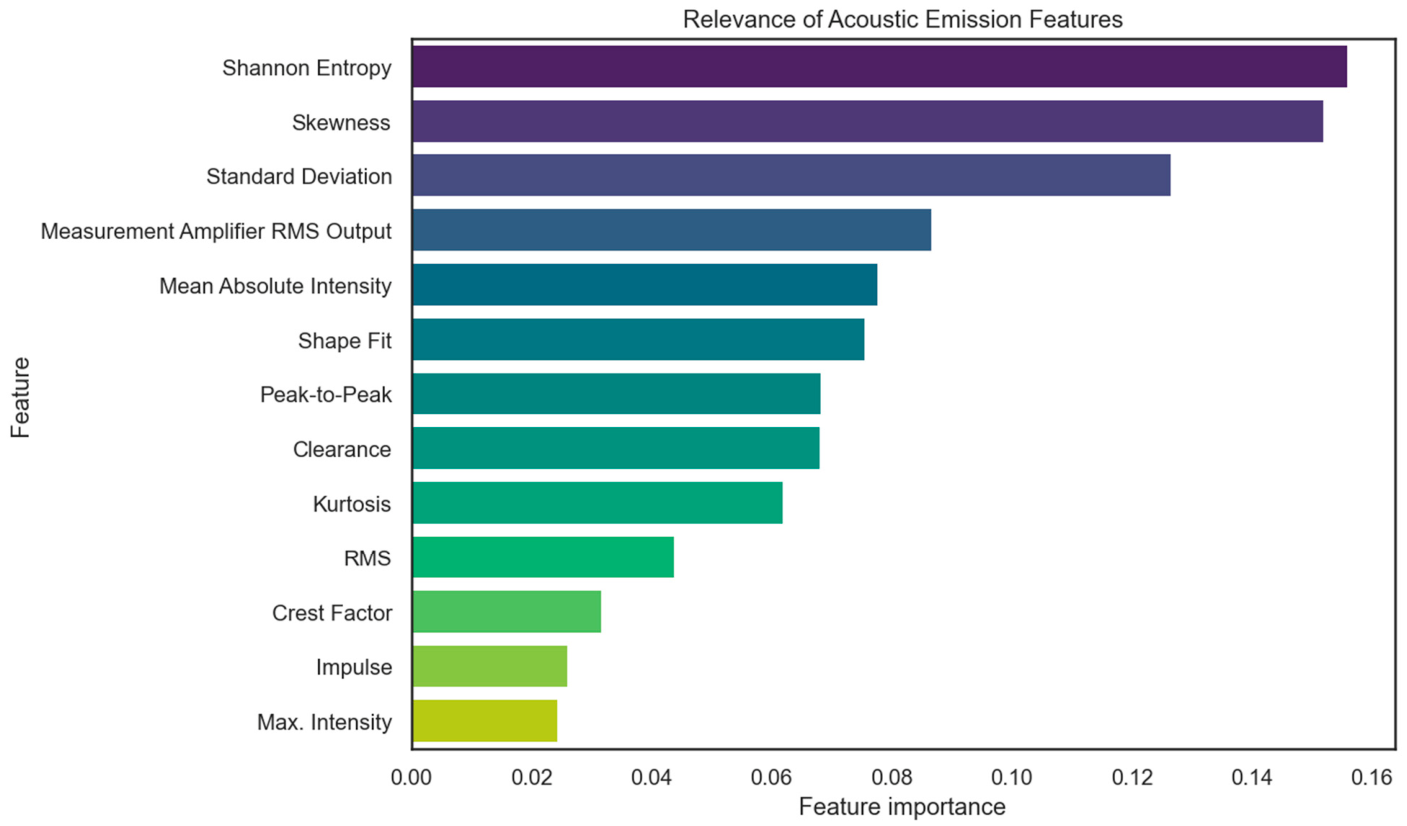
Figure 5 depicts the feature importance ranking for the initial XGBoost model.
Based on the ranking, it is clear that while some features are more important than others, every feature adds to the end result. It is, however, also likely that some features can be cut without the model losing too much of its accuracy. It is also interesting to note that two RMS are collected and used for the model and later validation and anomaly detection. One is the calculated root mean square (RMS), and one is a direct output of the sensor amplifier (Measurement Amplifier RMS Output). Both have different importance in modelling success. This could be due to a couple of reasons. The amplifier might calculate RMS differently or just average out the intensity as measured. There is also a good possibility of the measurements having slight differences in their timestamp. High-frequency AE snapshots need to go through the digital oscilloscope and are saved in consecutive subdirectories within the H5 structure, while amplifier data are logged in the main tables directly. This means that the high-frequency data might have some lag in comparison to the low-frequency amplifier data. Either way, there seems to be a difference in mutual information as it pertains to the other, more important features.
3. Results
3.1. Classification Performance on Primary Test System
The AE-feature-based classifier achieved excellent performance in distinguishing lubricated versus starved states.
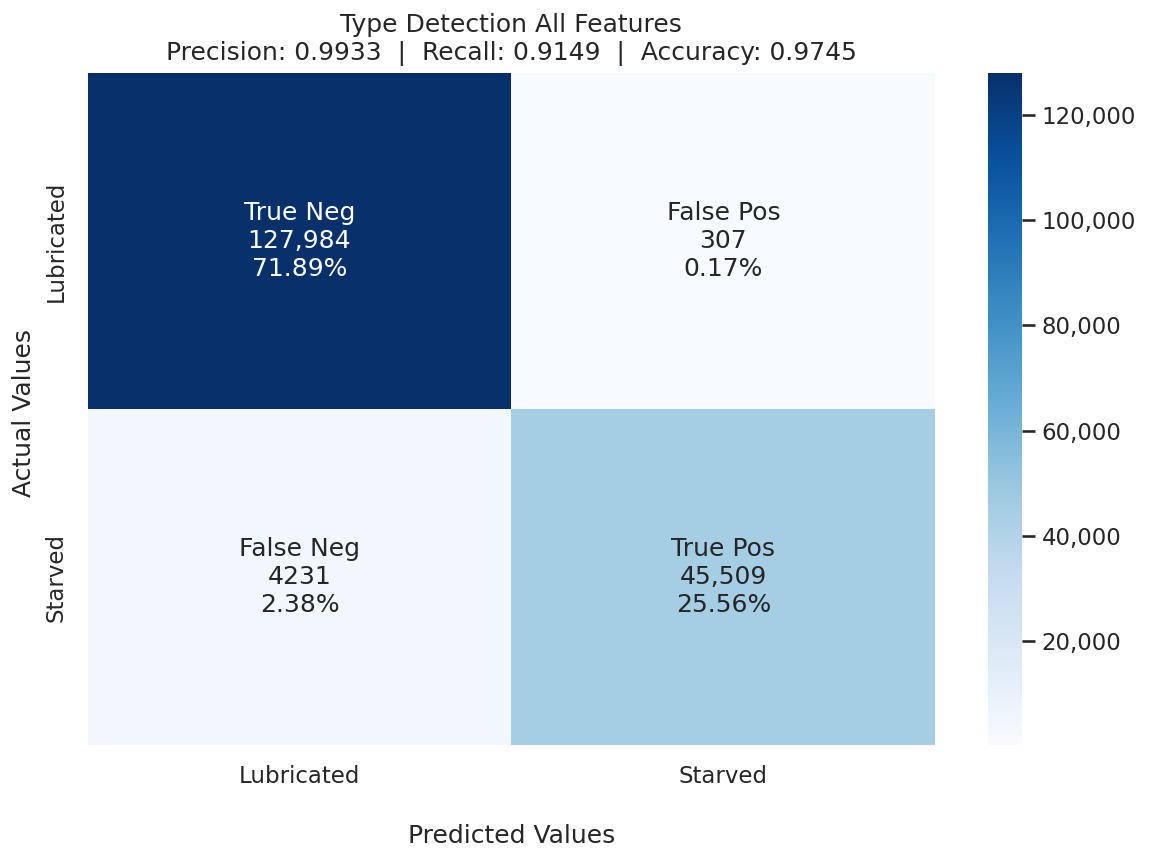
Figure 6 shows the confusion matrix of the model’s predictions on the hold-out test set. Out of ~178,000 class representations evaluated, about 97% were correctly classified. The model exhibited a high true negative rate for the Lubricated class and a high true positive rate for the Starved class. In terms of precision and recall, approximately 99% of the lubricated instances were identified correctly and about 91% of the starved instances were detected. These misclassifications can be explained: most of the false negatives occurred at the lowest load level tested, where the bearing was no longer being actively lubricated, but some lubricant remained in the bearing due to the nature of the cycle series. This, combined with the low load, meant that these class examples had a higher hydrodynamic component in the mixed friction regime. In this scenario, even starved systems produced minimal AE activity, making it harder for the model to differentiate. This aligns with voltage divider and displacement measurements showing that some residual oil can still provide lubrication and shaft lift at the lightest loads. Diminished separation sharpness for low-load systems being monitored via AE is well documented [
31].
3.2. Transferability to Different Oil Viscosities
Moving on, we incrementally tested the classifier’s transferability by having it classify unseen operating conditions without retraining. First, the model was applied to data from the same bearing material lubricated with different oil viscosities (68 mm
2/s and 16 mm
2/s). The overall classification accuracy in this transfer test remained relatively high (a slight decrease to ~94%), with a similar misclassification pattern. This suggests that the features the model relies on possess validity beyond the viscosity-based influence on load-carrying capacity [
32], and thus the frictional force and vibration-dampening effects of the lubricant. This dampening effect has been observed through vibration monitoring in rolling bearings [
33] as well as plain bearings [
34], with vibration intensity negatively correlating with the viscosity of the lubricant. This is an encouraging result, as it implies the classifier is not dependent on singular characteristics of the tribosystem (like specific oil properties such as viscosity) but rather responds to the physics of asperity contact events occurring during insufficient lubrication.
3.3. Transferability to Different Bearing Materials
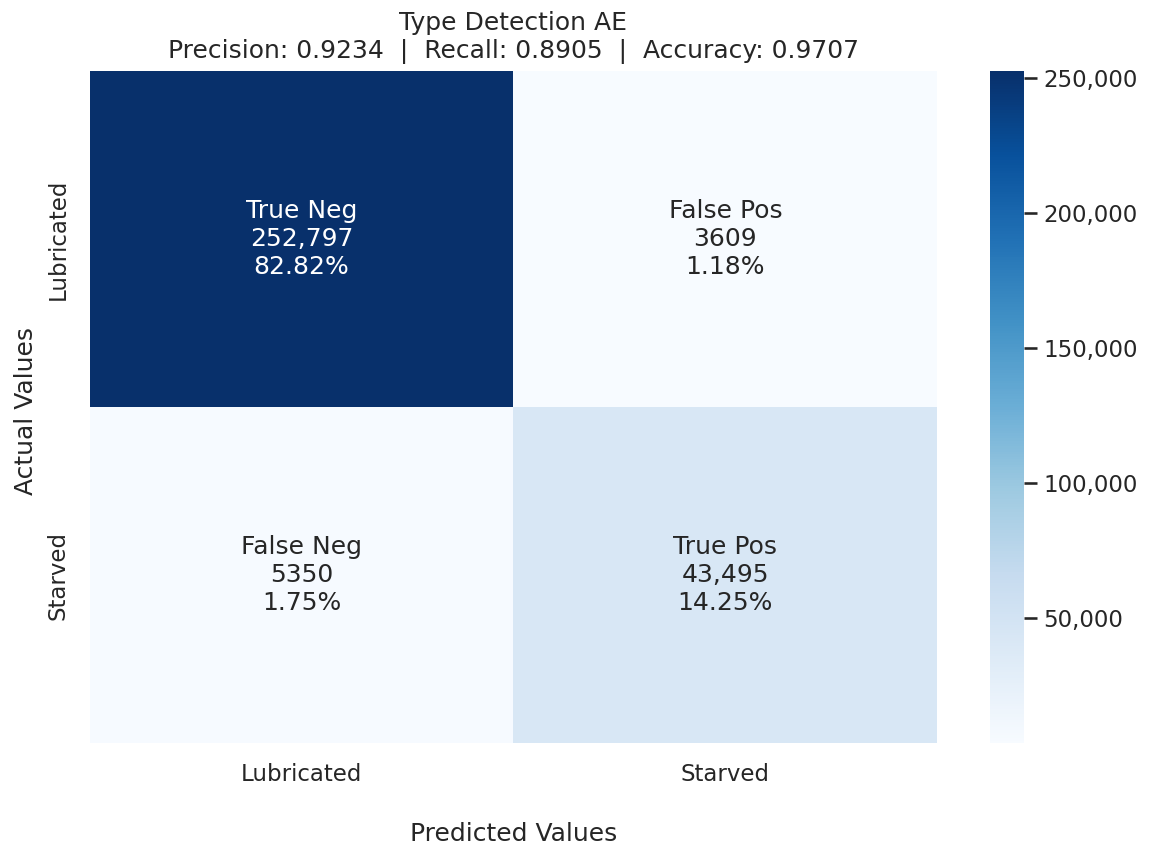
The model was next evaluated on the bronze bearing cycles in all three viscosities, with the result being slightly worse (see
Figure 7). While false negative errors are present in about the same magnitude and error pattern as in previous classifications, false positives—representations wrongfully classified as Starved—are much more present. This means that there are feature combinations, probably of higher intensity, present in the lubricated class that share similarities to starved aluminium alloy. When comparing the full measurement array of aluminium alloy and bearing bronze, the materials differ in their plasticity. The aluminium shows more deformation with load, more wear over time, as well as a quicker increase in voltage measurement over speed ramps, and thus better hydrodynamic film formation at lower speeds. This speaks for a system that tends to adapt to a conform contact configuration more readily than the bearing bronze, which in turn would be more prone to edge and asperity contact due to deformation and wear differences, leading to more frequent and more intense AE events. Despite these differences in results, the model’s performance on the bronze bearing remained strong.
3.4. Detection of Grease Starvation
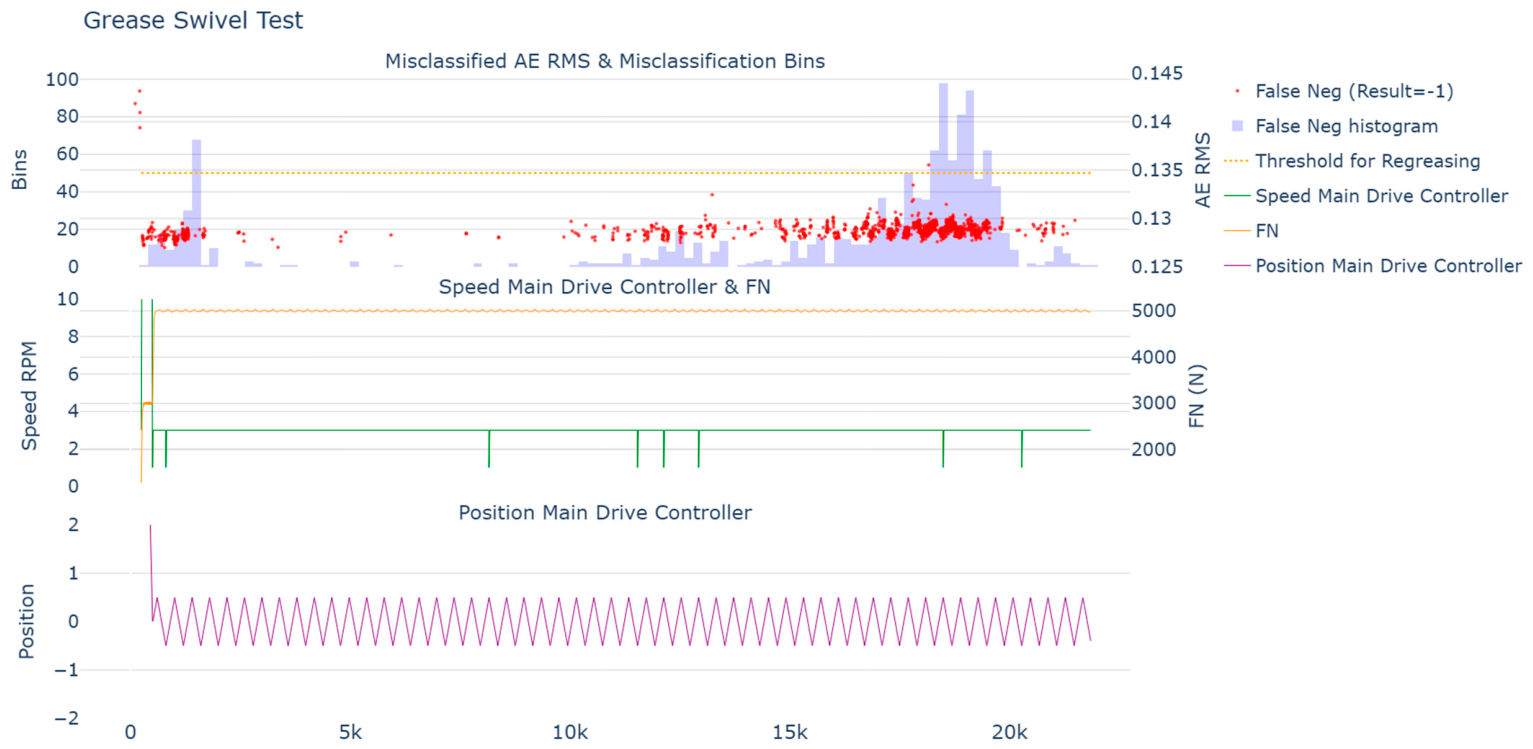
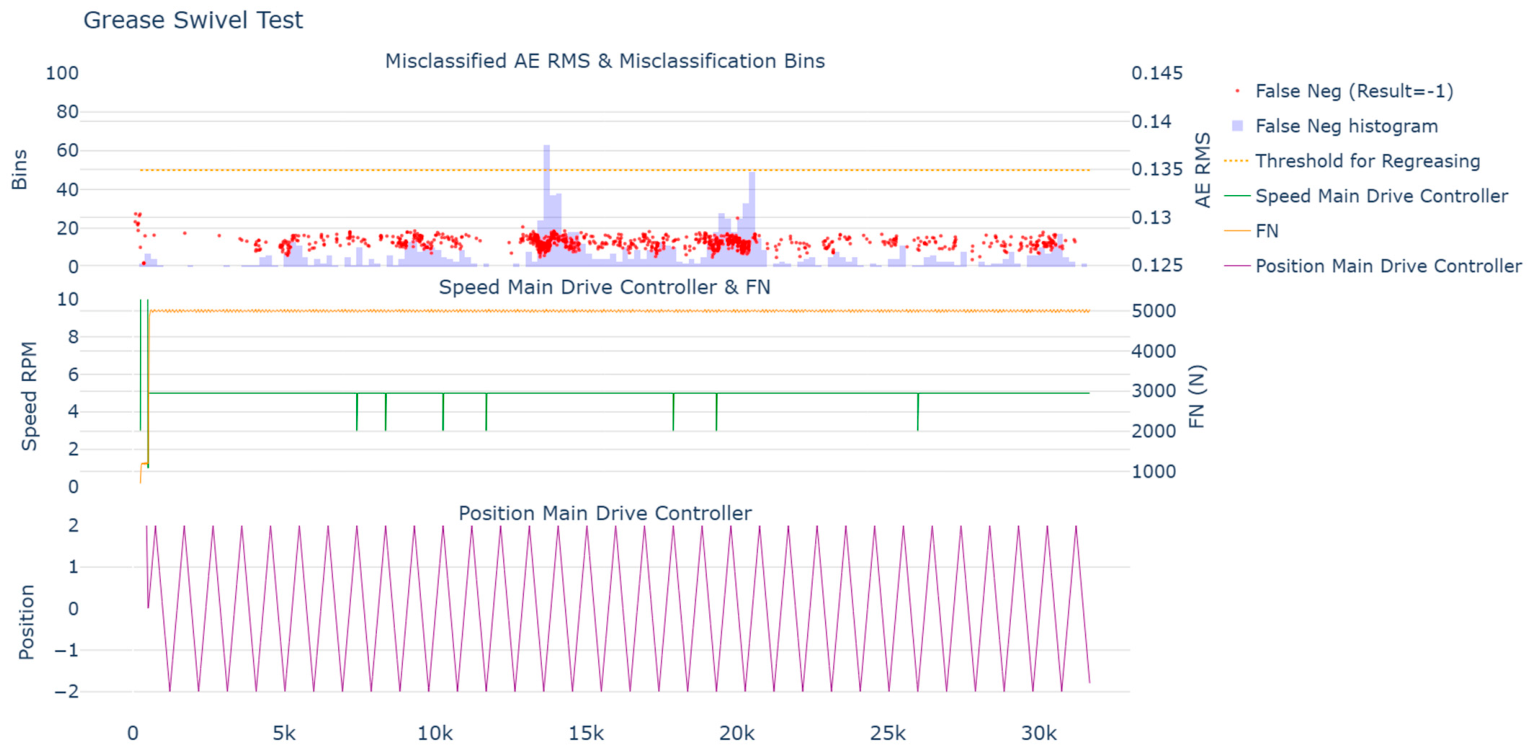
Finally, in the grease lubrication test, the system provided a clear indication of lubrication degradation. The bearing was packed with grease, and slow oscillation around a swivel angle between 3° and 60° under loads up to 20 MPa was used, far beyond the model training load collective and more in line with the way grease-lubricated journal bearings are often loaded in industry applications. Over time, the AE signal began to show increasing activity as the grease was pushed out or thickened, signifying lubrication degradation.
Figure 8 and
Figure 9 show the initially trained model used as an anomaly detector on the grease-lubricated bearing, signifying the need for lubrication upon reaching an anomaly counter threshold within the timeframe of one oscillation. The grease data is presented to the model labelled as “Lubricated”; anomalous behaviour is flagged when the model deems the AE-features to signal “Starved”. The pre-trained classifier (which had only seen oil-lubricated data at much lower loads during training) was still able to interpret this change: it started classifying the condition as Starved, effectively alerting that the grease film was failing. This corresponded well with other measurements of the test rig, and the operator performed a manual re-lubrication with a grease gun when the model signalled a Starved condition. After lubrication, subsequent AE readings confirmed the return to a reduced error count.
4. Discussion
4.1. Effectiveness of Acoustic Emission for Lubrication Monitoring
The findings presented confirm that AE, coupled with ML, provides a powerful tool to identify lubrication states in sliding bearings as well as differentiate between benign and malign states of mixed friction. Using only AE-derived features, the XGBoost model achieved high accuracy in distinguishing mixed friction and starved lubrication conditions in our tests. This outcome is consistent with and builds upon previous studies in the field: Noushin Mokhtari’s dissertation showed that even conventional algorithms could differentiate between journal-bearing hydrodynamic and mixed-friction states with high accuracy using AE features. Our results reinforce those observations with a different algorithm and a model trained using a dynamic test procedure. Furthermore, by obtaining high accuracy without including any direct information about operating conditions (such as load or speed) in the input data, we demonstrate that the AE signal on its own embodies the relevant information needed to describe the lubrication condition, which suggests an expert system can accurately derive tribosystem health from a single sensor measurement, potentially simplifying condition monitoring setups greatly.
4.2. Model Transferability and Generalisability
Our transferability tests yielded promising results. The classifier retained high performance across different oil viscosities and an alternate bearing material, which can be understood from the perspective of the underlying AE generation mechanism. In the adequately lubricated mixed friction contact, the lubricant film separates the majority of asperities, and the resulting AE signal is characterised by low-intensity, stochastically distributed activity with the registered AE events arising primarily from fluid-dynamic effects, occasional minor asperity interactions, as well as a speed-related shift within the mixed-friction spectrum. When lubrication becomes insufficient, the fluid film breaks down locally, and asperity collisions become the dominant contact mechanism, generating events at a markedly higher intensity over all frequencies of the measured spectrum with a burst-like statistical character. The transition from fluid-dominated to asperity-dominated AE is the main differentiator that the model has learned to classify. Critically, this mechanism is not specific to a particular viscosity or bearing material since asperity contact produces elastic waves regardless of whether the lubricant is VG 16, 32, or 68, and regardless of whether the counterface is aluminium or bronze. What changes across these conditions is the absolute scaling of the AE signal, driven by differences in lubricant film thickness, material hardness, and surface conformity. Since all features are normalised across tests, these scaling differences are suppressed, and the model responds to the statistical structure of the AE features in each individual measurement snapshot. This explains why the viscosity-induced dampening effect [
33,
34] and the material-dependent differences in surface conformity and plasticity, while clearly present in the raw signal, do not substantially degrade classification performance but instead shift the absolute signal level without altering the fundamental contrast between lubricated and starved AE character that the model exploits. It is important to note that the model does not learn to differentiate based on temporal order since all rows within the training, testing and validation datasets are randomised to break up autocorrelation.
We did observe that in each tested scenario, load and speed edge cases were points of misclassification. Misclassification at low loads was seen as Lubricated by the algorithm when they were actually Starved. However, at low loads, the amount of lubricant remaining in the run-in bearing and the relubrication through the lubricant in bearing cassette crevices might have been enough to create a lubricant film akin to fully lubricated bearings, making it a fault of mislabelling and experiment design instead of a problem on the algorithm side. Another point of misclassification was found at low speeds and high pressures in bearings that were seen as Starved by the algorithm, but were actually Lubricated, since at high-pressure, low-speed operating conditions, no lubricant film is created and the bearing mixed friction spectrum is skewed dramatically towards solid friction. While the observed misclassifications can be attributed to ambiguities in labelling and the inherently transitional nature of the chosen dynamic operating conditions, it is important to note that the chosen model limitations also potentially contribute to misclassification. A more expressive classifier, as well as the inclusion of operating condition parameters, such as temperature, speed and load setpoints as additional input features, could potentially reduce misclassification for the transitional, ambiguous cases and present a direction for future investigation. Anecdotally, the addition of either bearing temperature or VDrop measurement to the input variables dramatically increases classification quality over all analysed systems (with the exception of the qualitative grease swivel tests).
The grease starvation test provides compelling evidence for generalisability: the model trained on oil-lubricated, unidirectionally rotating journal bearings (0–1500 rpm, 2–10 MPa, speed ramps and load cycles) was directly applied to oscillation (3 rpm and 5 rpm, ±15° and ±60° oscillation, 20 MPa static load) without retraining. Rig-specific artefacts tied to drive system and structural resonance at the oscillation load collective would not be present in the model, and vice versa, yet the model showed promise for anomaly detection application and flagged the need for relubrication.
4.3. Model Architecture and Real-Time Implementation
Our relatively simple XGBoost classifier on engineered features is lightweight and can be executed in real time on the edge (e.g., on a small industrial PC or microcontroller at the machine). This makes it attractive for an expert system that continuously monitors a bearing and issues alerts. Vibration sensors can complement AE by providing continuous monitoring of overall machine health and catching secondary effects (like imbalance or shaft vibration due to increased friction), and have also been shown to be a powerful combination for condition monitoring and anomaly detection in various use cases, such as metal cutting [
35] or district heating pipe monitoring [
36].
4.4. Tribological Interpretation of Results
From a tribological perspective, the features that the model used to distinguish lubrication conditions likely correlate with known behaviour changes: in full hydrodynamic lubrication, the contact surfaces are separated by a fluid film, with the generated AE intensity being proportional to rotational speed and likely due to fluid-dynamic effects as found by Mirhadizadeh who measured an increase in AE correlating with power loss observed due to increasing speeds in hydrodynamic regime and concluded, that the principal source of AE in hydrodynamic friction is the shearin of the lubricant [
37]. If lubrication is insufficient, asperities collide and produce elastic waves where the count and intensity amplitude of AE events surge. Since hydrodynamic and mixed lubrication regimes are readily distinguishable by AE character alone, the present work deliberately focuses on the mixed friction regime, where the transition from adequate to inadequate lubrication is more subtle and of greater practical relevance. Bearings running in a hydrodynamic regime are rarely damaged. Mixed friction does not inherently indicate damage, but its progression towards boundary lubrication does. With mixed lubrication not being a binary space, there can be degrees of film breakdown (a spectrum from full-film to no-film operation). In our labelling, we used a binary classification for simplicity; while this does not fully represent the mixed friction spectrum, this approach is justified due to hydrodynamic journal bearings being designed to withstand mixed friction conditions across their operational lifetime [
22,
23,
24,
25,
26], making the distinction between adequate and inadequate lubrication a practical classification boundary. This line of thinking could be used to extend the binary classifier to a multi-class or regression problem (e.g., estimating a “lubrication health index” from 0 to 1).
4.5. Limitations and Future Research Directions
The presented work addresses lubrication state classification at a macroscopic scale, specifically the spectrum between still adequately lubricated and lubricant-starved conditions in the mixed friction regime. Furthermore, the present study was conducted under controlled laboratory conditions, with well-aligned shaft geometry and uncontaminated lubricant. In real-world applications, factors such as shaft misalignment and lubricant contamination are common and may influence AE signal characteristics. Misalignment introduces additional asperity contact and vibration components, while contamination particles can generate AE events independent of the lubrication condition. The extent to which these factors affect model performance remains to be investigated and is identified as a limitation of the present work. A further limitation of the present study concerns the acoustic noise environment. All measurements were conducted under controlled laboratory conditions. The hardware bandpass filter integrated into the AE sensor amplifier, with high-pass of 50 kHz, provides an inherent rejection of low-frequency industrial noise sources such as structural vibration, rotor imbalance, and gear mesh excitation, which typically manifest below 20 kHz, high-frequency noise sources including cavitation events, electrical discharge machining in proximity, or dense machinery installations could potentially overlap with the AE measurement band and influence classification performance. The robustness of the proposed framework under such conditions has not been evaluated and needs to be further studied.
Moving forward, there are several avenues for further research. First, training datasets could be expanded to encompass more bearing and lubricant types to expand the original model and increase its robustness. Secondly, classic statistical features could be compared to autonomously extracted features generated through deep learning models, perhaps yielding more subtle indicators of lubrication condition. Lastly, the next tier of validation would be to apply the model to raw AE data from a different test rig for lubricated sliding contacts, like a pin-on-disc or block-on-ring setup. Data from a different journal bearing rig should also be analysed, perhaps running alternate geometries. Finally, model transferability needs to be analysed on real-world applications, such as bearings in gearboxes or vane pumps.
5. Conclusions
In this work, a machine learning-based expert system was developed and validated for detecting the lubrication condition of sliding bearings using acoustic emission signals. The system was able to reliably classify whether a hydrodynamic bearing was running with adequate or deficient lubrication. The key findings are:
AE signals as an effective monitoring tool: High-frequency acoustic emissions from the bearing contained sufficient information to discriminate lubrication regimes. The XGBoost classifier, using features like standard deviation, RMS, and Shannon Entropy, achieved over 97% accuracy in our experiments, which agrees with prior findings that AE can be used to classify friction states in journal bearings.
Robust performance under varying conditions: The trained model maintained good performance even when applied to test runs with different viscosity classes and a different bearing material, correctly identifying lubrication states in those scenarios with only minor drops in accuracy. The classifier’s core logic proved transferable, hinting that a lab-trained model could be used across similar lab-based systems or even real-world applications.
Detection of lubrication starvation and maintenance needs: The system successfully detected true under-lubrication events and would have provided timely alerts for maintenance. In a greased bearing test, it flagged the need for re-greasing, after which the system returned to normal AE feature levels.
The present study was conducted under controlled laboratory conditions, which entails several limitations. All experiments were performed with well-aligned shaft geometry and uncontaminated lubricant; the influence of shaft misalignment and lubricant contamination on model performance has not been evaluated. Similarly, measurements were taken in a low-noise lab environment, and while the sensor’s 50 kHz high-pass filter suppresses the majority of industrial low-frequency noise, the robustness of the framework against high-frequency ambient and erratic noise sources has not been tested. Finally, the binary lubrication state classification and the use of AE features alone, without operating condition parameters as model inputs, represent simplifications that may limit performance at transitional operating points. These aspects are identified as priorities for future validation work.
In summary, the study confirms that combining acoustic emission sensing with machine learning is a promising strategy for real-time lubrication condition recognition in tribological systems. It also suggests that predictive maintenance models using AE sensor technology could be pre-trained in a laboratory setting using model systems if the system to be monitored does not have meaningful historical data, thus allowing maintenance personnel to easily and cost-effectively retrofit relevant machinery.
Author Contributions
Conceptualisation, R.H. and M.G.; methodology, R.H.; software, R.H.; validation, R.H., M.G. and C.H.; formal analysis, R.H.; investigation, R.H.; resources, M.G. and C.H.; data curation, R.H.; writing—original draft preparation, R.H.; writing—review and editing, M.G. and C.H.; visualisation, R.H.; supervision, M.G. and C.H.; project administration, M.G. All authors have read and agreed to the published version of the manuscript.
Funding
This research received no external funding.
Data Availability Statement
The data that support the findings of this study are available upon reasonable request from the corresponding author.
Conflicts of Interest
The authors declare no conflicts of interest.
References
- FVA987-I. Abschlussbericht zum Eigenmittelvorhaben FVA-987-I “Entwicklung einer Prüfstrategie zur Qualifizierung von Schmierfetten für Lebensdauer-Geschmierte Gleitanwendungen mit Langem Hub”; Forschungsverbands Antriebstechnik (FVA): Frankfurt, Germany, 2024. [Google Scholar]
- Carroll, J.; McDonald, A.; McMillan, D. Failure rate, repair time and unscheduled O&M cost analysis of offshore wind turbines. Wind Energy 2016, 19, 1107–1119. [Google Scholar]
- Shah, R.; Jaramillo, R.; Thomas, G.; Rayhan, M.T.; Hossain, N.; Kchaou, M.; Profito, F.J.; Rosenkranz, A. Artificial intelligence and machine learning in tribology: Selected case studies and overall potential. Adv. Eng. Mater. 2024, 26, 2101144. [Google Scholar] [CrossRef]
- Hassin, O.A.A. Condition Monitoring of Journal Bearings for Predictive Maintenance Management Based on High Frequency Vibration Analysis. Ph.D. Thesis, University of Huddersfield, Huddersfield, UK, 2017. [Google Scholar]
- Bote-Garcia, J.-L.; Mokhtari, N.; Gühmann, C. Wear monitoring of journal bearings with acoustic emission under different operating conditions. PHM Soc. Eur. Conf. 2020, 5, 8. [Google Scholar] [CrossRef]
- Molk Abadi, N. Überwachung Hydrodynamischer Gleitlager Basierend auf der Körperschallanalyse. Ph.D. Thesis, Technische Universität Berlin, Berlin, Germany, 2020. [Google Scholar]
- AlShorman, O.; Alkahatni, F.; Masadeh, M.; Irfan, M.; Glowacz, A.; Althobiani, F.; Kozik, J.; Glowacz, W. Sounds and acoustic emission-based early fault diagnosis of induction motor: A review study. Adv. Mech. Eng. 2021, 13, 1687814021996915. [Google Scholar] [CrossRef]
- König, F.; Ouald-Chaib, A.; Sous, C.; Jacobs, G. Machine learning-based anomaly detection and classification of acoustic emission events for wear monitoring in sliding bearing systems. Tribol. Int. 2021, 155, 106811. [Google Scholar] [CrossRef]
- Dalzochio, J.; Kunst, R.; Pignaton de Freitas, E.; Binotto, A.; Sanyal, S.; Favilla, J.; Barbosa, J. Machine learning and reasoning for predictive maintenance in Industry 4.0: Current status and challenges. Comput. Ind. 2020, 123, 103298. [Google Scholar] [CrossRef]
- Nassif, A.; Abu Talib, M.; Nasir, Q.; Dakalbab, F. Machine learning for anomaly detection: A systematic review. IEEE Access 2021, 9, 78658–78700. [Google Scholar] [CrossRef]
- Kamat, P.; Kumar, S.; Patil, S.; Kotecha, K. Anomaly-informed remaining useful life estimation (AIRULE) of bearing machinery using a deep learning framework. MethodsX 2024, 12, 102555. [Google Scholar] [CrossRef]
- Jamari, J.; Muchammad, M.; Hilmy, F.; Tauviqirrahman, M. Effect of inertia on the cavitation phenomena of hydrodynamic textured bearings considering slip. J. Braz. Soc. Mech. Sci. Eng. 2019, 41, 387. [Google Scholar] [CrossRef]
- Fritz, A.; Burger, W.; Albers, A. Schadensfrüherkennung an Geschmierten Gleitkontakten Mittels Schallemissionsanalyse; Institut für Maschinenkonstruktionslehre und Kraftfahrzeugbau, Universität Karlsruhe (TH): Frankfurt, Germany, 2001. [Google Scholar]
- Rastegaev, I.; Merson, D.; Rastegaeva, I.; Vinogradov, A. A time-frequency based approach for acoustic emission assessment of sliding wear. Lubricants 2020, 8, 52. [Google Scholar] [CrossRef]
- Lingard, S.; Yu, C.W.; Yau, C.F. Sliding wear studies using acoustic emission. Wear 1993, 162–164, 597–604. [Google Scholar] [CrossRef]
- Eftekharnejad, B.; Carrasco, M.R.; Charnley, B.; Mba, D. The application of spectral kurtosis on acoustic emission and vibrations from a defective bearing. Mech. Syst. Signal Process. 2011, 25, 266–284. [Google Scholar] [CrossRef]
- Devenport, T.M.; Lu, P.; Rolfe, B.F.; Pereira, M.P.; Griffin, J.M. Acoustic emission characteristics of galling behavior from dry scratch tests at slow sliding speed. Acoustics 2024, 6, 834–869. [Google Scholar] [CrossRef]
- Mathias, S.; Grossmann, D. Efficacy of statistical formulations on acoustic emission signals for tool wear predictions. In Proceedings of the 2nd International Conference on Innovative Intelligent Industrial Production and Logistics (IN4PL 2021), Online, 25–27 October 2021; pp. 108–115. [Google Scholar]
- Hase, A.; Mishina, H.; Wada, M. Fundamental study on early detection of seizure in journal bearings by using acoustic emission technique. Wear 2016, 346–347, 132–139. [Google Scholar] [CrossRef]
- Singh, D.; Singh, B. Investigating the impact of data normalization on classification performance. Appl. Soft Comput. 2020, 97, 105524. [Google Scholar] [CrossRef]
- Tervo, J.; Junttila, J.; Lämsä, V.; Savolainen, M.; Ronkainen, H. Hybrid methodology development for lubrication regimes identification based on measurements, simulation, and data clustering. Tribol. Int. 2024, 195, 109631. [Google Scholar] [CrossRef]
- Prölß, M.; Schwarze, H.; Hagemann, T.; Zemella, P.; Winking, P. Theoretical and experimental investigations on transient run-up procedures of journal bearings including mixed friction conditions. Lubricants 2018, 6, 105. [Google Scholar] [CrossRef]
- Koetz, F.; Schmitt, F.; Kirchner, E.; Zancul, E. Visualising the lubrication condition in hydrodynamic journal bearings using impedance measurement. Front. Mech. Eng. 2024, 10, 1456575. [Google Scholar] [CrossRef]
- Bergmann, P.; Grün, F.; Summer, F.; Gódor, I. Evaluation of wear phenomena of journal bearings by close-to-component testing and application of a numerical wear assessment. Lubricants 2018, 6, 65. [Google Scholar] [CrossRef]
- Muzakkir, S.M.; Hirani, H.; Thakre, G. Lubricant for heavily loaded slow-speed journal bearing. Tribol. Trans. 2013, 56, 1060–1068. [Google Scholar] [CrossRef]
- Hong, S.-H. Improvement of lubrication performance in misaligned journal bearings using grooves and rubber under large impact loads. Adv. Mech. Eng. 2024, 16, 16878132241310482. [Google Scholar] [CrossRef]
- Wang, X.; Wang, C. Application of XGBoost feature extraction in fault diagnosis of rolling bearing. Mech. Eng. Sci. 2020, 1, 1659. [Google Scholar] [CrossRef]
- Ayyappa, T.; Kurse, S. Fault detection of bearing using XGBoost algorithm and data visualization using t-SNE method. In Proceedings of the International Conference on Innovative Computing & Communication (ICICC), New Dehli, India, 20–21 February 2021. [Google Scholar]
- Xiang, C.; Zhou, J.; Han, B.; Li, W.; Zhao, H. Fault diagnosis of rolling bearing based on a priority elimination method. Sensors 2023, 23, 2320. [Google Scholar] [CrossRef] [PubMed]
- Grinsztajn, L.; Oyallon, E.; Varoquaux, G. Why do tree-based models still outperform deep learning on typical tabular data? Adv. Neural Inf. Process. Syst. 2022, 35, 507–520. [Google Scholar]
- Nowoisky, S.; Mokhtari, N.; Gühmann, C. Approach for the degradation of hydrodynamic journal bearings based on acoustic emission feature change. In Proceedings of the 2018 IEEE International Conference on Prognostics and Health Management (ICPHM); IEEE: Seattle, WA, USA, 2018. [Google Scholar]
- Erhunmwun, I.; Skpobi, J. Viscosity change and its effect on pressure distribution in hydrodynamically lubricated journal bearing. Ijcesen 2019, 5, 56–60. [Google Scholar] [CrossRef]
- Kong, F.; Huang, W.; Jiang, Y.; Wang, W.; Zhao, X. Research on effect of damping variation on vibration response of defective bearings. Adv. Mech. Eng. 2019, 11, 1687814019827733. [Google Scholar] [CrossRef]
- Chavan, A.; Thombare, D.; Chhapkhane, N. Experimental investigation of effect of lubricant viscosity on vibrations of plain hydrodynamic journal bearing system. Early Years 2015, 3, 31–36. [Google Scholar]
- Krishnakumar, P.; Krishnaswamy, R.; Ramachandran, K.I. Feature-level fusion of vibration and acoustic emission signals in tool condition monitoring using machine learning classifiers. Int. J. Progn. Health Manag. 2018, 9, 1–15. [Google Scholar] [CrossRef]
- Ji, H.W.; Lee, H.; Hwang, I. Supervised learning-based classification of acoustic emission and vibration signal for identifying condition change of district heating system. Measurement 2023, 220, 113388. [Google Scholar] [CrossRef]
- Mirhadizadeh, S.A.; Mba, D. Observations of acoustic emission in a hydrodynamic bearing. J. Qual. Maint. Eng. 2009, 15, 193–201. [Google Scholar] [CrossRef]
| Disclaimer/Publisher’s Note: The statements, opinions and data contained in all publications are solely those of the individual author(s) and contributor(s) and not of MDPI and/or the editor(s). MDPI and/or the editor(s) disclaim responsibility for any injury to people or property resulting from any ideas, methods, instructions or products referred to in the content. |