Article

Cross Scale Tribological Behavior of Textured High-Entropy Alloy Coatings


1
School of Mechanical Engineering, Henan University of Engineering, Zhengzhou 451191, China
2
College of Artificial Intelligence, Shaoxing Institute of Technology, Shaoxing 312000, China
*
Author to whom correspondence should be addressed.
Lubricants 2026, 14(5), 209; https://doi.org/10.3390/lubricants14050209

Submission received: 15 April 2026 / Revised: 12 May 2026 / Accepted: 14 May 2026 / Published: 19 May 2026

Abstract

This paper presents a cross-scale model for predicting the tribological behavior of textured coatings made of high-entropy alloys. The research methodology includes molecular dynamic modeling, a modified fractal surface model, and the Green’s method with fast Fourier transform. The main results demonstrate the existence of an optimal range of parameters: a fractal dimension of 2.45–2.55 and a texturing density of 15–20%, which reduces the coefficient of friction to 40% compared with untextured surfaces. The practical significance of the work lies in the creation of a theoretical basis for the integrated design and forecasting of the tribological properties of high-entropy coatings.

1. Introduction

Surface contact and tribology are the core foundations of mechanical system reliability and energy efficiency [1,2,3]. Classical contact mechanics theory is based on the assumptions of an ideal material [4,5], making the multiscale roughness of practical engineering surfaces and their complex constitutive behavior difficult to describe. The W-M function was introduced for surface characterization, which can describe surface features with finite parameters, thus avoiding the dependence of conventional roughness parameters on measurement scale [6,7]. The early fractal contact models were primarily developed for analyzing the relationship between elastoplastic deformation and area–load [8,9]. However, the existing models consider materials as ideal elastic–plastic bodies with their constitutive parameters taken as constant inputs, which fails to account for the performance origins of advanced materials, particularly materials with unique microstructures such as high-entropy alloys (HEAs).
HEAs are renowned for their severe lattice distortion, sluggish diffusion effects, and exceptional mechanical properties [10,11,12,13]. Compared to bulk HEAs, high-entropy alloy coatings (HEACs) can be prepared using techniques such as thermal spraying and laser cladding. These techniques enable the superior properties of HEAs to be imparted to the substrate surface, revealing significant potential for tribological applications. Research on AlCrCoFeNiTi coatings found that the BCC phase confers exceptionally high hardness and an extremely low wear rate to the coating [14]. The effect of Fe content on laser-cladded AlCoCrFeNi coatings was investigated, and the study observed that HEACs exhibited the highest microhardness and lowest wear rate [15]. Similarly, it was found that an appropriate ratio between the σ phase and BCC phase gave the coatings the best wear resistance at x = 0.5 [16]. CoCrFeNiMo0.2 coatings were prepared via laser cladding, and the wear rate was reduced by at least 87% [17]. Moreover, a self-lubricating coating with high hardness and low coefficient of friction (COF) was successfully prepared by doping multilayer graphene into AlCoCrFeNi2.1 eutectic HEACs [18]. However, the performance of the HEACs strongly depended on the unique microstructure formed during the non-equilibrium solidification process, which made the constitutive response significantly different from that of conventional alloys or bulk HEAs, especially the yield and hardening behavior [19]. Additionally, laser surface texturing has been widely adopted to further optimize tribological properties [20]. However, a universal theoretical model accounting for material micro-attributes, multiscale topography, and complex textured parameters is lacking. Molecular dynamics (MD) simulation could reveal the basic mechanism of material deformation from the atomic scale [21,22], and Green’s function method (GFM) is also an efficient numerical tool for solving elastic or elastoplastic contact problems. The integration of MD with GFM to construct a cross-scale predictive model spanning from atomic to macroscopic levels is a current frontier in tribology [23]. Existing models fail to simultaneously account for the intrinsic constitutive behavior, multiscale fractal topography, and texturing parameters of HEACs, which highlights the urgent need for a cross-scale prediction model.
Accordingly, the aim of this research was to build a cross-scale model for predicting the tribological behavior of textured coatings. The model combines the methods of MD modeling, fractal surface analysis, and the GFM, which will allow the effect of texturing parameters on the coefficient of friction to be evaluated in order to predict the contact behavior of coatings under various conditions and enable recommendations for optimizing texturing to be made for achieving specified tribological properties.

2. Cross-Scale Theoretical Model

2.1. MD Simulation of Nanomechanical Properties of HEACs

To acquire the fundamental mechanical parameters of the HEACs required for theoretical model and the MD simulations of nanoindentation were performed on HEACs. The interatomic interactions were described using an optimized Embedded Atom Method (EAM) multi-body potential function [24]. The equations of motion under the microcanonical ensemble was shown as follows:
m i d 2 r i d t 2 = i j i V i j r i j
where mi was the atomic mass. ri was the atomic position. Vij was EAM multi-body potential function. And, the load-displacement (P-h) curves from nanoindentation simulations were employed to extract the intrinsic mechanical parameters [25], which was as follows:
P h = α E r A c h 1.5 Elastic P y + K h h y n Plastic
where Er was reduced modulus. Ac was contact area. Py and hy were yield point and depth. K′ and n were the hardening parameters and its values were 115.6 GPa/nmn and 0.48 (for AlCoCrFeNi HEACs) respectively.

2.2. Modified Fractal Surface and Micro-Pit Textured Surface Topography Function

The traditional W-M function was limited to the description of surface topography. In this work, it was modified by correlating the asperity curvature radius and height distribution with the yield properties obtained from MD simulations [26]. The improved W-M function was given as
z ( x , y ) = L G L D 2 ln γ M m = 1 M n = 0 n m a x γ D 3 n cos ϕ m , n cos 2 π γ n x 2 + y 2 L cos tan 1 y x π m M + ϕ m , n
where x′ = xβL/γn and y′ = yβL/γn, while β was the phase adjustment factor used to suppress artifacts caused by periodic boundaries, and ϕm,n was random phase. A key improvement in the expression was achieved by correlating the scale coefficient G with the yield stress σy, where G = κ(σy/E)2/(3−D) [27], κ was a material constant and κ = 0.1.
Periodic spherical-shaped micro-pits were introduced onto the fractal rough surface z(x, y). If the center of a micro-dimple was located at (xc, yc) with radius Rd and depth hd, then the geometric function for the micro-pit was defined as
S d x , y = h d r R d 2 1 , i f r R d 0 , i f r R d
where r = [(xxc)2 + (yyc)2]1/2. For a periodic arrays, the total surface topography function could be expressed as follows:
Z total x , y = z x , y + i , j S d x i P x , y j P y
and Px and Py were the micro-pit periods.

2.3. Elastoplastic Contact Mechanics

To analyze the contact between a rigid plane and textured HEACs (T-HEACs) featuring the dual-scale coupling of texture roughness, compatible equations were introduced to describe the deformation compatibility between the rough surface and the rigid plane. The equation decomposes the total normal approach into the original surface morphology, elastic displacement field, and irrecoverable residual deformation caused by plastic yielding in order for the state of penetration or separation at any point within the contact region to be defined. Thus, the compatible equations were defined as
u z x , y + ω x , y + Z total x , y = δ
where uz is the normal elastic displacement and ω is the plastic residual deformation.
The elastic deformation response between contact bodies is described by the Boussinesq solution based on semi-infinite general assumptions. The elastic constitutive relation is
u z x , y = Ω 1 π E * p ξ , η x ξ 2 + y η 2 d ξ d η
where E* = E/(1 − ν2) was equivalent elastic modulus with E was the material elastic modulus and ν was the Poisson’s ratio. In the discrete domain, this was a convolution operation and uz = Kp, where K was the Green’s function convolution kernel could be accelerated by FFT.
The mechanical state of the micro body was judged by the applied pressure. The yield threshold below MD simulations was linear elastic. Conversely, plastic behavior was exhibited. The nonlinear hardening criterion was introduced in this work based on the dislocation pinning mechanism of HEACs revealed by MD simulations. Following the yielding of micro-asperities, the average contact pressure increases nonlinearly with plastic strain and is governed by the nonlinear hardening criterion:
p = p y + K ε p n
where εp is the equivalent plastic strain.

2.4. Multi-Scale Model for COF Prediction

The total COF originates from interfacial shear, plastic deformation, and particle cutting, so the total COF can be expressed as
μ = μ adh + μ pl + μ plow
and adhesive component was:
μ adh = τ int A real F N
where τint was the interfacial shear strength. The value of HEACs was close to the shear strength τintσ*y/3 and Areal was the real contact area. While the corresponding plastic deformation component and plowing component are shown as
μ pl = α i , j Ω p l p i , j Δ A i , j δ x F N
μ plow = 2 π tan θ A plow A real
where Ωpl was the set of plastic contact points. pi,j was the average pressure after yielding. ΔAi,j was the contact area. α was a coefficient related to plastic flow (about 0.1–0.3). δx was the sliding displacement. tanθ was surface average slope and Aplow was the proportion of contact area.

3. Model Validation and Comparative Analysis

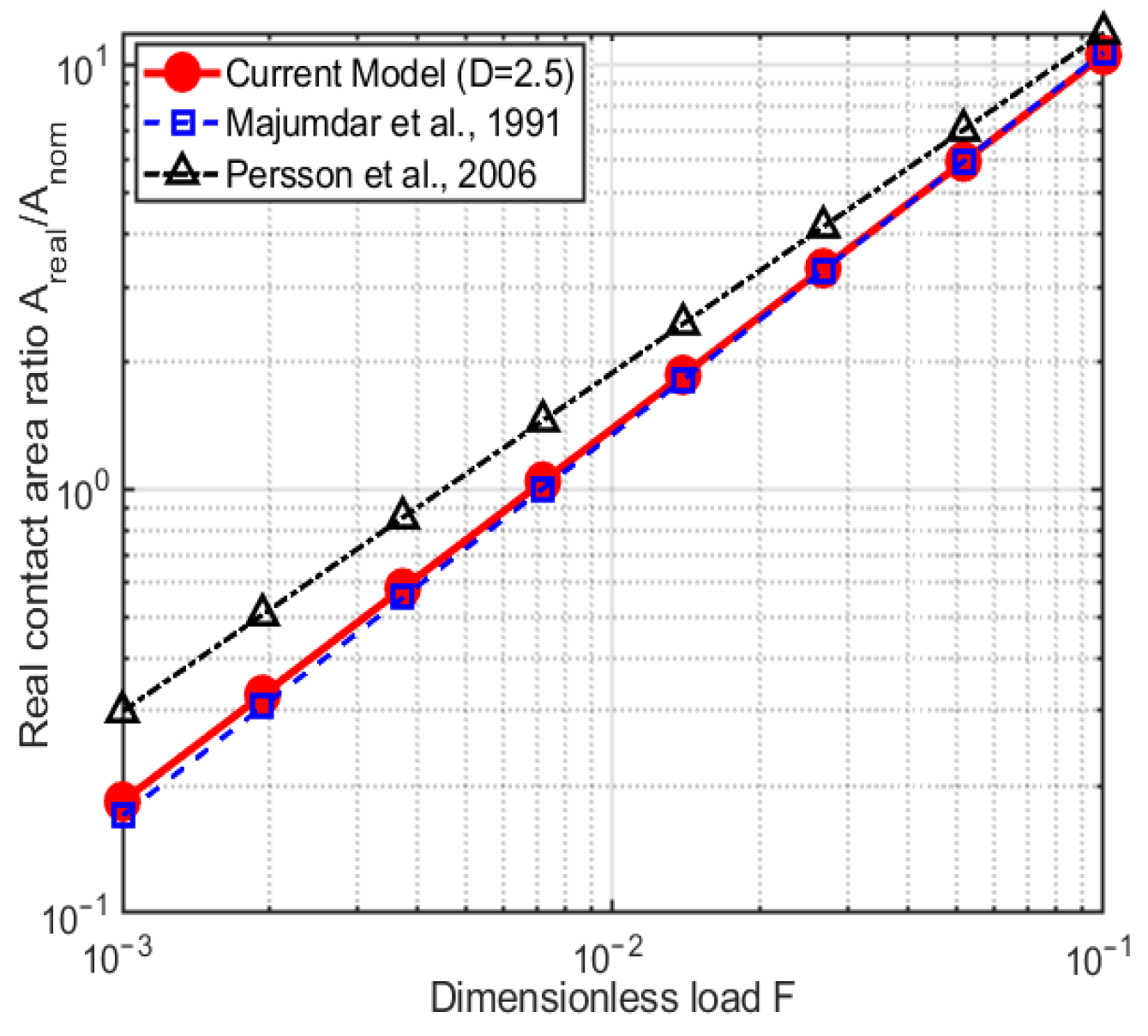
The results of this work were compared with those from the M-B model and the contact model based on Persson’s theory, as shown in Figure 1. For all models, the area ratio increased with increasing loads, and the results of the current model lay between those of the M-B model and Persson’s theory. The errors between the results of the current model and the M-B model and Persson’s theory were 1.28% and 1.67%, respectively, which were less than 2%. The accuracy of the present model in calculating the real contact area was validated, and the effectiveness of the fractal surface coupled with the MD parameters and FFT-GFM solution was proven.
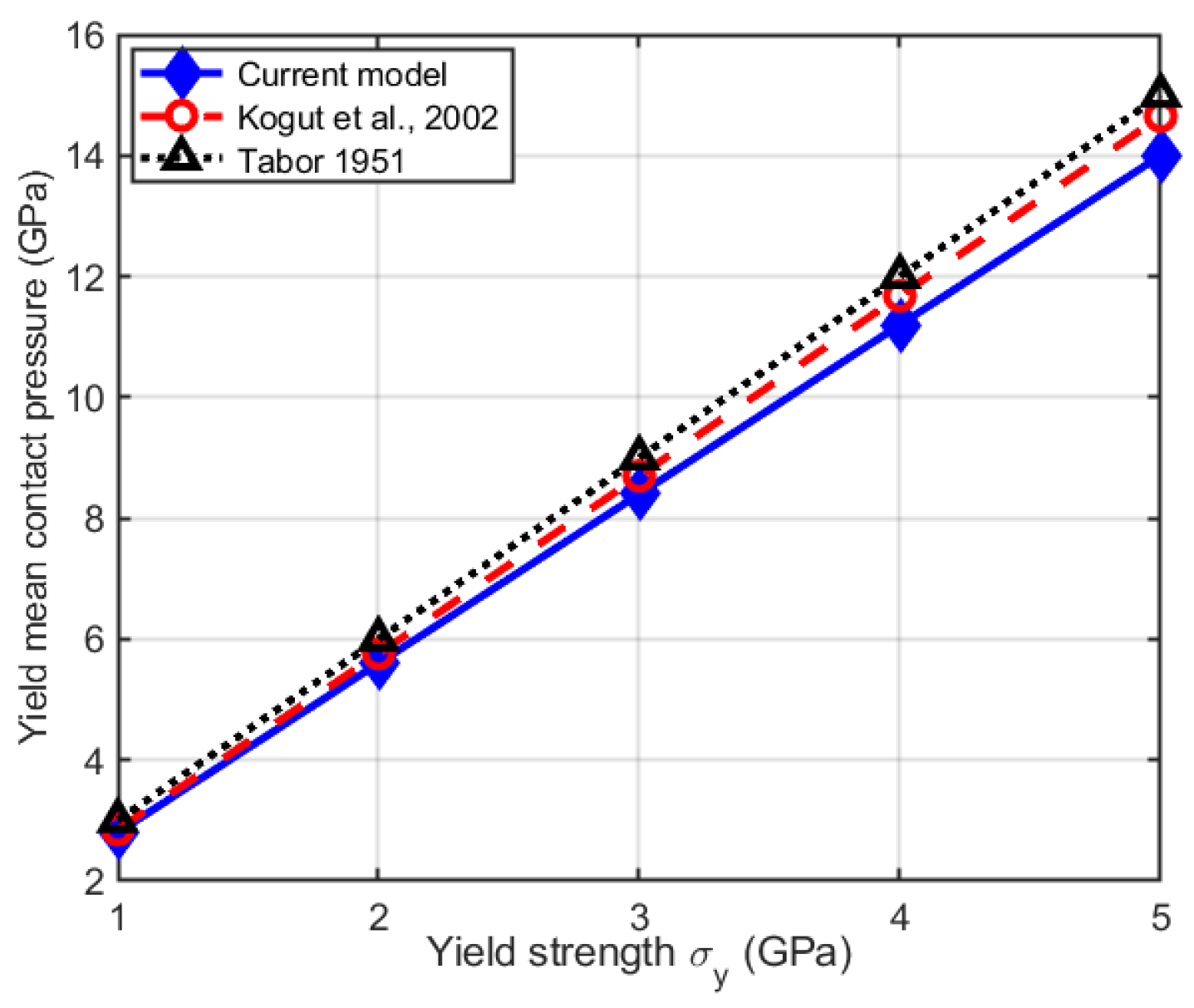
In order to further verify the correctness of the model, the average contact pressure of micro-asperity yielding calculated by the model was compared with the numerical results based on finite element analysis (FEA) and the classical Tabor empirical relationship, as shown in Figure 2. The results of this model and the FEA are both shown as (2.8–2.9)σy, which is slightly lower than the classical Tabor expression (3σy). This is because the Tabor expression corresponds to a fully plastic flow state, whereas the initial macroscopic yield threshold under actual contact conditions involving multiple asperities is more accurately captured by the current model and FEA. The calculation showed that the maximum relative error between the results of the model and those obtained from FEA across all data points was only 1.42%. This demonstrated that the elastic–plastic criterion adopted in this model and the subsequent plastic hardening correction could accurately simulate the transition from elastic to plastic deformation of micro-asperities in HEACs.

4. Results and Discussion

4.1. Variation in Load–Displacement Curves

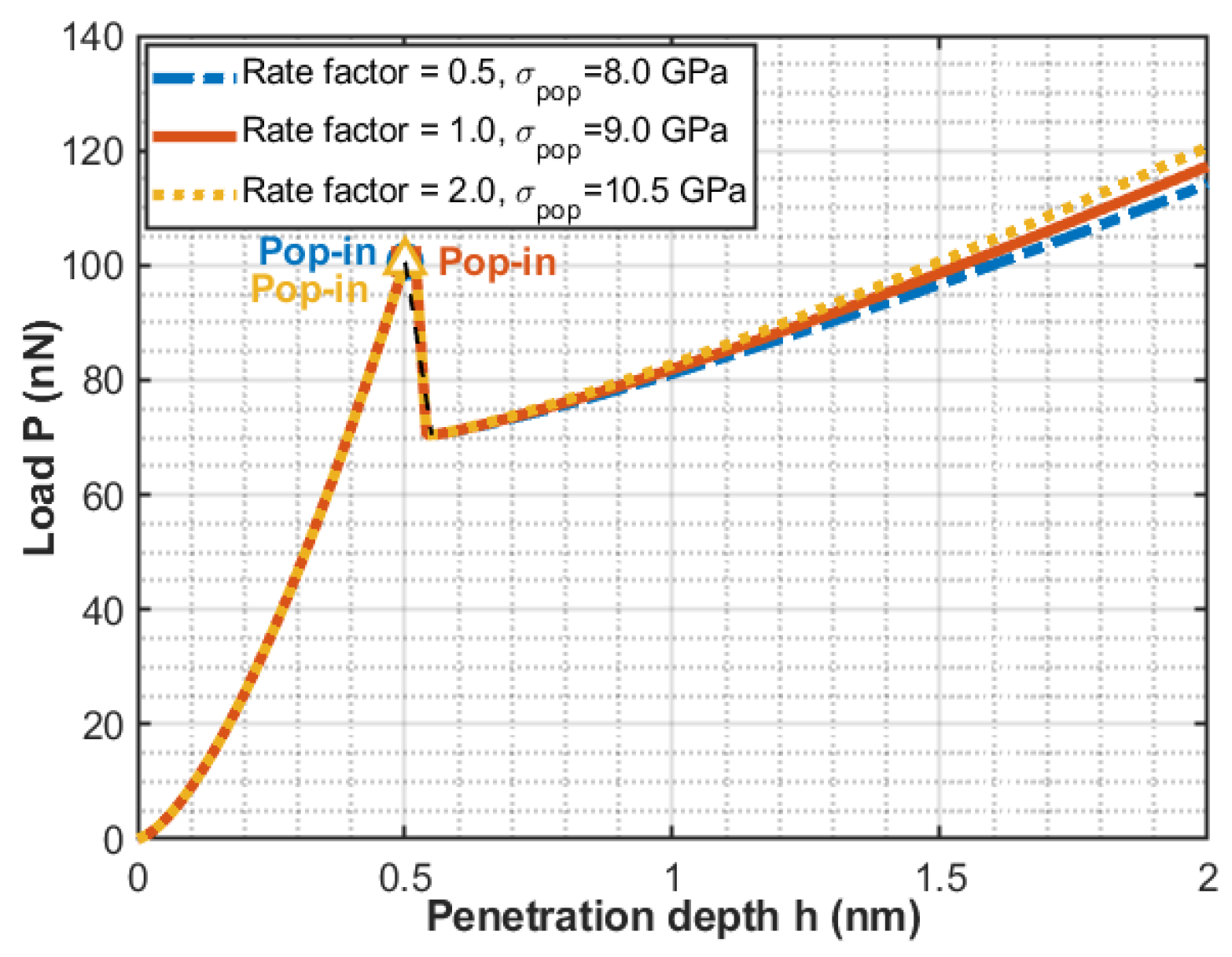
The load–displacement curves obtained via MD simulation are shown in Figure 3. All curves are characterized by an initial nonlinear elastic stage and a sudden ‘pop-in’ event (load-drop point) triggered by dislocation nucleation (or phase transformation), as well as a subsequent plastic-hardening stage. A key finding was that the initial yield stress (pop-in point) of the HEACs was significantly higher than that of conventional alloys and remained relatively insensitive to the loading rate (the pop-in stresses of the curves were in the range of 8.0 to 10.5 GPa). This behavior was attributed to the severe lattice distortion and short-range ordered structures in the HEACs, which significantly hinder the nucleation and initiation of dislocations. The pop-in stress serves as the critical yield threshold (σ*y) for asperities in the subsequent fractal contact model, while the hardening trend observed in the plastic stage can be used to define the pressure–area relationship following asperity yielding.

4.2. Surface Morphology, Contact Contours, and Pressure Distribution

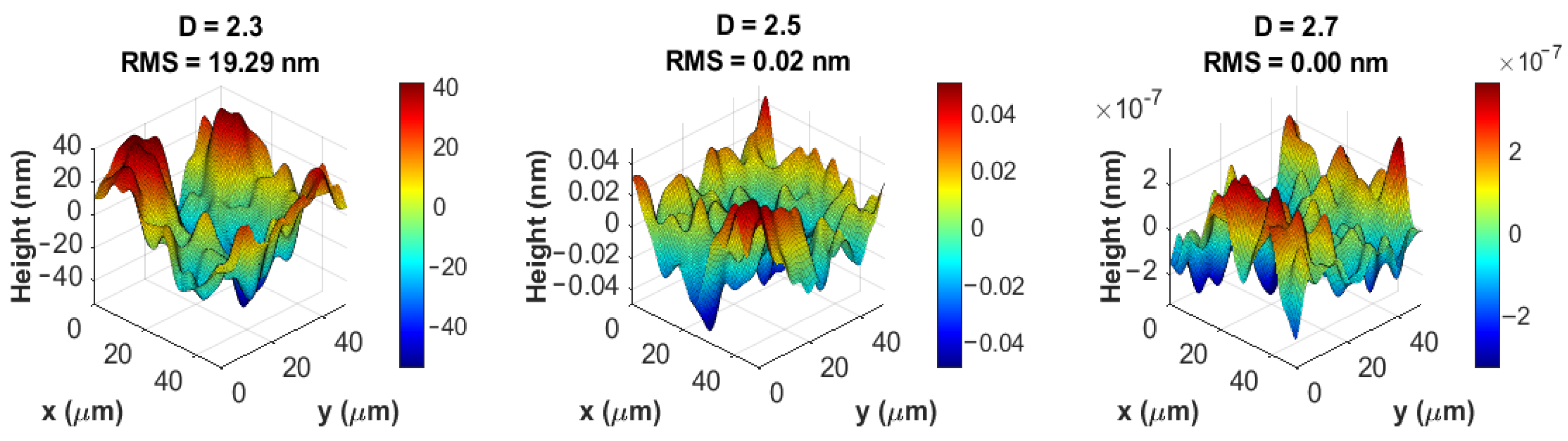
The rough surface topography with different fractal dimensions is displayed in Figure 4. The surface is dominated by wave-like undulations at D = 2.3, whereas D = 2.5 exhibits pronounced multiscale features with rich high- and low-frequency components and topography marked by sharp asperities at D = 2.7. The morphology generation method, which integrates intrinsic material properties and the deformation or yielding behavior of micro-asperity, was used to ensure self-consistency with the size and material attributes.
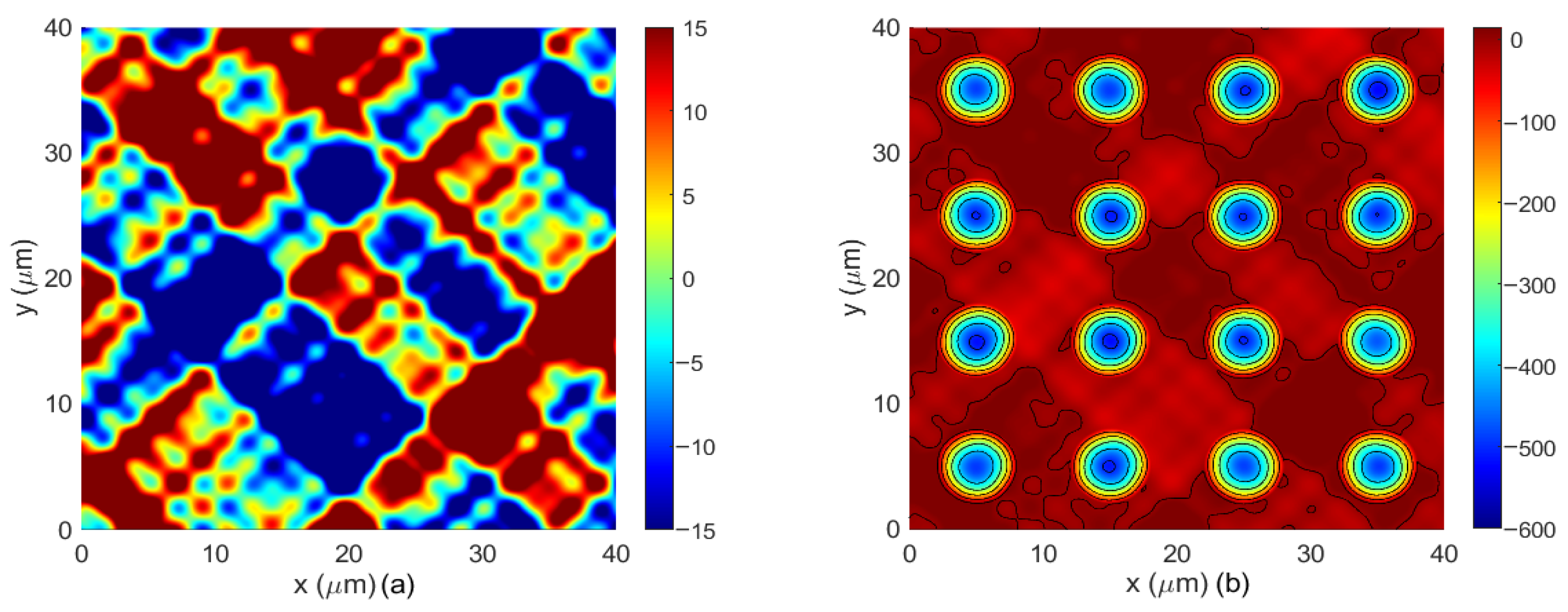
The surface morphology of textured HEACs (T-HEACs) versus polished HEACs is shown in Figure 5. The edge and bottom of the micro-pits are outlined by contour lines. The micro-pits coexist with the inherent fractal roughness, while the surface exhibits abundant submicron-scale roughness details inside the micro-pits and in the raised areas between them. The actual distribution of contact points was determined by the coupling of a ‘texture-roughness’ dual-scale structure, which was modulated macroscopically by micro-pit array and governed microscopically by the fractal roughness within each potential contact spot.
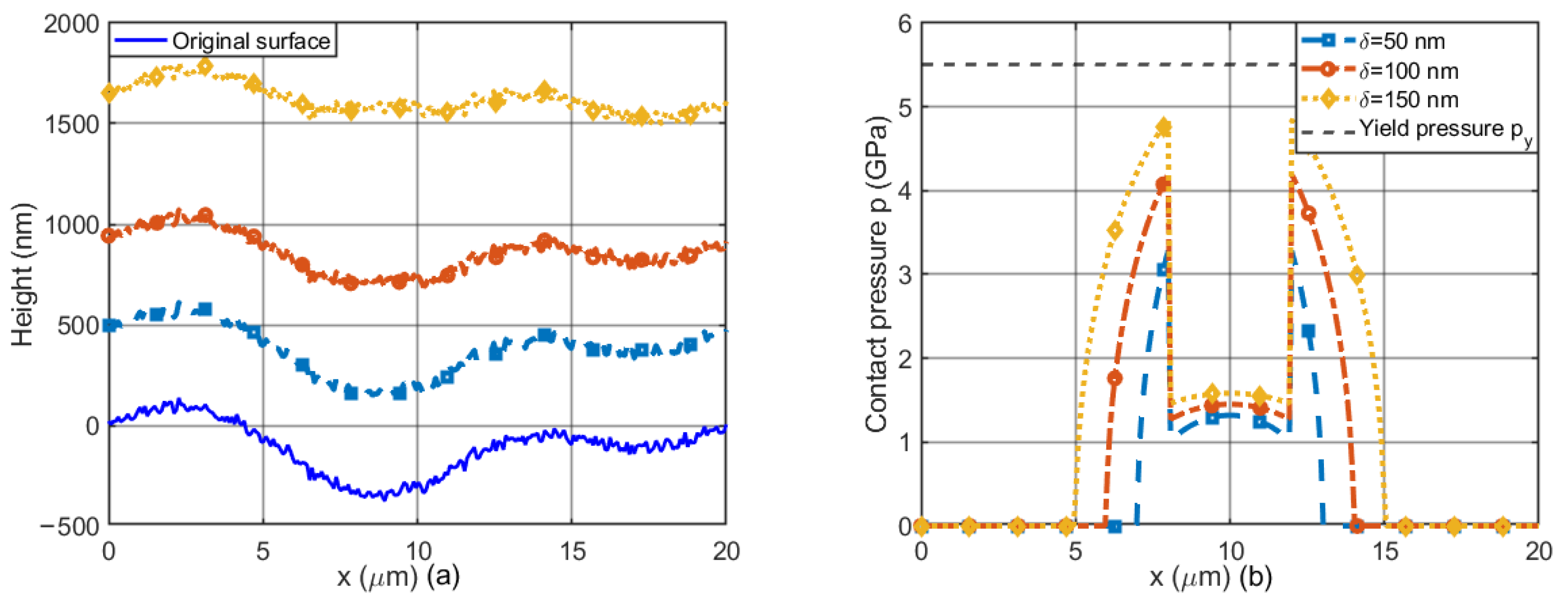
The contact contours and pressure distributions under elastoplastic conditions are shown in Figure 6. Figure 6a illustrates the original surface topography (solid blue line) and the contact profile (dashed colored line) calculated under varying normal approaches (δ, rigid body displacement). The contact area became wider, and deeper penetration of the contour line into the surface was observed as the δ increased. Figure 6b displays the corresponding contact pressure distribution, which was not a Hertzian profile, but the pressure decreased significantly above the micro-pit (central region), reflecting the stress redistribution effect of the surface texture. The peak pressure increased and the contact width expanded as the δ increased, with the black dotted line representing the yield pressure py. The peak pressure was observed to approach py when the δ reached its maximum, which indicated that the central contact region yielded gradually.

4.3. Influence of Fractal Dimension on Contact Ratio and COF

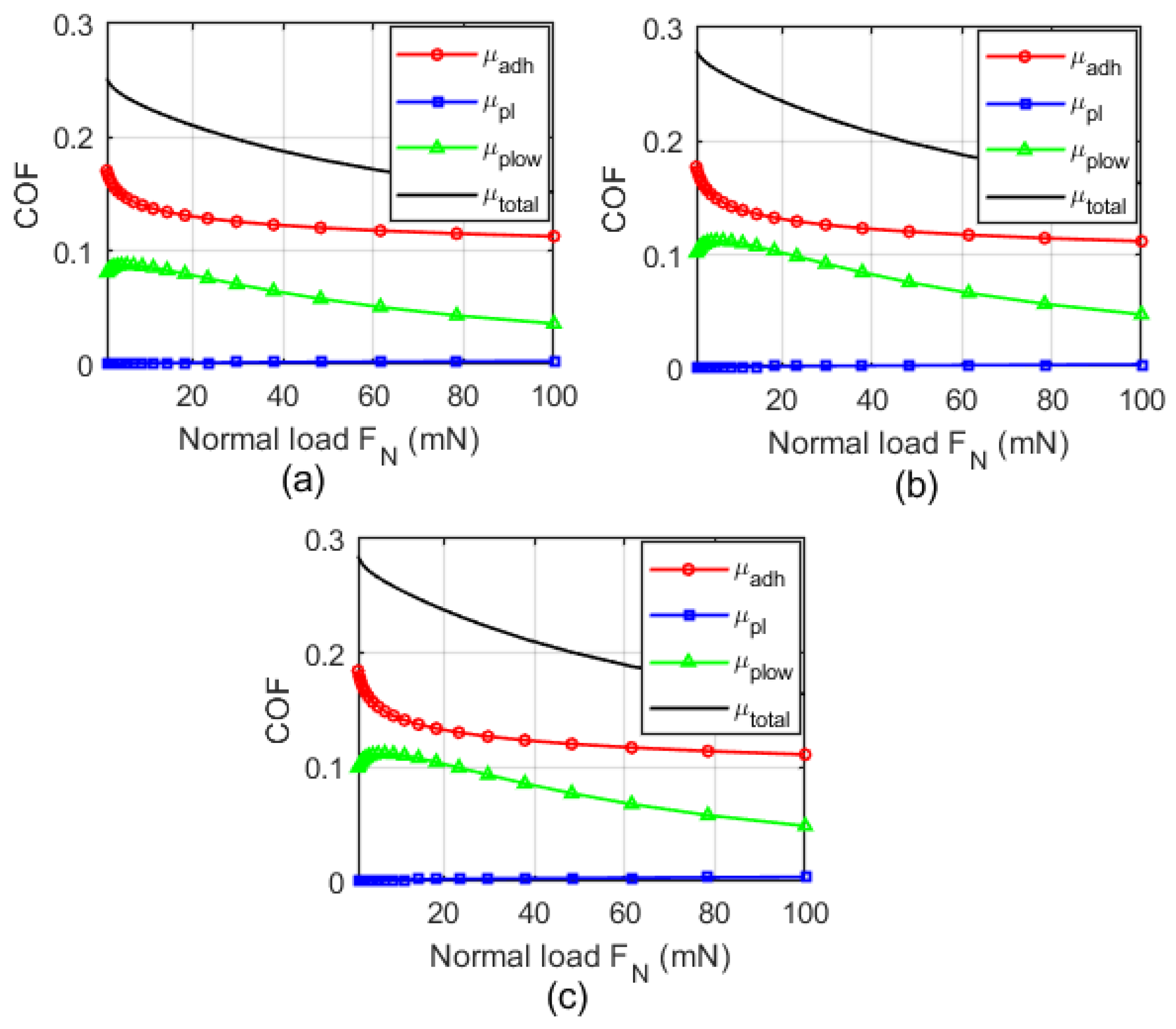
The contribution of each component and the influence of fractal dimension D were analyzed based on the multiscale friction model, as shown in Figure 7. It can be observed in Figure 7a–c that the μadh decreased with increasing load because the growth rate of the real contact area was slower than that of the load. In contrast, the μpl increased with load as more asperities entered the plastic deformation state. Furthermore, the contribution of the μplow was significant at low D (due to sharp peaks) and increased first before leveling off with the load.
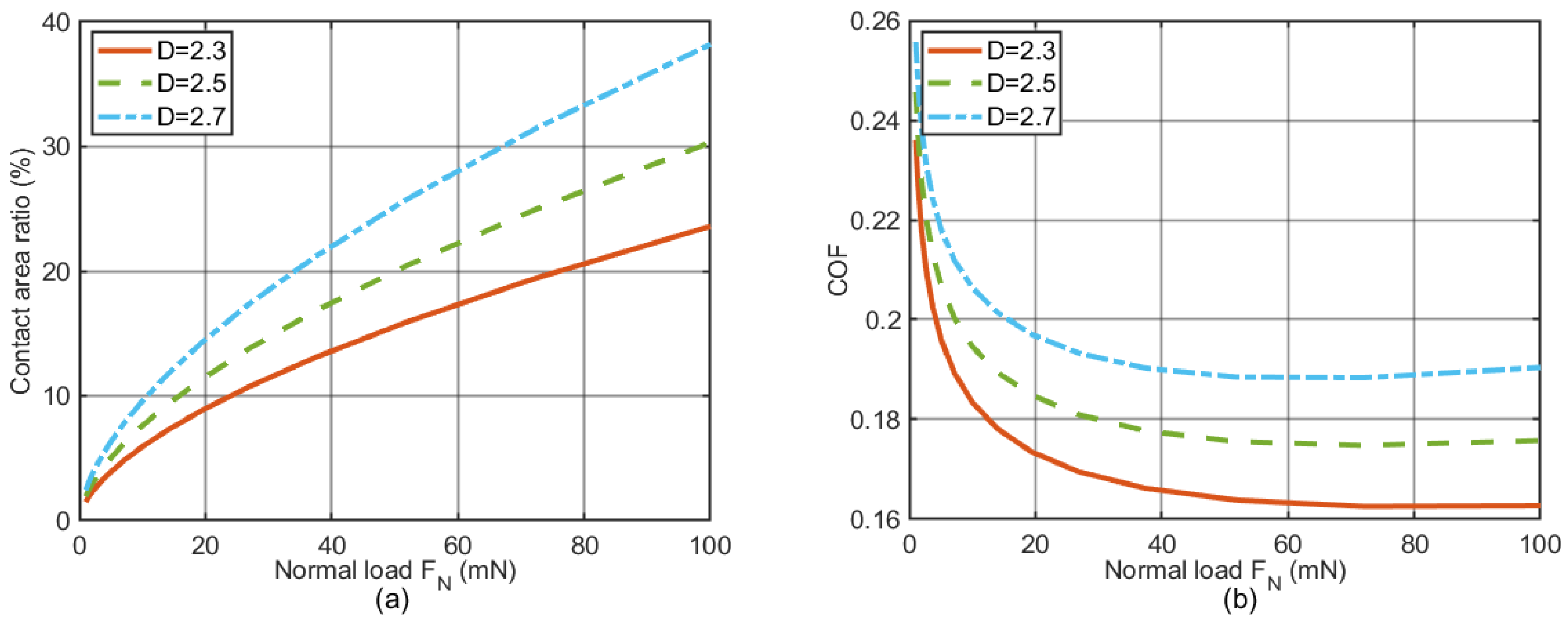
The influence of fractal dimension on the plastic contact ratio and total COF is shown in Figure 8. In Figure 8a, a higher fractal dimension D led to a larger proportion of plastic contact area under any given normal load. The reason was that the surface with higher D was composed of a large number of asperities with smaller radii of curvature, making it easier to reach the yield stress, and extensive plastic deformation occurred under the same load. As shown in Figure 8b, in the low-load regime, surfaces with a low fractal dimension D exhibited the highest COF, which was primarily attributed to the significant plowing effect induced by sharp asperities. In the high-load regime, an increase in COF occurred on surfaces with a high fractal dimension D due to the extensive transition of numerous asperities into the plastic state and the consequent sharp increase in plastic dissipation. Notably, a relatively lower COF was maintained over a wide load range for the surface with D ≈ 2.3. This was attributed to the achievement of an optimal balance among the three friction dissipation mechanisms—adhesion, plasticity, and plowing—which provided a crucial design basis for surface topography optimization.

4.4. Temperature Effects on the Interfacial Characteristics and COF of the T-HEACs

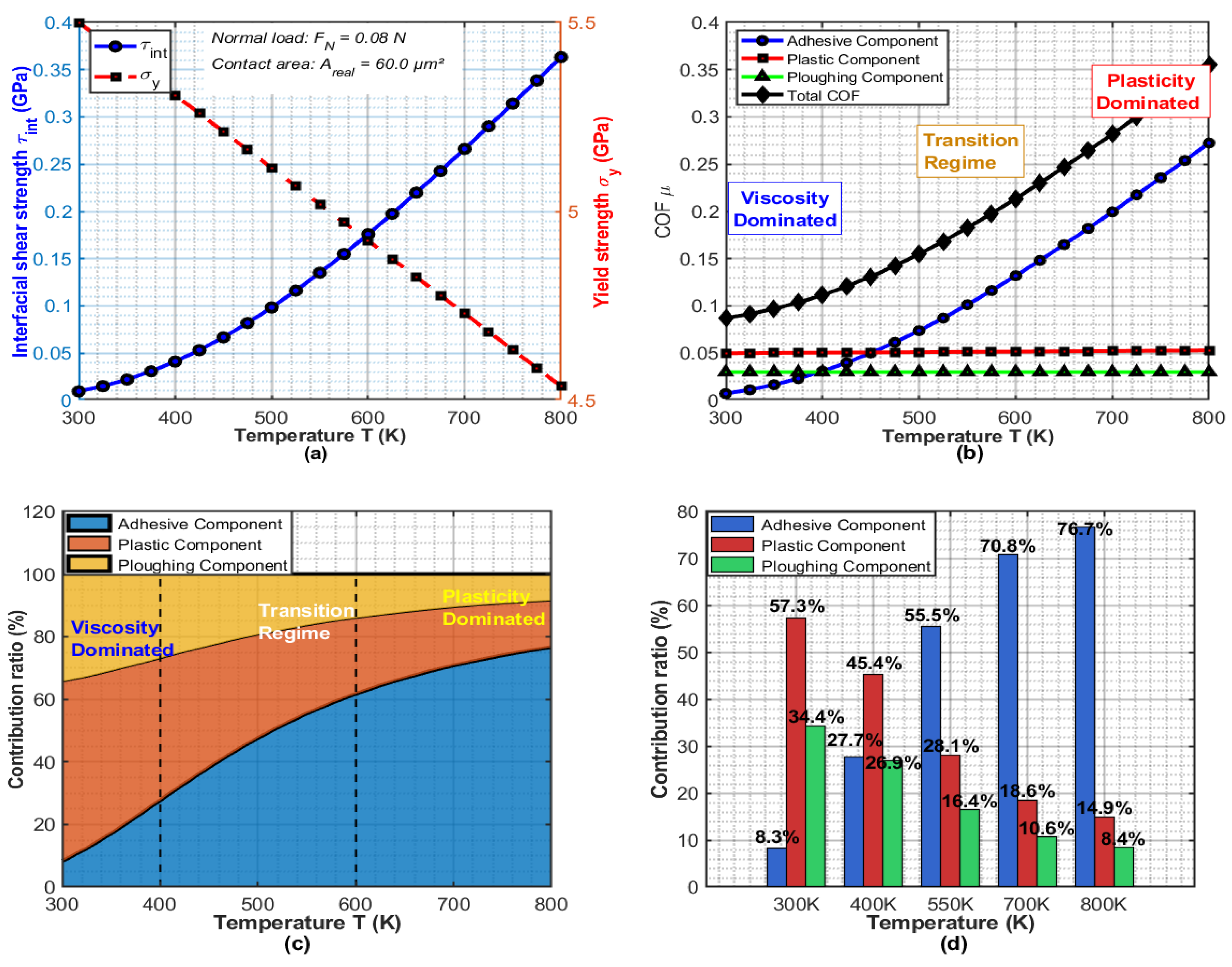
Figure 9 reveals the evolution of interfacial properties and friction mechanisms of the T-HEACs. Figure 9a shows that a decrease in the overall yield strength was induced by thermal softening, which enhanced dislocation mobility. An increase in the interfacial shear strength was enabled by oxide film densification within the textured regions and the dislocation pinning strengthening effect caused by dynamic strain aging, which increased with the increase in temperature. As shown in Figure 9b, the T-HEACs were softened and their plastic deformation was aggravated. Meanwhile, the wear debris or oxide films stored within the micro-pits were softened or exfoliated, weakening the debris-trapping and secondary lubrication functions, causing an increase in COF. Figure 9c shows that the dominant friction mechanism at 300 K was adhesive wear; the COF decreased to its minimum as a transitional regime was entered, whereby the contributions from the adhesive, plastic, and plowing components became balanced when the temperature increased to 550 K. The dominant friction mechanism at 800 K was plastic wear, and its synergistic action with the plowing component jointly drove the increases in COF. In Figure 9d, the three-stage friction mechanism transformation of ‘adhesion dominant–transitional balance–plasticity dominant’ is clearly displayed, illustrating the adaptation design of HEACs.

4.5. Synergistic Regulation of Fractal Dimension, Textured Area Density, and Load on the Friction Behavior of T-HEACs

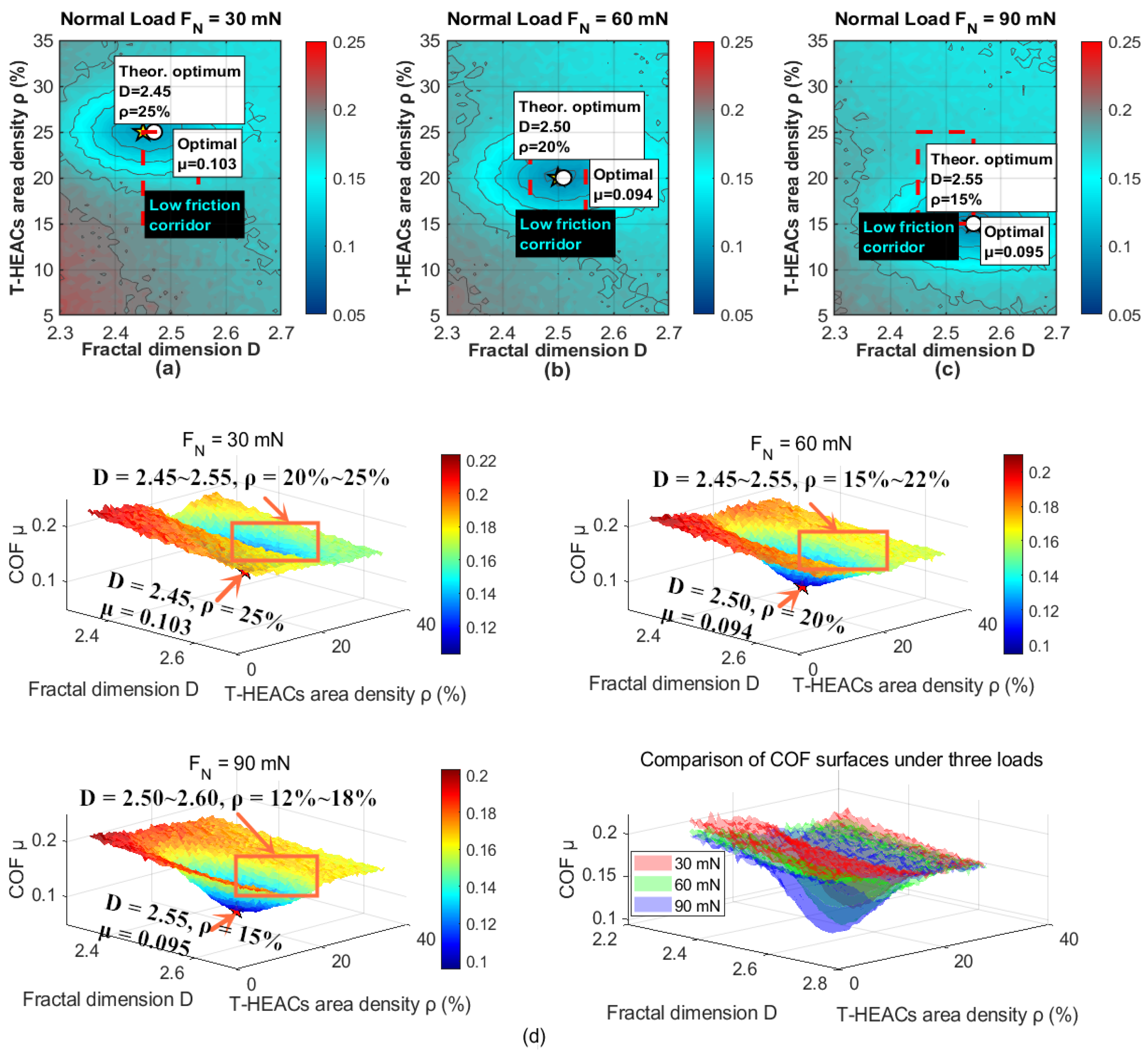
The synergistic regulation mechanism of T-HEACs is shown in Figure 10. In Figure 10a–c, the low-friction and optimal synergistic regime observed was attributed to the balanced mitigation of adhesion, plastic deformation, and plowing mechanisms. A combination of D = 2.45, ρ = 25%, and μ = 0.103 minimized friction primarily under a load of 30 mN through adhesive reduction via decreased real contact area. Conversely, the optimum shifted to D = 2.50, ρ = 20%, and μ = 0.094 when the load was 60 mN, achieving the balance between adhesion and load. In contrast, the optimal parameters were adjusted to D = 2.55, ρ = 15%, and μ = 0.095 when the load was 90 mN, and the local stress concentration caused by the reduction in effective bearing area was avoided with low area density.
The formation of the optimal synergy interval (D = 2.45–2.55, ρ = 15–20%) was attributed to the nonlinear competition among three frictional dissipation mechanisms: adhesive dissipation (μadh), plastic dissipation (μpl), and plowing dissipation (μplow). Within a specific range of fractal dimensions, the statistical characteristics of surface topography enable the three dissipation mechanisms to achieve an energy-minimizing balance. Simultaneously, a moderate textured area density optimized the synergy among debris storage, stress relief, and load-bearing capacity. This interval essentially represented a dissipation-minimizing region under multiscale coupling between surface geometry (fractal characteristics, texture density) and intrinsic material behavior (yield strength, hardening exponent).
In Figure 10d, the low-friction region is observed to be concentrated in the range of 20~25% of the T-HEAC area density and the fractal dimension (2.45~2.55) when the load was 30 mN; here, the friction reduction is predominantly governed by the debris storage effect associated with the high area density of the T-HEACs. When the load was 60 mN, the low-friction region was the widest, covering D = 2.45~2.55 and an area density of 15% to 22%. Meanwhile, the optimal balance was achieved among bearing capacity, debris storage, and stress distribution. The low-friction region was found to shift toward a lower T-HEAC area density (12~18%) and medium-to-high fractal dimension (2.45~2.55) when the load was 90 mN; further, the low T-HEAC area density ensured sufficient bearing contact area and avoided the excessive plastic deformation of the micro-asperities.

4.6. Comparative Analysis, Friction Reduction Mechanisms, and Model Limitations

To verify the reliability of the predicted results from the model, the predicted COF trends were qualitatively/semi-quantitatively compared with the published tribological experimental results of typical HEACs, as shown in Table 1. Typical HEACs exhibit COF values in the range of 0.35–0.55 under dry sliding conditions. The value was lower than that reported in the above-mentioned experimental studies on conventional HEACs, which was attributed to the introduction of surface micro-pit textures in the model to reduce friction by capturing debris and redistributing stress. The model prediction corresponds to the optimal parameter combination, whereas the experimental data were mostly derived from unoptimized textured parameters.
Notably, a friction coefficient of 0.433 was obtained by Zhang et al. [32] for an HVOF-sprayed AlCoCrFeNiMn0.5 coating after compositional optimization, which was approximately 16.7% lower than that of the Mn-free coating. This reduction was generally consistent with the 15–20% friction reduction range predicted by the present model. Moreover, a COF in the range of approximately 0.35–0.45 was reported [33] for FeNiCrCoCu HEACs using MD simulations, which agreed in magnitude with the predictions of the model. The above comparison demonstrates that the predicted COF range of this model is in good agreement with the experimental observation trend, and the predicted friction reduction amplitude is supported by literature data.
Although a high level of accuracy was achieved by the present model in predicting the frictional behavior of T-HEACs, the following limitations should be recognized and addressed in practical engineering applications. Based on the assumptions of continuum mechanics and fractal geometry, the presented model may experience a decrease in accuracy under extremely low load conditions (<1 mN), where the interactions between discrete contact spots and interfacial effects may become significant. When the surface became almost atomically smooth (arithmetic mean height Sa < 0.5 nm), the applicability of the fractal assumption was weakened, under which atomic forces and quantum effects might come to dominate the contact behavior. Additionally, the effects of environmental factors such as oxidation, humidity, and lubricating media on tribochemical behavior were not considered in the present study. For example, in a high-temperature oxidizing environment, a dense oxide film (e.g., Cr2O3, Al2O3) may form on the HEACs’ surface, which could either reduce friction (solid lubrication effect) or exacerbate wear (oxidative wear). Such chemo-mechanical coupling mechanisms have not yet been incorporated into the present model. In summary, the proposed model is subject to limitations under extremely low loads or atomically smooth surfaces and does not account for environmental factors such as oxidation or humidity, which should be addressed in future work.

4.7. Critical Parameter Sensitivity Analysis and Uncertainty Estimation

To evaluated the sensitivity of the model to its key input parameters and to verified its robustness, the fractal dimension D and the hardening coefficient K′ were varied by ±10% and ±20% from their nominal values, respectively, and the corresponding relative changes in the COF were observed under different load conditions. The sensitivity analysis results were summarized in Table 2. In Table 2, the sensitivity coefficient of fractal dimension D was about 0.80–0.91, which indicates that μ was sensitive to the change of fractal dimension D. When fractal dimension D was varied by ±10%, a maximum relative change of ±8.5% was observed in the μ. When fractal dimension D was varied by ±20%, the change in μ reached up to ±18.1%. This reflected the significant influence of the fractal dimension on surface topography and contact mechanics. The sensitivity coefficient of hardening coefficient K′ was about 0.43, which indicates that μ was less sensitive to hardening coefficient K′. When hardening coefficient K′ was varied by ±20%, a maximum relative changed of only ±8.5% was observed in μ, which demonstrated that the model was well tolerant to variations in the hardening parameter.
The uncertainty of the model prediction results mainly comes from the following aspects. Statistical errors of approximately ±5% were observed for K′ and n, which mainly arose from atomic thermal vibrations and initial configuration differences in the nanoindentation simulations. And, the selection of random phase φm,n in W-M function leaded to statistical fluctuation of surface morphology, which was estimated to affect μ by about 3–5%. The error introduced by FFT-GFM discretization and iterative convergence threshold was less than 1%. In summary, the total uncertainty in the COF μ predicted by the model was estimated to be approximately ±10–15%. This uncertainty was considered to be within an acceptable range and strong robustness was exhibited by the model.

5. Conclusions

In this work, a cross-scale fractal analysis of frictional behavior in T-HEACs was conducted. The main conclusions and innovations are as follows:
(1) A novel cross-scale analytical model was developed for the in-depth investigation of the contact and frictional behavior of fractal surfaces in micro-pit T-HEACs, providing a theoretical tool for the design and performance optimization of complex surfaces.
(2) An optimal synergistic parameter interval between the fractal dimension (D = 2.45~2.55) and the T-HEAC area density (ρ = 15~25%) was identified, which could balance the three friction dissipation mechanisms of adhesion, plasticity, and plowing to reduce the COF by up to 40% compared with untextured surfaces.
(3) A higher area density is required under low loads to leverage the debris-trapping effect, whereas a lower T-HEAC area density is needed under high loads to ensure sufficient contact area, directly reflecting the nonlinear regulation mechanism of the load on the synergistic relationship between surface texture and surface morphology.
(4) The interfacial shear strength may be enhanced by oxide film densification and dynamic strain aging as the temperature increases. Thus, through a balanced transitional regime, the transition from an adhesion-dominated to plasticity-dominated mechanism may provide a basis for the high-temperature design of coatings.

Author Contributions

Conceptualization, Y.M.; methodology, Y.M. and A.W.; software, A.W.; formal analysis, R.M.; investigation, L.G.; visualization, Z.W.; data curation, R.M.; writing-original draft preparation, L.G.; validation, A.W.; writing-review and editing, R.M.; supervision, Z.W.; resources, L.G.; project administration, Z.W.; funding acquisition, Y.M. All authors have read and agreed to the published version of the manuscript.

Funding

This work was supported by National Natural Science Foundation of Henan (Grant No. 262300420036), Henan Provincial Department of Science and Technology Research Project (Grant No. 242102220075), and Key Research Project for Higher Education of Henan (Grant No. 24A460002).

Data Availability Statement

The data that support the findings of this study are available from the corresponding author.

Acknowledgments

The authors would also like to express their sincere thanks to the anonymous referees and the editor for their constructive comments.

Conflicts of Interest

The authors declare no conflict of interest.

References

  1. Nie, S.L.; Gong, F.; Ji, H.; Wang, Y.; Che, C.; Zhang, G. Effect of surface texture on frictional energy dissipation under magnetic fluid lubrication used for semi-active nonlinear energy sink. Tribol. Int. 2024, 192, 109283. [Google Scholar] [CrossRef]
  2. Mandriota, C.; Menga, N.; Carbone, G. Adhesive contact mechanics of viscoelastic materials. Int. J. Solids Struct. 2024, 290, 112685. [Google Scholar] [CrossRef]
  3. Mao, Y.Z.; Hu, Q.X.; Yu, Y.Y.; Shi, S.; Pei, J.; Li, Z.; Wang, L. A mechanics model for contact with rough surface considering the interaction of micro-asperity bodies. Lubricants 2025, 13, 96. [Google Scholar] [CrossRef]
  4. Tang, X.Y.; Ta, W.R.; Zhou, Y.H. Contact behaviors of rough surfaces under tension and bending. Acta Mech. Sin. 2025, 41, 424067. [Google Scholar] [CrossRef]
  5. Chen, Z.; Wang, T.; Gao, T.; Wu, X.; Zhang, Z.; Zhao, Y.; Gu, P. Large deformation contact mechanics with non-slip interfaces. Int. J. Solids Struct. 2025, 320, 113474. [Google Scholar] [CrossRef]
  6. Chen, J.; Liu, D.; Wang, C.L.; Zhang, W.; Zhu, L. A fractal contact model of rough surfaces considering detailed multi-scale effects. Tribol. Int. 2022, 176, 107920. [Google Scholar] [CrossRef]
  7. Kang, H.H.; Li, Z.M.; Liu, T.; Zhao, G.; Jing, J.; Yuan, W. A novel multiscale model for contact behavior analysis of rough surfaces with the statistical approach. Int. J. Mech. Sci. 2021, 212, 106808. [Google Scholar] [CrossRef]
  8. Ni, X.Y.; Sun, J.J.; Ma, C.B.; Zhang, Y. Wear model of a mechanical seal based on piecewise fractal theory. Fractal Fract. 2023, 7, 251. [Google Scholar] [CrossRef]
  9. Yu, X.; Sun, Y.Y.; Liu, M.M.; Wu, S. Analytical description of the wear process using a multi-stage contact fractal approach. Wear 2024, 548–549, 205364. [Google Scholar] [CrossRef]
  10. Chen, X.G.; Yan, L.; Zhang, H.S.; Tong, Y.; Sang, W.; Zhang, H.; Liu, Z.; Zhang, D.; Zhang, M. Thermophysical and mechanical performances of (Nd0.2Sm0.2Gd0.2Yb0.2Y0.2)3TaO7 and (Nd0.2Sm0.2Gd0.2Yb0.2Y0.2)3 Ta0.5Nb0.5O7 high-entropy compounds. J. Alloys Compd. 2025, 1039, 183097. [Google Scholar] [CrossRef]
  11. Chen, X.G.; Zhang, X.P.; Xue, Y.F.; Wang, Y.; Zhang, H.; Zhang, H.; Guan, K.; Wang, C.; Zhao, Y. Investigation of thermophysical properties and elastic moduli of Sm2GdTa1-xCexO7-x/2 oxides for thermal barrier coatings. Ceram. Int. 2025, 51, 27550–27556. [Google Scholar]
  12. Zhang, H.M.; Feng, Y.; Chen, X.G.; Zhang, H.S.; Liu, Y.X.; Tang, A.; Ren, B. Thermal properties of La3TaO7 and La2AlTaO7 oxides. Ceram. Int. 2017, 43, 755–759. [Google Scholar]
  13. Chen, X.G.; Tang, A.; Zhang, H.S.; Liu, Y.; Zhang, H.; Zhao, Y. Thermal conductivity and expansion coefficient of Ln2LaTaO7 (Ln=Er and Yb) oxides for thermal barrier coating applications. Ceram. Int. 2016, 42, 13491–13496. [Google Scholar]
  14. Kumar, H.; Bhaduri, G.A.; Manikandan, S.G.K.; Kamaraj, M.; Shiva, S. Microstructural characterization and tribological properties of atmospheric plasma sprayed high entropy alloy coatings. J. Therm. Spray Technol. 2022, 31, 1956–1974. [Google Scholar] [CrossRef]
  15. Li, Y.; Shi, Y.J.; Li, S.W.; Yan, X.; Wang, S.; Zhuo, X. Effect of Fe content on the microstructure and wear resistance of AlCoCrFeNi high-entropy alloy coating prepared by laser cladding. Appl. Surf. Sci. 2025, 685, 162019. [Google Scholar] [CrossRef]
  16. Liang, H.; Hou, J.X.; Liu, J.H.; Xu, H.; Li, Y.; Jiang, L.; Cao, Z. The microstructures and wear resistance of CoCrFeNi2Mox high entropy alloy coatings. Coating 2024, 14, 760. [Google Scholar] [CrossRef]
  17. Zhang, S.L.; Sun, Y.N.; Cheng, W.J.; Chen, Y.; Gu, J.; Chen, G. Microstructure and tribological behavior of CoCrFeNiMo0.2/SiC high-entropy alloy gradient composite coating prepared by laser cladding. Surf. Coat. Technol. 2023, 467, 129681. [Google Scholar] [CrossRef]
  18. Gu, J.; Su, Y.N.; Cheng, W.J.; Chong, Z.; Ma, X.; Huang, L.; Zhang, S.; Chen, Y. Microstructure and wear resistance of multi-layer graphene doped AlCoCrFeNi2.1 high-entropy alloy self-lubricating coating prepared by laser cladding. Intermetallics 2025, 176, 108578. [Google Scholar] [CrossRef]
  19. Guo, Y.N.; Su, H.J.; Gao, H.L.; Shen, Z.; Yang, P.; Liu, Y.; Zhao, D.; Zhang, Z.; Guo, M.; Tan, X. Microstructural origins of enhanced work hardening and ductility in laser powder-bed fusion 3D-printed AlCoCrFeNi2.1 eutectic high-entropy alloys. Int. J. Plast. 2024, 179, 104050. [Google Scholar] [CrossRef]
  20. Wos, S.; Koszela, W.; Dzierwa, A.; Pawlus, P. Effect of zonal laser texturing on friction reduction of steel elements in lubricated reciprocating motion. Materials 2024, 17, 2401. [Google Scholar] [CrossRef]
  21. Barman, S.; Gupta, K.K.; Dey, S. Exploring nano-scale scratching induced tribological behavior of graphene engineered AlCoCrFeNi high entropy alloy. J. Appl. Mech. 2024, 91, 101007. [Google Scholar] [CrossRef]
  22. Zhang, J.; Deng, G.Y.; Li, W.Y.; Li, S.; Yan, Y.; Liu, X.; Ma, T.; Gao, L. Grain size and scratching depth dependent tribological characteristics of CrCoNi medium-entropy alloy coatings: A molecular dynamics simulation study. Surf. Coat. Technol. 2023, 468, 129772. [Google Scholar] [CrossRef]
  23. Phan, A.D.; Nga, D.T.; Que, N.T.; Peng, H.; Norhourmour, T.; Tu, L.M. A multiscale approach to structural relaxation and diffusion in metallic glasses. Comput. Mater. Sci. 2025, 251, 113759. [Google Scholar] [CrossRef]
  24. Luo, Y.; Byggmästar, J.; Daymond, M.R.; Béland, L.K. Interatomic force fields for zirconium based on the embedded atom method and the tabulated gaussian approximation potential. Comput. Mater. Sci. 2024, 233, 112730. [Google Scholar] [CrossRef]
  25. Han, R.C.; Song, H.Y.; Han, L.; An, M. Atomistic insights on the deformation mechanisms of amorphous/crystalline dual-phase high entropy alloys under nanoindentation. J. Mater. Res. Technol. 2023, 25, 6027–6038. [Google Scholar] [CrossRef]
  26. Zhao, J.; Wang, Z.K.; Li, Z.; Zhu, R. Fractal simulation of surface topography and prediction of its lubrication characteristics. Surf. Topogr. Metrol. Prop. 2021, 9, 045038. [Google Scholar] [CrossRef]
  27. Pan, W.J.; Sun, Y.H.; Li, X.M.; Song, H.; Guo, J. Contact mechanics modeling of fractal surface with complex multi-stage actual loading deformation. Appl. Math. Model. 2024, 128, 58–81. [Google Scholar] [CrossRef]
  28. Majumdar, A.; Bhushan, B. Fractal model of elastic-plastic contact between rough surfaces. J. Tribol. 1991, 113, 1–11. [Google Scholar] [CrossRef]
  29. Persson, B.N.J. Contact mechanics for randomly rough surfaces. Surf. Sci. Rep. 2006, 61, 201–227. [Google Scholar] [CrossRef]
  30. Kogut, L.; Etsion, I. Elastic-plastic contact analysis of a sphere and a rigid flat. J. Appl. Mech. 2002, 69, 657–662. [Google Scholar] [CrossRef]
  31. Tabor, D. The Hardness of Metals; Oxford University Press: Oxford, UK, 1951. [Google Scholar]
  32. Zhang, D.; Li, Q.; Chang, C.; Zhang, G.; Ma, X.; Sun, R. Effects of Mn addition on wear and corrosion resistances of AlCoCrFeNi high-entropy alloy coating sprayed by HVOF. J. Mater. Res. Technol. 2025, 34, 627–638. [Google Scholar] [CrossRef]
  33. Zhang, X.; Yang, Z.; Deng, Y. Molecular dynamics study on wear resistance of high entropy alloy coatings considering the effect of temperature. Materials 2024, 17, 3911. [Google Scholar] [CrossRef]
Figure 1. Comparison of real contact area ratio and classical theories [28,29].
Lubricants 14 00209 g001
Figure 2. Comparison of yield average pressure with FEA and classical expression [30,31].
Lubricants 14 00209 g002
Figure 3. Nanoindentation response of HEACs under different loading rates.
Lubricants 14 00209 g003
Figure 4. The rough surface topographies with different fractal dimensions.
Lubricants 14 00209 g004
Figure 5. Fractal rough surface morphology; (a) Original HEACs fractal surface; (b) Micro-pit textured HEACs fractal surface.
Lubricants 14 00209 g005
Figure 6. Contact contours and pressure distributions; (a) Surface topography and contact contours under various δ; (b) Corresponding contact pressure distribution.
Lubricants 14 00209 g006
Figure 7. Analysis of component contributions and the influence of fractal dimension; (a) Fractal dimension D = 2.3; (b) Fractal dimension D = 2.5; (c) Fractal dimension D = 2.7.
Lubricants 14 00209 g007
Figure 8. The variation of contact ratio and total COF with normal load; (a) Contact area ratio; (b) Total COF.
Lubricants 14 00209 g008
Figure 9. The evolution of interfacial properties and friction mechanisms of the T-HEACs; (a) Temperature dependence of material properties; (b) Temperature variation of the COF; (c) Contribution ratio of COF components; (d) Component contribution of key temperature points.
Lubricants 14 00209 g009
Figure 10. The synergistic regulation mechanism of fractal dimension and textured area density; (a) The optimal parameters with normal load 30 mN; (b) The optimal parameters with normal load 60 mN; (c) The optimal parameters with normal load 90 mN; (d) Three-dimensional diagram of the synergistic regulation of friction coefficient by fractal dimension and texture area density under different loads.
Lubricants 14 00209 g010
Table 1. The friction experimental results for typical HEACs.
Coating MaterialMethodTest ConditionsCOFReference
AlCoCrFeNiTiAPSBall-on-disk, dry sliding0.45–0.55Kumar et al. [14]
AlCoCrFeNiLCBall-on-disk, dry sliding0.48–0.52Li et al. [15]
AlCoCrFeNiMn0.5HVOFBall-on-disk, dry sliding0.433Zhang et al. [32]
FeNiCrCoCuMD/ExperimentDry sliding, RT0.35–0.45Zhang et al. [33]
Table 2. The sensitivity analysis of key parameters on the COF (FN = 60 mN).
ParameterVariationμ RangeRelative ChangeSensitivity Coefficient
Fractal dimension D (2.5)+10% (→2.75)0.094 → 0.102+8.5%0.85
−10% (→2.25)0.094 → 0.086−8.5%0.85
+20% (→3.0)0.094 → 0.111+18.1%0.91
−20% (→2.0)0.094 → 0.079−16.0%0.80
Hardening coefficient K′ (115.6 GPa/nmnn)+10% (→127.2)0.094 → 0.098+4.3%0.43
−10% (→104.0)0.094 → 0.090−4.3%0.43
+20% (→138.7)0.094 → 0.102+8.5%0.43
−20% (→92.5)0.094 → 0.086−8.5%0.43
Disclaimer/Publisher’s Note: The statements, opinions and data contained in all publications are solely those of the individual author(s) and contributor(s) and not of MDPI and/or the editor(s). MDPI and/or the editor(s) disclaim responsibility for any injury to people or property resulting from any ideas, methods, instructions or products referred to in the content.