


Abstract
Herringbone gear pairs are critical in high-speed aerospace transmissions, where windage power loss significantly impacts efficiency and thermal management. This study proposes a prediction method that decomposes the total windage loss into five components based on structural features: the tooth, end, circumferential, and relief groove surface losses for both gears, and the meshing extrusion loss. Theoretical models for each component are established to form a complete prediction method using fluid–structure interaction principles. CFD simulations analyze the velocity, pressure, and energy fields around the gear pair, with windage loss integrated via fluid torque on gear surfaces. Results indicate that windage loss escalates rapidly and becomes non-negligible when the driving gear speed exceeds 7000 rpm. The prediction model demonstrates strong agreement with CFD simulations, with a maximum relative error of 13.6%. Analysis reveals that the driving gear contributes the largest share of the total gear pair loss, with meshing extrusion accounting for 20.1–23.6%. For a single herringbone gear, the tooth surface is the primary source of loss (~83%), followed by the end surface (~8%), while relief groove and circumferential losses remain below 10%. This research provides a validated theoretical foundation for optimizing efficiency and thermal control in high-speed aerospace gear systems.
1. Introduction
Herringbone gear pairs have become the preferred transmission components in high-speed and high-power aerospace transmission systems owing to their unique advantages, such as high contact ratio in the face width direction, self-balancing axial force, and strong load-carrying capacity. They are widely used in key applications such as aero-engine accessory gearboxes and helicopter main reduction gearboxes [1]. However, with the continuous increase in operating speed, the interaction between the rotating herringbone gear pair and the surrounding fluid becomes increasingly significant. Windage power loss has gradually become a critical bottleneck restricting the improvement of transmission efficiency and operational stability, which has attracted extensive attention from scholars worldwide [2,3].
Windage power loss is an inevitable form of energy dissipation in high-speed gear transmission, which mainly originates from the stirring and shearing effects of the rotating gear on the surrounding fluid, as well as the fluid extrusion effect in the meshing region [4,5]. Handschuh et al. [6] pointed out in a NASA technical report that the windage loss of high-speed gear systems increases nonlinearly with the increase in rotational speed and can account for more than 30% of the total power loss under extreme conditions, which fully demonstrates the importance of research on windage power loss. Diab et al. [7] investigated the air-pumping phenomenon of high-speed spur gears and helical gears by combining experiments and analytical calculation, further revealing the energy dissipation mechanism of the interaction between gear rotation and fluid, which provides an important reference for the study of windage loss mechanisms.
Compared with spur gears and helical gears, the spiral motion trajectory of the tooth surface of the herringbone gear pair intensifies the shearing and entrainment effects on the fluid, and the existence of the relief groove tends to form local vortices, further increasing the energy dissipation [8]. As early as the 1990s, Chen [9] took the lead in focusing on the windage problem of aviation gear transmission systems and clearly pointed out that windage is an important factor restricting the improvement of efficiency. Subsequent studies have further verified this view: Liang et al. [10] confirmed through simulation analysis that windage loss has a significant impact on the efficiency of aviation gear systems, and installing a deflector can effectively reduce gear windage loss; Yang et al. [11] proposed an experimental method to measure the windage power loss of meshing herringbone gear pairs. A slight tooth thickness reduction (0.3 mm) was implemented on test gears using 3D additive manufacturing, avoiding direct contact between meshing tooth surfaces and thus eliminating tooth surface friction power loss, while preserving the surrounding fluid field characteristics. Through a large number of experiments, they found that the windage loss is related to the third power of the gear rotational speed, which indicates that the gear meshing state does not change the approximate cubic relationship between windage power loss and rotational speed. In addition, the lubrication method of lubricating oil and the position of the oil injection port both have a significant impact on the windage loss of gear transmission.
In recent years, scholars at home and abroad have carried out extensive research on gear windage power loss and achieved phased results [12,13]. Zhu et al. [14] clarified the proportion distribution of windage loss on the tooth surface and end face through simulation analysis, providing a reference for the component-based research of gear windage loss. Mo et al. [15] studied the differences in windage loss of gears with different tooth profiles and found that tooth profile parameters have a significant influence on windage loss, providing guidance for gear structure optimization. Satya and Ahmet [16,17] proposed calculation formulas for windage resistance in the meshing region of spur gears and compared them with the empirical formula proposed by Dawson, finding that the two results are in good agreement. Hill [18] carried out a detailed simulation of the gear flow field using the CFD method and proposed a windage loss calculation method based on flow field characteristics, laying a foundation for the subsequent application of CFD technology in gear windage research. In the same year, Pallas et al. [19] introduced a simplified numerical approach to estimate windage power loss, which allows efficient and timely computation of windage power loss. Concli [20] proposed an integrated CFD simulation method that can simultaneously calculate gear windage, churning, and cavitation losses, greatly improving simulation efficiency and accuracy, which provides a reference for the CFD simulation scheme in this paper. Wang et al. [3] completed numerical and experimental verification of herringbone gear windage but did not establish a complete component-based loss prediction model. Talbot et al. [21] proposed a calculation formula for the meshing region of helical gears, adopted the slicing method to divide the meshing region, and solved the power loss through the energy equation. However, there are certain errors in the calculation of the meshing area.
Current research on windage loss mainly focuses on single gears or non-meshing gear pairs with independent rotation, and most studies are concentrated on spur gears and helical gears. Relatively few investigations have been conducted on geometrically more complex gear types such as herringbone gear pairs and spiral bevel gear pairs. Furthermore, existing theoretical analysis models for windage loss rarely comprehensively consider the comprehensive effects of multiple gear surfaces and meshing zones on windage power loss. Moreover, the influence of lubricating oil on the windage power loss of gears has rarely been taken into account. Therefore, this paper takes the herringbone gear pair under oil injection lubrication conditions in aerospace high-speed transmission systems as the research object, and conducts a systematic study on the mechanism analysis, model establishment and verification of windage power loss. For the first time, the windage loss of the relief groove surface is incorporated into the component system. Theoretical calculation models for each component loss are established, respectively, forming a complete prediction method for windage power loss of herringbone gear pairs. An oil–gas two-phase flow numerical simulation model is employed to obtain the velocity and pressure distributions of the fluid around the gear as well as the transient flow behavior. The simulated windage power loss is then calculated and compared with the values predicted by theoretical models for validation. The research results of this paper provide a reference for the refined prediction of windage power loss of herringbone gear pairs and have important engineering value for improving the efficiency and ensuring the operational stability of aerospace transmission systems.
2. Related Background
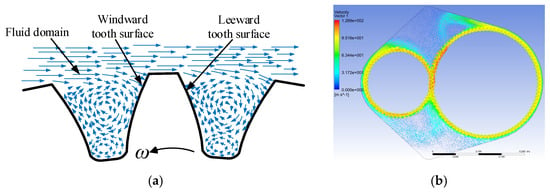
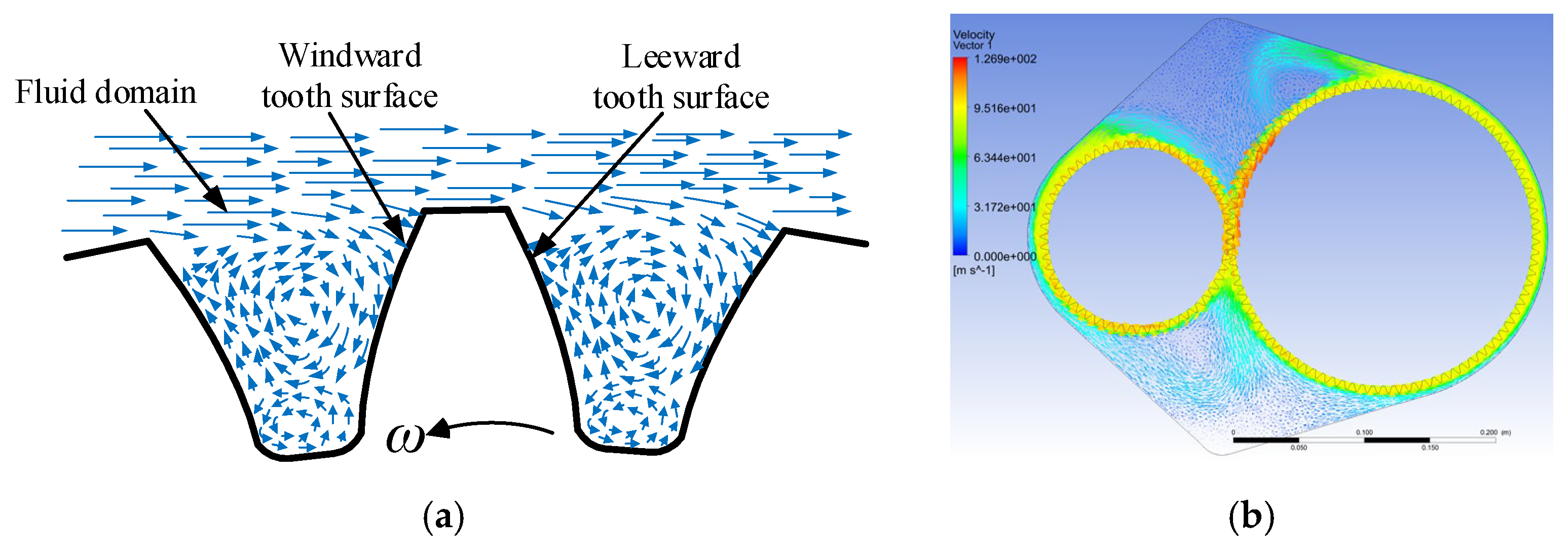
When an aerospace herringbone gear rotates at high speed, it drives the surrounding fluid to generate strong vortices, high-velocity fields, and centrifugal force fields [1]. As a result, pressure difference forces and viscous forces are produced on each surface of the gear, and these forces generate a torque opposite to the rotation direction of the gear, thus forming windage loss. In addition, when the gear rotates at high speed, it agitates the surrounding fluid to form intense turbulence, and the fluid kinetic energy is converted into thermal energy through turbulent dissipation, resulting in power loss, which also constitutes windage loss, as shown in Figure 1.
Figure 1.
Fluid motion around the gear pair during high-speed rotation. (a) Schematic diagram. (b) Simulation result.
Therefore, for a herringbone gear pair, its windage loss includes not only the windage loss on each surface of the driving and driven gears, but also the pumping and extrusion loss generated during the meshing process of the gear pair, namely,
where Pw, Pwi, and Pwp are the total windage power loss of the gear pair, the individual windage power loss of the driving and driven gears (where i = 1 denotes the driving gear and i = 2 denotes the driven gear), and the windage power loss caused by meshing extrusion of the gear pair, respectively.
These components will be analyzed and calculated separately in the following sections.
3. Method
3.1. Windage Prediction Model for Each Component of the Herringbone Gear
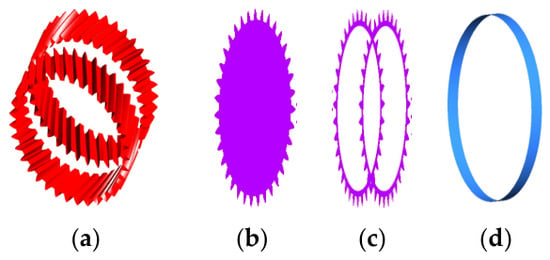
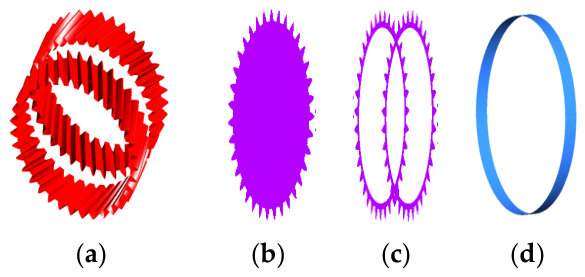
Taking the driving gear as an example, the surface of the herringbone gear is divided into four characteristic surfaces: tooth surface, end surface, circumferential surface, and relief groove surface, as shown in Figure 2. The tooth surface is subjected to both pressure difference torque and viscous torque, while the end surface, circumferential surface, and relief groove surface are subjected only to viscous torque. The formula for calculating the windage power loss of a single herringbone gear is as follows:
where Pwf, Pwt, Pwh, and Pws are the windage power losses of the tooth surface, end surface, circumferential surface, and relief groove surface, respectively.
Figure 2.
Characteristic surfaces of the herringbone gear. (a) Tooth surface. (b) End surface. (c) Circumferential surface. (d) Relief groove surface.
- (1)
- Calculation of Windage Power Loss on the Tooth Surface of Herringbone Gear
The fluid flow direction near the herringbone gear is related to the rotational direction and helix direction of the gear. The flow is mainly perpendicular to the gear teeth: fluid enters the tooth space from both end faces of the herringbone gear and then exits from the end face near the relief groove and the circumferential surface of the gear, respectively, as shown in Figure 3.
Figure 3.
Flow direction of fluid around the gear.
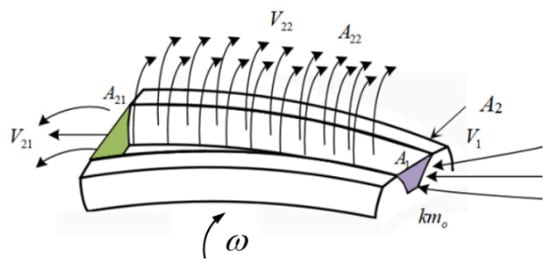
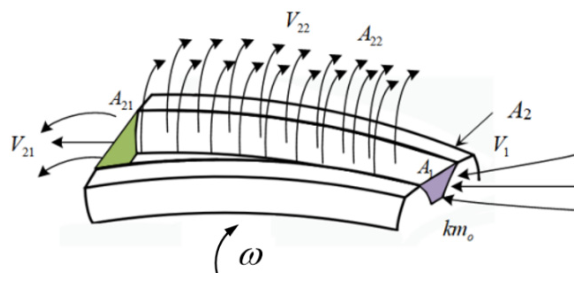
After the fluid is drawn into the tooth spaces by the herringbone gear, the flow state is shown in Figure 4. Assume that the mass of fluid flowing into the tooth spaces from the end face is km0, where m0 is the fluid mass, k (0 < k ≤ 1). Let the outflow area of the herringbone gear near the relief groove be A21 with an average flow velocity V21, the outflow area at the circumferential surface be A22 with an average flow velocity V22, the inflow area be A1 with an average flow velocity V1, and the contact area between gear teeth and fluid be A2. According to the law of mass conservation:
Figure 4.
Schematic diagram of fluid motion between tooth surfaces of the herringbone gear.
It is assumed that the fluid flow state between each gear tooth is uniform and the entire flow process is steady. Thus, term can be neglected. Meanwhile, considering that the fluid volume between gear teeth is relatively small compared with the whole flow field domain, the axial velocity gradient of the fluid between gear teeth varies insignificantly, and is nearly zero. Therefore, the Navier-Stokes (N-S) equations for the fluid between gear teeth can be simplified as:
where the z-axis is the axial direction of the gear. ρ and μ are the oil–gas two-phase fluid density and viscosity, respectively. P is the fluid pressure.
The boundary conditions are, on the tooth surface, . It is assumed that the pressure in the region outside the gear teeth is p = 0, i.e., the average pressure p1 = 0 at the fluid inflow surface A1, the average pressure p21 = 0 at the fluid outflow end surface A21, and the average pressure p22 = 0 at the tooth top surface A22. Treating the fluid entering the tooth space region as a whole, combining Equations (5)–(7) and neglecting the term , we obtain:
For Equations (8) and (9), the boundary conditions are set as follows: the pressure at the exit of the tooth top surface is zero. Taking the addendum circle radius as the radius at the exit of the tooth top surface, i.e., when r = Ra1, p = 0. On this basis, if the pressure at the midpoint of the tooth height is taken as the average pressure, the pressure expression of the fluid between gear teeth can be derived as:
where r is the radius of the gear. Ra1 is the addendum circle radius. ω is the angular velocity of the gear.
Then, the force exerted on the fluid within the gear teeth is:
Therefore, the windage power loss caused by the fluid in the gear teeth to the tooth surface of the herringbone gear is:
where Z is the number of gear teeth, and β is the effective area coefficient.
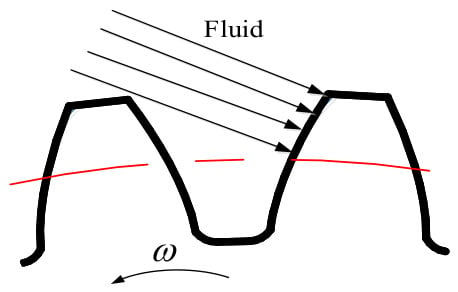
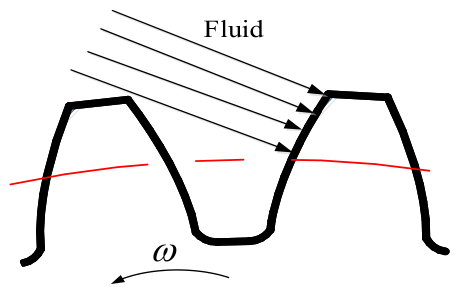
According to the research on gear windage loss by Diab, when a gear operates at high speed, the actual area of the tooth surface subjected to fluid action is determined by the tooth profile and the gear addendum [7], as shown in Figure 5. Therefore, the force area coefficient is set to β = 0.55, here based on the herringbone gear model.
Figure 5.
Schematic diagram of the effective force-bearing area on the tooth surface.
- (2)
- Calculation of Windage Power Loss on the End Surface of Herringbone Gear
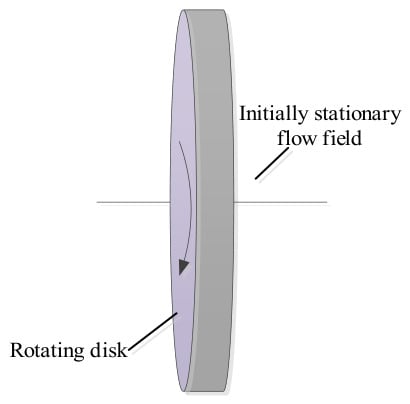
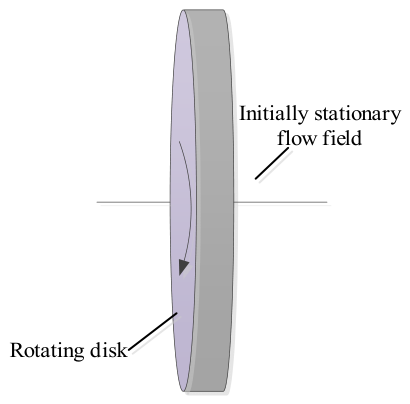
To simplify the analysis, the shaft holes, fillets, and other structures of the herringbone gear are neglected in the calculation, and the gear end surface can be simplified as a rotating disk, as shown in Figure 6.
Figure 6.
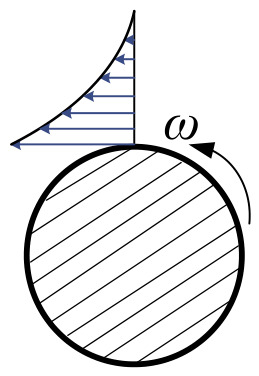
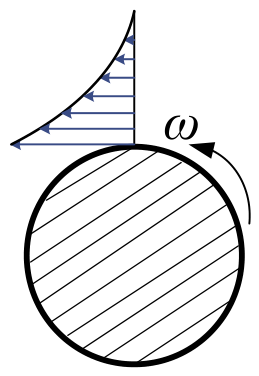
Flow around a rotating disk.
The disk rotates about the z-axis with an angular velocity ω. A no-slip condition is assumed on the disk surface. The rotating disk drives the surrounding fluid to rotate via shearing action. A flow boundary layer forms on the gear end face due to the circumferential velocity (vr = rω). The tangential velocity of fluid near the end face is close to vr and decreases gradually outward along the axial direction until it drops to zero at the boundary layer interface. By introducing symmetric boundary conditions, the end-face flow field solution is simplified to a half-domain analysis problem, which significantly reduces the computational dimension.
According to the research method adopted by our team [22], the fluid flow on the gear end face includes laminar and turbulent regimes, and the corresponding end-face windage power losses are given, respectively, by:
where ν is the kinematic viscosity of the oil–gas two-phase fluid, rc is the radius of the laminar region on the end face, rt represents the radius of the turbulent region, denotes the windage loss in the turbulent region, and denotes the windage loss in the laminar region, Re is the Reynolds number.
- (3)
- Calculation of Windage Power Loss on the Circumferential Surface of Herringbone Gear
The windage loss on the circumferential surface of the herringbone gear shares the same generation mechanism as that on the end surface, both arising from the frictional effect with the fluid. The difference is that the fluid velocity on the circumferential surface is constant. Due to the no-slip condition on the rotating surface, a boundary layer will form on the rotor, as shown in Figure 7.
Figure 7.
Boundary layer flow on a rotating circular cylinder.
According to the research method proposed by our team [22], the tangential velocity vθ2 and pressure distribution of the fluid outside the circumferential surface can be obtained by solving the fluid continuity equation and Navier-Stokes equations for the rotating circumferential surface. Furthermore, the formula for calculating the windage loss on the gear circumferential surface is given by
where b is the width of the gear.
- (4)
- Calculation of Windage Power Loss on the Relief Groove Surface of Herringbone Gear
The calculation principle of windage loss on the relief groove surface of the herringbone gear is the same as that on the circumferential surface, thus:
where bT is the width of the relief groove, and rT is the radius of the relief groove.
3.2. Prediction Model for Power Loss in the Meshing Zone of Gear Pair
The power loss in the meshing zone of a gear pair refers to the energy dissipation caused by the dynamic hydrodynamic pocket formed by the fluid squeezed between the meshing tooth surfaces in the gear transmission system. During the meshing process of the gear pair, the fluid inside the meshing clearance is continuously compressed and expanded. The density and pressure changes in the fluid caused by the volume variation in the meshing clearance result in high-speed extrusion of the fluid. The meshing extrusion power loss is defined as the work performed by the gear pair to expel the fluid out of the meshing clearance, which increases the load-independent power loss of the gear pair. Seetharaman [17] described this phenomenon as the “pumping flow effect”. In this case, the mixture of air and oil inside the meshing clearance formed by the teeth of two mating gears is treated as a compressible fluid. When two adjacent teeth of the gear approach the tooth surface of the mating gear, the tooth space between them is intruded by a tooth of the mating gear, leading to a rapid reduction in the pocket volume and an increase in pressure inside the pocket. This generates a pressure difference between the meshing pocket and the surrounding environment, which forces the fluid to flow out at high speed from the end openings and backlash of the gear pair, thereby producing extrusion power loss. This part of loss is an important component of the windage power loss of the gear pair.
- (1)
- Calculation of Fluid Extrusion Area
During the meshing process of a gear pair, multiple cavities (fluid control volumes) are formed. The control volume is defined by the involute surfaces and tooth root profiles of the two meshing teeth. The volume of the control volume is continuously compressed and expanded as the gears rotate, as shown in Figure 8.
Figure 8.
Axial view of the fluid control volume at the gear meshing interface at different rotational positions. (a) L = 0. (b) L = L1. (c) L = L2. (d) L = L3.
As shown in Figure 8, represents the j-th fluid control volume of the i-th gear at the L-th position, where i = 1 or 2 (1 for the driving gear and 2 for the driven gear), j ∈ [1, J] (the value of J depends on the contact ratio of the gear pair), and L denotes different rotational positions of the gear pair with L ϵ [0, Ln − 1] (where Ln represents the number of discrete positions within one base pitch).
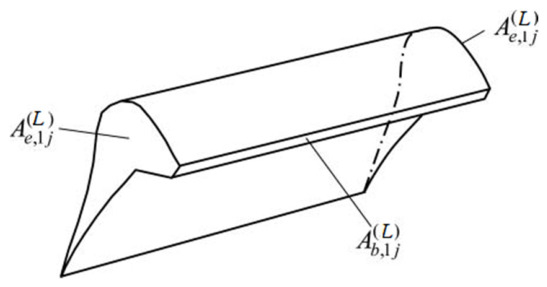
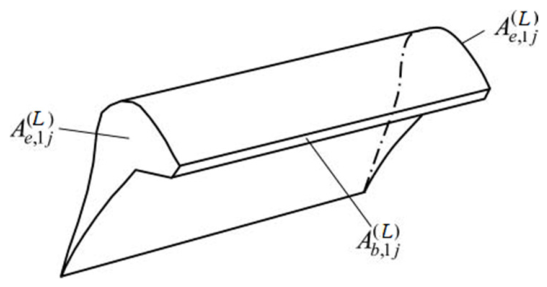
For a pair of herringbone gears, the three-dimensional view of a control volume on the driving gear at an arbitrary instantaneous position L is shown in Figure 9.
Figure 9.
Three-dimensional view of a single control volume.
As shown in Figure 9, the fluid is squeezed out from both end faces (where denotes the end face area) and the tooth side clearance (where denotes the backlash area) of the control volume. The end flow region is formed by the tooth height of the driving and driven gears, several involute lines, and the tooth root profile, while the backlash flow region is defined by the shortest chord from the trailing edge of a tooth on the driving gear to the meshing tooth surface on the driven gear. The initial meshing position is defined as the position when the addendum of the driven gear first contacts the involute surface of the driving gear tooth at the starting point of the active profile, i.e., when L = 0. The fluid control volume is designated as , with the end face area and backlash area . When the gear pair rotates by an increment θiL, the backlash area and end face area of the fluid control volume at this position are calculated, where the formula for θiL is given by:
where θi0 is the initial angle; ria, rib, and ris are the addendum circle radius, base circle radius, and starting radius on the line of action of gear i, respectively.
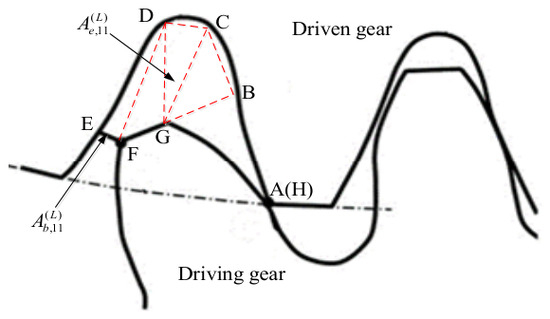
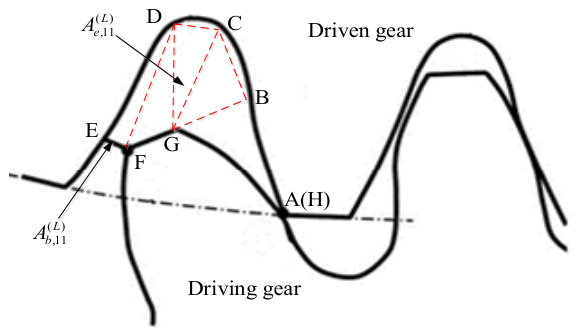
Taking the driving gear as an example, the end face flow area and backlash area of its fluid control volume are calculated. The axial view of the control volume is shown in Figure 10.
Figure 10.
End face flow area and backlash area of .
As shown in Figure 10, to find the points defining the fluid control volume on the two gear tooth surfaces, a search algorithm is first used in Tooth Contact Analysis (TCA) to locate the points (A, H and E, F) with the shortest distance between the gear surfaces on the contact side and the backlash side. Then, the vertex of the tooth profile (G) is selected on the driving gear tooth, and the intersection points (B, C, and D) of the addendum circle, pitch circle, and root circle with the tooth profile are selected on the driven gear, respectively. By adding multiple division points on the tooth profiles of the driving and driven gears, the end face area can be approximated by the sum of the areas of multiple triangles. Thus, the end face area is given by:
where the coordinates of points A, B, C, D, E, F, and G can be obtained by TCA.
Similarly, as shown in Figure 10, the formula for calculating the area of the backlash flow region is given by:
where ae is the semi-major axis length of the contact ellipse of the gear pair, which can be obtained from the following equation according to the Hertzian contact theory:
where RI and RII are the principal radii of curvature; be is the semi-minor axis length of the contact ellipse; denotes the eccentricity of the contact ellipse; and are the complete elliptic integrals of the first and second kind, respectively. Fpg is the load transmitted between a pair of gear teeth, which can be derived from the calculation formula , where T1 is the torque applied to the pinion. Re is the equivalent radius of curvature at the contact point, given by . E* is the equivalent elastic modulus, calculated as , where E1, E2 and μ1, μ2 are the elastic moduli and Poisson’s ratios of the pinion and the gear, respectively. F1(e) is a correction function dependent on the ratio of ae/be, with the calculation formula expressed as:
By assigning initial values to ae and be and then performing iterative calculations in the Loaded Tooth Contact Analysis (LTCA), the effective length of the instantaneous action line of the gear pair under different torques can be obtained. At this point, the volume of the fluid control volume A can be calculated as:
During the meshing process of a gear pair, multiple cavities (fluid control volumes) are squeezed in exactly the same way. Therefore, the backlash flow areas of other fluid control volumes can be calculated in the same manner. Since the consecutive contact points of adjacent meshing tooth surfaces are separated by exactly one base pitch, and given that , the backlash flow areas for all control volumes of both gears can be computed. Using the same method, the end face areas, backlash areas, and volumes of all fluid control volumes at Ln positions within one base pitch can be calculated for both the driving and driven gears.
- (2)
- Calculation of pocketing Power Loss
The fluid control volumes formed in the meshing zone of a gear pair are filled with a mixture of air and lubricating oil. Most existing references, such as Seetharaman [17] and Guo [23], have established corresponding incompressible fluid flow equations for this fluid. However, research has shown that this approach fails to predict the functional relationship between fluid density and control volume changes during the compression–expansion process, and thus cannot account for the significant pressure variations caused by the compressibility of the fluid within the control volume. Therefore, this paper treats the fluid within the control volume as a compressible fluid and establishes a compressible fluid dynamics equation.
Applying the principle of mass conservation to an arbitrary fluid control volume, the rate of change in total mass within the control volume is equal to the sum of the rate of change in mass accumulated within the control volume and the net mass flow out of the control volume (the sum of mass inflow and outflow), i.e.,
The momentum conservation equation at the outlet of any fluid control volume (neglecting viscous effects and body forces) is:
It is assumed that the flow parameters are uniformly distributed within the control volume, such that the fluid density and velocity are identical throughout each control volume. Applying the continuity equation to the control volumes and at consecutive rotational positions L and L + 1, the discrete form of the mass conservation equation over the time increment Δt is expressed as:
where and are the fluid volume and density of the fluid control volume , respectively; and are the velocities of the fluid flowing out from the end face and backlash of the control volume , respectively; when k = 0, ζ = −1, and when k = 1, ζ = 1; the time increment Δt can be expressed as:
where Δθi is the increment of the rotation angle of gear i between two consecutive rotational positions L and L + 1, which is obtained from Equation (16); ωi is the angular velocity of gear i.
The discrete form of the momentum conservation equation for fluid flow in the control volume along the directions of the backlash and end face regions is:
where is the fluid pressure inside the fluid control volume ; Pꝏ is the ambient pressure surrounding the gear, and when j = J, also represents the ambient pressure; vꝏ is the fluid velocity in the ambient environment at the gear end; is the centroid position of the backlash region of the control volume .
The simplified form of the Reynolds transport theorem is:
where Bsyst represents any property of the fluid within the control volume, such as energy or momentum, and β = dB/dm is the density value of any infinitesimal element in the fluid, or the quantity of Bsyst per unit mass.
Applying Equation (26) to the first law of thermodynamics, where Bsyst is the energy E and the energy per unit mass β = dE/dm = ε, the energy conservation equation for the fluid in an arbitrary control volume can be obtained as [24]:
when the heat source terms, such as thermal radiation and heat conduction of the fluid inside the control volume, are neglected, i.e., assuming the thermodynamic process is adiabatic, we have dQ/dt =0. For the control volume, the work performed by external forces can be divided into the following three parts:
where Ws, Wp, and Wυ are the shaft work, the work performed by surface pressure, and the shear work caused by viscous stress, respectively. In this section, shaft work and viscous work are neglected, i.e., dWs/dt = 0 and dWυ/dt = 0. Since all work inside the control volume is generated by equal and opposite forces, which cancel each other out, the work performed by surface pressure only occurs on the surface of the fluid control volume, i.e., it is given by:
The energy per unit mass of the fluid, ε, mainly consists of the following components:
where εint is the internal energy of the fluid; εkin is the kinetic energy of the fluid; εoth accounts for chemical reactions, nuclear reactions, electrostatic or magnetic effects; and εpot is the potential energy.
For the fluid control volume in the meshing clearance of the gear pair, εoth and εpot are neglected. Therefore, the energy per unit mass of the fluid in the control volume only includes the first two terms, namely:
where vV is the fluid velocity; is the specific internal energy of the fluid, which is given by:
where cυ is the specific heat capacity at constant volume, and T is the thermodynamic temperature of the fluid.
Therefore, the discrete form of the energy conservation equation for the fluid control volume can be expressed as:
When j = 1 or j = J, i.e., assuming a uniform flow at the inlet under ambient conditions, αk = 1; otherwise, for a fully developed flow elsewhere, αk = 2 [21].
Due to the high rotational speed of aero high-speed gears, the Mach number of fluid motion in the gear meshing zone is much greater than 0.3 and even approaches 1. Therefore, the compressible fluid within the control volume in the gear meshing clearance can be regarded as a perfect gas with constant specific heat. Neglecting viscosity and heat conduction, the fluid motion is isentropic. Then, from the isentropic relation , it can be obtained that the temperature, pressure, and density of the fluid in the control volume at two consecutive rotational positions satisfy the following relation:
where is the specific heat ratio.
The initial conditions for the above equations are that at t = 0, i.e., L = 0, . The boundary conditions are: it is assumed that the fluid around the gear meshing zone rotates at the same speed as the gear, i.e., vꝏ = vg; the ambient fluid temperature is the same as the initial state temperature of the environment around the gear; the ambient density ρꝏ is the equivalent density of the oil–gas two-phase flow around the gear, i.e., ρꝏ = ρ.
Based on the above definite conditions, the fluid density, pressure, and the velocities of the end flow and backlash flow at any position can be solved from the fundamental equations. The force exerted by the gear meshing extrusion effect on the control volume fluid can be expressed as the product of the fluid mass flow rate and the flow velocity. That is, the forces in the axial and radial flow directions can be expressed, respectively, as:
Therefore, at the L-th rotational position, the power loss caused by the extrusion effect of gear meshing on the control volume is:
Similarly, the instantaneous total extrusion power loss of all fluid control volumes of the gear pair at the L-th rotational position can be calculated. Then, by averaging over the entire meshing cycle of the gear, the average windage extrusion power loss of the gear pair can be obtained as:
where is the total number of control volumes for the driving gear, and is the total number of control volumes for the driven gear.
All variables in the formulas in this section are expressed in the International System of Units (SI).
4. Simulation
4.1. Parameters of Herringbone Gear Pair and Flow Field Model
The basic parameters of the herringbone gear pair are listed in Table 1.
Table 1.
Basic parameters of herringbone gear.
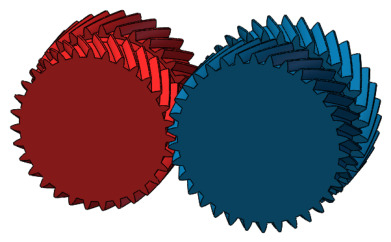
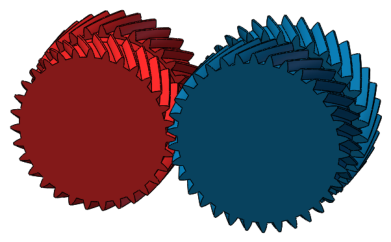
The 3D model structure of the gear pair is properly simplified. The shaft holes, chamfers of the gears, as well as various chamfers, bearings and their connectors on the reduction gearbox are omitted to improve the efficiency of the simulation analysis. To address the difficulty in generating high-quality computational meshes caused by the excessively small clearance in the gear meshing zone, this paper employs the tooth surface shifting method. Specifically, while maintaining the center distance and tooth profile geometry, the tooth surfaces of all engaging gears are translated slightly outward along the normal direction. This is equivalent to reducing the thickness of each tooth, thereby artificially increasing the clearance in the meshing zone to create sufficient space for mesh generation. The 3D model of the herringbone gear pair is shown in Figure 11.
Figure 11.
Three-dimensional Model of the Herringbone Gear Pair.
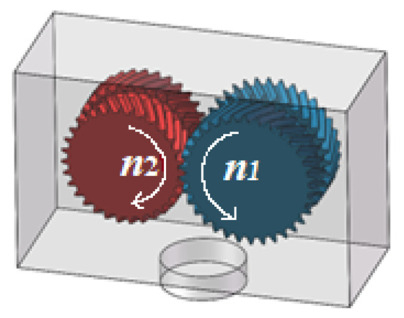
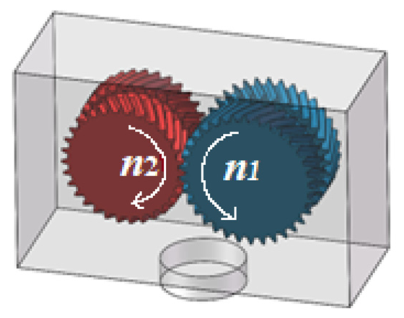
Figure 12 below demonstrates where the left gear is the driven gear with a clockwise meshing direction, and the right gear is the driving gear with a counterclockwise meshing direction.
Figure 12.
Flow Field Model for Windage Power Loss Calculation of Herringbone Gear Pair.
Due to the complex shape of herringbone gears and large variations in grid geometry near the gear teeth, ICEM CFD is used in this study to generate grids for better adaptability to the gear teeth. Model solutions are performed using FLUENT 17.0 software. The coupled algorithm of the pressure-based solver under transient analysis is adopted. The SST k-ω turbulence model is employed, which is more suitable for flows with high strain rates and large streamline curvature. The VOF two-phase flow model is adopted to simulate the oil–gas two-phase flow inside the gear chamber, which can accurately capture the gas–liquid interface and flow characteristics under high-speed rotation conditions. Given the presence of clear free surfaces and large-scale interface deformations within the gear meshing clearance, the VOF model provides superior accuracy in tracking the phase boundaries while ensuring mass conservation.
The maximum grid size is set to 3 mm, the maximum boundary layer thickness on the tooth surface is 0.5 mm with five layers, and the number of boundary layer layers is six. The profile function in FLUENT is used for grid motion definition. Default settings are retained for momentum and turbulent kinetic energy calculations. An iterative solution is carried out after initialization.
4.2. CFD Numerical Simulation Settings
For the rotating flow field around a high-speed gear pair, the SST k-ω turbulence model can provide results that are closer to experimental data [25]; therefore, this paper adopts the two-equation SST k-ω model based on the eddy-viscosity assumption. In this model, the value of ωω at the wall is specified as defined in [26].
where ω+ is the dimensionless value of ωω. For the logarithmic law layer of fully developed turbulence:
where the dimensionless wall parameter is defined as:
where y is the distance from the centroid of the first near-wall fluid cell to the wall, and uτ is the wall friction velocity defined as:
where τω is the wall shear stress.
The viscous sublayer is located approximately at y+ ≈ 5. If no wall function is used at this location, the near-wall region must be meshed with a much finer grid. Since this paper demands relatively high computational accuracy near the wall, the near-wall model approach is adopted. Moreover, based on the characteristics of the selected SST k-ω turbulence model, it can automatically judge the governing equations of the near-wall flow field according to the grid density in the near-wall region before performing calculations, so as to ensure successful simulation and achieve relatively high computational accuracy.
The boundary conditions are set as a velocity inlet at the nozzle with an injection velocity of 10–35 m/s, temperature of 20–80 °C, and pressure of 0.5 MPa, a pressure inlet for the internal air domain, a pressure outlet at the oil return port with 0 Pa gauge pressure, no-slip rotating walls for gears, and no-slip stationary walls for the gearbox. The VOF model is adopted with air as the primary phase and oil as the secondary phase.
4.3. Grid Discretization and Grid Independence Verification
The computational flow field model of the herringbone gear pair was imported into the preprocessing software ANSYS ICEM CFD 17.0, and unstructured tetrahedral elements were generated for the fluid domain. To avoid excessive computational cost caused by overly dense grids or reduced accuracy due to overly coarse grids, local refinement was applied to the grids near the tooth surfaces, end faces, relief grooves, and meshing zones. Meanwhile, grid smoothing was conducted to improve grid quality. Since all tooth surfaces undergo meshing during rotation, densification was implemented on the tooth surfaces and meshing regions to ensure that y+ falls within a reasonable range.
To simulate the continuous rotation of the gear, the sliding mesh technique is adopted. The region containing the gear pair is set as the rotating domain, while the external flow field is the stationary domain, with data exchange between the two domains via a sliding interface. The rotational motion is realized by assigning a constant angular velocity to the rotating domain, and the mesh topology remains unchanged at each time step, thus eliminating the need for dynamic mesh deformation or remeshing. For regions where the initial clearance in the meshing zone is extremely small, the tooth surface shifting method is employed to preprocess the geometric model, enabling the generation of high-quality boundary layer meshes. During the rotational simulation, local mesh refinement and time step control (Courant number < 1) are used to ensure numerical stability in the small-clearance region.
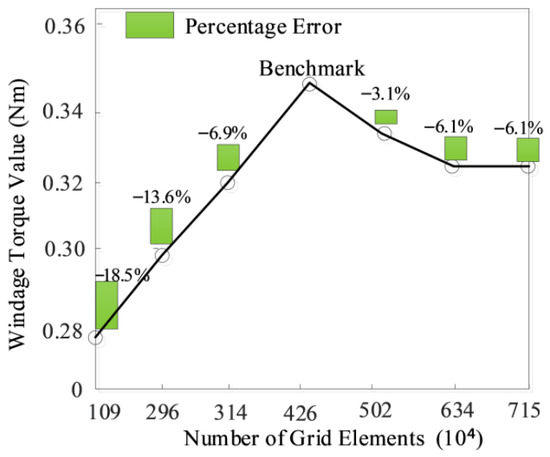
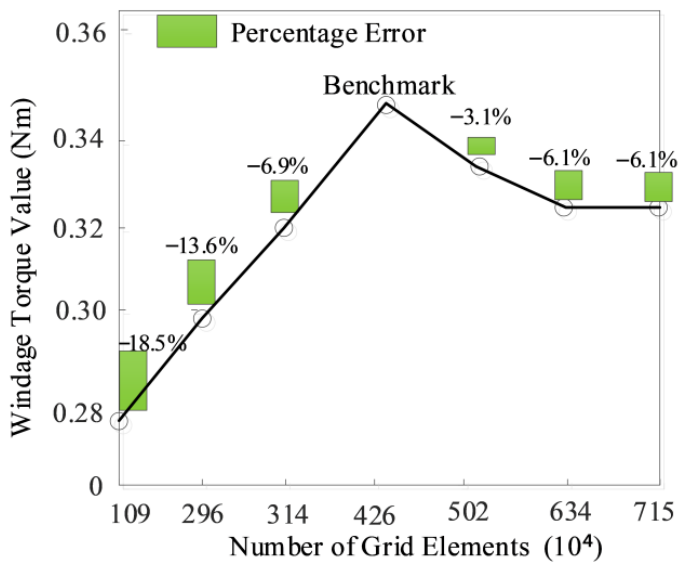
Grid quality and quantity are key factors affecting the accuracy and reliability of numerical simulation results. Therefore, grid independence verification is required to quantify and minimize discretization errors. In this study, the windage torque of the herringbone gear pair was adopted as the criterion for grid independence testing. By varying the grid number, the windage torque at a driving gear speed of 10,000 rpm was tested, and the results are listed in Figure 13.
Figure 13.
Number of Grid Elements and Windage Torque Value.
According to Figure 13, when the number of grids reaches approximately 5 million, the calculated values remain basically stable, and the windage torque values vary within 6%. Therefore, considering both computational accuracy and cost comprehensively, this paper selects a grid model with 5.02 million grid elements to calculate the windage power loss of the gear. Trial calculations show that under this grid condition, the computation can be guaranteed to converge and the computational speed is acceptable.
4.4. Computational Fluid Dynamics Governing Equations
The basic governing equations for numerical simulation analysis are consistent with those in [2,4]. This paper only presents the Reynolds-averaged equations.
- (1)
- Fluid Reynolds number calculation
During the meshing of high-speed herringbone gears, the surrounding air is agitated, and the flow Reynolds number Re = 1.7 × 10⁵, which is much greater than 2300. Therefore, the internal air flow can be regarded as turbulent flow.
- (2)
- Reynolds-averaged equations
Owing to the nonlinear term (u∇ u) in the momentum conservation process, which simultaneously possesses both control and feedback functions, there is currently a lack of an effective mathematical treatment to directly solve the Navier-Stokes (N-S) equations. Consequently, for turbulent flow modeling, the N-S equations have been transformed into equations that can be treated by Reynolds averaging, through the Reynolds averaging process:
5. Results and Discussion
5.1. Analysis of Flow Field Characteristics Around the Gear Pair
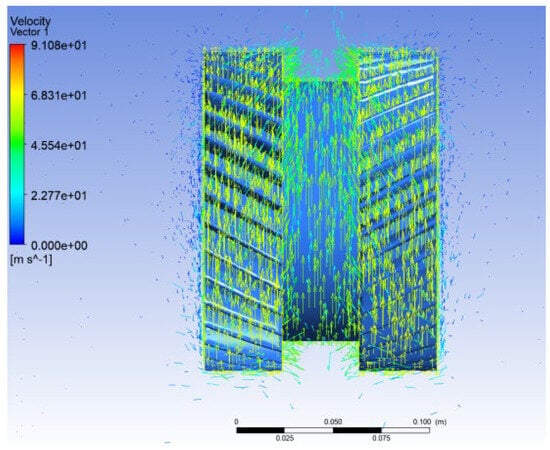
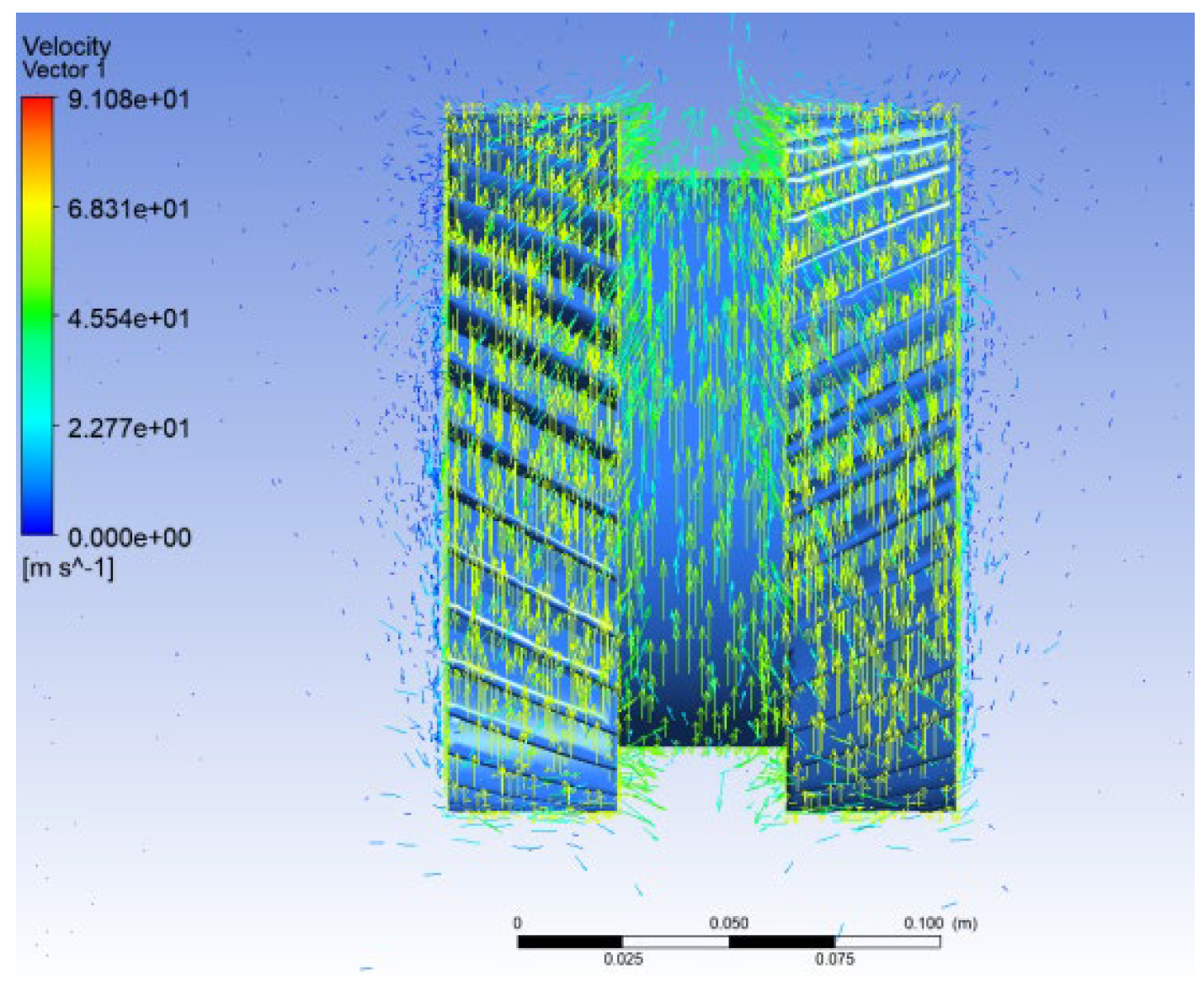
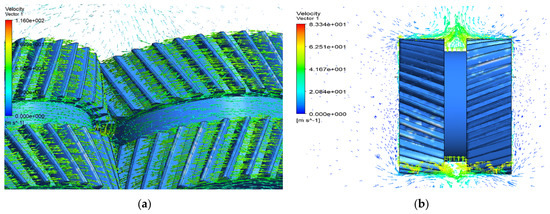
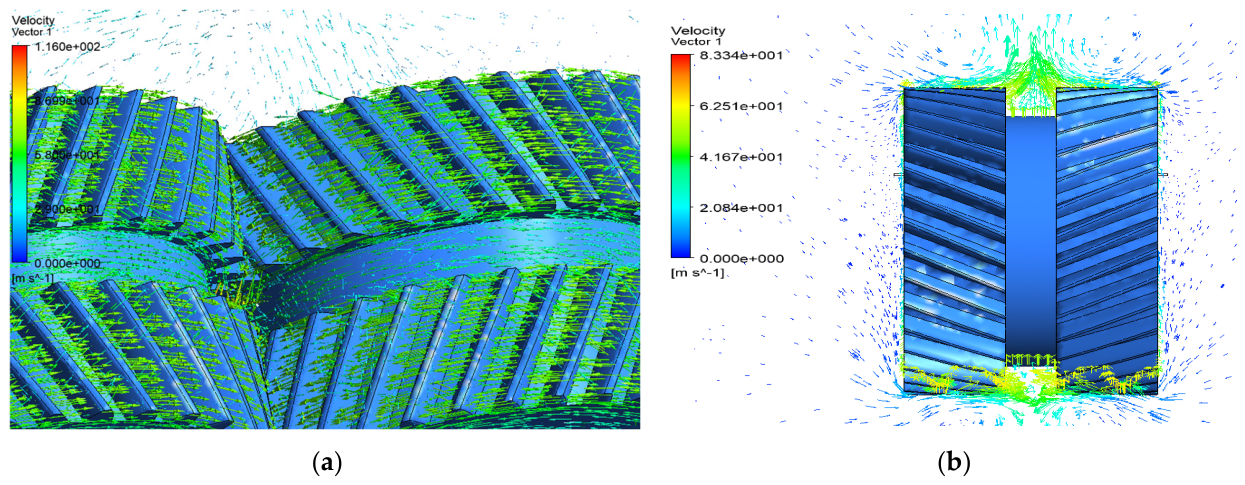
The velocity field characteristics around the gear pair are first observed, as shown in Figure 14. It can be seen from the figure that the movement direction of the fluid near the herringbone gear after being agitated is related to the rotation and helix directions of the gear, and the fluid basically moves along the direction perpendicular to the tooth surface. Meanwhile, it can be observed from Figure 14a,b that under the working conditions of the present model, the fluid is sucked into the meshing region at both ends of the herringbone gear and ejected out near the end-face region close to the relief groove.
Figure 14.
Velocity field vector diagram around the gear pair. (a) Velocity vector diagram of gear pair in meshing. (b) Velocity vector diagram of a single gear.
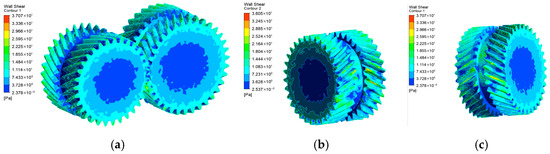
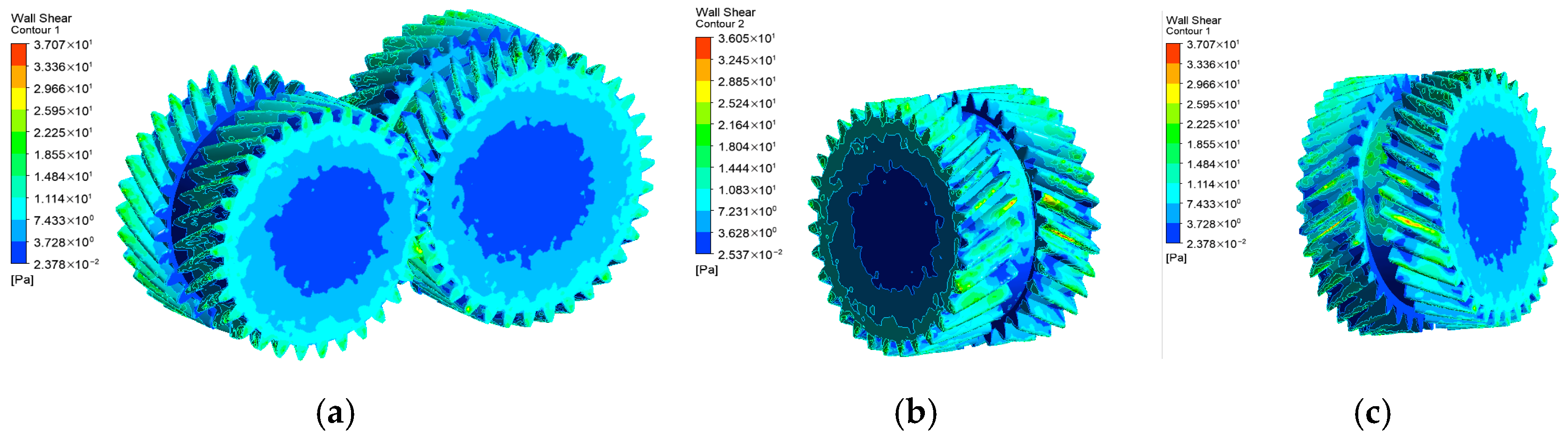
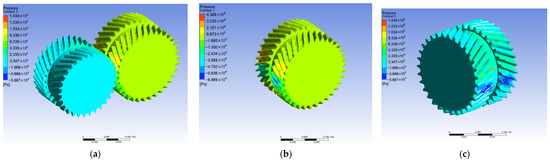
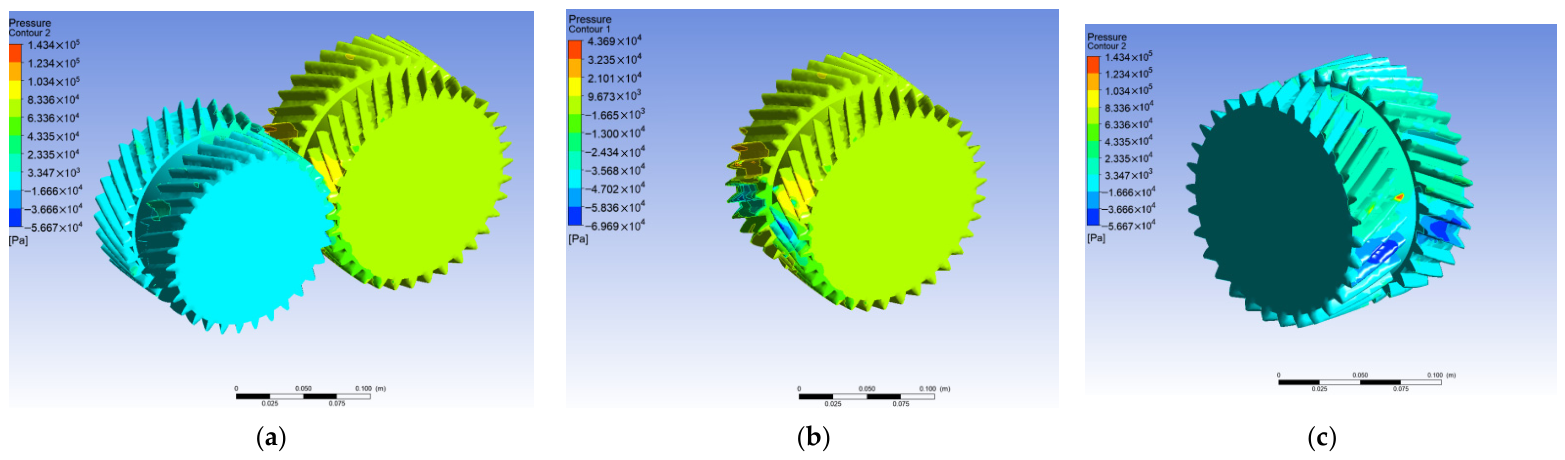
Next, the pressure field distribution characteristics of the gear pair are observed. Figure 15 and Figure 16 show the contour plots of viscous shear stress and pressure distribution on each surface of the herringbone gear pair and the single gear.
Figure 15.
Viscous shear stress contour of herringbone gear pair. (a) Herringbone gear pair. (b) Driven gear. (c) Driving gear.
Figure 16.
Pressure distribution contour of herringbone gear pair. (a) Herringbone gear pair. (b) Driven gear. (c) Driving gear.
It can be seen from the viscous shear stress contours that the viscous shear stress of the herringbone gear pair reaches the maximum value in the meshing zone. For a single gear, relatively large viscous shear stress appears on the tooth surface, the circumferential surface and the end face, and the peak shear stress occurs on both sides of the tooth helix and at the gear edges. This indicates that these regions are the locations where the viscous friction between the fluid and the gear surface is the strongest. The viscous shear stress exerts a resistance moment on the rotating gear, thereby generating frictional windage loss, which corresponds to the windage losses on the tooth surface, end face and circumferential surface decomposed by the prediction model.
It can be seen from the pressure distribution contours that an obvious pressure concentration exists near the tooth helix and in the meshing region of the herringbone gear pair, where the pressure values are significantly higher than those in other regions. This indicates that these regions are the locations where the interaction between the fluid and the gear surface is the most intense. The high-speed rotating gear exerts strong extrusion on the surrounding fluid, forming local high-pressure zones, and the high-pressure fluid generates a reverse resistance moment on the gear surface. By comparing the pressure distribution on each surface of the driving and driven gears, it can be found that due to the coupled motion characteristics of the double helical tooth profile of the herringbone gear, the pressure distribution on the tooth surface shows a symmetric trend.
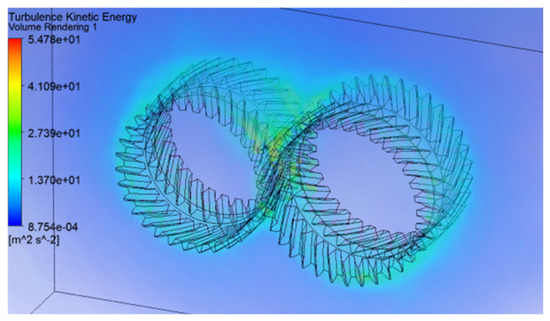
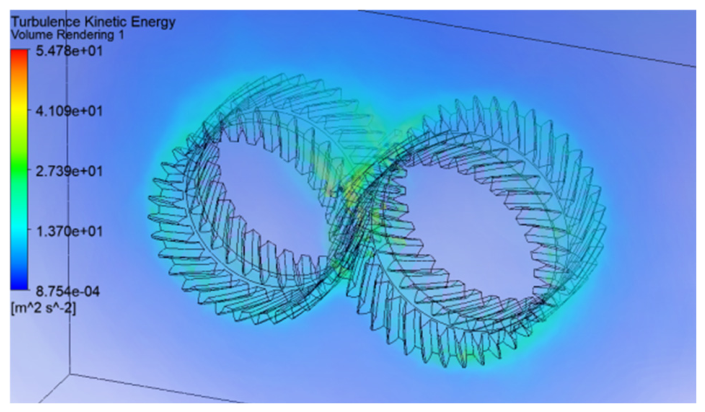
Then, the energy field distribution characteristics of the fluid around the gear pair are observed. Figure 17 shows the turbulent kinetic energy contour of the fluid flow around the herringbone gear pair.
Figure 17.
Turbulent kinetic energy contour of the fluid around the herringbone gear pair.
It can be seen from the turbulent kinetic energy contour that turbulent kinetic energy reaches its maximum value in the meshing region of the gear pair, with an average of approximately 41 m2/s2. This is followed by the region near the gear tooth surfaces, where the average turbulent kinetic energy is about 20 m2/s2. The average turbulent kinetic energy in other regions is lower than those in these two regions. This indicates that the fluid velocity fluctuations are more intense in these two regions, and the fluid flow is relatively disordered. Fluid turbulence intensifies the momentum exchange between the gear and the fluid, increases the resistance effect of the fluid on the gear, and thus leads to additional windage loss.
5.2. Comparative Analysis Between Predicted Model Values and Simulation Results
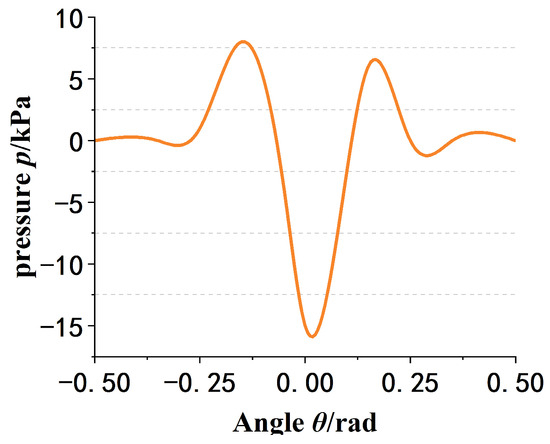
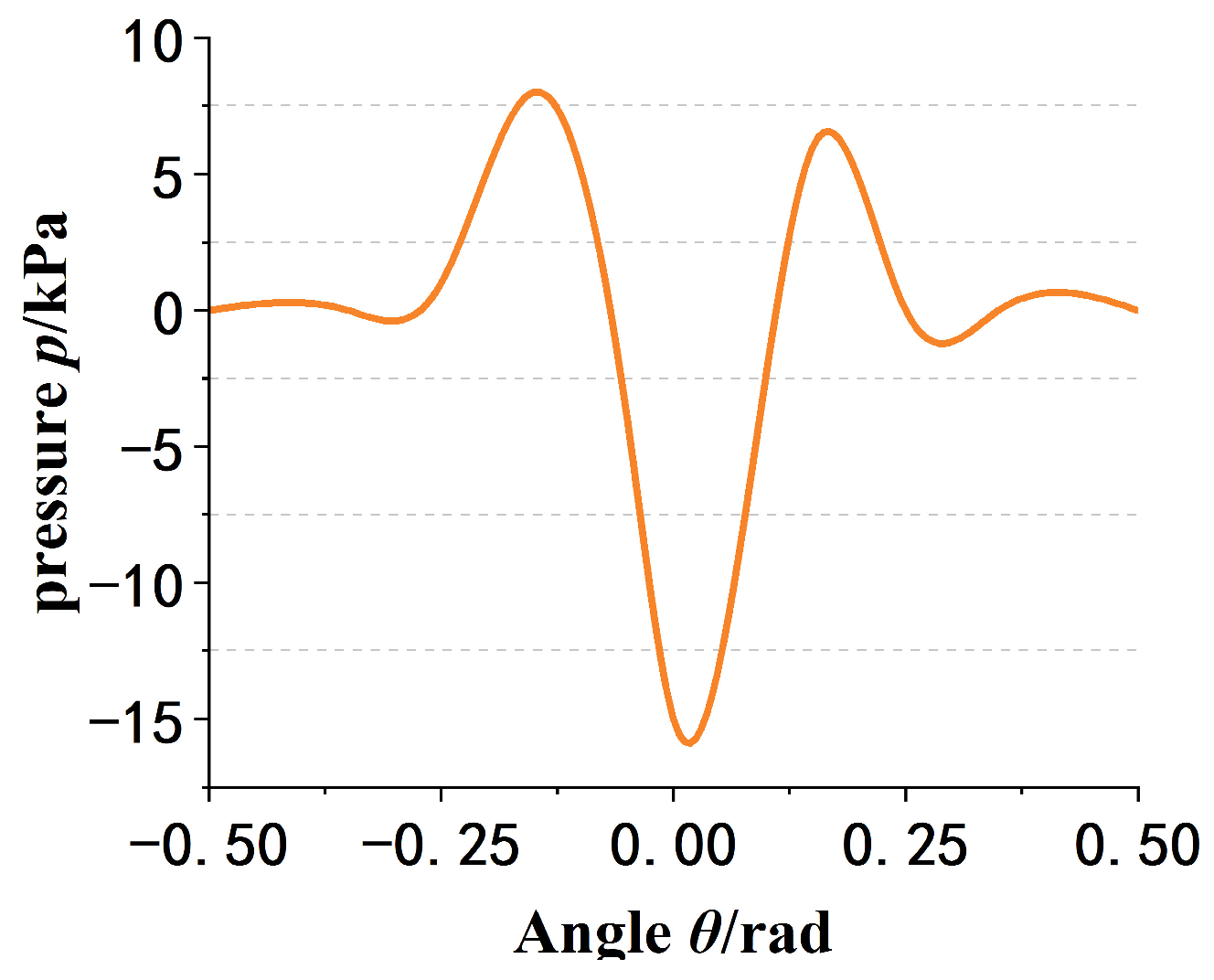
According to the variation in control volume with time during the gear pair meshing process in Figure 8, the pressure curves of the control volume in different meshing regions can be obtained, as shown in Figure 18. By comparing with the pressure curve, it is found that the pressure on the gear teeth in the meshing region follows a trend of increasing first, then decreasing, and then increasing again.
Figure 18.
Pressure variation diagram of gear teeth in the meshing region.
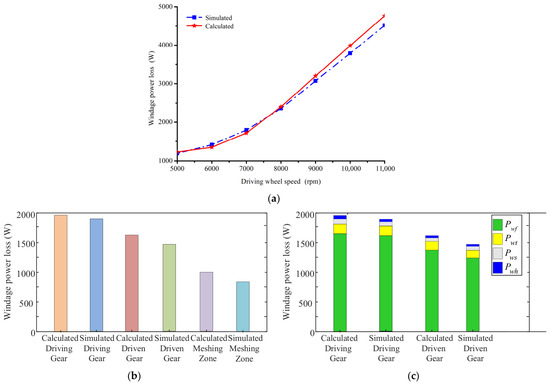
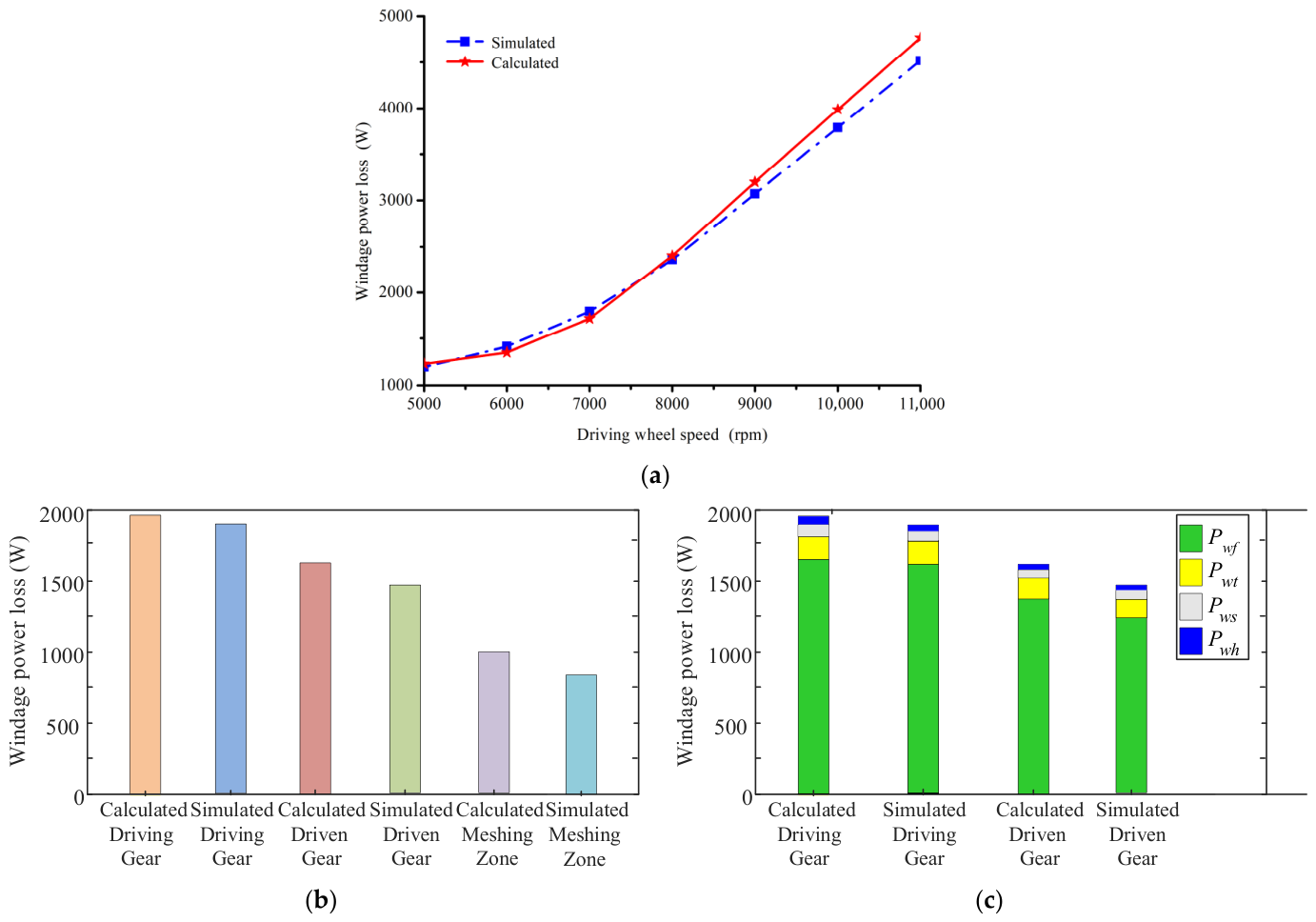
According to the parameters of the herringbone gear pair listed in Table 1, the windage power loss of the gear pair is calculated and compared with the simulation results. Figure 19 shows the comparison between the numerical simulation results and the predicted model calculations. Among them, Figure 19b,c show the windage power loss values of the driving gear, driven gear, meshing zone of the gear pair, and each gear surface at a driving gear rotational speed of 11,000 rpm. Specifically, the numerical simulation value of windage power loss in the meshing zone is determined by subtracting the windage power loss of the driving gear and the driven gear rotating individually under identical operating conditions from the total windage power loss of the gear pair.
Figure 19.
Comparison of windage power loss calculation results for herringbone gear pair. (a) Results comparison at different rotating speeds. (b) Results comparison of driving gear, driven gear and meshing zone. (c) Results comparison of different surfaces of a single gear.
It can be seen from Figure 19a that the variation trends of the simulation results and the predicted model values with the gear speed are consistent. The difference between the simulation results and the predicted model values increases with the increase in the gear speed, and the maximum error is about 13.6%. Moreover, both the simulation and the model prediction show that the windage power loss of the gear pair increases rapidly when the driving gear speed exceeds approximately 7000 rpm, indicating that the windage effect of the gear pair becomes significant and cannot be neglected. In addition, the predicted model values are obviously larger than the simulation results at higher rotational speeds. This is mainly because the fluid flow in the gear meshing zone becomes more intense as the gear speed increases, leading to greater pumping power loss caused by meshing extrusion. The prediction model calculates this part of the power loss separately, making its values closer to the actual condition.
It can be seen from Figure 19b that the pumping power loss caused by meshing extrusion accounts for approximately 20.1–23.6% of the total power loss. The variation trends of the simulation values and calculated values are consistent.
It can be seen from Figure 19c that for a single herringbone gear, the windage power losses generated by different surfaces are different. Among them, the windage loss on the tooth surface is the largest, accounting for about 83% of the total windage loss, followed by the end-face windage loss at about 8%. The windage losses of the relief groove surface and the circumferential surface are relatively small, and their sum accounts for less than 10%. This is because although the relief groove is a region with concentrated pressure, viscous shear stress and turbulent kinetic energy, its surface area and the circumferential surface area are small, the rotational linear velocity is relatively low, and the surface structure is relatively smooth. Therefore, both the shear effect and the pressure difference effect of the fluid on these surfaces are weak, resulting in low windage power loss.
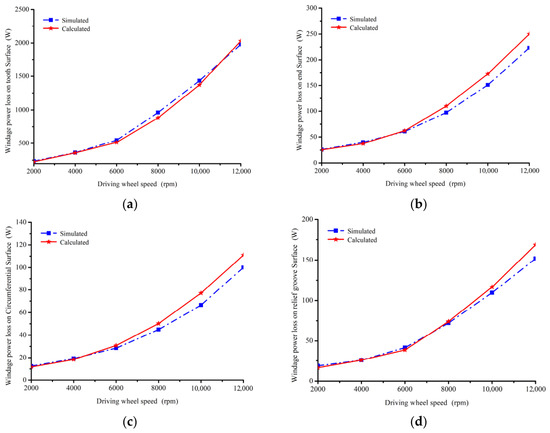
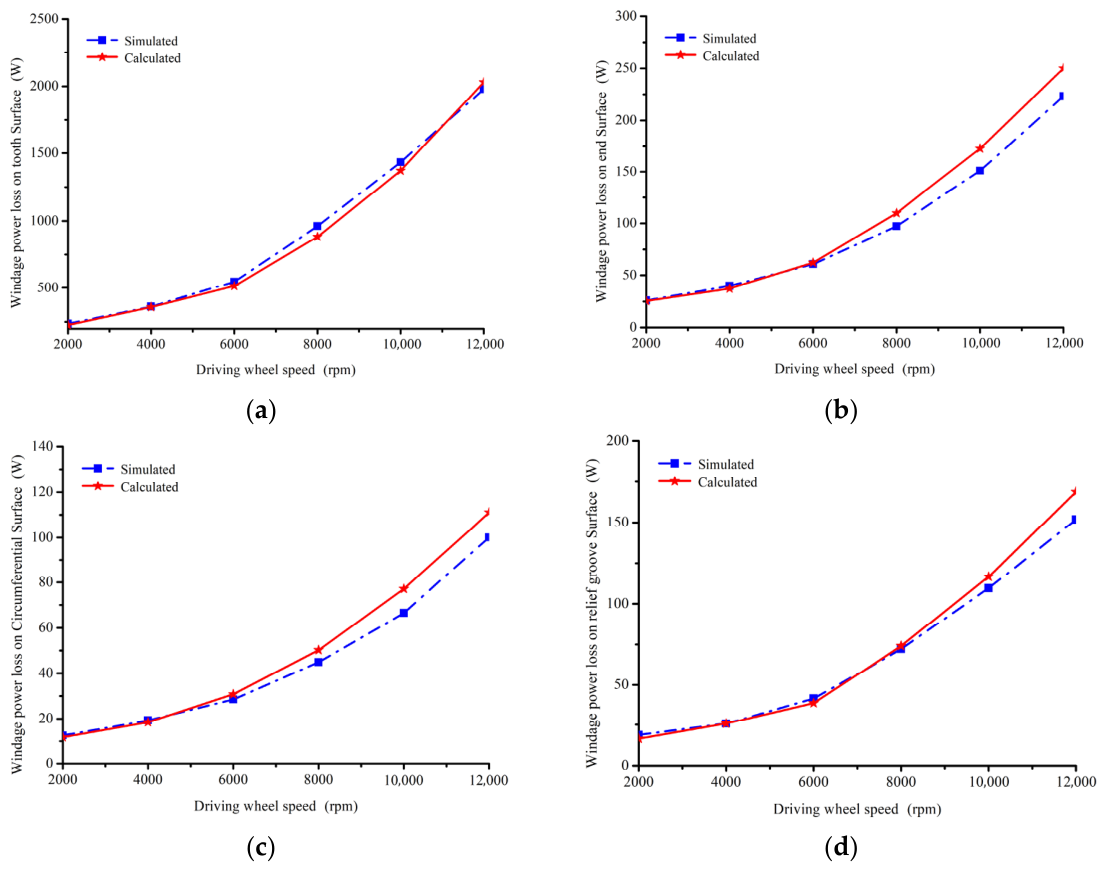
Taking the driving gear in the gear pair as an example, the variation in windage power loss on each gear surface with rotational speed is investigated, as shown in Figure 20.
Figure 20.
Windage power loss of different parts for the gear. (a) Windage power loss on tooth surface. (b) Windage power loss on end surface. (c) Windage power loss on circumferential surface. (d) Windage power loss on relief groove surface.
It can be seen from the numerical simulation and analytical calculation results in Figure 20 that the variation patterns of windage power loss for different parts of the gear with rotational speed are generally consistent. As the rotational speed increases, the windage power loss grows more rapidly, indicating that rotational speed is an important factor affecting gear windage power loss. According to the studies of Dawson [13] and Diab [7], the windage power loss of a gear is approximately proportional to the cube of its rotational speed.
6. Conclusions
- (1)
- A prediction model for the windage power loss of herringbone gear pairs is established, which decomposes the windage power loss into five parts: the windage losses on the tooth surface, end face, circumferential surface and relief groove surface of the driving and driven gears, as well as the meshing extrusion power loss caused by fluid extrusion in the meshing region. The prediction model fully considers the unique structural characteristics of the herringbone gear pair and the motion characteristics of its meshing region.
- (2)
- The flow field characteristics around the herringbone gear pair are clarified through CFD simulation. The analysis of the velocity field, pressure field, viscous shear stress field and turbulent kinetic energy field shows that the tooth surface edges, meshing regions and relief grooves are the key regions of fluid disturbance, pressure concentration, viscous shear stress concentration and turbulent kinetic energy concentration, which are important factors affecting windage power loss.
- (3)
- The comparison between the CFD simulation results and the calculated values of the prediction model shows that the maximum relative error between them is about 13.6%, which is within the engineering acceptable range, verifying the calculation accuracy and engineering applicability of the established prediction model.
- (4)
- The distribution law of windage power loss is revealed: (1) The windage power loss increases with the increase in gear speed. When the driving gear speed exceeds 7000 rpm, the windage power loss increases rapidly, indicating that the windage effect is significant under high-speed working conditions and cannot be ignored. (2) The windage power loss of a single herringbone gear mainly comes from the tooth surface, accounting for about 83% of the total loss, followed by the end face (about 8%), and the sum of the losses on the relief groove surface and circumferential surface is less than 10%, which is closely related to its small area, low rotational linear velocity and weak fluid interaction. 3) In the total windage power loss of the herringbone gear pair, the driving gear accounts for the largest proportion, and the meshing extrusion power loss accounts for 20.1–23.6% of the total loss.
Author Contributions
Conceptualization, L.L. and Y.Z.; Methodology, L.L.; Software, Y.Z.; Validation, L.L.; Resources, Y.Y.; Data curation, L.L.; Writing—original draft, L.L.; Writing—review & editing, Y.Y. All authors have read and agreed to the published version of the manuscript.
Funding
This work was supported by the General Program of Shaanxi Provincial Natural Science Basic Research Plan (Grant No. 2025JC-YBMS-626), the Scientific Research Startup Fund Project for High-Level Talents of the Xi’an Aeronautical Polytechnic Institute (Grant No. 2025XHQDJ01), and the Scientific Research Program Project of the Shaanxi Provincial Department of Education (Grant No. 25JR092).
Data Availability Statement
All data generated or analyzed during this study are included in this published article.
Conflicts of Interest
Author Yuanjun Ye was employed by the company Shandong Taisheng Marine Cable Co., Ltd. The remaining authors declare that the research was conducted in the absence of any commercial or financial relationships that could be construed as a potential conflict of interest.
References
- Lin, T.; Liu, R. Analysis of Windage Power Loss and Its Influencing Factors of High-Speed Herringbone Gear Pairs. J. Aerosp. Power 2021, 36, 1533–1544. [Google Scholar] [CrossRef]
- Yao, L.M.; Xiao, Z.M.; Liu, J.B.; Zhang, Q.; Wang, M. An optimized CFD-DEM method for fluid-particle coupling dynamics analysis. Int. J. Mech. Sci. 2020, 174, 105503. [Google Scholar] [CrossRef] [Scilit]
- Wang, L.; Du, Z.K.; Zhang, B.Y.; Li, H. Numerical and experimental study of windage power loss in high-speed double helical gears considering the influence of oil-air volume ratio. Proc. Inst. Mech. Eng. Part C J. Mech. Eng. Sci. 2025, 239, 5273–5283. [Google Scholar] [CrossRef] [Scilit]
- Huang, B.; Zhang, H.; Ding, Y. CFD Modelling and Numerical Simulation of the Windage Characteristics of a High-Speed Gearbox Based on Negative Pressure Regulation. Processes 2023, 11, 804. [Google Scholar] [CrossRef] [Scilit]
- Zhu, X.; Dai, Y.; Ma, F.Y. On the estimation of the windage power losses of spiral bevel gears: An analytical model and CFD investigation. Simul. Model. Pract. Theory 2021, 110, 102334. [Google Scholar] [CrossRef] [Scilit]
- Handschuh, R.; Kilmain, C.; Ehinger, R.; Sinusas, E. Gear design effects on the performance of high speed helical gear trains as used in aerospace drive systems. In Proceedings of the 69th AHS Annual Forum and Technology Display, Phoenix, AZ, USA, 21–23 May 2013. [Google Scholar]
- Diab, Y.; Ville, F.; Velex, P.; Changenet, C. Windage losses in high-speed gears preliminary experimental and theoretical results. J. Mech. Des. 2004, 126, 903–908. [Google Scholar] [CrossRef] [Scilit]
- Li, L.; Wang, S.; Zhang, X.; Li, Z.; Li, F.; Zou, H. Numerical Calculation Analysis and Characteristic Research on Windage Loss of Oil-Jet Lubricated Aviation Gear Pair. Int. J. Aerosp. Eng. 2022, 2022, 7499587. [Google Scholar] [CrossRef] [Scilit]
- Chen, S. “Windage” for high gear systems in aviation. J. Aerosp. Power 1993, 8, 303–304+312. [Google Scholar] [CrossRef]
- Liang, Z.; Du, J.; Guo, M. Simulation of gear windage lossess and its application. J. Aerosp. Power 2017, 32, 1419–1424. [Google Scholar] [CrossRef]
- Yang, J.; Lin, T.; Jiang, L. Experimental and simulation analysis on windage power loss of herringbone gear pair. J. Tribol. 2023, 145, 084201. [Google Scholar] [CrossRef] [Scilit]
- Massini, D.; Fondelli, T.; Facchini, B.; Tarchi, L.; Leonardi, F. High speed visualizations of oil jet lubrication for aero-engine gearboxes. Energy Procedia 2016, 101, 1248–1255. [Google Scholar] [CrossRef] [Scilit]
- Dawson, P.H. Windage loss in larger high-speed gears. Proc. Inst. Mech. Eng. Part A J. Power Energy 1984, 198, 51–59. [Google Scholar] [CrossRef] [Scilit]
- Zhu, X.; Dai, Y.; Ma, F.Y. Development of a quasi-analytical model to predict the windage power losses of a spiral bevel gear. Tribol. Int. 2020, 146, 106258. [Google Scholar] [CrossRef] [Scilit]
- Mo, S.; Dang, H.Y.; Zou, Z.X.; Tang, W.J.; Yue, Z.X.; Gao, H.J. Research on windage power loss of high-speed spiral bevel gear. J. Mech. Transm. 2021, 45, 1–6. [Google Scholar] [CrossRef]
- Seetharaman, S.; Kahraman, A. Load-Independent Spin Power Losses of a Spur Gear Pair: Model Formulation. ASME J. Tribol. 2009, 131, 022201. [Google Scholar] [CrossRef] [Scilit]
- Seetharaman, S.; Kahraman, A. A Windage Power Loss Model for Spur Gear Pairs. Tribol. Trans. 2010, 53, 473–484. [Google Scholar] [CrossRef] [Scilit]
- Hill, M.J.; Kunz, R.F. A Computational Investigation of Gear Windage (NASA/CR-2012-217807); NASA Glenn Research Center: Cleveland, OH, USA, 2012.
- Pallas, S.; Marchesse, Y.; Changenet, C.; Ville, F.; Velex, P. Application and validation of a simplified numerical approach for the estimation of windage power losses in spur gears. Comput. Fluids 2013, 84, 39–45. [Google Scholar] [CrossRef] [Scilit]
- Concli, F.; Gorla, C. Numerical modeling of the power losses in geared transmissions: Windage, churning and cavitation simulations with a new integrated approach that drastically reduces the computational effort. Tribol. Int. 2016, 103, 58–68. [Google Scholar] [CrossRef] [Scilit]
- Talbot, D.; Kahraman, A.; Seetharaman, S. A Helical Gear Pair Pocketing Power Loss Model. ASME J. Tribol. 2014, 136, 021105. [Google Scholar] [CrossRef] [Scilit]
- Wang, S.; Liu, L. An Analysis Model for Predicting Windage Power Loss of Aviation Spiral Bevel Gears Under Optimal Injection Jet Layout. Tribol. Trans. 2023, 66, 1057–1077. [Google Scholar] [CrossRef] [Scilit]
- Guo, D.; Chen, F.; Liu, J.; Shi, X.; Luo, D. Theoretical Calculation and Experimental Study on High-Speed Oil Agitation Resistance Moment of Gear Pairs. J. Mech. Eng. 2021, 57, 49–60. [Google Scholar] [CrossRef] [Scilit]
- Frank, M.W. Fluid Mechanics, 8th ed.; McGraw Hill: New York, NY, USA, 2016; ISBN 9780073398273. [Google Scholar]
- Concli, F.; Gorla, C. CFD simulation of power losses and lubricant flow in gearboxes. In American Gear Manufacturers Association Fall Technical Meeting 2017; Paper No. 17FTM01; AGMA (American Gear Manufacturers Association): New York, NY, USA, 2017; pp. 2–14. [Google Scholar]
- Mastrone, M.N.; Concli, F. Power losses of spiral bevel gears: An analysis based on computational fluid dynamics. Front. Mech. Eng. 2021, 7, 655266. [Google Scholar] [CrossRef] [Scilit]



Disclaimer/Publisher’s Note: The statements, opinions and data contained in all publications are solely those of the individual author(s) and contributor(s) and not of MDPI and/or the editor(s). MDPI and/or the editor(s) disclaim responsibility for any injury to people or property resulting from any ideas, methods, instructions or products referred to in the content. |
© 2026 by the authors. Licensee MDPI, Basel, Switzerland. This article is an open access article distributed under the terms and conditions of the Creative Commons Attribution (CC BY) license.