Article

Design, Synthesis and Multifunctional Additive Performance of Novel Hindered Phenolic Amide–Esters

1
School of Materials and Chemistry, University of Shanghai for Science and Technology, Shanghai 200093, China
2
State Key Laboratory of Organometallic Chemistry, Shanghai Institute of Organic Chemistry, Chinese Academy of Sciences, Shanghai 200032, China
3
School of Chemistry and Materials Science, Hangzhou Institute for Advanced Study, University of Chinese Academy of Sciences, Hangzhou 310024, China
4
PetroChina Shanghai Lubricating Material Research and Development Center, Shanghai 201821, China
5
Technical Department, Nanjing ChemRun Co., Ltd., Nanjing 211500, China
*
Author to whom correspondence should be addressed.
Lubricants 2026, 14(5), 197; https://doi.org/10.3390/lubricants14050197
Submission received: 24 March 2026 / Revised: 30 April 2026 / Accepted: 7 May 2026 / Published: 9 May 2026

Abstract

Harsh modern industrial working conditions require high-performance lubricants, but traditional additives are limited by single functionality and poor compatibility, driving the development of multifunctional alternatives. Two novel hindered phenolic amide–esters (MADE, DAME) were synthesized and characterized. Their thermal/storage stability, antioxidant and tribological properties in synthetic oil were evaluated, with commercial 1010 and T203 as references. DFT calculations and worn surface analysis were also employed to clarify the lubrication mechanism. The results indicate that MADE exhibits better thermal/storage stability, comprehensive antioxidation and lubricating performance than DAME, with residual mass of 85.3% and 73.2% at 300 °C, respectively. A total of 1 wt.% MADE shortens the running-in period to 200 s (vs. 300 s for base oil), reduces the average. WSD by 12.1% and wear volume by 60.2%. Mechanistically, MADE adsorbs strongly on metal surfaces and forms a protective tribofilm via tribochemical reaction, exhibiting synergistic antioxidant and anti-wear effects. This work establishes a novel and sustainable paradigm for developing next-generation, multifunctional lubricant additives with high performance.

1. Introduction

With the rapid development of modern industry, mechanical equipment operates under increasingly harsh conditions, including high load, high speed, and high temperature [1], which imposes stringent demands on high-performance lubricants. Such lubricants need to possess excellent oxidation stability, anti-wear and friction-reducing properties, as well as strong adaptability to extreme working environments [2]. However, traditional lubricant additives usually exhibit single or limited functions, failing to meet the demands of advanced equipment. Although mixed additive systems have been widely used to improve comprehensive lubrication performance [3,4,5], they still suffer from drawbacks such as physical incompatibility, chemical antagonism, poor formulation stability, and thermal/oxidative degradation under harsh conditions [6,7,8], which greatly limit their practical applications in high-end lubricants.
To address the demand for high-performance lubrication, tremendous efforts have been dedicated to the development of additives [9,10,11,12]. Zinc dialkyldithiophosphate (ZDDP) and its derivatives are the dominant multifunctional additives with anti-wear, antioxidant and corrosion-inhibiting effects [13], but their environmental impacts related to sulfur, phosphorus and ash emissions have attracted growing attention [14]. Specifically, ZDDP-derived phosphorus can poison three-way catalysts and clog particulate filters, and global environmental regulations have imposed strict limits on its content: the API SP standard requires phosphorus content ≤ 0.08%, while the EU REACH regulation restricts it to below 0.07%. Currently, nanomaterials [15,16], ionic liquids [17,18], functional organic compounds [19,20,21,22,23], polymers [24,25], and their complexes [26,27,28] are widely explored for developing next-generation multifunctional additives.
Nanomaterials have garnered extensive attention in lubrication due to their unique size and interfacial effects [29]. Du et al. [30] found that surface-functionalized crumpled graphene balls (GCBs) with carboxyl groups can improve tribological performance, reducing the coefficient of friction (COF) and wear rate by 14% and 20%, but their poor dispersion, easy aggregation and potential abrasive wear still limit practical applications [31].
In view of these limitations, molecularly designed organic additives have attracted more extensive research attention owing to their tunable structures, good oil compatibility, and clear action mechanisms. Notably, molecules containing polar groups (e.g., -COO- [32], -CONH- [33,34]) usually exhibit excellent anti-wear [21], friction-reducing and anti-corrosion properties [35], making them key building blocks for multifunctional design [33,34,36]. Meanwhile, hindered phenol derivatives play a crucial role in multifunctional additives due to their unique antioxidant mechanism: mono- or di-substitution of the phenolic hydroxyl-containing benzene ring enhances steric hindrance, promoting hydrogen atom donation to scavenge peroxyl and alkyl radicals and efficiently terminate the oxidation chain reaction [37,38,39]. Raj K. Singh et al. [40] reported a hindered-phenol-functionalized triazine Schiff base additive (TrBzEd) with excellent anti-wear, friction-reducing, and antioxidant performance. At a dosage of 1500 ppm, TrBzEd extended the Rancimat induction period of biodiesel to 13.14 ± 0.07 h, 2.19 times that of neat biodiesel, whose effectiveness is attributed to the free-radical scavenging ability of the hindered phenol moiety [37,41,42,43,44].
In the previous studies, we successfully synthesized ternary-structure compounds containing ester/amide groups (DOA-mPEG350 [45] and DOAPO [46]), which exhibited good tribological properties. Specifically, 1 wt.% DOA-mPEG350 reduced the coefficient of friction (COF) and wear scar diameter (WSD) of PAO6 by 20.1% and 34.8%, respectively, while 0.5 wt.% DOAPO decreased the COF and WSD of low-viscosity PAO4 by 8.2% and 16.2%. These results demonstrate that the rational incorporation of ester/amide groups could enhance the tribological performance of additives. Moreover, 3-amino-1,2-propanediol, with dual reactive amino and hydroxyl moieties, serves as a promising functional building block for developing high-performance multifunctional additives.
Nevertheless, current studies are mainly focused on tribological performance improvement, while the antioxidant performance and its underlying synergistic mechanisms remain insufficiently explored. To address this research gap and solve the existing problems (e.g., poor solubility, inadequate compatibility and limited multifunctionality) of hindered phenol derivatives in hydrocarbon base oils [47], two novel amide–esters, namely monoamide diester (MADE) and diamide monoester (DAME), were designed and synthesized from 3-amino-1,2-propanediol and 1,3-diamino-2-propanol. Their structures and thermal stability were systematically characterized by nuclear magnetic resonance (NMR), high-resolution mass spectrometry (HR-MS), Fourier transform infrared spectroscopy (FT-IR) and thermogravimetric analysis (TGA). Furthermore, the storage stability, antioxidation and tribological performance of MADE and DAME in low-viscosity synthetic base oil were investigated, compared with commercial additives Irganox 1010 and T203.

2. Materials and Methods

2.1. Materials and Reagents

3-(3,5-Di-tert-butyl-4-hydroxyphenyl)propionic acid (3,5-DTBPA, 98%) was purchased from Macklin Biochemical Co., Ltd. (Shanghai, China). 3-Amino-1,2-propanediol (98%), 4-dimethylaminopyridine (99%), and 1,3-diamino-2-propanol (98%) were obtained from Innochem Technology Co., Ltd. (Beijing, China). Oxalyl chloride (2 M solution in dichloromethane, 98%), N, N-dimethylformamide (DMF, 99.5%), dry dichloromethane (DCM, 99.9%), and triethylamine (TEA, 99%) were supplied by Energy Chemical, Shanghai, China. Petroleum ether, ethyl acetate, and dichloromethane (99.9%) were purchased from Titan Scientific Co., Ltd. (Shanghai, China). All other reagents were commercially available and used as received. All chemicals were employed at their commercial purity and applied directly in the preparation of MADE and DAME without further purification, unless otherwise noted.
Poly a-olefin Durasyn®164 (PAO4, INEOS, London, UK) and trimethylolpropane tricaprylate Priolube 3970 (3970, Cargill, Minneapolis, MN, USA) were acquired from Shanghai Qicheng Industrial Co., Ltd. (Shanghai, China) and Shanghai Hersbit Chemical Co., Ltd. (Shanghai, China), respectively. These were employed as base oils to evaluate the tribological properties, compatibility, and antioxidant performance of the as-synthesized additives. Pentaerythritol tetrakis(3-(3,5-di-tert-butyl-4-hydroxyphenyl)propionate) (Irganox 1010, BASF, Ludwigshafen, Germany) and zinc dioctyldithiophosphate (T203, Suzhou Xingchangrun Chemical, Suzhou, China) were used as commercial additives for performance comparison with MADE and DAME.

2.2. Synthesis Method

2.2.1. Synthesis of DAME

Under an argon atmosphere, 3,5-DTBPA (12.36 g, 44.40 mmol) was dissolved in dry DCM in a 250 mL three-neck flask and stirred at room temperature for 20 min. Subsequently, 3 drops of DMF were added, and stirring was continued for another 10 min. The mixture was cooled in an ice-water bath, and oxalyl chloride (44.44 mL, 88.80 mmol) was added dropwise slowly. The reaction was stirred continuously at room temperature for 4 h. Excess oxalyl chloride was removed under reduced pressure to afford the intermediate 3,5-di-tert-butyl-4-hydroxyphenylpropionyl chloride (3,5-DTBPC), which was redissolved in dry DCM and stirred for 20 min for later use.
In a separate 250 mL three-neck flask, 1,3-diamino-2-propanol (0.50 g, 5.5 mmol) was dissolved in dry DCM. TEA (2.30 g, 22.78 mmol) and 4-dimethylaminopyridine (0.20 g, 1.66 mmol) were added, and the mixture was stirred uniformly. The freshly prepared 3,5-DTBPC solution was added dropwise via a constant-pressure dropping funnel under ice-water bath cooling, and the reaction proceeded at room temperature for 12 h. After quenching with distilled water, the mixture was extracted with DCM three times. The combined organic phases were washed sequentially with saturated sodium bicarbonate solution and saturated sodium chloride solution (three times each), dried over anhydrous sodium sulfate, filtered, and concentrated by rotary evaporation. The crude product was purified by column chromatography (eluent: petroleum ether/ethyl acetate = 3/1) to afford DAME as a white solid (73.0%).
1H NMR (400 MHz, CDCl3) δ 6.98 (s, 6H), 5.94 (t, J = 6.7 Hz, 2H), 5.06 (d, J = 4.1 Hz, 3H), 4.65 (s, 1H), 3.36 (ddd, J = 12.5, 7.9, 4.1 Hz, 2H), 2.87 (m, 8H), 2.56 (t, J = 7.6 Hz, 2H), 2.48 (m, 4H), 1.41 (d, J = 10.1 Hz, 54H) (Figure S1a). 13C NMR (101 MHz, CDCl3) δ 170.65, 149.61, 133.44, 128.36, 122.26, 74.77, 74.45, 74.14, 36.21, 35.66, 33.63, 31.72, 29.03, 28.55 (Figure S1b). R-MS (ESI) calculated for C54H81NO8 [M+H]+: 871.6193, found: 871.6193 (Figure S1c). FT-IR (KBr): ν = 3643.0, 3410.9, 3312.7, 3069.4, 2956.7, 2872.3, 1732.6, 1659.3, 1530.2 1435.2 1361.6, 1316.1, 1233.1, 1163.2, 1120.0, 874.8, 768.7, 614.4 cm−1 (Figure S1d).

2.2.2. Synthesis of MADE

For the synthesis of MADE, 0.25 equivalent (0.50 g) of 3-amino-1,2-propanediol was dissolved in dry DCM in a three-neck flask. Then, 1 equivalent (2.3 g) of TEA and 0.1 equivalent (0.20 g) of 4-dimethylaminopyridine were added and stirred thoroughly. After cooling in an ice-water bath, the freshly prepared 3,5-DTBPC solution was added dropwise, and the reaction was continued at room temperature for 12 h. The reaction was quenched with distilled water and extracted with DCM three times. The combined organic phases were washed with saturated sodium bicarbonate solution and saturated sodium chloride solution (three times each), dried over anhydrous sodium sulfate, filtered, and concentrated by rotary evaporation. The crude product was purified by column chromatography (eluent: petroleum ether/ethyl acetate = 3/1) to yield MADE as a light yellow solid (82.9%).
1H NMR (400 MHz, CDCl3) δ 6.97 (s, 6H), 5.56 (t, J = 6.0 Hz, 1H), 5.10 (m, 4H), 4.20 (m, 2H), 3.37 (t, J = 5.8 Hz, 2H), 2.84 (dt, J = 8.5, 6.6 Hz, 6H), 2.61 (t, J = 8.0 Hz, 4H), 2.38 (td, J = 7.5, 2.1 Hz, 2H), 1.40 (d, J = 7.6 Hz, 54H) (Figure S2a). 13C NMR (101 MHz, CDCl3) δ 170.37, 170.08, 149.66, 133.47, 133.43, 128.64, 128.18, 128.10, 122.23, 122.16, 74.78, 74.46, 74.14, 36.88, 36.31, 33.62, 31.73, 29.01, 28.29, 27.78, 27.69 (Figure S2b). HR-MS (ESI) calculated for C54H81NO8 [M+H]+: 872.6039, found: 872.6039 (Figure S2c). FT-IR (KBr): ν = 3642.3, 3402.4, 3065.9, 2957.3, 2872.2, 1739.5, 1667.1, 1522.5, 1435.3, 1361.8, 1315.7, 1233.5, 1160.3, 1120.3, 877.2, 768.6, 616.7 cm−1 (Figure S2d).

2.3. Characterizations

1H and 13C spectra were recorded on a 400-MR NMR spectrometer (Varian, Palo Alto, USA) using CDCl3 as the solvent. HR-MS was performed on a Q Exactive HF Orbitrap mass spectrometer equipped with an electrospray ion source (Thermo Fisher Scientific, Bremen, Germany). FT-IR and micro-IR spectra were collected on a Nicolet iN10MX spectrometer (Thermo Fisher Scientific, Waltham, MA, USA) over the range of 650–4000 cm−1. TGA was carried out on a Q500 thermal analyzer under a nitrogen atmosphere with a heating rate of 10 °C/min with a gas flow rate of 60 mL/min (TA Instruments, Milford, CT, USA). The surface morphology and elemental composition of steel balls were investigated using a QUANTAX SEM–EDS system (Bruker, San Jose, CA, USA). XPS was conducted on a K-Alpha instrument (Thermo Fisher Scientific, Waltham, MA, USA) with Al-Kα radiation to analyze the chemical states of surface elements and tribochemical films formed on the worn surfaces. All XPS spectra were processed with Advantage software (version 6.6.0).

2.4. Oil Sample Preparation

A blended base oil was prepared by mixing low-viscosity synthetic hydrocarbon PAO4 (90 wt.%) and saturated polyol ester 3970 (10 wt.%), followed by heating at 60 °C with stirring for 2 h. The as-synthesized additives MADE and DAME were then individually added into the base oil at concentrations of 0.1–1 wt.% and stirred at 60 °C for a further 2 h to afford oil samples with different additives. Since the commercial additive 1010 could not be fully dissolved under stirring at 60 °C for 2 h; therefore, it was instead stirred at 70 °C for 2 h to prepare the corresponding oil sample.
The storage stability of oil samples at room temperature was observed via photography for 30 days. Meanwhile, an LS155 color haze meter (Linshang Technology Co., Ltd., Shenzhen, China) was used to evaluate the thermal storage stability at 60 °C. Haze, light transmittance and turbidity were measured in accordance with ASTM D1003-21 [48] and ASTM D1209-05 (2019) [49], and all tests were performed in triplicate.

2.5. Antioxidant Performance

The antioxidant properties of synthesized MADE and DAME in the blended base oil were evaluated via a pressure differential scanning calorimeter (PDSC Q20, TA Instruments, USA), following ASTM E2009-23 [50] and ASTM D6186-08 (2013) [51], with commercial antioxidant 1010 selected as the control.
For the oxidation onset temperature (OOT) test, 3.0 ± 0.3 mg of sample was placed in an alumina crucible. After sealing with a screw cap, the internal gas was purged twice via replacement. The sample was subsequently heated from 40 °C to the target temperature at a heating rate of 10 °C/min. After oxidation, the OOT was defined as the temperature at the intersection of the tangent line at the maximum slope of the exothermic curve and the baseline, with this value automatically calculated via the instrument software. The oxidation induction time (OIT) was tested as follows: 3.0 ± 0.3 mg of sample was placed in an alumina crucible and heated to 180 °C. The time until the sample oxidation occurred under a 3.5 MPa O2 atmosphere was recorded. To ensure the accuracy and reproducibility of the experimental data, all tests were performed in triplicate at a minimum; the obtained OOT and OIT values were statistically analyzed and compared.

2.6. Tribological Test

The tribological properties of synthesized hindered phenolic amide–esters (MADE, DAME) and commercial additives (Irganox 1010, T203) in the blended synthetic base oil were systematically investigated via a Tenkey MS10A four-ball tribometer (Xiamen Tenkey Automation Co., Ltd., Xiamen, China). According to ASTM D4172-20 [52], 12.7 mm GCr15-bearing steel balls were used. Tribological tests were implemented at 75 °C, 392 N load and 1200 rpm for 1 h. All tests were performed in triplicate, and the average COF and WSD were summarized for comparison.
After the tests, the wear scars and volumes on steel balls were observed and measured by a 3D optical profilometer (Contour GT-K, Bruker, Billerica, MA, USA), and the corresponding data were analyzed using Vision64 software (Version 6.3.4). Wear volume was calculated via Vision64 software, with a 2.5× objective lens and a 2.0× field-of-view lens. Measurements and data analysis complied with the manufacturer’s guidelines. The detailed procedures were as follows: (a) the unworn flat area was calibrated as the zero plane; (b) the Mask function was used to exclude non-worn areas, and only the wear region was analyzed; and (c) the negative volume below the zero plane was determined as the wear volume.

3. Results and Discussion

3.1. Synthetic Route

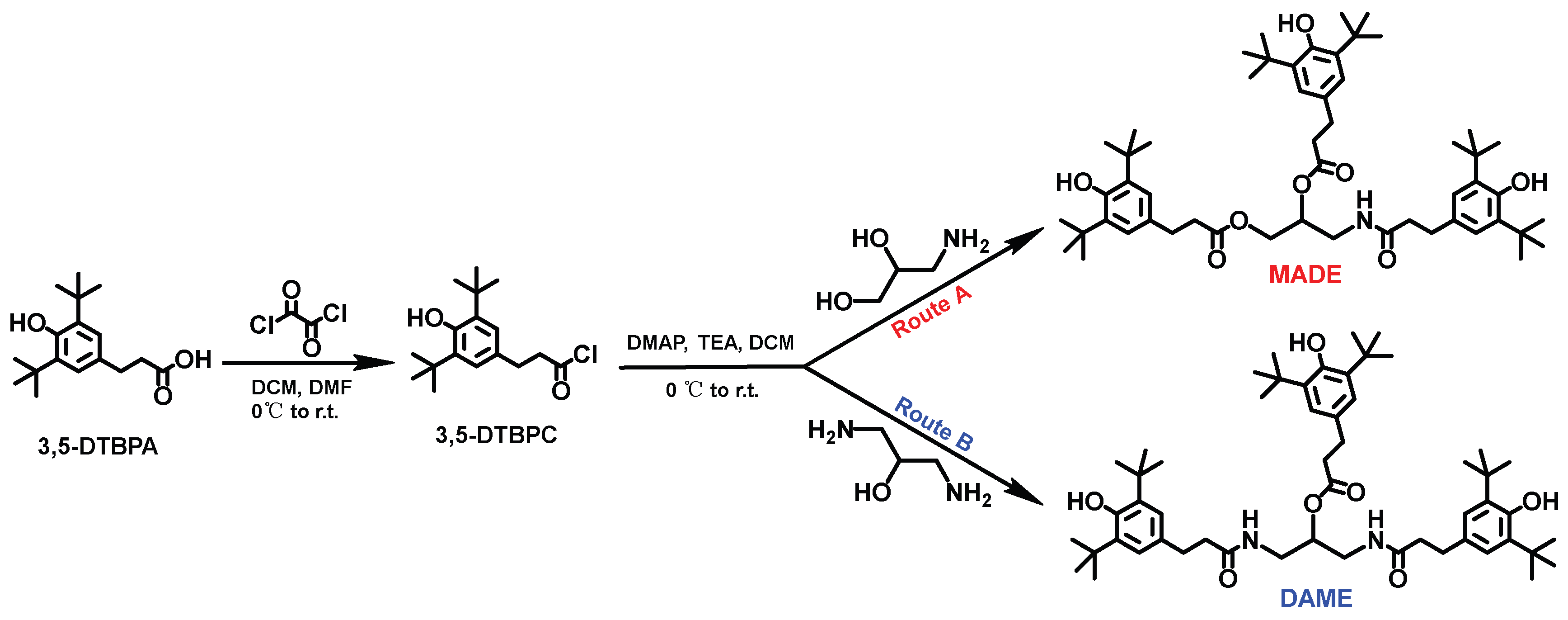
As illustrated in Scheme 1, 3,5-DTBPA was first activated with oxalyl chloride in the presence of DMF to generate the corresponding acyl chloride intermediate, 3,5-DTBPC. This intermediate was then reacted with 3-amino-1,2-propanediol (Route A) or 1,3-diamino-2-propanol (Route B) under basic conditions (TEA, DMAP) in DCM at 0 °C to room temperature, affording the target amide–ester additives MADE and DAME, respectively. The structures of MADE and DAME were fully confirmed by NMR, HR-MS, and FT-IR, with detailed characterization data provided in Section 2.2.

3.2. Thermal Stability

Lubricants, including engine oils, anti-wear hydraulic oils, and compressor oils, demand excellent high-temperature resistance. While thermal stability is primarily governed by the base oil, it also represents a critical factor governing the lifetime and performance of lubricant additives. Additives with low decomposition temperatures can compromise the overall stability of the lubricant formulation, leading to diminished performance and reduced service life. Consequently, thermal stability constitutes a key metric for evaluating the efficacy of additives.
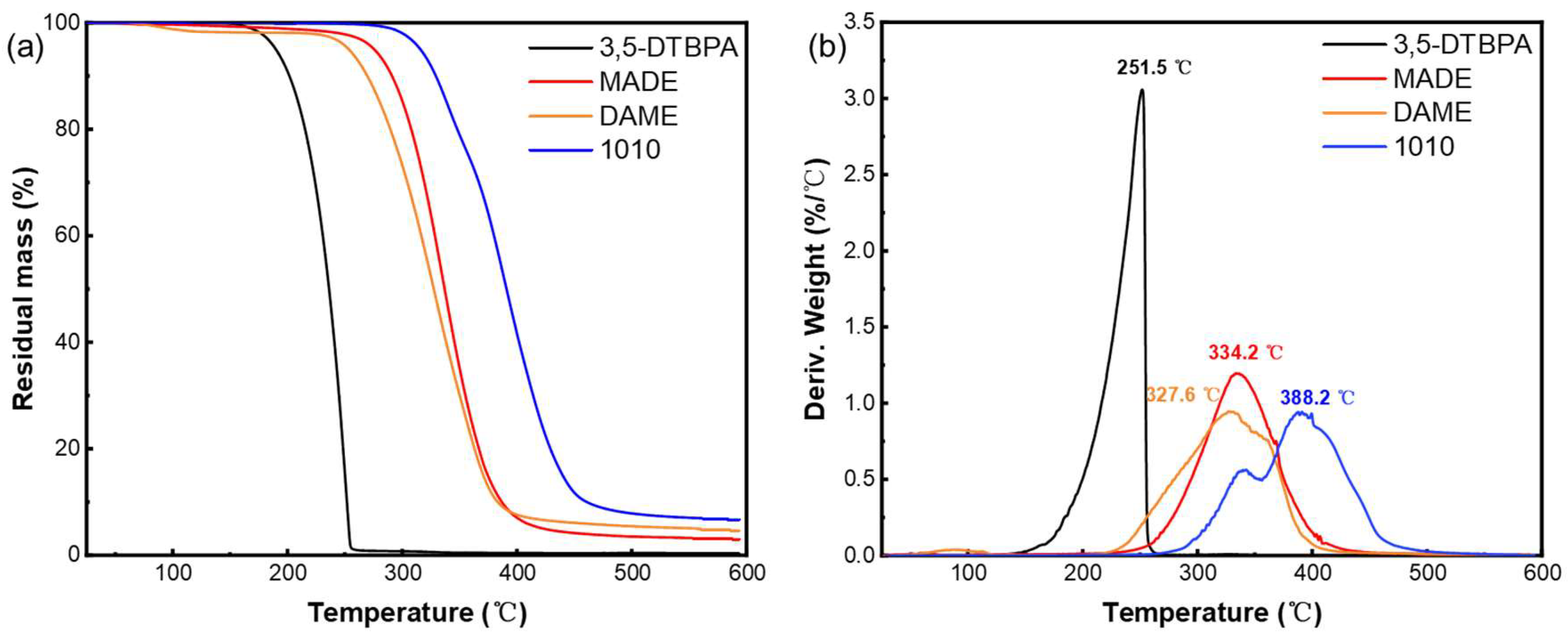
The thermal stability of 3,5-DTBPA, MADE, DAME, and the commercial 1010 was comparatively evaluated using TGA and differential thermogravimetry (DTG) curves. As depicted in Figure 1 and summarized in Table S1, the initial/terminal decomposition temperatures of 3,5-DTBPA, MADE, DAME and 1010 were 150.9/253.5, 217.2/475.6, 210.18/411.9, and 243.1/559.6 °C, respectively, with corresponding maximum decomposition temperatures at 251.5, 334.2, 327.6 and 388.2 °C. The residual masses at 300 °C and 400 °C were as follows: 3,5-DTBPA (0.7%, 0.4%), MADE (85.3%, 7.6%), DAME (73.2%, 7.5%) and 1010 (97.9%, 41.5%). The thermal stability followed the descending order: 1010 > MADE > DAME > 3,5-DTBPA. This demonstrates that the introduction of amide and ester functional groups effectively enhances the thermal stability of MADE and DAME compared with the precursor 3,5-DTBPA. Nevertheless, their thermal stabilization performance is still marginally inferior to that of the commercial antioxidant 1010, which possesses more ester groups in its molecular structure.

3.3. Storage Stability

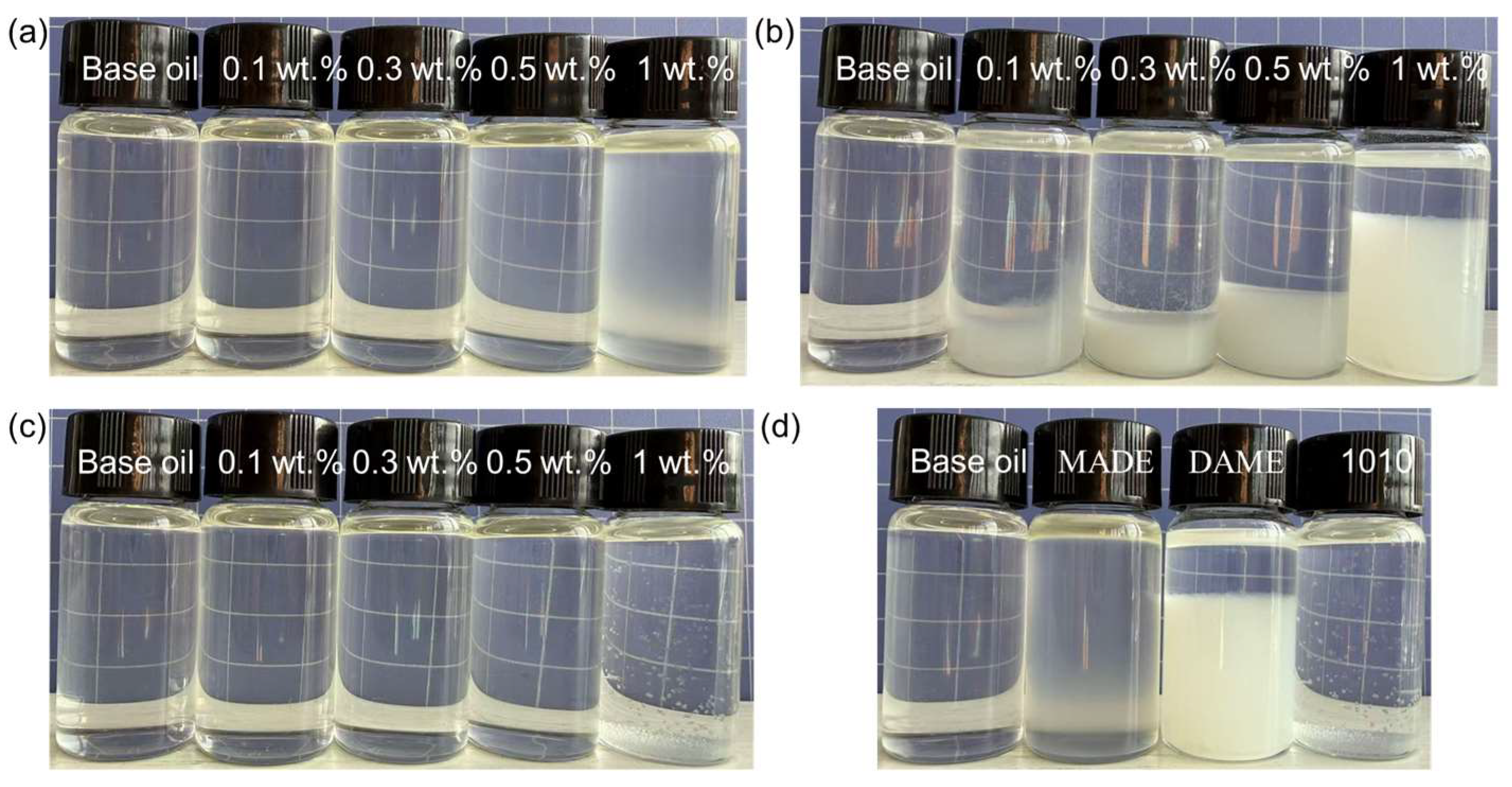
In addition to thermal stability, the storage stability of additives in the base oil is also critical, because only additives with both excellent thermal and storage stability can perform reliably in a lubricant system. Accordingly, the compatibility of MADE and DAME in synthetic base oils was evaluated through room-temperature storage tests and further compared with the commercial 1010. MADE, DAME, and 1010 were separately added into the base oil at concentrations from 0.1 to 1 wt.%. As shown in Figure 2a, after 30 days of storage, all oil samples containing MADE remained clear and bright, except for the 1 wt.% sample, which showed slight uniform haze, similar to the neat base oil (0 wt.%). In contrast, DAME-containing samples became cloudy when cooled to room temperature and exhibited distinct phase separation after 30 days (Figure 2b). As for 1010-added samples, crystallization appeared at the bottom of the 1 wt.% sample after 15 days, whereas the other samples remained clear and bright (Figure 2c). Notably, direct comparison of the 1 wt.% formulations (Figure 2d) clearly demonstrates that MADE possesses much better storage stability than DAME and 1010.
As shown in Table S2, the haze, light transmittance and turbidity data of oil samples stored at 60 °C reveal that: the 1 wt.% MADE-containing oil, similar to the base oil, maintained extremely low haze and turbidity as well as high light transmittance, with no significant changes observed over the 7-day test period. The 1 wt.% 1010-containing oil retained high light transmittance, yet its haze and turbidity were higher than those of the MADE-containing oil. In contrast, the 1 wt.% DAME-containing oil exhibited extremely high haze (96.29%) and turbidity (953.6 NTU), along with a transmittance of only 44.96%, at the initial stage (Day-0). By Day-7, the haze and turbidity decreased sharply, while transmittance increased significantly, a phenomenon attributed to the precipitation of DAME. The results demonstrate that, in the blended synthetic base oil, the storage stability of the monoamide diester MADE is superior to commercial tetraester-based antioxidant 1010, and significantly better than that of diamide monoester DAME. This indicates that the introduction of a single amide bond has no adverse effect on the additive’s storage stability in base oil, whereas the diamide moiety significantly impairs its solubility and thus storage stability by enhancing inter- and intramolecular hydrogen bonding interactions.

3.4. Oxidation Stability

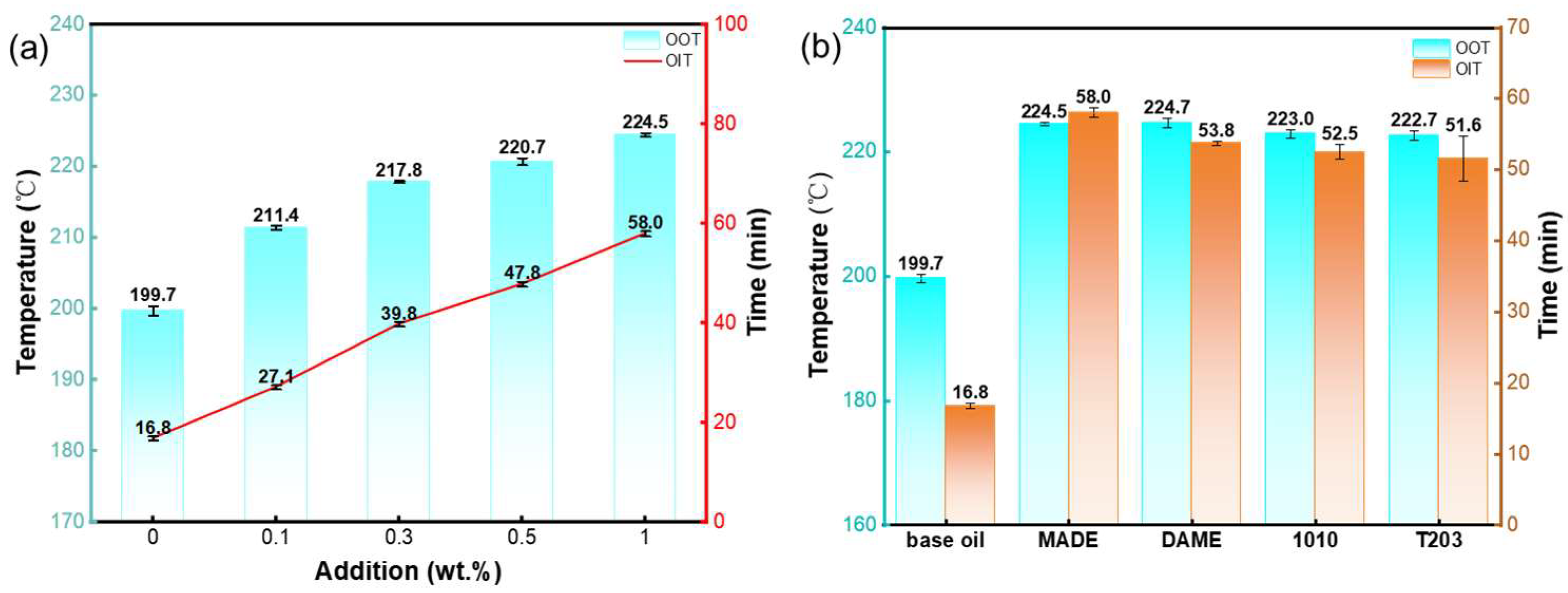
The antioxidant performance of lubricants directly determines their service life and the operational reliability of equipment [53]. Building on the evaluation of the additives’ storage stability, the oxidation stability of oil samples was systematically assessed. As shown in Figure 3a, with the addition of MADE increasing from 0 to 1 wt.%, the OOT gradually rises from 199.7 °C to 224.5 °C, indicating significantly improved oxidation thermal stability of 1 wt.% MADE-containing oil compared with the neat base oil. Meanwhile, the OIT extends from 16.8 min to 58.0 min, demonstrating that MADE can effectively delay the oxidation process of base oil, and its antioxidant efficacy is significantly addition-dependent. To further benchmark its performance, MADE was evaluated alongside DAME, as well as commercial additives 1010 and T203. As illustrated in Figure 3b, the base oil exhibits the poorest oxidation resistance, with an OOT of 199.7 °C and an OIT of only 16.8 min. After adding 1 wt.% of each additive, MADE increased the OOT to 224.5 °C and the OIT to 58.0 min, while DAME, 1010 and T203 also significantly improved the OOT (to 224.7, 223.0 and 222.7 °C, respectively) and OIT (53.8, 52.5 and 51.6 min, respectively). This demonstrates that MADE delivers better overall antioxidant performance.

3.5. Tribological Performance

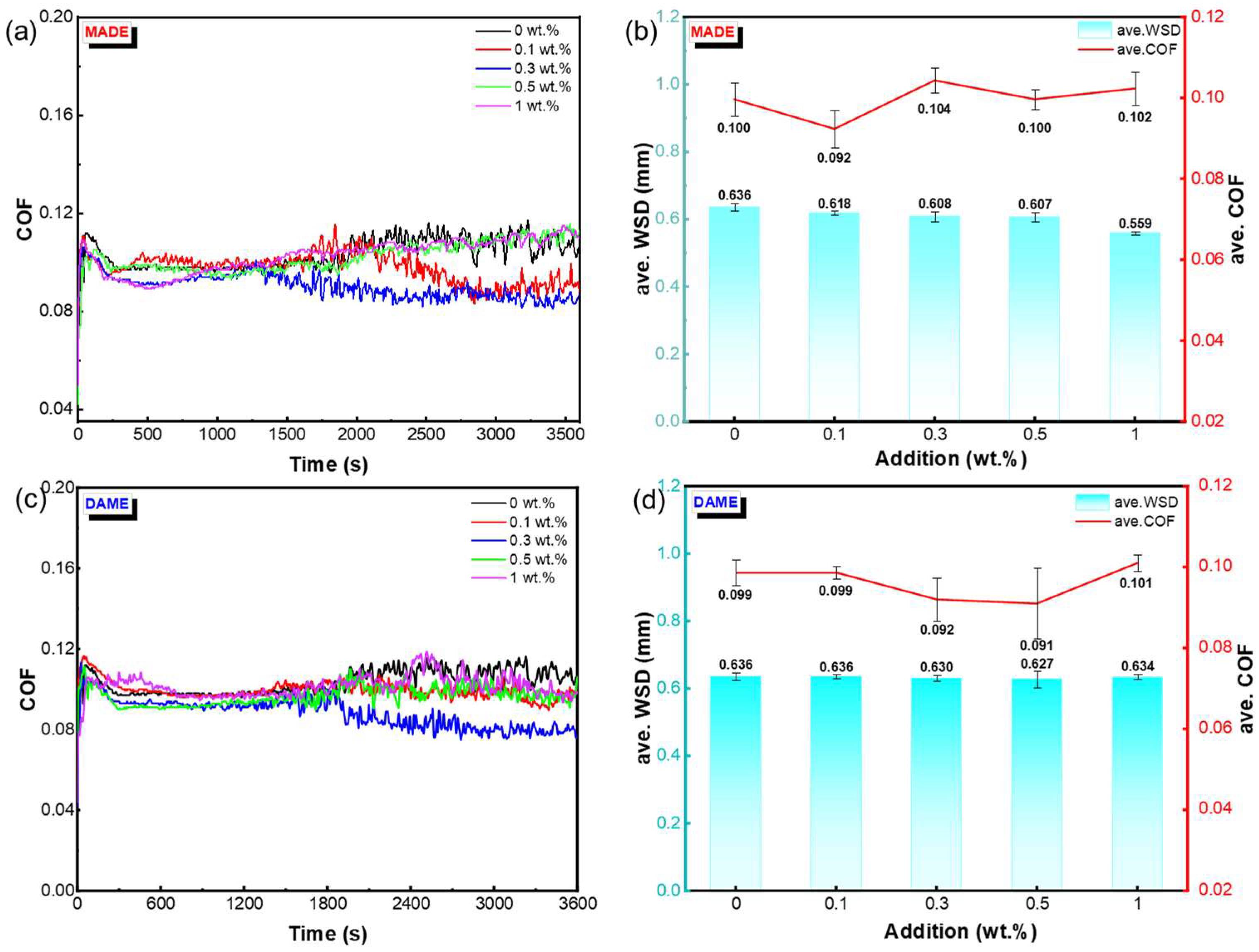
The tribological performance of additives serves as a critical benchmark for evaluating their practical application efficacy, and the influence of amide–esters’ additions (0.1–1 wt.%) was therefore investigated first. Figure 4 presents the tribological properties of synthesized MADE and DAME at different additions. For MADE, as shown in Figure 4a,b, the base oil exhibited a prolonged running-in period (~300 s) and pronounced fluctuations in COF during the steady-state stage. With increasing MADE addition, the COF decreased remarkably, and the friction profiles became much more stable. At 1 wt.% addition, the average WSD was reduced from 0.636 mm (base oil) to 0.559 mm, corresponding to a reduction of 12.1%, demonstrating excellent anti-wear performance. Meanwhile, the average COF remained stable, indicating a synergistic effect of both anti-wear and friction-reducing functions. For DAME, illustrated in Figure 4c,d, the COF only showed a slight decrease at different additions, and the stability of the friction profiles was inferior to that of MADE. The average WSD changed marginally, remaining in the range of 0.627–0.636 mm, indicating limited improvement in anti-wear performance.
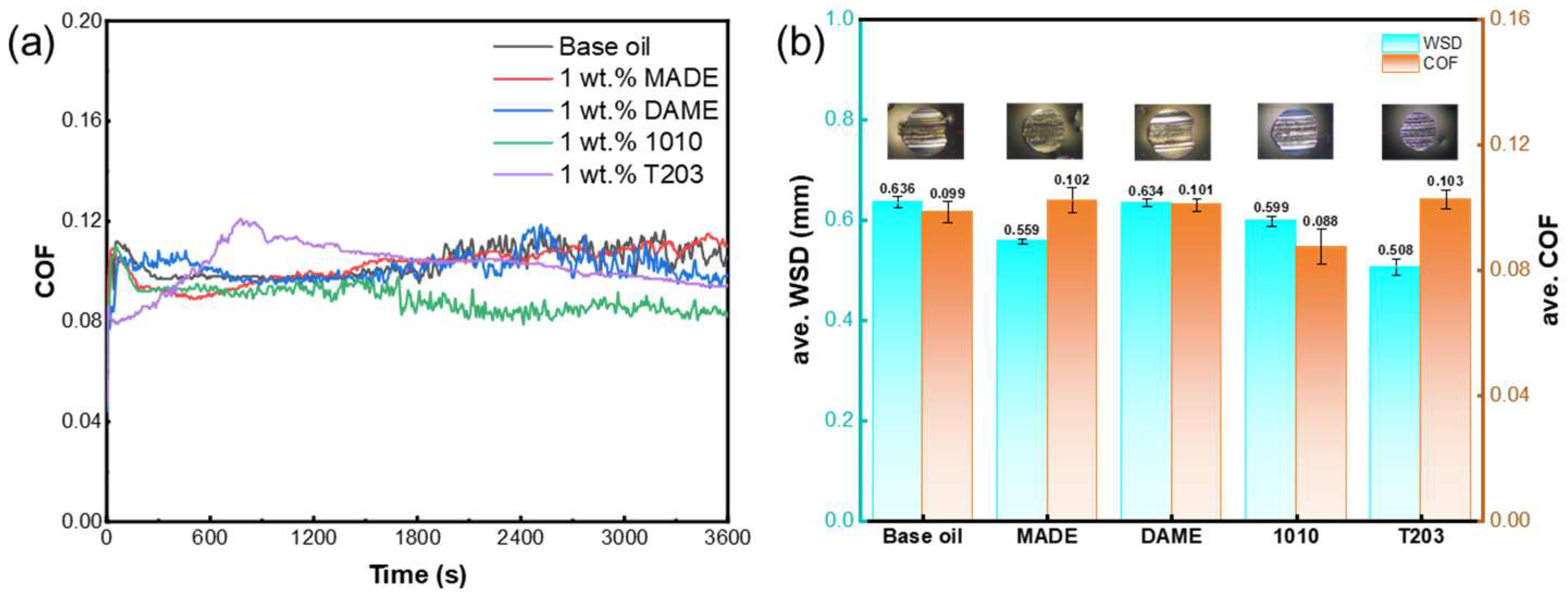
Further comparison of the tribological performance of different additives at 1 wt.% addition (Figure 5a,b) shows that commercial 1010 exhibits the lowest and most stable COF, indicating the best friction-reducing effect. The base oil shows a relatively high COF with significant fluctuations, demonstrating poor stability. The COF values of MADE, DAME and T203 are all lower than that of the base oil, with MADE showing better COF stability than DAME. The average data in Figure 5b reveal that commercial T203 has the smallest average WSD (0.508 mm), indicating its best anti-wear performance, followed by MADE (0.559 mm), which is significantly lower than the base oil (0.636 mm). The 1010 shows the lowest average COF (0.088), highlighting its excellent friction-reducing performance. The wear scar micrographs visually confirm that the wear traces on the steel ball surface are significantly alleviated with shallower and narrower scratches after adding MADE, 1010 and T203, which is consistent with the WSD results.
Overall, T203 and MADE demonstrate good anti-wear performance, 1010 excels in friction-reducing, while DAME shows relatively limited improvement in tribological properties. The comparison results confirm that MADE outperforms DAME in both friction stability and anti-wear capacity, delivering superior comprehensive tribological properties.
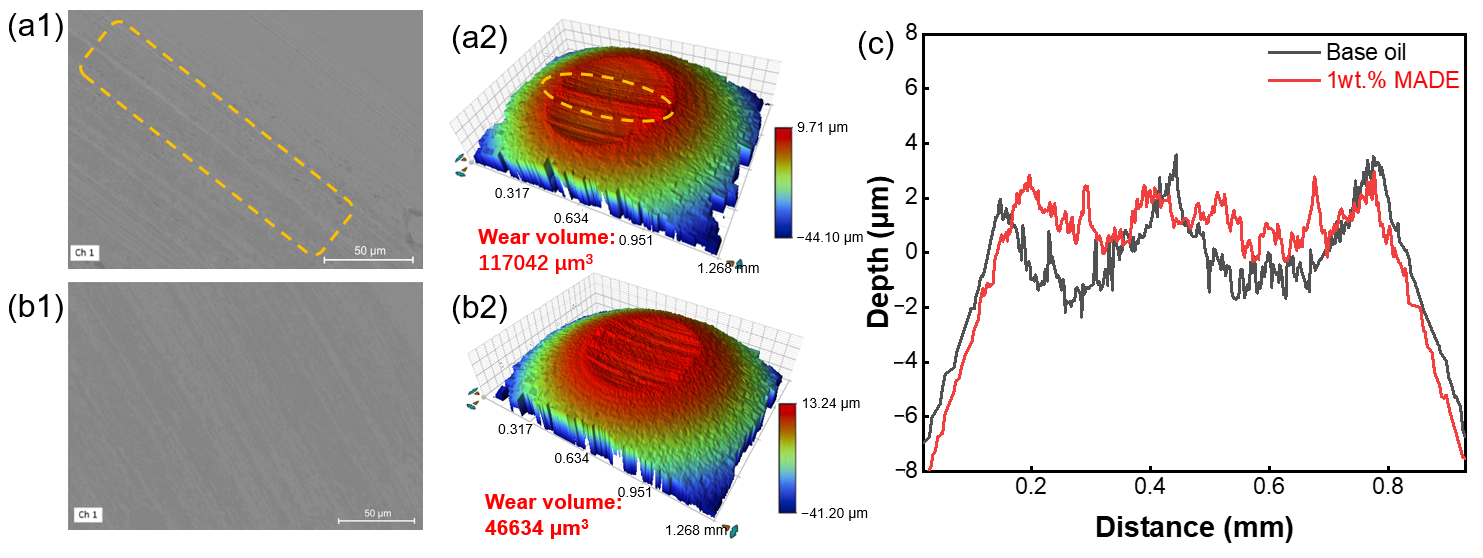
To further verify the anti-wear effect of MADE, the worn surfaces were characterized by SEM morphology and white light interferometer 3D topography. SEM images (Figure 6(a1,b1)) show that the worn surface under base oil lubrication exhibits wide and deep wear tracks, indicating severe wear. After adding 1 wt.% MADE, the wear tracks become significantly shallower and narrower, with greatly improved surface smoothness. The 3D topography (Figure 6(a2,b2)) and wear volume data obtained by white light interferometer show that the wear volume under base oil lubrication is 117,042 μm3, while it decreases to 46,634 μm3 with 1 wt.% MADE addition, corresponding to a reduction of 60.2%. The cross-sectional profile curves of the wear scar in Figure 6c further confirm that the wear scar under 1 wt.% MADE lubrication has a smaller depression depth and gentler surface fluctuations, indicating significantly reduced wear degree. These findings confirm that MADE can effectively alleviate the wear of friction pairs and improve the anti-wear performance of lubricants, which provides a reliable technical basis for extending the service life of mechanical components and reducing equipment failure risks.

3.6. Lubrication Mechanism

3.6.1. Worn Surface Analysis

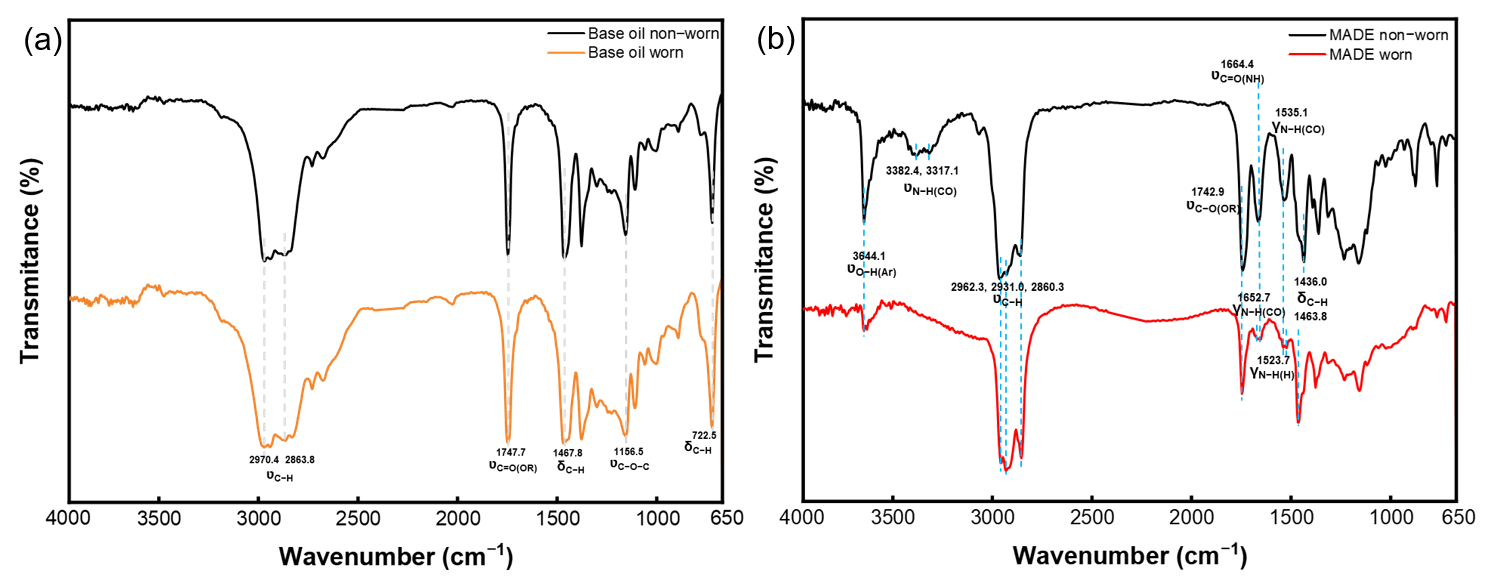
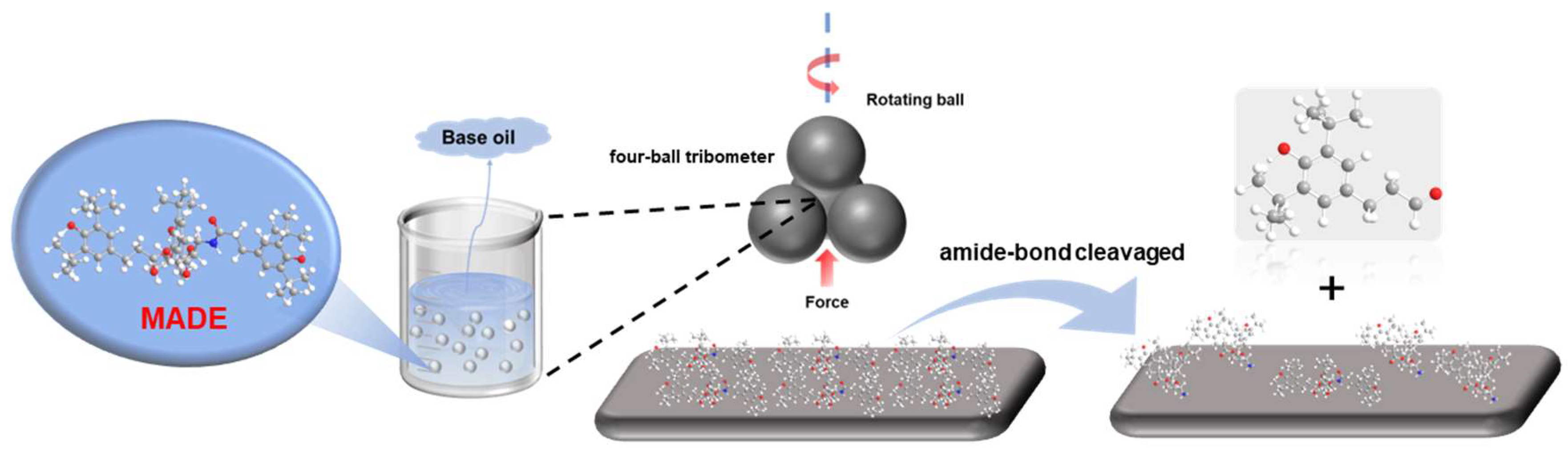
Chemical changes at the friction interface provide critical evidence for revealing the lubrication mechanism. Figure 7a presents the micro-IR spectra of steel balls lubricated with base oil before and after friction. No obvious changes in characteristic peaks or new functional groups are observed, indicating that the base oil only provides physical adsorption and hydrodynamic lubrication, failing to form a stable tribochemical film and thus showing poor anti-wear performance. In contrast, for 1 wt.% MADE-containing oil after friction (Figure 7b), significant changes occur in the intensity and shape of characteristic absorption peaks assigned to the N-H stretching vibration (3382.4, 3317.1 cm−1), C=O stretching vibration (1664.4 cm−1), and N-H bending vibration (1535.1 cm−1) of the amide bond. Notably, a new characteristic absorption peak ascribed to the N-H bending vibration of primary amine appears at 1523.7 cm−1. This demonstrates that amide-bond cleavage takes place in MADE under the combined action of frictional heat and interfacial stress, laying a material foundation for the formation of the tribochemical film.
To further clarify the composition of the interfacial lubricating films, SEM-EDS analysis was carried out on non-worn and worn steel balls, as displayed in Table S3. The SEM images clearly demonstrate that the lubricant 1 wt.% MADE-containing remarkably alleviates the wear severity on the steel ball. According to the elemental analysis, the O contents on the surfaces of base oil and MADE-containing oil are similar (9.66% and 9.35%, respectively) with no significant difference in the non-worn state. After the tribological tests, the O content on the MADE-lubricated surface increases sharply to 36.27%, much higher than that on the base oil-lubricated surface, while the signal intensity of Fe decreases obviously. The remarkable increase in O content directly proves that MADE participates in chemical reactions at the friction interface and forms a dense oxygen-rich lubricating film. This film effectively isolates the metal substrate and reduces direct contact, thus significantly decreasing the wear volume.
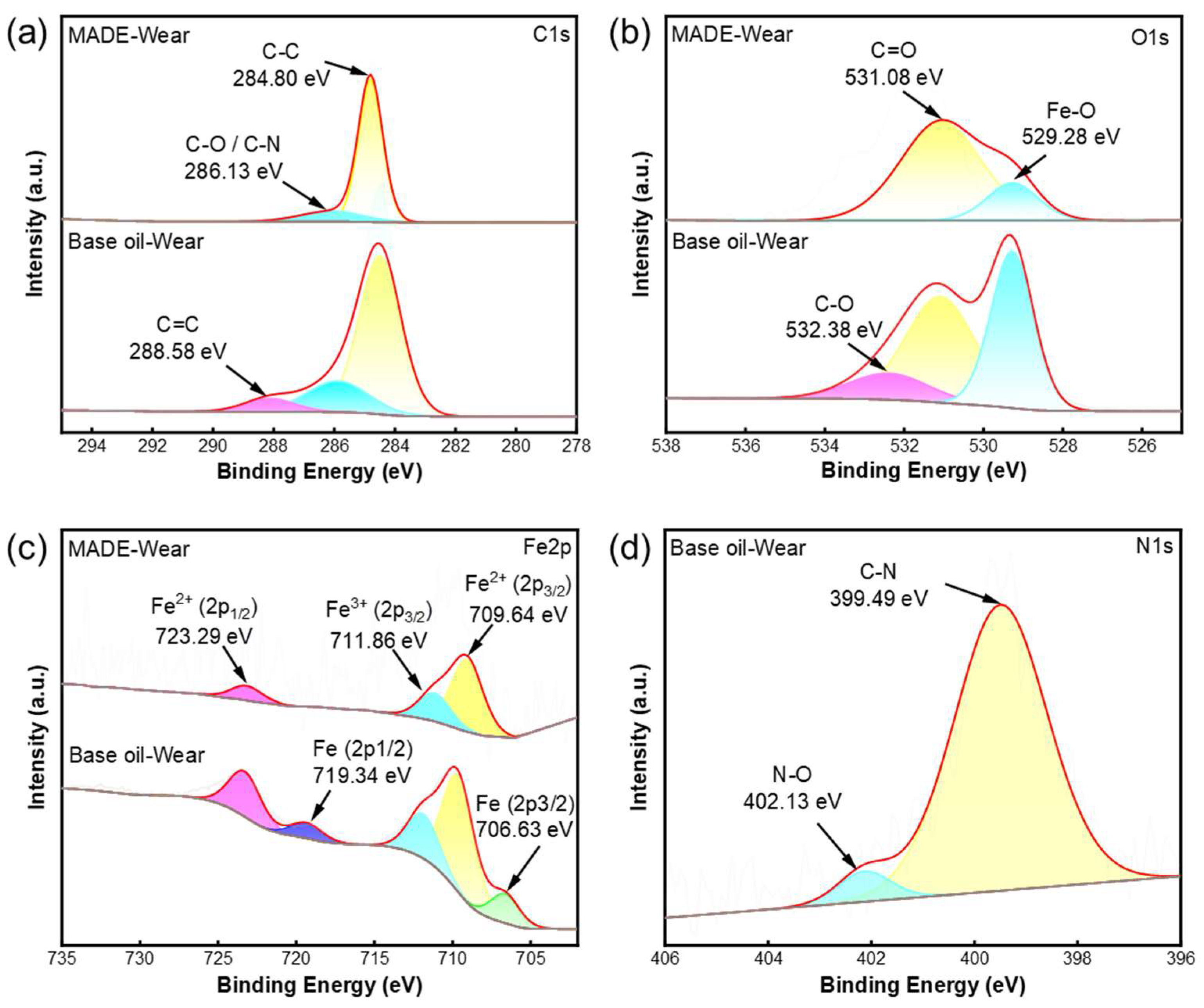
XPS results further reveal the chemical states of the interfacial film [54]. As presented in Figure 8 and Table S4, the C1s spectrum of the worn surface lubricated with 1 wt.% MADE-containing oil displays three main peaks: C-C/C=C (284.80 eV, 71.87%), C-O/C-N (286.21 eV, 20.92%), and C=O (288.58 eV, 7.21%) [55]. The relative content of the C-C/C=C peak is lower than that of the worn surface lubricated with base oil, in which only C-C/C=C (84.07%) and C=O (15.93%) bonding components are detected (Figure 8a). In the O1s spectrum, both samples show characteristic peaks at 529.28 eV, 531.08 eV and 532.38 eV, corresponding to Fe-O, C=O, and C-O bonds [55,56], respectively. Notably, under lubrication, the worn surface lubricated with 1 wt.% MADE-containing oil exhibits significantly higher Fe-O (32.25% vs. 6.98%) and C-O (16.60% vs. 0%) contents than that with base oil, while the C=O content is substantially lower (51.16% vs. 93.02%) (Figure 8b). The results suggest that the ester groups in MADE may break during friction and contribute to the formation of a friction-induced oxide film rich in Fe-O and C-O, thus modifying the surface chemical composition.
In the Fe2p spectrum, the characteristic peaks at 706.63 eV (2p3/2) and 719.34 eV (2p1/2) arise from metallic iron in the steel ball substrate. The peaks at 723.29 eV (2p1/2), 711.86 eV (2p3/2) and 709.64 eV (2p3/2) correspond to Fe2+ (2p1/2), Fe3+ (2p3/2) and Fe2+ (2p3/2), respectively. These results indicate that the high temperature and pressure at the friction interface promote chemical reactions between surface iron atoms and oxygen [56,57] (Figure 8c). Combined with the O1s spectrum, it can be inferred that an iron oxide film, mainly composed of Fe2O3, FeOOH, FeO and Fe3O4, is formed on the worn surface lubricated with 1 wt.% MADE-containing oil during friction. In addition, the N1s spectrum of the worn surface lubricated with 1 wt.% MADE-containing oil shows peaks at 399.49 eV and 402.13 eV, corresponding to C-N and N-O bonds, which implies that part of the amide undergoes oxidation during friction to generate nitrogen-containing oxides [58,59] (Figure 8d). These results collectively confirm that MADE participates in friction-induced interfacial reactions and forms a robust composite tribofilm of iron oxides, organic iron salts and nitrogen-containing complexes. This film exhibits low shear strength and good load-bearing capability, retaining structural integrity under continuous sliding to deliver durable friction reduction and anti-wear performance.

3.6.2. DFT Calculations

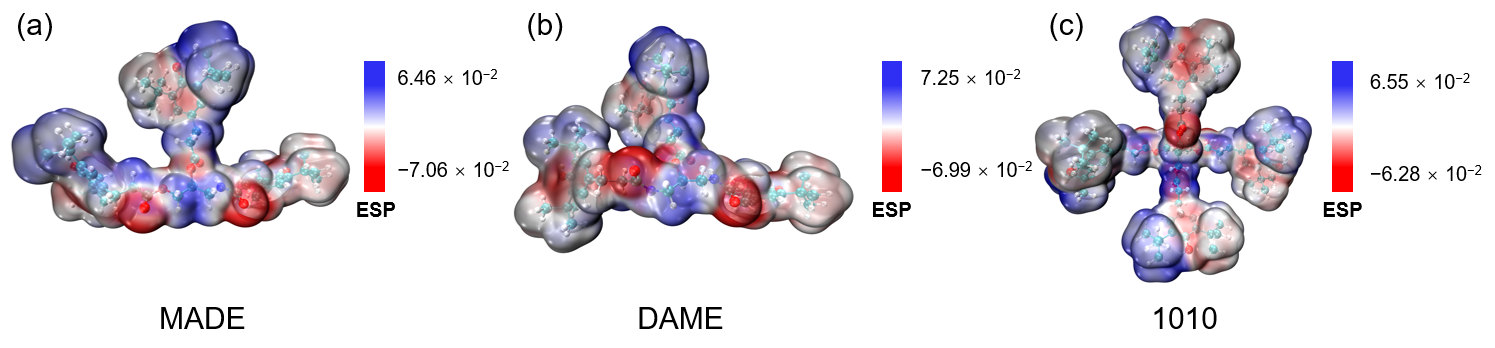
To further corroborate the experimental results and elucidate the origin of the distinct tribological behaviors induced by different additive structures, DFT-based electrostatic potential (ESP) calculations were performed on MADE, DAME and 1010 using the Gaussian 16 program [60]. Specifically, the molecular geometries were optimized using the B3LYP hybrid exchange-correlation functional [61,62,63], and the optimized structures were verified by harmonic vibration frequency analysis (Nimag = 0 for local minimum and Nimag = 1 for transition states). The 6-31G* basis set was employed to analyze the ESP distribution on C, H, O and N atoms. All optimizations were carried out in the gas phase without any symmetry constraint. ESP (-ESPrhoiso = 0.001) was conducted using Multiwfn 3.8 (dev) [64,65,66,67,68], and the results were visualized by VMD [69].
As shown in Figure 9, the minimum/maximum ESP values for MADE, DAME and 1010 are −0.0706/0.0646, −0.0699/0.0725 and −0.0628/0.0655, respectively. Notably, a more negative ESP minimum implies a stronger tendency of adsorption of the molecule onto metal surfaces [70,71]. Accordingly, the theoretical adsorption strength follows the order MADE > DAME > 1010. This result demonstrates that the amide–ester structure in MADE gives rise to a more pronounced polar distribution and good surface affinity, enabling the formation of a more robust adsorption film on metal surfaces. Along with the results of micro-IR analysis, the amide bonds in MADE undergo cleavage under the combined effects of frictional heat and interfacial stress. Following adsorption, the amide-bond cleavage in MADE can facilitate the formation of a protective metal oxide film, thereby enhancing anti-wear performance. Meanwhile, such bond cleavage also lowers the interfacial shear force strength, which contributes to the friction-reducing performance. The enhanced surface polarity revealed by DFT calculations is in good agreement with the tribochemical behaviors observed experimentally, confirming that MADE improves tribological performance through the synergistic effect of the adsorption and interfacial reactions enabled by its amide and ester groups.
Combining the DFT calculation results and worn-surface analysis, MADE exhibits a stronger adsorption capacity on the metal surface than DAME and commercial 1010, as evidenced by its more negative ESP minimum value (−0.0706, compared with −0.0699 for DAME and −0.0628 for 1010). During the friction process, the amide bond in MADE tends to cleave, generating a polar carboxyl group (Figure 10). This carboxyl group can interact with the metal surface to form a dense iron oxide protective film, while the chain cleavage process also reduces interfacial shear resistance. Collectively, the adsorption–cleavage–film-forming mechanism of MADE effectively enhances the friction-reducing and anti-wear performance, contributing to its good tribological performance.

4. Conclusions

In this study, two novel hindered phenolic amide–esters (MADE, DAME) were synthesized from 3,5-DTBPA. Their structures (NMR, HR-MS, FT-IR), thermal stability (TGA), storage stability, oxidation and tribological performance in synthetic oil were systematically investigated. Commercial additives 1010 and T203 were used as references, combined with DFT calculations and worn surface analyses to reveal the underlying mechanism. The results demonstrate that MADE exhibits superior thermal and storage stability relative to DAME, along with more balanced antioxidant and tribological properties. A total of 1 wt.% MADE effectively shortens the running-in period of base oil (200 s vs. 300 s), reduces the average WSD by 12.1% and wear volume by 60.2%. MADE presents stronger adsorption on metal surfaces (ESP: −0.0706) and trends amide-bond cleavage under friction to form a protective tribofilm, realizing synergistic antioxidation and anti-wear effects. Overall, MADE displays good comprehensive performance, providing a feasible strategy for multifunctional lubricant additive design with great application potential in advanced high-performance systems such as engine oils and transmission oils.

Supplementary Materials

The following supporting information can be downloaded at: https://www.mdpi.com/article/10.3390/lubricants14050197/s1, Figure S1: (a) 1H NMR, (b) 13C NMR, (c) HR-MS and (d) FT-IR spectra of DAME; Figure S2: (a) 1H NMR, (b) 13C NMR, (c) HR-MS and (d) FT-IR spectra of MADE; Table S1: Thermogravimetric analysis of 3,5-DTBPA, MADE, DAME and 1010; Table S2: Changes in haze, light transmittance and turbidity of oil samples within 0–7 days at 60 °C; Table S3: SEM-EDS analysis of steel balls lubricated with base oil and 1 wt.% MADE-containing oil before and after tribological tests; Table S4: XPS analysis of worn surfaces lubricated with base oil and 1 wt.% MADE-containing oil after tribological tests.

Author Contributions

Conceptualization, H.Y., X.S. and Y.T.; methodology, X.F., and Z.L.; validation, F.L., Y.H. and H.Y.; formal analysis, H.Y., J.H. and Z.L.; investigation, Z.L. and C.X.; software, Y.Z.; data curation, Z.L. and X.X.; writing—original draft preparation, Z.L.; writing—review and editing, H.Y.; supervision, H.Y. All authors have read and agreed to the published version of the manuscript.

Funding

This research was funded by the National Key R&D Program of China (2024YFA1510200), National Natural Science Foundation of China (U23A2084), the Strategic Priority Research Program of the Chinese Academy of Sciences (XDC0180103) and the Shanxi Provincial Key Research and Development Program (202402040201002).

Institutional Review Board Statement

Not applicable.

Informed Consent Statement

Not applicable.

Data Availability Statement

Data are contained within the article and Supplementary Materials.

Conflicts of Interest

Author Xiaomei Xu was employed by the company Nanjing ChemRun Co., Ltd. The remaining authors declare that the research was conducted in the absence of any commercial or financial relationships that could be construed as a potential conflict of interest.

References

  1. Danilov, A.; Bartko, R.; Antonov, S. Current advances in the application and development of lubricating oil additives. Pet. Chem. 2021, 61, 35–42. [Google Scholar] [CrossRef]
  2. Wan, S.; Tieu, A.K.; Xia, Y.; Zhu, H.; Tran, B.H.; Cui, S. An overview of inorganic polymer as potential lubricant additive for high temperature tribology. Tribol. Int. 2016, 102, 620–635. [Google Scholar] [CrossRef]
  3. Holmberg, K.; Andersson, P.; Erdemir, A. Global energy consumption due to friction in passenger cars. Tribol. Int. 2012, 47, 221–234. [Google Scholar] [CrossRef]
  4. Liu, Z.; Xue, W.; Shi, J.; Han, S.; Yan, J. Recent advances in polyalkylene glycol base oil. Res. Chem. Intermed. 2024, 50, 1515–1539. [Google Scholar] [CrossRef]
  5. Chao, M.-R.; Li, W.-M.; Zhu, L.-L.; Ma, H.-H.; Wang, X.-B. Effect of alkylated diphenylamine on thermal-oxidative degradation behavior of poly-α-olefin. Chem. Pap. 2015, 69, 1004–1011. [Google Scholar] [CrossRef]
  6. Guo, H.; Iglesias, P. Tribological behavior of ammonium-based protic ionic liquid as lubricant additive. Friction 2021, 9, 169–178. [Google Scholar] [CrossRef]
  7. Duangkaewmanee, S.; Petsom, A. Synergistic and antagonistic effects on oxidation stability of antioxidants in a synthetic ester based oil. Tribol. Int. 2011, 44, 266–271. [Google Scholar] [CrossRef]
  8. Zhan, W.; Jia, D.; Jin, Y.; Duan, H.; Li, J.; Liu, J. Synthesis and evaluation of amines/phenolics antioxidant for TMPTO base oil. Ind. Lubr. Tribol. 2020, 72, 46–53. [Google Scholar] [CrossRef]
  9. Naletova, A.; Davydov, D.; Bakunin, V. Derivatives of 2, 5-Dimercapto-1, 3, 4-Thiadiazole as Multifunctional Lubricant Additives. Chem. Technol. Fuels Oils 2021, 57, 783–791. [Google Scholar] [CrossRef]
  10. Rudnick, L.R. Lubricant Additives: Chemistry and Applications; CRC Press: Boca Raton, FL, USA, 2009. [Google Scholar]
  11. Zhu, L.; Wu, X.; Zhao, G.; Wang, X. Effect of a new phosphate compound (BAFDP) addition on the lubricating performance of engine oils at elevated temperatures. Tribol. Int. 2016, 104, 383–391. [Google Scholar] [CrossRef]
  12. Chen, B.; Liu, L.; Zhang, C.; Zhang, S.; Zhang, Y.; Zhang, P. Tribological properties and lubrication mechanism of protic ionic liquid-modified nanosilica as high-temperature antiwear additive for pentaerythritol ester. Tribol. Int. 2022, 176, 107886. [Google Scholar] [CrossRef]
  13. Spikes, H. The history and mechanisms of ZDDP. Tribol. Lett. 2004, 17, 469–489. [Google Scholar] [CrossRef]
  14. Gosvami, N.N.; Bares, J.A.; Mangolini, F.; Konicek, A.R.; Yablon, D.G.; Carpick, R.W. Mechanisms of antiwear tribofilm growth revealed in situ by single-asperity sliding contacts. Science 2015, 348, 102–106. [Google Scholar] [CrossRef] [PubMed]
  15. Htwe, Y.Z.N.; Al-Janabi, A.S.; Wadzer, Y.; Mamat, H. Review of tribological properties of nanoparticle-based lubricants and their hybrids and composites. Friction 2024, 12, 569–590. [Google Scholar] [CrossRef]
  16. Xiong, S.; Zhang, B.; Luo, S.; Wu, H.; Zhang, Z. Preparation, characterization, and tribological properties of silica-nanoparticle-reinforced BN-co-doped reduced graphene oxide as a multifunctional additive for enhanced lubrication. Friction 2021, 9, 239–249. [Google Scholar] [CrossRef]
  17. Keshavarz, S.; Naimi-Jamal, M.R.; Izadmanesh, Y.; Dekamin, M.G. Synthesis of ionic liquids with multifunctional tribological properties as excellent single-component package additives for turbine oils. Lubr. Sci. 2019, 31, 311–320. [Google Scholar] [CrossRef]
  18. Ma, R.; Zhao, Q.; Zhang, E.; Zheng, D.; Li, W.; Wang, X. Synthesis and evaluation of oil-soluble ionic liquids as multifunctional lubricant additives. Tribol. Int. 2020, 151, 106446. [Google Scholar] [CrossRef]
  19. Cui, J.; Bu, Y.; Che, Q.; Liu, L.; Li, Y.; Quan, X.; Hu, L.; Zhang, S. Excellent catalytic oxidation inhibition and lubrication performance of carboxylic acid based ionic liquids as ester oil additives. Tribol. Int. 2025, 216, 111603. [Google Scholar] [CrossRef]
  20. Ren, T.; Xue, Q.; Wang, H. A study of S-(1H-benzotriazol-1-yl) methyl N, N-dialkyldithiocarbamates as novel multifunctional oil additives. Wear 1994, 172, 59–64. [Google Scholar]
  21. Gao, Y.; Zhang, Z.; Xue, Q. Study on 1, 3, 4-thiadiazole derivatives as novel multifunctional oil additives. Mater. Res. Bull. 1999, 34, 1867–1874. [Google Scholar] [CrossRef]
  22. Cosimbescu, L.; Demas, N.; Robinson, J.W.; Erck, R. Friction-and wear-reducing properties of multifunctional small molecules. ACS Appl. Mater. Interfaces 2018, 10, 1317–1323. [Google Scholar] [CrossRef] [PubMed]
  23. Li, W.; Wu, Y.; Wang, X.; Liu, W. A study of P–N compound as multifunctional lubricant additive. Lubr. Sci. 2011, 23, 363–373. [Google Scholar] [CrossRef]
  24. Chen, Q.; Yao, L.; Li, X.; Wang, B.; Wang, J. Synthesis of polymer-grafted carbon dots serving as multifunctional lubricant additives with excellent tribological performance and additional rust resistance function for steel/steel contact. Langmuir 2023, 39, 14374–14383. [Google Scholar] [CrossRef] [PubMed]
  25. Hong, F.T.; Ladelta, V.; Gautam, R.; Sarathy, S.M.; Hadjichristidis, N. Polyether-based block co (ter) polymers as multifunctional lubricant additives. ACS Appl. Polym. Mater. 2021, 3, 3811–3820. [Google Scholar] [CrossRef]
  26. Tang, W.; Lei, H.; Wang, Y.; Liu, H.; Wei, X.; Gao, W.; Zhang, Z.; Jiang, Z.; Li, Y. Multifunctional carbon dots: Versatile and high-efficiency additives for polyethylene glycol. Carbon 2025, 245, 120796. [Google Scholar] [CrossRef]
  27. Zhang, C.; Wang, X.; Sun, Y.; Sun, S.; Zhao, C.; Liu, Y.; Yang, S.; Yu, Q.; Ali, M.K.A. Synthesis of a novel multifunctional ionic liquid based on benzotriazole for enhanced tribological performance of steel interfaces. Tribol. Lett. 2025, 73, 64. [Google Scholar] [CrossRef]
  28. Wang, L.; Sun, S.; Zhang, Y.; Zhang, C.; Zhang, S. Ionic liquid-functionalized ZnO nanomaterial: Multifunctional additives enhancing tribological performance and corrosion resistance in ester oil. Tribol. Int. 2025, 202, 110320. [Google Scholar] [CrossRef]
  29. Zhang, Z.; Hongjun, E.; Zhai, B.; Gao, Y.; Huang, Z.; Chen, J.; Gao, H.; Wang, G. Review of Recent Advances in Porous Organic Frameworks as Additives for Lubrication. ACS Appl. Mater. Interfaces 2025, 17, 49119–49147. [Google Scholar] [CrossRef]
  30. Du, G.; Zhang, Y.; Yang, G.; Song, N.; Zhang, S. Deciphering mechanistic role of oxygen functional groups in graphene crumpled balls for high-temperature lubrication. Tribol. Int. 2026, 218, 111785. [Google Scholar] [CrossRef]
  31. Tang, Z.; Li, S. A review of recent developments of friction modifiers for liquid lubricants (2007–present). Curr. Opin. Solid State Mater. Sci. 2014, 18, 119–139. [Google Scholar] [CrossRef]
  32. Kuwahara, T.; Romero, P.A.; Makowski, S.; Weihnacht, V.; Moras, G.; Moseler, M. Mechano-chemical decomposition of organic friction modifiers with multiple reactive centres induces superlubricity of ta-C. Nat. Commun. 2019, 10, 151. [Google Scholar] [CrossRef] [PubMed]
  33. Hu, W.; Xu, Y.; Zeng, X.; Li, J. Alkyl-ethylene amines as effective organic friction modifiers for the boundary lubrication regime. Langmuir 2020, 36, 6716–6727. [Google Scholar] [CrossRef]
  34. Faujdar, E.; Singh, R.K. Amide polymers based on N-phenyl-p-phenylenediamine with α-olefins-co-maleic anhydride as multifunctional additives for lubricant application. Polym. Adv. Technol. 2022, 33, 2820–2834. [Google Scholar] [CrossRef]
  35. Gao, X.; Wang, Z.; Dai, K.; Wang, T. A quantitative structure tribo-ability relationship model for ester lubricant base oils. J. Tribol. 2015, 137, 021801. [Google Scholar] [CrossRef]
  36. Yao, J.; Liu, R.; Huang, M.; Zhang, J.; Fu, Z.; Liang, Z. Synergistic lubrication of long-chain alkyl-modified silicone/ester blends with enhanced tribological performance under low-viscosity conditions. Tribol. Int. 2026, 221, 112073. [Google Scholar] [CrossRef]
  37. Boulebd, H. Comparative study of the radical scavenging behavior of ascorbic acid, BHT, BHA and Trolox: Experimental and theoretical study. J. Mol. Struct. 2020, 1201, 127210. [Google Scholar] [CrossRef]
  38. Rashed, M.; Masjuki, H.; Kalam, M.; Alabdulkarem, A.; Rahman, M.; Imdadul, H.; Rashedul, H. Study of the oxidation stability and exhaust emission analysis of Moringa olifera biodiesel in a multi-cylinder diesel engine with aromatic amine antioxidants. Renew. Energy 2016, 94, 294–303. [Google Scholar] [CrossRef]
  39. Varatharajan, K.; Cheralathan, M. Effect of aromatic amine antioxidants on NOx emissions from a soybean biodiesel powered DI diesel engine. Fuel Process. Technol. 2013, 106, 526–532. [Google Scholar] [CrossRef]
  40. Singh, R.K.; Kukrety, A.; Sharma, O.P.; Poddar, M.K.; Atray, N.; Thakre, G.D.; Ray, S.S. Evaluation of a novel hindered phenolic triazine Schiff base as multifunctional additive in biolube and biodiesel. Waste Biomass Valorization 2016, 7, 1437–1445. [Google Scholar] [CrossRef]
  41. Xia, D.; Wang, Y.; Liu, H.; Yan, J.; Lin, H.; Han, S. Research Progress of Antioxidant Additives for Lubricating Oils. Lubricants 2024, 12, 115. [Google Scholar] [CrossRef]
  42. Huang, Y.; Chen, Q.; Yang, J.; Guo, P.; Liu, X.; Feng, K.; Cai, M.; Zhou, F. A novel hindered phenol based multi-functional lubricant additive with enhanced antioxidant and tribological performance. Tribol. Int. 2026, 214, 111136. [Google Scholar] [CrossRef]
  43. Ji, X.; Huang, Z.; Cao, H.; Chen, X.; Tang, M. Highly Selective Synthesis and Superior Antioxidant Performance of Cardanol-Derived Unsymmetrical Hindered-Phenol Additives. ChemistrySelect 2025, 10, e04397. [Google Scholar] [CrossRef]
  44. Lu, D.; Lin, Y.; Liu, Y.; Guo, T.; Abudukairimu, M.; Wang, D.; Yin, Z.; Yan, J.; Han, S. Preparation and performance of novel, highly efficient modified hindered phenolic antioxidants in lubricating oils. Res. Chem. Intermed. 2025, 51, 1883–1897. [Google Scholar] [CrossRef]
  45. Wang, J.; Xu, X.; Zhou, J.; Zhao, Y.; Sun, X.; Tang, Y.; He, S.; Yang, H. Synthesis of New Sulfur-free and Phosphorus-free Ether-ester and Study on Its Properties As Ashless Friction Modifier. Acta Chim. Sin. 2023, 81, 461–468. [Google Scholar] [CrossRef]
  46. Xu, X.; Yang, F.; Yang, H.; Zhao, Y.; Sun, X.; Tang, Y. Preparation and tribological behaviors of sulfur-and phosphorus-free organic friction modifier of amide–ester type. Lubricants 2024, 12, 196. [Google Scholar] [CrossRef]
  47. De Jesus, J.H.F.; Ferreira, A.P.G.; Szilágyi, I.; Cavalheiro, E.T.G. Thermal behavior and polymorphism of the antioxidants: BHA, BHT and TBHQ. Fuel 2020, 278, 118298. [Google Scholar] [CrossRef]
  48. ASTM D1003-21; Standard Test Method for Haze and Luminous Transmittance of Transparent Plastics. ASTM International: West Conshohocken, PA, USA, 2021.
  49. ASTM D1209-05(2019); Standard Test Method for Color of Clear Liquids (Platinum-Cobalt Scale). ASTM International: West Conshohocken, PA, USA, 2019.
  50. ASTM E2009-23; Standard Test Method for Oxidation Onset Temperature of Hydrocarbons by Differential Scanning Calorimetry. ASTM International: West Conshohocken, PA, USA, 2023.
  51. ASTM D6186-08(2013); Standard Test Method for Oxidation Induction Time of Lubricating Oils by Pressure Differential Scanning Calorimetry (PDSC). ASTM International: West Conshohocken, PA, USA, 2013.
  52. ASTM D4172-20; Standard Test Method for Wear Preventive Characteristics of Lubricating Fluid (Four-Ball Method). ASTM International: West Conshohocken, PA, USA, 2020.
  53. Wang, Y.; Lu, Q.; Xie, H.; Liu, S.; Ye, Q.; Zhou, F.; Liu, W. In-situ formation of nitrogen doped microporous carbon nanospheres derived from polystyrene as lubricant additives for anti-wear and friction reduction. Friction 2024, 12, 439–451. [Google Scholar] [CrossRef]
  54. De Barros, M.; Bouchet, J.; Raoult, I.; Le Mogne, T.; Martin, J.-M.; Kasrai, M.; Yamada, Y. Friction reduction by metal sulfides in boundary lubrication studied by XPS and XANES analyses. Wear 2003, 254, 863–870. [Google Scholar] [CrossRef]
  55. Zhang, R.; Liu, X.; Guo, Z.; Cai, M.; Shi, L. Effective sugar-derived organic gelator for three different types of lubricant oils to improve tribological performance. Friction 2020, 8, 1025–1038. [Google Scholar] [CrossRef]
  56. Huang, J.; Li, Y.; Jia, X.; Song, H. Preparation and tribological properties of core-shell Fe3O4@ C microspheres. Tribol. Int. 2019, 129, 427–435. [Google Scholar] [CrossRef]
  57. Hu, J.; Zhang, Y.; Yang, G.; Gao, C.; Song, N.; Zhang, S.; Zhang, P. In-situ formed carbon based composite tribo-film with ultra-high load bearing capacity. Tribol. Int. 2020, 152, 106577. [Google Scholar] [CrossRef]
  58. Otero, I.; Lopez, E.R.; Reichelt, M.; Fernandez, J. Tribo-chemical reactions of anion in pyrrolidinium salts for steel–steel contact. Tribol. Int. 2014, 77, 160–170. [Google Scholar] [CrossRef]
  59. Lu, Q.; Wang, H.; Ye, C.; Liu, W.; Xue, Q. Room temperature ionic liquid 1-ethyl-3-hexylimidazolium-bis (trifluoromethylsulfonyl)-imide as lubricant for steel–steel contact. Tribol. Int. 2004, 37, 547–552. [Google Scholar] [CrossRef]
  60. Frisch, M.J.; Trucks, G.W.; Schlegel, H.; Scuseria, G.E.; Robb, M.A.; Cheeseman, J.R.; Scalmani, G.; Barone, V.; Petersson, G.A.; Nakatsuji, H. Gaussian 16, Revision C. 01; Gaussian, Inc.: Wallingford, CT, USA, 2016. [Google Scholar]
  61. Becke, A.D. A new mixing of Hartree-Fock and local density-functional theories. J. Chem. Phys. 1993, 98, 1372–1377. [Google Scholar] [CrossRef]
  62. Becke, A.D. Density-functional exchange-energy approximation with correct asymptotic behavior. Phys. Rev. A 1988, 38, 3098. [Google Scholar] [CrossRef] [PubMed]
  63. Lee, C.; Yang, W.; Parr, R.G. Development of the Colle-Salvetti correlation-energy formula into a functional of the electron density. Phys. Rev. B 1988, 37, 785. [Google Scholar] [CrossRef]
  64. Johnson, E.R.; Keinan, S.; Mori-Sánchez, P.; Contreras-García, J.; Cohen, A.J.; Yang, W. Revealing noncovalent interactions. J. Am. Chem. Soc. 2010, 132, 6498–6506. [Google Scholar] [CrossRef]
  65. Lu, T.; Chen, F. Multiwfn: A multifunctional wavefunction analyzer. J. Comput. Chem. 2012, 33, 580–592. [Google Scholar] [CrossRef]
  66. Lu, T. A comprehensive electron wavefunction analysis toolbox for chemists, Multiwfn. J. Chem. Phys. 2024, 161, 082503. [Google Scholar] [CrossRef] [PubMed]
  67. Lu, T.; Chen, Q. Independent gradient model based on Hirshfeld partition: A new method for visual study of interactions in chemical systems. J. Comput. Chem. 2022, 43, 539–555, Erratum in ChemRxiv 2022, https://doi.org/10.26434/chemrxiv-2022-g1m34. [Google Scholar] [CrossRef]
  68. Zhang, J.; Lu, T. Efficient evaluation of electrostatic potential with computerized optimized code. Phys. Chem. Chem. Phys. 2021, 23, 20323–20328. [Google Scholar] [CrossRef] [PubMed]
  69. Humphrey, W.; Dalke, A.; Schulten, K. VMD Version 1.9. 3. J. Mol. Graph. 1996, 14, 33–38. [Google Scholar] [CrossRef]
  70. Liu, Z.; Lu, T.; Chen, Q. Intermolecular interaction characteristics of the all-carboatomic ring, cyclo[18]carbon: Focusing on molecular adsorption and stacking. Carbon 2021, 171, 514–523. [Google Scholar] [CrossRef]
  71. Politzer, P.; Murray, J. The electrostatic potential as a guide to molecular interactive behavior. In Chemical Reactivity Theory: A Density Functional View; CRC Press: Boca Raton, FL, USA, 2009; Volume 17, pp. 243–254. [Google Scholar]
Figure 1. (a) TGA and (b) DTG curves of 3,5-DTBPA, MADE, DAME and 1010.
Lubricants 14 00197 g001
Figure 2. Photos of oil samples after 30 days of storage at room temperature: (a) various additions of MADE; (b) various additions of DAME; (c) various additions of 1010; (d) comparison of MADE, DAME and 1010 at 1 wt.% addition.
Lubricants 14 00197 g002
Figure 3. OOT and OIT of oil samples: (a) effects of varying MADE additions; (b) comparison of MADE, DAME, 1010 and T203 at 1 wt.% addition.
Lubricants 14 00197 g003
Figure 4. Tribological properties of amide–ester oil samples at different additions: (a) friction profiles, (b) average COF and average WSD of MADE; (c) friction profiles, (d) average COF and average WSD of DAME.
Lubricants 14 00197 g004
Figure 5. Tribological properties comparison of different additives at 1 wt.% addition: (a) friction profiles; (b) average COF and average WSD, with corresponding micrographs of wear scars shown above each bar.
Lubricants 14 00197 g005
Figure 6. (a1,b1) SEM morphologies, (a2,b2) white light interferometer 3D topographies and (c) cross-sectional profile curves of the wear scar of worn surfaces lubricated by base oil and 1 wt.% MADE-containing oil.
Lubricants 14 00197 g006
Figure 7. Micro-IR spectra of worn and non-worn surfaces lubricated by (a) base oil and (b) 1 wt.% MADE-containing oil.
Lubricants 14 00197 g007
Figure 8. XPS spectra of worn surfaces lubricated by base oil and 1 wt.% MADE-containing oil: (a) C1s; (b) O1s; (c) Fe2p; and (d) N1s.
Lubricants 14 00197 g008
Figure 9. Theoretical ESP of (a) MADE, (b) DAME and (c) 1010.
Lubricants 14 00197 g009
Figure 10. Schematic diagram of the lubrication mechanism with MADE.
Lubricants 14 00197 g010
Scheme 1. The synthesis routes of MADE and DAME.
Lubricants 14 00197 sch001
Disclaimer/Publisher’s Note: The statements, opinions and data contained in all publications are solely those of the individual author(s) and contributor(s) and not of MDPI and/or the editor(s). MDPI and/or the editor(s) disclaim responsibility for any injury to people or property resulting from any ideas, methods, instructions or products referred to in the content.