Article

Laser Cladding Fabrication of B4C-Reinforced Titanium Matrix Composites: Wear Resistance and Corrosion Performance


1
College of Intelligent Equipment Engineering, Wuxi Taihu University, Wuxi 214063, China
2
College of Mechanical and Electrical Engineering, Huangshan University, Huangshan 245041, China
3
Jiangsu Key Laboratory of Advanced Food Manufacturing Equipment & Technology, School of Mechanical Engineering, Jiangnan University, Wuxi 214122, China
*
Author to whom correspondence should be addressed.
Lubricants 2026, 14(3), 134; https://doi.org/10.3390/lubricants14030134
Submission received: 15 December 2025 / Revised: 23 February 2026 / Accepted: 16 March 2026 / Published: 19 March 2026
(This article belongs to the Special Issue Laser Surface Engineering for Advanced Tribological Performance)

Abstract

This study involves the addition of B4C particles to TC4 powder to fabricate B4C-reinforced titanium matrix composite coatings on an AISI 304L substrate using a laser cladding process. The effects of B4C addition (0–12 wt.%) on microstructure, microhardness, wear, and corrosion performance were systematically investigated. Results indicate that the composite coating with 9 wt.% B4C exhibits optimal properties, achieving a peak microhardness of 600 HV0.2 and a wear rate of 2.82 × 10⁻⁴ mm3/N·m, representing a 58.22% reduction compared to the pure TC4 coating. Electrochemical tests in 3.5 wt.% NaCl solution reveal a significant positive shift in corrosion potential and reduced corrosion current density with increasing B4C content, confirming enhanced corrosion resistance, and the improved performance is attributed to grain refinement and dispersion strengthening by B4C particles. This work provides a feasible strategy for enhancing the surface properties of 304L stainless steel under demanding wear and corrosive environments.

1. Introduction

AISI 304 stainless steel (SS 304L) is extensively employed in critical sectors such as biomedical implants, aerospace components, and marine structures owing to its outstanding corrosion resistance, good heat resistance, and oxidation stability [1,2,3]. However, its relatively low surface hardness and poor wear resistance severely limit its performance in applications involving frequent friction, abrasive environments, or demanding mechanical loads. To extend the service life and expand the application scope of 304L components, it is imperative to improve their surface properties through advanced modification techniques. Laser cladding stands out as an effective technique due to its characteristics of high energy density, low dilution rate, and rapid heating and cooling rates [4,5,6,7], in which an alloying layer with good metallurgical bonding at the interface can be acquired over the substrate, which is regarded as a suitable way to fabricate enhanced layers on 304L substrate.
Ceramic-reinforced metal matrix composites (MMCs) combine the toughness and ductility of the metal matrix with the high hardness and strength of ceramic reinforcements, yielding synergistic properties unattainable by conventional alloys. These include high specific strength, specific stiffness, low thermal expansion, and superior wear and temperature resistance [8,9,10]. Among various MMCs, titanium matrix composites (TMCs) are particularly promising for advanced aerospace, automotive, and biomedical applications due to their exceptional strength-to-weight ratio, corrosion resistance, and biocompatibility [11,12,13]. A key challenge lies in further enhancing their surface mechanical properties, such as hardness and wear resistance, to meet more demanding operating conditions. Boron carbide (B4C) is recognized as the third hardest ceramic material globally [14,15], surpassed only by diamond and cubic boron nitride (CBN). It retains a high hardness of 9.3 on the Mohs scale even at elevated temperatures [16,17]. B4C exhibits a low density of 2.52 g/cm3 and possesses a high melting point, making it highly suitable for incorporation via laser cladding process [18,19,20]. Bai et al. identified an optimal B4C content range that significantly improves microhardness, fracture toughness, and wear resistance in coatings [21]. Coatings containing an appropriate amount of B4C (not exceeding 15 wt.%) have demonstrated outstanding overall mechanical properties. Similarly, Xu et al. reported that adding 2% B4C nanoparticles to an IN625 matrix via laser cladding resulted in an ~86% reduction in wear rate, despite a slight increase in the coefficient of friction [22]. However, there is little research data that can be found about adding B4C particles to the TC4 powder, and the corresponding weight ratio of its addition is not clear. It is worth noting that the C element in B4C is beneficial to the formation of carbide hard phases, but is also prone to forming cracks [23,24]. Alexander Golyshev et al. prepared Ti-6Al-4V/BC composite materials containing boron carbide (BC) powder on a titanium alloy substrate using selective laser melting (SLM) technology and analyzed the influence of different weight percentages (1%, 5%, and 10%) on the composite material properties. The results demonstrated that increasing the BC content led to enhanced hardness and crack propagation resistance of the material. Significantly, at a BC content of 10%, the composite achieved its peak hardness of approximately 372.0 HV0.3, with wear resistance approximately 4.2 times higher than that of samples devoid of BC. Furthermore, the microstructural analysis revealed the formation of a heterogeneous structure and issues related to phase transformations associated with regular arrangement in each newly deposited layer [25]. Previous research outcomes concerning B4C furnish a well-grounded conceptual framework and a promising launchpad for the present investigation.
Hence, the present work employed laser cladding technology to fabricate B4C-reinforced TC4 titanium matrix composite coatings on an AISI 304L stainless steel substrate. The research focuses on the systematic investigation of the effect of B4C addition (at 0, 3, 6, 9, and 12 wt.%) as a secondary phase on the microstructure, microhardness, wear resistance, and corrosion behavior in a 3.5 wt.% NaCl solution of the coatings. The primary objectives are to elucidate the structure–property relationships between B4C content and the overall coating performance, to identify an optimized B4C content range that achieves high hardness, superior wear and corrosion resistance without significant defects, and to reveal the underlying wear failure mechanisms of the composite coatings. This work aims to provide both experimental evidence and theoretical guidance for developing high-performance surface protective coatings on 304L stainless steel, suitable for demanding wear and corrosive environments.

2. Experimental Procedure

2.1. Materials and Laser Cladding Process

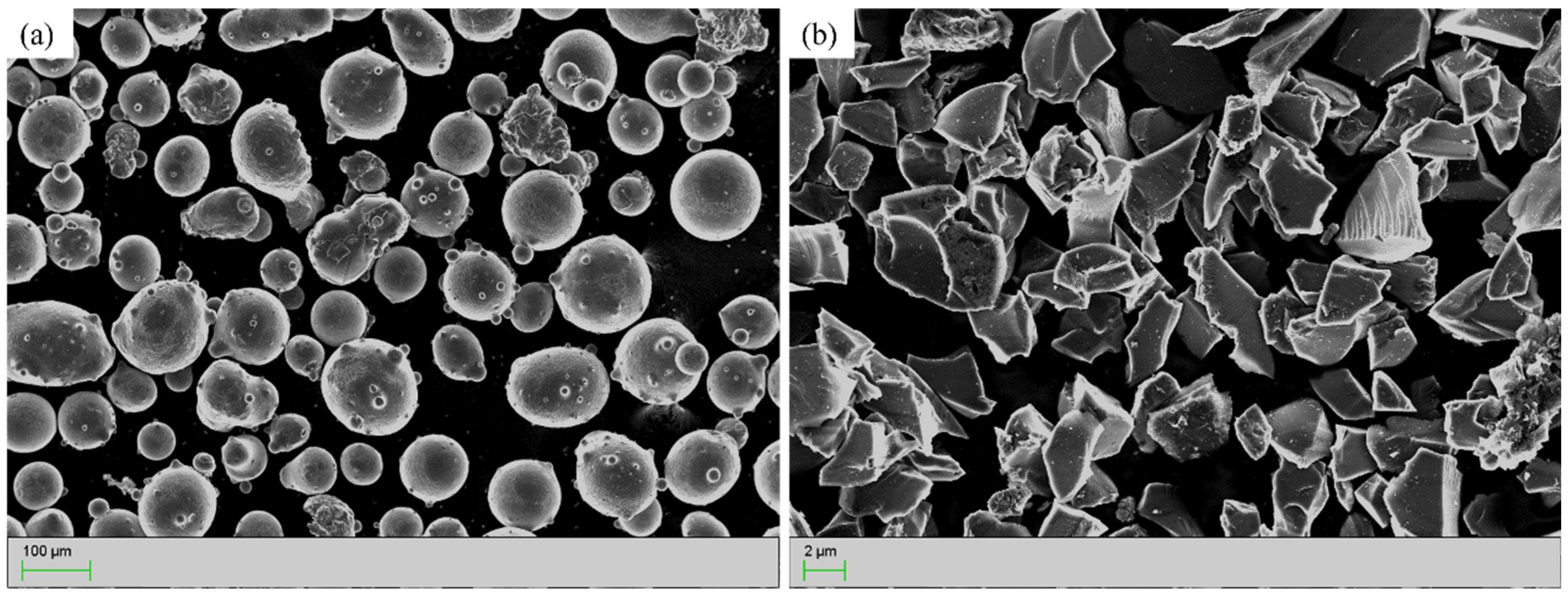
SS AISI 304L cuboid specimens with dimensions of 120 mm × 100 mm × 15 mm were utilized as the parent material for laser cladding. TC4 powders, having a particle size range of 35–100 µm, were chosen as the primary raw material, with their detailed chemical composition presented in Table 1. The selected cladding materials are B4C powders and TC4 powders, with their microscopic morphologies shown in Figure 1. To make a homogeneous mixture, the metal matrix composite powders were uniformly mixed in a planetary ball mill (Nanjing Nanda Instrument Co., Ltd., Nanjing, China). The ball milling process parameters were as follows: a ceramic ball made of zirconia (ZrO2) with a diameter of 5 mm, a ball-to-powder ratio of 10:1, a speed of 100 r/min, and a milling time of 2 h. Five kinds of powder mixtures with different mass ratios of B4C and TC4 powders were used in the experiments, as listed in Table 2. The powder mixtures were designated TC4, TC4@3B4C, TC4@6B4C, TC4@9B4C, and TC4@12B4C, respectively, based on the incremental mass percentages of B4C incorporated.

2.2. Laser Cladding Process

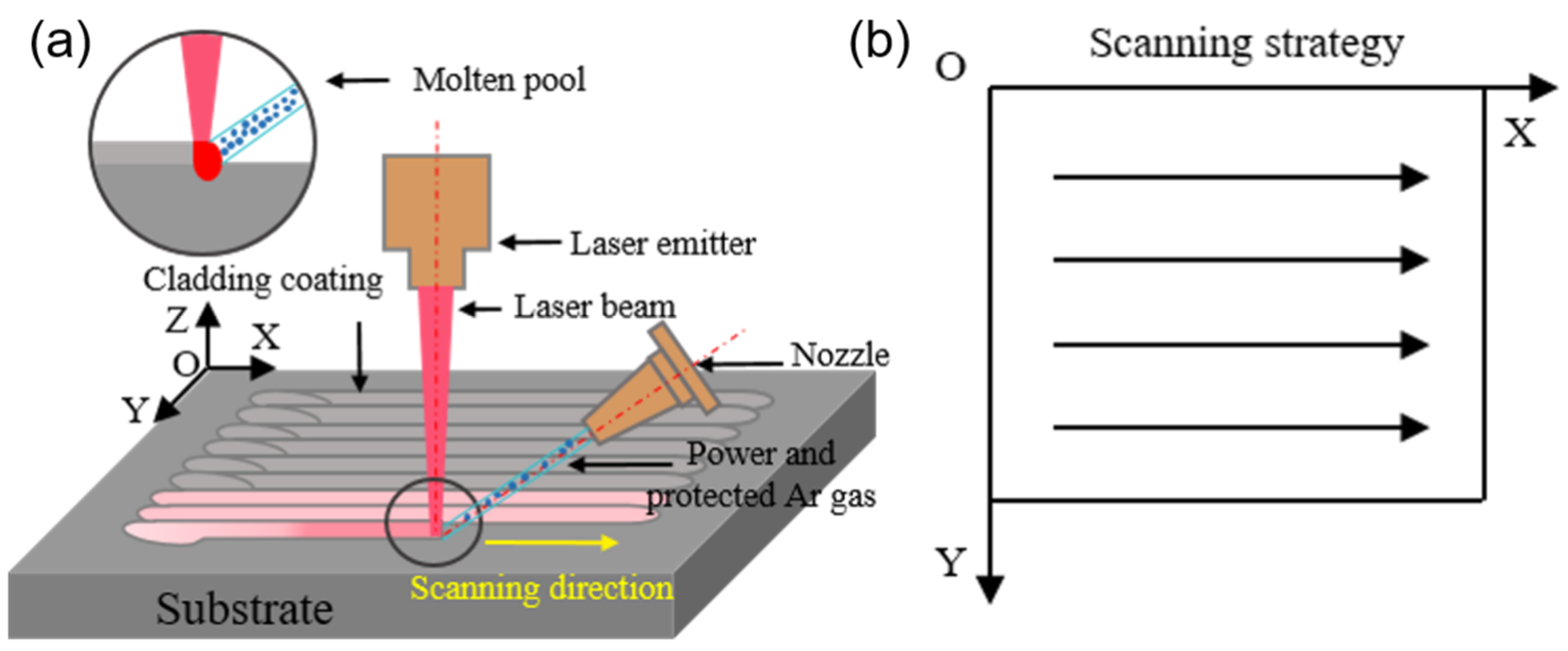
Before laser cladding, the surface of the substrate was mechanically polished and cleaned with ethanol to obtain a flat and smooth surface as well as avoid oxides and foreign inclusions. The TC4/B4C composite coatings were fabricated using the LSJG-GQ-3200 laser cladding system (Nanjing Zhongke Raycham Laser Technology Co., Ltd., Nanjing, China) composed of an IPG optical fiber system and a powder feeder, and the laser heat source exhibits a Gaussian distribution, meaning that the heat flux density is non-uniform, with a high energy concentration near the center of the beam spot and diminishing energy further away from the center. The peak power achievable is up to 3200 watts, and the wavelength operates at 1080 ± 10 nm. The optimization of laser cladding parameters was applied as laser spot diameter of 4 mm, scanning speed of 8 mm/s, laser power of 2000 W, powder feeding rate of 1.5 g/min, and overlapping rate of 50%. Notably, during the laser cladding process, the 99.99% purity argon gas was blown into the molten pool for protection from oxidation with a gas flow rate of 4 L/min. A schematic representation of the laser cladding process is illustrated in Figure 2.

2.3. Mechanical Property Characterization

The Vickers hardness of each coating was measured using HVS-1000ZCM-XY microhardness indenter (Shanghai Suoyan Testing Instrument Co. Ltd., Shanghai, China) with a 200 g load and 15 s dwell time. The microhardness measurements of each specimen were taken at different locations on the cladding layer, and the average value of ten measurement results was employed. In self-made seawater (prepared seawater was obtained by dissolving a defined quantity of sea salts into deionized water to reach a 2–10 wt.%.) medium, the tribological properties of different coatings were evaluated on MFT-5000 tribometer (Rtec Co., San Jose, CA, USA) for 30 min using a normal load of 15 N, a sliding distance of 8 mm and a sliding frequency of 1 HZ. A 9 mm-diameter Si3N4 ball (Ra ≤ 0.05 µm) was applied as the counter-bodies. Post-experiment, the wear volume was measured by White Light Interferometer (MFP-D, RTEC Instruments, San Jose, CA, USA), and the worn surface morphology was characterized using a scanning electron microscope (SEM, Thermo Fisher Scientific, Waltham, MA, USA) to reveal the wear mechanism of varying coatings.

2.4. Electrochemical Test

To investigate the corrosion behavior of various coatings at room temperature, all samples were submerged in a 3.5 wt.% NaCl solution. All electrochemical experiments were carried out on an electrochemical workstation (CHI660E, Shanghai Chenhua Instrument (CH Instruments), Shanghai, China) using a conventional three-electrode electrolytic cell consisting of platinum as a counter electrode, a saturated calomel electrode (SCE) as a reference electrode, and the test sample as the working electrode. The exposed area of the working electrode was 1.44 cm2, and the non-working face was sealed by acrylic resin powder. Before electrochemical impedance spectroscopy (EIS) tests, all samples were immersed in NaCl solution for over 1000 s to obtain a stable open-circuit potential (OCP). The frequency ranged from 105 to 10−2 Hz using a 10 mV (vs. SCE) sinusoidal potential modulation. Afterward, the potentiodynamic polarization tests were conducted from a potential range of −1 V to 1 V (vs. SCE) at a scanning rate of 0.5 mV·s−1. Finally, the impedance spectra were analyzed and fitted using the ZSimpWin 3.60 software. Notably, all electrochemical tests were conducted three times to confirm their reproducibility.

3. Results and Discussion

3.1. Surface Morphology

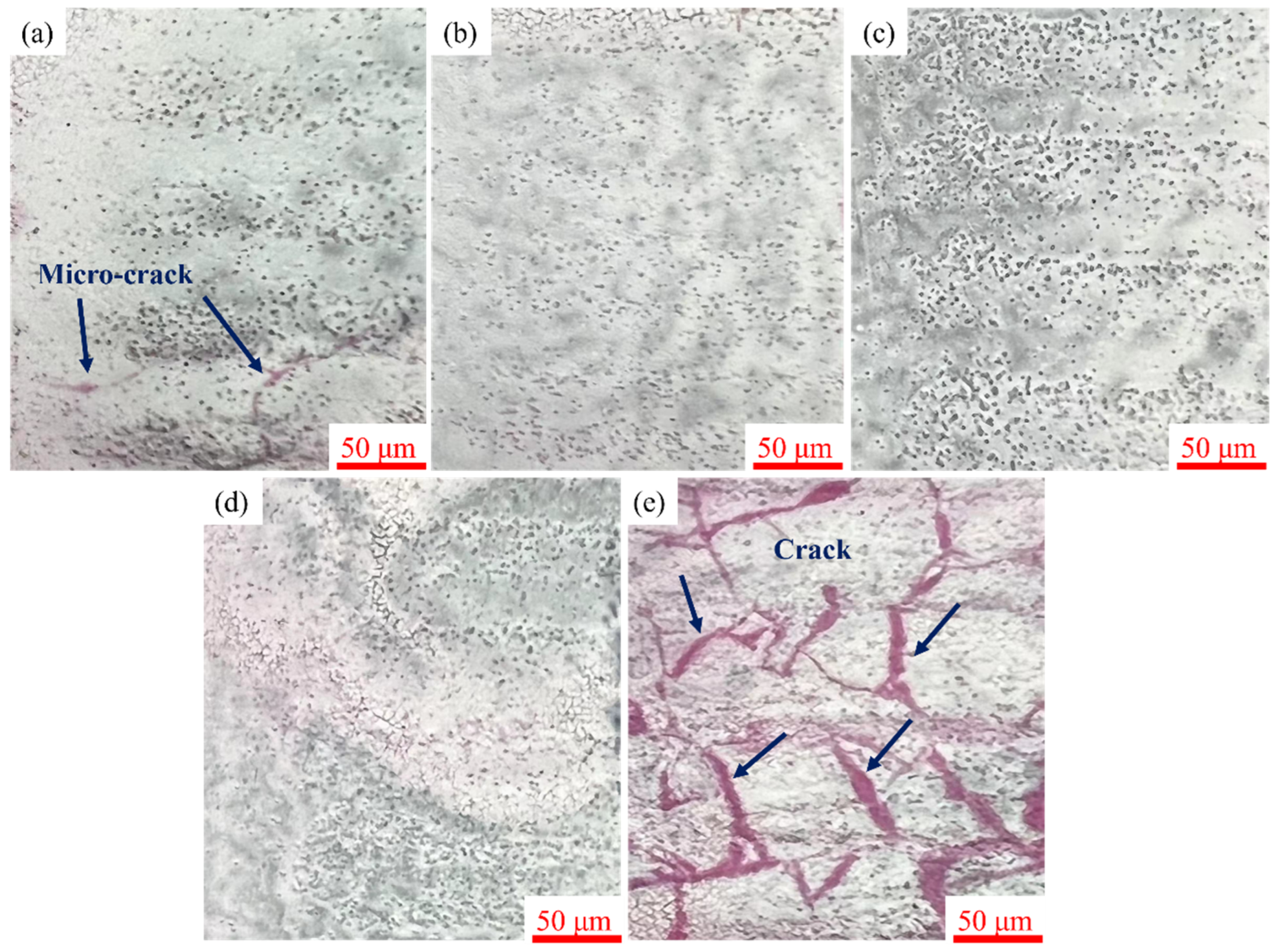
Figure 3 illustrates the surface morphologies of composite coatings containing varying amounts of B4C. Due to different physical properties including thermal expansion coefficient, specific heat capacity, and mutual solubility of the layer and the substrate, when pure TC4 coating was laser cladding on the surface of SS AISI 304L substrate, some micro-cracks can be observed on the surface of the coatings. The introduction of a small quantity of B4C reinforcement (3.0 wt.%, 6.0 wt.%, and 9.0 wt.%) into the TC4 powder resulted in composite coatings with no discernible micro-cracks on their surfaces. This phenomenon can be explained by the fact that mixing a small amount of B4C can not only refine the grains and improve the fluidity of the solution but also reduce the surface tension of the molten pool, which is beneficial to diminish the tendency to generate cracks. However, with the incorporation of 12.0 wt.% B4C, significant cracks can be observed on the surface of the composite coatings. Consequently, the TC4@12B4C sample was not included in subsequent analyses.

3.2. Cross-Sectional Micrograph and Microstructure

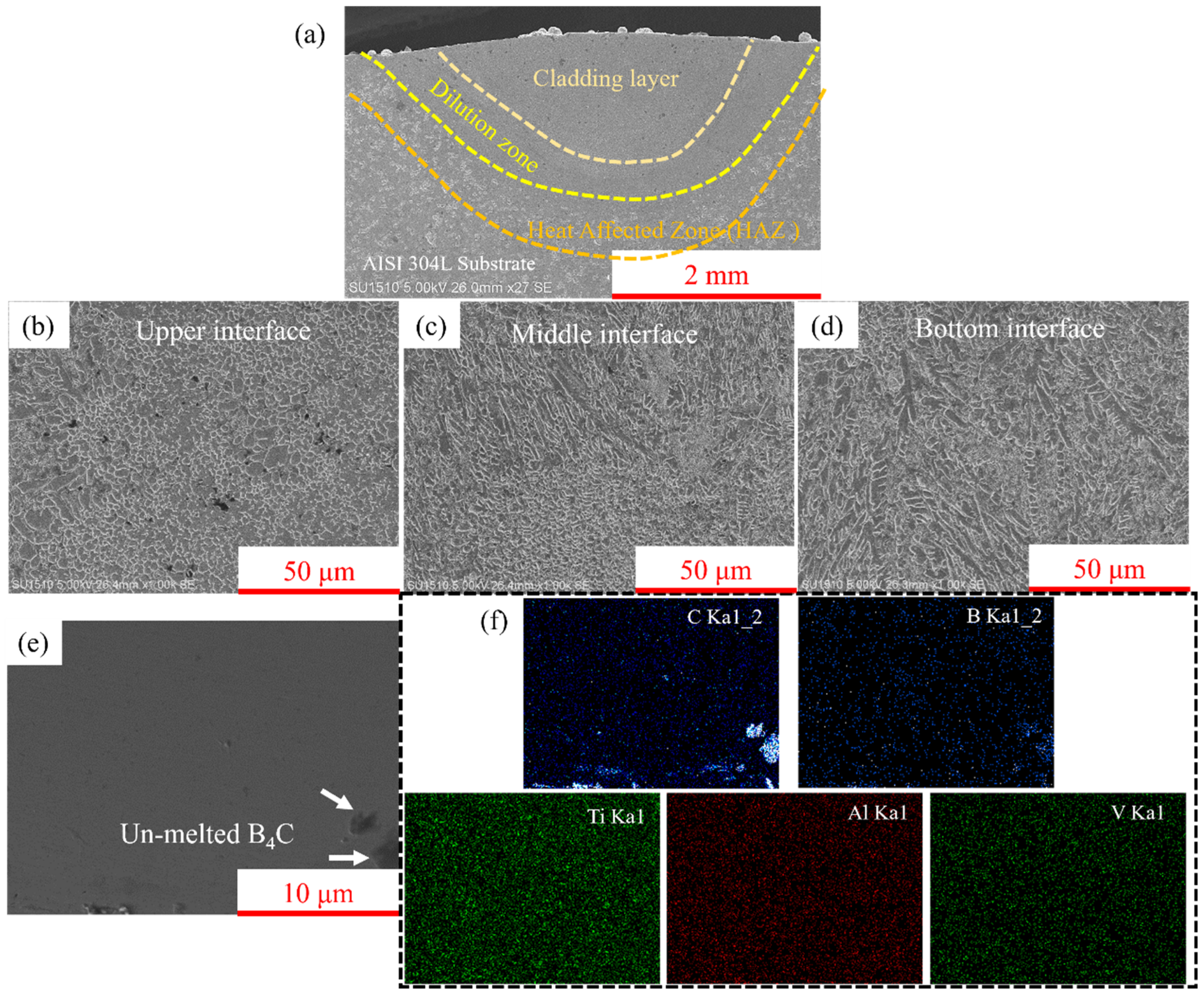
As shown in Figure 4, a typical specimen of TC4@9B4C composite coatings was selected for characterization through SEM cross-sectional micrographs and microstructural analysis. From Figure 4a, it can be distinctly observed that the clad region is composed of the cladding layer, dilution zone, Heat-Affected Zone (HAZ), and substrate. The SEM cross-sectional image after laser cladding reveals no evident cracks or pores, signifying the absence of any severe defects. A small amount of unmolten powder adheres to the upper surface of the cladding layer, which appears overall flat and smooth. Moreover, the interface between the cladding layer and the substrate exhibits tight and uniform bonding, indicating excellent metallurgical adhesion throughout. In Figure 4b–d, microstructures at different interfaces—upper, middle, and lower parts—are displayed for the cladding layer. At the top interface of the cladding layer in Figure 4b, a dense mixture of columnar grains, equiaxed grains, and dendritic grain structures is apparent, with relatively smaller grain sizes due to the high undercooling caused by rapid laser solidification, which restricts grain growth. As shown in Figure 4c,d, moving towards the substrate (at the middle and lower interfaces), microstructural features such as compositional segregation, grain coarsening, and precipitation or dissolution of secondary phase particles are observed, which are closely related to the decreasing temperature gradient during the laser cladding process. Figure 4e,f illustrate dispersed unmolten B4C particles embedded within the Ti alloy matrix, forming a characteristic metal matrix composite structure. Notably, no significant in situ formation of TiC and TiB2 phases was detected. This could potentially stem from two factors: on one hand, the excessively large temperature gradient during laser cladding might not have been sufficient to allow for a complete reaction, thus leaving inadequate time for the generation of TiC and TiB2. On the other hand, the molar ratio of Ti to the B4C precursor may not have reached the optimal proportion necessary for generating TiC and TiB2, leading to difficulties in the reaction proceeding or insufficient production of the targeted compounds. In addition, the cross-sectional measurements for the dimension of the TC4 composite coatings are presented in Table 3. It can be observed that as the B4C content increases from 0 wt.% to 9 wt.%, the coating width decreases slightly from 4.50 mm to 4.05 mm, while the coating depth increases from 1.85 mm to 2.05 mm. This trend can be attributed to the influence of B4C particles on the melt pool dynamics. The addition of B4C, which has a significantly higher melting point than TC4, increases the overall viscosity of the molten pool and alters its surface tension. This results in reduced lateral flow (leading to narrower width) and enhanced penetration into the substrate (leading to greater depth) due to improved energy absorption and Marangoni convection effects. These dimensional changes are consistent with the microstructural observations in Figure 4, where a more refined and denser structure is evident with increasing B4C content, further validating the role of B4C in modifying the solidification behavior.

3.3. Microhardness Analysis

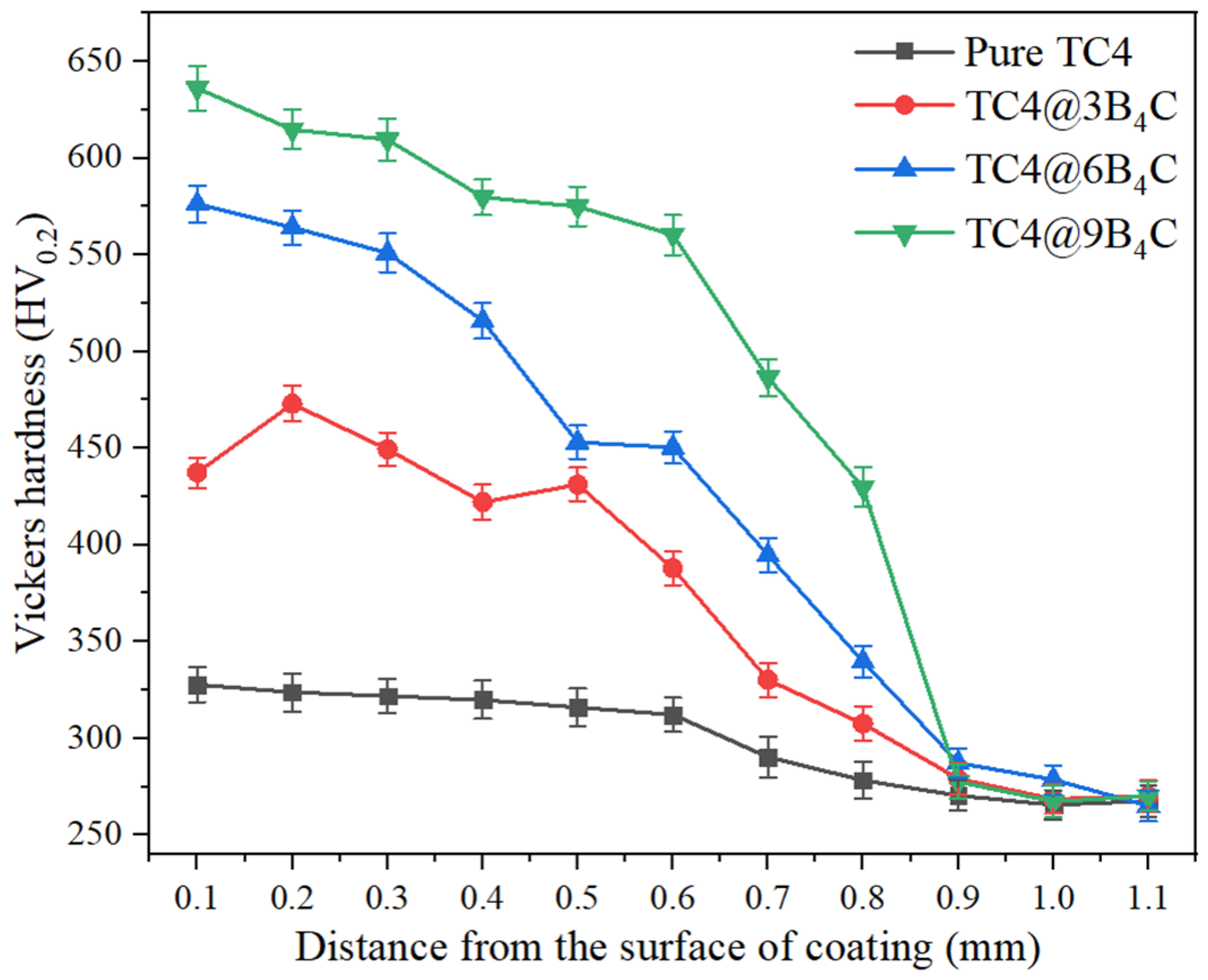
To evaluate the effect of the content of B4C as reinforcement particles on the microhardness of the composite coatings, the microhardness distribution along the depth direction was measured, as shown in Figure 5. It was found that the microhardness of the coatings was positively correlated with the B4C content. The microhardness of the substrate (SS AISI 304L) is only around 270 HV0.2. However, the microhardness at the top of the TC4, TC4@3B4C, TC4@6B4C, and TC4@9B4C samples are around 320 HV0.2, 440 HV0.2, 550 HV0.2 and 600 HV0.2, respectively. In particular, the microhardness of TC4@9B4C increased by 122.2% compared to the substrate. This enhancement is attributed primarily to the intrinsic hardness of B4C particles and grain refinement induced by laser processing. While some studies suggest that trace in situ formation of TiC/TiB2 phases may contribute to hardening [26], their presence was not definitively confirmed in the microstructure. Thus, the observed mechanical improvement is likely dominated by B4C dispersion strengthening and microstructural refinement, rather than in situ reaction phases.

3.4. Wear Behavior

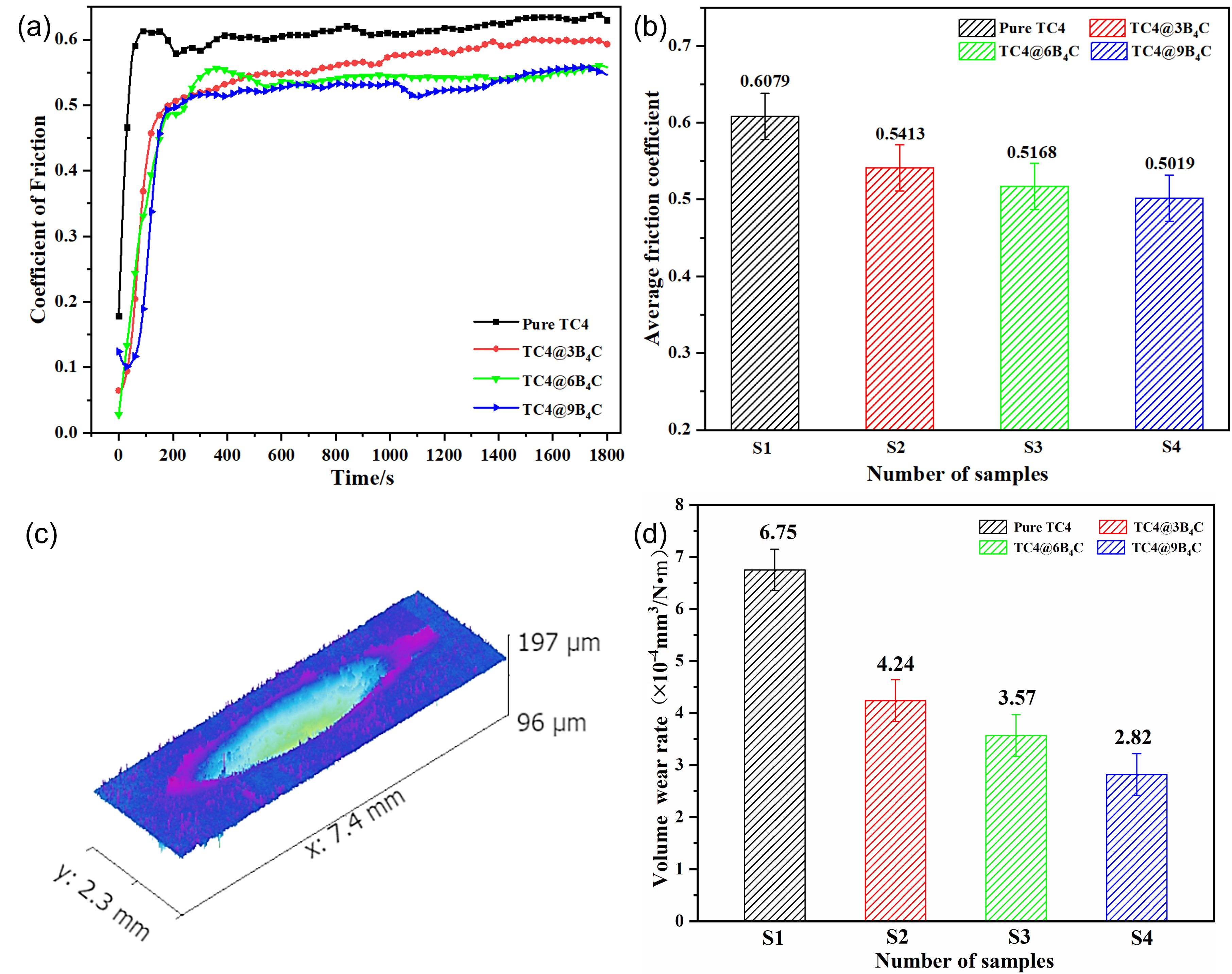
The friction coefficients, three-dimensional worn morphologies, and wear volumes of titanium matrix composite coatings with different B4C contents prepared by laser cladding are shown in Figure 6. Figure 6a presents the real-time friction coefficient curves, revealing that the wear process consists of two distinct stages: a running-in period and a steady-state wear period. Consistent with established literature [27,28], the running-in phase (approximately 0–100 s) exhibits higher fluctuations and an overall increasing trend in the friction coefficient. After this period, the curves stabilize, indicating the transition to steady-state wear. This stabilization may be further promoted by the seawater test medium, where a surface-tension water film between the grinding ball and the coating must be ruptured before full contact, thereby damping friction variations. As shown in Figure 6b, the pure TC4 coating exhibits the highest average friction coefficient, in accordance with the intrinsically poor wear resistance of titanium alloys. With the addition of B4C, the microhardness of the coatings increases significantly, leading to a clear downward trend in the friction coefficient. The composite with 9.0 wt.% B4C achieves the lowest friction coefficient of 0.5019, representing a 17.44% reduction compared to pure TC4. This improvement is attributed not only to the dispersion strengthening and grain refinement induced by B4C but also to the possible formation of a protective boron-rich oxide layer at the friction interface under localized high temperatures, which further mitigates wear. Figure 6c displays the three-dimensional worn morphology of the TC4@9B4C coating, used to calculate the wear volume. The corresponding volume wear rates are plotted in Figure 6d, showing a variation trend consistent with that of the friction coefficient. At 9.0 wt.% B4C, the wear rate reaches a minimum of 2.82 × 10⁻⁴ mm3·N−1·m−1, which is 58.22% lower than that of the pure TC4 coating. The enhanced wear performance is primarily due to the role of B4C as a dispersed reinforcing phase. The hard B4C particles effectively pin dislocations in the TC4 matrix, increasing the critical shear stress for dislocation motion and thereby improving yield strength, hardness, and resistance to plastic deformation. Additionally, the high melting point of B4C (about 46.7% higher than that of TC4) reduces the molten-pool dilution rate during cladding, contributing to a more refined and reinforced microstructure. In summary, the incorporation of B4C effectively improves the wear resistance of TC4-based coatings through combined mechanisms of dispersion strengthening, grain refinement, and possible surface tribo-oxidation, resulting in simultaneously lower friction coefficients and significantly reduced wear rates.
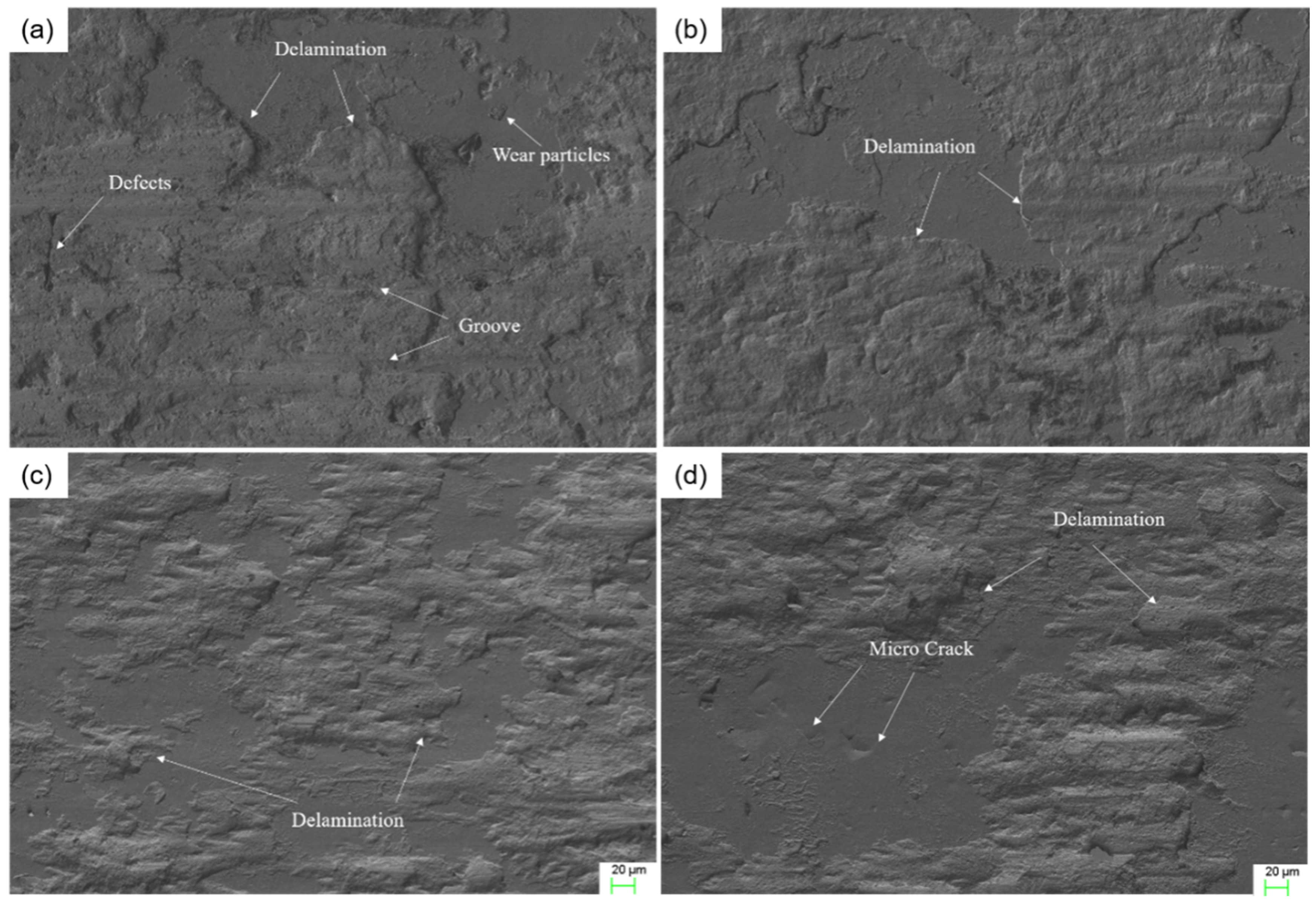
To elucidate the underlying wear mechanisms, a detailed analysis of the worn surfaces across titanium matrix composite coatings with varying B4C contents was conducted. The results indicate that material removal predominantly occurred through plastic deformation and delamination wear, with accompanying abrasive grooves. As shown in Figure 7a, the pure TC4 coating surface exhibited fragmented wear debris and pronounced delamination features. With the introduction of B4C reinforcement, the wear morphology shifted toward delamination-dominated damage, while the severity of abrasive grooves was notably reduced, as evident in Figure 7b–d. The enhanced microhardness resulting from B4C addition effectively delayed the initiation and propagation of delamination, thereby improving overall wear resistance; this finding is consistent with the tribological test results. Notably, at the optimal B4C content of 9 wt.%, Figure 7d reveals the emergence of micro-cracks within the coating, suggesting that while B4C significantly enhances hardness and wear performance, higher ceramic content may promote localized brittleness under repeated sliding stress.

3.5. Electrochemical Behavior

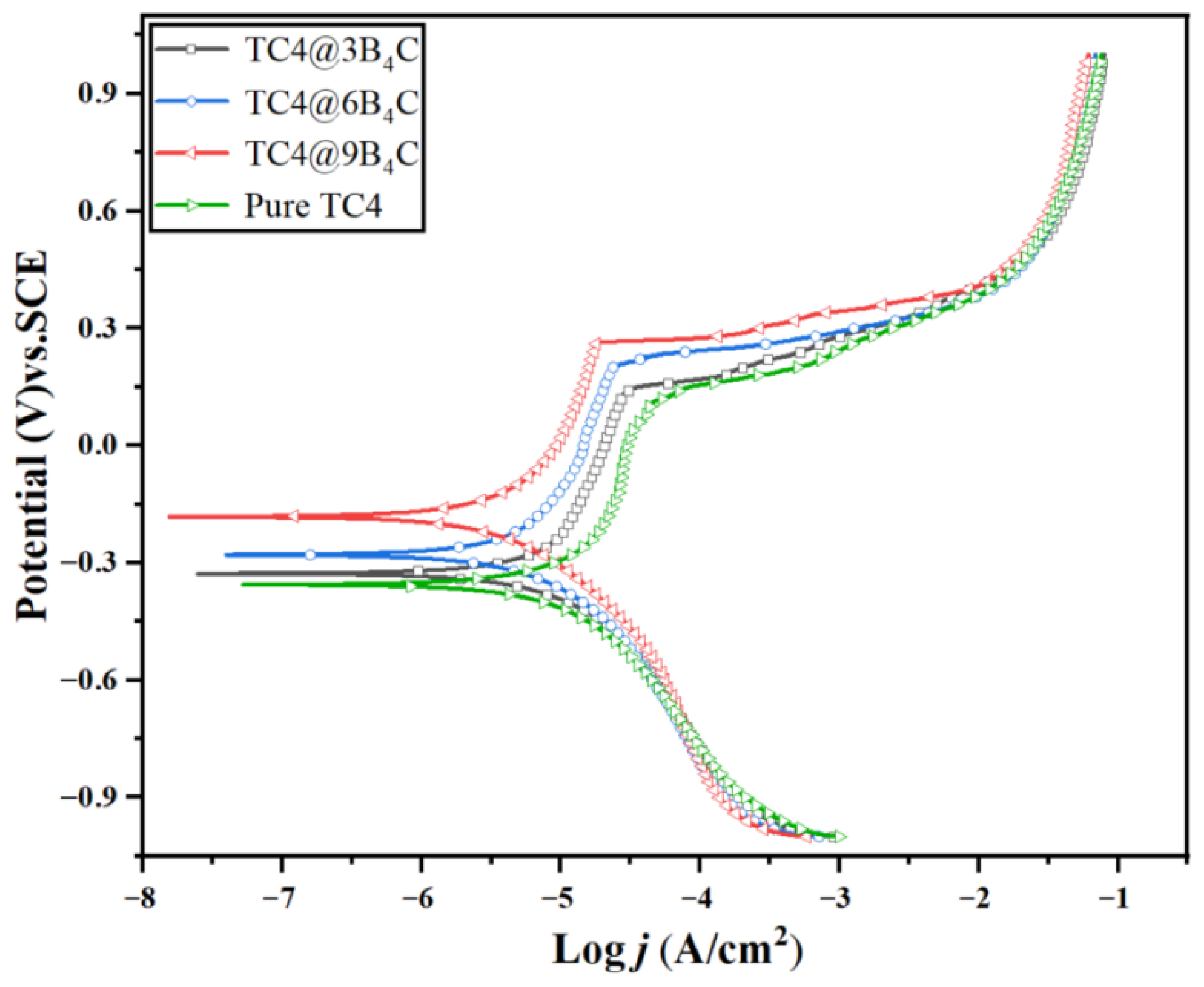
To investigate the effect of B4C addition on the corrosion resistance of TC4 coatings on 304L substrate, the samples were detected by electrochemical tests in 3.5 wt.% NaCl solution. Figure 8 shows the potentiodynamic polarization curves of different coatings, and the corresponding electrochemical parameters, including corrosion potential (Ecorr) and corrosion current density (Icorr), can be obtained through Tafel extrapolation, as listed in Table 4. As can be seen, the Ecorr of TC4 coating, TC4@3B4C, TC4@6B4C and TC4@9B4C composite coatings is about −0.355 V/SCE, −0.327 V/SCE, −0.279 V/SCE and −0.182 V/SCE, while the Icorr of which is 7.98 × 10⁻⁶, 7.28 × 10⁻⁶, 5.20 × 10⁻⁶ and 3.19 × 10⁻⁶ A/cm2. In general, the corrosion potential can reflect the corrosion difficulty of the material, and the higher the value, the better the corrosion resistance of the material [29]. Higher corrosion current density means lower corrosion resistance and faster corrosion speed [30]. It can be found that a higher Ecorr value can be obtained with the increase in B4C addition (TC4 < TC4@3B4C < TC4@6B4C < TC4@9B4C). Accordingly, the TC4@9B4C sample exhibits superior corrosion resistance.
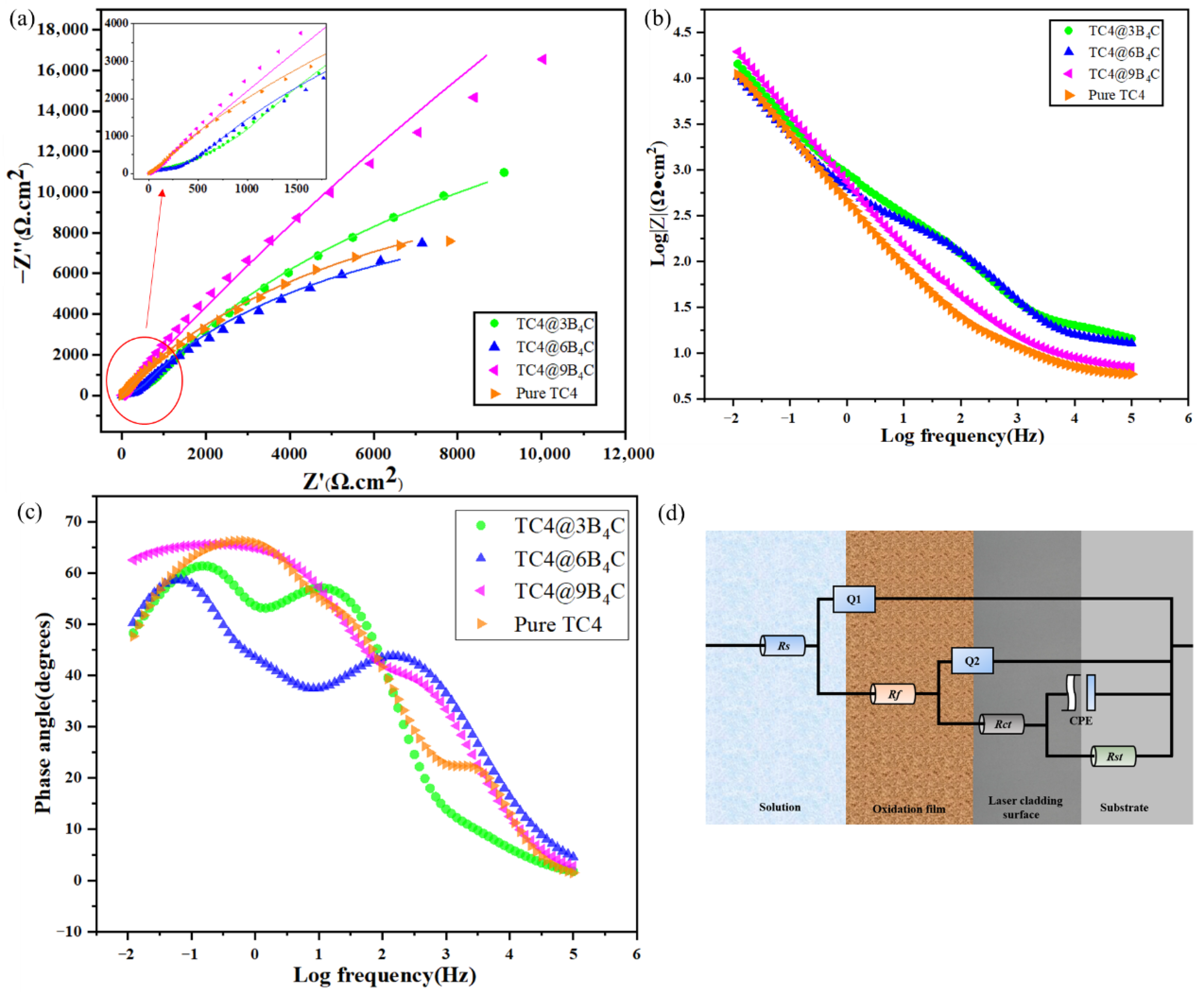
To further investigate the corrosion behavior of the TC4/B4C composite coatings, EIS measurement was carried out to analyze the corrosion-inhibiting effect, as depicted in Figure 9. Figure 9a shows the Nyquist diagram of different samples, with the capacitance loop in the low-frequency region inserted in it. As we all know, the radius and shape of Nyquist plots can reflect the properties of the passive film and the electrochemical process [31,32]. A higher Z modulus at a lower frequency and a larger radius of the capacitive loop mean a lower corrosion rate. Thus, the corrosion resistance was: TC4@9B4C coatings > TC4@6B4C coatings > TC4@3B4C coatings > Pure TC4 coating, which was consistent with the results of the potentiodynamic polarization curve, as shown in Figure 9b. Moreover, as shown in Figure 9c, it can be observed from the Nyquist plots that all the samples perform a single-capacitor circuit, which means that the corrosion on the surface of all the laser-modified samples is mainly controlled by charge transfer, which is transferred to the electrolyte through the coating surface. For further interpretation of the EIS results, measured data were fitted using an equivalent circuit presented in Figure 9d, which describes the electrical components of the working electrode and the physical parameters of the solution system. The Rs represents the resistance of the electrolyte; Rf represents the thin film resistance formed on the coating surface, acting as an accumulated barrier between the metal and the aggressive medium interface; Rct and Rst indicate the high charge transfer resistance and the charge transfer resistance of the substrate, respectively. The surface properties of the 304L substrate were improved, and Rct was greatly improved by laser cladding titanium alloy composites. The total resistance of the system is represented by the polarization resistance Rp, which is a combination of Rf and Rct. In addition, the three non-ideal capacitors indicate a constant phase element generated by the membrane/solution interface, a constant phase element generated by the coated metal and the surrounding film, and the capacitor CPE generated by the surface inhomogeneity between the coated metal and the substrate material, respectively. Y01 and Y02 correspond to the amplitude of change in Q1 and Q2 constant phase elements between film/solution and metal/film, respectively. According to Table 5, the values of dispersion coefficients n1 and n2 are less than 1, indicating that surface defects are caused by roughness, porosity, and hard phases. It can be found that the TC4@9B4C composite coatings show the highest Rst value. The Rf value is in a fluctuating state, which may be due to the inconsistent surface composition of part of the resistance and the different hindrance effects of the dense oxide film formed on charge transfer. However, compared with the samples without the enhanced phase, the overall film resistance of the other samples is greatly reduced. The increase in Y01 and Y02 indicated that the water resistance of the sample surface was improved with the addition of the reinforcing phase. In addition, the dispersion coefficient n also shows an increasing trend, which is consistent with the improvement of corrosion protection behavior of metal surfaces by laser cladding coating in aggressive media. χ2 values are all slightly higher than 1 × 10⁻³, further verifying the minimum error margin in electrochemical circuit fitting.
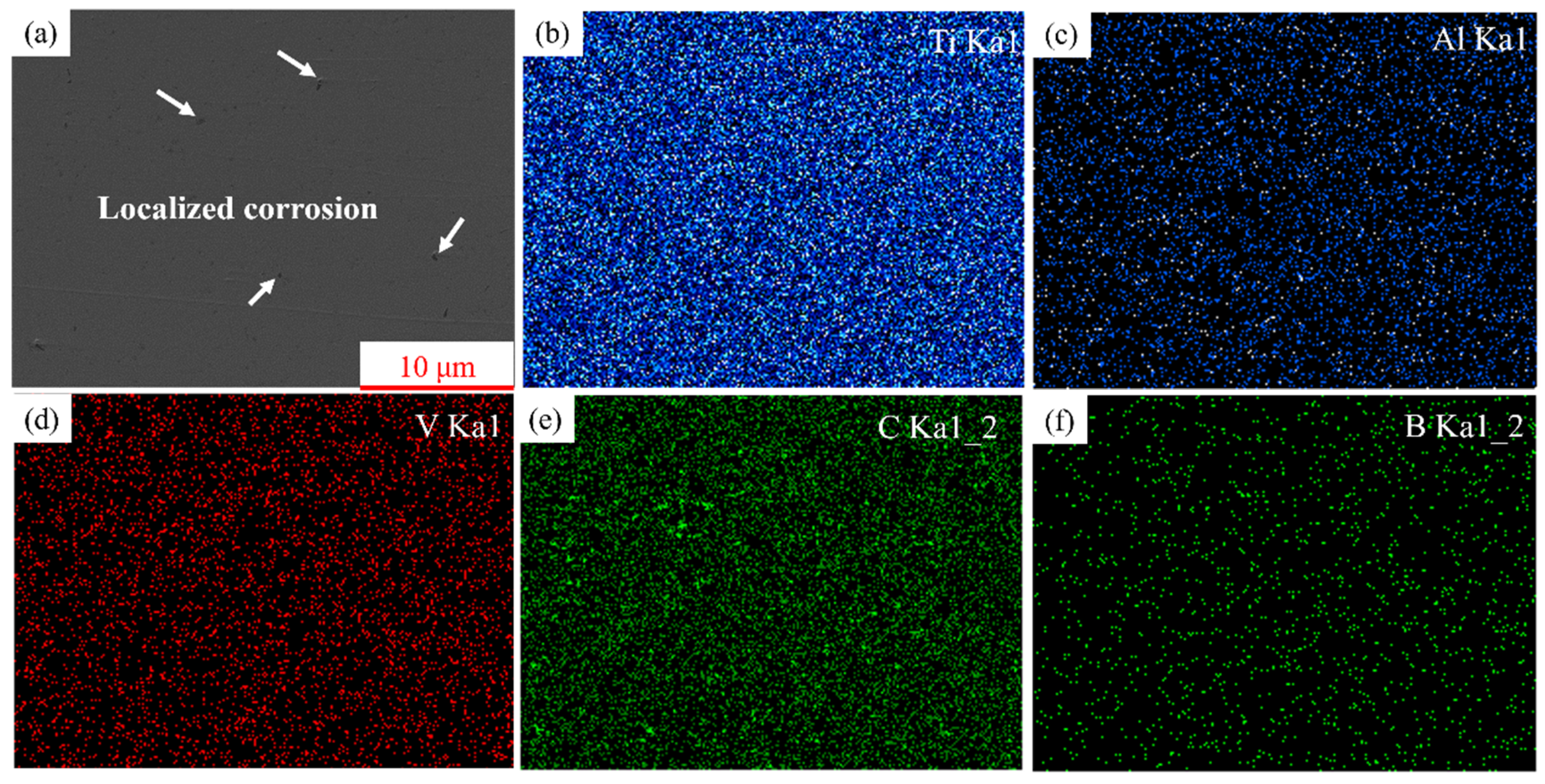
To further validate the corrosion behavior and the role of the B4C reinforcing phase, EDS elemental mapping was conducted on the TC4@9 B4C composite coating after the potentiodynamic polarization test, as shown in Figure 10. The Ti, Al, and V maps exhibit uniform distribution across the analyzed area, indicating that the TC4 matrix maintained its structural integrity without significant elemental dissolution or segregation during corrosion. In contrast, the B and C maps reveal localized enrichment at specific sites, corresponding to the positions of undissolved B4C particles. This confirms that the B4C reinforcing phase remained stable under the corrosive conditions and did not undergo complete dissolution or detrimental interfacial reactions. The presence of intact B4C particles after corrosion suggests that they may act as physical barriers that hinder the propagation of corrosion pathways, contributing to the enhanced corrosion resistance observed for the TC4@9 B4C coating. These EDS findings are consistent with the electrochemical results discussed above.

4. Conclusions

In this study, TC4/B4C composite coatings were successfully fabricated on an AISI 304L substrate using laser cladding technology to improve the mechanical properties, wear, and corrosion resistance of the AISI 304L substrate. From the above results and analysis, the results of the work are summarized as follows:
(1)
The addition of B4C makes the micro-cracks disappear on the pure TC4 coating on the surface of the 304L substrate. When the addition amount is more than 12.0 wt.%, significant cracks were observed on the surface of the titanium matrix composite coatings.
(2)
The microhardness of the TC4/B4C composite coatings saw a substantial improvement over that of pure TC4 coatings, a phenomenon attributable to the dual role of B4C in both reinforcing and refining the microstructure of the cladding layer. When the addition of B4C was 9 wt.%, the microhardness of titanium matrix composite coatings reached 600 HV0.2, significantly increased by 122.2% compared to the substrate.
(3)
For the case of 9 wt.% B4C into TC4 powders, the friction coefficient of the titanium matrix composite coatings was about 0.5019, and the wear rate was 2.82 × 10⁻⁴ mm3/N·m, which is 58.22% lower than that of the coating without B4C addition. With the increasing addition of B4C, the groove phenomenon caused by abrasive wear of the coatings was weakened.
(4)
The electrochemical tests showed the corrosion resistance of the titanium matrix composite coatings in 3.5 wt.% NaCl solution was dramatically enhanced with the increase in B4C addition. After adding B4C, the self-corrosion potential of the composite coatings was significantly higher than that of the pure TC4 coating, and the self-corrosion current density of TC4@9B4C composite coatings decreased to 3.19 × 10⁻⁶ A/cm2.

Author Contributions

Y.B.: Investigation, Methodology, Writing-original draft. P.L.: Supervision, Writing-review & editing. Y.C.: Data curation, Writing-review & editing. Z.X.: Validation. All authors have read and agreed to the published version of the manuscript.

Funding

This research was funded by [Design of Power Battery Cooling System Topology and Study on Flow and Heat Transfer Performance] grant number [2025AHGXZK40584], and [Innovation and Entrepreneurship Training Program for College Students] grant number [202410375025].

Data Availability Statement

The data used to support the findings of this study are included within the article.

Conflicts of Interest

On behalf of all authors, the corresponding author states that there is no conflict of interest.

References

  1. Suresh, G.; Dasgupta, A.; Kishor, P.S.V.R.A.; Upadhyay, B.N.; Saravanan, T.; Mallika, C.; Mudali, U.K. Effect of laser surface melting on the microstructure and pitting corrosion resistance of 304L SS weldment. Metall. Mater. Trans. B 2017, 48, 2516–2525. [Google Scholar] [CrossRef] [Scilit]
  2. Mariani, F.E.; Ribeiro, K.S.B.; Lombardi, A.N.; Casteletti, L.C.; Coelho, R.T. Effect of laser polishing post-processing technique on the roughness and wear resistance of Inconel 625 deposited by laser cladding on AISI 304L stainless steel. J. Mater. Eng. Perform. 2021, 30, 6713–6721. [Google Scholar] [CrossRef] [Scilit]
  3. Martínez-Baltodano, F.; Díaz-Guillén, J.C.; López-Ojeda, L.; Vargas-Gutiérrez, G.; Pech-Rodríguez, W. Study of Surface Treatment by Ionic Plasma and Self-Protective Pastes of AISI 304 and 316L Stainless Steels: Chemical, Microstructural, and Nanohardness Evaluation. Lubricants 2025, 13, 195. [Google Scholar] [CrossRef] [Scilit]
  4. Liu, J.; Liu, H.; Tian, X.; Yang, H.; Hao, J. Microstructural Evolution and Corrosion Properties of Ni-based Alloy Coatings Fabricated by Multi-layer Laser Cladding on Cast Iron. J. Alloys Compd. 2020, 822, 153708. [Google Scholar] [CrossRef] [Scilit]
  5. Alam, M.K.; Mehdi, M.; Urbanic, R.J.; Edrisy, A. Mechanical behavior of additive manufactured AISI 420 martensitic stainless steel. Mater. Sci. Eng. A-Struct. 2020, 773, 138815. [Google Scholar] [CrossRef] [Scilit]
  6. Tshilwane, N.; van der Merwe, J. Stress corrosion cracking of laser alloyed 304L stainless steel with Ru in hot chloride solution. Surf. Coat. Technol. 2018, 347, 414–419. [Google Scholar] [CrossRef] [Scilit]
  7. Wu, J.; Zhang, J.; Chen, B.; Wang, G.; Huang, J.; Shi, W.; An, F.; Wu, X. Effect of Laser Power on the Microstructure and Wear and Corrosion Resistance of Ni25 Alloy Coatings. Lubricants 2025, 13, 549. [Google Scholar] [CrossRef] [Scilit]
  8. Yue, K.; Lian, G.; Feng, M.; Zhan, Y. Investigation on the effect of powder size on the properties of cladding layer based on RSM. Metall. Res. Technol. 2022, 119, 113. [Google Scholar] [CrossRef] [Scilit]
  9. Xu, S.; Cai, Q.; Li, G.; Lu, X.; Zhu, X. Effect of scanning speed on microstructure and properties of TiC/Ni60 composite coatings on Ti6Al4V alloy by laser cladding. Opt. Laser Technol. 2022, 154, 108309. [Google Scholar] [CrossRef] [Scilit]
  10. Chen, T.; Li, W.; Liu, D.; Xiong, Y.; Zhu, X. Effects of heat treatment on microstructure and mechanical properties of TiC/TiB composite bioinert ceramic coatings in-situ synthesized by laser cladding on Ti6Al4V. Ceram. Int. 2021, 47, 755–768. [Google Scholar] [CrossRef] [Scilit]
  11. Li, N.; Xiong, Y.; Xiong, H.; Shi, G.; Blackburn, J.; Liu, W.; Qin, R. Microstructure, formation mechanism and property characterization of Ti + SiC laser cladded coatings on Ti6Al4V alloy. Mater. Charact. 2019, 148, 43–51. [Google Scholar] [CrossRef] [Scilit]
  12. Gao, Q.; Yan, H.; Qin, Y.; Zhang, P.; Guo, J.; Chen, Z.; Yu, Z. Laser cladding Ti-Ni/TiN/TiW+TiS/WS2 self-lubricating wear resistant composite coating on Ti-6Al-4V alloy. Opt. Laser Technol. 2019, 113, 182–191. [Google Scholar] [CrossRef] [Scilit]
  13. Chen, T.; Wu, W.; Li, W.; Liu, D. Laser cladding of nanoparticle TiC ceramic powder: Effects of process parameters on the quality characteristics of the coatings and its prediction model. Opt. Laser Technol. 2019, 116, 345–355. [Google Scholar] [CrossRef] [Scilit]
  14. Arun, K.; Jasmin, N.M.; Kamesh, V.; Pramod, V.; Krishnaraj, S.; Suresh, V.; Subbiah, R. Applications of artificial neural network simulation for prediction of wear rate and coefficient of friction titanium matrix composites. Mater. Res. 2023, 26, e20220306. [Google Scholar] [CrossRef] [Scilit]
  15. Manohar, G.; Pandey, K.; Maity, S. Characterization of Boron Carbide (B4C) particle reinforced aluminium metal matrix composites fabricated by powder metallurgy techniques—A review. Mater. Today 2021, 45, 6882–6888. [Google Scholar] [CrossRef] [Scilit]
  16. Lai, S.; Zang, J.; Shen, W.; Huang, G.; Fang, C.; Zhang, Y.; Chen, L.; Wang, Q.; Wan, B.; Jia, X.; et al. High hardness and high fracture toughness B4C-diamond ceramics obtained by high-pressure sintering. J. Eur. Ceram. Soc. 2023, 43, 3090–3095. [Google Scholar] [CrossRef] [Scilit]
  17. Xu, H.; Ji, W.; Jiang, J.; Liu, J.; Wang, H.; Zhang, F.; Yu, R.; Tu, B.; Zhang, J.; Zou, J.; et al. Contribution of boundary non-stoichiometry to the lower-temperature plasticity in high-pressure sintered boron carbide. Nat. Commun. 2023, 14, 4889. [Google Scholar] [CrossRef] [Scilit]
  18. Zhao, X.; Li, C.; Yu, T. Effect of B4C on CBN/CuSnTi laser cladding grinding tool. Int. J. Adv. Manuf. Technol. 2022, 119, 6307–6319. [Google Scholar] [CrossRef] [Scilit]
  19. Zhang, Y.; Zhang, P.; Liu, H.; Li, Z.; Shi, C.; Yan, D. The effect of Ti and B4C on the microstructure and properties of the laser clad FeCoCrNiMn based high entropy alloy coating. Surf. Coat. Technol. 2022, 441, 128499. [Google Scholar] [CrossRef] [Scilit]
  20. Zhao, Y.; Yu, T.; Chen, L.; Chen, Y.; Guan, C.; Sun, J. Microstructure and wear resistance behavior of Ti–C–B4C-reinforced composite coating. Ceram. Int. 2020, 46, 25136–25148. [Google Scholar] [CrossRef] [Scilit]
  21. Bai, L.; Li, J.; Chen, J.; Song, R.; Shao, J.; Qu, C. Effect of the content of B4C on microstructural evolution and wear behaviors of the laser-clad coatings fabricated on Ti6Al4V. Opt. Laser Technol. 2016, 76, 33–45. [Google Scholar] [CrossRef] [Scilit]
  22. Xu, Z.; Xie, Y.; Ebrahimnia, M.; Dang, H. Effect of B4C nanoparticles on microstructure and properties of laser cladded IN625 coating. Surf. Coat. Technol. 2021, 416, 127154. [Google Scholar] [CrossRef] [Scilit]
  23. Fereiduni, E.; Ghasemi, A.; Elbestawi, M. TiB reinforced Ti-6Al-4V matrix composites with improved short-term creep performance fabricated by laser powder bed fusion. J. Manuf. Process. 2021, 70, 593–607. [Google Scholar] [CrossRef] [Scilit]
  24. Han, T.; Xiao, M.; Zhang, Y.; Shen, Y. Laser cladding composite coatings by Ni-Cr-Ti-B4C with different process parameters. Mater. Manuf. Process. 2019, 34, 898–906. [Google Scholar] [CrossRef] [Scilit]
  25. Golyshev, A.; Orishich, A. Microstructure and mechanical characterization of TI6AL4V-B4C metal ceramic alloy, produced by laser powder-bed fusion additive manufacturing. Int. J. Adv. Manuf. Technol. 2020, 109, 579–588. [Google Scholar] [CrossRef] [Scilit]
  26. Guo, S.; Li, Y.; Gu, J.; Liu, J.; Peng, Y.; Wang, P.; Zhou, Q.; Wang, K. Microstructure and mechanical properties of Ti6Al4V/B4C titanium matrix composite fabricated by selective laser melting (SLM). J. Mater. Res. Technol. 2023, 23, 1934–1946. [Google Scholar] [CrossRef] [Scilit]
  27. Singh, S.; Goyal, D.K.; Kumar, P.; Bansal, A. Influence of laser cladding parameters on slurry erosion performance of NiCrSiBC + 50WC claddings. Int. J. Refract. Met. Hard Mater. 2022, 105, 105825. [Google Scholar] [CrossRef] [Scilit]
  28. Zhuang, D.-D.; Du, B.; Zhang, S.-H.; Tao, W.-W.; Wang, Q.; Shen, H.-B. Effect and action mechanism of ultrasonic assistance on microstructure and mechanical performance of laser cladding 316L stainless steel coating. Surf. Coat. Technol. 2022, 433, 128122. [Google Scholar] [CrossRef] [Scilit]
  29. Leon, A.; Aghion, E. Effect of surface roughness on corrosion fatigue performance of AlSi10Mg alloy produced by Selective Laser Melting (SLM). Mater. Charact. 2017, 131, 188–194. [Google Scholar] [CrossRef] [Scilit]
  30. Zhang, Y.; Liu, F.; Chen, J.; Yuan, Y. Effects of surface quality on corrosion resistance of 316L stainless steel parts manufactured via SLM. J. Laser Appl. 2017, 29, 022306. [Google Scholar] [CrossRef] [Scilit]
  31. Li, L.; Chen, Y.; Lu, Y.; Qin, S.; Huang, G.; Huang, T.; Lin, J. Effect of heat treatment on the corrosion resistance of selective laser melted Ti6Al4V3Cu alloy. J. Mater. Res. Technol. 2021, 12, 904–915. [Google Scholar] [CrossRef] [Scilit]
  32. Chen, Y.; Zhang, J.; Dai, N.; Qin, P.; Attar, H.; Zhang, L.-C. Corrosion behaviour of selective laser melted Ti-TiB biocomposite in simulated body fluid. Electrochim. Acta 2017, 232, 89–97. [Google Scholar] [CrossRef] [Scilit]
Figure 1. SEM morphology of powders: (a) TC4, (b) B4C.
Lubricants 14 00134 g001
Figure 2. (a) Schematic of laser cladding process, (b) scanning strategy.
Lubricants 14 00134 g002
Figure 3. Macroscopic surface morphology (optical images) of titanium matrix composite coatings: (a) Pure TC4; (b) TC4@3B4C; (c) TC4@6B4C; (d) TC4@9B4C; (e) TC4@12B4C.
Lubricants 14 00134 g003
Figure 4. The SEM cross-sectional micrographs and microstructures of TC4@9B4C composite coatings: (a) Overview of clad layer structure; (b) Upper interface; (c) Middle interface; (d) Bottom interface; (e) B₄C particle distribution; (f) EDS of interface.
Lubricants 14 00134 g004
Figure 5. Microhardness distribution in a cross-section of different composite coatings.
Lubricants 14 00134 g005
Figure 6. Tribological behavior of TC4@B4C composite coatings prepared by laser cladding: (a) real-time friction coefficient; (b) average friction coefficient; (c) three-dimensional wear morphology of S4; (d) volume wear rate.
Lubricants 14 00134 g006
Figure 7. Worn morphologies of different coatings: (a) pure TC4; (b) TC4@3B4C; (c) TC4@6B4C; (d) TC4@9B4C.
Lubricants 14 00134 g007
Figure 8. Potentiodynamic polarization curves for TC4/B4C composite coatings on 304L substrate.
Lubricants 14 00134 g008
Figure 9. EIS measurements for different coatings in 3.5 wt.% NaCl solution: (a) Nyquist plots, (b,c) Bode plots, (d) Equivalent circuit for impedance spectral analysis.
Lubricants 14 00134 g009
Figure 10. SEM image and corresponding EDS elemental mapping of the TC4@9B4C composite coating after potentiodynamic polarization test in 3.5 wt.% NaCl solution: (a) SEM morphology of the corroded surface, (b) Ti Kα1, (c) Al Kα1, (d) V Kα1, (e) C Kα1, (f) B Kα1.
Lubricants 14 00134 g010
Table 1. Chemical composition of TC4 powders (wt.%).
ElementAlVNFeOTi
Mass fraction6.364.060.01120.050.077Bal.
Table 2. Mass fraction (wt.%) of different powder mixtures.
Specimen NumberSpecimen InformationB4C/wt.%TC4/wt.%
S1Pure TC40100
S2TC4@3B4C397
S3TC4@6B4C694
S4TC4@9B4C991
S5TC4@12B4C1288
Table 3. Cross-sectional dimensions of laser-cladded TC4/B4C composite coatings.
Specimen NumberSpecimen InformationWidth (mm)Depth (mm)
S1Pure TC44.50 ± 0.151.85 ± 0.10
S2TC4@3B4C4.35 ± 0.151.90 ± 0.10
S3TC4@6B4C4.25 ± 0.151.95 ± 0.10
S4TC4@9B4C4.05 ± 0.152.05 ± 0.10
Table 4. Electrochemical parameters of different samples.
SampleEcorr, VIcorr, A/cm2Rp, Ω·cm2
Pure TC4−0.3557.98 × 10−65952.5
TC4@3B4C−0.3277.28 × 10−67156.5
TC4@6B4C−0.2795.20 × 10−69497.3
TC4@9B4C−0.1823.19 × 10−614,230.9
Table 5. Equivalent circuit parameters for laser cladding different coatings on 304L substrate.
SampleRs (Ω.cm2)CPE1Rf (Ω.cm2)CPE2Rct (Ω.cm2)Cap × 10−4Rst (Ω.cm2)χ2 × 10⁻³
Y01 × 10−4−1cm−2sn) n1Y02 × 10−4−1cm−2sn) n2
Pure TC415.793.730 0.6523.412.016 0.8178102.95410,6426.391
TC4@3B4C13.403.474 0.6543.44.087 0.9419,0601.38110,8161.172
TC4@6B4C14.891.305 0.6477.462.130 0.7527,4001.32513,6302.738
TC4@9B4C14.420.195 0.7480.311.491 0.7827,7501.74018,8422.821
Disclaimer/Publisher’s Note: The statements, opinions and data contained in all publications are solely those of the individual author(s) and contributor(s) and not of MDPI and/or the editor(s). MDPI and/or the editor(s) disclaim responsibility for any injury to people or property resulting from any ideas, methods, instructions or products referred to in the content.