


Abstract
Boriding is a thermochemical process that improves the surface properties of metallic materials, such as wear resistance, hardness, and Young’s modulus. The current work evaluated the kinetics of boride layers formed by boriding on AISI H13 steel. The AISI H13 steel samples were covered with a non-commercial powder mixture of 70% wt. SiC, 20% B4C wt. and 10% wt. KBF4. The samples were treated for 2, 4, and 6 h at 850, 875, and 900 °C, respectively. The growth kinetics of boride layers were estimated as a function of the treatment parameters, using a solution of the second Fick’s Law, as in a parabolic model. Also, the hardness of layers was assessed by Vickers microindentation. Optical examination of the samples showed a biphasic FeB/Fe2B layer at all temperatures after 6 h of treatment. In contrast, those exposed for 2 h exhibited a monophasic Fe2B layer with isolated zones of the FeB phase in all temperatures. The results suggested that the obtained layer thicknesses are highly dependent on the treatment parameters. After 2 h at 850 °C, the samples exhibited a well-defined layer with a thickness of 8.51 ± 1.01 μm, whereas after 6 h it was 24.39 ± 1.01 μm. The activation energy was estimated at 230.63 kJ/mol, with a correlation coefficient (R2) of 0.97, consistent with values reported in the literature. Additionally, the hardness values were estimated to range from 1880 to 2192 HV for the FeB phase and from 1294 to 1715 HV for the Fe2B phase, indicating that the hardness of the boride layers is highly dependent on the treatment conditions.
1. Introduction
The useful life of different steel alloys used in engineering is a fundamental issue; hence, improving their properties, such as corrosion resistance, wear resistance, and friction resistance, among others, has been explored. For the reasons stated, diverse methods to modify the surface of these materials have been developed. An option for this purpose is the thermochemical treatment known as boriding [1,2,3]. This treatment improves the properties of the steel surface by diffusing boron atoms onto its surface and subsequently forming a hard boride layer, mainly composed of boron and the base metal [4]. Several factors, including the substrate’s chemical composition, treatment conditions (temperature and time), and the applied boron potential, are essential in the boriding process and determine the characteristics of the resulting layers [5]. The resulting layer can be a monophasic compound mainly of Fe2B with a tetragonal structure or a biphasic layer of FeB/Fe2B with an orthorhombic/tetragonal structure. According to literature, the FeB phase is harder and more brittle than the Fe2B phase, and, consequently, the FeB phase shows a lower fracture toughness than the Fe2B phase [6]. As mentioned above, the FeB phase is more susceptible to detachment or cracking when subjected to thermal or mechanical shock. Therefore, the monophasic Fe2B layer is more suitable than a monophasic FeB phase or a biphasic FeB/Fe2B layer. Thus, for industrial applications, the presence of the monophasic Fe2B layer is preferred over that of the biphasic layer. According to the literature, the formation of a monophasic or biphasic layer can be controlled by varying the parameters [7].
On the other hand, for industrial applications, especially in cutting tools, injection molds, dies, and extrusion tooling, the AISI H13 steel is applied despite its higher silicon content compared to other steels, due to its toughness, high hardenability, machinability, wear, erosion, and resistance to thermal fatigue, which make it suitable for use in hot work [8]. However, the wear resistance of AISI H13 steel is a characteristic that needs improvement, especially in applications where the material’s surface is exposed to wear conditions, such as injection molds, dies, and extrusion tooling, where surface roughness and dimensions are of great importance.
In this work, the boriding process was applied to AISI H13 steel to form a boride layer on its surface and to enhance its mechanical properties. Additionally, as the treatment time and temperature were relatively short, the growth kinetics were reduced when using a higher boron potential mixture than those offered commercially. The resulting activation energy for layer formation was similar to that reported in the literature, suggesting possible energy savings by using lower temperatures for shorter treatment times.
2. Materials and Methods
2.1. Layers Formation
Cylindrical samples of AISI H13 steel with a 25.4 mm diameter and 5 mm of thickness were cut from a cylindrical bar. The chemical composition of the AISI H13 steel is shown in Table 1.
Table 1.
Chemical composition of the AISI H13 steel.
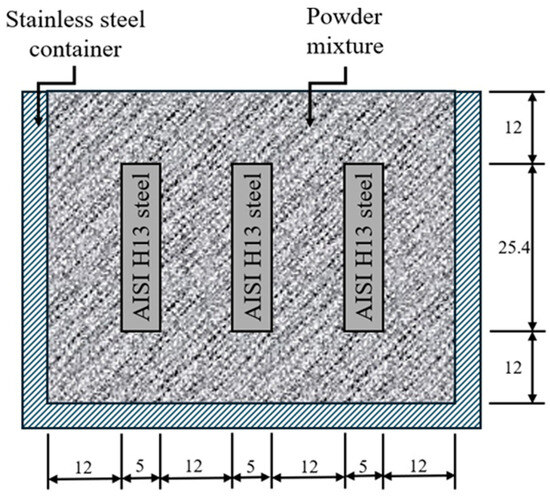
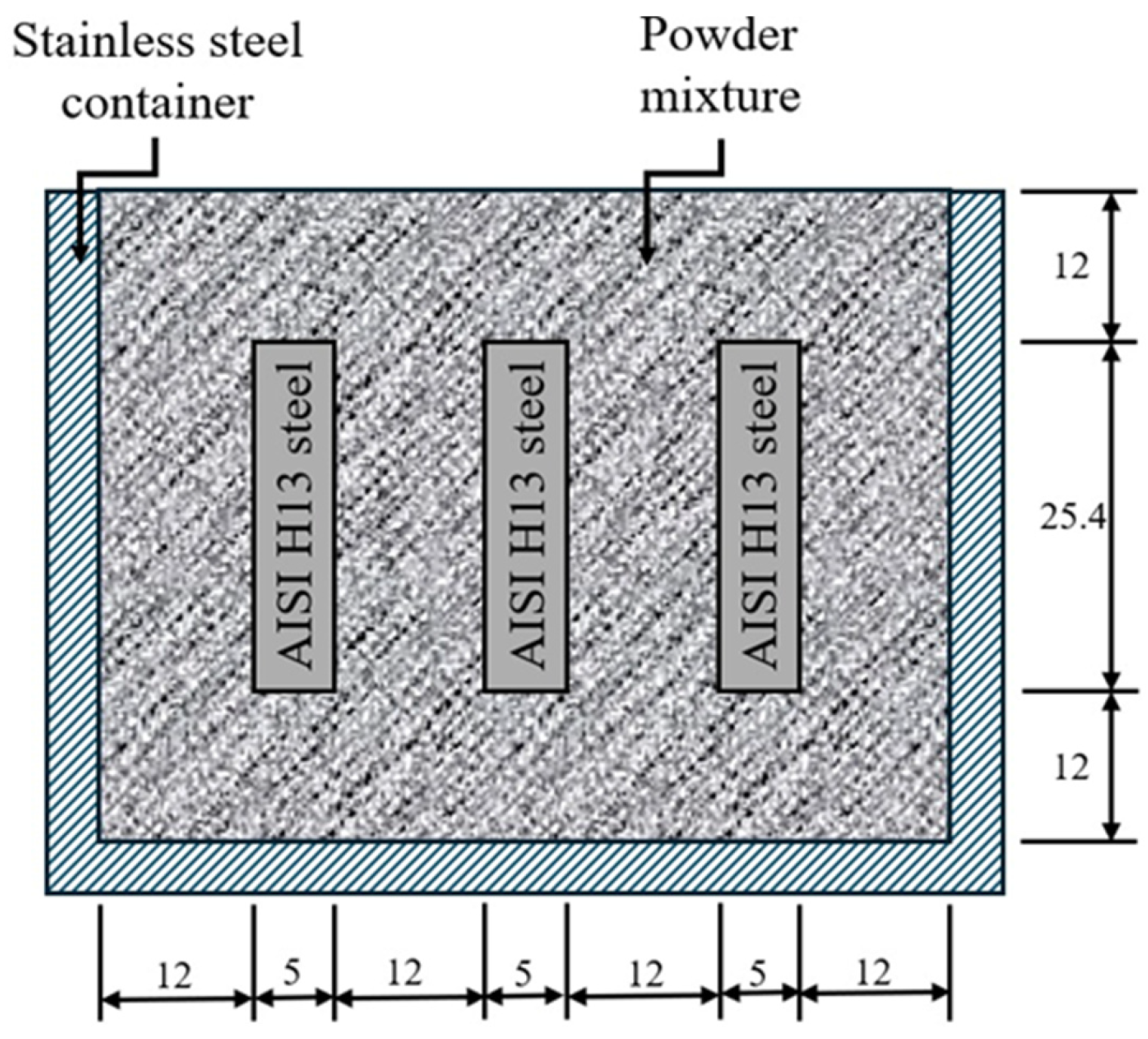
The samples were prepared using a metallographic technique that involved sanding them consecutively with SiC abrasive paper at 80, 100, 180, 240, 320, 400, 600, 1000, 1500, and 2000 grit. Then, the samples were cleaned in an ultrasonic bath for 5 min in a 50/50 ethanol/distilled water mixture to remove grease or residual dirt. After washing, the samples were embedded in a non-commercial boron precursor mixture compounded by 20% B4C powder as a boron-donating agent, 10% KBF4 as activator, and 70% SiC as a boron carbide diluent. The proportions of the mixture components were set based on the results reported by R. Carrera in his PhD thesis and by M. Olivares-Luna et al. [9,10]. The mixture was homogenized in a high-energy mill for 30 min, and the particle size was controlled to 50 µm. A crucible of AISI 304 stainless steel was used for packaging the samples and the boron precursor mixture. The placement of the test specimens within the container is of particular interest since the amount of boron that diffuses into the specimens depends on the amount of boron-containing agent surrounding them [6].
Furthermore, an insufficient amount of boron-containing agent can facilitate the presence of oxygen, allowing the formation of iron oxides on the material’s surface. It is estimated that powder thicknesses of less than 2 mm allow oxygen to reach the material’s surface. In comparison, at thicknesses of 10 mm, ambient oxygen does not penetrate to the surface of the samples [6]. In this work, the powder mixture was applied to the samples to a depth of 12 mm (Figure 1) to prevent oxidation by atmospheric oxygen.
Figure 1.
Schematic representation of the samples’ colocation (dimensions in mm).
The rate of growth of the boride layer depends on the SiC content of the boriding agent; as the SiC content increases, the growth rate decreases, resulting in less porosity and a more uniform layer. Also, B4C donates the boron atoms that form the boriding layer. However, FeB is favored in the presence of an excess of B4C. On the other hand, the kinetic reaction of B4C is accelerated by KBF4, in which boron atoms are released and carried toward the AISI H13 steel, as reported by Carrera [9].
The use of a non-commercial mixture allows control of the morphology and the phases that can be obtained; it can also yield a Fe2B monophasic layer, unlike a commercial boriding agent. On the other hand, commercial boriding agents such as Ekabor or Durborid have a consistent, standardized composition; they form the Fe2B and FeB phases. However, the generation of Fe2B and FeB phases, or just one phase, depends on the quality, reliability, and uniform mixing of the non-commercial mixture, which can be irregular; therefore, its management must be careful with formulation and mixing, whereas for commercial boron agents, handling is easier. Alternatively, the hardness values are similar when the Fe2B and FeB phases are generated, whether with a commercial or non-commercial boriding agent; therefore, both types of boron agents improve hardness and resistance. Nevertheless, the commercial agents are more expensive than the non-commercial mixtures [9].
In the literature, some commercial boriding agents are reported, e.g., Karakas M. S. et al. used Ekabor II as a boriding agent to obtain Fe2B and FeB phases on an AISI H13 steel, at 1000 °C for 6 h, where they obtained layer thicknesses of 103 μm and determined that the hardness values were between 1600–1800 HV, with an activation energy of 284.2 KJ/mol [11]. In addition, Kara R. et al. utilized the same boron agent, and they obtained the same phases on an AISI H13 steel; the difference was that they made the thermochemical treatment at 950 °C for 6 h; therefore, they reported 85 μm of thickness layer and hardness values between 1797–1897 HV [12]. Moreover, Genel K. et al. performed a thermochemical treatment using Ekabor I as a boriding agent at 1000 °C for 5 h, obtaining hardness values of 1650–2000 HV and an activation energy of 186.2 kJ/mol [13].
The processes were carried out in a high-temperature furnace in the absence of inert gases (Felisa, model FE-360, México City, México). The process was carried out at 850, 875, and 900 °C, with exposure times of 2, 4, and 6 h at each temperature. Three samples for each treatment condition were prepared to ensure reproducibility of the results.
The treatment conditions of temperature and time were selected because previous studies have shown that these two variables are vital for the mechanical and chemical properties of the FeB and Fe2B layers in treated steels. It has been reported that the process preferably involves heating the materials to 700–1000 °C for the time ranges mentioned to obtain complete layers [14]. Campos Silva et al. mention that working temperatures in the boriding process below 1000 °C allow hardness and oxidation resistance to be maintained in the boron layers [15], so maintaining a temperature of 900 °C is ideal, as a higher temperature can generate structural defects in the boride layer, as described by Mourad A. et al. in 2025 [16]. In addition, several research studies indicate that the formation of continuous boron layers in steel typically begins at 800 °C or lower. Below this temperature, the process tends to occur more slowly and discontinuously [17,18,19].
Once the thermochemical processes concluded, the furnace was turned off, and the samples were cooled to room temperature to avoid thermal crashes.
2.2. Chemical Characterization
After cooling, the samples were cleaned with scotch fiber to remove residual powder and then ultrasonically bathed to remove any remaining impurities from the treatment.
A diffractometer (Bruker, Billerica, MA, USA) was used to analyze the nature and the crystalline structure of the formed layers. The diffractometer was operated at a sweep speed of 2°/min over 2θ = 20–100°, with 35 kV and 25 mA, using a Cu Kα line.
2.3. Physical Characterization
2.3.1. Surface Roughness
The roughness of the AISI H13 steel was evaluated before and after the boriding process using a roughness meter (GRAIGAR TECHNOLOGY, Shenzhen, China, Model CS200) to determine the effect of the process on the surface finish characteristics of the steel. At least five measurements were realized in different zones of the surface samples to ensure a confident result.
2.3.2. Layer Thickness and Kinetics of Growth
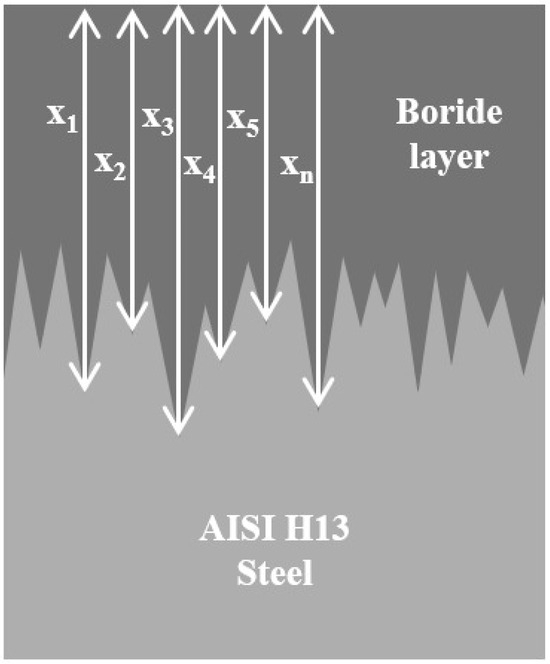
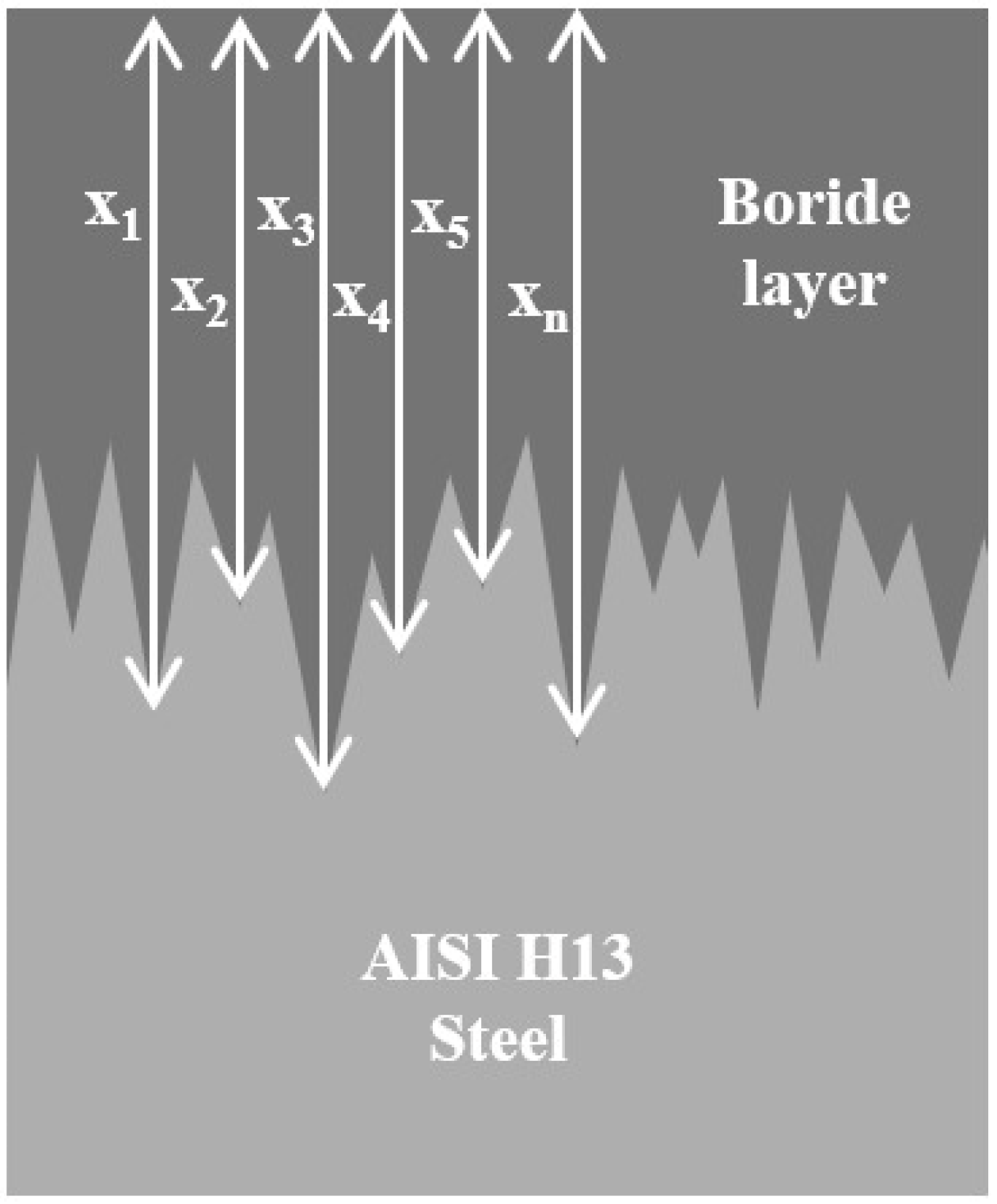
After the roughness measurement, the samples were mounted on Bakelite and sanded with SiC paper until the cross-section was exposed, allowing analysis of the morphology and layer thickness. An inverted metallographic microscope (VELAB, model Ve-407) was used to observe the formed layer. Cross-section images of the samples were captured and digitized with a digital camera (Canon EOS 3 Raptor T3, Canon Inc., Tokyo, Japan) using Image-Pro Plus V6 TM software, media cybernetics, Rockville, MD, USA. The layer thickness was measured using the methodology described in Figure 2. At least 100 thickness measurements were taken across different zones of the samples to ensure a representative average.
Figure 2.
Schematic of the layer thickness measurements.
The kinetics of growth of the boride layers on the AISI H13 steel was established according to the solution of the second Fick’s Law, which relates the treatment conditions to a constant of parabolic growth as shown in Equation (1):
where x is the layer thickness [m], K is the constant of parabolic growth [m2s−1], and t is the time of treatment [s].
The constant parabolic growth can be obtained from the slope of the plot x2 vs. t.
Additionally, the activation energy was estimated using the Arrhenius equation, as shown in Equations (2) and (3):
2.4. Mechanical Characterization
The hardness of the boride layers was measured using a microhardness tester (CMS Metrology, Querétaro, México) according to ASTM-E384 guidelines [20], with a 25 g constant load and a diamond Vickers tip, across the cross-section of the samples from the surface to the center. At least 5 indentations were made for each distance from the surface.
3. Results
3.1. Chemical Characterization
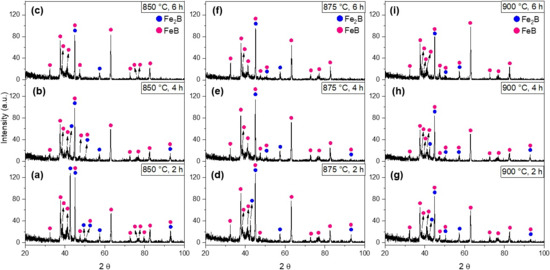
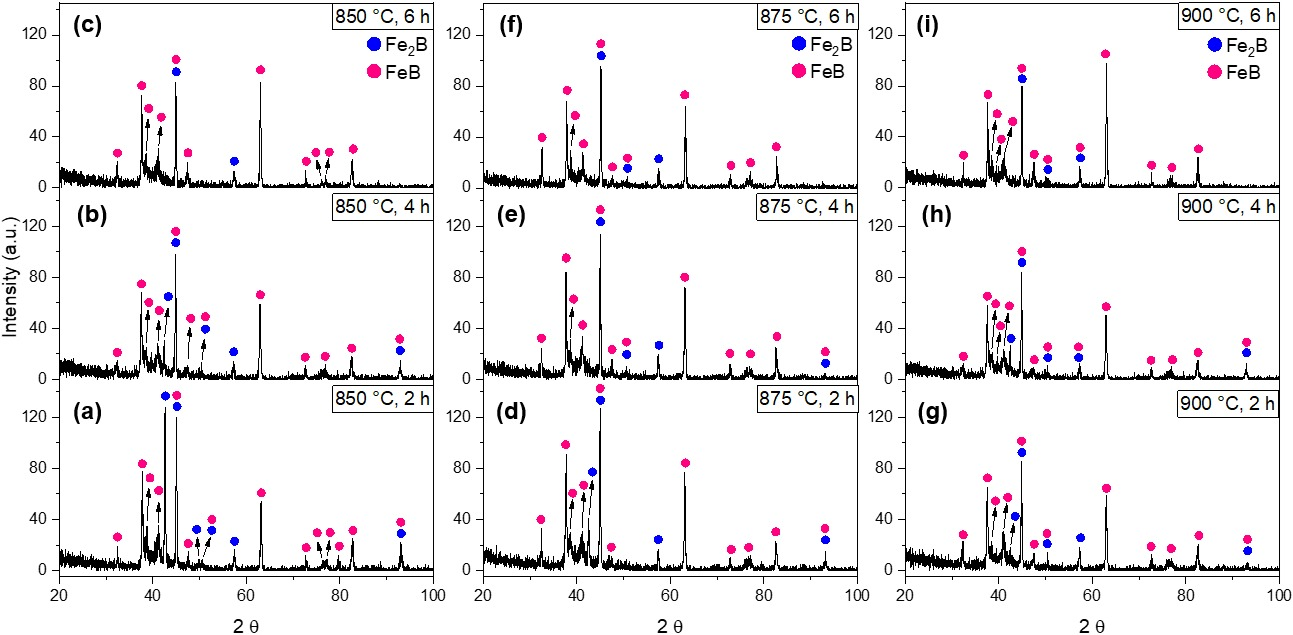
The XRD patterns of the samples treated to Figure 3a–c 850 °C, Figure 3d–f 875 °C, and Figure 3g–i 900 °C for 2, 4, and 6 h for each temperature are displayed in Figure 3. The technique on the surface of all samples determined the presence of two phases of iron boride FeB and Fe2B. The presence of these characteristic peaks indicated that, even after 2 h of treatment, both phases were formed for each treatment temperature. However, it is worth noting the lack of other phases of metallic borides. The presence of other metallic boride phases is associated with differences in the boriding process parameters, such as treatment time, temperature, and boriding agent [8]. Boumaali et al. [8] reported the presence of the phases FeB, Fe2B, VB, and Cr6B5 when the AISI H13 steel was borided. The presence of the two last phases could be due to the exposure of AISI H13 steel to 1000 °C, and the boriding agent was a boron-rich mixture rather than that employed in the present work (10 wt % NaBF4 and 90 wt % B4C) [8].
Figure 3.
XRD patterns of the samples treated to (a–c) 850 °C, (d–f) 875 °C, and (g–i) 900 °C for 2, 4, and 6 h for each temperature.
It can be seen that the intensity of principal reflection peaks decreased with the increase of exposure time of the thermochemical treatment, which can be attributed to the microstructure change due to the formation of the boriding phases because of the parameter differences of the lattices given that the AISI H13 steel has a body-center cubic (BCC), meanwhile FeB a tetragonal and Fe2B an orthorhombic lattices; these changes lead to residual stresses that could distort the lattice, the above results in the decrease of the reflection peaks.
The intensity relations for the (101) plane of FeB and the (211) plane of Fe2B were calculated to perform a quantitative analysis. FeB phase conforms between 46 and 39% volume of the totality of the boride layer. The trend of FeB phase increasing with treatment time confirms that boron saturation at the surface increases with exposure time. For the samples exposed to 875 °C and 900 °C, their intensity relation tends to increase, with the exception of the samples exposed to 875 °C for 6 h and 900 °C for 4 h, the preferential orientation of grains can be present in the samples due to boride grains growing with high temperatures, so the intensity that is determined in a specific plane could shift backwards.
On the other hand, phase stability in AISI H13 steel is determined by alloying elements such as V or Cr. These elements can form boride compounds like CrB, Cr2B, or VB. However, these compounds were not observed in the XRD patterns, probably because they are overlapped by the Fe2B and FeB phases, according to the pattern charts 1511152 and 9008944, respectively. The main CrB, Cr2B and VB peaks at 2θ = 44.9°, 44.3°, and 44.8° which can be indexed as (111), (211), and (130) planes, according to the pattern charts 2310092, 1009055, and 2107291, respectively; these peaks are overlapped with the main Fe2B peak at 2θ = 45.11 that can be indexed as (211) plane. Moreover, other CrB and VB peaks at 2θ = 38.3° and 37.6° can be indexed as the (021) and (021) planes, respectively. They overlap with the FeB peak at 2θ = 37.7°; the latter can be indexed as a (101) plane. In addition, the CrB peak at 2θ = 46.4° can be indexed as the (130) plane; it overlaps with the FeB peak at 2θ = 48.8°, which can be indexed as the (210) plane, as reported by Kara and Genel [12,13].
The boride formations in the AISI H13 steel, due to alloying elements, deform the crystalline lattice and can produce intensity variations in XRD peaks. Moreover, the needle-like growth of Fe2B and FeB is disrupted by boride formation, promoting a more compact, flatter layer that improves structural integrity under detachment stress, as reported by Kara et al. [12].
3.2. Physical Characterization
3.2.1. Surface Roughness
The surface roughness values of the borided samples under different treatment conditions are shown in Table 2.
Table 2.
Surface roughness of the borided samples (µm).
The roughness of the borided samples was higher than that of the non-treated samples. Moreover, the surface roughness appears to be influenced not only by treatment time but also by treatment temperature, as it increased with both. This behavior was previously reported for AISI M2 steel by Garcia Venegas et al. [21]. On the other hand, considering that the typical roughness values for an automotive crankshaft range between 0.1 and 0.4 µm, it is possible to assume that the surface roughness of the steel is not significantly affected by the boriding process.
3.2.2. Cross-Section Analysis
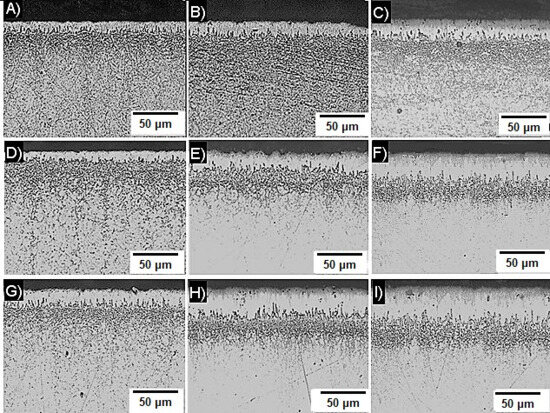
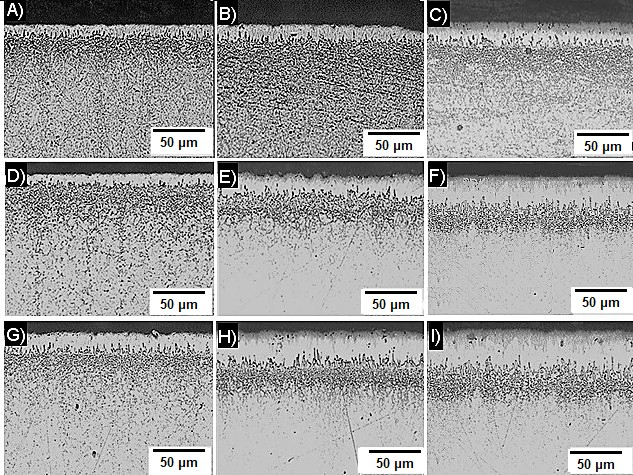
The cross-section of the AISI H13 boride steel to Figure 4A–C 850 °C, Figure 4D–F 875 °C, and Figure 4G–I 900 °C, with an exposure time of 2, 4, and 6 h for each temperature can be observed in Figure 4. A biphasic layer of FeB/Fe2B can be observed at the surface of the AISI H13 steel, as can be seen in Figure 4, corroborating the XRD results. The FeB layer appears as small islets near the surface, followed by the Fe2B phase. The FeB phase was observed in the samples exposed to 850 °C for 2 and 4 h, and to 875 °C for 2 h, as it is darker than the Fe2B phase, probably due to the higher boron content. Besides, the Fe2B phase is larger than the FeB phase, so in that context, the FeB phase is barely perceptible in the samples exposed to 850 °C for 2 and 4 h, and 875 °C for 2 h, due to the low temperature and exposure time. On the other hand, the biphasic layer is clearly observed in the samples exposed to 875 °C for 6 h and to 900 °C for 4 and 6 h. The above is due to increased temperature and longer exposure time, which leads to a more nucleated biphasic layer [22]. However, the morphology of the layers presents a light grade of toothed, which can be attributed to the content of alloying elements of the AISI H13 steel, such as chrome, molybdenum, vanadium, and silicon; the content of these elements limits the growth of the layer due to acting as a diffusion barrier, and inducing the formation of flat front of growth [8,13]. During boriding treatment, the alloying elements are introduced in the layer’s boundaries of FeB and Fe2B, limiting the boron diffusion and the toothed shape in these zones. However, after the FeB/Fe2B layer, boron diffusion is observed without coalescing and scattered as a dark interface towards the substrate material (AISI H13 steel).
Figure 4.
Cross section of AISI H13 boron steel treated at: (A) 850 °Cfor2 h, (B) 850 °C for 4 h, (C) 850 °C for 6 h, (D) 875 °C for 2 h, (E) 875 °C for 4 h, (F) 875 °C for 6 h, (G) 900 °C for 2 h, (H) 900 °C for 4 h, (I) 900 °C for 6 h.
3.2.3. Kinetics of Growth
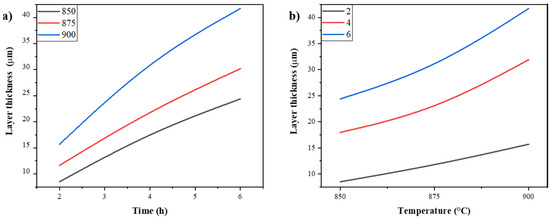
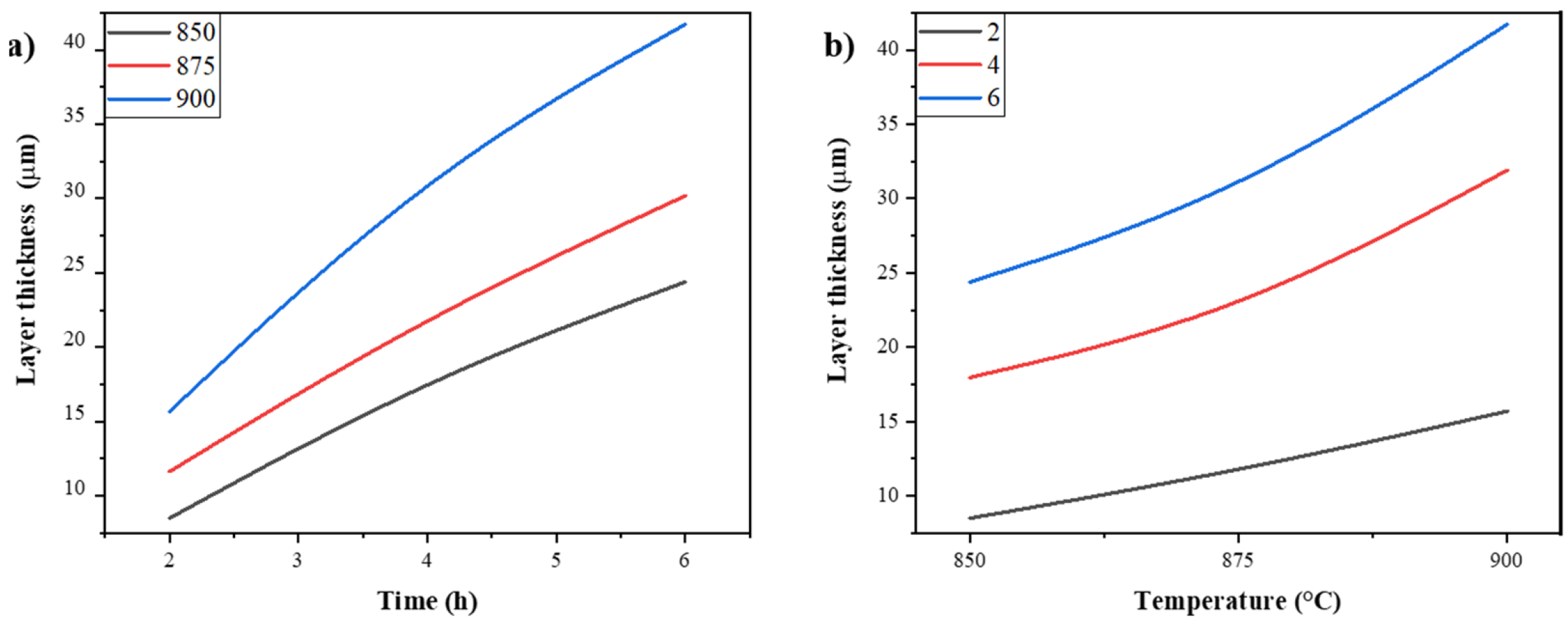
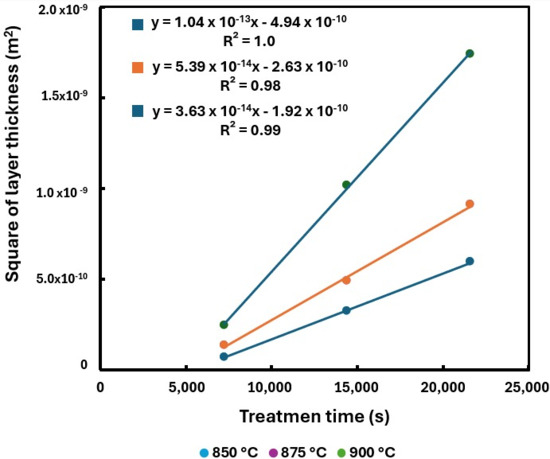
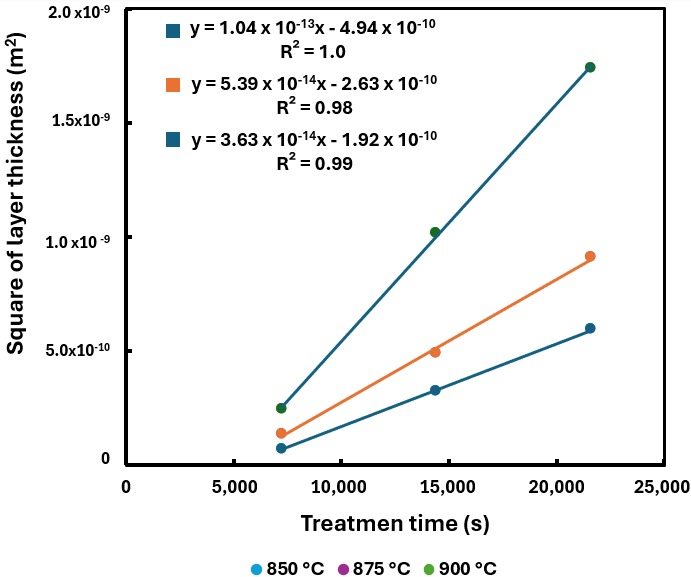
The evolution of the boride layers on the surface of AISI H13 steel as a function of treatment time and temperature is shown in Figure 5a for time and Figure 5b, respectively. Figure 6 shows the behavior of the square layer thickness as a function of the treatment time and temperature. The thickness values of the boride layers and the values of the constant of parabolic growth with the regression coefficients (R2) are depicted in Table 3. According to the physical characterizations and the results shown in Figure 4, Figure 5, and Table 3, the layer thickness increases with increasing exposure time and temperature, indicating that boron diffusion proceeds from the surface toward the AISI H13 steel matrix.
Figure 5.
Growth evolution of the boride layers on the surface of AISI H13 steel as a function of the treatment time for different exposures: (a) time and (b) temperature.
Figure 6.
Behavior of the square of the layer thickness as a function of the treatment time and temperature.
Table 3.
Layer thickness and constant of parabolic growth as a function of the treatment conditions (µm).
The behavior of constant parabolic growth indicates that the treatment temperature accelerates the process.
According to the data presented in Table 3, the treatment conditions (time and temperature) influence the layer’s growth; however, the most critical parameter is temperature, as the parabolic growth constant increases with increasing temperature. Moreover, the R2 values were close to 1.0, indicating that the process was carried out correctly and that the measured thicknesses follow a clear linear trend.
Table 3 also shows the thickness percentage of the boride phases (FeB and Fe2B) as a function of the treatment conditions. The results indicate that at low temperatures, the FeB phase grows more slowly, so at the initial time of the process, 100% of the layers are composed of the Fe2B phase. Then, as the process evolves, the Fe2B phase acts as a diffusion barrier, leading to boron saturation at the surface and the formation of the FeB phase [23].
The increase in the % of FeB phase as the time and temperature increase is concordant with those observed in the XRD assays, where peaks with higher intensity were observed at the highest temperature and time of treatment.
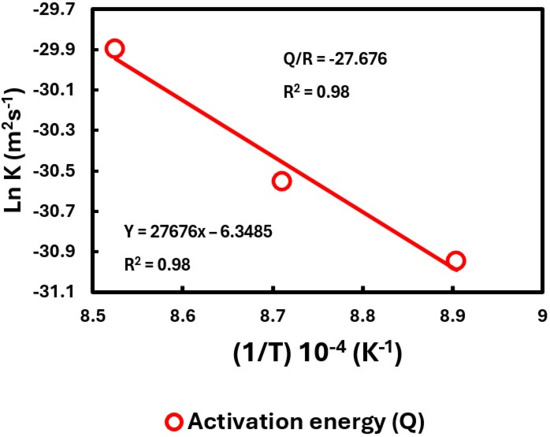
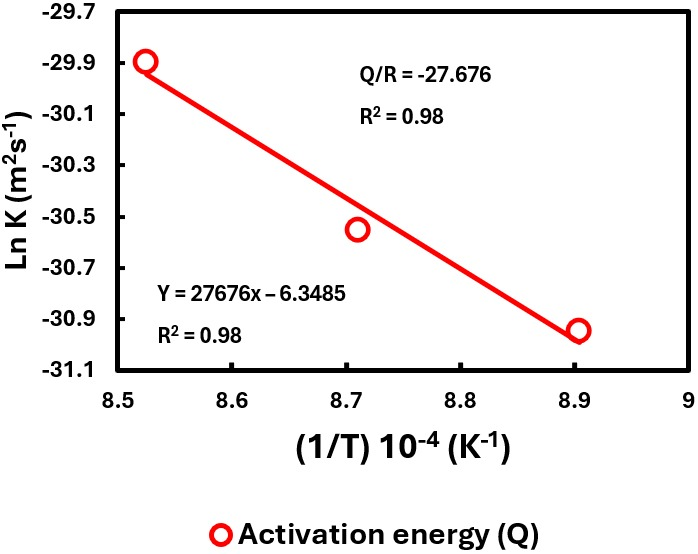
Once the constants of parabolic growth have been obtained, it is possible to determine the activation energy required for diffusion to occur, as shown in Figure 7.
Figure 7.
Behavior of the constant of parabolic growth as a function of the temperature of treatment, to determine the activation energy.
The activation energy was estimated at 230.63 kJ/mol. Compared to those reported in the literature, this value appears high, probably because the boron mixture was non-commercial. Thus, the boron potential was lower than that used in literature. Additionally, the temperature and process time in the present work were lower than those reported in the literature, leading to higher energy consumption [13]. K. Genel reported an activation energy value of 186.2 kJ/mol for the boriding process of AISI H13 steel. He exposed the samples to 1073, 1123, and 1273 K for 1–5 h in an Ekabor-1 medium. On the other hand, U. Sen et al. [24] reported an activation energy of 234 kJ/mol for AISI 4340 borided steel using molten salts.
3.2.4. Mechanical Characterization
The hardness values obtained in the borided layer in both the FeB phase and the Fe2B phase as a function of the treatment conditions are depicted in Table 4.
Table 4.
Hardness of both phases of the boride layers as a function of the treatment conditions (HV).
The low hardness values near the surface of the samples exposed to 850 °C, 875 °C, and 900 °C for 2 h indicated the absence of the FeB phase under these conditions.
These results seem to contradict those discussed above for the XRD analysis, where all the samples showed indications of the presence of the FeB phase. However, the XRD analysis indicates the presence of FeB in the form of isolated zones, as detected by the X-ray scan.
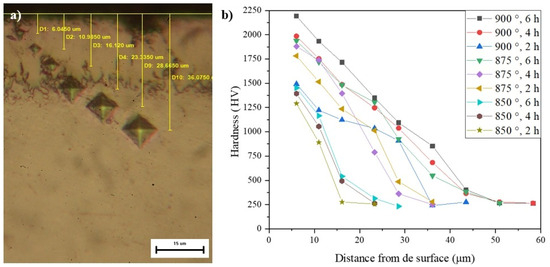
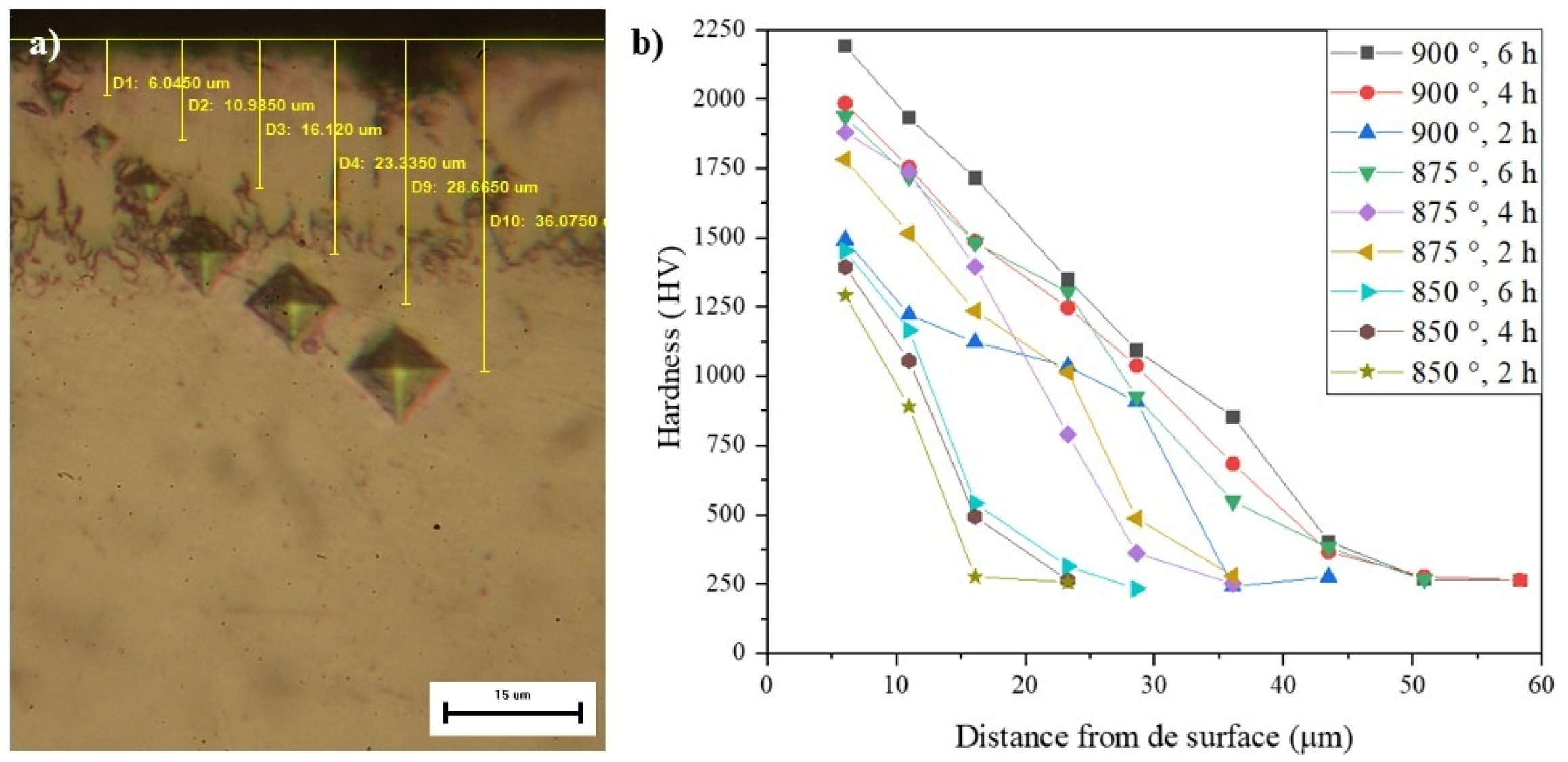
The microindentation profile through the cross section of the samples treated at 900 °C for 6 h is shown in Figure 8a, and the microhardness behavior graph for samples treated at 900, 875, and 850 °C for 2, 4, and 6 h is depicted in Figure 8b. It can be observed in Figure 8a that the indentation prints are smaller in the boride layer than those in the substrate, indicating a higher hardness. Moreover, the hardness profile shows that the borided steel’s hardness decreases gradually as the boron concentration decreases, until the substrate is reached. In Figure 8b, it can be observed that microhardness is higher on the surface and tends to decrease until it reaches a constant value. This behavior is due to the boride layer being more compact than the AISI H13 steel, as the boron concentration at the surface is highest. Therefore, it is notable that the microhardness is higher on the surface of the sample exposed to 900 °C for 6 h than on those exposed to lower temperatures or shorter treatment times.
Figure 8.
(a) Microhardness indentations profile of the sample treated to 900 °C for 6 h through its cross section, (b) Microhardness behavior graph for samples treated at 900 °C, 875 °C, and 850 °C, for 6, 4, and 2 h for each temperature.
4. Discussion
The XRD technique on the surface of all samples indicated the presence of a biphasic layer of iron borides FeB/Fe2B. The cross-sectional analysis of the borided samples revealed a well-formed, flat layer. Compared to that reported in literature for low carbon steels where the resulting layer are highly saw-toothed [25] The formation of the FeB phase, even in the samples exposed to 850 °C for 2 h, can be explained due to the presence of the alloying elements, mainly Cr, which act as a diffusion barrier [23], causing boron to accumulate on the surface. This boron accumulation, coupled with the appearance of the Fe2B phase, which also acts as a diffusion barrier, induces the formation of the FeB phase [26]. However, the FeB phase alone can only be observed as small islets near the surface in most samples. Only in samples exposed to 900 °C for 4 and 6 h can a well-formed FeB phase be observed. The above can be explained because the boriding process requires temperatures up to 850 °C to initiate and up to 900 °C to form the FeB phase [7,27,28].
The thicknesses of the resulting layers ranged from 8.51 µm for the samples exposed to 850 °C for 2 h to 41.73 µm for the samples exposed to 900 °C for 6 h. These thickness values are consistent with those reported in the literature by S. Taktak [26], who reported layers ranging from 8 to 58 µm for the AISI H13 steel exposed to boriding.
The surface roughness of the borided samples ranged from 0.082 to 0.156 µm for samples exposed to 850 °C for 2 h and 900 °C for 6 h, respectively, and was higher than that of the non-treated samples. S. Taktak reported surface roughness values in the range of 0.223 to 0.849 µm [26]. The difference in surface roughness values is probably due to the treatment time, since he started his research at 3 h of treatment. Moreover, the surface roughness appears to be influenced not only by treatment time but also by treatment temperature, as it increased with both parameters. On the other hand, considering that the typical roughness values for an automotive crankshaft range between 0.1 and 0.4 µm, it is possible to assume that the surface roughness of the steel is not significantly affected by the boriding process.
The activation energy was slightly higher than reported in the literature, probably due to the use of a non-commercial boriding mixture, a short treatment time, and a lower treatment temperature. The hardness of the resulting layers was dependent on the treatment parameters; however, the hardness values were mainly influenced by the treatment temperature. Thus, higher hardness was achieved in samples exposed to 900 °C for 6 h. Nevertheless, the hardest layer not necessarily the the best. Higher hardness values were attributed to the formation of the FeB phase, which is harder than Fe2B. However, due to its higher hardness, the FeB phase is also more brittle than the monophasic Fe2B phase, making it undesirable for industrial applications [29].
5. Conclusions
Based on the results obtained in this work, it is possible to draw the following conclusions:
- •
- From optical microscopy images, a biphasic FeB/Fe2B-type layer was observed at the surface of samples exposed at 875 and 900 °C for 4 and 6 h, respectively.
- •
- The XRD patterns confirm the presence of both phases, FeB/Fe2B, in all samples; however, only small, isolated zones of the FeB phase can be detected in samples with low treatment time and temperature.
- •
- The XRD patterns show that the Fe2B and FeB peaks increased with increasing exposure time and temperature, suggesting that the boron diffusion process was controlled.
- •
- The growth of the boride layers was strongly influenced by the treatment temperature, as expected, since boriding is a thermally activated process.
- •
- The activation energy was 230.63 kJ/mol, which is similar to values reported in the literature; this result is interesting because this work used a non-commercial boride mixture, which is easier to obtain than commercial mixtures.
- •
- The roughness of the boride layers increased slightly compared to the non-treated samples; however, this increase was not significant and remained below industrial requirements.
- •
- The trend of the microhardness values of the boride layers increasing with increasing treatment parameters is due to the higher concentration and diffusion of atomic boron at the surface, which promotes thermal residual stress and increases surface microhardness.
Author Contributions
Conceptualization and writing—original draft preparation, Y.S.-F. and E.H.-S.; investigation, R.C.-E. and C.P.-C.; writing review and editing, R.T.-R.; resources and validation, E.H.-S. and J.A.B.-L.; data curation, L.A.L.-D. and J.G.M.-H..; methodology and software, M.A.-V. All authors have read and agreed to the published version of the manuscript.
Funding
This research received no external funding.
Data Availability Statement
The data that support the findings of this study are available from the corresponding author upon reasonable request.
Acknowledgments
Y. Sánchez-Fuentes (CVU: 771277), L. A. Linares-Duarte (CVU:1244024), and C. Proa-Coronado (CVU: 328806) thank the Mexican Research Council (CONAHCYT) for PhD and Postdoc scholarships. The authors would like to thank the Universidad Autónoma de Coahuila and Universidad de las Américas Puebla for their collaboration in developing this work.
Conflicts of Interest
The authors declare no conflict of interest.
References
- Al-Samara, R.A.; Al-Douri, Y. Friction and Wear in Metals; Springer Nature: Berlin/Heidelberg, Germany, 2024. [Google Scholar] [CrossRef] [Scilit]
- Hurricks, P.L. Some Metallurgical Factors Controlling the Adhesive and Abrasive Wear Resistance of Steels. A review. Wear 1973, 26, 285–304. [Google Scholar] [CrossRef] [Scilit]
- Kulka, M. Current Trends in Boriding: Techniques; Springer International Publishing: Berlin/Heidelberg, Germany, 2019. [Google Scholar] [CrossRef] [Scilit]
- Winter, K.–M.; Kalucki, J.; Koshel, D. Process Technologies for Thermochemical Surface Engineering. In Thermochemical Surface Engineering of Steels; Woodhead Publishing: Cambridge, UK, 2015; pp. 141–206. [Google Scholar] [CrossRef] [Scilit]
- Yu, L.G.; Chen, X.J.; Khor, K.A.; Sundararajan, G. FeB/Fe2B Phase Transformation During SPS Pack-Boriding: Boride Layer Growth Kinetics. Acta Mater. 2005, 53, 2361–2368. [Google Scholar] [CrossRef] [Scilit]
- Jain, V.; Sundararajan, G. Influence of the Pack Thickness of the Boronizing Mixture on the Boriding of Steel. Surf. Coat. Technol. 2002, 149, 21–26. [Google Scholar] [CrossRef] [Scilit]
- Erdoğan, A. Investigation of High Temperature Dry Sliding Behavior of Borided H13 Hot Work Tool Steel with Nanoboron Powder. Surf. Coat. Technol. 2019, 357, 886–895. [Google Scholar] [CrossRef] [Scilit]
- Boumaali, B.; Nait, A.Z.; Keddam, M. Characterization of Bilayer (FeB/Fe2B) on AISI H13 Work Tool Steel. Koroze Ochr. Mater. 2021, 65, 40–48. [Google Scholar] [CrossRef] [Scilit]
- Carrera, R. Desarrollo e Implementación de Una Formulación con Base al Potencial de Boro para el Proceso de Borurización en Caja de un Acero AISI 1018. Ph.D. Thesis, Instituto Politécnico Nacional, Mexico City, Mexico, 2014. [Google Scholar]
- Olivares-Luna, M.; Jiménez-Corona, S.; Espino-Cortés, F.P.; Rosales-López, J.L.; Castillo-Vela, L.E.; Chaparro-Pérez, K.D.; Campos-Silva, I. Insights on the pulsed-DC powder-pack boriding process: Equivalent circuit modeling and electric field distribution in the poder mixture–steel system. Surf. Coat. Technol. 2025, 509, 132217. [Google Scholar] [CrossRef] [Scilit]
- Karakas, M.S.; Günen, A.; Kanca, E.; Yilmaz, E. Boride layer growth kinetics of AISI H13 steel borided with nano-sized powders. Arc. Metall. Mater. 2018, 63, 159–165. [Google Scholar] [CrossRef] [Scilit]
- Kara, R.; Colak, F.; Kayali, Y. Investigation of wear and adhesion behaviors of borided steel. Trans. Indian Inst. Met. 2016, 69, 1169–1177. [Google Scholar] [CrossRef] [Scilit]
- Genel, K. Boriding kinetics of H13 steel. Vacuum 2006, 80, 451–457. [Google Scholar] [CrossRef] [Scilit]
- Gunes, I.; Yildiz, I. Rate pf growth of boride layers on stainless steels. Oxid. Commun. 2015, 38, 2189–2198. [Google Scholar]
- Campos Silva, I.E.; Günen, A.; Serdar Karakaş, M.; Delgado Brito, A.M. The Boriding Process for Enhancing the Surface Properties of High-Temperature Metallic Materials. In Coatings for High-Temperature Environment; Amirhossein, P., Kamalan Kirubaharan, A.M., Eds.; Springer: Cham, Switzerland, 2024; pp. 221–259. [Google Scholar] [CrossRef] [Scilit]
- Mourad, A.; Mahdy, A.A.; Mosa, E.S.; Kandil, A.; Elhelaly, M.A. Enhancement of tribological behavior and microhardness of AISI H13 tool steel by electrochemical boriding. Sci. Rep. 2025, 15, 43384. [Google Scholar] [CrossRef] [Scilit]
- Yu, L.G.; Khor, K.A.; Sundararajan, G. Boriding of mild steel using the spark plasma sintering (SPS) technique. Surf. Coat. Technol. 2002, 157, 226–230. [Google Scholar] [CrossRef] [Scilit]
- Keddam, M.; Orihel, P.; Jurci, P.; Kusy, M. Characterization of Boride Layers on S235 Steel and Calculation of Activation Energy Using Taylor Expansion Model. Coatings 2025, 15, 579. [Google Scholar] [CrossRef] [Scilit]
- Neccaroglu, V.; Karademir, I.; Unal, O. Effects of pack boriding temperature on wear and corrosion performance of high-strength armor steel. Emerg. Mater. Res. 2025, 14, 83–97. [Google Scholar] [CrossRef] [Scilit]
- ASTM E-384-05A; Standard Test Method for Microindentation Hardness of Materials. ASTM International: West Conshohocken, PA, USA, 2005.
- García-Vanegas, L.; Elías-Espinosa, M.C.; Perrusquia, N.L.; Ruiz, M.A.D.; Bastida-Escamilla, E. Effect of surface roughness, elastic modulus, and hardness on wear and friction in borided AISI M2 steel substrates. Mater. Res Express 2025, 12, 106401. [Google Scholar] [CrossRef] [Scilit]
- Delai, O.; Xia, C.; Shiqiang, L. Growth kinetics of the FeB/Fe2B boride layer on the surface of 4Cr5MoSiV1 steel: Experiments and modelling. J. Mater. Res. Technol. 2021, 11, 1272–1280. [Google Scholar] [CrossRef] [Scilit]
- Hernández Sánchez, E. Propiedades Mecánicas de Aceros Borurados AISI 1018 Evaluadas por Indentación a Escala Micro y Nanométrica. Ph.D. Thesis, Instituto Politécnico Nacional, México City, México, 2011. [Google Scholar]
- Sen, S.; Sen, U.; Bindal, C. An approach to kinetic study of borided steels. Surf. Coat. Technol. 2005, 191, 274–285. [Google Scholar] [CrossRef] [Scilit]
- Hernández-Sánchez, E.; Hernández-Domínguez, D.; Tadeo-Rosas, R.; Sánchez-Fuentes, Y.; Linares-Duarte, L.A.; Orozco-Álvarez, C.; Miranda-Hernández, J.G.; Carrera-Espinoza, R. Tribological and Mechanical Behavior of Automotive Crankshaft Steel Superficially Modified Using the Boriding Hardening Process. Coatings 2024, 14, 716. [Google Scholar] [CrossRef] [Scilit]
- Taktak, S. Some mechanical properties of borided AISI H13 and 304 steels. Mater. Des. 2007, 28, 1836–1843. [Google Scholar] [CrossRef] [Scilit]
- Von Matuschka, M.G. Boronizing, 1st ed.; Carl Hanser: Munich, Germany, 1980. [Google Scholar]
- Kariofillis, G.K.; Kiourtsidis, G.E.; Tsipas, D.N. Corrosion behavior of borided AISI H13 hot work steel. Surf. Coat. Technol. 2006, 201, 19–24. [Google Scholar] [CrossRef] [Scilit]
- Hernández-Sanchez, E.; Rodriguez-Castro, G.; Meneses-Amador, A.; Bravo-Bárcenas, D.; Arzate-Vazquez, I.; Martínez-Gutiérrez, H.; Romero-Romo, M.; Campos-Silva, I. Effect of the anisotropic growth on the fracture toughness measurements obtained in the Fe2B layer. Surf. Coat. Technol. 2013, 237, 292–298. [Google Scholar] [CrossRef] [Scilit]

Disclaimer/Publisher’s Note: The statements, opinions and data contained in all publications are solely those of the individual author(s) and contributor(s) and not of MDPI and/or the editor(s). MDPI and/or the editor(s) disclaim responsibility for any injury to people or property resulting from any ideas, methods, instructions or products referred to in the content. |
© 2026 by the authors. Licensee MDPI, Basel, Switzerland. This article is an open access article distributed under the terms and conditions of the Creative Commons Attribution (CC BY) license.