
Impact of Comorbid Generalized Anxiety Disorder on rTMS/iTBS Clinical Outcomes in Major Depression: A Multicenter Registry-Based Observational Study

 ,
, 
Abstract
1. Introduction
2. Methods
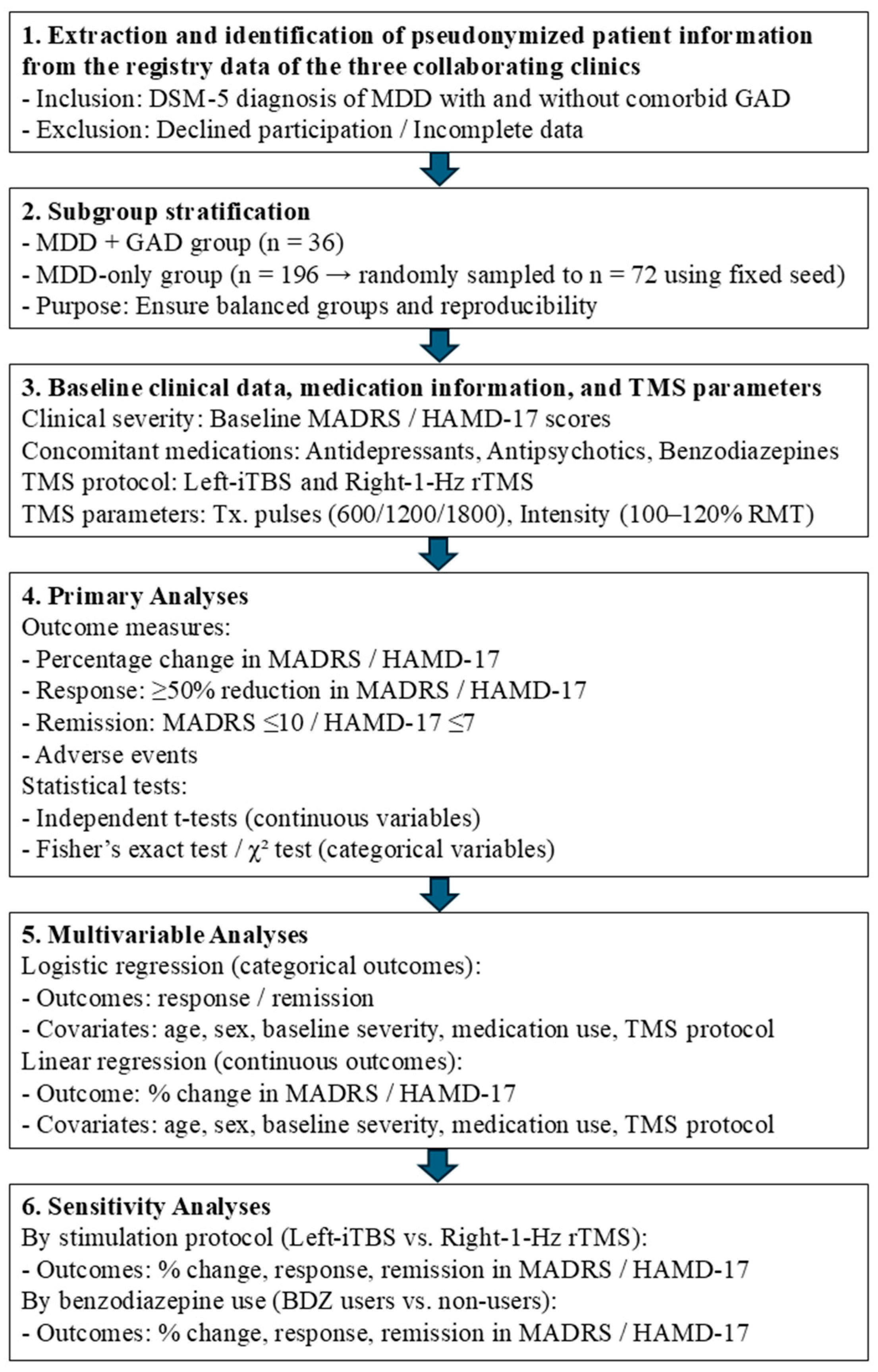
2.1. Study Design and Participants
2.2. Treatment Protocols
2.3. Concomitant Medications
2.4. Outcome Measures
2.5. Statistical Analysis
2.6. Ethical Considerations
3. Results
3.1. Patient Characteristics
3.2. Depressive Outcomes
3.3. Effect of Concomitant Medications
3.4. Effect of Stimulation Protocol
3.5. Multivariable Analyses
3.6. Sensitivity Analyses
3.6.1. Stimulation Protocol
3.6.2. BDZ Use
3.6.3. Stimulation Parameters
3.7. Adverse Events
4. Discussion
4.1. Summary of Findings
4.2. Clinical Implications of Comorbidity
4.3. Role of Concomitant Medications
4.4. Effects of TMS Protocols and Parameters
4.5. Adverse Events in Comorbid Anxiety Disorders
4.6. Strengths of This Study
4.7. Limitations
4.8. Future Directions
5. Conclusions
Author Contributions
Funding
Institutional Review Board Statement
Informed Consent Statement
Data Availability Statement
Acknowledgments
Conflicts of Interest
Abbreviations
| AD | Antidepressants |
| BDZ | Benzodiazepines |
| CI | Confidence Interval |
| DLPFC | dorsolateral prefrontal cortex |
| DSM-5 | Diagnostic and Statistical Manual of Mental Disorders, Fifth Edition |
| HAMD-17 | Hamilton Depression Rating Scale, 17-item version |
| iTBS | Intermittent Theta-Burst Stimulation |
| MADRS | Montgomery–Åsberg Depression Rating Scale |
| MDD | Major Depressive Disorder |
| OR | Odds Ratio |
| rTMS | Repetitive Transcranial Magnetic Stimulation |
| RMT | Resting Motor Threshold |
| SD | Standard Deviation |
References
- Arnaud, A.M.; Brister, T.S.; Duckworth, K.; Foxworth, P.; Fulwider, T.; Suthoff, E.D.; Werneburg, B.; Aleksanderek, I.; Reinhart, M.L. Impact of Major Depressive Disorder on Comorbidities: A Systematic Literature Review. J. Clin. Psychiatry 2022, 83, 43390. [Google Scholar] [CrossRef]
- Malhi, G.S.; Mann, J.J. Depression. Lancet 2018, 392, 2299–2312. [Google Scholar] [CrossRef]
- Pappa, S.; Shah, M.; Young, S.; Anwar, T.; Ming, T. Health-care utilisation and associated economic burden in major depressive disorder and treatment-resistant depression in a longitudinal population-based cohort study of 110.000 patients. J. Psychiatr. Res. 2024, 180, 511–518. [Google Scholar] [CrossRef]
- Blanco, C.; Rubio, J.M.; Wall, M.; Secades-Villa, R.; Beesdo-Baum, K.; Wang, S. The latent structure and comorbidity patterns of generalized anxiety disorder and major depressive disorder: A national study. Depress. Anxiety 2014, 31, 214–222. [Google Scholar] [CrossRef][Green Version]
- Zhou, Y.; Cao, Z.; Yang, M.; Xi, X.; Guo, Y.; Fang, M.; Cheng, L.; Du, Y. Comorbid generalized anxiety disorder and its association with quality of life in patients with major depressive disorder. Sci. Rep. 2017, 7, 40511. [Google Scholar] [CrossRef]
- Fava, M.; Rankin, M.A.; Wright, E.C.; Alpert, J.E.; Nierenberg, A.A.; Pava, J.; Rosenbaum, J.F. Anxiety disorders in major depression. Compr. Psychiatry 2000, 41, 97–102. [Google Scholar] [CrossRef]
- Fava, M.; Rush, A.J.; Alpert, J.E.; Balasubramani, G.K.; Wisniewski, S.R.; Carmin, C.N.; Biggs, M.M.; Zisook, S.; Leuchter, A.; Howland, R.; et al. Difference in treatment outcome in outpatients with anxious versus nonanxious depression: A STAR*D report. Am. J. Psychiatry 2008, 165, 342–351. [Google Scholar] [CrossRef]
- Gorman, J.M. Comorbid depression and anxiety spectrum disorders. Depress. Anxiety 1996, 4, 160–168. [Google Scholar] [CrossRef]
- Tiller, J.W. Depression and anxiety. Med. J. Aust. 2013, 199, S28–S31. [Google Scholar] [CrossRef]
- Miron, J.P.; Jodoin, V.D.; Lesperance, P.; Blumberger, D.M. Repetitive transcranial magnetic stimulation for major depressive disorder: Basic principles and future directions. Ther. Adv. Psychopharmacol. 2021, 11, 20451253211042696. [Google Scholar] [CrossRef]
- Kishi, T.; Ikuta, T.; Sakuma, K.; Hatano, M.; Matsuda, Y.; Wilkening, J.; Goya-Maldonado, R.; Tik, M.; Williams, N.R.; Kito, S.; et al. Theta burst stimulation for depression: A systematic review and network and pairwise meta-analysis. Mol. Psychiatry 2024, 29, 3893–3899. [Google Scholar] [CrossRef]
- Berlim, M.T.; Van den Eynde, F.; Jeff Daskalakis, Z. Clinically meaningful efficacy and acceptability of low-frequency repetitive transcranial magnetic stimulation (rTMS) for treating primary major depression: A meta-analysis of randomized, double-blind and sham-controlled trials. Neuropsychopharmacology 2013, 38, 543–551. [Google Scholar] [CrossRef]
- Blumberger, D.M.; Vila-Rodriguez, F.; Thorpe, K.E.; Feffer, K.; Noda, Y.; Giacobbe, P.; Knyahnytska, Y.; Kennedy, S.H.; Lam, R.W.; Daskalakis, Z.J.; et al. Effectiveness of theta burst versus high-frequency repetitive transcranial magnetic stimulation in patients with depression (THREE-D): A randomised non-inferiority trial. Lancet 2018, 391, 1683–1692. [Google Scholar] [CrossRef]
- Wiethoff, K.; Bauer, M.; Baghai, T.C.; Moller, H.J.; Fisher, R.; Hollinde, D.; Kiermeir, J.; Hauth, I.; Laux, G.; Cordes, J.; et al. Prevalence and treatment outcome in anxious versus nonanxious depression: Results from the German Algorithm Project. J. Clin. Psychiatry 2010, 71, 1047–1054. [Google Scholar] [CrossRef]
- Papakostas, G.I.; Petersen, T.; Mahal, Y.; Mischoulon, D.; Nierenberg, A.A.; Fava, M. Quality of life assessments in major depressive disorder: A review of the literature. Gen. Hosp. Psychiatry 2004, 26, 13–17. [Google Scholar] [CrossRef] [PubMed]
- O’Connor, D.J. Personalized Medicine: When the Common Becomes the Rare. Front. Med. 2024, 11, 1523594. [Google Scholar] [CrossRef] [PubMed]
- Williams, L.M. Precision psychiatry: A neural circuit taxonomy for depression and anxiety. Lancet Psychiatry 2016, 3, 472–480. [Google Scholar] [CrossRef]
- Hunter, A.M.; Minzenberg, M.J.; Cook, I.A.; Krantz, D.E.; Levitt, J.G.; Rotstein, N.M.; Chawla, S.A.; Leuchter, A.F. Concomitant medication use and clinical outcome of repetitive Transcranial Magnetic Stimulation (rTMS) treatment of Major Depressive Disorder. Brain Behav. 2019, 9, e01275. [Google Scholar] [CrossRef] [PubMed]
- Ziemann, U.; Lonnecker, S.; Steinhoff, B.J.; Paulus, W. Effects of antiepileptic drugs on motor cortex excitability in humans: A transcranial magnetic stimulation study. Ann. Neurol. 1996, 40, 367–378. [Google Scholar] [CrossRef]
- McClintock, S.M.; Reti, I.M.; Carpenter, L.L.; McDonald, W.M.; Dubin, M.; Taylor, S.F.; Cook, I.A.; O’Reardon, J.; Husain, M.M.; Wall, C.; et al. Consensus Recommendations for the Clinical Application of Repetitive Transcranial Magnetic Stimulation (rTMS) in the Treatment of Depression. J. Clin. Psychiatry 2018, 79, 3651. [Google Scholar] [CrossRef]
- Dalhuisen, I.; Biemans, T.; Vos, C.F.; Hark, S.T.; van Oostrom, I.; Spijker, J.; Wijnen, B.; van Exel, E.; van Mierlo, H.; de Waardt, D.; et al. A comparison between rTMS and antidepressant medication on depressive symptom clusters in treatment-resistant depression. Eur. Arch. Psychiatry Clin. Neurosci. 2025, 275, 1799–1807. [Google Scholar] [CrossRef] [PubMed]
- Zaidi, A.; Shami, R.; Sewell, I.J.; Cao, X.; Giacobbe, P.; Rabin, J.S.; Goubran, M.; Hamani, C.; Swardfager, W.; Davidson, B.; et al. Antidepressant class and concurrent rTMS outcomes in major depressive disorder: A systematic review and meta-analysis. EClinicalMedicine 2024, 75, 102760. [Google Scholar] [CrossRef]
- Noda, Y.; Kizaki, J.; Takahashi, S.; Mimura, M. TMS Database Registry Consortium Research Project in Japan (TReC-J) for Future Personalized Psychiatry. J. Pers. Med. 2022, 12, 844. [Google Scholar] [CrossRef]
- Black, D.W.; Grant, J.E.; American Psychiatric Association. DSM-5 Guidebook: The Essential Companion to the Diagnostic and Statistical Manual of Mental Disorders, 5th ed.; American Psychiatric Publishing: Washington, DC, USA, 2014; 543p. [Google Scholar]
- Beam, W.; Borckardt, J.J.; Reeves, S.T.; George, M.S. An efficient and accurate new method for locating the F3 position for prefrontal TMS applications. Brain Stimul. 2009, 2, 50–54. [Google Scholar] [CrossRef] [PubMed]
- Lefaucheur, J.P.; Aleman, A.; Baeken, C.; Benninger, D.H.; Brunelin, J.; Di Lazzaro, V.; Filipovic, S.R.; Grefkes, C.; Hasan, A.; Hummel, F.C.; et al. Evidence-based guidelines on the therapeutic use of repetitive transcranial magnetic stimulation (rTMS): An update (2014–2018). Clin. Neurophysiol. 2020, 131, 474–528. [Google Scholar] [CrossRef]
- Rossini, P.M.; Burke, D.; Chen, R.; Cohen, L.G.; Daskalakis, Z.; Di Iorio, R.; Di Lazzaro, V.; Ferreri, F.; Fitzgerald, P.B.; George, M.S.; et al. Non-invasive electrical and magnetic stimulation of the brain, spinal cord, roots and peripheral nerves: Basic principles and procedures for routine clinical and research application. An updated report from an I.F.C.N. Committee. Clin. Neurophysiol. 2015, 126, 1071–1107. [Google Scholar] [CrossRef]
- Montgomery, S.A.; Asberg, M. A new depression scale designed to be sensitive to change. Br. J. Psychiatry 1979, 134, 382–389. [Google Scholar] [CrossRef]
- Hamilton, M. A rating scale for depression. J. Neurol. Neurosurg. Psychiatry 1960, 23, 56–62. [Google Scholar] [CrossRef]
- Taylor, W.D.; McQuoid, D.R.; Steffens, D.C.; Krishnan, K.R. Is There a Definition of Remission in Late-Life Depression That Predicts Later Relapse? Neuropsychopharmacology 2004, 29, 2272–2277. [Google Scholar] [CrossRef]
- Ionescu, D.F.; Niciu, M.J.; Mathews, D.C.; Richards, E.M.; Zarate, C.A., Jr. Neurobiology of anxious depression: A review. Depress. Anxiety 2013, 30, 374–385. [Google Scholar] [CrossRef] [PubMed]
- Pastuszak, M.; Cubala, W.J.; Kwasny, A.; Mechlinska, A. The Search for Consistency in Residual Symptoms in Major Depressive Disorder: A Narrative Review. J. Pers. Med. 2024, 14, 828. [Google Scholar] [CrossRef]
- Menza, M.; Marin, H.; Opper, R.S. Residual symptoms in depression: Can treatment be symptom-specific? J. Clin. Psychiatry 2003, 64, 516–523. [Google Scholar] [CrossRef] [PubMed]
- Andreescu, C.; Lenze, E.J.; Dew, M.A.; Begley, A.E.; Mulsant, B.H.; Dombrovski, A.Y.; Pollock, B.G.; Stack, J.; Miller, M.D.; Reynolds, C.F. Effect of comorbid anxiety on treatment response and relapse risk in late-life depression: Controlled study. Br. J. Psychiatry 2007, 190, 344–349. [Google Scholar] [CrossRef]
- Spijker, J.; Muntingh, A.; Batelaan, N. Advice for Clinicians on How to Treat Comorbid Anxiety and Depression. JAMA Psychiatry 2020, 77, 645–646. [Google Scholar] [CrossRef]
- Fitzgerald, P.B.; Daskalakis, Z.J.; Hoy, K.E. Benzodiazepine use and response to repetitive transcranial magnetic stimulation in Major Depressive Disorder. Brain Stimul. 2020, 13, 694–695. [Google Scholar] [CrossRef]
- Tran, L.; Hahn, L.; Gill, S.; Ng, F.; Clarke, P.; Paterson, T.; Galletly, C. Do benzodiazepines reduce the efficacy of transcranial magnetic stimulation? Australas. Psychiatry 2024, 32, 180–185. [Google Scholar] [CrossRef] [PubMed]
- Hunter, A.M.; Leuchter, A.F. Benzodiazepine Use and rTMS Outcome. Am. J. Psychiatry 2020, 177, 172. [Google Scholar] [CrossRef] [PubMed]
- Kaster, T.S.; Downar, J.; Vila-Rodriguez, F.; Thorpe, K.E.; Feffer, K.; Noda, Y.; Giacobbe, P.; Knyahnytska, Y.; Kennedy, S.H.; Lam, R.W.; et al. Trajectories of Response to Dorsolateral Prefrontal rTMS in Major Depression: A THREE-D Study. Am. J. Psychiatry 2019, 176, 367–375. [Google Scholar] [CrossRef]
- Ziemann, U.; Meintzschel, F.; Korchounov, A.; Ilic, T.V. Pharmacological modulation of plasticity in the human motor cortex. Neurorehabil. Neural Repair. 2006, 20, 243–251. [Google Scholar] [CrossRef]
- Spitz, N.A.; Pace, B.D.; Ten Eyck, P.; Trapp, N.T. Early Improvement Predicts Clinical Outcomes Similarly in 10 Hz rTMS and iTBS Therapy for Depression. Front. Psychiatry 2022, 13, 863225. [Google Scholar] [CrossRef] [PubMed]
- Li, C.T.; Chang, W.C.; Cheng, C.M.; Su, T.P.; Bai, Y.M.; Tu, P.C. Comparative effects of 10-Hz rTMS and iTBS on cortico-striatal connectivity in major depressive disorder: A sham-controlled study. Mol. Psychiatry 2025, 30, 5084–5092. [Google Scholar] [CrossRef]
- Lan, X.J.; Yang, X.H.; Qin, Z.J.; Cai, D.B.; Liu, Q.M.; Mai, J.X.; Deng, C.J.; Huang, X.B.; Zheng, W. Efficacy and safety of intermittent theta burst stimulation versus high-frequency repetitive transcranial magnetic stimulation for patients with treatment-resistant depression: A systematic review. Front. Psychiatry 2023, 14, 1244289. [Google Scholar] [CrossRef]
- De Witte, S.; De Raedt, R.; Wu, G.; De Smet, S.; Dedoncker, J.; Klooster, D.; Tandt, H.; Van De Velde, N.; De Schrijver, N.; Herremans, S.; et al. Assessing accelerated iTBS in treatment-resistant melancholic depression: Doubling the number of pulses per session does not double the response rates. Brain Stimul. 2025, 18, 195–197. [Google Scholar] [CrossRef]
- Rossi, S.; Hallett, M.; Rossini, P.M.; Pascual-Leone, A.; Safety of TMS Consensus Group. Safety, ethical considerations, and application guidelines for the use of transcranial magnetic stimulation in clinical practice and research. Clin. Neurophysiol. 2009, 120, 2008–2039. [Google Scholar] [CrossRef]
- Ikawa, H.; Osawa, R.; Takeda, Y.; Sato, A.; Mizuno, H.; Noda, Y. Real-world retrospective study of repetitive transcranial magnetic stimulation (TMS) treatment for bipolar and unipolar depression using TMS registry data in Tokyo. Heliyon 2024, 10, e27288. [Google Scholar] [CrossRef]
- Matsuda, Y.; Kito, S.; Hiraki, F.; Izuno, T.; Yoshida, K.; Nakamura, M.; Kodaka, F.; Yamazaki, R.; Taruishi, N.; Imazu, S.; et al. A multisite observational real-world study on the effectiveness of repetitive transcranial magnetic stimulation therapy for patients with treatment-resistant depression in Japan. Psychiatry Res. 2024, 342, 116263. [Google Scholar] [CrossRef]
- Oetzmann, C.; Cummins, N.; Lamers, F.; Matcham, F.; Siddi, S.; White, K.M.; Haro, J.M.; Vairavan, S.; Penninx, B.; Narayan, V.A.; et al. Identifying depression subtypes and investigating their consistency and transitions in a 1-year cohort analysis. PLoS ONE 2025, 20, e0314604. [Google Scholar] [CrossRef]
- Tian, X.; Hu, N.; Lu, L.; Tan, L.; Li, P. Gender differences in major depressive disorder at different ages: A REST-meta-MDD project-based study. BMC Psychiatry 2024, 24, 575. [Google Scholar] [CrossRef] [PubMed]
- Kraemer, H.C.; Wilson, G.T.; Fairburn, C.G.; Agras, W.S. Mediators and moderators of treatment effects in randomized clinical trials. Arch. Gen. Psychiatry 2002, 59, 877–883. [Google Scholar] [CrossRef] [PubMed]
- Gueorguieva, R.; Krystal, J.H. Move over ANOVA: Progress in analyzing repeated-measures data and its reflection in papers published in the Archives of General Psychiatry. Arch. Gen. Psychiatry 2004, 61, 310–317. [Google Scholar] [CrossRef] [PubMed]
- Wang, M.T.; Bolland, M.J.; Grey, A. Reporting of Limitations of Observational Research. JAMA Intern. Med. 2015, 175, 1571–1572. [Google Scholar] [CrossRef]
- Shook-Sa, B.E.; Hudgens, M.G. Power and sample size for observational studies of point exposure effects. Biometrics 2022, 78, 388–398. [Google Scholar] [CrossRef]
- Sterrantino, A.F. Observational studies: Practical tips for avoiding common statistical pitfalls. Lancet Reg. Health Southeast Asia 2024, 25, 100415. [Google Scholar] [CrossRef]
- Brunoni, A.R.; Chaimani, A.; Moffa, A.H.; Razza, L.B.; Gattaz, W.F.; Daskalakis, Z.J.; Carvalho, A.F. Repetitive Transcranial Magnetic Stimulation for the Acute Treatment of Major Depressive Episodes: A Systematic Review With Network Meta-analysis. JAMA Psychiatry 2017, 74, 143–152. [Google Scholar] [CrossRef]
- Simmatis, L.; Russo, E.E.; Geraci, J.; Harmsen, I.E.; Samuel, N. Technical and clinical considerations for electroencephalography-based biomarkers for major depressive disorder. npj Ment. Health Res. 2023, 2, 18. [Google Scholar] [CrossRef] [PubMed]
- Hussain, S.J.; Quentin, R. Decoding personalized motor cortical excitability states from human electroencephalography. Sci. Rep. 2022, 12, 6323. [Google Scholar] [CrossRef] [PubMed]
- Comai, S.; Manchia, M.; Bosia, M.; Miola, A.; Poletti, S.; Benedetti, F.; Nasini, S.; Ferri, R.; Rujescu, D.; Leboyer, M.; et al. Moving toward precision and personalized treatment strategies in psychiatry. Int. J. Neuropsychopharmacol. 2025, 28, pyaf025. [Google Scholar] [CrossRef] [PubMed]
- Kas, M.J.H.; Penninx, B.; Knudsen, G.M.; Cuthbert, B.; Falkai, P.; Sachs, G.S.; Ressler, K.J.; Balkowiec-Iskra, E.; Butlen-Ducuing, F.; Leboyer, M.; et al. Precision psychiatry roadmap: Towards a biology-informed framework for mental disorders. Mol. Psychiatry 2025, 30, 3846–3855. [Google Scholar] [CrossRef]
- Jones, C.; Nemeroff, C.B. Precision Psychiatry: Biomarker-Guided Tailored Therapy for Effective Treatment and Prevention in Major Depression. Adv. Exp. Med. Biol. 2021, 1305, 535–563. [Google Scholar] [CrossRef]
- Purgato, M.; Singh, R.; Acarturk, C.; Cuijpers, P. Moving beyond a ‘one-size-fits-all’ rationale in global mental health: Prospects of a precision psychology paradigm. Epidemiol. Psychiatr. Sci. 2021, 30, e63. [Google Scholar] [CrossRef]
- Moggia, D.; Lutz, W.; Brakemeier, E.L.; Bickman, L. Treatment Personalization and Precision Mental Health Care: Where are we and where do we want to go? Adm. Policy Ment. Health 2024, 51, 611–616. [Google Scholar] [CrossRef] [PubMed]
- Gay, F.; Singier, A.; Aouizerate, B.; Salvo, F.; Bienvenu, T.C.M. Neuromodulation Treatments of Pathological Anxiety in Anxiety Disorders, Stressor-Related Disorders, and Major Depressive Disorder: A Dimensional Systematic Review and Meta-Analysis. Front. Psychiatry 2022, 13, 910897. [Google Scholar] [CrossRef] [PubMed]
- Sunder, K.; Makale, M.T.; Makale, M.; Bodhanapati, J.; Murphy, K.T.; Dennen, C.A.; Baron, D.; Thanos, P.K.; Hanna, C.; Ashford, J.W.; et al. Coupling Bio-Resonance Neurotechnology (BRNT) and Dual Hemispheric Repetitive Transcranial Magnetic Stimulation (rTMS) Reduces Comorbid Major Depressive Disorder (MDD) and Generalized Anxiety Disorder (GAD) as Demonstrated by PHQ-9 and GAD-7: Pilot Case Series. Psychol. Res. Behav. Manag. 2025, 18, 225–240. [Google Scholar] [CrossRef]
- Buthut, M.; Chandler, J.A.; Bublitz, C.; Soekadar, S.R. Ethics of Non-invasive Neuromodulation in Psychiatry. In Ethics in Psychiatry: European Contributions; Helmchen, H., Sartorius, N., Gather, J., Eds.; Springer: Dordrecht, The Netherlands, 2025; pp. 445–468. [Google Scholar]
- Noda, Y. The New Ethics of Neuromodulation with Transcranial Magnetic Stimulation: A Critical Appraisal. J. Integr. Neurosci. 2024, 23, 112. [Google Scholar] [CrossRef] [PubMed]
- Shaw, J.; Pyreddy, S.; Rosendahl, C.; Lai, C.; Ton, E.; Carter, R. Current Neuroethical Perspectives on Deep Brain Stimulation and Neuromodulation for Neuropsychiatric Disorders: A Scoping Review of the Past 10 Years. Diseases 2025, 13, 262. [Google Scholar] [CrossRef]
- Clarke, E.; Clarke, P.; Gill, S.; Paterson, T.; Hahn, L.; Galletly, C. Efficacy of repetitive transcranial magnetic stimulation in the treatment of depression with comorbid anxiety disorders. J. Affect. Disord. 2019, 252, 435–439. [Google Scholar] [CrossRef]
- Caussat, T.; Blair, B.; Oberman, L.M. Effect of TMS laterality on clinical outcomes in treatment resistant depression patients with comorbid anxiety—A retrospective study. Front. Psychiatry 2025, 16, 1494811. [Google Scholar] [CrossRef]
- Trapp, N.T.; Purgianto, A.; Taylor, J.J.; Singh, M.K.; Oberman, L.M.; Mickey, B.J.; Youssef, N.A.; Solzbacher, D.; Zebley, B.; Cabrera, L.Y.; et al. Consensus review and considerations on TMS to treat depression: A comprehensive update endorsed by the National Network of Depression Centers, the Clinical TMS Society, and the International Federation of Clinical Neurophysiology. Clin. Neurophysiol. 2025, 170, 206–233. [Google Scholar] [CrossRef]


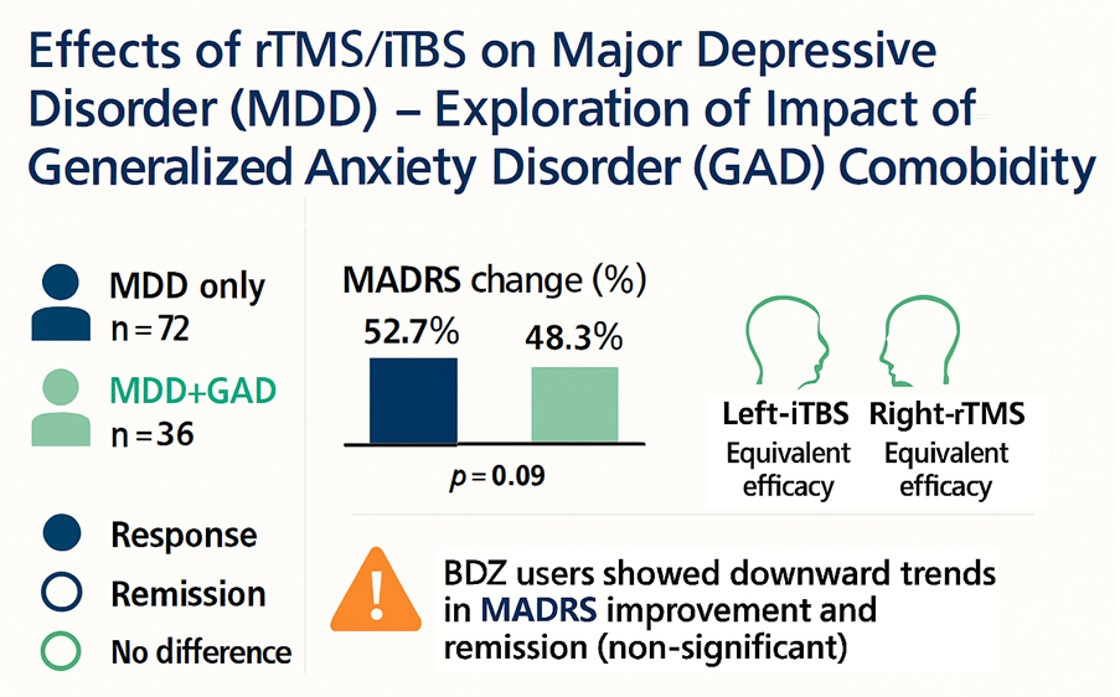
| Outcome | MDD with GAD (n = 36) | MDD Only (n = 72) | Statistic (t/χ2, df) | p Value |
|---|---|---|---|---|
| MADRS baseline | 30.2 ± 5.1 | 31.0 ± 5.4 | t = −0.81, df = 106 | 0.42 |
| HAMD-17 baseline | 20.1 ± 3.8 | 21.0 ± 4.1 | t = −1.06, df = 106 | 0.29 |
| % change in MADRS score | 48.3 ± 16.2 | 52.7 ± 15.9 | t = −1.70, df = 106 | 0.09 |
| % change in HAMD-17 score | 52.6 ± 14.8 | 54.1 ± 15.2 | t = −0.51, df = 106 | 0.61 |
| MADRS response | 66.7% | 72.2% | χ2 = 0.40, df = 1 | 0.53 |
| HAMD-17 response | 72.2% | 75.0% | χ2 = 0.08, df = 1 | 0.78 |
| MADRS remission | 38.9% | 43.1% | χ2 = 0.17, df = 1 | 0.68 |
| HAMD-17 remission | 41.7% | 44.4% | χ2 = 0.06, df = 1 | 0.81 |
| Medication | Outcome | On-Medication Group | No Medication Group | Statistic (t, df) | p Value |
|---|---|---|---|---|---|
| Antidepressants | % change in MADRS score | 48.9 ± 16.1 | 52.0 ± 15.8 | t = −1.00, df = 106 | 0.32 |
| % change in HAMD-17 score | 52.8 ± 14.7 | 54.2 ± 15.1 | t = −0.48, df = 106 | 0.63 | |
| Antipsychotics | % change in MADRS score | 49.1 ± 16.0 | 51.8 ± 15.7 | t = −0.73, df = 106 | 0.47 |
| % change in HAMD-17 score | 53.2 ± 15.1 | 54.0 ± 15.0 | t = −0.20, df = 106 | 0.84 | |
| BDZ | % change in MADRS score | 47.5 ± 15.8 | 52.3 ± 15.9 | t = −1.31, df = 106 | 0.19 |
| % change in HAMD-17 score | 51.0 ± 14.9 | 54.8 ± 15.2 | t = −1.09, df = 106 | 0.28 |
| Outcome | Left-iTBS | Right-rTMS | Statistic (t/χ2, df) | p Value |
|---|---|---|---|---|
| % change in MADRS score | 51.2 ± 15.8 | 52.0 ± 16.1 | t = −0.30, df = 106 | 0.76 |
| % change in HAMD-17 score | 53.9 ± 15.0 | 54.5 ± 15.3 | t = −0.23, df = 106 | 0.82 |
| MADRS response | 71.0% | 70.0% | χ2 = 0.02, df = 1 | 0.88 |
| HAMD-17 response | 74.1% | 73.3% | χ2 = 0.01, df = 1 | 0.91 |
| MADRS remission | 40.0% | 39.6% | χ2 = 0.01, df = 1 | 0.93 |
| HAMD-17 remission | 42.0% | 41.7% | χ2 = 0.00, df = 1 | 0.95 |
| Outcome | Independent Variable | Adjusted OR | 95% CI | Wald χ2 (df = 1) | p Value |
|---|---|---|---|---|---|
| MADRS response | BDZ | 0.90 | 0.56–1.46 | χ2 = 0.17 | 0.68 |
| Antipsychotics | 1.01 | 0.57–1.81 | χ2 = 0.01 | 0.97 | |
| Antidepressants | 1.08 | 0.67–1.74 | χ2 = 0.09 | 0.76 | |
| TMS protocol | 1.05 | 0.67–1.64 | χ2 = 0.04 | 0.84 | |
| HAMD-17 response | BDZ | 0.92 | 0.57–1.49 | χ2 = 0.12 | 0.73 |
| Antipsychotics | 0.98 | 0.55–1.75 | χ2 = 0.01 | 0.94 | |
| Antidepressants | 1.07 | 0.66–1.73 | χ2 = 0.07 | 0.78 | |
| TMS protocol | 1.03 | 0.66–1.61 | χ2 = 0.02 | 0.89 | |
| MADRS remission | BDZ | 0.88 | 0.54–1.45 | χ2 = 0.26 | 0.61 |
| Antipsychotics | 0.97 | 0.51–1.85 | χ2 = 0.01 | 0.93 | |
| Antidepressants | 1.09 | 0.67–1.76 | χ2 = 0.10 | 0.75 | |
| TMS protocol | 1.04 | 0.66–1.66 | χ2 = 0.03 | 0.87 | |
| HAMD-17 remission | BDZ | 0.86 | 0.51–1.44 | χ2 = 0.34 | 0.56 |
| Antipsychotics | 0.95 | 0.49–1.86 | χ2 = 0.02 | 0.88 | |
| Antidepressants | 1.10 | 0.67–1.81 | χ2 = 0.13 | 0.72 | |
| TMS protocol | 1.02 | 0.63–1.66 | χ2 = 0.01 | 0.93 |
| Outcome | Independent Variable | β | 95% CI | Statistic (t, df) | p Value |
|---|---|---|---|---|---|
| % change in MADRS score | BDZ | −3.2 | −6.8 to 0.4 | t = −1.74, df = 106 | 0.08 |
| Antipsychotics | −1.8 | −5.6 to 2.0 | t = −0.93, df = 106 | 0.35 | |
| Antidepressants | −2.4 | −5.9 to 1.1 | t = −1.35, df = 106 | 0.18 |
| Outcome | Left-iTBS (n = 86) | Right-rTMS (n = 22) | Statistic (t/χ2, df) | p Value |
|---|---|---|---|---|
| MADRS baseline | 30.8 ± 5.3 | 30.5 ± 5.2 | t = 0.23, df = 106 | 0.82 |
| HAMD-17 baseline | 20.7 ± 4.0 | 20.5 ± 3.9 | t = 0.19, df = 106 | 0.85 |
| % change in MADRS score | 51.2 ± 15.8 | 52.0 ± 16.1 | t = −0.30, df = 106 | 0.76 |
| % change in HAMD-17 score | 53.9 ± 15.0 | 54.5 ± 15.3 | t = −0.23, df = 106 | 0.82 |
| MADRS response | 71.0% | 70.0% | χ2 = 0.02, df = 1 | 0.88 |
| HAMD-17 response | 74.1% | 73.3% | χ2 = 0.01, df = 1 | 0.91 |
| MADRS remission | 40.0% | 39.6% | χ2 = 0.01, df = 1 | 0.93 |
| HAMD-17 remission | 42.0% | 41.7% | χ2 = 0.00, df = 1 | 0.95 |
| Outcome | BDZ Users (n = 17) | BDZ Non-Users (n = 91) | Statistic (t/χ2, df) | p Value |
|---|---|---|---|---|
| MADRS baseline | 30.5 ± 5.0 | 30.9 ± 5.3 | t = −0.32, df = 106 | 0.75 |
| HAMD-17 baseline | 20.6 ± 3.9 | 20.8 ± 4.0 | t = −0.18, df = 106 | 0.86 |
| % change in MADRS score | 47.5 ± 15.8 | 52.3 ± 15.9 | t = −1.31, df = 106 | 0.19 |
| % change in HAMD-17 score | 51.0 ± 14.9 | 54.8 ± 15.2 | t = −1.09, df = 106 | 0.28 |
| MADRS response | 68.6% | 72.0% | χ2 = 0.16, df = 1 | 0.69 |
| HAMD-17 response | 71.4% | 74.2% | χ2 = 0.09, df = 1 | 0.77 |
| MADRS remission | 34.3% | 42.7% | χ2 = 0.77, df = 1 | 0.38 |
| HAMD-17 remission | 35.7% | 44.0% | χ2 = 0.68, df = 1 | 0.41 |
Disclaimer/Publisher’s Note: The statements, opinions and data contained in all publications are solely those of the individual author(s) and contributor(s) and not of MDPI and/or the editor(s). MDPI and/or the editor(s) disclaim responsibility for any injury to people or property resulting from any ideas, methods, instructions or products referred to in the content. |
© 2026 by the authors. Licensee MDPI, Basel, Switzerland. This article is an open access article distributed under the terms and conditions of the Creative Commons Attribution (CC BY) license.
Share and Cite
Noda, Y.; Osawa, R.; Takeda, Y.; Fujita, K.; Tsuji, T.; Kitahata, R. Impact of Comorbid Generalized Anxiety Disorder on rTMS/iTBS Clinical Outcomes in Major Depression: A Multicenter Registry-Based Observational Study. J. Pers. Med. 2026, 16, 68. https://doi.org/10.3390/jpm16020068
Noda Y, Osawa R, Takeda Y, Fujita K, Tsuji T, Kitahata R. Impact of Comorbid Generalized Anxiety Disorder on rTMS/iTBS Clinical Outcomes in Major Depression: A Multicenter Registry-Based Observational Study. Journal of Personalized Medicine. 2026; 16(2):68. https://doi.org/10.3390/jpm16020068
Chicago/Turabian StyleNoda, Yoshihiro, Ryota Osawa, Yuya Takeda, Keiko Fujita, Takumi Tsuji, and Ryosuke Kitahata. 2026. "Impact of Comorbid Generalized Anxiety Disorder on rTMS/iTBS Clinical Outcomes in Major Depression: A Multicenter Registry-Based Observational Study" Journal of Personalized Medicine 16, no. 2: 68. https://doi.org/10.3390/jpm16020068
APA StyleNoda, Y., Osawa, R., Takeda, Y., Fujita, K., Tsuji, T., & Kitahata, R. (2026). Impact of Comorbid Generalized Anxiety Disorder on rTMS/iTBS Clinical Outcomes in Major Depression: A Multicenter Registry-Based Observational Study. Journal of Personalized Medicine, 16(2), 68. https://doi.org/10.3390/jpm16020068