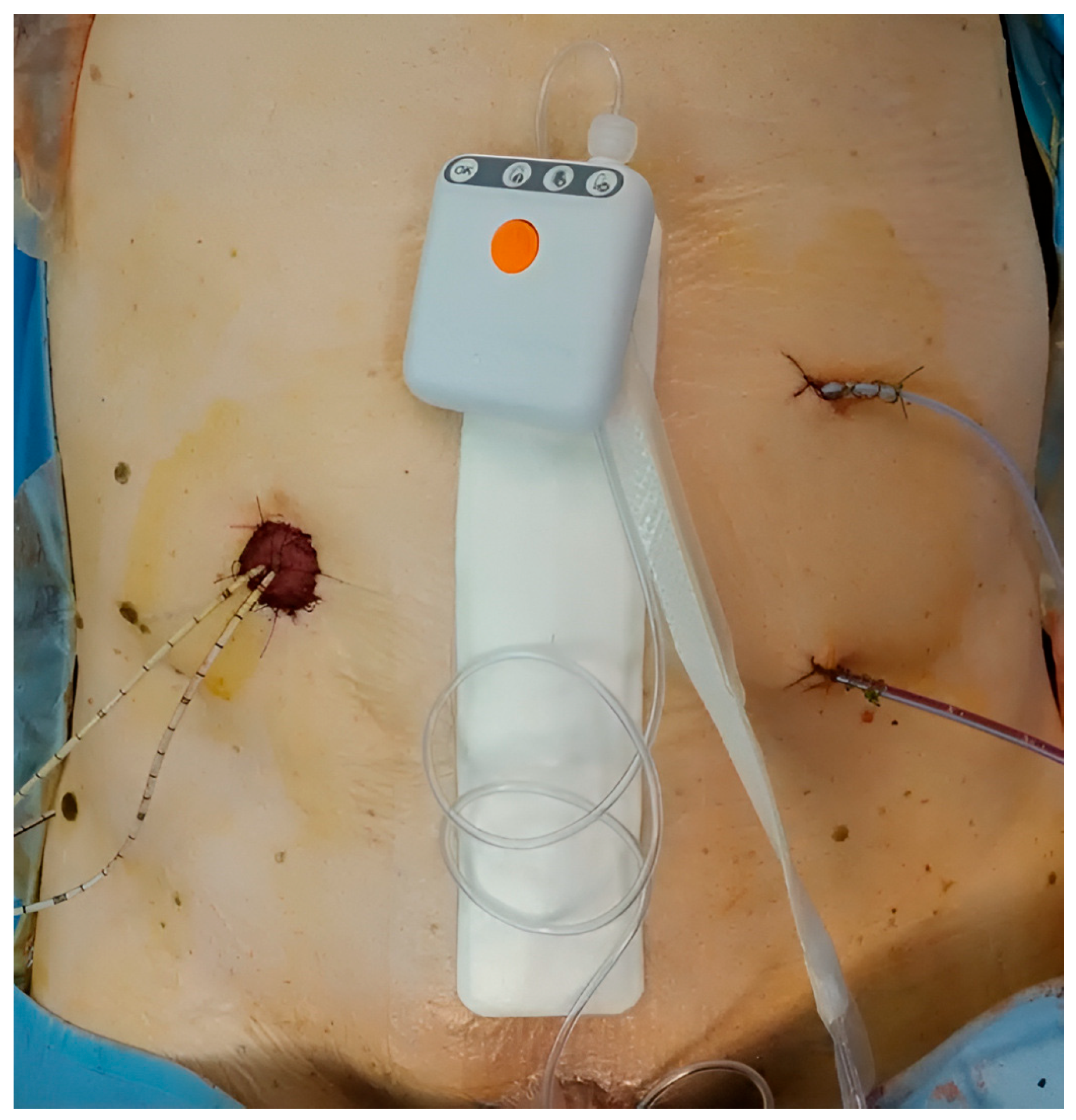


Incisional Negative-Pressure Wound Therapy Versus Standard Dressing for the Prevention of Surgical Site Complications Following Radical Cystectomy

 , ,
, ,  , and
, and
Abstract
1. Introduction
2. Materials and Methods
3. Results
4. Discussion
5. Conclusions
Author Contributions
Funding
Institutional Review Board Statement
Informed Consent Statement
Data Availability Statement
Conflicts of Interest
Abbreviations
| ASA | American Society of Anesthesiologists |
| BMI | Body Mass Index |
| CCI | Charlson Comorbidity Index |
| CDC | Centers for Disease Control and Prevention |
| CKD | Chronic Kidney Disease |
| CI | Confidence Interval |
| ERAS | Enhanced Recovery After Surgery |
| iNPWT | incisional Negative-Pressure Wound Therapy |
| OR | Odds Ratio |
| RC | Radical Cystectomy |
| SSC(s) | Surgical Site Complication(s) |
| pTNM | pathological Tumor–Node–Metastasis |
References
- Abudurexiti, M.; Ma, J.; Li, Y.; Hu, C.; Cai, Z.; Wang, Z.; Jiang, N. Clinical Outcomes and Prognosis Analysis of Younger Bladder Cancer Patients. Curr. Oncol. 2022, 29, 578–588. [Google Scholar] [CrossRef]
- Alfred Witjes, J.; Max Bruins, H.; Carrión, A.; Cathomas, R.; Compérat, E.; Efstathiou, J.A.; Fietkau, R.; Gakis, G.; Lorch, A.; Martini, A.; et al. European Association of Urology Guidelines on Muscle-Invasive and Metastatic Bladder Cancer: Summary of the 2023 Guidelines. Eur. Urol. 2024, 85, 17–31. [Google Scholar] [CrossRef]
- Kim, S.P.; Shah, N.D.; Karnes, R.J.; Weight, C.J.; Frank, I.; Moriarty, J.P.; Han, L.C.; Borah, B.; Tollefson, M.K.; Boorjian, S.A. The Implications of Hospital Acquired Adverse Events on Mortality, Length of Stay and Costs for Patients Undergoing Radical Cystectomy for Bladder Cancer. J. Urol. 2012, 187, 2011–2017. [Google Scholar] [CrossRef]
- Takeyama, K.; Matsukawa, M.; Kunishima, Y.; Takahashi, S.; Hotta, H.; Nishiyama, N.; Tsukamoto, T. Incidence of and Risk Factors for Surgical Site Infection in Patients with Radical Cystectomy with Urinary Diversion. J. Infect. Chemother. 2005, 11, 177–181. [Google Scholar] [CrossRef]
- Joice, G.A.; Tema, G.; Semerjian, A.; Gupta, M.; Bell, M.; Walker, J.; Kates, M.; Bivalacqua, T.J. Evaluation of Incisional Negative Pressure Wound Therapy in the Prevention of Surgical Site Occurrences After Radical Cystectomy: A New Addition to Enhanced Recovery After Surgery Protocol. Eur. Urol. Focus. 2020, 6, 698–703. [Google Scholar] [CrossRef]
- O’Leary, D.P.; Peirce, C.; Anglim, B.; Burton, M.; Concannon, E.; Carter, M.; Hickey, K.; Coffey, J.C. Prophylactic Negative Pressure Dressing Use in Closed Laparotomy Wounds Following Abdominal Operations: A Randomized, Controlled, Open-Label Trial: The P.I.C.O. Trial. Ann. Surg. 2017, 265, 1082–1086. [Google Scholar] [CrossRef] [PubMed]
- Sahebally, S.M.; Burke, J.P.; McNamara, D.A. Negative Pressure Wound Therapy for Surgical Site Infection Prevention Requires Further Study Before Widespread Adoption-Reply. JAMA Surg. 2019, 154, 673–674. [Google Scholar] [CrossRef]
- Willy, C.; Agarwal, A.; Andersen, C.A.; Santis, G.D.; Gabriel, A.; Grauhan, O.; Guerra, O.M.; Lipsky, B.A.; Malas, M.B.; Mathiesen, L.L.; et al. Closed Incision Negative Pressure Therapy: International Multidisciplinary Consensus Recommendations. Int. Wound J. 2017, 14, 385–398. [Google Scholar] [CrossRef] [PubMed]
- Shen, P.; Blackham, A.U.; Lewis, S.; Clark, C.J.; Howerton, R.; Mogal, H.D.; Dodson, R.M.; Russell, G.B.; Levine, E.A. Phase II Randomized Trial of Negative-Pressure Wound Therapy to Decrease Surgical Site Infection in Patients Undergoing Laparotomy for Gastrointestinal, Pancreatic, and Peritoneal Surface Malignancies. J. Am. Coll. Surg. 2017, 224, 726–737. [Google Scholar] [CrossRef]
- Borchardt, R.A.; Tzizik, D. Update on Surgical Site Infections: The New CDC Guidelines. Jaapa 2018, 31, 52–54. [Google Scholar] [CrossRef] [PubMed]
- Paner, G.P.; Stadler, W.M.; Hansel, D.E.; Montironi, R.; Lin, D.W.; Amin, M.B. Updates in the Eighth Edition of the Tumor-Node-Metastasis Staging Classification for Urologic Cancers. Eur. Urol. 2018, 73, 560–569. [Google Scholar] [CrossRef]
- Sandy-Hodgetts, K.; Watts, R. Effectiveness of Negative Pressure Wound Therapy/Closed Incision Management in the Prevention of Post-Surgical Wound Complications: A Systematic Review and Meta-Analysis. JBI Database Syst. Rev. Implement. Rep. 2015, 13, 253–303. [Google Scholar] [CrossRef]
- Scalise, A.; Calamita, R.; Tartaglione, C.; Pierangeli, M.; Bolletta, E.; Gioacchini, M.; Gesuita, R.; Di Benedetto, G. Improving Wound Healing and Preventing Surgical Site Complications of Closed Surgical Incisions: A Possible Role of Incisional Negative Pressure Wound Therapy. A Systematic Review of the Literature. Int. Wound J. 2016, 13, 1260–1281. [Google Scholar] [CrossRef]
- Ingargiola, M.J.; Daniali, L.N.; Lee, E.S. Does the Application of Incisional Negative Pressure Therapy to High-Risk Wounds Prevent Surgical Site Complications? A Systematic Review. Eplasty 2013, 13, e49. [Google Scholar]
- Semerjian, A.; Milbar, N.; Kates, M.; Gorin, M.A.; Patel, H.D.; Chalfin, H.J.; Frank, S.M.; Wu, C.L.; Yang, W.W.; Hobson, D.; et al. Hospital Charges and Length of Stay Following Radical Cystectomy in the Enhanced Recovery After Surgery Era. Urology 2018, 111, 86–91. [Google Scholar] [CrossRef] [PubMed]
- Parker, W.P.; Tollefson, M.K.; Heins, C.N.; Hanson, K.T.; Habermann, E.B.; Zaid, H.B.; Frank, I.; Thompson, R.H.; Boorjian, S.A. Characterization of Perioperative Infection Risk among Patients Undergoing Radical Cystectomy: Results from the National Surgical Quality Improvement Program. Urol. Oncol. 2016, 34, e13–e532. [Google Scholar] [CrossRef]
- Kamei, J.; Endo, K.; Yamazaki, M.; Sugihara, T.; Takaoka, E.-I.; Ando, S.; Kume, H.; Fujimura, T. Lower Bleeding Volume Contributes to Decreasing Surgical Site Infection in Radical Cystectomy: A Propensity Score-Matched Comparison of Open versus Robot-Assisted Radical Cystectomy. Int. J. Urol. 2024, 31, 430–437. [Google Scholar] [CrossRef]
- Simhal, R.K.; Simon, D.P.; Wang, K.R.; Shah, Y.B.; Havranek, B.; Mark, J.R.; Chandrasekar, T.; Shah, M.S.; Lallas, C.D. Perioperative and Complication Related Outcomes for Robotic-Assisted vs Open Radical Cystectomy: A Comparative National Surgical Quality Improvement Project Analysis. J. Endourol. 2024, 38, 331–339. [Google Scholar] [CrossRef] [PubMed]
- Plikaitis, C.M.; Molnar, J.A. Subatmospheric Pressure Wound Therapy and the Vacuum-Assisted Closure Device: Basic Science and Current Clinical Successes. Expert. Rev. Med. Devices 2006, 3, 175–184. [Google Scholar] [CrossRef]
- Gili-Ortiz, E.; González-Guerrero, R.; Béjar-Prado, L.; López-Méndez, J.; Ramírez-Ramírez, G. Surgical Site Infections in Patients Who Undergo Radical Cystectomy: Excess Mortality, Stay Prolongation and Hospital Cost Overruns. Actas Urol. Esp. 2015, 39, 210–216. [Google Scholar] [CrossRef] [PubMed]
- Broex, E.C.J.; van Asselt, A.D.I.; Bruggeman, C.A.; van Tiel, F.H. Surgical Site Infections: How High Are the Costs? J. Hosp. Infect. 2009, 72, 193–201. [Google Scholar] [CrossRef] [PubMed]
- Konety, B.R.; Allareddy, V. Influence of Post-Cystectomy Complications on Cost and Subsequent Outcome. J. Urol. 2007, 177, 280–287, discussion 287. [Google Scholar] [CrossRef] [PubMed]
- Wolters, M.; Oelke, M.; Lutze, B.; Weingart, M.; Kuczyk, M.A.; Chaberny, I.F.; Graf, K. Deep Surgical Site Infections after Open Radical Cystectomy and Urinary Diversion Significantly Increase Hospitalisation Time and Total Treatment Costs. Urol. Int. 2017, 98, 268–273. [Google Scholar] [CrossRef]
- Formosa, M.; Ebejer, S.J. Prophylactic Negative Pressure Wound Therapy in Reducing Surgical Site Infections: An Evidence-Based Literature Review. SAGE Open Nurs. 2024, 10, 23779608241292839. [Google Scholar] [CrossRef] [PubMed]


| Variable | Standard (n = 80) | iNPWT (n = 66) | p-Value |
|---|---|---|---|
| Age ± SD | 72.3 ± 2.1 | 73.5 ± 2.2 | 0.65 |
| Sex, n (%) | 0.33 | ||
| Male | 58 (72.5) | 45 (68.2) | |
| Female | 22 (27.5) | 21 (31.8) | |
| BMI (kg/m2) | |||
| BMI | 25.9 | 25.1 | 0.21 |
| BMI ≥ 30, n (%) | 16 (20.0) | 6 (9.0) | 0.20 |
| Smokers, n (%) | |||
| Active | 22 (27.5) | 33 (50.0) | 0.013 |
| Former | 39 (48.8) | 13 (19.7) | 0.001 |
| Charlson Comorbidity Index | 5.9 | 6.6 | 0.48 |
| ASA score | |||
| ASA | 2.6 | 2.6 | 0.51 |
| ≤2 pt, n (%) | 35 (43.8) | 28 (42.4) | |
| ≥3 pt, n (%) | 45 (56.2) | 38 (57.6) | |
| Previous abdominal surgery, n (%) | |||
| Laparotomic | 27 (33.7) | 37 (56.0) | 0.019 |
| Laparoscopic | 2 (2.5) | 1 (1.5) | 0.015 |
| Previous pelvic RT, n (%) | 12 (15.0) | 0 (0.0) | 0.004 |
| Neoadjuvant CT, n (%) | 4 (5.0) | 7 (10.6) | 0.09 |
| Acute myocardial infarction, n (%) | 16 (20.0) | 23 (34.8) | 0.08 |
| Cerebrovascular disease, n (%) | 4 (5.0) | 10 (15.2) | 0.09 |
| COPD, n (%) | 10 (12.5) | 13 (19.7) | 0.31 |
| CKD, n (%) | 13 (16.3) | 23 (34.8) | 0.02 |
| Diabetes, n (%) | 18 (22.5) | 17 (25.8) | 0.67 |
| Variable | No SSCs (n = 123) | SSCs (n = 23) | p-Value |
|---|---|---|---|
| Age | 72.5 | 73.2 | 0.72 |
| Sex, n (%) | 0.12 | ||
| Male | 89 (72.4) | 14 (60.9) | |
| Female | 34 (27.6) | 9 (39.1) | |
| BMI (kg/m2) | |||
| BMI | 25.2 | 28.9 | 0.001 |
| BMI ≥ 30, n (%) | 12 (9.8) | 10 (43.5) | 0.001 |
| Smokers, n (%) | 0.19 | ||
| Active | 43 (35.0) | 9 (39.1) | 0.81 |
| Former | 44 (35.7) | 11 (47.8) | 0.36 |
| Charlson Comorbidity Index | 6.1 | 6.4 | 0.51 |
| ASA score | 2.5 | 2.8 | 0.03 |
| Anticoagulant therapy, n (%) | 9 (7.3) | 2 (8.7) | 0.99 |
| Antiplatelet therapy, n (%) | 34 (27.6) | 5 (21.7) | 0.33 |
| CKD, n (%) | 31 (25.2) | 5 (21.7) | 0.38 |
| Oral antidiabetic drugs, n (%) | 15 (12.2) | 10 (43.5) | 0.001 |
| Previous abdominal laparotomic surgery, n (%) | 43 (35.0) | 10 (43.5) | 0.01 |
| Previous pelvic RT, n (%) | 8 (6.5) | 4 (17.4) | 0.23 |
| Neoadjuvant CT, n (%) | 9 (7.3) | 2 (8.7) | 0.99 |
| Variable | No SSCs (n = 123) | SSCs (n = 23) | p-Value |
|---|---|---|---|
| Surgical RC procedure, n (%) | |||
| Bricker ileal conduit | 91 (74.0) | 21 (91.3) | 0.09 |
| Cutaneous ureterostomy | 31 (25.2) | 2 (8.7) | 0.21 |
| Neobladder | 1 (0.8) | 0 (0.0) | |
| Lymphadenectomy, n (%) | |||
| Loco-regional | 45 (36.6) | 10 (43.5) | 0.41 |
| Extended | 71 (57.7) | 9 (39.1) | 0.2 |
| Surgical wound classification, n (%) | |||
| Clean-contaminated | 119 (96.7) | 22 (95.7) | 0.99 |
| Contaminated | 4 (3.3) | 1 (4.3) | 0.99 |
| Emergency RC, n (%) | 1 (0.8) | 2 (8.7) | 0.23 |
| Operative time (min) | |||
| Mean ± DS | 310 ± 9 | 337 ± 20 | 0.02 |
| ≥300, n (%) | 67 (54.5) | 20 (87.0) | 0.04 |
| Estimated blood loss (mL) | |||
| Mean ± DS | 781 ± 95 | 1021 ± 376 | 0.21 |
| ≥500, n | 75 (61.0) | 21 (91.3) | 0.15 |
| Blood transfusion, n (%) | 48 (39.0) | 13 (56.5) | 0.49 |
| Subcutaneous synthesis, n (%) | |||
| Not closed | 2 (1.6) | 0 (0.0) | 0.18 |
| Detached dots, single layer | 116 (94.3) | 21 (91.3) | 0.54 |
| Detached dots, double layer | 1 (0.8) | 2 (8.7) | 0.08 |
| Intradermal | 4 (3.3) | 0 (0.0) | 0.99 |
| Skin synthesis, n (%) | |||
| Staples | 123 (100) | 22 (95.7) | 0.18 |
| Detached spots | 0 | 1 (4.3) | |
| Drainage, n (%) | |||
| Single | 21 (17.0) | 3 (13.0) | |
| Double | 102 (83.0) | 20 (87.0) | |
| Wound medication n (%) | |||
| iNPWT | 61 (49.6) | 5 (21.7) | 0.03 |
| Conventional | 62 (50.4) | 18 (78.3) | 0.17 |
| LOS (days) | 18.5 | 25.6 | 0.03 |
| Incision Complication | Standard (n = 80) | Inpwt (n = 66) | p-Value |
|---|---|---|---|
| Hematoma, n (%) | 0 (0.0) | 0 (0.0) | / |
| Seroma, n (%) | 0 (0.0) | 1 (1.5) | 0.78 |
| Skin dehiscence/infection, n (%) | 16 (20.0) | 4 (6.0) | 0.08 |
| Fascial dehiscence, n (%) | 2 (2.5) | 0 (0.0) | 0.50 |
| Total n (%) | 18 (22.5) | 5 (7.6) | 0.03 |
| Variable | Hazard Ratio (95% CI) | p-Value |
|---|---|---|
| iNPWT | 0.223 (0.063–0.784) | 0.019 |
| Operative time > 300 min | 1.007 (0.983–1.031) | 0.569 |
| BMI ≥ 30 | 0.456 (0.108–1.935) | 0.287 |
| Smoker | 1.410 (0.505–3.934) | 0.512 |
| Previous abdominal surgery | 0.611 (0.208–1.795) | 0.370 |
| Acute myocardial infarction | 0.734 (0.212–2.534) | 0.624 |
| Cerebrovascular disease | 3.907 (0.881–17.324) | 0.073 |
| COPD | 1.224 (0.325–4.604) | 0.765 |
| CKD | 0.954 (0.289–3.142) | 0.938 |
| Diabetes | 3.440 (1.168–10.135) | 0.025 |
Disclaimer/Publisher’s Note: The statements, opinions and data contained in all publications are solely those of the individual author(s) and contributor(s) and not of MDPI and/or the editor(s). MDPI and/or the editor(s) disclaim responsibility for any injury to people or property resulting from any ideas, methods, instructions or products referred to in the content. |
© 2025 by the authors. Licensee MDPI, Basel, Switzerland. This article is an open access article distributed under the terms and conditions of the Creative Commons Attribution (CC BY) license (https://creativecommons.org/licenses/by/4.0/).
Share and Cite
Traunero, F.; Biasatti, A.; Rossin, G.; Piasentin, A.; Zorzi, F.; Rizzo, M.; Umari, P.; Cai, T.; Zucchi, A.; Liguori, G. Incisional Negative-Pressure Wound Therapy Versus Standard Dressing for the Prevention of Surgical Site Complications Following Radical Cystectomy. J. Pers. Med. 2025, 15, 581. https://doi.org/10.3390/jpm15120581
Traunero F, Biasatti A, Rossin G, Piasentin A, Zorzi F, Rizzo M, Umari P, Cai T, Zucchi A, Liguori G. Incisional Negative-Pressure Wound Therapy Versus Standard Dressing for the Prevention of Surgical Site Complications Following Radical Cystectomy. Journal of Personalized Medicine. 2025; 15(12):581. https://doi.org/10.3390/jpm15120581
Chicago/Turabian StyleTraunero, Fabio, Arianna Biasatti, Giulio Rossin, Andrea Piasentin, Federico Zorzi, Michele Rizzo, Paolo Umari, Tommaso Cai, Alessandro Zucchi, and Giovanni Liguori. 2025. "Incisional Negative-Pressure Wound Therapy Versus Standard Dressing for the Prevention of Surgical Site Complications Following Radical Cystectomy" Journal of Personalized Medicine 15, no. 12: 581. https://doi.org/10.3390/jpm15120581
APA StyleTraunero, F., Biasatti, A., Rossin, G., Piasentin, A., Zorzi, F., Rizzo, M., Umari, P., Cai, T., Zucchi, A., & Liguori, G. (2025). Incisional Negative-Pressure Wound Therapy Versus Standard Dressing for the Prevention of Surgical Site Complications Following Radical Cystectomy. Journal of Personalized Medicine, 15(12), 581. https://doi.org/10.3390/jpm15120581