The Role of Hemogram-Derived Inflammation Indices for the Prediction of Nausea and Vomiting in Pregnancy and the Need for Hospitalization

 , , , , , , ,
Abstract
1. Introduction
2. Materials and Methods
2.1. Study Design
2.2. Definitions, Characteristics of Study Population, Patient Selection
2.3. Imaging Methods, Laboratory Measurements and Study Variables
2.4. Statistical Analysis
3. Results
4. Discussion
5. Conclusions
Author Contributions
Funding
Institutional Review Board Statement
Informed Consent Statement
Data Availability Statement
Conflicts of Interest
Abbreviations
| AUC | Area under the curve |
| BMI | Body-mass index |
| CBC | Complete blood count |
| CI | Confidence interval |
| CRL | Crown-rump length |
| HG | Hyperemesis gravidarum |
| LHR | Likelihood ratio |
| MLR | Monocyte-to-lymphocyte ratio |
| NLR | Neutrophil-to-lymphocyte ratio |
| NVP | Nausea and vomiting in pregnancy |
| PIV | Pan-immune inflammation value |
| PLR | Platelet-to-lymphocyte ratio |
| PUQE | Pregnancy-unique quantification of emesis and nausea |
| ROC | Receiver operating characteristics |
| SII | Systemic immune-inflammation index |
| SIRI | Systemic inflammatory response index |
References
- Boelig, R.C.; Barton, S.J.; Saccone, G.; Kelly, A.J.; Edwards, S.J.; Berghella, V. Interventions for treating hyperemesis gravidarum: A Cochrane systematic review and meta-analysis. J. Matern. Fetal Neonatal Med. 2018, 31, 2492–2495. [Google Scholar] [CrossRef]
- Mohammed Seid, A.; Mehari, E.A.; Bekalu, A.F.; Dula Sema, F.; Limenh, L.W.; Geremew, D.T.; Tessema, T.A.; Anagaw, Y.K.; Mitku, M.L.; Worku, M.C.; et al. Prevalence of hyperemesis gravidarum and associated factors among pregnant women at comprehensive specialized hospitals in northwest Ethiopia: Multicenter cross-sectional study. SAGE Open Med. 2024, 12, 20503121241257163. [Google Scholar] [CrossRef]
- Vinnars, M.T.; Forslund, M.; Claesson, I.M.; Hedman, A.; Peira, N.; Olofsson, H.; Wernersson, E.; Ulfsdottir, H. Treatments for hyperemesis gravidarum: A systematic review. Acta Obstet. Gynecol. Scand. 2024, 103, 13–29. [Google Scholar] [CrossRef]
- Committee on Practice Bulletins-Obstetrics. ACOG Practice Bulletin No. 189: Nausea and Vomiting of Pregnancy. Obstet Gynecol. 2018, 131, e15–e30. [Google Scholar] [CrossRef]
- Dominguez, F.; Yáñez-Mó, M.; Sanchez-Madrid, F.; Simón, C. Embryonic implantation and leukocyte transendothelial migration: Different processes with similar players? FASEB J. 2005, 19, 1056–1060. [Google Scholar] [CrossRef] [PubMed]
- Garlanda, C.; Maina, V.; Martinez de la Torre, Y.; Nebuloni, M.; Locati, M. Inflammatory reaction and implantation: The new entries PTX3 and D6. Placenta 2008, 29, 129–134. [Google Scholar] [CrossRef] [PubMed]
- Tunc, S.Y.; Agacayak, E.; Budak, S.; Tunc, N.; Icen, M.S.; Findik, F.M.; Ekinci, A.; Gul, T. Serum levels of neopterin, inflammatory markers and oxidative stress indicators in hyperemesis gravidarum. J. Obstet. Gynaecol. Res. 2016, 42, 618–624. [Google Scholar] [CrossRef] [PubMed]
- Kaplan, P.B.; Gücer, F.; Sayin, N.C.; Yüksel, M.; Yüce, M.A.; Yardim, T. Maternal serum cytokine levels in women with hyperemesis gravidarum in the first trimester of pregnancy. Fertil. Steril. 2003, 79, 498–502. [Google Scholar] [CrossRef]
- Aslan, M.M.; Yeler, M.T.; Bıyık, İ.; Yuvacı, H.U.; Cevrioğlu, A.S.; Özden, S. Hematological Parameters to Predict the Severity of Hyperemesis Gravidarum and Ketonuria. Rev. Bras. Ginecol. Obstet. 2022, 44, 458–466. [Google Scholar] [CrossRef]
- Dochez, V.; Dimet, J.; David-Gruselle, A.; Le Thuaut, A.; Ducarme, G. Validation of specific questionnaires to assess nausea and vomiting of pregnancy in a French population. Int. J. Gynaecol. Obstet. 2016, 134, 294–298. [Google Scholar] [CrossRef]
- Dereli, M.L.; Savran Üçok, B.; Özkan, S.; Sucu, S.; Topkara, S.; Fıratlıgil, F.B.; Ercan, E.E.; Uğur, M.; Akdaş Reis, Y.; Engin Üstün, Y. The importance of blood-count-derived inflammatory markers in predicting methotrexate success in patients with tubal ectopic pregnancy. Int. J. Gynaecol. Obstet. 2024, 167, 789–796. [Google Scholar] [CrossRef]
- Ioannidou, P.; Papanikolaou, D.; Mikos, T.; Mastorakos, G.; Goulis, D.G. Predictive factors of Hyperemesis Gravidarum: A systematic review. Eur. J. Obstet. Gynecol. Reprod. Biol. 2019, 238, 178–187. [Google Scholar] [CrossRef]
- Kim, H.Y.; Cho, G.J.; Kim, S.Y.; Lee, K.M.; Ahn, K.H.; Han, S.W.; Hong, S.C.; Ryu, H.M.; Oh, M.J.; Kim, H.J.; et al. Pre-Pregnancy Risk Factors for Severe Hyperemesis Gravidarum: Korean Population Based Cohort Study. Life 2020, 11, 12. [Google Scholar] [CrossRef] [PubMed]
- Nurmi, M.; Rautava, P.; Gissler, M.; Vahlberg, T.; Polo-Kantola, P. Incidence and risk factors of hyperemesis gravidarum: A national register-based study in Finland, 2005–2017. Acta Obstet. Gynecol. Scand. 2020, 99, 1003–1013. [Google Scholar] [CrossRef]
- Dean, C.R.; Shemar, M.; Ostrowski, G.A.U.; Painter, R.C. Management of severe pregnancy sickness and hyperemesis gravidarum. BMJ 2018, 363, k5000. [Google Scholar] [CrossRef] [PubMed]
- Kohnke, S.; Meek, C.L. Don’t seek, don’t find: The diagnostic challenge of Wernicke’s encephalopathy. Ann. Clin. Biochem. 2021, 58, 38–46. [Google Scholar] [CrossRef]
- Nijsten, K.; van der Minnen, L.; Wiegers, H.M.; Koot, M.H.; Middeldorp, S.; Roseboom, T.J.; Grooten, I.J.; Painter, R.C. Hyperemesis gravidarum and vitamin K deficiency: A systematic review. Br. J. Nutr. 2022, 128, 30–42. [Google Scholar] [CrossRef] [PubMed]
- Agmon, N.; Sade, S.; Pariente, G.; Rotem, R.; Weintraub, A.Y. Hyperemesis gravidarum and adverse pregnancy outcomes. Arch. Gynecol. Obstet. 2019, 300, 347–353. [Google Scholar] [CrossRef]
- Koren, G.; Ornoy, A.; Berkovitch, M. Hyperemesis gravidarum-Is it a cause of abnormal fetal brain development? Reprod. Toxicol. 2018, 79, 84–88. [Google Scholar] [CrossRef]
- Brusnahan, A.; Carrasco-Tenezaca, M.; Bates, B.R.; Roche, R.; Grijalva, M.J. Identifying health care access barriers in southern rural Ecuador. Int. J. Equity Health. 2022, 21, 55. [Google Scholar] [CrossRef] [PubMed]
- Demir, B.; Erel, C.T.; Haberal, A.; Oztürk, N.; Güler, D.; Koçak, M. Adjusted leptin level (ALL) is a predictor for hyperemesis gravidarum. Eur. J. Obstet. Gynecol. Reprod. Biol. 2006, 124, 193–196. [Google Scholar] [CrossRef] [PubMed]
- Ozturk, G.; Ozgu-Erdinc, A.S.; Ucar, F.; Ginis, Z.; Erden, G.; Danisman, N. Concentrations of prealbumin and some appetite-controlling hormones in pregnancies associated with hyperemesis gravidarium. Ann. Clin. Biochem. 2017, 54, 258–263. [Google Scholar] [CrossRef]
- Gungor, S.; Gurates, B.; Aydin, S.; Sahin, I.; Kavak, S.B.; Kumru, S.; Celik, H.; Aksoy, A.; Yilmaz, M.; Catak, Z.; et al. Ghrelins, obestatin, nesfatin-1 and leptin levels in pregnant women with and without hyperemesis gravidarum. Clin. Biochem. 2013, 46, 828–830. [Google Scholar] [CrossRef]
- Yıldız, G.; Mat, E.; Kurt, D.; Yıldız, P.; Başol, G.; Gündoğdu, E.C.; Kuru, B.; Turan, K.; Kale, A. Hyperemesis gravidarum and its relationships with placental thickness, PAPP-A and free beta-HCG: A case control study. South. Clin. Ist. Euras 2022, 33, 406–412. [Google Scholar] [CrossRef]
- Tayfur, C.; Burcu, D.C.; Gulten, O.; Betul, D.; Tugberk, G.; Onur, O.; Engin, K.; Orcun, O. Association between platelet to lymphocyte ratio, plateletcrit and the presence and severity of hyperemesis gravidarum. J. Obstet. Gynaecol. Res. 2017, 43, 498–504. [Google Scholar] [CrossRef]
- Dereli, M.L.; Sucu, S.; Kurt, D.S.; Kurt, A.; Fıratlıgil, F.B.; Ağbal, T.; Çağlar, A.T. Systemic immune inflammation index, systemic inflammatory response index and pan-immune inflammation value in the prediction of idiopathic late-onset fetal growth restriction. Cytokine 2026, 198, 157081. [Google Scholar] [CrossRef]
- Dereli, M.L.; Sucu, S.; Kurt, A.; Kumcu, E.; Mat, E.; Turhan Çağlar, A. The Role of Blood Count-Derived Inflammatory Indices in the Short-Term Prediction of Delivery in Women With Threatened Preterm Labor. Am. J. Reprod. Immunol. 2025, 94, e70126. [Google Scholar] [CrossRef]
- Beser, D.M.; Oluklu, D.; Hendem, D.U.; Ayhan, S.G.; Sahin, D. The role of systemic immune-inflammation index in the severity of hyperemesis gravidarum. J. Gynecol. Obstet. Hum. Reprod. 2023, 52, 102583. [Google Scholar] [CrossRef]
- Ozkan, S.; Firatligil, F.B.; Sucu, S.; Dereli, M.L.; Kurt, D.; Yigit, A.; Reis, Y.A.; Yucel, K.Y.; Celen, S.; Engin-Ustun, Y. Can inflammatory biomarkers based on first trimester complete blood count parameters predict placental abruption?: A case-control study. J. Reprod. Immunol. 2024, 164, 104279. [Google Scholar] [CrossRef]
- Topkara Sucu, S.; Goktuğ Kadioglu, B.; Elmas, B.; Ozer, M.C.; Fidan, U.; Ozturk, M.; Ceyhan, S.T. New Immunological Indexes for the Effect of Systemic Inflammation on Oocyte and Embryo Development in Women with Unexplained Infertility: Systemic Immune Response Index and Pan-Immune-Inflammation Value. Am. J. Reprod. Immunol. 2024, 92, e13923. [Google Scholar] [CrossRef]


| NVP Group (n = 278) | Control Group (n = 278) | p-Value | |
|---|---|---|---|
| Maternal age (years) | 26 (22–29.2) | 27 (23–31) | 0.06 |
| Gestational age (weeks) | 9 (7–12) | 9 (8–10) | 0.333 |
| BMI (kg/m2) | 25 (21–31) | 28.5 (26–31) | <0.001 |
| Gravida (number) | 1 (1–2) | 2 (1–3) | <0.001 |
| Parity (number) | 0 (0–1) | 1 (0–2) | <0.001 |
| SII (103/μL) | 1173 (771–1702) | 774 (599–1089) | <0.001 |
| SIRI (103/μL) | 1.9 (1.3–2.7) | 1.8 (1.4–2.5) | 0.74 |
| PIV (106/μL2) | 487.1 (321.7–816.8) | 397.7 (283.9–663.4) | <0.001 |
| Mild NVP (n = 58) | Moderate NVP (n = 140) | Severe NVP (HG) (n = 80) | p-Value | |
|---|---|---|---|---|
| Age (years) | 27 (22–30) | 26 (22–29) | 26 (23–30) | 0.68 |
| Gestational age (weeks) | 9 (7–12) | 9 (7–12) | 10 (8–12) | 0.454 |
| BMI (kg/m2) | 27 (22–31) | 24 (21–31) | 26 (23–31) | 0.21 |
| Gravida (number) | 1 (1–2) | 1 (1–2) | 1 (1–2) | 0.42 |
| Parity (number) | 0 (0–1) | 0 (0–1) | 0 (0–1) | 0.41 |
| SII (103/μL) | 808 (677–1397) | 1209 (764–1703) | 1234 (910–1792) | 0.003 * |
| SIRI (103/μL) | 1.50 (1.00–2.21) | 1.94 (1.29–2.76) | 1.95 (1.48–3.38) | 0.009 * |
| PIV (106/μL2) | 376 (264–582) | 513 (347–819) | 516 (368–950) | 0.007 * |
| Variable | AUC | CI 95% | p | Cut-Off Value | Sensitivity (%) | Specificity (%) | + LHR | − LHR | |
|---|---|---|---|---|---|---|---|---|---|
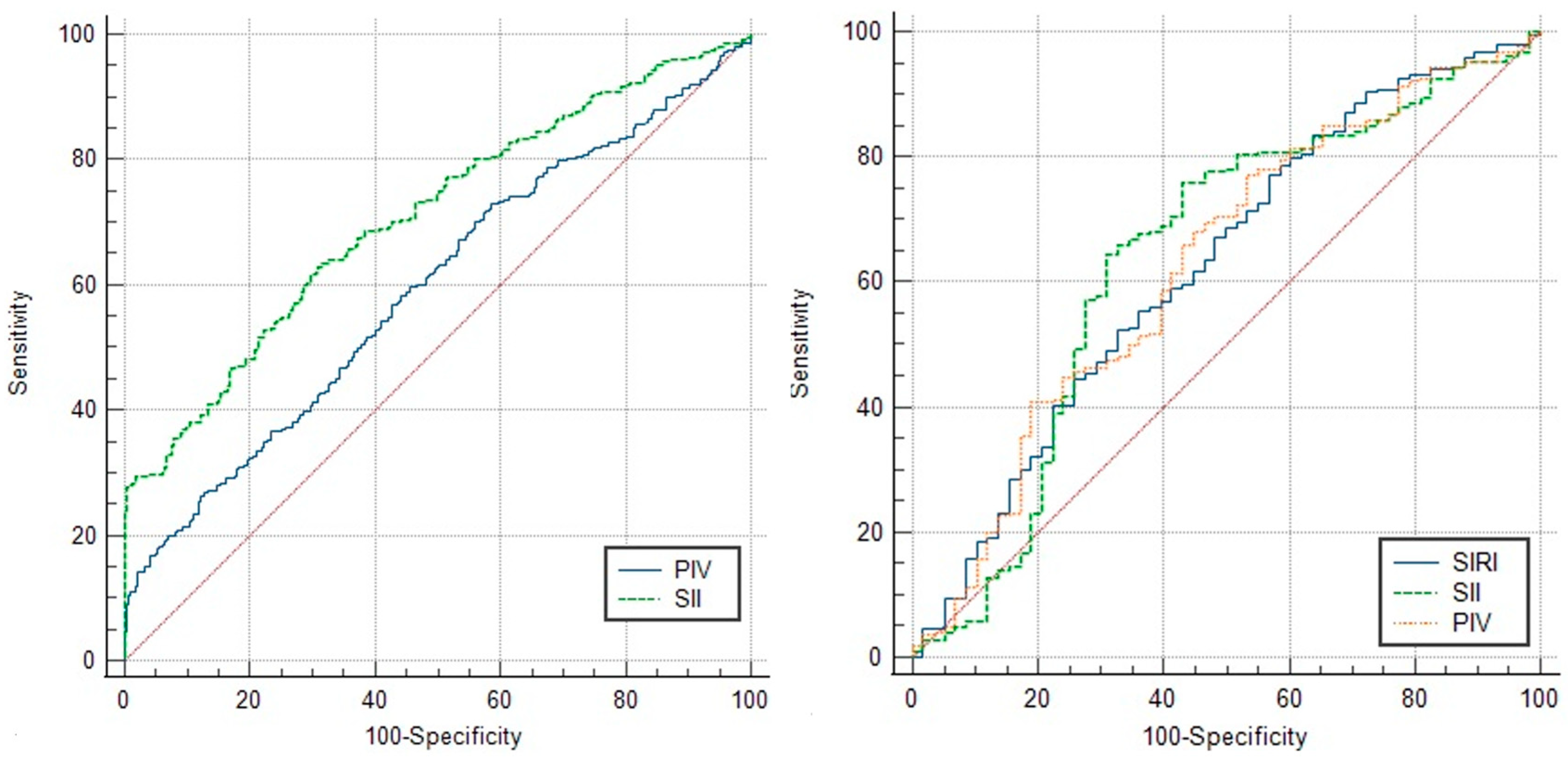
| NVP prediction | SII (103/μL) | 0.708 | 0.67–0.75 | <0.001 | >966 | 63.67 | 68.35 | 2.01 | 0.53 |
| PIV (106/μL2) | 0.593 | 0.55–0.64 | <0.001 | >348 | 73.02 | 41.37 | 1.25 | 0.65 | |
| Inpatient treatment prediction | SII (103/μL) | 0.639 | 0.58–0.70 | 0.002 | >1056 | 64.55 | 68.97 | 2.08 | 0.51 |
| SIRI (103/μL) | 0.625 | 0.57–0.68 | 0.003 | 32.12 | 77.27 | 43.10 | 1.36 | 0.53 | |
| PIV (106/μL2) | 0.627 | 0.57–0.68 | 0.003 | >350.19 | 77.27 | 46.55 | 1.45 | 0.49 |
| Variable | NVP Prediction | Inpatient Treatment Prediction | |||
|---|---|---|---|---|---|
| SII (AUC = 0.708) | PIV (AUC = 0.593) | SII (AUC = 0.639) | SIRI (AUC = 0.625) | PIV (AUC = 0.627) | |
| SII | <0.001 | 0.661 | 0.698 | ||
| SIRI | 0.661 | 0.872 | |||
| PIV | <0.001 | 0.698 | 0.872 | ||
| OR | 95% CI | p | |
|---|---|---|---|
| SII (105/μL) | 1.187 | 1.138–1.239 | <0.001 |
| SII (105/μL) * | 1.163 | 1.114–1.215 | <0.001 |
| SII (105/μL) ** | 1.163 | 1.115–1.214 | <0.001 |
| PIV (108/μL2) | 1.103 | 1.052–1.157 | <0.001 |
| PIV (108/μL2) * | 1.085 | 1.034–1.139 | 0.001 |
| PIV (108/μL2) ** | 1.086 | 1.034–1.140 | 0.001 |
Disclaimer/Publisher’s Note: The statements, opinions and data contained in all publications are solely those of the individual author(s) and contributor(s) and not of MDPI and/or the editor(s). MDPI and/or the editor(s) disclaim responsibility for any injury to people or property resulting from any ideas, methods, instructions or products referred to in the content. |
© 2026 by the authors. Licensee MDPI, Basel, Switzerland. This article is an open access article distributed under the terms and conditions of the Creative Commons Attribution (CC BY) license.
Share and Cite
Savran Üçok, B.; Dereli, M.L.; Sucu, S.; Özkan, S.; Kurt, D.; Kurt, A.; Fıratlıgil, F.B.; Yakut Yücel, K.; Çelen, Ş.; Çağlar, A.T. The Role of Hemogram-Derived Inflammation Indices for the Prediction of Nausea and Vomiting in Pregnancy and the Need for Hospitalization. Diagnostics 2026, 16, 669. https://doi.org/10.3390/diagnostics16050669
Savran Üçok B, Dereli ML, Sucu S, Özkan S, Kurt D, Kurt A, Fıratlıgil FB, Yakut Yücel K, Çelen Ş, Çağlar AT. The Role of Hemogram-Derived Inflammation Indices for the Prediction of Nausea and Vomiting in Pregnancy and the Need for Hospitalization. Diagnostics. 2026; 16(5):669. https://doi.org/10.3390/diagnostics16050669
Chicago/Turabian StyleSavran Üçok, Belgin, Murat Levent Dereli, Sadun Sucu, Sadullah Özkan, Dilara Kurt, Ahmet Kurt, Fahri Burçin Fıratlıgil, Kadriye Yakut Yücel, Şevki Çelen, and Ali Turhan Çağlar. 2026. "The Role of Hemogram-Derived Inflammation Indices for the Prediction of Nausea and Vomiting in Pregnancy and the Need for Hospitalization" Diagnostics 16, no. 5: 669. https://doi.org/10.3390/diagnostics16050669
APA StyleSavran Üçok, B., Dereli, M. L., Sucu, S., Özkan, S., Kurt, D., Kurt, A., Fıratlıgil, F. B., Yakut Yücel, K., Çelen, Ş., & Çağlar, A. T. (2026). The Role of Hemogram-Derived Inflammation Indices for the Prediction of Nausea and Vomiting in Pregnancy and the Need for Hospitalization. Diagnostics, 16(5), 669. https://doi.org/10.3390/diagnostics16050669