Development and Clinical Validation of an Artificial Intelligence-Based Automated Visual Acuity Testing System

 , , , and
Abstract
1. Introduction
2. Materials and Methods
2.1. Technical Development of the Visual Acuity System
2.1.1. Design of Automated Visual Acuity Measurement
2.1.2. Speech Inference Development
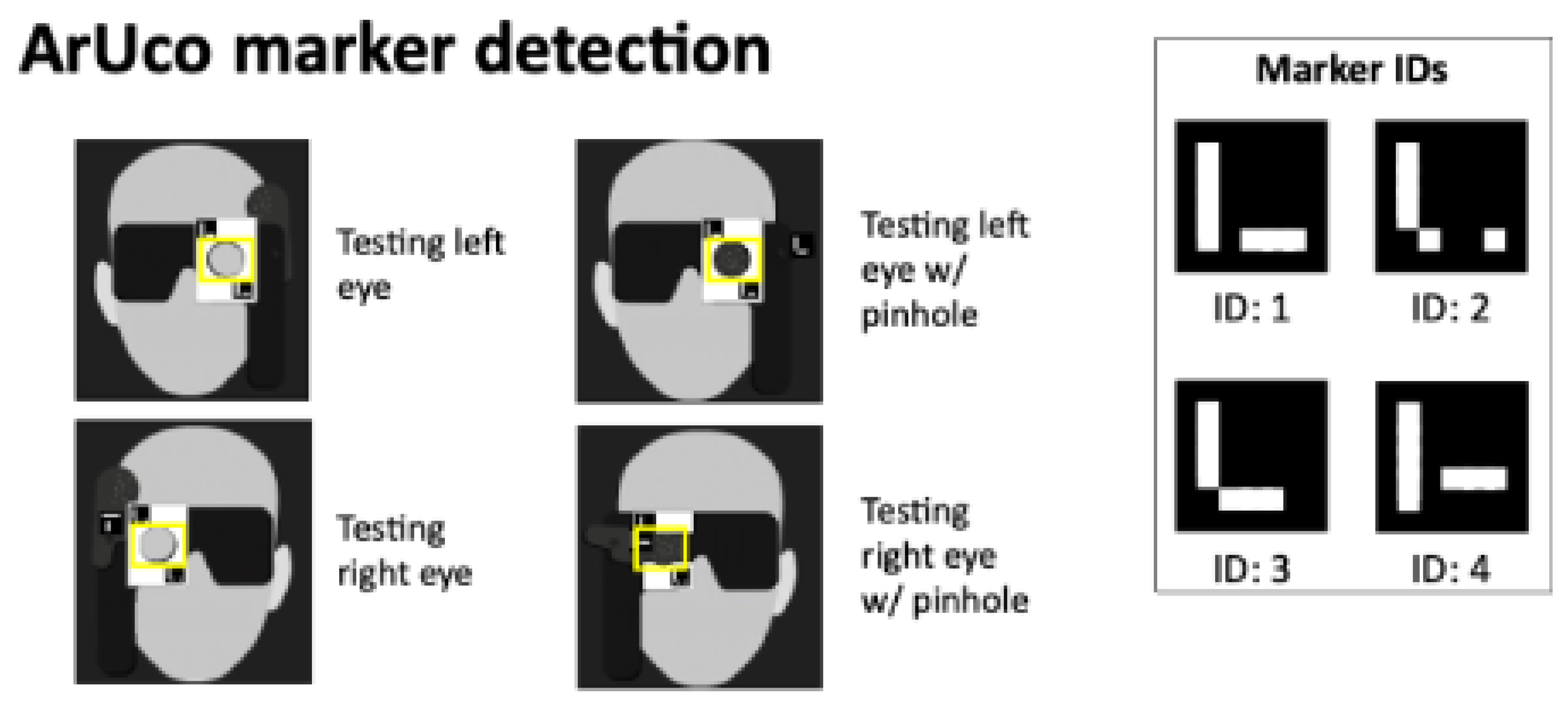
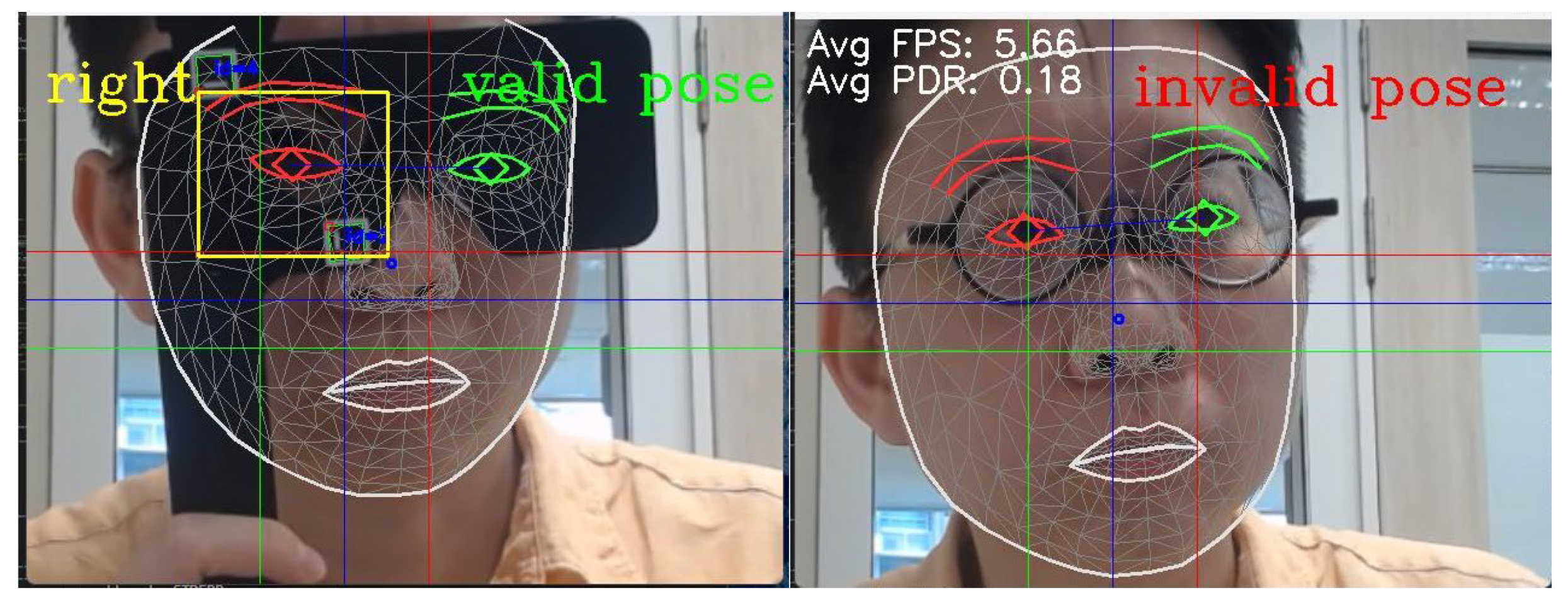
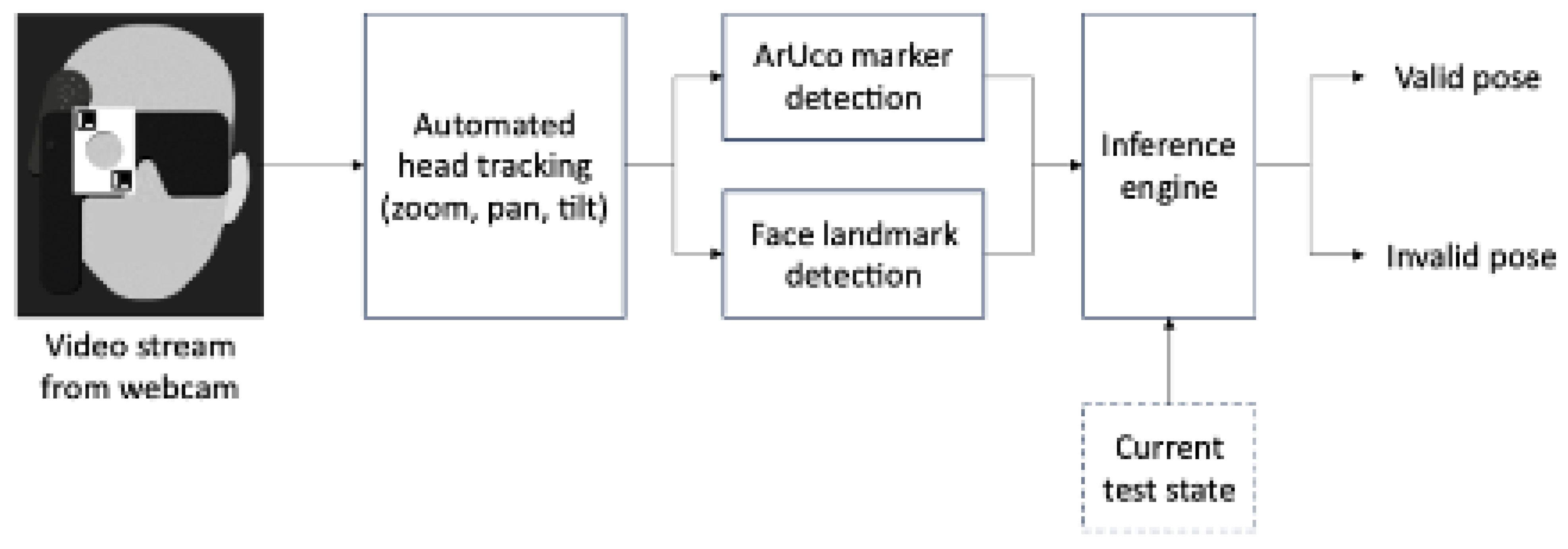
2.1.3. Face Pose Detection and Validation Engine
2.1.4. State-Driven, Adaptive Approach to Comprehensive Eye Examination
2.1.5. User Interface Development
2.2. Speech Recognition Validation
2.3. Pose Recognition Validation
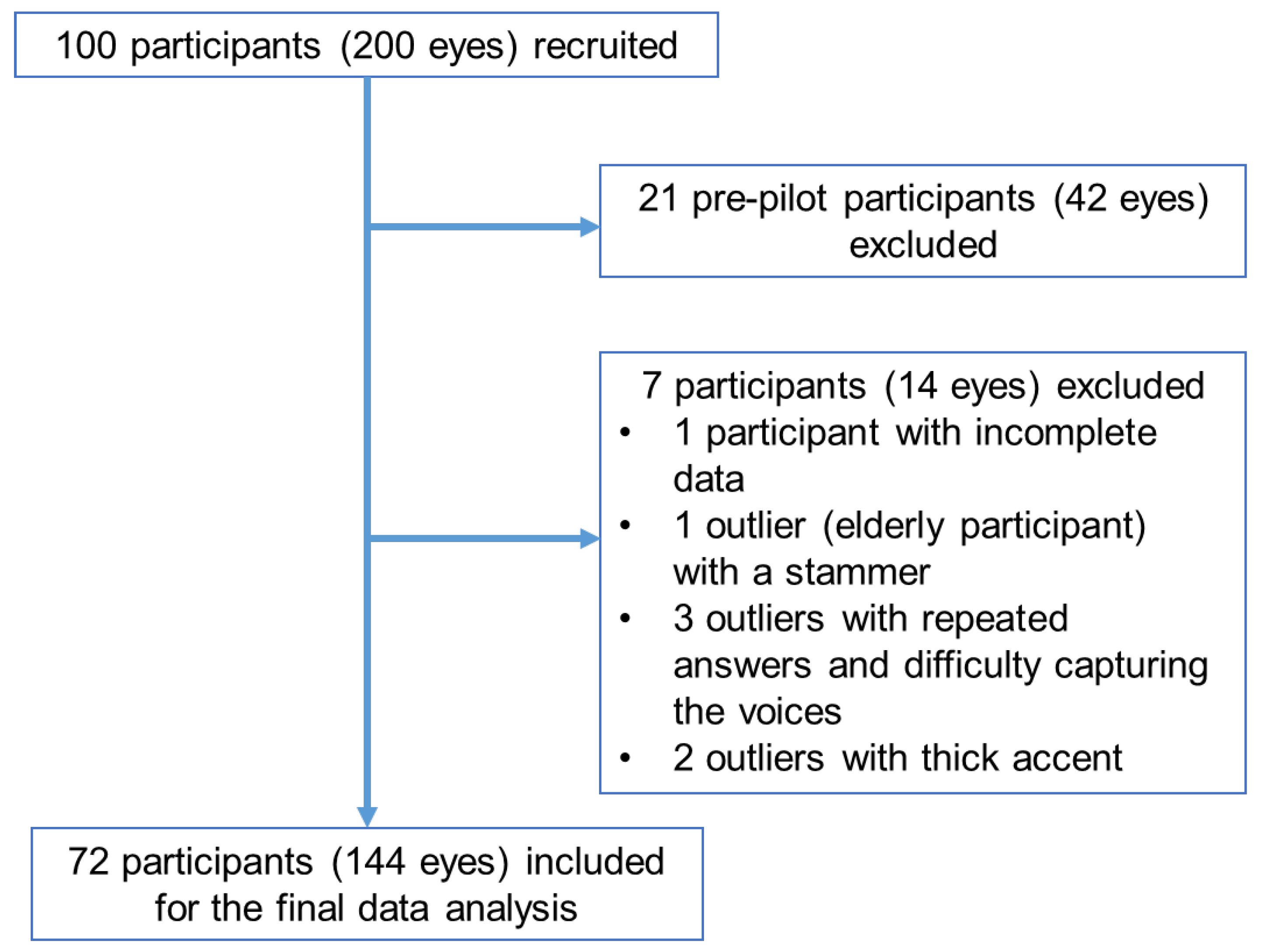
2.4. Clinical Validation Methodology
- Accuracy: Agreement between prototype and manual VA results.
- Efficiency: Time required for each test.
- User Satisfaction: Participant feedback on usability and satisfaction.
2.5. Statistical Analysis
2.6. Ethics Approval
3. Results
3.1. Laboratory Validation of Speech Recognition
3.2. Laboratory Validation of Pose Detection
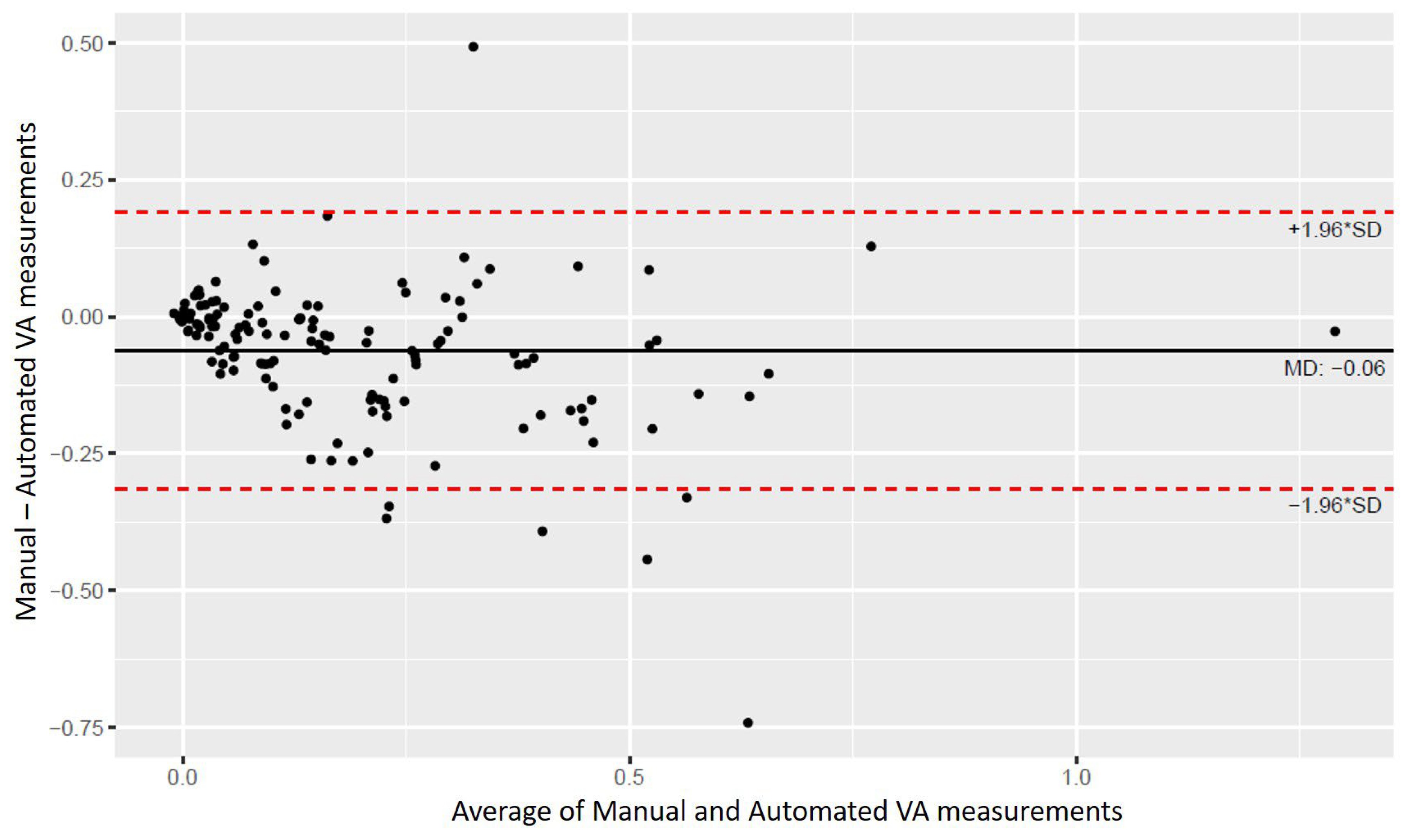
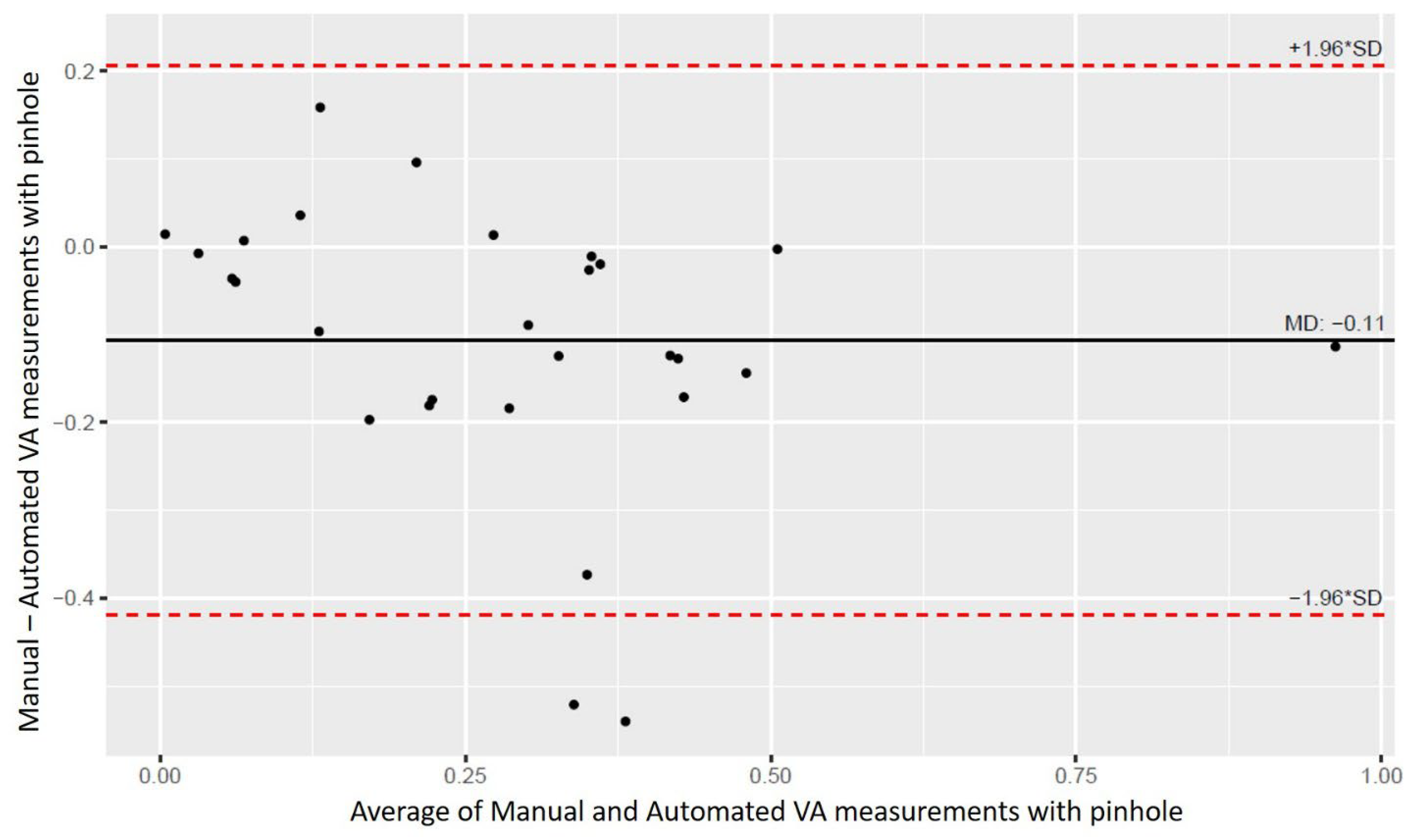
3.3. Clinical Validation
4. Discussion
4.1. Performance of the Automated VA System
4.2. Optimization of Speech Recognition
4.3. Integration of Computer Vision Techniques
4.4. Comparison with Existing Automated VA Models
4.5. Challenges in Patient Guidance and Occluder Handling
4.6. Technical and Resource Limitations
4.7. Future Directions
5. Conclusions
Supplementary Materials
Author Contributions
Funding
Institutional Review Board Statement
Informed Consent Statement
Data Availability Statement
Acknowledgments
Conflicts of Interest
References
- Chia, E.M.; Mitchell, P.; Ojaimi, E.; Rochtchina, E.; Wang, J.J. Assessment of vision-related quality of life in an older population subsample: The Blue Mountains Eye Study. Ophthalmic Epidemiol. 2006, 13, 371–377. [Google Scholar] [CrossRef] [Scilit] [PubMed]
- Kniestedt, C.; Stamper, R.L. Visual acuity and its measurement. Ophthalmol. Clin. N. Am. 2003, 16, 155–170. [Google Scholar] [CrossRef] [Scilit] [PubMed]
- Beck, R.W.; Maguire, M.G.; Bressler, N.M.; Glassman, A.R.; Lindblad, A.S.; Ferris, F.L. Visual acuity as an outcome measure in clinical trials of retinal diseases. Ophthalmology 2007, 114, 1804–1809. [Google Scholar] [CrossRef] [Scilit] [PubMed]
- Caltrider, D.; Gupta, A.; Tripathy, K. Evaluation of Visual Acuity; StatPearls Publishing: Treasure Island, FL, USA, 2024. [Google Scholar]
- Gibson, R.A.; Sanderson, H.F. Observer variation in ophthalmology. Br. J. Ophthalmol. 1980, 64, 457–460. [Google Scholar] [CrossRef] [Scilit]
- Shen, T.-W.; Hsu, H.-Y.; Chen, Y.-Z. Evaluation of Visual Acuity Measurement Based on the Mobile Virtual Reality Device. Math. Probl. Eng. 2022, 2022, 1270565. [Google Scholar] [CrossRef] [Scilit]
- Suo, L.; Ke, X.; Zhang, D.; Qin, X.; Chen, X.; Hong, Y.; Dai, W.; Wu, D.; Zhang, C.; Zhang, D. Use of Mobile Apps for Visual Acuity Assessment: Systematic Review and Meta-analysis. JMIR mHealth uHealth 2022, 10, e26275. [Google Scholar] [CrossRef] [Scilit]
- Claessens, J.L.J.; Geuvers, J.R.; Imhof, S.M.; Wisse, R.P.L. Digital Tools for the Self-Assessment of Visual Acuity: A Systematic Review. Ophthalmol. Ther. 2021, 10, 715–730. [Google Scholar] [CrossRef] [Scilit]
- Peter, E.N.; Abah, E.R.; Oladigbolu, K.K.; Samaila, E.; Garba, F.; Zubairu, A.E. Ease and Willingness to Use Smartphone Applications for Visual Acuity Assessment Among Patients in Ahmadu Bello University Teaching Hospital, Zaria. J. W. Afr. Coll. Surg. 2021, 11, 13–17. [Google Scholar] [CrossRef] [Scilit]
- Black, J.M.; Jacobs, R.J.; Phillips, G.; Chen, L.; Tan, E.; Tran, A.; Thompson, B. An assessment of the iPad as a testing platform for distance visual acuity in adults. BMJ Open 2013, 3, e002730. [Google Scholar] [CrossRef] [Scilit]
- Pang, Y.; Sparschu, L.; Nylin, E. Validation of an automated-ETDRS near and intermediate visual acuity measurement. Clin. Exp. Optom. 2020, 103, 663–667. [Google Scholar] [CrossRef] [Scilit]
- Ong, S.C.; Pek, L.C.I.; Chiang, T.L.C.; Soon, H.W.; Chua, K.C.; Sassmann, C.; Razali, M.A.B.; Koh, T.C.V. A Novel Automated Visual Acuity Test Using a Portable Head-mounted Display. Optom. Vis. Sci. 2020, 97, 591–597. [Google Scholar] [CrossRef] [Scilit]
- Cheng, C.P.; Serafini, R.A.; Labkovich, M.; Warburton, A.J.; Navarro, V.; Shaik, N.; Reddy, H.; Chelnis, J.G. Clinical report: Virtual reality enables comparable contrast sensitivity measurements to in-office testing (pilot study). Optom. Vis. Sci. 2024, 101, 124–128. [Google Scholar] [CrossRef] [Scilit] [PubMed]
- Ricci, F.; Cedrone, C.; Cerulli, L. Standardized measurement of visual acuity. Ophthalmic Epidemiol. 1998, 5, 41–53. [Google Scholar] [CrossRef] [Scilit] [PubMed]
- Jackson, A.; Bailey, I. Visual Acuity. Optom. Pract. 2004, 5, 53–68. [Google Scholar]
- Carkeet, A. Modeling logMAR visual acuity scores: Effects of termination rules and alternative forced-choice options. Optom. Vis. Sci. 2001, 78, 529–538. [Google Scholar] [CrossRef] [Scilit]
- Ferris, F.L., 3rd; Kassoff, A.; Bresnick, G.H.; Bailey, I. New visual acuity charts for clinical research. Am. J. Ophthalmol. 1982, 94, 91–96. [Google Scholar] [CrossRef] [Scilit]
- OpenAI. Whisper. Available online: https://github.com/openai/whisper (accessed on 8 October 2025).
- snakers4. Silero VAD: Pre-Trained Enterprise-Grade Voice Activity Detector. Available online: https://github.com/snakers4/silero-vad (accessed on 8 October 2025).
- Hu, E.; Shen, Y.; Wallis, P.; Allen-Zhu, Z.; Li, Y.; Wang, S.; Chen, W. LoRA: Low-Rank Adaptation of Large Language Models. arXiv 2021, arXiv:2106.09685. [Google Scholar]
- Tiew, S.; Lim, C.; Sivagnanasithiyar, T. Using an excel spreadsheet to convert Snellen visual acuity to LogMAR visual acuity. Eye 2020, 34, 2148–2149. [Google Scholar] [CrossRef] [Scilit]
- Rosser, D.A.; Laidlaw, D.A.; Murdoch, I.E. The development of a “reduced logMAR” visual acuity chart for use in routine clinical practice. Br. J. Ophthalmol. 2001, 85, 432–436. [Google Scholar] [CrossRef] [Scilit]
- Li, J.O.; Liu, H.; Ting, D.S.J.; Jeon, S.; Chan, R.V.P.; Kim, J.E.; Sim, D.A.; Thomas, P.B.M.; Lin, H.; Chen, Y.; et al. Digital technology, tele-medicine and artificial intelligence in ophthalmology: A global perspective. Prog. Retin. Eye Res. 2021, 82, 100900. [Google Scholar] [CrossRef] [Scilit]
- Tong, L.; Saw, S.M.; Chan, E.S.; Yap, M.; Lee, H.Y.; Kwang, Y.P.; Tan, D. Screening for myopia and refractive errors using LogMAR visual acuity by optometrists and a simplified visual acuity chart by nurses. Optom. Vis. Sci. 2004, 81, 684–691. [Google Scholar] [CrossRef] [Scilit] [PubMed]
- Cheng, L.; Kim, H.K. Eye screenings among Singaporeans aged 40-60 years: Formative research based on the theory of planned behaviour. Singap. Med. J. 2023, 64, 403–406. [Google Scholar] [CrossRef] [Scilit] [PubMed]
- Koenecke, A.; Nam, A.; Lake, E.; Nudell, J.; Quartey, M.; Mengesha, Z.; Toups, C.; Rickford, J.R.; Jurafsky, D.; Goel, S. Racial disparities in automated speech recognition. Proc. Natl. Acad. Sci. USA 2020, 117, 7684–7689. [Google Scholar] [CrossRef] [Scilit] [PubMed]
- Loewenstein, J.I.; Palmberg, P.F.; Connett, J.E.; Wentworth, D.N. Effectiveness of a pinhole method for visual acuity screening. Arch. Ophthalmol. 1985, 103, 222–223. [Google Scholar] [CrossRef] [Scilit]
- Thirunavukarasu, A.J.; Hassan, R.; Limonard, A.; Savant, S.V. Accuracy and reliability of self-administered visual acuity tests: Systematic review of pragmatic trials. PLoS ONE 2023, 18, e0281847. [Google Scholar] [CrossRef] [Scilit]
- Wen, J.; Yang, B.; Cui, J.; Wang, L.; Li, X. An Automated Method for Assessing Visual Acuity in Infants and Toddlers Using an Eye-Tracking System. J. Vis. Exp. 2023, 193, e65274. [Google Scholar] [CrossRef] [Scilit]
- Vrabič, N.; Juroš, B.; Tekavčič Pompe, M. Automated Visual Acuity Evaluation Based on Preferential Looking Technique and Controlled with Remote Eye Tracking. Ophthalmic Res. 2021, 64, 389–397. [Google Scholar] [CrossRef] [Scilit]
- Kumar, S.; Bulsara, M.; Yogesan, K. Automated determination of distance visual acuity: Towards teleophthalmology services. Clin. Exp. Optom. 2008, 91, 545–550. [Google Scholar] [CrossRef] [Scilit]
- MS, L.J.G.R.G.A.H.M.M. Speech recognition for control of optotype characters of the Snellen chart using LogMAR transformation. AIP Conf. Proc. 2018, 2045, 020055. [Google Scholar] [CrossRef] [Scilit]
- Taufik, D.; Hanafiah, N. AutoVAT: An Automated Visual Acuity Test Using Spoken Digit Recognition with Mel Frequency Cepstral Coefficients and Convolutional Neural Network. Procedia Comput. Sci. 2021, 179, 458–467. [Google Scholar] [CrossRef] [Scilit]
- Nisar, S.; Khan, M.-A.; Algarni, F.; Wakeel, A.; Uddin, M.-I.; Ullah, I. Speech Recognition-Based Automated Visual Acuity Testing with Adaptive Mel Filter Bank. Comput. Mater. Contin. 2022, 70, 2991–3004. [Google Scholar] [CrossRef] [Scilit]



| ID | Validity | Pose | Description |
|---|---|---|---|
| 1 | Valid | Left | Occluder covering right eye (testing left) |
| 2 | Valid | Right | Occluder covering right eye (testing right) |
| 3 | Valid | Left Pinhole | Left eye with pinhole |
| 4 | Valid | Right Pinhole | Right eye with pinhole |
| 5 | Invalid | Partial Eye Cover (L) | Occluder not fully covering left eye |
| 6 | Invalid | Partial Eye Cover (R) | Occluder not fully covering right eye |
| 7 | Invalid | Pinhole Partially Lowered (L) | Incomplete lowering of pinhole on left |
| 8 | Invalid | Pinhole Partially Lowered (R) | Incomplete lowering of pinhole on right |
| 9 | Invalid | No Occluder | Occluder not raised |
| ID | Validity | Pose | Aruco Marker IDs Detected | Final Pose |
|---|---|---|---|---|
| 1 | Valid | Left | 1 | Left |
| 2 | Valid | Right | 2 | Right |
| 3 | Valid | Left Pinhole | 1, 3 | Left_ph |
| 4 | Valid | Right Pinhole | 2, 4 | Right_ph |
| 5 | Invalid | Partial Eye Cover (L) | 1 | Invalid |
| 6 | Invalid | Partial Eye Cover (R) | 2 | Invalid |
| 7 | Invalid | Pinhole Partially Lowered (L) | 1 | Left |
| 8 | Invalid | Pinhole Partially Lowered (R) | 4 | Right |
| 9 | Invalid | No Occluder | None | Invalid |
Disclaimer/Publisher’s Note: The statements, opinions and data contained in all publications are solely those of the individual author(s) and contributor(s) and not of MDPI and/or the editor(s). MDPI and/or the editor(s) disclaim responsibility for any injury to people or property resulting from any ideas, methods, instructions or products referred to in the content. |
© 2026 by the authors. Licensee MDPI, Basel, Switzerland. This article is an open access article distributed under the terms and conditions of the Creative Commons Attribution (CC BY) license.
Share and Cite
Li, K.Z.; Oo, H.H.; Liang, K.C.W.; Ismail, N.; Chua, J.L.L.; Chng, J.J.S.; Wu, Y.; Wong, D.W.R.; Khan, S.R.; Yap, B.P.; et al. Development and Clinical Validation of an Artificial Intelligence-Based Automated Visual Acuity Testing System. Life 2026, 16, 357. https://doi.org/10.3390/life16020357
Li KZ, Oo HH, Liang KCW, Ismail N, Chua JLL, Chng JJS, Wu Y, Wong DWR, Khan SR, Yap BP, et al. Development and Clinical Validation of an Artificial Intelligence-Based Automated Visual Acuity Testing System. Life. 2026; 16(2):357. https://doi.org/10.3390/life16020357
Chicago/Turabian StyleLi, Kelvin Zhenghao, Hnin Hnin Oo, Kenneth Chee Wei Liang, Najah Ismail, Jasmine Ling Ling Chua, Jackson Jie Sheng Chng, Yang Wu, Daryl Wei Ren Wong, Sumaya Rani Khan, Boon Peng Yap, and et al. 2026. "Development and Clinical Validation of an Artificial Intelligence-Based Automated Visual Acuity Testing System" Life 16, no. 2: 357. https://doi.org/10.3390/life16020357
APA StyleLi, K. Z., Oo, H. H., Liang, K. C. W., Ismail, N., Chua, J. L. L., Chng, J. J. S., Wu, Y., Wong, D. W. R., Khan, S. R., Yap, B. P., Tong, R., Kiew, C. M., Huang, Y., Chua, C. H., Lim, A. K. S., & Fan, X. (2026). Development and Clinical Validation of an Artificial Intelligence-Based Automated Visual Acuity Testing System. Life, 16(2), 357. https://doi.org/10.3390/life16020357