SWAU-Net: Longitudinal Prediction of Geographic Atrophy via Sliding-Window Attention


Abstract
1. Introduction
1.1. Geographic Atrophy and Retinal Imaging
1.2. Spatiotemporal Deep Learning
1.3. Deep Learning for GA Detection and Forecasting
1.4. Main Contributions of Our Deep Learning Architecture
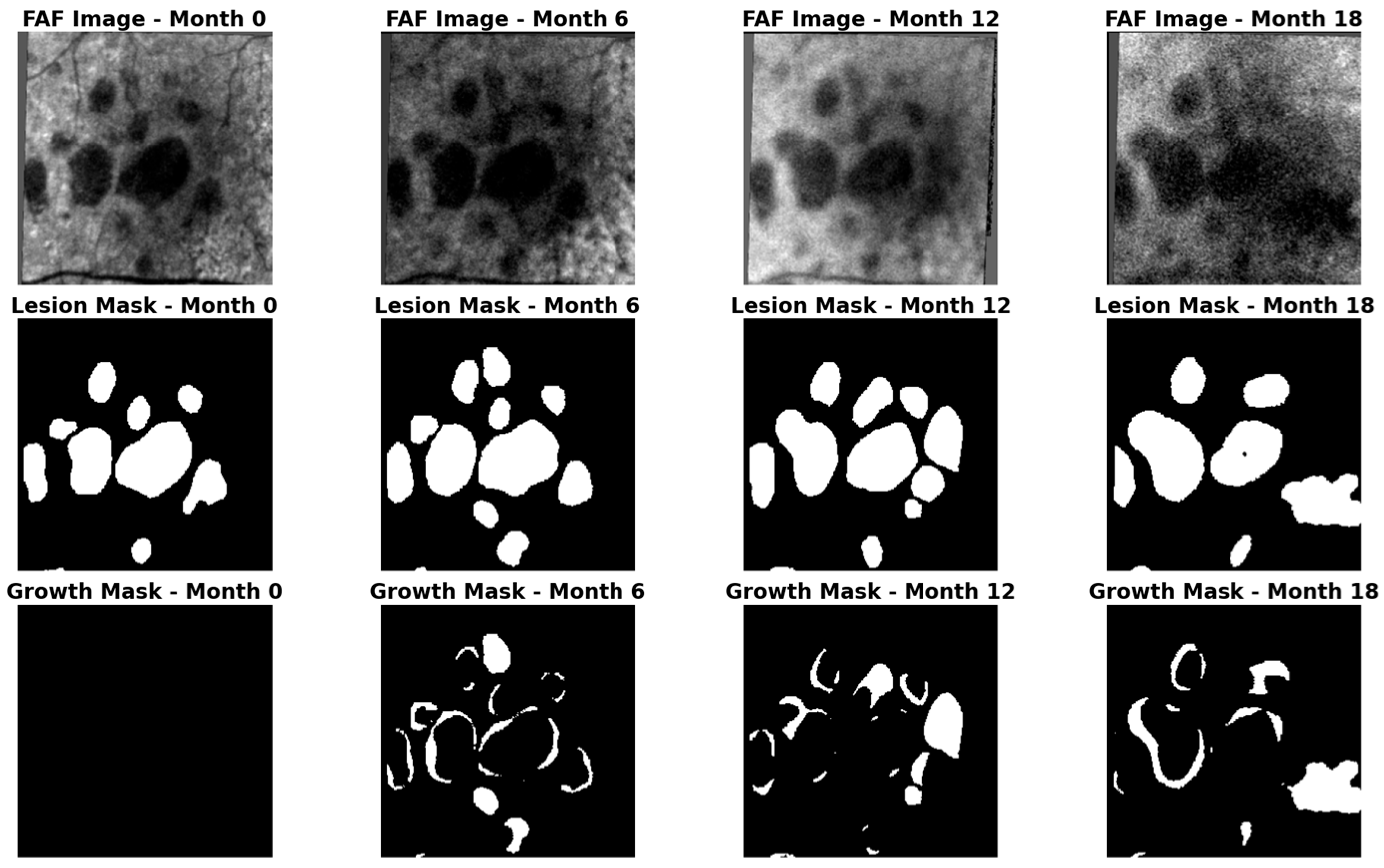
- A regularized U-Net for spatial detail: To resolve the thin, irregular structure of GA growth regions, the model’s backbone is constrained to preserve boundary detail while filtering out noise. Refined residual blocks prevent the over-smoothing of junctional zone features, ensuring the growth front remains sharp even when training data is limited [46].
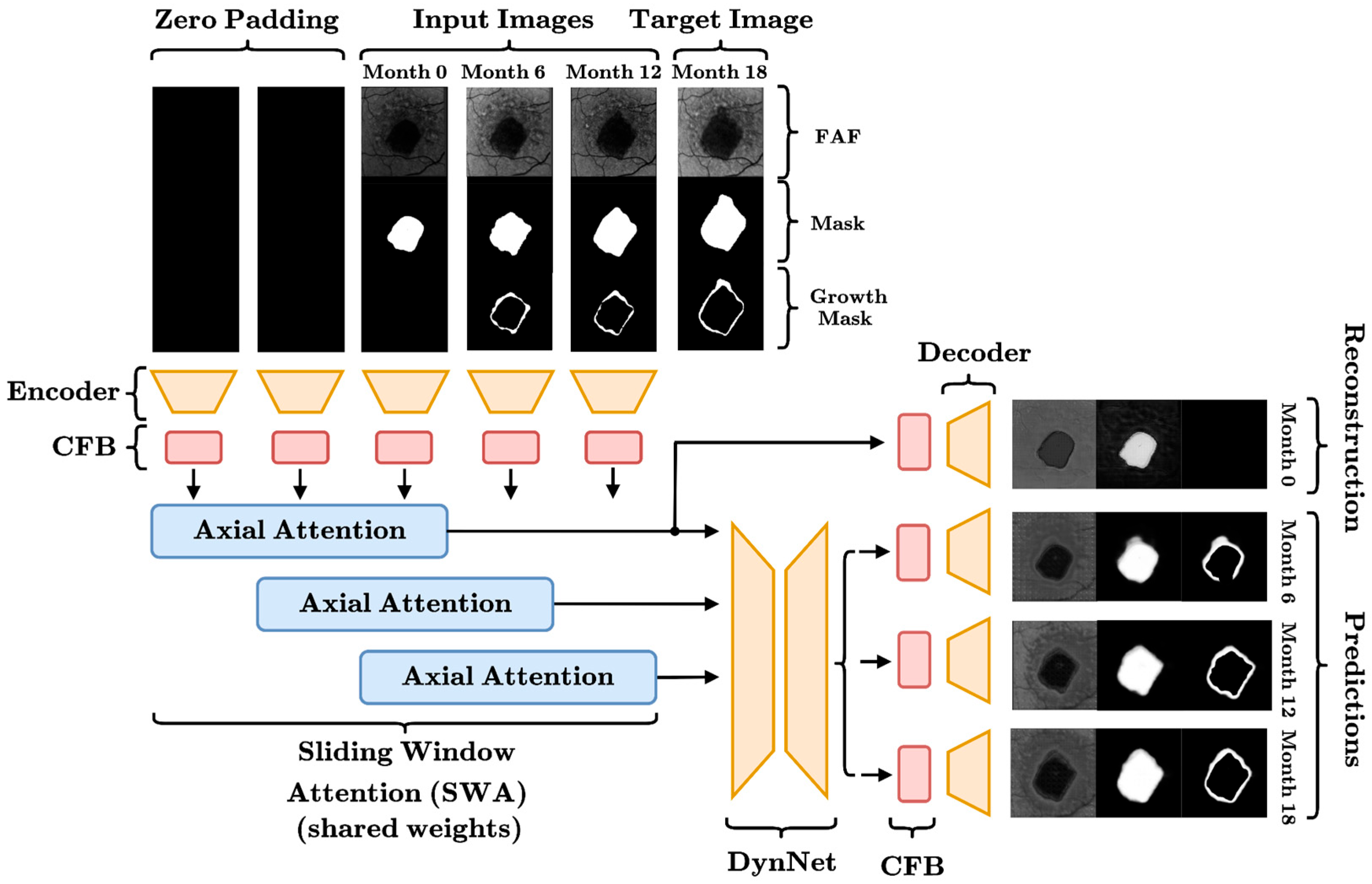
- Sliding Window Attention (SWA): To ensure the model generalizes across time, we enforce a “temporal stationarity” prior through architectural weight-sharing. By applying the same attention parameters across shifted windows, we create a structural bottleneck that prevents the model from memorizing specific visits. Instead, it is forced to learn a generalized, time-invariant transition function—effectively capturing the underlying biological “velocity” of GA expansion across the retina.
- Decoupled Dynamics Network (DynNet): We physically separate the task of identifying the current disease (state estimation) from the task of predicting future changes (evolution). By decoupling these functions, the encoder and SWA core can focus on producing a stable map of the atrophy, while a separate module (DynNet) is dedicated purely to modeling how those features evolve over time.
1.5. Study Objectives
2. Materials and Methods
2.1. Data
2.2. Hybrid Encoder–Decoder Architecture and Feature Regularization
2.3. SWA for Temporal Aggregation
- Feature Extraction: The encoder extracts raw spatial features from the FAF and masks.
- Semantic Alignment: The CFB refines these features into a semantically aligned disease representation ().
- Windowed Aggregation: The SWA module applies the weight-shared attention block across a sliding window of three consecutive visits to construct the integrated temporal state.
- —utilized to predict the state at Month 6.
- —utilized to predict the state at Month 12.
- —utilized to predict the state at Month 18.
2.4. State Evolution and Frame Prediction
2.5. Synthetic Pretraining via Anisotropic Growth Simulation
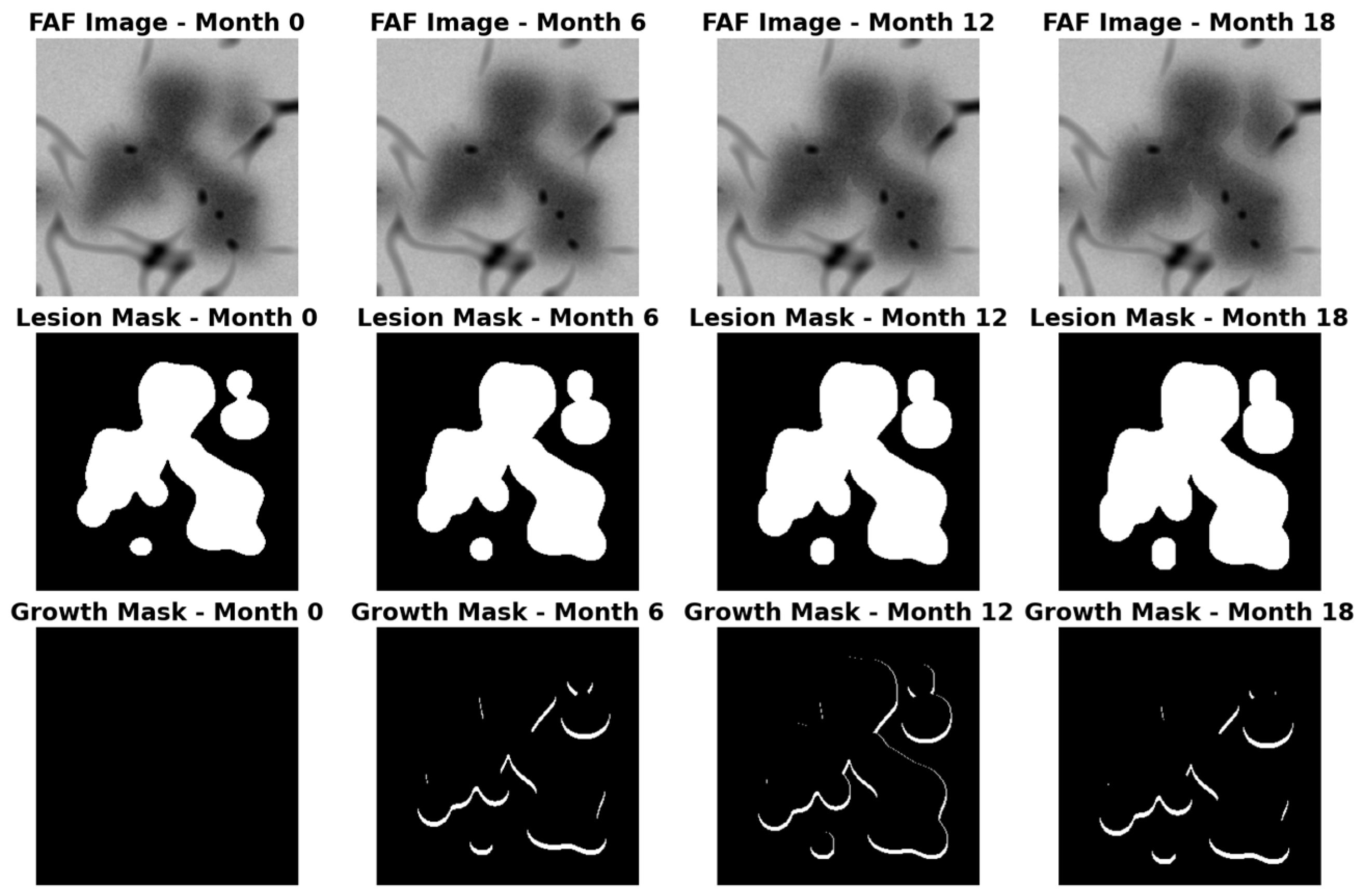
- Mask Generation: Lesion masks are initialized by thresholding multi-peak Gaussian fields, then expanded through anisotropic directional dilation combined with stochastic erosion/dilation cycles. This mimics the non-uniform growth of clinical GA, where lesions often expand more rapidly in areas of hyperautofluorescence while remaining stable in others. This process generates realistic, jagged growth boundaries that specifically mimic the irregular, directional nature of clinical GA progression, enforcing a high-frequency boundary prior.
- FAF Realism: The simulator incorporates clinical artifacts such as vein-like structures and peripheral noise to ensure the model learns features robust to real-world image interference. This ensures the attention mechanism learns to ignore non-pathological dark structures (like blood vessels) that can mimic the appearance of GA in FAF imaging.
2.6. Loss Formulation and Training Strategy
3. Experiments
3.1. Experimental Setup
3.2. Results
4. Discussion and Conclusions
Author Contributions
Funding
Institutional Review Board Statement
Informed Consent Statement
Data Availability Statement
Conflicts of Interest
References
- Fleckenstein, M.; Schmitz-Valckenberg, S.; Chakravarthy, U. Age-Related Macular Degeneration: A Review. JAMA 2024, 331, 147–157. [Google Scholar] [CrossRef] [Scilit]
- Bakri, S.J.; Bektas, M.; Sharp, D.; Luo, R.; Sarda, S.P.; Khan, S. Geographic Atrophy: Mechanism of Disease, Pathophysiology, and Role of the Complement System. J. Manag. Care Spec. Pharm. 2023, 29, S2–S11. [Google Scholar] [CrossRef] [Scilit]
- Li, M.; Huisingh, C.; Messinger, J.; Dolz-Marco, R.; Ferrara, D.; Freund, K.B.; Curcio, C.A. Histology of Geographic Atrophy Secondary to Age-Related Macular Degeneration: A Multilayer Approach. Retina 2018, 38, 1937–1953. [Google Scholar] [CrossRef] [Scilit] [PubMed]
- Sohn, E.H.; Flamme-Wiese, M.J.; Whitmore, S.S.; Workalemahu, G.; Marneros, A.G.; Boese, E.A.; Kwon, Y.H.; Wang, K.; Abramoff, M.D.; Tucker, B.A.; et al. Choriocapillaris Degeneration in Geographic Atrophy. Am. J. Pathol. 2019, 189, 1473–1480. [Google Scholar] [CrossRef] [Scilit]
- Wong, W.L.; Su, X.; Li, X.; Cheung, C.M.G.; Klein, R.; Cheng, C.-Y.; Wong, T.Y. Global Prevalence of Age-Related Macular Degeneration and Disease Burden Projection for 2020 and 2040: A Systematic Review and Meta-Analysis. Lancet Glob. Health 2014, 2, e106–e116. [Google Scholar] [CrossRef] [Scilit] [PubMed]
- Friedman, D.S.; O’Colmain, B.J.; Muñoz, B.; Tomany, S.C.; McCarty, C.; de Jong, P.T.V.M.; Nemesure, B.; Mitchell, P.; Kempen, J. Eye Diseases Prevalence Research Group Prevalence of Age-Related Macular Degeneration in the United States. Arch. Ophthalmol. 2004, 122, 564–572. [Google Scholar] [CrossRef] [Scilit] [PubMed]
- Sunness, J.S.; Margalit, E.; Srikumaran, D.; Applegate, C.A.; Tian, Y.; Perry, D.; Hawkins, B.S.; Bressler, N.M. The Long-Term Natural History of Geographic Atrophy from Age-Related Macular Degeneration. Ophthalmology 2007, 114, 271–277. [Google Scholar] [CrossRef] [Scilit]
- Fleckenstein, M.; Mitchell, P.; Freund, K.B.; Sadda, S.; Holz, F.G.; Brittain, C.; Henry, E.C.; Ferrara, D. The Progression of Geographic Atrophy Secondary to Age-Related Macular Degeneration. Ophthalmology 2018, 125, 369–390. [Google Scholar] [CrossRef] [Scilit]
- Schmitz-Valckenberg, S.; Nadal, J.; Fimmers, R.; Lindner, M.; Holz, F.G.; Schmid, M.; Fleckenstein, M. FAM Study Group. Modeling Visual Acuity in Geographic Atrophy Secondary to Age-Related Macular Degeneration. Ophthalmologica 2016, 235, 215–224. [Google Scholar] [CrossRef] [Scilit]
- Huang, A.; Wu, Z.; Ansari, G.; Von Der Emde, L.; Pfau, M.; Schmitz-Valckenberg, S.; Fleckenstein, M.; Keenan, T.D.L.; Sadda, S.R.; Guymer, R.H.; et al. Geographic Atrophy: Understanding the Relationship between Structure and Function. Asia-Pac. J. Ophthalmol. 2025, 14, 100207. [Google Scholar] [CrossRef] [Scilit]
- Sparrow, J.R. Bisretinoids of RPE Lipofuscin: Trigger for Complement Activation in Age-Related Macular Degeneration. Adv. Exp. Med. Biol. 2010, 703, 63–74. [Google Scholar] [CrossRef] [Scilit]
- Ferrara, D.; Silver, R.E.; Louzada, R.N.; Novais, E.A.; Collins, G.K.; Seddon, J.M. Optical Coherence Tomography Features Preceding the Onset of Advanced Age-Related Macular Degeneration. Investig. Ophthalmol. Vis. Sci. 2017, 58, 3519–3529. [Google Scholar] [CrossRef] [Scilit]
- Papaioannou, C. Advancements in the Treatment of Age-Related Macular Degeneration: A Comprehensive Review. Postgrad. Med. J. 2024, 100, 445–450. [Google Scholar] [CrossRef] [Scilit]
- Holz, F.G.; Bindewald-Wittich, A.; Fleckenstein, M.; Dreyhaupt, J.; Scholl, H.P.N.; Schmitz-Valckenberg, S.; FAM-Study Group. Progression of Geographic Atrophy Impact of Fundus Autofluorescence Patterns in Age-Related Macular Degeneration. Am. J. Ophthalmol. 2007, 143, 463–472. [Google Scholar] [CrossRef] [Scilit] [PubMed]
- Bindewald, A.; Schmitz-Valckenberg, S.; Jorzik, J.J.; Dolar-Szczasny, J.; Sieber, H.; Keilhauer, C.; Weinberger, A.W.A.; Dithmar, S.; Pauleikhoff, D.; Mansmann, U.; et al. Classification of Abnormal Fundus Autofluorescence Patterns in the Junctional Zone of Geographic Atrophy in Patients with Age Related Macular Degeneration. Br. J. Ophthalmol. 2005, 89, 874–878. [Google Scholar] [CrossRef] [Scilit] [PubMed]
- Shi, X.; Chen, Z.; Wang, H.; Yeung, D.-Y.; Wong, W.; Woo, W. Convolutional LSTM Network: A Machine Learning Approach for Precipitation Nowcasting. In Proceedings of the 29th International Conference on Neural Information Processing Systems—Volume 1, Montreal, QC, Canada, 7–12 December 2015. [Google Scholar]
- Tran, D.; Bourdev, L.; Fergus, R.; Torresani, L.; Paluri, M. Learning Spatiotemporal Features with 3D Convolutional Networks. In Proceedings of the 2015 IEEE International Conference on Computer Vision, Santiago, Chile, 7–13 December 2015. [Google Scholar]
- Dosovitskiy, A.; Beyer, L.; Kolesnikov, A.; Weissenborn, D.; Zhai, X.; Unterthiner, T.; Dehghani, M.; Minderer, M.; Heigold, G.; Gelly, S.; et al. An Image Is Worth 16x16 Words: Transformers for Image Recognition at Scale. In Proceedings of the International Conference on Learning Representations, Online, 3 June 2021. [Google Scholar]
- Bertasius, G.; Wang, H.; Torresani, L. Is Space-Time Attention All You Need for Video Understanding? In Proceedings of the 38th International Conference on Machine Learning, (ICML), Online, 18–24 July 2021; Proceedings of Machine Learning Research: New York, NY, USA, 2021. [Google Scholar]
- Chen, J.; Lu, Y.; Yu, Q.; Luo, X.; Adeli, E.; Wang, Y.; Lu, L.; Yuille, A.L.; Zhou, Y. TransUNet: Transformers Make Strong Encoders for Medical Image Segmentation. arXiv 2021, arXiv:2102.04306. [Google Scholar] [CrossRef] [Scilit]
- Valanarasu, J.M.J.; Oza, P.; Hacihaliloglu, I.; Patel, V.M. Medical Transformer: Gated Axial-Attention for Medical Image Segmentation. In Medical Image Computing and Computer Assisted Intervention—MICCAI 2021; Springer: Cham, Switzerland, 2021. [Google Scholar] [CrossRef] [Scilit]
- Gao, Y.; Zhou, M.; Metaxas, D. UTNet: A Hybrid Transformer Architecture for Medical Image Segmentation. In International Conference on Medical Image Computing and Computer-Assisted Intervention; Springer: Cham, Switzerland, 2021. [Google Scholar] [CrossRef] [Scilit]
- Liu, Z.; Lin, Y.; Cao, Y.; Hu, H.; Wei, Y.; Zhang, Z.; Lin, S.; Guo, B. Swin Transformer: Hierarchical Vision Transformer Using Shifted Windows. In Proceedings of the 2021 IEEE/CVF International Conference on Computer Vision (ICCV), Online, 11–17 October 2021. [Google Scholar]
- Cao, H.; Wang, Y.; Chen, J.; Jiang, D.; Zhang, X.; Tian, Q.; Wang, M. Swin-Unet: Unet-like Pure Transformer for Medical Image Segmentation. In European Conference on Computer Vision 2022 Workshops; Springer: Cham, Switzerland, 2022. [Google Scholar] [CrossRef] [Scilit]
- Li, K.; Wang, Y.; Zhang, J.; Gao, P.; Song, G.; Liu, Y.; Li, H.; Qiao, Y. UniFormer: Unifying Convolution and Self-Attention for Visual Recognition. IEEE Trans. Pattern Anal. Mach. Intell. 2023, 45, 12581–12600. [Google Scholar] [CrossRef] [Scilit]
- Fan, H.; Xiong, B.; Mangalam, K.; Li, Y.; Yan, Z.; Malik, J.; Feichtenhofer, C. Multiscale Vision Transformers. In Proceedings of the IEEE/CVF International Conference on Computer Vision, Montreal, BC, Canada, 11–17 October 2021; IEEE: New York, NY, USA, 2021. [Google Scholar]
- Shi, X.; Keenan, T.D.L.; Chen, Q.; Silva, T.D.; Thavikulwat, A.T.; Broadhead, G.; Bhandari, S.; Cukras, C.; Chew, E.Y.; Lu, Z. Improving Interpretability in Machine Diagnosis: Detection of Geographic Atrophy in OCT Scans. Ophthalmol. Sci. 2021, 1, 100038. [Google Scholar] [CrossRef] [Scilit]
- Yao, H.; Wu, Z.; Gao, S.S.; Guymer, R.H.; Steffen, V.; Chen, H.; Hejrati, M.; Zhang, M. Deep Learning Approaches for Detecting of Nascent Geographic Atrophy in Age-Related Macular Degeneration. Ophthalmol. Sci. 2024, 4, 100428. [Google Scholar] [CrossRef] [Scilit] [PubMed]
- Spaide, T.; Jiang, J.; Patil, J.; Anegondi, N.; Steffen, V.; Kawczynski, M.G.; Newton, E.M.; Rabe, C.; Gao, S.S.; Lee, A.Y.; et al. Geographic Atrophy Segmentation Using Multimodal Deep Learning. Transl. Vis. Sci. Technol. 2023, 12, 10. [Google Scholar] [CrossRef] [Scilit]
- Dow, E.R.; Jeong, H.K.; Katz, E.A.; Toth, C.A.; Wang, D.; Lee, T.; Kuo, D.; Allingham, M.J.; Hadziahmetovic, M.; Mettu, P.S.; et al. A Deep-Learning Algorithm to Predict Short-Term Progression to Geographic Atrophy on Spectral-Domain Optical Coherence Tomography. JAMA Ophthalmol. 2023, 141, 1052–1061. [Google Scholar] [CrossRef] [Scilit] [PubMed]
- Elsawy, A.; Keenan, T.D.L.; Chen, Q.; Shi, X.; Thavikulwat, A.T.; Bhandari, S.; Chew, E.Y.; Lu, Z. Deep-GA-Net for Accurate and Explainable Detection of Geographic Atrophy on OCT Scans. Ophthalmol. Sci. 2023, 3, 100311. [Google Scholar] [CrossRef] [Scilit]
- Hu, Z.; Wang, Z.; Sadda, S.R. Automated Segmentation of Geographic Atrophy Using Deep Convolutional Neural Networks. In Proceedings of the Medical Imaging 2018: Computer-Aided Diagnosis; SPIE: Bellingham, WA, USA, 2018; Volume 10575, pp. 229–237. [Google Scholar] [CrossRef] [Scilit]
- Wang, Z.; Sadda, S.R.; Hu, Z. Deep Learning for Automated Screening and Semantic Segmentation of Age-Related and Juvenile Atrophic Macular Degeneration. In Proceedings of the Medical Imaging 2019: Computer-Aided Diagnosis; SPIE: Bellingham, WA, USA, 2019; Volume 10950, pp. 447–455. [Google Scholar] [CrossRef] [Scilit]
- Saha, S.; Wang, Z.; Sadda, S.; Kanagasingam, Y.; Hu, Z. Visualizing and Understanding Inherent Features in SD-OCT for the Progression of Age-Related Macular Degeneration Using Deconvolutional Neural Networks. Appl. AI Lett. 2020, 1, e16. [Google Scholar] [CrossRef] [Scilit]
- Wang, Z.; Sadda, S.R.; Lee, A.; Hu, Z.J. Automated Segmentation and Feature Discovery of Age-Related Macular Degeneration and Stargardt Disease via Self-Attended Neural Networks. Sci. Rep. 2022, 12, 14565. [Google Scholar] [CrossRef] [Scilit]
- Hu, Z.; Medioni, G.G.; Hernandez, M.; Hariri, A.; Wu, X.; Sadda, S.R. Segmentation of the Geographic Atrophy in Spectral-Domain Optical Coherence Tomography and Fundus Autofluorescence Images. Investig. Ophthalmol. Vis. Sci. 2013, 54, 8375–8383. [Google Scholar] [CrossRef] [Scilit] [PubMed]
- Mishra, Z.; Wang, Z.C.; Xu, E.; Xu, S.; Majid, I.; Sadda, S.R.; Hu, Z.J. Recurrent and Concurrent Prediction of Longitudinal Progression of Stargardt Atrophy and Geographic Atrophy towards Comparative Performance on Optical Coherence Tomography as on Fundus Autofluorescence. Appl. Sci. 2024, 14, 7773. [Google Scholar] [CrossRef] [Scilit]
- Yoshida, K.; Anegondi, N.; Pely, A.; Zhang, M.; Debraine, F.; Ramesh, K.; Steffen, V.; Gao, S.S.; Cukras, C.; Rabe, C.; et al. Deep Learning Approaches to Predict Geographic Atrophy Progression Using Three-Dimensional OCT Imaging. Transl. Vis. Sci. Technol. 2025, 14, 11. [Google Scholar] [CrossRef] [Scilit]
- Mai, J.; Lachinov, D.; Reiter, G.S.; Riedl, S.; Grechenig, C.; Bogunovic, H.; Schmidt-Erfurth, U. Deep Learning-Based Prediction of Individual Geographic Atrophy Progression from a Single Baseline OCT. Ophthalmol. Sci. 2024, 4, 100466. [Google Scholar] [CrossRef] [Scilit]
- Zhou, Z.; Siddiquee, M.M.R.; Tajbakhsh, N.; Liang, J. UNet++: A Nested U-Net Architecture for Medical Image Segmentation. In Deep Learning in Medical Image Analysis and Multimodal Learning for Clinical Decision Support: 4th International Workshop, DLMIA 2018, and 8th International Workshop, ML-CDS 2018, Held in Conjunction with MICCAI 2018, Granada, Spain, 20 September 2018; Springer: Berlin/Heidelberg, Germany, 2018. [Google Scholar] [CrossRef] [Scilit]
- Oktay, O.; Schlemper, J.; Folgoc, L.L.; Lee, M.; Heinrich, M.; Misawa, K.; Mori, K.; McDonagh, S.; Hammerla, N.Y.; Kainz, B.; et al. Attention U-Net: Learning Where to Look for the Pancreas. In Proceedings of the 1st Conference on Medical Imaging with Deep Learning (MIDL 2018), Amsterdam, The Netherlands, 4–6 July 2018. [Google Scholar]
- Woo, S.; Park, J.; Lee, J.-Y.; Kweon, I.S. CBAM: Convolutional Block Attention Module. In Proceedings of the European Conference on Computer Vision (ECCV 2018), Munich, Germany, 8–14 September 2018. [Google Scholar] [CrossRef] [Scilit]
- Schlemper, J.; Oktay, O.; Schaap, M.; Heinrich, M.; Kainz, B.; Glocker, B.; Rueckert, D. Attention Gated Networks: Learning to Leverage Salient Regions in Medical Images. Med. Image Anal. 2019, 53, 197–207. [Google Scholar] [CrossRef] [Scilit]
- Vaswani, A.; Shazeer, N.; Parmar, N.; Uszkoreit, J.; Jones, L.; Gomez, A.N.; Kaiser, L.; Polosukhin, I. Attention Is All You Need. In Proceedings of the Advances in Neural Information Processing Systems 2017, Long Beach, CA, USA, 4–9 December 2017; Curran Assoc, Inc.: Red Hook, NY, USA, 2017; Volume 30. [Google Scholar]
- Tay, Y.; Dehghani, M.; Bahri, D.; Metzler, D. Efficient Transformers: A Survey. ACM Comput. Surv. 2022, 55, 1–28. [Google Scholar] [CrossRef] [Scilit]
- Racioppo, P.; Alhasany, A.; Pham, N.V.; Wang, Z.; Corradetti, G.; Mikaelian, G.; Paulus, Y.M.; Sadda, S.R.; Hu, Z. Automated Foveal Avascular Zone Segmentation in Optical Coherence Tomography Angiography Across Multiple Eye Diseases Using Knowledge Distillation. Bioengineering 2025, 12, 334. [Google Scholar] [CrossRef] [Scilit] [PubMed]
- Lindner, M.; Böker, A.; Mauschitz, M.M.; Göbel, A.P.; Fimmers, R.; Brinkmann, C.K.; Schmitz-Valckenberg, S.; Schmid, M.; Holz, F.G.; Fleckenstein, M.; et al. Directional Kinetics of Geographic Atrophy Progression in Age-Related Macular Degeneration with Foveal Sparing. Ophthalmology 2015, 122, 1356–1365. [Google Scholar] [CrossRef] [Scilit]
- Sadda, S.R.; Guymer, R.; Holz, F.G.; Schmitz-Valckenberg, S.; Curcio, C.A.; Bird, A.C.; Blodi, B.A.; Bottoni, F.; Chakravarthy, U.; Chew, E.Y.; et al. Consensus Definition for Atrophy Associated with Age-Related Macular Degeneration on OCT: Classification of Atrophy Report 3. Ophthalmology 2018, 125, 537–548. [Google Scholar] [CrossRef] [Scilit]
- Pilotto, E.; Guidolin, F.; Convento, E.; Spedicato, L.; Vujosevic, S.; Cavarzeran, F.; Midena, E. Fundus Autofluorescence and Microperimetry in Progressing Geographic Atrophy Secondary to Age-Related Macular Degeneration. Br. J. Ophthalmol. 2013, 97, 622–626. [Google Scholar] [CrossRef] [Scilit] [PubMed]
- Csaky, K.G.; Patel, P.J.; Sepah, Y.J.; Birch, D.G.; Do, D.V.; Ip, M.S.; Guymer, R.H.; Luu, C.D.; Gune, S.; Lin, H.; et al. Microperimetry for Geographic Atrophy Secondary to Age-Related Macular Degeneration. Surv. Ophthalmol. 2019, 64, 353–364. [Google Scholar] [CrossRef] [Scilit] [PubMed]



| Model/ Ablation Name | Core Modification | Primary Hypothesis Tested |
|---|---|---|
| No Spatial Attention | Removes all Spatial Self-Attention layers within the Encoder and DynNet. | Tests the contribution of non-local pixel interactions vs. purely local convolutional processing in maintaining feature fidelity. |
| No Channel Fusion Bottleneck | Replaces all Channel Fusion Bottleneck (CFB) blocks with simple residual skips and concatenation. | Tests the importance of explicit semantic alignment of multi-modal input features (FAF, GA Mask, Growth Mask). |
| SWA Ablation 1 (Standard Attention) | Replaces SWA with Standard Causal Axial Attention (non–weight-shared). | Tests whether SWA’s temporal-stationarity prior (via weight-sharing) is needed to prevent highly expressive but unregularized Transformers from overfitting small datasets. |
| SWA Ablation 2 (Temporal Aggregator) | Replaces SWA with a simple convolutional aggregator (feature concatenation) at L1–L3. | Tests whether the stable CNN backbone (DynNet-based decomposition) alone is sufficient, or if explicit attention-based temporal aggregation is required. |
| SWA Ablation 3 (ConvLSTM) | Replaces the entire SWA core with a sequence of standard ConvLSTM cells, but retains spatial attention and CFB. | Tests whether our decoupled hybrid architecture (CNN → Attention → DynNet) provides stability or expressivity benefits over conventional coupled ConvLSTM approaches. |
| No DynNet | Removes the Dynamics Network (DynNet) and reconstruction loss, and predicts directly from the estimated state. | Tests whether the explicit separation of state estimation and temporal evolution acts as a regularizer against the entanglement of spatial noise and temporal forecasting. |
| No Synthetic Pretraining | Skips phase 1 of training and initializes the model directly on the small clinical dataset. | Tests whether establishing a strong, generalized prior (especially for high-frequency boundaries) is required for Transformer components to converge effectively in the target domain. |
| No Data Augmentation | Removes online data augmentation, including FAF intensity jitter and noise, and geometric transformations (flips, rotations, etc.). | Tests whether online data augmentation is necessary to stabilize attention-based layers on the small clinical dataset. |
| Model | Mask DSC (Mean ± SD) | Growth Mask DSC (Mean ± SD) |
|---|---|---|
| SWAU Net | 0.94 ± 0.01 | 0.66 ± 0.01 |
| Spatial Attention Ablation | 0.94 ± 0.01 | 0.64 ± 0.01 |
| CFB Ablation * | 0.92 ± 0.01 | 0.53 ± 0.02 |
| SWA Ablation 1 (Standard Attention) * | 0.92 ± 0.02 | 0.52 ± 0.02 |
| SWA Ablation 2 (Temporal Aggregator) | 0.94 ± 0.01 | 0.63 ± 0.01 |
| SWA Ablation 3 (Attention-ConvLSTM) | 0.94 ± 0.01 | 0.66 ± 0.01 |
| DynNet Ablation | 0.94 ± 0.01 | 0.63 ± 0.03 |
| No Synthetic Pretraining | 0.94 ± 0.01 | 0.64 ± 0.02 |
| No Data Augmentation | 0.94 ± 0.02 | 0.63 ± 0.04 |
| Model | p-Value |
|---|---|
| SWAU Net vs. Spatial Attention Ablation | 0.0254 |
| SWAU Net vs. CFB Ablation | 0.0005 |
| SWAU Net vs. SWA Ablation 1 (Standard Attention) | 0.0002 |
| SWAU Net vs. SWA Ablation 2 (Temporal Aggregator) | 0.0116 |
| SWAU Net vs. SWA Ablation 3 (Attention-ConvLSTM) | 0.9899 |
| SWAU Net vs. DynNet Ablation | 0.1187 |
| SWAU Net vs. No Synthetic Pretraining | 0.0109 |
| SWAU Net vs. No Augmentation | 0.1415 |
Disclaimer/Publisher’s Note: The statements, opinions and data contained in all publications are solely those of the individual author(s) and contributor(s) and not of MDPI and/or the editor(s). MDPI and/or the editor(s) disclaim responsibility for any injury to people or property resulting from any ideas, methods, instructions or products referred to in the content. |
© 2026 by the authors. Licensee MDPI, Basel, Switzerland. This article is an open access article distributed under the terms and conditions of the Creative Commons Attribution (CC BY) license.
Share and Cite
Racioppo, P.; Wang, Z.C.; Sadda, S.R.; Hu, Z.J. SWAU-Net: Longitudinal Prediction of Geographic Atrophy via Sliding-Window Attention. Life 2026, 16, 303. https://doi.org/10.3390/life16020303
Racioppo P, Wang ZC, Sadda SR, Hu ZJ. SWAU-Net: Longitudinal Prediction of Geographic Atrophy via Sliding-Window Attention. Life. 2026; 16(2):303. https://doi.org/10.3390/life16020303
Chicago/Turabian StyleRacioppo, Peter, Ziyuan Chris Wang, SriniVas R. Sadda, and Zhihong Jewel Hu. 2026. "SWAU-Net: Longitudinal Prediction of Geographic Atrophy via Sliding-Window Attention" Life 16, no. 2: 303. https://doi.org/10.3390/life16020303
APA StyleRacioppo, P., Wang, Z. C., Sadda, S. R., & Hu, Z. J. (2026). SWAU-Net: Longitudinal Prediction of Geographic Atrophy via Sliding-Window Attention. Life, 16(2), 303. https://doi.org/10.3390/life16020303