

Preliminary Identification of Putative Terpene Synthase Genes in Caryocar brasiliense and Chemical Analysis of Major Components in the Fruit Exocarp

 , , , and
Abstract
1. Introduction
2. Materials and Methods
2.1. Sequence Retrieval and Identification of Putative Terpene Synthase Genes
2.2. Phylogenetic Analyses
2.3. Solid-Phase Microextraction Gas Chromatography–Mass Spectrometry
3. Results and Discussion
4. Conclusions
Author Contributions
Funding
Institutional Review Board Statement
Informed Consent Statement
Data Availability Statement
Conflicts of Interest
References
- Damasco, G.; Fontes, C.; Françoso, R.; Haidar, R. The Cerrado biome: A forgotten biodiversity hotspot. Front. Young Minds 2018, 6, 22. [Google Scholar] [CrossRef]
- Araujo, F.D. A review of Caryocar brasiliense (Caryocaraceae)—An economically valuable species of the central Brazilian cerrado. Econ. Bot. 1995, 49, 40–48. [Google Scholar] [CrossRef]
- De Carvalho, L.S.; Pereira, K.F.; de Araújo, E.G. Botanical features, therapeutic effects and active ingredients present in pequi (Caryocar brasiliense). Arq. Ciênc. Saúde UNIPAR 2015, 19, 147–157. [Google Scholar] [CrossRef]
- Pinto, L.C.L.; Morais, L.M.O.; Guimarães, A.Q.; Almada, E.D.; Barbosa, P.M.; Drumond, M.A. Traditional knowledge and uses of the Caryocar brasiliense Cambess. (Pequi) by “quilombolas” of Minas Gerais, Brazil: Subsidies for sustainable management. Braz. J. Biol. 2016, 76, 511–519. [Google Scholar] [CrossRef] [PubMed]
- Santos, B.O.; Tanigaki, M.; Silva, M.R.; Ramos, A.L.C.C.; Labanca, R.A.; Augusti, R.; Melo, J.O.F.; Takahashi, J.A.; de Araújo, R.L.B. Development and Chemical Characterization of Pequi Pericarp Flour (Caryocar brasiliense Camb.) and Effect of in vitro Digestibility on the Bioaccessibility of Phenolic Compounds. J. Braz. Chem. Soc. 2022, 33, 1058–1068. [Google Scholar] [CrossRef]
- Junior, A.J.; Leitão, M.M.; Bernal, L.P.T.; dos Santos, E.; Kuraoka-Oliveira, Â.M.; Justi, P.; Argandoña, E.J.S.; Kassuya, C.A.L. Analgesic and Anti-inflammatory Effects of Caryocar brasiliense. Antiinflamm. Antiallergy Agents Med. Chem. 2020, 19, 313–322. [Google Scholar] [CrossRef]
- Roll, M.M.; Miranda-Vilela, A.L.; Longo, J.P.F.; da Agostini-Costa, T.S.; Grisolia, C.K. The pequi pulp oil (Caryocar brasiliense Camb.) provides protection against aging-related anemia, inflammation and oxidative stress in Swiss mice, especially in females. Genet. Mol. Biol. 2018, 41, 858–869. [Google Scholar] [CrossRef]
- De Oliveira, T.S.; Thomaz, D.V.; Neri, H.F.D.S.; Cerqueira, L.B.; Garcia, L.F.; Gil, H.P.V.; Pontarolo, R.; Campos, F.R.; Costa, E.A.; Dos Santos, F.C.A.; et al. Neuroprotective effect of Caryocar brasiliense Camb. leaves is associated with anticholinesterase and antioxidant properties. Oxid. Med. Cell. Longev. 2018, 2018, 9842908. [Google Scholar] [CrossRef]
- Roesler, R.; Lorencini, M.; Pastore, G. Fontes de antioxidantes do cerrado brasileiro: Citotoxicidade e fototoxicidade in vitro. Ciênc. Tecnol. Aliment. 2010, 30, 814–821. [Google Scholar] [CrossRef]
- Souza, M.R.; de Carvalho, R.K.; de Carvalho, L.S.; de Sá, S.; Andersen, M.L.; de Araújo, E.G.; Mazaro-Costa, R. Effects of subchronic exposure to Caryocar brasiliense peel ethanolic extract on male reproductive functions in Swiss mice. Reprod. Toxicol. 2019, 87, 118–124. [Google Scholar] [CrossRef]
- Braga, K.M.S.; Araujo, E.G.; Sellke, F.W.; Abid, M.R. Pequi Fruit Extract Increases Antioxidant Enzymes and Reduces Oxidants in Human Coronary Artery Endothelial Cells. Antioxidants 2022, 11, 474. [Google Scholar] [CrossRef]
- Gallardo, E.; Seca, A.M.L. Secondary Metabolites and Their Applications. Appl. Sci. 2022, 12, 2317. [Google Scholar] [CrossRef]
- Melo, J.O.F.; Conchinhas, B.; Leitão, A.E.B.; Ramos, A.L.C.C.; de Sousa, I.M.N.; Ferreira, R.M.d.S.B.; Ribeiro, A.C.; Batista-Santos, P. Phenolic Compounds Characterization of Caryocar brasiliense Peel with Potential Antioxidant Activity. Plants 2024, 13, 2016. [Google Scholar] [CrossRef]
- Tetali, S.D. Terpenes and isoprenoids: A wealth of compounds for global use. Planta 2019, 249, 1–8. [Google Scholar] [CrossRef]
- Masyita, A.; Sari, R.M.; Astuti, A.D.; Yasir, B.; Rumata, N.R.; Emran, T.B.; Nainu, F.; Simal-Gandara, J. Terpenes and terpenoids as main bioactive compounds of essential oils, their roles in human health and potential application as natural food preservatives. Food Chem. X 2022, 13, 100217. [Google Scholar] [CrossRef] [PubMed]
- de Queiroz, J.C.E.; Leite, J.R.S.A.; Vasconcelos, A.G. Prospecting Plant Extracts and Bioactive Molecules with Antimicrobial Activity in Brazilian Biomes: A Review. Antibiotics 2023, 12, 427. [Google Scholar] [CrossRef] [PubMed]
- Tohidi, B.; Rahimmalek, M.; Trindade, H. Review on essential oil, extracts composition, molecular and phytochemical properties of Thymus species in Iran. Ind. Crops Prod. 2019, 134, 89–99. [Google Scholar] [CrossRef]
- Gucwa, K.; Milewski, S.; Dymerski, T.; Szweda, P. Investigation of the antifungal activity and mode of action of Thymus vulgaris, Citrus limonum, Pelargonium graveolens, Cinnamomum cassia, Ocimum basilicum, and Eugenia caryophyllus essential oils. Molecules 2018, 23, 1116. [Google Scholar] [CrossRef] [PubMed]
- Moazeni, M.; Davari, A.; Shabanzadeh, S.; Akhtari, J.; Saeedi, M.; Mortyeza-Semnani, K.; Abastabar, M.; Nabili, M.; Moghadam, F.H.; Roohi, B.; et al. In vitro antifungal activity of Thymus vulgaris essential oil nanoemulsion. J. Herb. Med. 2021, 28, 100452. [Google Scholar] [CrossRef]
- Pedroso, M.B.; Scariot, F.J.; Rocha, R.K.M.; Echeverrigaray, S.; Delamare, A.P.L. Antifungal activity and mechanism of action of monoterpenes against Botrytis cinerea. Ciênc. Agrotec. 2024, 48, e018823. [Google Scholar] [CrossRef]
- Belo, R.F.C.; Augusti, R.; Lopes, P.S.N.; Junqueira, R.G. Characterization and classification of pequi trees (Caryocar brasiliense Camb.) based on the profile of volatile constituents using headspace solid-phase microextraction–gas chromatography–mass spectrometry and multivariate analysis. Ciênc. Tecnol. Aliment. 2013, 33, 116–124. [Google Scholar] [CrossRef]
- Geőcze, K.; Barbosa, L.; Fidêncio, P.; Silvério, F.; Lima, C.; Barbosa, M.; Ismail, F.M. Essential oils from pequi fruits from the Brazilian Cerrado ecosystem. Food Res. Int. 2013, 54, 1–8. [Google Scholar] [CrossRef]
- da Costa, C.A.R.; do Nascimento, S.V.; da Silva Valadares, R.B.; da Silva, L.G.M.; Machado, G.G.L.; da Costa, I.R.C.; Nahon, S.M.R.; Rodrigues, L.J.; Vilas Boas, E.V.B. Proteome and metabolome of Caryocar brasiliense Camb. fruit and their interaction during development. Food Res. Int. 2024, 191, 114687. [Google Scholar] [CrossRef]
- Silva, M.; Bueno, G.; Araújo, R.; Lacerda, I.; Freitas, L.; Morais, H.; Augusti, R.; Melo, J. Evaluation of the Influence of Extraction Conditions on the Isolation and Identification of Volatile Compounds from Cagaita (Eugenia dysenterica) using HS-SPME/GC-MS. J. Braz. Chem. Soc. 2019, 30, 379–387. [Google Scholar] [CrossRef]
- Ramos, A.L.C.C.; Mendes, D.D.; Silva, M.R.; Augusti, R.; Melo, J.O.F.; de Araújo, R.L.B.; Lacerda, I.C.A. Chemical profile of Eugenia brasiliensis (Grumixama) pulp by PS/MS Paper Spray and SPME-GC/MS solid-phase microextraction. Res. Soc. Dev. 2020, 9, e318974008. [Google Scholar] [CrossRef]
- Mariano, A.P.X.; Ramos, A.L.C.C.; Júnior, A.H.d.O.; García, Y.M.; de Paula, A.C.C.F.F.; Silva, M.R.; Augusti, R.; de Araújo, R.L.B.; Melo, J.O.F. Optimization of Extraction Conditions and Characterization of Volatile Organic Compounds of Eugenia klotzschiana O. Berg Fruit Pulp. Molecules 2022, 27, 935. [Google Scholar] [CrossRef]
- Santos, B.O.; Augusti, R.; Melo, J.O.F.; Takahashi, J.A.; de Araújo, R.L.B. Optimization of extraction conditions of volatile compounds from pequi peel (Caryocar brasiliense Camb.) using HS-SPME. Res. Soc. Dev. 2020, 9, e919974893. [Google Scholar] [CrossRef]
- Takahashi, J.A.; Melo, J.O.; de Araújo, R.L.; Pimenta, L.P.; Mazzinghy, A.C.D.C.; Ramos, A.L.; Silva, V.D. Economic, nutritional, and innovative aspects of non-conventional Brazilian fruits in the international novel foods market. Food Res. Int. 2024, 197, 115223. [Google Scholar] [CrossRef]
- Nunes, R.; Gonçalves, A.R.; Telles, M.P.C. Data on the draft genome sequence of Caryocar brasiliense Camb. (Caryocaraceae): An important genetic resource from Brazilian savannas. Data Brief 2019, 26, 104543. [Google Scholar] [CrossRef]
- Couillaud, J.; Leydet, L.; Duquesne, K.; Iacazio, G. The Terpene Mini-Path, a New Promising Alternative for Terpenoids Bio-Production. Genes 2021, 12, 1974. [Google Scholar] [CrossRef]
- Fordjour, E.; Mensah, E.O.; Hao, Y.; Yang, Y.; Liu, X.; Li, Y.; Liu, C.-L.; Bai, Z. Toward improved terpenoids biosynthesis: Strategies to enhance the capabilities of cell factories. Bioresour. Bioprocess. 2022, 9, 6. [Google Scholar] [CrossRef]
- Ma, Y.; Zu, Y.; Huang, S.; Stephanopoulos, G. Engineering a universal and efficient platform for terpenoid synthesis in yeast. Proc. Natl. Acad. Sci. USA 2022, 120, e2207680120. [Google Scholar] [CrossRef] [PubMed]
- Seppey, M.; Manni, M.; Zdobnov, E.M. BUSCO: Assessing Genome Assembly and Annotation Completeness. Methods Mol. Biol. 2019, 1962, 227–245. [Google Scholar] [CrossRef] [PubMed]
- Cantarel, B.L.; Korf, I.; Robb, S.M.C.; Parra, G.; Ross, E.; Moore, B.; Holt, C.; Alvarado, A.S.; Yandell, M. MAKER: An easy-to-use annotation pipeline designed for emerging model organism genomes. Genome Res. 2008, 18, 188–196. [Google Scholar] [CrossRef]
- One Thousand Plant Transcriptomes Initiative. One thousand plant transcriptomes and the phylogenomics of green plants. Nature 2019, 574, 679–685. [Google Scholar] [CrossRef]
- Jones, P.; Binns, D.; Chang, H.-Y.; Fraser, M.; Li, W.; McAnulla, C.; McWilliam, H.; Maslen, J.; Mitchell, A.; Nuka, G.; et al. InterProScan 5: Genome-scale protein function classification. Bioinformatics 2014, 30, 1236–1240. [Google Scholar] [CrossRef]
- Jia, Q.; Brown, R.; Köllner, T.G.; Chen, F. Origin and early evolution of the plant terpene synthase family. Proc. Natl. Acad. Sci. USA 2022, 119, e2100361119. [Google Scholar] [CrossRef]
- Katoh, K.; Misawa, K.; Kuma, K.; Miyata, T. MAFFT: A novel method for rapid multiple sequence alignment based on fast Fourier transform. Nucleic Acids Res. 2002, 30, 3059–3066. [Google Scholar] [CrossRef] [PubMed]
- Darriba, D.; Posada, D.; Kozlov, A.M.; Stamatakis, A.; Morel, B.; Flouri, T. ModelTest-NG: A new and scalable tool for the selection of DNA and protein evolutionary models. Mol. Biol. Evol. 2020, 37, 291–294. [Google Scholar] [CrossRef]
- Flouri, T.; Izquierdo-Carrasco, F.; Darriba, D.; Aberer, A.; Nguyen, L.-T.; Minh, B.; Von Haeseler, A.; Stamatakis, A. The Phylogenetic Likelihood Library. Syst. Biol. 2015, 64, 356–362. [Google Scholar] [CrossRef]
- Kozlov, A.M.; Darriba, D.; Flouri, T.; Morel, R.; Stamatakis, A. RAxML-NG: A fast, scalable, and user-friendly tool for maximum likelihood phylogenetic inference. Bioinformatics 2019, 35, 4453–4455. [Google Scholar] [CrossRef] [PubMed]
- Mazzinghy, A.C.D.C.; Silva, V.D.M.; Ramos, A.L.C.C.; de Oliveira, C.P.; de Oliveira, G.B.; Augusti, R.; de Araújo, R.L.B.; Melo, J.O.F. Influence of the Different Maturation Conditions of Cocoa Beans on the Chemical Profile of Craft Chocolates. Foods 2024, 13, 1031. [Google Scholar] [CrossRef]
- NCBI Conserved Domain. 2025. Available online: https://www.ncbi.nlm.nih.gov/Structure/cdd/wrpsb.cgi (accessed on 25 October 2025).
- Mendes, M.D.; Barroso, J.G.; Oliveira, M.M.; Trindade, H. Identification and characterization of a second isogene encoding γ-terpinene synthase in Thymus caespititius. J. Plant Physiol. 2014, 171, 1017–1027. [Google Scholar] [CrossRef]
- Lima, A.S.; Schimmel, J.; Lukas, B.; Novak, J.; Barroso, J.G.; Figueiredo, A.C.; Pedro, L.G.; Degenhardt, J.; Trindade, H. Genomic characterization, molecular cloning and expression analysis of two terpene synthases from Thymus caespititius (Lamiaceae). Planta 2013, 238, 191–204. [Google Scholar] [CrossRef]
- Hao, X.; Wang, S.; Fu, Y.; Liu, Y.; Shen, H.; Jiang, L.; McLamore, E.S.; Shen, Y. The WRKY46–MYC2 module plays a critical role in E-2-hexenal-induced anti-herbivore responses by promoting flavonoid accumulation. Plant Commun. 2024, 5, 100734. [Google Scholar] [CrossRef]
- Zhang, X.; Li, D.; Luo, Z.; Xu, Y. (E)-2-hexenal fumigation control the gray mold on fruits via consuming glutathione of Botrytis cinerea. Food Chem. 2024, 432, 137146. [Google Scholar] [CrossRef] [PubMed]
- Sdiri, Y.; Lopes, T.; Rodrigues, N.; Silva, K.; Rodrigues, I.; Pereira, J.A.; Baptista, P. Biocontrol ability and production of volatile organic compounds as a potential mechanism of action of olive endophytes against Colletotrichum acutatum. Microorganisms 2022, 10, 571. [Google Scholar] [CrossRef] [PubMed]
- Paradza, V.M.; Khamis, F.M.; Yusuf, A.A.; Subramanian, S.; Akutse, K.S. Efficacy of Metarhizium anisopliae and (E)–2–hexenal combination using autodissemination technology for the management of the adult greenhouse whitefly, Trialeurodes vaporariorum Westwood (Hemiptera: Aleyrodidae). Front. Insect Sci. 2022, 2, 991336. [Google Scholar] [CrossRef]
- Heinemann, B.; Hildebrandt, T.M. The role of amino acid metabolism in signaling and metabolic adaptation to stress-induced energy deficiency in plants. J. Exp. Bot. 2021, 72, 4634–4645. [Google Scholar] [CrossRef]
- Bouillaud, F.; Hammad, N.; Schwartz, L. Warburg effect, glutamine, succinate, alanine, when oxygen matters. Biology 2021, 10, 1000. [Google Scholar] [CrossRef]
- Chen, S.; Xie, P.; Li, Y.; Wang, X.; Liu, H.; Wang, S.; Han, W.; Wu, R.; Li, X.; Guan, Y.; et al. New insights into stress-induced β-ocimene biosynthesis in tea (Camellia sinensis) leaves during oolong tea processing. J. Agric. Food Chem. 2021, 69, 11656–11664. [Google Scholar] [CrossRef] [PubMed]
- Zhang, N.X.; Andringa, J.; Brouwer, J.; Alba, J.M.; Kortbeek, R.W.J.; Messelink, G.J.; Janssen, A. The omnivorous predator Macrolophus pygmaeus induces production of plant volatiles that attract a specialist predator. J. Pest Sci. 2022, 95, 1343–1355. [Google Scholar] [CrossRef]
- Rushendran, R.; Singh, A.; Siva, K.B.; Ilango, K. Chemical composition of essential oils–fatty acids. In Essential Oils: Sources, Production and Applications; Padalia, R.C., Verma, D.K., Arora, C., Mahish, P.K., Eds.; De Gruyter: Berlin, Germany, 2023; pp. 65–88. [Google Scholar] [CrossRef]
- Liu, G.; Wang, Q.; Chen, H.; Wang, Y.; Zhou, X.; Bao, D.; Wang, N.; Sun, J.; Huang, F.; Yang, M.; et al. Plant-derived monoterpene S-linalool and β-ocimene generated by CsLIS and CsOCS-SCZ are key chemical cues for attracting parasitoid wasps for suppressing Ectropis obliqua infestation in Camellia sinensis L. Plant Cell Environ. 2024, 47, 913–927. [Google Scholar] [CrossRef] [PubMed]



| Statistics | |
|---|---|
| Total sequence length (bp) | 212,172,521 |
| Number of scaffolds | 55,248 |
| Scaffold N50 | 6005 |
| Scaffold L50 | 10,533 |
| Complete BUSCOs | 302 (71.1%) |
| Fragmented BUSCOs | 88 (20.7%) |
| Missing BUSCOs | 35 (8.2%) |
| Species Name |
|---|
| Bischofia javanica |
| Chrysobalanus icaco |
| Croton tiglium |
| Drypetes deplanchei |
| Erythroxylum coca |
| Galphimia gracilis |
| Garcinia oblongifolia |
| Hypericum perforatum |
| Licania michauxii |
| Linum bienne |
| Malesherbia fasciculata |
| Mammea americana |
| Ochna serrulata |
| Passiflora edulis |
| Rhizophora mangle |
| Salix acutifolia |
| Viola tricolor |
| Conserved Domains | Conserved Motif | ||||||
|---|---|---|---|---|---|---|---|
| Identification | Size (aa) | Active Site Lid Residues | Substrate Binding Pocket | Substrate-Mg2+ Binding Site | Aspartate-Rich Region 1 | Aspartate-Rich Region 2 | DDxxD |
| CbTPS01 | 50 | ||||||
| CbTPS02 | 52 | ||||||
| CbTPS03 | 53 | ||||||
| CbTPS04 | 57 | x | X | ||||
| CbTPS05 | 74 | ||||||
| CbTPS06 | 83 | ||||||
| CbTPS07 | 109 | ||||||
| CbTPS08 | 123 | x | |||||
| CbTPS09 | 124 | ||||||
| CbTPS10 | 229 | x | X | ||||
| CbTPS11 | 287 | x | x | X | |||
| CbTPS12 | 294 | ||||||
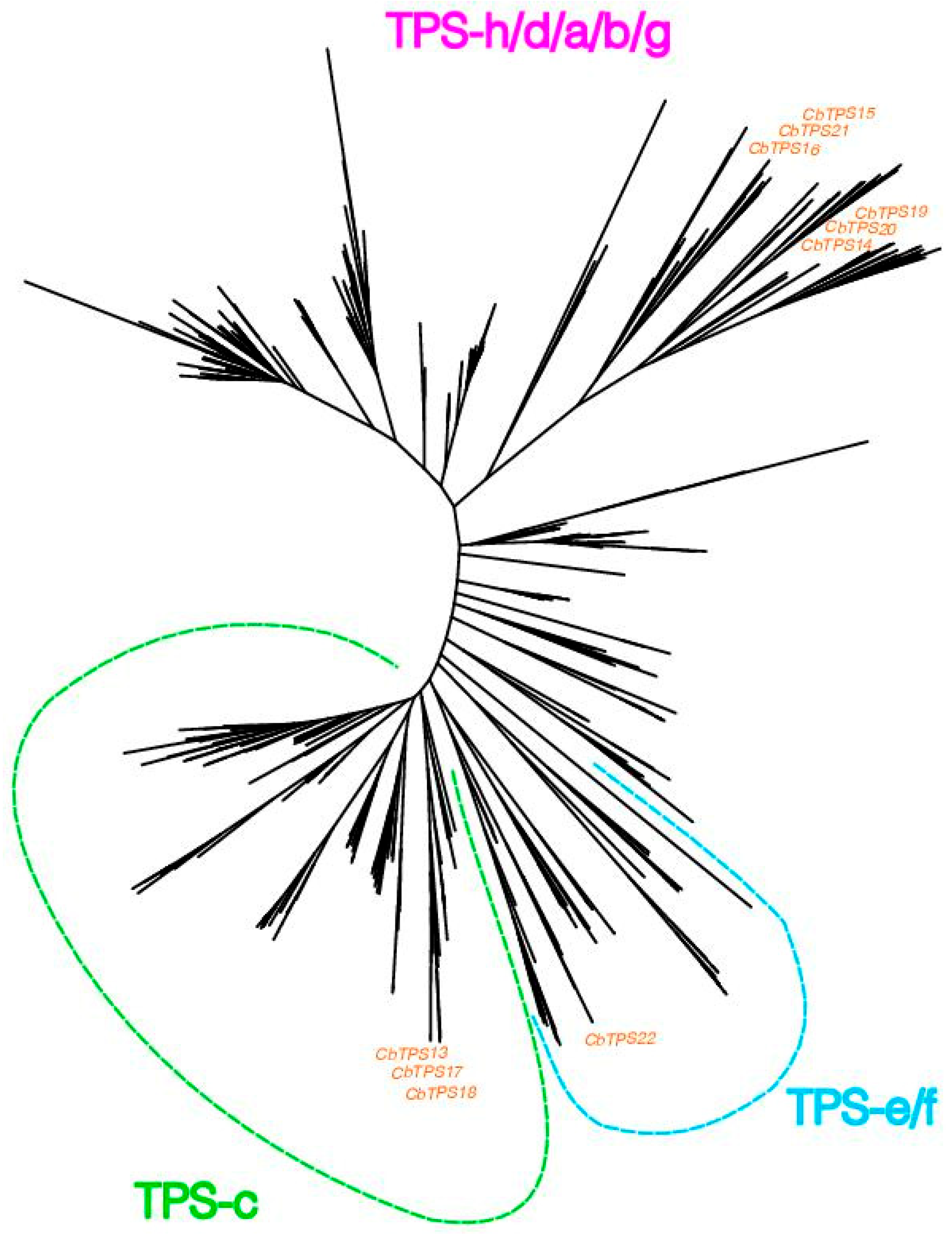
| CbTPS13 * | 298 | x | x | x | |||
| CbTPS14 * | 325 | x | x | x | X | ||
| CbTPS15 * | 391 | x | X | ||||
| CbTPS16 * | 394 | x | X | ||||
| CbTPS17 * | 443 | x | |||||
| CbTPS18 * | 448 | x | |||||
| CbTPS19 * | 458 | x | x | x | x | X | |
| CbTPS20 * | 497 | x | x | x | x | ||
| CbTPS21 * | 561 | x | x | x | x | x | X |
| CbTPS22 * | 729 | x | x | x | x | X | |
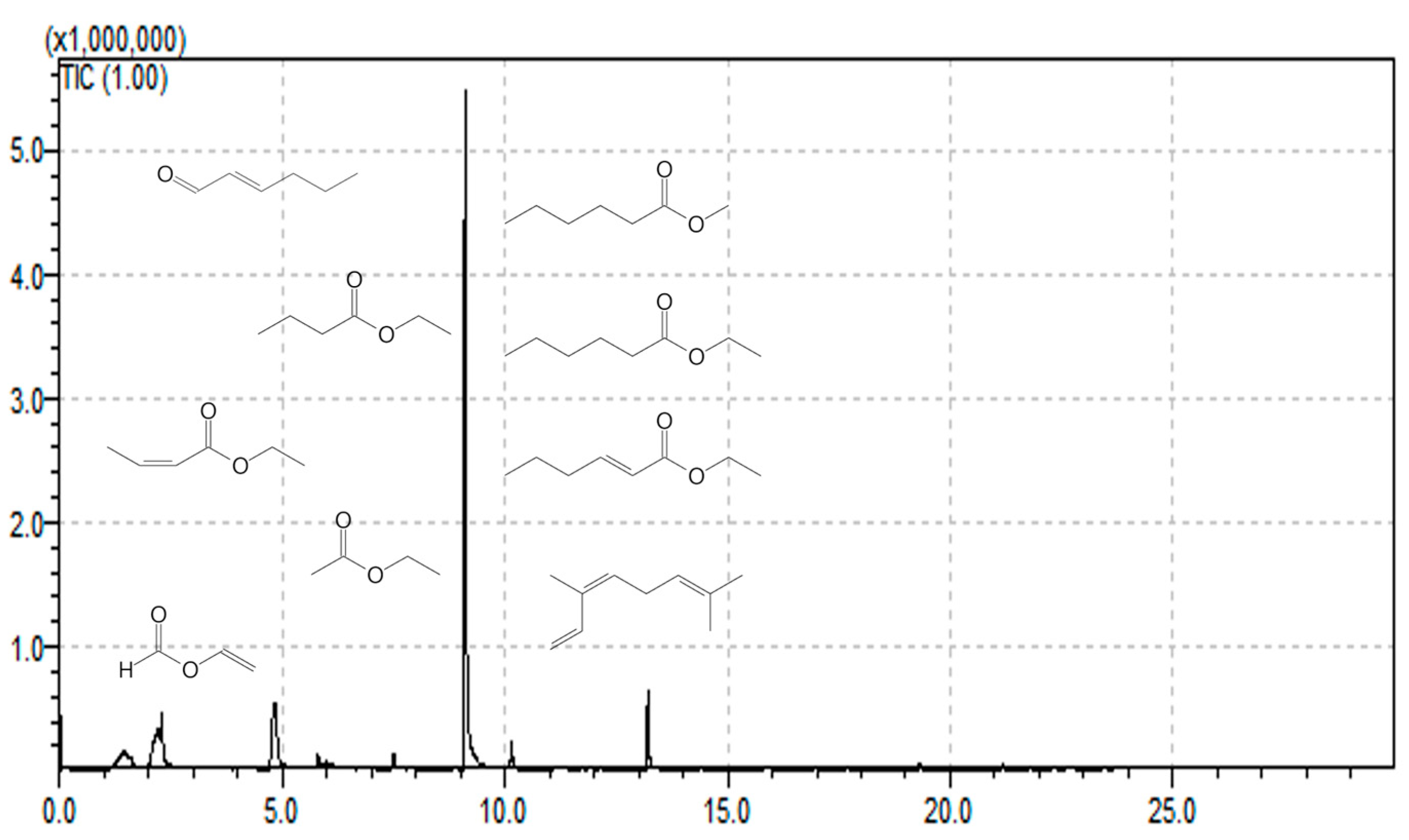
| Peak N. | Retention Time (min) | Compound | Formula | CAS | Chemical Class |
|---|---|---|---|---|---|
| 1 | 1.420 | Alanine | C3H7NO2 | 56-41-7 | α-Amino acid |
| 2 | 1.515 | Formic acid, ethenyl ester | C3H4O2 | 692-45-5 | Formate ester |
| 3 | 2.200 | Ethyl Acetate | C4H8O2 | 141-78-6 | Ethyl ester of a carboxylic acid |
| 4 | 4.825 | Butanoic acid, ethyl ester | C6H12O2 | 105-54-4 | Carboxylic acid ester |
| 5 | 5.800 | (E)-2-Butenoic acid, ethyl ester, | C6H10O2 | 623-70-1 | Carboxylic acid ester |
| 6 | 5.995 | 2-Hexenal, (E)- | C6H10O | 6728-26-3 | Unsaturated aldehyde |
| 7 | 7.500 | Hexanoic acid, methyl ester | C7H14O2 | 106-70-7 | Carboxylic acid ester |
| 8 | 9.105 | Hexanoic acid, ethyl ester | C8H16O2 | 123-66-0 | Carboxylic acid ester |
| 9 | 10.100 | 2-Hexenoic acid, ethyl ester | C8H14O2 | 1552-67-6 | α,β-Unsaturated carboxylic acid ester |
| 10 | 10.150 | 1,3,6-Octatriene, 3,7-dimethyl-, (Z)- | C10H16 | 3338-55-4 | Monoterpene hydrocarbon |
| 11 | 13.210 | Octanoic acid, ethyl ester | C10H20O2 | 106-32-1 | Carboxylic acid ester |
Disclaimer/Publisher’s Note: The statements, opinions and data contained in all publications are solely those of the individual author(s) and contributor(s) and not of MDPI and/or the editor(s). MDPI and/or the editor(s) disclaim responsibility for any injury to people or property resulting from any ideas, methods, instructions or products referred to in the content. |
© 2026 by the authors. Licensee MDPI, Basel, Switzerland. This article is an open access article distributed under the terms and conditions of the Creative Commons Attribution (CC BY) license.
Share and Cite
Trindade, H.; Nevado, B.; de Araújo, R.L.B.; Silva, V.D.M.; Aguiar, L.L.; Ribeiro, A.; Melo, J.O.-F.; Batista-Santos, P. Preliminary Identification of Putative Terpene Synthase Genes in Caryocar brasiliense and Chemical Analysis of Major Components in the Fruit Exocarp. Life 2026, 16, 67. https://doi.org/10.3390/life16010067
Trindade H, Nevado B, de Araújo RLB, Silva VDM, Aguiar LL, Ribeiro A, Melo JO-F, Batista-Santos P. Preliminary Identification of Putative Terpene Synthase Genes in Caryocar brasiliense and Chemical Analysis of Major Components in the Fruit Exocarp. Life. 2026; 16(1):67. https://doi.org/10.3390/life16010067
Chicago/Turabian StyleTrindade, Helena, Bruno Nevado, Raquel Linhares Bello de Araújo, Viviane Dias Medeiros Silva, Lara Louzada Aguiar, Ana Ribeiro, Julio Onesio-Ferreira Melo, and Paula Batista-Santos. 2026. "Preliminary Identification of Putative Terpene Synthase Genes in Caryocar brasiliense and Chemical Analysis of Major Components in the Fruit Exocarp" Life 16, no. 1: 67. https://doi.org/10.3390/life16010067
APA StyleTrindade, H., Nevado, B., de Araújo, R. L. B., Silva, V. D. M., Aguiar, L. L., Ribeiro, A., Melo, J. O.-F., & Batista-Santos, P. (2026). Preliminary Identification of Putative Terpene Synthase Genes in Caryocar brasiliense and Chemical Analysis of Major Components in the Fruit Exocarp. Life, 16(1), 67. https://doi.org/10.3390/life16010067