Article

Level 3 Cardiopulmonary Exercise Testing to Guide Therapeutic Decisions in Non-Severe Pulmonary Hypertension with Lung Disease

1
Division of Pulmonary, Critical Care and Sleep, Hartford Hospital, Hartford, CT 06102, USA
2
Department of Internal Medicine, University of Connecticut, Farmington, CT 06030, USA
3
Division of Pulmonary, Sleep and Critical Care Medicine, Tufts Medical Center, Boston, MA 02111, USA
*
Author to whom correspondence should be addressed.
Life 2025, 15(7), 1089; https://doi.org/10.3390/life15071089
Submission received: 17 June 2025 / Revised: 9 July 2025 / Accepted: 9 July 2025 / Published: 11 July 2025
(This article belongs to the Section Physiology and Pathology)

Abstract

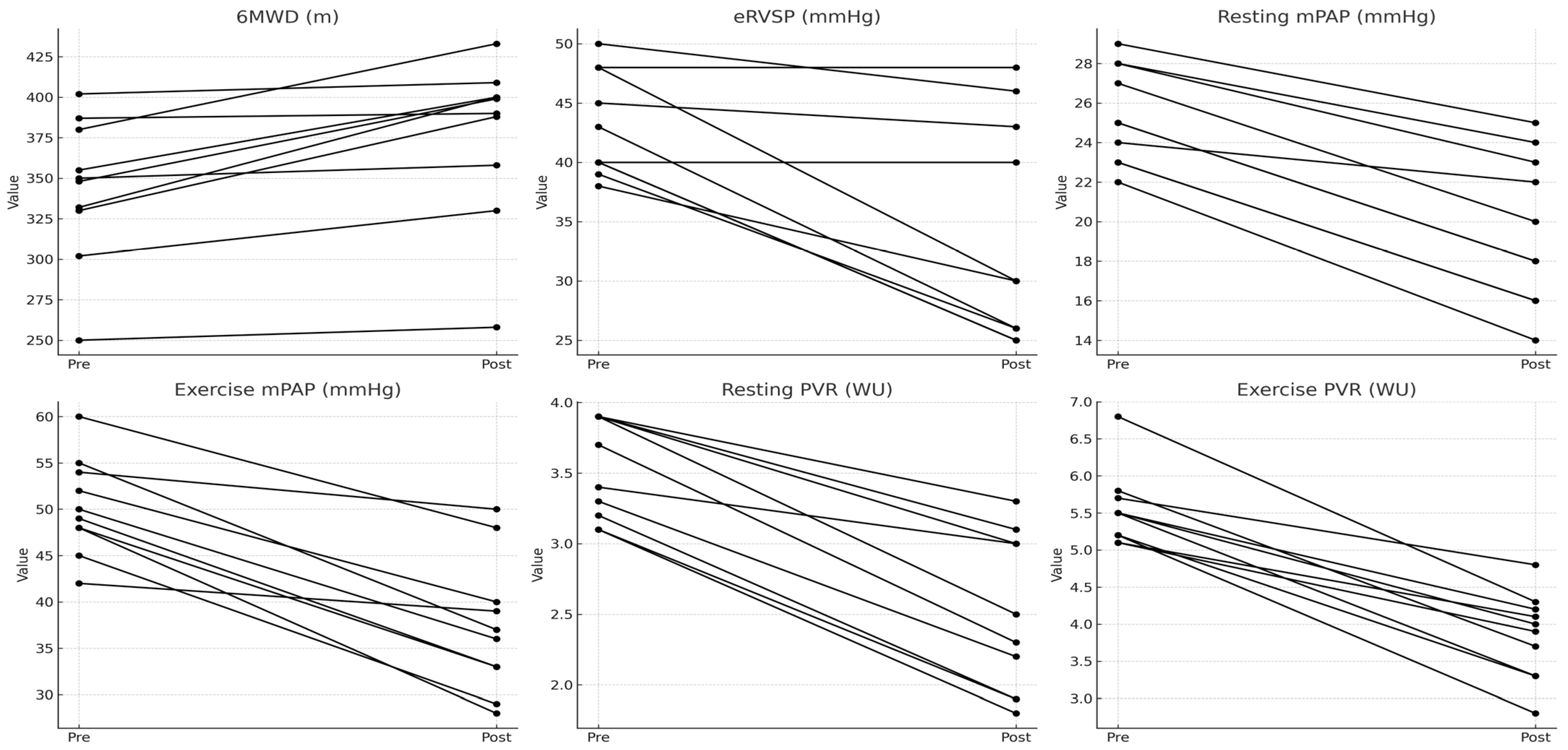
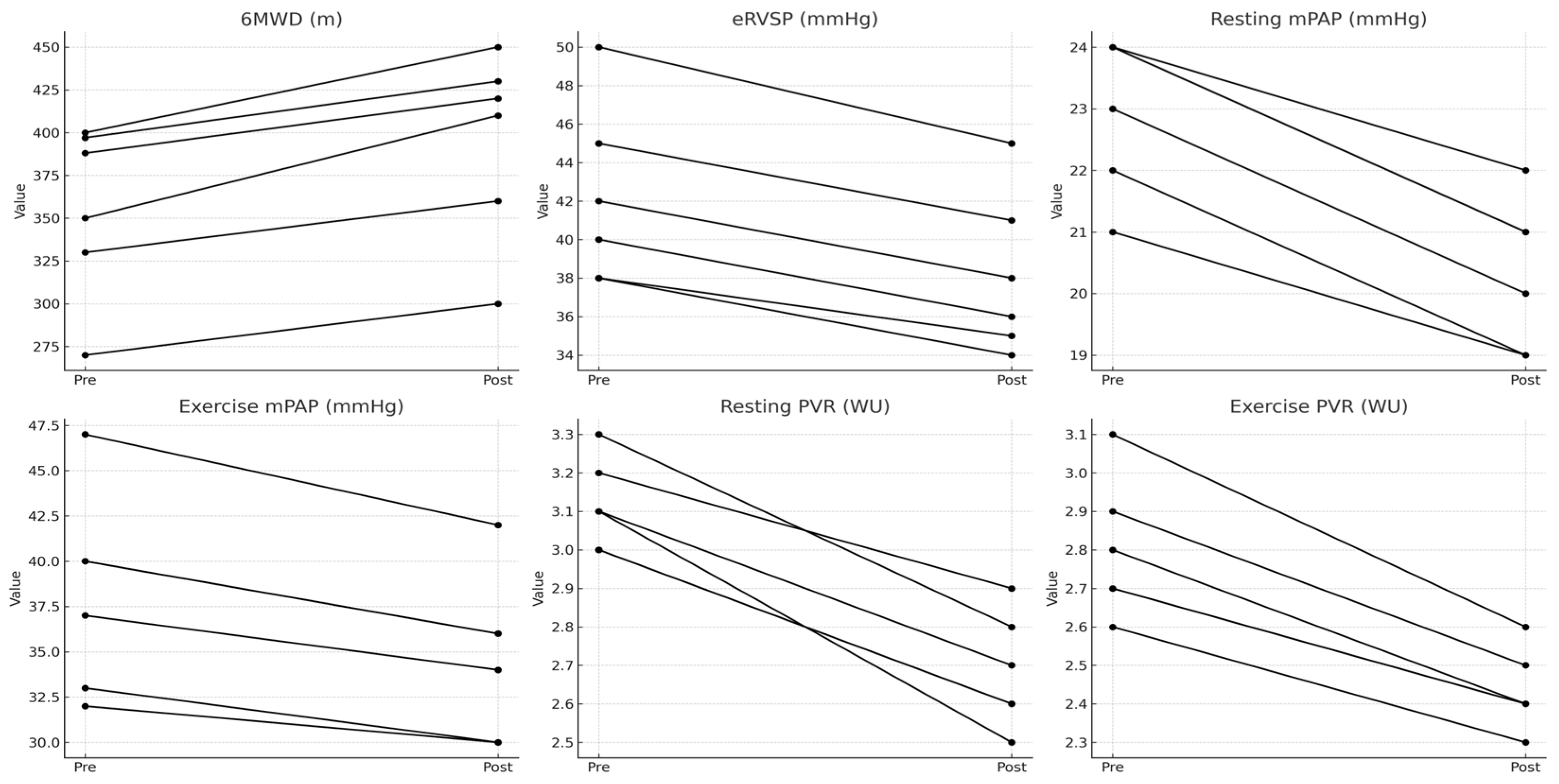
Inhaled treprostinil is approved for the treatment of pulmonary hypertension-associated interstitial lung disease (PH-ILD); however, it has not shown significant benefit in patients with a pulmonary vascular resistance (PVR) < 4 WU. As such, treatment for non-severe PH-ILD remains controversial. A total of 16 patients with non-severe PH-ILD were divided into two groups based on changes in PVR during exercise: a dynamic PVR group (n = 10), characterized by an increase in PVR with exertion, and a static PVR group (n = 6), with no increase in PVR with exercise. The dynamic PVR group received inhaled treprostinil, while the static PVR group was monitored off therapy. Baseline and 16-week follow-up values were compared within each group. At 16 weeks, the dynamic PVR group demonstrated significant improvements in mean 6 min walk distance (6MWD) (+32.5 m, p < 0.05), resting PVR (−1.04 WU, p < 0.05), resting mean pulmonary arterial pressure (mPAP) (−5.8 mmHg, p < 0.05), exercise PVR (−1.7 WU, p < 0.05), exercise mPAP (−13 mmHg, p < 0.05), and estimated right ventricular systolic pressure (−9.2 mmHg, p < 0.05). In contrast, the static PVR group remained clinically stable. These observations suggest that an exercise-induced increase in PVR, identified through Level 3 CPET, may help select patients with non-severe PH-ILD who are more likely to benefit from early initiation of inhaled treprostinil.
Keywords: level 3 cardiopulmonary exercise testing; group 3 pulmonary hypertension; pulmonary hypertension; interstitial lung disease; pulmonary vascular resistance; treprostinil level 3 cardiopulmonary exercise testing; group 3 pulmonary hypertension; pulmonary hypertension; interstitial lung disease; pulmonary vascular resistance; treprostinil