Article

Which Positions Optimize Pelvic Floor Activation in Female Athletes?

by
Elena Sonsoles Rodríguez-López
1,2,*,
Luz María Martín-Márquez
1,
María Barbaño Acevedo-Gómez
1,
África López-Illescas
1,3,
María Benito-de-Pedro
1,2 and
Cristina Ojedo-Martín
1,2
1
Physiotherapy and Health Research Group (FYSA), Department of Physiotherapy, Faculty of Health Sciences—HM Hospitals, University Camilo José Cela, Villanueva de la Cañada, 28692 Madrid, Spain
2
HM Hospitals Health Research Institute, 28015 Madrid, Spain
3
Sports Medicine Center, Department of Sport and Health, Spanish Sports Council, 28040 Madrid, Spain
*
Author to whom correspondence should be addressed.
Life 2025, 15(1), 58; https://doi.org/10.3390/life15010058
Submission received: 5 December 2024 / Revised: 28 December 2024 / Accepted: 2 January 2025 / Published: 6 January 2025
(This article belongs to the Special Issue Recent Advances in Physiotherapy for Musculoskeletal Disorders)

Abstract

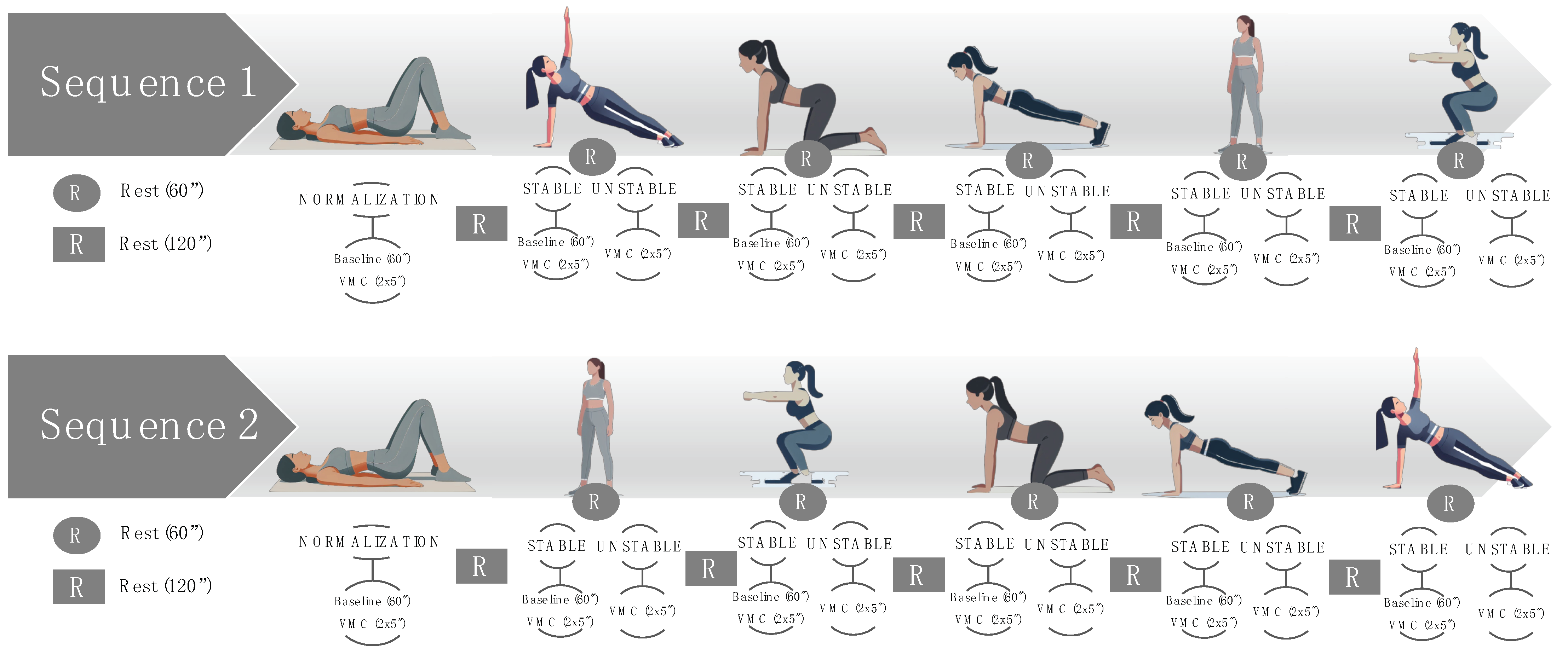
Background/Objectives: Implementing and optimizing pelvic floor muscle (PFM) training programs is crucial for reducing the risk of dysfunctions, improving athletic performance, and enhancing quality of life for athletes. The aim of this study was to assess PFM activation in female athletes during postural challenges. Methods: An observational and descriptive study was conducted with twenty-five female rugby players. Surface electromyography was used to evaluate the PFMs in five different body positions under stable and unstable conditions. Results: The peak amplitude of the PFMs at baseline differed according to the physical demand of each position (p < 0.001). The lowest percentage activation was in the supine position (16.23%), while the highest recruitment was observed during the parallel squat (40.69%). The percentage of maximum voluntary contraction also differed according to each position (p = 0.001). The values were similar in supine position, side plank (104%), and standing position, being significantly lower (p < 0.05) than those reached during the off-knees quadruped hold (121.58%), full plank (121.97%), and parallel squat (151.40%); however, the values were comparable between stable and unstable positions (p = 1.000). Conclusions: Positions that challenge gravity and pelvic biomechanics, such as the squat, plank, and quadruped, facilitate greater activation of the PFMs. Contrary to previous recommendations, these exercises do not appear to have significant negative effects; therefore, consideration should be given to the implementation of these exercises for the management of pelvic floor dysfunction and as part of comprehensive exercise programs designed to improve overall core and pelvic floor function.
Keywords: pelvic floor; electromyography; posture; sportswomen; rugby pelvic floor; electromyography; posture; sportswomen; rugby