Review

Endocrinopathies and Male Infertility
by
Pallav Sengupta
1,2,†,
Sulagna Dutta
2,3,†,
Ivan Rolland Karkada
1 and
Suresh V. Chinni
4,*
1
Physiology Unit, Faculty of Medicine, Bioscience and Nursing, MAHSA University, Jenjarom 42610, Malaysia
2
School of Medical Sciences, Bharath Institute of Higher Education and Research (BIHER), Chennai 600126, India
3
Department of Oral Biology and Biomedical Sciences, Faculty of Dentistry, MAHSA University, Jenjarom 42610, Malaysia
4
Department of Biotechnology, Faculty of Applied Sciences, AIMST University, Bedong 08100, Malaysia
*
Author to whom correspondence should be addressed.
These authors have equally contributed to the work.
Life 2022, 12(1), 10; https://doi.org/10.3390/life12010010
Submission received: 3 November 2021 / Revised: 9 December 2021 / Accepted: 16 December 2021 / Published: 22 December 2021
(This article belongs to the Collection Male Infertility: Current Knowledge and Future Perspectives)

Abstract

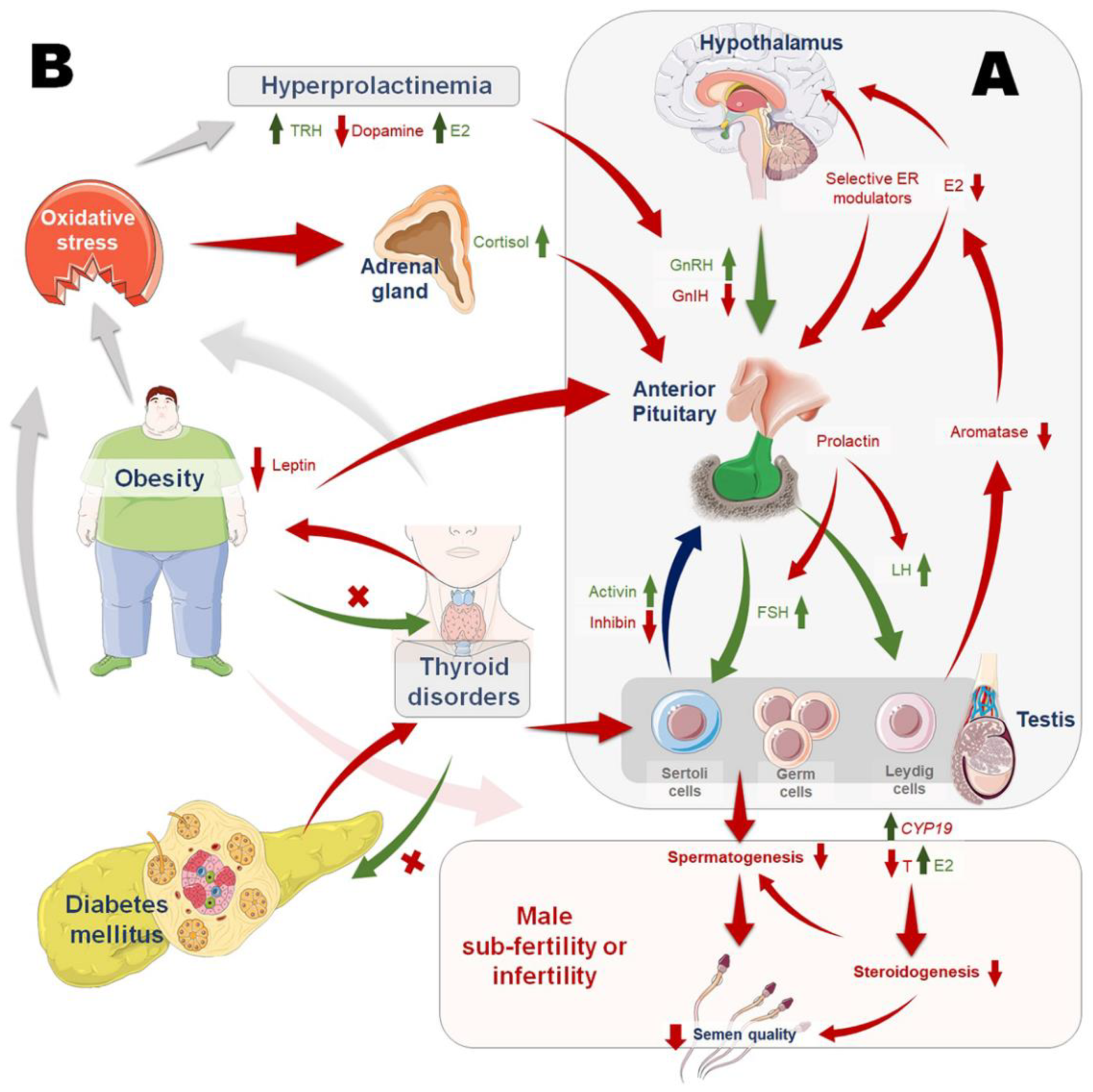
Male infertility is approaching a concerning prevalence worldwide, and inflicts various impacts on the affected couple. The hormonal assessment is a vital component of male fertility evaluation as endocrine disorders are markedly reversible causatives of male infertility. Precise hormonal regulations are prerequisites to maintain normal male fertility parameters. The core male reproductive event, spermatogenesis, entails adequate testosterone concentration, which is produced via steroidogenesis in the Leydig cells. Physiological levels of both the gonadotropins are needed to achieve normal testicular functions. The hypothalamus-derived gonadotropin-releasing hormone (GnRH) is considered the supreme inducer of the gonadotropins and thereby the subsequent endocrine reproductive events. This hypothalamic–pituitary–gonadal (HPG) axis may be modulated by the thyroidal or adrenal axis and numerous other reproductive and nonreproductive hormones. Disruption of this fine hormonal balance and their crosstalk leads to a spectrum of endocrinopathies, inducing subfertility or infertility in men. This review article will discuss the most essential endocrinopathies associated with male factor infertility to aid precise understanding of the endocrine disruptions-mediated male infertility to encourage further research to reveal the detailed etiology of male infertility and perhaps to develop more customized therapies for endocrinopathy-induced male infertility.
Keywords: endocrinopathies; male infertility; hypothyroidism; hyperprolactinemia endocrinopathies; male infertility; hypothyroidism; hyperprolactinemia