


Abstract
Structure-preserving trajectory tracking control for a six-degree-of-freedom robotic manipulator is developed within the port-Hamiltonian framework. Error Hamiltonian is constructed by incorporating configuration and momentum tracking errors into the system energy. Based on this formulation, a momentum-based tracking controller with feedforward compensation and damping injection is derived without coordinate transformations or matching conditions. A disturbance estimator is further introduced to compensate unknown external torques. Energy-based analysis proves nominal closed-loop stability and uniform ultimate boundedness in the presence of estimation errors. Simulation results on a full rigid-body manipulator demonstrate accurate trajectory tracking under coupled and high-speed joint motions.
1. Introduction
Robotic manipulators have become a core enabling technology in modern manufacturing and service automation, where high-accuracy and high-speed motion execution is routinely required in tasks such as pick-and-place, assembly, machining, and contact-rich operations. In these applications, trajectory tracking control—i.e., driving multi-joint, strongly coupled nonlinear dynamics to follow a prescribed reference motion—is a fundamental capability that directly determines motion precision, throughput, and operational safety. Consequently, a rich body of motion/force control methodologies has been developed over the past decades, spanning model-based joint-space tracking and adaptive schemes [1,2], operational-space formulations for task-level motion/force control [3], and impedance-based interaction control for regulating dynamic behavior during contact [4]. These developments have been systematically documented in standard robotics and control references, which also highlight the practical importance of scalable tracking designs for high-degree-of-freedom manipulators [5,6,7].
Classical nonlinear control strategies have dominated the field of robotic trajectory tracking for several decades. Among them, computed torque control and feedback linearization explicitly compensate nonlinear dynamic terms to obtain a linear error system, thereby achieving high-accuracy tracking performance [6,7]. Such approaches have been extensively documented in standard robotics literature and widely implemented in industrial manipulators. However, their performance relies heavily on accurate dynamic modeling, and the cancellation of nonlinear dynamics may obscure the intrinsic physical structure of the mechanical system. To address modeling uncertainties and external disturbances, adaptive and robust control schemes have been developed, providing theoretical guarantees and practical effectiveness in various robotic applications [1,2]. Despite these advances, most existing tracking designs are formulated primarily at the level of error dynamics rather than directly exploiting the underlying energy and interconnection structure of the system. In recent years, passivity-based and energy-shaping control methodologies have attracted increasing attention, as they utilize the natural energy properties of mechanical systems to guide controller synthesis and stability analysis [8,9]. These approaches offer a physically consistent and structure-aware alternative for nonlinear mechanical control. In addition to the classical robotics literature, passivity-based and energy-shaping approaches have also played an important role in the control of mechanical systems. Representative results include the globally asymptotically stable PD+ controller for robot manipulators [10], systematic joint-space formulations for model-based robot tracking control [11], interconnection and damping assignment passivity-based control of port-controlled Hamiltonian systems [12,13,14], and trajectory tracking formulations developed for port-controlled Hamiltonian systems [15,16].
While these methods provide important theoretical foundations, they exhibit distinct limitations when applied to trajectory tracking of robotic manipulators. Classical robot tracking approaches, such as computed torque control, rely on exact cancellation of nonlinear dynamics and are, therefore, sensitive to modeling uncertainties, while also failing to preserve the intrinsic port-Hamiltonian structure. In contrast, passivity-based and energy-shaping methods emphasize stability through energy properties, but are primarily formulated for regulation problems rather than explicit trajectory tracking [17]. Consequently, a systematic framework that combines trajectory tracking objectives with structure-preserving energy-based design remains insufficiently developed.
More recently, extended quadratic port-Hamiltonian formulations have been proposed to address trajectory tracking problems for general nonlinear systems [18]. However, these results are mainly developed at an abstract level and do not directly provide explicit realizations for rigid-body robotic manipulators. In particular, the construction of implementable error Hamiltonians consistent with Euler–Lagrange mechanical structures and the derivation of explicit control laws for high-degree-of-freedom manipulators remain open issues.
In addition, it is worth emphasizing that classical passivity-based and energy-shaping approaches for mechanical systems are primarily designed for stabilization or regulation tasks, and their extension to trajectory tracking is not always straightforward.
On the other hand, standard robot trajectory tracking methods, such as computed torque control, rely on feedback linearization and exact cancellation of nonlinear dynamics, and, therefore, do not explicitly preserve the port-Hamiltonian structure of the system.
Consequently, there remains a gap between abstract port-Hamiltonian tracking formulations and practically implementable controllers for rigid-body manipulators that simultaneously preserve the underlying energy structure and provide explicit control laws. As a result, the application of the extended quadratic PHS tracking concept to realistic rigid manipulators remains an open problem.
Therefore, the main challenge is to bridge the gap between abstract port-Hamiltonian tracking formulations and practically implementable controllers for rigid-body manipulators, while preserving the underlying energy structure. Motivated by these observations, this paper develops a structure-preserving trajectory tracking control framework for a six-degree-of-freedom rigid robotic manipulator within the port-Hamiltonian setting. In contrast to classical computed torque approaches, the proposed method does not rely on exact cancellation of nonlinear dynamics, but, instead, preserves the intrinsic energy-based structure of the system. Moreover, compared with existing passivity-based and energy-shaping methods, which mainly address stabilization problems, the present work explicitly considers trajectory tracking within a port-Hamiltonian framework.
More specifically, an error Hamiltonian is constructed by augmenting the mechanical energy with quadratic terms in both configuration and momentum tracking errors. Based on this structure, a momentum-based tracking controller is derived, consisting of an equivalent feedforward compensation term and a damping injection term. In addition, an online disturbance estimator is incorporated to compensate unknown external torques acting on the manipulator joints, further improving the robustness of the closed-loop system.
The main contributions of this paper can be summarized as follows. First, compared with existing abstract port-Hamiltonian tracking formulations, a concrete specialization to rigid-body robotic manipulators is developed, leading to an explicit realization in terms of configuration and momentum variables. Second, compared with classical computed torque and feedback linearization methods, an explicit momentum-based control law is derived that preserves the port-Hamiltonian structure without relying on exact cancellation of nonlinear dynamics. Third, compared with standard passivity-based regulation approaches, the proposed method explicitly addresses trajectory tracking and systematically integrates disturbance estimation within the same energy-based framework. The structure of the paper is summarized as follows. Section 2 describes the port-Hamiltonian modeling of the considered six-degree-of-freedom manipulator. Section 3 derives the error Hamiltonian and the associated tracking controller with closed-loop stability analysis. Section 4 reports the simulation results together with related discussions and Section 5 concludes the paper.
2. Problem Formulation and Port-Hamiltonian Modeling
2.1. Manipulator Dynamics and Notation
Consider a rigid-body robotic manipulator with six revolute joints. Let denote the joint coordinates, the joint velocities, and the joint torque input. The manipulator dynamics are described by the standard Euler–Lagrange model
where is the inertia matrix, collects Coriolis and centrifugal terms, and is the gravity vector. Throughout this paper, the manipulator is assumed to be fully actuated and rigid, and actuator dynamics are not explicitly modeled. The reference trajectory is assumed to be twice continuously differentiable with bounded derivatives.
2.2. Port-Hamiltonian Representation
Define the generalized momentum
Let denote the gravitational potential energy. The total mechanical energy is
Define the state vector . Then the system admits the port-Hamiltonian form
where
In the absence of external inputs, the system is lossless and energy conserving.
2.3. Structural Properties
The inertia matrix is symmetric positive definite for all admissible configurations. Moreover, the standard robot property holds: the matrix is skew-symmetric, which implies
Using (1)–(3), the time derivative of the total energy satisfies
which shows that the input power is equal to the rate of change of stored energy. These properties will be used in the subsequent structure-preserving tracking control design.
3. Structure-Preserving Trajectory Tracking Control
Based on the port-Hamiltonian model derived in Section 2, the objective of this section is to develop a structure-preserving trajectory tracking controller for the manipulator while compensating unknown disturbance torques.
The robot dynamics are, therefore, considered in the presence of matched disturbances acting on the joints,
where denotes the joint position vector ( for the manipulator considered in this paper), is the control torque input, and represents an unknown disturbance torque.
The control objective is to design a control law such that the joint positions track a desired trajectory while preserving the energy-based structure of the port-Hamiltonian model.
Let be a smooth desired trajectory satisfying
The control objective is to design a control law such that
To formulate the tracking problem within the port-Hamiltonian framework, the position error is defined as
Let
denote the generalized momentum. The desired momentum is introduced as
The momentum tracking error is, therefore,
3.1. Nominal Tracking Controller
In this subsection, the nominal tracking control problem is considered without disturbance estimation.
Define the following error Hamiltonian:
where is a symmetric positive definite gain matrix.
The nominal control torque is chosen as
where is symmetric positive definite and
The proposed controller preserves the port-Hamiltonian structure of the error dynamics. Instead of canceling nonlinearities as in computed torque control, the tracking objective is embedded directly into the energy function through the error Hamiltonian.
3.2. Nominal Closed-Loop Stability
Proposition 1.
Consider the disturbance-free robot manipulator
with the control law defined above. Then the closed-loop tracking error dynamics satisfy
Equivalently, the error system admits the port-Hamiltonian form
where
Moreover, the equilibrium is asymptotically stable.
Proof.
From the definitions of e and ,
Thus,
The momentum dynamics of the disturbance-free system are
Substituting the control law yields
which leads to
The gradients of the error Hamiltonian are
Substituting these expressions yields the port-Hamiltonian form.
To prove stability, consider as Lyapunov function. As and , is positive definite.
Its derivative is
The condition implies . Substituting into the error dynamics gives
For invariance, we require , which implies that . As is positive definite, .
Hence, the largest invariant set is . By LaSalle’s invariance principle, the equilibrium is asymptotically stable. □
3.3. Disturbance Estimator
Following the immersion and invariance disturbance estimation framework proposed in [19], an online disturbance estimation scheme is introduced to compensate unknown external torques.
From the robot dynamics, the momentum equation can be written as
The disturbance estimate is generated by the adaptive law
where and are design parameters.
Define the estimation error:
Proposition 2.
Assume that the disturbance derivative satisfies . Then, for bounded signals and , the estimation error remains bounded and converges to a neighborhood of the origin whose size depends on ξ.
Proof.
Taking the time derivative of gives
Substituting the estimator dynamics yields
Using the momentum equation, this becomes
Consider the Lyapunov function
Its derivative satisfies
As and are bounded and , there exists a constant such that
Therefore, is bounded and converges to a neighborhood of the origin determined by . □
3.4. Closed-Loop Stability with Disturbance Estimation
When the disturbance estimate is incorporated, the control law becomes
The resulting error dynamics are
Define the error state
Then the closed-loop error system is
Proposition 3.
Assume that . Then the tracking error state is uniformly ultimately bounded. Furthermore, all closed-loop signals remain bounded. If , then the equilibrium is asymptotically stable.
Proof.
Consider the nominal system corresponding to :
From Proposition 1, is asymptotically stable. Thus, there exists a Lyapunov function such that
For the perturbed system,
From the estimator dynamics, is bounded provided that p and are bounded. As is composed of and the reference trajectory is bounded, the boundedness of implies boundedness of q, , p, and .
Therefore, the closed-loop system is self-consistent: the boundedness of ensures the boundedness of , and vice versa.
Hence, there exists a neighborhood such that outside it, the negative term dominates, yielding . Thus, is uniformly ultimately bounded.
As is bounded and the reference trajectory is bounded, it follows that all closed-loop signals are bounded.
Finally, if , then the perturbation term vanishes, and the system reduces asymptotically to the nominal asymptotically stable system. Hence, is asymptotically stable. □
4. Simulation Result
4.1. Simulation Setup
4.1.1. Robot Description
All simulations are conducted using a six-degree-of-freedom industrial manipulator platform (VSCR-6EUR3). The robot is a serial rigid-body manipulator equipped with six revolute joints and integrated servo actuators. According to the manufacturer specifications, the robot provides a nominal payload capacity of 3 kg, a maximum working radius of 666 mm, and an overall height of approximately 820.5 mm. The repeatability of the end-effector positioning is better than ±0.05 mm under nominal payload conditions.
4.1.2. Robot Model Parameters
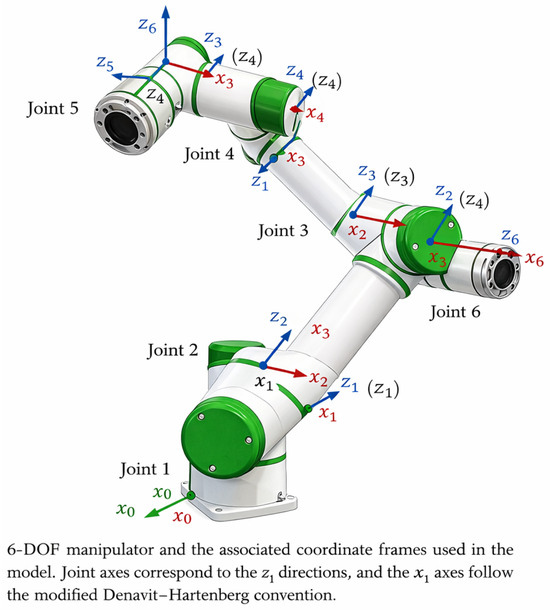
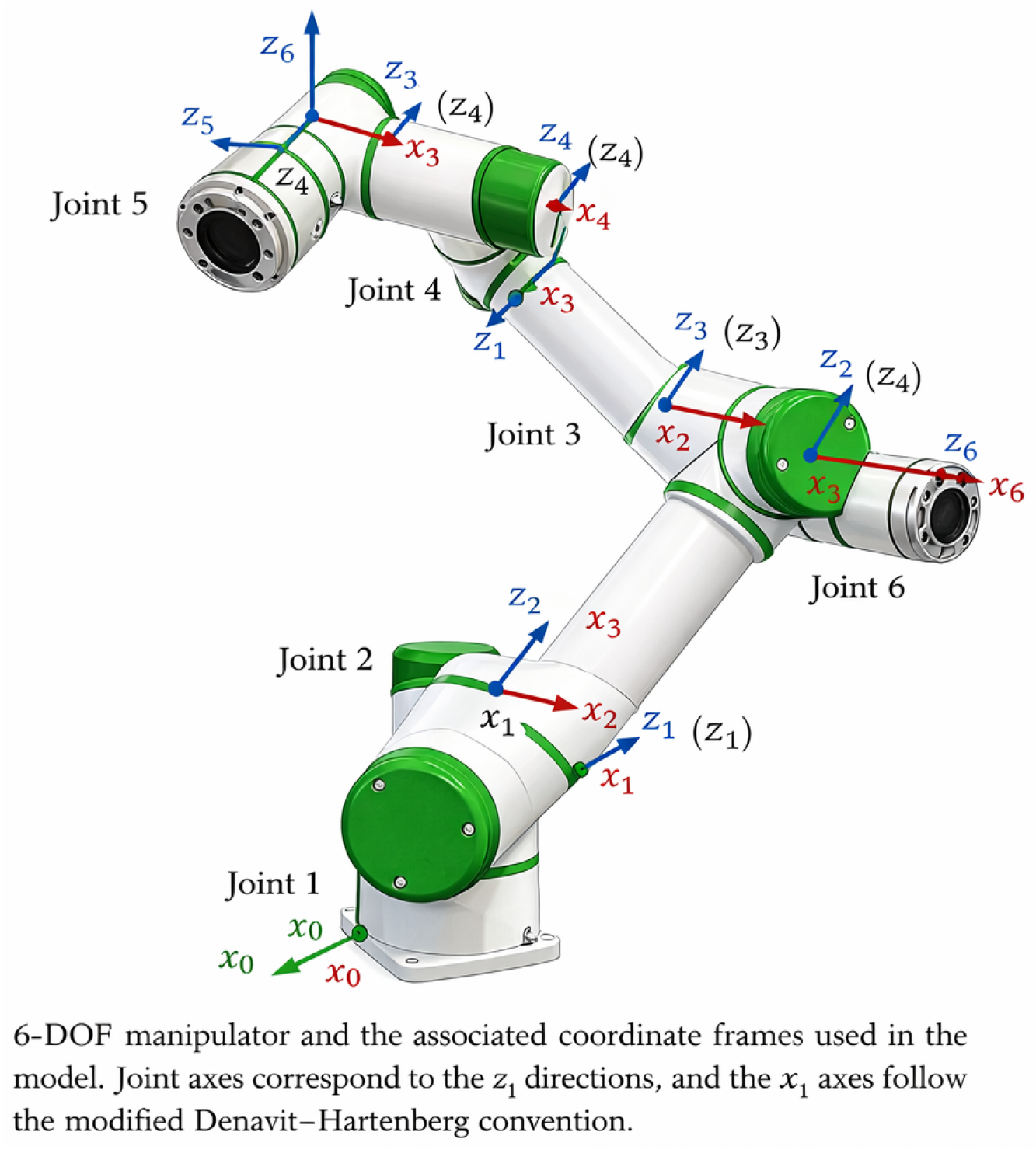
According to the robot experimental manual, the manipulator kinematic frames are established using the modified Denavit–Hartenberg convention. The associated geometric parameters are provided in Table 1.
Table 1.
Modified Denavit–Hartenberg parameters of the manipulator.
Figure 1 illustrates the six-degree-of-freedom industrial manipulator considered in this work, where the joints are numbered sequentially from the base to the end-effector (Joint 1 to Joint 6). The kinematic frames are assigned according to the modified Denavit–Hartenberg (MDH) convention. The corresponding geometric and rigid-body parameters are reported in Table 1 and Table 2, which are directly associated with the robot configuration shown in Figure 1.
Figure 1.
Six-degree-of-freedom industrial manipulator platform considered in the simulation study. The joints are numbered from the base to the end-effector according to the MDH-based kinematic model used in this paper.
Table 2.
Rigid-body parameters of the six-link manipulator.
4.1.3. Simulation Environment
All simulations are carried out in MATLAB/Simulink (MathWorks, R2024b) over the time interval s using a fixed-step solver with sampling time
For both Case 1 and Case 2, the same controller parameters are used. The proportional and damping gain matrices are chosen as
A small viscous damping term is included in the plant model for numerical robustness,
The disturbance estimator gain is implemented in diagonal matrix form as the vectorized extension of the scalar parameter introduced in the theoretical formulation:
The initial conditions are selected as
The same disturbance model is used in both cases, while the reference trajectories are varied to generate different operating conditions. The corresponding trajectory parameters are reported in the descriptions of Case 1 and Case 2.
4.2. Tracking Performance Under Disturbance
In order to evaluate the effectiveness of the disturbance estimation mechanism, a comparative study is conducted under identical simulation conditions. Two configurations are considered: the proposed port-Hamiltonian controller with disturbance estimation, and the same controller without disturbance compensation, i.e., with .
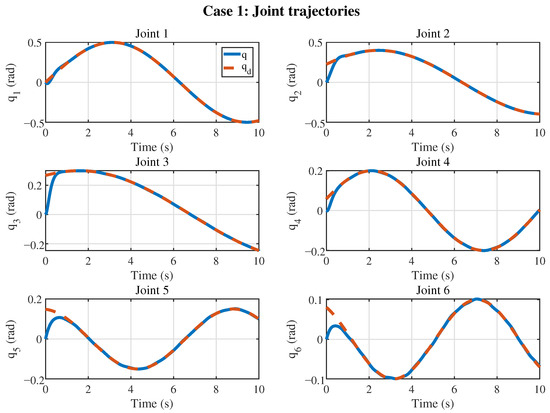
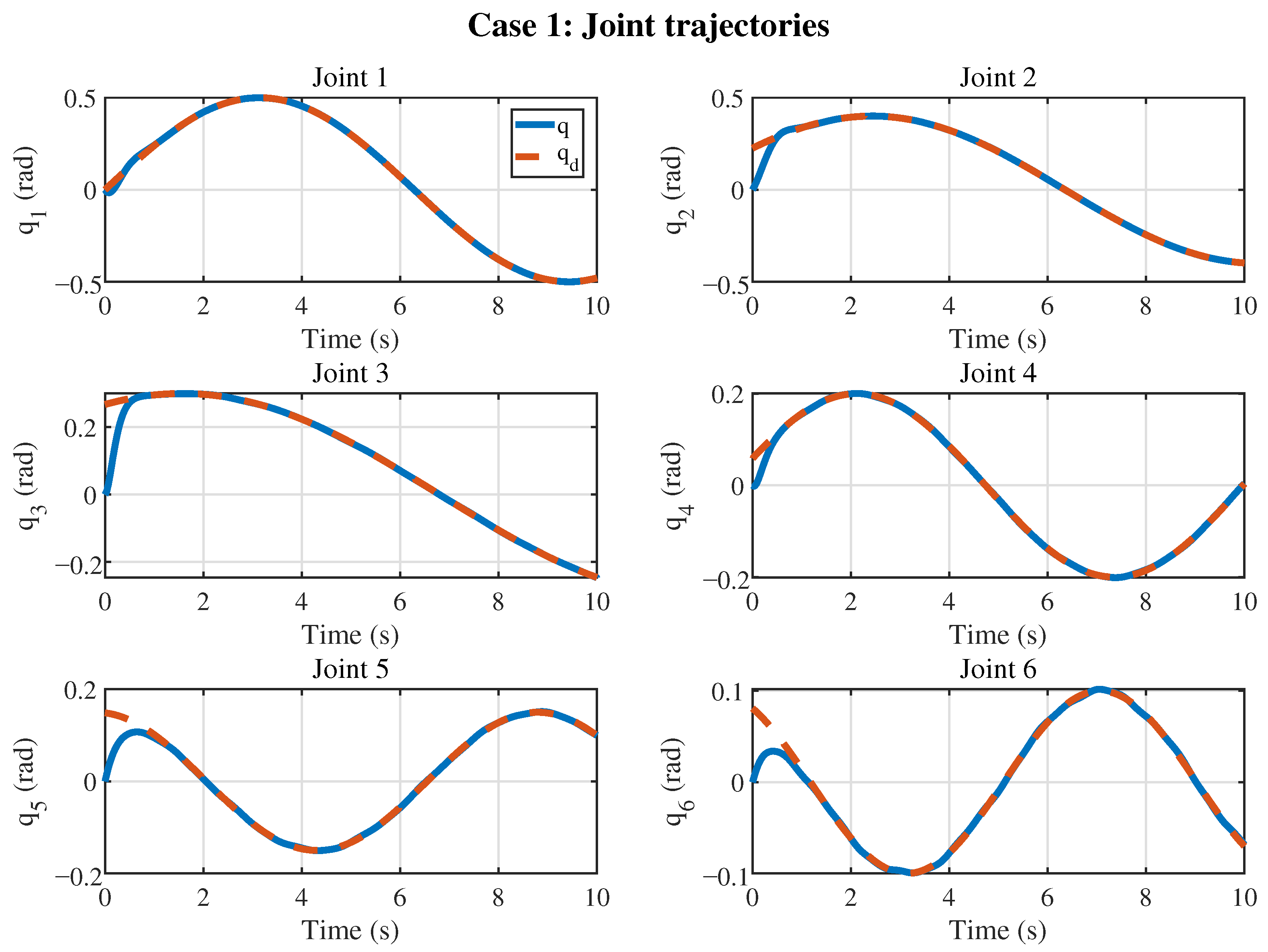
Figure 2 illustrates the joint trajectories and their corresponding reference signals. It can be observed that all joint positions accurately track the desired trajectories. The actual trajectories almost perfectly overlap with the reference signals throughout the entire simulation interval, indicating that the proposed control strategy effectively compensates for the nonlinear robot dynamics and inter-joint coupling.
Figure 2.
Joint trajectories and reference signals under coupled multi-joint motion.
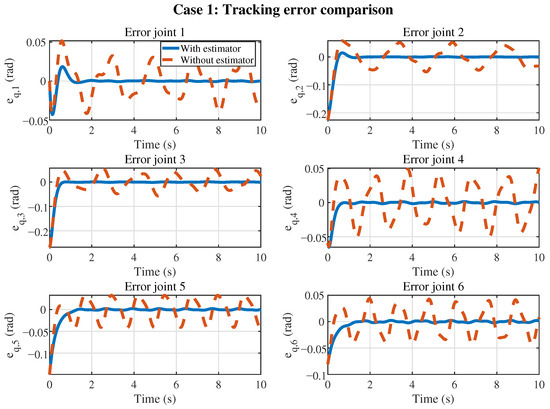
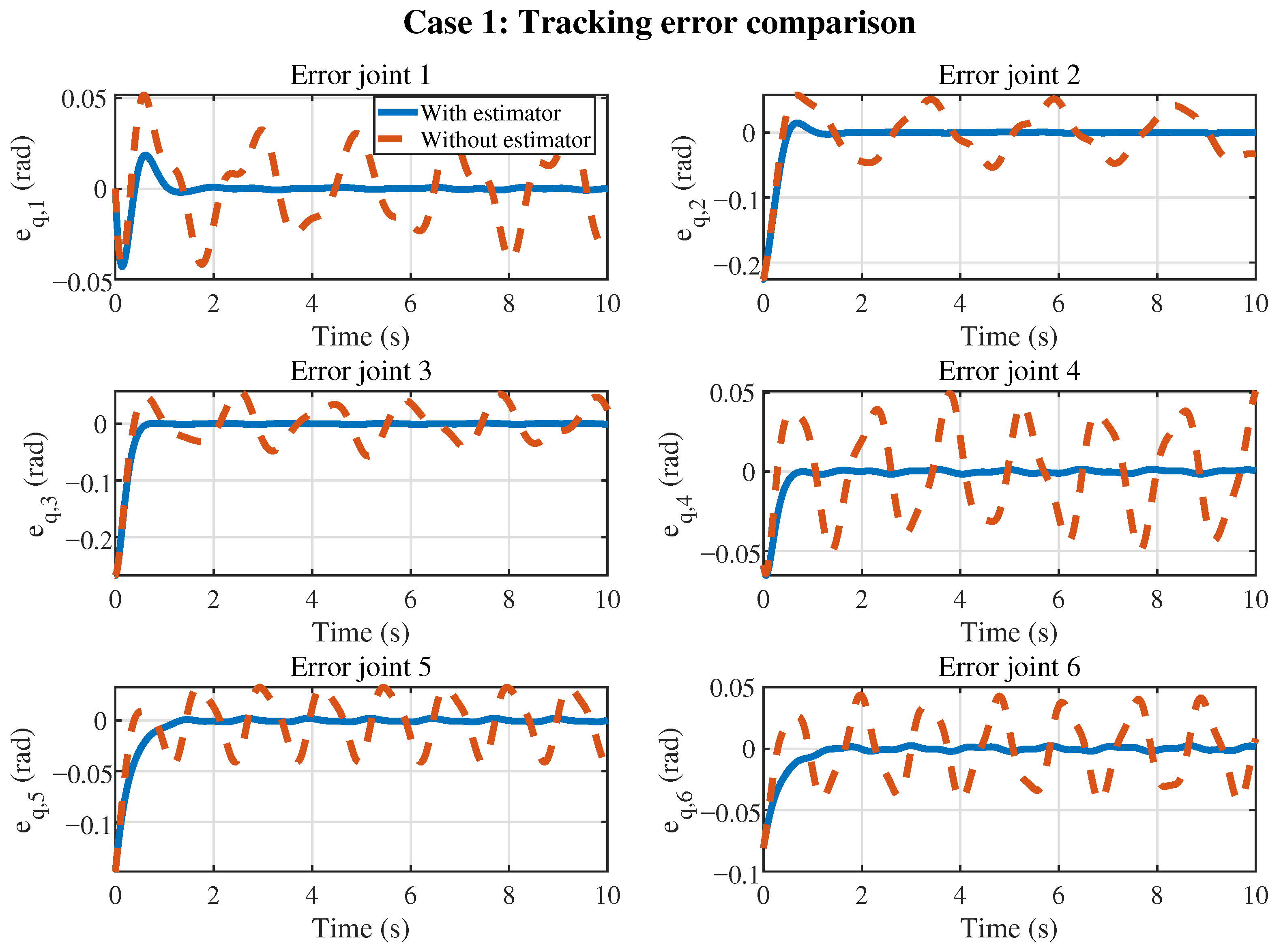
Figure 3 compares the joint tracking errors obtained with and without disturbance estimation. For all six joints, the controller without disturbance compensation exhibits visibly larger transient deviations and a slower return toward the origin. By contrast, when the estimator is activated, the error envelopes are significantly reduced and the convergence behavior becomes more uniform across the joints. This difference is particularly important because both configurations use the same tracking controller and are subjected to the same external disturbances. Therefore, the observed improvement can be directly attributed to the disturbance compensation mechanism rather than to a change in the nominal control law. These results confirm that the estimator effectively attenuates the influence of matched disturbances and improves the disturbance rejection capability of the closed-loop system.
Figure 3.
Joint tracking error comparison between the proposed method (with disturbance estimation) and the controller without disturbance compensation.
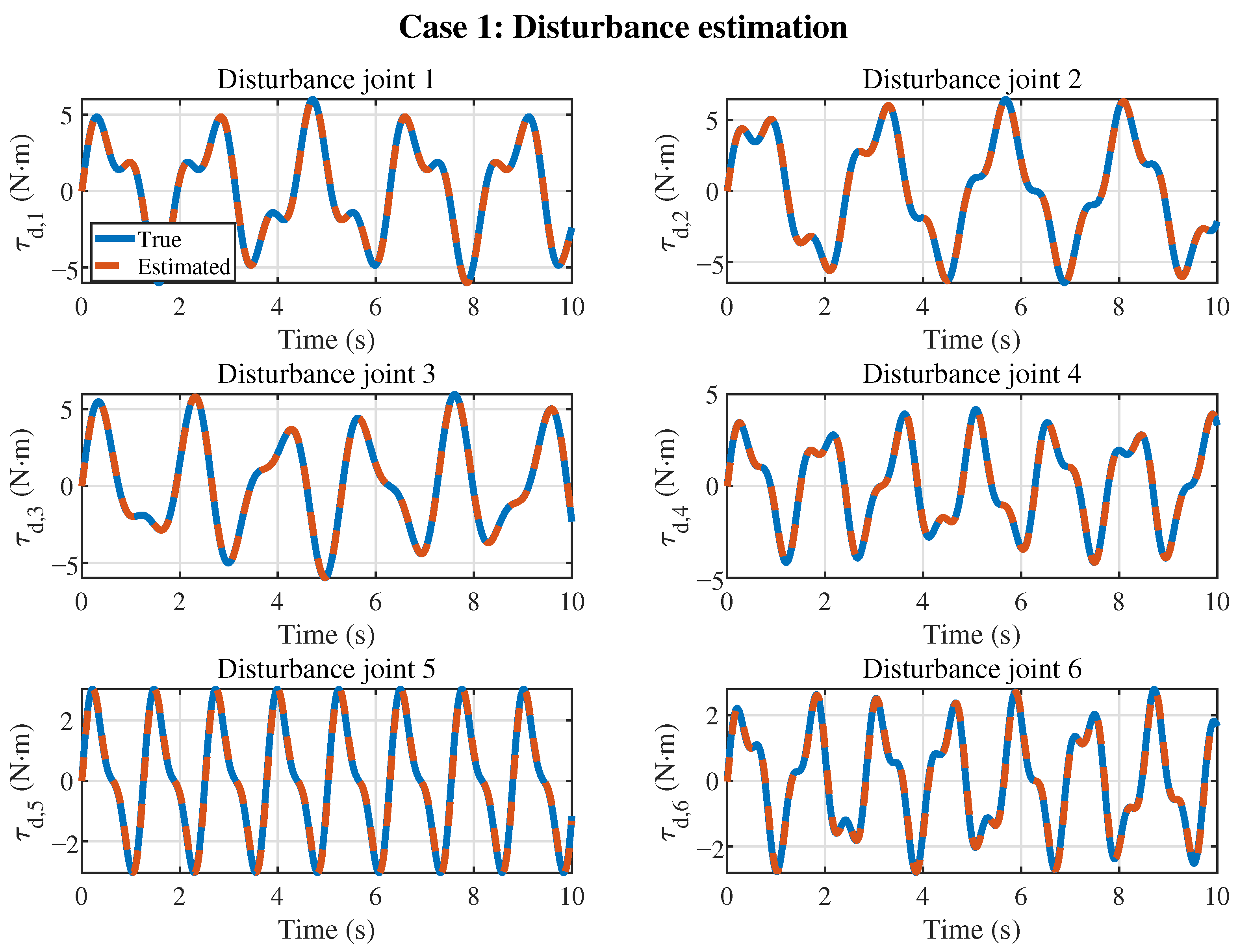
To further evaluate the disturbance estimation capability, unknown external disturbance torques are injected into each joint. The disturbances are composed of multiple sinusoidal components with different frequencies, generating rapidly varying torque disturbances.
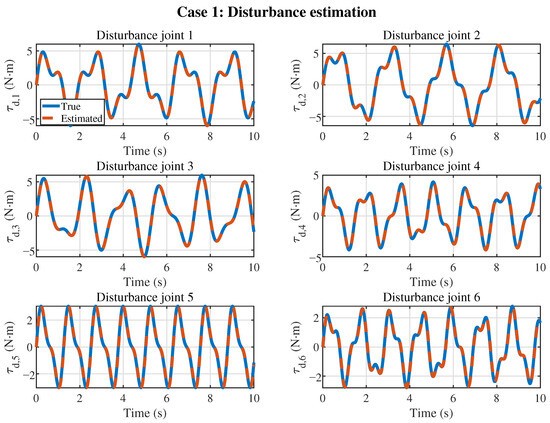
Figure 4 compares the true disturbance torques with the estimated disturbances provided by the proposed estimator. It can be observed that the estimated disturbances closely follow the true disturbances for all joints, indicating that the estimator is able to accurately reconstruct the unknown disturbance torques in real time.
Figure 4.
True disturbance torques and estimated disturbances for all joints.
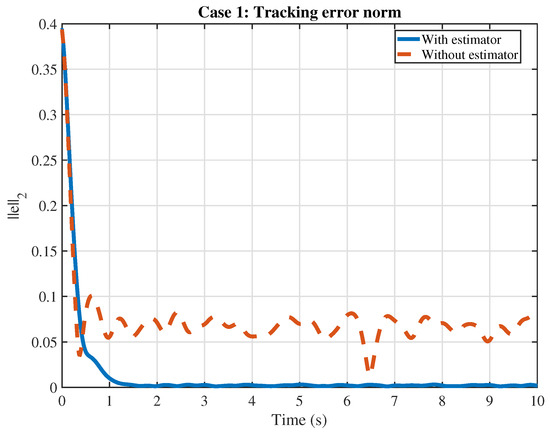
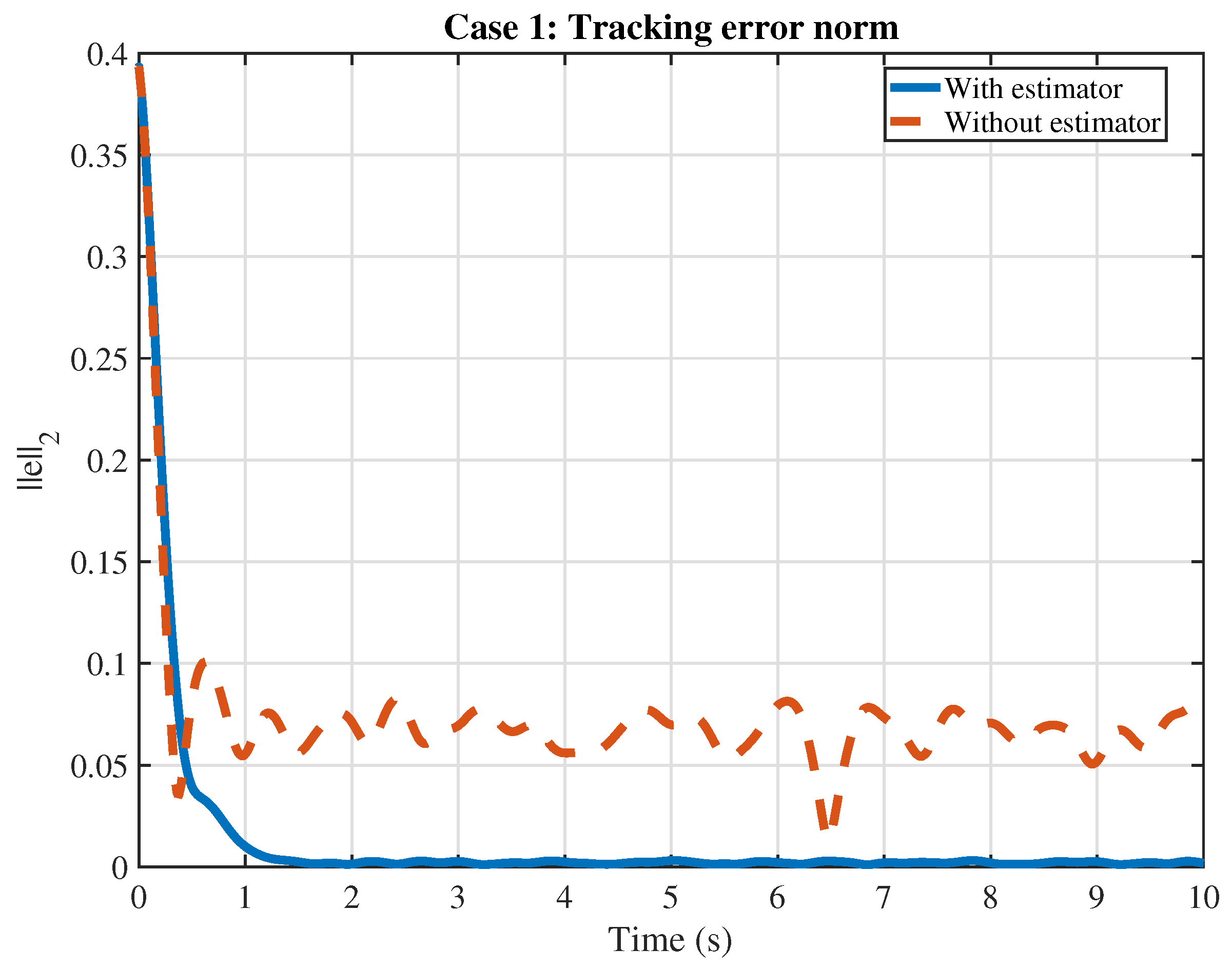
The overall effect of disturbance compensation is further highlighted in Figure 4, which shows the Euclidean norm of the tracking error. Compared with the controller without disturbance estimation, the proposed method yields a faster decay of the error norm and a lower residual value after the transient phase. This indicates not only improved pointwise joint tracking, but also a clear reduction in the global tracking error level of the manipulator. From a control perspective, this result shows that the estimator improves the closed-loop robustness without altering the structure-preserving tracking framework itself. In other words, the estimator acts as an effective compensation layer that enhances tracking performance under disturbance while preserving the port-Hamiltonian formulation of the controller.
The overall effect of disturbance compensation is further illustrated in Figure 5, which shows the Euclidean norm of the tracking error. Compared with the controller without disturbance estimation, the proposed method yields a faster decay of the error norm and a lower residual value after the transient phase. This observation is important because it shows that the improved tracking performance in Figure 3 and Figure 4 is not achieved at the price of an impractical increase in control effort.
Figure 5.
Euclidean norm of the tracking error with and without disturbance estimation.
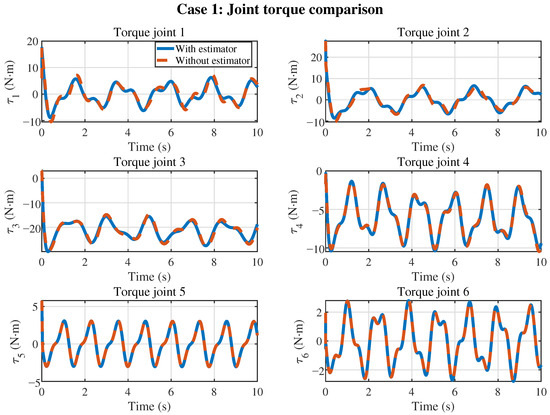
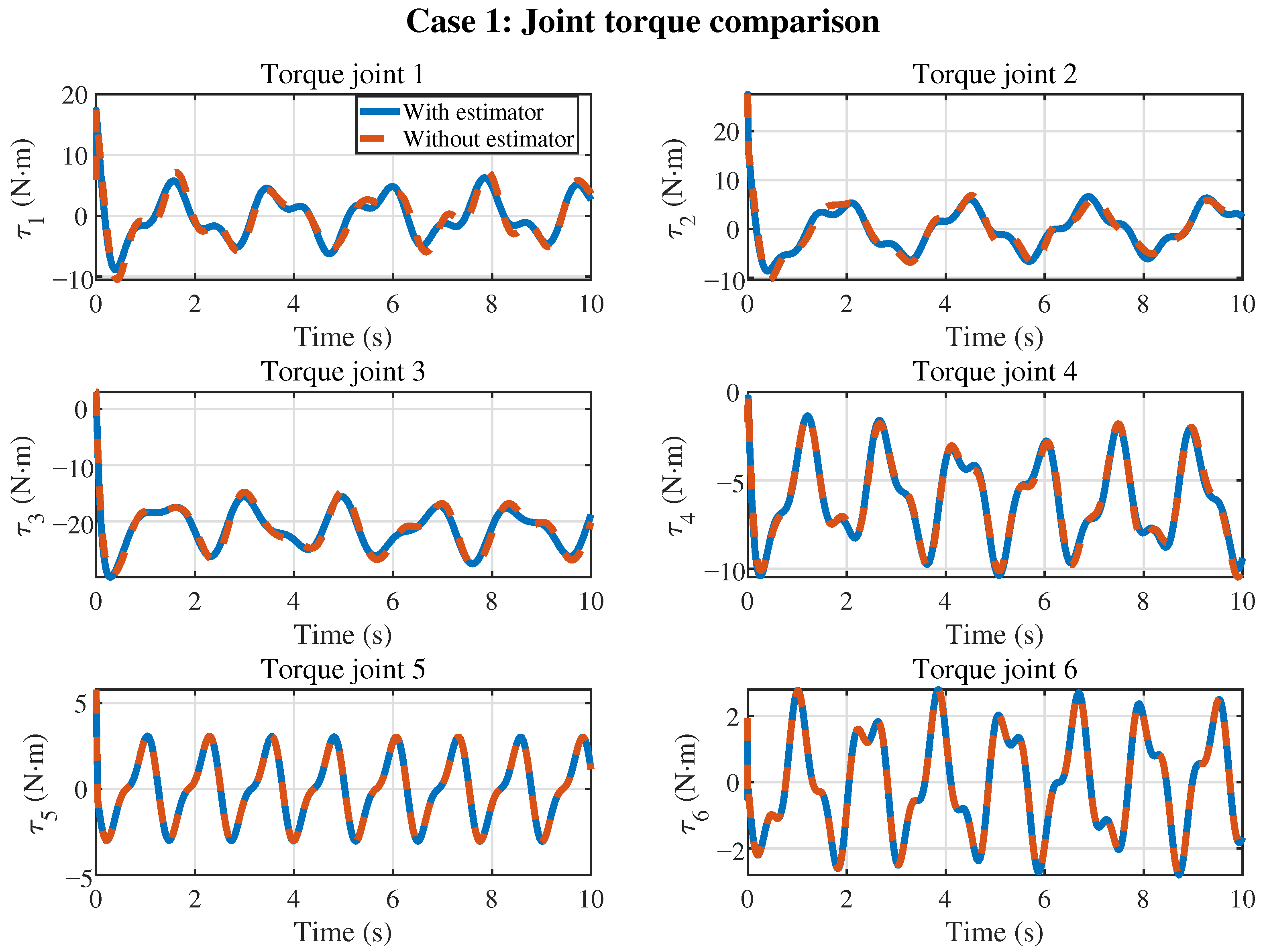
The corresponding joint control torques are shown in Figure 6. It can be observed that the introduction of disturbance compensation does not produce excessive torque amplification. Although the proposed method modifies the control action through the estimated disturbance term, the resulting torque profiles remain of comparable magnitude to those obtained without the estimator. Instead, the proposed method provides a more effective use of the control input by compensating for external disturbances in a targeted manner. Hence, the estimator improves tracking accuracy while maintaining a reasonable torque demand for all joints.
Figure 6.
Joint torques.
In addition to the tracking performance and disturbance estimation results, the evolution of the error-related energy is also examined to further illustrate the structural behavior of the closed-loop system.
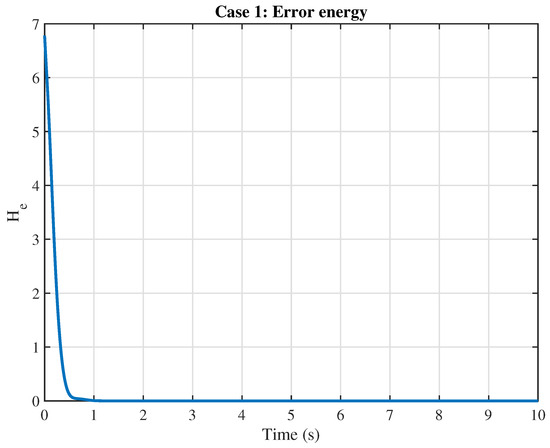
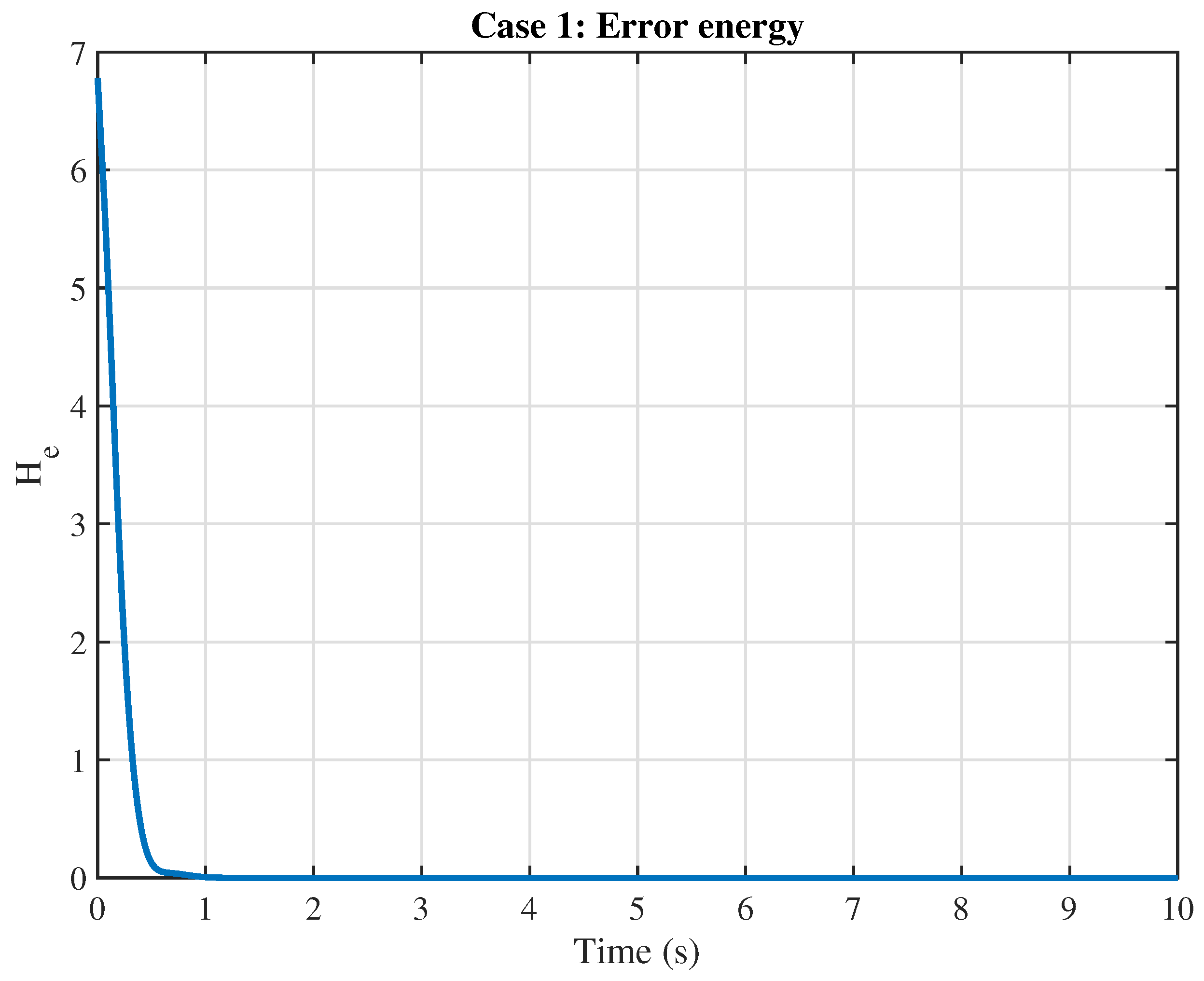
Figure 7 shows the time evolution of the error energy . It can be observed that the energy decreases rapidly during the initial transient phase and then gradually approaches a small residual neighborhood as the tracking errors converge. This behavior is consistent with the dissipative mechanism induced by the proposed controller.
Figure 7.
Evolution of the error energy in the coupled multi-joint tracking case.
From a structural viewpoint, the decreasing trend of confirms that the closed-loop system preserves the expected energy evolution characteristic in the numerical implementation. In particular, no growth of the error energy is observed over the simulation horizon, which is in agreement with the stability properties derived in the theoretical analysis.
It is worth noting that the energy curve may not be perfectly monotonic at every sampling instant due to numerical integration, finite-step discretization, and algebraic approximations in the robot dynamics computation. Nevertheless, the global dissipative trend remains clear, which further supports the structure consistency of the proposed energy-based tracking controller.
The quantitative results reported in Table 3 further confirm the advantage of the proposed method. Compared with the controller without disturbance compensation, the proposed method achieves lower RMS and maximum tracking errors, together with a shorter settling time. In addition, the control torque remains at a comparable level, indicating that the performance improvement is not obtained at the expense of excessive control effort. The low disturbance estimation error also confirms the effectiveness of the estimator in reconstructing the unknown external torques.
Table 3.
Quantitative performance metrics for Case 1.
4.3. High-Speed or Large-Amplitude Tracking Case
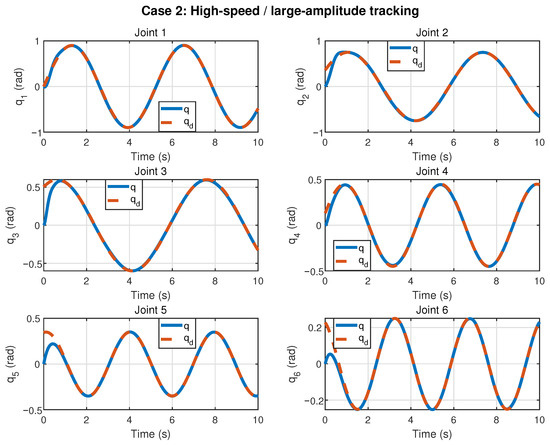
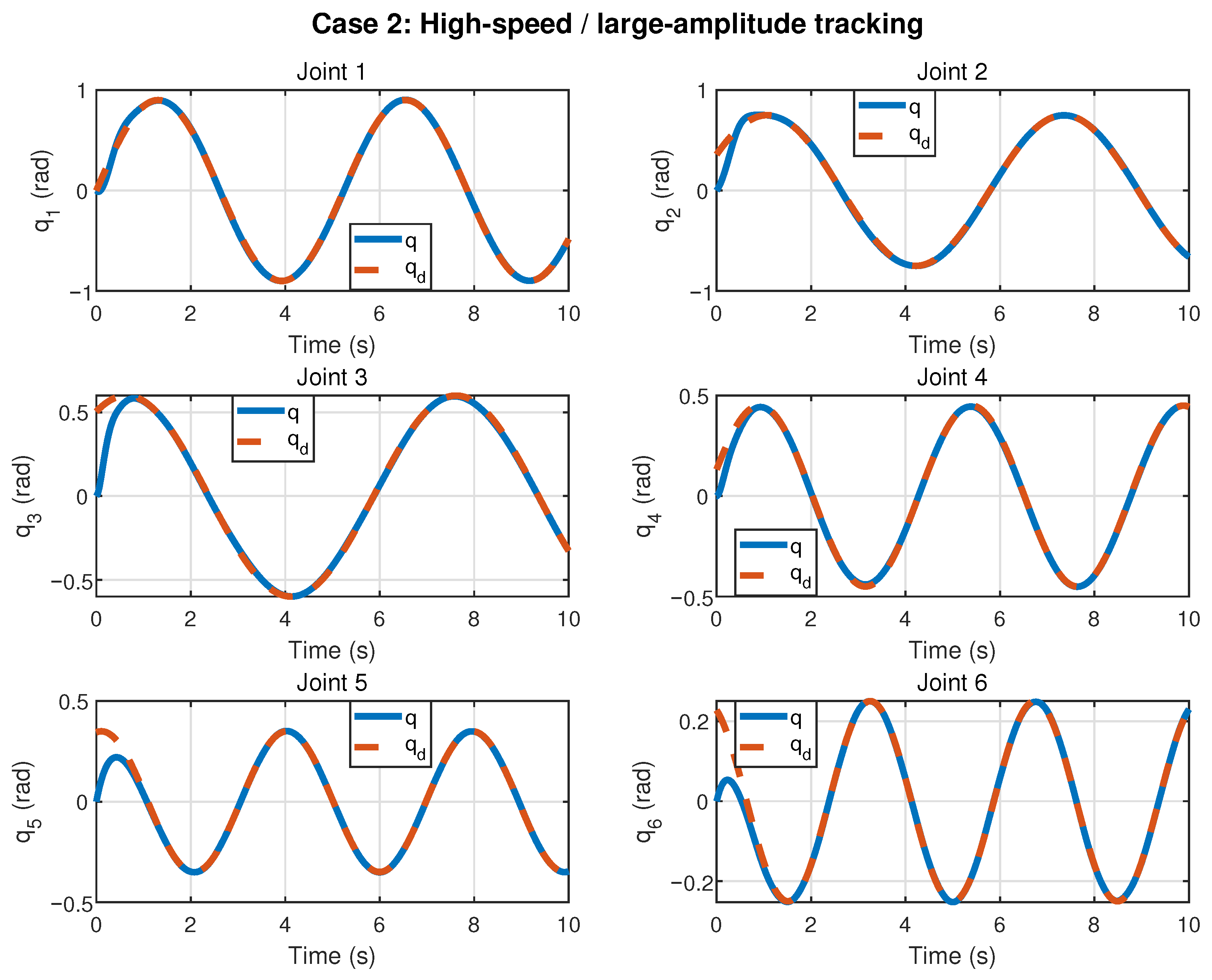
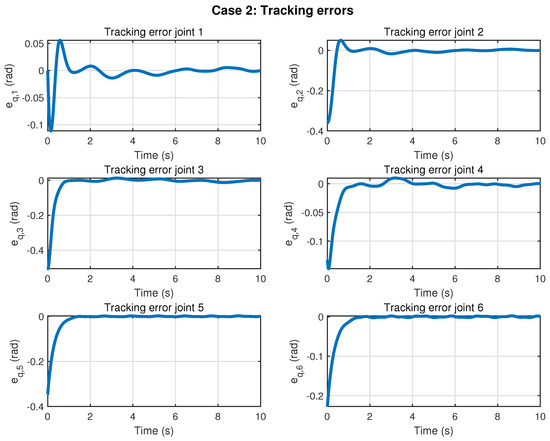
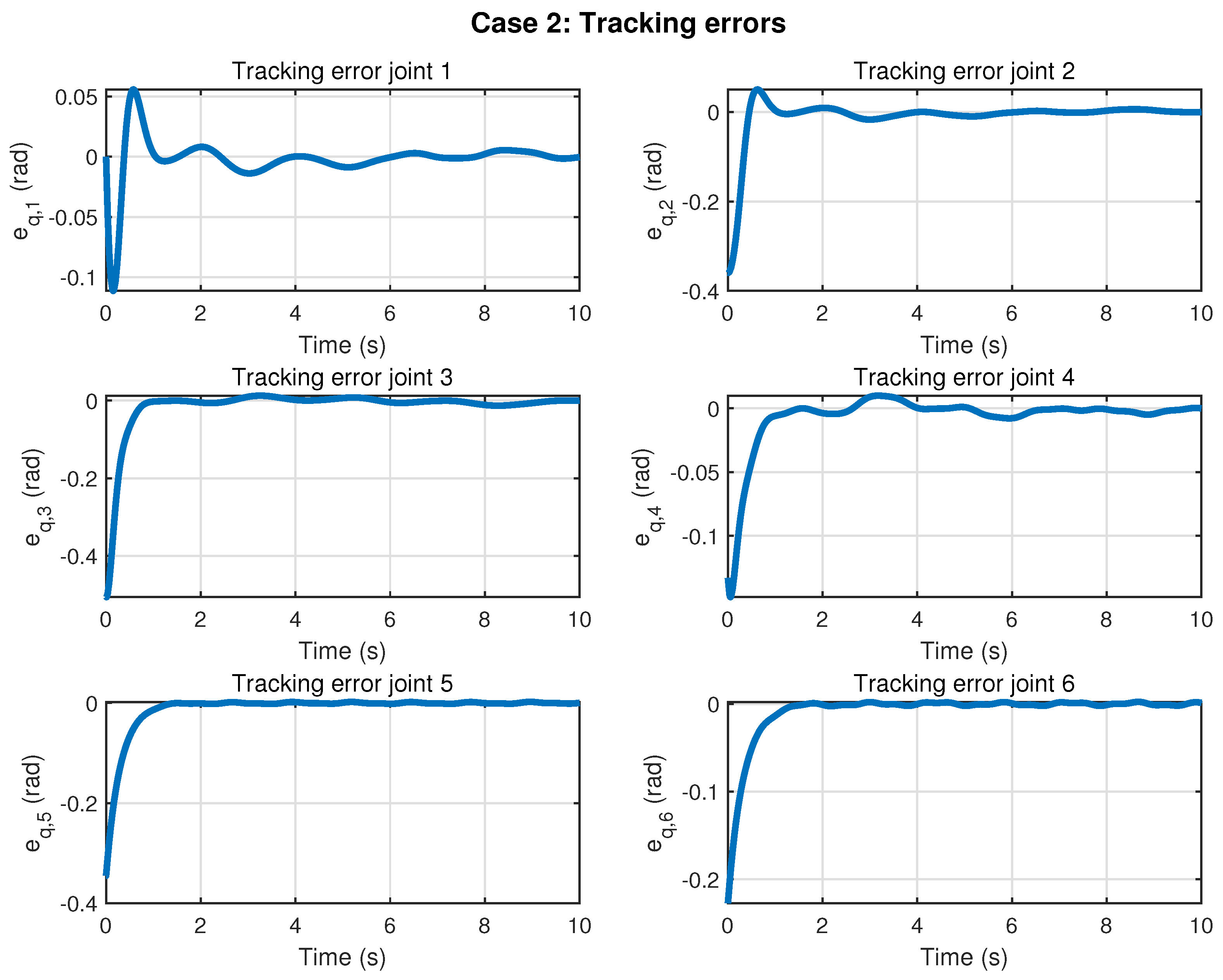
To further evaluate the performance of the proposed controller under more demanding operating conditions, a high-speed and large-amplitude tracking case is considered. In this simulation, all six joints are required to follow reference trajectories with increased amplitudes and higher frequencies compared with those used in the previous case. As a result, the manipulator is subjected to stronger dynamic coupling, larger velocity and acceleration variations, and more demanding control effort requirements.
Figure 8 shows the joint trajectories and their corresponding reference signals in this aggressive motion scenario. It can be observed that the actual joint responses still closely follow the desired trajectories for all six joints. Although the motion conditions are significantly more challenging than those in the nominal tracking case, the controller preserves accurate trajectory tracking performance over the entire simulation interval.
Figure 8.
Joint trajectories and reference signals under the high-speed and large-amplitude tracking case.
The corresponding tracking errors are presented in Figure 9. As expected, the error magnitudes are slightly larger than those observed in the previous case due to the higher motion speed and larger trajectory amplitudes. Nevertheless, the tracking errors remain small and bounded, and no instability or performance degradation is observed. This result demonstrates that the proposed controller is capable of handling stronger nonlinear coupling effects and more aggressive joint motions while maintaining satisfactory tracking accuracy.
Figure 9.
Tracking errors of all joints under the high-speed and large-amplitude motion case.
Overall, the results of this case confirm that the proposed method is not limited to mild operating conditions. Instead, it remains effective under high-speed and large-amplitude motion, which further verifies its scalability and applicability to demanding robotic tracking tasks.
5. Conclusions
This paper presented a port-Hamiltonian-based tracking control framework for a six-degree-of-freedom robotic manipulator. Starting from the port-Hamiltonian formulation of the robot dynamics, a momentum-based tracking controller was developed to regulate the joint trajectories while preserving the energy-related structural properties of the system. In addition, a disturbance estimation mechanism was incorporated to enhance the robustness of the closed-loop system against unknown external torques.
The proposed controller was evaluated through numerical simulations involving coupled multi-joint motions and high-speed large-amplitude trajectories. The results demonstrated accurate trajectory tracking performance and effective disturbance compensation for all joints. Furthermore, the evolution of the error energy confirmed the dissipative behavior of the closed-loop system, which is consistent with the energy-based design philosophy underlying the proposed control framework.
Future work will focus on experimental validation of the proposed method on a real robotic platform. In addition, the framework will be extended to more complex robotic systems, including rigid-flexible coupled manipulators where link flexibility is modeled using beam dynamics. Integration of the present energy-based tracking design with flexible-link dynamics is expected to provide a systematic approach for controlling lightweight manipulators with significant structural deformation.
Author Contributions
Conceptualization, Z.L. and W.Z.; methodology, Z.L. and J.W.; software, Z.L., J.W. and X.H.; validation, Z.L. and X.H.; formal analysis, J.W. and W.Z.; investigation, J.W. and T.W.; data curation, J.W.; writing—original draft preparation, Z.L. and W.Z.; writing—review and editing, T.W.; visualization, Z.L. and X.H.; supervision, W.Z.; project administration, W.Z. All authors have read and agreed to the published version of the manuscript.
Funding
This research received no external funding.
Data Availability Statement
The data used to support the findings of this study are available from the corresponding author upon reasonable request.
Conflicts of Interest
The authors declare no conflict of interest.
References
- Slotine, J.J.E.; Li, W. On the adaptive control of robot manipulators. Int. J. Robot. Res. 1987, 6, 49–59. [Google Scholar] [CrossRef] [Scilit]
- Lewis, F.L.; Abdallah, C.T.; Dawson, D.M. Control of Robot Manipulators; Macmillan Publishing Company: New York, NY, USA, 1993. [Google Scholar]
- Khatib, O. A unified approach for motion and force control of robot manipulators: The operational space formulation. IEEE J. Robot. Autom. 1987, RA-3, 43–53. [Google Scholar] [CrossRef] [Scilit]
- Hogan, N. Impedance control: An approach to manipulation: Part I—Theory. ASME J. Dyn. Syst. Meas. Control 1985, 107, 1–7. [Google Scholar] [CrossRef] [Scilit]
- Craig, J.J. Introduction to Robotics: Mechanics and Control, 3rd ed.; Pearson Prentice Hall: Upper Saddle River, NJ, USA, 2005. [Google Scholar]
- Spong, M.W.; Hutchinson, S.; Vidyasagar, M. Robot Modeling and Control; John Wiley & Sons: Hoboken, NJ, USA, 2005. [Google Scholar]
- Siciliano, B.; Sciavicco, L.; Villani, L.; Oriolo, G. Robotics: Modelling, Planning and Control; Springer: London, UK, 2009. [Google Scholar]
- Ortega, R.; van der Schaft, A.J.; Mareels, I.; Maschke, B.M. Putting energy back in control. IEEE Control Syst. Mag. 2001, 21, 18–33. [Google Scholar]
- van der Schaft, A.J. L2-Gain and Passivity Techniques in Nonlinear Control; Springer: London, UK, 2000. [Google Scholar]
- Paden, B.; Panja, R. Globally asymptotically stable PD+ controller for robot manipulators. Int. J. Control 1988, 47, 1697–1712. [Google Scholar] [CrossRef] [Scilit]
- Kelly, R.; Santibánez, V.; Loria, A. Control of Robot Manipulators in Joint Space; Springer: London, UK, 2005. [Google Scholar]
- Maschke, B.M.; van der Schaft, A.J.; Breedveld, P.C. An intrinsic Hamiltonian formulation of network dynamics: Non-standard Poisson structures and gyrators. J. Frankl. Inst. 1992, 329, 923–966. [Google Scholar] [CrossRef] [Scilit]
- van der Schaft, A.J.; Maschke, B.M. Hamiltonian formulation of distributed-parameter systems with boundary energy flow. J. Geom. Phys. 2002, 42, 166–194. [Google Scholar] [CrossRef] [Scilit]
- Ortega, R.; van der Schaft, A.J.; Mareels, I.; Maschke, B.M. Interconnection and damping assignment passivity-based control of port-controlled Hamiltonian systems. Automatica 2002, 38, 585–596. [Google Scholar] [CrossRef] [Scilit]
- Fujimoto, K.; Sakurama, K.; Sugie, T. Trajectory tracking control of port-controlled Hamiltonian systems via generalized canonical transformations. Automatica 2003, 39, 2059–2069. [Google Scholar] [CrossRef] [Scilit]
- Fujimoto, K.; Sugie, T. Canonical transformations and stabilization of generalized Hamiltonian systems. Syst. Control Lett. 2001, 42, 217–227. [Google Scholar] [CrossRef] [Scilit]
- Duindam, V.; Macchelli, A.; Stramigioli, S.; Bruyninckx, H. Modeling and Control of Complex Physical Systems: The Port-Hamiltonian Approach; Springer: Berlin/Heidelberg, Germany, 2009. [Google Scholar]
- Hoang, N.H.; Nguyen, T.S.; Le, T.K.P.; Dochain, D.; Maschke, B.M.; Le Gorrec, Y. Trajectory tracking for nonlinear systems using extended quadratic port-Hamiltonian models without input and state coordinate transformations. Syst. Control Lett. 2022, 167, 105325. [Google Scholar] [CrossRef] [Scilit]
- Astolfi, A.; Ortega, R. Immersion and invariance: A new tool for stabilization and adaptive control of nonlinear systems. IEEE Trans. Autom. Control 2003, 48, 590–606. [Google Scholar] [CrossRef] [Scilit]

Disclaimer/Publisher’s Note: The statements, opinions and data contained in all publications are solely those of the individual author(s) and contributor(s) and not of MDPI and/or the editor(s). MDPI and/or the editor(s) disclaim responsibility for any injury to people or property resulting from any ideas, methods, instructions or products referred to in the content. |
© 2026 by the authors. Licensee MDPI, Basel, Switzerland. This article is an open access article distributed under the terms and conditions of the Creative Commons Attribution (CC BY) license.