Article

A Novel Dynamic Surge Modeling Framework for Gas Turbines: Integration of Compressor Variable Geometry


Department of Aeronautical and Automotive Engineering, Loughborough University, Loughborough LE11 3TU, UK
*
Author to whom correspondence should be addressed.
Machines 2026, 14(3), 327; https://doi.org/10.3390/machines14030327

Submission received: 30 January 2026 / Revised: 3 March 2026 / Accepted: 11 March 2026 / Published: 13 March 2026

Abstract

Gas turbines are complex mechatronic systems that require reliable dynamic models to support automated operation under varying aerodynamic conditions. This study presents a novel dynamic surge modeling framework that integrates compressor variable geometry into a gas turbine component-level model. A physics-based formulation is developed in which the influence of inlet guide vane (IGV) deflection is incorporated through sensitivity-based parameterization and a physics-informed extension of compressor performance characteristics. The proposed framework captures the nonlinear interaction between compressor surge dynamics and component-level system behavior, enabling consistent prediction of instability onset and dynamic stability margins over a wide range of operating conditions. Model verification through stability analysis, phase-space characterization, and time-domain simulations demonstrates that the framework reproduces key features of classical compressor surge and quantifies the impact of variable geometry on system stability. The results show that the proposed model provides a practical and computationally efficient basis for control-oriented surge analysis, including stability monitoring and surge delay assessment. By coupling the IGV-aware surge dynamics with a gas turbine component-level model, the proposed method enables control-oriented, automation-ready simulation for gas turbine design and control.

1. Introduction

Gas turbines are widely utilized in modern energy conversion systems owing to their high power-to-weight ratio and operational flexibility. As the core component of a gas turbine, the compressor increases the air pressure through successive stages of rotors and stators, thereby ensuring efficient energy transfer within the gas turbine [1]. Under unstable operating conditions, the compressor would experience a surge phenomenon, in which the outlet pressure and mass flow undergo significant low-frequency oscillations. These oscillations result in a sharp reduction in overall compression capability and rotational speed, marking a loss of aerodynamic stability within the system [2,3,4]. Compressor surge represents a typical nonlinear dynamic instability characterized by large-scale flow reversal, intense backflow through the compressor stages, and strong periodic pressure and velocity fluctuations. Such behaviors disrupt the stable operation of the gas turbine, leading to cyclic mechanical and thermal loads on the compressor components [5]. In addition, compressor surge could accelerate material fatigue, induce mechanical failures, and degrade the overall performance and reliability of the gas turbine [6]. Hence, a fundamental understanding of surge mechanisms and accurate dynamic modeling are indispensable for bridging the gap between instability prediction and control, which forms the basis for the efficient and autonomous operation of modern gas turbine systems.
To develop effective enough methods for suppressing or mitigating compressor surge, it is essential to first investigate its underlying physical mechanisms and dynamic characteristics, which are currently studied mainly through experimental testing and digital-twin model simulation [7,8]. Although extensive experimental studies have been conducted on surge phenomena, several limitations remain. Each experimental test involves high cost and considerable risk, as surge testing requires operating the compressor near or beyond its stability limit, where mechanical or thermal failures may occur [9]. From the perspective of digital twin modeling, the establishment of a reliable model can effectively reduce experimental expenses and shorten the validation cycle. Meanwhile, recent data-driven and machine learning approaches have also been explored for compressor health monitoring and instability prediction, aiming to detect incipient surge or stall precursors from measurement signals. For instance, Carrattieri et al. developed machine learning models for radial compressor monitoring with instability detection, demonstrating the feasibility of data-driven surveillance under realistic operating variations [10]. Thapa et al. further proposed a data-driven dynamic modeling approach for spike stall precursor detection in an axial compressor, highlighting the potential of learning-based methods for early-warning applications [11]. Despite their promise, such approaches typically rely on the representativeness of training data and may face challenges in extrapolation across unseen configurations or variable geometry schedules, which motivates physics-based models that retain interpretability and are readily integrated with system-level simulation and control. Therefore, developing and establishing a model that can accurately capture and reproduce compressor surge behavior is of great importance. With the increasing adoption of hybrid energy architectures, improvements in battery thermal management facilitate more dynamic power sharing and load-following operations [12,13]. These trends motivate robust gas turbine stability monitoring and control, since frequent transients may move compressor operation closer to surge boundaries. In parallel, Internet-distributed energy management and multi-objective design optimization for fuel-cell systems further highlight the trend toward coordinated multi-source control under time-varying conditions [14]. These developments motivate robust gas turbine stability monitoring and control, since frequent power reallocation and transients in hybrid operation can drive the compressor closer to its stability limit, making accurate surge-onset modeling practically valuable.
Research on compressor surge modeling has mainly focused on using reduced-order models to simulate the dynamic behavior of a surge. Greitzer [15,16] developed a one-dimensional nonlinear model to describe the rotating stall behavior in axial compressors and introduced the well-known parameter B to characterize the degree and type of instability. Then, Moore [17] proposed a two-dimensional model of a rotating stall to investigate the conditions that allow flow disturbances to propagate steadily through multistage compressors, even when the upstream and downstream pressures remain constant. Building on these individual contributions, Moore and Greitzer [18,19] collaboratively developed an unsteady nonlinear Moore–Greitzer (MG) model that could capture the essential dynamic characteristics of compression systems. This work represented a significant advancement in the dynamic modeling of compressor instability. Based on their work, many researchers have developed modified or extended models to address specific aspects of compressor surge and rotating stall. Haynes et al. further refined the model by incorporating blade row time-lag effects, improving its ability to capture the dynamic response [20]. Li and Zheng took humidity into account in the model [21]. Zhang et al. established separate characteristic models for inlet distortion and blade-tip loss [22], further improving the comprehensiveness of the model. Shahriyari et al. designed an LQR controller for the MG model [23] and compared the closed-loop performance of the system. However, these studies are confined to the compressor characteristics or its external structure, without considering the strong aerodynamic coupling between the variable geometry compressor and the overall gas turbine performance. In addition, the issues of model coordination and compatibility, as well as the corresponding mapping relationship between variable geometry and surge margin, have not been further derived. In variable geometry compressors, adjustments of inlet guide vanes directly modify the flow and pressure characteristics, leading to strong nonlinear coupling between compressor aerodynamics and the overall gas turbine system. To position the proposed modeling framework within mainstream surge modeling approaches, a concise comparison is provided in terms of computational efficiency, surge reproduction capability, and engineering applicability, as summarized in Table 1.
According to existing research, the component-level model has been widely applied to simulate the dynamic processes of gas turbines at design points and during acceleration or deceleration due to its high accuracy performance [24,25,26]. However, when a gas turbine enters the surge condition, a standalone component-level model cannot accurately capture the parameter variations occurring during the compressor surge process. Although relatively few studies have focused on describing the aerodynamic effects during compressor surge, the continuous evolution of modern gas turbine technology and the introduction of variable geometry structures inherently enhance overall aerodynamic performance. Therefore, developing a real-time dynamic model capable of simulating compressor surge under various gas turbine operating conditions is of great significance for understanding surge mechanisms, resolving surge faults, and advancing active stability control of such electromechanical systems. In this context, this paper proposes a real-time surge modeling framework for gas turbines that explicitly incorporates the influence of variable geometry into the compressor–turbine coupling framework, enabling multi-configuration mapping between the surge margin and IGV setting angle. First, a component-level model of the gas turbine and a classical MG model are established, with the variable geometry mechanism introduced into the system. Then, through sensitivity analysis and physics-based modeling, a surge dynamic model under variable geometry conditions is developed. The compressor’s full-speed characteristics are extended to multiple geometric configurations, forming a mapping relationship between surge margin and geometric angle. Based on the coupling between the variable geometry surge model and the CLM, the proposed approach integrates the surge dynamics model with the gas turbine component-level model capable of steady-state and transient simulations. This integration enables the computation of key characteristic parameters throughout the entire surge process of the gas turbine. Finally, a widely used surge detection method is employed to validate the credibility of the proposed model. The developed surge model provides a solid foundation for model-based surge monitoring and control, avoiding the high risks and costs associated with surge experiments, and offers essential support for the technological advancement and stability enhancement of modern advanced gas turbines.
This paper is organized as follows. Section 2 outlines the gas turbine component-level model. Section 3 describes the proposed real-time surge modeling framework incorporating compressor variable geometry. Section 4 presents the validation and simulation results to validate the coupled CLM–surge modeling framework under various operating conditions. Finally, Section 5 concludes the study.

2. Gas Turbine Component-Level Model

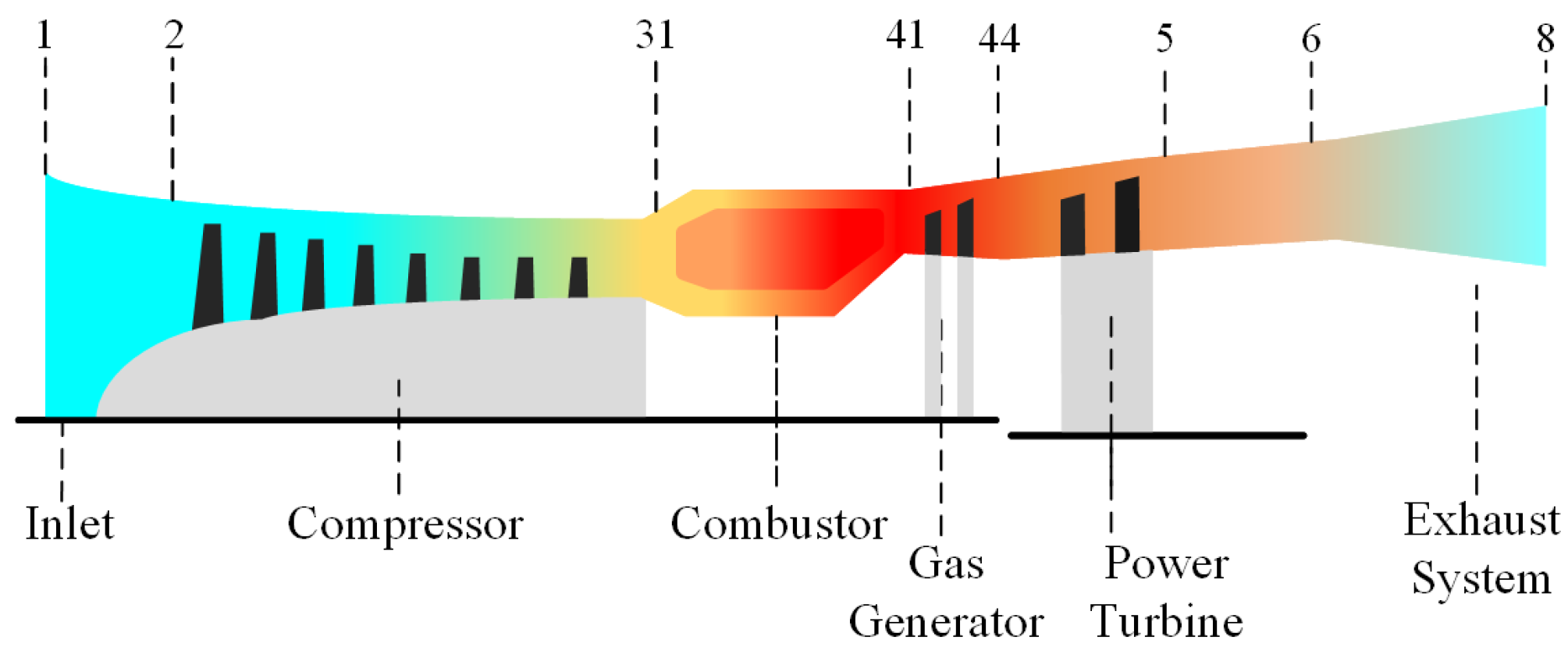
The structure and sectional definitions of the gas turbine developed in this study are shown in Figure 1, where the numbers 1, 2, 31, 41, etc., represent the inlet or outlet sections of different components. The main components include the inlet duct, compressor, combustor, gas generator turbine, power turbine, and exhaust system. Meanwhile, all components satisfy the mass flow balance equations. In particular, under steady-state conditions, the components connected by the same rotor also satisfy the corresponding power-balance relationships.
The gas turbine system is formed by linking each component model according to its physical relationships. The coupled governing equations, covering both steady-state and dynamic conditions, describe the interactions among components. Once the component-level models are established, the aerodynamic and thermodynamic parameters at each section are computed and combined into a nonlinear system of equations to obtain the system solution.
Under steady-state conditions, the rotating components are required to satisfy the power balance, while the mass flow at each section fulfills the continuity constraint. Based on these relationships, a residual vector F is formulated, and the steady-state operating parameters are determined by solving F = 0.
F = F 1 F 2 , F R 5 , F 1 R 3 , F 2 R 2 .
where the residual vector F comprises the flow-continuity residuals F 1 and the power-balance residuals F 2 .
F 1 = W 41 W 41 c W 41 c W 44 W 44 c W 44 c W 6 W 6 c W 6 c , F 2 = P g t P c / η g s p o o l 1 P p t P l o a d / η p s p o o l 1 .
where the numeric subscripts denote the corresponding stations along the gas turbine flow path. Variables with the subscript “c” (e.g., W 41 c , W 44 c , W 6 c ) denote the calculated mass flow rates, whereas those without “c” (e.g., W 41 , W 44 , W 6 ) represent the actual flow rates at the respective sections. P denotes output power, with the subscripts g t , p t , and l o a d referring to the gas turbine, the power turbine, and the external load, respectively. η represents the shaft mechanical efficiency, where g s p o o l and p s p o o l correspond to the high-speed and low-speed spools. During the dynamic process, the flow continuity across each section of the gas turbine remains valid, whereas the power-balance condition of the rotor is no longer satisfied. The corresponding dynamic equation is expressed as follows:
d n g d t = 30 π 2 P g t η g s p o o l P c J g t n g d n p d t = 30 π 2 P p t η p s p o o l P l o a d J p t n p
where n g and n p denote the rotational speeds of the gas generator and power turbine, respectively; η g s p o o l and η p s p o o l are the mechanical efficiencies of the high-speed and low-speed shafts; and J g and J p are the rotational inertias of the corresponding shafts.
In steady-state conditions, the residual equations F = 0 described above are expected to be equal to zero. The nonlinear system is solved using the Newton–Raphson (N–R) iterative method. The iteration process can be expressed as:
Y ( i + 1 ) = Y ( i ) λ F Y Y ( i ) 1 F ( Y ( i ) )
where
Y = n g n p π c π g t π p t T
Here, Y represents the iterative variable vector, which consists of the normalized gas generator speed n g , normalized power turbine speed n p , compressor pressure ratio π c , gas generator pressure ratio π g t , and power turbine pressure ratio π p t . F ( Y ) denotes the residual vector composed of the governing equations, and F Y is the Jacobian matrix of F with respect to Y . The parameter λ is the iteration step size, which controls the convergence rate of the Newton–Raphson process. The iteration continues until all elements of the residual vector converge below a predefined threshold (e.g., 10 5 ), ensuring that both the flow-continuity and power-balance conditions are satisfied under steady-state operation.

3. Real-Time Variable Geometry Surge Modeling Framework

3.1. Variable Geometry Extended Surge Model

Conventional compressor surge models aim to describe the fundamental dynamics of compressor surge using relatively simplified physical assumptions. These models are often based on lumped-parameter formulations and are able to capture key system behaviors, such as pressure-flow oscillations. Among them, the MG model stands out as a fundamental model, providing a system-level explanation of surge dynamics. Due to its clarity and mathematical simplicity, it has been widely used in surge analysis and control design.

3.1.1. Classical MG Model

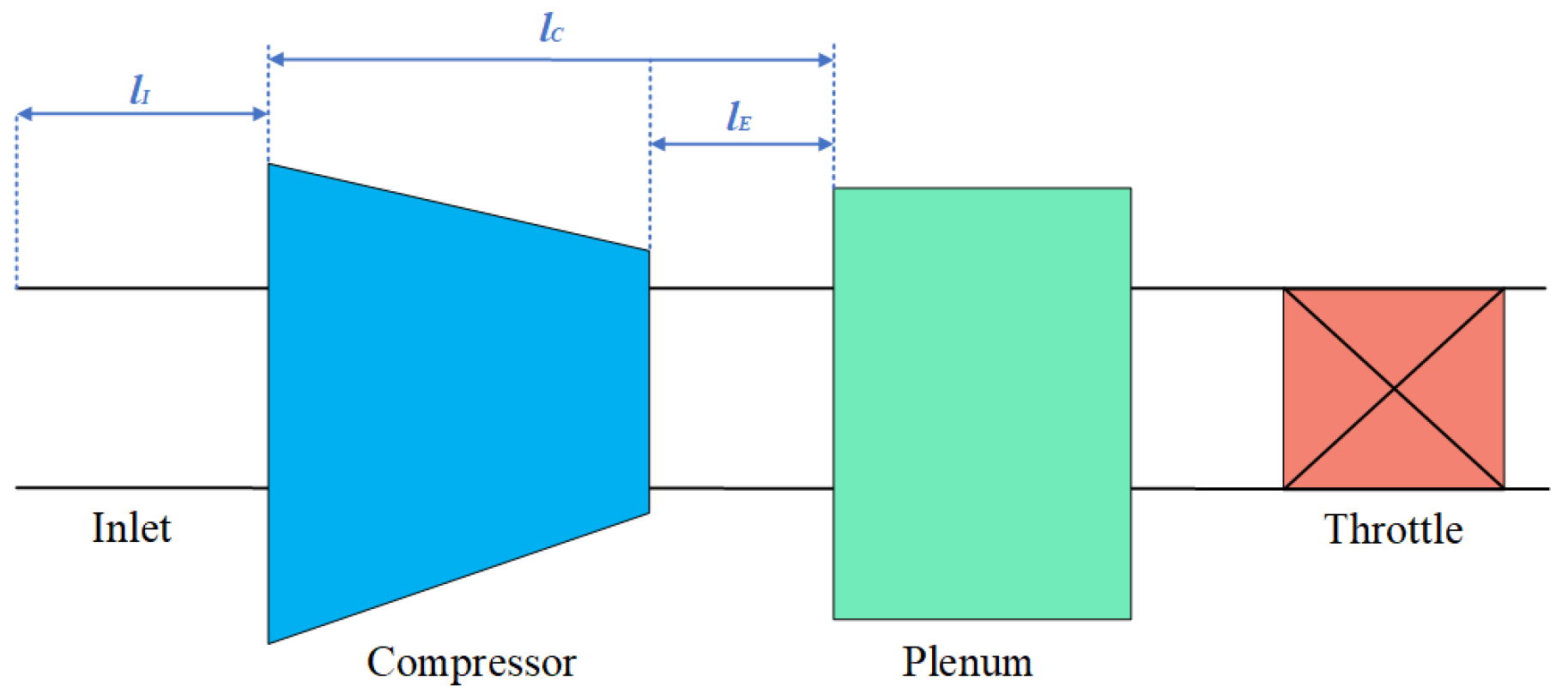
The classical MG model could capture the dynamic characteristics of surge and rotating stall in a compression system, as illustrated in Figure 2.
The main contribution of this study is the incorporation of the static pressure-rise characteristic, the throttle valve characteristic and the B parameter to characterize the dimensionless compressor performance. The definitions of these three quantities are given as follows:
Ψ c ( Φ ) = Ψ c 0 + H 1 + 3 2 Φ W c 1 1 2 Φ W c 1 3 ,
Φ T ( Ψ ) = γ T Ψ ,
B = U 2 a s V p A c L c ,
where Ψ c is the steady pressure-rise coefficient, Φ is the dimensionless mass flow coefficient, H and W c denote the height and width of the static pressure-rise curve, respectively, and B is the non-dimensional Greitzer parameter that characterizes the system stability. U is the rotor tip speed, a s is the speed of sound at the compressor inlet, and V p , A c , and L c represent the plenum volume, duct cross-sectional area, and duct length, respectively.
However, the MG model examines compressor instability under the assumption of a constant rotational speed, whereby the compressor characteristics are only represented by a single axisymmetric curve. To overcome this limitation and enhance model generality, the original model was later extended to account for multiple operating speeds by [22]. The resulting multi-speed compressor surge model can be formulated in a state-space form as
z ˙ = f ( z ) , z = ( Φ , Ψ , J n , B ) T R 4 .
The governing equations are given by:
d Φ d ξ = H l c ( B ) Ψ Ψ c 0 H + 1 + 3 2 Φ W 1 1 J 2 1 2 Φ W 1 3 A ,
where
A = l E U d Γ Λ 1 b H Φ .
In Equations (9) and (10), H is the height of the static pressure-rise curve, W is the width of the characteristic curve, and J denotes the amplitude. l c ( B ) is a length-scale function of the non-dimensional flow coefficient B, while A is an empirical parameter. Other parameters include l E , U d , Γ , Λ 1 , b, and H, which are characteristic geometric and aerodynamic coefficients associated with the compressor configuration.
d Ψ d ξ = b R U d B l c ( Φ Φ T ) 2 ρ R 3 A c b Γ U d Ψ
Equation (11) governs the transient behavior of the compressor pressure-rise coefficient Ψ . The first term reflects the influence of the mass flow deviation ( Φ Φ T ) on the pressure response, while the second term represents the damping contribution arising from the plenum and duct dynamics. Together, these terms characterize the pressure evolution within the compression system during unsteady operation.
In this study, the speed-dependent characteristic parameters are identified based on compressor performance data, allowing the static pressure-rise and throttle characteristics to be explicitly expressed as functions of rotational speed n g . This formulation enables the multi-speed surge model to capture variations in compressor behavior across a range of operating conditions.
Based on Equations (5) and (6), the static pressure-rise characteristics of the compressor and the throttle valve characteristics can be extended to multiple gas turbine rotational speeds n g as follows:
Ψ c ( Φ , n g ) = Ψ c 0 ( n g ) + H ( n g ) 1 + 3 2 Φ W c ( n g ) 1 1 2 Φ W c ( n g ) 1 3 ,
Φ T ( Ψ , n g ) = γ T ( n g ) Ψ ,
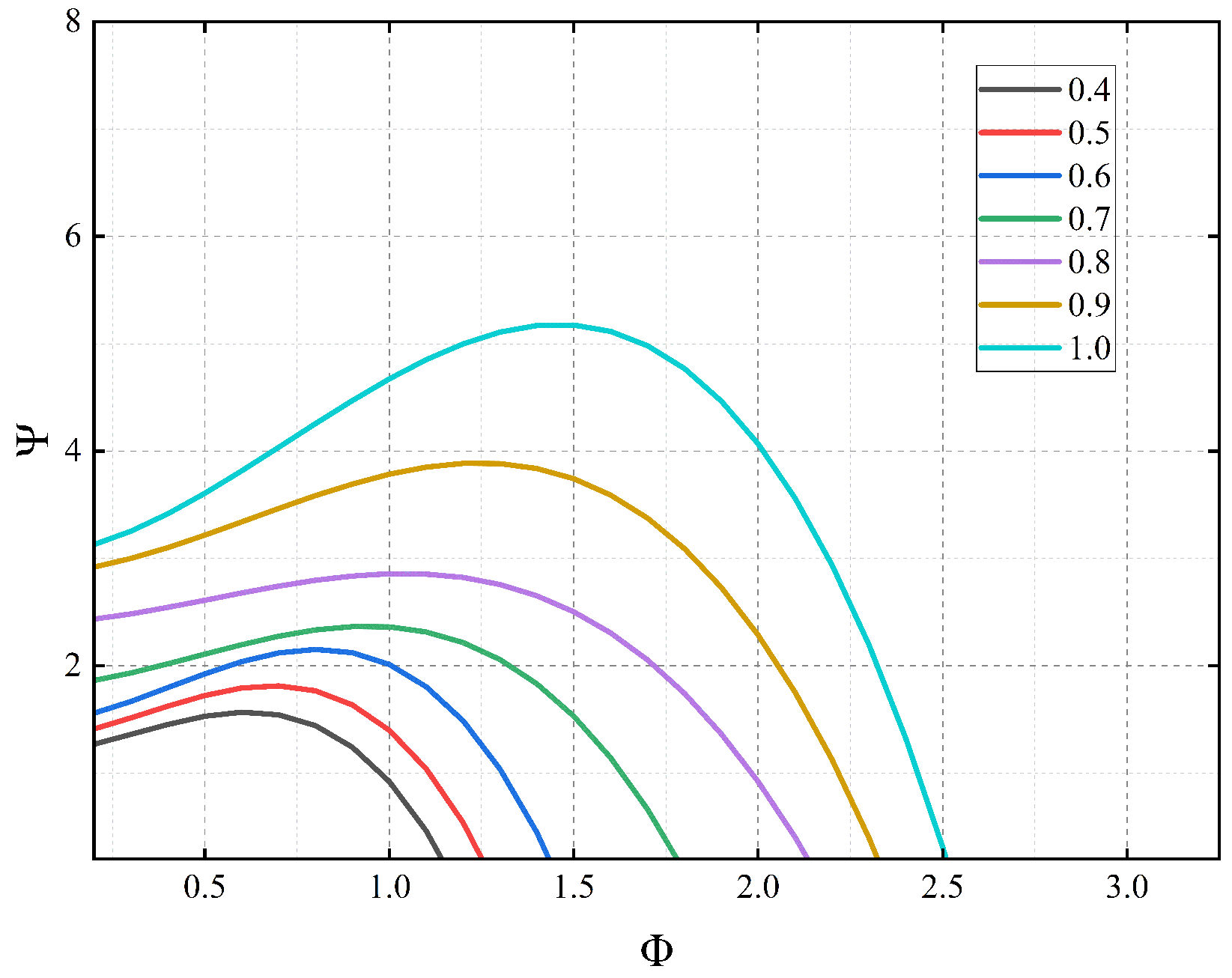
Then, the static pressure-rise curves under various rotational speeds are shown in Figure 3.

3.1.2. Quantitative Sensitivity Analysis

The inlet guide vane (IGV) serves as a key variable geometry component that directly alters the incidence angle and aerodynamic loading of the compressor blades, thereby influencing both the steady-state performance and dynamic stability characteristics of the compression system. Small variations in the IGV angle can significantly affect the compressor characteristics, surge margin, and overall system stability. Therefore, a quantitative sensitivity analysis is conducted to evaluate the degree of influence of the IGV angle on the compressor’s aerodynamic and dynamic behaviors. This analysis provides a quantitative explanation for incorporating variable geometry effects into the surge model. The nonlinear dynamic system of the compressor can be generally expressed as:
z ˙ = f ( z , θ ) , θ = θ p θ n .
θ = [ θ p , θ n ] T represents the IGV deflection vector, where θ p and θ n denote the positive (opening) and negative (closing) deviations from the engineering design setting, respectively.
Then, considering the coupling between the surge model and the CLM, the sensitivity coefficient matrix can be further defined as:
S θ = Φ θ p Ψ θ p W 31 θ p P 31 θ p T 31 θ p Φ θ n Ψ θ n W 31 θ n P 31 θ n T 31 θ n T .
where θ p and θ n denote the positive and negative IGV deflection angles, respectively. The bidirectional sensitivity matrix S θ quantifies the asymmetric influence of IGV opening and closing on the system states, reflecting the nonlinear geometric coupling effects within the compressor flow path. The temporal evolution of the sensitivity matrix is obtained by differentiating the governing equations with respect to θ :
d S θ d t = f z S θ + f θ .
where f z represents the system Jacobian matrix describing the coupling among state variables, and f θ characterizes the direct impact of IGV angle variations on the system dynamics.
To allow a consistent comparison between aerodynamic parameters of different dimensions, a normalized sensitivity index (NSI) is introduced to describe the relative effect of inlet guide vane (IGV) angle variations on compressor performance. This dimensionless index removes the scale differences among parameters such as flow, pressure. The NSI is defined as:
S I x i , θ = θ x i x i θ , x i { Φ , Ψ , W 31 , P 31 , T 31 } .
Here, S I x i , θ denotes the normalized sensitivity of the variable x i with respect to the IGV angle θ . A positive value of S I x i , θ indicates that the parameter increases with IGV opening, while a negative value signifies a decrease. The magnitude of S I x i , θ represents the relative strength of the variable’s response, allowing direct comparison across different quantities. This formulation provides a unified basis for assessing how IGV adjustment affects the overall aerodynamic and thermodynamic behavior of the coupled compressor–turbine system.
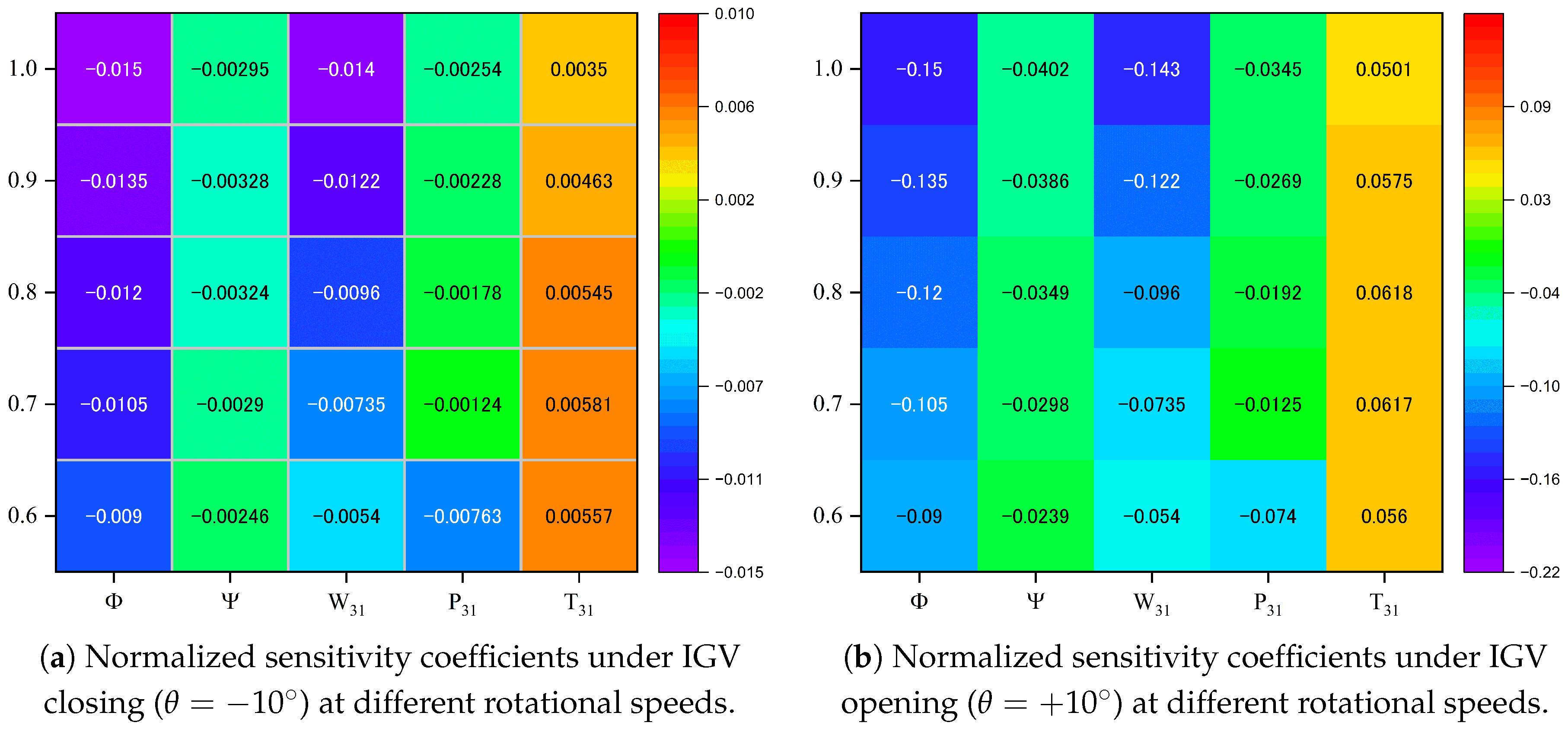
To visualize the quantitative influence of the IGV deflection on each variable, the sensitivity coefficient matrix is illustrated in the form of a heatmap, as shown in Figure 4. The analysis is performed under standard atmospheric conditions to ensure consistency and comparability of results, with two representative IGV angles ( θ = 10 ° and + 10 ° ) selected to introduce controlled, symmetric perturbations around the nominal setting. These values correspond to a typical moderate IGV adjustment range in practical operation and remain within the validity envelope of the employed compressor characteristics, thereby enabling a clear and fair comparison between negative and positive deflections.
These deflection values correspond to typical vane opening and closing conditions observed in variable geometry compressors, allowing the bidirectional effects of IGV adjustment to be clearly examined. For each deflection case, the resulting changes in the aerodynamic and thermodynamic parameters ( Φ , Ψ , W 31 , P 31 , and T 31 ) are computed, and the corresponding sensitivity coefficients are normalized and visualized.
Figure 4 reveals distinct sensitivity distributions associated with opposite IGV deflection directions. Under IGV closing ( 10 ° ), parameters related to pressure rise ( Ψ , P 31 ) exhibit strong positive sensitivities, while flow-related variables ( Φ , W 31 ) respond negatively. Physically, IGV closing reduces the inlet flow incidence and effective flow area, resulting in a lower mass flow rate and a higher static pressure rise across the compressor. As the incoming air is turned more toward the axial direction, the compressor operates at a lower flow coefficient and closer to the high-pressure, low-flow region of the performance map. In this regime, the flow becomes more throttled and less responsive to further variations in the IGV angle, leading to smaller overall sensitivity magnitudes.
In contrast, IGV opening (+10°) increases the inlet incidence and mass flow rate, shifting the compressor operating point toward the high-flow region. The aerodynamic loading on the blades is reduced, and the pressure ratio decreases accordingly. This change reverses the sensitivity signs compared with the IGV closing case. Moreover, the system becomes more responsive to geometric perturbations, but the overall sensitivity magnitude decreases because the flow field is more uniform and less prone to separation.

3.1.3. Physical Mechanism of Variable Geometry Effects

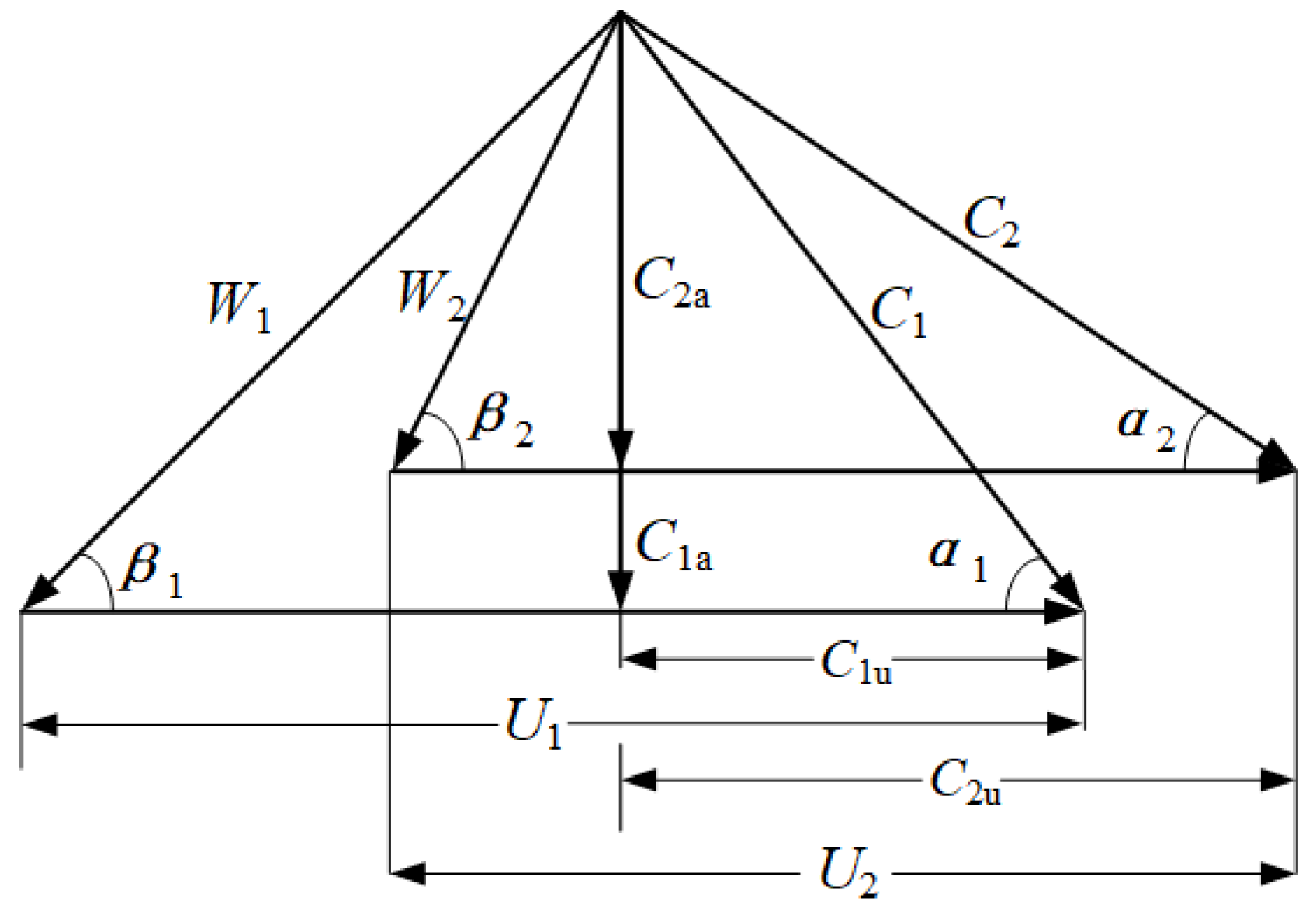
In order to reveal the impact mechanism of inlet guide vane (IGV) adjustment on the overall performance of the compressor, a physical deduction model of the influence of guide vane angle change on flow rate, pressure ratio and efficiency was established based on the velocity triangle relationship and energy equation. The variable geometry of the compressor, mainly achieved through the adjustment of the inlet guide vanes, alters the inlet flow direction and thus changes the flow incidence on the rotor blades. This section derives the physical mechanism by which the IGV angle influences the overall compressor performance in terms of flow rate, pressure ratio, and efficiency.
At a constant rotational speed, the velocity triangles at the inlet and outlet can be expressed as:
tan β 1 = V x U V θ 1 , tan α 1 = V θ 1 V x ,
tan β 2 = V x U V θ 2 , tan α 2 = V θ 2 V x ,
where U is the blade peripheral velocity, V x the axial velocity component, V θ the tangential velocity component, and α , β the absolute and relative flow angles, respectively. A change in IGV setting angle θ IGV modifies the outlet flow direction α 1 , thereby changing the tangential velocity V θ 1 and the rotor inlet incidence angle β 1 .
The geometric relationships of the velocity components and flow angles in Equations (18) and (19) are illustrated in Figure 5. The figure shows the velocity triangles at the rotor inlet and outlet, where C denotes the absolute velocity, W the relative velocity, and U the blade peripheral velocity. The angles α and β represent the absolute and relative flow angles, respectively. A variation in the inlet guide vane (IGV) angle changes the outlet flow direction α 1 , thereby altering the tangential velocity component V θ 1 and the rotor inlet incidence angle β 1 .
According to the Euler turbomachinery equation, the specific work input is given by:
Δ h = U ( V θ 2 V θ 1 ) ,
and the corresponding stage pressure ratio can be expressed as:
π c = 1 + η c U ( V θ 2 V θ 1 ) c p T 1 γ γ 1 ,
where c p is the specific heat at constant pressure, T 1 the inlet total temperature, η c the efficiency, and γ the specific heat ratio.
The variation of the IGV angle also affects the rotor incidence, defined as the deviation between the actual and design relative inlet angles:
i ( θ IGV ) = β 1 ( θ IGV ) β 1 , d , β 1 ( θ IGV ) = arctan V x U V θ 1 ( θ IGV ) ,
Following the sign convention in Figure 5, β 1 is measured from the axial direction and V θ 1 is defined as positive in the rotor rotational direction; hence the rotor-relative tangential component satisfies W θ 1 = U V θ 1 . Here, β 1 , d denotes the design incidence angle, and a positive incidence ( i > 0 ) implies increased deviation from the design inlet angle and is typically associated with higher aerodynamic losses due to boundary-layer separation and wake thickening.
Combining incidence and diffusion effects, the compressor efficiency can be approximated by an empirical loss model:
η c ( θ ) = η 0 k i [ i ( θ ) ] 2 k D [ D ( θ ) D 0 ] 2 ,
where η 0 is the design-point efficiency, and k i , k D are the empirical coefficients associated with incidence and diffusion losses, respectively. The diffusion factor D ( θ ) follows the Lieblein approximation:
D ( θ ) = 1 V 2 V 1 + V θ 2 V θ 1 ( θ ) 2 V 1 , V 1 V x 2 + V θ 1 2 .
From Equations (20)–(24), it can be inferred that the IGV deflection influences the compressor performance through coupled aerodynamic mechanisms:
  • Changing the inlet flow incidence and thereby the mass flow rate;
  • Modifying the tangential momentum exchange and therefore the stage pressure ratio;
  • Affecting diffusion and loss characteristics, which determine the overall efficiency.
In a simplified normalized form, the tendencies can be summarized as:
Δ m ˙ m ˙ Δ θ IGV , Δ π c π c Δ θ IGV , Δ η c η c ( Δ θ IGV ) 2
These relations reveal that IGV closure increases pressure ratio and efficiency but reduces mass flow rate, while excessive deflection (either opening or closing) degrades efficiency due to strong incidence and diffusion losses.

3.2. Coupled Framework of the Surge Model and the CLM

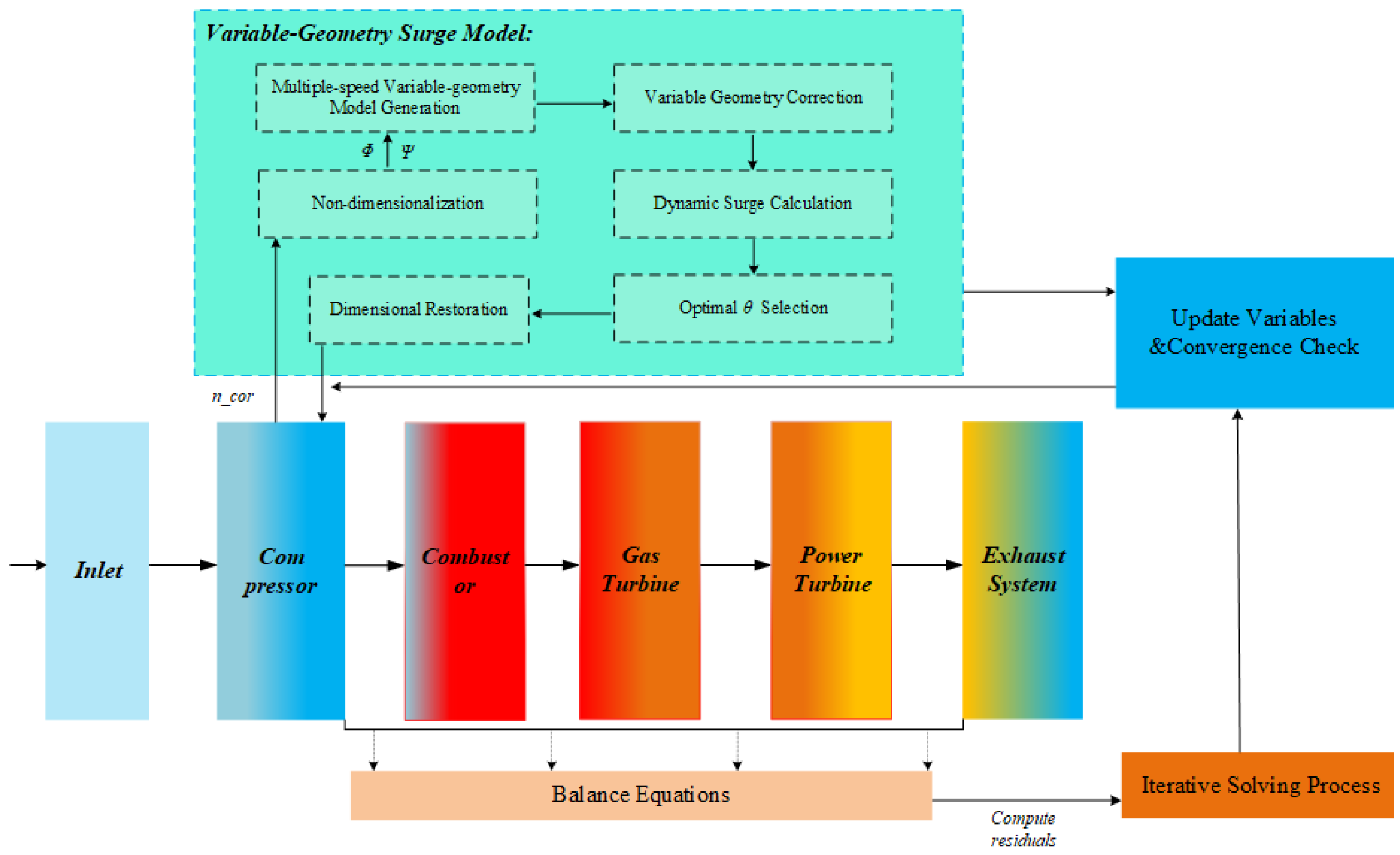
The variable geometry surge model is coupled with the component-level model to represent the interaction between compressor surge dynamics and the overall system response. The surge model describes the compression system in terms of dimensionless aerodynamic variables, while the component-level model is formulated using measurable thermodynamic quantities. To enable a consistent exchange of information between the two models, transformation relations are introduced to link the corresponding flow and pressure representations. The dimensionless flow and pressure-rise coefficients are
Φ = m ˙ c ρ a A c U , Ψ = Δ p c 1 2 ρ a U 2 ,
where m ˙ c is the compressor mass flow rate, Δ p c the total pressure rise, ρ a the inlet-air density, A c the flow area, and U the blade-tip speed.
The inverse relations that convert the surge model variables back to the CLM form are
m ˙ c = Φ ρ a A c U , π c = 1 + Ψ U 2 2 c p T 1 γ γ 1 ,
where T 1 is the compressor inlet total temperature, c p the specific heat, and γ the specific heat ratio. These relations allow real-time data exchange between the aerodynamic and thermodynamic subsystems.
The coupled dynamic equations of the integrated model can be expressed as
z ˙ S = f s z s , θ IGV , n g , z ˙ CLM = f CLM z CLM , m ˙ c , π c ,
where z MG = ( Φ , Ψ ) T and z CLM contains the gas turbine thermodynamic states. The variables m ˙ c and π c serve as the coupling interface between the two models, forming a closed-loop compressor–gas turbine system capable of reproducing surge-onset and recovery behavior.
As shown in Figure 6, the coupling is achieved through bidirectional data exchange: the surge model supplies the transient aerodynamic response, while the CLM updates the thermodynamic boundary conditions in real time. This interaction forms a self-consistent closed-loop representation of the entire gas turbine–compressor system. This framework ensures consistency between the dimensionless surge dynamics and the physical model, providing a unified basis for simulation, fault diagnosis, and control of compressor instabilities.

4. Simulation and Verification

Simulation results are presented in this section to validate the proposed variable geometry surge modeling framework.

4.1. Verification of Surge Reproduction Capability

The classical surge behavior reproduced by the proposed model is examined in this section through phase-space and time-domain analyses under different operating conditions.

4.1.1. Stability Characteristics of Surge Onset

To verify whether the proposed surge model reproduces the correct instability mechanism associated with compressor surge, a stability-based verification is carried out using a Hopf bifurcation criterion. In compressor surge modeling, Hopf bifurcation analysis is commonly used to identify the transition from steady operation to self-sustained oscillations and to define the onset of surge instability [21,27]. Within this framework, surge inception corresponds to the loss of local stability of the equilibrium point, indicated by a pair of complex-conjugate eigenvalues crossing the imaginary axis.
For verification purposes, the nonlinear surge dynamics of the proposed model are expressed in a state-space form,
z ˙ = f ( z , B , n g , θ IGV ) ,
where z = ( Φ , Ψ ) T denotes the flow and pressure state vector. For a given operating condition, the equilibrium state z e = ( Φ e , Ψ e ) is determined by the steady coupling between the compressor characteristic and the throttle relation, satisfying
f ( z e , B , n g , θ IGV ) = 0 .
Local stability of the equilibrium point is evaluated by linearizing the nonlinear system around z e , yielding
ξ ˙ = J ( z e , B , n g , θ IGV ) ξ , ξ = z z e ,
where J denotes the Jacobian matrix of the system. Under variable geometry conditions, the Jacobian matrix explicitly depends on both the rotational speed and the IGV angle and can be expressed as
J ( Φ 0 , Ψ 0 , n g , θ IGV ) = 1 l c Ψ c ( Φ , n g , θ IGV ) Φ Φ 0 1 l c 1 4 B 2 l c 1 4 B 2 l c Ψ T ( Ψ , n g ) Ψ Ψ 0 ,
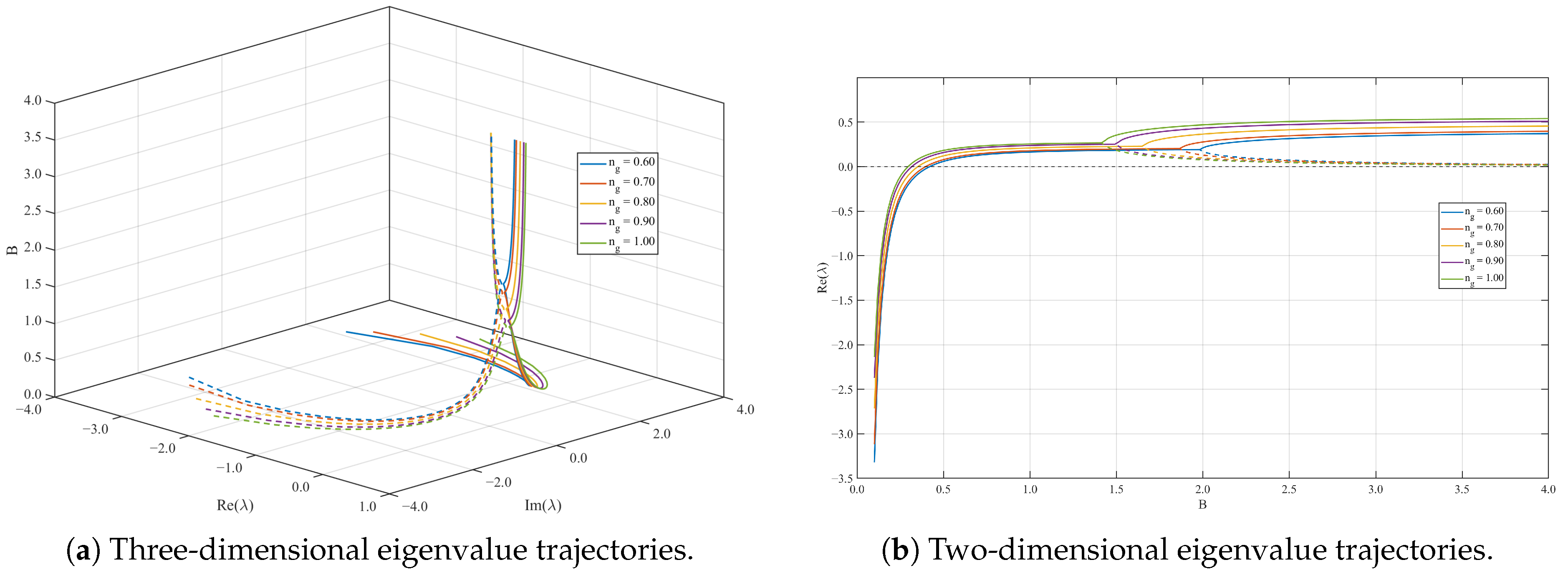
By varying the parameter B, the eigenvalues of the Jacobian matrix are tracked to evaluate the stability evolution of the equilibrium point, as shown in Figure 7. A Hopf bifurcation is identified when the real part of a complex-conjugate eigenvalue pair crosses zero while the imaginary part remains nonzero.
The three-dimensional trajectories show that the dominant eigenvalue pair gradually migrates toward the imaginary axis as B increases. The corresponding two-dimensional projection further highlights the crossing of the real part through zero, which marks the onset of surge instability. This behavior is consistently observed across all relative rotational speeds and follows the same qualitative trend reported in [22]. These results provide further confirmation that the proposed surge model reproduces the classical surge instability mechanism via a Hopf bifurcation.
To quantify the stability boundary implied by the eigenvalue evolution, the critical Hopf bifurcation parameters are extracted for each normalized rotational speed and IGV setting. Specifically, the critical value B cr is identified at the point where the dominant complex-conjugate eigenvalue pair crosses the imaginary axis, and the associated equilibrium operating point ( Φ cr , Ψ cr ) and oscillation frequency ω cr are reported simultaneously. For clarity and engineering relevance, the bifurcation points are tabulated at representative discrete IGV settings θ IGV = { 12 ° , 6 ° , 0 ° , + 6 ° , + 12 ° } commonly used in practical IGV scheduling and control. The resulting bifurcation point dataset is summarized in Table 2, enabling a direct comparison of the surge stability margin and the corresponding dynamic characteristics across different operating conditions.
As summarized in Table 2, B cr exhibits a clear dependence on the IGV setting at each normalized speed. In particular, B cr reaches a minimum around θ IGV 6 ° 0 ° and increases as | θ IGV | becomes larger, indicating an enlarged stability margin against surge. With increasing rotational speed, the overall B cr level decreases, whereas the critical frequency ω cr increases, implying a faster oscillatory mode at the onset of instability. Meanwhile, the equilibrium coordinates ( Φ cr , Ψ cr ) shift systematically with IGV deflection, reflecting the IGV-induced redistribution of the steady operating point on the compressor characteristic.

4.1.2. Phase-Space Characteristics and Limit-Cycle Formation

The nonlinear surge behavior beyond the linear stability boundary is characterized through phase-space analysis in the Φ Ψ plane. The resulting phase portraits could directly reveal the evolution of system trajectories and indicate whether the post-instability dynamics remain bounded or develop into sustained oscillations.
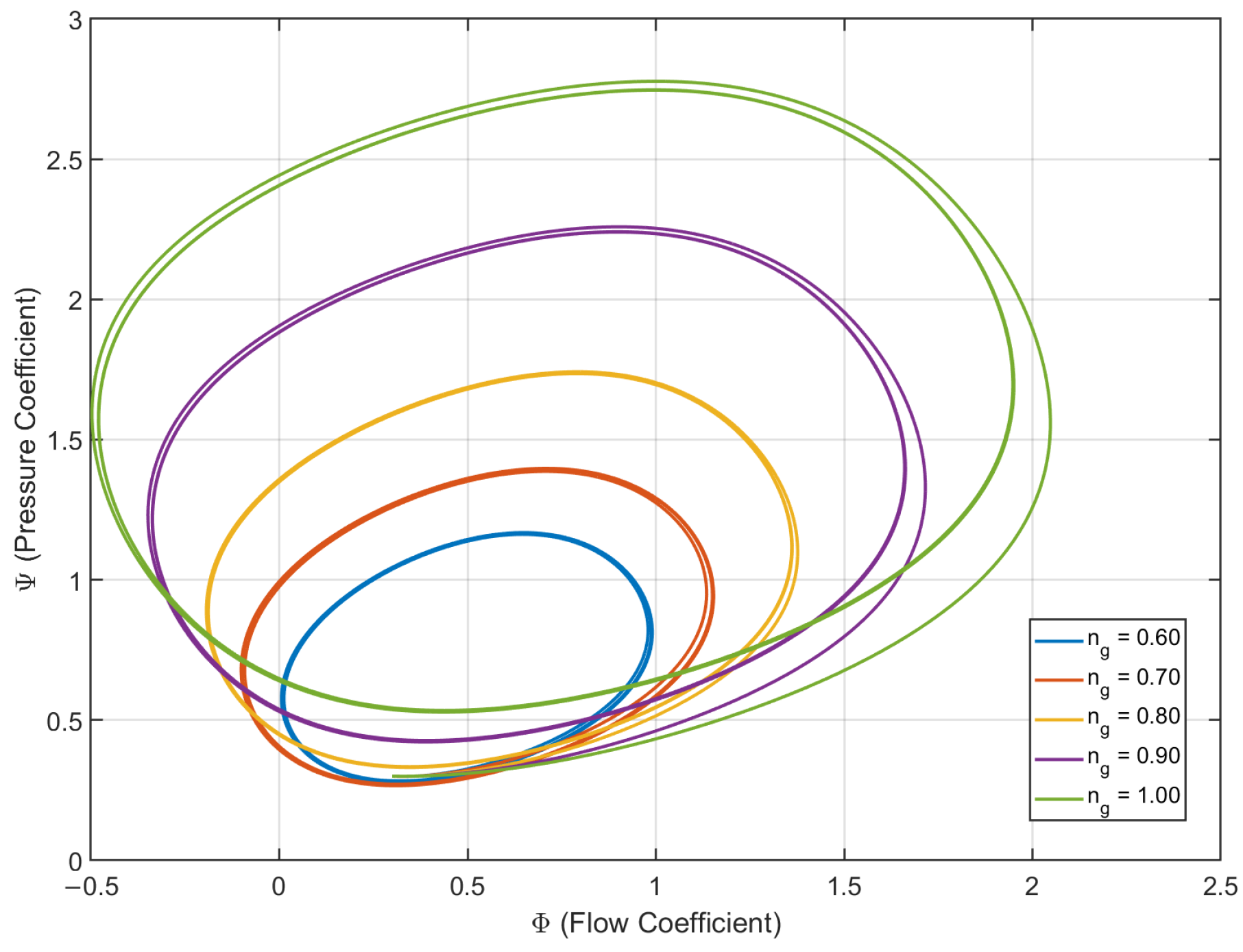
In this subsection, a baseline configuration without geometric variation is considered. The inlet guide vane angle is fixed at its nominal setting (0°), and the parameter B is fixed at B = 0.7 , which is above the critical stability threshold. Under this condition, the rotational speed is varied to assess the nonlinear surge behavior across different operating points. The corresponding phase portraits for different rotational speeds are shown in Figure 8.
As shown in Figure 8, closed trajectories are observed for all rotational speeds, indicating the formation of stable limit cycles after the loss of equilibrium stability. The size of the limit cycle increases with rotational speed, reflecting enhanced pressure–flow interaction at higher operating levels. This trend is physically reasonable, as higher rotational speeds correspond to increased compressor pressure rise and stronger coupling between flow inertia and system compressibility, leading to larger oscillation amplitudes in the surge regime. The bounded limit cycles observed across all cases are characteristic of classical compressor surge dynamics and are consistent with the expected post-bifurcation behavior of a Hopf instability, confirming that the proposed model captures the essential nonlinear mechanisms governing the transition to sustained surge oscillations.

4.1.3. Time-Domain Evolution of Surge Dynamics

While the phase-space analysis confirms the existence of stable limit-cycle oscillations after the loss of equilibrium stability, the time-domain response provides a direct view of how surge oscillations develop and persist in time. Time-domain simulations are used to examine the coupled evolution of flow and pressure during surge.
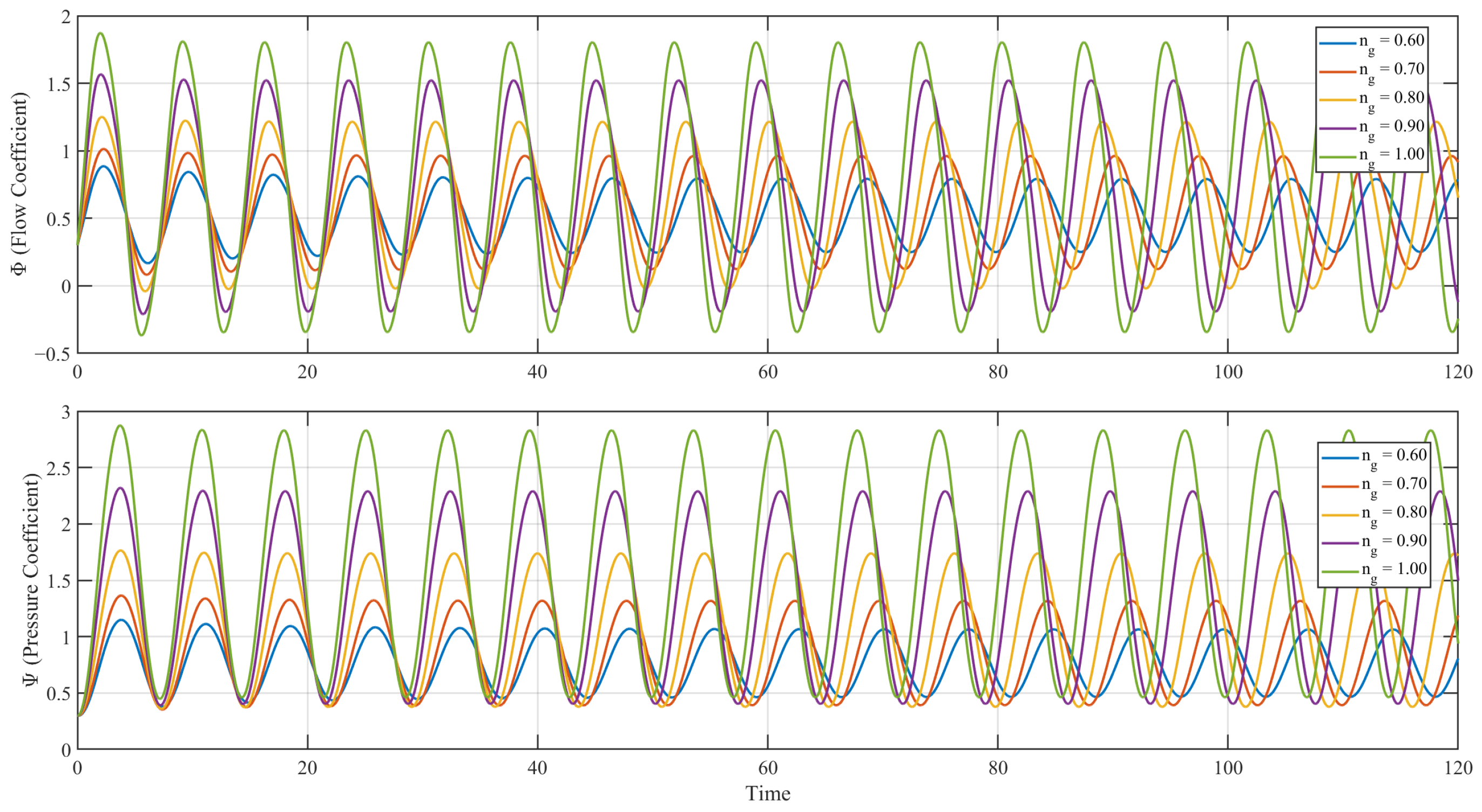
Figure 9 shows the evolution of the flow and pressure coefficients under surge conditions. Following the loss of equilibrium stability, both variables exhibit sustained oscillations with finite amplitude, indicating the establishment of a stable nonlinear oscillatory state.
The oscillations are characterized by low frequency and large amplitude, consistent with the classical definition of compressor surge. The flow and pressure coefficients oscillate in a strongly coupled manner, reflecting the interaction between flow inertia and system compressibility that governs surge dynamics.
As the rotational speed increases, the amplitudes of both flow and pressure oscillations increase, while the overall waveform and oscillation pattern remain similar. This indicates that the same instability mechanism governs the surge dynamics across the investigated operating conditions, with higher rotational speeds intensifying the pressure–flow interaction. The presence of bounded and repeatable oscillations in the time domain confirms that the instability saturates through nonlinear effects rather than leading to divergence. Together with the linear stability and phase-space analyses presented earlier, these results verify that the proposed model reproduces the essential dynamic features of classical compressor surge.

4.1.4. Comparison with Experimental Surge Characteristics

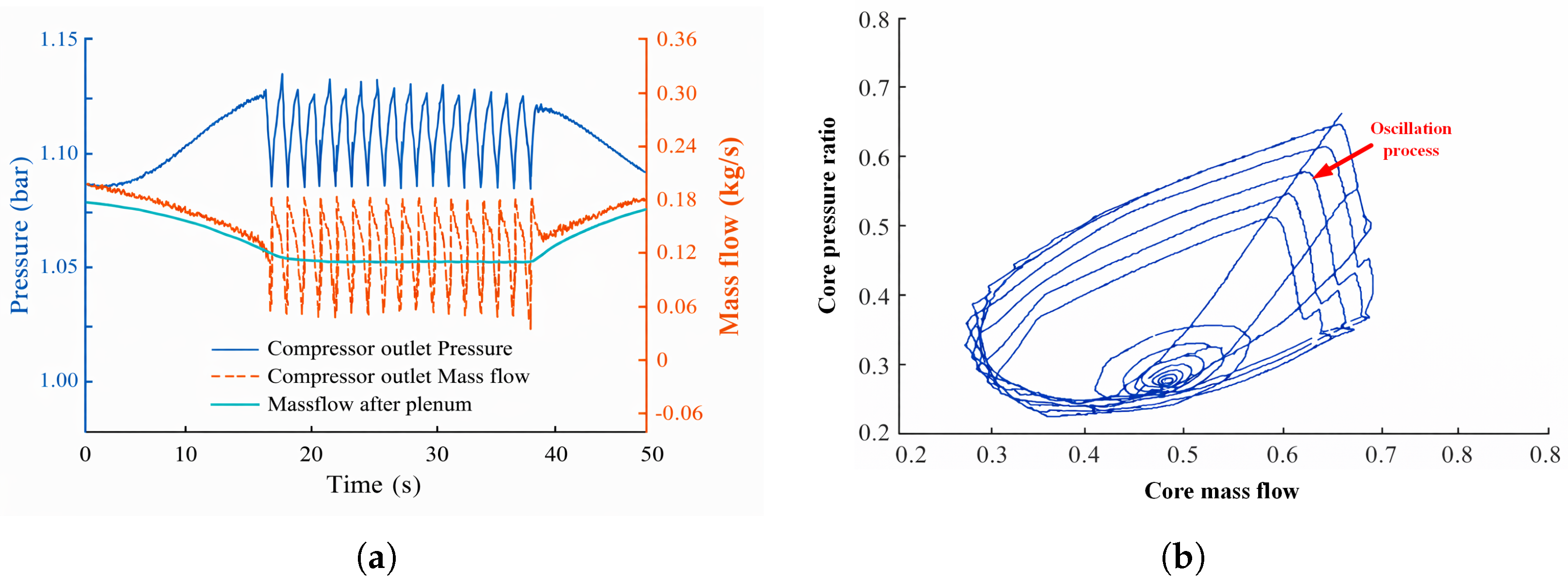
To further corroborate the model, the simulated surge response is compared with experimental surge characteristics reported in the open literature. In practice, publicly available experimental records that provide complete transient waveforms and fully specified test conditions are limited. Therefore, the comparison focuses on commonly accepted surge signatures that are consistently observable across platforms, including: (i) a rapid transient trigger, (ii) finite-amplitude low-frequency oscillations in pressure and mass flow after onset, and (iii) a bounded closed-loop operating-point trajectory on the compressor map.
Figure 10 provides two typical experimental surge signatures from the literature. The time-domain pulsations of compressor outlet pressure and mass flow reported by [9] are shown in Figure 10a, and a characteristic closed-loop trajectory in the pressure ratio–mass flow plane discussed in [28] is shown in Figure 10b. These signatures are widely used as qualitative identifiers of surge in experiments and transient analyses.
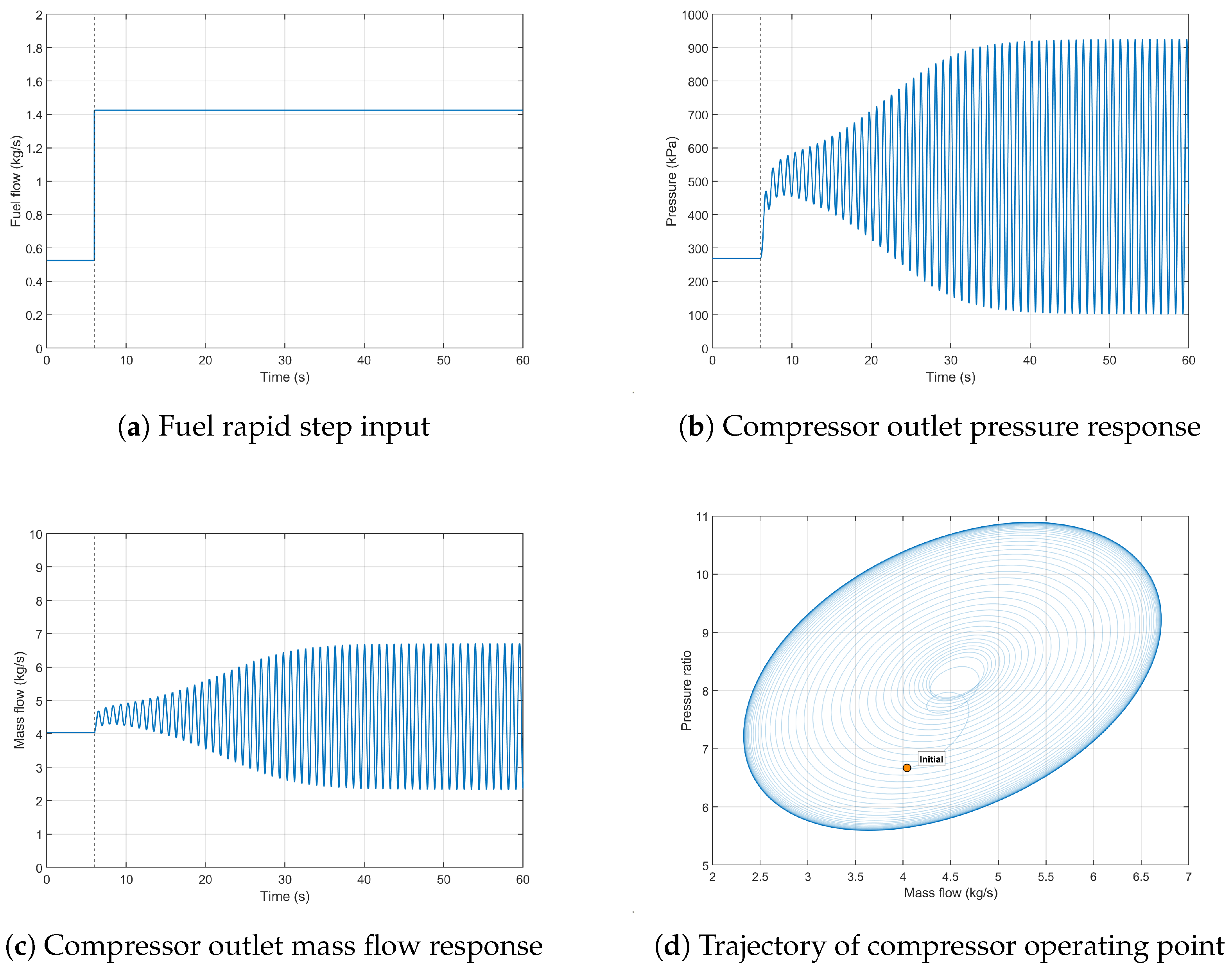
Figure 11 shows the simulated surge transient induced by a rapid fuel step. After the trigger, the compressor outlet pressure and mass flow exhibit sustained oscillations with finite amplitude (Figure 11b,c), which is consistent with the experimentally reported time-domain surge behavior in Figure 10a. In addition, the simulated operating-point trajectory forms a bounded closed loop on the compressor map (Figure 11d), consistent with the classical surge loop illustrated in Figure 10b.
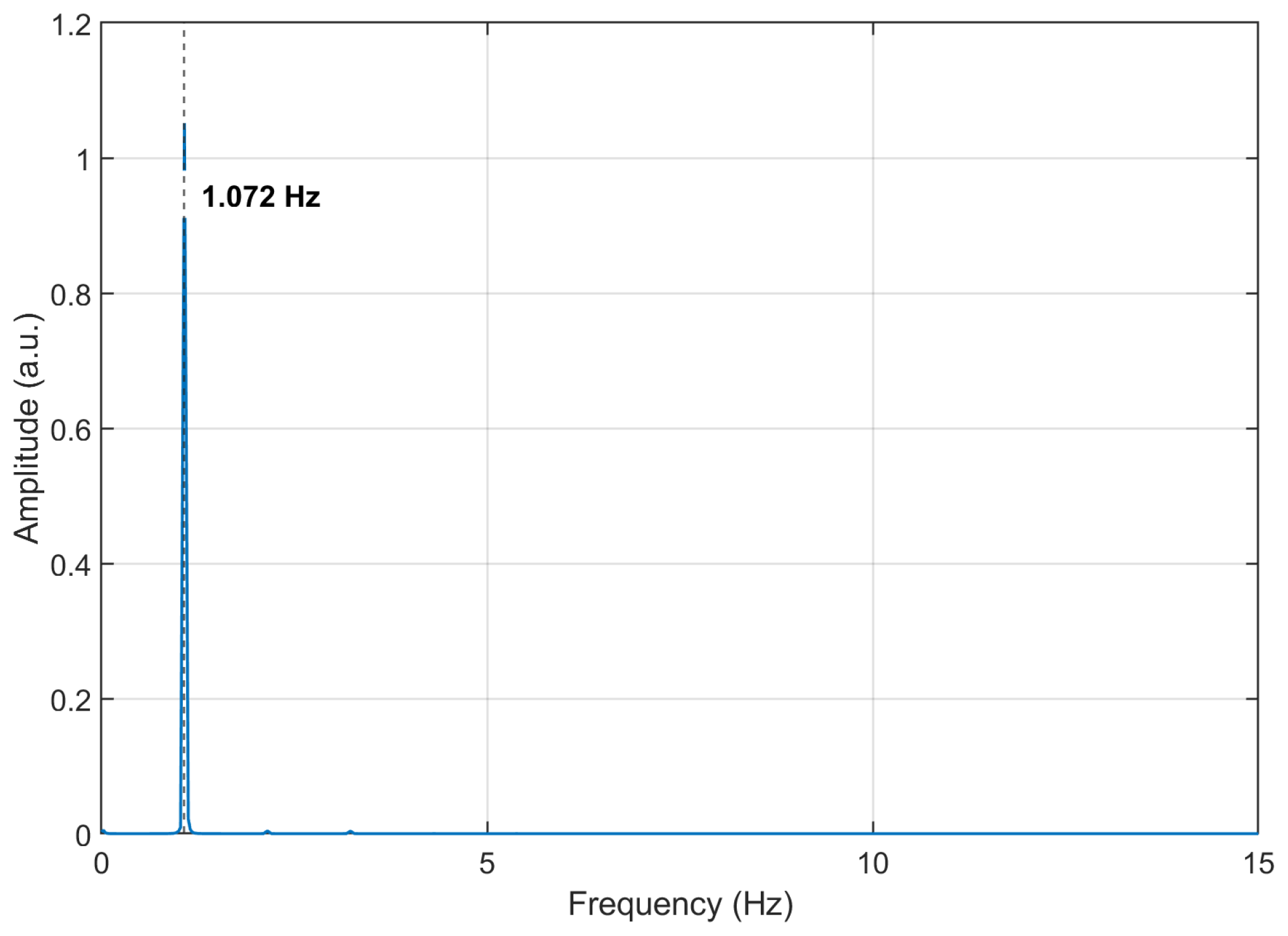
Then, a frequency-domain check is performed for the post-step outlet mass flow signal (Figure 12) to provide an additional characterization of the post-onset oscillations. The spectrum shows a distinct dominant peak at f surge = 1.072 Hz , together with comparatively weaker broadband components, indicating a predominantly periodic low-frequency response in the post-surge regime. The identified dominant frequency lies within the surge frequency band commonly reported in the literature (0–15 Hz) [22], providing a consistent time-scale reference for the limit-cycle oscillations observed in the time domain. Together with the bounded closed-loop trajectory of the operating point on the compressor map, these results suggest that the model captures the principal dynamic signatures of surge reported in experiments.

4.2. Effect of Variable Geometry on Surge Stability

4.2.1. IGV-Dependent Modification of Compressor Characteristics

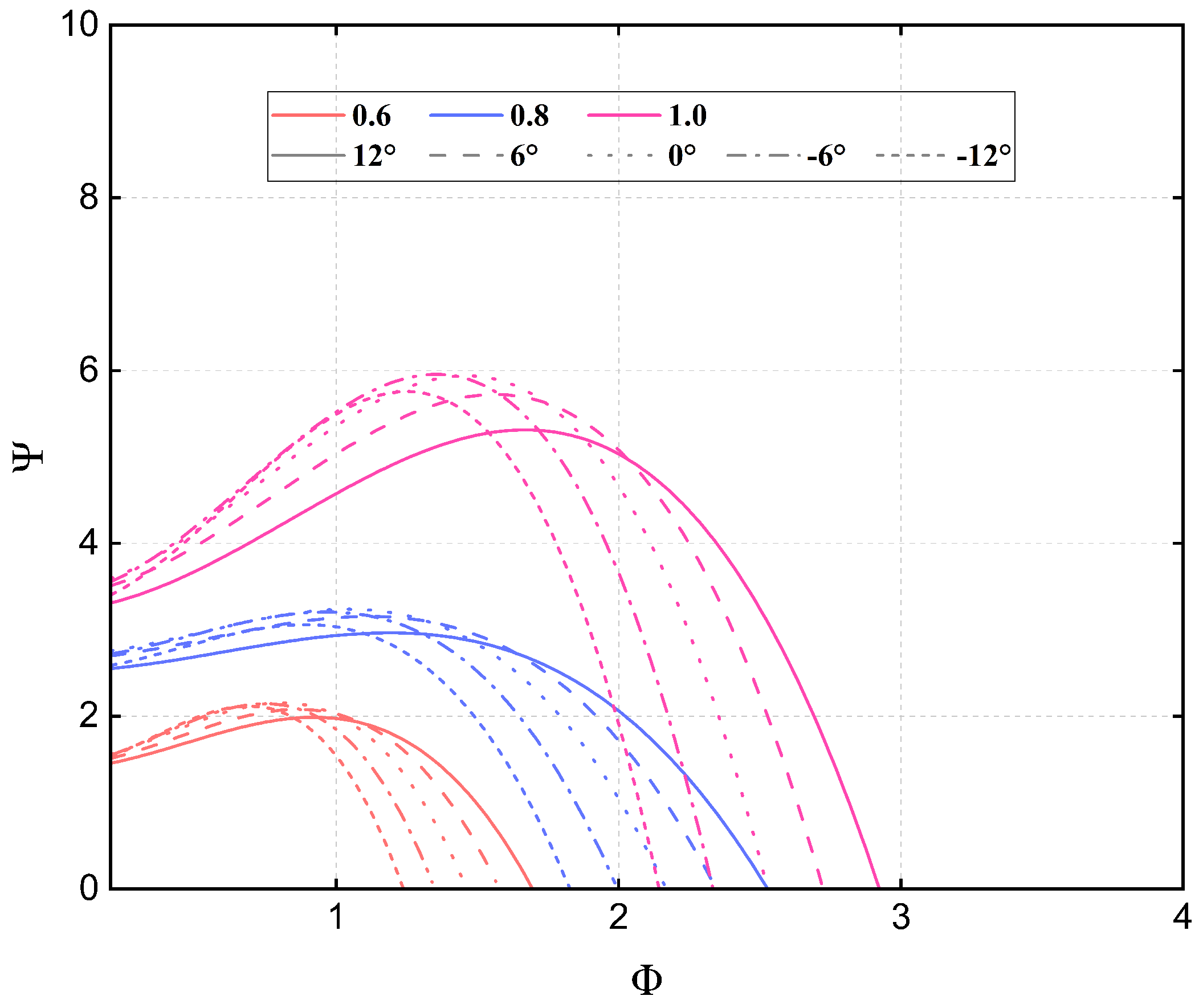
The inlet guide vane (IGV) angle is introduced as a geometric control parameter to parametrically modify the steady compressor characteristic, thereby affecting the equilibrium operating condition and the associated stability boundary. The analysis here is restricted to the onset-related stability behavior implied by the steady characteristic changes; detailed in-surge flow structures are not pursued. For engineering relevance, the representative IGV deflections are selected as θ IGV = { 12 ° , 6 ° , 0 ° , + 6 ° , + 12 ° } , which correspond to typical discrete settings used in practical IGV scheduling and control implementations. Figure 13 shows representative static pressure-rise characteristics at three relative rotational speeds ( 0.6 , 0.8 , and 1.0 n des ) under different IGV deflection angles.
As shown in Figure 13, changing the IGV angle produces systematic and repeatable shifts of the static characteristic family across the investigated speed lines. In particular, the characteristic curves exhibit a noticeable displacement in the low-flow region, which is the regime most relevant to surge inception. From a stability perspective, such changes influence not only the attainable operating range but also the local slope of the pressure-rise characteristic near the low-flow end, which directly enters the linearized stability properties in the present framework. These observations motivate treating the IGV setting as a control input at the level of the compressor characteristic.
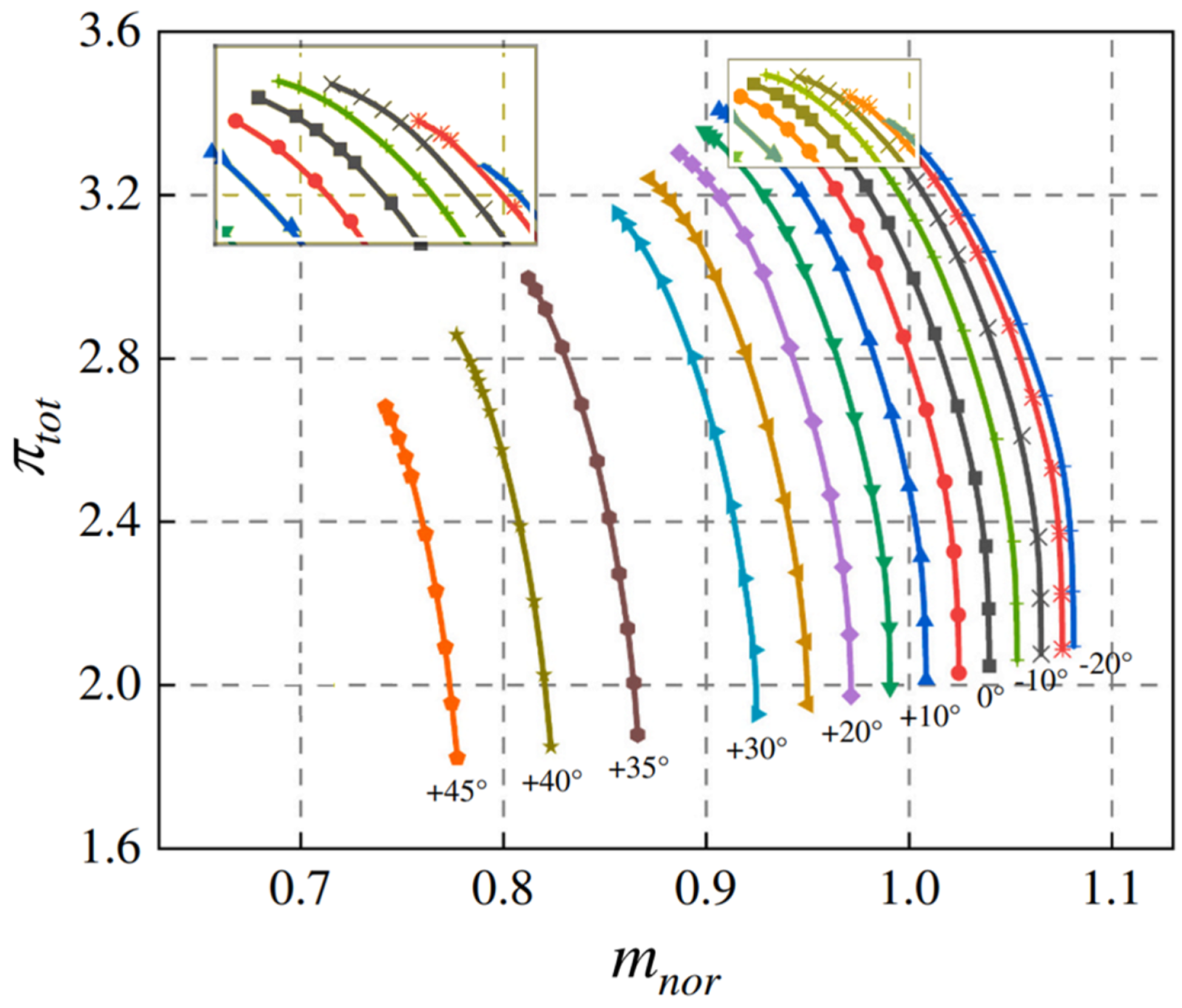
To connect the modeled IGV effects with published experimental observations, we use the IGV-dependent compressor characteristics reported by Li et al. [29] as a literature reference, as shown in Figure 14. Since the original results are available only in figure form and the corresponding test boundary conditions are not fully documented, the assessment is conducted at a trend level after nondimensionalization. Specifically, characteristic curves at representative IGV angles are digitized, and the extracted experimental data points are listed in Table 3. These points are then used to reconstruct the corresponding static pressure-rise curves. The reconstructed curves are subsequently nondimensionalized and normalized with respect to the nominal-IGV case at the same corrected speed, enabling a consistent visualization of the IGV-induced characteristic shifts.
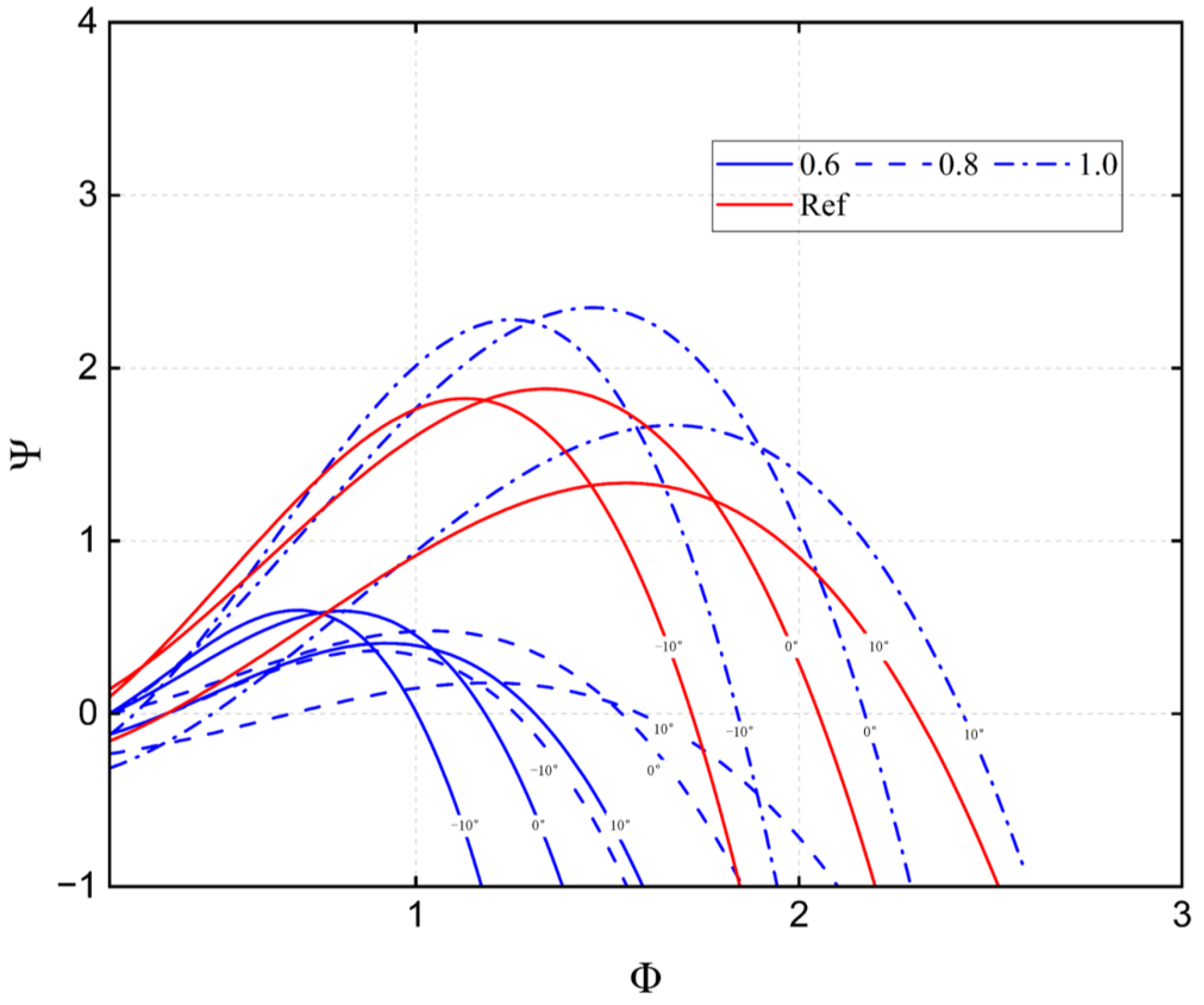
Figure 15 compares the normalized IGV-dependent static characteristics obtained from the published reference data (red curves) with those predicted by the proposed model (blue curves). The IGV characteristic modification in the proposed framework is derived from physically interpretable mechanisms, where IGV deflection changes the effective flow capacity and the pressure-rise distribution, leading to a systematic deformation of the compressor characteristic. Aerodynamically, IGV closing reduces flow capacity and shifts the characteristic toward lower corrected flow and higher loading, whereas IGV opening increases flow capacity and moves the characteristic toward higher flow with reduced loading. As shown in Figure 15, the model predictions reproduce the same IGV regulation signatures observed in the reference trends: the characteristic family shifts monotonically with θ IGV , and the relative separation among the { 10 ° , 0 ° , + 10 ° } cases is preserved over the main operating range. This agreement provides literature-based validation that the proposed physics-based formulation captures the correct direction and magnitude order of IGV-induced steady characteristic variations, thereby supporting the subsequent stability-boundary evaluation under variable geometry conditions.

4.2.2. Quantitative Evaluation of IGV Influence on the Stability Boundary

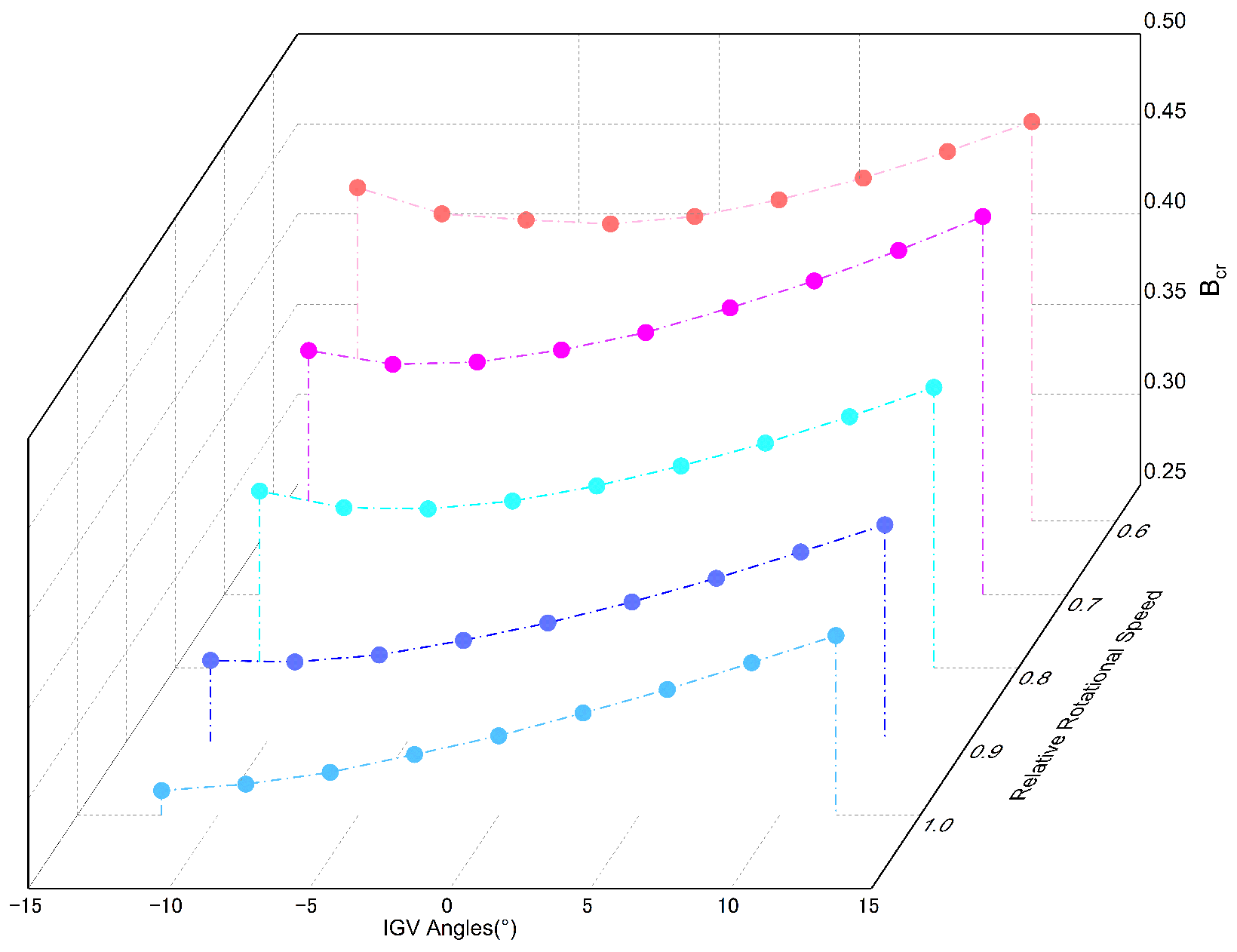
To quantify how IGV deflection affects the onset threshold over the investigated operating envelope, the critical Greitzer parameter B cr is evaluated as a function of IGV angle and relative rotational speed. Within the present model, B cr denotes the dynamic stability threshold associated with surge onset under the adopted operating-point definition.
Figure 16 summarizes the variation of B cr with IGV deflection along different speed lines. The results indicate that IGV regulation leads to a consistent shift of the stability boundary, while the degree of sensitivity depends on the rotational speed. In addition, the influence of IGV deflection becomes less pronounced at higher relative speeds, suggesting that the coupled compressor–system dynamics increasingly dominate the onset threshold in this regime.
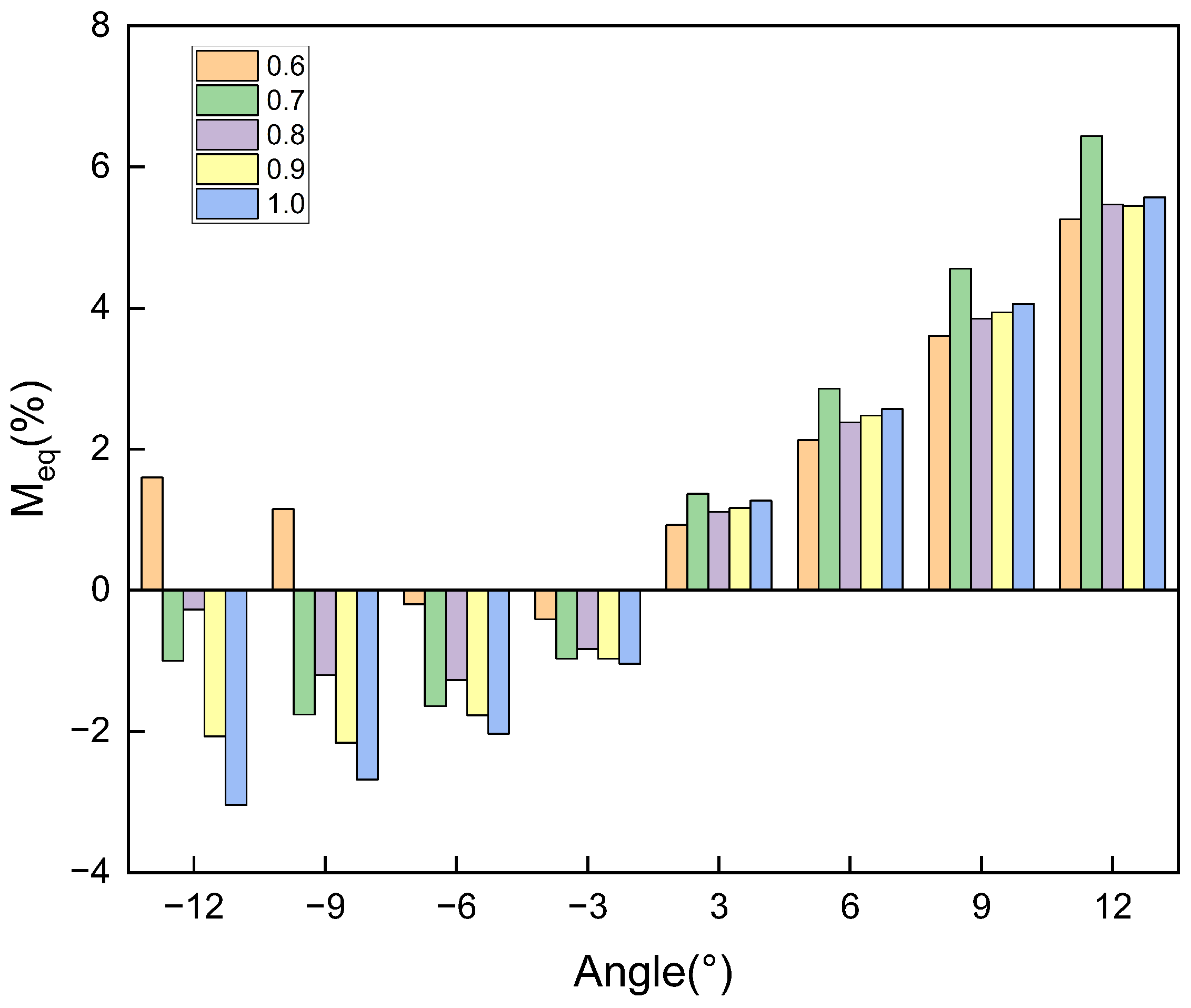
Since the Greitzer parameter is related to the characteristic flow velocity and therefore varies with operating speed under fixed system geometry, changes in B cr can be interpreted as an equivalent shift in the admissible operating range before instability. To facilitate comparison across speed lines, an equivalent stability margin is defined as the relative change of the critical parameter with respect to the nominal IGV setting:
M eq ( n g ) = B cr ( n g , θ IGV ) B cr ( n g , 0 ) B cr ( n g , 0 ) × 100 % ,
where B cr ( n g , 0 ) denotes the critical value at the nominal IGV setting for the same rotational speed.
The mapping in Figure 17 provides a compact description of how IGV deflection shifts the modeled stability boundary over the investigated speed range. In this sense, M eq serves as a normalized indicator of the IGV-induced boundary movement within the present framework.

5. Conclusions

This study proposes a variable geometry surge modeling framework integrated within a gas turbine component-level model, with a specific focus on the dynamic role of inlet guide vanes (IGVs). By embedding IGV effects into a physics-based surge formulation, the proposed approach establishes a direct link between compressor variable geometry and system-level surge dynamics. A physically motivated parameterization is introduced to describe how IGV deflection modifies flow capacity, pressure rise, and the local slope of the static characteristic near surge inception. This extension enables the model to capture geometry-induced changes in dynamic stability, rather than treating variable geometry as a purely steady-state adjustment. The resulting framework reproduces key features of classical compressor surge, including Hopf bifurcation at instability onset, stable post-bifurcation limit cycles, and low-frequency large-amplitude oscillations in the time domain. In addition, the surge transient signatures and dominant oscillation time scale predicted by the model are shown to be consistent with representative experimental surge characteristics reported in the open literature.
A central contribution of this work is the formulation of a stability-based surge boundary that explicitly depends on both rotational speed and IGV setting. Using the critical B parameter as a unified stability indicator, the influence of IGV deflection on surge onset is quantified across the operating envelope. Within the present modeling framework, IGV opening leads to a systematic increase in the critical threshold, indicating delayed surge inception. To facilitate engineering interpretation, an equivalent stability margin is introduced and expressed in terms of an effective increase in allowable rotational speed prior to surge. This formulation provides a clear and quantitative mapping between IGV angle and surge delay capability. The predicted IGV-induced characteristic shifts are further validated at a trend level against published IGV-regulated compressor measurements, supporting the physical soundness of the proposed IGV characteristic modification. The proposed framework is primarily intended for surge-onset prediction and control-oriented stability analysis under variable geometry, and it captures the post-onset limit-cycle dynamics in the vicinity of the stability boundary. Other instability modes, such as deep surge and rotating stall, are not explicitly represented in the present lumped-parameter formulation; covering these phenomena would require additional nonlinear and spatial dynamics, which will be investigated in future work. In addition, future work will include validation against independent compressor rig test measurements under varied IGV schedules, focusing on surge-onset thresholds, oscillation characteristics, and transient signatures. It is worth noting that, although this study focuses on a gas turbine, the proposed modeling framework can be extended to other rotating turbomachinery given appropriate characteristic-map and parameter calibration.
Overall, this work provides a unified and computationally efficient tool for analyzing the dynamic impact of compressor variable geometry on surge behavior. By shifting the role of variable geometry from static characteristic modification to dynamic stability regulation, the proposed framework offers new insight into how geometry scheduling can extend the surge-free operating envelope during transient operation. The results establish a foundation for model-based surge monitoring and active stability control design in gas turbine systems.

Author Contributions

Conceptualization, J.D., Y.Z.; validation, J.D., Y.Z.; writing—original draft, J.D.; writing—review and editing, Y.Z., M.M.G. and A.S. All authors have read and agreed to the published version of the manuscript.

Funding

This research received no external funding.

Data Availability Statement

The original contributions presented in this study are included in the article. Further inquiries can be directed to the corresponding author.

Conflicts of Interest

The authors declare no conflicts of interest.

Abbreviations

The following abbreviations are used in this manuscript:
CLMComponent Level Model
IGVInlet Guide Vane
NSINormalized Sensitivity Index

References

  1. Boyce, M.P. Gas Turbine Engineering Handbook; Elsevier: Oxford, UK, 2011; pp. 51–56. ISBN 978-0-12-383842-1. [Google Scholar]
  2. Park, Y.; Choi, M.; Kim, D.; Lee, J.; Choi, G. Performance analysis of large-scale industrial gas turbine considering stable combustor operation using novel blended fuel. Energy 2021, 236, 121408. [Google Scholar] [CrossRef]
  3. Yang, Y.; Nikolaidis, T.; Jafari, S.; Pilidis, P. Gas turbine engine transient performance and heat transfer effect modelling: A comprehensive review, research challenges, and exploring the future. Appl. Therm. Eng. 2024, 236, 121523. [Google Scholar] [CrossRef]
  4. Tan, C.S.; Day, I.; Morris, S.; Wadia, A. Spike-type compressor stall inception, detection, and control. Annu. Rev. Fluid Mech. 2010, 42, 275–300. [Google Scholar] [CrossRef]
  5. Wang, W.; Lu, J.; Luo, X.; Huang, R.; Chu, W. Failure mechanism of casing treatment in improving stability of a highly loaded two-stage axial compressor. Aerosp. Sci. Technol. 2020, 105, 105979. [Google Scholar] [CrossRef]
  6. Aprea, C.; Mastrullo, R.; Renno, C. Determination of the compressor optimal working conditions. Appl. Therm. Eng. 2009, 29, 1991–1997. [Google Scholar] [CrossRef]
  7. Liu, A.X.; Zheng, X.Q. Methods of surge point judgment for compressor experiments. Exp. Therm. Fluid Sci. 2013, 51, 204–213. [Google Scholar] [CrossRef]
  8. Galindo, J.; Serrano, J.R.; Climent, H.; Tiseira, A. Experiments and modelling of surge in small centrifugal compressor for automotive engines. Exp. Therm. Fluid Sci. 2008, 32, 818–826. [Google Scholar] [CrossRef]
  9. Munari, E.; Morini, M.; Pinelli, M.; Spina, P.R.; Suman, A. Experimental investigation of stall and surge in a multistage compressor. J. Eng. Gas Turbines Power 2017, 139, 022605. [Google Scholar] [CrossRef]
  10. Carrattieri, L.; Cravero, C.; Marsano, D.; Valenti, E.; Sishtla, V.; Halbe, C. The Development of Machine Learning Models for Radial Compressor Monitoring with Instability Detection. J. Turbomach. 2025, 147, 051004. [Google Scholar] [CrossRef]
  11. Thapa, A.; Li, J.; Schoen, M.P. Spike Stall Precursor Detection in a Single-Stage Axial Compressor: A Data-Driven Dynamic Modeling Approach. Machines 2025, 13, 338. [Google Scholar] [CrossRef]
  12. Qi, W.; Yu, J.; Wang, X.; Zhang, R.; Wu, X.; Xue, S.; Yang, J.; Ge, S.; Zhang, Y.; He, Z. Thermal Management Performance Enhancement of Cylindrical Power Battery Modules via Cooling Strips with Reflux Microchannel Structure. Energy 2026, 346, 140312. [Google Scholar] [CrossRef]
  13. Sheng, L.; Wang, H.; Zhang, C.; Zhang, X. Experimental study on immersion cooling performance of a lithium-ion battery module for commercial/industrial energy storage at different ambient temperatures. Int. J. Therm. Sci. 2026, 221, 110473. [Google Scholar] [CrossRef]
  14. Qi, W.; Yu, L.; Tang, X.; Wu, J.; Zhang, Y.; He, Z. Multi-objective optimization of a hydrogen-fueled PEMFC with multi wavy channels via machine learning and CFD simulation. Int. J. Hydrogen Energy 2026, 199, 152748. [Google Scholar] [CrossRef]
  15. Greitzer, E.M. Surge and rotating stall in axial flow compressors—Part I: Theoretical compression system model. J. Eng. Power 1976, 98, 190–198. [Google Scholar] [CrossRef]
  16. Greitzer, E.M. Surge and rotating stall in axial flow compressors—Part II: Experimental results and comparison with theory. J. Eng. Power 1976, 98, 199–217. [Google Scholar] [CrossRef]
  17. Moore, F.K. A theory of rotating stall of multistage axial compressors: Part I—Small disturbances. J. Eng. Gas Turbines Power 1984, 106, 313–321. [Google Scholar] [CrossRef]
  18. Moore, F.K.; Greitzer, E.M. A theory of post-stall transients in axial compression systems: Part I—Development of equations. J. Eng. Gas Turbines Power 1986, 108, 68–76. [Google Scholar] [CrossRef]
  19. Greitzer, E.M.; Moore, F.K. A theory of post-stall transients in axial compression systems: Part II—Application. J. Eng. Gas Turbines Power 1986, 108, 231–239. [Google Scholar] [CrossRef]
  20. Haynes, J.M.; Hendricks, G.J.; Epstein, A.H. Active stabilization of rotating stall in a three-stage axial compressor. J. Turbomach. 1994, 116, 226–239. [Google Scholar] [CrossRef]
  21. Li, M.; Zheng, Q. Wet compression system stability analysis: Part I—Wet compression Moore–Greitzer transient model. In Proceedings of the ASME Turbo Expo: Power for Land, Sea, and Air; ASME: Vienna, Austria, 2004; Volume 41693, pp. 703–712. [Google Scholar] [CrossRef]
  22. Zhang, X.; Zhang, T.; Sheng, H. A novel aeroengine real-time model for active stability control: Compressor instabilities integration. Aerosp. Sci. Technol. 2024, 145, 108844. [Google Scholar] [CrossRef]
  23. Shahriyari, M.J.; Firouzabadi, A.; Khaleghi, H.; Esmailifar, S.M. A new model for compressor surge and stall control. Sci. Rep. 2024, 14, 5347. [Google Scholar] [CrossRef]
  24. Al-Hamdan, Q.Z.; Ebaid, M.S.Y. Modeling and simulation of a gas turbine engine for power generation. J. Eng. Gas Turbines Power 2006, 128, 302–311. [Google Scholar] [CrossRef]
  25. Larsson, E.; Åslund, J.; Frisk, E.; Eriksson, L. Gas turbine modeling for diagnosis and control. J. Eng. Gas Turbines Power 2014, 136, 071601. [Google Scholar] [CrossRef]
  26. Xu, M.; Liu, J.; Li, M.; Geng, J.; Wu, Y.; Song, Z. Improved hybrid modeling method with input and output self-tuning for gas turbine engine. Energy 2022, 238, 121672. [Google Scholar] [CrossRef]
  27. Zhang, X.; Li, L.; Zhang, T. Research on real-time model of turboshaft engine with surge process. Appl. Sci. 2022, 12, 744. [Google Scholar] [CrossRef]
  28. Chung, K.; Leamy, K.; Collins, T. A turbine engine aerodynamic model for in-stall transient simulation. In Proceedings of the 21st Joint Propulsion Conference, Monterey, CA, USA, 8–11 July 1985; p. 1429. [Google Scholar] [CrossRef]
  29. Li, P.; Zuo, Z.; Li, J.; Tao, H.; Guo, W.; Chen, H. Characteristics of inlet guide vane adjustment of multi-stage axial compressor in compressed air energy storage system. J. Energy Storage 2023, 72, 108342. [Google Scholar] [CrossRef]
Figure 1. Structural schematic of the gas turbine.
Machines 14 00327 g001
Figure 2. Scheme diagram of the compressor system.
Machines 14 00327 g002
Figure 3. Static pressure-rise curves cluster at multiple rotational speeds.
Machines 14 00327 g003
Figure 4. Normalized sensitivity coefficient matrices of key aerodynamic and thermodynamic parameters with respect to inlet guide vane (IGV) deflection at different corrected speeds. (a) IGV closing ( 10 ° ); (b) IGV opening ( + 10 ° ). Each cell represents the normalized sensitivity of a parameter ( Φ , Ψ , W 31 , P 31 , T 31 ) at a given corrected speed ( n cor = 0.6 1.0 ), illustrating the bidirectional influence of IGV adjustment on compressor flow, pressure, and temperature characteristics.
Machines 14 00327 g004
Figure 5. Velocity triangles at the rotor inlet and outlet of the compressor.
Machines 14 00327 g005
Figure 6. Schematic of the coupled framework between the surge model and CLM.
Machines 14 00327 g006
Figure 7. Eigenvalue evolution from bifurcation analysis: (a) three-dimensional eigenvalue trajectories illustrating the migration of the dominant eigenvalue pair with varying rotational speeds; (b) two-dimensional eigenvalue trajectories showing the real-part crossing associated with Hopf bifurcation.
Machines 14 00327 g007
Figure 8. Phase portraits in the Φ Ψ plane illustrating the formation of stable limit cycles under different rotational speeds.
Machines 14 00327 g008
Figure 9. Time-domain surge responses under different rotational speeds.
Machines 14 00327 g009
Figure 10. Typical surge signatures reported in the literature: (a) typical surge pulsations reported in experiment [9] and (b) typical surge operating-point trajectory reported in experiment [28].
Machines 14 00327 g010
Figure 11. Simulated surge transient induced by a rapid fuel step.
Machines 14 00327 g011
Figure 12. Frequency spectrum of the post-step compressor response.
Machines 14 00327 g012
Figure 13. Static pressure-rise characteristics under different IGV angles and rotational speeds.
Machines 14 00327 g013
Figure 14. Experimental IGV-dependent compressor characteristics [29].
Machines 14 00327 g014
Figure 15. Comparison with published IGV-adjustment characteristics.
Machines 14 00327 g015
Figure 16. Critical B cr versus IGV angle for different relative rotational speeds.
Machines 14 00327 g016
Figure 17. Equivalent stability margin M eq versus IGV angle for different rotational speeds.
Machines 14 00327 g017
Table 1. Comparison between mainstream surge modeling approaches and the proposed framework from computational efficiency, surge reproduction capability, and engineering applicability.
Model FamilyComputational EfficiencySurge Reproduction CapabilityEngineering Applicability (Pros/Cons)Variable Geometry Integration
MG modelsHighYesPros: physics-based, interpretable.
Cons: not directly deployable for practical control; typically focuses on compressor dynamics.
Limited
Component-level modelsModerateLimited (needs additional surge submodels)Pros: high system-level fidelity. Cons: heavy calibration; surge not natural without extra modeling.Possible but intensive
Data-driven modelsHighData-dependent (within training domain)Pros: effective for surge monitoring/early warning.
Cons: requires extensive training data; insufficient physical interpretability.
Possible (needs IGV data)
Proposed modeling frameworkHighYesPros: mechanism-driven and interpretable; variable geometry integrated; control-oriented.
Cons: depends on characteristic parameterization.
Explicit
Table 2. Critical Hopf bifurcation points under different normalized rotational speeds and IGV settings.
N / N ref IGV Angle B cr Φ cr Ψ cr ω cr
0.6 12 ° 0.46510.93852.44640.8415
0.6 6 ° 0.41710.91302.31580.9184
0.6 0 ° 0.41910.88782.18940.9099
0.6 + 6 ° 0.44040.86552.08060.8701
0.6 + 12 ° 0.47170.84651.99060.8187
0.7 12 ° 0.38550.99572.75400.9955
0.7 6 ° 0.37910.96602.59171.0032
0.7 0 ° 0.39550.93922.45000.9637
0.7 + 6 ° 0.42410.91672.33420.9067
0.7 + 12 ° 0.45990.89832.24140.8446
0.8 12 ° 0.34841.12103.49061.1044
0.8 6 ° 0.33841.08783.28751.1252
0.8 0 ° 0.35111.05773.10721.0861
0.8 + 6 ° 0.37491.03202.95831.0250
0.8 + 12 ° 0.40581.01082.83860.9563
0.9 12 ° 0.29521.25684.38811.2912
0.9 6 ° 0.29821.21854.12471.2728
0.9 0 ° 0.31591.18533.90221.2092
0.9 + 6 ° 0.34071.15783.72391.1317
0.9 + 12 ° 0.37041.13573.58251.0510
1.0 12 ° 0.26371.36975.21141.4390
1.0 6 ° 0.27381.32774.89691.3865
1.0 0 ° 0.29411.29284.64251.3023
1.0 + 6 ° 0.31981.26474.44281.2104
1.0 + 12 ° 0.34981.24224.28611.1184
B cr denotes the critical stability parameter at the Hopf bifurcation, and ω cr is the corresponding critical oscillation frequency.
Table 3. Compressor characteristic points at three IGV settings.
θ IGV = 10 ° θ IGV = 0 ° θ IGV = + 10 °
W c π c W c π c W c π c
0.9863.3410.9543.4950.9343.547
0.9883.3180.9563.4770.9403.507
0.9913.2940.9593.4550.9433.481
0.9933.2690.9613.4330.9493.429
0.9963.2420.9643.4100.9543.376
0.9983.2150.9673.3860.9603.320
1.0003.1880.9693.3620.9653.262
1.0023.1600.9713.3370.9693.201
1.0033.1310.9733.3120.9733.137
1.0053.1020.9763.2860.9763.072
1.0063.0720.9773.2600.9793.005
1.0073.0420.9793.2330.9812.903
1.0083.0130.9813.2060.9882.591
1.0092.8620.9863.0630.9942.404
1.0072.7470.9882.8560.9802.937
W c denotes corrected mass flow and π c denotes compressor pressure ratio.
Disclaimer/Publisher’s Note: The statements, opinions and data contained in all publications are solely those of the individual author(s) and contributor(s) and not of MDPI and/or the editor(s). MDPI and/or the editor(s) disclaim responsibility for any injury to people or property resulting from any ideas, methods, instructions or products referred to in the content.