
Effective Compensations for Disability: Results from a Usability Evaluation of an Assistive Robot Among Spinal-Cord-Injured Users


Abstract
1. Introduction
2. Methods
2.1. Participants
2.2. Materials
2.3. Procedures
- (1)
- Assessments: Upon arrival on the first day, OA were screened with the MoCA and dismissed from the study if unable to score a minimum of 26. All participants completed the informed consent, demographics questionnaire, and personality questionnaire. Participants then completed the vision assessments. To avoid fatigue or order effects, YA and OA participants then completed the remaining assessments in randomized order.
- (2)
- Tasks: Participants completed baselines for the two study tasks in randomized order.
- (3)
- Compensations: The compensations were activated one at a time in random order. Participants were given a brief description of what had changed. For instance, with the move suggestion feature, participants were told that if there was a delay in choosing a movement, suggestions for the next movement would be offered on the screen and auditorily.
- (4)
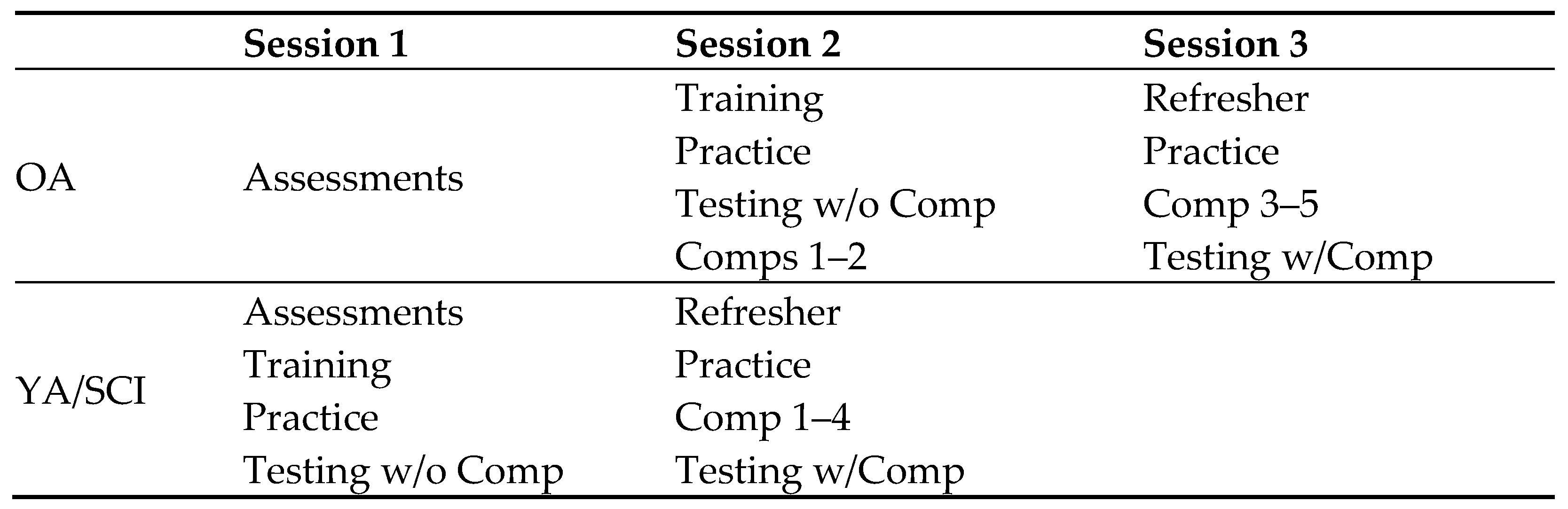
- Study Details: On average, OA required more time to complete the individual difference assessments and therefore completed the robotic arm tasks during a second and third session, while SCI and YA completed the tasks in the first and second sessions, with each session lasting approximately one hour. Figure 3 outlines how the workload was broken down per session for each group.
3. Experimental Task Results
4. Usability and User Experience Evaluation
4.1. Grounded Theory Analysis
4.2. Usability: Results and Discussion
4.2.1. SUS Scores
4.2.2. Participant Interviews: Overall
4.3. User Experience (UX) and Usability of Compensations
4.3.1. Slowing near Object
4.3.2. Object Highlight
4.3.3. Move Suggestions
4.3.4. One-Click
4.3.5. Level Indicator
4.3.6. Most Useful and Least Useful Compensations
4.4. User Suggestions
4.4.1. WMRA Movement
4.4.2. Automation
4.4.3. Controls
4.4.4. Feedback and Indications
4.5. Usability and UX: SCI Discussion
5. Conclusions and Future Work
Author Contributions
Funding
Data Availability Statement
Acknowledgments
Conflicts of Interest
References
- Kaye, H.S.; Kang, T.; LaPlante, M.P. Mobility Device Use in the United States; National Institute on Disability and Rehabilitation Research, US Department of Education: Washington, DC, USA, 2000; Volume 14.
- King, C.H.; Chen, T.L.; Fan, Z.; Glass, J.D.; Kemp, C.C. Dusty: An assistive mobile manipulator that retrieves dropped objects for people with motor impairments. Disabil. Rehabil. Assist. Technol. 2012, 7, 168–179. [Google Scholar] [CrossRef] [Scilit]
- Kobelt, G.; Berg, J.; Atherly, D.; Hadjimichael, O. Costs and quality of life in multiple sclerosis a cross-sectional study in the United States. Neurology 2006, 66, 1696–1702. [Google Scholar] [CrossRef] [Scilit]
- Laffont, I.; Biard, N.; Chalubert, G.; Delahoche, L.; Marhic, B.; Boyer, F.C.; Leroux, C. Evaluation of a graphic interface to control a robotic grasping arm: A multicenter study. Arch. Phys. Med. Rehabil. 2009, 90, 1740–1748. [Google Scholar] [CrossRef] [Scilit]
- Crewe, N.M.; Krause, J.S. Spinal cord injury. In Medica, Psychosocial and Vocational Aspects of Disability; Brodwin, M.G., Siu, F.W., Howard, J.H., Brodwin, E.R., Eds.; Elliot and Fitzpatrick: Athens, Georgia, 2009; pp. 289–304. [Google Scholar]
- Tsui, K.; Yanco, H.; Kontak, D.; Beliveau, L. Development and evaluation of a flexible interface for a wheelchair mounted robotic arm. In Proceedings of the 3rd ACM/IEEE International Conference on Human Robot Interaction; ACM: New York, NY, USA, 2008; pp. 105–112. [Google Scholar]
- Nguyen, H.; Anderson, C.; Trevor, A.; Jain, A.; Xu, Z.; Kemp, C. El-E: An Assistive Robot that Fetches Objects from Flat Surfaces. In Proceedings of the Human-Robot Interaction 2008 Workshop on Robotic Helpers, Amsterdam, The Netherlands, 12–15 March 2008. [Google Scholar]
- Ding, Z.; Jabalameli, A.; Al-Mohammed, M.; Behal, A. End-to-End Intelligent Adaptive Grasping for Novel Objects using an Assistive Robotic Manipulator. Machines 2025, 13, 275. [Google Scholar] [CrossRef] [Scilit]
- Gallenberger, D.; Bhattacharjee, T.; Kim, Y.; Srinivasa, S.S. Transfer Depends on Acquisition: Analyzing Manipulation Strategies for Robotic Feeding. In Proceedings of the 14th ACM/IEEE International Conference on Human-Robot Interaction (HRI), Daegu, Republic of Korea, 11–14 March 2019; pp. 267–276. [Google Scholar]
- Try, P.; Schöllmann, S.; Wöhle, L.; Gebhard, M. Visual Sensor Fusion Based Autonomous Robotic System for Assistive Drinking. Sensors 2021, 21, 5419. [Google Scholar] [CrossRef] [Scilit] [PubMed]
- Alwala, A.; El-Hussieny, H.; Mohamed, A.; Iwasaki, K.; Assal, S.F.M. On the Development of Autonomous Assistive Robotic System for Drinking Task for People with Disability. In Proceedings of the 2022 IEEE International Conference on Advanced Robotics and Its Social Impacts (ARSO), Long Beach, CA, USA, 28–30 May 2022; pp. 1–6. [Google Scholar] [CrossRef] [Scilit]
- Kim, D.J.; Hazlett, R.; Godfrey, H.; Rucks, G.; Portee, D.; Bricout, J.; Cunningham, T.; Behal, A. On the relationship between autonomy, performance, and satisfaction: Lessons from a three week user study with post-SCI Patients using a smart 6DOF assistive robotic manipulator. In Proceedings of the 2010 IEEE International Conference on Robotics and Automation, Anchorage, AK, USA, 3–8 May 2010; pp. 217–222. [Google Scholar]
- Kim, D.J.; Hazlett-Knudsen, R.; Culver-Godfrey, H.; Rucks, G.; Cunningham, T.; Portee, D.; Bricout, J.; Wang, Z.; Behal, A. How autonomy impacts performance and satisfaction: Results from a study with spinal cord injured subjects using an assistive robot. IEEE T. Syst. Man. Cybern. A 2012, 42, 2–14. [Google Scholar] [CrossRef] [Scilit]
- Styler, B.K.; Deng, W.; Chung, C.-S.; Ding, D. Evaluation of a vision-guided shared-control robotic arm system with power wheelchair users. Sensors 2025, 25, 4768. [Google Scholar] [CrossRef] [Scilit]
- Zarif, M.I.I.; Sunny, M.S.H.; Banik, N.; Longwell-Grice, E.H.R.; Ahamed, S.I.; Wang, I.; Rahman, M.H. Evaluation of different control systems of wheelchair-mounted assistive robotic arm in performing activities of daily living. In Proceedings of the International Conference on Biomedical and Health Informatics (ICBHI 2024), Tainan, Taiwan, 30 October–2 November 2024; IFMBE Proceedings; Springer: Cham, Switzerland, 2024; Volume 118, pp. 204–209. [Google Scholar] [CrossRef] [Scilit]
- Liu, Y.; Liu, Y.; Yao, Y.; Zhong, M. Object affordance-based implicit interaction for WMRA using a laser pointer. Sensors 2023, 23, 4477. [Google Scholar] [CrossRef] [Scilit]
- Czaja, S.J.; Boot, W.R.; Charness, N.; Rogers, W.A. Designing for Older Adults: Principles and Creative Human Factors Approaches, 3rd ed.; CRC Press: Boca Raton, FL, USA, 2019; pp. 125–141. [Google Scholar]
- Sutika, T.; Funikul, S.; Triyason, T.; Supattatham, M. Quality of smartphone user experience analysis: Focusing on smartphone screen brightness level for the elderly. In Proceedings of the IAIT 2018 10th International Conference on Advances in Information, Bangkok, Thailand, 10–13 December 2018; pp. 1–6. [Google Scholar]
- Naveh-Benjamin, M.; Craik, F.I.; Guez, J.; Kreuger, S. Divided attention in younger and older adults: Effects of strategy and relatedness on memory performance and secondary task costs. J. Exp. Psychol. Learn. Mem. Cogn. 2005, 31, 520–537. [Google Scholar] [CrossRef] [Scilit]
- Hess, D.W.; Marwitz, J.H.; Kreutzer, J.S. Neuropsychological impairments after spinal cord injury: A comparative study with mild traumatic brain injury. Rehabil. Psychol. 2003, 48, 151–156. [Google Scholar] [CrossRef] [Scilit]
- Pak, R.; McLaughlin, A. Designing Displays for Older Adults; CRC Press: Boca Raton, FL, USA, 2011; pp. 20–22. [Google Scholar]
- Dillen, A.; Omidi, M.; Ghaffari, F.; Romain, O.; Vanderborght, B.; Roelands, B.; Nowé, A.; De Pauw, K. User Evaluation of a Shared Robot Control System Combining BCI and Eye Tracking in a Portable Augmented Reality User Interface. Sensors 2024, 24, 5253. [Google Scholar] [CrossRef] [Scilit]
- Langer, D.; Legler, F.; Diekmann, P.; Dettmann, A.; Glende, S.; Bullinger, A.C. Got It? Comparative Ergonomic Evaluation of Robotic Object Handover for Visually Impaired and Sighted Users. Robotics 2024, 13, 43. [Google Scholar] [CrossRef] [Scilit]
- Lathan, C.; Tracey, M. The Effects of Operator Spatial Perception and Sensory Feedback on Human-Robot Teleoperation Performance. Presence Teleoper. Virtual Environ. 2002, 11, 368–377. [Google Scholar] [CrossRef] [Scilit]
- Long, L.O.; Gomer, J.A.; Moore, K.S.; Pagano, C.C. Investigating the Relationship between Visual Spatial Abilities and Robot Operation during Direct Line of Sight and Teleoperation. Proc. Hum. Factors Ergon. Soc. Annu. Meet. 2009, 53, 1437–1441. [Google Scholar] [CrossRef]
- Gomer, J.; Pagano, C. Spatial Perception and Robot Operation: Should Spatial Abilities Be Considered When Selecting Robot Operators? Proc. Hum. Factors Ergon. Soc. Annu. Meet. 2011, 55, 1260–1264. [Google Scholar] [CrossRef] [Scilit]
- Long, L.O.; Gomer, J.A.; Wong, J.T.; Pagano, C.C. Visual Spatial Abilities in Uninhabited Ground Vehicle Task Performance During Teleoperation and Direct Line of Sight. Presence Teleoperators Virtual Environ. 2011, 20, 466–479. [Google Scholar] [CrossRef] [Scilit]
- Paperno, N.; Rupp, M.A.; Parkhurst, E.L.; Maboudou-Tchao, E.M.; Smither, J.A.; Behal, A. A predictive model for use of an assistive robotic manipulator: Human factors versus performance in pick-and-place/retrieval tasks. IEEE Trans. Hum-Mach. Syst. 2016, 46, 846–858. [Google Scholar] [CrossRef]
- Paperno, N.; Rupp, M.A.; Parkhurst, E.L.; Maboudou-Tchao, E.M.; Smither, J.A.; Bricout, J.; Behal, A. Age and gender differences in performance for operating a robotic manipulator. IEEE Trans. Hum-Mach. Syst. 2019, 49, 137–149. [Google Scholar] [CrossRef] [Scilit]
- Sweller, J. Cognitive load during problem solving: Effects on learning. Cogn. Sci. 1988, 12, 257–285. [Google Scholar] [CrossRef]
- Sweller, J.; Ayres, P.; Kalyuga, S. Cognitive Load Theory; Springer: New York, NY, USA, 2011. [Google Scholar]
- Fong, T.; Thorpe, C.; Baur, C. Collaboration, dialogue, and human–robot interaction. In Proceedings of the International Symposium of Robotics Research (ISRR), Siena, Italy, 19–22 October 2003; pp. 255–266. [Google Scholar]
- Goodrich, M.A.; Schultz, A.C. Human–robot interaction: A survey. Found. Trends Hum.–Comput. Interact. 2007, 1, 203–275. [Google Scholar] [CrossRef] [Scilit]
- Endsley, M.R. Toward a theory of situation awareness in dynamic systems. Hum. Factors 1995, 37, 32–64. [Google Scholar] [CrossRef] [Scilit]
- Haggard, P. Sense of agency in the human brain. Nat. Rev. Neurosci. 2017, 18, 196–207. [Google Scholar] [CrossRef] [Scilit]
- Nasreddine, Z.S.; Phillips, N.A.; Bedirian, V.; Charbonneau, S.; Whitehead, V.; Collin, I.; Cummings, J.L.; Chertkow, H. The Montreal Cognitive Assessment, MoCA: A brief screening tool for mild cognitive impairment. J. Am. Geriatr. Soc. 2005, 53, 695–699. [Google Scholar] [CrossRef] [Scilit]
- Ginsburg, A.P. Next generation contrast sensitivity testing. In Functional Assessment of Low Vision; Mosby: St Louis, MO, USA, 1996; pp. 77–88. [Google Scholar]
- Visual Awareness Research Group, Inc. (2020). UFOV® Software. Available online: https://www.visualawareness.com/ (accessed on 24 April 2025).
- Kirchner, W.K. Age differences in short-term retention of rapidly changing information. J. Exp. Psychol. Gen. 1958, 55, 352–358. [Google Scholar] [CrossRef] [Scilit]
- Peters, M.; Laeng, B.; Latham, K.; Jackson, M.; Zaiyouna, R.; Richardson, C. A Redrawn Vandenberg and Kuse Mental Rotations Test—Different Versions and Factors that affect Performance. Brain Cogn. 1995, 28, 39–58. [Google Scholar] [CrossRef] [Scilit]
- Hegarty, M.; Waller, D. A dissociation between mental rotation and perspective-taking spatial abilities. Intelligence 2004, 32, 175–191. [Google Scholar] [CrossRef] [Scilit]
- Brooke, J. A ‘quick and dirty’ usability scale. In Usability Evaluation in Industry; Jordan, P.W., Thomas, B., Weerdmeester, B.A., McClelland, I.L., Eds.; Taylor & Francis: London, UK, 1996; pp. 189–194. [Google Scholar]
- Hazlett, R.; Smith, M.; Behal, A. Knowledge Based Design of User Interface for Operating an Assistive Robot. In Proceedings of the 14th International Conference on Human Computer Interaction, Orlando, FL, USA, 9–14 July 2011; pp. 304–312. [Google Scholar]
- 3Dconnexion, Inc. Spacemouse Wireless. 2018. Available online: https://www.3dconnexion.com/ (accessed on 24 April 2025).
- Koditschek, D.E.; Rimon, E. Robot Navigation Functions on Manifolds with Boundary. Adv. Appl. Math. 1990, 11, 412–442. [Google Scholar] [CrossRef] [Scilit]
- Jabalameli, A.; Behal, A. From Single 2D Depth Image to Gripper 6D Pose Estimation: A Fast and Robust Algorithm for Grabbing Objects in Cluttered Scenes. Robotics 2019, 8, 63. [Google Scholar] [CrossRef] [Scilit]
- Wang, Z.; Kim, D.J.; Behal, A. Design of stable visual servoing under sensor and actuator constraints via a Lyapunov-based approach. IEEE Trans. Control Syst. Technol. 2012, 20, 1575–1582. [Google Scholar] [CrossRef] [Scilit]
- Abdullah-Al-Wadud, M.; Kabir, M.H.; Dewan, M.A.A.; Chae, O. A dynamic histogram equalization for image contrast enhancement. IEEE Trans. Consum. Electron. 2007, 53, 593–600. [Google Scholar] [CrossRef] [Scilit]
- Strauss, A.; Corbin, J. Grounded theory methodology: An overview. In Handbook of Qualitative Research; Denzin, N.K., Lincoln, Y.S., Eds.; Sage Publications Inc.: Thousand Oaks, CA, USA, 1994; pp. 273–285. [Google Scholar]
- ISO/IEC 25010:2011; Systems and Software Engineering—Systems and Software Quality Requirements and Evaluation (SQuaRE)—System and Software Quality Models. International Organization for Standardization: Geneva, Switzerland, 2011.
- Sheridan, T.B. Automation, authority, and angst. In Proceedings of the Human Factors Society 35th Annual Meeting, San Francisco, CA, USA, 2–6 September 1991; pp. 2–6. [Google Scholar]
- Bangor, A.; Kortum, P.; Miller, J. Determining what individual SUS scores mean: Adding an adjective rating scale. J. Usability Stud. 2009, 4, 114–123. [Google Scholar]




| Contrast Sensitivity (CS) | Functional Acuity Contrast Test [37] |
| Processing Speed (PS) | Useful Field of View (UFOV) Subtest 1 [38] |
| Working Memory (WM) | Two-Back Task [39] |
| Spatial Visualization (SV) | Mental Rotations Test [40] |
| Spatial Orientation (SO) | Perspective Taking Test [41] |
| TASK 1 | |||||||||
|---|---|---|---|---|---|---|---|---|---|
| B1 | OH | SNO | E1 | ||||||
| GROUP | M (SD) | Z | M (SD) | Z | M (SD) | Z | M (SD) | Z | |
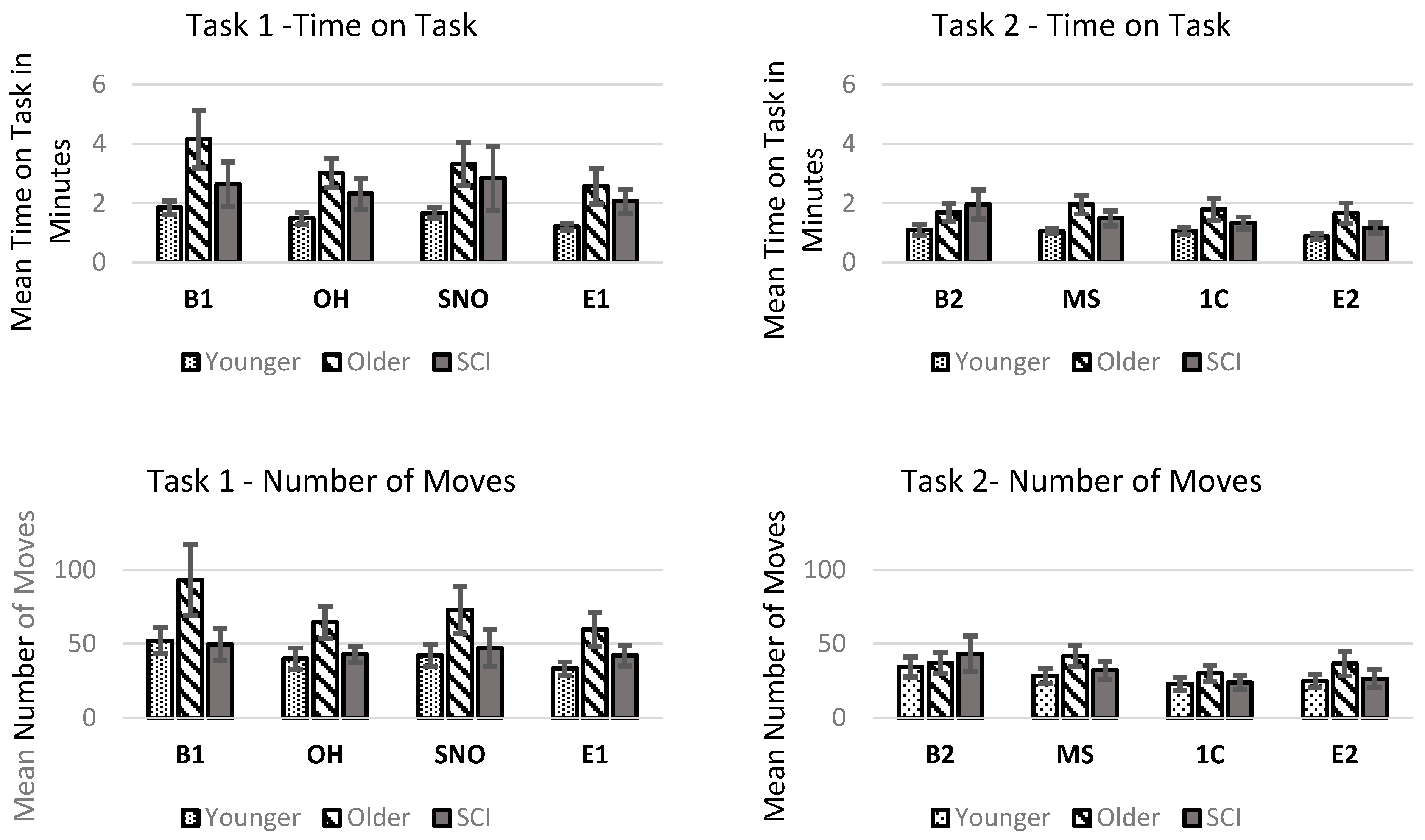
| Younger | ToT | 1.85 (0.47) | −0.62 | 1.49 (0.43) | −0.74 | 1.68 (0.36) | −0.65 | 1.21 (0.25) | −0.67 |
| NoM | 52.20 (19.27) | −0.41 | 40.10 (15.66) | −0.50 | 42.30 (15.95) | −0.48 | 33.40 (9.78) | −0.59 | |
| Older | ToT | 4.16 (2.07) | 0.69 | 3.02 (1.06) | 0.72 | 3.32 (1.54) | 0.56 | 2.58 (1.28) | 0.62 |
| NoM | 93.35 (50.77) | 0.60 | 64.70 (23.29) | 0.64 | 73.15 (33.77) | 0.60 | 59.85 (24.86) | 0.66 | |
| SCI | ToT | 2.65 (0.90) | −0.17 | 2.32 (0.62) | 0.21 | 2.85 (1.29) | 0.22 | 2.07 (0.50) | 0.14 |
| NoM | 49.63 (13.09) | −0.47 | 43.00 (6.48) | −0.36 | 47.38 (14.69) | −0.30 | 42.25 (8.29) | −0.17 | |
| CS | ToT | 3.91 (2.09) | 0.55 | 2.93 (0.96) | 0.64 | 3.57 (1.68) | 0.74 | 2.68 (1.41) | 0.71 |
| NoM | 82.13 (49.73) | 0.34 | 59.94 (23.65) | 0.42 | 74.56 (37.32) | 0.65 | 57.50 (26.39) | 0.55 | |
| SCI-CS 1 | ToT | 4.18 | 0.70 | 2.63 | 0.35 | 5.53 | 2.19 | 2.43 | 0.48 |
| NoM | 60 | −0.22 | 51 | 0.01 | 77 | 0.74 | 50 | 0.19 | |
| WM | ToT | 3.99 (2.31) | 0.59 | 2.90 (1.18) | 0.61 | 3.31 (1.57) | 0.55 | 2.32 (1.02) | 0.37 |
| NoM | 83.94 (55.79) | 0.37 | 58.39 (25.94) | 0.35 | 69.56 (37.25) | 0.48 | 52.78 (27.72) | 0.32 | |
| SCI-WM 2 | ToT | 3.43 (1.06) | 0.28 | 2.87 (0.33) | 0.58 | 4.60 (1.32) | 1.50 | 2.61 (0.25) | 0.65 |
| NoM | 55.00 (7.07) | −0.34 | 50.50 (0.70) | −0.02 | 64.00 (18.38) | 0.28 | 49.00 (1.41) | 0.15 | |
| PS | ToT | 2.84 (1.90) | −0.06 | 2.03 (0.92) | −0.23 | 2.37 (0.99) | −0.13 | 1.79 (0.85) | −0.12 |
| NoM | 73.18 (57.07) | 0.10 | 48.18 (27.40) | −0.12 | 58.47 (35.35) | 0.09 | 45.77 (26.17) | −0.01 | |
| SCI-PS 3 | ToT | 2.23 (0.46) | −0.41 | 2.19 (0.79) | −0.07 | 2.58 (0.94) | 0.02 | 2.07 (0.63) | 0.14 |
| NoM | 46.00 (9.64) | −0.56 | 40.67 (8.08) | −0.47 | 42.67 (7.37) | −0.47 | 39.67 (8.02) | −0.29 | |
| SO | ToT | 4.05 (2.34) | 0.62 | 2.90 (1.25) | 0.61 | 3.43 (1.83) | 0.64 | 2.55 (1.44) | 0.59 |
| NoM | 79.80 (52.15) | 0.27 | 57.20 (25.92) | 0.29 | 60.40 (31.76) | 0.15 | 54.13 (26.76) | 0.39 | |
| SCI-SO 3 | ToT | 2.83 (1.17) | −0.06 | 2.21 (0.40) | −0.06 | 3.26 (1.97) | 0.51 | 1.89 (0.47) | −0.03 |
| NoM | 51.00 (14.73) | −0.44 | 43.00 (7.00) | −0.36 | 52.00 (22.91) | −0.14 | 41.00 (8.19) | −0.23 | |
| SV | ToT | 2.85 (1.01) | −0.05 | 2.36 (0.83) | 0.09 | 3.37 (1.85) | 0.60 | 2.25 (1.36) | 0.31 |
| NoM | 60.80 (19.76) | −0.20 | 47.60 (12.37) | −0.15 | 66.00 (30.88) | 0.35 | 48.20 (19.47) | 0.11 | |
| SCI-SV 4 | ToT | 2.68 (0.87) | −0.15 | 2.28 (0.58) | 0.02 | 3.09 (1.53) | 0.39 | 2.02 (0.55) | 0.09 |
| NoM | 51.20 (10.47) | −0.44 | 43.00 (7.00) | −0.36 | 49.40 (17.04) | −0.23 | 40.60 (8.11) | −0.25 | |
| TASK 2 | |||||||||
|---|---|---|---|---|---|---|---|---|---|
| B2 | MS | 1C | E2 | ||||||
| GROUP | M (SD) | Z | M (SD) | Z | M (SD) | Z | M (SD) | Z | |
| Younger | ToT | 1.10 (0.36) | −0.62 | 1.06 (0.19) | −0.72 | 1.07 (0.24) | −0.55 | 0.88 (0.20) | −0.60 |
| NoM | 34.65 (14.56) | −0.18 | 28.55 (10.45) | −0.45 | 23.10 (9.34) | −0.30 | 25.00 (9.31) | −0.36 | |
| Older | ToT | 1.69 (0.64) | 0.32 | 1.96 (0.69) | 0.72 | 1.79 (0.78) | 0.60 | 1.66 (0.76) | 0.65 |
| NoM | 37.40 (14.56) | 0.01 | 41.85 (15.14) | 0.53 | 30.35 (11/78) | 0.39 | 36.75 (17.69) | 0.46 | |
| SCI | ToT | 1.96 (0.58) | 0.76 | 1.49 (0.30) | −0.02 | 1.34 (0.24) | −0.13 | 1.17 (0.21) | −0.14 |
| NoM | 43.50 (14.34) | 0.42 | 32.25 (7.21) | −0.18 | 24.00 (5.76) | −0.22 | 26.63 (7.27) | −0.25 | |
| CS | ToT | 1.72 (0.72) | 0.38 | 1.84 (0.70) | 0.52 | 1.59 (0.53) | 0.28 | 1.55 (0.67) | 0.48 |
| NoM | 38.63 (14.44) | 0.09 | 37.50 (14.56) | 0.21 | 27.69 (11.54) | 0.14 | 34.69 (19.53) | 0.32 | |
| SCI-CS 1 | ToT | 2.30 | 1.30 | 1.50 | −0.02 | 1.57 | 0.24 | 1.50 | 0.40 |
| NoM | 46 | 0.59 | 30 | −0.35 | 29 | 0.26 | 35 | 0.34 | |
| WM | ToT | 1.69 (0.74) | 0.33 | 1.82 (0.78) | 0.51 | 1.76 (0.83) | 0.56 | 1.50 (0.83) | 0.40 |
| NoM | 38.39 (17.01) | 0.08 | 37.94 (17.20) | 0.24 | 29.78 (13.09) | 0.34 | 32.83 (19.76) | 0.19 | |
| SCI-WM 2 | ToT | 2.29 (0.65) | 1.29 | 1.64 (0.20) | 0.21 | 1.55 (0.02) | 0.22 | 1.27 (0.33) | 0.02 |
| NoM | 49.50 (4.95) | 0.82 | 30.00 (0.00) | −0.35 | 31.00 (8.00) | 0.45 | 26.00 (12.73) | −0.29 | |
| PS | ToT | 1.49 (0.72) | 0.01 | 1.44 (0.57) | −0.10 | 1.33 (0.32) | −0.14 | 1.28 (0.68) | 0.05 |
| NoM | 34.94 (17.08) | −0.16 | 32.77 (15.49) | −0.14 | 24.18 (9.77) | −0.20 | 32.12 (20.21) | 0.14 | |
| SCI-PS 3 | ToT | 1.94 (0.53) | 0.73 | 1.57 (0.27) | 0.10 | 1.46 (0.23) | 0.66 | 1.17 (0.17) | −0.13 |
| NoM | 41.00 (13.11) | 0.25 | 31.33 (2.31) | −0.25 | 26.33 (7.64) | 0.01 | 25.33 (9.71) | −0.34 | |
| SO | ToT | 1.83 (0.70) | 0.55 | 1.90 (0.71) | 0.62 | 1.78 (0.89) | 0.58 | 1.60 (0.85) | 0.57 |
| NoM | 38.00 (17.49) | 0.05 | 38.27 (13.69) | 0.26 | 26.87 (13.34) | 0.06 | 35.07 (19.85) | 0.35 | |
| SCI-SO 3 | ToT | 1.90 (0.38) | 0.66 | 1.60 (0.09) | 0.15 | 1.34 (0.30) | −0.11 | 1.24 (0.23) | −0.02 |
| NoM | 42.00 (6.08) | 0.32 | 36.67 (6.11) | 0.14 | 23.33 (5.51) | −0.28 | 30.00 (4.36) | −0.01 | |
| SV | ToT | 1.58 (0.48) | 0.14 | 1.66 (0.56) | 0.24 | 1.53 (0.36) | 0.19 | 1.39 (0.46) | 0.22 |
| NoM | 37.40 (8.51) | 0.01 | 36.93 (11.00) | 0.16 | 28.40 (6.59) | 0.20 | 31.07 (9.15) | 0.06 | |
| SCI-SV 4 | ToT | 2.04 (0.33) | 0.88 | 1.65 (0.10) | 0.23 | 1.44 (0.25) | 0.04 | 1.22 (0.20) | −0.05 |
| NoM | 44.40 (6.47) | 0.48 | 34.80 (5.22) | 0.01 | 26.20 (5.81) | −0.01 | 28.60 (7.64) | −0.11 | |
| Variable | TASK 1 | B1 | OH | SNO | E1 | TASK 2 | B2 | MS | 1C | E2 | |
|---|---|---|---|---|---|---|---|---|---|---|---|
| Age | ToT | 0.56 *** | 0.60 *** | 0.47 *** | 0.53 *** | 0.71 *** | 0.57 *** | 0.59 *** | |||
| NoM | 0.49 *** | 0.54 *** | 0.58 *** | 0.62 *** | 0.48 *** | 0.36 * | 0.37 ** | ||||
| SO | ToT | −0.27 * | −0.32 * | −0.28 * | −0.33 * | ||||||
| SV | NoM | −0.31 * | |||||||||
| F | ToT | 19.95 *** | 23.04 *** | 19.33 *** | 22.14 *** | 8.81 ** | 45.56 *** | 21.71 *** | 24.63 *** | ||
| NoM | 14.53 *** | 19.14 *** | 22.93 *** | 28.59 *** | 4.98 * | 14.02 ** | 6.99 * | 7.38 ** | |||
| R2 | ToT | 0.45 | 0.59 | 0.44 | 0.47 | 0.25 | 0.49 | 0.31 | 0.34 | ||
| NoM | 0.22 | 0.28 | 0.32 | 0.37 | 0.08 | 0.22 | 0.11 | 0.12 |
Disclaimer/Publisher’s Note: The statements, opinions and data contained in all publications are solely those of the individual author(s) and contributor(s) and not of MDPI and/or the editor(s). MDPI and/or the editor(s) disclaim responsibility for any injury to people or property resulting from any ideas, methods, instructions or products referred to in the content. |
© 2026 by the authors. Licensee MDPI, Basel, Switzerland. This article is an open access article distributed under the terms and conditions of the Creative Commons Attribution (CC BY) license.
Share and Cite
Parkhurst, E.L.; Montalvo, F.; Ding, Z.; Smither, J.A.; Behal, A. Effective Compensations for Disability: Results from a Usability Evaluation of an Assistive Robot Among Spinal-Cord-Injured Users. Machines 2026, 14, 174. https://doi.org/10.3390/machines14020174
Parkhurst EL, Montalvo F, Ding Z, Smither JA, Behal A. Effective Compensations for Disability: Results from a Usability Evaluation of an Assistive Robot Among Spinal-Cord-Injured Users. Machines. 2026; 14(2):174. https://doi.org/10.3390/machines14020174
Chicago/Turabian StyleParkhurst, Eva L., Fernando Montalvo, Zhangchi Ding, Janan A. Smither, and Aman Behal. 2026. "Effective Compensations for Disability: Results from a Usability Evaluation of an Assistive Robot Among Spinal-Cord-Injured Users" Machines 14, no. 2: 174. https://doi.org/10.3390/machines14020174
APA StyleParkhurst, E. L., Montalvo, F., Ding, Z., Smither, J. A., & Behal, A. (2026). Effective Compensations for Disability: Results from a Usability Evaluation of an Assistive Robot Among Spinal-Cord-Injured Users. Machines, 14(2), 174. https://doi.org/10.3390/machines14020174