
Abstract
This paper investigates the event-triggered fault diagnosis (FD) problem for interval type-2 (IT2) Takagi–Sugeno (T-S) fuzzy networked systems. Firstly, an FD fuzzy filter is proposed by using IT2 T-S fuzzy theory to generate a residual signal. This means that the FD filter premise variable needs to not be identical to the nonlinear networked systems (NNSs). The evaluation functions are referenced to determine the occurrence of system faults. Secondly, under the event-triggered mechanism, a fault residual system (FRS) is established with parameter uncertainty, external disturbance and time delay, which can reduce signal transmission and communication pressure. Thirdly, the progressive stability of the fault residual system is guaranteed by using the Lyapunov theory. For the energy bounded condition of external noise interference, the performance criterion is established using linear matrix inequalities. The matrix parameters of the target FD filter are obtained by the convex optimization method. A less conservative fault diagnosis method can be obtained. Finally, the simulation example is provided to illustrate the effectiveness and the practicalities of the proposed theoretical method.
1. Introduction
The networked systems have been widely used because of these many advantages, their simple physical structure, reduced integration costs, resource sharing, suitable for installation, expansion and maintenance [1,2]. In order to satisfy the development of aerospace and smart manufacturing, the networked systems have increasingly strong nonlinearity, uncertainty and complexity [3,4]. New challenges are brought to the control field to deal with problems such as delay, data packet loss and network bandwidth limitation caused by network introduction [5,6,7,8,9]. With the development of nonlinear networked systems, it needs new performance indexes including standard interface modularization, high reliability, high stability, and so on [10,11].
Fuzzy control is an effective tool for solving nonlinear problems linearization [7,12]. Fault diagnosis (FD) technology plays a vital role in improving the reliability and safety of complex engineering systems [13,14]. The task of fault diagnosis of the networked system is to transmit the input and output data of the system to the fault diagnosis unit through the network, so as to ensure that the stable operation of the system without fault occurs [6]. The FD methods of networked systems are proposed based on the fuzzy model [7,15,16]. However, there are bad situations under time-triggered FD such as unnecessary data transmission, increased network burden, data loss, and greater network delay [8]. The event-triggered mechanism has irreplaceable advantages in the network resource-constrained system. The research on fault diagnosis technology of networked systems with event-triggered mechanisms has received extensive attention from international scholars, which has become a hot research issue in the academic community of automatic control and produced many valuable research results [8,9,15,16,17,18,19,20,21,22,23,24,25,26,27,28,29,30,31,32].
Different event triggering methods are studied such as the adaptive event-triggering mechanism [5,10,22,23,27,29,32], the dynamic event triggering mechanism containing internal dynamic variables [19,28,31], the event triggering mechanism designed by improving constant thresholds [8,15,16,20,21,25,26]. The fault filtering problem of NCSs with interval time-varying time lags is studied by using the fuzzy fault detection filter with a generic structure [17]. The authors in [22] propose a novel adaptive event-triggered fault detection approach for Markov jump systems, wherein the transition probabilities are not required to be fully known. The problem of troubleshooting networked systems subject to multiple factors is discussed [21,23,25,28,30]. The problem of fault detection for stochastic nonlinear generalized networked systems is studied, which is subject to network delay, packet loss, and asynchronous premise variables [23]. Fault diagnosis problems of NNSs with communication channels are subject to limited bandwidth and random data loss are investigated. Time-varying delay, dynamic event triggering mechanism, random nonlinearity and simultaneous packet loss are considered in building a unified fault detection dynamic model moment, which is used to solve the fault detection problem [28]. The dissipative stabilization problem is solved by considering the delay and external disturbance [30].
The existing research has been extensive. However, the complexity of real systems can no longer be described by simple models. For instance, the membership functions approaches have been proposed based on the restriction that the membership functions of the descriptive model of the systems [15,16,21]. When this issue is considered, the general T-S fuzzy modeling scheme cannot achieve the desired results [15]. The IT2 fuzzy model was developed because of its good proxy for nonlinear systems with parameter uncertainty [29,30,31,32,33,34,35,36,37]. The problem of the FD filtering method is proposed with event-based, which is the application in IT2 fuzzy theory under the framework of networked time-delay control systems [29]. Event-triggered dissipation-based control is investigated by using the IT2 T-S fuzzy theory to describe uncertain nonlinear networked systems [30]. The nonlinear networked system with parameter uncertainty is studied under the event-triggered mechanism with adaptive discrete fuzzy filtering described by IT2 T-S fuzzy model [32]. In [33,34,35,36,37,38], the FD fighting design, impulse control and discrete control based on the IT2 fuzzy model are studied. Interval two-type theory is being recognized and studied by more and more scholars [39,40]. Expanding the application scope of event-driven technology in the IT2 fuzzy control system is the first motivation for writing this paper.
Then, the FD methods for fuzzy systems have been proposed without considering the problems of nonlinear perturbation and transmission-limited [13,14]. Reducing the conservativeness of existing results and redundancy in design is a difficult issue of academic concern. In summary, solutions to event-driven FD problems are important for NNSs subject to uncertainties, perturbation, and network-induced delays. The main contributions of the paper as follows:
- (1)
- A new FD fuzzy filter is designed by using IT2 T-S fuzzy model for generating a residual signal, which means that the designed FD filter premise variable could be different from NNSs.
- (2)
- A fault residual system is established by integrating the IT2 fuzzy theory, external disturbance, event-triggered scheme, time delays and parameter uncertainty.
- (3)
- The stability conditions and the existence conditions of the FD filter are derived by the form of linear matrix inequalities, as a result of the Lyapunov–Krasovskii generalized function method providing the basis. Matrix decoupling implements the transformation of the filter existence conditions with stability analysis.
The rest of this paper is structured as follows. An IT2 fuzzy fault residual system is given based on the IT2 fuzzy networked control system model, event-triggered scheme, and fault diagnosis mechanism in Section 2. Section 3 is the focus of the article and is intended to discuss and clarify the stability analysis and the design of the filter for the fault residual system. Section 4 conducts simulations and discusses the validity of the proposed method. The full paper is summarized, and further research directions are given in Section 5.
Table 1 shows the abbreviations and notations used in this paper.
Table 1.
Explanation of abbreviations and notations.
2. Problem Formulation
2.1. IT2 T-S Nonlinear Networked Systems
An NNSs is modeled by IT2 T–S fuzzy rules by using state-space representation, its parameter uncertainty and external perturbations are described.
Plant rule: IF is , is ,……, and is , THEN
In the IT2 T-S NNSs, , , , , and are system matrices. Separately, , , represents the state vector, measured output, and the fault signal waiting to be detected, in particular, is the external disturbance which belongs to . Define stands for premise variable, the number of fuzzy sets is , the IT2 fuzzy set is described as , where , and , the firing strength of ith rule is defined as follows [39]:
where , , , . We can get the IT2 fuzzy model after weighting, as follows:
where , meanwhile , and are greater than zero, which represent the weighting functions and satisfying:
Obviously, in the process of NNSs modeling, we define a fuzzy set for the membership function to describe its uncertainty, which provides a basis for the subsequent design of a low conservation fault diagnosis filter.
2.2. Event-Triggered FD Filter
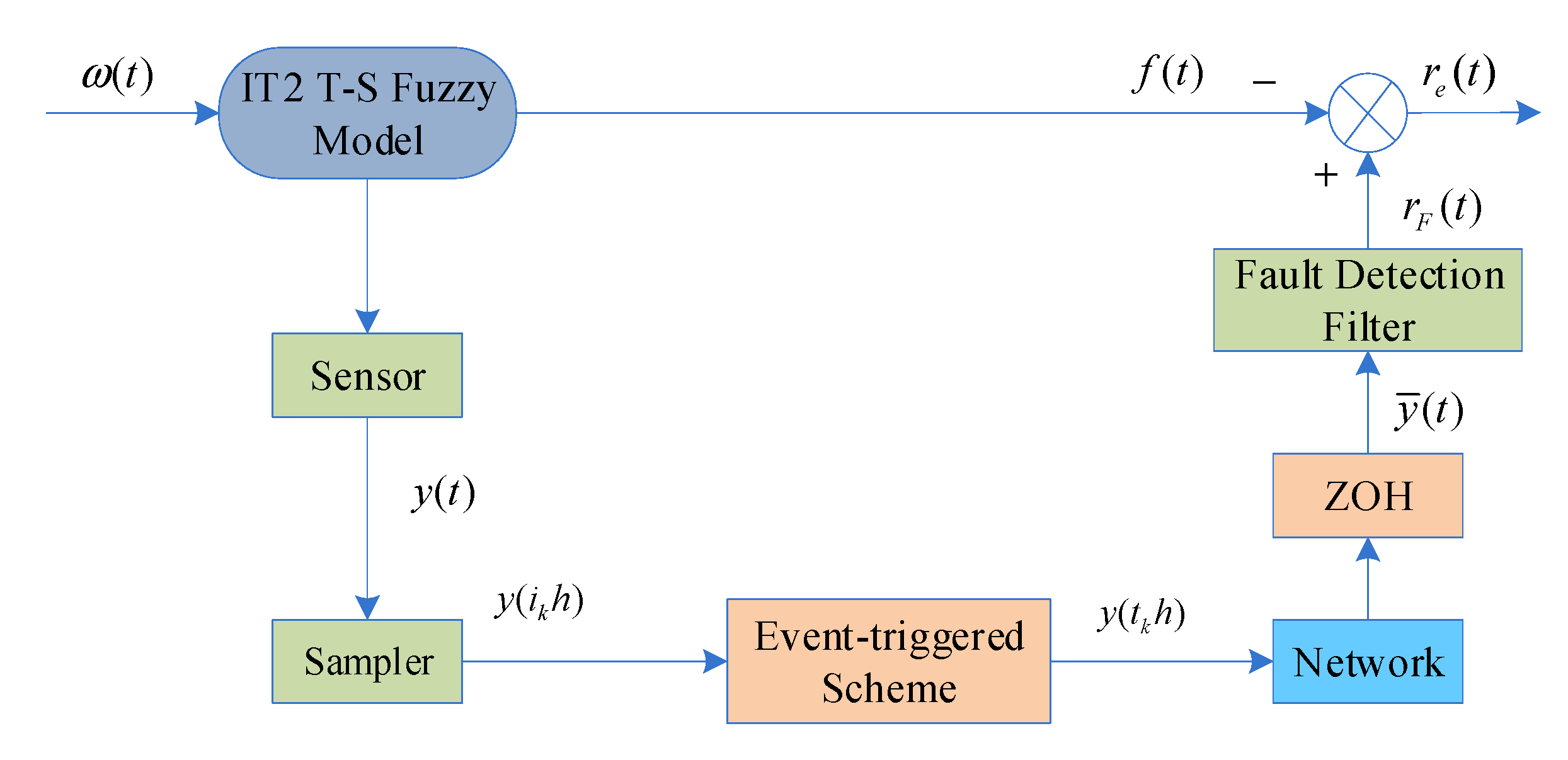
Next, an event-triggering mechanism is introduced within the system, which is between the considered system and FD Filter as shown in Figure 1.
Figure 1.
Framework of IT2 T-S NNSs with event-triggered scheme.
The current sampled signal must reach the trigger threshold of the event monitoring terminal before it can be transmitted to the next node. Similar to [34], we can define the event-triggering mechanism as:
where , is the threshold error, which is the key factor that determines whether the event trigger mechanism occurs, and is obtained by subtracting current sampled data from the latest transmitted data . denotes the positive triggering parameters.
ZOH provides information about the last transmitted data continuously, the input signal received by the filter can be described as
The system can be transformed into a new time lag system, which can be directly analyzed with time lag system theory. Without loss of generality, the holding region of ZOH is expressed as:
Define , where , , and then we can obtain:
Based on the above, can be rewritten as:
Remark 1.
The introduction of the event triggering mechanism (5) reduces redundant transmission data and saves network resources.
Summarizing the previous discussion, the IT2 fuzzy FD filter is modeled by IT2 T–S fuzzy rules:
Filter Rule: IF is , is ,……, and is , THEN
in which, , , , and are FD filter gain matrices. , , and represent the state vector, the output, and residual output vector of the event-triggered FD filter. The fuzzy set is , , , is the number of fuzzy sets. are the premise variables. The firing strength of jth rule is expressed by interval sets:
with , , , , and represent, the bounds of membership, where and represent the bounds of the membership function, respectively. The event-triggered FD filter is designed as:
where , , while and are nonlinear functions used to represent the uncertainty of the FD filter, satisfying
For the convenience of the following writing, using , instead of , .
Remark 2.
The FD filter (13) proposed has two advantages. Firstly, the model has higher accuracy by using IT2 T-S fuzzy theory to describe uncertainty effectively. Secondly, the FD filter is more general as the object’s affiliation function and the fuzzy rules are not shared with the FD filter.
2.3. Fault Residual System (FRS)
In this section, the fault residual system is developed based on models (3) and (13). The fault diagnosis problem is simplified to the problem of asymptotic tracking of residuals and faults. Combination the ETS (5), and defining with , , , the FRS can be represented as:
, , , , ,
, , , .
The target of this section is to design the FD filter (13) and triggering mechanism (5) such that the FRS (15) satisfies asymptotically stable with the performance indicators. In the meantime, the following conditions are satisfied:
- (1)
- When , the FRS (15) is considered to be asymptotically stable.
- (2)
- Under the condition of zero initial, contents , where bring about performance level.
2.4. FD Mechanism
Define the following FD mechanism.
where is the residual evaluation function, and is the threshold, represents the limited length of evaluation time. The fault detection mechanism is as follows:
Lemma 1.
(Schur complement) [41] For the given matrix , where,, the following three sets of conditions and inequalities hold and are equivalent:
- (1)
- ;
- (2)
- (3)
- .
Lemma 2.
[42] For real matriceswith appropriate dimensions, in which theis symmetric, then
for all, there exists, such that:
Lemma 3.
[43] Given a symmetric and positive matrix, inequality (18) holds:
Remark 3.
It is worth noting that the fault residual system is built via IT2 T-S fuzzy model, considering the event-triggered communication mechanisms, disturbances and network time delays. In the existing work, there is less research on the IT2 T-S fuzzy network control system FD filtering with event triggering, which is one of the innovative points in this section.
3. Main Conclusion
3.1. Stability Analysis
In this subsection, the following improvements will be made in the stability analysis process to reduce the system conservativeness. First, a new Lyapunov–Krasovskii function with fourfold integration is constructed; second, Wirtinger’s inequality is applied to process the integral term, which is in the time derivative of the Lyapunov–Krasovskii function; third, a relaxation matrix is introduced to deal with the premise variable mismatch problem.
Theorem 1.
For given scalars, , , and the membership functions satisfying, if IT2 FRS (15) is asymptotically stable, and achieving the expectedperformance level, then there exists parameter matrix, , , , , , , , , and, , meanwhile, the following inequalities exist in the appropriate dimensions:
for,
in which, where,
, ,
,,,
,,,
,
,,,.
Proof.
For the FRS (15), construct the following Lyapunov–Krasovskii function:
where
,
,
,
,
.
and , , , , , , .
Along the trajectory of the FRS (15), the time derivative of is:
where
,
,
,
,
.
The integral term in , which we treat by applying Lemma 3, yields
Furthermore, in a bid to obtain stability conditions with low conservativeness, the following slack matrix is introduced:
From (23) to (28), we can obtain
under for all . Combined with the event-triggering mechanism (5), we can derive
where
, ,
.
By using Schur complement, , hence, we have
Integrating from 0 to simultaneously on the left and right sides of (30), we can obtain:
Equation (32) representative holds for any nonzero . Thus, the FRS (15) is under the restriction of Theorem 1 is asymptotically stable and satisfies the given performance index . □
Remark 4.
The Lyapunov–Krasovskii function (23) constructed contains multiple integrals, such as triple, quadruple integrals. The more system and time delay information are considered, and the amplification of the integral term processing is avoided effectively. Convergence of global asymptotic stability is guaranteed. Moreover, more recently, the introduction of the relaxation matrix (28) makes the obtained stability criterion with less conservative.
3.2. Fault Diagnosis Filter Design
In this section, solving the parameters of the FD filter is transformed into the problem of matrix convex optimization, which can be solved by MATLAB. Using the matrix transformation and deformation, the proposed filter design method is implemented.
Theorem 2.
For given scalars,,, and the membership functions satisfying,, if the IT2 FRS (15) is asymptotically stable and meets the expectedperformance level, then there exists parameter matrix,,,,,,,,,andhave suitable dimensions satisfying the following inequality:
for,
in which, where,
, ,
,,
, , , ,
,.
,
.
Based on the above condition for the establishment of linear matrix inequality, the filter parameter matrix is obtained as follows
Proof.
On the basis of Theorem 1, we set , , .
Then, we have to multiply the left and right sides of Equations (20)–(22) by and . It yields that
The application of Lemma 2 achieves the conversion of (37) to (38).
To facilitate the simplification and operation of the matrix, the following expression is made:
Bringing them into Equations (20)–(22), we can obtain Equations (33)–(35).
By using Schur Complement Lemma, the matrix is equivalent to . Furthermore, equivalently under transformation , the parameters of the fault detection filter can be yielded as follows:
According to Theorem 2, we determine the FD filter parameters by solving the convex optimization problems:
min subject to the inequalities (33)–(35).
The proof is completed. □
4. Simulation
In this section, we provide several examples to illustrate the usefulness of the designed IT2 fuzzy FD approach and to compare it with the existing results in [44,45] to show the advantages of our method.
Two rules have been considered in the following IT2 fuzzy system (system parameters are borrowed from [46])
with . The membership functions of the plant and fault detection filter are depicted in Table 2. The nonlinear functions are chosen as, i.e., , , , and for .
Table 2.
Membership functions for plant and filter.
In order to derive the gain matrices of the FD filter in (7), we assume the parameter sets . Then by solving the conditions in Theorem 2, we can obtain
Besides, the performance is calculated as . According to the FD mechanism, we set the fault signal as
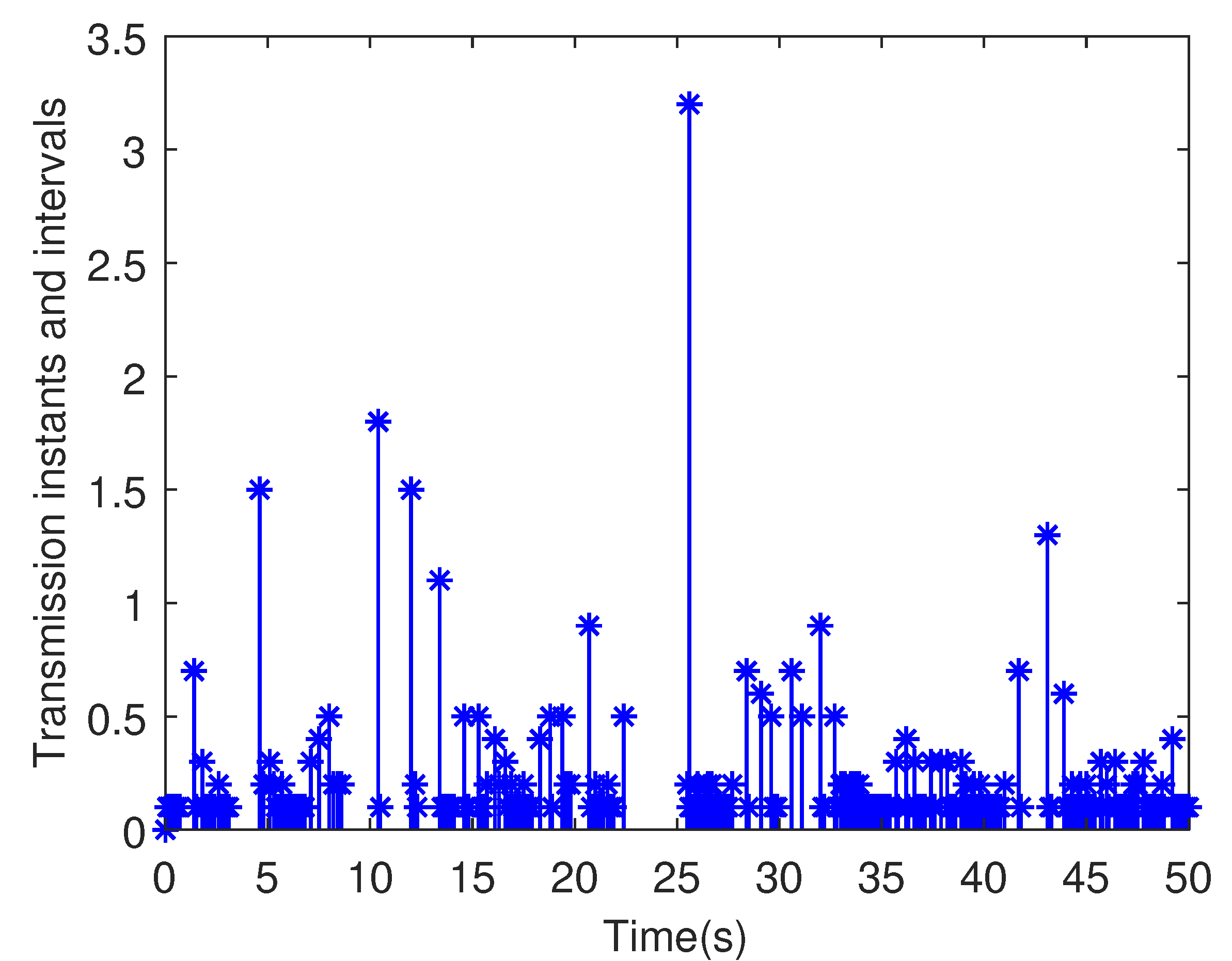
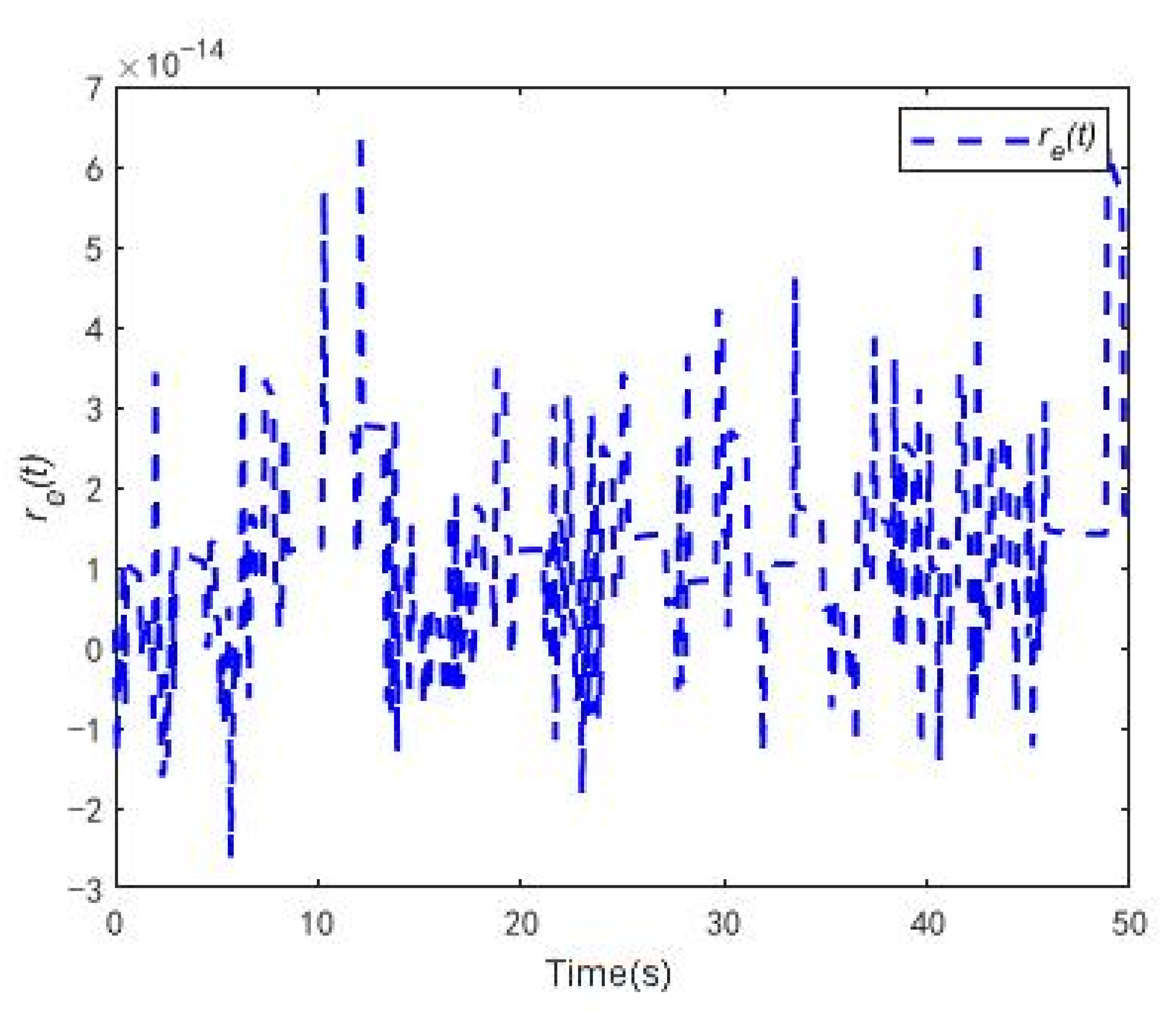
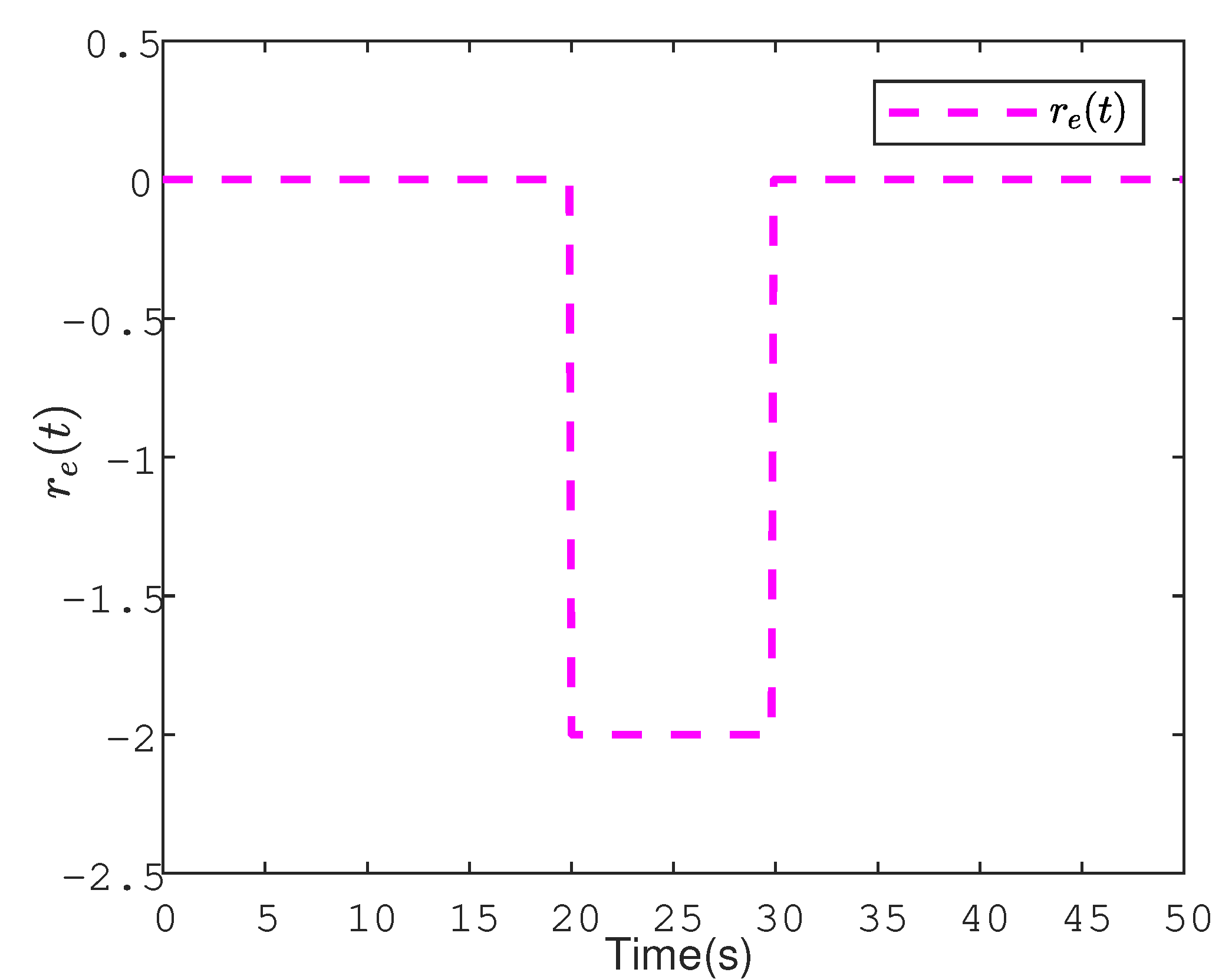
and the external disturbance is stochastic noise that belongs to standard normal distribution. Let the initial states be . Then, we can derive Figure 2, Figure 3 and Figure 4. Specifically, Figure 2 depicts the actual transmission instants and intervals under the event-triggered scheme. In the simulation time (50 s) and sampling period (0.1 s), only 20.0% of sampled data are transmitted over the wireless network. Clearly, it saves many communication resources. Figure 3 and Figure 4, respectively, show the trajectories of the error without/with fault.
Figure 2.
Transmission instants and intervals.
Figure 3.
The trajectories of without fault.
Figure 4.
The trajectories of with fault.
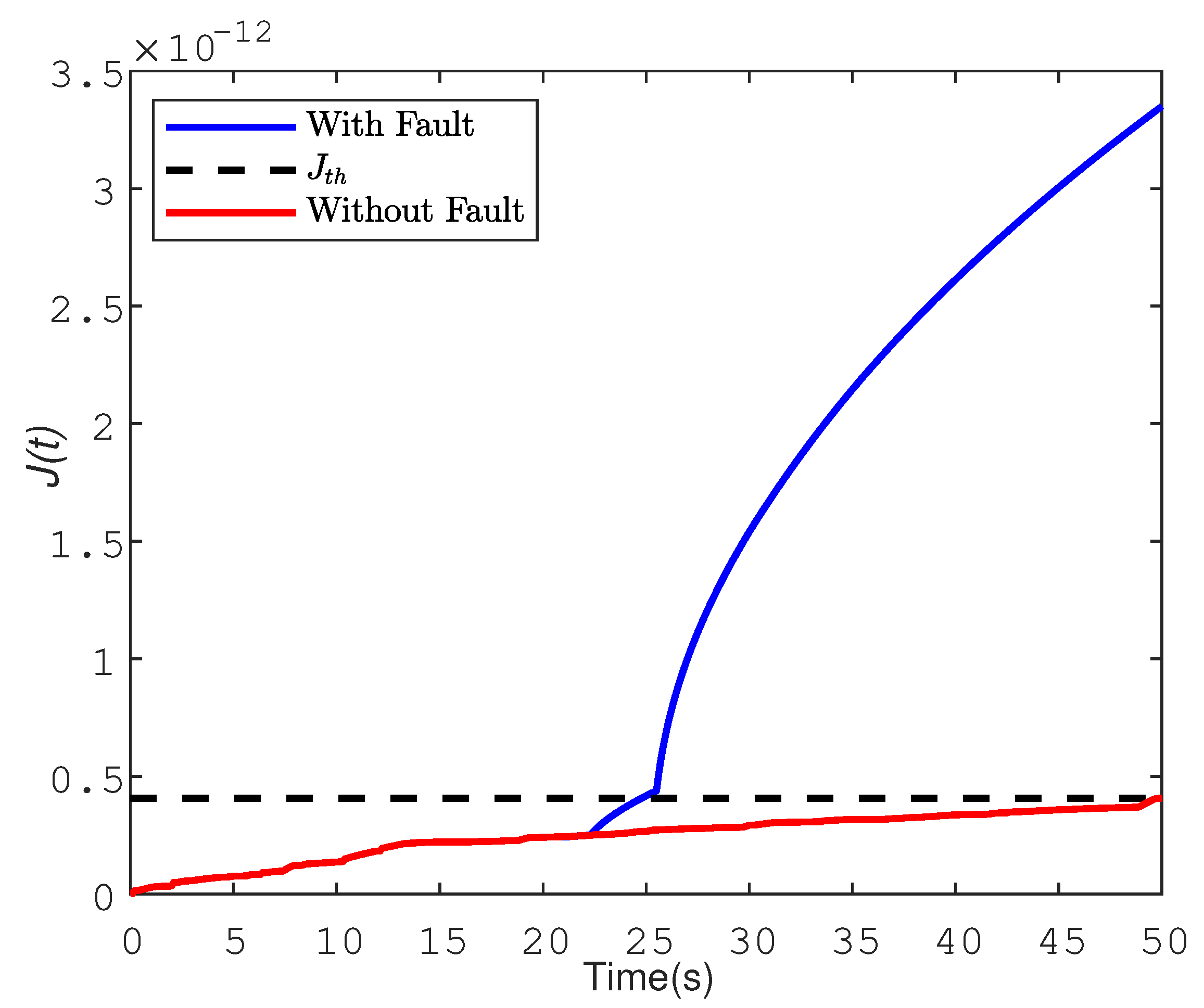
Moreover, the threshold can be calculated without fault, i.e., . Then, it is not hard to obtain that . This means that the fault can be detected after 4.9 s. Further, Figure 5 illustrates the fault detection results demonstrating that the proposed FD approach is effective.
Figure 5.
The trajectories of evaluation function with/without fault.
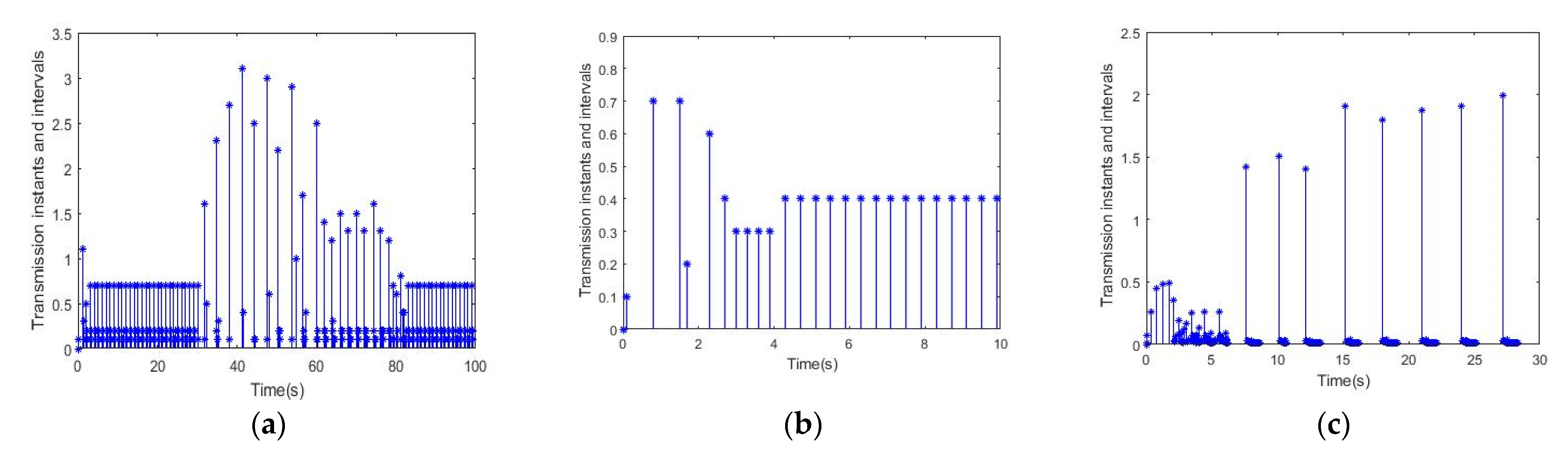
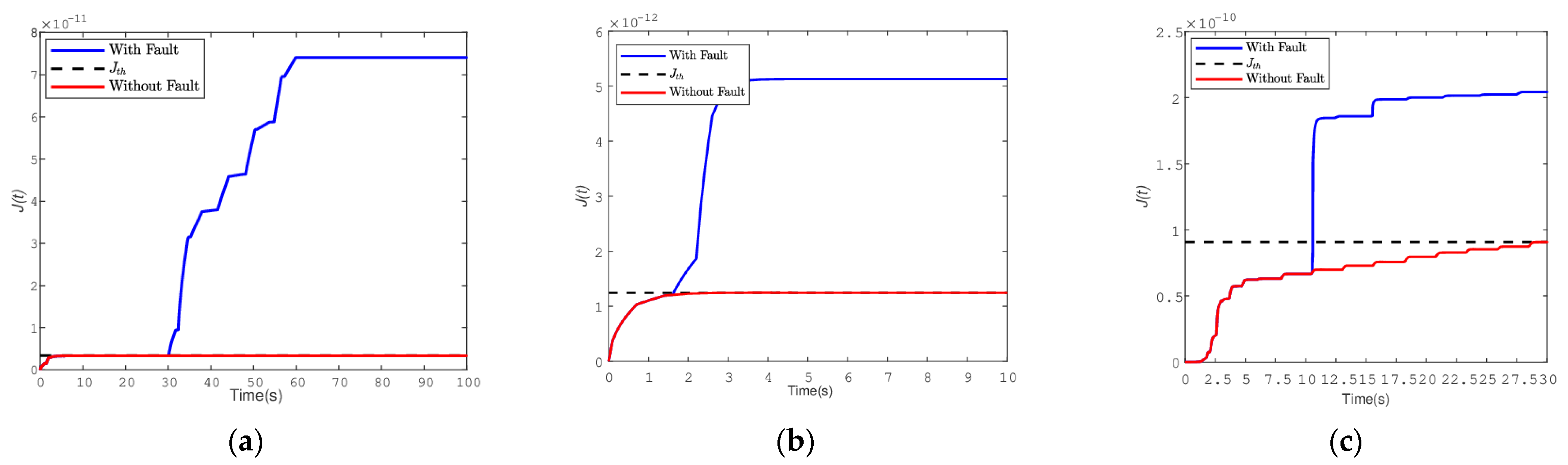
Following the above steps, considering the different types of faults, we performed three sets of simulations. Then, we produced Table 3 and derived Figure 6 and Figure 7.
Table 3.
Verification for different types of faults.
Figure 6.
Transmission instants and intervals for experiment (a–c).
Figure 7.
The trajectories of evaluation function with/without fault for experiment (a–c).
Experiment a uses the same system parameters and fault types as those the in the literature [44]. During the simulation time (100 s) with the sampling period (0.1 s), the cycle triggering time is 1000, and the events triggering time is 239. Simultaneously, the results show that the proposed method obtains a faster detection time. In experiment b, the step signal is used to represent the sudden fault. The final time is 10 s, and the sampling period is 0.1 s. With the same experimental conditions, the proposed method has fewer triggers and a faster detection speed. It can be seen that the structure of the event triggering mechanism we used is simpler. More recently, in order to discuss the effectiveness of the method for time-varying faults. Experiment c was performed by considering an inverted pendulum on a cart. It readjusts that the experimental time is 30 s and sampling period is 0.01 s, and only 26.3% of sampled data is transmitted over the wireless network. In Figure 7, one can see that the fault can be detected after 0.6 s.
5. Conclusions
The event-triggered FD problem of IT2 T-S fuzzy nonlinear networked systems has been studied in this paper. A fault residual system is established by integrating the IT2 fuzzy theory, external disturbance, event-triggered scheme, time delays and parameter uncertainties. In particular, the designed FD filter premise variable could be different from NNSs. The stability conditions and performance criterion have been proposed with the aid of the Lyapunov theory. At last, the validity has been verified by simulation experiments. The results illustrate that the proposed FD method can achieve rapid detection of faults, and the event-triggered scheme reduces the transmission rate and saves wireless communication resources. The responsiveness to different types of faults highlights its low conservativeness. The event-triggered FD problem of NNSs with random cyberattacks and packet losses will be further investigated.
Author Contributions
Conceptualization, Z.L., C.Z. and L.W.; methodology, Z.L., F.X. and L.W.; software, C.Z.; validation, Z.L., C.Z., F.X., Z.W. and L.W.; writing—review and editing, Z.L., C.Z., F.X., Z.W. and L.W.; visualization, Z.L.; supervision, L.W.; project administration, L.W. and Z.L.; funding acquisition, L.W., F.X. and Z.L. All authors have read and agreed to the published version of the manuscript.
Funding
This work was financially supported by the Heilongjiang Provincial Natural Science Foundation of China [No. LH2021F057], the Fundamental Research Funds in Heilongjiang Provincial Universities [No.135409602,135409102], the Science and Technology Project of State Grid Heilongjiang Electric Power Co., Ltd. [No.5224162000JK], and the Open project of Agricultural multidimensional sensor information Perception of Engineering and Technology Center in Heilongjiang Province [No. DWCGQKF202105].
Institutional Review Board Statement
Not applicable.
Informed Consent Statement
Not applicable.
Data Availability Statement
Not applicable.
Conflicts of Interest
The authors declare no conflict of interest.
References
- Zhang, X.; Han, Q.; Ge, X.; Ding, D.; Ding, L.; Yue, D.; Peng, C. Networked Control Systems, A Survey of Trends and Techniques. IEEE/CAA J. Autom. Sinica 2020, 7, 1–17. [Google Scholar] [CrossRef]
- Zhou, J.; Zhang, D. H∞ Fault Detection for Delta Operator Systems with Random Two-Channels Packet Losses and Limited Communication. IEEE Access 2019, 7, 94448–94459. [Google Scholar] [CrossRef]
- Liu, Y.; Arunkumar, A.; Sakthivel, R.; Nithya, V.; Alsaadi, F. Finite-time Event-Triggered Non-fragile control and Fault Detection for Switched Networked Systems with Random Packet Losses. J. Frankl. Inst. 2019, 357, 11394–11420. [Google Scholar] [CrossRef]
- Han, C.; Song, D.; Ran, G.; Yu, J. Event-Triggered Mixed Non-Fragile and Measurement Quantization Filtering Design for Interval Type-2 Fuzzy Systems. IEEE Access 2020, 9, 1533–1545. [Google Scholar] [CrossRef]
- Wang, X.; Fei, Z.; Wang, Z.; Yu, J. Zonotopic fault detection observer design for discrete-time systems with adaptively adjusted event-triggered mechanism. IET Control Theory Appl. 2020, 14, 96–104. [Google Scholar] [CrossRef]
- Ju, Y.; Tian, X.; Liu, H.; Ma, L. Fault detection of networked dynamical systems, a survey of trends and techniques. Int. J. Syst. Sci. 2021, 52, 3390–3409. [Google Scholar] [CrossRef]
- Chen, H.; Liu, Z.; Alippi, C.; Huang, B.; Liu, D. Explainable Intelligent Fault Diagnosis for Nonlinear Dynamic Systems: From Unsupervised to Supervised Learning. TechRxiv 2022. [Google Scholar] [CrossRef]
- Sun, S.; Li, T.; Pang, Y.; Hua, X. Multiple delay-dependent event-triggered finite-time H∞ filtering for uncertain networked random systems against state and input constraints. Appl. Math. Comput. 2022, 415, 126711. [Google Scholar] [CrossRef]
- Zhang, Z.; Wang, H.; Huang, M. Neural network-based event-triggered fault detection of discrete-time nonlinear uncertain systems. J. Frankl. Inst. 2020, 357, 4887–4900. [Google Scholar] [CrossRef]
- Liu, M.; Yu, J.; Sun, Y.; Li, J. Adaptive event-triggered fault detection for Markovian jump systems with network time-delays. Trans. Inst. Meas. Control 2021, 43, 2934–2947. [Google Scholar] [CrossRef]
- Lu, Z.; Ran, G.; Xu, F.; Lu, J. Novel mixed-triggered filter design for interval type-2 fuzzy nonlinear Markovian jump systems with randomly occurring packet dropouts. Nonlinear Dyn. 2019, 97, 1525–1540. [Google Scholar] [CrossRef]
- Weidman, T. Comments on “Fuzzy-Model-Based Quantized Guaranteed Cost Control of Nonlinear Networked Systems”. IEEE Trans. Fuzzy Syst. 2018, 26, 1086–1088. [Google Scholar] [CrossRef]
- Guo, X.; Fan, X.; Wang, J.; Park, J. Event-triggered Switching-type Fault Detection and Isolation for Fuzzy Control Systems under DoS Attacks. IEEE Trans. Fuzzy Syst. 2020, 29, 3401–3414. [Google Scholar] [CrossRef]
- Liu, X.; Su, X.; Shi, P.; Nguang, S.; Shen, C. Fault detection filtering for nonlinear switched systems via event-triggered communication approach. Automatica 2019, 101, 365–376. [Google Scholar] [CrossRef]
- Qi, J.; Li, Y. Hybrid-triggered fault detection filter design for networked Takagi–Sugeno fuzzy systems subject to persistent heavy noise disturbance. Int. J. Adapt. Control Signal Process. 2021, 35, 1062–1082. [Google Scholar] [CrossRef]
- Yi, X.; Li, G.; Liu, Y.; Fang, F. Event-triggered H∞ filtering for nonlinear networked control systems via T-S fuzzy model approach. Neurocomoputing 2021, 448, 344–352. [Google Scholar] [CrossRef]
- Tan, Y.; Wang, K.; Su, X.; Xue, F.; Shi, P. Event-Triggered Fuzzy Filtering for Networked Systems with Application to Sensor Fault Detection. IEEE Trans. Fuzzy Syst. 2021, 29, 1409–1422. [Google Scholar] [CrossRef]
- Ran, G.; Liu, J.; Li, C.; Chen, L.; Li, D. Event-Based Finite-Time Consensus Control of Second-Order Delayed Multi-Agent Systems. IEEE Trans. Circuits Syst. II Express Briefs 2021, 68, 276–280. [Google Scholar] [CrossRef]
- Wan, X.; Han, T.; An, J.; Wu, M. Fault Diagnosis for Networked Switched Systems, An Improved Dynamic Event-Based Scheme. IEEE Trans. Cybern. 2021, 1–12. [Google Scholar] [CrossRef]
- Aslam, M.; Ullah, R.; Dai, X.; Sheng, A. Event-triggered scheme for fault detection and isolation of non-linear system with time-varying delay. IET Control Theory Appl. 2020, 14, 2429–2438. [Google Scholar] [CrossRef]
- Chen, Z.; Bao, Y.; Ma, Q.; Zhang, Z. Event-Based Control for Networked T-S Fuzzy Systems via Auxiliary Random Series Approach. IEEE Trans. Cybern. 2020, 50, 2166–2175. [Google Scholar] [CrossRef]
- Ran, G.; Liu, J.; Li, C.; Lam, H.; Li, D.; Chen, H. Fuzzy Model Based Asynchronous Fault Detection for Markov Jump Systems with Partially Unknown Transition Probabilities, An Adaptive Event-Triggered Approach. IEEE Trans. Fuzzy Syst. 2022, 1–10. [Google Scholar] [CrossRef]
- Li, R.; Yang, Y. Event-triggered fault detection for nonlinear descriptor networked control systems. J. Frankl. Inst. 2021, 358, 8715–8735. [Google Scholar] [CrossRef]
- Huang, C.; Shen, B.; Zou, L.; Shen, Y. Event-Triggering State and Fault Estimation for a Class of Nonlinear Systems Subject to Sensor Saturations. Sensors 2021, 21, 1242. [Google Scholar] [CrossRef]
- Chen, Z.; Zhang, B.; Zhang, Y.; Li, Y.; Zhang, Z. Event-triggered fault detection for T-S fuzzy systems subject to data losses. International. J. Syst. Sci. 2020, 51, 1162–1173. [Google Scholar] [CrossRef]
- Liu, Q.; Long, Y.; Ju, H.; Li, T. Neural network-based event-triggered fault detection for nonlinear Markov jump system with frequency specifications. Nonlinear Dyn. 2021, 103, 1–17. [Google Scholar] [CrossRef]
- Mishra, S.K.; Jha, A.V.; Verma, V.K.; Appasani, B.; Abdelaziz, A.Y.; Bizon, N. An Optimized Triggering Algorithm for Event-Triggered Control of Networked Control Systems. Mathematics 2021, 9, 1262. [Google Scholar] [CrossRef]
- Ning, Z.; Wang, T.; Song, X.; Yu, J. Fault detection of nonlinear stochastic systems via a dynamic event-triggered strategy. Signal Processing 2019, 167, 107283. [Google Scholar] [CrossRef]
- Xie, X.; Li, S.; Xu, B. Fault detection filter design for interval type-2 fuzzy systems under a novel adaptive event-triggering mechanism. Int. J. Syst. Sci. 2019, 50, 2510–2528. [Google Scholar] [CrossRef]
- Yang, H.; Wang, X.; Park, J. Sampled-Data-Based Dissipative Stabilization of IT-2 TSFSs Via Fuzzy Adaptive Event-Triggered Protocol. IEEE Trans. Cybern. 2021, 8, 1–10. [Google Scholar] [CrossRef]
- Guo, X.; Fan, X.; Ahn, C. Adaptive Event-Triggered Fault Detection for Interval Type-2 T-S Fuzzy Systems with Sensor Saturation. IEEE Trans. Fuzzy Syst. 2021, 29, 2310–2321. [Google Scholar] [CrossRef]
- Xie, X.; Li, S.; Xu, B. Adaptive event-triggered H∞ fuzzy filtering for interval type-2 T-S fuzzy-model-based networked control systems with asynchronously and imperfectly matched membership functions. J. Frankl. Inst.-Eng. Appl. Math. 2019, 356, 11760–11791. [Google Scholar] [CrossRef]
- Pan, Y.; Yang, G. Event-Driven Fault Detection for Discrete-Time Interval Type-2 Fuzzy Systems. IEEE Trans. Syst. Man Cybern. Syst. 2019, 51, 4959–4968. [Google Scholar] [CrossRef]
- Ran, G.; Li, C.; Lam, H.; Li, D.; Han, C. Event-Based Dissipative Control of Interval Type-2 Fuzzy Markov Jump Systems Under Sensor Saturation and Actuator Nonlinearity. IEEE Trans. Fuzzy Syst. 2022, 30, 714–727. [Google Scholar] [CrossRef]
- Rong, N.; Wang, Z. Event-Based Impulsive Control of IT2 T-S Fuzzy Interconnected System Under Deception Attacks. Int. J. Fuzzy Syst. 2021, 29, 1615–1628. [Google Scholar] [CrossRef]
- Ran, G.; Liu, J.; Li, D.; Zhang, Y.; Huang, Y. An Event-Triggered H∞ Filter for Interval Type-2 T–S Fuzzy Nonlinear Networked Systems with Parameter Uncertainties and Delays. Int. J. Fuzzy Syst. 2021, 23, 2144–2156. [Google Scholar] [CrossRef]
- Li, H.; Wu, L.; Lam, H.K.; Gao, Y. Analysis and Synthesis for Interval Type-2 Fuzzy-Model-Based Systems; Springer: Singapore, 2016. [Google Scholar]
- Zhou, J.; Cao, J.; Chen, J.; Hu, A.; Zhang, J.; Hu, M. Dynamic Event-Triggered Predictive Control for Interval Type-2 Fuzzy Systems with Imperfect Premise Matching. Entropy 2021, 23, 1452. [Google Scholar] [CrossRef]
- Ren, J.; Sun, J.; Fu, J. Finite-time event-triggered sliding mode control for one-sided Lipschitz nonlinear systems with uncertainties. Nonlinear Dyn. 2021, 103, 865–882. [Google Scholar] [CrossRef]
- Lam, H.; Seneviratne, L. Stability analysis of interval type-2 fuzzy-model-based control systems. IEEE Trans. Syst. Man Cybern. B Cybern. 2008, 38, 617–628. [Google Scholar] [CrossRef]
- Boyd, S.; Ghaoui, L.; Feron, E.; Balakrishnan, V. Linear Matrix Inequalities in System and Control Theory; SIAM: Philadelphia, PA, USA, 1994. [Google Scholar]
- Petersen, I.R. A stabilization algorithm for a class of uncertain linear systems. Syst. Control Lett. 1987, 8, 351–357. [Google Scholar] [CrossRef]
- Park, P.G.; Ko, J.W.; Jeong, C. Reciprocally convex approach to stability of systems with time-varying delays. Automatica 2011, 47, 1:235–238. [Google Scholar] [CrossRef]
- He, Z. Research on Fault Detection Methods of Networked Control Systems with Mixed Delays; Northeast Petroleum University: Daqing, China, 2020; pp. 42–47. [Google Scholar]
- Gu, Z.; Yue, D.; Park, J.H.; Xie, X. Memory-Event-Triggered Fault Detection of Networked IT2 T-S Fuzzy Systems. IEEE Trans. Cybern. 2022, 1–10. [Google Scholar] [CrossRef] [PubMed]
- Pan, Y.; Li, H.; Zhou, Q. Fault detection for interval type-2 fuzzy systems with sensor nonlinearities. Neurocomputing 2014, 145, 488–494. [Google Scholar] [CrossRef]
- Huang, S.; Yang, G. Fault Tolerant Controller Design for T–S Fuzzy Systems with Time-Varying Delay and Actuator Faults: A K-Step Fault-Estimation Approach. IEEE Trans. Fuzzy Syst. 2014, 22, 1526–1540. [Google Scholar] [CrossRef]
Publisher’s Note: MDPI stays neutral with regard to jurisdictional claims in published maps and institutional affiliations. |
© 2022 by the authors. Licensee MDPI, Basel, Switzerland. This article is an open access article distributed under the terms and conditions of the Creative Commons Attribution (CC BY) license (https://creativecommons.org/licenses/by/4.0/).