
A Local Fixed Point Theorem for Multivalued Mappings in Strong Partial b-Metric Spaces with Potential Applications to Language Dynamics



Abstract
1. Introduction
2. Materials and Methods
2.1. Strong Partial B-Metric Spaces
- I
- , provided that ;
- II
- ;
- III
- ;
- IV
- .
- 1.
- If for any , then condition (IV) becomes , and is a strong b-metric space.
- 2.
- If, in addition, , then , so p is an ordinary metric.
- 3.
- If , then condition (IV) becomes the usual partial metric triangle inequality, and one recovers the class of partial metric spaces.
- 4.
- Replacing (IV) by yields the partial b-metric introduced by Shukla [9].
- 5.
- Finally, choosing in the previous inequality gives the classical partial metric introduced by Matthews [10].
- 1.
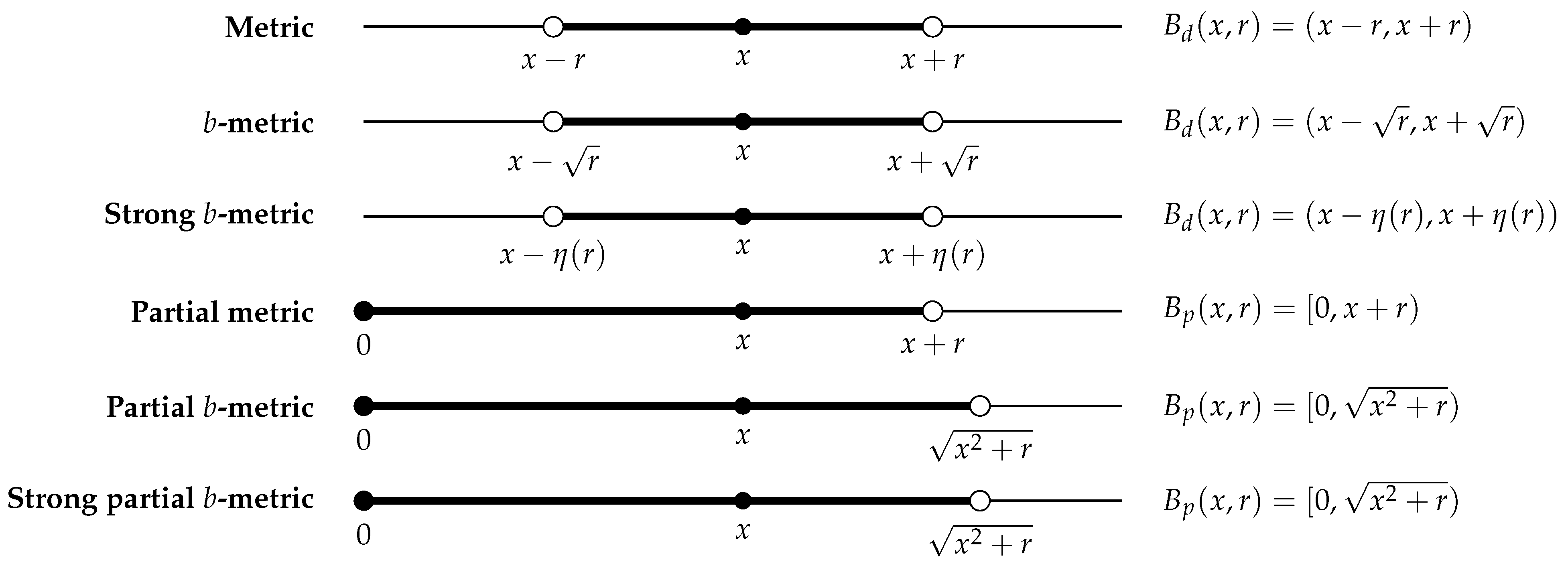
- Metric space: Let and define . Then is a metric space.
- 2.
- b-metric space: Let and let . Then , so is a b-metric space in the sense of Czerwik [11]. It is not a metric space since the ordinary triangle inequality fails.
- 3.
- Strong b-metric space: Let , define for , and put . Since h is increasing and , the mean value theorem gives for all . Consequently, , so is a strong b-metric space. It is not a metric space, since
- 4.
- Partial metric space: Let and define . Then p is the classical partial metric introduced by Matthews [10]. Here . so every point possesses a positive self-distance.
- 5.
- Partial b-metric space: Let and define . This is one of the standard examples of a partial b-metric given by Shukla [9]. The self-distances are positive, and the generalized triangle inequality holds with a coefficient .
- 6.
- Strong partial b-metric space: Let , and defineThis is a standard example of a strong partial b-metric introduced by Moshokoa and Ncongwane [1]. It illustrates simultaneously the presence of positive self-distances and the strong form of the generalized triangle inequality.
2.2. Interpretation of the Generalized Distance
2.3. Balls and Induced Topology
2.4. Point-to-Set Distance and Excess
2.5. 0-Completeness
2.6. Bianchini–Grandolfi Gauge Functions
3. Auxiliary Estimates
- (i)
- A is 0-closed with respect to p;
- (ii)
- whenever and satisfy , then .
3.1. A Preliminary Linguistic Interpretations
4. Main Result
4.1. A Local Set-Valued Fixed Point Theorem
4.2. Construction of a Strong Partial B-Metric for Linguistic Enrichment
4.2.1. From a Metric to a Strong B-Metric
4.2.2. From a Strong B-Metric to a Strong Partial B-Metric
4.2.3. A Graph Metric on the Linguistic States
4.2.4. The Stable Target Family and the Induced Self-Distances
4.2.5. The Finite Refinement Mapping and Verification of the Contractive Conditions
5. Special Cases of the Main Theorem
6. Discussion
7. Conclusions
Author Contributions
Funding
Data Availability Statement
Acknowledgments
Conflicts of Interest
Appendix A. Detailed Computations for the Metric-Type Examples
Appendix A.1. Open and Closed Balls
- (i)
- For the ordinary metric for , we have
- (ii)
- For the b-metric for , the inequality is equivalent to . Therefore, we have
- (iii)
- Consider the strong b-metric for . Since h is strictly increasing, its inverse isConsequently, there hold
- (iv)
- For the partial metric for , we have . Hence,Similarly, .
- (v)
- For the partial b-metric for , we have . Thus,whereas .
- (vi)
- Finally, consider the strong partial b-metricAgain, , and the defining inequalities give

Appendix A.2. Point-to-Set Distances
- (i)
- For the ordinary metric , we have . The infimum is attained at .
- (ii)
- For the b-metric , there holds . Again, the minimum is attained at .
- (iii)
- For the strong b-metric , where , the function h is increasing, and hence the minimum is attained at .Therefore, .
- (iv)
- For the partial metric , . Notice that .
- (v)
- For the partial b-metric , . In this case, .
- (vi)
- For the strong partial b-metricevery satisfies , and therefore .Consequently, .
Appendix A.3. One-Sided Excesses
- (i)
- For the ordinary metric , we have for .Therefore, .
- (ii)
- For the b-metric , for .Hence, .
- (iii)
- For the strong b-metric with , the monotonicity of h gives for any .Consequently, .
- (iv)
- For the partial metric , every satisfiesThus, .
- (v)
- For the partial b-metric , we havefor every . Therefore, .
- (vi)
- For the strong partial b-metricwe must take some care at the common endpoint . If , then . For , however, . Thus for every , and consequently, .
Appendix A.4. Complete Ratio Table for the Finite Refinement Model
Appendix B. Complete Linguistic Realization of the Finite Model
Appendix B.1. Organization of the Refinement Levels
Appendix B.2. The Twenty Formulations
- State : If function is continuous in closed interval, it have minimum and maximum in this interval.
- State : When a function continuous on a closed interval, then there exist a smallest and a biggest value of the function.
- State : For every continuous function in closed and bounded interval, the minimum and maximum are existing.
- State : A continuous function over a closed interval always has one minimum value and one maximum value somewhere inside the interval.
- State : If a function is continuous on a closed interval, it has a minimum and a maximum value on that interval.
- State : Every function that is continuous on a closed and bounded interval has both a smallest value and a largest value.
- State : A continuous real function defined on a closed interval reaches its minimum and maximum values on the interval.
- State : When a real-valued function is continuous on a closed bounded interval, its minimum and maximum values exist on this interval.
- State : Every continuous real-valued function on a closed and bounded interval attains a minimum value and a maximum value.
- State : If a real-valued function is continuous on a compact interval, then it attains both its smallest and its largest values on that interval.
- State : A function that is continuous on a closed interval attains its minimum and maximum somewhere in .
- State : Let f be a continuous real-valued function on a closed and bounded interval. Then the range of f contains a least element and a greatest element.
- State : If is continuous, then there exist points such thatfor every .
- State : Let f be continuous on the closed interval . Then f attains both an absolute minimum and an absolute maximum on .
- State : For every continuous function , there exist satisfying
- State : A continuous real-valued function defined on a compact interval attains its extreme values; that is, it has both an absolute minimum and an absolute maximum on its domain.
- State : Let be continuous. Then there exist such that
- State : Suppose that a real-valued function is continuous on a closed and bounded interval. Then the function takes both a smallest value and a largest value at some points of that interval.
- State —stable formal formulation: Let be continuous. Then f attains its minimum and maximum on ; equivalently, there exist such thatfor every .
- State —stable explanatory formulation: Every continuous real-valued function on a closed and bounded interval takes both a smallest and a largest value. In other words, there are points in the interval at which the function attains its absolute minimum and its absolute maximum.
References
- Moshokoa, S.P.; Ncongwane, F.T. On completeness in strong partial b-metric spaces, strong b-metric spaces and the 0-Cauchy completions. Topol. Its Appl. 2020, 275, 107011. [Google Scholar] [CrossRef] [Scilit]
- Ge, X.; Lin, S. Balls in generalizations of metric spaces. J. Inequal. Appl. 2016, 2016, 16. [Google Scholar] [CrossRef] [Scilit]
- Slimani, B.; Graef, J.R.; Ouahab, A. Multivalued contraction fixed-point theorem in b-metric spaces. Mathematics 2024, 12, 567. [Google Scholar] [CrossRef] [Scilit]
- Georgiev, V.; Ilchev, A.; Ivanova, V.; Todorov, A.; Zlatanov, B. Beyond discourse expansion: A linguistic enrichment framework for academic language development. Preprints 2026, 2026080489. [Google Scholar] [CrossRef] [Scilit]
- Beckner, C.; Blythe, R.; Bybee, J.; Christiansen, M.H.; Croft, W.; Ellis, N.C.; Holland, J.; Ke, J.; Larsen-Freeman, D.; Schoenemann, T. Language is a complex adaptive system: Position paper. Lang. Learn. 2009, 59, 1–26. [Google Scholar] [CrossRef] [Scilit]
- Hiver, P.; Al-Hoorie, A.H.; Evans, R. Complex dynamic systems theory in language learning: A scoping review of 25 years of research. Stud. Second Lang. Acquis. 2022, 44, 913–941, Correction in Stud. Second Lang. Acquis. 2022, 44, 1210. https://doi.org/10.1017/S0272263122000262. [Google Scholar] [CrossRef] [Scilit]
- Hyland, K. Academic Discourse: English in a Global Context; Continuum Discourse; Continuum: London, UK; New York, NY, USA, 2009. [Google Scholar]
- Schleppegrell, M.J. The Language of Schooling: A Functional Linguistics Perspective; Lawrence Erlbaum Associates: Mahwah, NJ, USA, 2004. [Google Scholar]
- Shukla, S. Partial b-metric spaces and fixed point theorems. Mediterr. J. Math. 2014, 11, 703–711. [Google Scholar] [CrossRef] [Scilit]
- Matthews, S.G. Partial metric topology. Ann. N. Y. Acad. Sci. 1994, 728, 183–197. [Google Scholar] [CrossRef] [Scilit]
- Czerwik, S. Contraction mappings in b-metric spaces. Acta Math. Inform. Univ. Ostrav. 1993, 1, 5–11. [Google Scholar]
- Aubin, J.-P.; Frankowska, H. Set-Valued Analysis; Modern Birkhäuser Classics; Birkhäuser: Boston, MA, USA, 2009. [Google Scholar] [CrossRef] [Scilit]
- Bianchini, R.M.T.; Grandolfi, M. Trasformazioni di tipo contrattivo generalizzato in uno spazio metrico. Atti Accad. Naz. Lincei Rend. Cl. Sci. Fis. Mat. Nat. 1968, 45, 212–216. [Google Scholar]

| Metric-Type Structure | Open Ball | ||
|---|---|---|---|
| Metric | 1 | 1 | |
| b-metric | 1 | 1 | |
| Strong b-metric | |||
| Partial metric | 2 | 2 | |
| Partial b-metric | 4 | 4 | |
| Strong partial b-metric | 4 | 4 |
Disclaimer/Publisher’s Note: The statements, opinions and data contained in all publications are solely those of the individual author(s) and contributor(s) and not of MDPI and/or the editor(s). MDPI and/or the editor(s) disclaim responsibility for any injury to people or property resulting from any ideas, methods, instructions or products referred to in the content. |
© 2026 by the authors. Licensee MDPI, Basel, Switzerland. This article is an open access article distributed under the terms and conditions of the Creative Commons Attribution (CC BY) license.
Share and Cite
Ilchev, A.; Ivanova, V.; Nedelcheva, D.; Todorov, A.; Zlatanov, B. A Local Fixed Point Theorem for Multivalued Mappings in Strong Partial b-Metric Spaces with Potential Applications to Language Dynamics. Axioms 2026, 15, 686. https://doi.org/10.3390/axioms15090686
Ilchev A, Ivanova V, Nedelcheva D, Todorov A, Zlatanov B. A Local Fixed Point Theorem for Multivalued Mappings in Strong Partial b-Metric Spaces with Potential Applications to Language Dynamics. Axioms. 2026; 15(9):686. https://doi.org/10.3390/axioms15090686
Chicago/Turabian StyleIlchev, Atanas, Vanya Ivanova, Diana Nedelcheva, Angel Todorov, and Boyan Zlatanov. 2026. "A Local Fixed Point Theorem for Multivalued Mappings in Strong Partial b-Metric Spaces with Potential Applications to Language Dynamics" Axioms 15, no. 9: 686. https://doi.org/10.3390/axioms15090686
APA StyleIlchev, A., Ivanova, V., Nedelcheva, D., Todorov, A., & Zlatanov, B. (2026). A Local Fixed Point Theorem for Multivalued Mappings in Strong Partial b-Metric Spaces with Potential Applications to Language Dynamics. Axioms, 15(9), 686. https://doi.org/10.3390/axioms15090686