Article

Genesis and Mineralization Process of the Lanuoma Sediment-Hosted Pb–Zn Deposit, Sanjiang Metallogenic Belt, Southwestern China: Constraints from Zn, Pb, and S Isotopes


1
School of Hydraulic Engineering, Jiangxi University of Water Resources and Electric Power, Nanchang 330099, China
2
State Key Laboratory of Critical Mineral Research and Exploration, Institute of Geochemistry, Chinese Academy of Sciences, Guiyang 550001, China
*
Author to whom correspondence should be addressed.
Minerals 2026, 16(2), 164; https://doi.org/10.3390/min16020164
Submission received: 18 December 2025 / Revised: 17 January 2026 / Accepted: 28 January 2026 / Published: 30 January 2026

Abstract

The Lanuoma sediment-hosted lead–zinc (Pb–Zn) deposit, situated in the central part of the Sanjiang base metal metallogenic belt (SMB) within the Changdu Basin, is hosted by Triassic Bolila Formation limestone. The source of metals and sulfur (S), as well as the ore-forming processes for the deposits in this belt, are contentious. To constrain the metal and sulfur sources and to define the ore-forming mechanism, we analyzed Zn, Pb, and S isotopes of sphalerite and robinsonite, as well as Zn isotopes of the host limestone and the metamorphic basement. Sphalerite shows homogeneous δ66Zn values (−0.31‰ to −0.12‰; mean = −0.20‰). The calculated δ66Zn of the ore-forming fluid (~0.00‰) matches that of the Triassic limestone, indicating a sedimentary Zn source (δ66Zn = −0.11‰ to −0.09‰; average 0.00‰). Robinsonite displays a wider δ66Zn range (−0.22‰ to 0.44‰), reflecting a mixture of sedimentary and metamorphic sources (δ66Zn = 0.12‰ to 0.42‰; average 0.22‰). Lead isotopes of sphalerite are uniform (206Pb/204Pb = 19.041–19.079) and indicative of a sedimentary rock source, whereas robinsonite shows wide variation (206Pb/204Pb = 19.070–19.156) and linear trends between low- and high-radiogenic end-members, indicating mixed Pb sources from sedimentary rocks and metamorphic basement. Sulfur isotopic compositions of sulfides (δ34S = −1.4‰ to 2.6‰; mean = −0.1‰) cluster near 0‰, consistent with a deep magmatic origin. A strong linear correlation between 206Pb/204Pb and δ66Zn, coupled with a lack of correlation between both 206Pb/204Pb and δ34S and δ66Zn and δ34S in the sulfides, indicates that Pb and Zn were derived from a common metal source, whereas sulfur originated from a distinct reservoir. Combined with previously published fluid inclusion, rare earth element, and multi-isotopic constraints, these results suggest that Pb–Zn mineralization at Lanuoma was controlled by a mixing between metal-rich basinal brines and sulfur-rich deep-sourced fluids, leading to sulfide precipitation dominated by open-space filling. This study provides new insights into the genesis and mineralization process of sediment-hosted Pb–Zn deposits in the Sanjiang metallogenic belt.

1. Introduction

Sediment-hosted Pb–Zn deposits are common in the Sanjiang metallogenic belt (SMB) and constitute one of the most important base-metal resources in China [1]. These deposits are mainly hosted in foreland basin successions and are commonly regarded as Mississippi Valley-type (MVT-like) systems formed during basin evolution associated with Cenozoic orogeny [2]. Owing to their economic significance and complex tectonic setting, SMB sediment-hosted Pb–Zn deposits have been the subject of extensive geological, geochemical, and isotopic investigations.
Previous studies have made substantial progress in constraining the timing, fluid characteristics, and possible metal sources of these deposits. Geochronological data indicate that most sediment-hosted Pb–Zn deposits in the SMB formed during the Oligocene (ca. 27–33 Ma; [3]), broadly synchronous with regional tectonic deformation and magmatic activity [4]. Fluid inclusion, trace element, and multi-isotopic (e.g., C–O–Sr–Nd–Hg–He) studies suggest that basinal brines played a major role in metal transport, and that fluid mixing involving meteoric, metamorphic, and/or magmatic components may have occurred in different segments of the belt [5,6,7].
Despite these advances, several fundamental issues remain unresolved. The sources of Pb and Zn are still debated. Many studies favor derivation from basinal sedimentary strata. Others propose contributions from metamorphic basement or deeper crustal components, based mainly on Pb isotopic heterogeneity and mixing trends [8,9]. The source and redox state of sulfur remain controversial. Both thermochemical sulfate reduction (TSR) and bacterial sulfate reduction (BSR) have been invoked [10,11], and in some cases magmatic sulfur has been proposed [12]. However, these interpretations are commonly based on sulfur isotopes alone and lack integration with metal isotopic constraints. Third, although fluid mixing has been widely recognized [13], the mechanisms linking fluid evolution to metal precipitation are still poorly constrained, particularly in terms of whether metals and sulfur were sourced from the same or distinct reservoirs.
The Lanuoma sediment-hosted Pb–Zn–Sb deposit, located in the Changdu Basin in the central SMB, is a good candidate for addressing these issues. Previous studies have suggested that Lanuoma mineralization involved mixing between basinal brines and magmatic-related fluids, and that sulfur was reduced through TSR [12,14]. Mercury isotope data further indicate contributions from both sedimentary strata and metamorphic basement [15]. However, the precise sources of Pb and Zn, and their relationship to sulfur sources and precipitation processes, remain insufficiently constrained.
Recent advances in Zn isotope geochemistry provide a powerful tool to trace metal sources and fluid–rock interaction processes in hydrothermal systems ([16] and references therein). When combined with Pb and S isotopes, Zn isotopes can help distinguish between sedimentary, basement, and magmatic contributions, and be used to evaluate whether metals and sulfur were derived from common or decoupled reservoirs [17,18,19,20,21].
In this study, we integrate Zn, Pb, and S isotopes of sphalerite and robinsonite with Zn isotopes of ore-hosting strata and metamorphic basement from the Lanuoma deposit. By combining these new data with previously published Pb isotopic and fluid geochemical constraints, we aim to (1) identify the sources of Pb, Zn, and reduced sulfur, (2) evaluate the role of fluid mixing in metal transport and precipitation, and (3) provide new insights into the metallogenic mechanism of sediment-hosted Pb–Zn deposits in the Sanjiang metallogenic belt.

2. Regional Geology

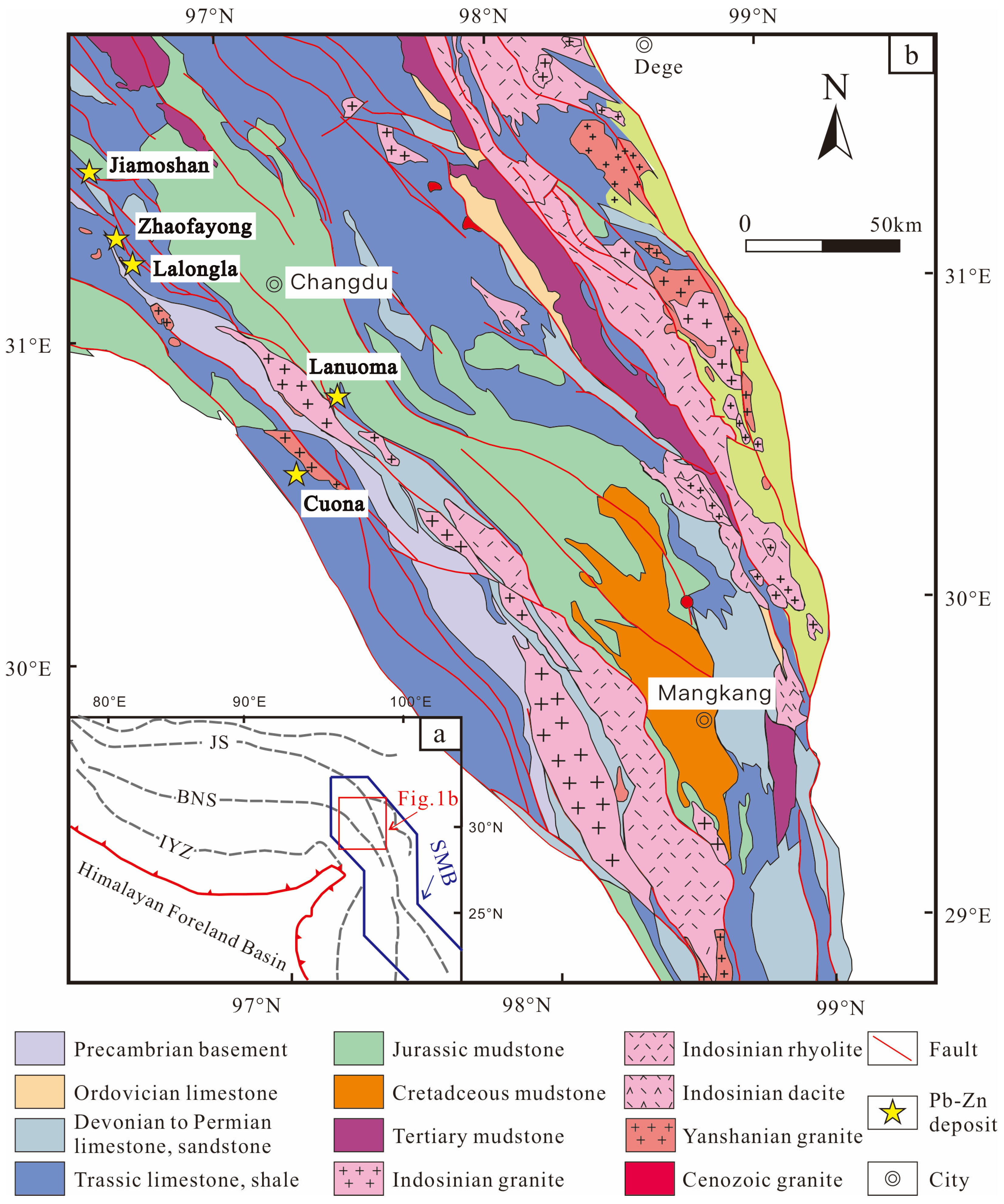
The Sanjiang base metal metallogenic belt (SMB) is located along the eastern and northern margins of the Qinhai-Tibet Plateau, bounded by the Jinshajiang Sutures (JS) to the north and the Bangognhu-Nujiang Sutures (BNS) to the south (Figure 1a). The SMB was profoundly influenced by the collisional orogeny between the Indian and Eurasian continents during Cenozoic, which resulted in the development of large-scale strike-slip fault system, thrust-nappe structural systems, and associated Tertiary foreland basins [22,23]. More than one hundred Pb–Zn–Cu–Ag deposits and occurrences have been identified within the SMB, predominantly hosted in sedimentary rocks. From north to south of the SMB, these deposits are distributed within a series of Tertiary foreland basins, including the Tuotuohe, Yushu, Changdu, and Lanping-Simao basins, collectively forming a more than 1000 km-long base-metal metallogenic belt.
The Changdu Basin is bounded by the Jinshajiang suture to the east and the Nujiang suture to the west, forming a NW-trending belt that widens toward the north and converges toward the south. The Precambrian Jitang Group, which is composed of schist, gneiss and granulite, constitutes the metamorphic basement of Changdu Basin (Figure 1b). Paleozoic strata, including Ordovician, Devonian, Carboniferous, and Permian systems, are sporadically distributed and mainly composed of clastic rocks and carbonates. Mesozoic strata are widely distributed in the mining area. The Triassic is dominated by marine carbonate rocks and sandy mudstone. The Jurassic consists of marine–terrestrial to terrestrial clastic rocks, while the Cretaceous is characterized by continental clastic rocks. Tertiary strata are composed of clastic rocks and gypsum [24].
Extensive tectonism occurred in the basin in response to the collision of the Indian and Asian continents in the Cenozoic. During the middle to late Eocene, the Jinshajiang and Lancangjiang orogenic belts on both sides of the Changdu Basin thrust toward the basin, forming a convergent thrust tectonic pattern. In the late Eocene to Oligocene, the basin experienced strike-slip extension, developing a series of en échelon structures along pre-existing deep faults [1].
Igneous rocks in the Changdu Basin comprise Late Triassic volcanic and intrusive rocks. The volcanic rocks mainly consist of basalt, andesitic tuff, and rhyolite [6]. The main intrusive rocks are represented by the Jitang pluton, which intrudes into the Jitang Group metamorphic rocks and Carboniferous strata. They are mainly composed of S-type biotite granite and granodiorite [25].

3. Geology of the Lanuoma Deposit

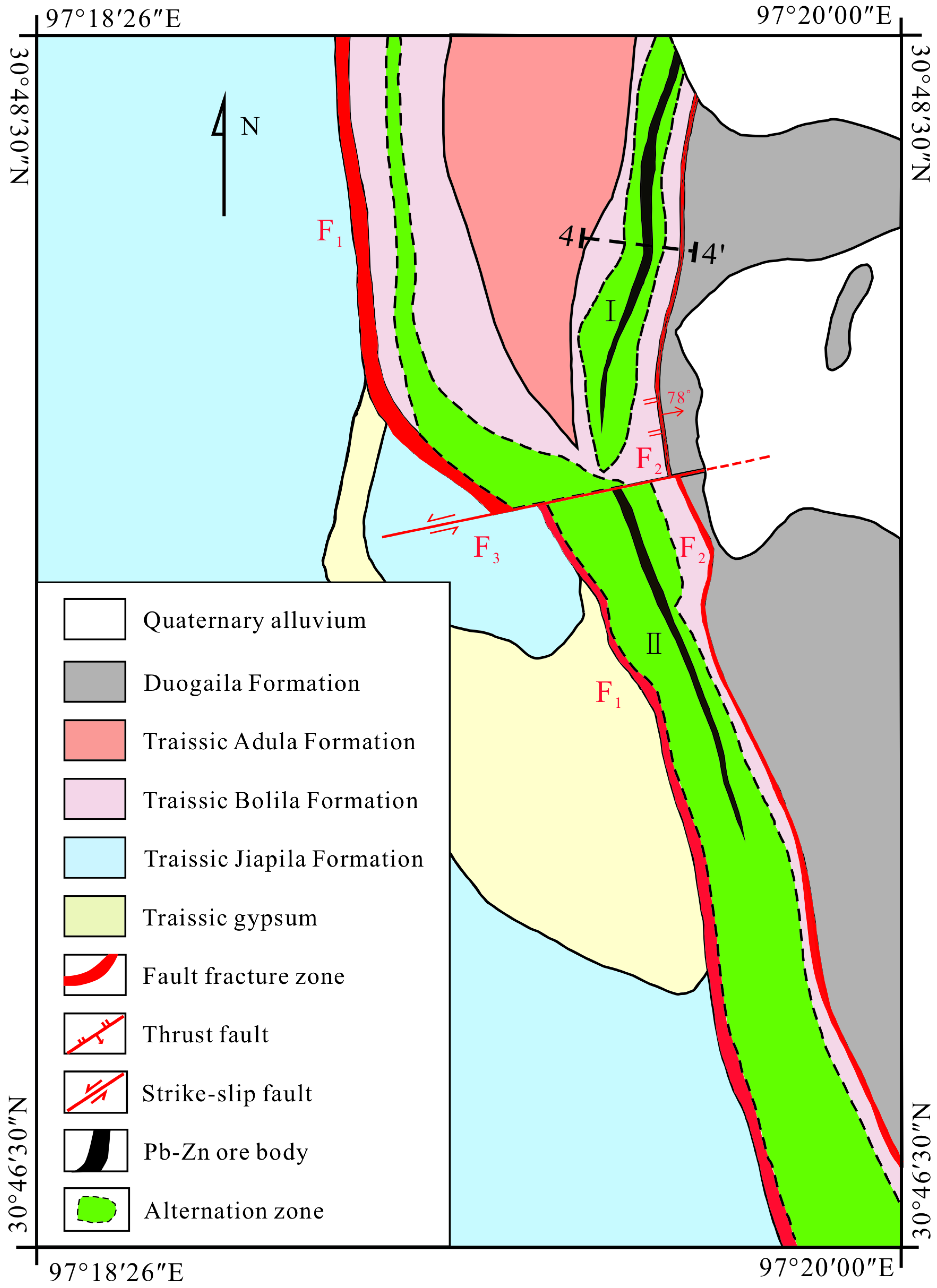
The Lanuoma deposit is located approximately 10 km north of the town of Jitang and is hosted in the Upper Triassic Strata. The mining area of the Lanuoma deposit exposes four sedimentary formations: the Jiapila, Bolila, Adula, and Duogaila formations (Figure 2). From bottom to top, the Jiapila Formation distributed in western and northwestern mining area is a clastic rock assemblage composed mainly of lithic and feldspathic quartz sandstones interbedded with gypsum layers. The Bolila Formation exposed in the central part of the mining area is the ore-hosting strata for Pb–Zn ore bodies; the lithology of the formation is mainly gray to white limestone, which was formed in a coastal environment representing a transitional marine–terrestrial facies. The Adula Formation is outcropped in the north-central part of the mining area and has a funnel-shaped morphology, with the lithology of mudstone and shale interbedded with minor quartz sandstone. The Duogaila Formation on the top can be divided into two members. The lower member is mainly composed of carbonaceous mudstone whereas the upper member is dominated by feldspathic sandstone. Quaternary residual, colluvial, and alluvial–proluvial deposits occur in the eastern part of the mining area.
Three major faults occur in the Lanuoma deposit. The F1 and F2 reverse faults, located in the central-western part and eastern part of the mining area, are the main ore-controlling structure. The F1 marks the boundary between the Jiapila Formation and the Bolila Formation. It generally dips westward with an inclination of 45–60°. The F2 fault dips eastward with an inclination of 60–78°. The footwall consists of the Bolila Formation, while the hanging wall is composed of the Duogaila Formation. The F3 strike-slip fault is a post-ore structure. An anticline structure is developed in the central part of the mining area, plunging northward. The western limb is steeply dipping (55–85°), while the eastern limb is gently dipping (35–65°). No. I and No. II ore bodies are distributed within the Bolila Formation on the limbs of the anticline.
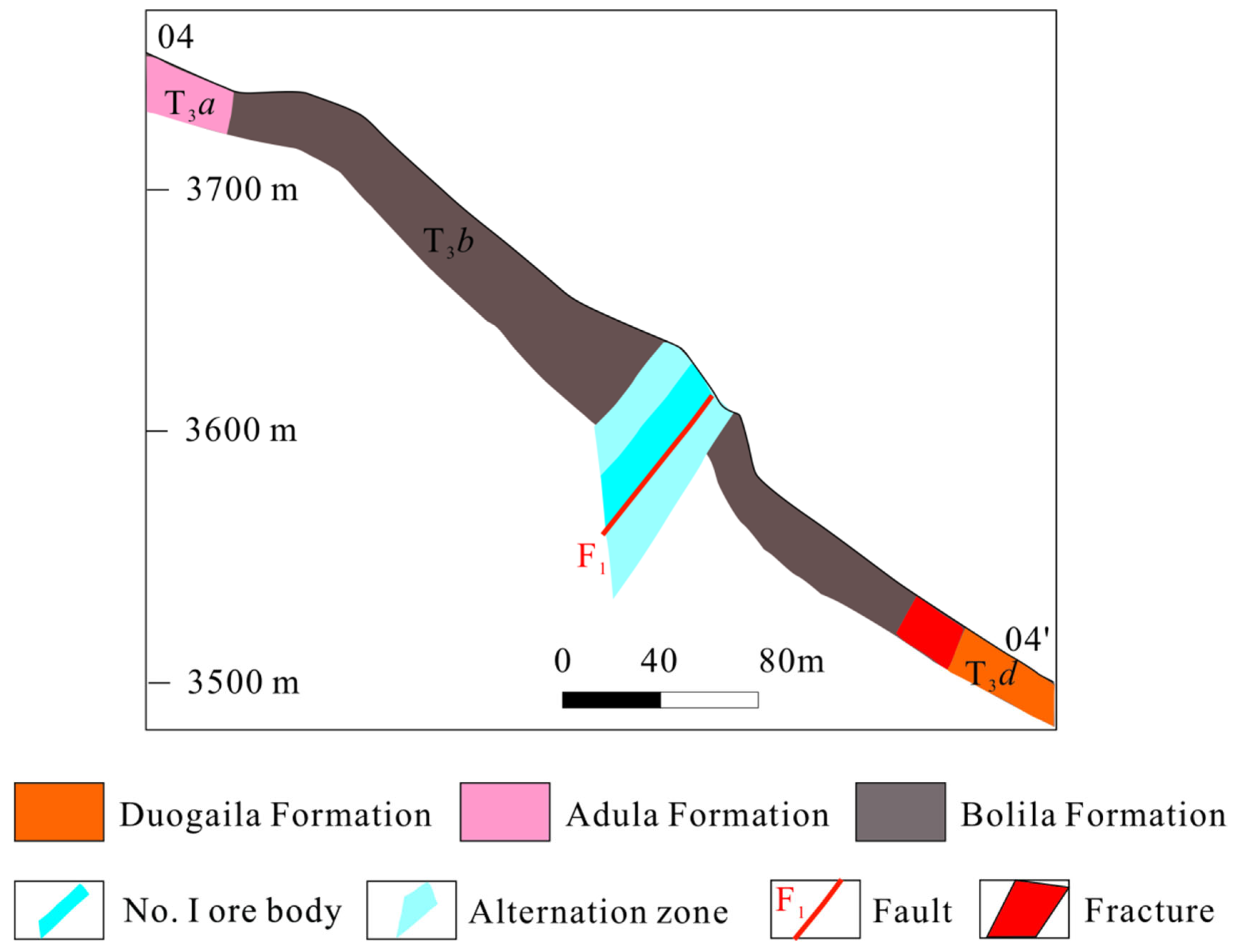
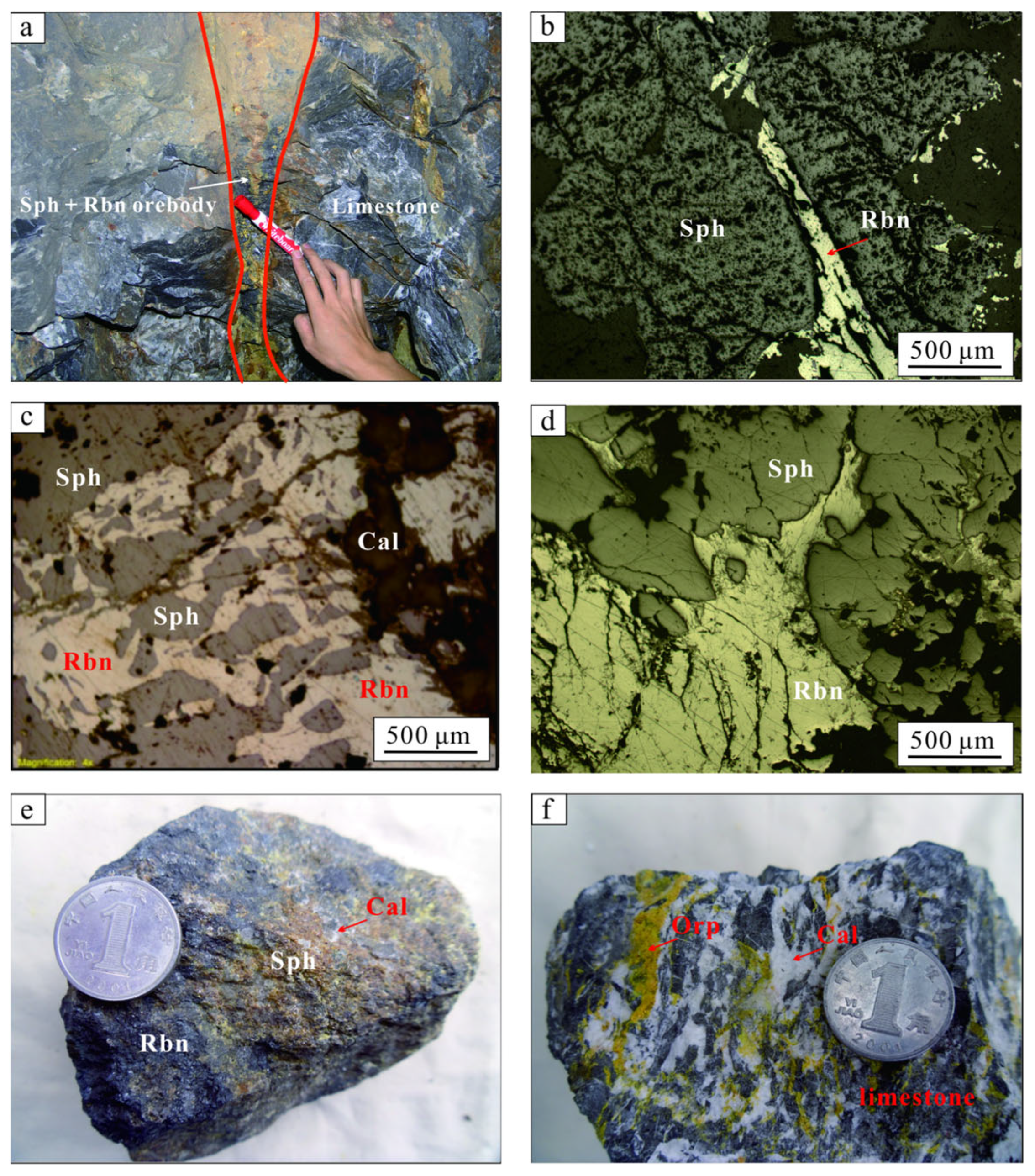
The ore body hosted in limestone of the Bolila Formation occurs as stratified or lenticular in morphology (Figure 3 and Figure 4a) and is controlled by structural fracture zones. Mineralization is dominated by open-space filling, with replacement playing a subordinate role. Ore minerals mainly occur in vein-like, brecciated, and massive forms. Based on exploration data, two ore bodies (No. I and No. II) have been delineated. The F3 fault separates the two ore bodies, with ore Body No. I located to the north and ore Body No. II to the south.
The ore Body No. I strikes NNW and dips westward with a dip angle of 40–50°. It extends 1100 m in length, has an average thickness of 12 m, and reaches a maximum down-dip extension of 175 m. The average grades are 2.41 wt.% Pb, 3.02 wt.% Zn, and 1.92 wt.% Sb. The ore Body No. II generally dips eastward at angles of 60–70°, with a strike length of approximately 1025 m and an average thickness of 6.48 m. The average ore grades are 1.86 wt.% Pb and 1.08 wt.% Zn.
Wall-rock alteration is characterized mainly by calcitization, pyritization, silicification, and orpiment mineralization. Calcitization is expressed by micritic calcite replacement of limestone and marl, as well as by the widespread development of calcite veins. Cross-cutting relationships among calcite veins indicate that calcitization occurred during multiple stages. Micritic calcite replacement of limestone and marl is commonly accompanied by pyritization. Orpiment mineralization occurs mainly within fault-related breccia zones. Orpiment (locally associated with realgar) is abundant in carbon-rich, brittle marls, where it occurs in vein-like and massive forms.
Robinsonite and sphalerite are the main ore minerals, which commonly occur as granular aggregates. Robinsonite also occurs intergrown with sphalerite, either as banded or fine vein-like replacements (Figure 4b). The latter shows a replacement relict (Figure 4c), or isolated or embayed texture (Figure 4d). The ores are mainly characterized by massive (Figure 4e), disseminated, stockwork (Figure 4f), vein-type, porous, and brecciated textures.
The Lanuoma Pb–Zn deposit is hosted in limestone of the Triassic Bolila Formation, which was deposited in a shallow-marine carbonate platform environment. The host rocks are locally brecciated and fractured, providing favorable open spaces for fluid circulation and mineral precipitation. Mineralization reflects a transition from diagenetic to hydrothermal conditions, as indicated by dominant open-space filling accompanied by subordinate replacement of the carbonate host rocks. These structural and lithological features facilitated fluid focusing and fluid–rock interaction, forming a suitable physicochemical environment for Pb–Zn–Sb sulfide deposition.
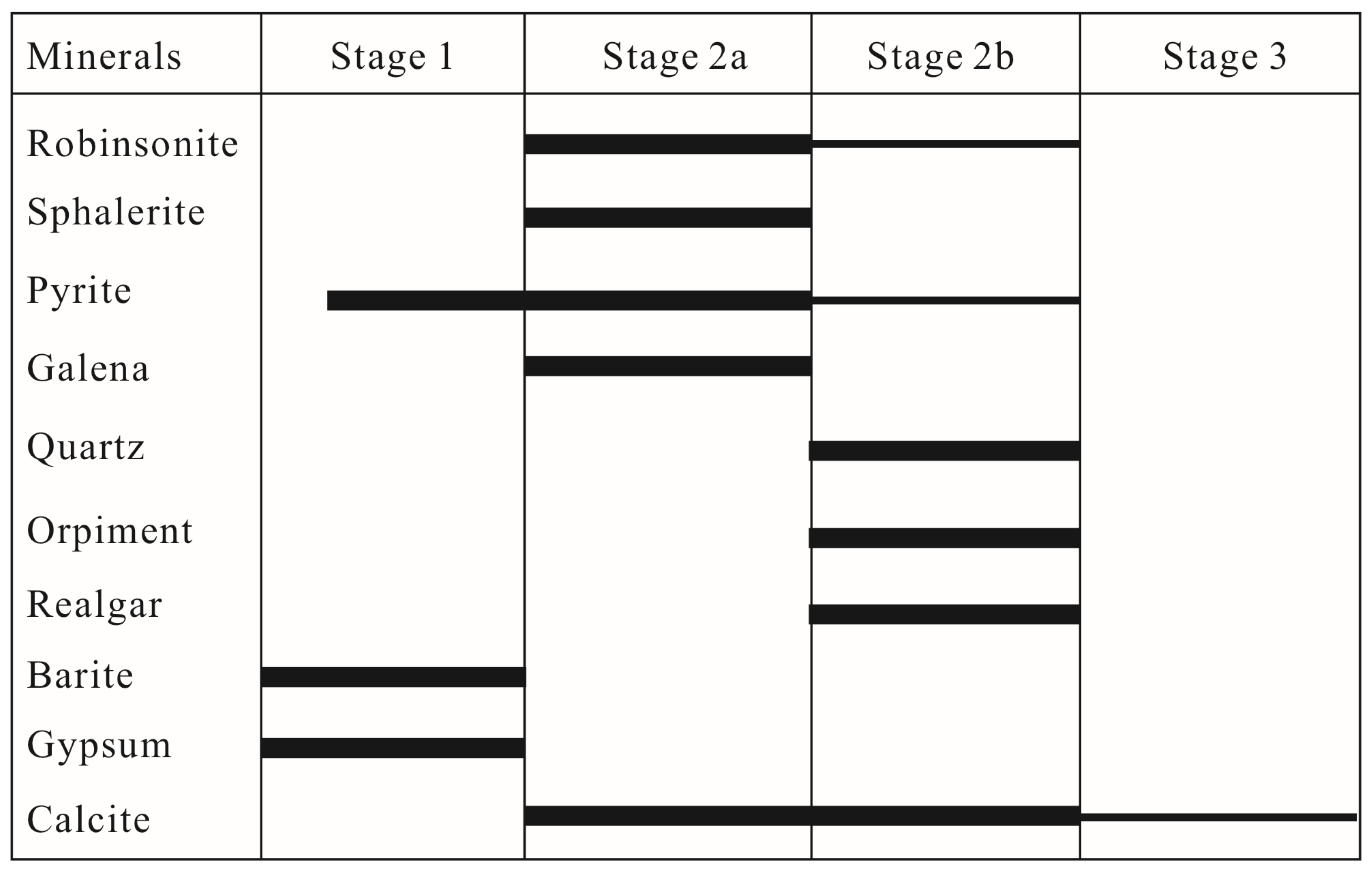
Based on mineral assemblages and textural relationships, the mineralization can be divided into three stages [14], including a pre-mineral stage (Stage 1), a syn-mineral stage (Stage 2), and a post-mineral stage (Stage 3). The paragenetic sequence of minerals for the Lanuoma deposit is summarized in Figure 5. The pre-mineral stage (Stage 1) is characterized by early pyrite and gangue minerals, dominated by oolitic pyrite, calcite, and minor sulfate minerals (e.g., gypsum and barite), which are disseminated within limestone and predate significant Pb–Zn mineralization. The syn-mineral stage (Stage 2) represents the main period of sulfide deposition. The early stage (Stage 2a) corresponds to the principal Pb–Zn–Sb mineralization and is characterized by pyrite, sphalerite, galena, and robinsonite, occurring mainly as vein fillings and breccia fillings, commonly associated with calcite. The late stage (Stage 2b) is dominated by orpiment and realgar, with minor late-stage sulfides hosted in calcite veins. The post-mineral stage (Stage 3) is marked by the emplacement of barren, coarse-grained calcite veins that cut earlier mineral assemblages and contain little to no sulfide minerals.

4. Sampling and Analytical Methods

4.1. Sample Collection

Sphalerite and robinsonite samples used for zinc, lead, and sulfur isotopic analyses in this study were collected from underground galleries of the Lanuoma mine at elevations between 3280 and 3396 m asl. These samples are from Stage 2 and represent mineralization-stage products. Host limestone samples were taken from exposed outcrops in the ore district, whereas metamorphic rocks were sampled from distal regional outcrops near the town of Jitang.

4.2. Zinc Isotopic Analyses

About 50 mg of each powdered sample was dissolved in concentrated HNO3-HF (1:3) and then refluxed in 6 N HCl to remove fluorides, following the dissolution procedure described by [27]. Zinc was purified by anion-exchange chromatography using AGI-X8 resin, after the method of [28]. The resin was conditioned with 1.5 N HBr, and Zn was eluted with 0.5 N HNO3. Total Zn blanks were <10 ng, and recovery exceeded 99%. The purified Zn solutions were evaporated to dryness and re-dissolved in 0.1 N HNO3 for isotopic measurement. Zinc isotope compositions were measured on a Thermo Scientific Neptune Plus MC-ICP-MS (Thermo Fisher Scientific, Bremen, Germany) at Washington University in St. Louis, following the analytical conditions of [29]. Isotope ratios were expressed in delta notation (δ66Zn, δ68Zn) relative to the JMC 3-0749 L Zn standard, with mass bias corrected using exponential law. Analytical reproducibility (2σ) was better than ±0.05‰ for δ66Zn.

4.3. Sulfur Isotopic Analyses

Powdered sulfide (sphalerite and robinsonite) analyses were conducted at the Institute of Geochemistry, Chinese Academy of Sciences, Guiyang. Sulfur isotope analyses were completed using a Finnigan MAT-253 continuous flow isotope ratio mass spectrometer coupled to an elemental analyzer (EA-IRMS) (Thermo Fisher Scientific, Bremen, Germany) according to the method of [30]. Sulfide samples were converted to SO2 for isotopic analysis by burning in the reactor under a constant temperature of about 1000 °C using a stream of purified oxygen. The sulfur dioxide was then carried by helium into the mass spectrometer. Measurements are reported using standard δ-notation relative to V-CDT international standard. The analytical error was better than 0.2‰ (1σ) calculated from replicate analyses of the IAEA international standards: IAEA S1 (−0.30‰), IAEA S2 (+22.62‰) and IAEA S3 (−32.49‰). The precision calculated from replicate analyses of unknown samples is better than 0.2‰ (1σ).

4.4. Lead Isotopic Analyses

Lead isotope analyses were performed at the Analytical Laboratory of Beijing Research Institute of Uranium Geology by IsoProbe-T thermal ionization mass spectrometer (TIMS) (GV Instruments, Manchester, UK). Detailed procedures were described by [31]. Briefly, small quantities of powdered sulfide samples (sphalerite and robinsonite) were dissolved in acid, chemically separated and purified by ion exchange (AG1 × 8, 200–400 resin) with diluted HBr used as eluant, loaded on Re filaments using phosphoric acid and silica gel, thermally ionized, and then analyzed by mass spectrometry. The 208Pb/206Pb, 207Pb/206Pb, and 204Pb/206Pb ratios of the Standard NBS 981 were 2.16810 ± 0.0008 (2σ), 0.91464 ± 0.00033 (2σ), and 0.059042 ± 0.000037 (2σ), respectively. They are consistent with their corresponding recommended values of 2.16701 ± 0.00013 (2σ), 0.91459 ± 0.00009 (2σ), and 0.059047 ± 0.000024 (2σ) [32].

5. Results

5.1. Zinc Isotopes

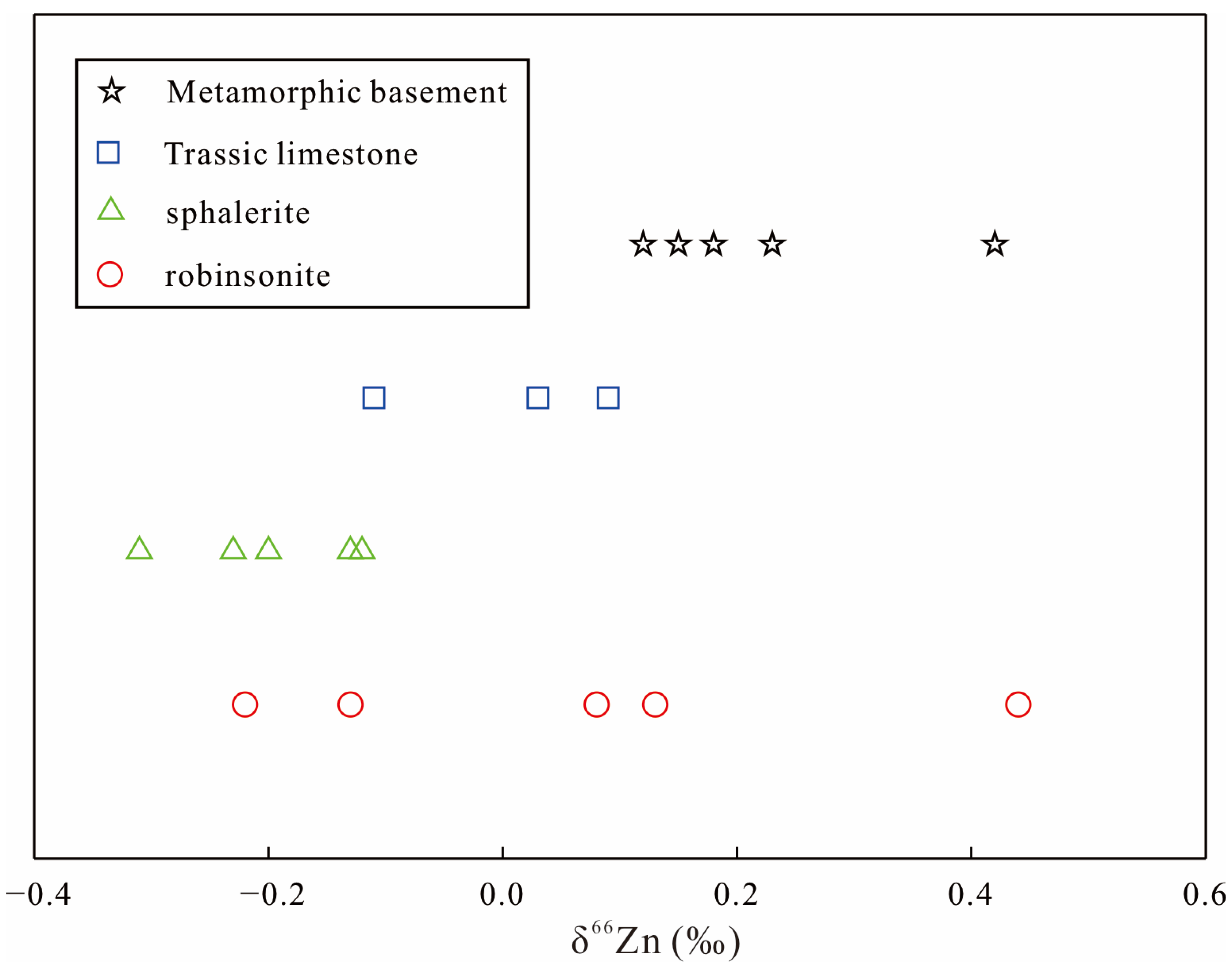
The δ66Zn values of sphalerite range from −0.31‰ to ~−0.12‰ (average −0.20‰; n = 5) with narrow variations. Robinsonite has a wide range of δ66Zn values from −0.22‰ to ~0.44‰ with an average value of 0.06‰ (n = 5). The δ66Zn values of the Triassic Bolila formation limestone and the Jitang Group metamorphic rocks are between −0.11‰ and ~0.09‰ (average 0.00‰; n = 3) and 0.12‰ and ~0.42‰ (average 0.22‰; n = 5), respectively (Table 1).
Sphalerite has the lowest δ66Zn values. Metamorphic rocks of the Jitang Group have the highest δ66Zn values. The δ66Zn values of robinsonite overlap between Jitang Group metamorphic rocks and the Triassic Bolila formation limestone.

5.2. Sulfur Isotopes

The δ34S values of sphalerite vary between −0.7‰ and 0.6‰ (n = 10), with an average of −0.2‰ and robinsonite between −0.2‰ and −1.6‰ (n = 10), with an average of −0.74‰ (Table 1). Tao et al. (2011) [26] obtained δ34S values of sphalerite and robinsonite that range from −0.4‰ to ~2.4‰ (average 0.9‰) and −1.6‰ to ~2.6‰ (average 0.4‰). In general, the δ34S values of sulfides from the Lanuoma deposit are within the ranges of −1.4‰~2.6‰, averaging at −0.1‰. These results are narrowly distributed around 0‰, which is consistent with the isotopic compositions of sulfur of mantle origin (δ34S = −2‰~2‰) [33].

5.3. Lead Isotopes

The lead isotopic compositions of seven sphalerite samples are uniform, with 206Pb/204Pb, 207Pb/204Pb and 208Pb/204Pb ranging from 19.041~19.079 (average 19.058), 15.653~15.699 (average 15.674) and 39.033~39.181 (average 39.102), respectively. Seven robinsonite samples have large variations of lead isotopic compositions. Their 206Pb/204Pb, 207Pb/204Pb and 208Pb/204Pb values are between 19.070 and 19.156 (averaging at 19.114), 15.686 and 15.796 (averaging at 15.742), 39.145 and 39.526 (averaging at 39.343) (Table 1). Noticeably, sphalerite and robinsonite show positive relationship with robinsonite characterized by higher contents of radioactive lead.

6. Discussion

6.1. Interpretation and Implications of Zn Isotopic Data

6.1.1. Mechanisms of Zn Isotope Variations

Previous studies have demonstrated that, in hydrothermal deposits, variations in δ66Zn are mainly controlled by four factors: (1) temperature effects, (2) mixing of different Zn sources, (3) Zn isotopic fractionation between co-existing mineral pairs, and (4) kinetic Rayleigh fractionation [34,35]. Previous fluid inclusion data indicates that sphalerite at the Lanuoma deposit formed at temperatures between ~153 °C and 250 °C (average ~189 °C) [14]. These temperatures are within the low to moderate temperature range (60–250 °C) of natural hydrothermal systems where Zn isotope fractionation has been shown to be largely independent of temperature [36,37]. Therefore, the δ66Zn variations in Lanuoma sphalerite are unlikely to be controlled by temperature. Rayleigh distillation process can produce significant Zn isotope fractionation in sphalerite within a single deposit (up to 0.84‰), and the process will result in progressively higher δ66Zn values in later-formed sphalerite, as lighter Zn isotopes (64Zn) are preferentially incorporated into earlier precipitates, leaving the fluid enriched in δ66Zn [38,39]. In the Lanuoma deposit, sphalerite samples have a narrow range of Zn isotopic compositions, with δ66Zn values ranging from −0.31‰ to −0.12‰ (Figure 6). This limited range does not support a Rayleigh fractionation-dominated mechanism for Zn isotope variation. Such homogeneous Zn isotopic compositions have also been reported in other Pb–Zn deposits, including the Navan Pb–Zn deposit (sample D2, D5; δ66Zn = 0.14‰ to +0.20‰) in Ireland, the Alexandrinka VHMS-type deposit (δ66Zn = −0.027‰ to +0.231‰) in the Urals, Russia, the MVT-type Maozu deposit (δ66Zn = −0.06‰ to +0.23‰) and the magmatic-hydrothermal Zhaxikang deposit (δ66Zn = 0.03‰ to +0.28‰) in southwestern China [40,41,42,43]. The Zn isotope fractionation mechanisms in these deposits likewise do not favor Rayleigh-type processes.
The homogeneity of Zn isotopes in sphalerite from the Lanuoma deposit is attributed to near-equilibrium isotope partitioning between sphalerite and the hydrothermal fluid during precipitation under relatively closed and stable physicochemical conditions, which allowed extensive mineral-fluid isotopic exchange [17,42]. Fluid inclusion and ore texture studies indicate that sphalerite precipitation was triggered by isothermal mixing of different fluids, resulting in a relatively slow temperature decrease. Consequently, sphalerite grew slowly, forming coarse euhedral to subhedral crystals (Figure 4b) and lacking colloform, framboidal, brecciated, and fragmented textures typically associated with rapid or non-equilibrium precipitation [41,43]. These features support the conclusion that Zn isotope fractionation between the ore-forming fluid and sphalerite approached isotopic equilibrium. This mechanism is consistent with that of the Zhaxikang Pb–Zn deposit, where a stable fractionation relative to the Zn source is maintained [42].
Petrographic observations indicate that although robinsonite commonly coexists with sphalerite, it locally replaces sphalerite, suggesting that robinsonite formed later (Figure 4b). The coexisting robinsonite exhibits relatively large Zn isotope fractionation, with δ66Zn values ranging from −0.22‰ to +0.44‰ (mean = +0.06‰), substantially higher than those of sphalerite (−0.31‰ to −0.12‰, mean = −0.20‰), indicating isotopic fractionation between these coexisting sulfide phases (Table 1 and Figure 6). The overall pattern appears consistent with a Rayleigh fractionation model, in which later-formed minerals are expected to have heavier δ66Zn values. However, the occurrence of both heavier and lighter δ66Zn values in robinsonite and some robinsonite samples having δ66Zn values even lighter than the associated sphalerite, indicate that isotopic equilibrium was not consistently maintained during its formation. The high variability in robinsonite is best explained by a combination of processes, including partial Rayleigh fractionation, kinetic effects linked to rapid or localized precipitation, and mixing of Zn from sources with distinct isotopic compositions [40,41].

6.1.2. Sources of Zn

To trace the source of Zn in sphalerite, it is essential to reconstruct the original Zn isotopic composition of the ore-forming fluid for comparison with potential Zn sources [20,36,42,44,45,46]. As discussed above, the Zn isotope partitioning between sphalerite and the hydrothermal fluid in the Lanuoma deposit reflects near-equilibrium processes. Therefore, we apply a +0.2‰ equilibrium fractionation factor [17] to the measured δ66Zn values of sphalerite to estimate the δ66Zn of the original hydrothermal fluid and thereby trace the Zn source more accurately. The inferred δ66Zn values of the ore-forming fluid range from −0.11‰ to +0.08‰, with a mean close to ~0.00‰. These values closely match the δ66Zn composition of the Triassic limestone (−0.11‰ to +0.09‰, mean = +0.00‰), but differ from metamorphic rocks (0.12‰~0.42‰, mean = +0.22‰), suggesting that Zn in sphalerite was predominantly sourced from the Triassic limestone through fluid–rock interaction. In contrast, robinsonite exhibits a much broader δ66Zn range from −0.22‰ to +0.44‰ (mean ≈ +0.06‰), overlapping not only with sphalerite but also with both the Triassic limestone and the Precambrian schist (δ66Zn = 0.12‰~0.42‰, mean ≈ +0.22‰) (Figure 6). This wide isotopic distribution indicates that robinsonite did not simply inherit the Zn isotope signature of a single, uniform source, but a mixture of the Triassic limestone and the Precambrian schist.

6.2. Sources of Pb

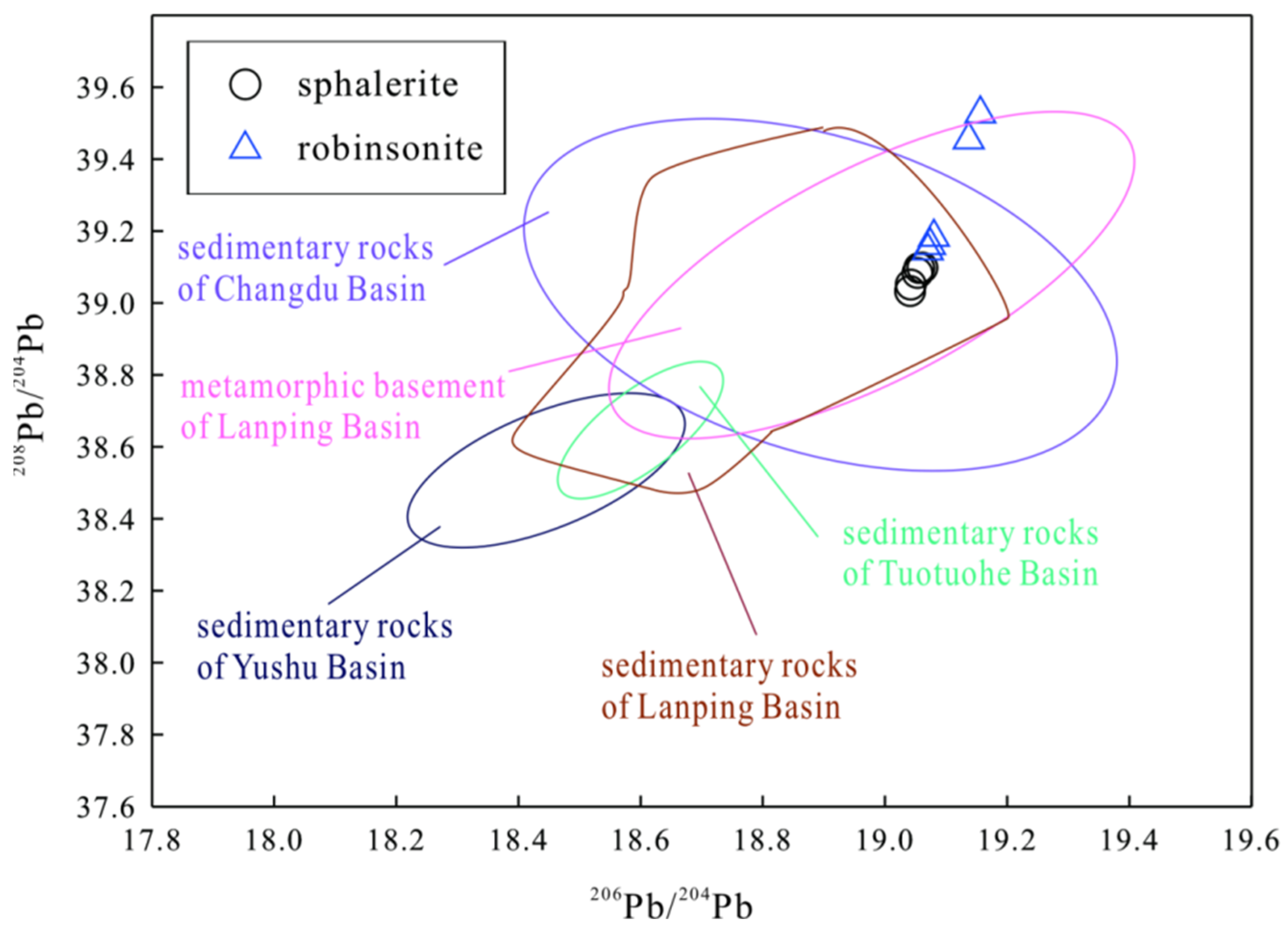
The Pb isotopic compositions of ore-hosting sedimentary strata from different sedimentary basins in the SMB were well constrained (see references in Figure 7 caption). Lead isotopes from the Yushu Basin in the north, the Changdu Basin in the central region, and the Lanping Basin in the south of the SMB exhibit some Pb isotope variation but partially overlap with each other (Figure 7). This indicates that regional heterogeneity of Pb isotopic compositions exists within the ore-hosting sedimentary strata of the SMB. The Pb isotopes of sphalerites overlap with the ore-hosting sedimentary strata in the Changdu Basin, suggesting a common source. Robinsonite, however, has large variations of Pb isotopic composition characterized by two end-members, one with low- and the other with high-radiogenic Pb content. The low-radiogenic Pb composition suggests a similar source as the sedimentary rocks in the region, whereas high-radiogenic Pb composition displays no affinity with any known sedimentary Pb reservoirs, indicating incorporation of an additional external Pb source (Figure 7).
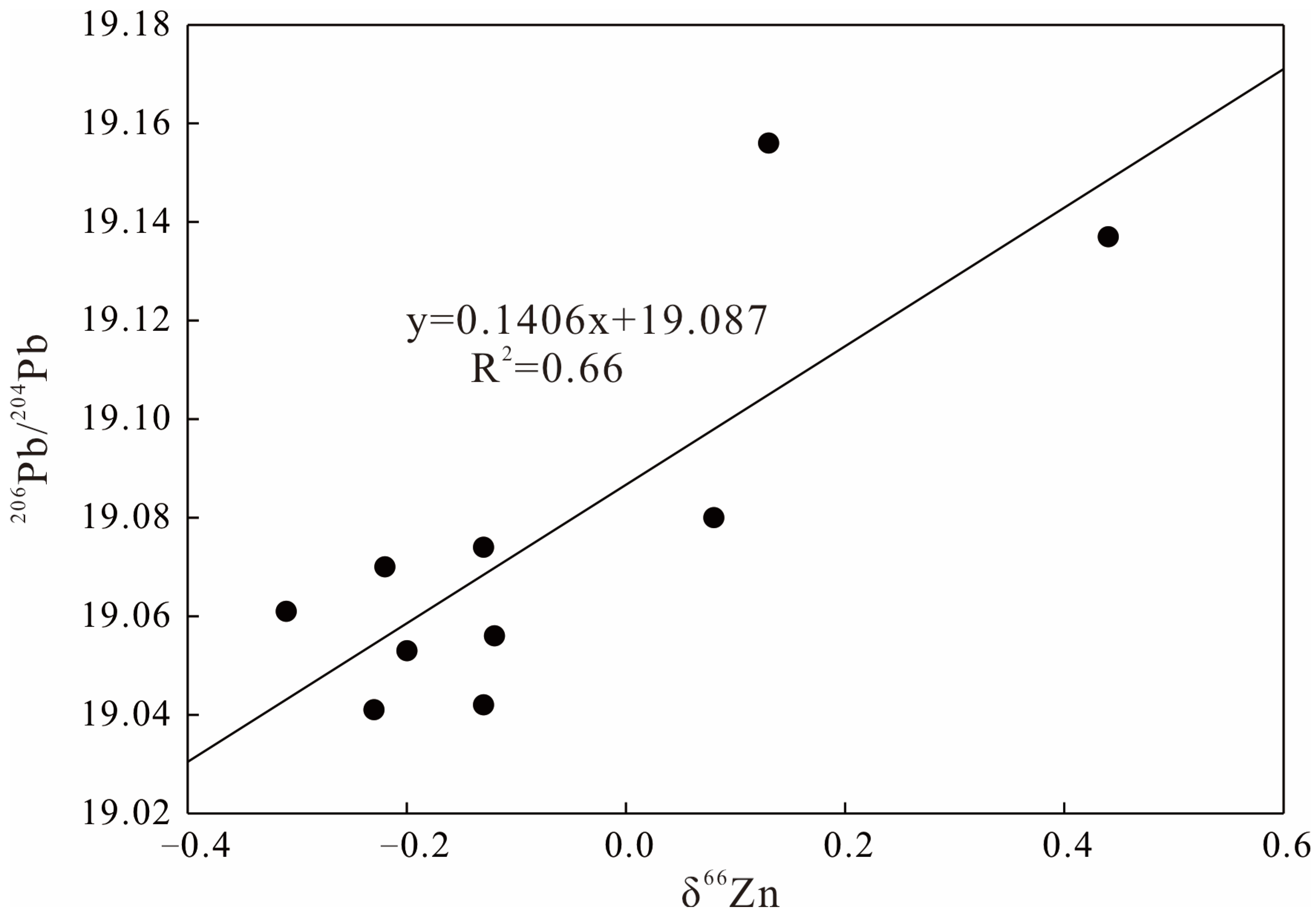
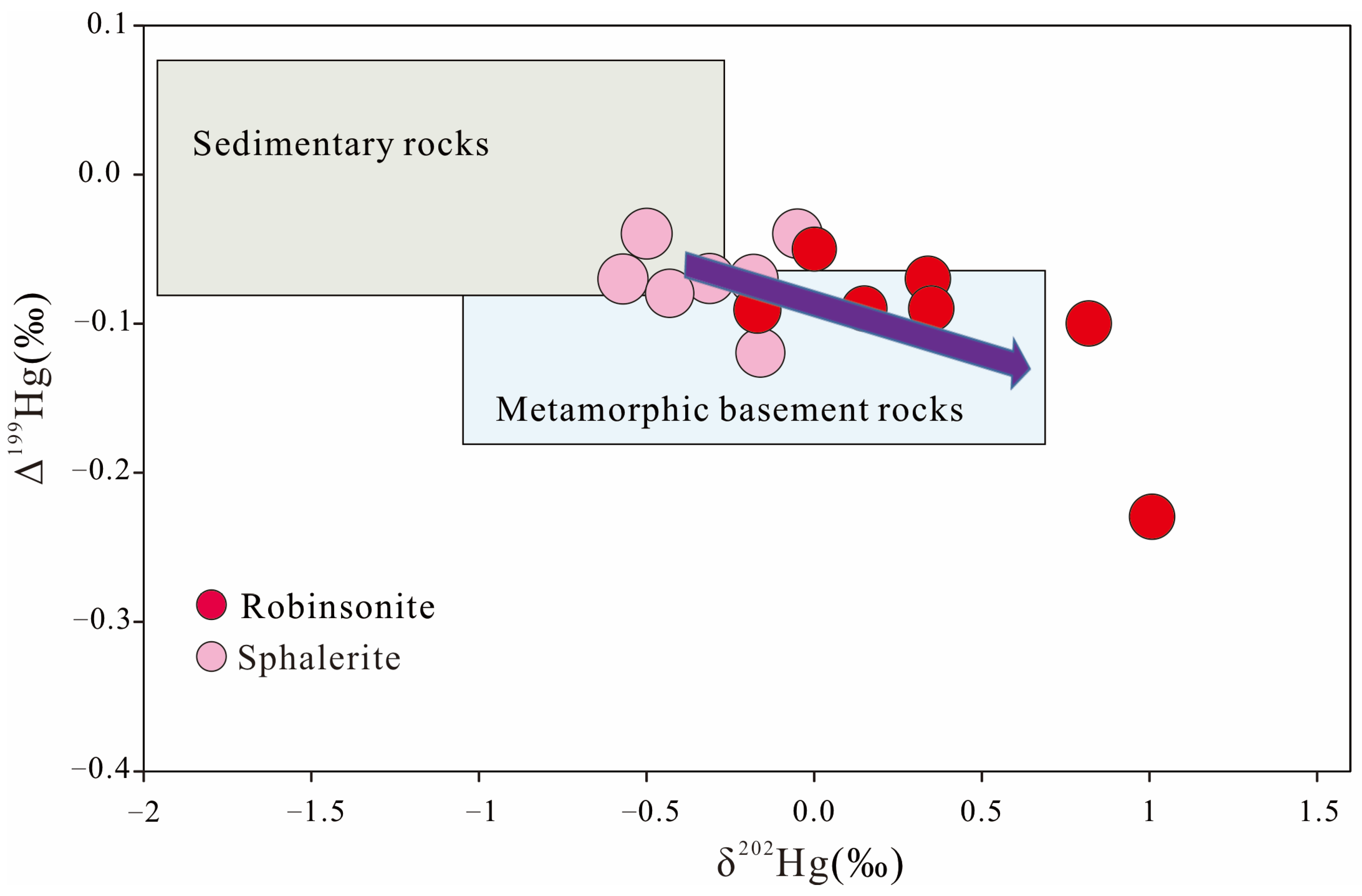
In a plot of 206Pb/204Pb-δ66Zn (Figure 8), a linear relation exists between the 206Pb/204Pb ratio and δ66Zn values of sphalerite and robinsonite (R2 = 0.66). This indicates Pb and Zn have the same source. Both δ66Zn and Pb isotope compositions of sphalerite indicate that Zn and Pb originated from sedimentary rocks, whereas the δ66Zn of robinsonite shows the source of Zn is a mixture of sedimentary rocks and metamorphic basement. Thus, Pb in robinsonite is also derived from mixture of sedimentary rocks and metamorphic basement. The area in Figure 7 where robinsonites with high-radiogenic lead composition plot indicate metamorphic basement origin. This perspective is further supported by Hg isotopes from the Lanuoma deposit (Figure 9), where the Hg in sphalerite indicates sourcing from sedimentary rocks and the Hg in robinsonites has a stronger input from the metamorphic basement (Figure 9).

6.3. Distinct Source of S

Sulfur in hydrothermal deposits is derived from three sources: (1) deep source, either from mantle or compositionally homogeneous deep crust with sulfur isotope compositions consistent with meteorite (δ34S∑S −2‰~2‰); (2) sea water or marine evaporites, δ34S∑S higher than 15‰; (3) biogenic sulfur, showing non-equilibrium sulfur isotope effect with the δ34S∑S values varying significantly due to intensity of biological effect and open or closed system of SO42−, H2S [55,56].
To trace sulfur sources in hydrothermal deposits, δ34S∑S-fluid needs to be calculated to determine the sulfur origin. The values of δ34S∑S-fluid depend on the fO2, pH, temperature, types of sulfur-bearing species and ionic strength of the solution [55,56]. The mineral assemblage in the Lanuoma deposit is sphalerite, robinsonite, orpiment and galena. No sulfate mineral coexists with these sulfides indicating a low oxygen fugacity and low pH environment. In addition, thermometry of fluid inclusions in sphalerite shows ore-forming temperature is ~190 °C [14]. Based on the Ohmoto model, the δ34S values of the sulfides are therefore representative of the sulfur isotope compositions of the hydrothermal fluid (δ34S∑S-fluid) [33,56].
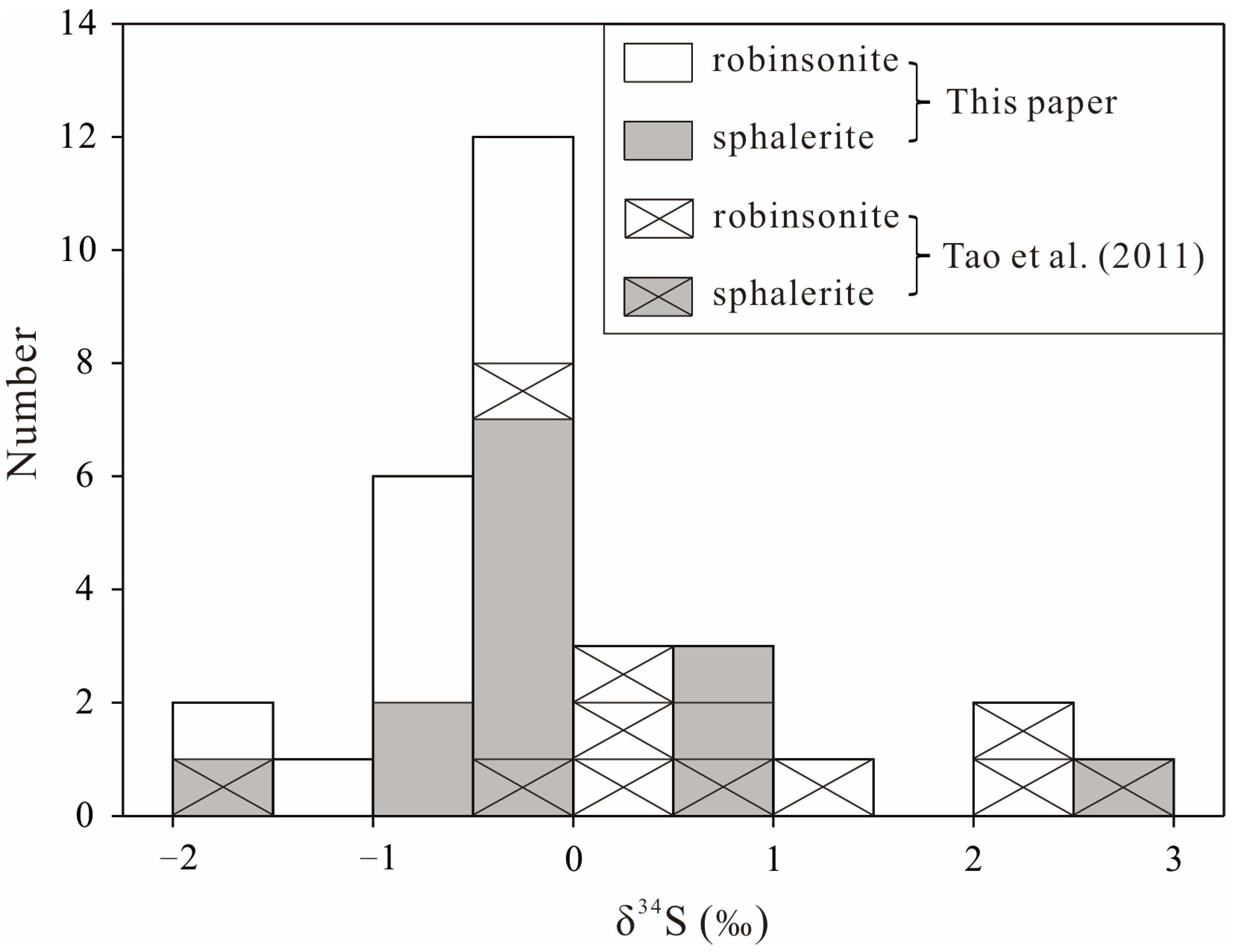
The δ34S values of sphalerite and robinsonite are fairly homogenous (−1.4~2.6, average −0.1‰), clustering around 0‰ and exhibiting a relatively normal distribution (Figure 10). Therefore, we can consider the δ34S∑S-fluid value to be ~0‰, reflecting that the sulfur in the hydrothermal fluid originated from a deep-seated magmatic fluid. Xu et al. (2025) [14] conducted fluid inclusion, rare earth element, and C–O–Sr–Nd isotope studies on the Lanuoma deposit. Their results indicate that the Pb–Zn mineralization was formed through the isothermal mixing of two distinct sources of ore-forming fluids: a low-salinity magmatic fluid and a high-salinity brine [14]. The former carried reducing sulfur, whereas the latter was enriched in metals. The validity of the conclusion that sulfur and Zn–Pb have different sources can be further assessed by examining the interrelationship among Zn, Pb, and S isotopes [21,38,41,45,57].
Previous studies have shown that a positive correlation between δ66Zn and δ34S can reflect a common source. Both δ66Zn and δ34S values increase due to kinetic Raleigh fractionation during long-distance migration of ore-forming fluids or long-periods of ore precipitation [21,45]. A negative correlation between δ66Zn and δ34S is attributed to preferential precipitation of 34S in the early stages at the bottom of the hydrothermal system, where Zn and S share a common source [39]. In contrast, the absence of a linear relationship between δ66Zn and δ34S may reflect either mixing of zinc derived from two distinct sources in which sulfur and zinc underwent different fractionation processes [57], or the mixing of Pb- and S-bearing fluids with different origins, resulting in decoupled δ66Zn and δ34S values [37,38,43]. A lack of a linear relationship between 206Pb/204Pb and δ34S also suggests mixing of Zn- and S-bearing fluids [21].
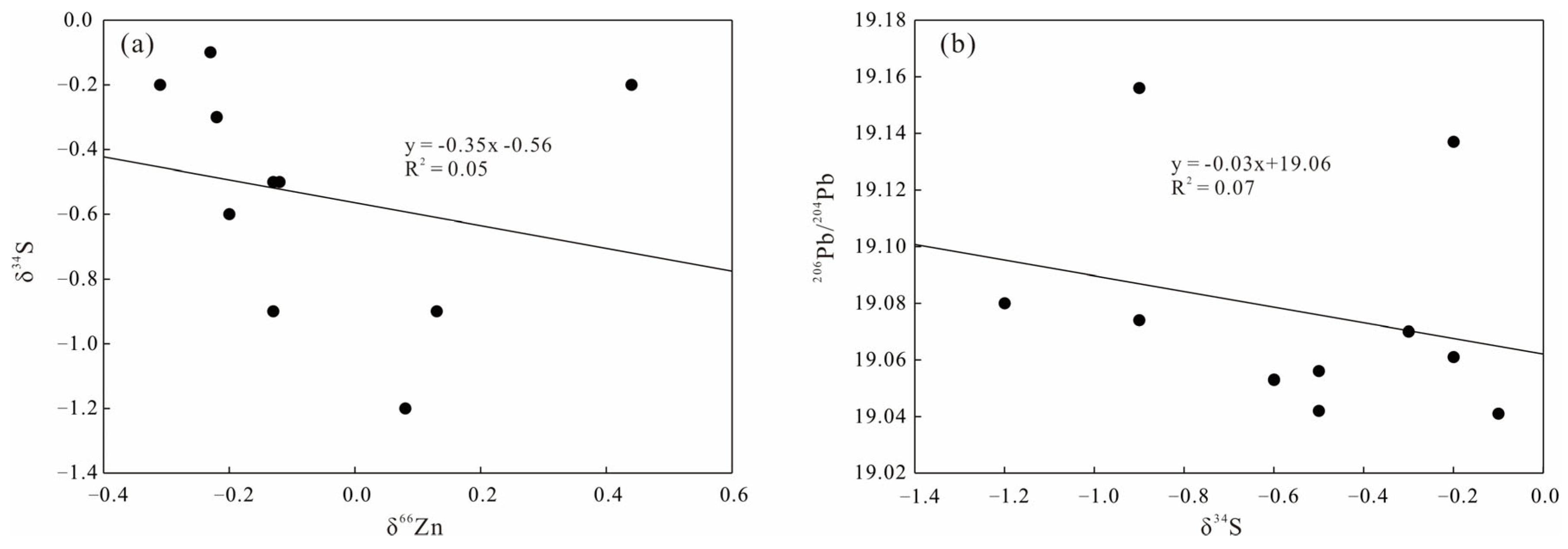
In the Lanuoma deposit, both δ66Zn vs. δ34S and 206Pb/204Pb vs. δ34S from the Lanuoma deposit show no significant correlation, with R2 values of 0.05 (Figure 11a) and 0.07 (Figure 11b), respectively. Since the Zn and Pb isotope data indicate a common metal source, while fluid inclusions, trace element compositions, and C–O–Sr–Nd isotopic data collectively point toward the involvement of two types of mineralizing fluids [14], it is proposed that the Lanuoma deposit formed through the mixing of a magmatic fluid carrying reducing sulfur with metal-rich brines.
The occurrence of robinsonite (Pb4Sb6S13), a rare Pb–Sb sulfosalt, provides an additional mineralogical constraint on the redox state and fluid evolution at Lanuoma. Robinsonite commonly occurs intergrown with, or locally replacing, sphalerite, which indicates that it formed during a relatively late phase of the main mineralization stage under more reduced and Sb-enriched conditions than those prevailing during early sphalerite deposition. On this basis, we infer that Sb enrichment represents a superimposed component in the ore-forming system. However, the present dataset does not allow determination of the Sb reservoir. The antimony could have been supplied by variable contributions from the metal-bearing basinal brines, interaction with deeper lithologies along the fluid pathway, and/or episodic input of Sb-bearing fluids during structural reactivation. In addition, the characteristic mineral assemblage of sphalerite + robinsonite with late orpiment–realgar is consistent with reduced, sulfur-rich conditions at low to moderate temperatures, supporting a fluid-mixing scenario rather than purely sedimentary diagenesis. These mineralogical observations link the isotopic decoupling between metals (Zn–Pb) and sulfur (δ34S) to evolving physicochemical conditions during mineralization, and they provide a mineral-based framework for the metallogenic process and mineralization model discussed below.

6.4. Metallogenic Process and Mineralization Model of the Lanuoma Deposit

During Cenozoic tectonic compression and basin evolution, basinal brines circulated through the Triassic carbonate strata and underlying metamorphic basement, leaching Pb and Zn from these lithologies. These metal-bearing brines migrated along fault zones and fracture networks within the Bolila Formation.
Concurrently, deep-seated magmatic fluids ascended along regional structures and supplied reduced sulfur, as indicated by the homogeneous δ34S values of sulfides clustering around 0‰. The lack of correlation between sulfur and metal isotopic systems suggests that sulfur and metals were derived from distinct reservoirs. Isothermal mixing between metal-rich basinal brines and sulfur-rich magmatic fluids, within structurally prepared sites, triggered sulfide precipitation through sulfidation reactions. This led to the formation of sphalerite, galena, and robinsonite during the main mineralization stage.
Mineralization at Lanuoma is characterized predominantly by open-space filling, with minor replacement of host limestone, and is structurally controlled by faults and breccia zones. This mineralization mode reflects a hybrid system involving basin-derived metals and deep-sourced sulfur, representing a transitional type between classic MVT deposits and sediment-hosted systems influenced by deep-sourced fluids within the Sanjiang metallogenic belt.
From a genetic and classification perspective, the Lanuoma Pb–Zn–Sb mineralization exhibits features that are transitional between sediment-hosted Pb–Zn systems and Pb–Sb sulfosalt-bearing deposits. The occurrence of robinsonite as a late-stage mineral, together with its close association with sphalerite and evidence for highly reduced, Sb-enriched fluids, indicates that antimony was introduced during a superimposed mineralization stage rather than forming a primary Sb vein-type system. According to the evolutionary models and classification schemes of Sb and Pb–Sb mineralization proposed by Dill (1998), Dill et al. (2008), and Dill and Berner (2014) [58,59,60], such deposits are best interpreted as structurally controlled, sediment-hosted base-metal systems with late-stage Sb enrichment, commonly related to fluid mixing and tectonic reactivation [61]. Within broader genetic classification frameworks of economic geology, the Lanuoma deposit is therefore classified as a sediment-hosted Pb–Zn deposit with superimposed Sb mineralization, rather than a typical primary Sb-dominated deposit.

7. Conclusions

(1) The ore-forming fluid that precipitated sphalerite has δ66Zn values that correspond closely to the Triassic limestone, suggesting that Zn was mainly leached from sedimentary rocks. The δ66Zn values of robinsonite imply Zn contributions from both sedimentary and metamorphic sources.
(2) Homogeneous Pb isotopic compositions in sphalerite are indicative of a sedimentary source, indicating Pb source from these rocks. In contrast, robinsonite displays variable Pb isotopes forming a mixing trend between low-radiogenic and high-radiogenic end-members, reflecting mixed inputs from sedimentary strata and metamorphic basement.
(3) The δ34S values of sphalerite and robinsonite are narrowly distributed around 0‰, signifying that sulfur in the ore-forming fluids originated predominantly from magmatic fluids carrying reduced sulfur. The lack of correlation between δ34S and δ66Zn or 206Pb/204Pb suggests distinct sources for metals and reducing sulfur, further indicating mixing of magmatic sulfur-bearing fluids with metal-rich sedimentary brines. Such fluid mixing accounts for Pb–Zn deposition and the multi-source isotopic signatures.
(4) Integrated isotopic, mineralogical, and geological evidence indicates that Pb–Zn mineralization at the Lanuoma deposit was controlled by structurally focused mixing between metal-rich basinal brines and sulfur-rich magmatic fluids. Sulfide precipitation occurred predominantly through open-space filling, with subordinate replacement of the carbonate host rocks. This mineralization style represents a hybrid system involving basin-derived metals and deep-sourced sulfur, providing a genetic link between sediment-hosted Pb–Zn deposits and magmatic–hydrothermal processes in the Sanjiang metallogenic belt.

Author Contributions

Conceptualization, C.X. and J.P.; methodology, C.X. and J.G.; software, C.X. and J.G.; validation, C.X., J.G. and C.T.; formal analysis, C.X. and J.P.; investigation, C.X., J.G., C.T., Z.Y.; resources, C.X. and J.P.; data curation, C.X. and Z.Y.; writing—original draft preparation, C.X. and J.P.; writing—review and editing, C.X., J.P. and C.H.; supervision, J.P.; project administration, C.X. and J.P.; funding acquisition, C.X., J.P. and J.G. All authors have read and agreed to the published version of the manuscript.

Funding

This research was funded by the National Key Basic Research Program of China (2015CB452603), the Natural Science Foundation of Jiangxi Province (20224BAB203043), and the National Natural Science Foundation of China (42162025).

Data Availability Statement

All the research data related to this paper have been listed in the manuscript.

Acknowledgments

We gratefully acknowledge Heng Chen from Columbia University for his assistance with Zn isotopic analyses. Ryan Sharpe from the University of Manitoba and Zhiquan Li from Lakehead University are greatly appreciated for their valuable suggestions and language polishing. Special thanks to two anonymous reviewers for their constructive comments and significant help in improving the manuscript.

Conflicts of Interest

The author declares no conflicts of interest.

References

  1. Deng, J.; Wang, Q.F.; Li, G.J.; Santosh, M. Cenozoic tectono-magmatic and metallogenic processes in the Sanjiang region, southwestern China. Earth-Sci. Rev. 2014, 138, 268–299. [Google Scholar] [CrossRef]
  2. Song, Y.C.; Liu, Y.C.; Hou, Z.Q.; Fard, M.; Zhang, H.R.; Zhuang, L.L. Sediment-hosted Pb–Zn deposits in the Tethyan domain from China to Iran: Characteristics, tectonic setting, and ore controls. Gondwana Res. 2019, 75, 249–281. [Google Scholar] [CrossRef]
  3. Bi, X.W.; Tang, Y.Y.; Tao, Y.; Wang, C.M.; Xu, L.L.; Qi, H.W.; Lan, Q.; Mu, L. Composite metallogenesis of sediment-hosted Pb-Zn-Ag-Cu base metal deposits in the Sanjiang collisional orogen, SW China, and its deep driving mechanisms. Acta Petrol. Sin. 2019, 35, 1341–1371. [Google Scholar]
  4. Tang, J.X.; Zhong, K.H.; Liu, Z.C.; Li, Z.J.; Dong, S.Y.; Zhang, L. Intracontinent orogen and metallogenesis in Himalayan epoch, Changdu large composite basin, Eastern Tibet. Acta Geol. Sin. 2006, 80, 1364–1376. [Google Scholar]
  5. Liu, Y.C.; Yang, Z.M.; Tian, S.H.; Song, Y.C.; Zhang, H.R. Fluid origin of fluorite-rich carbonate-hosted Pb–Zn mineralization of the Himalayan–Zagros collisional orogenic system: A case study of the Mohailaheng deposit, Tibetan Plateau, China. Ore Geol. Rev. 2015, 70, 546–561. [Google Scholar] [CrossRef]
  6. Tang, Y.Y.; Bi, X.W.; Mostafa, F.; Stuart, F.M.; Wu, L.Y.; Jiang, G.H.; Xu, L.L.; Liang, F. Genesis of the Jinding Zn-Pb deposit, northwest Yunnan Province, China: Constraints from rare earth elements and noble gas isotopes. Ore Geol. Rev. 2017, 90, 970–986. [Google Scholar] [CrossRef]
  7. Liu, Y.F.; Qi, H.W.; Bi, X.W.; Hu, R.Z.; Qi, L.K.; Yin, R.S.; Tang, Y.Y. Mercury and sulfur isotopic composition of sulfides from sediment-hosted lead-zinc deposits in Lanping basin, southwestern China. Chem. Geol. 2021, 559, 119910. [Google Scholar] [CrossRef]
  8. Jia, W.B.; Li, Y.S.; Yan, G.S.; Lv, Z.C.; Yu, X.F. Ore genesis of the Duocaima Pb-Zn deposit, Tuotuohe area, Qinghai Province, China: Evidences from in situ S and Pb isotopes. Acta Petrol. Sin. 2018, 34, 1285–1298. [Google Scholar]
  9. Zhang, H.S.; Ji, W.H.; Yang, X.Y.; Zhou, J.X.; Sun, C.; Jia, Z.Y.; Hong, J.; Lv, P.R.; Zhao, Z.; Hou, Q. The origin of the Quemocuo carbonate-hosted Pb-Zn deposit in the Sanjiang Tethyan Belt, SW China: Constrained by Sm-Nd isochronic age and Sr-S-Pb isotope compositions. Resour. Geol. 2020, 117, 103264. [Google Scholar] [CrossRef]
  10. Tang, Y.Y.; Bi, X.W.; Fayek, M.; Hu, R.Z.; Wu, L.Y.; Zou, Z.C.; Feng, C.X.; Wang, X.S. Microscale sulfur isotopic compositions of sulfide minerals from the Jinding Zn-Pb deposit, Yunnan Province, Southwest China. Gondwana Res. 2014, 26, 594–607. [Google Scholar] [CrossRef]
  11. Xue, C.J.; Zeng, R.; Liu, S.W.; Chi, G.X.; Qing, H.R.; Chen, Y.C.; Yang, J.M.; Wang, D.H. Geologic, fluid inclusion and isotopic characteristics of the Jinding Zn-Pb deposit, western Yunnan, South China: A review. Ore Geol. Rev. 2007, 31, 337–359. [Google Scholar] [CrossRef]
  12. Sheng, X.Y.; Bi, X.W.; Hu, R.Z.; Tang, Y.Y.; Lan, Q.; Xia, J.F.; Tao, Y.; Huang, M.L.; Peng, J.T.; Xu, L.L. The mineralization process of the Lanuoma Pb-Zn-Sb deposit in the Sanjiang Tethys region: Constraints from in situ sulfur isotopes and trace element compositions. Ore Geol. Rev. 2019, 111, 10294. [Google Scholar] [CrossRef]
  13. Liu, Y.C.; Kendrick, M.A.; Hou, Z.Q.; Yang, Z.S.; Tian, S.H.; Song, Y.C.; Honda, M. Hydrothermal fluid origins of carbonate-hosted Pb-Zn deposits of the Sanjiang thrust belt, Tibet: Indications from noble gases and halogens. Econ. Geol. 2017, 112, 1247–1268. [Google Scholar] [CrossRef]
  14. Xu, C.X.; Peng, J.T.; Hu, S.M.; Gan, J.J.; Huang, C. Characterization of ore-forming fluids in the Lanuoma Sediment-Hosted Pb-Zn deposit, Sanjiang Tethys Region, Southwestern China: Evidences from fluid inclusions, rare earth elements, and C-O-Sr-Nd isotopes. Resour. Geol. 2025, 75, e70013. [Google Scholar] [CrossRef]
  15. Xu, C.X.; Yin, R.S.; Peng, J.T.; Hurley, J.P.; Lepak, R.F.; Gao, J.F.; Feng, X.B.; Hu, R.Z.; Bi, X.W. Mercury isotope constraints on the source for sediment-hosted lead-zinc deposits in the Changdu area, southwestern China. Miner. Depos. 2018, 53, 339–352. [Google Scholar]
  16. Wilkinson, J.J. The potential of Zn isotopes in the science and exploration of ore deposits. In Isotopes in Economic Geology, Metallogenesis and Exploration; Huston, D., Gutzmer, J., Eds.; Springer International Publishing: Reston, VA, USA, 2023; pp. 451–463. [Google Scholar]
  17. Fujii, T.; Moynier, F.; Pons, M.L.; Albarède, F. The origin of Zn isotope fractionation in sulfides. Geochim. Cosmochim. Acta 2011, 75, 7632–7643. [Google Scholar] [CrossRef]
  18. Duan, J.L.; Tang, J.X.; Lin, B. Zinc and lead isotope signatures of the Zhaxikang Pb-Zn deposit, South Tibet: Implications for the source of the ore-forming metals. Ore Geol. Rev. 2016, 78, 58–68. [Google Scholar] [CrossRef]
  19. Qi, Y.Q.; Hu, R.Z.; Fan, H.F.; Zhao, J.H. Zn isotopic variations in ore-related granite and ore minerals in a magmatic-hydrothermal deposit. Geochim. Cosmochim. Acta 2025, 408, 258–268. [Google Scholar] [CrossRef]
  20. Zhu, C.W.; Wang, J.; Zhang, J.W.; Chen, X.C.; Fan, H.F.; Zhang, Y.X.; Yang, T.; Wen, H.J. Isotope geochemistry of Zn, Pb and S in the Ediacaran strata hosted Zn-Pb deposits in Southwest China. Ore Geol. Rev. 2020, 117, 103274. [Google Scholar] [CrossRef]
  21. Xu, C.; Zhong, H.; Hu, R.Z.; Wen, H.J.; Zhu, W.G.; Bai, Z.J.; Zhu, W.G.; Fan, H.F.; Li, F.F.; Zhou, T. Sources and ore-forming fluid pathways of carbonate-hosted Pb–Zn deposits in Southwest China: Implications of Pb–Zn–S–Cd isotopic compositions. Miner. Depos. 2020, 55, 491–513. [Google Scholar] [CrossRef]
  22. Song, Y.C.; Hou, Z.Q.; Liu, Y.C.; Zhuang, L.L.; Hu, G. Mississippi Valley-type Zn–Pb deposits in orogenic thrust belts: Ore formation in response to synorogenic crustal transpression or extension. Miner. Depos. 2023, 58, 1333–1350. [Google Scholar] [CrossRef]
  23. Liu, C.; Su, J.B. Mississippi valley-type Pb–Zn deposits formed by episodic fluid migration in the fold-and-thrust belts of the Tibetan Plateau. Ore Geol. Rev. 2025, 181, 106597. [Google Scholar] [CrossRef]
  24. Peng, Y.M.; Wang, M.J.; Chen, M. The Qamdo-Riwoqe Triassic cratonic basin in eastern Xizang, sequence stratigraphy and correlation. Sedim. Geol. Tethyan Geol. 2020, 20, 62–67. [Google Scholar]
  25. Tao, Y.; Bi, X.W.; Li, C.S.; Hu, R.Z.; Li, Y.B.; Liao, M.Y. Geochronology, petrogenesis and tectonic significance of the Jitang granitic pluton in eastern Tibet, SW China. Lithos 2014, 184, 314–323. [Google Scholar] [CrossRef]
  26. Tao, Y.; Bi, X.W.; Xin, Z.L.; Zhu, F.L.; Liao, M.Y.; Li, Y.B. Geology, geochemistry and origin of Lanuoma Pb–Zn–Sn deposit in Changdu area, Tibet. Miner. Depos. 2011, 30, 599–615. [Google Scholar]
  27. Moynier, F.; Albarède, F.; Herzog, G.F. Isotopic composition of zinc, copper, and iron in lunar samples. Geochim. Cosmochim. Acta 2006, 70, 6103–6117. [Google Scholar] [CrossRef]
  28. Chen, H.; Savage, P.S.; Teng, F.Z.; Helz, R.T.; Moynier, F. Zinc isotope fractionation during magmatic differentiation and the isotopic composition of the bulk Earth. Earth Planet. Sci. Lett. 2013, 369–370, 34–42. [Google Scholar] [CrossRef]
  29. Paniello, R.C.; Moynier, F.; Beck, P.; Barrat, J.A.; Podosek, F.A.; Pichat, S. Zinc isotopes in HEDs: Clues to the formation of 4-Vesta, and the unique composition of Pecora Escarpment 82502. Geochim. Cosmochim. Acta 2012, 86, 76–87. [Google Scholar] [CrossRef]
  30. Ueda, A.; Sakai, H. Sulfur isotope study of Quaternary volcanic rocks from the Japanese Islands Arc. Geochim. Cosmochim. Acta 1984, 48, 1837–1848. [Google Scholar] [CrossRef]
  31. Ni, Z.Y.; Chen, Y.J.; Li, N.; Zhang, H. Pb–Sr–Nd isotope constraints on the fluid source of the Dahu Au–Mo deposit in Qinling Orogen, central China, and implication for Triassic tectonic setting. Ore Geol. Rev. 2012, 46, 60–67. [Google Scholar] [CrossRef]
  32. Todt, W.; Cliff, R.A.; Hanser, A.; Hofmann, A.W. Evaluation of a 205Pb-202Pb double spike for high-precision lead isotopic analysis. In Earth Processes: Reading the Isotopic Code; Basu, A., Hart, S.R., Eds.; American Geophysical Union: Washington, DC, USA, 1996; pp. 429–437. [Google Scholar]
  33. Seal, R.R. Sulfur isotope geochemistry of sulfide minerals. Rev. Miner. Geochem. 2006, 61, 633–677. [Google Scholar] [CrossRef]
  34. Zhang, H.; Zhou, J.X.; Zhou, M.F.; Yue, Z.P.; He, Y. Zinc isotopes revealed the role of ore-hosting carbonate rocks in the formation of MVT deposits: A case study of the Huize Pb–Zn deposit, SW China. J. Geochem. Explor. 2024, 258, 107396. [Google Scholar] [CrossRef]
  35. Ma, H.C.; Wang, D.; Mathur, R.; Wang, G.T.; Bai, F. Zinc and cadmium isotope signatures: Insights into ore genesis and exploration strategies at the Xiaohongshilazi Pb-Zn-(Ag) deposit, northeast China. Geosci. Front. 2025, 16, 102054. [Google Scholar] [CrossRef]
  36. Maréchal, C.; Albarède, F. Ion-exchange fractionation of copper and zinc isotopes. Geochim. Cosmochim. Acta 2002, 66, 1499–1509. [Google Scholar] [CrossRef]
  37. Wilkinson, J.J.; Weiss, D.J.; Mason, T.F.D.; Coles, B.J. Zinc isotope variation in hydrothermal systems: Preliminary evidence from the Irish Midlands ore field. Econ. Geol. 2005, 100, 583–590. [Google Scholar] [CrossRef]
  38. Kelley, K.D.; Wilkinson, J.J.; Chapman, J.B.; Crowther, H.L.; Weiss, D.J. Zinc isotopes in sphalerite from base metal deposits in the red dog district, northern Alaska. Econ. Geol. 2009, 104, 767–773. [Google Scholar] [CrossRef]
  39. Zhou, J.X.; Huang, Z.L.; Zhou, M.F.; Zhu, X.K.; Muchez, P. Zinc, sulfur and lead isotopic variations in carbonate-hosted Pb–Zn sulfide deposits, southwest China. Ore Geol. Rev. 2014, 58, 41–54. [Google Scholar] [CrossRef]
  40. Mason, T.F.D.; Weiss, D.J.; Chapman, J.B.; Wilkinson, J.J.; Tessalina, S.G.; Spiro, B.; Matthew, S.A.; Spratt, J.; Coles, B.J. Zn and Cu isotopic variability in the Alexandrinka volcanic-hosted massive sulphide (VHMS) ore deposit, Urals, Russia. Chem. Geol. 2005, 221, 170–187. [Google Scholar] [CrossRef]
  41. Gagnevin, D.; Boyce, A.J.; Barrie, C.D.; Menuge, J.F.; Blakeman, R.J. Zn, Fe and S isotope fractionation in a large hydrothermal system. Geochim. Cosmochim. Acta 2012, 88, 183–198. [Google Scholar] [CrossRef]
  42. Deng, J.; Wang, C.M.; Bagas, L.; Selvaraja, V.; Jeon, H.; Wu, B.; Yang, L.F. Insights into ore genesis of the Jinding Zn–Pb deposit, Yunnan Province, China: Evidence from Zn and in-situ S isotopes. Ore Geol. Rev. 2017, 90, 943–957. [Google Scholar] [CrossRef]
  43. Zhang, H.J.; Xiao, C.Y.; Wen, H.J.; Zhu, X.K.; Ye, L.; Huang, Z.L.; Zhou, J.X.; Fan, H.F. Homogeneous Zn isotopic compositions in the Maozu Zn-Pb ore deposit in Yunnan Province, southwestern China. Ore Geol. Rev. 2019, 109, 1–10. [Google Scholar] [CrossRef]
  44. Gao, Z.F.; Zhu, X.K.; Sun, J.; Luo, Z.H.; Bao, C.; Tang, C.; Ma, J.X. Spatial evolution of Zn-Fe-Pb isotopes of sphalerite within a single ore body: A case study from the Dongshengmiao ore deposit, Inner Mongolia, China. Miner. Depos. 2018, 53, 55–65. [Google Scholar] [CrossRef]
  45. Zhu, C.W.; Liao, S.L.; Wang, W.; Zhang, Y.X.; Yang, T.; Fan, H.F.; Wen, H.J. Variations in Zn and S isotope chemistry of sedimentary sphalerite, Wusihe Zn-Pb deposit, Sichuan Province, China. Ore Geol. Rev. 2018, 95, 639–648. [Google Scholar] [CrossRef]
  46. Chen, J.; Zhao, Y.; Xue, C.J.; Brzozowski, M.J.; Jing, G. Zinc isotopes trace the metal source and fluid flow pathways of the large Caixiashan Pb–Zn deposit, China. Ore Geol. Rev. 2025, 176, 106389. [Google Scholar] [CrossRef]
  47. Tian, S.H.; Yang, Z.S.; Hou, Z.Q.; Liu, Y.C.; Song, Y.C.; Wang, F.C.; Xue, W.W. Sulfur, lead, strontium and neodymium isotope compositions of the Dongmozhazhua lead-zinc ore deposit in the Yushu area, southern Qinghai: Implications for the sources of ore-forming material in the deposit. Acta Petrol. Sin. 2011, 27, 2173–2183. [Google Scholar]
  48. Liu, Y.C. Characteristics and Metallogenic Genesis of the Carbonate-Hosted Lead-Zinc Deposits in the Middle Part of Sanjiang Area, Tibetan Plateau. Ph.D. Thesis, Chinese Academy of Geological Sciences, Beijing, China, 2012. [Google Scholar]
  49. Liu, Y.C.; Hou, Z.Q.; Yu, Y.S.; Tian, S.H.; Li, Y.L.; Yang, Z.S. Characteristics and genesis of Lalongla MVT-like deposit in Changdu region, Tibet. Acta Petrol. Sin. 2013, 29, 1407–1426. [Google Scholar]
  50. Liu, X.P.; Zhou, L.S.; You, J.; Li, S.Y.; Liu, R. Genesis of the Waliaoge Pb-Ag deposit in Qamdo City, Tibet, China: Constraints from ore deposit geology, fluid inclusions, and isotope geochemistry. Acta Miner. Sin. 2020, 40, 223–236. [Google Scholar]
  51. Zhao, X. Stable isotope geochemistry of the Jinding lead-zinc ore deposit, Yunnan. Earth Sci. 1989, 14, 495–502. [Google Scholar]
  52. Luo, J.L.; Yang, Y.H.; Zhao, Z.; Chen, J.S.; Yang, J.Z. Evolution of the Tethys in Western Yunnan and Mineralization for Main Metal Deposits; Geological Publishing Press: Beijing, China, 1994; pp. 157–215. [Google Scholar]
  53. Zhang, Q.; Liu, J.J.; Shao, S.X.; Liu, Z.H. An estimate of the lead isotopic compositions of upper mantle and upper crust and implications for the source of lead in the Jinding Pb-Zn deposit in Western Yunnan, China. Geochem. J. 2002, 36, 271–287. [Google Scholar] [CrossRef][Green Version]
  54. Wang, G.H. A Genetic Study on the Jinman-Liancheng Vein Cu Deposits in the Northwestern Yunnan. Master’s Thesis, Kunming University of Science and Technology, Kunming, China, 2010. [Google Scholar]
  55. Ohmoto, H. Systematics of sulfur and carbon isotopes in hydrothermal ore deposits. Econ. Geol. 1972, 67, 551–578. [Google Scholar] [CrossRef]
  56. Ohmoto, H.; Rye, R.O. Isotopes of sulfur and carbon. In Geochemistry of Hydrothermal Ore Deposits, 2nd ed.; Barnes, H.L., Ed.; Wiley: New York, NY, USA, 1979; pp. 509–567. [Google Scholar]
  57. Pašava, J.; Tornos, F.; Chrastný, V. Zinc and sulfur isotope variation in sphalerite from carbonate-hosted zinc deposits, Cantabria, Spain. Miner. Depos. 2014, 49, 797–807. [Google Scholar] [CrossRef]
  58. Dill, H.G.; Melcher, F.; Botz, R. Meso- to epithermal W-bearing Sb vein-type deposits in calcareous rocks in western Thailand; with special reference to their metallogenetic position in SE Asia. Ore Geol. Rev. 2008, 34, 242–262. [Google Scholar] [CrossRef]
  59. Dill, H.G. Evolution of Sb mineralisation in modern fold belts: A comparison of the Sb mineralisation in the Central Andes (Bolivia) and the Western Carpathians (Slovakia). Miner. Depos. 1998, 33, 359–378. [Google Scholar] [CrossRef]
  60. Dill, H.G.; Berner, Z.A. Sedimentological and structural processes operative along a metalliferous catena from sandstone-hosted to unconformity-related Pb-Cu-Zn deposits in an epicontinental basin, SE Germany. Ore Geol. Rev. 2014, 63, 91–114. [Google Scholar] [CrossRef]
  61. Li, Y.; Song, Y.; Tang, J.X.; Chen, W.; Sun, H. Distribution, types and metallogenic regularity of antimony deposits in Tibet. Geol. China 2024, 51, 1570–1600. [Google Scholar]
Figure 1. (a) Simplified tectonic map, showing the SMB within the Tibetan Plateau. (b) Geological map of the Changdu area showing the Lanuoma deposit (Modified after [14]).
Minerals 16 00164 g001
Figure 2. Simplified geological map of the Lanuoma deposit (modified after [14]).
Minerals 16 00164 g002
Figure 3. Cross section along 4-4′ exploration lines (Modified after [12,26]).
Minerals 16 00164 g003
Figure 4. Photographs of representative orebodies; ore samples from the Lanuoma deposit. (a) Lenticular Zn–Pb–Sb orebody hosted by limestone; the red lines outline the boundary of the orebody; (b) sphalerite replaced by fine veinlet-type robinsonite; (c) robinsonite replacing sphalerite and showing a replacement relict texture; (d) Sphalerite occurred as isolated and embayed patches; (e) massive ore composed of sphalerite, robinsonite, and calcite; (f) orpiment and calcite occurred as a veinlet network structure within limestone.
Minerals 16 00164 g004
Figure 5. Paragenetic sequence of minerals in the Lanuoma deposit.
Minerals 16 00164 g005
Figure 6. The δ66Zn values of sphalerite and robinsonite samples from the Lanuoma deposit, as well as the ore-hosting strata and metamorphic basement.
Minerals 16 00164 g006
Figure 7. Plot of 208Pb/204Pb vs. 206Pb/204Pb of sphalerite and robinsonite samples from the Lanuoma deposit. Data of the bulk rock Pb isotopic compositions of the sedimentary rocks in the Yushan Basin and Tuotuohe Basin are from [47,48], in Changdu Basin are from [49,50]. Data of the bulk rock Pb isotopic compositions of the sedimentary rocks and metamorphic basement of Lanping Basin are from [51,52,53,54].
Minerals 16 00164 g007
Figure 8. Plots of 206Pb/204Pb vs. δ66Zn in sphalerite and robinsonite samples from the Lanuoma deposit.
Minerals 16 00164 g008
Figure 9. Plots of Δ199Hg vs. δ202Hg for sphalerite and robinsonite samples from the Lanuoma deposit (Modified after [17]). The purple arrow indicates a mixing trend from a sedimentary rock source toward a stronger contribution from the metamorphic basement.
Minerals 16 00164 g009
Figure 10. Histogram of δ34S values of sulfides from the Lanuoma deposit. Data from this study are compared with reference data from Tao et al. (2011) [26].
Minerals 16 00164 g010
Figure 11. Plots of δ66Zn vs. δ34S (a) and 206Pb/204Pb vs. δ34S (b) in sphalerite and robinsonite samples from the Lanuoma deposit.
Minerals 16 00164 g011
Table 1. Zinc, lead and sulfur lead isotopic compositions in samples from the Lanuoma deposits.
Sample No.Description206Pb/204Pb207Pb/204Pb208Pb/204Pbδ66ZnJMCδ67ZnJMCδ68ZnJMCδ34SV-CDT
Pt11-1Schist of precambrian
metamorphic basement
0.120.180.25
Pt11-3 0.230.340.46
Pt11-4 0.180.260.36
Pt11-6 0.150.220.29
Pt11-8 0.420.620.83
LNM11-3Limestone of Upper Triassic Bolila Foramtion −0.11−0.17−0.22
LNM11-21 0.030.040.05
LNM11-16 0.090.150.17
LNM-12Sphalerite19.06115.67339.098−0.31−0.46−0.55−0.2
LNM-10419.04115.65339.033−0.23−0.36−0.46−0.1
LNM-11819.04215.66039.051−0.13−0.27−0.32−0.5
LNM-12319.05315.66839.083−0.20−0.23−0.30−0.6
LNM-12519.05615.67039.097−0.12−0.23−0.33−0.5
LNM-2Robinsonite19.15615.79639.5260.130.160.24−0.9
LNM-319.13715.77339.4540.440.650.87−0.2
LNM-11819.08015.69839.1830.080.120.15−1.2
LNM-12319.07015.68639.145−0.22−0.34−0.45−0.3
LNM-12519.07415.69139.160−0.13−0.18−0.16−0.9
LNM-13Sphalerite 0.6
LNM-14 0.5
LNM-26 −0.4
LNM-116 −0.5
LNM-124 −0.7
LNM-9Robinsonite −0.6
LNM-26 −0.3
LNM-27 −0.4
LNM-117 −1.6
LNM-124 −1.0
Disclaimer/Publisher’s Note: The statements, opinions and data contained in all publications are solely those of the individual author(s) and contributor(s) and not of MDPI and/or the editor(s). MDPI and/or the editor(s) disclaim responsibility for any injury to people or property resulting from any ideas, methods, instructions or products referred to in the content.