Abstract
The microwave assisted leaching of the vanadium bearing-high carbonaceous shale process was investigated using surface response methodology (RSM) based on Box–Behnken design (BBD). The effect of important factors such as CaF2 usage, H2SO4 concentration, leaching time and microwave power, as well as the interactive coefficients, the signification of the model and factors were analyzed. With the condition of 9.8 wt % CaF2, 23.0 vol % H2SO4, 170.6 min and 350 W, the actual values of vanadium (V) leaching efficiency in microwave heating (MH) and conventional heating (CH) were 85.43% and 79.64%, which agreed well with the predicted values. Meanwhile, the influence order of the factors in MH and CH was CaF2 dosage > H2SO4 concentration > leaching time. Microwave was an efficacious impetus for V extraction, but the microwave power itself was not a significant factor when the temperature of leaching system was high enough. The further characterization of mineral components before and after leaching confirmed that the prior dissolving of muscovite and pyrite in MH was intensified, while both minerals were in fine grains and filled with black carbon. The selective heating of carbon and pyrite sequenced the large temperature gradient between solids and liquids, which accelerated the dissolving reaction of muscovite with CaF2 present in MH condition.
1. Introduction
Vanadium (V) bearing shale ore is one of the two most important vanadium recourses in China, along with the vanadium titanium magnetite [1]. Often, primary ore contains considerable element carbon and reducing minerals. The vanadium mainly exists in the form of isomorphism in muscovite or illite, which is difficult to extract [2,3]. The current practice first used high temperature pretreatment to destroy the lattice structure and the subsequential leaching process to dissolve the metals into liquid phase [4]. At present, the research was focused on enhancing these two stages to increase the V extraction. The external field intensified method, like ultrasonic and microwave irradiation, were introduced to the process [5]. Considering the fact that both the carbon and pyrite are the typically strong microwave absorbing materials, the application of microwave into black shale extraction process is promising.
Microwave heating differs from conventional heating due to the fact that the microwave heating occurs via direct microwave material interaction, while the conventional heating requires the heat to be transferred from the external heat sources [6]. As in situ heat generation alleviates the heat transfer limitations of the conventional ovens, materials can be processed at a faster rate via the use of the microwave ovens. The properties of in-core volumetric and uniform heating, lower thermal inertia and faster responses make microwave chemistry applied widely [7,8]. In the materials and metallurgy research, microwave assisted synthesis of catalysts, electrodes, and optical devices [9,10,11] have proven to be efficient with some special effects. Moreover, in the organic compound extraction and separation, in medical, food and energy fields, the microwave assistance method has already been practically used [12,13,14]. In hydrometallurgical leaching of nonferrous, lanthanum and noble metals, the dielectric properties have also been reported to have a pronounced effect on the microwave heating pattern [15,16,17]. The effect of microwaves appeared in different circumstances, but it also occasionally disappeared while the system changed.
In the previous research of vanadium extraction through the blank roasting-acid leaching process, the synergic effect of microwaves with CaF2 on V leaching improvement was observed, for which it was attributed to the decrease of chemical reaction resistance with the transformation from chemical reaction control to diffusion control [18]. Attributed to the muscovite, as well as the roasted shale ore having barely any microwave absorbing capacity, the particular selective features and volumetric heating of microwaves were not shown in such cases. In other words, it means that, in most cases, the microwave heating appeared to have no effect on V leaching from roasted shale. Meanwhile, the V leaching efficiency was improved by only 10% under the optimized condition, for which it was not so significant in high-cost terms. Another problem was the explanation about how this consequence was realized was not convincing enough, and the interrelation in it was also not figured out [19,20,21,22].
As the carbon and pyrite were favorable for the microwave absorption, the leaching of black shale in microwave heating may be efficacious with a remarkable improvement in V extraction. The research of microwave heated leaching of carbonaceous black shale may be enlightening for the mechanism discussion for the same reason. The response surface analysis was used to analyze the main influencing factors of extracting vanadium from shale by microwave and conventional heating. Hence, the present work intends to assess the effects of variables such as CaF2 usage, H2SO4 concentration, leaching time and microwave power using a Box–Behnken design (BBD). The comparison experiments in conventional heating were also carried out for the contrast. The phase and morphology analysis before and after leaching were also conducted as the corroborative evidence of the optimizing process.
2. Materials and Methods
2.1. Materials
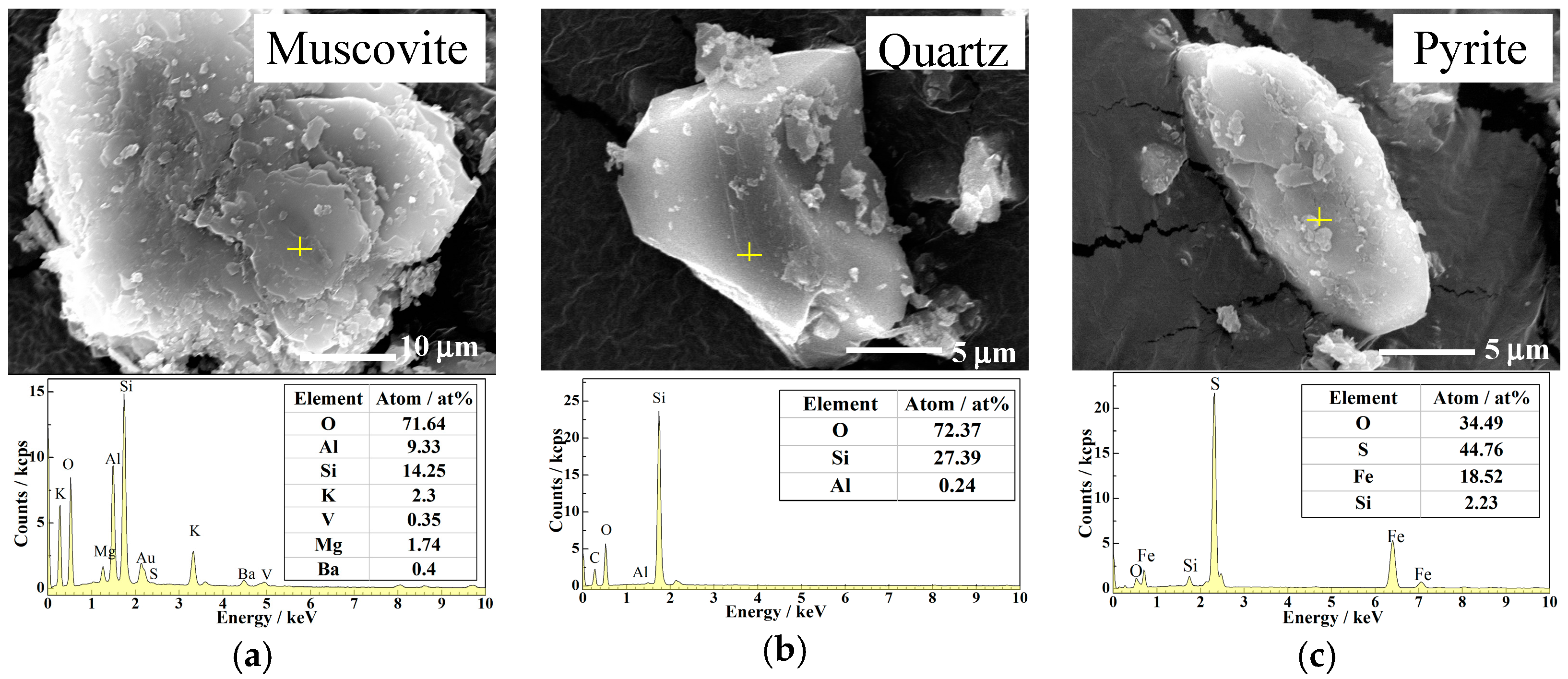
The material obtained from Tongshang, Hubei province, China was first mixed evenly and then crushed to −0.074 mm accounted for 80%. The main chemical composition determined by scanning electron microscopy (QEMSCAN) analysis (FEI, Hillsboro, OR, USA) is presented in Table 1. The carbon and pyrite indicated that the material was a highly carbonaceous original type shale formed in a reducing environment. The surface morphology of the minerals is shown in Figure 1 by means of scanning electron microscope (SEM; JSM-IT300, JEOL, Tokyo, Japan), equipped with an X-ACT energy dispersive spectrometer (EDS; Oxford Instruments, Oxford, UK). According to the rock-mineral determination [23], muscovite is micro scaly with fine grains, mostly occurring in close contact with carbonaceous matter, and the grain size is basically <0.02 mm, mostly <0.01 mm. The pyrite is generally dispersed in quartz, silicate and carbonaceous materials with finer particles. The surface and clearance of pyrite was contaminated or filled with black carbon. The carbonaceous matter in the ore is mainly in the form of flakes or microcrystalline in clay minerals, and the size of some carbon inlays is generally less than 0.005 mm.
Table 1.
Main chemical composition of the black shale (wt %).
Figure 1.
The SEM-EDS results of the minerals before leaching: (a) muscovite; (b) quartz; (c) pyrite.
The capacity of different microwave absorbents to be heated can be measured and compared using the dielectric properties. In Table 2, the relative dielectric constant (ε′) and dielectric loss factor (ε″) are used to express the dielectric response of materials in the microwave field [24]. The dielectric constant measures the ability of a material to store microwave energy, i.e., the ability of the material to be polarized. The loss factor measures the ability of a material to dissipate the stored energy into heat [25].
Table 2.
Major mineral constituents and dielectric property (ε′, ε″) in black shale.
2.2. Equipment and Experimental
2.2.1. Leaching Procedure with Microwave Heating (MH)
The equipment was assembled with a microwave furnace (Model MAS-II plus supplied by SINEO Microwave Chemistry Technology Co., Ltd., Shanghai, China) with a spherical condenser, temperature sensor and mechanical stirrer. Take 50 g material in a three neck flask and fully mix it with the sulfuric acid. The sulfuric acid solution was heated to approximately 102 °C and then mixed with the raw material to eliminate possible temperature differences. The stirring speed was 300 rpm. During the experiment, the power was fixed at different conditions and the temperature was not restricted. After leaching was completed, the slurries were filtered to obtain the leachate solution and the residue. In this paper, the vanadium leaching rate is the mass ratio of V2O5 in the raw material and in the leachate solution. The concentration of V was determined through inductively coupled plasma-atomic emission spectrometry (ICP-AES) (IRIS Advantage Radial, Thermo-Elemental, Waltham, MA, USA).
2.2.2. Leaching Procedure with Conventional Heating (CH)
The leaching experiments with conventional heating were conducted in the same manner as those by microwave heating except that the heater was an electric heating jacket. The rated power of the electric heating jacket was 350 W and cannot be changed. The temperature was at approximately 102 ± 1 °C (boiling point at atmosphere pressure).
2.3. Experimental Design
Response surface methodology (RSM) was used for the process optimization with a minimum number of experiments as well as analyzing the interaction between the factors [26,27,28]. Based on the previous work we have made, four major factors: CaF2 dosage (wt %), H2SO4 concentration (vol %), leaching time (min) and microwave power (W) were chosen as the independent variables because of the apparent affection on the V leaching. As the conventional heating equipment was unadjustable, the factor of power was not suited for the CH leaching procedure. On the other side, the boiling temperatures in MH at different levels of power were different (about 102 ± 1 °C at 350 W as well). Thus, the analysis of CH leaching was based on the first three factors. Their levels and ranges are shown in Table 3. The other basic leaching conditions were a solid-to-liquid ratio of 1.5 mL/g. The response variables Y1, Y2 were the leaching rate of V with MH and CH, respectively.
Table 3.
Independent factors and levels used for design.
3. Results and Discussion
3.1. Response Analysis and Interpretation
The experimental conditions in the design and the results are shown in Table 4. The leaching efficiency of V in both microwave heating (MH) and conventional heating (CH) conditions designed by RSM were present. In Run 2 and Run 25, the V leaching rate difference of MH and CH was increased to 13% with the leaching time increased from 60.0 min to 150.0 min with no CaF2 present. Compared with Run 17 and Run 19, with 10.0 wt % CaF2 and 20.0 vol % H2SO4 used, the microwave improving effect was shown in the initial leaching stage, and then gradually disappeared. Meanwhile, in Run 13 and Run 14, the differences were generally less than 3%.
Table 4.
Experimental design matrix and results.
The ANOVA of quadratic model is presented in Table 5, which proves the validity of the model. The Model F-value implies the models are significant, and the value lack of fit implies that it is not significant relative to the pure error. In the fit summary, both of the two response factors were fitted for quadratic model. The proposed quadratic model agrees well with the experimental data, with correlation coefficients (R2) of the factors of Y1, Y2 were 0.9931 and 0.9970, respectively. The predicted leaching of V in MH and CH, which do not show any significant nonlinear pattern indicating non-normality in the error term.
Table 5.
Analysis of variance (ANOVA) for response surface quadratic model.
The value of Prob > F less than 0.05 indicates that the model terms are significant. Values greater than 0.1000 indicate that the model terms are not significant. For the leaching of V, the influence order in MH (Y1) was X1 > X2 > X3 > X1X2 > X12. While in the CH (Y2) condition, it was X1 > X2 > X3 > X1X2 > X1X3 > X12. CaF2 usage has the greatest effect on V leaching with the highest F-value, whereas sulfuric acid concentration and leaching time were found to be less significant. The microwave was an efficacious impetus for V extraction, but the microwave power itself was not a significant factor while the temperature of the leaching system was high enough. The insignificance of microwave power in the leaching process was attached to the high temperature concealment. While the insignificant terms were already eliminated to simplify the model, the detailed modified models were present as follows:
Y1 = 0.62 + 0.23X1 + 0.19X2 + 0.056X3 + 0.043X1X2 − 0.082X12,
Y2 = 0.59 + 0.23X1 + 0.19X2 + 0.077X3 + 0.078X1X2 + 0.055X1X3 − 0.14X12.
The combined effect of independent variables CaF2 and H2SO4 concentration on the V leaching can be observed. The factors’ significant ranking of V extraction in MH indicated the particular function of microwave irradiation. More concretely, in contrast to CH leaching, the CaF2 was not that important or affected greatly.
3.2. Process Optimization
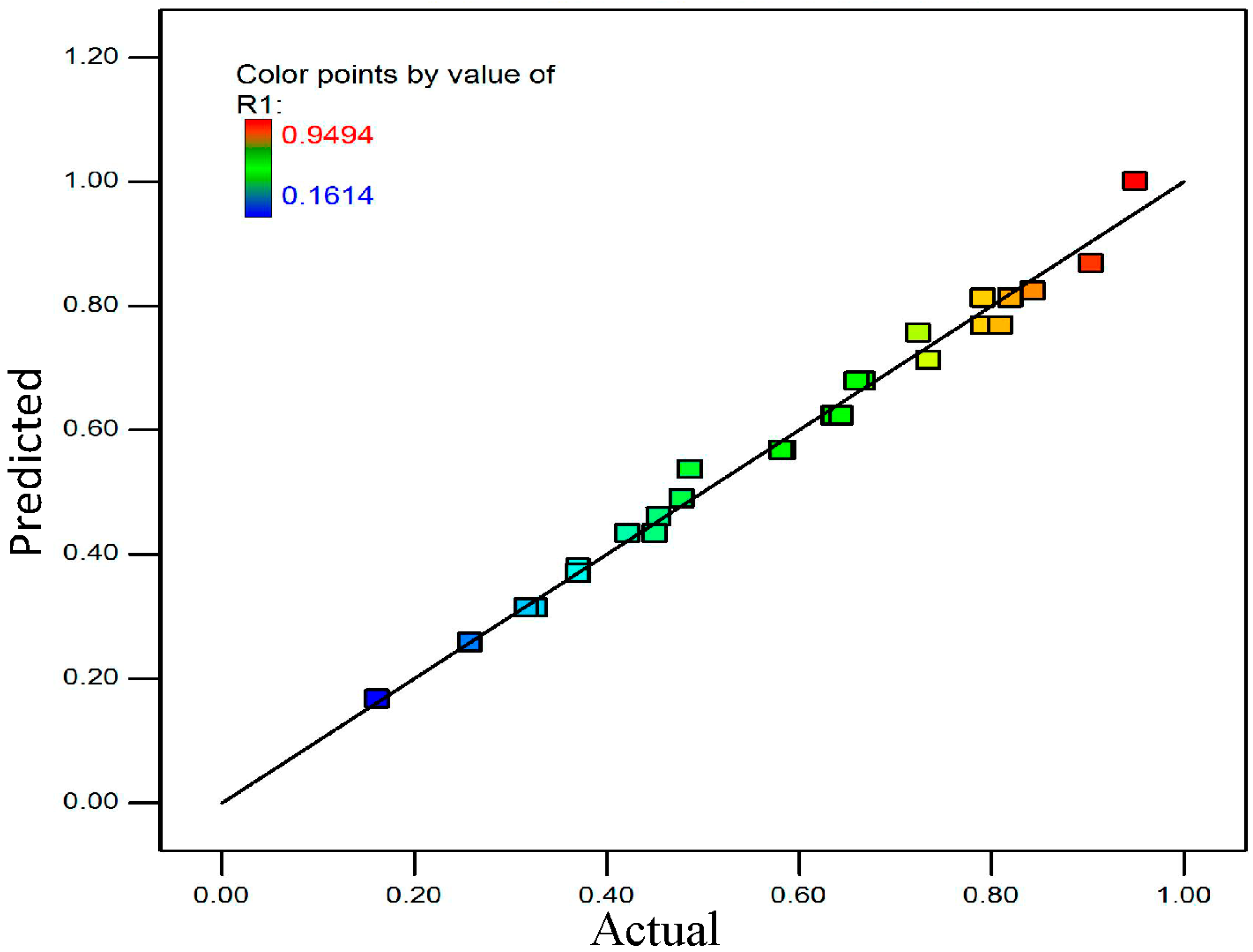
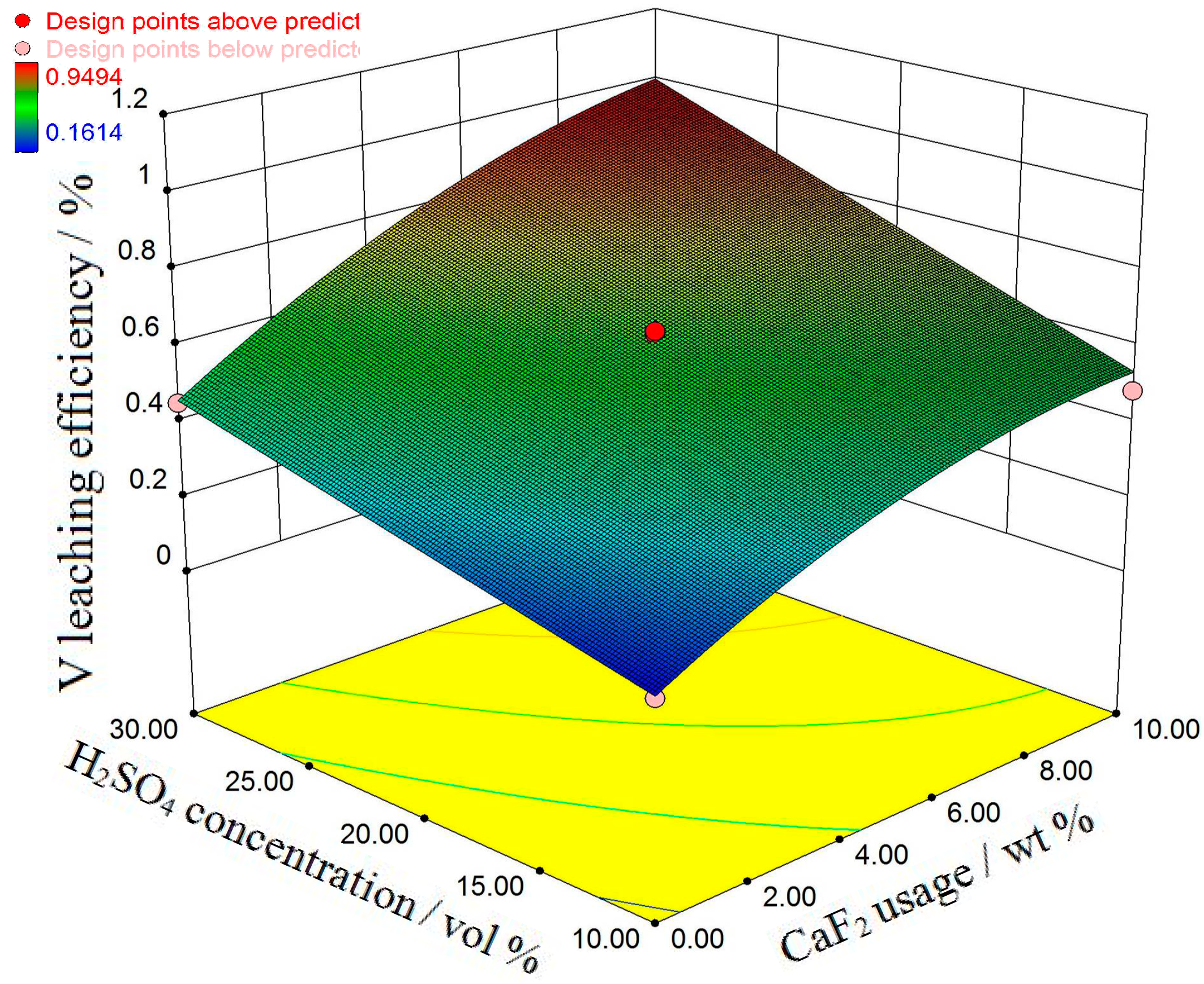
With the modified quadratic model, the experimental and predicted V leaching with MH are shown in Figure 2. The figure shows a close proximity of the model prediction with the experimental data signifying the validity of the regression model. Figure 3 shows the 3D plot of interactive effects between H2SO4 concentration and CaF2 usage on the V leaching. It shows that the V leaching increases significantly with an increase in the CaF2 presented in the leaching solution.
Figure 2.
Plot of predicted vs. actual data of the modified model in MH.
Figure 3.
3D response surface plot of the interactive effects between CaF2 and H2SO4 concentration on V leaching efficiency in MH.
In the optimization process, with the aim of observing the specific effect of microwave heating, the target of V leaching rate in MH was set at 85.0% considering the agents and energy consumption, and other projects were set in range. The solution selected was 9.81 wt % CaF2, 23.06 vol % H2SO4, 170.6 min and 350 W, and the desired values of Y1 and Y2 were 85.01%, 80.18%, respectively. The actual confirmation experiments under the selected condition results of Y1, Y2 were 85.43%, 79.64%, which agrees well with the predicted values. This solution given indicated that it was difficult for the carbonaceous shale to be dissolved even with the assistance of microwave heating. With the aim of improving the affect as a consequence of MH, the purpose of the optimize process was changed to find out the most beneficial leaching system for MH, and the target of V leaching efficiency in MH was set at Maximize. Meanwhile, it was set at Minimize in CH. The solutions were given in Table 6.
Table 6.
Solutions given out at target of V leaching efficiency in MH at Maximize and Minimize in CH.
An obvious phenomenon was observed that only two extreme conditions with CaF2 usage were present here, and the differences of V leaching efficiency between MH and CH were at the highest level. With 10 wt % CaF2 added for 60.0 min, the microwave heating significantly promoted the V leaching rate to about 15% higher than that in CH, while, with 0.04 wt % CaF2 used for 240.0 min, the microwave heating significantly promoted the V leaching rate to about 17% higher than that in CH. As the references reported [20], the activation energy as well as chemical reaction difficulty could be reduced with CaF2 added. Thus, the leaching system of carbonaceous shale required for MH was also confirmed.
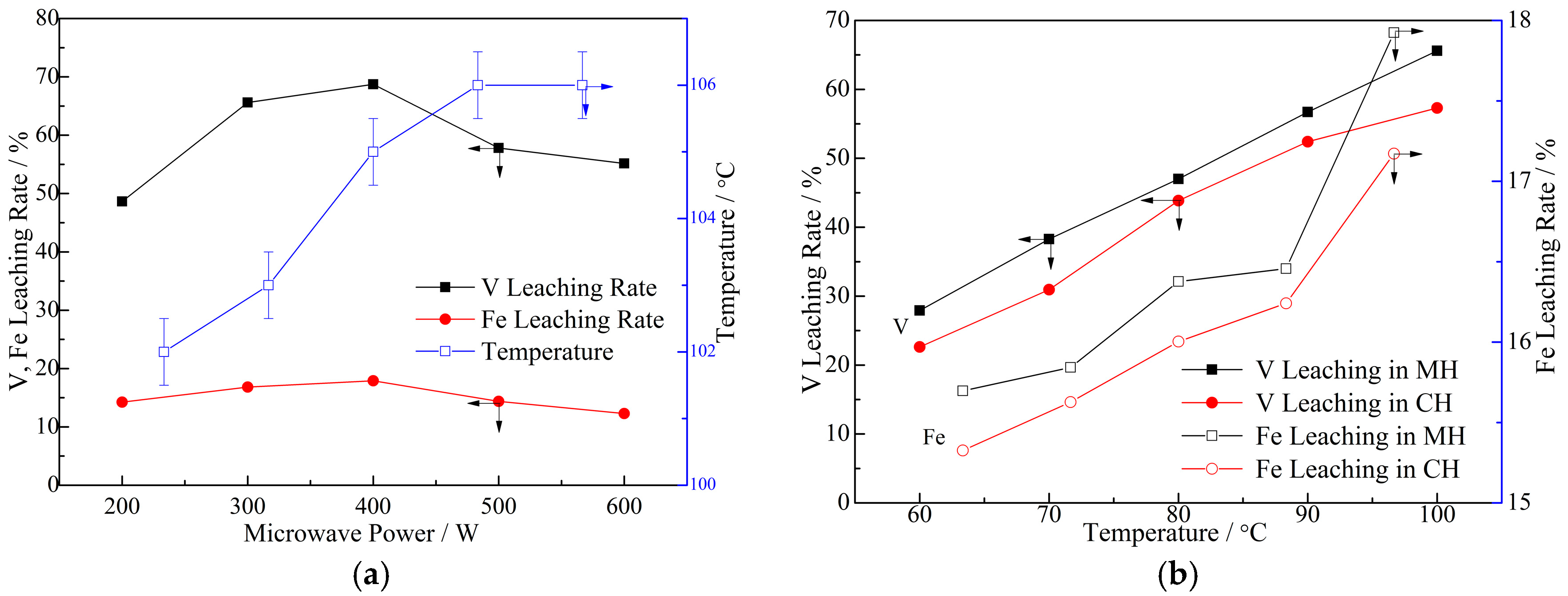
As the carbon was strong absorbing microwave material, the temperature of carbon in microwave power could have easily reached more than 102 °C when the temperature of the surroundings was still at a lower level. Thus, the water contacting the carbon would be especially hated and exceed its surroundings. The detailed research of the effect of microwave power and temperature on V, Fe leaching was discussed. The results are shown in Figure 4.
Figure 4.
The effect of microwave power (a) and temperature (b) on the V, Fe leaching efficiency.
A possible reason was the local high temperature regions caused by the strong microwave absorbing materials, such as pyrite and carbon. As the carbon was disseminated in particles, there may exist many “hot point” regions, and this helps the muscovite reacting with the sulfuric acid. While the “hot point” regions were unable to be detected by temperature sensor, the characterization of the materials before and after leaching may be helpful for the explanation of this phenomenon. As it was difficult for the pyrite to be dissolved in sulfuric acid, the Fe leaching rate tendency was not violent in both MH and CH conditions. Thus, temperature was the major factor while the microwave power was strong enough.
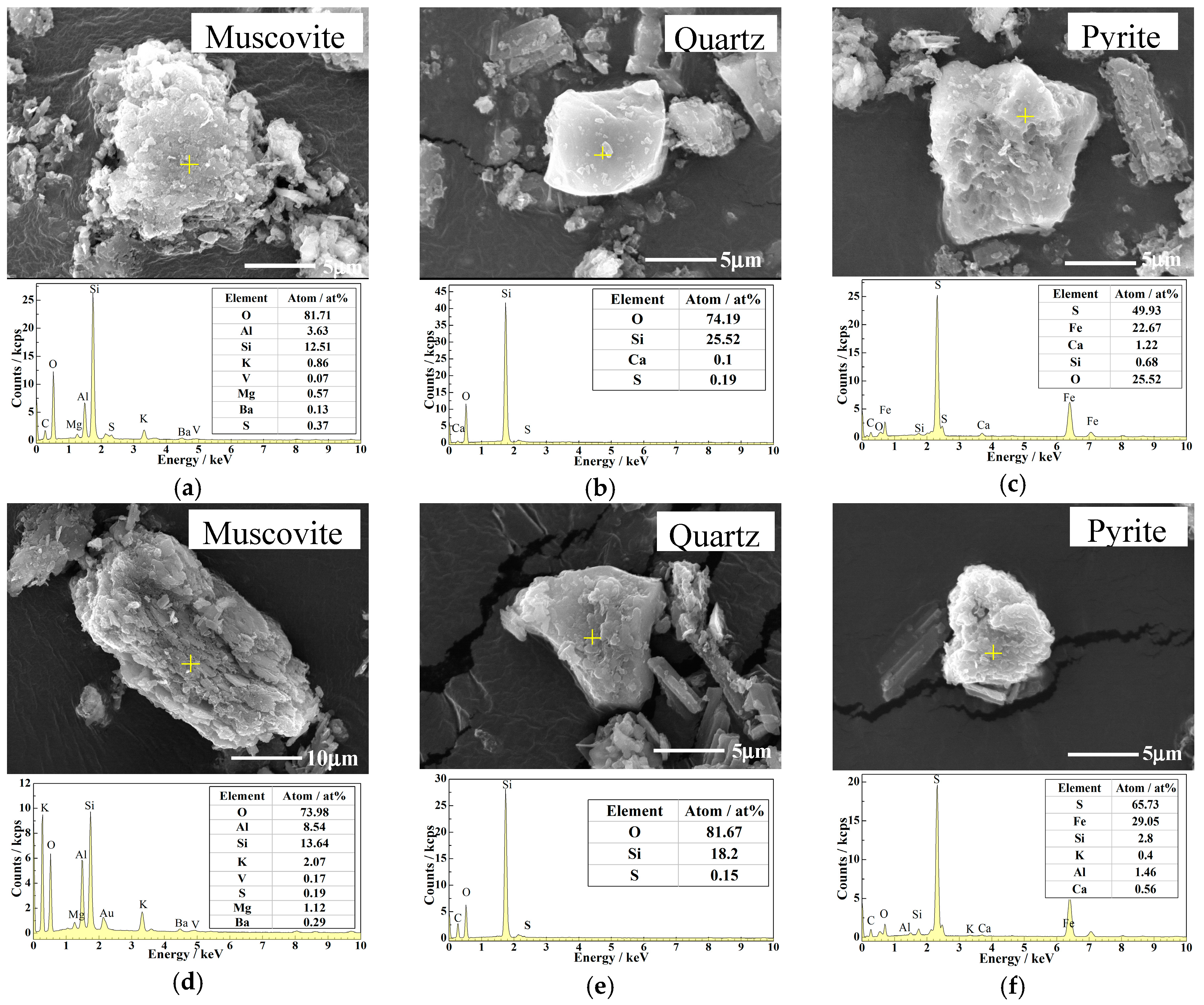
The muscovite was dissolved with the cations released inside and the silicon residue remaining. Meanwhile, the quartz may compete with muscovite for HF [29,30]. The selective decomposition of muscovite with CaF2 in MH indicated the existence of selective “hot point” regions. For directly perceived evidence, the leaching residues in Run 17, with 10 wt % CaF2, were taken for the detailed micro morphology analysis. The results are shown in Figure 5.
Figure 5.
The SEM-EDS results of the residues in Run 17: (a–c) in MH and (d–f) in CH.
The muscovite minerals (Figure 5a,d) in the residue was seriously corroded in both MH and CH, and the straight edges shown in Figure 1 disappeared. Thus, the V inside was released. Compared with the residue in MH, the surface of quartz in CH (Figure 5b,e) was abnormally dissolved. Another remarkable piece of evidence was the appearance of pyrite in MH, which was coarse and full of tiny pores. Meanwhile, the pyrite found in CH residues (Figure 5c,f) still had smooth surfaces. It could be confirmed that the existence of “hot point” regions resulted in the desorption of small particles packed in the pyrite [31].
The leaching system with 9.81 wt % CaF2 added was much more sensitive to the hot regions resulted from microwave irradiation with the muscovite dissolved more drastically. Hence, the optimum condition of microwave assisted high carbonaceous black shale acid leaching was under the conditions of 9.81 wt % CaF2, 23.06 vol % H2SO4, 170.6 min and 350 W.
4. Conclusions
Via the comparative experiments of V leaching in microwave heating and conventional heating with RSM analysis, the proposed quadratic model was in good accordance with all of the two response factors’ experimental data. The influence order in MH and CH was CaF2 usage > H2SO4 concentration > leaching time. Compared with conventional heating, microwave was an efficacious impetus for V extraction. However, the microwave power itself was not a significant factor when the temperature of the leaching system was high enough. The interactive effect of CaF2 and H2SO4 concentration was confirmed in MH. With the optimization condition of 9.8 wt % CaF2, 23.0 vol % H2SO4, 170.6 min and 350 W, the actual values of V leaching efficiency in MH and CH were 85.43%, 79.64%, which agreed well with the predicted values.
Through the comparison of SEM-EDS analysis of the minerals before and after leaching, the prior dissolving of muscovite and pyrite with the coarse surface and structure destruction, which was contaminated by tiny carbon in MH, was observed. The selective heating of carbon and pyrite, which sequenced the large temperature gradient between solids and liquids in MH, accelerated the dissolving reaction of muscovite with CaF2 present as well as the V leaching in MH. It also confirmed the feasibility of microwave intensified V extraction from black shale.
Acknowledgments
This research was financially supported by the National Natural Science Foundation of China (No. 51474162, No. 51774215) and the Key Science and Technology Support Programs (No. 2015BAB18B01).
Author Contributions
Jingpeng Wang and and Yimin Zhang conceived and designed the experiments; Jingpeng Wang performed the experiments; Jingpeng Wang and Jing Huang analyzed the data; Tao Liu contributed reagents/materials/analysis tools; Jingpeng Wang wrote the paper.
Conflicts of Interest
The authors declare no conflict of interest.
References
- Zhang, Y.M.; Bao, S.X.; Liu, T.; Chen, T.J.; Huang, J. The technology of extracting vanadium from stone coal in China: History, current status and future prospects. Hydrometallurgy 2011, 109, 116–124. [Google Scholar] [CrossRef]
- Liu, C.; Zhang, Y.M.; Bao, S.X. Vanadium recovery from stone coal through roasting and flotation. Trans. Nonferrous Met. Soc. China 2017, 27, 197–203. [Google Scholar] [CrossRef]
- Yang, X.; Zhang, Y.; Bao, S. Preparation of high purity V2O5 from a typical low-grade refractory stone coal using a pyro-hydrometallurgical process. Minerals 2016, 6, 69. [Google Scholar] [CrossRef]
- Hu, P.; Zhang, Y.; Liu, T.; Huang, J.; Yuan, Y.; Yang, Y. Separation and recovery of iron impurity from a vanadium-bearing stone coal via an oxalic acid leaching-reduction precipitation process. Sep. Purif. Technol. 2017, 180, 99–106. [Google Scholar] [CrossRef]
- Xiang, Z.; Wu, X. Ultrasonic-microwave assisted extraction of total flavonoids from scutellaria baicalensis using response surface methodology. Pharm. Chem. J. 2017, 51, 318–323. [Google Scholar] [CrossRef]
- Sadeghi, S.M.; Vanpeteghem, G.; Neto, I.F.F.; Soares, H.M.V.M. Selective leaching of Zn from spent alkaline batteries using environmentally friendly approaches. Waste Manage. 2017, 60, 696–705. [Google Scholar] [CrossRef] [PubMed]
- Al-Harahsheh, M.; Kingman, S.W. Microwave-assisted leaching—a review. Hydrometallurgy 2004, 73, 189–203. [Google Scholar] [CrossRef]
- Tong, Z.; Ma, G.; Zhang, X.; Cai, Y. Microwave-supported leaching of electric arc furnace (EAF) slag by ammonium salts. Minerals 2017, 7, 119. [Google Scholar] [CrossRef]
- Shanshan, C.; Jianfeng, H.; Zhanwei, X.; Jiayin, L.; Haibo, O.; Liyun, C.; Lei, Z. Influence of microwave heating on the structure and electrochemical property of NH4V3O8 cathode material for lithium ion batteries. Ceram. Int. 2015, 41, 6747–6752. [Google Scholar] [CrossRef]
- Drunka, R.; Grabis, J.; Krumina, A. Microwave assisted synthesis, modification with platinum and photocatalytical properties of TiO2 nanofibers. Mater. Sci. 2016, 22, 138–141. [Google Scholar] [CrossRef]
- Zadaviciute, S.; Baltakys, K.; Bankauskaite, A. The effect of microwave and hydrothermal treatments on the properties of hydrotalcite. J. Therm. Anal. Calorim. 2017, 127, 189–196. [Google Scholar] [CrossRef]
- Keisandokht, S.; Haddad, N.; Gariepy, Y.; Orsat, V. Screening the microwave-assisted extraction of hydrocolloids from Ocimum basilicum L. seeds as a novel extraction technique compared with conventional heating-stirring extraction. Food Hydrocoll. 2018, 74, 11–22. [Google Scholar] [CrossRef]
- Falciglia, P.P.; De Guidi, G.; Catalfo, A.; Finocchiaro, G.; Farina, M.; Liali, M.; Lorenzano, G.; Valastro, G.; Vagliasindi, F.G.A. Glycerol-enhanced microwave heating for ultra-rapid effective remediation of marine sediments highly contaminated with hydrocarbons. Sep. Purify. Technol. 2017, 189, 11–19. [Google Scholar] [CrossRef]
- Li, X.; Wang, B.; Wu, S.; Kong, X.; Fang, Y.; Liu, J. Optimizing the conditions for the microwave-assisted pyrolysis of cotton stalk for bio-oil production using response surface methodology. Waste Biomass Valorization 2017, 8, 1361–1369. [Google Scholar] [CrossRef]
- Wen, T.; Zhao, Y.; Xiao, Q.; Ma, Q.; Kang, S.; Li, H.; Song, S. Effect of microwave-assisted heating on chalcopyrite leaching of kinetics, interface temperature and surface energy. Results Phys. 2017, 7, 2594–2600. [Google Scholar] [CrossRef]
- Hua, Y.; Cai, C.; Cui, Y. Microwave-enhanced roasting of copper sulfide concentrate in the presence of CaCO3. Sep. Purify. Technol. 2006, 50, 22–29. [Google Scholar] [CrossRef]
- Li, H.; Cui, J.; Liu, J.; Li, X.; Gao, X. Mechanism of the effects of microwave irradiation on the relative volatility of binary mixtures. AIChE J. 2017, 63, 1328–1337. [Google Scholar] [CrossRef]
- Wang, J.-P.; Zhang, Y.-M.; Huang, J.; Liu, T. Synergistic effect of microwave irradiation and CaF2 on vanadium leaching. Int. J. Miner. Metall. Mater. 2017, 24, 156–163. [Google Scholar] [CrossRef]
- Shariaty, P.; Lashaki, M.J.; Hashisho, Z.; Sawada, J.; Kuznicki, S.; Hutcheon, R. Effect of ETS-10 ion exchange on its dielectric properties and adsorption/microwave regeneration. Sep. Purify. Technol. 2017, 179, 420–427. [Google Scholar] [CrossRef]
- Lee, C.S.; Binner, E.; Winkworth-Smith, C.; John, R.; Gomes, R.; Robinson, J. Enhancing natural product extraction and mass transfer using selective microwave heating. Chem. Eng. Sci. 2016, 149, 97–103. [Google Scholar] [CrossRef]
- Li, L.; Guo, Z.; Han, W.; Wang, Q. The effect of microwave on the primary nucleation of CaSO4 from aqueous solutions. Powder Technol. 2017, 317, 189–196. [Google Scholar] [CrossRef]
- Janney, M.A.; Kimrey, H.D.; Allen, W.R.; Kiggans, J.O. Enhanced diffusion in sapphire during microwave heating. J. Mater. Sci. 1997, 32, 1347–1355. [Google Scholar] [CrossRef]
- Huang, J.; Zhang, Y.; Huang, J.; Liu, T.; Cai, Z.; Xue, N. Selective leaching of vanadium from roasted stone coal by dilute sulfuric acid dephosphorization-two-stage pressure acid leaching. Minerals 2016, 6, 75. [Google Scholar] [CrossRef]
- Al-harahsheh, M.; Kingman, S.; Al-Makhadmah, L.; Hamilton, I.E. Microwave treatment of electric arc furnace dust with PVC: Dielectric characterization and pyrolysis-leaching. J. Hazard. Mater. 2014, 274, 87–97. [Google Scholar] [CrossRef] [PubMed]
- Bayca, S.U. Microwave radiation leaching of colemanite in sulfuric acid solutions. Sep. Purify. Technol. 2013, 105, 24–32. [Google Scholar] [CrossRef]
- Bohlouli, A.; Afshar, M.R.; Aboutalebi, M.R.; Seyedein, S.H. Optimization of tungsten leaching from low manganese wolframite concentrate using Response Surface Methodology (RSM). Int. J. Refract. Met. Hard Mater. 2016, 61, 107–114. [Google Scholar] [CrossRef]
- Mpinga, C.N.; Eksteen, J.; Aldrich, C.; Dyer, L. Identification of the significant factors determining extractability of Ni and Cu after sulfation roasting of a PGM-bearing chromitite ore. Miner. Eng. 2017, 110, 153–165. [Google Scholar] [CrossRef]
- Ferdowsi, A.; Yoozbashizadeh, H. Process optimization and kinetics for leaching of cerium, lanthanum and neodymium elements from iron ore waste’s apatite by nitric acid. Trans. Nonferrous Met. Soc. China 2017, 27, 420–428. [Google Scholar] [CrossRef]
- Terry, B. Specific chemical rate constants for the acid dissolution of oxides and silicates. Hydrometallurgy 1983, 11, 315–344. [Google Scholar] [CrossRef]
- Larsen, E.; Kleiv, R.A. Flotation of quartz from quartz-feldspar mixtures by the HF method. Miner. Eng. 2016, 98, 49–51. [Google Scholar] [CrossRef]
- Baghurst, D.R.; Mingos, D.M.P. Superheating effects associated with microwave dielectric heating. J. Chem. Soc. Chem. Commun. 1992, 9, 674–677. [Google Scholar] [CrossRef]
© 2018 by the authors. Licensee MDPI, Basel, Switzerland. This article is an open access article distributed under the terms and conditions of the Creative Commons Attribution (CC BY) license (http://creativecommons.org/licenses/by/4.0/).