Article

Geochemical Characteristics of Pyrite in Carbonatites and Its Implications for Rare Earth Mineralization of Bachu REE Deposit, Northwestern China


1
State Key Laboratory of Geological Process and Mineral Resources, China University of Geosciences, Beijing 100083, China
2
Frontiers Science Center for Deep-time Digital Earth, China University of Geosciences, Beijing 100083, China
*
Author to whom correspondence should be addressed.
Minerals 2026, 16(9), 952; https://doi.org/10.3390/min16090952 (registering DOI)
Submission received: 17 July 2026 / Revised: 31 August 2026 / Accepted: 16 September 2026 / Published: 18 September 2026

Abstract

The burgeoning global demand for rare earth elements (REEs), driven by rapid technological advancements, has elevated their strategic significance. As a ubiquitous metallic mineral that crystallizes throughout the magmatic and hydrothermal stages, pyrite can potentially record the history of REE enrichment within magmatic–hydrothermal systems. The Bachu carbonatite-hosted REE deposit in Xinjiang represents a significant rare earth resource base in China. Elucidating its ore-forming mechanism is therefore crucial for understanding regional metallogenesis and guiding future exploration efforts. In this study, pyrite from this deposit is investigated in detail by employing an integrated analytical approach that includes scanning electron microscopy (SEM), electron probe microanalysis (EPMA), laser ablation inductively coupled plasma mass spectrometry (LA-ICP-MS) trace-element analysis, and in situ sulfur isotope analysis. Based on textural and petrogenetic relationships observed under microscopy, three distinct types of pyrite are identified: (1) pyrite coexisting with hydrothermal minerals such as barite and celestite; (2) pyrite showing evident replacement textures, despite the absence of direct intergrowth with sulfate minerals; and (3) pyrite displaying neither intergrowth nor replacement textures with sulfates. These textural distinctions, combined with variations in Co/Ni ratios, Co-Ni-As ternary plots, and Co/Sb vs. Se/As systematics, enable a clear discrimination between pyrite formed during the magmatic (Py1) and hydrothermal (Py2) stages. Pyrite from the magmatic stage (Py1) is characterized by positive δ34S values ranging from 0.03‰ to 4.67‰, with a pronounced peak at 1.30‰, which is higher than the mantle δ34S value (~0‰). This sulfur isotope signature suggests that crustal material was involved in the petrogenesis of the Bachu carbonatite. In contrast, pyrite from the hydrothermal stage (Py2) exhibits a bimodal distribution of δ34S values. One group, peaking at approximately +0.93‰, indicates a magmatic sulfur source genetically related to Py1. The other group, however, displays distinctly negative values, with a peak around −4.93‰, which may be attributed to sulfur isotope fractionation processes during mineralization. Notably, barite from the hydrothermal stage exhibits consistently positive and elevated δ34S values, ranging from 10.46‰ to 15.94‰ (average 12.82‰). The contrasting δ34S values compared to the negative Py2 values manifest a clear “Tower Effect,” strongly suggesting that the extensive precipitation of barite was a primary driver of the negative sulfur isotope values observed in the composition of coexisting hydrothermal pyrite (Py2). The pyrite generations also establish a stage-specific link to REE mineralization: Py1 records the reduced magmatic interval of carbonatite differentiation and primary REE preconcentration, whereas Py2 is associated with the barite–celestine–fluorapatite–monazite assemblage of the REE-rich hydrothermal veins and records the later oxidized fluid overprint. By integrating detailed mineralogical and geochemical evidence, this study successfully distinguishes between magmatic and hydrothermal pyrite populations and provides critical constraints on the sources of ore-forming materials in the Bachu carbonatite-type REE deposit.

1. Introduction

Rare earth elements (REEs) are indispensable strategic resources underpinning modern technologies, from renewable energy and electronics to defense systems [1,2,3]. Among the diverse types of REE deposits—including ion-adsorption clays and sedimentary phosphorites—those hosted by carbonatite–alkaline complexes constitute the world’s most economically significant sources of REEs, often also enriched in niobium, phosphorus, and fluorine [2,3]. Given the growing supply–demand imbalance driven by accelerating technological innovation, carbonatite complexes have become primary targets for both REE exploration and fundamental research into their petrogenesis and metallogeny [1,3].
Despite decades of investigation, the relative roles of magmatic versus hydrothermal processes in concentrating REEs within carbonatite systems remain highly controversial [4,5,6]. One school of thought, based on petrographic observations and fluid-inclusion studies, argues that exsolved hydrothermal fluids play a critical role in REE mineralization [1,7,8]. Conversely, experimental measurements of fluid–melt partition coefficients (Df/m) for REEs have yielded values below unity, indicating that REEs preferentially partition into carbonatitic melts rather than exsolved aqueous fluids, thereby challenging the hydrothermal model and favoring magmatic differentiation as the primary enrichment mechanism [9,10]. Consequently, the respective contributions of magmatic and post-magmatic processes to REE concentration in carbonatite-hosted deposits remain vigorously debated, and the physicochemical conditions governing the magmatic–hydrothermal transition are poorly constrained [11,12,13,14,15,16,17,18,19].
The Bachu REE deposit, located in the Xinjiang Uygur Autonomous Region, NW China, offers an exceptional opportunity to address this controversy. Hosted within carbonatite dykes of the Wajilitage complex—part of the Permian Tarim Large Igneous Province—the deposit contains approximately 300,000 tons of measured total rare earth oxide (TREO) resources [15]. The ore-bearing lithologies are dominated by dolomite carbonatite, with subordinate calcite carbonatite and red REE-rich hydrothermal veins containing total REE contents of up to 20 wt.% [15]. Importantly, both the dolomite and calcite carbonatite preserve primary magmatic REE minerals with euhedral textures, whereas the red hydrothermal veins exhibit pronounced hydrothermal overprinting, characterized by highly variable proportions of barite, fluorapatite, celestine, and quartz. Fluid inclusions in vein-hosted barite yield homogenization temperatures of 198–267 °C, and the C–O isotope compositions of the veins are consistent with fluid exsolution from an evolved carbonatitic system [15]. This coexistence of magmatic and hydrothermal assemblages within a single system makes the Bachu deposit an ideal natural laboratory for disentangling the relative roles of these two processes.
In this contribution, we present an integrated study of pyrite—a ubiquitous mineral that crystallizes throughout the magmatic–hydrothermal transition and is highly sensitive to fluid composition and physicochemical conditions [20,21,22,23,24,25,26,27,28]. Through systematic petrography, mineral chemistry, and in situ sulfur isotope analysis, we aim to (1) distinguish magmatic- from hydrothermal-stage pyrite using textural and geochemical criteria; (2) constrain the sources of ore-forming sulfur and metals; and (3) evaluate the respective contributions of magmatic and hydrothermal processes to REE mineralization. Our results provide new insights into the magmatic–hydrothermal evolution of carbonatite systems and offer critical constraints on the genesis of carbonatite-hosted REE deposits.

2. Geological Background

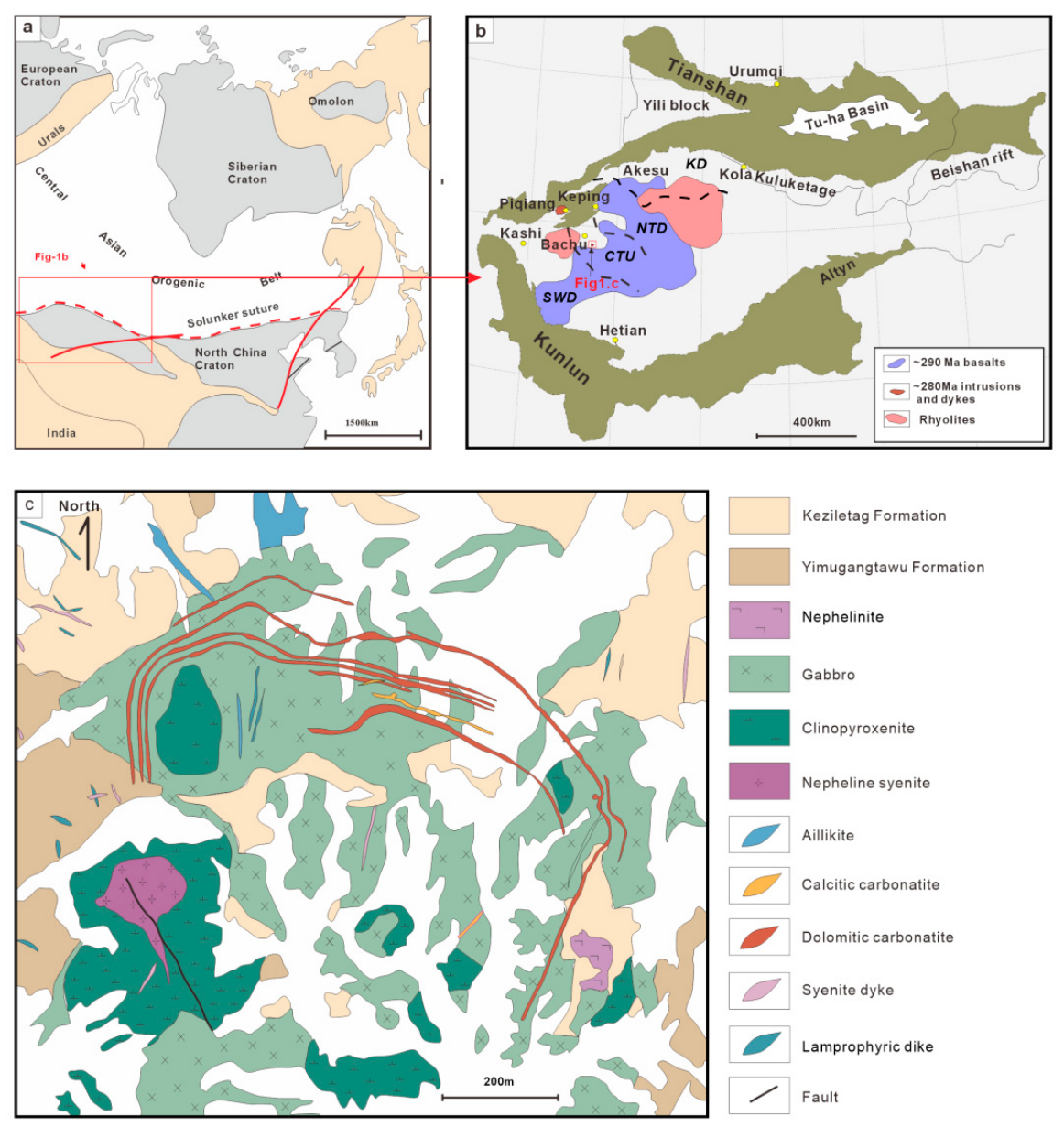
The study area is located in the Wajilitage region of Bachu County, on the northwestern margin of the Tarim Basin, Xinjiang, northwestern China. The Tarim Basin is one of the largest intracontinental basins in China, covering an area of approximately 560,000–600,000 km2. It is tectonically bounded by the Tianshan orogenic belt to the north, the Altyn Tagh orogenic belt to the southeast, and the Kunlun orogenic belt to the south (Figure 1a). The basin is underlain by the Tarim Craton, one of the major Precambrian cratonic blocks in China. The Tarim Craton consists of a Precambrian crystalline basement, including volcano-sedimentary and high-grade metamorphic rocks, overlain by a thick Phanerozoic sedimentary cover [29,30].
During the Early Permian, the western Tarim Craton experienced extensive magmatic activity, which produced voluminous continental flood basalts, rhyolites, mafic–ultramafic intrusions, syenites, and granites. These magmatic products collectively constitute the Tarim Large Igneous Province (TLIP), which is generally interpreted to be related to plume-induced magmatism [31,32] (Figure 1b). Available geochronological data indicate that the TLIP records several major magmatic stages, including an early ultramafic–alkaline magmatic event (ca. 300 Ma), the main flood-basalt eruption (ca. 289–284 Ma), and later mafic–ultramafic, alkaline, and dyke-related magmatism (ca. 283–272 Ma) [31,33]. A later stage of magmatism is further indicated by nephelinite lavas, with a reported age of 268 Ma [34].
The Wajilitage complex is located in the northwestern part of the TLIP (Figure 1b), along the northwestern margin of the Tarim Craton, Xinjiang, NW China. In the Wajilitage area, the complex occupies an exposed area of approximately 10–12 km2 and intrudes upper Devonian clastic successions of the Keziletag and Yimugantawu formations, which are dominated by terrestrial sandstones and siltstones. The complex is characterized by a diverse association of alkaline and mafic–ultramafic rocks, including aillikite, layered mafic–ultramafic intrusions, gabbro, clinopyroxenite, nepheline syenite, nephelinite, lamprophyre, diabase, and carbonatite dykes [30] (Figure 1c).
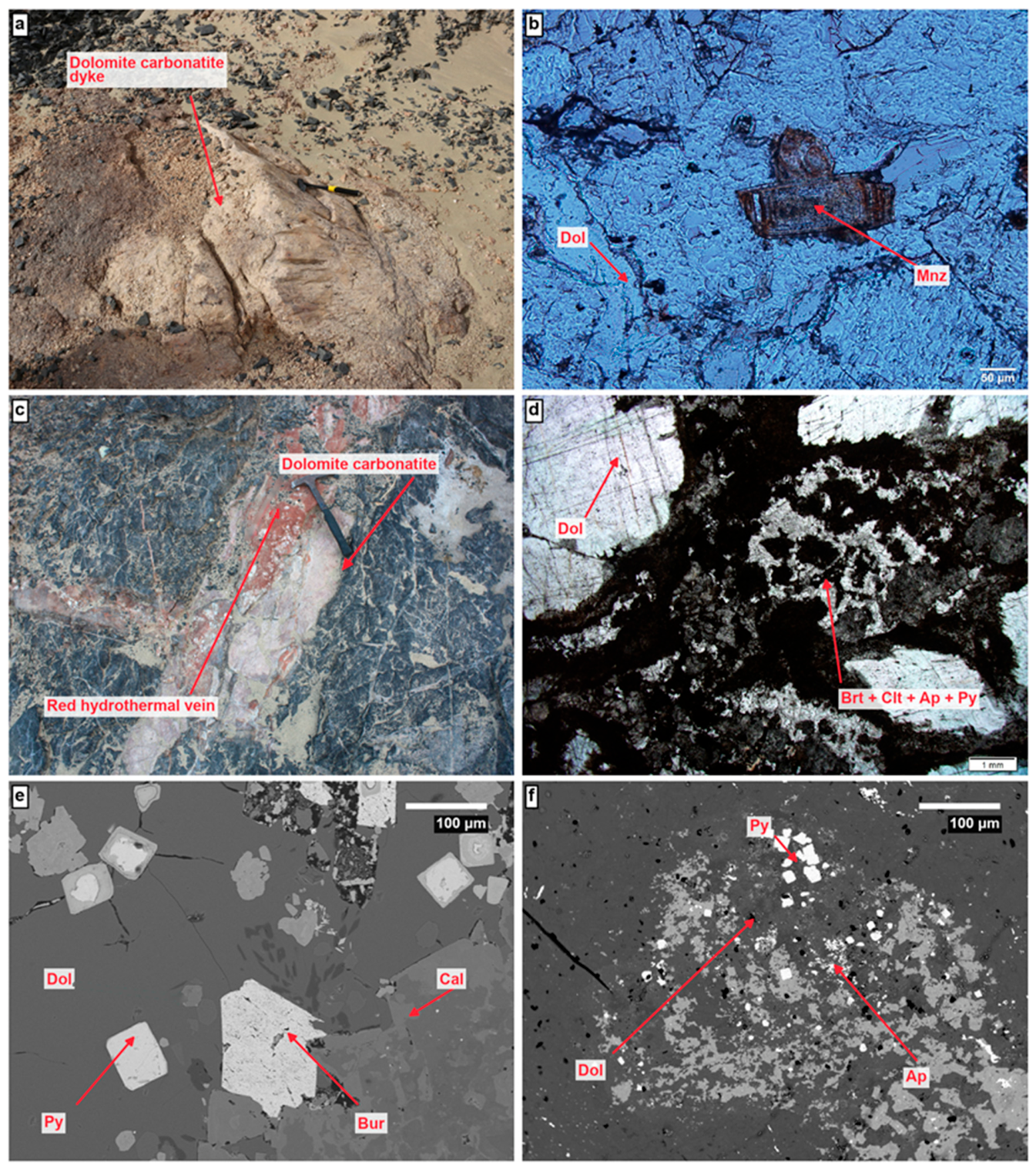
Carbonatite dykes constitute an integral component of the Wajilitage complex and serve as the principal host for REE mineralization. They are predominantly emplaced within the layered mafic–ultramafic intrusions, particularly pyroxenite and gabbro. These dykes define a ring-like system around the mafic–ultramafic body, forming an east–west-trending carbonatite zone that extends for several kilometers (Figure 1c). Individual dykes range from narrow veins to meter-scale bodies and dip steeply (70–80°) inward toward the complex interior [15]. Later diabase dykes crosscut the carbonatite dykes; combined with the emplacement ages of the layered mafic–ultramafic intrusions and the diabase dykes, this crosscutting relationship constrains the age of the carbonatite dykes to between 283 and 272 Ma [15]. This inference is corroborated by monazite U–Pb geochronology, which dates a ring-shaped carbonatite dyke at 272 Ma [10]. The carbonatite suite is dominated by dolomite carbonatite (Figure 2a), with subordinate calcite carbonatite; both varieties occur within the ring-like dyke system and are spatially associated. The adjacent wall rocks, mainly pyroxenite and gabbro, display local fenitization. The Bachu REE deposit is hosted by these carbonatite dykes. The deposit contains a measured resource of approximately 300,000 t of TREO [15]. Primary monazite-(Ce) and bastnäsite-(Ce) occur as euhedral or interstitial grains in the carbonatite (Figure 2b), together with apatite and accessory Nb-bearing minerals. Although the major carbonate minerals contain only tens to hundreds of ppm total REEs, the carbonatites as a whole are strongly enriched, indicating that carbonate fractionation concentrated REEs into the residual carbonatitic melt. A second and locally much higher-grade style of mineralization occurs as red REE-rich veins that cut the dolomite carbonatite (Figure 2c). These veins contain up to approximately 20 wt.% total REEs and are characterized by barite + celestine + fluorapatite + monazite-(Ce), with minor dolomite, pyrite, quartz, and magnetite (Figure 2d) [15]. Dolomite carbonatite and the red hydrothermal veins are the principal focus of this study.

3. Petrography

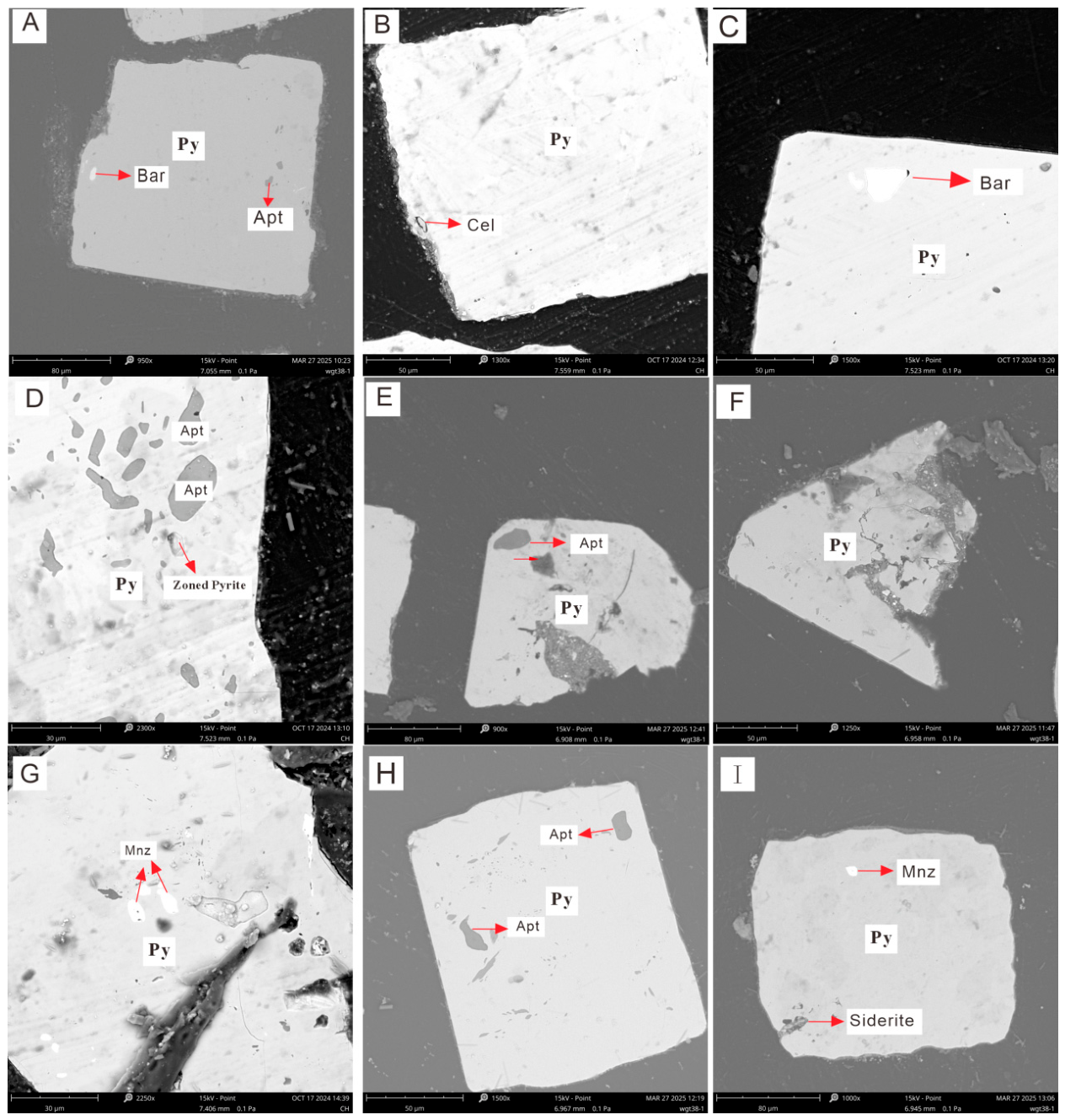
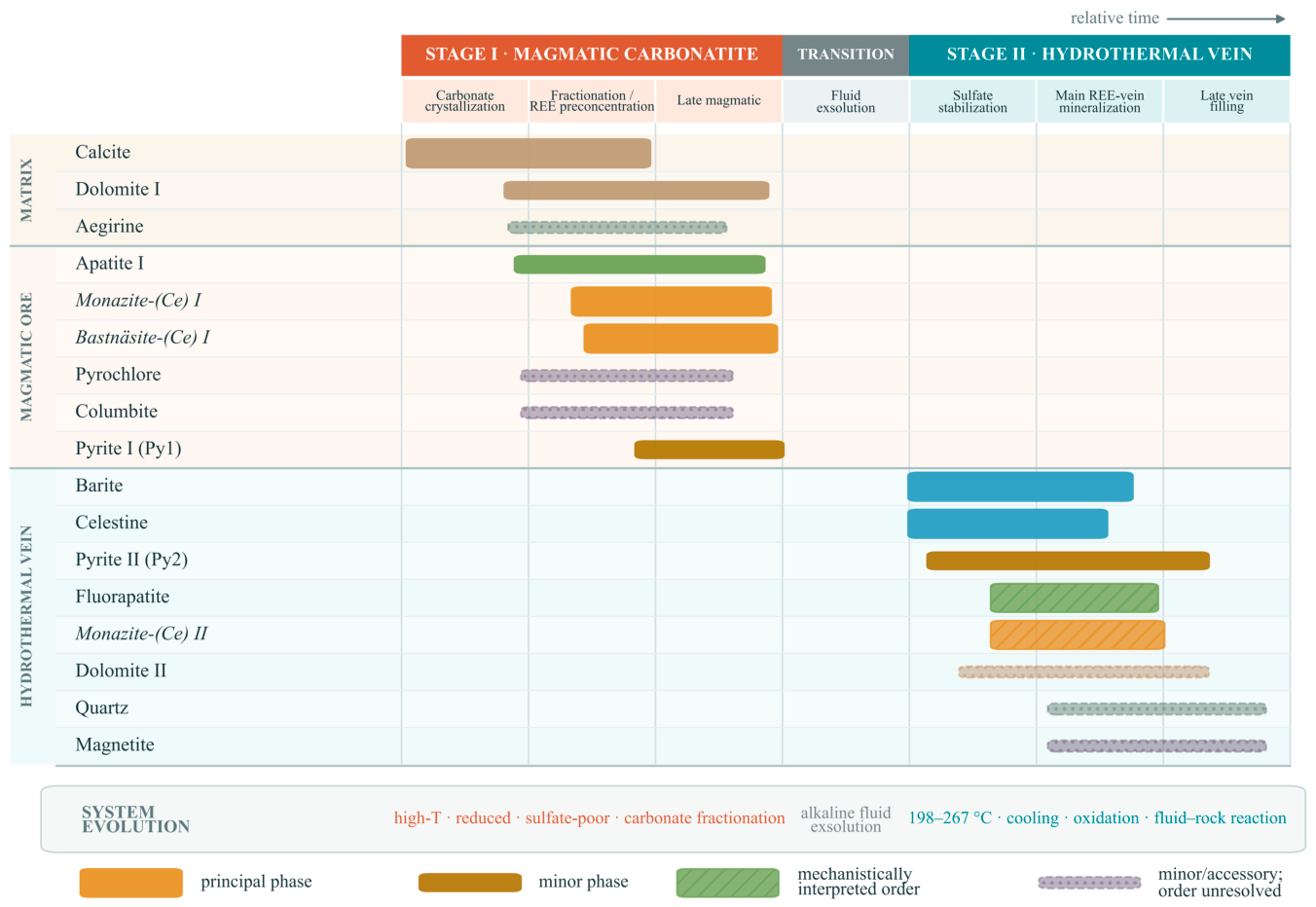
Dolomite carbonatite is composed predominantly of dolomite, with subordinate calcite and apatite and accessory aegirine, barite, celestine, pyrite, monazite, bastnäsite, pyrochlore, and columbite (Figure 2e,f). REE- and Nb-bearing minerals occur mainly as disseminated grains or irregular aggregates. The paragenetic sequence for minerals is shown in Figure 3. Based on the textural features and paragenetic relationships, pyrite can be divided into three distinct types: Type 1 coexists with hydrothermal minerals (barite, celestine) and locally contains apatite or sulfate inclusions (Figure 4a–d); Type 2 lacks direct association with sulfates but shows clear replacement textures (Figure 4e–g); and Type 3 is euhedral to subhedral and shows neither visible sulfate intergrowth nor replacement textures (Figure 4h,i). This diverse assemblage records a complex evolutionary history involving multiple magmatic and hydrothermal episodes. In pyrite-bearing samples, apatite is ubiquitous and exhibits two textural types: fine-grained granular aggregates (10–15 μm) surrounding pyrite crystals, and subordinate discrete irregular grains enclosed within pyrite. Sulfate minerals are also common: barite occurs as subhedral tabular, prismatic, or granular aggregates (30–60 μm), whereas celestine, with similar grain sizes, is predominantly hosted as inclusions within barite and appears gray in backscattered electron images. Monazite, a major rare earth phosphate mineral, forms subhedral crystals with sizes ranging from 50 to 200 μm. Backscattered electron (BSE) imaging confirms the intimate spatial association of these phases with pyrite.
In addition, millimeter- to centimeter-scale red hydrothermal veins, commonly irregular or banded, are locally developed within the dolomite carbonatite, often filling fractures in the dolomite-rich host rock. Their mineral assemblage is dominated by barite, celestine, fluorapatite, and monazite-(Ce), with minor dolomite, pyrite, quartz, and magnetite in some samples. The occurrence of these veins indicates a distinct hydrothermal stage during the REE mineralization process.

4. Materials and Methods

4.1. Electron Probe Microanalysis

Electron probe microanalysis (EPMA) was conducted at the State Key Laboratory of Geological Processes and Mineral Resources, China University of Geosciences, Beijing, China. Samples were collected from dolomite carbonatite and crosscutting red REE-rich hydrothermal veins. Polished sections were screened via optical microscopy and BSE imaging, and analytical domains were selected to (i) represent the three pyrite textural types, (ii) preserve associations with carbonate, apatite, barite, celestine, and monazite-(Ce), (iii) avoid cracks and weathered surfaces, and (iv) exclude visible mineral inclusions from quantitative spots. A total of 45 pyrite spots and 9 barite spots were analyzed. The instrument used was a Shimadzu EPMA-1720 (Shimadzu Corporation, Kyoto, Japan). For oxide minerals, the operating conditions were 15 kV accelerating voltage, 20 nA beam current, 5 μm beam diameter, and 20 s peak counting time. For sulfides, the corresponding conditions were 20 kV, 10 nA, 5 μm, and 20 s. Natural and synthetic silicate standards were used for oxide phases, whereas natural sulfides and pure metals were used for sulfides.

4.2. LA-ICP-MS Trace-Element Analysis

Trace-element analyses of 45 pyrite grains were performed at the State Key Laboratory of Geological Processes and Mineral Resources, China University of Geosciences, Beijing, China. The laser ablation system employed was an Analyte Excite 193 nm ArF excimer laser (Teledyne Cetac Technologies, Omaha, NE, USA), coupled with an Agilent 7700x quadrupole inductively coupled plasma mass spectrometer (ICP-MS, Agilent Technologies, Santa Clara, CA, USA). Prior to analysis, all sample points were pre-ablated using a large beam diameter to remove any potential surface contamination. During analysis, the background gas signal was collected for 15 s, followed by laser ablation for 40 s with a beam diameter of 40 μm, a repetition rate of 5 Hz, and an energy density of 6.06 J/cm2. The aerosol generated during ablation was transported by helium carrier gas, mixed with argon as the make-up gas, and introduced into the ICP-MS for analysis. The USGS standard glasses BCR-2G (USGS, Reston, VA, USA) [35] and SRM 610 (NIST, Gaithersburg, MD, USA) [36] were used as external calibration standards. Elemental concentrations were quantified using the external-/internal-standard method, with iron (Fe) as the internal standard on the basis of EPMA analyses. Data reduction was performed using Iolite software (v4, Elemental Scientific Inc., Omaha, NE, USA) [37].

4.3. In Situ Sulfur Isotope Analysis

In situ sulfur isotope (δ34S) analysis of 45 pyrite grains and 59 barite grains was conducted at the Institute of Mineral Resources, Chinese Academy of Geological Sciences, using a laser ablation multi-collector inductively coupled plasma mass spectrometer (LA-MC-ICP-MS, Nu Instruments Ltd. and Teledyne CETAC Technologies, Wrexham, UK). The laser ablation system was an Analyte Excite 193 nm ArF excimer laser (Teledyne Cetac Technologies), featuring ultra-short pulse durations (<4 ns) and high energy density (up to 15 J/cm2), enabling efficient ablation of sulfide minerals. The mass spectrometer was a Nu Plasma II MC-ICP-MS (Nu Instruments Ltd., Wrexham, UK). Prior to analysis, all sample points were pre-ablated using a large beam diameter to remove surface contamination. During analysis, the background gas signal was collected for 40 s, followed by laser ablation for 35 s with a beam diameter of 33 μm and a repetition rate of 5 Hz. The sample aerosol was transported by helium carrier gas mixed with argon and introduced into the MC-ICP-MS. To ensure data accuracy and reliability, the “standard–sample–standard” bracketing method was employed for calibration. The pyrite standard MXG was used as the external standard, with analyses performed after every four unknown sample measurements to maintain consistent calibration. MXG is an in-house pyrite (FeS2) reference material with a conventional gas-source isotope-ratio mass spectrometry value of δ34SV-CDT = −0.35 ± 0.29‰ (2 SD); independent LA-MC-ICP-MS measurements yielded −0.26 ± 0.37‰ (2 SD, n = 21), consistent within uncertainty [38,39]. Sulfur isotope ratios are reported as δ34S values in permil (‰) relative to Vienna Canyon Diablo Troilite (V-CDT).

5. Result

5.1. Major-Element Geochemistry of Minerals

5.1.1. Pyrite

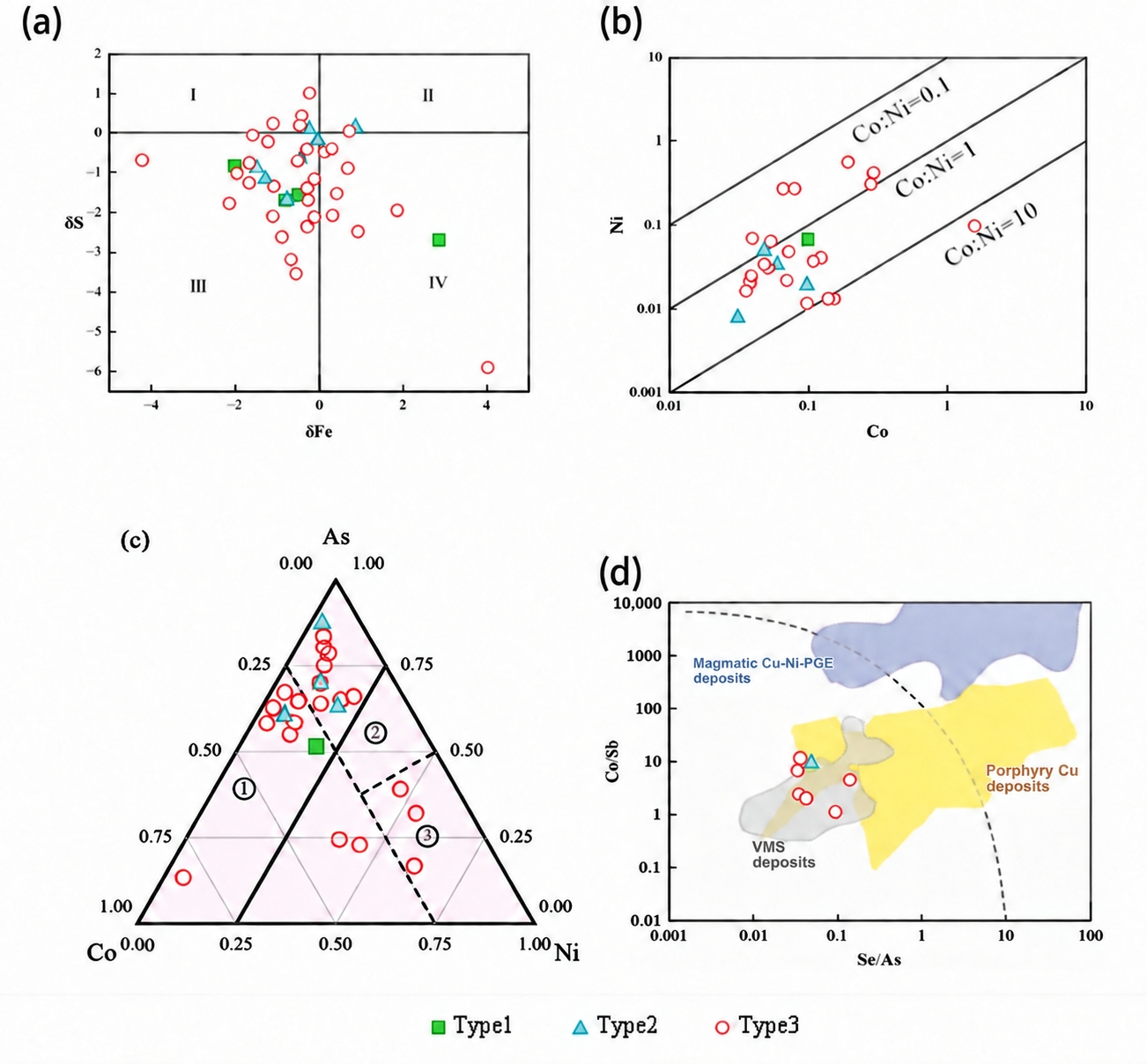
The major-element compositions of pyrite from the Bachu REE deposit are presented in Table S1, and a summary table is provided in Table 1. Fe contents of Type 1, Type 2 and Type 3 range from 45.6 to 47.9 wt.%, 44.0 to 47.0 wt.%, and 44.6 to 48.4 wt.%, respectively, while their S contents vary from 52.0 to 53.0 wt.%, 52.6 to 53.6 wt.%, and 50.3 to 54.0 wt.%. To evaluate stoichiometric characteristics and assess potential element substitution or lattice deficiencies, we employed the parameters δFe and δS, which quantify deviations of measured Fe and S concentrations from their theoretical values in ideal pyrite (FeS2; theoretical Fe = 46.55 wt%, S = 53.45 wt%). These parameters were calculated in accordance with [20], using the following equations:
δ F e = F e 46.55 46.55 × 100
δ S = S 53.45 53.45 × 100
As shown in Table S1 and Figure 5a, the three texturally distinct pyrite types display systematic differences in δFe and δS values. Type 1 and 2 pyrites are characterized by predominantly negative δFe and δS values, indicating slight depletion of Fe and S relative to the ideal stoichiometry, likely reflecting trace-element substitution or vacancy-related defects in the pyrite lattice. In contrast, Type 3 pyrite exhibits a distinctive bimodal distribution: one population shows negative δFe and δS values comparable to those of Types 1 and 2, whereas the other displays positive δFe or δS values, indicating Fe and/or S enrichment relative to stoichiometric pyrite.

5.1.2. Barite

Major-element compositions of barite are listed in Table S2. The analyzed grains exhibit relatively uniform compositions, with BaO ranges from 59.1 to 65.1 wt.%, CaO ranges from 0 to 0.07 wt.%, SrO ranges from 0.06 to 2.09 wt.%, and SO3 ranges from 34.5 wt.% to 37.6 wt.%. The dominance of Ba is consistent with the typical stoichiometry of barite. Notably, most crystals show pronounced isomorphous substitution, primarily involving the replacement of Ba by Sr and, to a lesser extent, Ca, as reflected in the significant SrO contents. This compositional variation indicates extensive solid solution along the barite–celestine (BaSO4–SrSO4) series.

5.2. Trace-Element Geochemistry of Pyrite

Trace-element concentrations of the three texturally distinct pyrite types are presented in Table S3, and a summary table is provided in Table 1. Most elements, including Cr, V, Ge, Mn, Cu, Te, Zn, Ca, Sb, and Se, are consistently low in abundance across all pyrite types, with no systematic enrichment or depletion. Arsenic (As) concentrations are relatively elevated but comparable among the three pyrite populations.
In contrast, cobalt (Co) and nickel (Ni) vary markedly (Figure 5b). Type 1 pyrite is characterized by uniformly low Co and Ni contents, with Co ranging from 304 to 994 ppm and Ni at ~ 662 ppm, and an average Co/Ni ratio of 1.30. Co and Ni contents of Type 2 pyrite are 310 to 1014 ppm and 81.76 to 500.33 ppm, with Co/Ni ratios ranging from 1.1 to 4.5. Type 3 pyrite contains variable Co and Ni concentrations, with Co ranging from 355 to 15,718 ppm and Ni ranging from 116 to 5370 ppm, with a large Co/Ni distribution (Figure 5b): one population has low ratios (1–5), similar to those in Types 1 and 2, whereas the other is characterized by significantly elevated ratios (>5). This distribution suggests that Type 3 pyrite may record two distinct generations or formation conditions.
Collectively, the EPMA and LA-ICP-MS data demonstrate that Type 3 pyrite is characterized by bimodal distributions of δFe–δS values, Co/Ni ratios, and δEu–δCe values, indicating that it comprises two genetically distinct subpopulations.

5.3. Sulfur Isotope Geochemistry

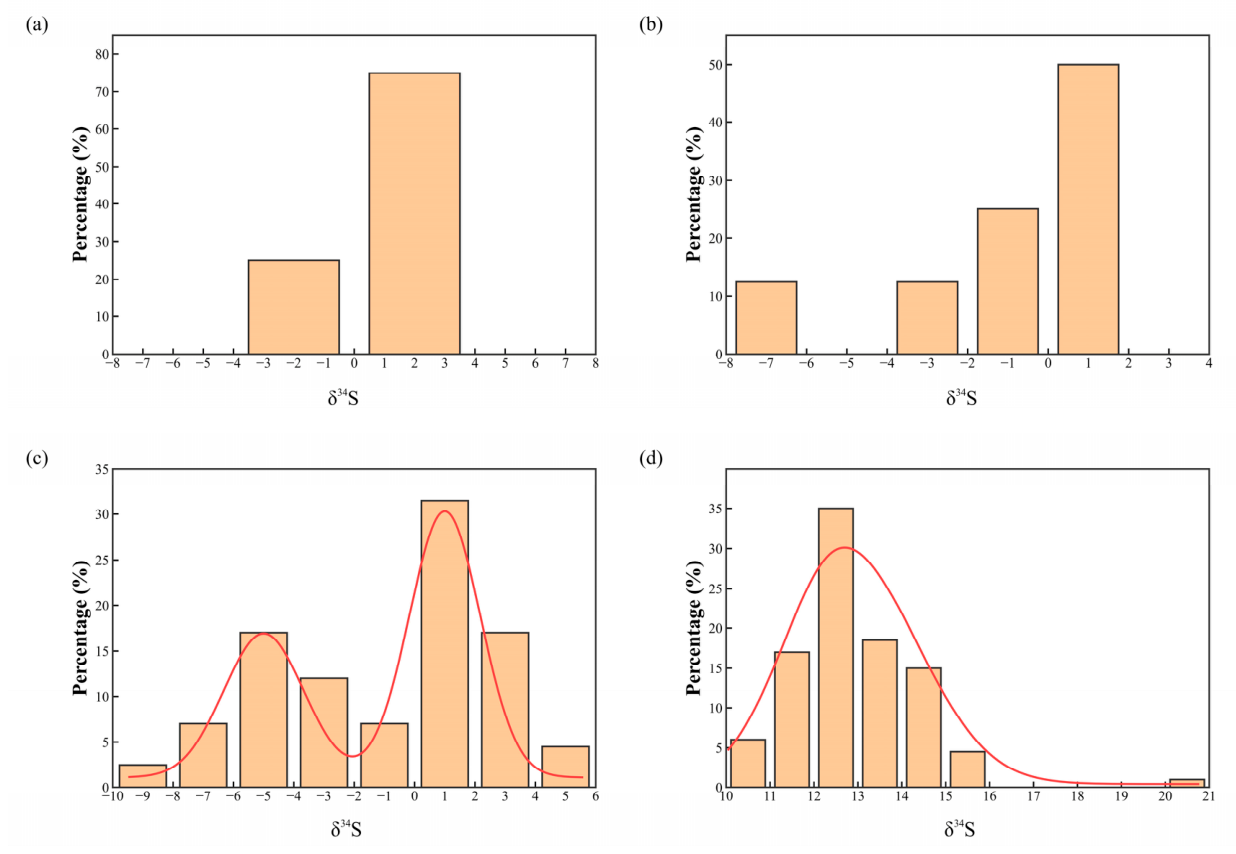
In situ sulfur isotope compositions of pyrite, determined by LA-MC-ICP-MS, are presented in Table S4 and Figure 6. The δ34S values vary systematically among the three texturally distinct pyrite types, providing critical constraints on sulfur sources and fluid evolution. Types 1 and 2 pyrites yield consistently negative to weakly positive δ34S values, predominantly below +3‰ (Figure 6a,b), with a narrow overall range that suggests a homogeneous sulfur source and limited isotope fractionation during precipitation. In marked contrast, Type 3 pyrite displays a striking bimodal δ34S distribution, with values ranging from −8.49‰ to +4.67‰ (Figure 6c). One subpopulation shows negative to weakly positive values (<+3‰), comparable to those of Types 1 and 2, whereas the other subpopulation is characterized by distinctly elevated values (>+3‰). This bimodality mirrors the observed patterns of Co/Ni ratios, δFe–δS systematics, and REE anomalies, indicating that Type 3 pyrite comprises two genetically distinct subpopulations: one sharing affinities with hydrothermal pyrite (Types 1 and 2) and another recording a magmatic stage.
To further constrain the hydrothermal sulfur budget, in situ sulfur isotope analyses were performed on 58 barite grains from six representative hydrothermal vein samples (Table S5; Figure 6d). Barite δ34S values are remarkably consistent, ranging from 10.46‰ to 15.94‰ (mean 12.82‰). These high sulfate values contrast with the negative to weakly positive values of coexisting pyrite and record sulfate–sulfide isotope fractionation.

6. Discussion

6.1. Classification of Pyrite Types and Discrimination Criteria

Petrographic observations reveal that a subset of pyrite grains exhibit textural evidence of hydrothermal alteration, including anhedral morphologies, variable crystallinity, and association with hydrothermal mineral assemblages. Traditionally, magmatic pyrite is characterized by euhedral habits and the absence of sulfate minerals, reflecting high-temperature, reduced conditions with elevated sulfur fugacity. In contrast, hydrothermal pyrite typically displays poor crystallinity and coexists with hydrothermal minerals, owing to overprinting under more oxidized conditions [22,40,41,42]. However, recent studies have demonstrated that well-crystallized pyrite can also form under high oxygen fugacity [43,44,45,46], rendering textural criteria alone insufficient for genetic classification. Therefore, an integrated petrographic and geochemical approach is required.
Previous work has established that the Bachu deposit records both magmatic and hydrothermal mineralization stages [15,47]. On the basis of our integrated dataset, we classify pyrite into two genetic populations: magmatic pyrite (Py1) and hydrothermal pyrite (Py2). Types 1 and 2 pyrite, characterized by clear hydrothermal alteration features and association with sulfate minerals, are directly assigned to the hydrothermal stage (Py2). Type 3 pyrite, however, exhibits well-developed euhedral forms yet displays bimodal distributions of multiple geochemical proxies—including Co/Ni ratios, δFe–δS values, and δ34S compositions—and thus requires further subdivision into magmatic (Py1) and hydrothermal (Py2) subpopulations.
To establish robust discrimination criteria, we employed several geochemical parameters sensitive to pyrite formation conditions. The stoichiometric deviation parameters δFe and δS, calculated using Equations (1) and (2), provide insights into element substitution and lattice defects. Hydrothermal pyrite is typically depleted in sulfur (δS < 0), reflecting isomorphous substitution of S2− by As3− and Sb3− [48,49,50]. The widely used Co/Ni ratio provides a complementary genetic indicator [20,51,52]. Sedimentary pyrite typically contains less than 100 ppm Co and Ni and has Co/Ni ratios below 1, whereas hydrothermal pyrite contains approximately 100–5000 ppm Co and Ni, with Co/Ni ratios predominantly between 1 and 5. Volcanic-related pyrite generally contains more than 5000 ppm Co, relatively little Ni, and Co/Ni ratios above 5 and commonly above 10 [20,53].
Because Co/Ni alone may not unambiguously distinguish hydrothermal pyrite [51], the Co–Ni–As ternary diagram can be used to provide an additional constraint (Figure 5c). Magmatic pyrite is generally enriched in Co and Se but depleted in Sb and As [23,24], whereas hydrothermal pyrite shows the opposite tendency [21,25,26,27]. The Co/Sb-versus-Se/As diagram [21,28] was also applied and identifies hydrothermal affinities among the available Type 2 and Type 3 grains (Figure 5d).
By integrating the δFe–δS plot, Co/Ni ratios, Co–Ni–As ternary diagram, and Co/Sb-versus-Se/As diagram with the petrographic observations, we can assign the analyzed pyrite grains to magmatic Py1 or hydrothermal Py2. This classification provides the framework for interpreting ore-forming processes and material sources in the Bachu deposit.

6.2. Involvement of Crustal Sulfur

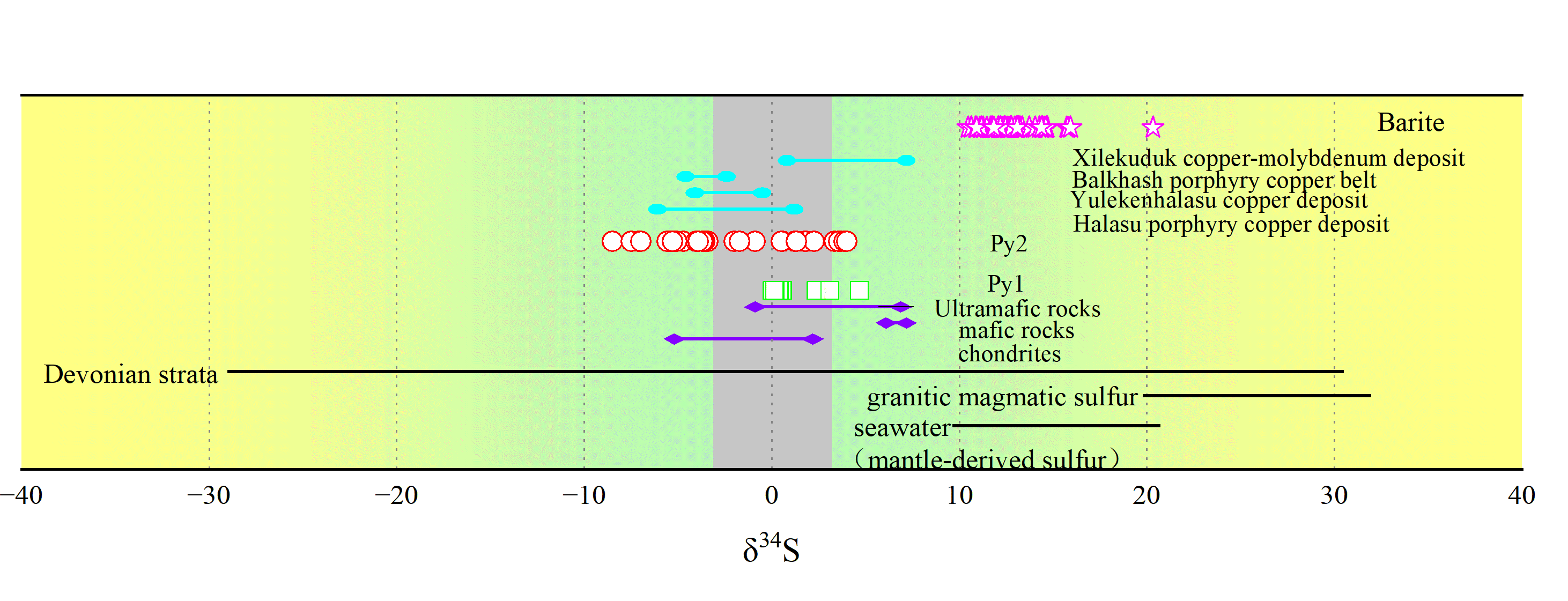
Sulfur isotope compositions (δ34S) provide robust constraints on sulfur sources and fluid evolution in magmatic–hydrothermal systems. In geological reservoirs, mantle- and magmatic-derived sulfur typically exhibits δ34S values near 0‰ (commonly within ±2‰), whereas sedimentary, metamorphic, seawater, and mixed sulfur reservoirs show markedly wider or distinctively positive isotopic ranges [54,55,56,57,58] (Figure 7). This isotopic framework offers a fundamental reference for interpreting the sulfur geochemistry of the Bachu REE deposit.
Magmatic-stage pyrite (Py1) from the Bachu deposit is characterized by a sulfide-only assemblage, lacking sulfate minerals such as barite or celestine. This mineralogical simplicity indicates that sulfur in the magmatic fluid existed predominantly as reduced S2−. In the absence of sulfate phases that would preferentially incorporate 34S, the δ34S values of Py1 can be taken as a reliable proxy for the total sulfur isotope composition of the magmatic system, particularly given the limited isotope fractionation between sulfides and the melt at high magmatic temperatures.
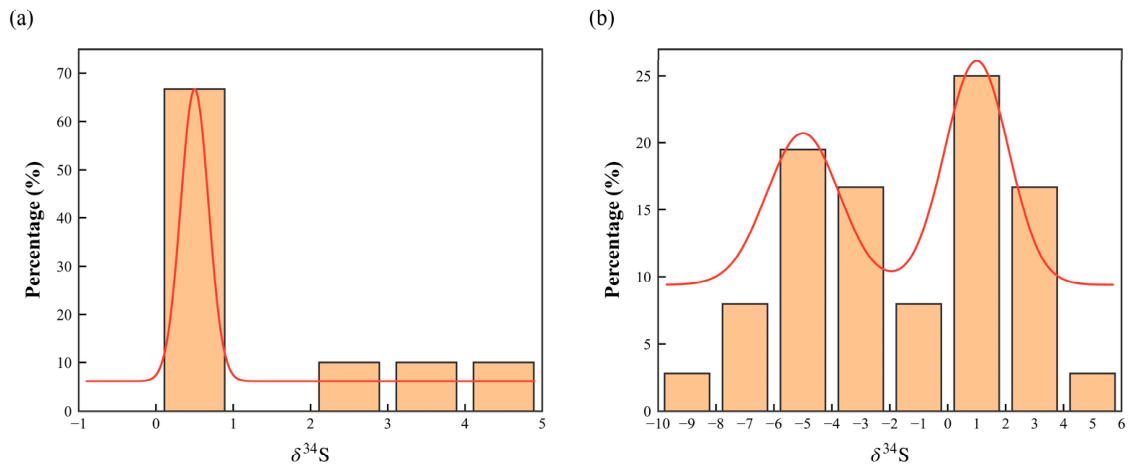
Py1 exhibits uniformly positive δ34S values ranging from 0.03‰ to 4.67‰, with a prominent peak at 1.30‰ (Figure 8a). Although falling within the typical range of magmatic sulfur, these values are systematically higher than the canonical mantle signature (0 ± 2‰; [57]) and lack negative values. This positive offset cannot be attributed to equilibrium fractionation with coexisting sulfates—a process known to drive sulfide δ34S to negative values—because such phases are absent in the magmatic assemblage. Instead, the 34S enrichment points to a sulfur source that was inherently heavier than the pristine mantle. Notably, similar positive shifts have been documented in other magmatic systems, such as the Xilekuduk Cu–Mo deposit (δ34S = +0.4‰ to +7.6‰, average +4.1‰), and attributed to the involvement of crustal sulfur [59] (Figure 7).
The positive δ34S signature of Py1 thus provides potential evidence for crustal contamination of mantle-derived magmas [60]—an interpretation consistent with the broader Permian tectonic framework of the TLIP. Previous studies have proposed that the Wajilitag region experienced an interaction between a mantle plume and subduction-recycled oceanic crust [61], which could introduce subducted crustal materials with elevated δ34S values into the mantle source. Subducted sedimentary rocks and hydrothermally altered oceanic crust are known carriers of 34S-enriched sulfur due to seawater sulfate incorporation; their recycling into the mantle would impart a heavier isotopic signature to subsequent magmatic sulfides. This model is independently corroborated by anomalous Sr–Nd–Mg–C–O isotope compositions in Wajilitage carbonatites, which have been interpreted as evidence of recycled carbonate components from subducted slabs [61].

6.3. Sulfur Isotope Fractionation During Hydrothermal Evolution

The widespread occurrence of barite and celestine in the hydrothermal assemblage marks a shift from the sulfate-poor Py1 stage toward conditions that stabilized oxidized sulfur. This mineralogical change is consistent with higher oxygen fugacity and introduces strong sulfate–sulfide isotope partitioning into the Py2 system [22,41,42,62,63]. The magnitude recorded by the minerals, however, depends on temperature, sulfur speciation, reaction time, fluid mixing, and the extent of isotopic exchange [63,64,65,66].
An individual sulfide or sulfate δ34S value does not automatically represent the bulk-fluid sulfur isotope composition (δ34SΣS). At equilibrium, 34S preferentially partitions into sulfate over sulfide; barite therefore records the sulfate reservoir, whereas pyrite records the reduced-sulfur reservoir from which it precipitated. Barite δ34S can approximate δ34SΣS only where oxidized sulfur dominates total dissolved sulfur and mineral–fluid equilibrium is demonstrated. Without paired cogenetic minerals and sulfur mass balance, the high barite values should not be treated as an unqualified proxy for total fluid sulfur [62,63,67].
The δ34S values of Py2 are bimodal, with peaks near +0.93‰ and −4.93‰ (Figure 8b), whereas those of barite range from 10.46‰ to 15.94‰. The separation between barite and the negative Py2 population is therefore approximately 15–20‰. Sakai and Dickson experimentally measured a 20.0 ± 0.2‰ fractionation between aqueous sulfate and sulfide at 300 °C and 1000 bar [64], demonstrating that an offset of this order is plausible under hydrothermal conditions. Kinetic modeling showed that exchange depends strongly on temperature, pH, sulfur concentration, and residence time [65], and later pyrite experiments at 300–350 °C indicated that rapid precipitation can initially preserve disequilibrium before recrystallization drives the system toward equilibrium [66]. Because the Bachu veins formed at 198–267 °C and the analyzed barite and pyrite spots are not strictly paired cogenetic analyses, the 15–20‰ offset is treated as evidence for substantial sulfate–sulfide fractionation rather than as a unique equilibrium geothermometer [63,64,65,66,67].
The appearance of sulfate minerals thus explains two key observations simultaneously: (1) the widespread precipitation of barite and (2) the pronounced negative δ34S excursion in a subset of Py2. The bimodal Py2 distribution can therefore be interpreted as recording two distinct hydrothermal pathways: the positive mode (+0.93‰) reflects pyrite precipitated from fluids that retained a magmatic sulfur signature, possibly in micro-domains isolated from the main sulfate precipitation event; the negative mode (−4.93‰) records precipitation from fluids that had undergone prior sulfate removal and consequent 34S depletion. This interpretation is consistent with the complex paragenetic relationships between barite and pyrite, which include both co-precipitation and sequential crystallization. This negative-dominated sulfur isotope signature is not unique to the Bachu deposit; analogous patterns are widely documented in magmatic–hydrothermal systems, such as the Halasu porphyry Cu deposit (δ34S = −6.5‰ to −1.6‰, peak at −3.5‰) [68], the Yulekenhalasu Cu deposit (−4.5‰ to −0.1‰, peak at −3‰) [69], and the Balkhash porphyry Cu belt in Kazakhstan (bimodal peaks at −2.5‰ and −4.5‰; Figure 7) [70,71], further supporting the interpretation that intra-system sulfate–sulfide fractionation is a common process in oxidized hydrothermal systems.
Collectively, these observations demonstrate that the negative δ34S values in Py2 do not reflect a change in sulfur source (e.g., sedimentary sulfur) but rather record the isotopic fingerprint of oxidation-driven fluid evolution within a magmatic–hydrothermal system. This finding underscores the critical importance of considering intra-system fractionation processes when interpreting sulfur isotope data from deposits that preserve a transition from magmatic to hydrothermal conditions; it also highlights the role of redox change as a key driver of sulfate saturation and isotopic diversification during REE mineralization.

6.4. Pyrite Crystallization as a Mineral-Scale Indicator of REE Mineralization

The significance of pyrite for REE mineralization at Bachu derives from the temporal and process correspondence among pyrite generations, sulfur speciation, and REE-bearing mineral assemblages. Independent petrographic, mineralogical, fluid-inclusion, and stable-isotope evidence defines two principal REE-forming stages at Bachu: crystallization and fractionation of REE-rich carbonatite magma, followed by exsolution and circulation of a lower-temperature hydrothermal fluid that formed red REE-rich veins [72,73,74]. The Py1–Py2 transition identified in this study follows the same sequence and provides an independent sulfide-mineral record of that ore-forming evolution.
Py1 records the early, comparatively reduced carbonatite stage. Its euhedral morphology, sulfide-only assemblage, relatively Co-rich trace-element character, and near-magmatic δ34S values indicate crystallization before the widespread stabilization of sulfate. At the deposit scale, this stage corresponds to carbonatite fractionation and the occurrence of primary euhedral monazite-(Ce), bastnäsite-(Ce), and apatite [72,73,74]. Because dolomite and calcite themselves contain relatively little REE content, their crystallization increased REE concentrations in the residual carbonatitic melt, a pattern independently quantified by mineral-scale mass-balance studies of other carbonatites [75]. Py1 is not inferred to have sequestered these REEs; instead, its crystallization records the sulfur-bearing magmatic environment in which REE preconcentration and primary REE-mineral formation took place.
Py2 records the subsequent hydrothermal reworking of this magmatic inventory. It displays replacement textures and/or occurs with barite and celestine, and it belongs to the same paragenetic interval as fluorapatite and monazite-(Ce) in the red REE-rich veins. The appearance of abundant sulfate minerals, together with the contrast between isotopically heavy barite and the lighter Py2 population, is consistent with oxidation of the hydrothermal sulfur system and sulfate–sulfide isotope fractionation. These features link Py2 crystallization to the 198–267 °C vein-forming event evidenced by fluid inclusions [72,73,74], during which REEs were remobilized from the evolved carbonatite and locally reconcentrated in monazite- and apatite-bearing veins. Comparable natural systems show that sulfate- and halogen-rich carbonatitic fluids evolve through cooling, mixing, and fluid–rock reactions toward widespread REE deposition [72,76,77,78].
The pyrite–REE relationship is therefore mechanistic at the scale of fluid evolution, but not causal at the scale of a single mineral reaction. A consistent sequence is as follows: (i) carbonate fractionation enriched REEs in the residual melt; (ii) an evolved, alkaline carbonatitic fluid transported part of this REE inventory; (iii) cooling, oxidation, and fluid–rock interaction stabilized sulfate and produced the barite–celestine assemblage; and (iv) decreasing ligand capacity and the availability of phosphate and fluoride favored precipitation of monazite-(Ce), fluorapatite, and associated REE minerals. Experimental studies demonstrate that alkalis and carbonate complexes strongly enhance REE mobility from evolved carbonatitic melts into brine–melts and hydrothermal fluids [75,79]. Natural-system fluid data, mineral replacement textures, and mineral-scale mass balances independently document hydrothermal REE redistribution and precipitation [72,75,76,77,78]. The textures, trace elements, and δ34S values of Py2 record the same cooling and oxidation history and thus bracket the hydrothermal REE-mineralizing interval, even though pyrite itself is not the principal REE-bearing phase.
This relationship provides a testable criterion for exploring the Bachu system and analogous carbonatite-hosted deposits. Sulfate-poor assemblages dominated by Py1 indicate preservation of the early magmatic carbonatite stage, whereas replacement-textured Py2 associated with barite + celestine + fluorapatite + monazite-(Ce), lower Co/Ni signatures, and isotopically light sulfide reflects a stronger hydrothermal overprint and proximity to REE-rich veins. The present data demonstrate a paragenetic and physicochemical correlation between pyrite crystallization and REE mineralization.

7. Conclusions

The Bachu carbonatite-hosted REE deposit records an early magmatic stage followed by a hydrothermal stage, represented by two genetically distinct pyrite generations. Magmatic Py1 occurs as euhedral grains in sulfate-free sulfide assemblages and shows no replacement textures. Hydrothermal Py2 includes euhedral and replacement-textured grains within sulfate-bearing assemblages containing barite and celestine, recording subsequent hydrothermal overprinting.
Py1 has uniformly positive δ34S values and preserves a predominantly magmatic sulfur signature, possibly modified by recycled crustal components inherited from the mantle source. In contrast, Py2 displays a distinct bimodal δ34S distribution. Its positive mode largely retains the magmatic signature, whereas the negative mode records sulfate–sulfide fractionation during hydrothermal oxidation. The isotopic relationship between barite and Py2 supports the internal redistribution of magmatic sulfur without requiring an external sulfur source.
The two pyrite generations are closely related to the independently recognized stages of REE mineralization at Bachu. Py1 crystallized during carbonatite evolution, when carbonate fractionation promoted REE enrichment in the residual melt and the formation of primary monazite-(Ce), bastnäsite-(Ce), and apatite. In contrast, Py2 formed during the subsequent hydrothermal event, represented by the barite–celestine–fluorapatite–monazite-(Ce) assemblage in the red REE-rich veins. The transition from Py1 to Py2 therefore records the cooling and oxidation of the ore-forming system, together with a shift from sulfide-dominated magmatic conditions to sulfate-rich hydrothermal conditions under which REEs were remobilized and locally reprecipitated. Pyrite is not the principal REE host or the direct cause of REE-mineral precipitation, but it records the transition between these two metallogenic stages.
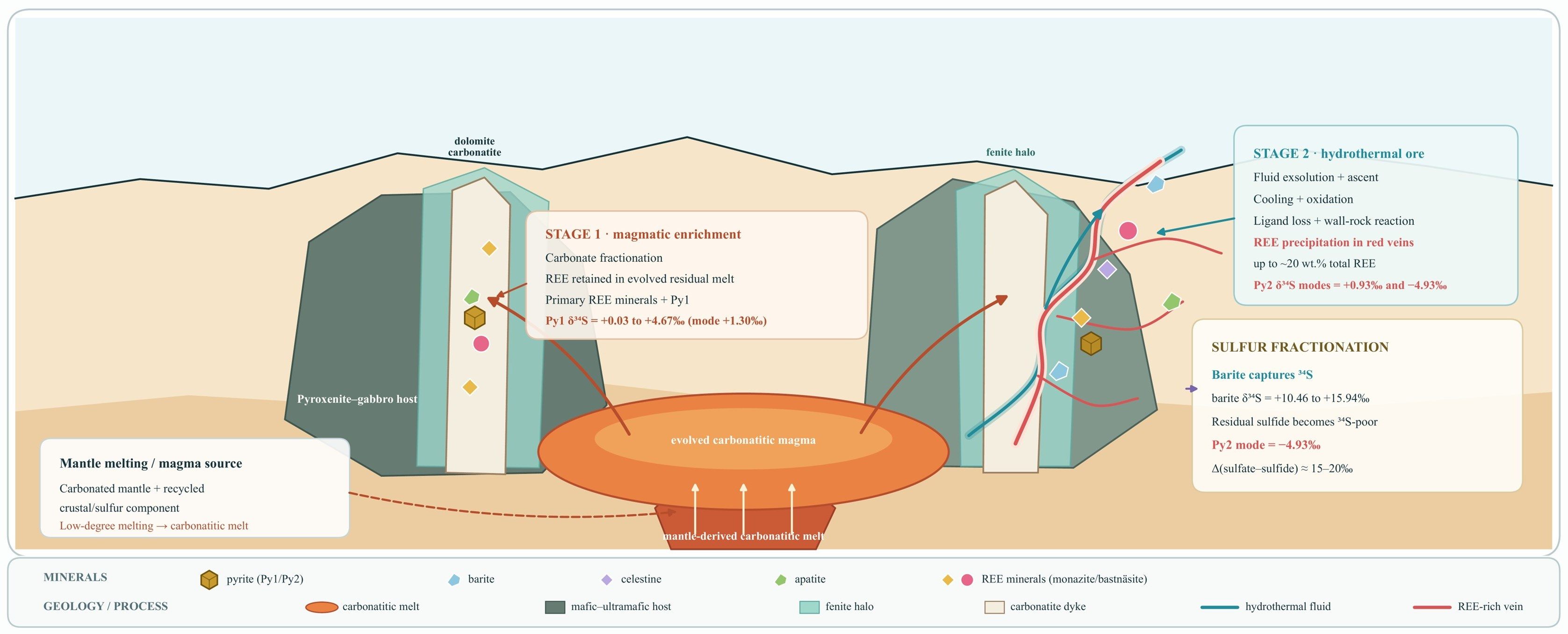
Collectively, these results support a two-stage model for the Bachu REE deposit (Figure 9). During the first stage, mantle-derived carbonatitic melts influenced by recycled crustal components underwent fractionation, precipitating Py1 and primary REE minerals while progressively concentrating REEs in the residual melt. During the second stage, exsolved hydrothermal fluids cooled and became more oxidized, leading to the formation of Py2, barite, celestine, fluorapatite, and monazite-(Ce), accompanied by REE remobilization and high-grade vein mineralization. The textures, trace-element compositions, and sulfur isotope signatures of pyrite therefore provide a mineral-scale record linking mantle-source inheritance, carbonatite differentiation, and hydrothermal REE concentration. This integrated interpretation clarifies the implications of pyrite crystallization for the genesis of carbonatite-hosted REE deposits and provides a potential mineralogical and geochemical criterion for recognizing hydrothermal overprinting and vectoring towards REE-rich veins.

Supplementary Materials

The following supporting information can be downloaded at: https://www.mdpi.com/article/10.3390/min16090952/s1, Table S1: Electron microprobe data of major elements in pyrite from the Bachu carbonatite REE deposit (wt.%); Table S2: Electron microprobe data of major elements in barite from the Bachu carbonatite REE deposit (wt.%); Table S3: Trace element data of pyrite from the Bachu carbonatite REE deposit (ppm); Table S4: Sulfur isotope data of pyrite from the Bachu carbonatite REE deposit; Table S5:Sulfur isotope data of Barite from the Bachu carbonatite REE deposit.

Author Contributions

Conceptualization, Z.C.; Methodology, Z.C. and X.F.; Formal Analysis, Y.D. and X.F.; Investigation, Y.D., Z.C. and X.F.; Resources, Z.C.; Data Curation, Y.D.; Writing—Original Draft Preparation, Y.D.; Writing—Review & Editing, Z.C. and Z.Z.; Visualization, Y.D. and X.F.; Supervision, Z.C. and Z.Z.; Project Administration, Z.C. and Z.Z.; Funding Acquisition, Z.C. and Z.Z. All authors have read and agreed to the published version of the manuscript.

Funding

This work was financially supported by the Deep Earth Probe and Mineral Resources Exploration–National Science and Technology Major Project (2024ZD1003402) and National Natural Science Foundation of China (92479210).

Data Availability Statement

The original contributions presented in this study are included in the Supplementary Material. Further inquiries can be directed to the corresponding author.

Conflicts of Interest

The authors declare no conflicts of interest.

References

  1. Anenburg, M.; Broom-Fendley, S.; Chen, W. Formation of Rare Earth Deposits in Carbonatites. Elements 2021, 17, 327–332. [Google Scholar] [CrossRef] [Scilit]
  2. Kanazawa, Y.; Kamitani, M. Rare earth minerals and resources in the world. J. Alloys Compd. 2006, 408–412, 1339–1343. [Google Scholar] [CrossRef] [Scilit]
  3. Yaxley, G.M.; Anenburg, M.; Tappe, S.; Decree, S.; Guzmics, T. Carbonatites: Classification, Sources, Evolution, and Emplacement. Annu. Rev. Earth Planet. Sci. 2022, 50, 261–293. [Google Scholar] [CrossRef] [Scilit]
  4. Woolley, A.R.; Kjarsgaard, B.A. Paragenetic types of carbonatite as indicated by the diversity and relative abundances of associated silicate rocks: Evidence from a global database. Can. Mineral. 2008, 46, 741–752. [Google Scholar] [CrossRef] [Scilit]
  5. Gittins, J.; Mitchell, R.H. The genesis of calcite and dolomite carbonatite-forming magma by liquid immiscibility: A critical appraisal. Geol. Mag. 2023, 160, 1463–1480. [Google Scholar] [CrossRef] [Scilit]
  6. Anenburg, M.; Walters, J.B. Metasomatic ijolite, glimmerite, silicocarbonatite, and antiskarn formation: Carbonate and silicate phase equilibria in the system Na2O–CaO–K2O–FeO–MgO–Al2O3–SiO2–H2O–O2–CO2. Contrib. Mineral. Petrol. 2024, 179, 40. [Google Scholar] [CrossRef] [Scilit]
  7. Broom-Fendley, S.; Brady, A.E.; Wall, F.; Gunn, G.; Dawes, W. REE minerals at the Songwe Hill carbonatite, Malawi: HREE-enrichment in late-stage apatite. Ore Geol. Rev. 2017, 81, 23–41. [Google Scholar] [CrossRef] [Scilit]
  8. Walter, B.F.; Giebel, R.J.; Steele-MacInnis, M.; Marks, M.A.W.; Kolb, J.; Markl, G. Fluids associated with carbonatitic magmatism: A critical review and implications for carbonatite magma ascent. Earth Sci. Rev. 2021, 215, 103509. [Google Scholar] [CrossRef] [Scilit]
  9. Chakhmouradian, A.R.; Zaitsev, A.N. Rare Earth Mineralization in Igneous Rocks: Sources and Processes. Elements 2012, 8, 347–353. [Google Scholar] [CrossRef] [Scilit]
  10. Song, W.L.; Xu, C.; Chakhmouradian, A.R.; Kynicky, J.; Huang, K.J.; Zhang, Z.L. Carbonatites of Tarim (NW China): First evidence of crustal contribution in carbonatites from a large igneous province. Lithos 2017, 282–283, 1–9. [Google Scholar] [CrossRef] [Scilit]
  11. Anenburg, M.; Mavrogenes, J.A.; Frigo, C.; Wall, F. Rare earth element mobility in and around carbonatites controlled by sodium, potassium, and silica. Sci. Adv. 2020, 6, eabb6570. [Google Scholar] [CrossRef] [Scilit] [PubMed]
  12. Louvel, M.; Etschmann, B.; Guan, Q.; Testemale, D.; Brugger, J. Carbonate complexation enhances hydrothermal transport of rare earth elements in alkaline fluids. Nat. Commun. 2022, 13, 1456. [Google Scholar] [CrossRef] [Scilit] [PubMed]
  13. Yuan, X.; Zhong, R.; Xiong, X.; Gao, J.; Ma, Y. Transition from carbonatitic magmas to hydrothermal brines: Continuous dilution or fluid exsolution? Sci. Adv. 2023, 9, eadh0458. [Google Scholar] [CrossRef] [Scilit] [PubMed]
  14. Yuan, X.; Yang, Z.; Mayanovic, R.A.; Hou, Z. Experimental evidence reveals the mobilization and mineralization processes of rare earth elements in carbonatites. Sci. Adv. 2024, 10, eadm9118. [Google Scholar] [CrossRef] [Scilit] [PubMed]
  15. Cheng, Z.G.; Zhang, Z.C.; Aibai, A.; Kong, W.L.; Holtz, F. The role of magmatic and post-magmatic hydrothermal processes on rare-earth element mineralization: A study of the Bachu carbonatites from the Tarim Large Igneous Province, NW China. Lithos 2018, 314–315, 71–87. [Google Scholar] [CrossRef] [Scilit]
  16. Zheng, X.; Liu, Y.; Zhang, L. The role of sulfate-, alkali-, and halogen-rich fluids in mobilization and mineralization of rare earth elements: Insights from bulk fluid compositions in the Mianning–Dechang carbonatite-related REE belt, southwestern China. Lithos 2021, 386–387, 106008. [Google Scholar] [CrossRef] [Scilit]
  17. Shu, X.; Liu, Y. Fluid inclusion constraints on the hydrothermal evolution of the Dalucao carbonatite-related REE deposit, Sichuan Province, China. Ore Geol. Rev. 2019, 107, 41–57. [Google Scholar] [CrossRef] [Scilit]
  18. Ying, Y.-C.; Chen, W.; Simonetti, A.; Jiang, S.-Y.; Zhao, K.-D. Significance of hydrothermal reworking for REE mineralization associated with carbonatite: Constraints from in situ trace element and C–Sr isotope study of calcite and apatite from the Miaoya carbonatite complex (China). Geochim. Cosmochim. Acta 2020, 280, 340–359. [Google Scholar] [CrossRef] [Scilit]
  19. Beland, C.M.J.; Williams-Jones, A.E. The mineralogical distribution of the REE in carbonatites: A quantitative evaluation. Chem. Geol. 2021, 585, 120558. [Google Scholar] [CrossRef] [Scilit]
  20. Bajwah, Z.U.; Seccombe, P.K.; Offler, R. Trace element distribution, Co:Ni ratios and genesis of the Big Cadia iron-copper deposit, New South Wales, Australia. Miner. Depos. 1987, 22, 292–300. [Google Scholar] [CrossRef] [Scilit]
  21. Duran, C.J.; Barnes, S.J.; Corkery, J.T. Chalcophile and platinum-group element distribution in pyrites from the sulfide-rich pods of the Lac des Iles Pd deposits, Western Ontario, Canada: Implications for post-cumulus re-equilibration of the ore and the use of pyrite compositions in exploration. J. Geochem. Explor. 2015, 158, 223–242. [Google Scholar] [CrossRef] [Scilit]
  22. Hedenquist, J.W.; Lowenstern, J.B. The role of magmas in the formation of hydrothermal ore deposits. Nature 1994, 370, 519–527. [Google Scholar] [CrossRef] [Scilit]
  23. Dare, S.A.S.; Barnes, S.J.; Prichard, H.M.; Fisher, P.C. Chalcophile and platinum-group element (PGE) concentrations in the sulfide minerals from the McCreedy East deposit, Sudbury, Canada, and the origin of PGE in pyrite. Miner. Depos. 2011, 46, 381–407. [Google Scholar] [CrossRef] [Scilit]
  24. Djon, M.L.N.; Barnes, S.J. Changes in sulfides and platinum-group minerals with the degree of alteration in the Roby, Twilight, and High Grade zones of the Lac des Iles complex, Ontario, Canada. Miner. Depos. 2012, 47, 875–896. [Google Scholar] [CrossRef] [Scilit]
  25. Large, R.R.; Danyushevsky, L.; Hollit, C.; Maslennikov, V.; Meffre, S.; Gilbert, S.; Bull, S.; Scott, R.; Emsbo, P.; Thomas, H.; et al. Gold and trace element zonation in pyrite using a laser imaging technique: Implications for the timing of gold in orogenic and Carlin-style sediment-hosted deposits. Econ. Geol. 2009, 104, 635–668. [Google Scholar] [CrossRef] [Scilit]
  26. Thomas, H.V.; Large, R.R.; Bull, S.W.; Maslennikov, V.; Berry, R.F.; Fraser, R.; Froud, S.; Moye, R. Pyrite and pyrrhotite textures and composition in sediments, laminated quartz veins, and reefs at Bendigo Gold Mine, Australia: Insights for ore genesis. Econ. Geol. 2011, 106, 1–31. [Google Scholar] [CrossRef] [Scilit]
  27. Revan, M.K.; Genç, Y.; Maslennikov, V.V.; Maslennikova, S.P.; Large, R.R.; Danyushevsky, L.V. Mineralogy and trace-element geochemistry of sulfide minerals in hydrothermal chimneys from the Upper-Cretaceous VMS deposits of the Eastern Pontide Orogenic Belt (NE Turkey). Ore Geol. Rev. 2014, 63, 129–149. [Google Scholar] [CrossRef] [Scilit]
  28. Patten, C.G.C.; Pitcairn, I.K.; Teagle, D.A.H.; Harris, M. Sulphide mineral evolution and metal mobility during alteration of the oceanic crust: Insights from ODP Hole 1256D. Geochim. Cosmochim. Acta 2016, 193, 132–159. [Google Scholar] [CrossRef] [Scilit]
  29. Long, X.P.; Yuan, C.; Sun, M.; Zhao, G.C.; Xiao, W.J.; Wang, Y.J.; Yang, Y.H.; Hu, A.Q. Archean crustal evolution of the northern Tarim craton, NW China: Zircon U-Pb and Hf isotopic constraints. Precambrian Res. 2011, 180, 272–284. [Google Scholar] [CrossRef] [Scilit]
  30. Cheng, Z.G.; Zhang, Z.C.; Jin, Z.L.; Brzozowski, M.J. Petrogenetic Link Between Carbonatite and Silicate rocks in the Wajilitage Carbonatite Complex: Insights from in situ Geochemical and Isotope Analysis of Apatite and Calcite. J. Petrol. 2026, 67, egag011. [Google Scholar] [CrossRef] [Scilit]
  31. Xu, Y.G.; Wei, X.; Luo, Z.Y.; Liu, H.Q.; Gao, J. The Early Permian Tarim large igneous province: Main characteristics and a plume incubation model. Lithos 2014, 204, 20–35. [Google Scholar] [CrossRef] [Scilit]
  32. Yang, S.F.; Chen, H.L.; Li, Z.L.; Li, Y.Q.; Yu, X.; Li, D.X.; Meng, L.F. Early Permian Tarim Large Igneous Province in northwest China. Sci. China Earth Sci. 2014, 56, 2015–2026. [Google Scholar] [CrossRef] [Scilit]
  33. Zhong, Y.T.; Luo, Z.Y.; Mundil, R.; Wei, X.; Liu, H.Q.; He, B.; Huang, X.L.; Tian, W.; Xu, Y.G. Constraining the duration of the Tarim flood basalts (northwestern China): CA-TIMS zircon U-Pb dating of tuffs. Geol. Soc. Am. Bull. 2022, 134, 325–334. [Google Scholar] [CrossRef] [Scilit]
  34. Cheng, Z.; Zhang, Z.; Hou, T.; Santosh, M.; Zhang, D.; Ke, S. Petrogenesis of nephelinites from the Tarim Large Igneous Province, NW China: Implications for mantle source characteristics and plume–lithosphere interaction. Lithos 2015, 220, 164–178. [Google Scholar] [CrossRef] [Scilit]
  35. Rocholl, A. Major and Trace Element Composition and Homogeneity of Microbeam Reference Material: Basalt Glass USGS BCR-2G. Geostand. Newsl. 1998, 22, 33–45. [Google Scholar] [CrossRef] [Scilit]
  36. Pearce, N.J.G.; Perkins, W.T.; Westgate, J.A.; Gorton, M.P.; Jackson, S.E.; Neal, C.R.; Chenery, S.P. A Compilation of New and Published Major and Trace Element Data for NIST SRM 610 and NIST SRM 612 Glass Reference Materials. Geostand. Newsl. 1997, 21, 115–144. [Google Scholar] [CrossRef] [Scilit]
  37. Paton, C.; Hellstrom, J.; Paul, B.; Woodhead, J.; Hergt, J. Iolite: Freeware for the Visualisation and Processing of Mass Spectrometric Data. J. Anal. At. Spectrom. 2011. [Google Scholar] [CrossRef] [Scilit]
  38. Ma, X.H.; Zeng, Q.W.; Tao, S.Y.; Cao, R.; Zhou, Z.H. Mineralogical Characteristics and In-Situ Sulfur Isotopic Analysis of Gold-Bearing Sulfides from the Qilishan Gold Deposit in the Jiaodong Peninsula, China. J. Earth Sci. 2021, 32, 116–126. [Google Scholar] [CrossRef] [Scilit]
  39. Zhao, F.; Gao, W.; Huang, F.; Liu, B. Re-distribution and Upgrade of Metals Induced by the Superimposition of Later Magmatic Fluids in the Archean Hongtoushan VMS Deposit, NE China. Ore Geol. Rev. 2024, 167, 105997. [Google Scholar] [CrossRef] [Scilit]
  40. Yan, Y.T.; Li, S.R.; Jia, B.J.; Zhang, N.; Yan, L.N. Pyrite composition characteristics and statistical analysis of different types of gold deposits in China. Earth Sci. Front. 2012, 19, 214–226, (In Chinese with English abstract). [Google Scholar]
  41. Marini, L.; Principe, C.; Lelli, M. Closed-System Magma Degassing and Disproportionation of SO2 Revealed by Changes in the Concentration and δ34S Value of H2S(g) in the Solfatara Fluids (Campi Flegrei, Italy). Geosciences 2025, 15, 162. [Google Scholar] [CrossRef] [Scilit]
  42. Harlov, D.E.; Pokrovski, G.S. (Eds.) The Role of Sulfur in Planetary Processes: From Cores to Atmospheres; Springer Nature: Cham, Switzerland, 2026. [Google Scholar] [CrossRef] [Scilit]
  43. Liu, G.; Zhao, K.; Jiang, S. In-situ sulfur isotope and trace element analysis of pyrite from the Xiwang uranium ore deposit in South China: Implications for ore genesis. J. Geochem. Explor. 2018, 195, 49–65. [Google Scholar] [CrossRef] [Scilit]
  44. Lai, J.; Guo, X.W.; Liu, W.Q.; Jiang, W.B.; Wu, J.Y. Pyrite genesis and its implications for uranium metallogenesis in the Tangwan uranium deposit, Central Zhuguang. Geol. Rev. 2024, 70, 541–553, (In Chinese with English abstract). [Google Scholar]
  45. Xu, Y.; Lan, T.G.; Shu, L.; Hu, H.L.; Chen, Y.H.; Wang, H. Arsenic enrichment mechanism of pyrite in the Sanshandao gold deposit, Jiaodong, and its implications for gold metallogenesis. Miner. Depos. Geol. 2021, 40, 419–431, (In Chinese with English abstract). [Google Scholar]
  46. Huang, G.W.; Yu, F.C.; Pan, J.Y.; Chen, Z.L.; Wu, D.H.; Xue, W.W.; Song, T.Z.; Li, S.P. Genesis and characteristics of pyrite in the Mengqiguer uranium deposit, Ili Basin, and its implications for uranium metallogenesis. China Geol. 2021, 48, 507–519, (In Chinese with English abstract). [Google Scholar]
  47. Song, W.L.; Xu, C.; Smith, M.P.; Kynicky, J.; Yang, J.K.; Liu, T.T.; Jing, D.L. Origin of heavy rare earth element enrichment in carbonatites. Geochim. Cosmochim. Acta 2023, 362, 115–126. [Google Scholar] [CrossRef] [Scilit]
  48. Springer, G.; Schachner-Korn, D.; Long, J.V.P. Metastable solid solution relations in the system FeS2-CoS2-NiS2. Econ. Geol. 1964, 59, 475–491. [Google Scholar] [CrossRef] [Scilit]
  49. Riley, J.F. The cobaltiferous pyrite series. Am. Mineral. 1968, 53, 293–295. [Google Scholar]
  50. Boynton, W. Geochemistry of the rare earth elements: Meteorite studies. In Rare Earth Element Geochemistry; Henderson, P., Ed.; Elsevier: Amsterdam, The Netherlands, 1984; pp. 63–114. [Google Scholar]
  51. Song, X.X.; Zhang, J.K. Trace element characteristics of pyrite from various genesis types in China. In Collections of Papers of the Institute of Mineral Deposit Geology. China Geol. Surv. 1986, 18, 175–184, (In Chinese with English abstract). [Google Scholar]
  52. Duan, Z. The Mineralization and Mechanism of the Iron Skarn Deposits in Laiwu District, Shandong Province. Master’s Thesis, China University of Geosciences, Wuhan, China, 2019. (In Chinese with English abstract). [Google Scholar]
  53. Sun, S.S.; McDonough, W.F. Chemical and isotopic systematics of oceanic basalts: Implications for mantle composition and processes. Geol. Soc. Lond. Spec. Publ. 1989, 42, 313–345. [Google Scholar] [CrossRef] [Scilit]
  54. Ohmoto, H.; Rye, R.O. Isotopes of sulfur and carbon. In Geochemistry of Hydrothermal Ore Deposits; Barnes, H.L., Ed.; John Wiley & Sons: New York, NY, USA, 1979; pp. 509–567. [Google Scholar]
  55. Yin, G.; Ni, S.J. Isotope Geochemistry; Geological Publishing House: Beijing, China, 2009; (In Chinese with English abstract). [Google Scholar]
  56. Shan, L.; Zheng, Y.Y.; Xu, R.K.; Cao, L.; Zhang, Y.L.; Lian, Y.L.; Li, Y.H. Review on sulfur isotopic tracing and hydrothermal metallogenesis. Geol. Resour. 2009, 18, 197–203, (In Chinese with English abstract). [Google Scholar]
  57. Labidi, J.; Cartigny, P.; Morira, M. Non-chondritic sulphur isotope composition of the terrestrial mantle. Nature 2013, 501, 208–211. [Google Scholar] [CrossRef] [Scilit] [PubMed]
  58. Zhao, J.; Liang, J.L.; Han, B. The component analyses of Au-bearing minerals and the occurrence of gold in Shuiyindong and Yangshan Carlin-type gold deposits, China. Bull. Sci. Technol. 2017, 33, 24–31, (In Chinese with English abstract). [Google Scholar]
  59. Long, L.L.; Wang, J.B.; Wang, Y.W.; Wang, L.J.; Liao, Z.; Zhao, L.T.; Sun, Z.Y.; Gao, L.M. Sulfur isotope characteristics and metallogenic material sources of the Xilekuduk Cu-Mo deposit, Xinjiang. Acta Petrol. Sin. 2015, 31, 545–554, (In Chinese with English abstract). [Google Scholar]
  60. Hutchison, W.; Babiel, R.J.; Finch, A.A.; Marks, M.A.W.; Markl, G.; Boyce, A.J.; Stüeken, E.E.; Friis, H.; Borst, A.M.; Horsburgh, N.J. Sulphur isotopes of alkaline magmas unlock long-term records of crustal recycling on Earth. Nat. Commun. 2019, 10, 4208. [Google Scholar] [CrossRef] [Scilit] [PubMed]
  61. Cheng, Z.G.; Zhang, Z.C.; Hou, T.; Santosh, M.; Chen, L.L.; Ke, S.; Xu, L.J. Decoupling of Mg-C and Sr-Nd-O isotopes traces the role of recycled carbon in magnesiocarbonatites from the Tarim Large Igneous Province. Geochim. Cosmochim. Acta 2017, 202, 159–178. [Google Scholar] [CrossRef] [Scilit]
  62. Seal, R.R., II. Sulfur Isotope Geochemistry of Sulfide Minerals. Rev. Mineral. Geochem. 2006, 61, 633–677. [Google Scholar] [CrossRef] [Scilit]
  63. Rye, R.O. A Review of the Stable-Isotope Geochemistry of Sulfate Minerals in Selected Igneous Environments and Related Hydrothermal Systems. Chem. Geol. 2005, 215, 5–36. [Google Scholar] [CrossRef] [Scilit]
  64. Sakai, H.; Dickson, F.W. Experimental Determination of the Rate and Equilibrium Fractionation Factors of Sulfur Isotope Exchange between Sulfate and Sulfide in Slightly Acid Solutions at 300 °C and 1000 Bars. Earth Planet. Sci. Lett. 1978, 39, 151–161. [Google Scholar] [CrossRef] [Scilit]
  65. Ohmoto, H.; Lasaga, A.C. Kinetics of Reactions between Aqueous Sulfates and Sulfides in Hydrothermal Systems. Geochim. Cosmochim. Acta 1982, 46, 1727–1745. [Google Scholar] [CrossRef] [Scilit]
  66. Syverson, D.D.; Ono, S.; Shanks, W.C.; Seyfried, W.E. Multiple sulfur isotope fractionation and mass transfer processes during pyrite precipitation and recrystallization: An experimental study at 300 and 350 °C. Geochim. Cosmochim. Acta 2015, 165, 418–434. [Google Scholar] [CrossRef] [Scilit]
  67. Field, C.W.; Zhang, L.; Dilles, J.H.; Rye, R.O.; Reed, M.H. Sulfur and oxygen isotopic record in sulfate and sulfide minerals of early, deep, pre-Main Stage porphyry Cu-Mo and late Main Stage base-metal mineral deposits, Butte district, Montana. Chem. Geol. 2005, 215, 61–93. [Google Scholar] [CrossRef] [Scilit]
  68. Yan, S.H.; Teng, R.; Zhang, Z.C.; Chen, B.L.; Chen, W.; Zhou, G.; He, L.X. Reinterpretation of the genesis of the Karaxianer porphyry copper belt in the southern Altai Mountains, Xinjiang: Constraints from sulfur-lead-hydrogen-oxygen isotopes and 40Ar-39Ar ages. Miner. Depos. Geol. 2006, 25, 292–301, (In Chinese with English abstract). [Google Scholar]
  69. Yang, F.Q.; Yan, S.H.; Liu, G.R.; Zhou, G.; Zhang, Z.X.; Liu, F.; Geng, X.X.; Guo, C.L. Geological characteristics and metallogenesis of the Zhundong porphyry copper deposit in the Junggar Basin, Xinjiang. Miner. Depos. Geol. 2010, 29, 956–971, (In Chinese with English abstract). [Google Scholar]
  70. Li, G.M.; Qin, K.Z.; Li, J.X. Geological characteristics and metallogenic background of the Balkhash porphyry copper deposits in Kazakhstan. Acta Petrol. Sin. 2008, 24, 2679–2700, (In Chinese with English abstract). [Google Scholar]
  71. Kolesnikov, V.V. Nonferrous Metal Deposits. Series: The Balkhash Segment; Gylym: Alma-Ata, Kazakhstan, 1991. [Google Scholar]
  72. Dietzel, C.A.F.; Kristandt, T.; Dahlgren, S.; Giebel, R.J.; Marks, M.A.W.; Wenzel, T.; Markl, G. Hydrothermal processes in the Fen alkaline-carbonatite complex, southern Norway. Ore Geol. Rev. 2019, 111, 102969. [Google Scholar] [CrossRef] [Scilit]
  73. Wang, Z.Y.; Fan, H.R.; Zhou, L.; Yang, K.F.; She, H.D. Carbonatite-Related REE Deposits: An Overview. Minerals 2020, 10, 965. [Google Scholar] [CrossRef] [Scilit]
  74. Qin, L.P.; Yang, W.B.; Xu, G.F.; Qu, P.; Niu, H.C. Apatite fingerprints the magmatic-hydrothermal processes of the Wajilitag alkaline-carbonatite complex, NW China. Lithos 2026, 536–537, 108571. [Google Scholar] [CrossRef] [Scilit]
  75. Mollé, V.; Gaillard, F.; Nabyl, Z.; Tuduri, J.; Di Carlo, I.; Erdmann, S. Crystallisation sequence of a REE-rich carbonate melt: An experimental approach. C. R. Géosci. 2022, 353, 217–231. [Google Scholar] [CrossRef] [Scilit]
  76. Smith, M.; Kynicky, J.; Xu, C.; Song, W.; Spratt, J.; Jeffries, T.; Brtnicky, M.; Kopriva, A.; Cangelosi, D. The origin of secondary heavy rare earth element enrichment in carbonatites: Constraints from the evolution of the Huanglongpu district, China. Lithos 2018, 308–309, 65–82. [Google Scholar] [CrossRef] [Scilit]
  77. Walter, B.F.; Steele-MacInnis, M.; Giebel, R.J.; Marks, M.A.W.; Markl, G. Complex carbonate-sulfate brines in fluid inclusions from carbonatites: Estimating compositions in the system H2O-Na-K-CO3-SO4-Cl. Geochim. Cosmochim. Acta 2020, 277, 224–242. [Google Scholar] [CrossRef] [Scilit]
  78. Singh, T.; Upadhyay, D.; Patel, A.K.; Mishra, B. High MREE-HREE solubility in a carbonatite-derived hydrothermal fluid: Evidence from fluorite-hosted fluid inclusions in the Amba Dongar carbonatite complex, India. Chem. Geol. 2022, 613, 121162. [Google Scholar] [CrossRef] [Scilit]
  79. Nisbet, H.; Migdisov, A.A.; Goncharov, V.; van Hinsberg, V.; Williams-Jones, A.E.; Xu, H.; Guo, X. The solubility and speciation of Nd in carbonate-bearing hydrothermal fluids up to 250 °C. Chem. Geol. 2022, 611, 121122. [Google Scholar] [CrossRef] [Scilit]
Figure 1. (a) Tectonic setting of the Tarim Large Igneous Province (TLIP) within the eastern Asian continent. (b) Simplified geological map of the TLIP. Abbreviations: SWD = Southwestern Depression; CTU = Central Tarim Uplift; NTD = Northern Tarim Depression; NTU = Northern Tarim Uplift; KD = Kuche Depression. (c) Detailed geological map of the Wajilitage Carbonatite Complex.
Minerals 16 00952 g001
Figure 2. Field relationships and mineralogical characteristics of the dolomitic carbonatite dyke and red hydrothermal vein. (a), Field photograph of the dolomitic carbonatite dyke. (b), Photomicrograph showing primary monazite enclosed in dolomite within the carbonatite. (c), Field photograph showing red hydrothermal veins crosscutting the dolomitic carbonatite dyke. (d), Photomicrograph showing the contact between the hydrothermal vein and dolomite. The hydrothermal vein comprises fine-grained barite, celestine, and apatite. (e), BSE image showing dolomite, calcite, and pyrite. Rhombic grains are burbankite. (f), BSE image showing apatite enclosing minor pyrite and barite. Scale bars: 50 μm (b), 1 mm (d), and 100 μm (e,f). Abbreviations: Dol, dolomite; Cal, Calcite; Brt, barite; Clt, Celestine; Ap, apatite; Bur, burbankite; Py, pyrite; Mnz, monazite.
Minerals 16 00952 g002
Figure 3. The paragenetic sequence for minerals in the Bachu REE deposit.
Minerals 16 00952 g003
Figure 4. Morphological characteristics of pyrite from Bachu carbonatite REE deposit. (AD) Pyrite with crystal structures and hydrothermal minerals, such as barite, celestite, and oscillatory-zoned pyrite (Type 1); (EG) pyrite with no direct association with sulfate minerals but exhibiting clear alteration textures (Type 2); (H,I) pyrite neither coexisting with sulfate minerals nor showing evidence of alteration (Type 3).
Minerals 16 00952 g004
Figure 5. Trace-element diagrams of pyrite from Bachu REE deposit. (a) δFe-δS diagram; (b) Co/Ni value distribution; (c) Co-Ni-As diagram (① volcanic–magmatic–hydrothermal type; ② Carlin-type hydrothermal type; ③ metamorphic hydrothermal type; (d): Co/Sb-Se/As diagram).
Minerals 16 00952 g005
Figure 6. Histograms of sulfur isotope frequencies in pyrite from Bachu REE deposit. (a) Type 1 pyrite; (b) Type 2 pyrite; (c) Type 3 pyrite; (d) barite.
Minerals 16 00952 g006
Figure 7. Comparison of δ34S values from different reservoirs on Earth [49,50,51,52,53].
Minerals 16 00952 g007
Figure 8. Diagram of sulfur isotope frequencies in Bachu deposit, Xinjiang. (a) Magmatic pyrite; (b) hydrothermal pyrite.
Minerals 16 00952 g008
Figure 9. An illustration showing the two-stage mineralization of the Bachu REE deposit.
Minerals 16 00952 g009
Table 1. Summary statistics for electron-microprobe and trace-element data of pyrite from the Bachu deposit.
ComponentType 1 (4 Analyses)Type 2 (8 Analyses)Type 3 (33 Analyses)
nAverageS.D.RangenAverageS.D.RangenAverageS.D.Range
Pyrite major-element data (Fe and S in wt.%; δFe and δS as reported)
Fe(10-2)446.500.9745.62–47.88846.030.9143.96–46.963346.350.6344.59–48.42
S(10-2)452.550.4052.02–53.00853.180.3552.58–53.553352.780.7350.31–53.98
δFe4−0.102.08−1.99–2.868−1.111.94−5.56–0.8733−0.431.35−4.21–4.02
δS4−1.690.76−2.68–0.848−0.500.65−1.62–0.1933−1.261.36−5.87–1.00
Pyrite trace-element data (ppm; Co/Ni dimensionless)
Cr187.6587.65–87.654138.1048.0792.33–194.5916263.72143.9860.06–539.34
Ge1170.60170.60–170.604195.1787.0182.17–285.2112207.15112.0971.08–376.91
V2294.4424.23277.31–311.583205.35176.5768.84–404.7617138.1084.4056.80–380.94
Mn1231.86231.86–231.862177.36154.0768.41–286.3010189.05123.6160.06–432.70
As41940.12147.161766.83–2123.0282212.26363.641726.89–2891.02332159.99421.991474.70–3628.81
Ni1662.09662.09–662.094280.93181.3281.76–500.33201140.541516.73115.82–5370.16
Sb05293.19223.9598.94–676.6311215.2278.6663.42–325.07
Co4590.60300.11303.85–993.778611.25260.31309.97–1014.30331408.472640.62355.06–15,717.59
Se02149.3183.7190.11–208.5017203.55145.8262.02–476.98
Ca4582.05501.6790.71–1282.737381.52249.58104.53–865.9432433.12233.7396.13–1136.28
Cu2306.350.13306.26–306.442542.512.18540.97–544.0517366.48200.4192.35–676.97
Te177.3177.31–77.312218.7269.64169.48–267.9618198.91111.3859.44–422.51
Zn2849.02399.07566.83–1131.206551.56321.20138.96–941.4126499.05503.4762.28–2528.40
Co/Ni11.301.30–1.3042.881.521.11–4.45204.256.240.25–19.71
Notes: n is the number of numeric determinations for each component. Average and S.D. are the arithmetic mean and sample standard deviation (n − 1), respectively; S.D. is shown as an em dash when n < 2. Range is minimum–maximum. Explicit zeros were retained, whereas em-dash entries in the source were treated as missing. Rows labelled ‘Average’ in the source workbooks were excluded and all statistics were recalculated from individual analyses. Co/Ni was summarized as reported in Table S3 and was not recalculated from the Co and Ni columns.
Disclaimer/Publisher’s Note: The statements, opinions and data contained in all publications are solely those of the individual author(s) and contributor(s) and not of MDPI and/or the editor(s). MDPI and/or the editor(s) disclaim responsibility for any injury to people or property resulting from any ideas, methods, instructions or products referred to in the content.