Integrating Sediment Geochemistry with Explainable Machine Learning for Provenance Discrimination in Wular Lake, Kashmir Himalaya, India
 ,
,
Abstract
1. Introduction
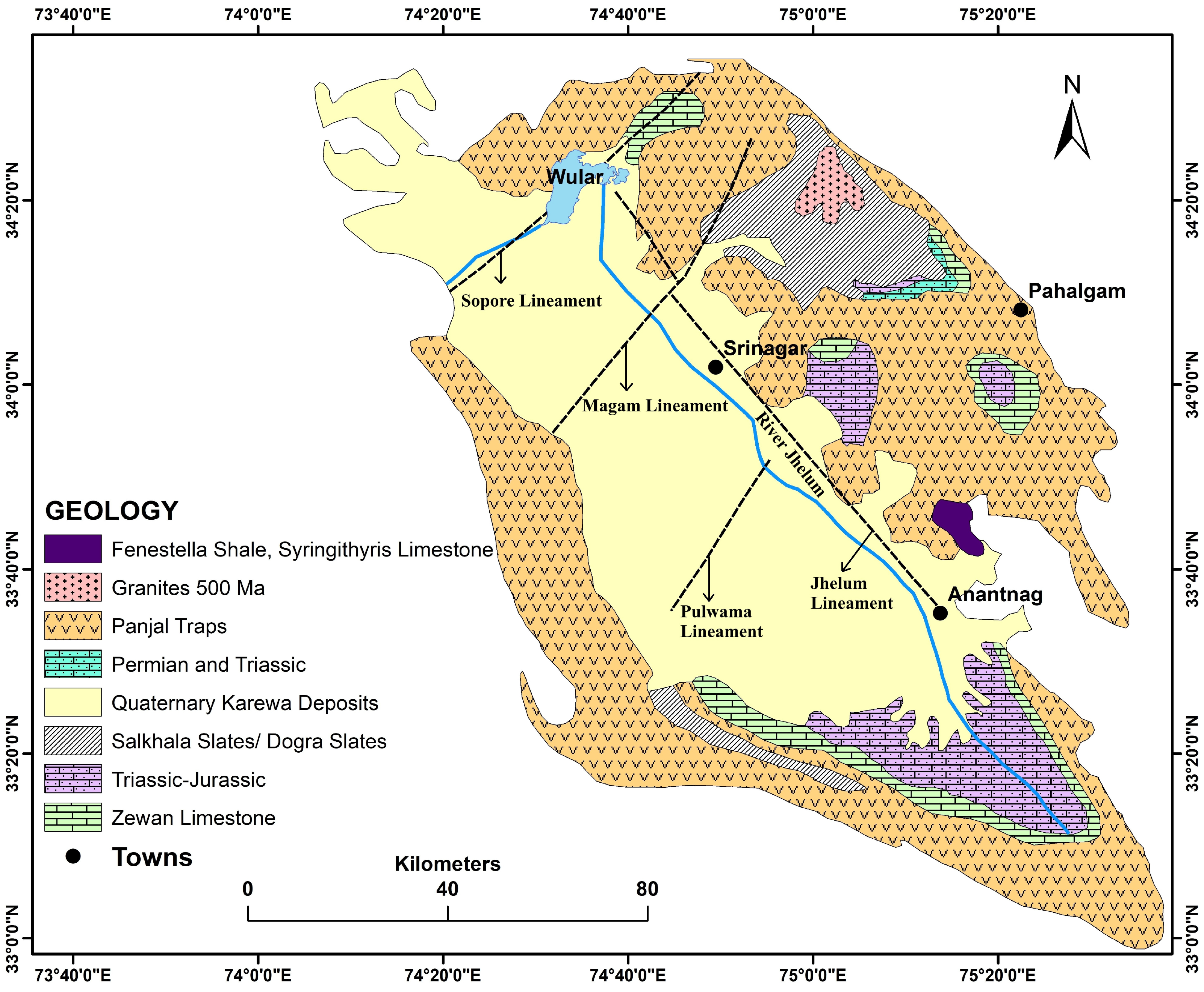
2. Geological Setting
3. Materials and Methods
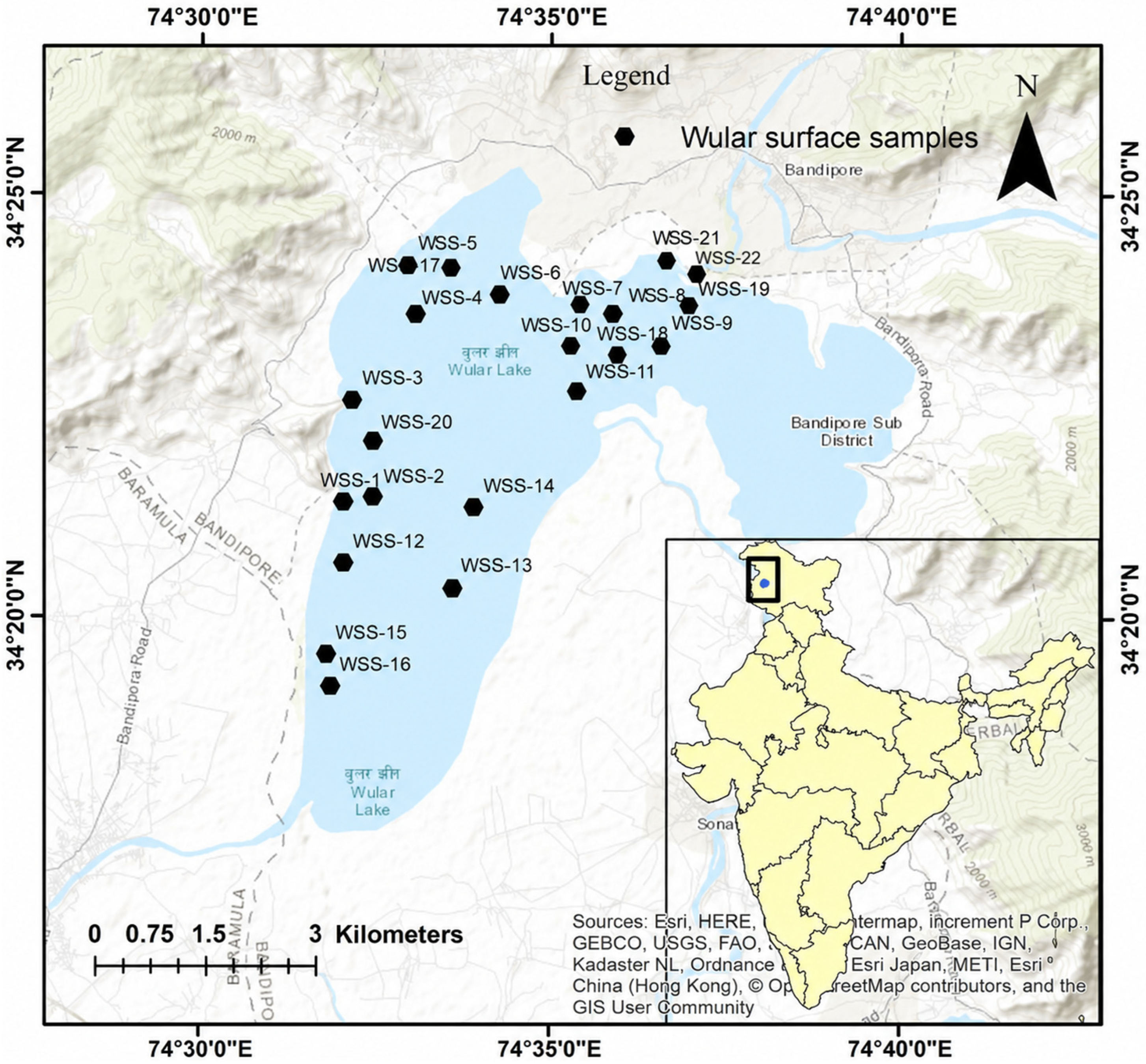
3.1. Sampling and Analytical Methods
3.2. Geochemical Methods
3.2.1. Chemical Weathering Indices
3.2.2. Provenance Discrimination
3.2.3. Enrichment Factors
3.2.4. Rare Earth Element Analysis
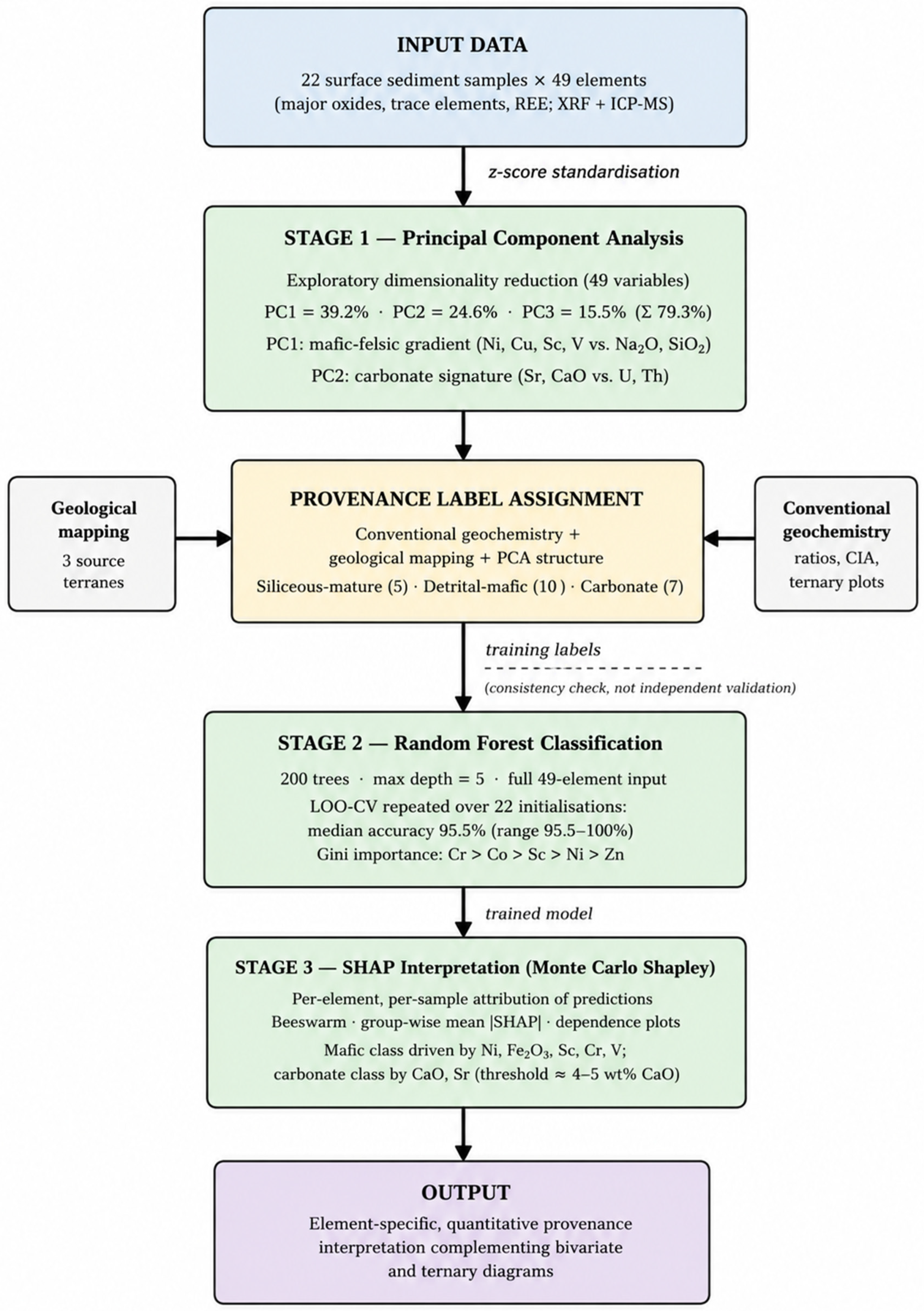
3.3. Machine Learning Framework
3.3.1. Principal Component Analysis (PCA)
3.3.2. Provenance Classification
3.3.3. Random Forest Classification
3.3.4. SHAP Analysis
4. Results
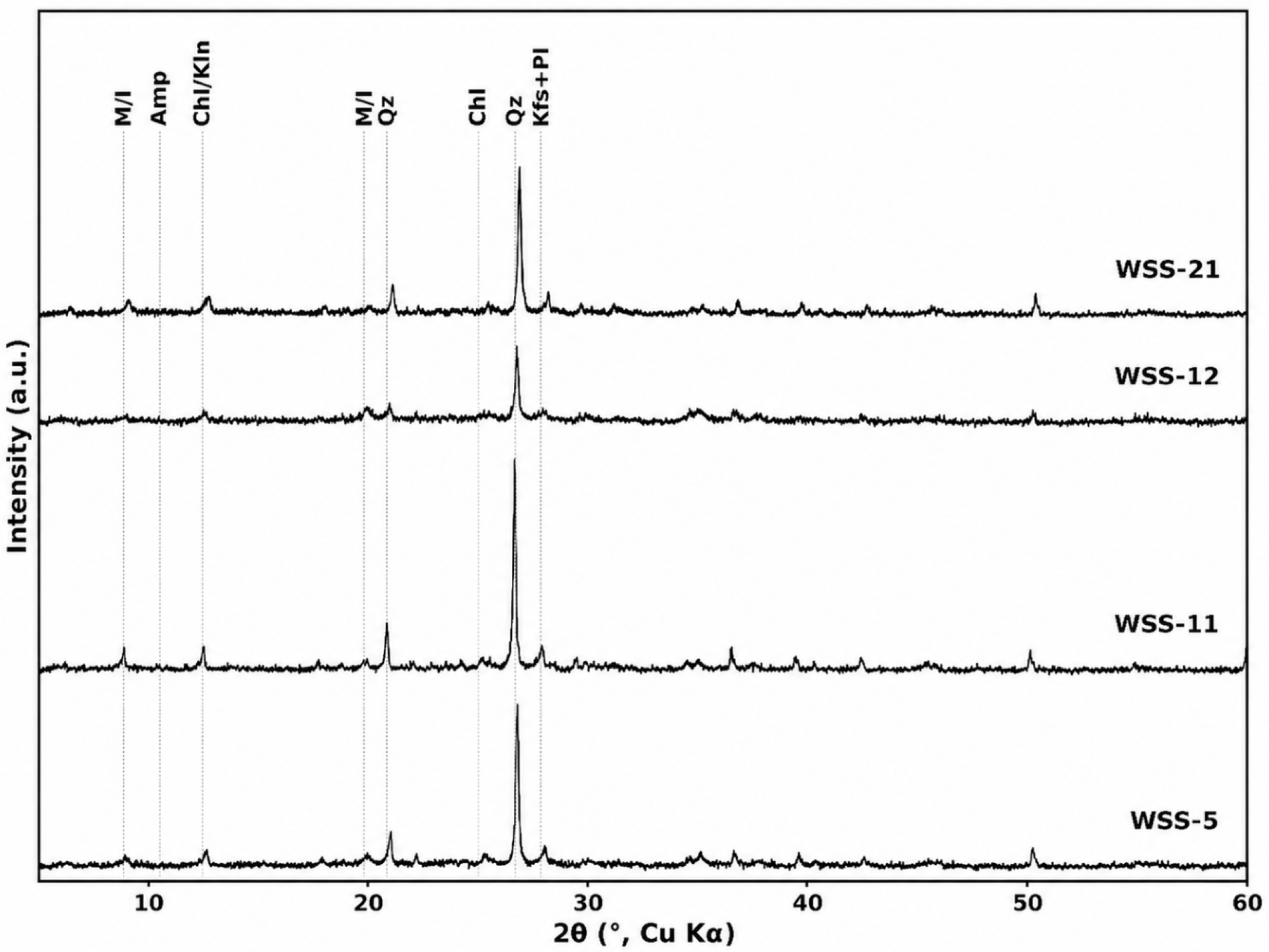
4.1. Mineralogy
4.2. Major and Trace Element Geochemistry
Rare Earth Element Pattern
4.3. Chemical Weathering Assessment
4.4. Sediment Classification and Provenance
4.5. Machine Learning Framework Result
4.5.1. Principal Component Analysis
4.5.2. Provenance Classification
4.5.3. Random Forest Classification
4.5.4. SHAP Analysis
4.6. Regional Comparison
5. Discussion
5.1. Weathering Regime and Climate Control
5.2. Provenance Identification: Conventional vs. Machine Learning Approaches
5.3. REE Constraints on Provenance
5.4. Regional Context
6. Conclusions
- (1)
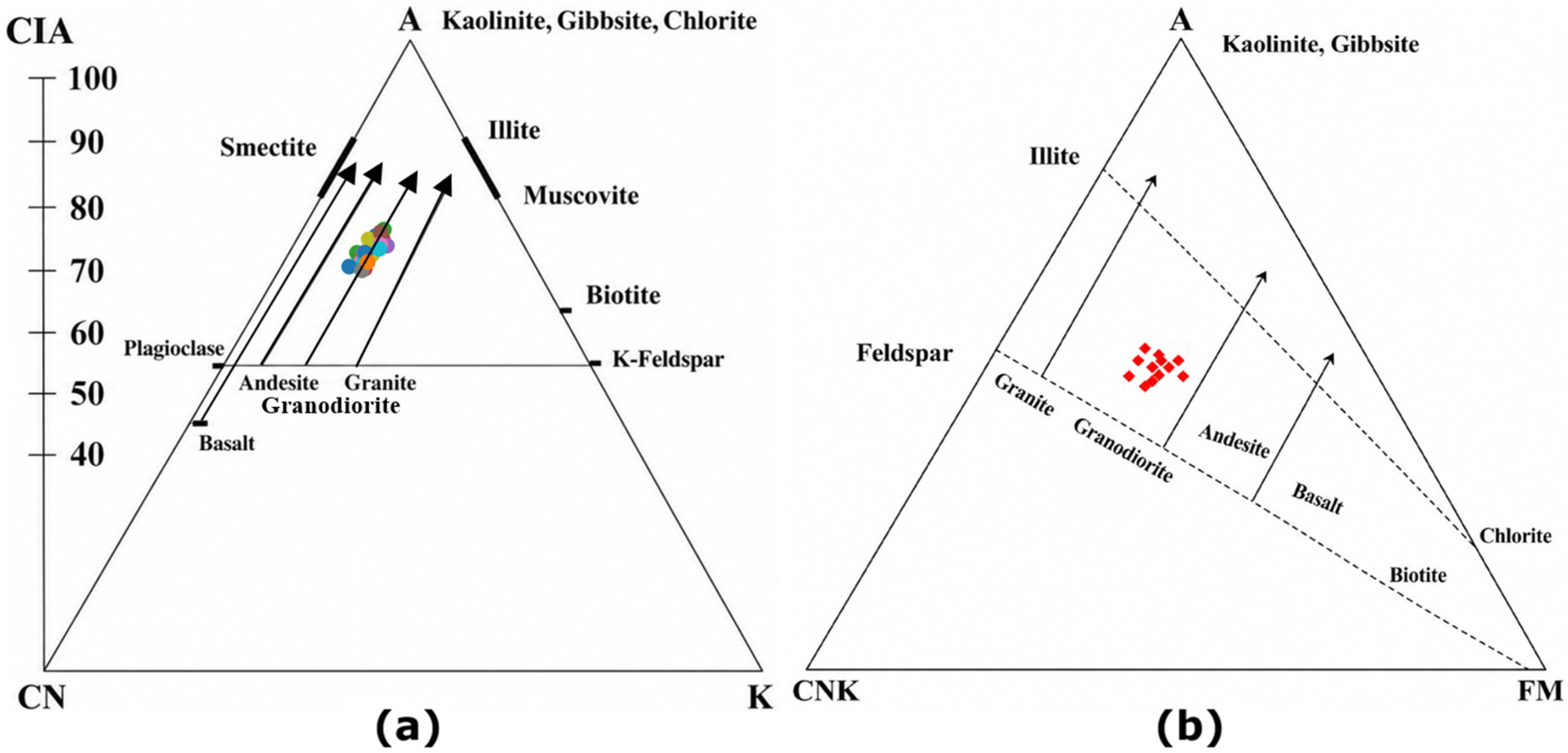
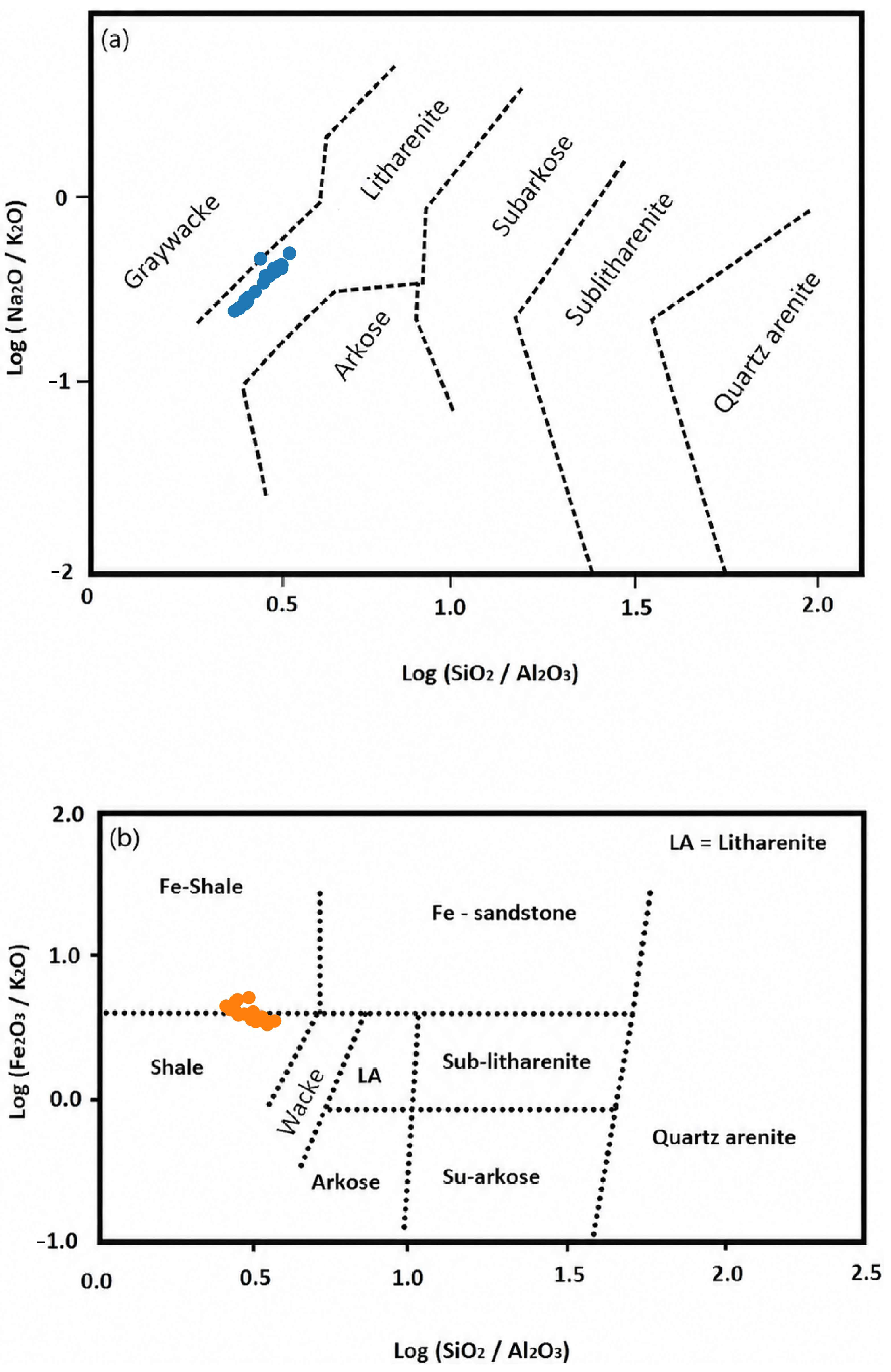
- The Wular Lake sediments are compositionally immature (ICV > 1), classified as shales on the Herron [6] diagram and have undergone moderate chemical weathering (CIA = 68.5–75.1, mean 72.1), consistent with the cold temperate climate of the Kashmir Valley. The mineralogical assemblage of quartz + muscovite/illite + chlorite + feldspar confirms the mixed metamorphic–volcanic provenance inferred from the geochemistry.
- (2)
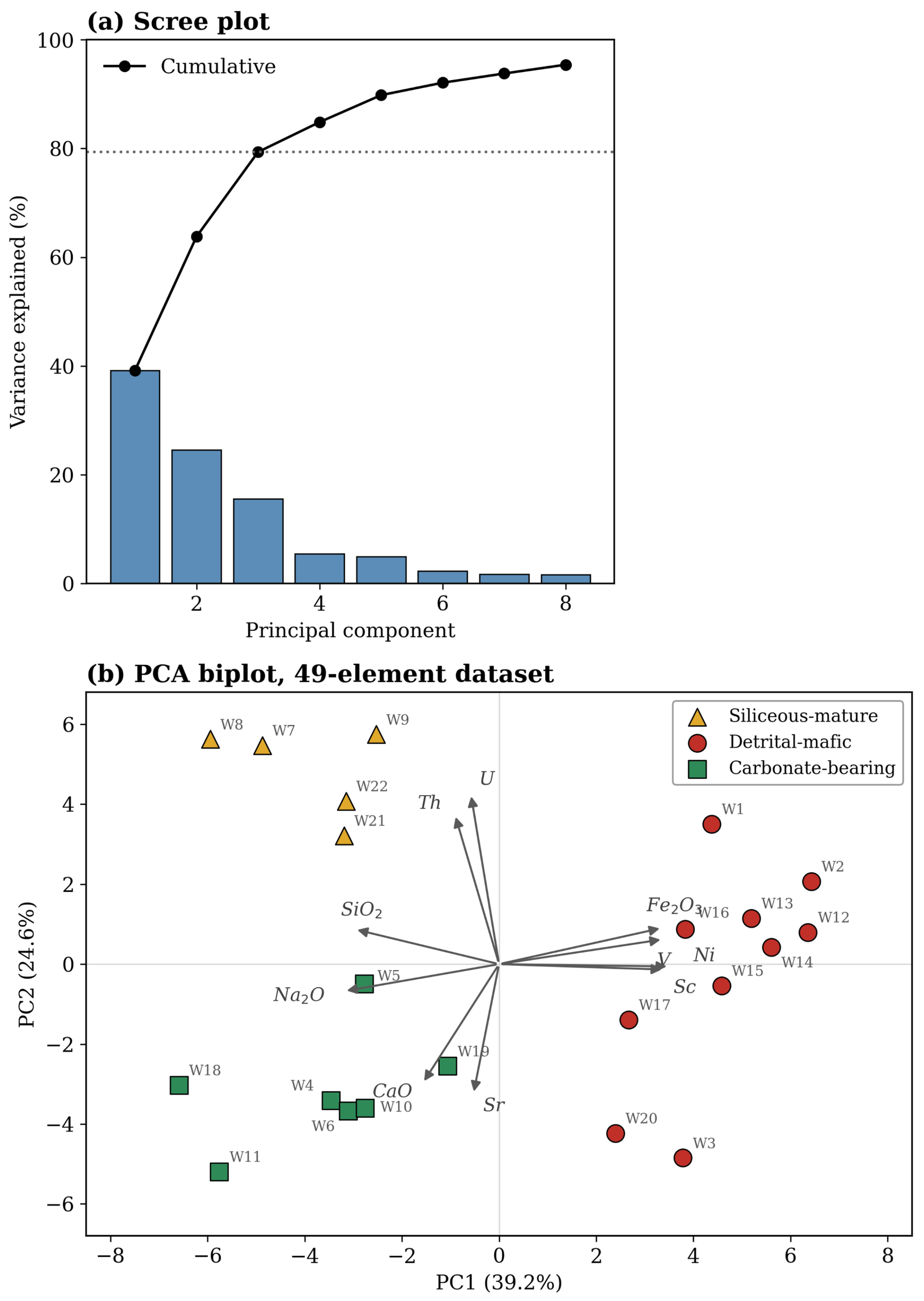
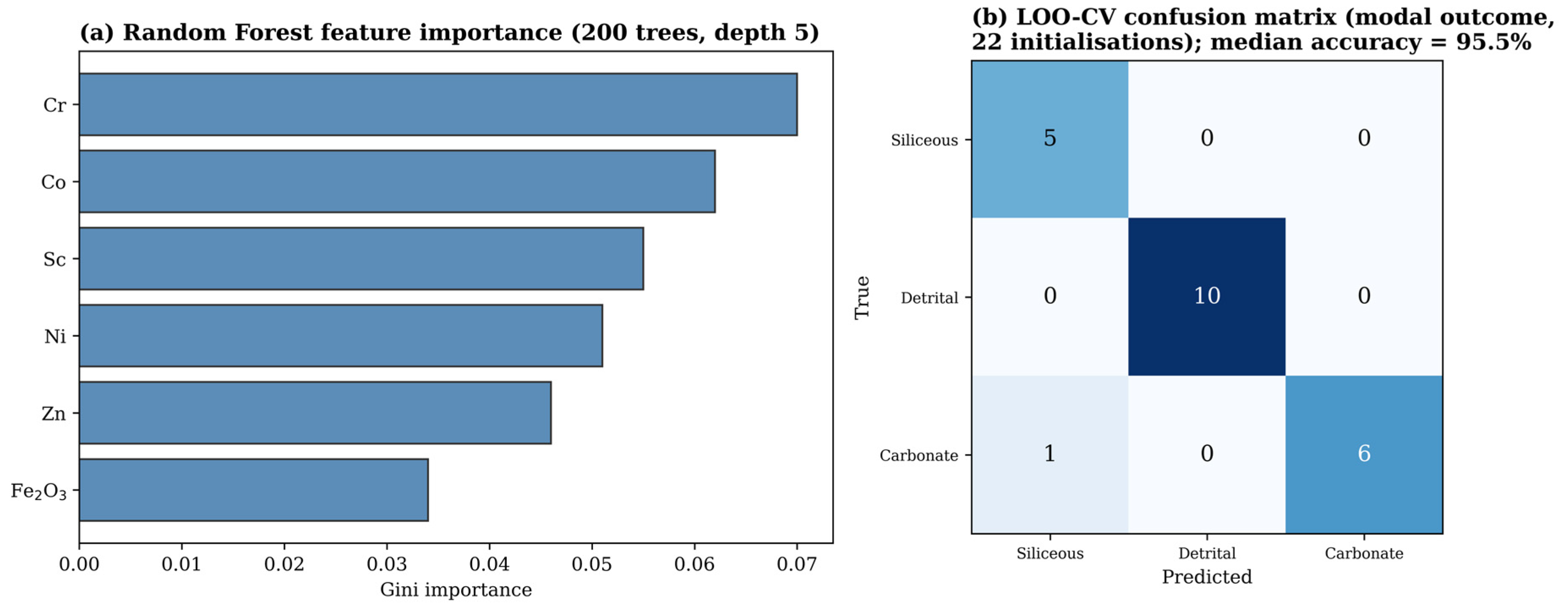
- Conventional provenance discrimination identifies three principal source contributions: the Higher Himalayan Crystalline Series (siliceous-mature component), the Panjal Trap basalts (mafic-detrital component), and the Karewa Group (carbonate-bearing component). Random forest classification on the full 49-element dataset achieves a LOO-CV accuracy of 95.5%, demonstrating that the provenance assignments are internally consistent with the multivariate geochemical signatures; because the training labels were informed by the same data, this result constitutes a consistency check rather than a fully independent validation of the provenance model. Unsupervised k-means clustering, however, reproduces the same three-group structure without any label information (Adjusted Rand Index = 1.0), indicating that the partition is intrinsic to the data.
- (3)
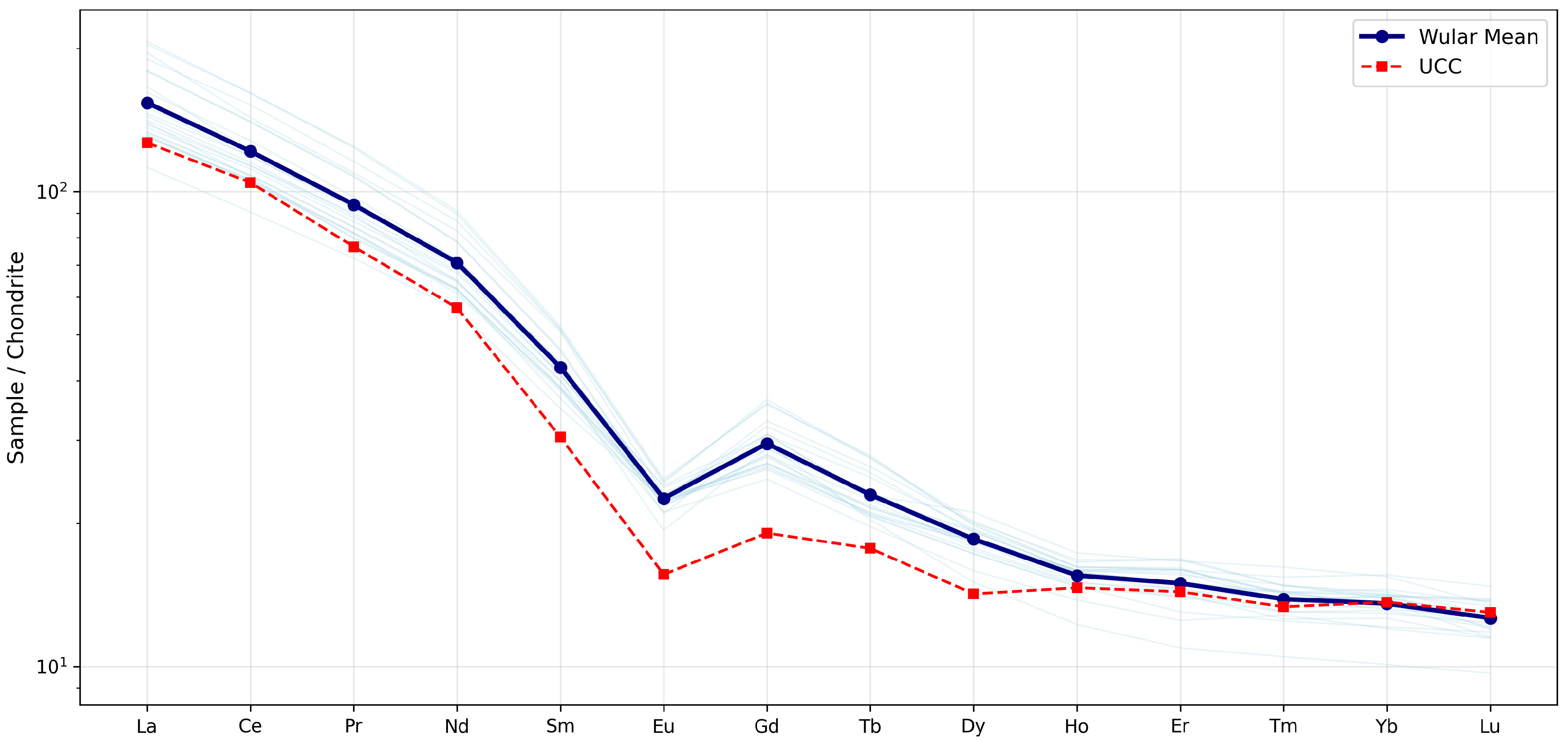
- Chondrite-normalised REE patterns provide complementary provenance support through provenance-specific Eu anomalies: Eu/Eu* = 0.57 (siliceous-mature, felsic crystalline source), 0.70 (detrital-mafic, Panjal Trap volcanic source), and 0.61 (carbonate-bearing, mixed input). The negligible Ce anomalies confirm that REE signatures are source-controlled rather than diagenetically modified.
- (4)
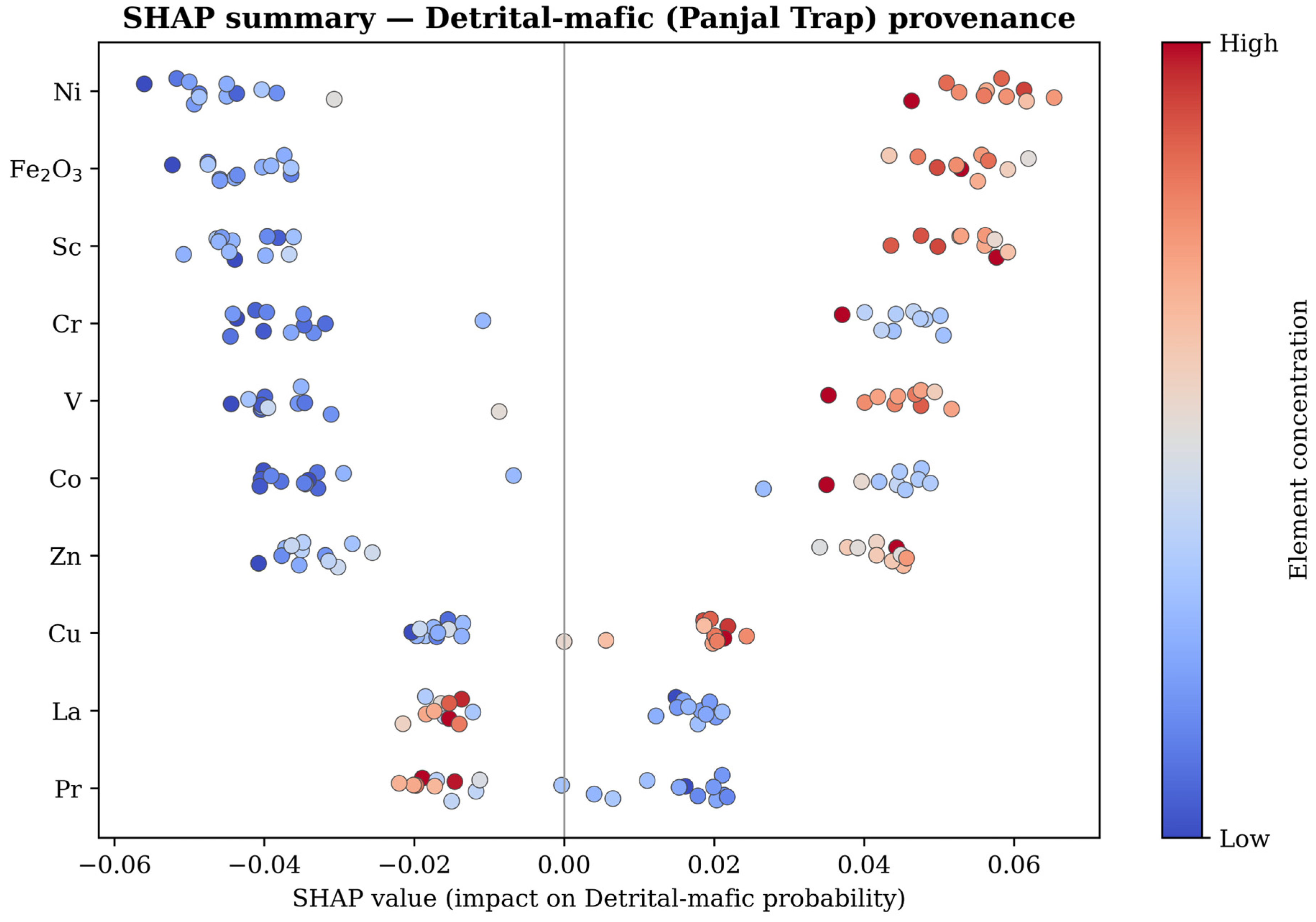
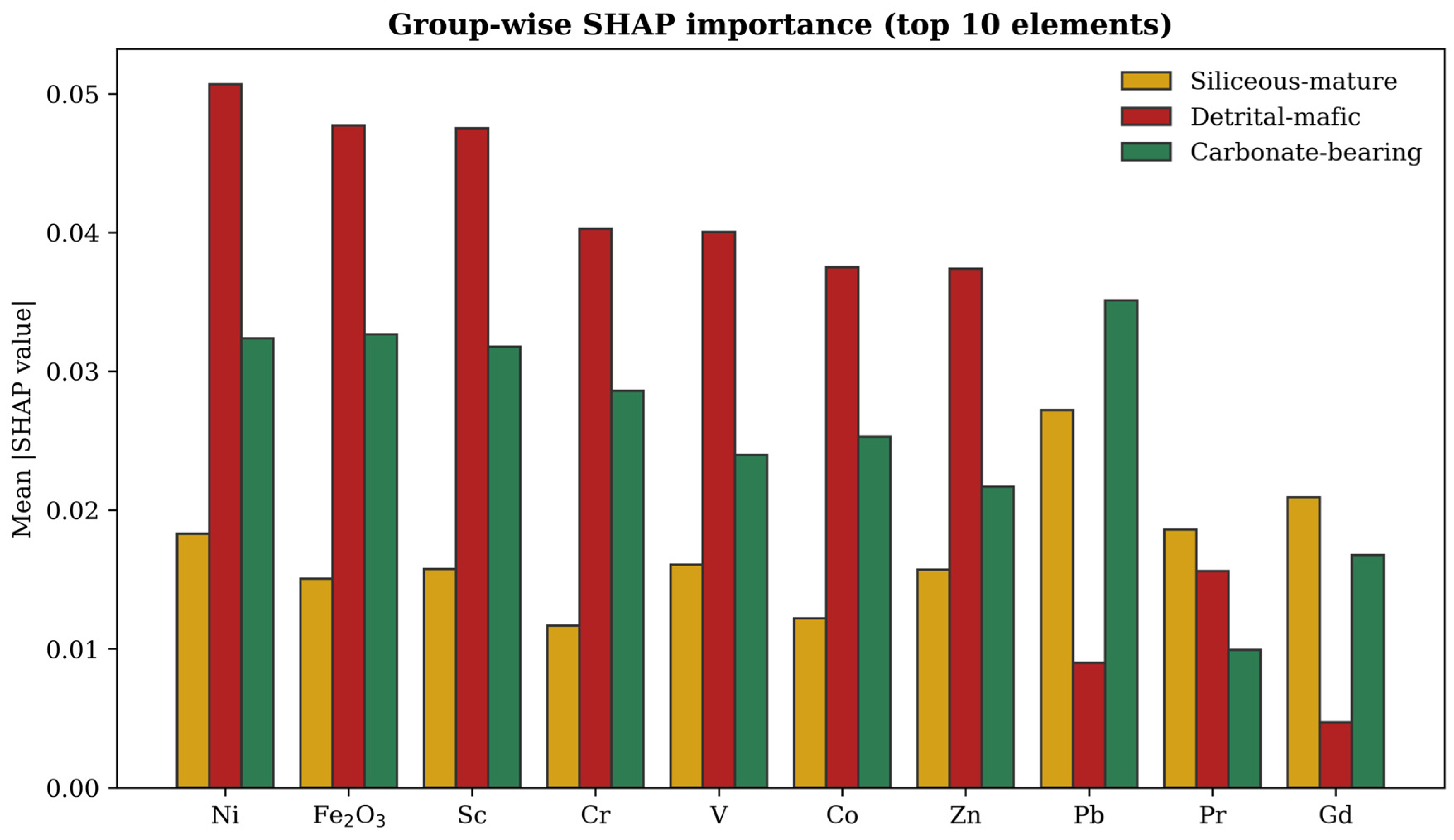
- SHAP analysis demonstrates that compatible trace elements (Cr, Co, Sc, Ni, Zn) carry greater provenance-discriminating power than do the major oxides traditionally emphasised in bivariate diagrams, suggesting, subject to confirmation in additional datasets and independent study areas, that trace elements deserve greater analytical priority in future Himalayan sediment provenance studies.
- (5)
- The three-stage ML pipeline (PCA → random forest → SHAP) is, in principle, transferable to other multi-source sedimentary settings where standard multi-element geochemical data are available, although its performance in locations beyond Wular Lake remains to be tested. By combining the geological interpretability of conventional methods with the full-dimensional exploitation of ML, this integrated framework offers a complementary, more fully multivariate approach to sediment provenance analysis than does either method alone.
Supplementary Materials
Author Contributions
Funding
Data Availability Statement
Acknowledgments
Conflicts of Interest
References
- Weltje, G.J.; von Eynatten, H. Quantitative Provenance Analysis of Sediments: Review and Outlook. Sediment. Geol. 2004, 171, 1–11. [Google Scholar] [CrossRef] [Scilit]
- McLennan, S.M. Weathering and Global Denudation. J. Geol. 1993, 101, 295–303. [Google Scholar] [CrossRef] [Scilit]
- Nesbitt, H.W.; Young, G.M. Early Proterozoic Climates and Plate Motions Inferred from Major Element Chemistry of Lutites. Nature 1982, 299, 715–717. [Google Scholar] [CrossRef] [Scilit]
- Verma, S.; Phartiyal, B.; Morthekai, P.; Venkateshwarlu, M.; Chandra, R.; Das, P.K. Provenance and Depositional Processes of Plio-Pleistocene Karewa Group Sediments of Kashmir Valley: Insights from Mineral Magnetism Study. Quat. Int. 2026, 760, 110167. [Google Scholar] [CrossRef] [Scilit]
- Shah, R.A.; Achyuthan, H.; Sangode, S.J.; Lone, A.M.; Rafiq, M. Mineral Magnetic and Geochemical Mapping of the Wular Lake Sediments, Kashmir Valley, NW Himalaya. Aquat. Geochem. 2020, 26, 31–52. [Google Scholar]
- Herron, M.M. Geochemical Classification of Terrigenous Sands and Shales from Core or Log Data. J. Sediment. Res. 1988, 58, 820–829. [Google Scholar] [CrossRef] [Scilit]
- Roser, B.P.; Korsch, R.J. Provenance Signatures of Sandstone-Mudstone Suites Determined Using Discriminant Function Analysis of Major-Element Data. Chem. Geol. 1988, 67, 119–139. [Google Scholar] [CrossRef] [Scilit]
- Bhatia, M.R. Plate Tectonics and Geochemical Composition of Sandstones. J. Geol. 1983, 91, 611–627. [Google Scholar] [CrossRef] [Scilit]
- Cox, R.; Lowe, D.R.; Cullers, R.L. The Influence of Sediment Recycling and Basement Composition on Evolution of Mudrock Chemistry in the Southwestern United States. Geochim. Cosmochim. Acta 1995, 59, 2919–2940. [Google Scholar] [CrossRef] [Scilit]
- Harnois, L. The CIW Index: A New Chemical Index of Weathering. Sediment. Geol. 1988, 55, 319–322. [Google Scholar] [CrossRef] [Scilit]
- Vermeesch, P.; Resentini, A.; Garzanti, E. An R Package for Statistical Provenance Analysis. Sediment. Geol. 2016, 336, 14–25. [Google Scholar] [CrossRef] [Scilit]
- Pszonka, J.; Godlewski, P.; Fheed, A.; Dwornik, M.; Schulz, B.; Wendorff, M. Identification and Quantification of Intergranular Volume Using SEM Automated Mineralogy. Mar. Pet. Geol. 2024, 162, 106708. [Google Scholar] [CrossRef] [Scilit]
- Hasterok, D.; Gard, M.; Bishop, C.M.B.; Kelsey, D. Chemical Identification of Metamorphic Protoliths Using Machine Learning Methods. Comput. Geosci. 2019, 132, 56–68. [Google Scholar] [CrossRef] [Scilit]
- Ueki, K.; Hino, H.; Kuwatani, T. Geochemical Discrimination and Characteristics of Magmatic Tectonic Settings: A Machine-learning-based Approach. Geochem. Geophys. Geosystems 2018, 19, 1327–1347. [Google Scholar] [CrossRef] [Scilit]
- Dramsch, J.S. 70 Years of Machine Learning in Geoscience in Review. Adv. Geophys. 2020, 61, 1–55. [Google Scholar] [CrossRef] [Scilit]
- Lundberg, S.M.; Lee, S.-I. A Unified Approach to Interpreting Model Predictions. Adv. Neural Inf. Process. Syst. 2017, 30. [Google Scholar] [CrossRef] [Scilit]
- Sahoo, A.; Verma, A.K.; Sabri, M.S.; Singh, T.N. Interpretable Machine Learning for Quantifying the Weathering Index of Mafic and Ultramafic Rocks Using SHAP and PDPE. Earth Sci. Inform. 2026, 19, 25. [Google Scholar] [CrossRef] [Scilit]
- Li, G.; Meng, Y.; Zhou, J.; Ming, D.; Dai, L.; Wang, L. Geochemical Characteristics and Source Analysis of Rare Earth Elements in Qinghai Lake Sediments. Acta Geochim. 2025, 44, 231–246. [Google Scholar] [CrossRef] [Scilit]
- Ori, G.G.; Friend, P.F. Sedimentary Basins Formed and Carried Piggyback on Active Thrust Sheets. Geology 1984, 12, 475–478. [Google Scholar]
- Burbank, D.W.; Johnson, G.D. The Late Cenozoic Chronologic and Stratigraphic Development of the Kashmir Intermontane Basin, Northwestern Himalaya. Palaeogeogr. Palaeoclimatol. Palaeoecol. 1983, 43, 205–235. [Google Scholar] [CrossRef] [Scilit]
- Rashid, S.A.; Ganai, J.A.; Masoodi, A.; Khan, F.A. Major and Trace Element Geochemistry of Lake Sediments, India: Implications for Weathering and Climate Control. Arab. J. Geosci. 2015, 8, 5677–5684. [Google Scholar] [CrossRef] [Scilit]
- Kulkarni, U.D.; Khan, A.N.; Gavali, R.S. Rate of Siltation in Wular Lake, (Jammu and Kashmir, India) with Special Emphasis on Its Climate & Tectonics. Int. J. Clim. Change Impacts Responses 2009, 1, 233. [Google Scholar] [CrossRef] [Scilit]
- Wadia, D.N. The Geology of Poonch State (Kashmir) and Adjacent Portions of the Punjab. Mem. Geol. Surv. India 1928, 51, 185–370. [Google Scholar] [CrossRef] [Scilit]
- Dixit, Y.; Tandon, S.K. Hydroclimatic Variability on the Indian Subcontinent in the Past Millennium: Review and Assessment. Earth-Sci. Rev. 2016, 161, 1–15. [Google Scholar] [CrossRef] [Scilit]
- Rashid, S.A.; Masoodi, A.; Khan, F.A. Sediment-Water Interaction at Higher Altitudes: Example from the Geochemistry of Wular Lake Sediments, Kashmir Valley, Northern India. Procedia Earth Planet. Sci. 2013, 7, 786–789. [Google Scholar] [CrossRef] [Scilit]
- Murthy, T.V.R.; Patel, J.G.; Panigrahy, S.; Parihar, J.S. National Wetland Atlas: Wetlands of International Importance Under Ramsar Convention; Space Applications Centre, ISRO: Ahmedabad, India, 2010. [Google Scholar]
- Shah, R.A.; Paul, O.J.; Dar, R.A.; Romshoo, S.A. Impact of Climate Change and Anthropogenic Activities on Lacustrine Ecosystems of the Kashmir Valley, NW Himalaya, India. Environ. Qual. Manag. 2024, 34, e22200. [Google Scholar] [CrossRef] [Scilit]
- Middlemiss, C.S. A Revision of the Silurian-Trias Sequence in Kashmir; Geological Survey of India: West Bengal, India, 1910. [Google Scholar]
- Fuchs, G.; Gupta, V.J. Palaeozoic Stratigraphy of Kashmir, Kishtwar and Chamba (Panjab Himalayas). Verhandlungen Geol. Bundesanst. 1971, 1, 68–97. [Google Scholar]
- Bhat, M.I.; Zainuddin, S.M. Origin and Evolution of the Panjal Volcanics. Himal. Geol. 1979, 9, 421–461. [Google Scholar]
- Shellnutt, J.G.; Bhat, G.M.; Wang, K.-L.; Yeh, M.-W.; Brookfield, M.E.; Jahn, B.-M. Multiple Mantle Sources of the Early Permian Panjal Traps, Kashmir, India. Am. J. Sci. 2015, 315, 589–619. [Google Scholar] [CrossRef] [Scilit]
- Wadia, D.N. The Cambrian-Trias Sequence of North-West Kashmir (Parts of Muzafarabad and Baramula Districts). Rec. Geol. Surv. India 1934, 68, 121. [Google Scholar]
- De Terra, H. Studies on the Ice-Age in India and Associated Human Cultures. Publ. Carnegie Inst. 1939, 493, 354. [Google Scholar]
- Bhatt, D.K. Lithostratigraphic Sub-Division of the Hirpur Formation (Lower Karewa)―A Critical Review and Modification. Himal. Geol. 1979, 9, 283–291. [Google Scholar]
- Bhatt, D.K. Lithostratigraphy of Karewa Group, Kashmir Valley, India and a Critical Review of Its Fossil Record. J. Geol. Soc. India 1989, 36, 548–549. [Google Scholar]
- Singh, I.B. Sedimentation Pattern in the Karewa Basin, Kashmir Valley, India, and Its Geological Significance. J. Palaeontol. Soc. India 1982, 27, 71–110. [Google Scholar] [CrossRef] [Scilit]
- Ahmad, I.; Chandra, R. Geochemistry of Loess-Paleosol Sediments of Kashmir Valley, India: Provenance and Weathering. J. Asian Earth Sci. 2013, 66, 73–89. [Google Scholar] [CrossRef] [Scilit]
- Terashima, S.; Imai, N.; Taniguchi, M.; Okai, T.; Nishimura, A. The preparation and preliminary characterisation of four new Geological Survey of Japan geochemical reference materials: Soils, JSO-1 and JSO-2; and marine sediments, JMS-1 and JMS-2. Geostand. Newsl. 2002, 26, 85–94. [Google Scholar] [CrossRef] [Scilit]
- Ring, E.J. The preparation and certification of fourteen South African silicate rocks for use as reference materials. Geostand. Newsl. 1993, 17, 137–158. [Google Scholar] [CrossRef] [Scilit]
- Paul, D.; Das, S.; Dash, J.K. Partitioning of Potentially Toxic Elements (PTEs) in the Surface Sediments of Muttukadu Estuary, Tamil Nadu, India: Implication for Environmental Risk Assessment. Soil Sediment Contam. Int. J. 2025, 34, 1743–1764. [Google Scholar] [CrossRef] [Scilit]
- Fedo, C.M.; Wayne Nesbitt, H.; Young, G.M. Unraveling the Effects of Potassium Metasomatism in Sedimentary Rocks and Paleosols, with Implications for Paleoweathering Conditions and Provenance. Geology 1995, 23, 921–924. [Google Scholar]
- Babechuk, M.G.; Widdowson, M.; Kamber, B.S. Quantifying Chemical Weathering Intensity and Trace Element Release from Two Contrasting Basalt Profiles, Deccan Traps, India. Chem. Geol. 2014, 363, 56–75. [Google Scholar] [CrossRef] [Scilit]
- Nesbitt, H.W.; Young, G.M. Prediction of Some Weathering Trends of Plutonic and Volcanic Rocks Based on Thermodynamic and Kinetic Considerations. Geochim. Cosmochim. Acta 1984, 48, 1523–1534. [Google Scholar] [CrossRef] [Scilit]
- Nesbitt, H.W.; Young, G.M. Formation and Diagenesis of Weathering Profiles. J. Geol. 1989, 97, 129–147. [Google Scholar] [CrossRef] [Scilit]
- Hayashi, K.-I.; Fujisawa, H.; Holland, H.D.; Ohmoto, H. Geochemistry Of ∼1.9 Ga Sedimentary Rocks from Northeastern Labrador, Canada. Geochim. Cosmochim. Acta 1997, 61, 4115–4137. [Google Scholar] [CrossRef] [Scilit] [PubMed]
- Pettijohn, F.J.; Potter, P.E.; Siever, R. Sand and Sandstone; Springer Science & Business Media: Berlin/Heidelberg, Germany, 2012; ISBN 1461210666. [Google Scholar]
- Rudnick, R.L.; Gao, S. The Crust, 3.01–The Composition of the Continental Crust. Treatise Geochem. 2003, 3, 635. [Google Scholar] [CrossRef] [Scilit]
- Cullers, R.L. The Geochemistry of Shales, Siltstones and Sandstones of Pennsylvanian–Permian Age, Colorado, USA: Implications for Provenance and Metamorphic Studies. Lithos 2000, 51, 181–203. [Google Scholar] [CrossRef] [Scilit]
- Hubert, L.; Arabie, P. Comparing Partitions. J. Classif. 1985, 2, 193–218. [Google Scholar] [CrossRef] [Scilit]
- Loring, D.H. Normalization of Heavy-Metal Data from Estuarine and Coastal Sediments. ICES J. Mar. Sci. 1991, 48, 101–115. [Google Scholar] [CrossRef] [Scilit]
- Sun, S.-S.; McDonough, W.F. Chemical and Isotopic Systematics of Oceanic Basalts: Implications for Mantle Composition and Processes. Geol. Soc. Lond. Spec. Publ. 1989, 42, 313–345. [Google Scholar] [CrossRef] [Scilit]
- Štrumbelj, E.; Kononenko, I. Explaining Prediction Models and Individual Predictions with Feature Contributions. Knowl. Inf. Syst. 2014, 41, 647–665. [Google Scholar] [CrossRef] [Scilit]
- Joliffe, I.T. Principal Component Analysis, 2nd ed.; Springer: New York, NY, USA, 2002. [Google Scholar]
- Breiman, L. Random Forests. Mach. Learn. 2001, 45, 5–32. [Google Scholar] [CrossRef] [Scilit]
- Taylor, S.R.; McLennan, S.M. The Continental Crust: Its Composition and Evolution; Blackwell Scientific Publications: Oxford, UK, 1985. [Google Scholar]
- McLennan, S.M.; Hemming, S.; McDaniel, D.K.; Hanson, G.N. Geochemical Approaches to Sedimentation, Provenance, and Tectonics; Geological Society of America: Boulder, CO, USA, 1993. [Google Scholar]
- Ojala, M.; Garriga, G.C. Permutation Tests for Studying Classifier Performance. J. Mach. Learn. Res. 2010, 11, 1833–1863. [Google Scholar]
- Varma, S.; Simon, R. Bias in Error Estimation When Using Cross-Validation for Model Selection. BMC Bioinform. 2006, 7, 91. [Google Scholar] [CrossRef] [Scilit] [PubMed]
- Jeelani, G.H.; Shah, A.Q. Geochemical Characteristics of Water and Sediment from the Dal Lake, Kashmir Himalaya: Constraints on Weathering and Anthropogenic Activity. Environ. Geol. 2006, 50, 12–23. [Google Scholar] [CrossRef] [Scilit]
- Babeesh, C.; Lone, A.; Achyuthan, H. Geochemistry of Manasbal Lake Sediments, Kashmir: Weathering, Provenance and Tectonic Setting. J. Geol. Soc. India 2017, 89, 563–572. [Google Scholar] [CrossRef] [Scilit]
- Das, B.K.; Haake, B.-G. Geochemistry of Rewalsar Lake Sediment, Lesser Himalaya, India: Implications for Source-Area Weathering, Provenance and Tectonic Setting. Geosci. J. 2003, 7, 299–312. [Google Scholar] [CrossRef] [Scilit]
- Shao, J.; Yang, S.; Li, C. Chemical Indices (CIA and WIP) as Proxies for Integrated Chemical Weathering in China: Inferences from Analysis of Fluvial Sediments. Sediment. Geol. 2012, 265, 110–120. [Google Scholar] [CrossRef] [Scilit]
- Davison, W. Iron and Manganese in Lakes. Earth-Sci. Rev. 1993, 34, 119–163. [Google Scholar] [CrossRef] [Scilit]



| Parameter | Siliceous-Mature | Detrital-Mafic | Carbonate-Bearing | All Samples (n = 22) |
|---|---|---|---|---|
| SiO2 | 57.3 (54.2–61.1) | 51.2 (49.4–53.7) | 55.2 (52.5–59.1) | 53.9 (49.4–61.1) |
| Al2O3 | 16.1 (15.8–16.4) | 17.2 (15.9–18.0) | 15.0 (13.7–16.4) | 16.2 (13.7–18.0) |
| TiO2 | 1.13 (1.06–1.26) | 1.13 (1.03–1.23) | 1.02 (0.94–1.13) | 1.10 (0.94–1.26) |
| Fe2O3 | 8.1 (7.6–8.5) | 10.8 (9.5–12.2) | 7.6 (6.7–8.5) | 9.2 (6.7–12.2) |
| MnO | 0.13 (0.09–0.18) | 0.15 (0.12–0.18) | 0.12 (0.11–0.13) | 0.14 (0.09–0.18) |
| MgO | 3.0 (2.9–3.1) | 3.6 (3.4–4.4) | 3.3 (2.9–3.5) | 3.3 (2.9–4.4) |
| CaO | 1.6 (1.1–2.1) | 1.8 (1.3–3.6) | 4.6 (1.7–7.2) | 2.6 (1.1–7.2) |
| Na2O | 1.03 (0.92–1.10) | 0.81 (0.72–1.06) | 1.02 (0.95–1.11) | 0.93 (0.72–1.11) |
| K2O | 2.9 (2.7–3.0) | 3.2 (2.5–3.3) | 2.7 (2.5–3.1) | 3.0 (2.5–3.3) |
| P2O5 | 0.18 (0.16–0.20) | 0.19 (0.16–0.33) | 0.20 (0.16–0.24) | 0.19 (0.16–0.33) |
| CIA | 71.2 (70.3–72.8) | 73.8 (71.9–75.1) | 70.2 (68.5–71.8) | 72.1 (68.5–75.1) |
| CIW | 82.7 (81.7–84.0) | 86.5 (82.0–88.3) | 81.6 (79.0–83.9) | 84.1 (79.0–88.3) |
| PIA | 79.3 (78.1–81.0) | 83.7 (79.0–85.8) | 78.1 (75.3–80.6) | 80.9 (75.3–85.8) |
| ICV | 1.11 (1.05–1.18) | 1.25 (1.16–1.43) | 1.37 (1.12–1.59) | 1.26 (1.05–1.59) |
| MIA | 66.9 (64.6–69.0) | 66.3 (55.9–68.9) | 54.9 (45.7–66.5) | 62.8 (45.7–69.0) |
| Parameter | Siliceous-Mature | Detrital-Mafic | Carbonate-Bearing | All Samples |
|---|---|---|---|---|
| ΣREE (ppm) | 215.2 (200.9–229.2) | 156.8 (138.0–169.4) | 178.2 (163.4–205.6) | 176.9 (138.0–229.2) |
| LREE/HREE | 10.2 (9.6–10.9) | 8.3 (7.1–9.5) | 9.7 (8.6–12.8) | 9.2 (7.1–12.8) |
| (La/Yb)N | 13.7 (12.5–14.6) | 9.5 (8.0–11.6) | 12.7 (10.5–19.4) | 11.5 (8.0–19.4) |
| (Gd/Yb)N | 2.5 (2.3–2.7) | 1.9 (1.8–2.1) | 2.3 (2.1–2.9) | 2.2 (1.8–2.9) |
| Eu/Eu* | 0.57 (0.56–0.58) | 0.70 (0.67–0.73) | 0.61 (0.57–0.65) | 0.64 (0.56–0.73) |
| Ce/Ce* | 1.01 (1.00–1.03) | 1.02 (1.00–1.03) | 1.01 (0.98–1.03) | 1.01 (0.98–1.03) |
| Ratio | Siliceous-Mature | Detrital-Mafic | Carbonate-Bearing | All Samples (n = 22) | UCC [41] | Silicic/Basic Sources [52] |
|---|---|---|---|---|---|---|
| Th/Sc | 1.12 (1.00–1.24) | 0.78 (0.52–0.84) | 0.94 (0.82–1.14) | 0.91 (0.52–1.24) | 0.75 | 0.84–20.5/0.05–0.22 |
| Zr/Sc | 5.64 (4.97–6.03) | 4.37 (3.57–5.28) | 4.28 (3.43–5.11) | 4.63 (3.43–6.03) | 13.8 | – |
| La/Sc | 2.94 (2.68–3.38) | 1.65 (1.34–1.89) | 2.41 (2.11–3.31) | 2.19 (1.34–3.38) | 2.21 | 2.50–16.3/0.43–0.86 |
| Cr/Th | 6.55 (5.59–7.66) | 10.4 (8.6–22.3) | 6.94 (5.87–7.94) | 8.42 (5.59–22.34) | 8.8 | 4.00–15.0/25–500 |
| Co/Th | 1.20 (0.96–1.49) | 2.08 (1.65–4.56) | 1.39 (1.12–1.96) | 1.66 (0.96–4.56) | 1.65 | 0.22–1.5/7.1–8.3 |
| Provenance Group | n | Samples | SiO2 | Fe2O3 | CaO | Sc | Cr | Ni | Sr | ΣREE | Eu/Eu* |
|---|---|---|---|---|---|---|---|---|---|---|---|
| Siliceous-mature | 5 | W7, W8, W9, WSS-21, WSS-22 | 57.3 | 8.1 | 1.6 | 15.5 | 113.3 | 49.7 | 106.3 | 215.2 | 0.57 |
| Detrital-mafic | 10 | W1, W2, W3, W12, W13, W14, W15, W16, W17, W20 | 51.2 | 10.8 | 1.8 | 19.1 | 147.7 | 76.8 | 126.6 | 156.8 | 0.70 |
| Carbonate-bearing | 7 | W4, W5, W6, W10, W11, W18, W19 | 55.2 | 7.6 | 4.6 | 15.5 | 101.0 | 47.7 | 158.3 | 178.2 | 0.61 |
| Parameter | Wular Lake (This Study) | Wular Lake [5] | Dal Lake [59] | Manasbal Lake [60] |
|---|---|---|---|---|
| CIA | 68.5–75.1 (mean 72.1) | ~64 | 87–95 | Low–moderate |
| Weathering intensity | Low to moderate | Low to moderate | Intense | Low to moderate |
| Dominant provenance | Panjal Traps (mafic) | Panjal Traps (mafic) | Panjal Traps (mafic) | Panjal Traps (mafic) |
Disclaimer/Publisher’s Note: The statements, opinions and data contained in all publications are solely those of the individual author(s) and contributor(s) and not of MDPI and/or the editor(s). MDPI and/or the editor(s) disclaim responsibility for any injury to people or property resulting from any ideas, methods, instructions or products referred to in the content. |
© 2026 by the authors. Licensee MDPI, Basel, Switzerland. This article is an open access article distributed under the terms and conditions of the Creative Commons Attribution (CC BY) license.
Share and Cite
Ahmad, M.H.; Rashid, S.A.; Khalid, M.; Ganai, J.A.; Ahmad, S.; Khan, A.; Abuzar. Integrating Sediment Geochemistry with Explainable Machine Learning for Provenance Discrimination in Wular Lake, Kashmir Himalaya, India. Minerals 2026, 16, 805. https://doi.org/10.3390/min16080805
Ahmad MH, Rashid SA, Khalid M, Ganai JA, Ahmad S, Khan A, Abuzar. Integrating Sediment Geochemistry with Explainable Machine Learning for Provenance Discrimination in Wular Lake, Kashmir Himalaya, India. Minerals. 2026; 16(8):805. https://doi.org/10.3390/min16080805
Chicago/Turabian StyleAhmad, Mukhtar Hasan, Shaik A. Rashid, Mohammad Khalid, Javid A. Ganai, Shamshad Ahmad, Amir Khan, and Abuzar. 2026. "Integrating Sediment Geochemistry with Explainable Machine Learning for Provenance Discrimination in Wular Lake, Kashmir Himalaya, India" Minerals 16, no. 8: 805. https://doi.org/10.3390/min16080805
APA StyleAhmad, M. H., Rashid, S. A., Khalid, M., Ganai, J. A., Ahmad, S., Khan, A., & Abuzar. (2026). Integrating Sediment Geochemistry with Explainable Machine Learning for Provenance Discrimination in Wular Lake, Kashmir Himalaya, India. Minerals, 16(8), 805. https://doi.org/10.3390/min16080805