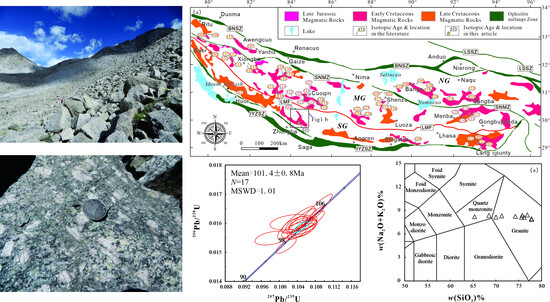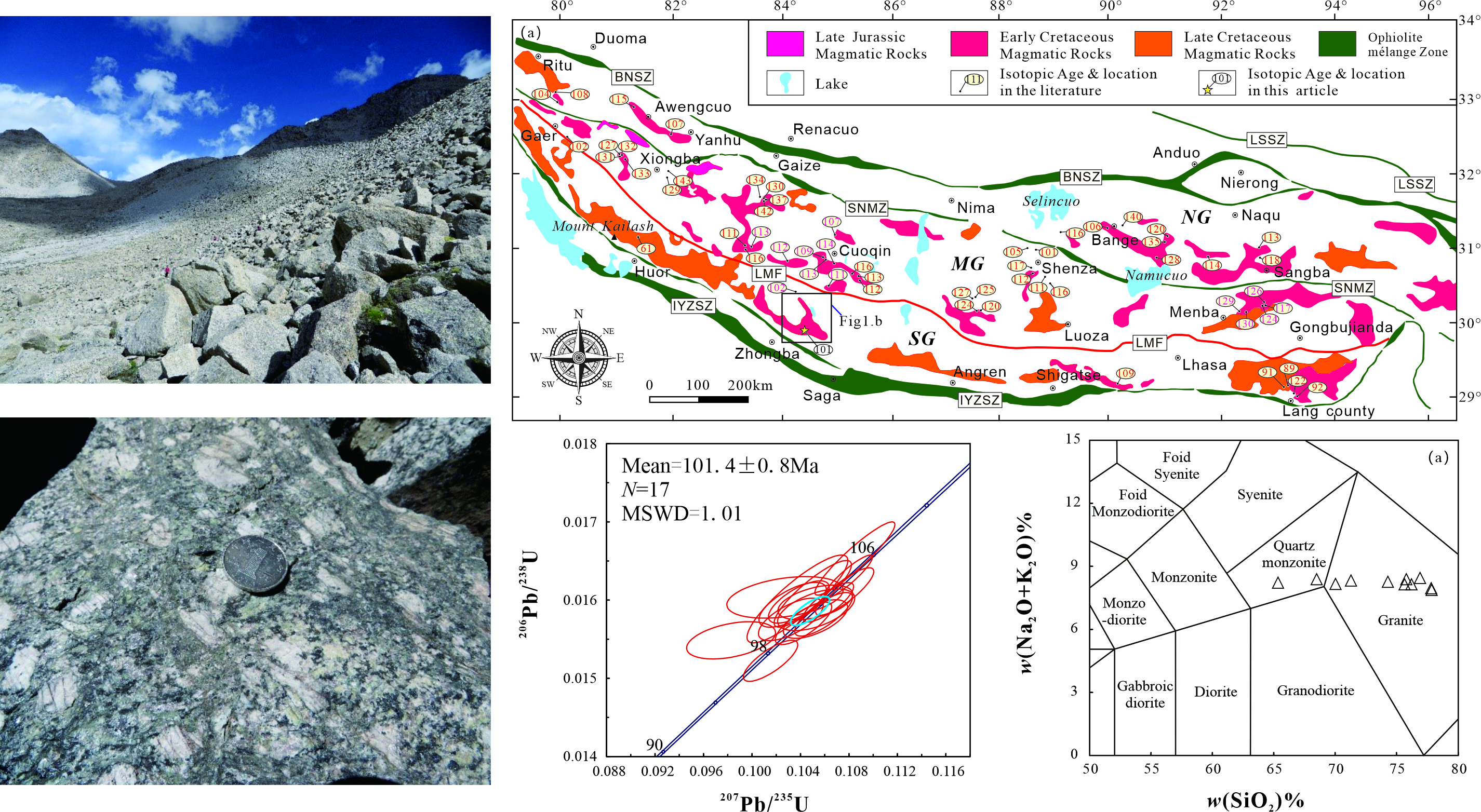
Article

Petrogenesis and Geological Significance of the Jasacuo Monzogranite, Western Gangdese Belt, Southern Tibet: SIMS Zircon U-Pb Chronological and Whole-Rock Geochemical Constraints


1
College of Earth and Planetary Sciences, Chengdu University of Technology, Chengdu 610059, China
2
CNNC Institute No. 280, Guanghan 618300, China
3
School of Computer Science and Engineering, Sichuan University of Science & Engineering, Yibin 644000, China
4
CNNC Key Laboratory of Uranium Resource Exploration and Evaluation Technology, Beijing Research Institute of Uranium Geology, Beijing 100029, China
*
Author to whom correspondence should be addressed.
Minerals 2026, 16(6), 644; https://doi.org/10.3390/min16060644
Submission received: 9 April 2026 / Revised: 9 June 2026 / Accepted: 11 June 2026 / Published: 18 June 2026

Abstract

Early Cretaceous magmatism in the western segment of the Gangdese belt is less well constrained than that in the central and eastern segments. This study presents petrography, whole-rock geochemistry, and SIMS zircon U–Pb geochronology for the Jasacuo monzogranite in Zhongba County, southern Tibet. Zircons are euhedral and show oscillatory zoning; 17 concordant analyses yield a weighted mean 206Pb/238U age of 101.4 ± 0.8 Ma (MSWD = 1.01), indicating crystallization in the late Early Cretaceous. The rocks are characterized by high SiO2 (63.73–77.11 wt.%), high K2O, low MgO, TiO2, and P2O5, and A/CNK values of 0.92–1.08, indicating metaluminous to weakly peraluminous, high-K calc-alkaline compositions with I-type affinity. Chondrite-normalized REE patterns show LREE enrichment and negative Eu anomalies, whereas primitive-mantle-normalized trace-element patterns display enrichment in Rb, U, Th, and Pb and depletion in Ba, Nb, Sr, Zr, and Ti. These features indicate that the Jasacuo monzogranite is an evolved felsic intrusion generated in a subduction-related continental-arc setting associated with northward subduction of the Neo-Tethyan oceanic lithosphere. The magma was dominated by crustal components and underwent significant fractional crystallization, mainly involving feldspar, with minor biotite and amphibole.

Graphical Abstract

1. Introduction

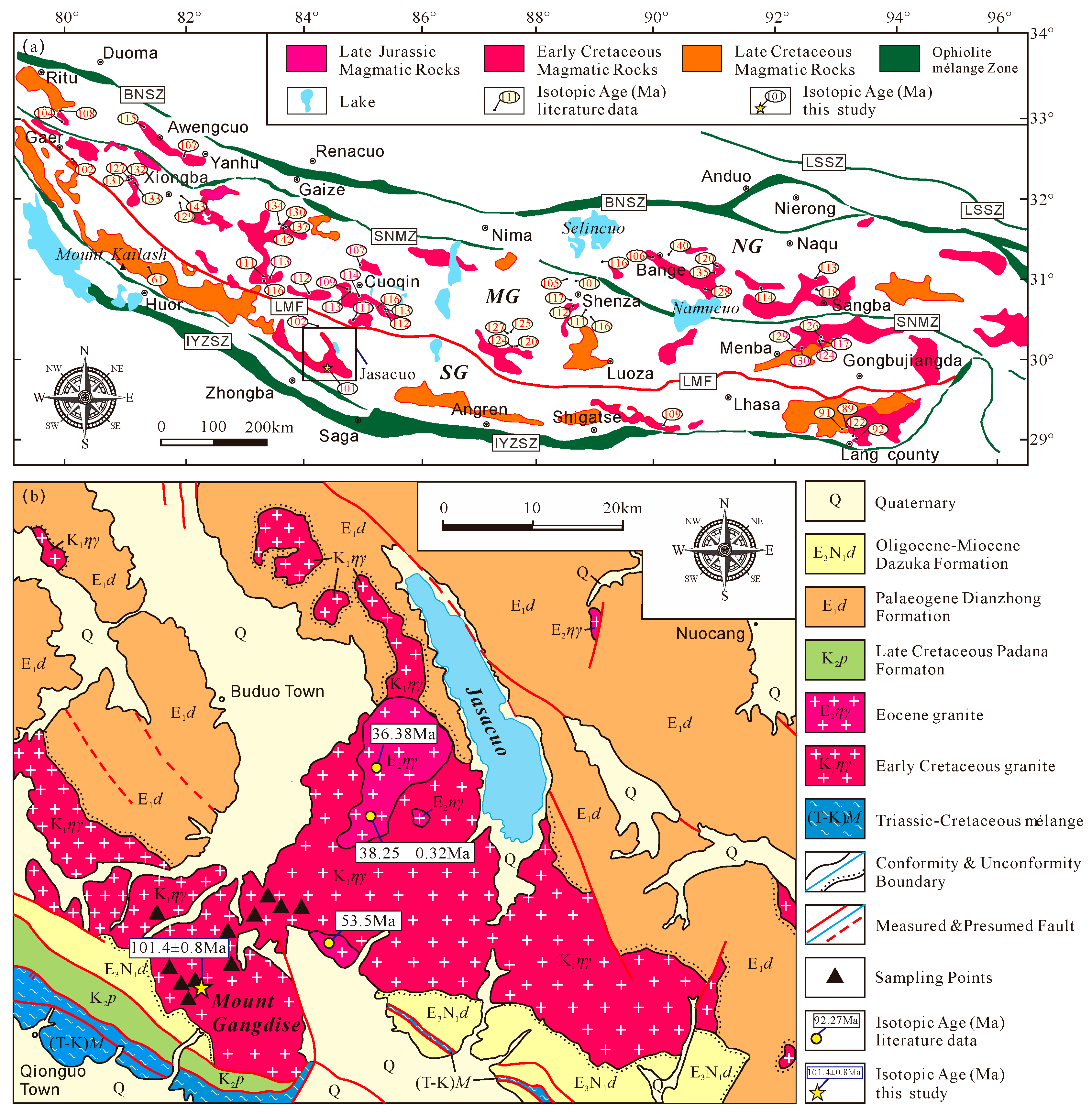
The Gangdese belt, situated between the India-Yarlung Zangbo Suture Zone (IYZSZ) to the south and the Bangong-Nujiang Suture Zone (BNSZ) to the north, constitutes a giant, ~2500 km-long E–W trending tectono-magmatic belt in southern Tibet (Figure 1a) [1,2,3]. This belt has experienced a complex geodynamic evolution involving the subduction and closure of the Neo-Tethyan Ocean and subsequent India-Asia continental collision, resulting in voluminous and multi-stage Mesozoic–Cenozoic magmatism [4,5]. As a principal component of the Lhasa Terrane, the Gangdese magmatic belt faithfully records the transition from oceanic subduction to continental collision and post-collisional processes, making it a world-class natural laboratory for investigating plate tectonics, crustal growth, and metallogenesis [6].
Chronological studies have subdivided Gangdese magmatism into distinct stages: Late Triassic–Jurassic (ca. 205–152 Ma) and Cretaceous (ca. 109–80 Ma) granitoids are widely considered products of the northward subduction of the Neo-Tethyan oceanic plate; Paleocene–Eocene (ca. 65–41 Ma) intrusions are linked to continued subduction, slab rollback, and potential breakoff; and Oligocene–Miocene (ca. 33–13 Ma) magmatism is associated with post-collisional lithospheric convective thinning and E–W extension [7,8,9,10]. Furthermore, the Gangdese batholith is commonly subdivided into northern, central, and southern sub-belts, demarcated by major structural boundaries such as the Shiquanhe–Namtso Mélange Zone (SNMZ) and the Luobadui–Milashan Fault Zone (LMF) [11].
Figure 1. (a) Distribution of Mesozoic magmatic rocks in the Gangdese belt [12]. (b) Simplified geological map of Jasacuo area, Zhongba County (Adapted from Regional Geological Survey Institute of Tibet Autonomous Region, 2004 [13]). Abbreviations: SNMZ—Shiquanhe-Namtso ophiolite Mélange zone; LMF—Luobadui Milashan Fault Zone; BNSZ—Bangonghu Nujiang Suture Zone; LSSZ—Longmucuo Shuanghu Suture Zone; IYZSZ—India-Yarlung Zangbo Suture Zone; NG—Northern Gangdese; MG—Middle Gangdese; SG—Southern Gangdese. Age data sources: Zhu et al., 2008 [14], 2011 [15]; Xie et al., 2015 [16]; Yu et al., 2011 [17]; Fan et al., 2015 [18]; Zhou et al., 2015 [19]; Zhang et al., 2012 [20]; Cao et al., 2018 [21]; Jiang et al., 2010 [22]; Zhang et al., 2021 [23]; Zhou et al., 2008 [24]; Wang et al., 2017 [25]; Ji et al., 2009 [26]; Wang et al., 2016 [27]; Fei et al., 2010 [28]; Cui et al., 2011 [29]; Wang et al., 2013 [30]; Chen et al., 2014 [31]; Liu et al., 2022 [32]; Wang et al., 2021 [33]; Du et al., 2011 [34]; Cao et al., 2016 [35]; Peng et al., 2022 [36]; Lei et al., 2022 [37]; Zhao et al., 2009 [38], 2011 [39]; Qu et al., 2012 [40]; Geng et al., 2020 [41]; Guan et al., 2014 [42]; Huang et al., 2020 [43]; Li et al., 2021 [44].
Minerals 16 00644 g001
In contrast to the well-documented central and eastern segments, where voluminous Cretaceous granitoids are extensively exposed, e.g., [12,45,46,47], the Mesozoic magmatic record in the western Gangdese remains comparatively obscure. Cretaceous igneous rocks in this western segment are often sporadic, occurring as relatively small plutons, apophyses, or roof pendants, frequently engulfed or concealed by later, more extensive Eocene–Miocene magmatic suites, e.g., [48,49]. Deciphering the petrogenesis and tectonic setting of these scattered Early Cretaceous plutons is, however, crucial for developing a holistic understanding of Neo-Tethyan subduction dynamics along the entire length of the Asian margin.
This study focuses on the Jasacuo monzogranite in Zhongba County, a representative Early Cretaceous intrusion in the western Gangdese. We present new petrographic observations, whole-rock major- and trace-element geochemistry, and high-precision SIMS zircon U–Pb geochronology. Our primary objectives are to: (1) precisely constrain the crystallization age of the pluton; (2) characterize its geochemical affinity and magmatic evolution; and (3) evaluate its petrogenesis and tectonic implications within the broader framework of Early Cretaceous arc magmatism along the southern Lhasa Terrane.

2. Geological Overview

The study area is located in Zhongba County, Shigatse City, Tibet. Tectonically, it belongs to the western segment of the Southern Gangdese (SG) sub-belt, bounded by the Luobadui–Milashan Fault Zone (LMF) to the north and the India–Yarlung Zangbo Suture Zone (IYZSZ) to the south (Figure 1a). The Early Cretaceous granite batholith (mapped as K1ηγ) in this region is unconformably overlain by volcanic rocks of the Paleocene Dianzhong Formation (E1d) of the Linzizong Group and clastic rocks of the Oligocene–Miocene Dazhuka Formation (E3N1d) (Figure 1b) [50,51]. The Dianzhong Formation volcanic suite, dated at ca. 61–71 Ma [52,53,54], is predominantly composed of rhyolitic tuffs and breccias. The Dazhuka Formation comprises a sequence of red molasse deposits including conglomerate, sandstone, and shale. To the southwest, near Qiongguo Town, the granite is in fault contact with Triassic–Cretaceous sedimentary mélange and Late Cretaceous clastic rocks of the Padana Formation (K2p). Locally, the batholith is intruded by Eocene granites (E2ηγ) with zircon U–Pb ages ranging from ca. 36 to 54 Ma [49,55]. The unconformable contact with the Paleocene Dianzhong Formation provides a minimum age constraint, indicating the granite was emplaced prior to the Paleogene.
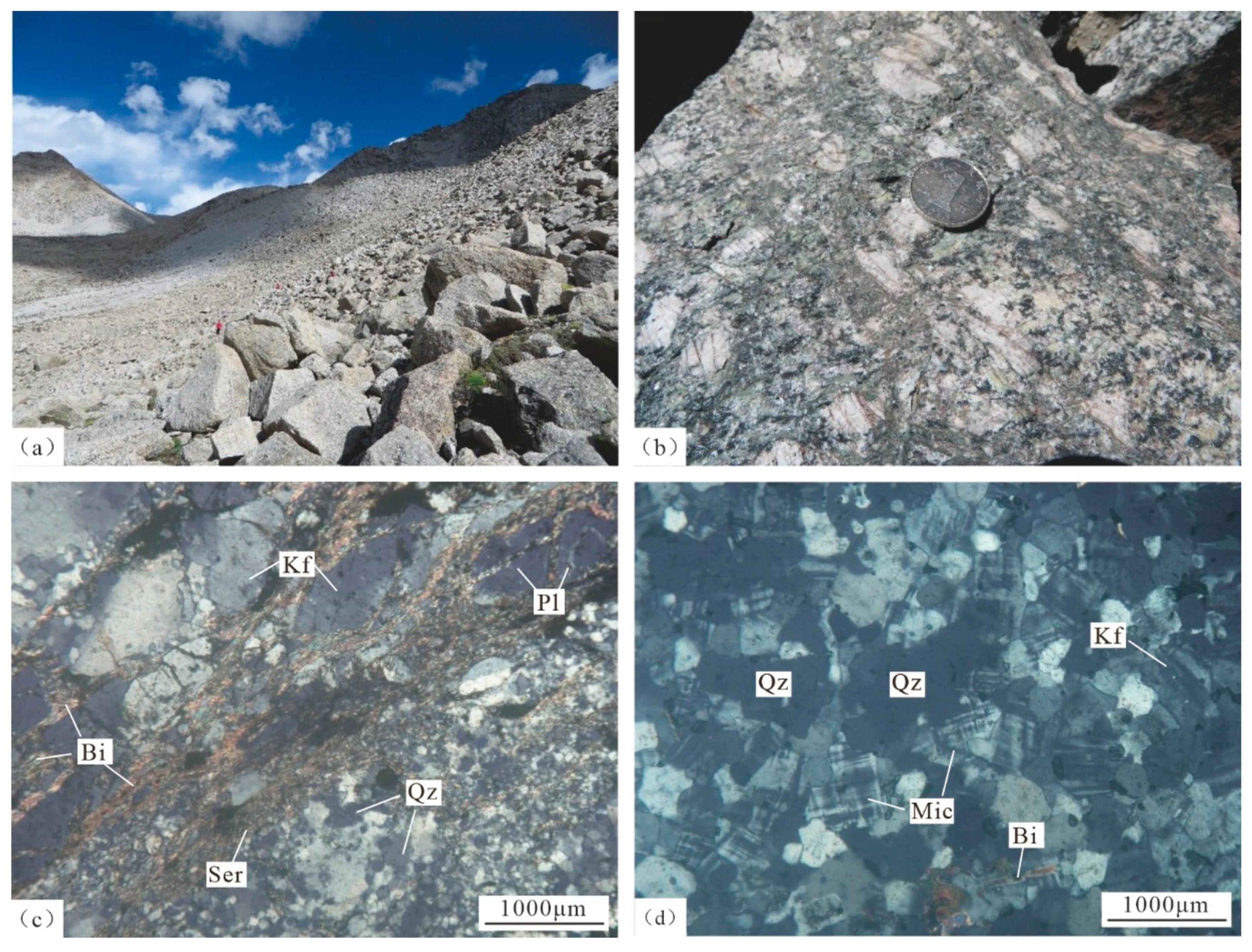
Samples for this study were collected from the main Gangdese Range (84°19′–84°39′ E, 29°54′–30°05′ N) at elevations between 5400 and 5800 m. Outcrops are extensively weathered and typically form blocky exposures (Figure 2a). The dominant lithology is a porphyritic biotite–hornblende monzogranite, locally grading into fractured to weakly mylonitic granitoids (Figure 2b,c). A subordinate fine-grained facies is also observed (Figure 2d). The porphyritic monzogranite is characterized by phenocrysts of K-feldspar and subordinate plagioclase (generally 1.5 × 2 cm, constituting 5–20 vol.%) set in a medium- to coarse-grained matrix of feldspar, quartz, amphibole, and minor biotite (<5%). Near a NW-trending fault, the rock exhibits cataclastic textures with angular crystal fragments. Minor secondary sericite and chlorite are observed along late-stage fractures.

3. Analytical Methods

Major and trace element compositions were determined at the Analysis and Testing Center of the No. 280 Institute, China National Nuclear Corporation (CNNC). For major element analysis, rock samples were fused with sodium carbonate (Na2CO3) at 1000 °C for 40 min. Subsequently, SiO2 and loss-on-ignition (LOI) were determined by gravimetric methods; CaO, MgO, Al2O3, and Fe2O3 were measured via volumetric titration; P2O5, MnO, and TiO2 were analyzed using a 722 spectrophotometer; and K2O and Na2O were determined using a Z-2000 atomic absorption spectrophotometer (AAS). Trace and rare earth elements (REEs) were analyzed by inductively coupled plasma mass spectrometry (ICP-MS) using an iCAP Qc instrument, following sample digestion with an HF + HNO3 acid mixture in pressurized vessels.
Quality assurance was maintained in accordance with the DZ/T 0130-2006 standard [56], with analytical accuracy and precision monitored using certified reference materials (CRMs) GBW07103 (granodiorite, for trace elements) and GBW04122 (limestone, for major elements). Analytical uncertainties (relative deviations) are within ±0.1%–5.0% for major oxides (SiO2, Fe2O3, Al2O3, CaO, and MgO) and ±0.5%–3.5% for minor oxides (TiO2, P2O5, and MnO). Trace element analyses exhibit relative uncertainties ranging from ±0.1% to ±10.8%. These results confirm that the analytical data are of high quality and satisfy the requirements for geochemical interpretation.
Zircon grains with intact morphology were separated at Langfang Geological Service Co., Ltd. Following epoxy mounting and polishing, cathodoluminescence (CL) imaging was performed to characterize internal structures and identify optimal analytical spots. U-Pb isotope analyses were conducted at the SIMS laboratory of the Beijing Geological Research and Analysis Testing Center, CNNC. Measurements were performed using a Cameca IMS-1280-HR secondary ion mass spectrometer (SIMS) with an O2 primary ion beam (intensity: 1.6–10.7 nA; spot diameter: 20 × 30 μm). Detailed analytical procedures and data reduction followed the protocols of Li et al. [57]. Weighted mean ages and concordia plots were processed using the Isoplot/Ex software (version 3.0) [58,59].

4. Analysis Results

4.1. SIMS Zircon U-Pb Age

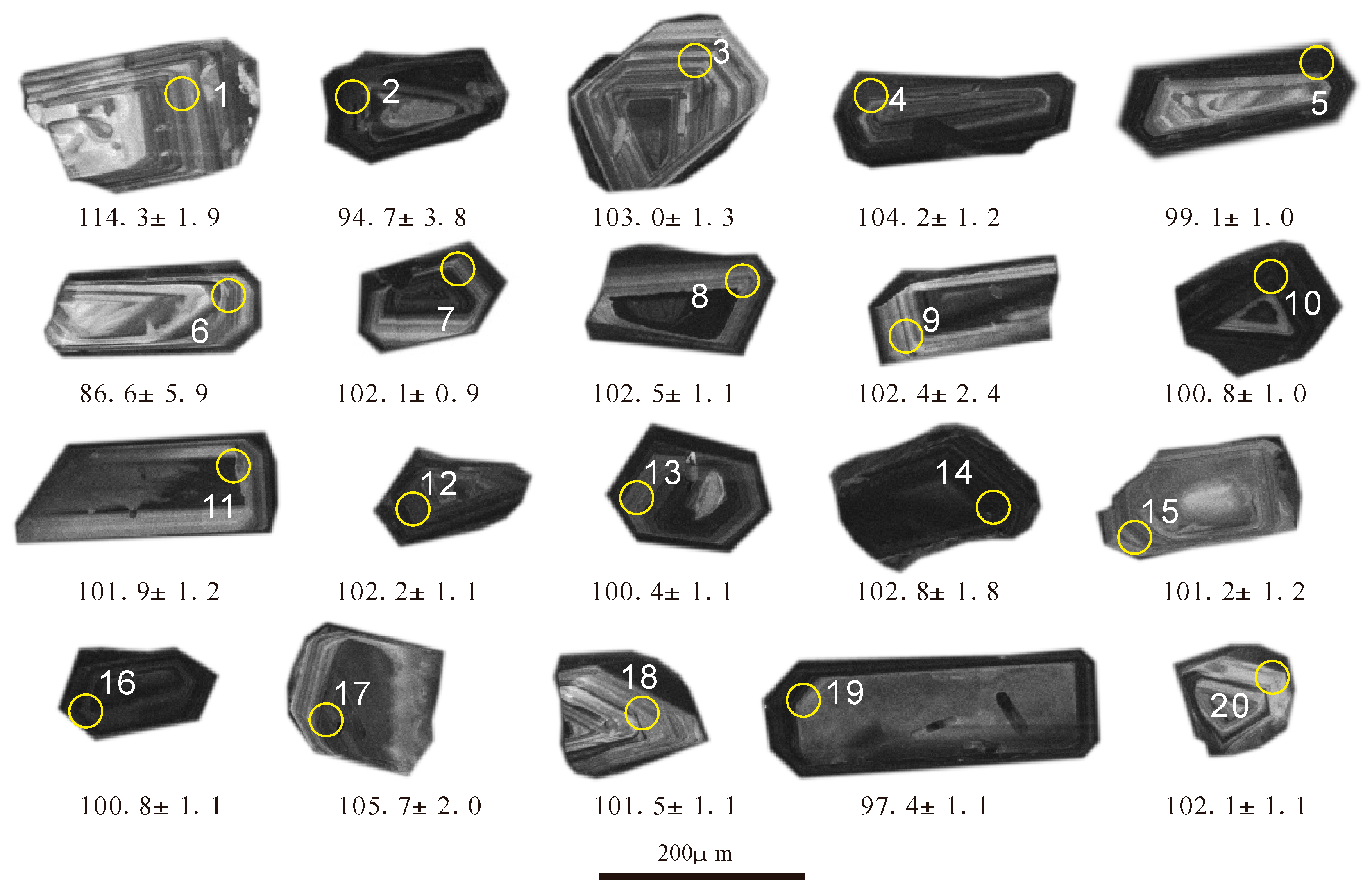
Zircon U–Pb analyses were performed on a monzogranite sample. Representative cathodoluminescence (CL) images and analytical results are presented in Figure 3 and Table 1, respectively. The zircon grains are predominantly euhedral, prismatic, and >200 μm in length, displaying well-defined oscillatory zoning and occasional core–rim structures, all characteristic of a magmatic origin [60,61]. Their Th and U contents range from 797 to 5642 ppm and 2486 to 26,406 ppm, respectively, with Th/U ratios varying from 0.14 to 0.74, further corroborating a magmatic genesis [62,63].
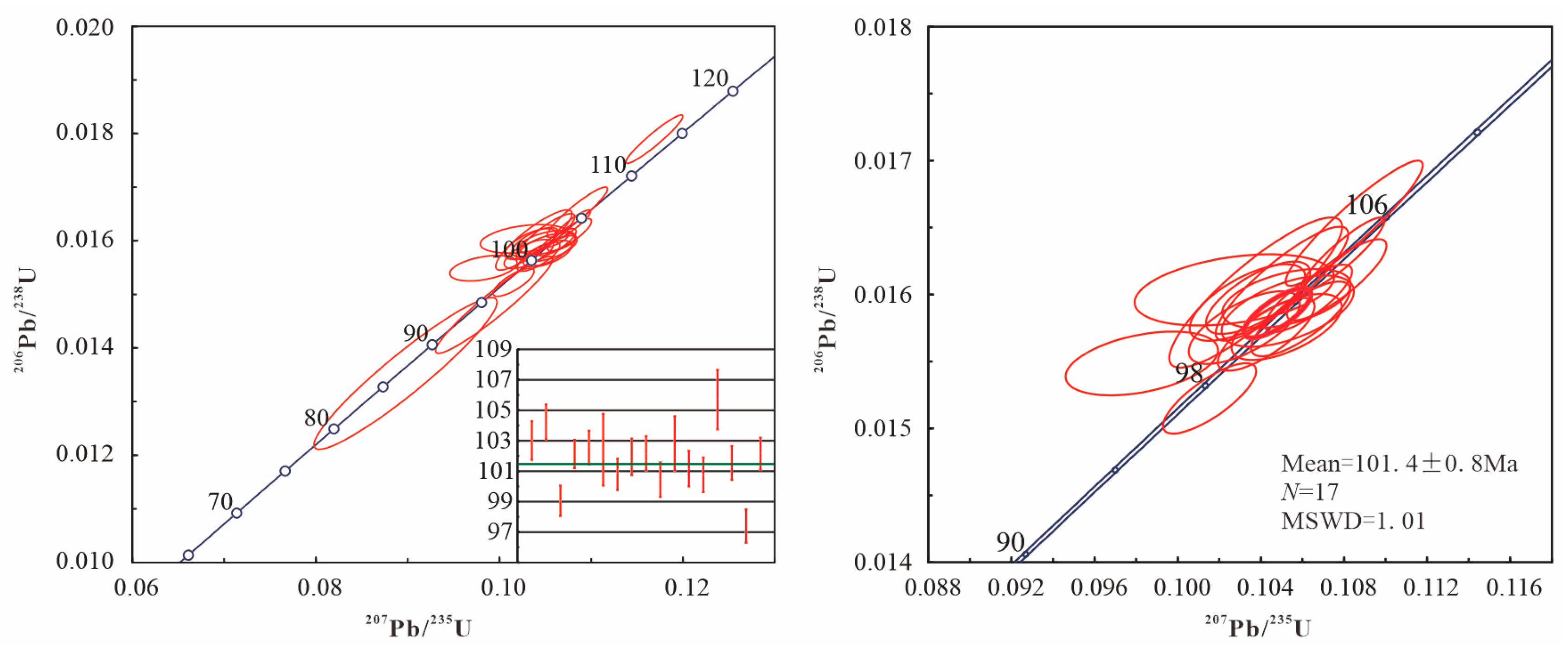
Among the 20 analyses, one spot yields an older 206Pb/238U age of 114.3 ± 1.9 Ma, whereas two spots yield younger ages of 94.7 ± 3.8 Ma and 86.6 ± 5.9 Ma. The inherited core (114.3 Ma) likely reflects older crustal materials, whereas the two younger ages are interpreted as a result of minor Pb loss or localized thermal disturbance during post-magmatic processes. Because these three analyses do not represent the main crystallization event, they were excluded from the weighted mean calculation. The remaining 17 analyses plot on or close to the concordia curve and yield a weighted mean 206Pb/238U age of 101.4 ± 0.8 Ma (MSWD = 1.01, Figure 4), which is interpreted as the crystallization age of the Jasacuo monzogranite.

4.2. Major Element Geochemical Characteristics

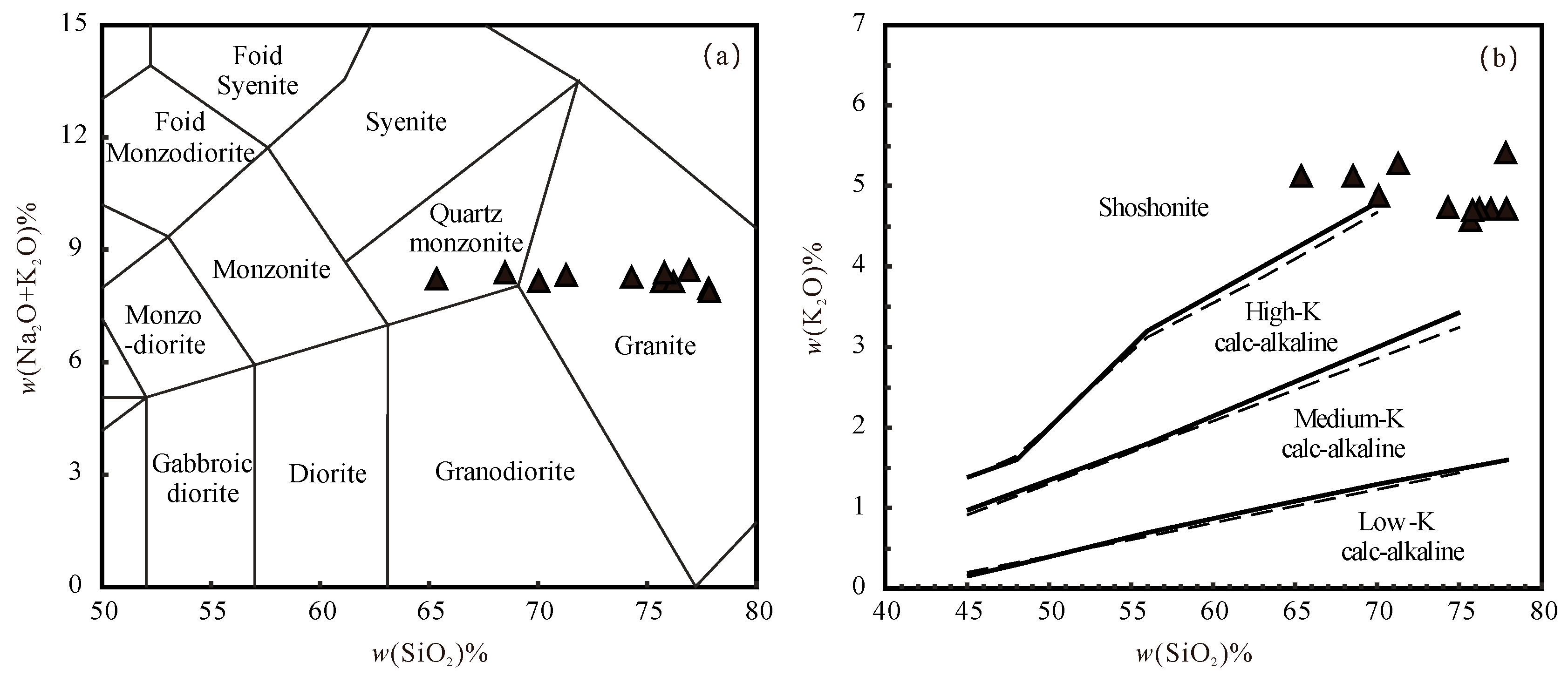
Whole-rock Geochemistry Major and trace element data are listed in Table 2. The samples exhibit low loss on ignition (LOI = 0.20–1.64 wt.%), indicating minimal post-magmatic alteration. SiO2 contents range from 63.73 to 77.11 wt.% (average 72.79 wt.%), Al2O3 from 11.6 to 15.4 wt.%, MgO from 0.25 to 1.63 wt.%, TiO2 from 0.088 to 0.691 wt.%, and CaO from 0.68 to 3.49 wt.%. Na2O and K2O contents are 2.52–3.74 wt.% and 4.54–5.32 wt.%, respectively, with Na2O/K2O ratios of 0.47–0.79. A/CNK values range from 0.92 to 1.08, indicating metaluminous to weakly peraluminous compositions. In the TAS and K2O–SiO2 diagrams (Figure 5) [64,65], the samples plot in the granite to quartz monzonite fields and belong to the high-K calc-alkaline series. Overall, the rocks are characterized by high SiO2 and K2O and relatively low MgO, TiO2, and P2O5.

4.3. Characteristics of Rare Earth and Trace Elements

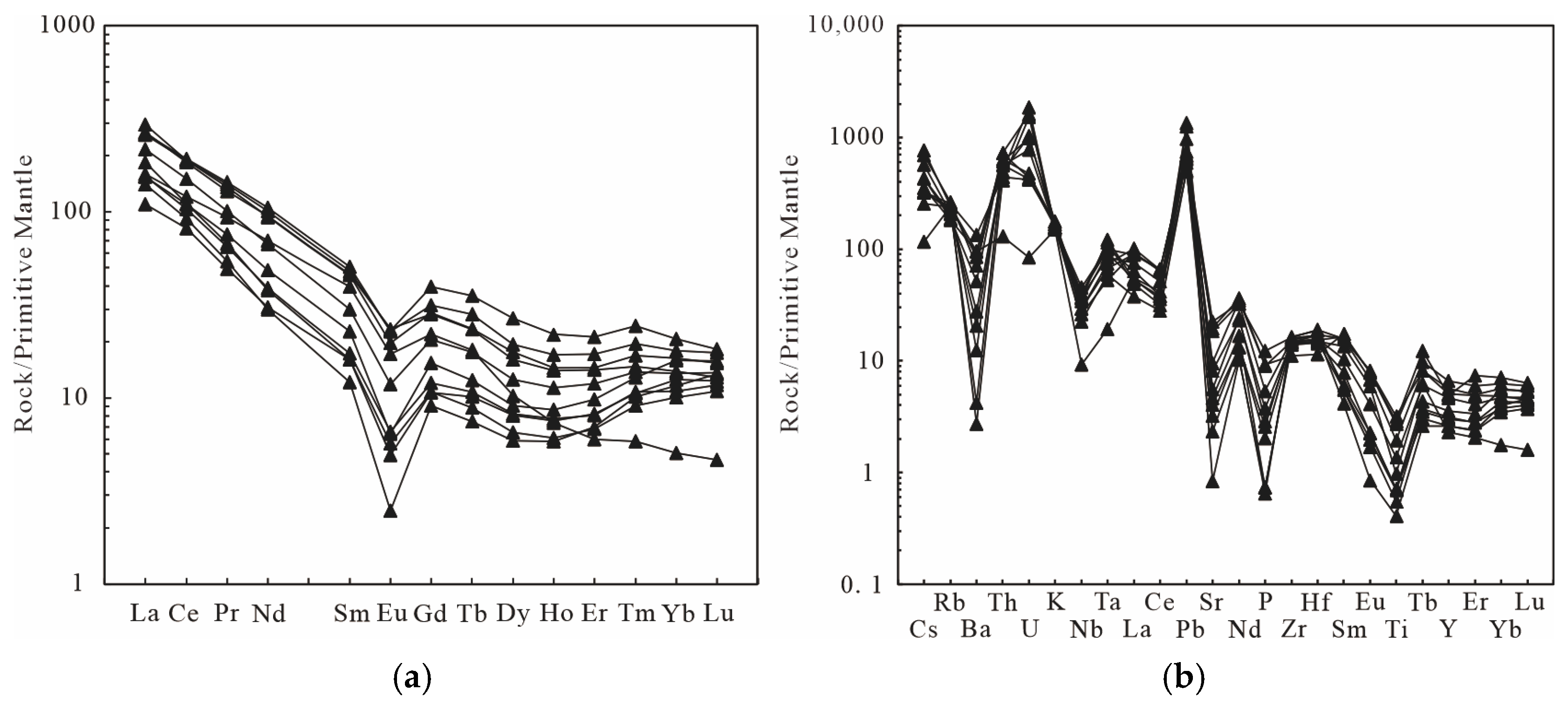
The chondrite-normalized REE patterns of the samples exhibit a right-inclined slope, highlighting significant fractionation between light REEs (LREEs) and heavy REEs (HREEs) (Figure 6a). The total REE (∑REE) concentrations are relatively high, ranging from 106.65 to 272.63 ppm (mean: 191.12 ppm). The LREE/HREE ratios vary from 9.62 to 17.58 (mean: 13.46), further confirming significant fractionation. Additionally, the La/Sm ratios (6.29–17.95) and (La/Yb)N values (8.71–31.54) consistently indicate strong enrichment of LREEs. The samples display δCe values between 0.88 and 1.02, suggesting the absence of significant Ce anomalies. In contrast, δEu values range from 0.23 to 0.63, revealing a pronounced negative Europium anomaly. These geochemical signatures are characteristic of evolved granitic rocks that have undergone significant plagioclase fractionation or represent partial melts of plagioclase-bearing sources.
In the standardized primitive-mantle normalized spider diagram (Figure 6b), the samples display a right-inclined, jagged pattern. The rocks are systematically enriched in large-ion lithophile elements (LILEs; e.g., Cs, Rb, Ba) and Pb, but markedly depleted in high-field-strength elements (HFSEs; e.g., Nb, Ta, Zr, Hf). Specifically, Rb, U, Th, and Pb show significant enrichment, whereas K, P, Eu, and Ta exhibit distinct negative anomalies. Furthermore, elements such as Ba, Nb, Sr, Zr, and Ti show pronounced depletion. The Rb/Sr ratios are highly variable, ranging from 0.28 to 8.75 (mean: 1.87), and Nb/Ta ratios range from 5.21 to 8.61 (mean: 7.12). Collectively, these trace element signatures and elemental ratios underscore the highly fractionated nature of the magma.

5. Discussion

5.1. Regional Spatio-Temporal Framework of Early Cretaceous Magmatism

Early Cretaceous magmatism was intense and widespread across the Gangdese belt, reflecting a prolonged period of crustal growth and reworking between ~133 and ~92 Ma. Regional geochronological compilations reveal distinct, heterogeneous pulses of arc-related magmatism across the western, middle, and eastern segments of the belt (Figure 1). These granitoids—primarily metaluminous to weakly peraluminous I-type suites—are widely interpreted as products of Neo-Tethyan slab subduction, involving varying contributions of ancient basement melting, mantle-derived underplating, and subsequent fractional crystallization [18,37,42,67]. In localized areas, A-type granites and syn-magmatic volcanic activity (e.g., in Kong Co and Cuoqin) further indicate that slab breakoff and localized lithospheric extension played a crucial role in diversifying the magmatic record [32,33].
The Jasacuo monzogranite, with a zircon U-Pb age of 101.4 ± 0.8 Ma (MSWD = 1.01), fits seamlessly into this regional framework. This age bridges the temporal gap between the early stage (130–120 Ma) and late-stage (110–90 Ma) magmatic pulses in the western Gangdese region. Given the typical magmatic oscillatory zoning and Th/U ratios (0.14–0.74) of the analyzed zircons, we confirm the crystallization of this pluton represents a definitive magmatic event in the late Early Cretaceous. Our new data not only expand the geochronological coverage for the western Gangdese belt but also underscore the continuity of regional tectono-magmatic activity during the northward subduction of the Neo-Tethyan oceanic slab.

5.2. Discussion on Tectonic Background

The Early Cretaceous monzogranites in the Jasacuo area are characterized by high SiO2 and Al2O3 contents, low TiO2, and distinct HFSE depletion. These geochemical features, combined with the presence of hornblende and the absence of primary muscovite or garnet, strongly indicate an I-type rather than S-type affinity. Specifically, the relatively low A/CNK ratios (typically < 1.1) and the lack of characteristic peraluminous minerals suggest a metaluminous to weakly peraluminous nature, consistent with a derivation from igneous protoliths rather than pelitic sediments.
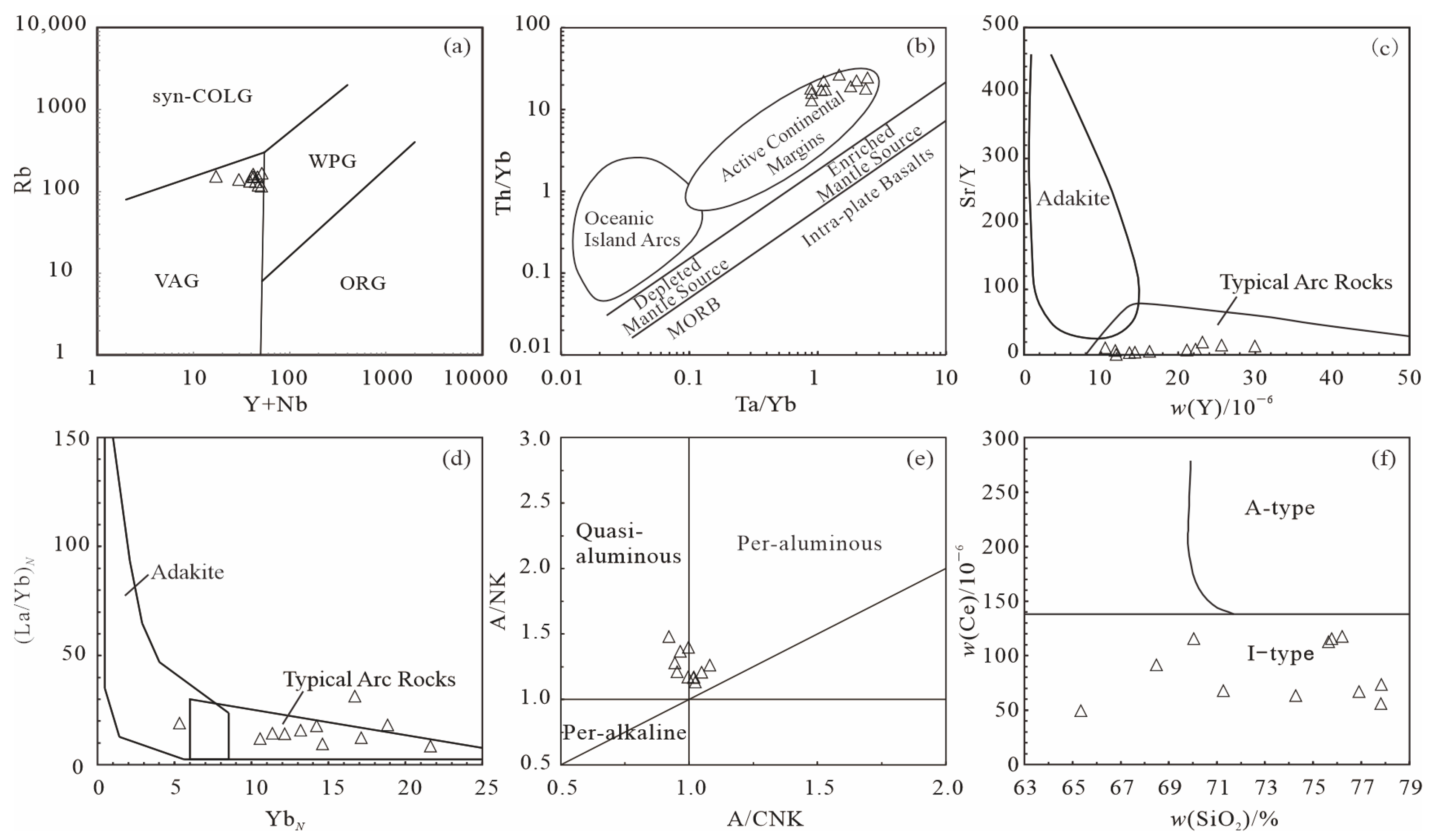
In the (Y + Nb) vs. Rb tectonic discrimination diagram [68], the studied samples exclusively plot within the volcanic arc granite (VAG) domain (Figure 7a). This geochemical affinity—characterized by depletion in heavy rare earth elements (HREEs; noting that Y behaves geochemically similarly to Ho) and HFSEs, coupled with enrichment in LILEs—signifies a robust genetic link to subduction processes. In such tectonic regimes, HFSEs are efficiently sequestered within the subducting slab by residual minerals such as rutile, whereas LILEs are readily mobilized by slab-derived fluids [69,70]. Consequently, this distinctive fluid-fluxed geochemical footprint strongly supports the interpretation that the granitic magmatism occurred within an active continental margin or island arc environment [71].
In the Ta/Yb vs. Th/Yb discrimination diagram [76], all samples plot into the active continental margin field (Figure 7b), which indicates that the granites have the characteristics of a convergent plate boundary orogenic belt setting. Regarding the tectonic affinities, the Jasacuo monzogranites plot primarily within the field of normal calc-alkaline arc-related rocks in the Sr/Y vs. Y and (La/Yb)N vs. YbN diagrams (Figure 7c,d). While these diagrams are primarily designed to characterize adakitic geochemical signatures—which are often linked to specific subduction dynamics [77]—the positioning of our samples outside the typical adakitic field confirms that the Jasacuo magmas were not derived from direct slab melting. Instead, this non-adakitic, calc-alkaline signature is consistent with standard arc-related magmatic processes typically observed in convergent plate margins [78]. This island-arc geochemical signature is supported by the primitive mantle-normalized spider diagram (Figure 6b), which reveals distinct enrichments in LILEs and pronounced depletions in HFSEs, e.g., Nb, Ta, Zr, and Hf. In summary, the Cretaceous granites in the Jasacuo area were generated in an island-arc setting along a convergent plate margin, corresponding to an active continental margin orogenic belt.
Integrating the regional tectonic evolution, prior to the India-Asia collision, the northward subduction of the Neo-Tethys oceanic crust formed an extensive “Andean-type” convergent margin, accompanied by prolonged arc magmatism spanning from the Early Jurassic to the Eocene [32]. The tectonic framework of the Gangdese belt was likely modulated by a bidirectional subduction regime: the southward subduction of the Bangong-Nujiang Tethys Ocean to the north and the northward subduction of the Yarlung Zangbo Ocean to the south [26,72]. Given its proximity to the Indus-Yarlung Zangbo Suture Zone (IYZSZ), the southern Gangdese belt developed as an Andean-type continental-margin magmatic arc driven by the northward subduction of the Yarlung Zangbo oceanic lithosphere. During the Cretaceous (127–70 Ma) [73], this intense northward subduction and subsequent slab-mantle interactions triggered widespread magmatic activity, manifested by synchronous volcanic eruptions and the emplacement of voluminous intermediate-acid plutons along the active continental margin.
More specifically, the southern Gangdese belt experienced a transition from early stage northward oceanic subduction to late-stage arc-continent collision during the Cretaceous. Although the closure of the ocean basin amalgamated the arc-continent assembly into a rigid lithospheric domain, continuous subduction and collision sustained a significant thermal and energy release within the lithosphere. Coupling at the crust-mantle boundary prompted the ascent of partial melts along preexisting subduction-related shear zones, accompanied by massive outpourings of silicic magmas. Within this geodynamic framework, the Early Cretaceous monzogranites in the Jasacuo area represent a prime example of arc magmatism developed at a convergent plate boundary along an active continental margin.

5.3. Discussion of Rock Genesis

The source of granitic magma is highly complex, typically involving the partial melting of various crustal structural layers. Based on the source material and tectonic setting, granites are broadly categorized into four types: I-, S-, M-, and A-types. Specifically, I-type granites are derived from the partial melting of meta-igneous protoliths (e.g., ortho-gneisses or amphibolites) [79], whereas S-type granites originate from the melting of meta-sedimentary precursors (e.g., pelites or greywackes). A-type granites denote anorogenic or alkaline rocks generated in rift or stable intracontinental settings [80,81]. Finally, M-type granites result from the differentiation and fractional crystallization of mantle-derived mafic magmas [82,83].
Although negative Eu anomalies and LILE enrichment are observed in both highly fractionated I-type and S-type granites, the Jasacuo monzogranite exhibits several distinct petrological and geochemical characteristics that preclude an S-type affinity. First, the primary mineral assemblage—comprising quartz, plagioclase, alkali feldspar, and porphyritic K-feldspar, with minor hornblende and biotite, and a notable absence of primary muscovite—is fundamentally inconsistent with the peraluminous mineralogy typical of S-type granites. Second, the geochemical signatures strongly align with an I-type nature: the samples are enriched in SiO2 and K2O but depleted in Fe, Mg, and Ca, with Na2O content consistently exceeding 3 wt.% (excluding sample Y1502). The bulk-rock Fe2O3/(FeO + Fe2O3) ratios (mean: 1.59), and the calculated Fe3+/(Fe2+ + Fe3+) ratios (mean: 40.86) indicate a relatively oxidized magma source, typical of magnetite-series I-type granites.
On the A/NK vs. A/CNK discrimination diagram (Figure 7e), the aluminum saturation index A/CNK varies between 0.92 and 1.08, plotting within the transitional zone between metaluminous and peraluminous fields—a hallmark of highly fractionated I-type granites [84]. This advanced degree of fractionation is further corroborated by the solidification index (SI = 2.43–11.81; mean: 5.56) and the differentiation index (DI = 74.29–94.55; mean: 88.13), which are highly comparable to the evolved I-type granites in the eastern Gangdese belt [12]. Finally, trace element signatures, combined with the classification on the Ce vs. SiO2 diagram (Figure 7f), confirming their geochemical affinity [75].
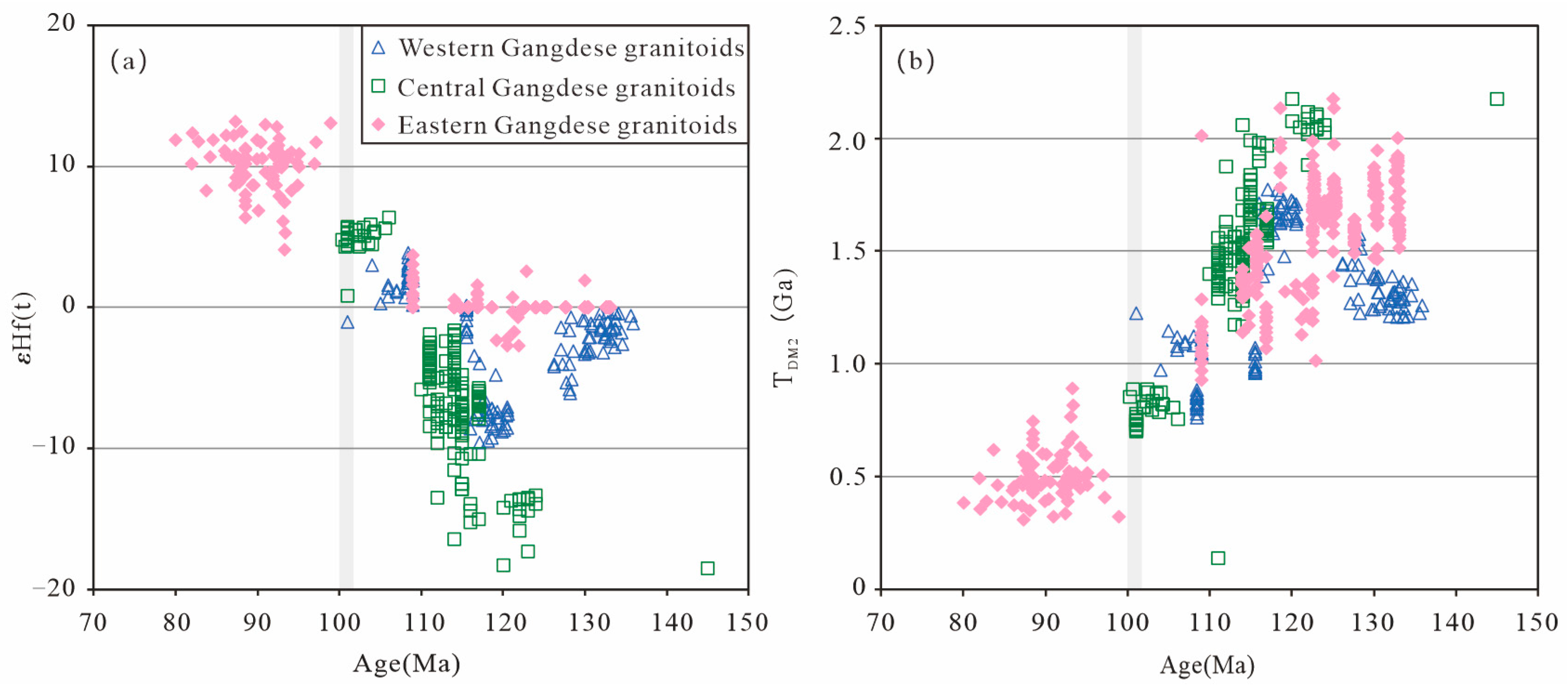
To place the Jasacuo monzogranite within a regional framework, we compiled published zircon Hf isotopic data from Early Cretaceous magmatic rocks across the Gangdese belt (Figure 8). The regional dataset reveals a clear spatio-temporal isotopic evolution: Early Cretaceous (130–110 Ma) granitoids across the western and middle segments of the belt are characterized by strongly negative εHf(t) values (−18.5 to −2.4) and ancient TDM2 ages (1.3–2.2 Ga), indicating a dominant contribution from the ancient Lhasa basement through crustal reworking [19,20,22,24,29,33,42,44,85,86]. In contrast, younger magmatic pulses (<105 Ma), particularly in the eastern segment and localized areas of the central belt, exhibit a significant shift toward positive εHf(t) values (up to +10) and younger TDM2 ages, reflecting an increasing contribution of juvenile mantle-derived melts. The Jasacuo monzogranite (~101 Ma), with its near-zero εHf(t) signature, occupies a pivotal transitional position in this regional trajectory. It likely records the climax of crust–mantle interaction, marking the geodynamic transition from subduction-related crustal thickening to extension-induced juvenile mantle recharge.
Given the typical I-type affinities of the studied pluton, its magma source precludes the possibility of an ancient aluminum-rich metasedimentary basement (S-type source) and must instead be meta-igneous. In the context of regional geology, the subduction of the Neo-Tethyan slab led to the massive underplating of mantle-derived basaltic magmas into the lower crust. The subsequent partial melting of this juvenile, mafic meta-igneous lower crust generated the voluminous I-type granitoids in this region [3,88]. This strongly suggests that the primary magma of the studied pluton originated from the partial melting of such a juvenile, basaltic meta-igneous lower crust [89].
The formation of I-type granites is intimately linked to specific tectonic settings, notably convergent plate margins and subduction zones. One prevailing school of thought emphasizes crust-mantle interactions, wherein the underplating or intrusion of mantle-derived basaltic magma triggers MASH (Melting, Assimilation, Storage, and Homogenization) processes within the lower crust [90,91]. These mantle-derived and hybridized melts subsequently undergo further fractional crystallization, crustal assimilation, and magma mixing within multi-tiered crustal magma chambers or during their ascent, ultimately generating granitic rocks [92]. Alternatively, another viewpoint proposes that I-type granites are derived directly from the extensive fractional crystallization of mantle-derived basaltic magmas. This pathway generates high-Mg pyroxenite cumulates in the deep roots of the arc while yielding complementary low-Mg, Al-rich derivative melts [93]. Consequently, primitive, hydrous basaltic magmas are capable of producing calc-alkaline silicic melts solely via fractional crystallization [94].
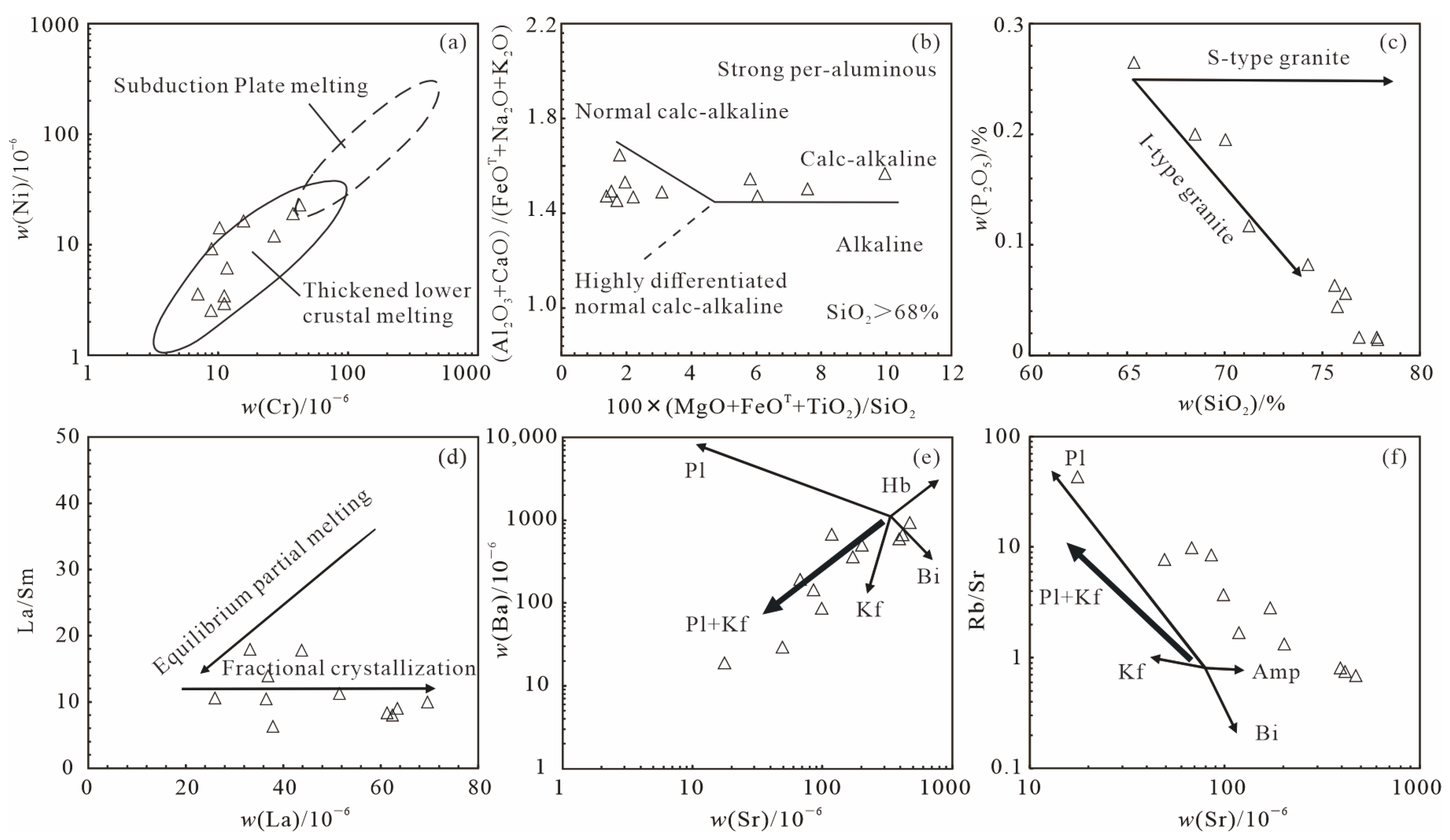
In the Ni−Cr discrimination diagram (Figure 9a), all samples plot within the thickened lower crustal melting zone rather than the subducting plate melting zone [95], indicating that the magma primarily originated from the partial melting of the newly formed crust. Furthermore, in the (Al2O3 + CaO)/(FeOT + Na2O + K2O) vs. 100(MgO + FeOT + TiO2)/SiO2 diagram (Figure 9b), the rocks predominantly plot in the highly differentiated normal calc-alkaline field, with a minor subset falling into the standard calc-alkaline zone [96]. Geochemical characteristics indicate that the magma source should have been dominated by crustal materials, assimilated and contaminated mantle materials; it may have been formed by the mixing of mantle-derived basic magma during crustal remelting. The I-type granite in the study area may have been formed by the mixing of mantle-derived basic materials during crustal remelting.
Major element oxides, including Al2O3, FeOT, CaO, MgO, MnO, P2O5, and TiO2 show significant negative correlations with SiO2 which indicates the rocks underwent separation and crystallization of feldspar minerals (such as potassium feldspar and plagioclase), iron magnesium minerals (such as biotite and amphibole), phosphorus-containing minerals (apatite), and titanium-containing minerals during melt separation and crystallization. This is illustrated in the P2O5 vs. SiO2 diagram (Figure 9c), where P2O5 contents decrease as SiO2 increases. This negative correlation suggests the early crystallization and fractionation of apatite from the melt [12,97], which is a characteristic trend of I-type granites. Conversely, S-type granites exhibit the opposite behavior, where P2O5 either increases or remains relatively abundant even in highly fractionated, high-silica magmas.
In the La/Sm vs. La diagram (Figure 9d, [98]), the samples exhibit a clear trend of increasing La concentrations at relatively constant La/Sm ratios. This horizontal trajectory is diagnostic of fractional crystallization, as equilibrium partial melting of a source region would follow a distinct vector where La/Sm ratios and La concentrations decrease concurrently with increasing degrees of partial melting (F). The lack of a partial melting trajectory in our data, compared against the theoretical partial melting vector, strongly suggests that the major element and trace element variations of the Jasacuo monzogranite were predominantly controlled by fractional crystallization processes during magma ascent and emplacement.
Furthermore, LILEs such as Rb preferentially become concentrated in the continental crust, yielding higher Rb/Sr ratios in the crust than in the mantle. The Rb/Sr ratios of the monzogranites in the study area range from 0.69 to 43.18, with an average of 9.88. This average is significantly higher than the upper mantle value (0.034), as well as the classic global continental crust average (0.32) [100] and even more recent crustal estimates (0.15) [101].
The Zr/Hf and Nb/Ta ratios of the samples range from 31.11 to 35.51 and from 5.21 to 8.61, respectively. Both ranges are lower than their corresponding continental crustal averages (Zr/Hf = 33.33, Nb/Ta = 7.1) [102]. Additionally, the Sm/Nd ratios (0.13–0.18), being lower than the mantle average (0.33), primarily reflect the source-derived signature and residual mineralogy (e.g., potential garnet) during partial melting. This source signature was subsequently overprinted by extensive fractional crystallization, as evidenced by other trace element systematics. The samples display obvious depletions in trace elements such as Ba, Nb, Ta, Sr, P, Zr, Ti, and Eu (Figure 6b). The observed negative anomalies in Nb, Ta, and Ti point to the fractional crystallization of Ti-bearing phases (e.g., ilmenite and/or rutile), whereas the relative depletion of P reflects the early fractionation of apatite. Collectively, the pronounced depletions in Ba, Sr, and Eu provide robust evidence for the extensive fractional crystallization of plagioclase and K-feldspar [12].
The Ba vs. Sr (Figure 9e) and Rb/Sr vs. Sr (Figure 9f) variation diagrams further confirm that the Jasacuo monzogranites underwent intense fractional crystallization predominantly controlled by plagioclase and K-feldspar, with subordinate contributions from hornblende and biotite. Rayleigh fractionation vectors are applied to constrain the fractionating mineral assemblage. In the Ba vs. Sr plot (Figure 9e), both Ba and Sr behave compatibly in K-feldspar (D > 1). In contrast, Sr displays remarkably higher compatibility in plagioclase than in K-feldspar; experimentally determined partition coefficients of Sr for plagioclase are approximately three times the values for K-feldspar [99]. Synchronous fractional crystallization of the two feldspar phases effectively depletes Ba and Sr in residual melts, matching the well-correlated decreasing trends of these two elements in samples. Although plagioclase, K-feldspar, and biotite all participated in magmatic differentiation, the overall distribution of geochemical data indicates that coupled fractionation of plagioclase and K-feldspar dominates the observed trace-element variations. Such substantial fractional crystallization, together with subduction-related geochemical signatures, records the intricate magmatic evolution of the Jasacuo pluton in an active continental margin setting.
In the Rb/Sr vs. Sr diagram (Figure 9f), elemental partitioning systematics further constrain magmatic differentiation processes. Sr is strongly compatible in both plagioclase and K-feldspar, whereas Rb is moderately incompatible in these two feldspars (DRb < 1.0) [103,104]. Continuous fractional crystallization preferentially removes Sr from evolving melts during feldspar precipitation, leading to progressive enrichment of Rb in residual liquids. Such contrasting partitioning characteristics produce an exponential increase in Rb/Sr ratios alongside decreasing whole-rock Sr concentrations. The evolutionary trend marked by rising Rb/Sr and falling Sr robustly verifies feldspar-dominated fractional crystallization as the primary petrogenetic mechanism controlling the Jasacuo magma evolution.
All vectors shown in Figure 9e,f illustrate modeled melt compositional trajectories during fractional crystallization, with every single-mineral vector calculated at an identical residual melt fraction of F = 0.8. The combined Pl + Kf vector is quantified based on the bulk partition coefficient formula Dbulk = ∑wi Di, this synthetic model vector closely overlaps the natural sample array, firmly confirming that coupled co-fractionation of plagioclase and K-feldspar serves as the dominant magmatic process.
Furthermore, because Eu preferentially partitions into plagioclase, its significant crystallization inevitably leads to negative Eu anomalies in the residual melt, as evidenced by the average δEu of 0.46. Given that the partial melting occurred in a thickened lower crustal environment where plagioclase is typically not a stable residual phase, the initial melt would not have inherited a strong negative Eu anomaly from the source. Therefore, the observed pronounced Eu and Sr depletions must have been induced by extensive fractional crystallization of plagioclase during the magma’s ascent to shallower crustal levels [20]. This reinforces the conclusion that the primary magma, derived from the melting of newly formed lower crust, underwent significant subsequent fractionation.
In summary, the Early Cretaceous Jasacuo monzogranites are I-type granites generated within the tectonic framework of the northward subduction of the Yarlung Zangbo oceanic lithosphere [10]. Petrogenetically, the underplating of mantle-derived basaltic magmas triggered the partial melting of lower crustal materials, producing a hybrid magma dominated by crustal melts with minor mantle-derived inputs. During its ascent to shallower crustal levels, the magma experienced extensive fractional crystallization—primarily governed by K-feldspar and plagioclase—ultimately culminating in the emplacement of the Jasacuo monzogranite intrusion.

6. Conclusions

(1)
Zircon U-Pb dating yields an age of 101.4 ± 0.8 Ma for the Jasacuo monzogranite, indicating that its emplacement and crystallization occurred during the Early Cretaceous (K1). This timing coincides with the broader magmatic activity across the Gangdese magmatic belt.
(2)
At approximately 100 Ma, the Jasacuo area was situated on an active continental margin, driven by the northward subduction of the Yarlung Zangbo oceanic crust. The subducting oceanic slab induced partial melting of both the mantle and lower crust, leading to magma emplacement and the crystallization of arc-related granitoids.
(3)
The Jasacuo monzogranite is classified as an I-type granite. It was generated by the intrusion of mantle-derived basaltic magmas, which triggered the partial melting of lower crustal materials. This process formed a hybridized magma dominated by crustal sources, with minor mantle-derived inputs. Subsequently, the magma underwent fractional crystallization of K-feldspar and plagioclase, along with minor amounts of biotite and hornblende.

Author Contributions

Conceptualization, W.H. and Q.Q.; methodology, W.H. and Y.W.; software, W.H.; validation, W.H., Q.Q. and W.X.; investigation, W.H., Q.Q. and Y.L.; writing—original draft preparation, W.H., Q.Q. and W.X.; writing—review and editing, W.H., Z.L., Q.Q., Y.W., Y.L. and W.X. All authors have read and agreed to the published version of the manuscript.

Funding

This research was funded by the Department of Natural Resources of Sichuan Province, grant number KJ-2025-059.

Data Availability Statement

The data presented in this study are available within the article.

Acknowledgments

We are deeply grateful to Linling Zhong and Kanghui Zhong for their insightful guidance and constructive suggestions throughout the course of this study.

Conflicts of Interest

The authors declare no conflicts of interest.

References

  1. Yin, A.; Harrison, T.M. Geologic evolution of the Himalayan–Tibetan orogen. Ann. Rev. Earth Planet. Sci. 2000, 28, 211–280. [Google Scholar] [CrossRef]
  2. Pan, G.T.; Ding, J.; Yao, D.S.; Wang, L.Q. Geological Map of the Qinghai–Tibet Plateau and Adjacent Areas (1:1,500,000); Chengdu Cartographic Publishing House: Chengdu, China, 2004. (In Chinese) [Google Scholar]
  3. Zhu, D.C.; Zhao, Z.D.; Niu, Y.; Dilek, Y.; Hou, Z.Q.; Mo, X.X. The Lhasa Terrane: Record of a microcontinent and its histories of drift and growth. Earth Planet. Sci. Lett. 2011, 301, 241–255. [Google Scholar] [CrossRef]
  4. Chung, S.L.; Chu, M.F.; Zhang, Y.Q.; Xie, Y.W.; Lo, C.H.; Lee, T.Y.; Lan, C.Y.; Li, X.H.; Zhang, Q.; Wang, Y.Z. Tibetan tectonic evolution inferred from spatial and temporal variations in post-collisional magmatism. Earth-Sci. Rev. 2005, 68, 173–196. [Google Scholar] [CrossRef]
  5. Hou, Z.Q.; Duan, L.F.; Lu, Y.J.; Zheng, Y.C.; Zhu, D.C.; Yang, Z.M.; Yang, Z.S.; Wang, B.D.; Pei, Y.R.; Zhao, Z.D.; et al. Lithospheric Architecture of the Lhasa Terrane and Its Control on Ore Deposits in the Himalayan–Tibetan Orogen. Econ. Geol. 2015, 110, 1541–1575. [Google Scholar] [CrossRef]
  6. Wang, R.; Richards, J.P.; Zhou, L.M.; Hou, Z.Q.; Stern, R.A.; Creaser, R.A.; Zhu, J.J. The role of Indian and Tibetan lithosphere in the genesis of magmatic rocks and ore deposits in the Gangdese belt, southern Tibet. Earth-Sci. Rev. 2015, 150, 68–101. [Google Scholar] [CrossRef]
  7. Ji, W.Q.; Wu, F.Y.; Chung, S.L.; Li, J.X.; Liu, C.Z. Zircon U–Pb geochronology and Hf isotopic constraints on petrogenesis of the Gangdese batholith, southern Tibet. Chem. Geol. 2009, 262, 229–245. [Google Scholar] [CrossRef]
  8. Mo, X.X.; Hou, Z.Q.; Niu, Y.L.; Dong, G.C.; Qu, X.M.; Zhao, Z.D.; Yang, Z.M. Mantle contributions to crustal thickening during continental collision: Evidence from Cenozoic igneous rocks in southern Tibet. Lithos 2007, 96, 225–242. [Google Scholar] [CrossRef]
  9. Zhu, D.C.; Wang, Q.; Zhao, Z.D.; Chung, S.L.; Cawood, P.A.; Niu, Y.; Liu, S.A.; Wu, F.Y.; Mo, X.X. Magmatic record of India–Asia collision. Sci. Rep. 2015, 5, 14289. [Google Scholar] [CrossRef] [PubMed]
  10. Ma, L.; Wang, Q.; Wyman, D.A.; Li, Z.X.; Jiang, Z.Q.; Yang, J.H.; Gou, G.N.; Guo, H.F. Late Cretaceous (100–89 Ma) magnesian granitoids in the southern Lhasa sub-terrane, Tibet: Products of slab roll-back of the Neo-Tethyan Ocean? Lithos 2013, 160–161, 1–13. [Google Scholar] [CrossRef][Green Version]
  11. Zhu, D.C.; Mo, X.X.; Niu, Y.; Zhao, Z.D.; Wang, L.Q.; Liu, Y.S.; Wu, F.Y. Geochemical investigation of Early Cretaceous igneous rocks along an east–west traverse throughout the central Lhasa Terrane, Tibet. Chem. Geol. 2009, 268, 298–312. [Google Scholar] [CrossRef]
  12. Zhu, D.C.; Mo, X.X.; Wang, L.Q.; Zhao, Z.D.; Liu, Y.L.; Zhou, C.Y.; Yang, Y.H. Petrogenesis of highly fractionated I-type granites in the Chayu area of eastern Gangdese, Tibet: Constraints from zircon U–Pb geochronology, geochemistry and Sr–Nd–Hf isotopes. Sci. China Earth Sci. 2009, 52, 1223–1239. [Google Scholar] [CrossRef]
  13. Regional Geological Survey Institute of Tibet Autonomous Region. 1:250,000 Regional Geological Survey Report of the Shiquanhe Area, Tibet; Geological Publishing House (GPH): Beijing, China, 2004. [Google Scholar]
  14. Zhu, D.C.; Mo, X.X.; Zhao, Z.D.; Xu, J.F.; Zhou, C.Y.; Sun, C.G.; Wang, L.Q.; Chen, H.H.; Dong, G.C.; Zhou, S. Zircon U–Pb geochronology of Zenong Group volcanic rocks in Coqen area of the Gangdese, Tibet and tectonic significance. Acta Petrol. Sin. 2008, 24, 401–412, (In Chinese with English abstract). [Google Scholar]
  15. Zhu, D.C.; Zhao, Z.D.; Niu, Y.L.; Wang, Q.; Dilek, Y.; Guan, Q.; Liu, Y.S.; Mo, X.X. Tracing the provenance of inherited zircons from peraluminous granites in the Lhasa Terrane and its paleogeographic implications. Acta Petrol. Sin. 2011, 27, 1917–1930, (In Chinese with English abstract). [Google Scholar]
  16. Xie, L.; Dun, D.; Zhu, L.D.; Ni, M.; Yang, W.G.; Tao, G.; Li, C.; He, B.; He, Y. Zircon U–Pb geochronology, geochemistry and geological significance of the Zhaduding A-type granites in northern Gangdese, Tibet. Geol. China 2015, 42, 1214–1227, (In Chinese with English abstract). [Google Scholar]
  17. Yu, Y.S.; Gao, Y.; Yang, Z.S.; Tian, S.H.; Liu, Y.C.; Cao, S.H.; Hu, W.Z.; Qie, H.M. Zircon LA–ICP–MS U–Pb dating and geochemistry of intrusive rocks from Gunjiu iron deposit in the Nixiong ore field, Coqen, Tibet. Acta Petrol. Sin. 2011, 27, 1949–1960, (In Chinese with English abstract). [Google Scholar]
  18. Fan, S.F.; Qu, X.M.; Song, Y.; Xin, H.B. Petrogenesis of the ore-forming granodiorite in the Nixiong Iron Deposit and its implications for the metallogenic tectonic background. Geotecton. Metallog. 2015, 39, 286–299, (In Chinese with English abstract). [Google Scholar]
  19. Zhou, H.; Qiu, J.S.; Yu, S.B.; Wang, R.Q. Geochronology and geochemistry of volcanic rocks from Coqen District of Tibet and their implications for petrogenesis. Acta Geol. Sin. 2015, 90, 3173–3191, (In Chinese with English abstract). [Google Scholar]
  20. Zhang, X.Q.; Zhu, D.C.; Zhao, Z.D.; Sui, Q.L.; Wang, Q.; Yuan, S.H.; Hu, Z.C.; Mo, X.X. Geochemistry, zircon U–Pb geochronology and in-situ Hf isotope of the Maiga batholith in Coqen, Tibet: Constraints on the petrogenesis of the Early Cretaceous granitoids in the central Lhasa Terrane. Acta Petrol. Sin. 2012, 28, 1615–1634, (In Chinese with English abstract). [Google Scholar]
  21. Cao, H.W.; Zhang, Y.H.; Santosh, M.; Li, G.M.; Zhang, L.K.; Tang, L.; Duan, Z.M. Petrogenesis and metallogenic implications of Cretaceous magmatism in Central Lhasa, Tibetan Plateau: A case study from the Lunggar Fe skarn deposit and perspective review. Geol. J. 2018, 54, 2323–2346. [Google Scholar] [CrossRef]
  22. Jiang, X.; Zhao, Z.D.; Zhu, D.C.; Zhang, F.Q.; Dong, G.C.; Mo, X.X.; Guo, T.Y. Zircon U–Pb geochronology and Hf isotopic geochemistry of Jiangba, Bangba, and Xiongba granitoids in western Gangdese Tibet. Acta Petrol. Sin. 2010, 26, 2155–2164, (In Chinese with English abstract). [Google Scholar]
  23. Zhang, S.Z.; Li, F.O.; Liu, H.; Li, J.; Gou, Z.B.; Qin, Y.D. The Early Cretaceous gabbro in Yare area, middle Lhasa Block: Magmatism response to the slab break-off of the southward subduction Bangong–Nujiang Ocean lithosphere. Geol. Bull. China 2021, 40, 1852–1864, (In Chinese with English abstract). [Google Scholar]
  24. Zhou, C.Y.; Zhu, D.C.; Zhao, Z.D.; Xu, J.F.; Wang, L.Q.; Chen, H.H.; Xie, L.W.; Dong, G.C.; Zhou, S. Petrogenesis of Daxiong pluton in western Gangdese, Tibet; zircon U–Pb dating and Hf isotopic constraints. Acta Petrol. Sin. 2008, 24, 348–358, (In Chinese with English abstract). [Google Scholar]
  25. Wang, L.Y.; Gao, S.B.; Zheng, Y.Y.; Li, W.L.; Mao, R.W.; Huang, L.L. Geochronology and geochemistry of the Quejiaonong Pluton in Middle Section of Gangdese, Tibet and its mineralization significance. Acta Geosci. Sin. 2017, 91, 822–835, (In Chinese with English abstract). [Google Scholar] [CrossRef]
  26. Ji, W.Q.; Wu, F.Y.; Zhong, S.L.; Liu, C.Z. Geochronology and petrogenesis of granitic rocks in Gangdese batholith, southern Tibet. Sci. China Earth Sci. 2009, 39, 849–971. (In Chinese) [Google Scholar]
  27. Wang, L.Q.; Xie, F.W.; Wang, Y. U–Pb geochronology and trace element compositions of zircon in biotite granite from the Bagaladong Pb–Zn Deposit, Tibet and their geological significance. Rock Miner. Anal. 2016, 35, 650–657, (In Chinese with English abstract). [Google Scholar] [CrossRef]
  28. Fei, G.C.; Wen, C.Q.; Wang, C.S.; Wu, P.Y.; Wen, Q.; Zhou, X. Zircon SHRIMP U–Pb age and its geological significance in Dongzhongla allgovite, Mozhugongka area, eastern segment of Gangdese, Tibet, China. Geol. Bull. China 2010, 29, 1138–1142, (In Chinese with English abstract). [Google Scholar] [CrossRef] [PubMed]
  29. Cui, X.L.; Tang, J.X.; Dorji; Zhong, K.H.; Gao, Y.M.; Liu, H.F.; Zhang, J.S.; Wang, C.H.; Liu, T.T. Zircon U–Pb age of the quartz porphyry from Dongzhongla Pb–Zn deposit in Tibet, China. J. Chengdu Univ. Technol. (Sci. Technol. Ed.) 2011, 38, 557–562, (In Chinese with English abstract). [Google Scholar]
  30. Wang, L.; Zeng, L.S.; Gao, L.E.; Chen, Z.Y. Early Cretaceous high Mg# and high Sr/Y clinopyroxene-bearing diorite in the southeast Gangdese batholith, Southern Tibet. Acta Petrol. Sin. 2013, 29, 1977–1994, (In Chinese with English abstract). [Google Scholar]
  31. Chen, Y.; Zhu, D.C.; Zhao, Z.D.; Meng, F.Y.; Wang, Q.; Santosh, M.; Wang, L.Q.; Dong, G.C.; Mo, X.X. Slab breakoff triggered ca. 113 Ma magmatism around Xainza area of the Lhasa Terrane, Tibet. Gondwana Res. 2014, 26, 449–463. [Google Scholar] [CrossRef]
  32. Liu, H.; Li, G.M.; Li, W.C.; Huang, H.X.; Li, Y.G.; Ouyang, Y.; Zhang, X.F.; Zhou, Q. Petrogenesis and tectonic setting of the late Early Cretaceous Kong Co A-type granite in the northern margin of Central Lhasa Terrane, Tibet. Acta Petrol. Sin. 2022, 38, 230–252. [Google Scholar] [CrossRef]
  33. Wang, X.X.; Yan, G.Q.; Liu, H.; Huang, H.X.; Lai, Y.; Tian, E.Y.; Ouyang, Y. Genesis of Late Cretaceous Qusanggele Granite in Central Lhasa Block Tibet: Constraints by geochemistry, zircon U–Pb geochronology, and Sr–Nd–Pb–Hf isotopes. Earth Sci. 2021, 46, 2832–2849, (In Chinese with English abstract). [Google Scholar]
  34. Du, D.D.; Qu, X.M.; Wang, G.H.; Xin, H.B.; Liu, Z.B. Bidirectional subduction of the Middle Tethys oceanic basin in the west segment of Bangonghu–Nujiang suture, Tibet: Evidence from zircon U–Pb LA–ICP–MS dating and petrogeochemistry of arc granites. Acta Petrol. Sin. 2011, 27, 1993–2002, (In Chinese with English abstract). [Google Scholar]
  35. Cao, M.J.; Qin, K.Z.; Li, G.M.; Li, J.X.; Zhao, J.X.; Evans, N.J.; Hollings, P. Tectono-magmatic evolution of Late Jurassic to Early Cretaceous granitoids in the west central Lhasa subterrane, Tibet. Gondwana Res. 2016, 39, 386–400. [Google Scholar] [CrossRef]
  36. Peng, B.; Zhao, T.F.; Li, B.L.; Shi, Z.M. Petrogenesis of the monzonitic granite from the North Awengcuo of Lhasa Terrane, Tibet: Constraints from zircon U–Pb age, geochemistry and Hf isotopic composition. J. Jilin Univ. (Earth Sci. Ed.) 2022, 52, 1594–1609, (In Chinese with English abstract). [Google Scholar]
  37. Lei, C.Y.; Tang, J.X.; Yin, X.K.; Song, Y.; Li, W.; Yuan, H.Y. Subduction polarity of Shiquanhe–Namco Tethys ocean basin: Evidence from geochronology and geochemistry of island arc magmatic rocks. Acta Geol. Sin. 2022, 96, 918–941, (In Chinese with English abstract). [Google Scholar] [CrossRef]
  38. Zhao, Y.Y.; Song, L.; Fan, X.T.; Shi, D.H.; Zhang, T.P.; Cheng, H.Q.; Qu, W.J. Re–Os dating of molybdenite from the Shesuo Copper Polymetallic Ore in Shenzha County, Tibet and its geological significance. Acta Geol. Sin. 2009, 83, 1150–1158, (In Chinese with English abstract). [Google Scholar]
  39. Zhao, Y.Y.; Cui, Y.B.; Lü, L.N.; Shi, D.H. Chronology, geochemical characteristics and the significance of Shesuo Copper Polymetallic Deposit, Tibet. Acta Petrol. Sin. 2011, 27, 2132–2142, (In Chinese with English abstract). [Google Scholar]
  40. Qu, X.M.; Wang, R.J.; Dai, J.J.; Li, Y.G.; Qi, X.; Xin, H.B.; Song, Y.; Du, D.D. Discovery of Xiongmei Porphyry Copper Deposit in Middle Segment of Bangonghu–Nujiang Suture Zone and Its Significance. Miner. Depos. 2012, 31, 1–12, (In Chinese with English abstract). [Google Scholar] [CrossRef]
  41. Geng, Q.R.; Zhang, Z.; Peng, Z.M.; Guan, J.L.; Cong, F. Petrogeochemistry and metallogenesis related to Xiongmei–Baingoin Granitic Zone in Central Tibet. Earth Sci. 2020, 45, 2805–2825, (In Chinese with English abstract). [Google Scholar]
  42. Guan, J.L.; Geng, Q.R.; Wang, G.Z.; Peng, Z.M.; Zhang, Z.; Cong, F.; Li, N. Zircon U–Pb dating and Hf isotope compositions of the Risong Granite in North Gangdese, Tibet. Acta Geol. Sin. 2014, 88, 36–52, (In Chinese with English abstract). [Google Scholar] [CrossRef]
  43. Huang, H.X.; Li, G.M.; Liu, B.; Dong, S.L.; Shi, H.Z.; Zhang, Z.L.; Fan, A.H. Zircon U–Pb geochronology and geochemistry of the Tiangongnile Skarn-type Cu–Au Deposit in Zhongba County, Tibet: Their genetic and tectonic setting significance. Acta Geosci. Sin. 2020, 33, 424–434, (In Chinese with English abstract). [Google Scholar]
  44. Li, G.X.; Zeng, L.S.; Zhao, L.H.; Gao, L.E.; Gao, J.H. Petrogenesis and geodynamic significances of the early Late Cretaceous intrusion in the Langxian Complex, eastern Gangdese batholith of southern Tibet. Acta Petrol. Sin. 2021, 37, 3348–3376, (In Chinese with English abstract). [Google Scholar] [CrossRef]
  45. Chiu, H.Y.; Chung, S.L.; Wu, F.Y.; Liu, D.Y.; Liang, Y.H.; Lin, I.J.; Iizuka, Y.; Xie, L.W.; Wang, Y.B.; Chu, M.F. Zircon U–Pb and Hf isotopic constraints from eastern Transhimalayan batholiths on the precollisional magmatic and tectonic evolution in southern Tibet. Tectonophysics 2009, 477, 3–19. [Google Scholar] [CrossRef]
  46. Wen, D.R.; Liu, D.; Chung, S.L.; Chu, M.F.; Ji, J.; Zhang, Q.; Song, B.; Lee, T.Y.; Yeh, M.W.; Lo, C.H. Zircon SHRIMP U–Pb ages of the Gangdese Batholith and implications for Neotethyan subduction in southern Tibet. Chem. Geol. 2008, 252, 191–201. [Google Scholar] [CrossRef]
  47. Zhang, Z.M.; Dong, X.; Santosh, M.; Zhao, G.C. Metamorphism and tectonic evolution of the Lhasa terrane, Central Tibet. Gondwana Res. 2014, 25, 170–189. [Google Scholar] [CrossRef]
  48. Meng, Y.K.; Dong, H.W.; Xu, Z.Q.; Cao, Y. Zircon U–Pb geochronology, Hf isotope and whole-rock geochemistry of the Early Cretaceous granitoids from the western segment of the Gangdese belt, southern Tibet. Acta Geol. Sin. (Engl. Ed.) 2016, 90, 1661–1678. [Google Scholar]
  49. He, J. The Magmatism in Zhongba Area, Yarlung Zangbo Suture Zone and Its Tectonic Implications. Master’s Thesis, China University of Geosciences (Beijing), Beijing, China, 2015. (In Chinese with English abstract). [Google Scholar]
  50. Dong, G.C.; Mo, X.X.; Zhao, Z.D.; Wang, L.; Zhou, S. A new understanding of the stratigraphic successions of the Linzizong volcanic rocks in the Lhunzhub basin, northern Lhasa, Tibet, China. Geol. Bull. China 2005, 24, 549–557, (In Chinese with English abstract). [Google Scholar]
  51. Zhou, P.; Liu, G.X.; Li, Q.; Yu, B. Zircon U–Pb ages and geochemistry of volcanic rocks from the Linzizong Group in the Tingong Area in Middle Gangdese Belt. Bull. Mineral. Petrol. Geochem. 2019, 38, 352–360, (In Chinese with English abstract). [Google Scholar]
  52. Sichuan Institute of Geological Survey. 1:250,000 Regional Geological Survey Report of the Cuoqin Area, Tibet; Geological Publishing House (GPH): Beijing, China, 2002. [Google Scholar]
  53. Lee, H.Y.; Chung, S.L.; Lo, C.H.; Ji, J.; Lee, T.Y.; Qian, Q.; Zhang, Q. Eocene Neotethyan slab breakoff in southern Tibet inferred from the Linzizong volcanic record. Tectonophysics 2009, 477, 20–35. [Google Scholar] [CrossRef]
  54. Zhu, D.C.; Wang, Q.; Cawood, P.A.; Zhao, Z.D.; Mo, X.X. Raising the Gangdese Mountains in southern Tibet. J. Geophys. Res. Solid Earth 2017, 122, 214–226. [Google Scholar] [CrossRef]
  55. Liu, D.; Zhao, Z.D.; DePaolo, D.J.; Zhu, D.C.; Mo, X.X. Potassic volcanic rocks and adakitic intrusions in southern Tibet: Insights into mantle–crust interaction and mass transfer from Indian plate. Lithos 2017, 268–271, 162–180. [Google Scholar] [CrossRef]
  56. Ministry of Land and Resources of the People’s Republic of China. DZ/T 0130-2006: The Specification of Testing Quality Management for Geological Laboratories; Ministry of Land and Resources: Beijing, China, 2006.
  57. Li, X.H.; Liu, Y.; Li, Q.L.; Guo, C.H. Precise determination of Phanerozoic zircon Pb/Pb age by multicollector SIMS without external standardization. Geochem. Geophys. Geosyst. 2009, 10, 1–21. [Google Scholar] [CrossRef]
  58. Ludwig, K.R. Users Manual for Isoplot 3.00: A Geochronological Toolkit for Microsoft Excel; Berkeley Geochronology Center: Berkeley, CA, USA, 2003; Volume 35, pp. 1–39. [Google Scholar]
  59. Yuan, H.L.; Gao, S.; Liu, X.M.; Li, H.M.; Günther, D.; Wu, F.Y. Accurate U–Pb age and trace element determinations of zircon by laser ablation–inductively coupled plasma–mass spectrometry. Geostand. Geoanal. Res. 2004, 28, 353–370. [Google Scholar] [CrossRef]
  60. Simon, L.H.; Nigel, M.K. Zircon tiny but timely. Elements 2007, 3, 13–18. [Google Scholar] [CrossRef]
  61. Belousova, E.A.; Griffin, W.L.; O’Reilly, S.Y.; Fisher, N.J. Igneous zircon: Trace element composition as an indicator of source rock type. Contrib. Mineral. Petrol. 2002, 143, 602–623. [Google Scholar] [CrossRef]
  62. Hoskin, P.W.O.; Schaltegger, U. The composition of zircon and igneous and metamorphic petrogenesis. Rev. Mineral. Geochem. 2003, 53, 27–62. [Google Scholar] [CrossRef]
  63. Wu, R.X. Study on zircon CL and U–Pb age of Neoproterozoic granodiorites in South Anhui. J. Anhui Univ. Sci. Technol. (Nat. Sci.) 2008, 28, 1–7, (In Chinese with English abstract). [Google Scholar]
  64. Middlemost, E.A.K. Naming materials in the magma/igneous rock system. Earth-Sci. Rev. 1994, 37, 215–224. [Google Scholar] [CrossRef]
  65. Rickwood, P.C. Boundary lines with petrologic diagrams which use oxides major and minor element. Lithos 1989, 22, 247–263. [Google Scholar] [CrossRef]
  66. Sun, S.S.; McDonough, W.F. Chemical and isotopic systematics of oceanic basalts: Implications for mantle composition and processes. Geol. Soc. Lond. Spec. Publ. 1989, 42, 313–345. [Google Scholar] [CrossRef]
  67. Shi, H.F.; Xu, Y.Q.; Zhang, J.; Gao, C.; Li, H.L.; Zhang, S. Geochemistry and zircon U–Pb dating of the Saizhuo granodiorite in Tibet and their tectonic significance. East China Geol. 2018, 39, 90–99, (In Chinese with English abstract). [Google Scholar]
  68. Pearce, J.A.; Harris, N.B.W.; Tindle, A.G. Trace element discrimination diagrams for the tectonic interpretation of granitic rocks. J. Petrol. 1984, 25, 956–983. [Google Scholar] [CrossRef]
  69. Foley, S.; Jackson, S.; Neumann, E.R.; Rosing, M. Trace element partition coefficients for clinopyroxene and rutile in aqueous fluids and melts under deep subduction zone conditions. Chem. Geol. 2000, 169, 297–318. [Google Scholar] [CrossRef]
  70. Schmidt, M.W.; Poli, S. Experimentally based water budgets for dehydrating slabs and consequences for mantle melting. Earth Planet. Sci. Lett. 1998, 163, 361–379. [Google Scholar] [CrossRef]
  71. Cawood, P.A.; Hawkesworth, C.J.; Dhuime, B. Detrital zircon record and tectonic setting. Geology 2012, 40, 875–878. [Google Scholar] [CrossRef]
  72. Pan, G.T.; Mo, X.X.; Hou, Z.Q.; Zhu, D.C.; Wang, L.Q.; Li, G.M.; Zhao, Z.D.; Geng, Q.R.; Liao, Z.L. Spatial–temporal framework of the Gangdese Orogenic Belt and its evolution. Acta Petrol. Sin. 2006, 22, 521–533, (In Chinese with English abstract). [Google Scholar]
  73. Mo, X.X.; Dong, G.C.; Zhao, Z.D.; Zhou, S.; Wang, L.L.; Qiu, R.Z.; Zhang, F.Q. Spatial and temporal distribution and characteristics of granitoids in the Gangdese, Tibet and implication for crustal growth and evolution. Geol. J. China Univ. 2005, 11, 281–290, (In Chinese with English abstract). [Google Scholar]
  74. Atherton, M.P.; Petford, N. Generation of sodium-rich magmas from newly underplated basaltic crust. Nature 1993, 362, 144–146. [Google Scholar] [CrossRef]
  75. Collins, W.J.; Beams, S.D.; White, A.J.R.; Chappell, B.W. Nature and origin of A-type granites with particular reference to southeastern Australia. Contrib. Mineral. Petrol. 1982, 80, 189–200. [Google Scholar] [CrossRef]
  76. Pearce, J.S. Sources and setting of granitic rocks. Episodes 1996, 19, 120–125. [Google Scholar] [CrossRef]
  77. Defant, M.J.; Drummond, M.S. Derivation of some modern arc magmas by melting of young subducted lithosphere. Nature 1990, 347, 662–665. [Google Scholar] [CrossRef]
  78. Frost, B.R.; Frost, C.D. A Geochemical Classification for Feldspathic Igneous Rocks. J. Petrol. 2008, 49, 1955–1969. [Google Scholar] [CrossRef]
  79. Chappell, B.W.; White, A.J.R. Two contrasting granite types. Pac. Geol. 1974, 8, 173–174. [Google Scholar]
  80. Loiselle, M.C.; Wones, D.R. Characteristics and origin of anorogenic granites. Geol. Soc. Am. Abstr. Programs 1979, 11, 468. [Google Scholar]
  81. Whalen, J.B.; Currie, K.L.; Chappell, B.W. A-type granites: Geochemical characteristics, discrimination and petrogenesis. Contrib. Mineral. Petrol. 1987, 95, 407–419. [Google Scholar] [CrossRef]
  82. White, A.J.R. Sources of granite magmas. Geol. Soc. Am. Abstr. Programs 1979, 11, 539. [Google Scholar]
  83. Whalen, J.B. Geochemistry of an island-arc plutonic suite: The Uasilau–Yau Yau intrusive complex, New Britain, PNG. J. Petrol. 1985, 26, 603–632. [Google Scholar] [CrossRef]
  84. Chappell, B.W. Aluminium saturation in I- and S-type granites and the characterization of fractionated haplogranites. Lithos 1999, 46, 535–551. [Google Scholar] [CrossRef]
  85. Gao, J.H.; Zeng, L.S.; Gao, L.E.; Hou, K.J.; Guo, C.L. Two episodes of Early Cretaceous magmatism in Geji area of the Lhasa Block, Tibet. Geol. Bull. China 2016, 35, 55–70, (In Chinese with English abstract). [Google Scholar] [CrossRef]
  86. Liu, C.; Yang, Z.S.; Xu, P.Y.; Zhao, X.Y.; Xia, W.J.; Yang, X.X. Zircon U-Pb age of granitoids from the Mamu Pb-Zn skarn mineralized area in Western Gangdese and its geological significance. Geosciences 2021, 35, 466–476, (In Chinese with English abstract). [Google Scholar]
  87. Blichert-Toft, J.; Albarede, F. The Lu-Hf isotope geochemistry of chondrites and the evolution of the mantle-crust system. Earth Planet. Sci. Lett. 1997, 148, 243–258. [Google Scholar] [CrossRef]
  88. Ji, W.Q.; Wu, F.Y.; Chung, S.L.; Li, J.X.; Liu, C.Z. Early Cretaceous adakitic granites in the northern margin of the southern Lhasa terrane, southern Tibet: Implications for the Neo-Tethys ocean subduction and slab tear. Gondwana Res. 2009, 16, 147–159. [Google Scholar] [CrossRef]
  89. Hou, Z.Q.; Duan, L.F.; Lu, Y.J.; Zheng, Y.C.; Zhu, D.C.; Yang, Z.M.; Yang, Z.S.; Wang, B.D.; Pei, Y.R.; Zhao, Z.D.; et al. Juvenile crust formation and evolution in the central Lhasa terrane, Tibet. Lithos 2015, 236, 183–196. [Google Scholar] [CrossRef]
  90. Hildreth, W.S.; Moorbath, S. Crustal contribution to arc magmatism in the Andes of Central Chile. Contrib. Mineral. Petrol. 1988, 98, 455–489. [Google Scholar] [CrossRef]
  91. Annen, C.; Blundy, J.D.; Sparks, R.S.J.; Genève, U.D. The genesis of intermediate and silicic magmas in deep crustal hot zones. J. Petrol. 2006, 47, 505–539. [Google Scholar] [CrossRef]
  92. Sisson, T.W.; Grove, T.L.; Coleman, D.S. Hornblende gabbro sill complex at Onion Valley, California, and a mixing origin for the Sierra Nevada batholith. Contrib. Mineral. Petrol. 1996, 126, 81–108. [Google Scholar] [CrossRef]
  93. Lee, C.T.A.; Cheng, X.; Horodyskyj, U. The development and refinement of continental arcs by primary basaltic magmatism, garnet pyroxenite accumulation, basaltic recharge and delamination: Insights from the Sierra Nevada, California. Contrib. Mineral. Petrol. 2006, 151, 222–242. [Google Scholar] [CrossRef]
  94. Nandedkar, R.H.; Ulmer, P.; Müntener, O. Fractional crystallization of primitive, hydrous arc magmas: An experimental study at 0.7 GPa. Contrib. Mineral. Petrol. 2014, 167, 1015. [Google Scholar] [CrossRef]
  95. Li, Y.; Zhang, S.Z.; Li, F.Q.; Qin, Y.D. Geochronology, geochemistry and petrogenesis of Late Jurassic granitoids in Shiquanhe Area, Western Lhasa Block, Tibet. Earth Sci. 2020, 45, 2846–2856, (In Chinese with English abstract). [Google Scholar]
  96. Sylvester, P.J. Post-collisional alkaline granites. J. Geol. 1989, 97, 261–280. [Google Scholar] [CrossRef] [PubMed]
  97. Li, X.H.; Li, W.X.; Li, Z.H. On the genetic classification and tectonic implications of the Early Yanshanian granitoids in the Nanling Range, South China. Chin. Sci. Bull. 2007, 52, 1873–1885. [Google Scholar] [CrossRef]
  98. Allègre, C.J.; Hart, S.R. Trace elements in igneous petrology. J. Geol. 1978, 86, 773–774. [Google Scholar] [CrossRef]
  99. Rollinson, H.; Pease, V. Using Geochemical Data to Understand Geological Processes, 2nd ed.; Cambridge University Press: Cambridge, UK, 2021; p. 346. [Google Scholar] [CrossRef]
  100. Taylor, S.R.; McLennan, S.M. The geochemical evolution of the continental crust. Rev. Geophys. 1995, 33, 241–265. [Google Scholar] [CrossRef]
  101. Rudnick, R.L.; Gao, S. Composition of the continental crust. In Treatise on Geochemistry, 2nd ed.; Holland, H.D., Turekian, K.K., Eds.; Elsevier: Amsterdam, The Netherlands, 2014; Volume 4, pp. 1–51. [Google Scholar] [CrossRef]
  102. Green, T.H. Significance of Nb/Ta as an indicator of geochemical processes in the crust–mantle system. Chem. Geol. 1995, 120, 347–359. [Google Scholar] [CrossRef]
  103. Nash, W.P.; Crecraft, H.R. Partition coefficients for trace elements in silicic magmas. Geochim. Cosmochim. Acta 1985, 49, 2309–2322. [Google Scholar] [CrossRef]
  104. Ewart, A.; Griffin, W.L. Application of proton-microprobe data to trace element partitioning in volcanic rocks. Chem. Geol. 1994, 117, 251–284. [Google Scholar] [CrossRef]
Figure 2. Field photographs and photomicrographs of the monzogranite in the Jasacuo area. (a) Field outcrop of the monzogranite. (b) Close-up view of the porphyritic monzogranite. (c) Photomicrograph of mylonitic. (d) Photomicrograph of the monzogranite. Mineral abbreviations: Qz (quartz); Pl (plagioclase); Kf (K-feldspar); Mic (microcline); Bi (biotite); Ser (sericite).
Minerals 16 00644 g002
Figure 3. Cathodoluminescence (CL) images of zircons from the monzogranite in the Jasacuo area. Yellow circles indicate the analytical spots for U–Pb, numbers next to the circles correspond to the analysis IDs in Table 1.
Minerals 16 00644 g003
Figure 4. U-Pb Concordia diagram of Zircons of monzogranite in the Jasacuo area.
Minerals 16 00644 g004
Figure 5. (a) TAS diagram (modified after Ref. [64]) and (b) K2O-SiO2 classification diagram (modified after Ref. [65]) in the Jasacuo area.
Minerals 16 00644 g005
Figure 6. (a) Chondrite-normalized REE patterns and (b) primitive mantle-normalized spider diagrams of Jasacuo monzogranites; normalization values follow Sun and McDonough (1989) [66].
Minerals 16 00644 g006
Figure 7. (a) (Y + Nb) vs. Rb tectonic discrimination diagram (modified after Ref. [68]); (b) Ta/Yb vs. Th/Yb discrimination diagrams (modified after Ref. [72]); (c) Sr/Y vs. Y discrimination diagram (modified after Ref. [73]); (d) (La/Yb)N vs. YbN discrimination diagram (modified after Ref. [74]); (e) A/NK vs. A/CNK discrimination diagram (modified after Ref. [75]); (f) Ce vs. SiO2 discrimination diagrams (modified after Ref. [75]). VAG (volcanic arc granites), syn-COLG (syn-collisional granites), WPG (within-plate granites), and ORG (ocean ridge granites).
Minerals 16 00644 g007
Figure 8. (a) Zircon εHf(t) vs. age; (b) TDM2 vs. age diagrams of the Cretaceous granites in the Gangdese belt. Data for comparison are compiled from published studies: Western Gangdese granitoids [22,24,42,86]; Central Gangdese granitoids [19,20,32,33]; Eastern Gangdese granitoids [29,44,85,86]. CHUR evolution line is based on Blichert-Toft and Albarede [87].
Minerals 16 00644 g008
Figure 9. (a) The Ni vs. Cr discrimination diagram (modified after Ref. [95]). (b) The (Al2O3 + CaO)/(FeOT + Na2O + K2O) vs. 100 (MgO + FeOT + TiO2)/SiO2 diagram (modified after Ref. [96]). (c) The P2O5 vs. SiO2 diagram (modified after Refs. [12,97]). (d) La/Sm vs. La discrimination diagram (modified after Ref. [98]). (e) Ba vs. Sr diagram and (f) Rb/Sr vs. Sr diagram (modified after Ref. [99]). Vectors indicate the calculated Rayleigh fractionation trends for different mineral phases: Kf (K-feldspar), Pl (plagioclase), Bi (biotite), and Amp (amphibole). The data array follows the trajectory of feldspar-dominated fractionation.
Minerals 16 00644 g009
Table 1. SIMS zircon U-Th-Pb dating results of monzogranite in the Jasacuo area.
Spot
No.
PbThUTh/U207Pb/206Pb207Pb/235U206Pb/238U207Pb/206Pb207Pb/235Pb206Pb/238Pb
(10−6)RatioRatioRatioAge (Ma)Age (Ma)Age (Ma)
01228294911,3480.260.047380.5630.116881.7630.017891.67068.213.3112.21.9114.31.9
025396730880.310.048721.3410.099444.2440.014804.027134.331.296.33.994.73.8
03201301110,9780.270.048470.7930.107651.4740.016111.243122.118.6103.81.5103.01.3
04248201813,9390.140.048030.5180.107941.2280.016301.113100.712.2104.11.2104.21.2
0554145929490.490.046032.2460.098272.4640.015481.013−0.853.395.22.299.11.0
06496564226,4060.210.048142.4720.089777.3370.013526.908106.257.487.36.286.65.9
079977857200.140.047801.7090.105241.9380.015970.91289.240.0101.61.9102.10.9
0857129730330.430.046472.8860.102733.0860.016031.09221.967.999.32.9102.51.1
09107231557170.400.046991.2860.103752.6480.016012.31448.730.4100.22.5102.42.4
1069253634250.740.048441.3080.105241.6670.015761.033120.830.5101.61.6100.81.0
1148131224860.530.047031.3220.103361.7760.015941.18650.831.399.91.7101.91.2
1259109931860.350.047161.1350.103871.5920.015981.11657.126.8100.31.5102.21.1
1369163337190.440.048160.9370.104261.4750.015701.139106.922.0100.71.4100.41.1
1478215240100.540.047370.9870.105022.0080.016081.74967.923.3101.41.9102.81.8
1569138837420.370.048560.9300.105911.4880.015821.162126.921.7102.21.4101.21.2
1682136945410.300.047521.2780.103211.7110.015751.13875.330.199.71.6100.81.1
17172407286850.470.047600.7450.108492.0100.016531.86679.417.6104.62.0105.72.0
1873175938800.450.048111.6630.105301.9970.015881.106104.438.8101.71.9101.51.1
199379755520.140.048370.9090.101531.4580.015221.140117.521.398.21.497.41.1
20115177263830.280.048270.7730.106301.2980.015971.042112.718.1102.61.3102.11.1
Table 2. Geochemical analysis data of monzogranite in the Jasacuo area.
SampleY1501Y1502Y1503Y1504Y1505Y1506Y1507Y1508Y1509Y1510Y1511
SiO275.0276.4176.9467.2368.7263.7375.3375.3371.0473.8277.11
TiO20.210.1520.0880.5860.6230.6910.1540.1510.4230.2940.118
Al2O313.611.612.814.714.715.412.91313.713.212
Fe2O30.510.370.31.511.031.770.480.41.080.760.34
FeO0.310.480.421.832.082.430.520.761.441.050.47
MnO0.0290.0350.0630.0820.0730.110.060.0660.0560.0850.053
MgO0.360.340.291.320.361.630.370.391.450.250.29
CaO10.970.682.482.343.490.920.922.091.640.85
Na2O3.562.523.743.213.233.023.43.683.043.523.15
K2O4.545.324.735.044.795.014.674.685.274.714.68
P2O50.0630.0160.0160.20.1950.2650.0560.0440.1170.0820.014
LOI0.531.260.20.850.270.640.340.290.380.310.26
A/CNK1.080.9941.0230.9640.9960.921.0471.0160.9440.9521.018
A/NK1.2631.1711.1351.3691.41.4821.2111.1691.281.2121.171
SI3.893.773.0610.233.1311.763.923.9411.812.433.25
DI92.0493.1294.5580.482.8374.2992.5392.4983.7789.6593.74
Li15.78.1551.537.758.934.373.665.123.877.814.2
Be1.666.214.56.445.594.9212.714.54.9312.27.24
Sc3.781.573.657.696.329.23.84.576.424.590.96
V9.6610.39.7581.760.291.111.415.154.637.47.88
Cr8.9610.47.0438.115.942.911.311.327.211.88.92
Co1.171.631.04137.6711.71.592.027.084.531.17
Ni9.1614.23.619.216.5232.943.46126.192.54
Cu4.0711.95.551115.726.43.354.3312.220.13.36
Zn15.420.724.443.862.258.322.425.848.140.427
Ga15.61418.919.21819.51818.718.719.414.2
Rb154151154116167163134132152119141
Sr11898.617.641420247167.785.339117149.1
Y10.516.211.929.922.223.114.311.825.621.113.6
Mo0.9113.7319.91.154.212.480.5161.572.041.870.73
Cd0.0320.030.1250.0460.0780.020.0220.0020.0550.0520.055
In0.0250.0040.0140.0430.0430.0390.0140.0170.0270.0210.005
Sb0.4131.160.8711.386.530.8720.5850.5290.8350.6310.867
Cs8.2122.754.625.149.623.140.530.618.130.723.5
Ba67286.718.966450093419314559736129.5
La37.936.533.262.461.363.436.943.869.651.526
Ce73.767.456.211811611363.467.911691.949.8
Pr8.857.195.1513.713.312.36.136.4312.99.594.7
Nd32.722.613.949.247.144.318.117.743.831.414.3
Sm6.033.491.857.777.337.042.652.466.974.572.45
Eu0.9940.3730.1431.321.331.360.3810.331.140.6840.285
Gd4.533.161.876.468.145.82.482.215.894.212.19
Tb0.6760.4650.281.051.330.8750.4020.330.8790.6570.379
Dy2.612.31.54.916.774.092.091.654.473.22.04
Ho0.4150.4870.3310.9691.240.7950.4360.3460.8240.640.425
Er0.991.621.152.853.522.341.341.132.41.971.36
Tm0.1490.3280.2590.4980.6230.3760.2750.2320.4320.3520.27
Yb0.8622.711.973.063.512.371.841.712.782.312.14
Lu0.1180.4010.340.4440.4650.3270.2990.2760.3910.3460.312
W2.814.543.114.259.71205.4930.89.3410.93.15
Tl1.42.083.971.781.612.333.843.751.842.352.11
Pb9635.288.84248.853.168.845.449.146.736.2
Bi0.6040.7420.9140.6030.531.342.490.30.7110.6740.565
Th11.15235.354.661.437.841.742.148.361.348.1
U1.7620.6329.979.158.8421.5398.8633.816.4
Nb6.625.928.4212918.624.432.420.826.416.1
Ta0.7854.974.722.754.12.163.764.233.023.452.42
Zr162155165125167182178157172165183
Hf4.634.455.253.524.755.855.24.625.324.865.75
(La/Yb)N31.549.6612.0914.6312.5319.1914.3818.3717.9615.998.71
δCe0.950.960.950.950.950.930.940.880.880.941.02
δEu0.560.340.230.550.520.630.450.420.530.470.37
Note: Major element concentrations are in wt.%; trace element concentrations are in ppm. Geochemical parameters and indices are calculated based on molar proportions, except for SI (in wt.%): A/CNK = Al2O3/(CaO + Na2O + K2O); A/NK = Al2O3/(Na2O + K2O); DI = Qz + Or + Ab + Ne + Lc + Kp; SI = (MgO × 100)/(MgO + FeO + Fe2O3 + Na2O + K2O); ( L a / Y b ) N = L a N Y b N ; δ C e = C e N 0.5 ( S m N + G d N ) ; δ E u = E u N 0.5 ( S m N + G d N ) .
Disclaimer/Publisher’s Note: The statements, opinions and data contained in all publications are solely those of the individual author(s) and contributor(s) and not of MDPI and/or the editor(s). MDPI and/or the editor(s) disclaim responsibility for any injury to people or property resulting from any ideas, methods, instructions or products referred to in the content.