Article

The Liuyuan Rift in the Beishan Area of the Central Asian Orogenic Belt, Western China: Revisiting the Diverse Permian Igneous Assemblages


1
National Geological Library of China, Beijing 100083, China
2
Geoscience Documentation Center, China Geological Survey, Beijing 100081, China
3
Institute of Geomechanics, Chinese Academy of Geological Sciences, Beijing 100081, China
4
Key Laboratory of Active Tectonics and Geological Safety, Ministry of Natural Resources, Beijing 100081, China
5
Key Laboratory of Paleomagnetism and Tectonic Reconstruction, Ministry of Natural Resources, Beijing 100081, China
6
Department of Earth Science and Mineral Resources, China University of Geosciences (Beijing), Beijing 100083, China
7
Institute of Earth Sciences, China University of Geosciences (Beijing), Beijing 100083, China
*
Authors to whom correspondence should be addressed.
Minerals 2026, 16(6), 610; https://doi.org/10.3390/min16060610
Submission received: 14 April 2026 / Revised: 27 May 2026 / Accepted: 3 June 2026 / Published: 8 June 2026

Abstract

The formation of tectonic–magmatic–sedimentary processes during the Permian in the Beishan region represents a highly debated research topic along the southern margin of the Central Asian Orogenic Belt and even globally: does it mark the final subduction and amalgamation of the Paleo-Asian Ocean, or does it instead represent rifting superimposed upon an earlier orogen? New field observations combined with geochemical analyses reveal that the Liuyuan area is dominated by Early Permian basalts, associated with a rifting sedimentary sequence. During the Mid–Late Permian, gabbro–rhyolite associations were emplaced, accompanied by minor lacustrine sedimentation. The late stage was characterized by minor granitic intrusions or dikes with adakitic affinities, culminating in the emplacement of lamprophyre dikes. The basalts and gabbros in the Liuyuan area display mantle-derived geochemical signatures, with compositions intermediate between MORB and OIB. The exposed Permian basalt–rhyolite bimodal magmatic suite represents a genetically integrated rift-related rock series. Geochemical data from the Ordovician granites and schists within the belt reveal adakitic characteristics, implying that the Permian granitic rocks largely represent remelting products of these early granitic and schistose protoliths. Collectively, the lithological characteristics and magmatic associations clearly demonstrate that the tectonic setting during the Early Permian corresponded to a post-collisional extensional environment superimposed upon the early Paleozoic orogenic belt (Caledonian Huitongshan ophiolite–arc accretionary orogen), which subsequently underwent tectonic inversion to form the present-day orogenic structure. This paper proposes a theoretical model wherein the bimodal magmatic suite was generated by the upwelling of enriched asthenospheric mantle material, providing the driving mechanism for rifting. It formed within a post-collisional extensional environment developed over a complex pre-existing orogenic belt and was subsequently inverted, forming the current tectonic belt—a typical intracontinental Pyrenees-type orogeny.

1. Introduction

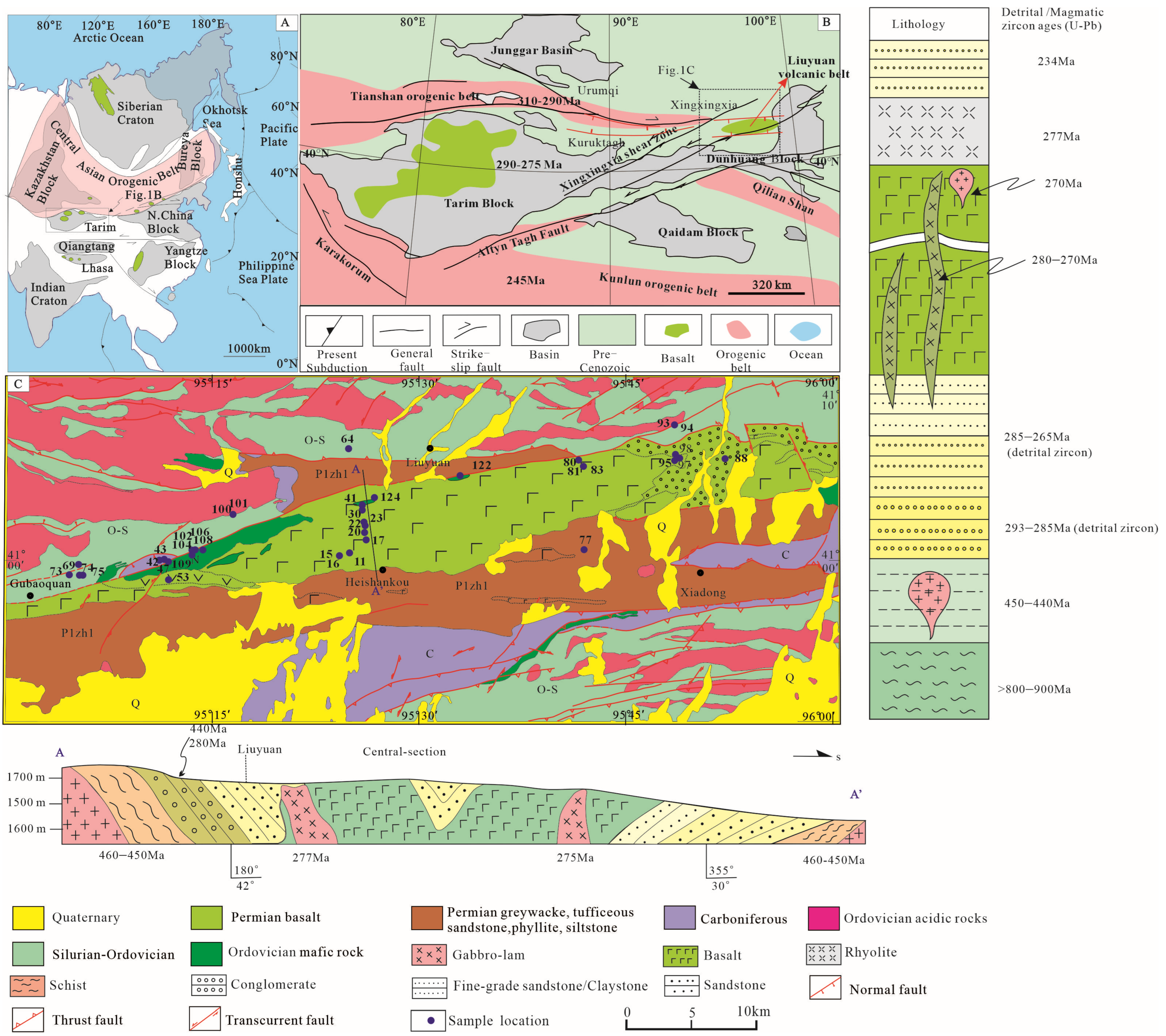
The Central Asian Orogenic Belt (CAOB) is recognized as one of the largest Phanerozoic accretionary orogens globally [1,2]. Its intense convergence and accretion processes resulted in the development of numerous subduction–accretion complexes, making it an ideal region for studying continental block amalgamation, plate subduction, and continental growth. Although the CAOB’s prolonged evolutionary history is widely accepted within the academic community, debates persist regarding its formation mechanisms. Two key contrasting views exist: (1) the Caledonian event represents a distinct tectonic boundary, in which early plate subduction–collision formed the Caledonian orogen, followed by late-stage extension–rifting or the development of limited small oceanic basins and subsequent block amalgamation upon this orogenic foundation [3,4,5,6] (Figure 1); (2) the CAOB formed through continuous accretion from the Cambrian until the Early Triassic [1,2,7]. Initially, it was interpreted as the product of multiple continental block collisions during the Paleozoic. Later models attributed its formation to oceanic subduction processes; however, these models have difficulty explaining the existence of multiple Paleozoic ophiolitic mélange belts within the CAOB. The prevailing view is that the CAOB formed through composite orogenesis involving multiple ocean basins, numerous subduction zones, and multidirectional accretion of microcontinents, oceanic islands, seamounts, and island arcs (e.g., [1]).
Investigating the CAOB’s evolutionary history necessitates examination of the subduction, consumption, and closure processes of the Paleo-Asian Ocean (PAO). Arc magmatism, as a direct product of crustal lateral growth during subduction–accretion, is crucial for understanding continental crustal evolution within orogenic belts. The widespread distribution of Paleozoic–Mesozoic granitoids and shallow-level mafic magmatic rocks within the CAOB precisely records this crustal growth process. Elucidating their origins is essential for understanding the final amalgamation between the Tarim Craton and the CAOB, as well as for reconstructing the CAOB’s tectonic framework, crust–mantle interactions, mineralization, and crustal growth processes [1,2]. However, similar granitic intrusions—those formed through remelting and overprinting within former orogenic belts—suggest both island arc origins and basement remelting [8]. The Liuyuan area, situated in the southernmost segment of the central CAOB, hosts abundant Paleozoic–Mesozoic granitoids and shallow-level mafic magmatic rocks, making it an ideal location for studying the evolutionary history of the Paleo-Asian Ocean (Figure 1).
Previous studies on the Liuyuan area are extensive. Xiao et al. (2010b) [2] proposed that the large-scale pillow lavas and cherts in Liuyuan are components of an ophiolitic suite, representing the site of the CAOB’s final closure along its southern margin [9,10]. However, whether the characteristics of these rocks conform to SSZ-type ophiolites remains debatable. This model also fails to explain the presence of coeval A-type granites, bimodal volcanic rocks, and north–south symmetrical sedimentary sequences within the basalt belt [3,4,5,6,11,12,13,14,15]. Disagreements over the Late Paleozoic tectonic setting of this region significantly constrain understanding of the overall evolution of the Beishan Orogenic Belt. Additionally, some Middle–Late Permian magmatic bodies and dikes have been interpreted as adakites, leading to the proposal that this zone represents the final closure site of the Paleo-Asian Ocean [9].
In this study, systematic field investigations in the Liuyuan area were conducted, different igneous rock types and ages exposed in the Beishan–Liuyuan area and its vicinity were selected for comprehensive geochronological, petrological, geochemical, and Sr–Nd–Pb isotopic analyses. The aims are to investigate their petrogenesis and further explore the demise process of the Paleo-Asian Ocean. By comparing these results with previous research data from the region, we interpret magma formation mechanisms, compositional end-members, and crust–mantle interactions. Finally, we propose a theoretical model based on these results, providing new insights and evidence for understanding the post-orogenic evolutionary processes of the Central Asian Orogenic Belt.

2. Geological Background

The Liuyuan volcanic belt is located on the corner of the NE extension of the Tarim Block. To the south, the Liuyuan area is adjacent to the Dunhuang–Alxa Block. It lies within a large tectonic wedge bounded by the Altyn Tagh and Xingxingxia strike-slip faults, and its tectonic affinity remains controversial [3,16,17,18,19].
The Liuyuan area lies along the east-northeast extension of the Early Paleozoic Huitongshan Ophiolite (450–460 Ma). South of Huitongshan, Permian volcanic rocks are well developed (notably in the Gubaoquan area on the map) (Figure 1B). On both the northern and southern sides of this zone, symmetrically distributed Ordovician–Silurian granites and metamorphic rocks are present, formed between 450 and 440 Ma. These are dominated by metagranite, granodiorite, foliated granite, and greenschist-facies metamorphic rocks, with protoliths mainly comprising basalt and volcaniclastic rocks. These rocks have reported K–Ar and Rb–Sr ages of around 230 Ma; therefore, some studies consider them to represent Triassic arc magmatic rocks. Within these metamorphic and granitic rocks, later intrusions of granitic dikes or small plutons formed between 280 and 272 Ma [9,12]. In earlier studies, Zheng et al. (2014) [20] interpreted these rocks as products of delamination or rifting; however, subsequent work proposed that they represent adakitic rocks formed under subduction-related settings [9]. These units are unconformably overlain by Permian strata, which are centered on pillow basalt lava with symmetrically distributed sediments on both sides, forming a nearly continuous sequence (Figure 1C). Detrital zircon age populations from these clastic rocks cluster at two main intervals: 460–450 Ma and 290–287 Ma [3], while later data from Guo et al. (2023) [10] extend this to as young as 264 Ma. The stratigraphic age distribution also exhibits clear symmetry (Figure 1). The aforementioned volcanic and sedimentary sequences are intruded by 227 Ma lamprophyres and unconformably overlain by Triassic sedimentary rocks—mainly conglomerates and other coarse clastics—with detrital zircon ages of 227–223 Ma (Figure 1).

3. Petrology and Mineral Assemblage Characteristics of Igneous Rocks

3.1. Characteristics of Volcanic Rocks

3.1.1. Characteristics of Basaltic Rocks

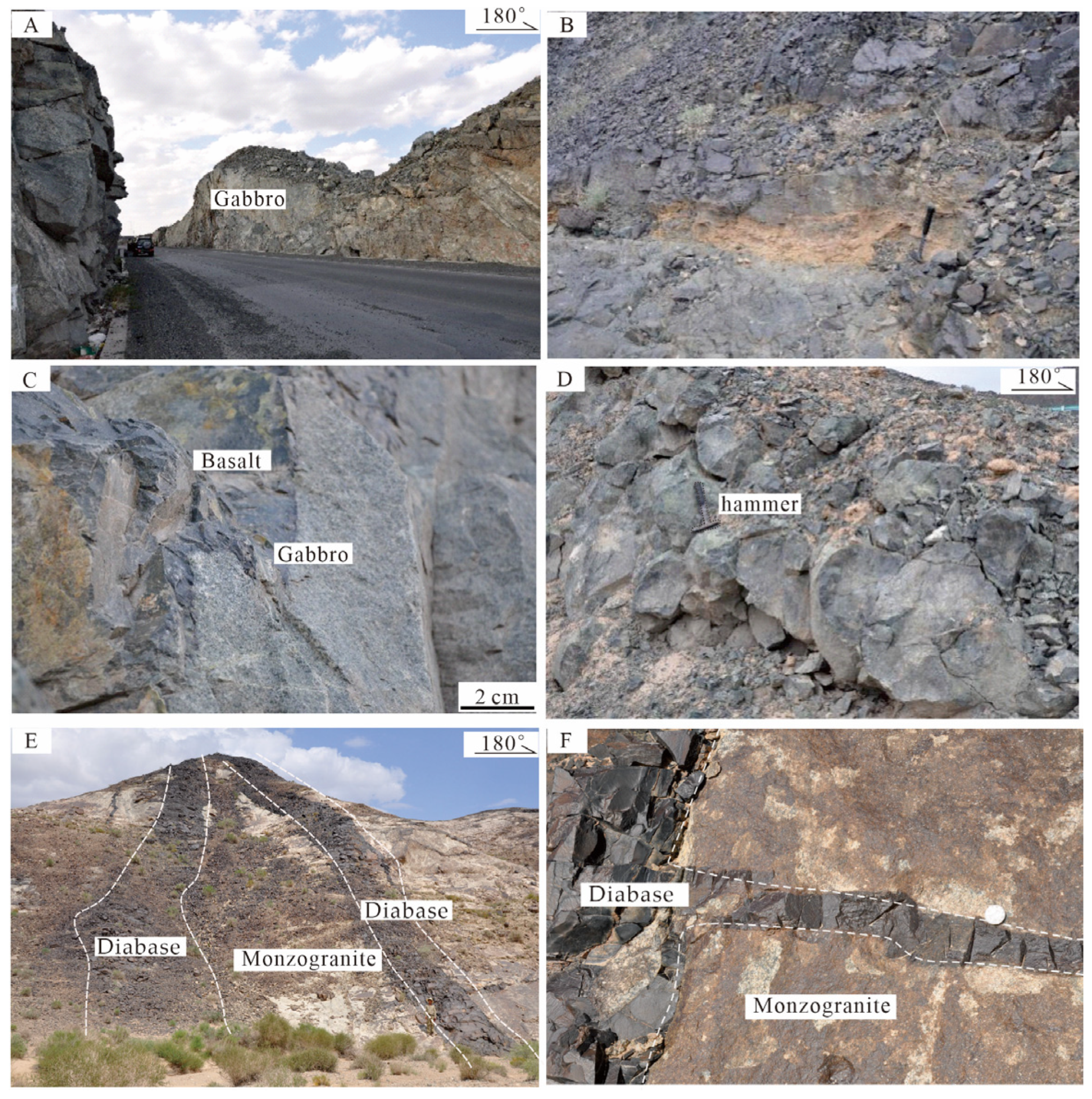
The Permian basalts in the Liuyuan area appear dark green in the field and exhibit pillow structures of varying sizes (Figure 2). They are distributed in the central part of the volcanic zone, extending from Gubaoquan in the west to north of Xiadong in the east. In addition to pillow lavas, volcanic breccias are also present. These are intercalated with sandstones and mudstones of variable thickness and overlie sandstones and black mudstones.
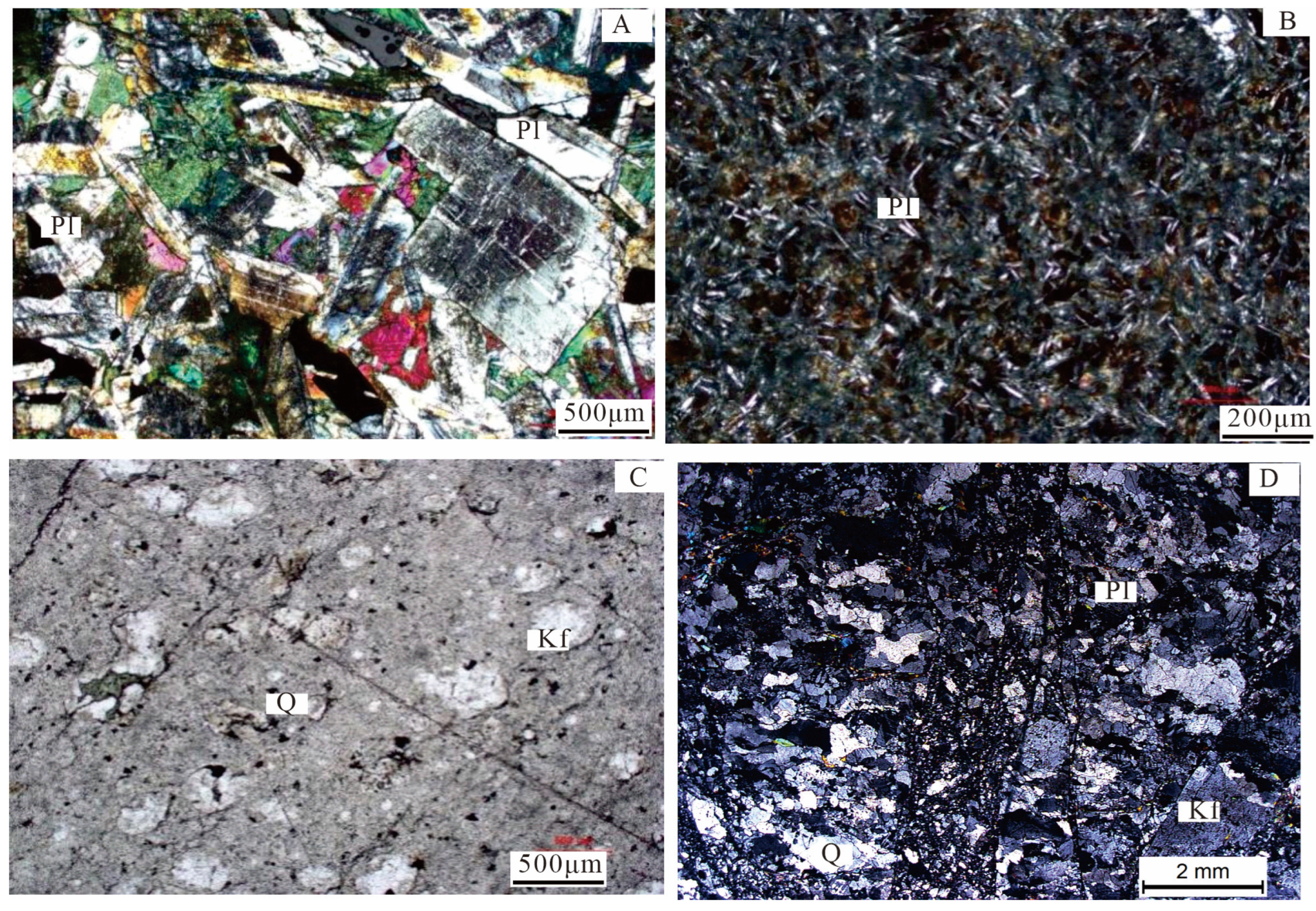
Under the microscope, the basalts predominantly display a porphyritic texture (Figure 3B). Phenocrysts mainly consist of euhedral plagioclase and augite, accounting for more than 10% of the rock volume. The plagioclase phenocrysts mostly appear as tabular or flaky crystals, whereas augite occurs as granular phenocrysts. Both exhibit a random, non-oriented arrangement. The groundmass is primarily composed of microlites of plagioclase and augite, forming an intergranular texture.

3.1.2. Characteristics of Basic–Intermediate Rocks

These rocks are not purely intermediate, and only a few occurrences have been identified, primarily near the rhyolite zones. In the field, minor dacite and volcaniclastic rocks are observed. They exhibit a cryptocrystalline groundmass with plagioclase phenocrysts. These rocks mainly occur south of the basalt belt, with minor interlayers within the basaltic sequence.

3.1.3. Characteristics of Acidic Rocks

Rhyolite is primarily distributed along the eastern margin of the volcanic belt, with minor occurrences along the southern margin (Figure 1). Massive rhyolite, rhyolitic volcanic glass, and subvolcanic volcanic necks are observed, and the rhyolite is overlain by Late Triassic sandstone.
In the field, rhyolite appears off-white to green and exhibits a massive structure, with well-developed flow banding. Under the microscope, it shows a grayish-white hue with a porphyritic texture. The flow bands contain potassium feldspar and quartz phenocrysts, some of which display embayed textures. The groundmass is cryptocrystalline (Figure 2D and Figure 3C).
Additional field observations indicate that rhyolite is exposed only in the eastern segment of the Liuyuan volcanic belt, where it overlies basalt and is, in turn, covered by Triassic sandstone. Shallow intrusions of rhyolitic rocks are also present.

3.2. Characteristics of Magmatic Rocks

3.2.1. Mafic Magmatic Rocks

Gabbro is mainly distributed along the northern flank of the volcanic belt, particularly in the western and central sectors (Figure 1). In the western region, gabbro outcrops occur at sites locally described as “dragon’s roar and tiger’s roar,” where they coexist with pyroxene peridotite and anorthosite bands. The gabbro bodies are broadly classified into coarse-grained and fine-grained types and intrude into basalts, basaltic breccias, and adjacent Permian sandstone layers (Figure 2A–C).
Field specimens appear dark green, with visible pyroxene phenocrysts. Under the microscope, plagioclase displays polysynthetic twinning and euhedral tabular habits, while pyroxene appears as euhedral granular crystals, comprising approximately 40% of the rock volume (Figure 3A). Schlieren structures are also observed.

3.2.2. Felsic Magmatic Rocks

The Liuyuan region hosts granitic rocks of diverse types and ages (Figure 1). Along the northern margin of the western volcanic belt, granite dikes occur parallel to strike-slip faults and feature well-developed potassium feldspar phenocrysts, with a formation age of 895 Ma [3]. Granites, metamorphic granites, and greenschists dated at 460–440 Ma are distributed north and south of the volcanic belt, unconformably overlain by Carboniferous–Permian sedimentary layers.
The Ordovician acidic rocks are mainly monzogranite, which is widely distributed in the northwestern corner of the Liuyuan area (Figure 1). They occur as batholiths, are intruded by diabase (Figure 2E,F), and are overlain by Late Triassic sedimentary rocks. In outcrop, the rock is predominantly grayish white, with a light flesh-red color on fresh surfaces. It displays a medium-grained texture and massive structure, and consists mainly of quartz (40%–50%), K-feldspar (25%–30%), plagioclase (20%–25%), and hornblende (5%–10%). Under the microscope, it exhibits a typical granitic texture. Plagioclase occurs as subhedral tabular-columnar crystals, with well-developed polysynthetic twinning and zoning; it commonly shows sericitization and zoisitization, giving a turbid appearance. K-feldspar is mostly microcline with gridiron twinning and perthite, and its surface is often kaolinized. Quartz is anhedral and granular, filling the interstices between feldspars, and commonly displays undulatory extinction (Figure 3D).

4. Geochemical Characteristics

4.1. Analytical Methods

A total of 33 igneous rock samples were collected from various localities near Liuyuan, including volcanic rocks, gabbros, granites, and orthogneiss (Table S1). Major and trace element analyses were performed on all samples (Table S2), with 13 representative specimens selected for Rb–Sr, Sm–Nd, and Pb isotope analyses (Tables S3 and S4).
Prior to testing, all samples were handpicked and examined under a polarizing microscope. Fresh samples were washed with distilled water, air-dried, crushed to 60 mesh using a stainless-steel mortar, and ground to below 200 mesh using an agate mortar.
Major, trace, and isotopic analyses were conducted at the Third Research Institute of Nuclear Industry. Major element compositions were determined using X-ray fluorescence (XRF) analysis on an AB-104L.PW2404 spectrometer, following the national standard GB/T14506.28–2010 [21]. Trace and rare earth elements were analyzed using an ELEMENT XR inductively coupled plasma mass spectrometer (ICP–MS), in accordance with GB/T14506.30–2010.
Rb–Sr isotopes were measured using a PHOENIX instrument with an analytical uncertainty of less than 0.001%, following the standard EJ/T692–1992 [22]. Sm–Nd isotopes were analyzed using an ISOPROBE-T instrument with an analytical uncertainty below 0.001%, following GB/T17672–1999. Pb isotopes were determined using an ISOPROBE-T instrument with an error margin below 0.4%, also following GB/T17672–1999.

4.2. Major Element Characteristics

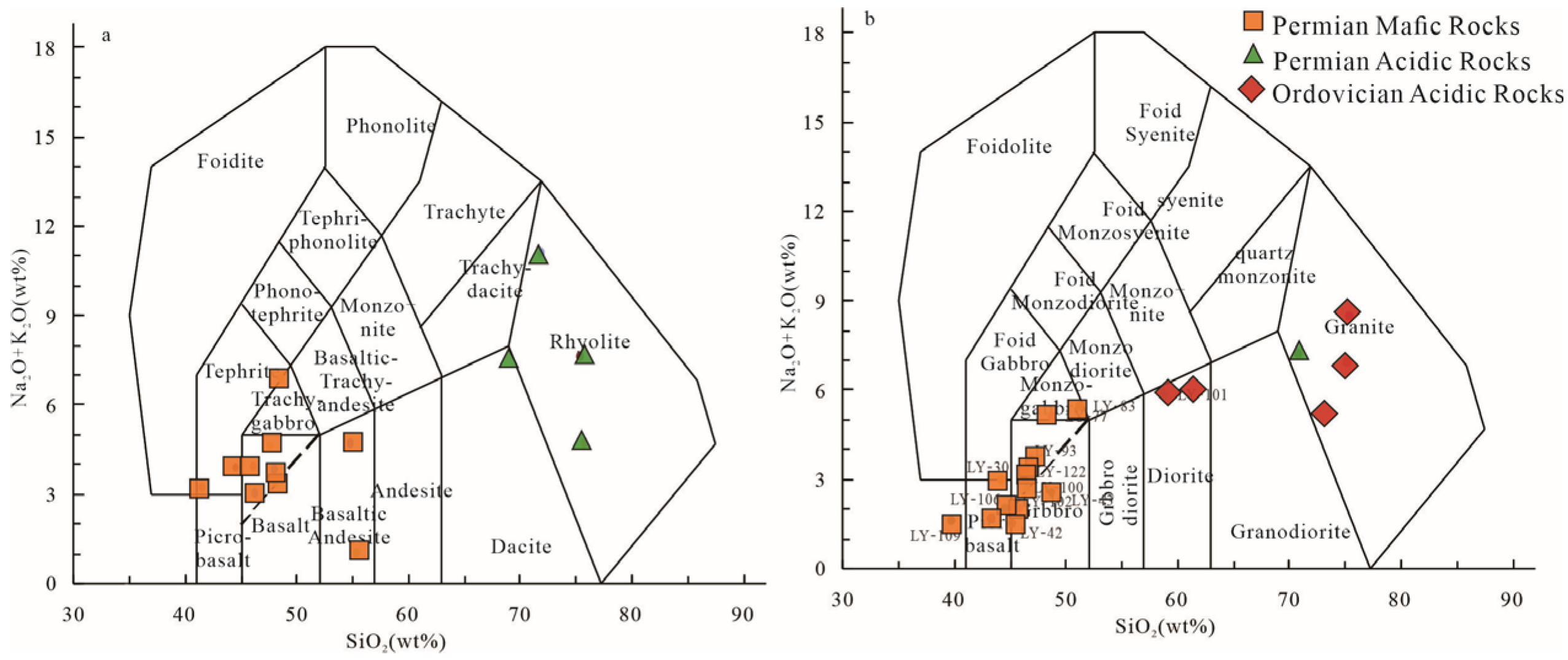
Based on the major element analyses, TAS classification diagrams (Figure 4) and zircon geochronology [3], the igneous rocks in the Liuyuan area can be divided into two main groups (Table S2): mafic and acidic types. In conjunction with petrographic observations, mafic rocks are represented primarily by gabbro and basalt, with sporadic occurrences of lamprophyre and diabase. Acidic rocks are mainly rhyolite and granite, with a few intermediate dacites.

4.2.1. Permian Mafic Rocks

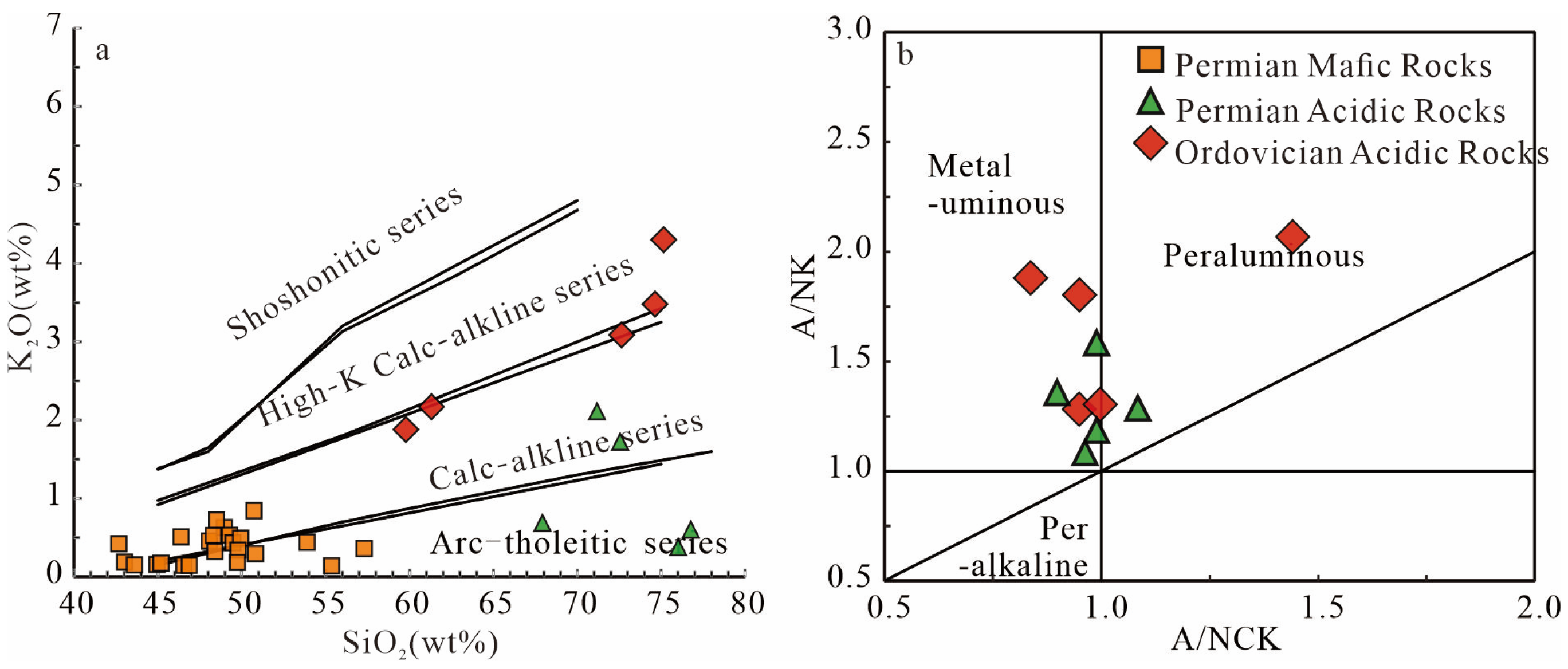
Major element data for Permian Mafic Rocks (Table S2, Figure 1) indicate SiO2 contents of 39.02%–57.28% (avg. 48.18%). Na2O ranges from 0.25% to 6.49% (avg. 2.83%), K2O from 0.018% to 0.802% (avg. 0.31%), and ALK from 0.28% to 6.80% (avg. 3.14%). On classification diagrams, most samples plot within the basalt or basaltic andesite fields (Figure 2 and Figure 3). The rocks are predominantly subalkaline, with a wide range of K contents. Al2O3 ranges from 5.39% to 23.26% (avg. 15.02%), and CaO from 3.77% to 15.57% (avg. 9.70%). A/CNK ratios vary between 0.46 and 0.97 (avg. 0.67) and A/NK between 1.36 and 12.24 (avg. 4.09), indicating metaluminous affinities (Figure 5). MgO ranges from 1.92% to 27.43% (avg. 8.00%) and Mg# from 1.5 to 77.8, which indicates variable degrees of magmatic differentiation and fractional crystallization. FeO ranges from 2.05% to 10.9% (avg. 6.54%) and Fe2O3 from 4.99% to 15.68% (avg. 10.92%).

4.2.2. Permian Acidic Rocks

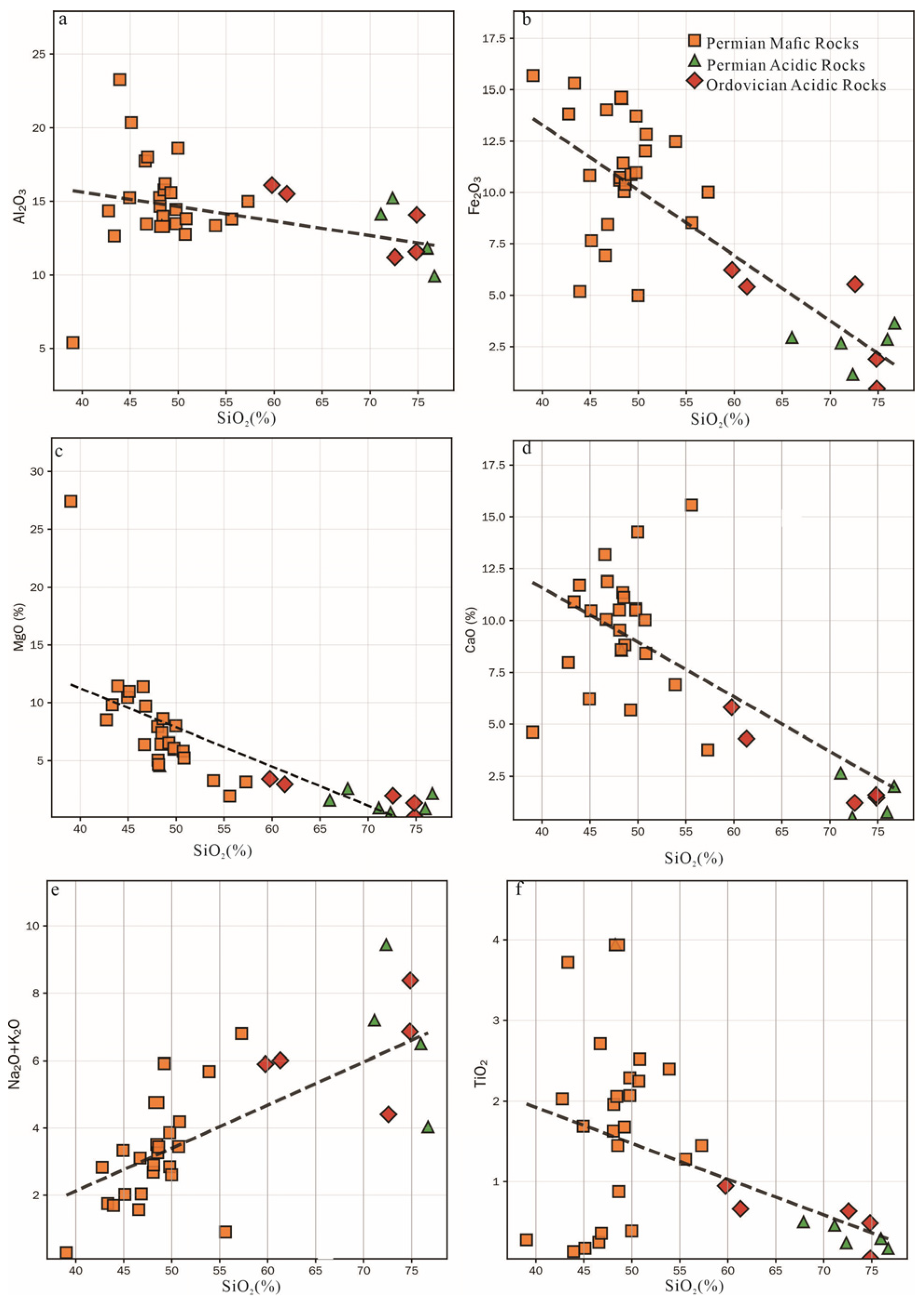
Major element data for Permian Acidic Rocks (Table S2, Figure 1) indicate SiO2 contents of 66.01–76.71% (avg. 71.68%). Na2O ranges from 0.018% to 7.78% (avg. 4.84%), K2O from 0.093% to 2.08% (avg. 0.87%), and ALK from 0.11% to 9.44% (avg. 5.71%), except for the very low ALK of sample LY-97 (0.11%), which is a siliceous, Ca-rich rock. On classification diagrams, most samples plot within the rhyolite or granite fields (Figure 4 and Figure 5). They show calc-alkaline to high-K calc-alkaline affinities. Al2O3 ranges from 2.67% to 15.22% (avg. 11.37%) and CaO from 0.51% to 14.94% (avg. 3.64%). A/CNK ratios vary between 0.098 and 1.121 (avg. 0.85) and A/NK between 1.04 and 20.49 (avg. 4.47), indicating peraluminous to peralkaline affinities (Figure 6). MgO ranges from 0.50% to 2.58% (avg. 1.42%) and Mg# from 29.2 to 45.2. FeO ranges from 0.60% to 2.55% (avg. 1.41%) and Fe2O3 from 1.14% to 4.52% (avg. 2.96%). Despite the distinct Daly gap separating the basalts and rhyolites in the Harker diagrams (Figure 5), the continuous correlations and trends of SiO2, CaO, TFeO, and Al2O3 imply a common parental magma source and an evolutionary relationship via crystal fractionation.

4.2.3. Ordovician Acidic Rocks

Major element data for Ordovician Acidic Rocks (Table S2, Figure 2) indicate SiO2 contents of 59.77–74.86% (avg. 68.67%). Na2O ranges from 1.34% to 4.05% (avg. 3.33%), K2O from 1.85% to 4.37% (avg. 2.98%), and ALK from 4.41% to 8.38% (avg. 6.31%). On classification diagrams, the samples plot within the granite, granodiorite, or rhyolite fields (Figure 4). Most are high-K calc-alkaline to shoshonitic series.
Al2O3 ranges from 11.20% to 16.10% (avg. 13.69%), and CaO from 1.21% to 5.82% (avg. 2.88%). A/CNK ratios vary between 0.84 and 1.45 (avg. 1.04) and A/NK between 1.24 and 2.03 (avg. 1.63), indicating metaluminous to peraluminous affinities (Figure 6). MgO ranges from 0.15% to 3.41% (avg. 1.96%) and Mg# from 29.7 to 45.3. FeO ranges from 0.13% to 3.30% (avg. 2.20%) and Fe2O3 from 0.45% to 6.24% (avg. 3.91%).

4.3. Trace Element Characteristics and Rare Earth Element (REE) Patterns

4.3.1. Permian Mafic Rocks

The total rare earth element (∑REE) content of the Liuyuan basic rocks ranges from 6.18 × 10⁻⁶ to 431.48 × 10⁻⁶, with light rare earth element (LREE) concentrations between 3.08 × 10⁻⁶ and 376.51 × 10⁻⁶, and heavy rare earth element (HREE) concentrations between 1.20 × 10⁻⁶ and 53.86 × 10⁻⁶. The LREE/HREE ratio varies from 0.84 to 13.32, while (La/Yb)n and (La/Sm)n ratios range from 0.26 to 19.41 and 0.41 to 4.00, respectively, which indicates variable degrees of fractional crystallization.
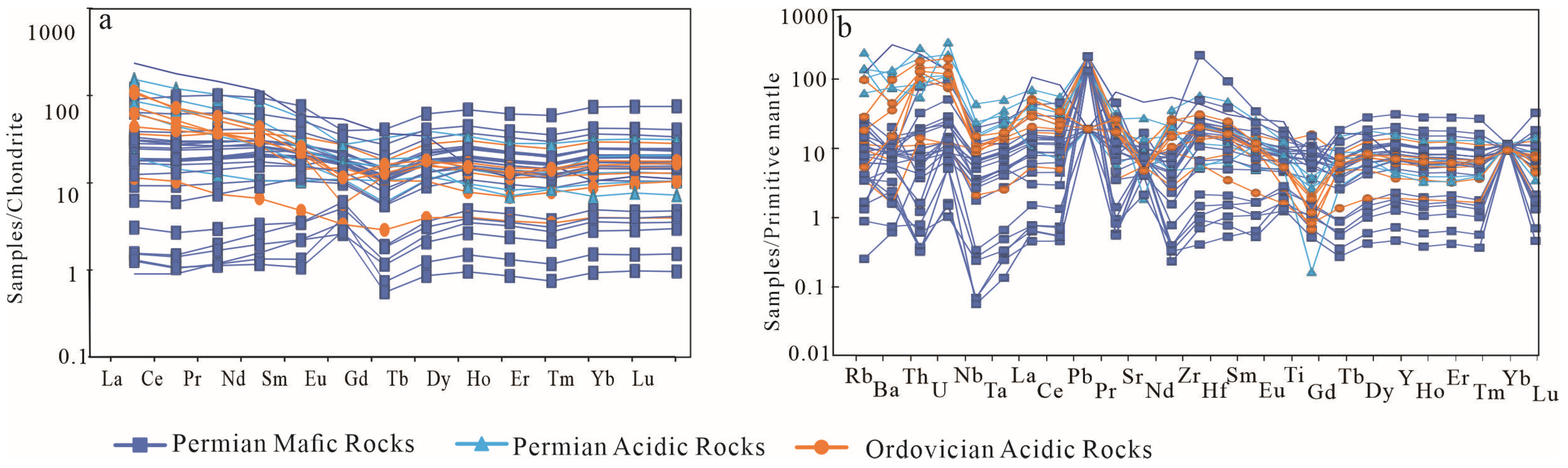
Overall, the REE distribution patterns display relative LREE enrichment to nearly flat trends, while HREE patterns remain relatively flat, resulting in an overall smooth REE curve (Figure 7a). The εEu values range from 0.88 to 13.32, indicating a predominant positive Eu anomaly, although samples LY-88, 15, 73, and 20 exhibit negative anomalies.
In the trace element spider diagram (Figure 7b), large-ion lithophile elements (LILEs) such as Rb and Ba are relatively enriched, whereas high field strength elements (HFSEs) Nb and Ta are depleted, forming a distinct Nb–Ta negative anomaly. Titanium (Ti) displays three variations—clear negative anomaly, slight negative anomaly, or positive anomaly—indicating heterogeneous magma evolution processes. Samples showing a positive Ti anomaly also exhibit a pronounced Zr–Hf negative anomaly, while Sr displays both clear negative and slight positive anomalies. These features collectively suggest magma derivation from a subduction-modified mantle source, with varying degrees of crustal interaction.

4.3.2. Permian Acidic Rocks

The total rare earth element (∑REE) content of the Liuyuan acidic volcanic rocks ranges from 36.08 × 10⁻⁶ to 433.12 × 10⁻⁶, with LREE contents between 21.69 × 10⁻⁶ and 334.42 × 10⁻⁶, and HREE contents between 5.22 × 10⁻⁶ and 40.40 × 10⁻⁶. The LREE/HREE ratio varies from 1.75 to 8.74, while the (La/Yb)n and (La/Sm)n ratios range from 0.96 to 8.91 and 1.84 to 5.41, respectively.
These results indicate that the acidic volcanic rocks are enriched in LREEs and depleted in HREEs, with REE patterns displaying a slightly right-leaning trend (Figure 7a). The εEu values range from 0.26 to 1.33, with an average of 0.76. Except for sample LY-94 (syenogranite), which shows a positive Eu anomaly, most samples exhibit a negative Eu anomaly, suggesting significant plagioclase fractionation during magma evolution.
In the trace element spider diagram (Figure 7b), the acidic rocks show relative enrichment in LILEs and depletion in HFSEs, marked by clear Nb–Ta–Ti negative anomalies. Additionally, Sr displays a pronounced negative anomaly, and Pb shows a distinct positive anomaly in most samples (Figure 7b). These geochemical characteristics imply that the acidic magmas were likely generated through partial melting of the continental crust or differentiation of mantle-derived magmas with strong crustal assimilation.

4.3.3. Ordovician Acidic Rocks

The total rare earth element (∑REE) contents of the Liuyuan acidic volcanic rocks range from 53.65 × 10⁻⁶ to 307.32 × 10⁻⁶, with LREE contents varying from 34.15 × 10⁻⁶ to 262.01 × 10⁻⁶ and HREE contents from 13.98 × 10⁻⁶ to 45.31 × 10⁻⁶. The LREE/HREE ratios span from 1.75 to 10.07, while (La/Yb)n and (La/Sm)n ratios range from 0.96 to 11.11 and 1.84 to 4.03, respectively. These results indicate that the acidic volcanic rocks are enriched in LREEs and depleted in HREEs, with chondrite-normalized REE patterns displaying a right-leaning trend (Figure 7a). The δEu values range from 0.62 to 1.33, averaging 0.87. Except for sample LY-94 (syenogranite), which exhibits a distinct positive Eu anomaly (δEu = 1.33), most samples show negative Eu anomalies, suggesting significant plagioclase fractionation or residual plagioclase in the source during magma evolution.
In the trace element spider diagram (Figure 7b), the acidic rocks are characterized by relative enrichment in large-ion lithophile elements (LILEs; e.g., Rb, Ba) and depletion in high field-strength elements (HFSEs), with pronounced negative Nb–Ta–Ti anomalies. Additionally, most samples display strong negative Sr anomalies and distinct positive Pb anomalies. These geochemical features imply that the acidic magmas were likely derived from partial melting of continental crust or from differentiation of mantle-derived magmas accompanied by extensive crustal assimilation.

4.4. Sr–Nd–Pb Isotopic Characteristics

4.4.1. Permian Mafic Rocks

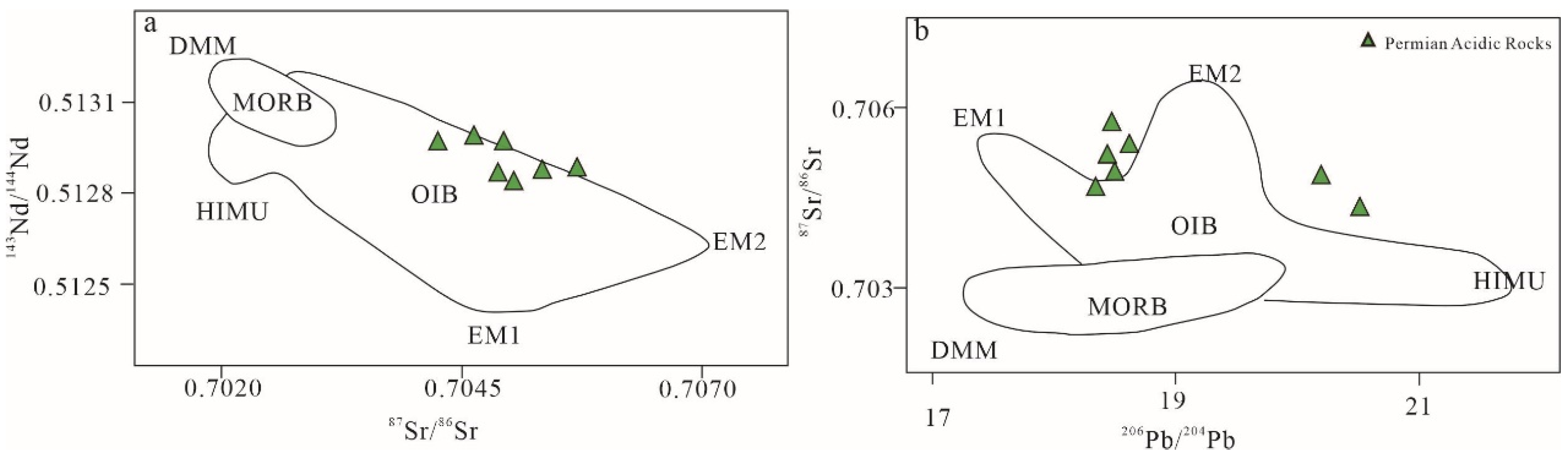
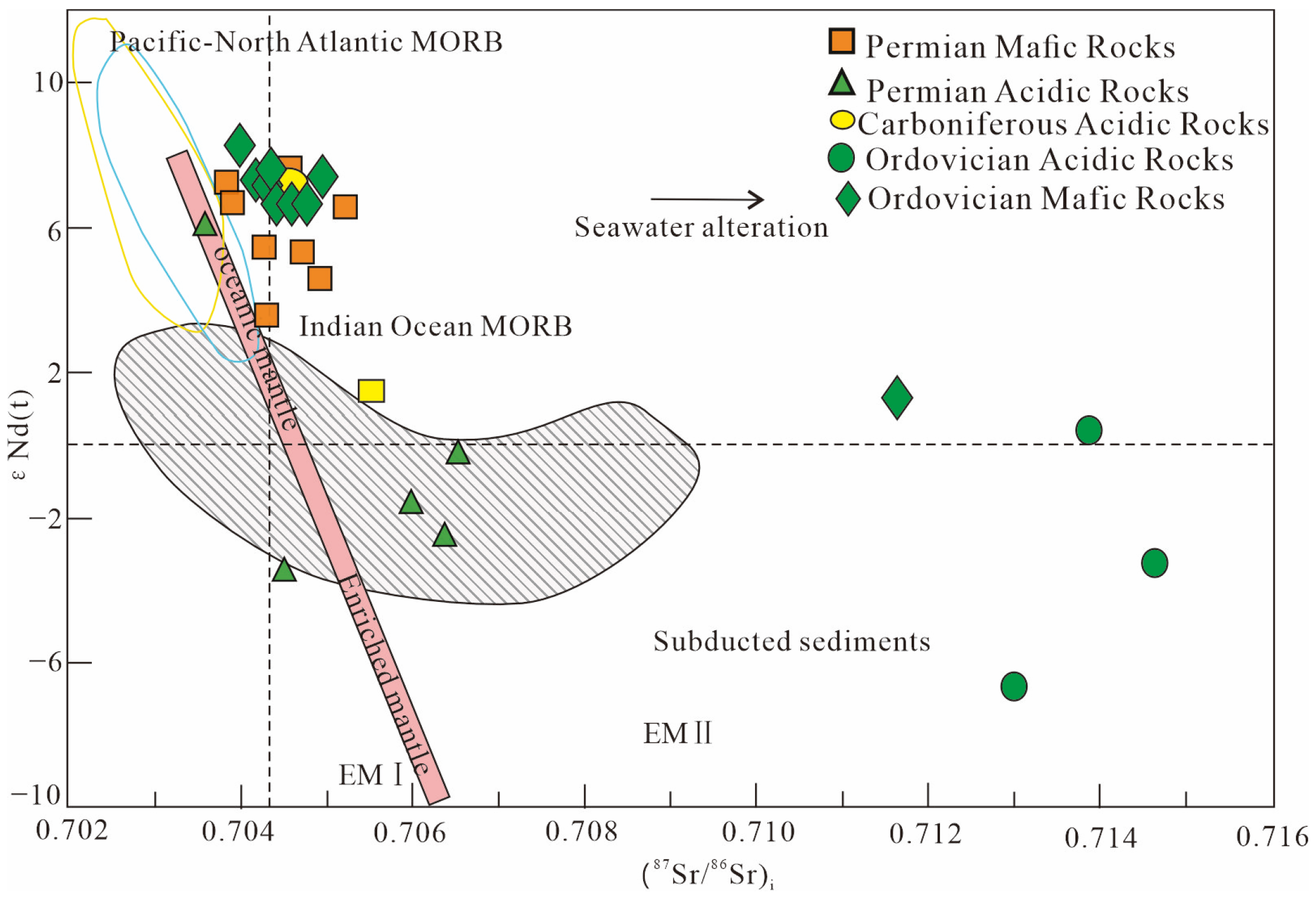
Representative samples were selected for Sr–Nd–Pb isotopic analyses, with results summarized in Table S3 and Figure 8a and Figure 9. The basic rocks exhibit low initial (87Sr/86Sr)i values and high (143Nd/144Nd)i ratios. Specifically, (87Sr/86Sr)i values range from 0.703595 to 0.705225, and (143Nd/144Nd)i values range from 0.512633 to 0.512832, corresponding to εNd(t) values between +3.6 and +7.6 (Table S3).
The Pb isotopic compositions are as follows (Table S4): (206Pb/204Pb)i = 18.3007–19.3215, (207Pb/204Pb)i = 15.5331–15.6101, and (208Pb/204Pb)i = 37.9845–38.3664 (Table S3). On Sr–Nd–Pb isotopic projection diagrams, most samples plot within the ocean island basalt (OIB) field, corresponding to the depleted mantle quadrant (Figure 10b). These isotopic signatures collectively indicate that the Liuyuan basic magmas were primarily derived from a depleted mantle source, possibly influenced by minor crustal contamination or subduction-related enrichment.

4.4.2. Permian Acidic Rocks

The acidic rock samples exhibit (87Sr/86Sr)i ratios ranging from 0.704070 to 0.706552 and (143Nd/144Nd)i ratios between 0.512045 and 0.512257, yielding εNd(t) values of −4.7 to −0.4 (Table S2). Their Pb isotopic compositions include (206Pb/204Pb)i = 18.6208–22.4888, (207Pb/204Pb)i = 15.6283–15.9533, and (208Pb/204Pb)i = 38.3664–38.5862 (Table S4).
On Sr–Nd–Pb isotopic projection diagrams, most acidic rock samples fall within the continental rift field, suggesting derivation from crustal or mixed crust–mantle sources (Figure 8 and Figure 9). The relatively elevated Sr isotopic ratios and negative εNd(t) values indicate a significant contribution from older continental crustal components, while the variability in Pb isotopic compositions reflects source heterogeneity and isotopic mixing during magma generation.

5. Discussion

5.1. Possible Magma Genesis

5.1.1. Permian Mafic Rocks

In the Liuyuan area, rhyolites and mafic rocks are spatially and temporally associated. Harker diagrams of major elements display a clear Daly gap (or Daly discontinuity) alongside continuous magmatic evolution trends (Figure 4), reflecting the typical characteristics of a bimodal volcanic assemblage.
The Liuyuan basalts analyzed in this study exhibit low initial (87Sr/86Sr) ratios and high initial (143Nd/144Nd) ratios. On initial Sr-Nd isotope diagrams (Figure 8 and Figure 9), the majority of basalt samples plot within the OIB (ocean island basalt) field, indicating a magma origin from an enriched mantle source, or a depleted mantle source contaminated by enriched components. Light rare earth element (LREE) patterns range from relatively depleted to slightly enriched, suggesting a contribution from a depleted mantle source. The Nb/La ratios of the basalts are 0.23–0.48 (primitive mantle = 0.87–1.42; OIB = 1.5; E-MORB = 0.87; N-MORB = 0.68; continental crust ≈ 3 ppm [34]), indicating that the basaltic magmas were primarily derived from depleted mantle, with minor input of OIB-like material and significant crustal contamination. Trace element ratios in the basalts plot between MORB (Mid-Ocean Ridge Basalt), CFB (Continental Flood Basalt), and island arc volcanic end-members, or between CFB, OIB, and continental crust end-members, indicating that the magmas represent mixtures of these components.
The variation in initial Sr-Nd isotopic ratios is limited, which differs from the results reported by Zhao et al. (2004, 2006) [35,36], whose samples displayed a wider range of Sr-Nd isotopic variation and both positive and negative εNd(t) values, suggesting varying degrees of crustal contamination. In contrast, the samples in this study show consistent εNd(t) values, possibly because some samples are gabbroic and thus less affected by crustal assimilation compared to basalts erupted at the surface. The Pb isotopic compositions of the basalts indicate an OIB-like source region, with data points plotting close to the EMI-type enriched mantle field (Figure 10). In summary, the basalts of the Liuyuan area were derived from depleted mantle and underwent contamination by crustal materials.

5.1.2. Permian Rhyolite

Bimodal volcanic rocks typically occur as closely associated basalt–rhyolite or basalt–dacite pairs that may be co-genetic or derived from separate sources.
The Liuyuan rhyolites display relatively low initial (87Sr/86Sr) ratios and high initial (143Nd/144Nd) ratios. On the initial Sr-Nd isotope diagram (Figure 8), the rhyolite samples plot within the CFB field and near the composition of Primitive Silicate Earth (PSE), far from the field of crustal melts. Pb isotopic characteristics further suggest that the rhyolites share a source region similar to the basalts, plotting within the OIB field and close to EMI-type enriched mantle (Figure 8 and Figure 9).
Primitive mantle-normalized trace element spider diagrams show enrichment in Rb, Nd, Th, U, and Pb, and depletion in Sr, P, Nb, Ta, and Ti. The strong enrichment in Th, U, and Pb indicates a crustal affinity. Significant depletion in Ba and Sr, along with negative Eu anomalies, suggests either low-pressure source conditions or significant fractional crystallization of plagioclase during magma ascent.
The Sr-Nd-Pb isotopic evidence points to two possible models for the origin of the felsic component in the bimodal volcanic suite. One model attributes its formation to continuous fractional crystallization (FC) of basaltic magma, with limited crustal assimilation (AFC; [37]). An alternative model proposes that the felsic and mafic rocks represent distinct melts—basalts originating from the mantle, while rhyolites formed through partial melting of ancient or juvenile crust induced by the intrusion of basaltic magmas [38]. The εNd(t) values of Liuyuan rhyolites range from −4.1 to −1.6, and initial (87Sr/86Sr)i ratios are 0.706–0.710. They plot between mantle-derived sources and Beishan metamorphic rocks (εNd(t) = −4 to −9, (87Sr/86Sr)i > 0.708) (Figure 7), indicating that their source represents a mixture of evolved mantle-derived magma and limited crustal material input.
Basalts in bimodal assemblages are generally derived from partial melting of mantle peridotite, while rhyolites can originate either from high-degree fractional crystallization of mantle-derived magma [39,40] or from partial melting of crustal rocks triggered by mantle-derived magma underplating [41,42]. However, crustal melts typically show enrichment in Al, Th, and LREE, with isotopic compositions distinctly different from mantle magmas [43]. In contrast, the Sr–Nd–Pb isotopic data from Liuyuan rhyolites are closely comparable to those of the local basalts and differ markedly from typical continental crust (Figure 10), indicating that the rhyolites formed via fractional crystallization of mafic magma.

5.1.3. Ordovician Acidic Rocks

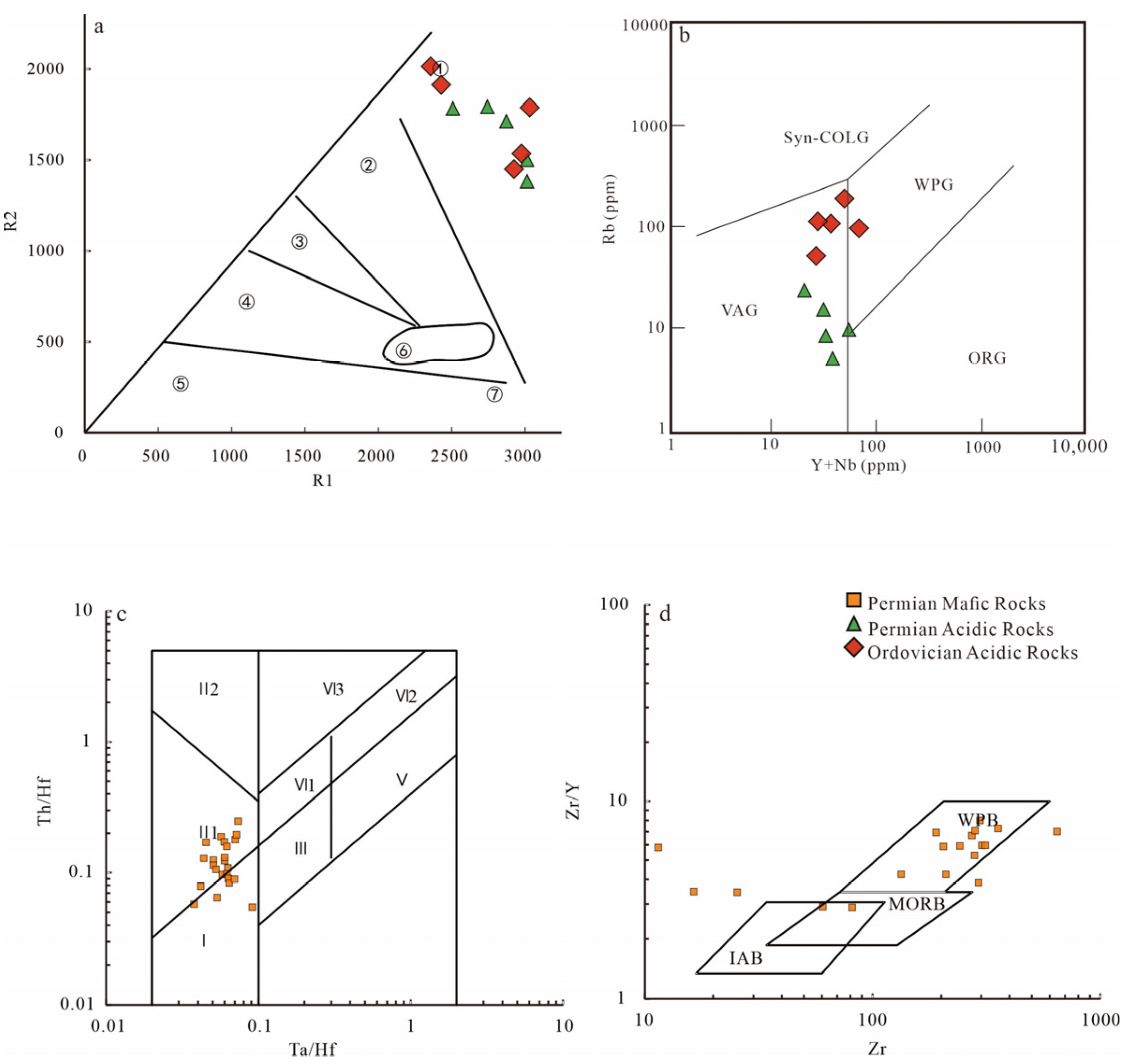
The Ordovician acid rocks in Liuyuan overall exhibit a pronounced crustal magma affinity, rather than being typical mantle-derived differentiation products. In the R1–R2 diagram (Figure 10a), detailed elemental and isotopic geochemical evidence indicates that their source is primarily partial melting of ancient continental crustal materials, rather than direct crystallization and differentiation of mantle-derived basaltic magmas. Specific evidence includes the following: (1) the rocks have high Rb contents (76.4–107 ppm), low Sr contents (43.9–326 ppm), and high Rb/Sr ratios (0.24–2.37), far exceeding the typical values of mantle-derived magmas (Rb/Sr < 0.1) and indicating the contribution of K-rich minerals in the source, consistent with the elemental partitioning characteristics of partial melting of crustal materials; (2) the Th/Hf ratios (1.18–4.44) are significantly higher than those of mantle-derived magmas (typically < 0.5); (3) the chondrite-normalized REE patterns show a right-leaning pattern enriched in LREEs (Figure 6), with LREE/HREE ratios of 5.78–8.74 and (La/Yb)n ratios of 4.78–8.91, exhibiting moderate to strong fractionation characteristics, consistent with the REE behavior of melts derived from partial melting of felsic crustal rocks (e.g., metagraywacke, tonalitic gneiss), and clearly distinct from the weak fractionation characteristics of mantle-derived magmas ((La/Yb)n typically < 3); (4) the samples generally have low Mg# values (0.3–0.45) and evolved Sr-Nd isotopic compositions (e.g., low εNd(t) values and old Nd model ages).
Regarding the specific melting conditions, the residual mineral assemblage in the source of these rocks is dominated by amphibole and plagioclase, with no significant involvement of garnet. Evidence includes: flat to moderately inclined HREE patterns without the strong HREE depletion typical of high-pressure melts; low Sr contents and pronounced negative Eu anomalies (δEu = 0.62–0.78) in some samples, indicating that plagioclase remained as a stable residual phase in the source or underwent fractional crystallization during the early stage of magma evolution. Therefore, the magmas formed at mid-to-lower crustal depths (amphibolite facies) rather than under high-pressure eclogite-facies conditions, and consequently did not produce adakitic melts. Furthermore, compositional differences among the samples reflect source heterogeneity—likely involving varying proportions of mixed melts from metagraywacke, metapelite, and metatonalite.
Under an Early Paleozoic post-collisional orogenic extensional setting, the thickened crust underwent decompression and heating, inducing partial melting of ancient crustal materials (dominantly metasedimentary and metaigneous rocks) in the mid-to-lower crust under amphibolite-facies conditions. The melts experienced limited plagioclase and amphibole fractional crystallization during ascent and emplacement, and may have been subjected to minor assimilation and contamination by crustal materials.

5.2. Tectonic Model of Magmatic Processes

The Liuyuan area, part of the ancient Asian Ocean domain, has two prevailing tectonic interpretations. One view considers the pillow basalt belt to have formed in a continental rift setting [3,44,45], while the other links it to a subduction-related environment [1,2,9,46]. The former suggests that closure of the ancient Asian Ocean in the southern Beishan Orogenic Belt occurred during the Ordovician–Silurian, supported by the absence of thrust faults, chert, Triassic arc magmatism, and marine sedimentary sequences [3,13]. The latter posits that this belt represents an ophiolitic mélange with enriched mantle–derived arc geochemistry, implying continued subduction of the ancient Asian Ocean until the end of the Permian or even Early Triassic [2,9,46,47].
In the present study, Ordovician granites plot entirely within the volcanic arc granite (VAG) field on the Y+Nb vs. Rb discrimination diagram (Figure 10b). Their geochemistry is characterized by high alkali and aluminum contents, enrichment in Rb, Th, U, K, and Pb, and depletion in Nb, Ta, and Ti, clearly indicating volcanic arc magmatic affinities. The magmatic assemblage, characterized by contemporaneous calc-alkaline I-type granites, adakitic rocks, and arc volcanic rocks, formed in an active continental margin setting under subduction conditions. Studies on coeval gabbros and basalts suggest that the Liuyuan area was in a subduction setting of the ancient Asian Ocean during the Ordovician (480–440 Ma) [30]. From the Late Silurian to Devonian, magmatic activity in the Beishan Orogenic Belt generally weakened, and S-type and A-type granites appeared in the central and southern parts of Beishan, indicating a tectonic transition from compression to extension. In the Shuangyingshan–Huaniushan arc, the Devonian Sangejing and Dundunshan formations contain volcanic-sedimentary rocks with coarse clastic deposits and intermediate-felsic volcanic eruptions, long considered to represent “molasse formations” marking the end of Beishan accretionary orogenesis. This suggests that the ancient Asian Ocean had already closed during the Devonian–Carboniferous period.
Although bimodal volcanic rocks commonly form in intracontinental rifts, they can also occur in oceanic islands, continental extensional zones, back-arc basins, post-orogenic settings, and mature island arcs. During the Early Permian, the volcanic rocks in the Liuyuan area display distinct bimodal volcanic characteristics (a basalt–rhyolite association), but notably lack andesite and intermediate intrusive rocks. In continental margin arc environments, bimodal volcanism usually includes substantial andesitic components; according to the tectonic discrimination diagram of Pearce et al. (1984) [31] (Rb vs. Y+Nb) (Figure 10b), the rhyolites primarily formed in an intracontinental rift setting, with a few showing subduction-related characteristics. Similarly, the Hf/3–Th–Ta diagram of Wood et al. (1979) [48] and Wood (1980) [32], and the Zr vs. Zr/Y discrimination diagram of Pearce et al. (1984) [31] indicate that the majority of Liuyuan basalts display within-plate basalt characteristics, although some samples exhibit arc magmatic features (Figure 10c,d).
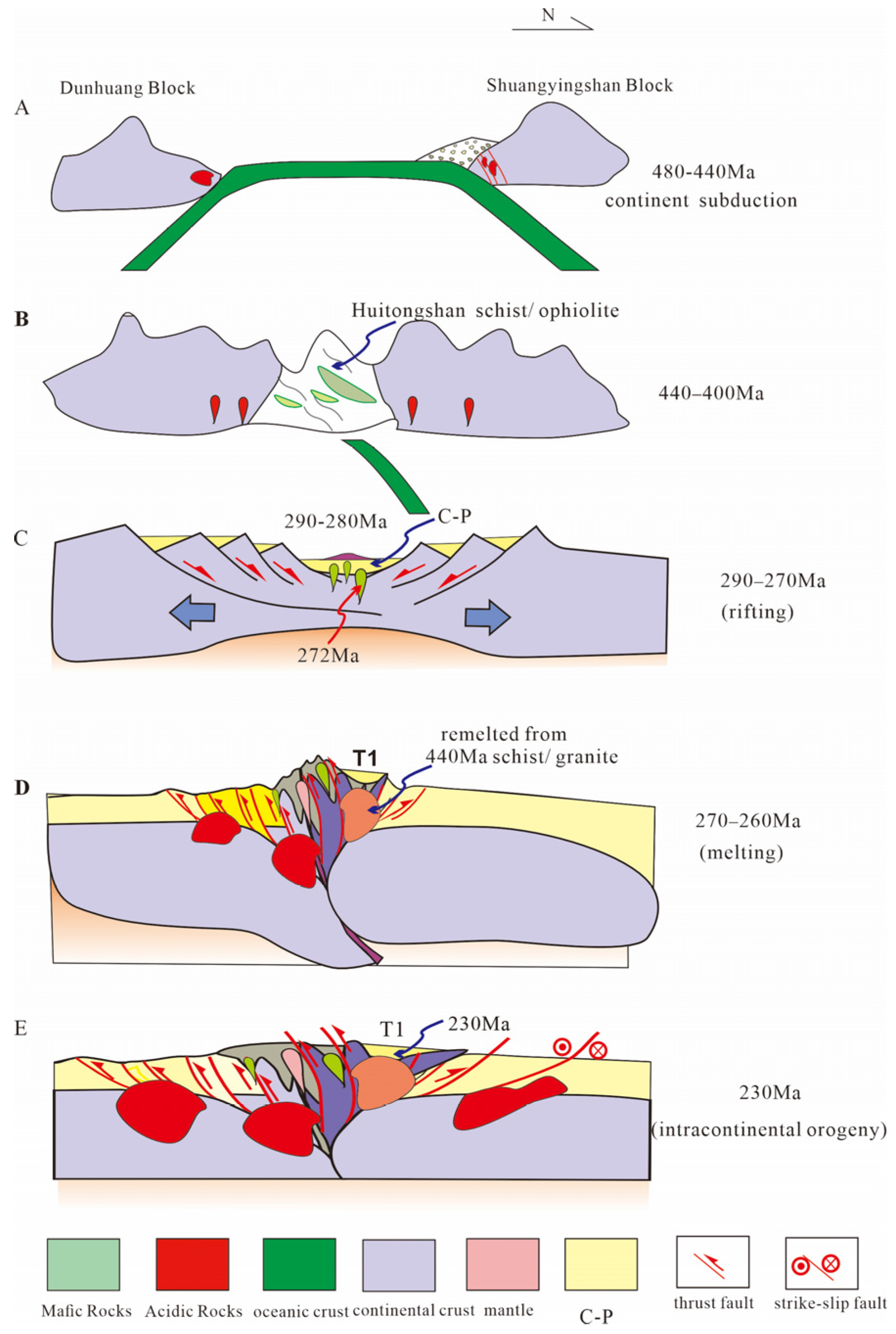
After the Caledonian orogenic activity (represented by the Huitongshan ophiolite), there is no clear evidence of continued subduction or collision; instead, localized Late Silurian to Devonian rifting occurred. The abrupt Permian rifting, superimposed on the Ordovician–Silurian orogenic structures, is evidenced by associated sedimentation, bimodal volcanism, and gabbroic intrusions. The Liuyuan area formed in a post-collisional extensional tectonic setting, with abrupt Permian extension superimposed upon the Ordovician–Silurian orogenic framework [49,50,51,52]. Regionally, the collisional peak of the Altai–Junggar and Tianshan was largely completed by the end of the Late Carboniferous (~300 Ma), and the Early Permian was in a post-collisional extensional stage, as corroborated by the contemporaneous bimodal volcanism of the Bogda rift in the Tianshan. Simultaneously, the Tarim basalt province formed at 290–275 Ma, placing the bimodal volcanic rocks of the Liuyuan area within the same tectonic context. Subsequently, at 270–245 Ma, the extrusion of the Tianshan block caused a rapid transition of the regional stress field from extension to compression [53,54]. This far-field stress acted directly on the pre-existing Beishan rift, leading to its tectonic inversion and the formation of the present-day intracontinental orogenic structure (Figure 11D) [3,55,56]. The closure of the southern Paleo-Tethys at 245–230 Ma generated northward compression, accompanied by the formation of the Altyn Tagh sinistral strike-slip and the Xingxingxia sinistral strike-slip faults. The combination of regional contraction and sinistral strike-slip motion produced north–south-trending folds and thrust faults [3,15,56,57] (Figure 11E).
On the La/Sm vs. Sm/Yb source discrimination diagram, the Liuyuan Permian basalts plot near the region of low-degree partial melting of primitive mantle, clearly distinct from the Tarim, Siberian, and Emeishan basalts [3] and references therein, which reflect higher degrees of partial melting (garnet lherzolite melting) potentially associated with mantle plume thermal anomalies. The Liuyuan Permian basalts differ significantly from the continental flood basalts of the Permian Emeishan Large Igneous Province, which fall in the CFB-OIB field, whereas the Liuyuan basalts plot between the MORB and continental crust end-member domains (Figure 7 and Figure 8). This difference indicates that the genesis of the Liuyuan basalts is not directly linked to mantle plume activity. The coexistence of arc-type and CFB geochemical signatures, along with enriched mantle signals in the Liuyuan area, suggests that the formation of the Liuyuan bimodal volcanic rocks may have been influenced by earlier arc-island material. Their OIB-like geochemical characteristics may reflect the upwelling of enriched mantle material through asthenospheric windows created by slab detachment, while their arc-related features are consistent with a post-collisional extensional setting. This interpretation aligns with field evidence of pillow lavas and rift-related lithofacies in the area. The ~270 Ma acidic rocks in the Liuyuan area share geochemical similarities with the 460–440 Ma granite–schist assemblages, supporting an origin through remelting of pre-existing arc rocks.
Therefore, the “Huitongshan–Liuyuan–Zhangfangshan Mélange Zone” does not represent a Permian subduction zone but rather the Liuyuan rift developed upon an earlier subduction complex (Figure 11). This tectonic belt extends eastward across central Inner Mongolia, along the northern margin of the North China Craton, and into northeastern China, constituting contemporaneous post-orogenic rifts developed along ancient suture zones. This interpretation is consistent with the mantle horizontal flow model proposed by Wang et al. (2017) [3] and the northeastward mantle escape model proposed by Qin et al. (2025) [58].
In summary, the complex magmatic and tectonic evolution of the Liuyuan area reflects a sudden tectonic transition from subduction-related arc magmatism (440–460 Ma) to intracontinental rifting (290–270 Ma) developed upon a previously accreted orogenic basement. This marks a phase of Permian lithospheric extension and subsequent widespread compression and orogeny driven by far-field tectonic stress, a process analogous to the Pyrenean-style intracontinental orogeny in Western Europe.
Accordingly, this study proposes that the Liuyuan bimodal volcanic assemblage, characterized by complex source signatures combining both arc and intraplate features, formed during the initial stages of the Liuyuan Ocean closure, associated with early oceanic slab detachment and subsequent remelting of pre-existing arc magmatic rocks. Early slab detachment created a tectonic window that facilitated the upwelling of enriched asthenospheric mantle, imparting enriched source characteristics to the magmatic suite. Geochemical evidence from the 460–450 Ma granites and schists in the region is consistent with partial remelting of earlier arc crustal materials. Given the Liuyuan area’s history as part of a complex arc–accretion system, its basement rocks retain arc-related geochemical signatures that were inherited by later magmatism. Asthenospheric upwelling through tectonic windows likely drove localized active rifting, producing the intraplate rift features observed today (Figure 11).

6. Conclusions

During the Early Permian, the Beishan region developed a rift-related environment characterized by bimodal volcanic rocks. The magmatic assemblage exhibits a distinct Daly gap. The basalts are classified as low-K basalts, and their isotopic characteristics indicate an OIB-type mantle source; however, their trace element patterns do not display typical OIB signatures. The rhyolites possess εNd(t) values close to that of the bulk silicate Earth and markedly different from those of the crustal components. Both major and trace element data demonstrate that the rhyolites have a genetic and evolutionary relationship with the basalts. Their Sr-Nd-Pb isotopic compositions are highly similar, suggesting a co-evolutionary origin.
The coexistence of rift-related characteristics and partial arc-type geochemical affinities, coupled with enriched mantle isotopic signatures, can be attributed to the early detachment of the subducted slab from the 440–460 Ma Huitongshan–Liuyuan Ocean. This process allowed enriched asthenospheric material to upwell, promoting the formation of a post-collisional extensional setting atop the pre-existing arc–accretionary system in the region. Consequently, a typical Pyrenees-type intracontinental orogeny was established in the Liuyuan area during the Permian–Triassic interval.

Supplementary Materials

The following supporting information can be downloaded at: https://www.mdpi.com/article/10.3390/min16060610/s1. Table S1: Sampled sites, petrologic descriptions, and zircon age data in Liuyuan area; Table S2: Major oxides composition (Wt %), REE and trace elements (ppm) of igneous rocks and metamorphic rocks in Liuyuan area; Table S3: Rb-Sr and Sm-Nd isotope composition of igneous rocks in Liuyuan area; Table S4: Pb isotope composition of igneous rocks in Liuyuan area [3].

Author Contributions

J.S.: conceptualization, investigation, data curation, writing—original draft. J.C.: conceptualization, funding acquisition, project administration, writing—original draft, review and editing. Z.L.: writing—review and editing. Y.W.: field work, interpretation of the data, review and editing. All authors have read and agreed to the published version of the manuscript.

Funding

This research was financially supported by the Strategic Intelligence Analysis and Research on Geological Survey Science and Technology (Grant No. DD202610102203), the National Natural Science Foundation of China (General Program) (Grant No. 41702216), the Natural Science Intelligence Tracking and Research (DD20221794) and the Earth Science Literature Knowledge Service and Decision Support (DD20230139).

Data Availability Statement

The data that support the findings of this study are available from the corresponding author, Jiawei Cui, upon reasonable request.

Conflicts of Interest

The authors declare no conflicts of interest.

References

  1. Xiao, W.J.; Windley, B.F.; Huang, B.C.; Han, C.M.; Yuan, C.; Chen, H.L.; Sun, M.; Sun, S.; Li, J.L. End-Permian to mid-Triassic termination of the accretionary processes of the southern Altaids: Implications for the geodynamic evolution, Phanerozoic continental growth, and metallogeny of Central Asia. Int. J. Earth Sci. 2009, 98, 1189–1217. [Google Scholar] [CrossRef]
  2. Xiao, W.J.; Mao, Q.G.; Windley, B.F.; Qu, J.F.; Zhang, J.E.; Ao, S.J.; Guo, Q.Q.; Cleven, N.R.; Lin, S.F.; Shan, Y.H.; et al. Paleozoic multiple accretionary and collisional processes of the Beishan orogenic collage. Am. J. Sci. 2010, 310, 1553–1594. [Google Scholar] [CrossRef]
  3. Wang, Y.; Luo, Z.H.; Santosh, M.; Wang, S.Z.; Wang, N. The Liuyuan Volcanic Belt in NW China revisited: Evidence for Permian rifting associated with the assembly of continental blocks in the Central Asian Orogenic Belt. Geol. Mag. 2017, 154, 265–285. [Google Scholar] [CrossRef]
  4. Niu, Y.Z.; Bai, J.K.; Shi, G.R.; Yang, B. Paleogeographic evolution of a Carboniferous–Permian sea in the southernmost part of the Central Asian Orogenic Belt, NW China: Evidence from microfacies, provenance and paleobiogeography. Earth-Sci. Rev. 2021, 220, 103738. [Google Scholar] [CrossRef]
  5. Niu, Y.Z.; Shi, G.R.; Wang, J.Q.; Liu, C.Y.; Zhou, J.L.; Lu, J.C.; Song, B.; Xu, W. The closing of the southern branch of the Paleo-Asian Ocean: Constraints from sedimentary records in the southern Beishan region of the Central Asian Orogenic Belt, NW China. Mar. Petrol. Geol. 2021, 124, 104791. [Google Scholar] [CrossRef]
  6. Niu, Y.Z.; Zhang, D.D.; Yang, B.; Zhang, Y.X.; Shi, J.Z.; Zhou, J.L. Two-stage evolution of the Late Paleozoic Liuyuan Ocean in the southern Beishan region, Central Asian Orogenic Belt. Acta Geol. Sin. 2024, 98, 1683–1700. [Google Scholar]
  7. Tian, Z.H.; Xiao, W.J. An Andean-type arc transferred into a Japanese-type arc at final closure stage of the Palaeo-Asian Ocean in the southernmost of Altaïds. Geol. J. 2020, 55, 2023–2043. [Google Scholar] [CrossRef]
  8. Liu, S.N.; Zhou, L.Y.; Wang, Y. Missing adakitic granite and syn-subduction mafic dikes within Permian volcanic belts of the southern margin of the CAOB? Comment on “Permian oceanic slab subduction in the southernmost Central Asian Orogenic Belt: Evidence from adakite and high-Mg diorite in the southern Beishan”. Lithos 2022, 412–413, 106025. [Google Scholar] [CrossRef]
  9. Zheng, R.G.; Li, J.Y.; Zhang, J.; Xiao, W.J.; Wang, Q.J. Permian oceanic slab subduction in the southmost of Central Asian Orogenic Belt: Evidence from adakite and high-Mg diorite in the southern Beishan. Lithos 2020, 358–359, 10546. [Google Scholar] [CrossRef]
  10. Guo, Q.Q.; Chung, S.L.; Lee, H.Y.; Xiao, W.J.; Hou, Q.L. Termination of the Paleo-Asian Ocean in the Beishan orogen, NW China: Constraints from detrital zircon U-Pb age and Hf isotope analysis of turbidites. Geol. Soc. Am. Bull. 2023, 135, 1734–1746. [Google Scholar] [CrossRef]
  11. Liu, C.; Zhao, Z.H.; Guo, Z.J. Chronology and geochemistry of lamprophyre dykes from Beishan area, Gansu Province and implications for the crust–mantle interaction. Acta Petrol. Sin. 2006, 22, 1294–1306, (In Chinese with English abstract). [Google Scholar]
  12. Liu, Q.; Zhao, G.C.; Han, Y.G.; Li, X.P.; Zhu, Y.L.; Eizenhöfer, P.R.; Zhang, X.R.; Wang, B.; Tsui, R.W. Geochronology and Geochemistry of Paleozoic to Mesozoic Granitoids in Western Inner Mongolia, China: Implications for the Tectonic Evolution of the Southern Central Asian Orogenic Belt. J. Geol. 2018, 126, 451–471. [Google Scholar] [CrossRef]
  13. Xu, X.Y.; Li, R.S.; Chen, J.L.; Ma, Z.P.; Li, Z.P.; Wang, H.L.; Bai, J.K.; Tang, Z. New constrains on the Paleozoic tectonic evolution of the northern Xinjiang area. Acta Petrol. Sin. 2014, 30, 1521–1534, (In Chinese with English abstract). [Google Scholar]
  14. Xu, G.; Duan, J.; Gao, W.B.; Wang, R.M.; Shi, Z.; Ma, B.C.; Sun, J. Geochronological and Geochemical Constraints on the Petrogenesis of Permian Dolerite Dyke Swarms in the Beishan Orogenic Belt, NW China. Front. Earth Sci. 2021, 9, 657716. [Google Scholar] [CrossRef]
  15. Yu, Y.Y.; Zong, K.Q.; Yuan, Y.; Klemd, R.; Wang, X.S.; Guo, J.L.; Xu, R.; Hu, Z.C.; Liu, Y.S. Crustal contamination of the mantle-derived Liuyuan basalts: Implications for the Permian evolution of the southern Central Asian Orogenic Belt. J. Earth Sci. 2022, 33, 1081–1094. [Google Scholar] [CrossRef]
  16. Zuo, G.C.; Zhang, S.L.; He, G.Q.; Zhang, Y. Plate tectonic characteristics during the early Paleozoic in Beishan near the Sino-Mongolian border region, China. Tectonophysics 1991, 188, 385–392. [Google Scholar] [CrossRef]
  17. Zuo, G.C.; Liu, Y.K.; Liu, C.Y. Framework and evolution of the tectonic structure in Beishan area across Gansu Province, Xinjiang Autonomous region and Inner Mongolia Autonomous region. Acta Geol. Gansu 2003, 12, 1–15, (In Chinese with English abstract). [Google Scholar]
  18. Wang, Y.; Zhang, X.M.; Zhang, J.F.; Wang, E.C.; Li, Q.; Sun, G.H. 40Ar–39Ar Thermochronological Evidence for Formation and Mesozoic evolution of the Northern–Central Segment of the Altyn Tagh Fault System in northern Tibetan Plateau. Geol. Soc. Am. Bull. 2005, 117, 1336–1346. [Google Scholar] [CrossRef]
  19. Wang, Y.; Sun, G.H.; Li, J.Y. U–Pb (SHRIMP) and 40Ar/39Ar geochronological constraints on the evolution of the Xingxingxia shear zone, NW China: A Triassic segment of the Altyn Tagh fault system. Geol. Soc. Am. Bull. 2010, 122, 487–505. [Google Scholar] [CrossRef]
  20. Zheng, R.G.; Wu, T.R.; Zhang, W.; Xu, C.; Meng, Q.P.; Zhang, Z.Y. Geochronology and geochemistry of late Paleozoic magmatic rocks in the Yinwaxia area, Beishan: Implications for rift magmatism in the southern Central Asian Orogenic Belt. J. Asian Earth Sci. 2014, 91, 39–55. [Google Scholar] [CrossRef]
  21. GB/T 14506.28-2010; Methods for Chemical Analysis of Silicate Rocks—Part 28: Determination of 16 Major and Minor Elements Content. Chinese National Standard: Beijing, China, 2010.
  22. EJ/T 692-1992; Determination of Rb-Sr Isochron Age of Rocks and Minerals. Chinese Nuclear Industry: Beijing, China, 2010.
  23. Le Maitre, R.W. Igneous rocks—A classification and glossary of terms. In Recommendations of the IUGS Subcommission on the Systematics of Igneous Rocks, 2nd ed.; Cambridge University Press: Cambridge, UK, 2002. [Google Scholar] [CrossRef]
  24. Peccerillo, A.; Taylor, S.R. Geochemistry of Eocene calc-alkaline volcanic rocks from the Kastamonu area, northern Turkey. Contrib. Mineral. Petrol. 1976, 58, 63–81. [Google Scholar] [CrossRef]
  25. Wright, J.B. A simple alkalinity ratio and its application to questions of non-orogenic granite genesis. Geol. Mag. 1969, 106, 370. [Google Scholar] [CrossRef]
  26. Nakamura, N. Determination of REE, Ba, Fe, Mg, Na and K in Carbonaceous and ordinary chondrites. Geochim. Cosmochim. Acta 1974, 38, 757–775. [Google Scholar] [CrossRef]
  27. McDonough, W.F.; Sun, S.S. The composition of the Earth. Chem. Geol. 1995, 120, 223–253. [Google Scholar] [CrossRef]
  28. Hofmann, A.W. Mantle geochemistry: The message from oceanic volcanism. Nature 1997, 385, 219–229. [Google Scholar] [CrossRef]
  29. Xiao, Y. Petrogenesis and Tectonic Setting of Xichangjing Ophiolite and Volcanic Rocks in Beishan Orogenic Belt. Ph.D. Thesis, Guilin University of Technology, Guilin, China, 2025. [Google Scholar]
  30. Zhang, C.J.; Liu, X.J.; Xiao, W.J.; Song, Y.J.; Xiao, Y.; Huang, Q.W. Geochronology, geochemistry, and Sr-Nd-Hf isotopic characteristics of the Liuyuan ophiolitic melange in Gansu: Implications for the Early Paleozoic tectonic evolution of the Beishan Orogenic Belt. Geochimica 2026, 55, 275–296. [Google Scholar]
  31. Pearce, J.A.; Harris, N.B.W.; Tindle, A.G. Trace element discrimination diagram for the tectonic interpretation of granitic rocks. J. Petrol. 1984, 25, 956–983. [Google Scholar] [CrossRef]
  32. Wood, D.A. The application of a Th-Hf-Ta diagram to problems of tectonomagmatic classification and to establishing the nature of crustal contamination of basaltic lavas of the British Tertiary Volcanic Province. Earth Planet. Sci. Lett. 1980, 50, 11–30. [Google Scholar] [CrossRef]
  33. Pearce, J.A.; Baker, P.E.; Harvey, P.K.; Luff, I.W. Geochemical evidence for subduction fluxes, mantle melting and fractional crystallization beneath the South Sandwich island arc. J. Petrol. 1995, 36, 1073–1109. [Google Scholar] [CrossRef]
  34. Condie, K.C. Mafic crustal xenoliths and the origin of the lower continental crust. Lithos 1999, 46, 95–101. [Google Scholar] [CrossRef]
  35. Zhao, Z.H.; Guo, Z.J.; Zhang, Z.C.; Shi, H.Y.; Tian, J. The geochemical characteristics and tectonic setting of the low Permian basalts in Hongliuhe area at the border between Xinjiang and Gansu provinces. Geol. J. China Univ. 2004, 10, 534–545, (In Chinese with English abstract). [Google Scholar]
  36. Zhao, Z.H.; Guo, Z.J.; Han, B.F.; Wang, Y.; Liu, C. A comparative study on Permian basalt from eastern Xinjiang–Beishan area of Gansu Province, and its tectonic implications. Acta Petrol. Sin. 2006, 22, 1279–1293, (In Chinese with English abstract). [Google Scholar]
  37. Müntener, O.; Pettke, T.; Desmurs, L.; Meier, M.; Schaltegger, U. Refertilization of mantle peridotite in embryonic ocean basins: Trace element and Nd isotopic evidence and implications for crust–mantle relationships. Earth Planet. Sci. Lett. 2009, 279, 376–387. [Google Scholar] [CrossRef]
  38. Van Wagoner, T.M.; Crosson, R.S.; Creager, K.C.; Medema, G.; Preston, L.; Symons, N.P.; Brocher, T.M. Crustal structure and relocated earthquakes in the Puget Lowland, Washington, from high-resolution seismic tomography. J. Geophys. Res. 2002, 107, ESE22. [Google Scholar] [CrossRef]
  39. Grove, T.L.; Donnelly-Nolan, J.M. The evolution of young silica lavas at Medicine Lake Volcano, California: Implications for the origin of compositional gaps in calc alkaline series lavas. Contrib. Mineral. Petrol. 1986, 92, 281–302. [Google Scholar] [CrossRef]
  40. Bacon, C.R.; Druitt, T.H. Compositional evolution of the zoned alcalkaline magma chamber of Mount Mazama, Crater Lake, Oregon. Contrib. Mineral. Petrol. 1988, 98, 224–256. [Google Scholar] [CrossRef]
  41. Cox, K.G. The Karoo volcanic cycle. J. Geol. Soc. Lond. 1972, 128, 311–336. [Google Scholar] [CrossRef]
  42. Bullen, T.D.; Clynne, M.A. Trace element and isotopic constraints on magmatic evolution at Lassen volcanic center. J. Geophys. Res. 1990, 95, 19671–19691. [Google Scholar] [CrossRef]
  43. Davies, G.R.; Macdonald, R. Crustal influences in the petrogenesis of the Naivasha basalt-comentite complex: Combined trace element and strontium-neodymium-lead isotope constraints. J. Petrol. 1987, 28, 1009–1031. [Google Scholar] [CrossRef]
  44. Zhang, Y.Y.; Dostal, J.; Zhao, Z.H.; Liu, C.; Guo, Z.J. Geochronology, geochemistry and petrogenesis of mafic and ultramafic rocks from Southern Beishan area, NW China: Implications for crust–mantle interaction. Gondwana Res. 2011, 20, 816–830. [Google Scholar] [CrossRef]
  45. Zhang, W.; Wu, T.R.; Zheng, R.G.; Feng, J.C.; Luo, H.L.; He, Y.K.; Xu, C. Post-collisional southeastern Beishan granites: Geochemistry, geochronology, Sr–Nd–Hf isotopes and their implications for tectonic evolution. J. Asian Earth Sci. 2012, 58, 51–63. [Google Scholar] [CrossRef]
  46. Ao, S.J.; Xiao, W.J.; Han, C.M.; Mao, Q.G.; Zhang, J.E. Geochronology and geochemistry of Early Permian mafic–ultramafic complexes in the Beishan area, Xinjiang, NW China: Implications for late Paleozoic tectonic evolution of the southern Altaids. Gondwana Res. 2010, 18, 466–478. [Google Scholar] [CrossRef]
  47. Mao, Q.G.; Ao, S.J.; Windley, B.F.; Zhang, Z.Y.; Sang, M.; Tan, Z.; Wang, H.; Li, R.; Xiao, W.J.; Pan, Z. Middle–Late Triassic southward-younging granitoids: Tectonic transition from subduction to collision in the Eastern Tianshan–Beishan Orogen, NW China. Geol. Soc. Am. Bull. 2022, 134, 2206–2224. [Google Scholar] [CrossRef]
  48. Wood, D.A.; Joron, J.L.; Treuil, M.; Norry, M.J.; Tarney, J. Elemental and Sr isotope variations in basic lavas from Iceland. Contrib. Mineral. Petrol. 1979, 70, 319–339. [Google Scholar] [CrossRef]
  49. Fernández-Lozano, J.; Sokoutis, D.; Willingshofer, E.; Cloetingh, S.; De Vicente, G. Cenozoic deformation of Iberia: A model for intraplate mountain building and basin development based on analogue modeling. Tectonics 2011, 30, TC1001. [Google Scholar] [CrossRef]
  50. Raimondo, T.; Hand, M.; Collins, W.J. Compressional intracontinental orogens: Ancient and modern perspectives. Earth-Sci. Rev. 2014, 130, 128–153. [Google Scholar] [CrossRef]
  51. Teixell, A.; Labaume, P.; Ayarza, P.; Espurt, N.; de Saint Blanquat, M.; Lagabrielle, Y. Crustal structure and evolution of the Pyrenean-Cantabrian belt: A review and new interpretations from recent concepts and data. Tectonophysics 2018, 724–725, 146–170. [Google Scholar] [CrossRef]
  52. Vasey, D.A.; Naliboff, J.B.; Cowgill, E.; Brune, S.; Glerum, A.; Zwaan, F. Impact of rift history on the structural style of intracontinental rift inversion orogens. Geology 2024, 52, 429–434. [Google Scholar] [CrossRef]
  53. Allen, M.B.; Windley, B.F.; Zhang, C. Paleozoic collisional tectonics and magmatism of Chinese Tien Shan, Central Asia. Tectonophysics 1992, 220, 89–115. [Google Scholar] [CrossRef]
  54. Brouxel, M.; Lapierre, H.; Michard, A.; Albarède, F. The deep layers of a Paleozoic arc: Geochemistry of the Copley-Blaklala series, northern California. Earth Planet. Sci. Lett. 1987, 85, 386–400. [Google Scholar] [CrossRef]
  55. Zhang, C.L.; Zou, H.B.; Li, H.K.; Wang, H.Y. Tectonic framework and evolution of the Tarim Block in NW China. Gondwana Res. 2013, 23, 1306–1315. [Google Scholar] [CrossRef]
  56. Zhang, C.L.; Zou, H.B.; Yao, C.Y.; Dong, Y.G. Origin of Permian gabbroic intrusions in the southern margin of the Altai Orogenic belt: A possible link to the Permian Tarim mantle plume? Lithos 2014, 204, 112–124. [Google Scholar] [CrossRef]
  57. Tian, Z.H.; Xiao, W.J.; Windley, B.F.; Lin, L.N.; Han, C.M.; Zhang, J.E.; Wan, B.; Ao, S.J.; Song, D.F.; Feng, J.Y. Structure, age, and tectonic development of the Huoshishan-Niujuanzi ophiolitic mélange, Beishan, southernmost Altaids. Gondwana Res. 2014, 25, 820–841. [Google Scholar] [CrossRef]
  58. Qin, K.Z.; Su, B.X.; Pirajno, F.; Ernst, R.E.; Bilali, H.; Mao, Y.J.; Cui, M.M.; Wang, J.; Tang, D.M. Escape of magma flow along the southern Central Asian Orogenic Belt prolonged the lifetime of the Tarim mantle plume. Geology 2025, 53, 722–726. [Google Scholar] [CrossRef]
Figure 1. Regional tectonic map of the Liuyuan tectonic belt and adjacent tectonic units (modified by Wang et al., 2017 [3]). (A) Regional tectonic map showing 300–280 Ma volcanic eruptions in different areas. (B) Simplified geological map of west China and Liuyuan volcanic field distribution. (C) Simplified geologic diagram of the Liuyuan volcanic belt and distributions of Carboniferous-Permian sedimentary rocks.
Minerals 16 00610 g001
Figure 2. Field photographs: (A) gabbro; (B) Marl within the basalt interlayers south of Liuyuan; (C) intercutting relationship of gabbro and basalt; (D) Permian pillow lava outcrop; (E,F) Ordovician Monzogranite intruded by diabase.
Minerals 16 00610 g002
Figure 3. Photographs under the microscope: (A) coarse grain gabbro; (B) basalt micro-photo under crossed polars; (C) rhyolite micro-photo under single polarizer; (D) Ordovician Monzogranite micro-photo under crossed polars.
Minerals 16 00610 g003
Figure 4. TAS grid (K2O + Na2O vs. SiO2 plots) showing fields for common rock types designated by the IUGS Subcommission on the Systematics of Igneous Rocks [23]. It indicates the division between subalkali and alkali series for different samples of Liuyuan volcanic belt. (a) represents volcanic rocks, (b) represents intrusive rocks.
Minerals 16 00610 g004
Figure 5. Geochemical plots of SiO2 and other main elements. These elements include Na2O, K2O, Al2O3, FeO, TiO2, MgO, and Ni and Cr. (a); SiO2 vs. Al2O3; (b); SiO2 vs. Fe3O2; (c); SiO2 vs. MgO; (d); SiO2 vs. CaO; (e); SiO2 vs. Na2O + K2O; (f); SiO2 vs. TiO2.
Minerals 16 00610 g005
Figure 6. Geochemical data for high- and low-K contents for different samples from the Liuyuan volcanic belt. (a) K2O vs. SiO2 plot showing subdivision into low K, medium K, and high K associations [23,24]. (b) A/NK–A/CNK plots [25].
Minerals 16 00610 g006
Figure 7. REE and trace element distributions of Liuyuan igneous rocks. (a) REE abundances for Liuyuan basalt, rhyolite, and granite suite samples (chondrite normalized [26]). (b) Spider diagram of trace element abundances normalized to primitive mantle [27].
Minerals 16 00610 g007
Figure 8. Sr-Nd-Pb isotopic plots for Liuyuan basalt and rhyolite [28]. (a) 87Sr/86Sr vs. 143Nd/144Nd discriminant diagram. (b) 206Pb/204Pb vs. 87Sr/86Sr discriminant diagram. DMM—depleted MORB mantle; MORB—mid-ocean ridge basalt; HIMU—high μ mantle; OIB—ocean island basalt; EM1—enriched mantle 1; EM2—enriched mantle 2.
Minerals 16 00610 g008
Figure 9. (87Sr/86Sr)i vs. εNd(t) discriminant diagram for Liuyuan basalt and rhyolite. Silurian–Ordovician data from Xiao (2025) [29] and Zhang et al. (2026) [30].
Minerals 16 00610 g009
Figure 10. Tectonic discriminant diagrams for studied units. (a) R1 vs. R2 diagram [31]. (b) Y+Nb vs. Rb diagram [31]. (c) Ta/Hf vs. Th/Hf diagram [32]. (d) Zr vs. Zr/Y diagram [33]. ① Mantle fractionates; ② pre-plate collision; ③ post-collision uplift; ④ late-orogenic; ⑤ anorogenic; ⑥ syn-collision; ⑦ post-orogenic. syn-COLG—syn-collisional granites; VAG—volcanic arc granites; WPG—within-plate granites; ORG—ocean ridge granites; IAB—island-arc basalts; MORB—mid-ocean ridge basalts; WPB—within-plate basalts.
Minerals 16 00610 g010
Figure 11. Simplified tectonic evolution of the Liuyuan area in the Beishan orogenic belt. The evolution shows transition from early Paleozoic subduction and complex accretion, overprinted by Permian rifting, to Pyrenees-type intracontinental orogeny. (A) 480–440 Ma: oceanic subduction and collision; (B) 440–400 Ma: subduction and collision forming the Huitongshan ophiolite; (C) 290–270 Ma: rifting formation; (D) 270–260 Ma: compression and early magma remelting; (E) 230 Ma: intracontinental orogeny.
Minerals 16 00610 g011
Disclaimer/Publisher’s Note: The statements, opinions and data contained in all publications are solely those of the individual author(s) and contributor(s) and not of MDPI and/or the editor(s). MDPI and/or the editor(s) disclaim responsibility for any injury to people or property resulting from any ideas, methods, instructions or products referred to in the content.