Article

Ages and Compositions of Titanite from the Bastielieke Tungsten Polymetallic Deposit, Southern Altay: Implications for Multiple-Stage Hydrothermal Events

1
School of Geology and Geomatics, Tianjin Chengjian University, Tianjin 300384, China
2
Xinjiang Key Laboratory for Geodynamic Processes and Metallogenic Prognosis of the Central Asian Orogenic Belt, Xinjiang University, Urumqi 830049, China
*
Author to whom correspondence should be addressed.
Minerals 2026, 16(7), 688; https://doi.org/10.3390/min16070688
Submission received: 23 May 2026 / Revised: 25 June 2026 / Accepted: 27 June 2026 / Published: 30 June 2026

Abstract

The Bastielieke W-polymetallic deposit, located in the Xinjiang Altay metallogenic belt, records a complex hydrothermal history critical to understanding multi-stage metallogenic processes in the southern Altay. This study integrates in situ U-Pb dating of hydrothermal titanite and zircon with textural and compositional analyses of titanite to reconstruct this history. Three types of hydrothermal titanite, identified from pyroxene skarn (TtnI), epidote skarn (TtnII), and quartz–sulfide ore (TtnIII), display dissolution–reprecipitation textures and systematic compositional variations, indicating distinct fluid compositions and origins. TtnI, TtnII, and TtnIII yield U-Pb ages of 244.7 ± 7.8 Ma, 252.4 ± 5.5 Ma, and 250.6 ± 3.0 Ma, respectively, and hydrothermal zircon from pyroxene skarn yields an age of 249.9 ± 2.1 Ma, constraining the hydrothermal event to the latest Permian to Early Triassic. These ages are interpreted to record the timing of U-Pb system resetting during regional shear–thrust movements. Compositional variations among the three titanite types reveal a two-stage hydrothermal history. The earlier stage involved W–Cu mineralization and protolith titanite precipitation related to magmatic–hydrothermal fluids exsolved from Permian granites. The later stage was driven by regional shear–thrust movements and metamorphic–hydrothermal processes, which reset the titanite U-Pb systems, partially altered TtnI and TtnII, precipitated TtnIII, and remobilized metals. This model links the Bastielieke deposit to multi-stage hydrothermal processes and provides insights into similar metallogenic events along the southern margin of Xinjiang Altay.

1. Introduction

The Chinese Altay Orogenic Belt (AOB), situated along the northern border of Xinjiang, is a Phanerozoic accretionary orogen that experienced multiple tectonic episodes from Cambro-Ordovician subduction–accretion to Triassic post-orogenic cooling, with major Devonian and Permian tectonothermal events [1,2,3]. The southern margin of this multiphase orogenic domain is also an important metallogenic belt in China and hosts numerous deposits, including Fe, Pb-Zn, W, and Cu-Zn skarn deposits, volcanic-hosted Fe deposits, volcanogenic massive Cu-Zn deposits, orogenic Au deposits, and pegmatite rare metal (Li, Be, Nb, Ta) deposits [4,5]. Previous studies on geological, geochronological, fluid inclusions and isotopic observations have shown that many skarn deposits are related to the Devonian and Permian magmatic events with different mineralization episodes at 400–381 Ma [5,6,7,8] and 287–270 Ma [9,10,11,12,13,14,15], respectively. However, recent geochronological studies from minerals hosted in skarn deposits (e.g., molybdenite Re–Os, garnet U–Pb) have yielded Permian to Late Triassic ages (ca. 268–210 Ma) [8,16,17,18,19] which are younger than the zircon U-Pb ages from regional magmatic events [10,14,15,20,21,22]. For example, the molybdenite Re-Os age, garnet LA-ICP-MS U-Pb age, and hydrothermal zircon SIMS age from the Mengku iron deposit are 262.9 ± 1.4 Ma, 254.2 ± 1.7 Ma and 252–250 Ma, respectively [6,16,18], whereas the LA-ICP-MS U-Pb age of zircon from magmatic rocks is ca. 404–399 Ma [16,21,22]. The garnet and hydrothermal zircon LA-ICP-MS U-Pb ages from the Koktal Pb-Zn-(Ag) deposit are 264.9 ± 8.3 Ma and 267.6 ± 3.3 Ma, respectively, and the LA-ICP-MS U-Pb age of zircon from magmatic rocks is 400.5 ± 1.1 Ma [19,23]. The garnet and titanite LA-ICP-MS U-Pb ages from the Talate Pb-Zn (-Fe) deposit are 231–211 Ma and 228–210 Ma [17], respectively, while the zircon LA-ICP-MS U-Pb age of the host volcanic rocks is 407–400 Ma [24,25]. The garnet LA-ICP-MS U-Pb ages from the Jiabasto iron skarn deposit are 248.3 ± 2.9 Ma and 246.0 ± 6.6 Ma [15], and the LA-ICP-MS U-Pb age of zircon from intrusions is 270.6 ± 4.4 Ma [9,15]. In addition, the 40Ar/39Ar ages of ore-related micas from other deposit types, including the Koktal Pb-Zn-(Ag) deposit (259.3 ± 2.6 Ma), Wulasigou Cu deposit (219.8 ± 2.3 Ma), Dadonggou Pb-Zn deposit (205.9 ± 2.1 Ma), Tiemurt Pb-Zn deposit (239.7 ± 2.4 Ma), and Sarekuobu Au deposit (213.5 ± 2.3 Ma) [23], are significantly younger than the zircon U-Pb ages from magmatic rocks (ca. 400 Ma, [25,26,27]). At present, it is debated whether these younger ages represent the true timing of mineralization [8,16,18] or post-ore superimposed mineralization resulting from fluid circulation [17,19,23]. Furthermore, for these deposits, it is unclear whether the skarn mineralization is related to regional shear movement [16,18], granitic magmatism [8,9,10,13,14], or both [15,17,23].
The timing and duration of ore-forming processes are the first step in understanding ore genesis [28]. Dating minerals formed from different stages can provide essential parameters for determining the age of ore formation and understanding the genetic correlation between mineralization and geological events [17,29,30]. Titanite (CaTiSiO4 (O, OH, Cl, F)) is a common mineral in magmatic and metamorphic rocks and hydrothermal deposits and incorporates a wide range of minor and trace elements [31,32]. Titanite has low to moderate common Pb and sufficiently high U and Th concentrations, making it a suitable mineral for U-Pb dating [28]. Titanite crystallizes over a wide range of crustal pressures and temperatures and has a closure temperature for Pb diffusion of about 660–700 °C [31,33], which records a different time–temperature point from zircon [34]. Moreover, titanite composition is sensitive to physicochemical conditions of the melt/hydrothermal fluid [34,35,36]. With the advancement of in situ microanalysis techniques, titanite has been successfully used to date hydrothermal alteration and associated ore deposits [17,30,36,37,38], to date high-temperature metamorphic events [34,35], and to record magma/hydrothermal fluid evolution [39,40] and multi-stage hydrothermal ore-forming processes [36,37,40]. Consequently, titanite is a useful tool for tracking time, mineral genesis, host rock evolution, and geological processes, including magmatic–hydrothermal activity, metamorphism, and mineralization [41]. However, titanite is susceptible to interaction with later hydrothermal fluids and melts [38,42,43], and its U-Pb ages in polymetallic systems that experienced multiple hydrothermal events may record later hydrothermal events rather than the primary skarn formation and coeval polymetallic mineralization [37,40,42,43].
The Bastielieke medium-sized W-polymetallic deposit is a newly discovered skarn deposit in the southern margin of the Chinese AOB (Figure 1). It contains a total reserve of 21,978 metric tonnes (t) W (WO3), 2684 t Cu, and 12,996 t Zn. Previous studies considered that the skarn-type mineralization at Bastielieke is genetically linked to Permian granitic magmatism [10,14,44]. Zircon U-Pb ages show that several multistage W-rich granites were emplaced at ca. 285–275 Ma [10,14], and a molybdenite Re-Os age of 284.4 ± 5.5 Ma revealed the timing of skarn-type mineralization [44]. Texture and composition data of scheelites hosted in skarn indicate multistage mineralization [45], and the fluid–rock interaction and fluid mixing (between magmatic water and meteoric water) play a key role in the Bastielieke W-Cu mineralization [11]. Meanwhile, regional tectonothermal events during the Permian to Early Triassic (299–205 Ma) at the southern margin of the Chinese AOB have intensely affected several different kinds of deposits near the Bastielieke, including the Mengku Fe deposit, Talate Pb-Zn (-Fe) deposit, Tiemurt Pb-Zn-Cu deposit, Koktal Pb-Zn deposit, Jiabasto Fe deposit, etc. [9,15,16,17,18,19,23]. However, whether the Bastielieke W-polymetallic mineralization is related to these regional tectonothermal events remains unclear, and the genesis of its skarn is still poorly constrained. In addition, the duration of hydrothermal mineralization and the relationship between tungsten and copper remain uncertain. At the Bastielieke, titanite can be found in different mineralization stages and thus provides a good opportunity to resolve these uncertainties.
In this paper, we present detailed petrographic, U-Pb isotope, and compositional data of hydrothermal titanite from the Bastielieke deposit to constrain the duration of multiple hydrothermal events in the deposit, the genesis of the Bastielieke deposit, and the hydrothermal fluid evolution history. This paper will provide a better understanding of the titanite composition that could trace the origin and the composition of the fluid.

2. Geological Background and Ore Geology of the Altay

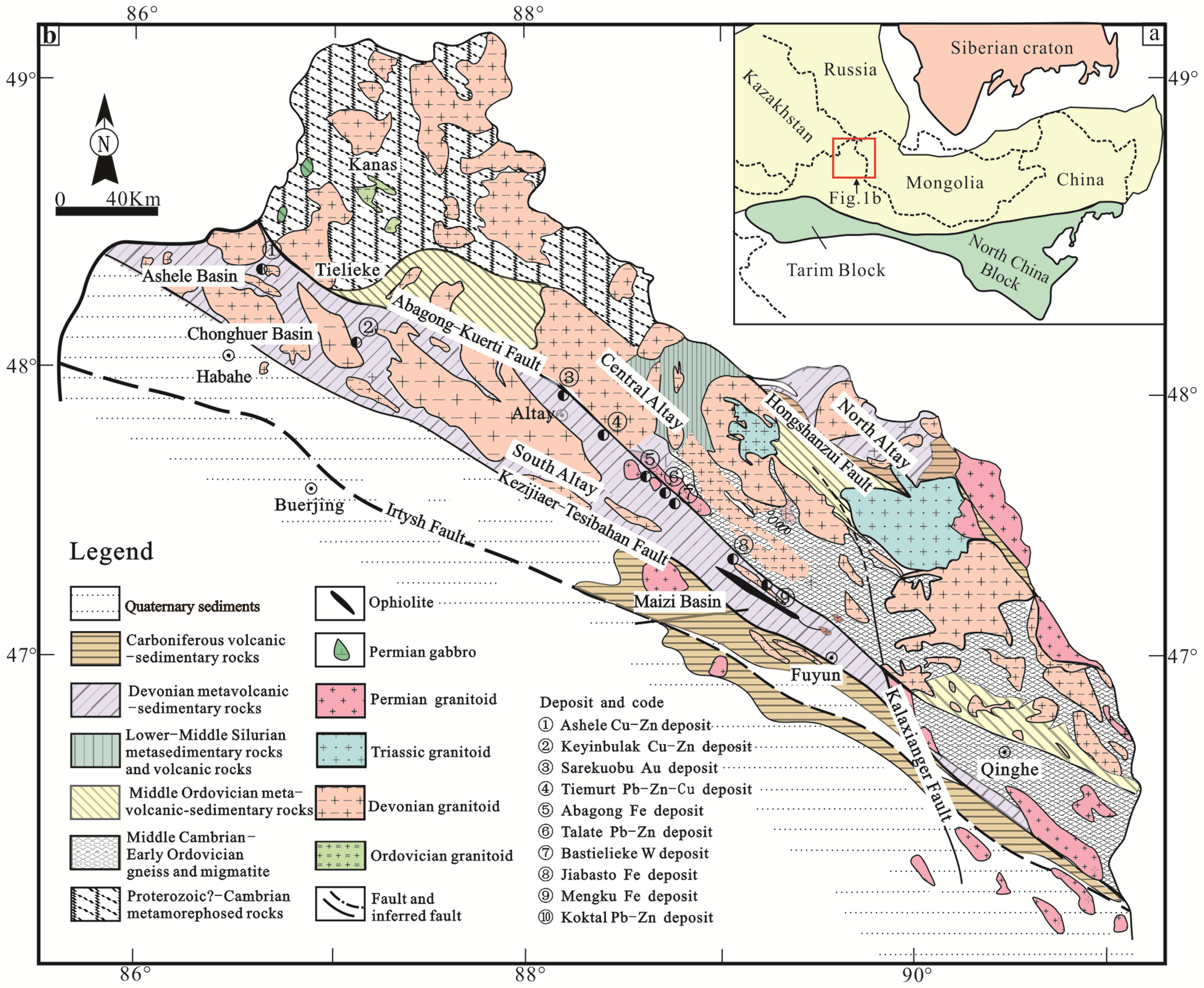
The Chinese AOB is tectonically situated between the Siberian and Kazakhstan–Junggar microplates. It is separated from the Junggar basin along the Irtysh fault to the south and bounded by Rudny Altay (Kazakhstan) and Gorny Altay (Russia) to the northwest and by Gobi Altay (Mongolia) to the northeast. It is divided into the North Altay, the Central Altay, and the South Altay by the Hongshanzui, Abagong, Kalaxianger, and Irtysh faults (Figure 1a). The North Altay is composed mainly of Middle–Late Devonian andesite and dacite and Late Devonian to Carboniferous volcaniclastic and sedimentary sequences. The Central Altay consists of Neoproterozoic to Lower Cambrian low-grade metasedimentary rocks, Middle Cambrian to Ordovician gneiss and migmatite, and Lower-Middle Silurian meta-sandstone and schist. The South Altay, which is the main focus of this study, is composed of Upper Silurian to Lower Devonian metamorphic volcanic–sedimentary rocks (Kangbutiebao Formation), Middle-Upper Devonian low-grade metamorphic volcanic–sedimentary rock (Altay Formation), with minor intercalation of volcanic rocks, and Carboniferous volcano–sedimentary rocks. In addition, minor Ordovician metavolcanic and metaclastic rocks, along with Middle-Upper Silurian schists and migmatite, are also locally exposed. Granitoids are widely exposed in the Chinese Altay, but their distribution varies across tectonic units. Magmatic intrusions mainly occurred during the Paleozoic and Mesozoic, with four major peaks at ca. 460 Ma, 400 Ma, 380 Ma, and 265 Ma [47,48]. Early to middle Paleozoic granitoids occur predominantly in the North Altay and Central Altay, whereas late Paleozoic granitoids and gabbro, together with Mesozoic granitoids and numerous pegmatite dykes, are mainly distributed in the South Altay [47,49]. Many economic deposits have been discovered in the Chinese AOB. From north to south, these include the Ashele Cu-Zn VMS deposit [5], Keyinbulak Cu-Zn skarn [50], Sarekuobu orogenic Au [51], Tiemurt Pb-Zn-Cu VMS [23], Abagong apatite-rich Fe [52], Talate Pb-Zn skarn [17], Bastielieke W-polymetallic skarn [47], Jiabasto Fe skarn [9,15], Koktal Pb-Zn VMS [19], and Mengku Fe [16,18] deposits (Figure 1b).
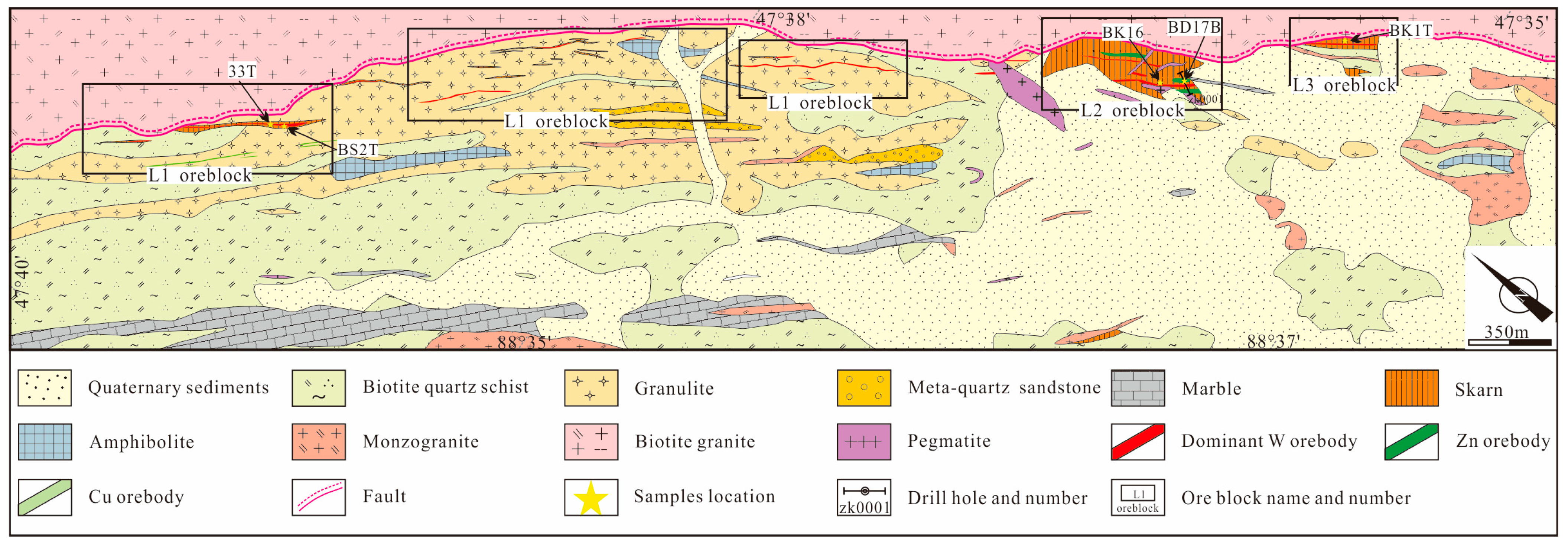
The Bastielieke W-polymetallic skarn deposit is located in the central part of the South Altay (Figure 1). The exposed strata at Bastielieke comprise the Upper Silurian–Lower Devonian Kangbutiebao Formation (Fm.) and the Middle-Upper Devonian Altay Fm., which are of low- to medium-grade and low-grade metavolcanic–sedimentary rocks, respectively. The Bastielieke skarn ores are mainly hosted at or near the contact between the Kangbutiebao Fm. and Permian granites and are dominated by W ores with minor Cu-Zn ores. The NW-trending Abagong Fault controls the distribution of strata, the emplacement of intrusions and orebodies. Previous studies have proposed that W mineralization has spatial–temporal and genetic relationships with two-mica granite/biotite granite, porphyritic monzogranite, and porphyritic K-feldspar granite (zircon U-Pb age of ca. 285–275 Ma). These intrusions were probably derived from different sources and fractionation degrees [10,14]. Some sparse quartz veins and Permian pegmatitic dykes also intruded the granitoids and the Kangbutiebao Fm. The deposit comprises three ore blocks (L1, L2, L3), extending approximately 15 km long and 50–100 m wide along a NW-SE trend (Figure 2). Tungsten, copper and zinc mineralization are highly variable in a single ore body.
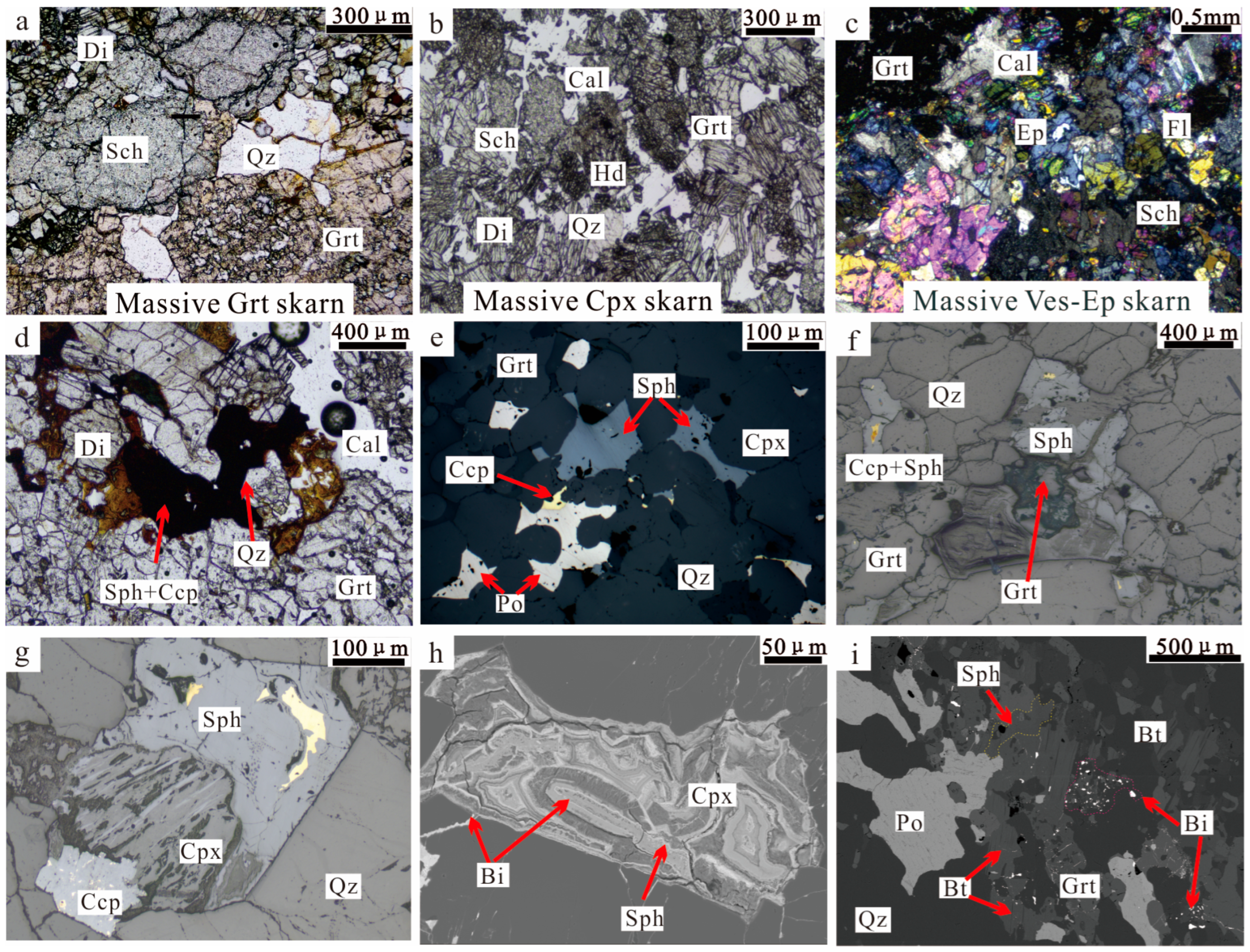
Based on field and petrographic observations, the mineralization contains the prograde (including early-stage and late-stage) metamorphic stage, retrograde metamorphic stage, quartz–sulfide stage and quartz–fluorite–calcite stage [11,45]. The early-prograde-stage skarn is massive garnet skarn, which is composed of coarse- to medium-grained garnet (Fe-poor Al-rich grossular), clinopyroxene, scheelite, quartz, apatite and titanite [53]. Scheelite is commonly euhedral and scattered sparsely, with spotted occurrences in skarn (Figure 3a). The late-prograde-stage skarn is mainly massive/banded clinopyroxene skarn, comprising clinopyroxene, garnet, feldspar, quartz, subhedral–anhedral fine-grained scheelite, apatite and titanite (Figure 3b). The retrograde stage skarn is characterized by the occurrence of densely disseminated scheelite, epidote, vesuvianite, chlorite, molybdenite, native bismuth, pyrrhotite, apatite, titanite and fluorite (Figure 3c). Scheelite grains display patchy textures and remarkable intragrain compositional variations by crystal growth and dissolution–reprecipitation [45]. Sulfides (e.g., chalcopyrite, sphalerite, molybdenite, and pyrrhotite) occasionally occur with epidote and chlorite and are mainly accompanied by quartz as veinlets crosscutting the earlier skarn. Chalcopyrite, sphalerite, and pyrrhotite were replaced with preexisting skarn minerals displaying metasomatic relict texture (Figure 3d,e). Chalcopyrite and sphalerite locally show subhedral to anhedral crystals and solid solution emulsion texture with variable sizes (Figure 3f,g). The textural relationships indicate that these sulfides were simultaneously precipitated and partly overlapped the earlier-stage skarn. They were formed in the late stage of mineralization. In addition, native bismuth grains occur within and along fractures of preexisting minerals (e.g., garnet, clinopyroxene), where they coexist with replacement sulfides (e.g., sphalerite), indicating a paragenetic relationship (Figure 3h,i).

3. Samples and Analytical Methods

3.1. Sample Description

Samples were collected from outcrops and drill holes at Bastielieke, including prograde scheelite-bearing garnet skarn (33T), scheelite-bearing pyroxene skarn (BS2T, BK16), retrograde scheelite–epidote skarn (BK1T), and quartz–chalcopyrite–sphalerite ore (BD17B). A total of four titanite-bearing polished thin sections (33T, BS2T, BK1T, and BD17B) were selected for titanite compositional analysis using electron microprobe analyses (EMPA), laser ablation-inductively coupled plasma mass spectrometry (LA-ICP-MS) techniques, and in situ titanite U-Pb geochronology. Additionally, zircon crystals separated from scheelite-bearing pyroxene skarn (BK16) were prepared for U-Pb dating. Transmitted and reflected polarizing microscope and backscattered electron (BSE) images were used to observe mineral assemblages, mineral morphologies, and internal structures and to guide spot selection for U-Pb dating and geochemical analysis. Sampling locations are shown in Figure 2.

3.2. Analytical Methods

3.2.1. Titanite U-Pb Dating and Geochemistry

Titanite major, in situ LA-ICP-MS trace element and U-Pb isotope dating analyses were conducted at the State Key Laboratory of Ore Deposit Geochemistry, Guiyang Institute of Geochemistry, Chinese Academy of Sciences (GIG-CAS). Prior to analysis, the mineralogy, paragenetic relationships and internal structure of titanite grains were studied by transmitted and reflected polarizing microscope (Leica Microsystems, Wetzlar, Germany) and back-scattered electron (BSE) images. All analysis spots were carefully selected to avoid cracks and inclusions.
Titanite major element compositions and BSE images were obtained with a JEOL JXA 8230 electron microprobe (JEOL, Tokyo, Japan). The operating conditions were a 25 kV acceleration voltage and a 20 nA beam current with a beam spot size of ~5 μm. Elements Si, Ti, Al, Fe, Ca, Mn, K, Na, P, W, Sn, F, and Cl were analyzed. The peak and background counting times were 10 s and 5 s. All data were processed with ZAF correction. The standards used for microanalysis were orthoclase (K), pyrope (Si, Mg, Fe, Mn, Al), plagioclase (Na), apatite (P, F), rutile (Ti), tugtupite (Cl), chrome diopside (Ca), cassiterite (Sn), Mo (MoO3), and W (WO3). The element detection limit in wt.% was: K (0.01), W (0.03), Fe (0.01), Mn (0.01), Ti (0.02), Na (0.02), Si (0.03), Mg (0.01), F (0.07), Al (0.02), P (0.02), Cl (0.01), Ca (0.01), Mo (0.02), and Sn (0.02).
In situ trace element and U-Pb dating analyses were performed separately on an Agilent 7500× ICP-MS (Agilent, Santa Clara, CA, USA) equipped with a GeoLas Pro 193 nm ArF excimer laser ablation system (Coherent, Santa Clara, CA, USA) to acquire ion signal intensities. The trace element analyses were performed on the same sample spots that were used for EMPA. Helium was applied as the carrier gas, which was mixed with argon make-up gas via a T-connector before entering the ICP-MS. Each analysis used approximately 30 s (gas blank) background acquisition followed by 50 s of analysis time. A laser beam with a diameter of 40 μm (for U-Pb dating) and 20–40 μm (for trace elements) was used to ablate the titanite grains at 7 Hz and about 3.2 J/cm2. For U-Pb dating, OLT-1 and SRM 612 were used as the external standard and monitor standard, respectively. Element contents were calibrated using average Si contents determined by electron microprobe as an internal standard, combined with the multiple reference materials (SRM 610, SRM 612, BCR-2G and BHVO-2G). These reference materials were analyzed at the beginning and end of every sample batch (about 15 measurements) to correct the data for time-dependent sensitivity drift and mass discrimination. The element concentrations of the reference glasses are from the GeoReM database (http://georem.mpch-mainz.gwdg.de/, accessed on 26 June 2026). Off-line selection and integration of background and analyte signals, time-drift correction and quantitative calibration were performed by ICPMSDataCal (developed by Liu Yongsheng et al., China University of Geosciences, Wuhan, China) [54]. The analysis accuracy was generally better than 10%, and the detection limit was below 0.1 ppm for most trace elements. Tera-Wasserburg diagrams were obtained using ISOPLOT 3.0 (developed by Kenneth R. Ludwig, Berkeley Geochronology Center, Berkeley, CA, USA) [55].

3.2.2. Zircon U-Pb Dating

Zircon grains were extracted using conventional heavy liquids and magnetic separation techniques. Then, they were mounted in an epoxy bracket and polished to expose the interior. Cathodoluminescence (CL) images were obtained at the Nanjing Hongchuang Geological Exploration Technology Service Co., Ltd. (Nanjing, China). Zircon U-Pb dating and trace element analyses were performed by LA-ICP-MS at Beijing Kerongen Science and Technology Ltd., Beijing, China, using an ESI-NWR-UP213 laser ablation system (Electro Scientific Industries, Portland, OR, USA) and an Agilent 7900 ICP-MS instrument (Agilent Technologies, Santa Clara, CA, USA). GJ–1 zircon was used as the primary reference material for calibration of U-Pb isotopic ratios and instrumental mass bias, and Plešovice zircon was used as the secondary (QC) standard to monitor the accuracy and precision of acquired U-Pb data. Off-line selection, integration of background and analyte signals, time-drift correction and quantitative calibration for trace element analysis and U-Pb dating were performed by ICPMSDataCal [54]. Concordia diagrams of zircon grains were obtained using ISOPLOT 3.0 [55].

4. Results

4.1. Petrography of Titanite

Titanite grains are common and can be found throughout the mineralization stages from the Bastielieke deposit. Based on detailed petrographic observations, we classified titanite into three textural types.
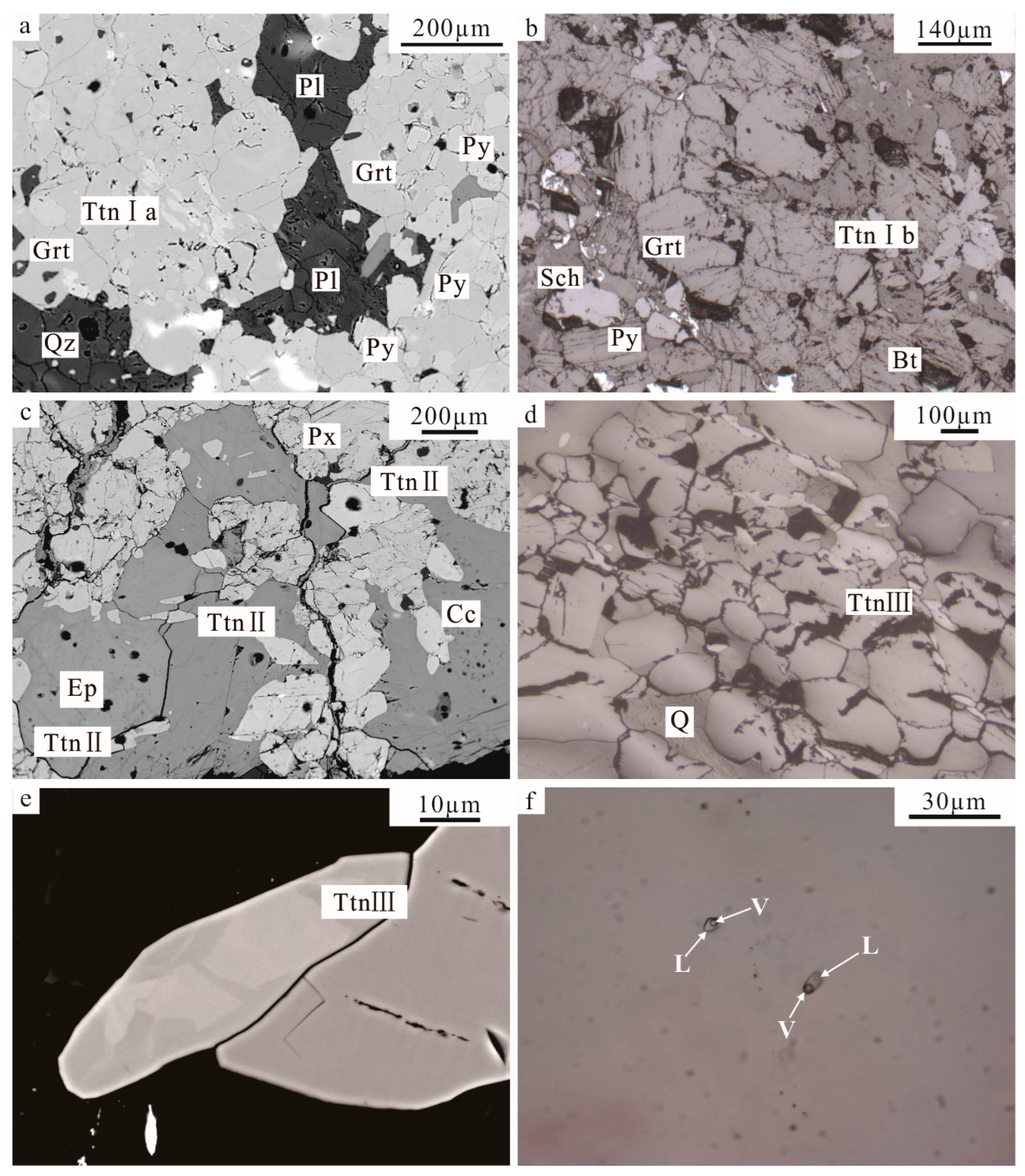
Titanite grains are enclosed in garnet or clinopyroxene as inclusions or grow in clusters with scheelite in the interstices of anhydrous minerals. Titanite in garnet skarn and pyroxene skarn is further divided into early-stage (TtnIa) and late-stage (TtnIb) ones. TtnIa grains are commonly subhedral to euhedral and fine-grained (<60 μm length) and occur either as inclusions within garnet or coexist with early prograde skarn minerals (Figure 4a). TtnIb grains are usually randomly oriented in the interstices of anhydrous minerals (Figure 4b). Titanite in clinopyroxene–epidote skarn (TtnII) occurs as relatively large grains, ranging from 80 to 300 μm in size. These grains are subhedral to euhedral, commonly envelope-shaped, and occur in the interstices of retrograde alteration minerals (Figure 4c). Titanite (TtnIII) occurs as euhedral grains ranging from 50 to 100 μm in size, coexisting with chalcopyrite and pyrite in the interstices between quartz. Titanite and quartz grains exhibit a distinct orientation (Figure 4d). In BSE images, all titanite grains show patchy textures characterized by irregular boundaries and uneven brightness, which are interpreted as relict features resulting from metasomatic alteration or dissolution–reprecipitation (Figure 4e). Locally, individual grains are euhedral and display a homogeneous BSE image. Most titanite grains contain primary two-phase aqueous fluid inclusions (Figure 4f).

4.2. Compositions of Titanite

4.2.1. Major Element Compositions of Titanite

Eighty-three analyses were conducted on 81 titanite crystals (covering three mineralization stages) from the prograde stage skarn, retrograde stage skarn, and quartz–sulfide vein. The EMPA results of TtnI, TtnII and TtnIII are listed in the Supplemental Table S1.
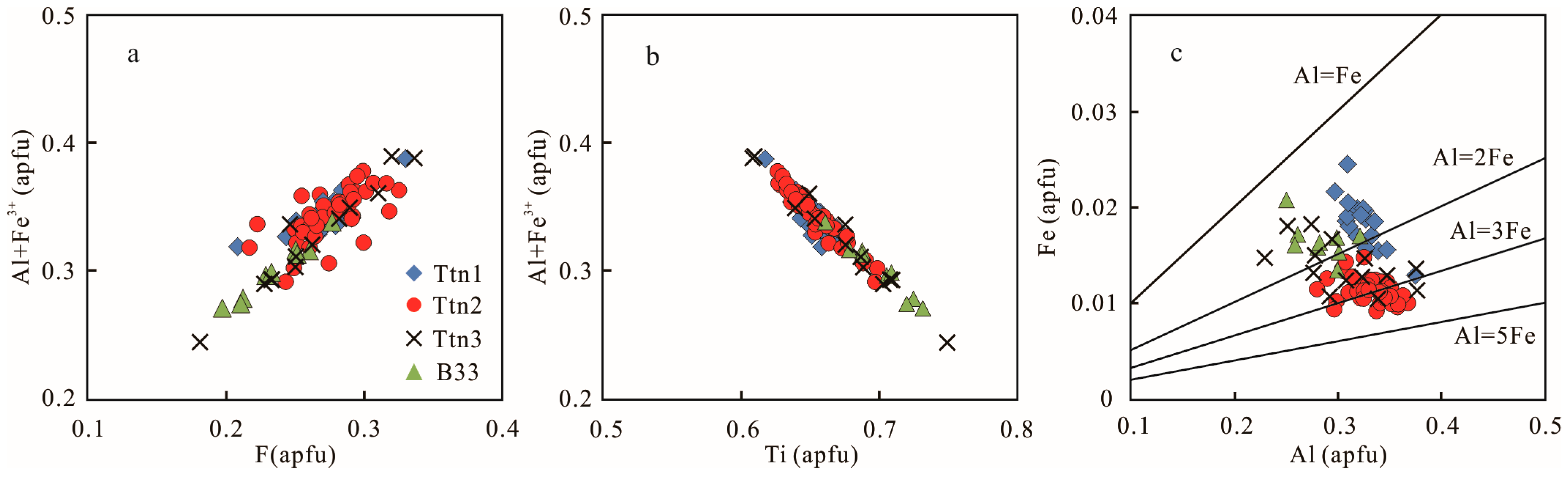
Stoichiometries were calculated assuming five equivalent oxygen atoms per formula unit and all iron as Fe3+ for titanite because Fe3+ is dominant in titanite, although some Fe2+ may also be present [36,56]. All three types of titanite have relatively uniform SiO2 (30.25–31.82 wt%) and CaO (28.41–29.21 wt%) contents. In contrast, Al2O3 (6.57–9.98 wt%), TiO2 (24.94–30.15 wt%), F (1.93–3.32 wt%), and FeO (0.34–0.91 wt%) show large variations, even within the same type, and the compositional ranges are similar across the three types (Supplemental Table S1). These variations are primarily reflected in the compositional differences between the darker and brighter zones within individual grains in BSE images, with the darker zones enriched in F and Al2O3 but depleted in TiO2 and Fe2O3 relative to the brighter zones. All titanites display obviously negative and positive correlations between (Al3+ + Fe3+) and F (apfu, atoms per formula unit) and between (Al3+ + Fe3+) and Ti4+, respectively (Figure 5a,b). These correlations indicate the substitution mechanism (Fe, Al)3+ + F ⟶ Ti4+ + O2−, which is common in titanite [38,57]. In addition, all titanite grains display lower Fe3+ than Al3+ (Figure 5c), indicating a substitution of (Fe, Al)3+ + OH ⟶ Ti4+ + O2− [36].

4.2.2. Trace Element Compositions of Titanite

A total of 74 in situ LA-ICP-MS analyses were obtained from titanite in the prograde-stage skarn, retrograde-stage skarn, and quartz–sulfide vein. Representative trace element and REE data of titanite are presented in Supplemental Table S2.
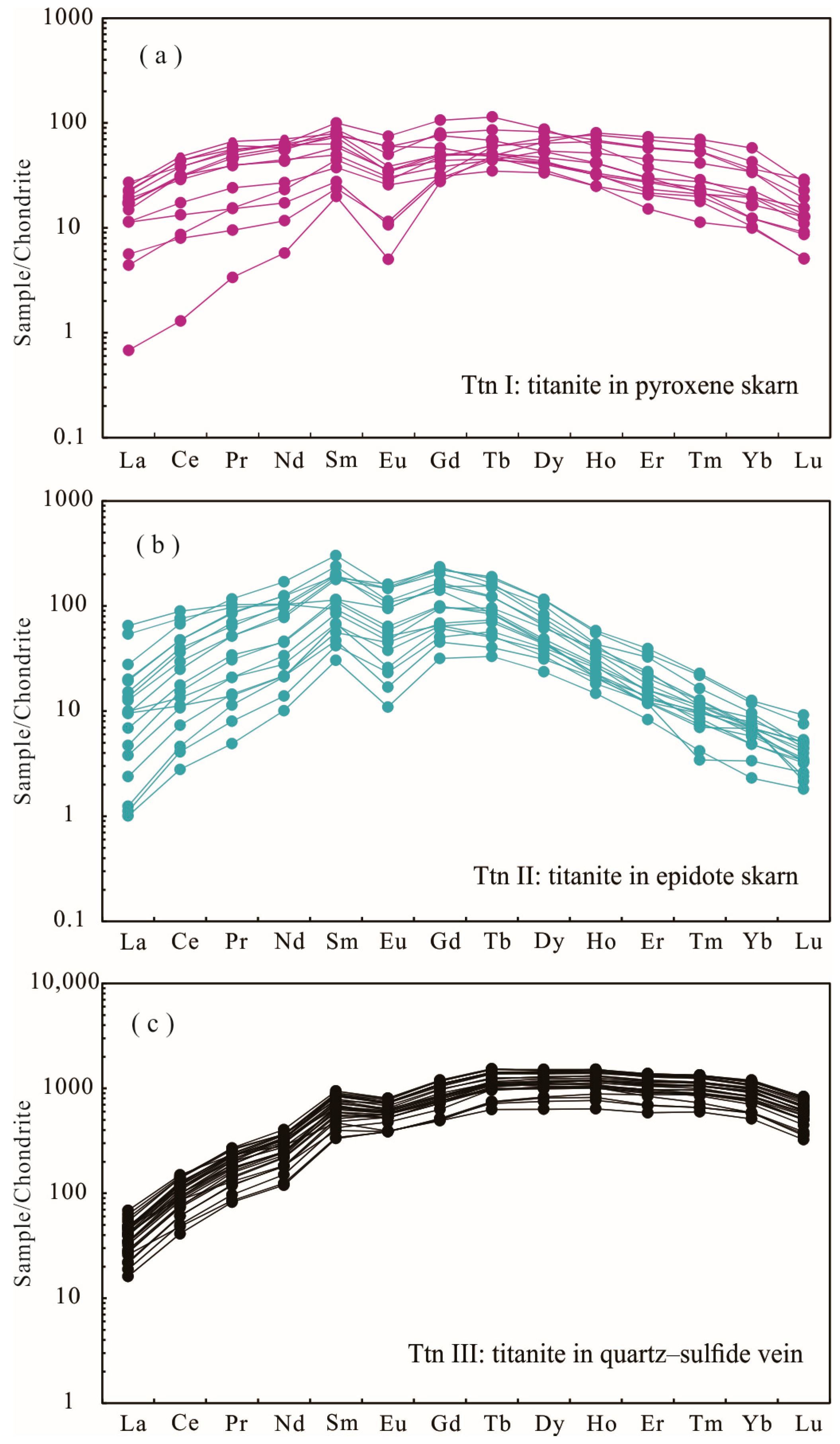
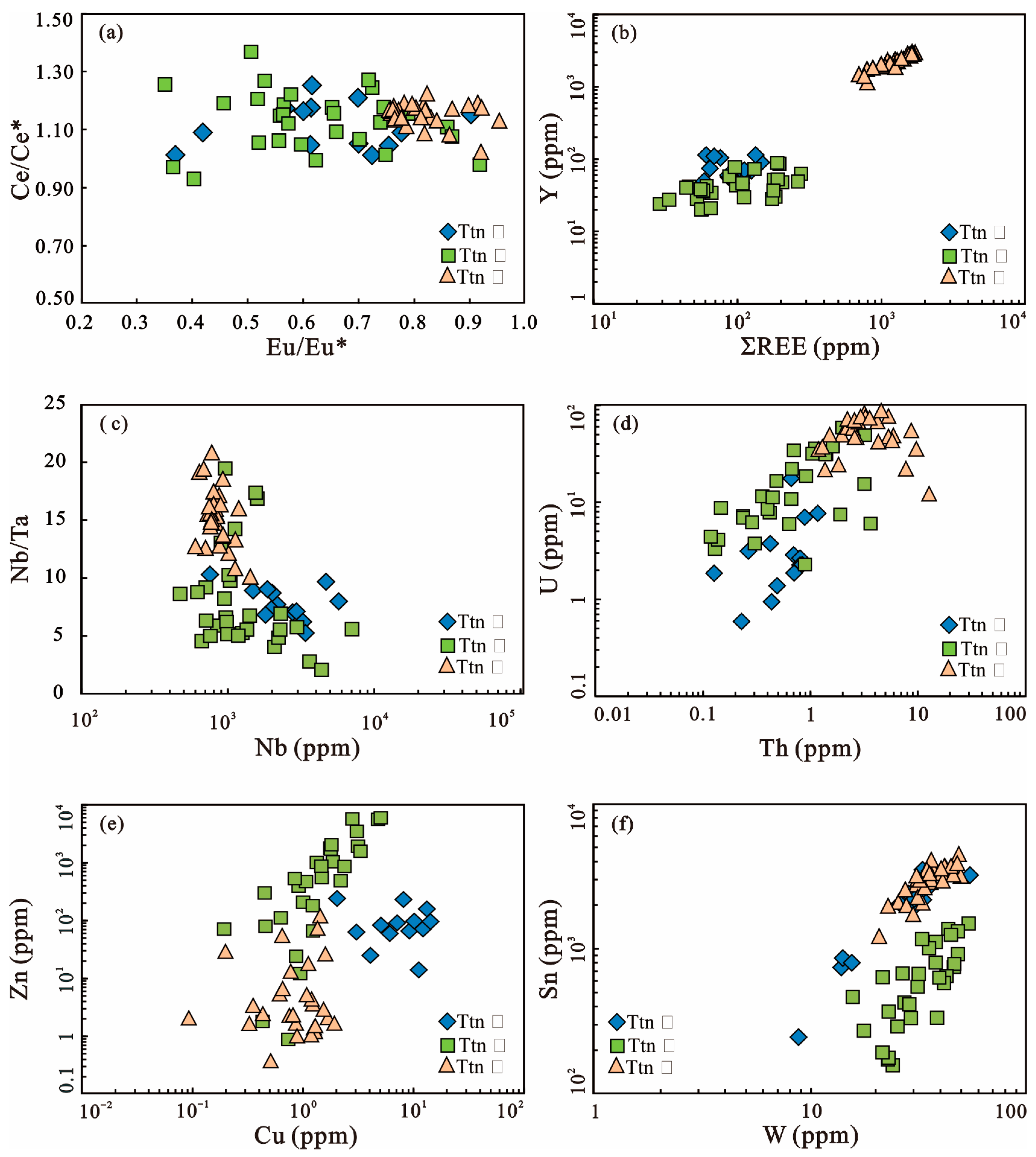
The three titanite types exhibit different chondrite-normalized REE patterns, consistent negative Eu anomalies (Eu/Eu* = 0.35–0.95) and weak positive Ce anomalies (Ce/Ce* = 0.93–1.37) (Figure 6). TtnI is characterized by low total REE (ΣREE) contents (58.6–146 ppm), a slightly MREE-enriched pattern with (La/Sm)N ratios of 0.10–0.41, mildly negative Eu anomalies (Eu/Eu* = 0.37–0.90), and slightly positive Ce anomalies (Ce/Ce* = 1.01–1.25). Compared with TtnI, TtnII exhibits consistent ΣREE concentrations (28.89–276 ppm), a strongly MREE enriched pattern with (La/Sm)N ratios of 0.02–1.22, strongly HREE fractionation ((Gd/Yb)N = 1.70–9.61), strongly negative Eu anomalies (Eu/Eu* = 0.35–0.92), and positive Ce anomalies (Ce/Ce* = 0.93–1.37). TtnIII has the highest ΣREE concentrations (787–1736 ppm) among the three types. It displays steeply left-sloping, HREE-enriched patterns with moderate HREE fractionation ((Gd/Yb)N =0.66–41.11), negative Eu anomalies (Eu/Eu* = 0.75–0.95), and slightly positive Ce anomalies (Ce/Ce* = 1.02–1.22) (Supplemental Table S2, Figure 6 and Figure 7a).
The three titanite types have distinct trace element concentrations, including Y, Nb, Ta, U, Cu, Zn, Sn, and V. TtnI and TtnII show significantly lower Y concentrations (46.32–113 ppm and 19.92–88.26 ppm, respectively) compared to TtnIII (1121–2611 ppm) (Supplemental Table S2, Figure 7b). Furthermore, TtnI is characterized by higher Nb (753–5709 ppm) and Ta (73.39–716 ppm) concentrations but lower Nb/Ta ratios (5.22–10.26) than TtnIII (Nb: 600–1421 ppm; Ta: 33.26–142 ppm; Nb/Ta: 10.1–20.81). In contrast, TtnII shows highly variable Nb (471–7049 ppm) and Ta (49.21–2145 ppm) concentrations and variable Nb/Ta ratios (2.03–19.43) (Figure 7c). TtnI and TtnII also have lower Th (0.13–1.19 ppm, 0.12–3.69 ppm, respectively) and U (0.59–17.54 ppm, 2.27–58.44 ppm, respectively) concentrations than TtnIII (Th: 1.20–12.96 ppm, U: 12.13–107.64 ppm; Figure 7d). TtnIII is distinguished by higher Lu/Hf ratios (0.46–2.63) but lower Th/U ratios (0.03–1.07). In addition, the titanite types in this study show markedly different Cu, Zn, and Sn contents, despite similarly low Mo (1.11–7.39 ppm) and W (13.73–54.38 ppm) concentrations. TtnI has significantly higher Cu concentrations (20.07–64.57 ppm) than TtnII (0.02–4.98 ppm) and TtnIII (0.09–1.9 ppm). TtnII exhibits the highest and most variable Zn contents (0.85–5718 ppm) and the lowest Sn contents (157–1490 ppm) (Supplemental Table S2, Figure 7e,f). The Sn contents of TtnI and TtnIII are considerably higher than those reported for skarn-type W deposits (1.3–1904 ppm) [38].

4.3. Titanite U-Pb Ages

The in situ titanite U-Pb isotopic results are listed in Supplemental Table S3. These titanite grains contain common Pb (0.34–4.30 ppm) (Supplemental Table S3) and varying Pb/U ratios. Thus, titanite U-Pb ages are calculated using the 207Pb correction method [59], and the lower intercept age in the Tera-Wasserburg diagram approximates the formation ages of titanite.
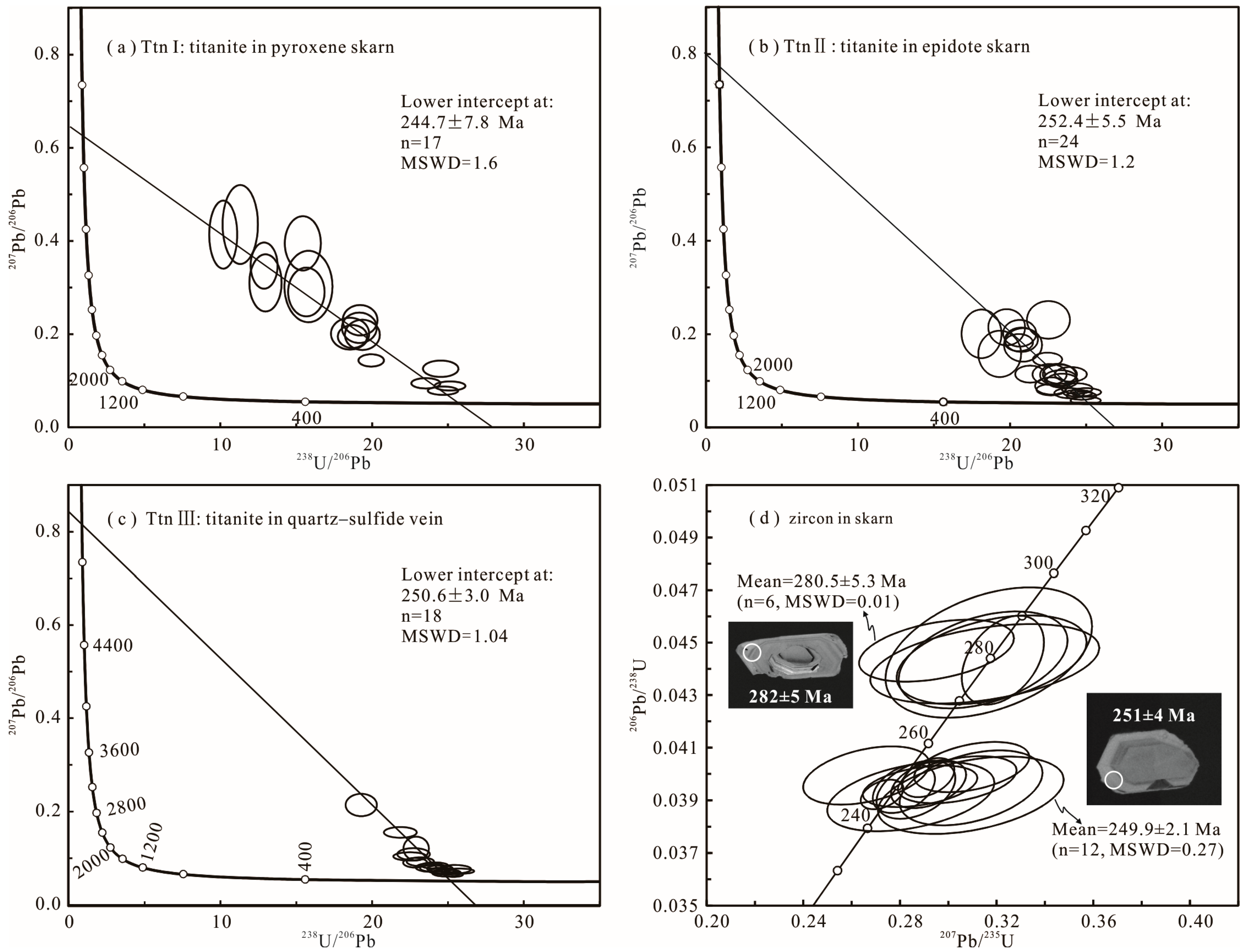
For TtnI, a total of seventeen spot analyses on 17 titanite grains yielded a lower intercept age of 244.7 ± 7.8 (MSWD = 1.6) in the Tera-Wasserburg diagram (Figure 8a). For TtnII, twenty-four spot analyses yielded a lower intercept age of 252.4 ± 5.5 (MSWD = 1.2) in the Tera-Wasserburg diagram (Figure 8b). For TtnIII, eighteen spot analyses yielded a lower intercept age of 250.6 ± 3.0 (MSWD = 1.04) in the Tera-Wasserburg diagram (Figure 8c).

4.4. Zircon U-Pb Age

Most zircon grains chosen for dating from scheelite-bearing pyroxene skarn are anhedral, transparent and translucent, and generally 50–150 μm long, with length-to-width ratios between 1:1 and 2:1.
Eighteen grains were analyzed, and the U-Pb isotopic data are presented in Supplemental Table S4. All the analyses of zircon define two populations of ages in the concordia diagram. A group of six zircon grains yields a 206Pb/238U concordia age of 279.7 ± 6.3 Ma (MSWD = 0.01) and a weighted age of 280.5 ± 5.3 Ma (MSWD = 0.03), which is consistent with the crystallization age (285–275 Ma) of the granite in Bastielieke ore district [10,14]. Another group of twelve analytical spots has a 206Pb/238U concordia age of 249.6 ± 2.6 Ma (MSWD = 0.29), a weighted age of 249.9 ± 2.1 Ma (MSWD = 0.27) and low Th/U ratios (0.01–1.31) (Figure 8d).

5. Discussion

5.1. Implications from the U-Pb Ages

As mentioned above, TtnI, TtnII and TtnIII coexist with hydrothermal minerals (e.g., garnet, diopside, epidote, scheelite, chlorite, calcite, chalcopyrite and sphalerite) (Figure 3) and contain primary aqueous two-phase inclusions (Figure 4f), suggesting that they were formed from ore-forming hydrothermal fluids. This interpretation is further supported by the titanite geochemistry. All titanite grains have relatively high Al, Fe, and F, low Ti contents and low Fe/Al ratios (<0.08) (Figure 5c), resembling those of hydrothermal titanite from skarn [30,37,38]. In addition, these titanites have low Th/U ratios (<0.4) (Figure 4), which are significantly lower than the Th/U ratios (>1) of titanites in granitoids [30,37,40]. Thus, we propose that TtnI, TtnII and TtnIII precipitated directly from hydrothermal fluids. Zircons from the skarn ores show complex textures. Some grains show typical magmatic zircon features (oscillatory or sector zoning) under CL imaging, with a weighted mean age of ca. 280 Ma, interpreted as the crystallization age of the magmatic protolith. This age is consistent with the regional Permian magmatism (287–275 Ma, [10,13,14,22]), indicating a genetic link to the Permian magmatic activity and thus providing an upper age limit for the skarn mineralization. In contrast, others show relatively bright or dark homogenous rims with low Th/U ratios (0.01–1.31) (Supplemental Table S1, Figure 8d), indicating recrystallization due to hydrothermal fluid alteration [60,61]. Together, the petrographic and geochemical evidence confirms that both the titanite and the ~250 Ma zircon are hydrothermal in origin. Their U-Pb ages thus directly record the timing of a late hydrothermal event in the skarn system, rather than representing inherited or magmatic ages.
The three types of titanite grains yield lower intercept ages of 244.7 ± 7.8 Ma (MSWD = 1.6), 252.4 ± 5.5 Ma (MSWD = 1.2), 250.6 ± 3.0 Ma (MSWD = 1.04), respectively, which are identical within error to the 249.9 ± 2.51 Ma U-Pb age of hydrothermal zircon from the mineralization skarn. These hydrothermal titanite and zircon U-Pb ages are significantly younger than the host granites (285–275 Ma [10]) and a molybdenite Re-Os age (280.6 ± 1.7 Ma [45]) from the Bastielieke deposit. They are also younger than the peak period of Permian granitic intrusions (287–275 Ma) [10,13,14,22] and metamorphism activities in the southern margin of the Chinese AOB [16]. The ~30 Myr gap significantly exceeds a slow cooling process of granitic intrusions and the typical duration of skarn systems (<10 Myr [62]); instead, it probably resulted from a separate hydrothermal event or a postcrystallization disturbance (see [63] for a comparable case). All titanites in the Bastielieke deposit display a patchy texture with irregular boundaries and dark and bright domains having different F, Al2O3, TiO2, Nb contents (Figure 5). The patchy texture, combined with intragrain compositional heterogeneity, is interpreted as the result of late-stage hydrothermal overprinting via dissolution–reprecipitation, a common process in skarn systems [64]. Therefore, the ~250 Ma titanite U-Pb age does not represent the initial crystallization age of skarn associated with Permian granite but rather the time of resetting via dissolution–reprecipitation related to hydrothermal fluids [32,41,43].
Importantly, the 245–252 Ma ages obtained in this study are within error consistent with the timing of the Erqis shear zone and Abagong Fault [16,18]. This temporal coincidence suggests that the hydrothermal fluid activity was likely triggered by the regional tectonic thermal events. Moreover, similar ages have been widely reported from other skarn deposits in the Xinjiang Altay, including the Mengku iron deposit (250–263 Ma [16,18]), the Talate Pb-Zn-(Fe) deposit (231.7 ± 7.2 Ma [17]), the Tiemurt Pb-Zn-Cu deposit (240 Ma [23]), the Koktal Pb-Zn deposit (264.9 ± 8.3 Ma [19]), and the Jiabasto iron deposit (248.3 ± 2.9 Ma [15]). We therefore interpret that the ~250 Ma titanite and zircon U-Pb ages record a hydrothermal event coeval with the late Permian–Triassic tectonic activity in the southern Altay.

5.2. Constraints on the Hydrothermal Fluid Conditions from Titanite Composition

Previous studies have demonstrated that titanite composition is controlled by hydrothermal fluid composition, element compatibility, and physicochemical parameters (e.g., pH, salinity, oxygen fugacity (fO2)) (e.g., [30,32]) and can be used to record the evolution history of hydrothermal fluids [39,40]. As discussed above, the ~250 Ma titanite U-Pb ages reflect thermal resetting through dissolution–reprecipitation associated with late Permian–Triassic tectonism in the southern Altay. Importantly, although REE concentrations vary among titanite grains of the same type, their REE patterns remain uniform within each type but differ between types. This pattern–concentration decoupling implies that the REE compositions were not pervasively modified by the resetting event, during which REE concentrations were remobilized but the original pattern signatures were retained [32,41,43,65,66]. Furthermore, HFSEs are generally considered immobile in most hydrothermal systems; however, both field and experimental evidence demonstrate that HFSEs can become highly mobile, particularly at high salinities and in alkali- and F-rich fluids [32,67,68]. Divalent transition metals (e.g., Cu, Zn) are also considered relatively immobile under most hydrothermal conditions, but experimental studies indicate that they can become highly mobile in Cl-rich, saline, and acidic fluids [69,70,71]. Consequently, these compositional features record the signature of the fluid associated with the resetting event, providing a basis for constraining the hydrothermal fluid conditions in the skarn system.

5.2.1. Fluid Compositions

All titanite grains are F-bearing, indicating the presence of F in the hydrothermal fluid throughout the skarn evolution. However, systematic variations in mineral assemblages and trace element compositions (e.g., Nb, Ta, Cu, and Zn) among the three titanite types indicate the involvement of distinct fluid compositions.
TtnI coexists with fluorite and F-bearing scheelite and exhibits high Nb-Ta contents with low Nb/Ta ratios (Supplemental Table S2, Figure 7c). Experimental studies have shown that high F significantly elevates the solubility of high-field-strength elements (HFSE), such as Nb and Ta, in reducing hydrothermal fluids. Conversely, F-poor aqueous solutions have generally low Nb solubility, and Ta is less soluble than Nb [72]. These features indicate that TtnI precipitated from F-rich fluids. TtnII coexists with F-bearing scheelite, chalcopyrite, and fluorite but shows variable Nb-Ta contents. Some grains are similar to TtnI, whereas others are comparable to TtnIII, although all retain low Nb/Ta ratios similar to TtnI. The variable Cu concentrations in TtnII, together with the coexistence of scheelite and chalcopyrite, suggest precipitation from F-Cl mixed fluids. This interpretation is supported by elevated Zn contents in TtnII (Figure 7), as Zn forms stable chloride complexes in hydrothermal fluids [73], consistent with increased Cl activity. TtnIII lacks fluorite, has low Nb-Ta contents with high Nb/Ta, and exhibits low Cu concentrations (Figure 7). Experimental studies have demonstrated that copper is transported in hydrothermal solutions primarily as chloride complexes (e.g., CuCl2−, CuCl32−), with Cu solubility increasing significantly with increasing chloride concentration [69,71]. Although TtnIII has low Cu concentrations, this does not reflect low Cl activity; rather, the low Cu contents likely reflect efficient Cu removal by chalcopyrite precipitation prior to titanite crystallization. Similarly, the low Zn in TtnIII likely results from efficient Zn removal by sphalerite precipitation. These features, combined with the absence of fluorite and the high Nb/Ta ratios (consistent with F-poor, Cl-rich fluids [72]), indicate that TtnIII precipitated from Cl-rich fluids.
Additional geochemical evidence further supports the distinct fluid compositions (F-rich vs. Cl-rich) recorded by the three titanite types. Eu anomalies show systematic variations. TtnI and TtnII have more negative Eu anomalies (0.35–0.92), whereas TtnIII has higher Eu anomalies (0.75–0.95) (Supplemental Table S2, Figure 7). Previous studies have shown that Eu2+ preferentially forms chloride complexes in hydrothermal fluids [74], and Cl-rich fluids retain Eu2+ in solution, producing less negative Eu anomalies in coprecipitating minerals. The higher Eu anomalies in TtnIII are therefore consistent with Cl-rich fluids, whereas the more negative anomalies in TtnI–TtnII reflect lower Cl activity. Similarly, this interpretation is reinforced by the U-Th systematics. Specifically, TtnIII exhibits high U contents and low Th/U ratios compared to TtnI and TtnII, indicating efficient U mobilization relative to Th in Cl-rich fluids [75].
In summary, the three titanite types record a different fluid nature under reducing conditions, with TtnI precipitating from F-rich fluids, TtnII from F-Cl mixed fluids, and TtnIII from Cl-rich fluids.

5.2.2. Fluid Origin

Multiple lines of independent evidence indicate that TtnIII formed from a fluid source distinct from that of TtnI and TtnII, rather than from continuous evolution of the same hydrothermal system.
Experimental studies have indicated that the partition coefficients for middle REE (MREE) between titanite and aqueous fluid are high, leading to preferential incorporation of the MREE into titanite in the absence of fluid speciation control [32]. In the Bastielieke deposit, TtnI and TtnII display MREE-enriched patterns, consistent with the experimental prediction. In contrast, TtnIII is characterized by strong LREE depletion (Figure 6), implying different formation conditions (e.g., salinity, F content, fO2, or metal complexes). TtnIII shows significantly higher ΣREE + Y contents, low Dy/Yb (<3), and weakly fractionated HREE patterns (Supplemental Table S2, Figure 6 and Figure 7). These features indicate that garnet was not present during TtnIII formation because garnet preferentially incorporated HREE, increasing LREE/HREE ratios in the residual fluid [34,76]. This rules out the probability that TtnIII precipitated from an evolved fluid of retrograde stage, which would have already experienced garnet crystallization. Furthermore, the high Nb/Ta ratios in TtnIII are different from those expected. Experimental studies have shown that under reducing conditions, the solubility of both Nb and Ta increases significantly in F-dominated fluid [77]. However, the titanite/fluid partition coefficient for Ta is considerably higher than that for Nb [35]. Therefore, during progressive titanite crystallization from a single evolving fluid, Ta is preferentially incorporated into the early-formed titanite, leading to high Nb/Ta ratios in the titanite that crystallizes later. TtnIII exhibits high Nb/Ta ratios (Figure 7), which is the opposite of what would be expected for a later-stage titanite from a continuously evolving hydrothermal fluid. This contradiction suggests that TtnIII is not a product of the same fluid evolution. Furthermore, experimental results show that titanite metasomatized by Cl-rich fluids exhibits no change in its Nb/Ta ratio. In contrast, metasomatism by F-rich (as well as OH-rich) fluids leads to a significant decrease in this ratio [78]. TtnIII exhibits significantly higher U and V concentrations than TtnI and TtnII (Figure 7). During progressive fluid evolution, early crystallization of garnet and titanite would have progressively depleted U from the residual fluid [79]. Under the reducing conditions, V is predominantly trivalent (V3+) [35,80], readily substituting for Ti4+ in titanite due to their similar ionic radii (V3+: 0.64 Å vs. Ti4+: 0.605 Å) [35,81]. Consequently, later-precipitated titanite (TtnIII) from the same evolving fluid would be expected to exhibit lower U and V contents than earlier TtnI and TtnII. The observation of higher U and V in TtnIII is again inconsistent with a common fluid evolution.
In summary, REE patterns, Nb/Ta ratios, and U-V concentrations collectively indicate that TtnIII formed from a fluid source distinct from that of TtnI and TtnII, consistent with the interpretation that TtnIII records a Cl-rich, F-poor fluid of a different origin.
All titanite types yield U-Pb ages of ca. 250 Ma, recording a regional tectono-hydrothermal event [16,17,18]. They display dissolution–reprecipitation textures, coexist with distinct mineral assemblages, and exhibit different REE patterns and trace element concentrations. We interpret these features as evidence that earlier magmatic–hydrothermal titanite was partially to completely replaced by regional metamorphic hydrothermal fluids at ca. 250 Ma. Specifically, TtnI and TtnII (80–300 μm) precipitated from 280 Ma magmatic–hydrothermal fluids and were partially replaced by the 250 Ma fluids, whereas TtnIII (50–100 μm) was completely replaced. This interpretation is supported by previous studies showing that the U-Pb system in titanite is more readily reset than trace elements under low fluid/rock ratios [65] and that dissolution–reprecipitation can occur at the microscale while preserving original trace element signatures [32,41,43]. Thus, while the U-Pb ages were completely homogenized to ca. 250 Ma, the distinct REE, Nb, Ta, and U signatures of TtnI, TtnII, and TtnIII were partially preserved. Furthermore, the highly variable Nb, Ta, U, and REE contents within TtnI and TtnII crystals are attributed to their early metasomatism by F-rich magmatic–hydrothermal fluids [45], prior to the 250 Ma overprint. Therefore, titanite in the Bastielieke deposit records a ca. 250 Ma dissolution–reprecipitation event that reset the U-Pb system and produced multiple titanite types with distinct trace element signatures.

5.3. Implications for Mineralization

The significance of mineralization at Bastielieke can be better understood in light of Permian–Triassic tectonic evolution in the southern Altay. Regional structural studies indicate the existence of intense NE–SW compression and large-scale folding during the Permian (ca. 300–270 Ma) [3,82]. The coeval Early Permian (~291–270 Ma) magmatism, high-temperature to ultrahigh-temperature metamorphism, and anatexis reflect significant thermal perturbation and post-collisional signatures [3,22,83]. The coexistence of regional contraction and crustal melting points to a transitional regime from collision-dominated compression to post-collisional extension [3,82,83]. Within such a transitional regime, localized thrusting and strike-slip faulting, accompanied by widespread magmatism, are typical features that may develop concurrently [3,84].
In this study, the early Permian (280 Ma) zircon U-Pb age from the ores links mineralization to Permian granitic magmas emplaced during the transitional regime. In contrast, the younger titanite (244–252 Ma) and zircon (ca. 250 Ma) ages are significantly later than the magmatic intrusive event (ca. 280 Ma) and coincide with regional shear–thrust movements (ca. 246 Ma) [18]. Three distinct types of titanite (TtnI–TtnIII) in the skarn, associated with different mineral assemblages, have been shown to be hydrothermal in origin, further supporting a fluid-rich late-stage process. These geochronological and compositional data together reveal a temporal decoupling between the initial magmatic intrusion and the later hydrothermal overprint. More importantly, the ore-related 278–270 Ma pluton in the Bastielieke district has been geochemically characterized as syn- to post-collisional, consistent with the transitional regime inferred from regional data [85]. Our newly obtained ca. 250 Ma hydrothermal ages, which postdate these intrusions, further indicate that the Bastielieke deposit represents a late-stage hydrothermal product formed during post-collisional tectonism. Integrating these data with titanite and hydrothermal zircon geochronology, titanite compositions, and regional geological constraints, we propose a two-stage fluid evolution model to reconstruct the Bastielieke deposit history.
The F-rich magmatic–hydrothermal fluids exsolved from the Permian granitic magmas (ca. 280 Ma) interacted with the wall rocks to form scheelite-bearing garnet skarn, scheelite-bearing pyroxene skarn, scheelite-bearing epidote skarn, and quartz–chalcopyrite–pyrrhotite ores [11,45]. During skarn formation, early titanite precipitated in the prograde stage, retrograde stage, and quartz–sulfide stage, respectively. These titanite grains are characterized by high Nb and Ta contents and MREE enrichment. During the Triassic (ca. 250 Ma), intense strike-slip and thrust shearing in the south Altay [16,18] caused heating and devolatilization of the wall rocks (the Kangbutiebao Fm. volcano–sedimentary rocks) to form a metamorphic fluid. At the same time, meteoric waters infiltrated to depth along shear zones and faults and were heated [16,18,23]. These two fluids mixed and formed a high-temperature, Cl-rich hydrothermal fluid. This mixture fluid metasomatized all three preexisting titanite types, completely resetting their U-Pb isotope system and yielding uniform ages of 245–252 Ma (ca. 250 Ma), whereas the extent of trace elements remobilized varied among them. Consequently, TtnI and TtnII (larger grains, 80–300 μm) still preserve the MREE enrichment characteristics and mineral assemblage information (coexisting with scheelite and fluorite) of the early skarn, with heterogeneous trace element distributions. In contrast, TtnIII (smaller grains, 50–100 μm), which has a different origin, underwent complete dissolution–reprecipitation, recording only the compositional features of the metamorphic fluid and coexisting with chalcopyrite.
In summary, the Bastielieke skarn W-Cu deposit is characterized by two-stage hydrothermal activity, controlled by the replacement of magmatic fluids exsolved from Permian granitic magmas (ca. 280 Ma) and overprinted by 250 Ma orogenic-type hydrothermal alterations. The Permian granitic magmas are responsible for the W and Cu mineralization, which precipitated at different stages of magmatic evolution (W early, Cu late) [45,47]. During the 250 Ma orogenic-type hydrothermal event, the metasomatism of preexisting titanite produced TtnIII, which is intergrown with chalcopyrite, indicating that this hydrothermal activity involved copper mobilization. This process may represent either remobilization of early copper or addition of external copper. The existence of coeval copper mineralization in the region supports the addition model [17]. This hydrothermal system was driven by regional shear zones, dominated by meteoric waters, and circulated along deep-seated faults.

6. Conclusions

Three types of hydrothermal titanite (TtnI, TtnII, and TtnIII) from the Bastielieke W-polymetallic deposit yield U-Pb ages of 245 Ma, 252 Ma, and 251 Ma, respectively, while hydrothermal zircon gives an age of 250 Ma. These titanite grains display dissolution–reprecipitation texture, indicating complete resetting of their U-Pb isotope systems during a hydrothermal event coeval with the late Permian–Triassic tectonic activity on the southern margin of Xinjiang AOB. Compositional variations among the three titanite types record a two-stage hydrothermal history. The earlier event occurred in the Permian (ca. 284–275 Ma) and is related to skarn formation through metasomatism by magmatic-hydrothermal fluids exsolved from Permian granites, which precipitated W-Cu mineralization and protolith titanite. The later event occurred in the Triassic (ca. 250 Ma) and is related to regional shear–thrust movements and metamorphic–hydrothermal processes, which partially altered TtnI and TtnII, precipitated TtnIII, and remobilized metals. These results link the early Permian mineralization (ca. 284–275 Ma) to a transitional regime from collision to post-collision and the early Triassic hydrothermal event (ca. 250 Ma) to post-collisional tectonism in the southern Altay and highlight the role of metamorphic fluid remobilization in polymetallic mineralization.

Supplementary Materials

The following supporting information can be downloaded at https://www.mdpi.com/article/10.3390/min16070688/s1: Table S1: Major element composition (wt%) of titanite grains from the Bastielieke deposit; Table S2: LA-ICP-MS analytical results of trace element concentrations (ppm) of titanite grains from the Bastielieke deposit; Table S3: LA-ICP-MS U-Pb isotope data for titanite from skarn in the Bastielieke deposit; Table S4: LA-ICP-MS U-Pb isotope data for zircon from skarn in the Bastielieke deposit.

Author Contributions

M.X.: writing—original draft, methodology, formal analysis, visualization, and conceptualization; F.C.: writing—review and editing, investigation, funding acquisition, and conceptualization; Y.W.: software, editing, visualization, and formal analysis; W.W.: methodology, investigation, and data curation. All authors have read and agreed to the published version of the manuscript.

Funding

This work was financially supported by the National Natural Science Foundation of China (NSFC 41872072).

Data Availability Statement

The data presented in this study are available on request from the corresponding author.

Acknowledgments

The authors thank the Xinjiang Geological Bureau for field support. The authors are grateful to Liu Yan and Wang Haohua for laboratory assistance. The authors also thank the Editor and anonymous reviewers for their critical reviews and helpful comments on the manuscript.

Conflicts of Interest

The authors declare that they have no known competing financial interests or personal relationships that could have appeared to influence the work reported in this paper.

References

  1. Windley, B.F.; Kroener, A.; Guo, J.H.; Qu, G.S.; Li, Y.Y.; Zhang, C. Neoproterozoic to Paleozoic geology of the Altai Orogen, NW China: New zircon age data and tectonic evolution. J. Geol. 2002, 110, 719–737. [Google Scholar] [CrossRef] [PubMed]
  2. Xiao, W.J.; Windley, B.F.; Yuan, C.; Sun, M.; Han, C.M.; Lin, S.F.; Chen, H.L.; Yan, Q.R.; Liu, D.Y.; Qin, K.Z.; et al. Paleozoic multiple subduction–accretion processes of the southern Altaids. Am. J. Sci. 2009, 309, 221–270. [Google Scholar] [CrossRef]
  3. Broussolle, A.; Aguilar, C.; Sun, M.; Schulmann, K.; Štípská, P.; Jiang, Y.; Yu, Y.; Xiao, W.; Wang, S.; Míková, J. Polycyclic Palaeozoic evolution of accretionary orogenic wedge in the southern Chinese Altai: Evidence from structural relationships and U–Pb geochronology. Lithos 2018, 314, 400–424. [Google Scholar] [CrossRef]
  4. Hong, D.W.; Wang, S.G.; Xie, X.L.; Zhang, J.S.; Wang, T. Metallogenic province derived from mantle sources: Nd, Sr, S and Pb isotope evidence from the Central Asian orogenic belt. Gondwana Res. 2003, 6, 711–728. [Google Scholar] [CrossRef]
  5. Yang, F.Q.; Geng, X.X.; Wang, R.; Zhang, Z.X.; Guo, X.J. A synthesis of mineralization styles and geodynamic settings of the Paleozoic and Mesozoic metallic ore deposits in the Altay Mountains, NW China. J. Asian Earth Sci. 2018, 159, 233–258. [Google Scholar] [CrossRef]
  6. Yang, F.Q.; Zhang, Z.X.; Qu, W.J.; Geng, X.X.; Lv, S.J.; Chai, F.M.; Jiang, L.P.; Liu, F. Re-Os age of molybdenite from the Mengku iron deposit in Altay, Xinjiang and its implication for metallogeny. Acta Geol. Sin. 2011, 85, 396–404, (In Chinese with English Abstract). [Google Scholar]
  7. Yang, F.Q.; Mao, J.W.; Liu, F.; Yang, F.M.; Geng, X.X.; Zhang, Z.X.; Guo, X.J.; Liu, G.R. A review of the geological characteristics and mineralization history of iron deposits in the Altay orogenic belt of the Xinjiang, Northwest China. Ore Geol. Rev. 2013, 54, 1–16. [Google Scholar] [CrossRef]
  8. Zhang, Z.X.; Yang, F.Q.; Liu, F.; Chai, F.M.; Geng, X.X.; Ouyang, L.J.; Jiang, L.P.; Lv, S.J. Study on the ore-forming mechanism of the Wutubulake iron deposit in the southern of Altay, Xinjiang. Acta Petrol. Sin. 2012, 28, 2043–2056, (In Chinese with English Abstract). [Google Scholar]
  9. Liu, F.; Zhang, C.; Yang, F.Q. A study of chronology and ore-forming process of Jialbasto iron deposit on southern margin of Altay. Miner. Depos. 2012, 31, 1277–1288, (In Chinese with English Abstract). [Google Scholar]
  10. Bao, C.J.; Chai, F.M.; Li, Y.; Qi, D.M.; Zhang, X.B.; Tian, M. Geochronology and geochemical characteristics of granitoids in the Bastielieke tungsten polymetallic deposit in the southern margin of Altay: Implications for tungsten mineralization. Acta Petrol. Sin. 2021, 37, 886–910. [Google Scholar] [CrossRef]
  11. Yang, J.J.; Zhang, G.F.; Li, Y.; Li, Q.; Yang, F.Q.; Tian, M.; Li, P. Fluid inclusions, stable isotopes (H-O-S), and age constraints on the genesis of the Basitielieke polymetallic tungsten deposit in the Altay, Xinjiang, NW China. Geol. J. 2021, 56, 4016–4037. [Google Scholar] [CrossRef]
  12. Zhang, Z.X.; Chai, F.M.; Wang, L.F.; Liu, F.; Geng, X.X. Geochemical characteristics and its significance of biotite monzogranite in the Keyinbulake copper-zinc deposit at the southern margin of Altay, Xinjiang. Geoscience 2014, 28, 461–471, (In Chinese with English Abstract). [Google Scholar]
  13. Zhang, X.B.; Chai, F.M.; Bao, C.J.; Qi, D.M. Geochronology, geochemistry, and Sr-Nd-Hf isotopic compositions of granitoids from the Jia’erbasidao Fe skarn deposit in Altay, NW China: Implications for tectonic setting and mineralization. Lithos 2021, 404–405, 106433. [Google Scholar] [CrossRef]
  14. Zhang, X.B.; Chai, F.M.; Wang, W.; Qi, D.M.; Liu, Y.T. Geochronology, geochemistry, and Sr-Nd-Hf isotopic compositions of Permian granitoids from the South Altay, NW China: Implications for tungsten-copper skarn mineralization. Ore Geol. Rev. 2022, 149, 105101. [Google Scholar] [CrossRef]
  15. Zhang, X.B.; Chai, F.M.; Xiao, B.; Chu, G.B.; Feng, Y.Z.; Lai, C.K. Geochronology and geochemistry of intrusion and multi-generation garnet at the Jia’erbasidao Fe skarn deposit: Implications for two-stage Fe mineralization in the Chinese Altay Orogen (NW China). Ore Geol. Rev. 2023, 163, 105777. [Google Scholar] [CrossRef]
  16. Wan, B.; Xiao, W.J.; Zhang, L.C.; Han, C.M. Iron mineralization associated with a major strike–slip shear zone: Radiometric and oxygen isotope evidence from the Mengku deposit, NW China. Ore Geol. Rev. 2012, 44, 136–147. [Google Scholar] [CrossRef]
  17. Li, D.F.; Fu, Y.; Sun, X.M. Onset and duration of Zn-Pb mineralization in the Talate Pb-Zn (-Fe) skarn deposit, NW China: Constraints from spessartine U-Pb dating. Gondwana Res. 2018, 63, 117–128. [Google Scholar] [CrossRef]
  18. Zang, Z.J.; Dong, L.L.; Liu, W.; Zhao, H.; Wang, X.S.; Cai, K.D.; Wan, B. Garnet U-Pb and O isotopic determinations reveal a shear-zone induced hydrothermal system. Sci. Rep. 2019, 9, 10382. [Google Scholar] [CrossRef] [PubMed]
  19. Sun, C.; Yang, X.Y.; Zhang, H.S.; Ji, W.H.; Chen, B.; Dong, Z.C.; Faisal, M.; Xi, D.H. Tracing the formation and modification of the Keketale VMS-type Pb-Zn deposit, Altai Mountains: Insights from ore deposit geology, geochronology, and magnetite geochemistry. Ore Geol. Rev. 2022, 144, 104852. [Google Scholar] [CrossRef]
  20. Wang, T.; Hong, D.W.; Jahn, B.M.; Tong, Y.; Wang, Y.B.; Han, B.F.; Wang, X.X. Timing, petrogenesis, and setting of Paleozoic synorogenic intrusions from the Altai Mountains, Northwest China: Implications for the tectonic evolution of an accretionary orogen. J. Geol. 2006, 114, 735–751. [Google Scholar] [CrossRef]
  21. Yang, F.Q.; Mao, J.W.; Yan, S.H.; Liu, F.; Chai, F.M.; Zhou, G.; Liu, G.R.; He, L.X.; Geng, X.X.; Dai, J.Z. Geochronology, geochemistry and geological implications of the Mengku synorogenic plagiogranite pluton in Altay, Xinjiang. Acta Geol. Sin. 2008, 82, 485–499, (In Chinese with English Abstract). [Google Scholar]
  22. Tong, Y.; Wang, T.; Jahn, B.M.; Sun, M.; Hong, D.W.; Gao, J.F. Post-accretionary Permian granitoids in the Chinese Altai Orogen: Geochronology, petrogenesis and tectonic implications. Am. J. Sci. 2014, 314, 80–109. [Google Scholar] [CrossRef]
  23. Zheng, Y.; Chen, Y.J.; Cawood, P.; Wang, Y.J.; Chen, H.Y.; Zhang, L.; Li, D.F. Late Permian-Triassic metallogeny in the Chinese Altay Orogen: Constraints from mica 40Ar/39Ar dating on ore deposits. Gondwana Res. 2017, 43, 4–16. [Google Scholar] [CrossRef]
  24. Shan, Q.; Zeng, Q.S.; Luo, Y.; Yang, W.B.; Zhang, H.; Qiu, Y.Z.; Yu, X.Y. SHRIMP U–Pb ages and petrology studies on the potassic and potic rhyolites in Altay, North Xinjiang. Acta Petrol. Sin. 2011, 27, 3653–3665, (In Chinese with English Abstract). [Google Scholar]
  25. Chai, F.M.; Mao, J.W.; Dong, L.H.; Yang, F.Q.; Liu, F.; Geng, X.X.; Zhang, Z.X. Geochronology of metarhyolites from the Kangbutiebao Formation in the Kelang basin, Altay Mountains, Xinjiang: Implications for the tectonic evolution and metallogeny. Gondwana Res. 2009, 16, 189–200. [Google Scholar] [CrossRef]
  26. Geng, X.X.; Yang, F.Q.; Chai, F.M.; Liu, M.; Guo, X.J.; Guo, Z.L.; Liu, F.; Zhang, Z.X. LA-ICP-MS U-Pb dating of volcanic rocks from Dadonggou ore district on southern margin of Altay in Xinjiang and its geological implications. Miner. Depos. 2012, 31, 1119–1131, (In Chinese with English Abstract). [Google Scholar]
  27. Zeng, X.W.; Liu, J.J. LA-ICP-MS zircon U–Pb Age, geochemistry of the Wuleiku-Kelang Pluton from the Dadonggou Area of Altay in Xinjiang and its tectonic implication. Northwest. Geol. 2017, 50, 37–48, (In Chinese with English Abstract). [Google Scholar]
  28. Chelle-Michou, C.; Chiaradia, M.; Selby, D.; Ovtcharova, M.; Spikings, R.A. High-Resolution Geochronology of the Coroccohuayco Porphyry-Skarn Deposit, Peru: A Rapid Product of the Incaic Orogeny. Econ. Geol. 2015, 110, 423–443. [Google Scholar] [CrossRef]
  29. Chen, W.T.; Zhou, M.F. Ages and compositions of primary and secondary allanite from the Lala Fe–Cu deposit, SW China: Implications for multiple episodes of hydrothermal events. Contrib. Mineral. Petrol. 2014, 168, 1043. [Google Scholar] [CrossRef]
  30. Li, J.D.; Li, X.F.; Xiao, R. In situ LA-ICP-MS U-Pb geochronology and trace element analysis of hydrothermal titanite from the Jiepai W-Cu deposit, South China: Implications for W mineralization. Can. Mineral. 2020, 58, 45–68. [Google Scholar] [CrossRef]
  31. Frost, B.R.; Chamberlain, K.R.; Schumacher, J.C. Sphene (titanite): Phase relations and role as a geochronometer. Chem. Geol. 2001, 172, 131–148. [Google Scholar] [CrossRef]
  32. Smith, M.P.; Storey, C.D.; Jeffries, T.E.; Ryan, C. In situ U-Pb and trace element analysis of accessory minerals in the Kiruna district, Norrbotten, Sweden: New constraints on the timing and origin of mineralization. J. Petrol. 2009, 50, 2063–2094. [Google Scholar] [CrossRef]
  33. Scott, D.J.; St-Onge, M.R. Constrains on Pb closure temperature in titanite based on rocks from the Ungava orogen, Canada: Implication for U-Pb geochronology and P-T-t path determination. Geology 1995, 23, 1123–1126. [Google Scholar] [CrossRef]
  34. Scibiorski, E.; Kirkland, C.L.; Kemp, A.I.S.; Tohver, E.; Evans, N.J. Trace elements in titanite: A potential tool to constrain polygenetic growth processes and timing. Chem. Geol. 2019, 509, 1–19. [Google Scholar] [CrossRef]
  35. Tiepolo, M.; Oberti, R.; Vannucci, R. Trace-element incorporation in titanite: Constraints from experimentally determined solid/liquid partition coefficients. Chem. Geol. 2002, 191, 105–119. [Google Scholar] [CrossRef]
  36. Lei, X.F.; Jiang, S.Y.; Su, H.M.; Ying, Y.C. Hydrothermal titanite U–Pb age and geochemistry as a reliable chronometer and genetic tracer for quartz vein-type tungsten deposit at Qipangou of Qinling orogenic belt, Central China. Ore Geol. Rev. 2021, 135, 104246. [Google Scholar] [CrossRef]
  37. Li, J.W.; Deng, X.D.; Zhou, M.F.; Liu, Y.S.; Zhao, X.F.; Guo, J.L. Laser ablation ICP–MS titanite U–Th–Pb dating of hydrothermal ore deposits: A case study of the Tonglushan Cu–Fe–Au skarn deposit, SE Hubei Province, China. Chem. Geol. 2010, 270, 56–67. [Google Scholar] [CrossRef]
  38. Che, X.D.; Linnen, R.L.; Wang, R.C.; Groat, L.A.; Brand, A.A. Distribution of trace and rare earth elements in titanite from tungsten and molybdenum deposits in Yukon and British Columbia, Canada. Can. Mineral. 2013, 51, 415–438. [Google Scholar] [CrossRef]
  39. Lucassen, F.; Franz, G.; Dulski, P.; Romer, R.L.; Rhede, D. Element and Sr isotope signatures of titanite as indicator of variable fluid composition in hydrated eclogite. Lithos 2011, 121, 12–24. [Google Scholar] [CrossRef]
  40. Deng, X.D.; Li, J.W.; Zhou, M.F.; Zhao, X.F.; Yan, D.R. In-situ LA-ICP-MS trace elements and U-Pb analysis of titanite from the Mesozoic Ruanjiawan W-Cu-Mo skarn deposit, Daye district, China. Ore Geol. Rev. 2015, 65, 990–1004. [Google Scholar] [CrossRef]
  41. Garber, J.M.; Hacker, B.R.; Kylander-Clark, A.R.C.; Stearns, M.; Seward, G. Controls on trace element uptake in metamorphic titanite: Implications for petrochronology. J. Petrol. 2017, 58, 1031–1057. [Google Scholar] [CrossRef]
  42. Kirkland, C.L.; Yakymchuk, C.; Gardiner, N.J.; Szilas, K.; Hollis, J.; Olierook, H.; Steenfelt, A. Titanite petrochronology linked to phase equilibrium modelling constrains tectono-thermal events in the Akia Terrane, West Greenland. Chem. Geol. 2020, 536, 119467. [Google Scholar] [CrossRef]
  43. Moser, A.C.; Hacker, B.R.; Gehrels, G.E.; Seward, G.G.E.; Kylander-Clark, A.R.C.; Garber, J.M. Linking titanite U-Pb dates to coupled deformation and dissolution-reprecipitation. Contrib. Mineral. Petrol. 2022, 177, 42. [Google Scholar] [CrossRef]
  44. Yang, F.Q.; Li, Y.; Chen, G.M.; Zhang, G.F.; Li, C.; Tian, M.; Li, P.; Li, Q. Ore forming age of the Basitielieke tungsten polymetallic deposit in the Altay, Xinjiang: Constraints of zircon U-Pb and molybdenite Re-Os geochronology. Geotecton. Metallog. 2019, 43, 1144–1154, (In Chinese with English Abstract). [Google Scholar]
  45. Chai, F.M.; Zhang, Z.C.; Wang, W.; Xie, Q.H.; Huang, H.; Zhang, Y.; Qi, D.M.; Zhang, X.B. New insights into the multiple magmatic fluid generations from scheelite in the Bastielieke W-polymetallic deposit, Chinese Altay (NW, China). Geosci. Front. 2023, 14, 101532. [Google Scholar] [CrossRef]
  46. Xinjiang Uygur Autonomous Region Non-Ferrous Metals Geological Exploration Bureau Institute of Geology and Mineral Resources Exploration (XNMGB, Urumqi, China). Geological Survey Report for the Bastielieke W-polymetallic Deposit in Fuhai County, Xinjiang, 2019. (Unpublished work).
  47. Song, P.; Wang, T.; Tong, Y.; Zhang, J.J.; Huang, H.; Qin, Q. Contrasting deep crustal compositions between the Altai and East Junggar orogens, SW Central Asian Orogenic Belt: Evidence from zircon Hf isotopic mapping. Lithos 2019, 328–329, 297–311. [Google Scholar] [CrossRef]
  48. Zheng, J.H.; Chai, F.M.; Yang, F.Q. The 401–409 Ma Xiaodonggou granitic intrusion: Implications for understanding the Devonian Tectonics of the Northwest China Altai orogen. Int. Geol. Rev. 2016, 58, 540–555. [Google Scholar] [CrossRef]
  49. Liu, F.; Han, D. Petrogenic and tectonic implications of Triassic granitoids in the Chinese Altay: The Alaer granite example. Heliyon 2019, 5, e01261. [Google Scholar] [CrossRef] [PubMed]
  50. Yang, F.Q.; Mao, J.W.; Liu, F.; Dong, Y.G.; Chai, F.M.; Geng, X.X. Geological characteristics and metallogenesis of the Keyinbulake copper-zinc deposit in Altay, Xinjiang. Acta Petrol. Sin. 2010, 26, 361–376, (In Chinese with English Abstract). [Google Scholar]
  51. Xu, J.H.; Ding, R.F.; Xie, Y.L.; Zhong, C.H.; Yuan, X. Pure CO2 fluids in the Sarekuobu gold deposit at southern margin of Altai Mountains in Xinjiang, West China. Chin. Sci. Bull. 2005, 50, 380–386. [Google Scholar] [CrossRef]
  52. Chai, F.M.; Yang, F.Q.; Liu, F.; Santosh, M.; Geng, X.X.; Li, Q.; Liu, G.R. The Abagong apatite-rich magnetite deposit in the Chinese Altay Orogenic Belt: A Kiruna-type iron deposit. Ore Geol. Rev. 2014, 57, 482–497. [Google Scholar] [CrossRef]
  53. Zhang, G.F.; Li, Y.; Yang, F.Q.; Li, Q.; Yang, C.D.; Chai, F.M. Mineral characteristics of Basitielieke W-polymetallic deposit in Altay of Xinjiang and their geological significance. Miner. Depos. 2019, 38, 101–119. [Google Scholar] [CrossRef]
  54. Liu, Y.S.; Hu, Z.C.; Gao, S.; Gunther, D.; Xu, J.; Gao, C.G.; Chen, H.H. In-situ analysis of major and trace elements of anhydrous minerals by LA-ICP-MS without applying an internal standard. Chem. Geol. 2008, 257, 34–43. [Google Scholar] [CrossRef]
  55. Ludwig, K.R. User’s Manual for Isoplot 3.00, a Geochronological Toolkit for Microsoft Excel; Berkeley Geochronology Center (BGC) Special Publications: Berkeley, CA, USA, 2003; pp. 25–32. [Google Scholar]
  56. King, P.L.; Sham, T.K.; Gordon, R.A.; Dyar, M.D. Microbeam Xray analysis of Ce3+/Ce4+ in Ti-rich minerals: A case study with titanite (sphene) with implications for multivalent trace element substitution in minerals. Am. Mineral. 2013, 98, 110–119. [Google Scholar] [CrossRef]
  57. Higgins, J.B.; Ribbe, P.H. The crystal chemistry and space groups of natural and synthetic titanites. Am. Mineral. 1976, 61, 878–888. [Google Scholar]
  58. Sun, S.S.; McDonough, W.F. Chemical and isotopic systematics of oceanic basalts: Implications for mantle composition and processes. In Magmatism in the Ocean Basins; Saunders, A.D., Norry, M.J., Eds.; Geological Society of London Special Publications: London, UK, 1989; Volume 42, pp. 313–345. [Google Scholar] [CrossRef]
  59. Aleinikoff, J.N.; Wintsch, R.P.; Fanning, C.M.; Dorais, M.J. U-Pb geochronology of zircon and polygenetic titanite from the Glastonbury Complex, Connecticut, USA: An integrated SEM, EMPA, TIMS, and SHRIMP study. Chem. Geol. 2002, 188, 125–147. [Google Scholar] [CrossRef]
  60. Hoskin, P.W.O.; Schaltegger, U. The Composition of Zircon and Igneous and Metamorphic Petrogenesis. Rev. Mineral. Geochem. 2003, 53, 27–62. [Google Scholar] [CrossRef]
  61. Wu, Y.B.; Zheng, Y.F. Genesis of zircon and its constraints on interpretation of U-Pb age. Chin. Sci. Bull. 2004, 49, 1554–1569. [Google Scholar] [CrossRef]
  62. Meinert, L.D.; Dipple, G.M.; Nicolescu, S. World skarn deposits. Econ. Geol. 2005, 100, 299–336. [Google Scholar] [CrossRef]
  63. Poitrenaud, T.; Poujol, M.; Augier, R.; Marcoux, E. The polyphase evolution of a late Variscan W/Au deposit (Salau, French Pyrenees): Insights from REE and U/Pb LA-ICP-MS analyses. Miner. Depos. 2020, 55, 1127–1147. [Google Scholar] [CrossRef]
  64. Meinert, L.D. Skarns and skarn deposits. Geosci. Can. 1992, 19, 145–162. [Google Scholar]
  65. Kubeš, M.; Leichmann, J.; Wertich, V.; Mozola, J.; Holá, M.; Kanický, V.; Škoda, R. Metamictization and fluid-driven alteration triggering massive HFSE and REE mobilization from zircon and titanite: Direct evidence from EMPA imaging and LA-ICP-MS analyses. Chem. Geol. 2021, 586, 120593. [Google Scholar] [CrossRef]
  66. Gordon, S.M.; Kirkland, C.L.; Reddy, S.M.; Blatchford, H.J.; Whitney, D.L.; Teyssier, C.; Evans, N.J.; McDonald, B.J. Deformation-enhanced recrystallization of titanite drives decoupling between U-Pb and trace elements. Earth Planet. Sci. Lett. 2021, 560, 116810. [Google Scholar] [CrossRef]
  67. Jiang, S.Y.; Wang, R.C.; Xu, X.S.; Zhao, K.D. Mobility of high field strength elements (HFSE) in magmatic-, metamorphic-, and submarine-hydrothermal systems. Phys. Chem. Earth 2005, 30, 1020–1029. [Google Scholar] [CrossRef]
  68. Sanchez-Valle, C.; Louvel, M. Controls on the mobilization and transport of HFSE in ore-forming magmatic-hydrothermal systems. In AGU Fall Meeting Abstracts; American Geophysical Union (AGU): Washington, DC, USA, 2015; V52B-05. [Google Scholar]
  69. Xiao, Z.; Gammons, C.H.; Williams-Jones, A.E. Experimental study of copper(I) chloride complexing in hydrothermal solutions at 40 to 300 °C and saturated water vapor pressure. Geochim. Cosmochim. Acta 1998, 62, 2949–2964. [Google Scholar] [CrossRef]
  70. Iveson, A.A.; Webster, J.D.; Rowe, M.C.; Neill, O.K. Fluid-melt trace-element partitioning behaviour between evolved melts and aqueous fluids: Experimental constraints on the magmatic-hydrothermal transport of metals. Chem. Geol. 2019, 516, 18–41. [Google Scholar] [CrossRef]
  71. Liu, S.; Keppler, H. The mobility of copper, zinc, molybdenum, and tungsten in subduction zone fluids. Geochim. Cosmochim. Acta 2024, 365, 174–185. [Google Scholar] [CrossRef]
  72. Timofeev, A.; Migdisov, A.A.; Williams-Jones, A.E. An experimental study of the solubility and speciation of niobium in fluoride-bearing aqueous solutions at elevated temperature. Geochim. Cosmochim. Acta 2015, 158, 103–111. [Google Scholar] [CrossRef]
  73. Mei, Y.; Sherman, D.M.; Liu, W.; Etschmann, B.; Testemale, D.; Brugger, J. Zinc complexation in chloride-rich hydrothermal fluids (25–600 °C): A thermodynamic model derived from ab initio molecular dynamics. Geochim. Cosmochim. Acta 2015, 150, 265–284. [Google Scholar] [CrossRef]
  74. Bau, M. Rare-earth element mobility during hydrothermal and metamorphic fluid-rock interaction and the significance of the oxidation state of europium. Chem. Geol. 1991, 93, 219–230. [Google Scholar] [CrossRef]
  75. Keppler, H.; Wyllie, P.J. Role of fluids in transport and fractionation of uranium and thorium in magmatic processes. Nature 1990, 348, 531–533. [Google Scholar] [CrossRef]
  76. Bea, F.; Montera, P.; Garuti, G.; Zacharini, F. Pressure-dependence of rare earth element distribution in amphibolite- and granulite-grade garnets. A LA-ICP-MS study. Geostand. Newsl. 1997, 21, 253–270. [Google Scholar] [CrossRef]
  77. Zaraisky, G.P.; Korzhinskaya, V.; Kotova, N. Experimental studies of Ta2O5 and columbite-tantalite solubility in fluoride solutions from 300 to 550 °C and 50 to 100 MPa. Mineral. Petrol. 2010, 99, 287–300. [Google Scholar] [CrossRef]
  78. Gmochowska, W.; Harlow, D.; Slaby, E.; Jokubauskas, P.; Slama, J.; Takci, M. Experimental metasomatic alteration of titanite in a series of metamorphic fluids at 700 °C and 200 MPa. Mineral. Petrol. 2024, 118, 321–344. [Google Scholar] [CrossRef]
  79. El Korh, A.; Schmidt, S.T.; Ulianov, A.; Potel, S. Trace Element Partitioning in HP-LT Metamorphic Assemblages during Subduction-related Metamorphism, Ile de Groix, France. J. Petrol. 2009, 50, 1107–1148. [Google Scholar] [CrossRef]
  80. Canil, D. Vanadium in peridotites, mantle redox and tectonic environments: Archean to present. Earth Planet. Sci. Lett. 2002, 195, 75–90. [Google Scholar] [CrossRef]
  81. Shannon, R.D. Revised effective ionic radii and systematic studies of interatomic distances in halides and chalcogenides. Acta Crystallogr. Sect. A 1976, 32, 751–767. [Google Scholar] [CrossRef]
  82. Krýza, O.; Jiang, Y.D.; Závada, P.; Schulmann, K.; Cosgrove, J.; Shu, T.; Semerád, J.; Zhang, W.F. Serial folding of partially molten crust in the Chinese Altai driven by mechanical anisotropy and migrating melt. Tectonics 2026, 45, e2026TC009414. [Google Scholar] [CrossRef]
  83. Lin, Z.; Yuan, C.; Zhang, Y.; Sun, M.; Long, X.; Wang, X.; Huang, Z.; Chen, Z. Petrogenesis and geodynamic implications of two episodes of Permian and Triassic high-silica granitoids in the Chinese Altai, Central Asian Orogenic Belt. J. Asian Earth Sci. 2019, 184, 103978. [Google Scholar] [CrossRef]
  84. Liégeois, J.P.; Navez, J.; Hertogen, J.; Black, R. Contrasting origin of post-collisional high-K calc-alkaline and shoshonitic versus alkaline and peralkaline granitoids. The use of sliding normalization. Lithos 1998, 45, 1–28. [Google Scholar] [CrossRef]
  85. Weng, K.; Dong, Y.; Ma, Z.; Cao, K.; Gao, Y. Petrogenesis of the Bastielieke W-mineralized granitic pluton in the Altai orogen, NW China. J. Asian Earth Sci. 2024, 268, 106175. [Google Scholar] [CrossRef]
Figure 1. (a) Sketch map of the tectonic framework and location of the Chinese Altay (modified after [45], reproduced with permission from Chai et al., Geoscience Frontiers, published by Elsevier, 2023, and [14], reproduced with permission from Zhang et al., Ore Geology Review, published by Elsevier, 2022). (b) Geological map of the Chinese AOB, showing the location of Bastielieke (modified from [15,46]).
Minerals 16 00688 g001
Figure 2. Geological map of the Bastielieke ore district (modified after [45,46], reproduced with permission from Chai et al., Geoscience Frontiers, published by Elsevier, 2023, and [14], reproduced with permission from Zhang et al., Ore Geology Review, published by Elsevier, 2022).
Minerals 16 00688 g002
Figure 3. Photomicrographs showing mineral assemblages and texture of mineralized skarn in the Bastielieke deposit. (a) Massive early prograde garnet skarn consisting of coarse-/medium-grained scheelite, garnet, clinopyroxene, quartz (plane polarized light). (b) Broken scheelite grains disseminated in a massive late prograde pyroxene skarn consisting of diopside, hedenbergite, garnet and quartz. (c) Retrograde skarn mainly shows garnet and clinopyroxene replaced or overprinted by scheelite, epidote, quartz, calcite, and fluorite in this case. (d) Sulfide replaced and infilled the interstices of garnet–pyroxene skarn. (e) Chalcopyrite and sphalerite coexist with pyrrhotite and scheelite and are present as interstitial infillings in preexisting grains. (f) Sphalerite replaced garnet, with garnet relicts in the core and zoning in sphalerite. (g) Chalcopyrite and sphalerite replaced preexisting minerals, showing a solid solution emulsion texture. (h) Sphalerite replaced clinopyroxene, exhibiting oscillatory zoning. Bismuth grains are dispersed along the zoning and within fractures. (i) Sphalerite and pyrrhotite replaced garnet and biotite. Bismuth occurs in fractures and cleavages of garnet and biotite. Abbreviations: Grt—garnet, Di—diopside, Hd—hedenbergite, Cpx—clinopyroxene, Ep—epidote, Qz—quartz, Sch—scheelite, Cal—calcite, Fl—fluorite, Ccp—chalcopyrite, Po—pyrrhotite, Sph—sphalerite.
Minerals 16 00688 g003
Figure 4. Photomicrographs and BSE images showing the texture of titanite in the Bastielieke deposit. (a) BSE image showing euhedral titanite (TtnIa) enclosed in garnet from garnet skarn. (b) Reflected light image showing euhedral to subhedral titanite (TtnIb) in garnet–pyroxene skarn, coexisting with scheelite, pyroxene, and garnet. (c) BSE image showing euhedral to subhedral titanite (TtnII) in epidote skarn, coexisting with scheelite, epidote, and axinite. (d) Reflected light image of euhedral titanite (TtnIII) in quartz–sulfide vein, infilling interstices between quartz grains. (e) BSE images of representative titanite grains showing irregular patchy texture with dark and bright domains. (f) Titanite grains contain primary two-phase aqueous fluid inclusions. Abbreviations: Grt—garnet, Px—pyroxene, Ep—epidote, Q—quartz, Sch—scheelite, Cc—calcite; L—liquid; V—vapor.
Minerals 16 00688 g004
Figure 5. Binary plots for titanite from the Bastielieke deposit. (a) F versus Al + Fe3+ (atoms per formula unit, apfu), (b) Ti versus Al + Fe3+ (apfu), and (c) Al 3+ (apfu) versus Fe3+ (apfu).
Minerals 16 00688 g005
Figure 6. Chondrite-normalized REE patterns of titanite (TtnI, TtnII, and TtnIII) in the Bastielieke deposit (normalization values are from [58]).
Minerals 16 00688 g006
Figure 7. Binary plots of trace element and REE abundance in the various types of titanite from the Bastielieke deposit. (a) Eu/Eu* versus Ce/Ce*, (b) ΣREE versus Y, (c) Nb versus Nb/Ta, (d) Th versus U, (e) Cu versus Zn, and (f) W versus Sn.
Minerals 16 00688 g007
Figure 8. Tera-Wasserburg diagrams of titanite U-Pb dating (ac) and zircon U-Pb concordia diagrams (d) from the Bastielieke deposit.
Minerals 16 00688 g008
Disclaimer/Publisher’s Note: The statements, opinions and data contained in all publications are solely those of the individual author(s) and contributor(s) and not of MDPI and/or the editor(s). MDPI and/or the editor(s) disclaim responsibility for any injury to people or property resulting from any ideas, methods, instructions or products referred to in the content.