Article

Evaluating Inter-Species Interaction in the Differential Settling of Binary Particle Suspensions

Department of Mining Engineering, University of Utah, Salt Lake City, UT 84112, USA
*
Author to whom correspondence should be addressed.
Minerals 2026, 16(6), 594; https://doi.org/10.3390/min16060594
Submission received: 7 April 2026 / Revised: 12 May 2026 / Accepted: 15 May 2026 / Published: 2 June 2026
(This article belongs to the Special Issue Advances in Mine Backfilling Technology and Materials, 2nd Edition)

Abstract

This study investigates the differential settling behavior of binary particle suspensions through a combination of theoretical modeling and batch settling experiments. A classical zone-formation differential settling model is adopted, and a comprehensive experimental program is designed to generate data for model evaluation. Batch settling tests conducted using fine copper tailings and coarse silica sands show that distinct settling zones can be identified, and the solids’ concentrations of the particle species are consistent with theoretical predictions. However, the behavior within the sediment region differs from model assumptions, as a range of solids’ concentrations is observed, suggesting the presence of a transition zone rather than a sharp transition from the hindered settling region to a sediment with maximum solids’ concentration. Experimental observations of the sediment boundary also reveal a discrepancy between theoretical predictions and measured propagation velocities. This discrepancy is attributed to inter-species interactions arising from differential settling velocities, which are not accounted for in conventional models. The results highlight the limitations of widely used differential settling models and emphasize the importance of incorporating species–species interactions and transition zone behavior to improve the prediction of settling behavior in multi-species suspensions.

1. Introduction

Sedimentation is frequently encountered across multiple stages of tailings’ management, from initial dewatering operations to final deposition, storage, and backfilling processes. Recognizing its operational significance, researchers have increasingly focused on the physical mechanisms governing the settling behavior of tailings’ suspensions [1,2,3,4]. Numerous studies have investigated the key factors influencing this behavior [5,6]. A commonly observed phenomenon during the settling of tailings’ particles is segregation, driven by differences in particle settling velocities [7,8]. In certain applications, such as slurry transport and hydraulic backfilling, particle segregation can be problematic and lead to undesirable performance [9]. Consequently, developing a clear mechanistic understanding of segregation behavior is critical for anticipating and mitigating the unpredictable outcomes that arise during the management of tailings.
The dynamics of solid–liquid sedimentation have been extensively studied for more than a century, typically using batch settling tests conducted in transparent columns [10]. Foundational work by [11] utilized such tests on slime suspensions to identify distinct concentration zones associated with hindered settling. The settling behavior was analyzed by tracking the movement of solids and liquid phases within the system. In 1952, Ref. [12] introduced the classical theory of sedimentation, providing, for the first time, a mathematical framework to predict different settling regimes. By combining the continuity equation with a solids’ flux function, Kynch’s model successfully predicts various settling modes and the formation of distinct settling zones, which are consistent with experimental observations [13,14,15]. Although Kynch’s theory was originally established for monodisperse suspensions (i.e., a single particle species), the settling modes derived from this theory have also influenced the development of subsequent differential settling models.
Early in 1965, Ref. [16] conducted one of the first studies on the differential settling of suspensions containing two distinct particle species. The author’s experiments visually confirmed this differential behavior, demonstrating that the rapid descent of the larger particles systematically left behind a distinct upper zone occupied exclusively by the finer suspended solids. In the 1970s, further experimental and theoretical work was carried out to describe the settling behavior of binary and polydisperse particle suspensions [17,18,19,20]. These early studies simplified the problem by assuming that the mixture consisted of particles with discretely distributed sizes and densities. The fundamental concept is that particles with different sizes and densities can be classified into a finite number of particle species [21,22]. During batch settling, each species settles at its characteristic velocity within the suspension. Differences in settling velocities lead to the formation of distinct settling zones, each containing different particle species [20]. The time evolution of the boundary of the zones in the settling region trace out the settling curve of each particle species (see Figure 1). Beyond the classical zone-formation framework, Ref. [23] developed models for multi-sized particle suspensions with both discrete and continuous size distributions. Furthermore, Ref. [24] examined differential settling behavior in multi-species suspensions based on Kynch’s theoretical framework and explored a wider range of settling scenarios.
The aforementioned differential settling models rely on flux-based relationships to determine the settling velocities of different particle species [20]. However, due to limitations in experimental techniques, the settling velocity of individual particle species in a differential settling environment is challenging to measure directly. As a result, velocity relationships originally developed for monodisperse suspensions are commonly adopted to represent species-specific settling behavior in differential systems, such as the Richardson–Zaki and Vesilind functions, which relate settling velocity to particle size, density, and local solids’ concentration [22,26,27]. However, the use of monodisperse suspension velocity relationships does not fully account for inter-species particle interactions. To continue applying the classical zone-formation differential settling framework to multi-species suspensions, the influence of inter-species interactions on settling behavior must be incorporated into the velocity relationships. Consequently, modified velocity relationships have been proposed to better characterize the settling behavior of particle species in differential settling systems [28,29,30]. These studies primarily focused on replacing the original velocity relationships with semi-empirical equations that account for particle interactions. The emphasis of these studies remained on predicting the overall differential settling behavior of the suspension rather than quantitatively evaluating inter-species particle interactions.
Additionally, a substantial body of experimental work has investigated mixtures of fine and coarse particles to better understand differential settling behavior [31,32,33]. Prior findings indicate that particle hindrance in differential settling is influenced by additional factors, including the degree of flocculation and the chemical properties of the suspension [25,34,35].
Despite these developments, quantitatively evaluating inter-species particle interactions in differential settling systems remains challenging. In this study, the classical zone-formation differential settling model for binary particle suspensions is adopted and interpreted within a new theoretical–experimental approach for evaluating inter-species particle interactions. Specifically, sediment boundary propagation velocity is utilized as an experimentally measurable quantity to quantitatively assess interaction effects between particle species during differential settling. To demonstrate the proposed approach, an experimental program is designed using a binary suspension composed of fine copper tailings and coarse silica sands. The experimental results provide data to evaluate the applicability of the proposed framework. The findings offer new insights into the role of inter-species particle interactions and transition zone behavior and demonstrate their importance in improving predictions of settling behavior in multi-species suspensions.

2. Differential Settling of Binary Particle Suspensions

The classical zone-formation differential settling framework for binary suspensions forms the theoretical basis of the proposed theoretical–experimental approach. The theoretical relationships derived from this framework are later combined with experimental measurements of sediment boundary propagation to quantitatively evaluate inter-species particle interactions.
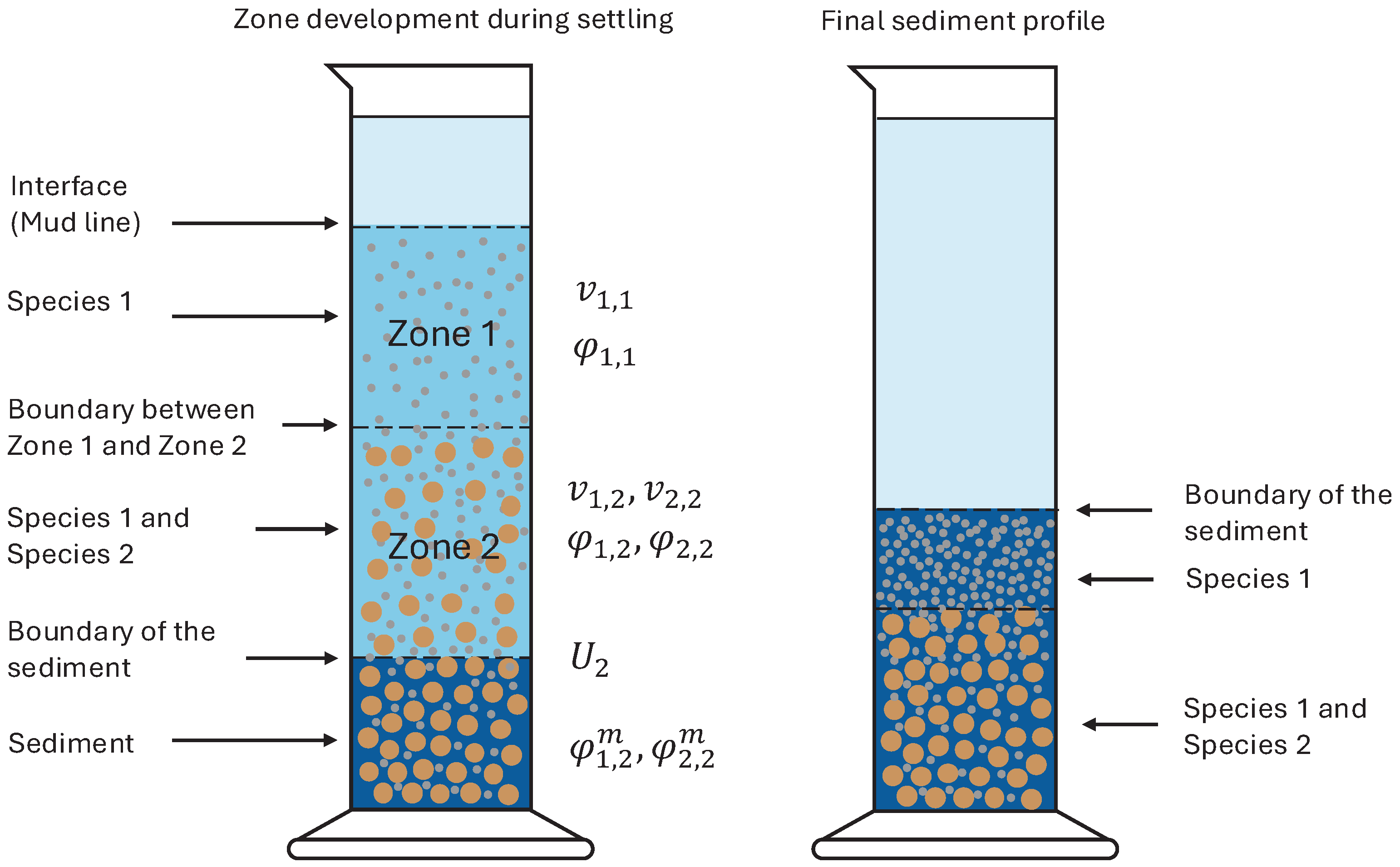
Following established differential settling models, the behavior of a binary particle suspension is described as follows. For the differential settling of a binary particle suspension containing two particle species of different particle size, the particle species are denoted by subscripts i (with i = 1 , 2 ), where subscript 1 represents fine particles and subscript 2 represents coarse particles. As the coarse particles settle at a higher velocity, two distinct zones form after the batch settling process initiates (See Figure 2). The two zones are indexed by subscripts 1 and 2. Zone 1 contains only fine particles, while zone 2 contains a mixture of both particle types.
In Zone 1, the total volumetric solids’ concentration φ 1 is equal to the solids’ concentration of the particle species 1 φ 1 , 1 . In zone 2, the solids’ concentration of particle species 1 and 2 are φ 1 , 2 and φ 2 , 2 , respectively. The total local solids’ concentration in zone 2, φ 2 , is therefore expressed as:
φ 2 = φ 1 , 2 + φ 2 , 2
Theoretically, the solids’ concentrations in zone 2 remain equal to their initial values, while the solids’ concentration in zone 1 evolves and must be determined based on the settling velocities of the particle species.
The settling velocity of species 1 in zone 1 is denoted as v 1 , 1 . In zone 2, the settling velocities of the two particle species are denoted by v i , 2 ( i = 1 , 2 ). The fluid velocity in this zone is denoted by v 2 f . Considering the total flux in zone 2, the following relationship holds:
v 1 , 2 φ 1 , 2 + v 2 , 2 φ 2 , 2 + v 2 f ( 1 φ 2 ) = 0
To solve Equation (2), a relationship between the variable v i , 2 ( i = 1 , 2 ) and v 2 f is required. Previous studies on the settling velocity of monodisperse suspension concluded that the slip velocity of a suspension was a function Φ of the local solids’ concentration [12,26]. This result was adopted in the differential settling model and represents the settling velocity of each particle species in different zones [20,24]. In the current study, settling relationships derived from monodisperse suspensions were also adopted to evaluate the influence of inter-species particle interactions. The proposed framework later demonstrates how discrepancies between theoretical predictions and experimental observations can be used to quantitatively assess interaction effects between particle species. Based on this framework, the settling velocity of each particle species in zone 2 can be written as:
v i , 2 v 2 f = Φ i ( φ 2 )
Substituting (3) into (2) yields the velocity of particle species i in zone 2:
v i , 2 = Φ i ( φ 2 ) 1 2 Φ i ( φ 2 ) φ i , 2
Previous studies discussed a simple differential settling mode in which the particles in the hindered settling region (the settling zone above) settled directly into the sediment zone at a maximum concentration without undergoing a gradual transition in solids’ concentration [19,20]. However, during the hindered settling of fine particles, a transition zone between the settling zone and the sediment can theoretically develop. Within this transition zone, the solids’ concentration gradually increases with depth. In addition, a solids’ concentration discontinuity may exist at the upper boundary of the transition zone. When such a discontinuity exists, the particles also experience an abrupt increase in solids’ concentration as they settle into the underlying zone.
As settling proceeds and particles accumulate within the sediment region, two sediment sub-zones may form sequentially: sub-zone 1 containing both fine and coarse particles, and sub-zone 2 containing only fine particles (See Figure 2). The solids’ concentrations of the particle species 1 and 2 in sediment sub-zone 2 is denoted by φ 1 , 2 m and φ 2 , 2 m , respectively.
Let the upwards velocity of the sediment boundary, which is in contact with zone 2, be denoted by U 2 . At the boundary, the flux of particles flowing into the boundary should be equal to the flow fluxing out of this boundary; therefore, the relationship below can be obtained [19]:
( U 2 v i , 2 ) φ i , 2 = ( U 2 v i , 2 m ) φ i , 2 m
In the sediment zone, particles pack together to form a solid skeleton. Although compression settling may still occur due to the self-weight of the particles, its velocity can be negligible when compared with the velocity of hindered settling. Therefore, v i , 2 m in Equation (5) is approximately equal to zero, and Equation (5) can be simplified as:
U 2 = v i , 2 φ i , 2 φ i , 2 φ i , 2 m
Combining Equations (4) and (6) gives:
U 2 = [ Φ i ( φ 2 ) 1 2 Φ i ( φ 2 ) φ i , 2 ] φ i , 2 φ i , 2 φ i , 2 m
In Equation (7), the local solids’ concentrations of the two particle species in zone 2 are known and are theoretically equal to the initial solids’ concentrations. Samples can also be taken from zone 2 to verify those values experimentally. The maximum solids’ concentrations of each particle species in the sediment can be obtained from sediment samples. The velocity function Φ i can be determined from batch settling tests of each particle species. Therefore, the sediment boundary velocity U 2 can be evaluated and compared with experimental observations. Through this comparison, new insights into inter-species particle interactions and differential settling behavior can be obtained.

3. Materials and Methodology

3.1. Particles’ Preparation

To validate the differential settling model discussed in Section 2, an experimental program consisting of a series of batch settling tests was designed. The primary materials used in this study were copper tailings and silica sands. Silica sand was selected because the color contrast between the two materials allowed improved observation and tracking of the zones formed during sedimentation. To minimize particle segregation within each material, a narrow particle size range was desired for both copper tailings and silica sand in this study of differential settling. Two distinct particle species with different size ranges were prepared:
  • Species 1 (fine copper tailings): This group comprised particles smaller than 53 μm. The materials was prepared through a wet screening process, in which the copper tailings particles passing through a 270 mesh sieve were collected and dried.
  • Species 2 (coarse silica sands): This group consisted of silica sands larger than 106 μm. In contrast to Species 1, the silica sand retained on the 140 mesh sieve was collected and dried. Since the original silica sand itself had a very narrow particle size distribution (PSD), this particle species was not further screened to remove larger particles.
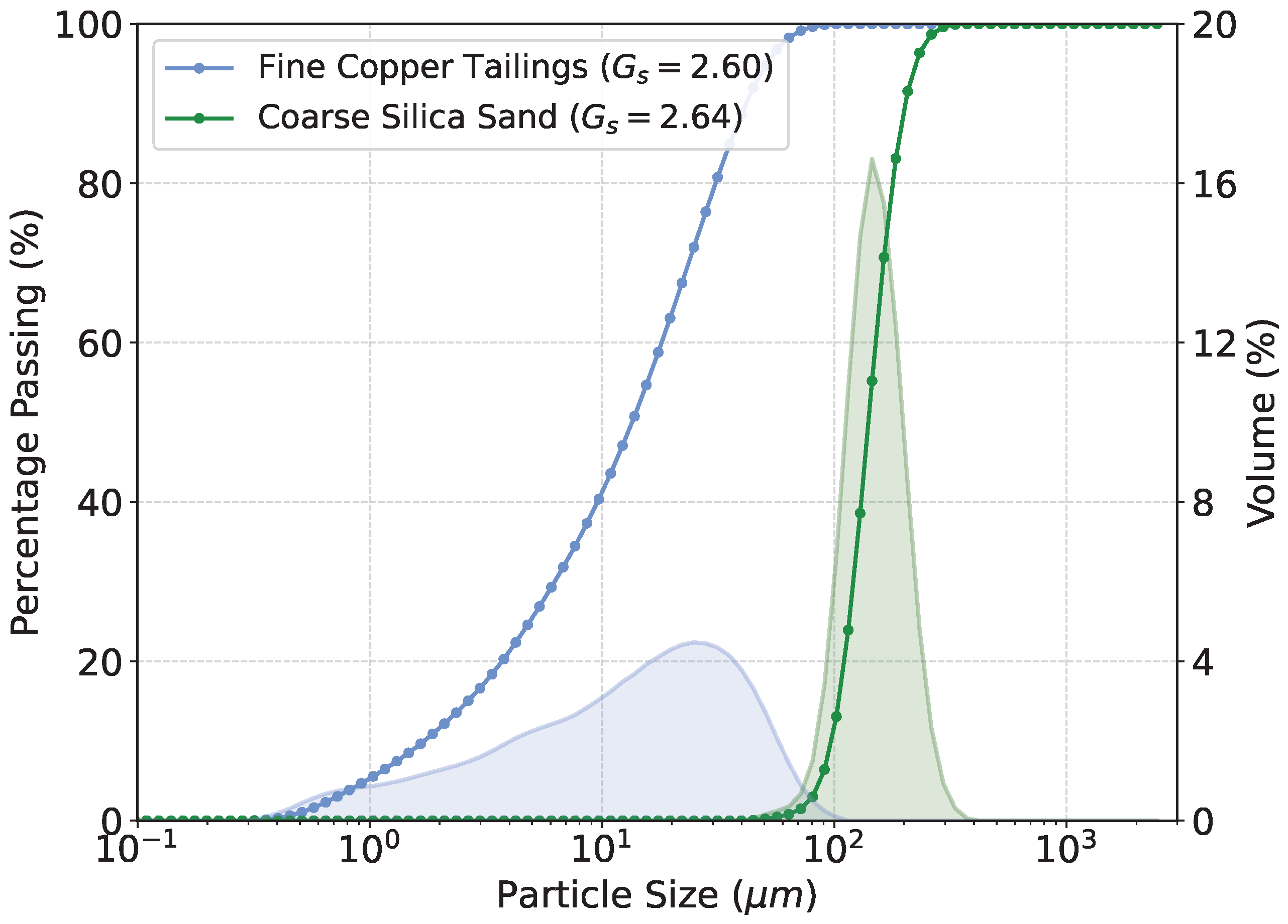
After the particles were separated, the PSD and specific gravity of the two particle species were measured. The results are illustrated in Figure 3. As the specific gravities of the two species were similar, the differential settling behavior was primarily governed by differences in particle size.
It should be noted that Species 1 exhibited a relatively wide PSD compared to Species 2, which showed a much narrower distribution (see Figure 3). The primary concern associated with a wide PSD is the potential segregation of coarser particles within the species during settling. However, for Species 1, approximately 40% of the particles were smaller than 10 μm and 60% were smaller than 20 μm. Due to the dominance of ultrafine particles and high solids’ concentration, the suspension exhibited collective hindered settling behavior rather than significant internal segregation during the monodisperse batch settling tests. In a previous study by [7], segregation in fine tailings’ suspensions was also shown to be negligible due to strong particle–particle interactions. Therefore, treating the fine copper tailings as a single particle species was considered a reasonable approximation for the scope of this study.

3.2. Suspensions’ Preparation

In the experimental program of this investigation, a series of batch settling tests were designed to evaluate the hindered settling process and to specifically quantify the differential settling behavior of the suspensions.
In Equation (3), the settling velocity of a monodisperse suspension (a single particle species) is expressed as a function of solids’ concentration. To establish the correlation Φ i ( φ ) experimentally, suspensions of both Species 1 (fine copper tailings) and Species 2 (coarse silica sands) were prepared by mixing the dry particles with distilled water. The initial solids content for particle Species 1 were 10%, 15%, 20%, and 30%, corresponding to volumetric concentrations of 4.10%, 6.36%, 8.77%, 14.15%. For particle Species 2, the initial solids content was 10%, 20%, and 30%, corresponding to volumetric concentrations of 4.04%, 8.65%, and 13.97%, respectively. It should be noted that both solids’ content and volumetric concentration were used in this study: solids’ content is reported for consistency with common practice in tailings engineering, while solids’ concentration was used in the calculations.
To directly observe the differential settling behavior, a binary suspension containing both particle species was prepared. The initial solids’ concentration was set to 14.06%, with a mass ratio of 1:1 between the two particle species, comprising 7.03% of Species 1 and 7.03% of Species 2.

3.3. Batch Settling Procedure

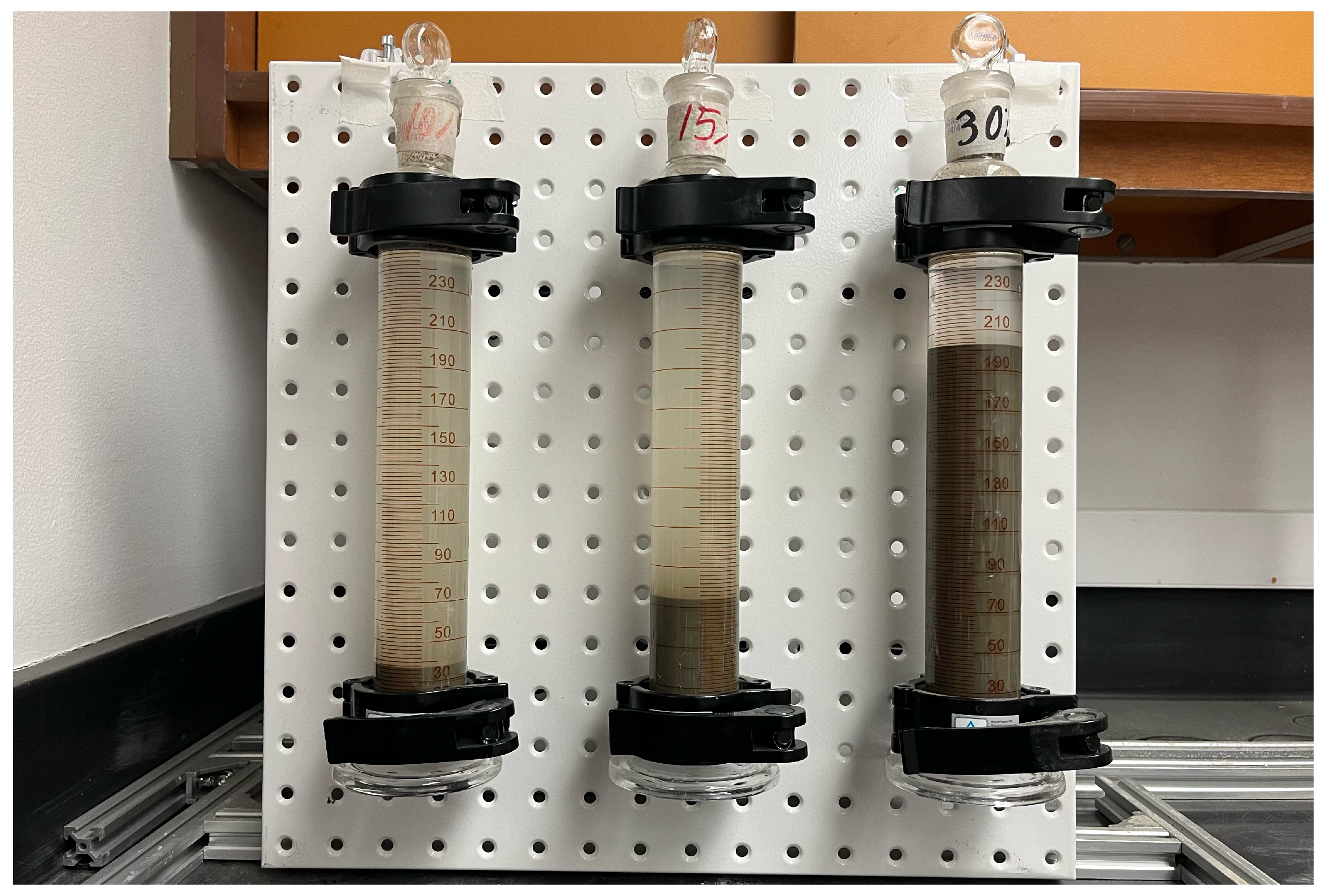
After preparation, the single-species suspensions were thoroughly mixed in a beaker to ensure homogeneity. The suspensions were then transferred into 250 mL clear graduated cylinders for batch settling tests (see Figure 4). The position of supernatant-suspension interface in the cylinder was continuously recorded to track its trajectory and generate settling curve. If a clear sediment boundary was observable, its movement was also recorded.
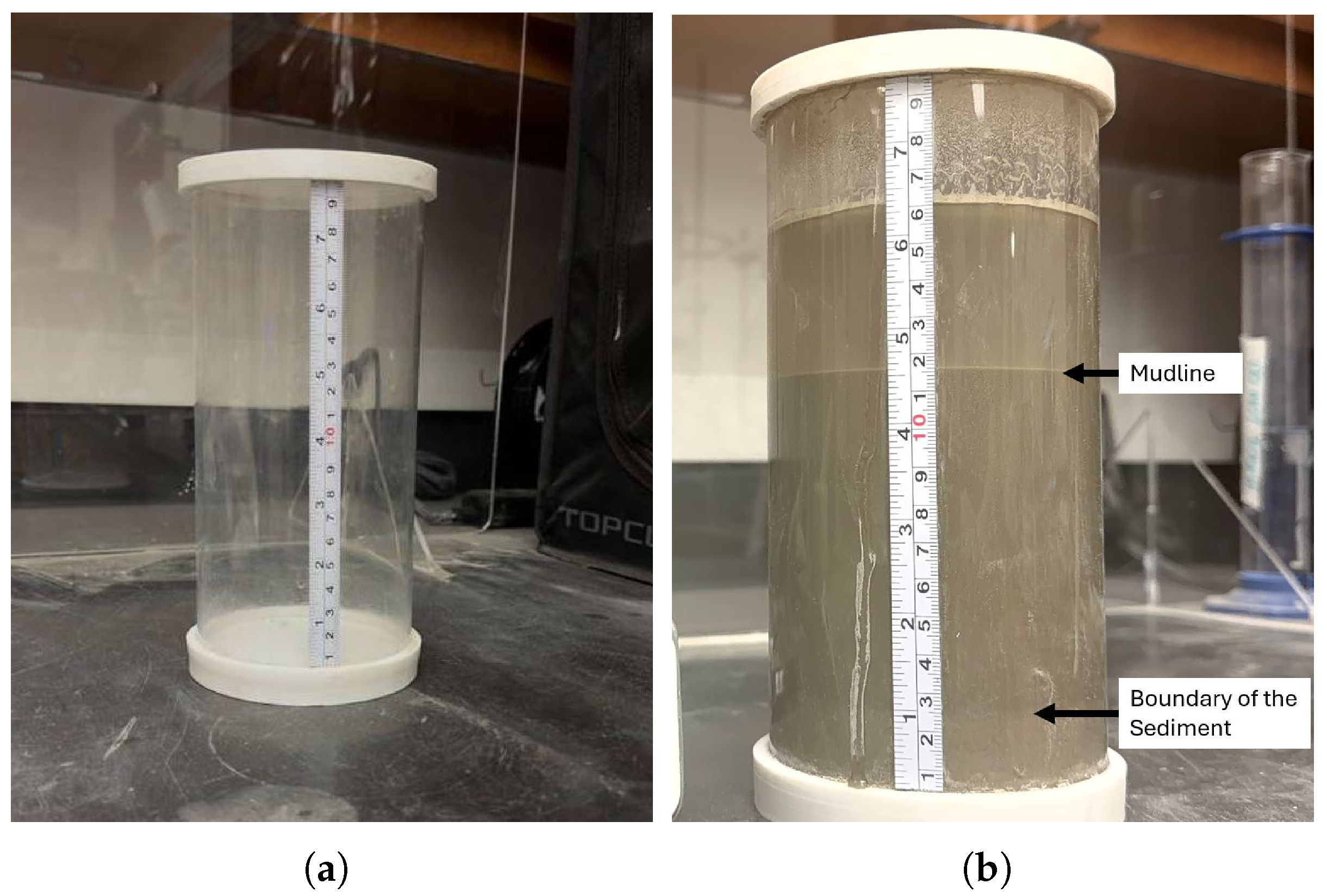
Following the batch settling tests of the single-species suspensions, batch settling tests were conducted on the binary particle suspensions. Unlike the single-species settling tests, the homogenized binary suspension was transferred into a customized sedimentation column with a diameter of 10 cm and a height of 20 cm, as illustrated in Figure 5a. It should be noted that different column diameters were used for the monodisperse and binary settling tests, which may have resulted in different wall effects. However, since the present study was based on Kynch’s sedimentation theory, one of the fundamental assumptions of the theory is that wall effects are negligible. Therefore, wall effects were not specifically considered in the current study.
Prior to sample collection, the repeatability of the binary suspension settling tests was examined through two preliminary non-interruptive settling tests. During these repeated non-interruptive tests, the trajectories of the supernatant–suspension interface and the propagation of the sediment boundary were monitored, and good agreement was observed among the experimental results. Following the repeatability assessment, two interruptive settling tests were performed for data collection and subsequent model evaluation. In the first interruptive binary suspension test, the trajectory of the supernatant–suspension interface was continuously monitored. In addition, the upward propagation of the sediment boundary was tracked (Figure 5b). The distinct color contrast between the dark copper tailings and the light silica sands facilitated visual identification of the sediment zone. The entire settling process was recorded using continuous video.
At the end of the first interruptive binary suspension test, when no significant downward movement of the mudline was observed, the supernatant was carefully removed. The remaining sediment was then collected in discrete horizontal layers. The samples were dried in an oven for solids’ concentration determination. PSD analysis was subsequently conducted on each layer to quantify the spatial variation in particle composition across the sediment profile. For the bottom layers, a 200 mesh sieve was used to separate Species 1 from Species 2, allowing the proportion of each particle species to be quantified.
To empirically determine the local solids’ concentrations during the settling process, a second interruptive batch settling test was performed under the same initial conditions. After the test was initiated, samples were carefully extracted from both the hindered settling region (zones 1 and 2 in Figure 2) and the sediment zone. These samples were then dried to determine the local solids’ concentrations. A 200 mesh sieve was again used to separate Species 1 from Species 2, allowing the proportion of each particle species to be quantified.

4. Results and Discussion

4.1. Batch Settling of Fine Copper Tailings

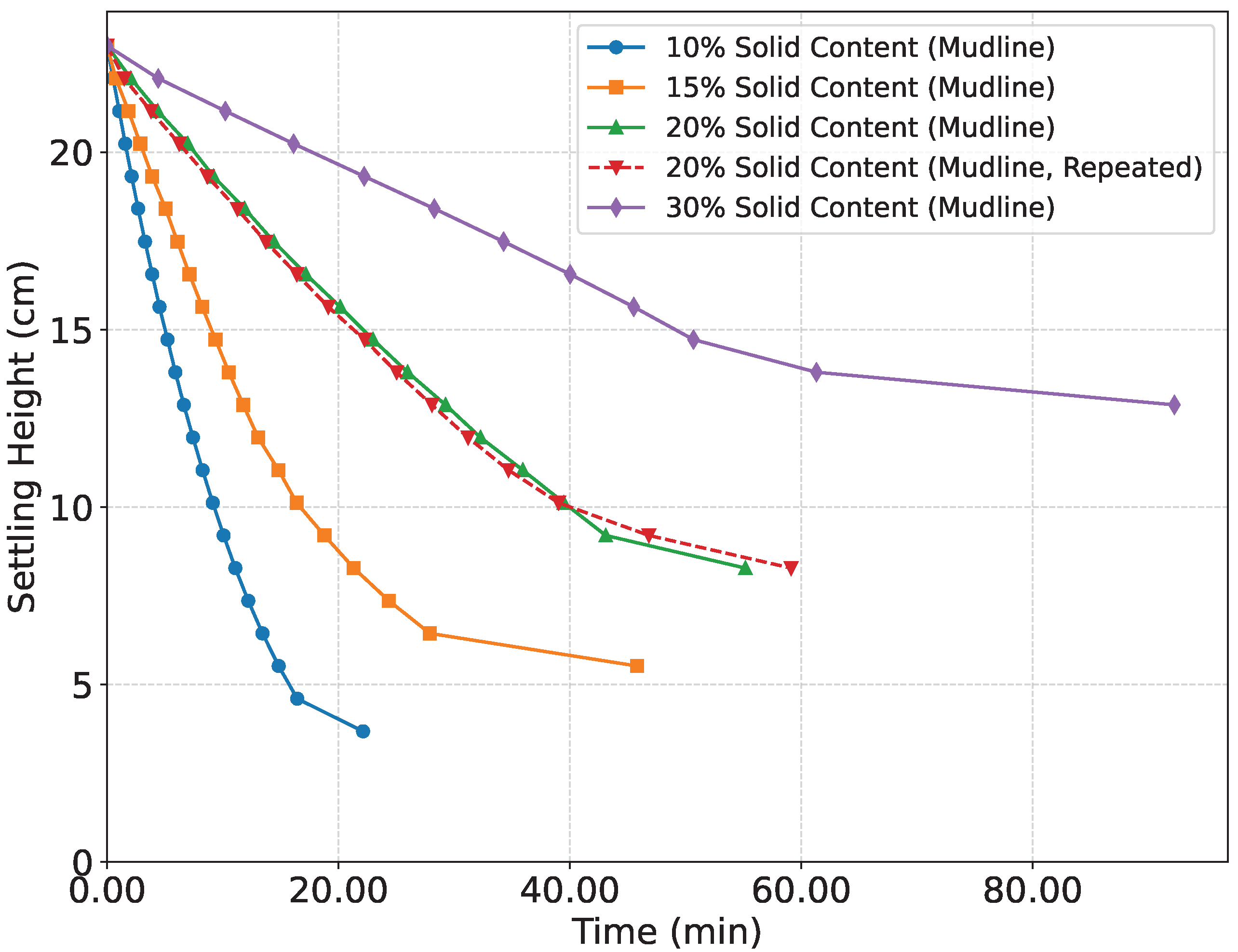
Batch settling tests on the fine copper tailings was first performed to generate settling curves. Clear supernatant–suspension interfaces were observed in all tests. To evaluate repeatability, the test corresponding to an initial solid content of 20% was performed in duplicate. Based on these interfaces, the settling curves are presented in Figure 6. For the fine copper tailings’ suspension, the first portion of the settling curve is approximately linear, which is consistent with the settling modes described by Kynch’s theory [12,15]. The settling velocity v s in this stage can be used to calculate the suspension velocity function Φ ( φ ) . Following [20], the classic power type suspension velocity function was adopted:
v s = Φ ( φ ) = v o ( 1 φ ) n
which can be linearized as [26]:
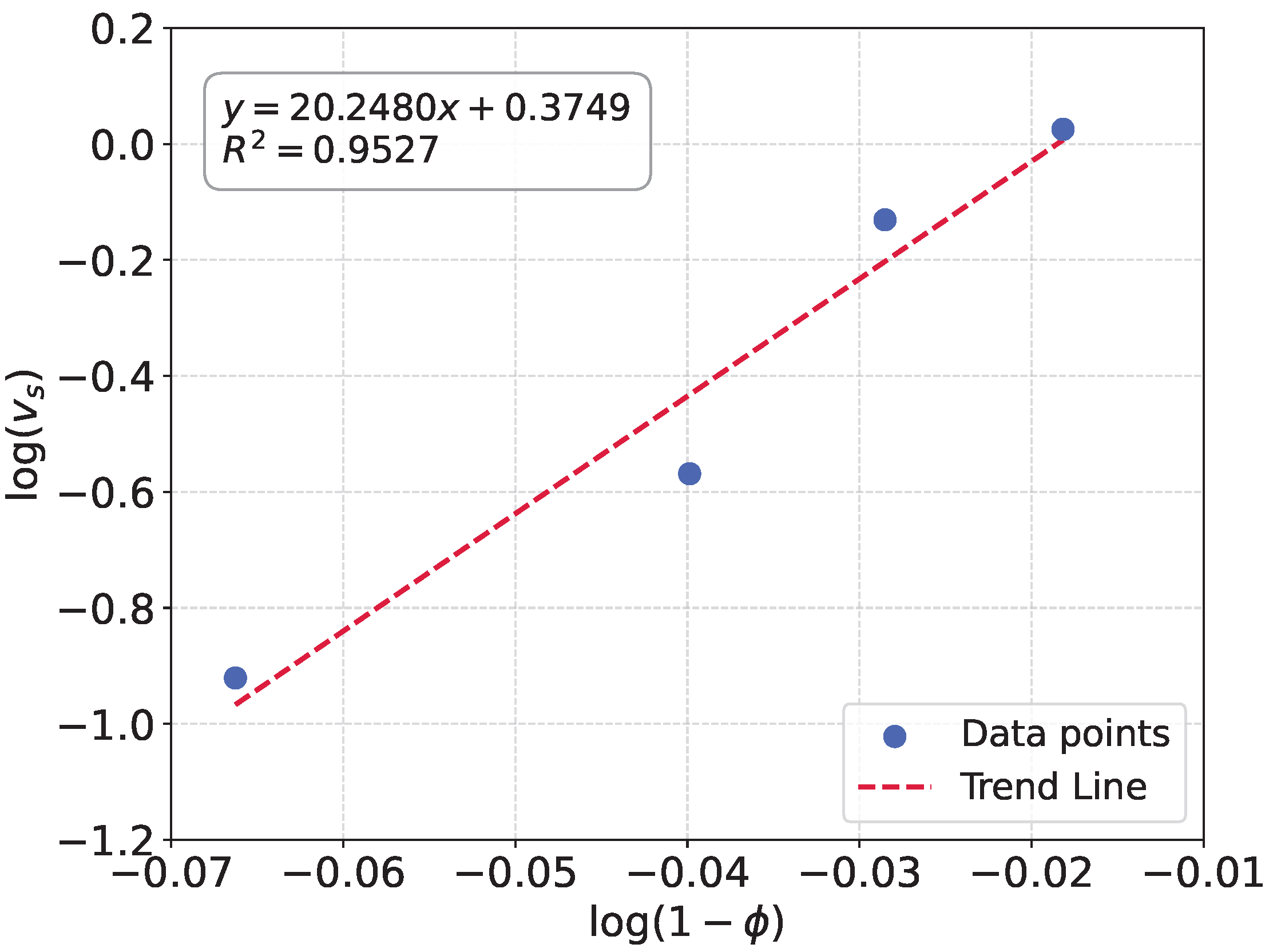
log v s = log v o + n log ( 1 φ )
Equation (9) represents a linear relationship in a log v s versus log ( 1 φ ) coordinate system. The experimental results of the fine copper tailings are plotted in Figure 7, where a linear trend is observed based on the four data points. From this linear fit, the parameters v o and n in Equation (8) were determined to be 2.37 m/h and 20.248, respectively. This relationship was subsequently used to estimate the theoretical settling velocity of the fine particle species in the binary suspension.
Following the initial linear settling stage, the settling curve becomes nonlinear. This deviation is attributed to the formation of a transition zone, where the solids’ concentration increases continuously toward a maximum value, as well as the onset of self-weight consolidation, during which effective stress develops due to direct particle contacts.
An important question arises as to whether a direct interface exists between the hindered settling zone and the sediment zone during the settling of fine particles. This issue is critical because the differential settling model introduced in Section 2 assumes that particles settle directly into the sediment zone without a gradual transition (see the graphical illustration in Figure 1). Based on the observed settling curves and Kynch’s sedimentation theory for monodisperse suspensions, it is also possible that a transition zone exists between the hindered settling zone and the sediment zone, within which the solids’ concentration increases continuously.
One of the settling modes described by Kynch also suggests that a solids’ concentration discontinuity may exist between the settling zone and the transition zone. If such a discontinuity is present, the derivations in Section 2 still hold. However, the maximum solids’ concentration φ i , 2 m used in Equation (7) should be interpreted as the local solids’ concentration immediately below this discontinuity, rather than the ultimate sediment concentration.

4.2. Batch Settling of Coarse Silica Sands

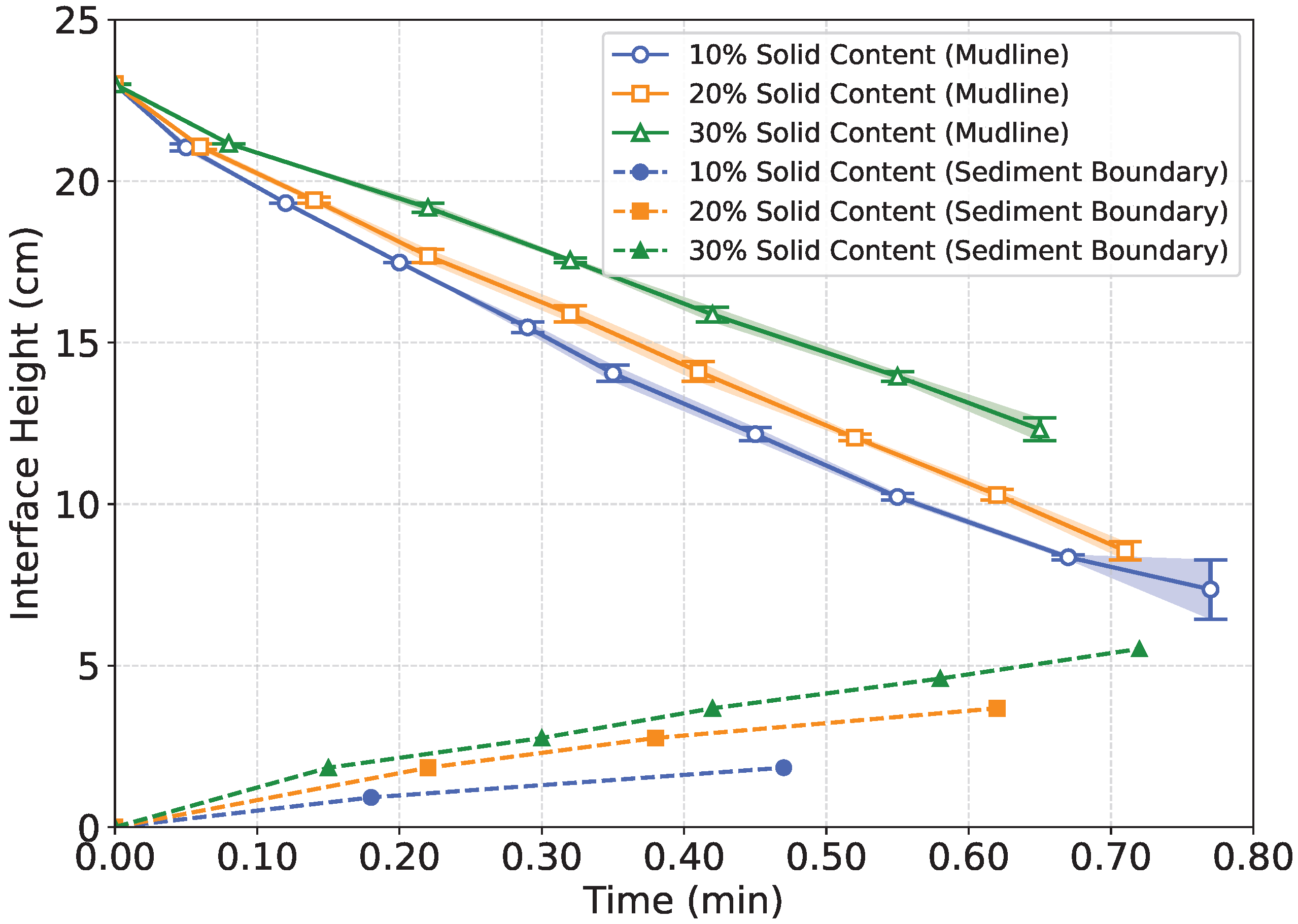
Batch settling tests were also performed on the silica sands. In contrast to the observations for the fine copper tailings’ suspension, no distinct supernatant–suspension interface was observed during the settling process. Instead, a diffuse interface between the supernatant and the settling particles was identified, from which the settling curve was determined. To minimize experimental uncertainty, each test was performed in duplicate. The accumulation of coarse sand particles at the bottom of the cylinder was clearly observed, and the ascending of the sediment boundary was recorded. The results are presented in Figure 8.
As shown in Figure 8, the settling curves exhibit a linear trend, indicating an approximately constant settling velocity. This behavior is consistent with the simplest settling mode described by Kynch’s theory. The influence of the initial solid content is less pronounced compared to that of the fine particle suspension. Based on these curves, the average settling velocities of the silica sands under different initial solids’ concentrations were calculated.

4.3. Differential Settling of the Binary Suspension

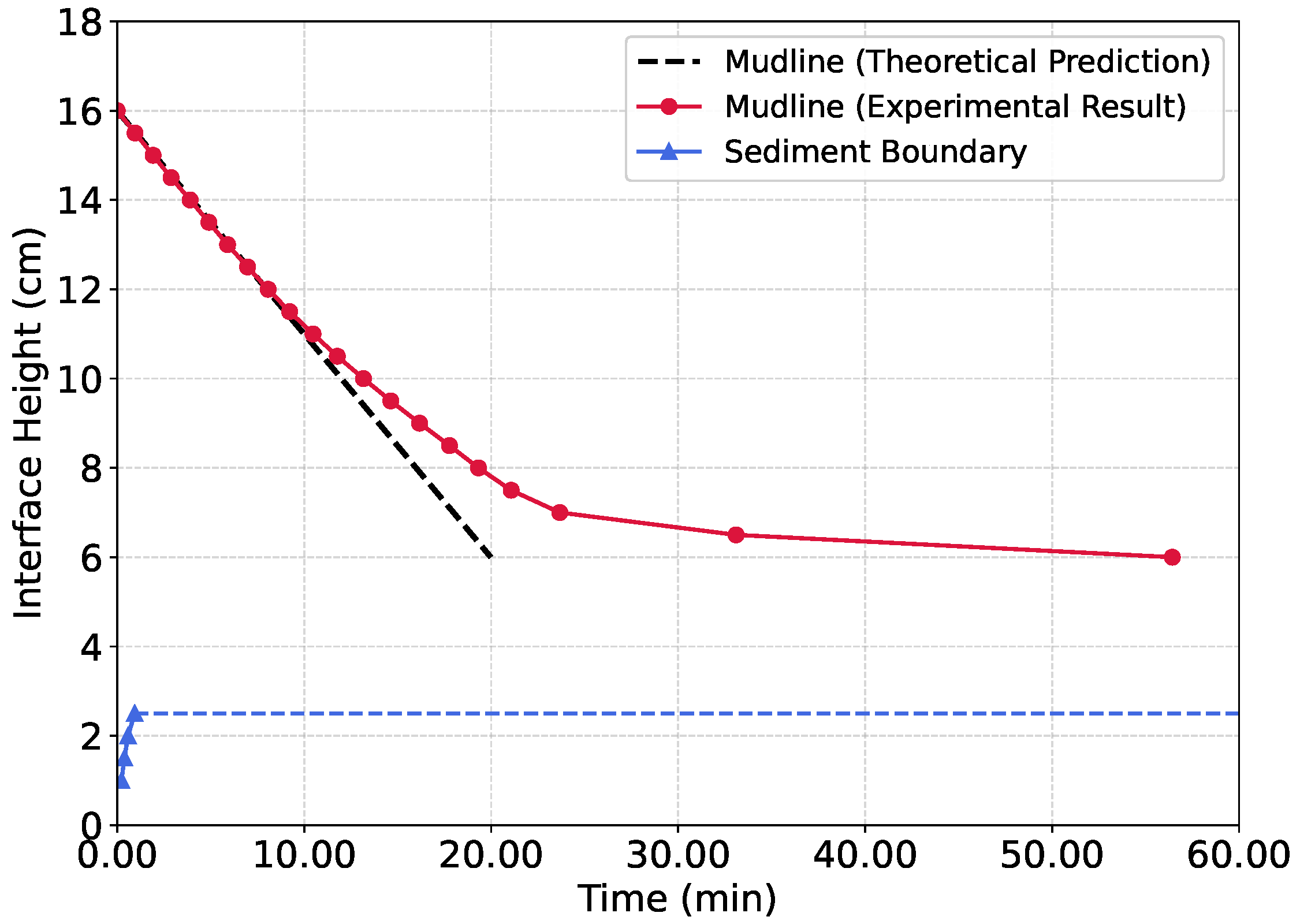
As described in Section 3.3, two batch settling tests were conducted on the binary suspension. Ideally, the interfaces and zone boundaries depicted in the schematic illustration (Figure 2) were expected to be observed. However, the boundary between zone 1 and zone 2 could not be clearly identified. A likely reason was the relatively high solids’ concentration of the fine particle species, which reduced the visual contrast between the suspended coarse particles and the surrounding suspension. In addition, the strong hindered settling behavior of the fine particles limited the relative movement and segregation of the coarse particles, resulting in a diffuse internal boundary rather than a distinct interface. Nevertheless, the applicability of the zone-formation model is not dependent on direct visual observation of the internal boundary. The governing mass balance and flux relationships remain mathematically valid even when the interface cannot be explicitly resolved experimentally. The interface between the supernatant and the fine particle zone, as well as the sediment interface, were clearly observed (Figure 5b). The trajectories of these two interfaces are plotted in Figure 9. Consistent with the results of the fine tailings’ suspension, the settling curve exhibits a two-stage behavior. The first stage is characterized by a relatively linear trend, while the second stage shows a deviation from linearity with a reduced settling rate. The sediment interface is observed to propagate rapidly during the early stage of settling.
Although zone 2 (see Figure 2) could not be explicitly delineated during the test, it was inferred that the region immediately above the sediment interface at the early stage of settling corresponded to zone 2. In the second batch settling test, two samples were collected from that region within the first minute of settling. The measured solids’ contents were 30.6% and 29.3%, corresponding to volumetric concentrations of 14.3% and 13.6%, respectively. The samples from zone 2 contained 49.9% silica sands, which was consistent with the initial mixture design. Based on these measurements, the solids’ concentrations of both Species 1 and Species 2 in zone 2 was calculated.
After several minutes, when zone 1 was well developed, three additional samples were collected from the region below the mudline. The average solids’ content of that zone was 22.0%. Using Equation (8) and the results from the fine copper tailings (Figure 7), the settling velocity of zone 1 (i.e., the mudline velocity) was calculated. The predicted result is plotted in Figure 9, showing good agreement with the experimental measurements during the first 10 min.
In addition to these samples from the settling regions, sediment samples were collected during and after completion of the tests to determine the solids’ concentration. The solids’ concentration of those samples ranged from 19.15% to 63.40%. The lower values were generally associated with samples collected near the sediment boundary, where mixing with material from the hindered settling zone may have reduced the measured solids’ concentration. In contrast, samples collected from the bottom region exhibited higher solids’ concentrations and were likely influenced by compression settling, resulting in densification of the sediment. Overall, the measured range indicates significant variation in solids’ concentration with both depth and time.

4.4. Particle Interaction in Binary Suspension

With the data collected from the experimental program, the theoretical ascending velocity of the sediment boundary could be calculated. However, as discussed in Section 4.1, it remains uncertain whether a transition zone exists between the hindered settling zone and the sediment. If a transition zone exists in the present case, the sharp interface is considered to represent the boundary between the hindered settling zone and the transition zone, rather than the boundary between the hindered settling zone and the fully established sediment. This interpretation is consistent with settling modes derived from Kynch’s sedimentation theory, in which a discontinuity in solids’ concentration may exist between the hindered settling region and the transition zone [12,15]. Within the transition zone, the solids’ concentration increases continuously toward the maximum sediment concentration. Under this interpretation, the transition zone needs to be treated as part of the sediment region when applying the differential settling model discussed in Section 2. In the mean time, the solids’ concentration term φ i , 2 m should be replaced by the solids’ concentration immediately below the discontinuity, denoted as φ i , 2 t . The physical interpretation of U 2 should be the propagation velocity of the solids’ concentration discontinuity between the settling zone and transition zone. In this case, the determination of the solids’ concentration φ i , 2 m in Equation (7) becomes more complicated.
Notably, the solids’ concentrations measured from the five samples collected in the sediment region ranged from 19.15% to 63.4%. These results provide supporting evidence for the presence of a transition zone where the solids’ concentration increases continuously. However, determining the solids’ concentration of the layer immediately beneath the settling zone remains challenging, as it cannot be precisely sampled during the settling process in the current experimental setup. The only constraint is that this solids’ concentration likely lies within the concentration range observed.
To mathematically determine the solids’ concentration of the layer immediately beneath the discontinuity for further analysis, the propagation velocity of the solids’ concentration discontinuity is utilized. Based on Equation (7), U 2 can be calculated using either Species 1 or Species 2. This leads to the following relationship between solids’ concentrations of the two particle species after replacing the sediment concentration terms with the transition-zone concentrations:
[ Φ 1 ( φ 2 ) 1 2 Φ i ( φ 2 ) φ i , 2 ] φ 1 , 2 φ 1 , 2 φ 1 , 2 t = [ Φ 2 ( φ 2 ) 1 2 Φ i ( φ 2 ) φ i , 2 ] φ 2 , 2 φ 2 , 2 φ 2 , 2 t
To solve Equation (10), an additional equation correlating φ 1 , 2 t and φ 2 , 2 t is needed. By separating Species 1 and Species 2 particles from the collected samples through wet screening, a ratio R, representing the mass fraction of coarse particles relative to the total solids, can be determined. It was observed that the proportion of the two species in the samples remained relatively consistent. The analyzed samples indicated that approximately 79% of the solids corresponded to coarse particles (Species 2), leading to:
φ 2 , 2 t = R φ 2 t = R ( φ 1 , 2 t + φ 2 , 2 t )
where R is equal to 79% in our suspension. Substituting Equation (11) into to Equation (10), the solids’ concentration of the two species immediately beneath the discontinuity can be determined. The corresponding local solids’ concentration, φ 2 t , defined as the sum of φ 1 , 2 t and φ 2 , 2 t , was calculated to be 25.07%. Since R is an important parameter in the calculation, a sensitivity analysis was performed. A 10% decrease in R resulted in a reduction in the calculated solids’ concentration to around 21.85%.
The calculated solids’ concentration fell within the measured range of 19.15% to 63.40%, indicating that the calculated value was physically reasonable. The difference from the maximum solids’ concentration is likely attributable to the presence of a transition zone and compression of the sediment.
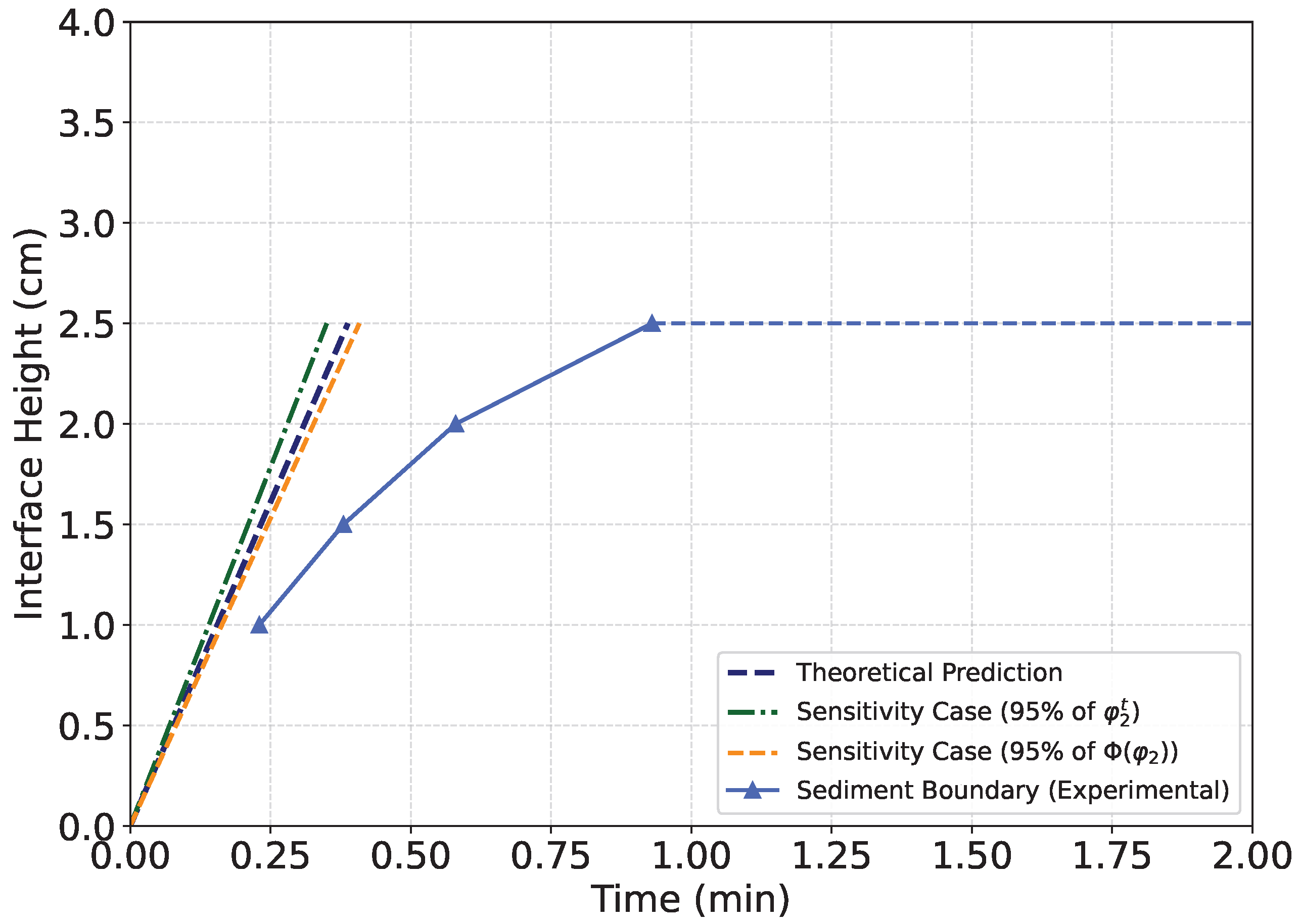
Using Equation (7), the theoretical ascending velocity of the solids’ concentration discontinuity can be calculated. The predicted values are plotted together with the experimental observation in Figure 10. It can be observed that the experimental ascending velocity is lower than the theoretical prediction, indicating that sediment bed formation occurs more slowly under actual conditions. A sensitivity analysis was performed to illustrate how variations in the settling velocity of the coarse particle species, Φ 2 ( φ 2 ) , and the total solids’ concentration of the layer beneath the discontinuity influenced the propagation velocity U 2 . The results indicated that a 5% decrease in the settling velocity of Species 2 led to an approximately 5% decrease in the predicted propagation velocity. In contrast, a 5% decrease in the solids’ concentration beneath the discontinuity resulted in an increase of approximately 10% in the predicted propagation velocity. Both sensitivity curves are plotted in Figure 10 for comparison.
To further investigate this discrepancy, Equation (7) for Species 2 was rearranged as:
U 2 = Φ 2 ( φ 2 ) ( 1 φ 2 , 2 ) φ 2 , 2 Φ 1 ( φ 1 ) φ 1 , 2 φ 2 , 2 φ 2 , 2 φ 2 , 2 t
From Equation (12), it can be interpreted that the increase in the theoretical velocity U 2 is primarily associated with the settling velocity of Species 2 in zone 2, since the settling velocity of Species 1 is much smaller compared with that of Species 2. In the conventional differential settling model, the settling velocity of Species 2 is based on experimental results obtained from homogeneous settling of a monodisperse suspension, which only considers particle–particle interactions within the same particle species. Such sedimentation does not involve inter-species interactions between particles settling at different velocities. During differential settling, as larger particles settle, they must displace smaller particles along their settling trajectories. Fine particles, especially coagulated fine particles, may form a network-like structure that hinders the movement of the faster-settling coarse particles. This process induces significant inter-species interactions, which impede the motion of the larger particles and reduce their effective settling velocity. In addition, the upward fluid flow generated by the settling coarse particles may further reduce the settling velocity of the fine particles. Consequently, the experimentally observed propagation velocity being lower than the theoretical prediction is considered physically reasonable. Furthermore, a larger discrepancy between theoretical and experimental propagation velocities may indicate stronger inter-species particle interactions within the suspension.
In addition, compression settling (self-weight consolidation) within the sediment may also contribute to the discrepancy between theoretical and experimental results. However, compression settling is not considered in the classical Kynch sedimentation theory or the conventional differential settling model. Furthermore, compression settling generally occurs at a much slower rate than hindered settling and sediment boundary propagation. Therefore, its influence is expected to be limited during the time scale considered in the current experiments and is not discussed further in this study.
The proposed approach effectively illustrates the influence of inter-species interactions on the differential settling velocity of the coarse particles. Based on the proposed framework, it is also possible to introduce an interaction coefficient through comparison between the settling velocity of the coarse particle species in monodisperse and binary suspensions. However, establishing such a coefficient would require a large number of repeated experiments and extensive datasets to ensure reliability. Therefore, the present study focuses primarily on developing and demonstrating the proposed approach rather than deriving a generalized interaction coefficient.
The binary suspension investigated in this study represents a simplified system compared to practical tailings’ suspensions, where particles typically exhibit a continuous PSD rather than two discrete particle species. Under such conditions, the suspension may be represented using multiple particle classes to better capture the overall settling behavior and segregation characteristics. The proposed framework can be extended to these more complex multi-species systems by introducing additional particle classes. Furthermore, when the segregation behavior of a specific particle fraction is of primary interest, the proposed approach may still be directly applicable.

5. Conclusions

This study investigated the differential settling behavior of binary particle suspensions through theoretical modeling and batch settling experiments. A framework was proposed to quantitatively evaluate inter-species particle interactions by tracking the propagation velocity of the sediment boundary containing two particle species. The proposed approach provides a practical and experimentally feasible method for assessing particle interactions in multi-species suspensions.
Experimental observations confirmed the formation of distinct settling zones within the hindered settling region, although the internal boundary between zone 1 and zone 2 could not be clearly resolved. The solids’ concentration in zone 2 was generally consistent with model assumptions, while the sediment region exhibited a range of solids’ concentrations, indicating the possible existence of a transition zone between the hindered settling region and the fully consolidated sediment.
The experimentally observed sediment boundary propagation velocity was lower than the theoretical prediction. This discrepancy is attributed to inter-species particle interactions that are not accounted for in conventional differential settling models derived from monodisperse settling behavior. Overall, the proposed framework demonstrates the potential to evaluate inter-species particle interactions through experimentally measurable quantities and provides new insights into the limitations of classical differential settling models.
A limitation of the proposed framework is that several model variables are sensitive and can significantly influence the calculated results. Therefore, advanced experimental techniques are needed in future studies to obtain more accurate measurements and generate reliable datasets for the development of interaction coefficients applicable to engineering practice. In addition, direct measurement of species-specific settling velocities within the settling region should be further explored to provide valuable data for validation and refinement of the proposed approach.

Author Contributions

Conceptualization, methodology, formal analysis, validation, supervision, writing—original draft preparation, writing—review and editing, Y.L.; methodology, investigation, data curation, visualization, writing—original draft preparation, writing—review and editing, L.T.A. All authors have read and agreed to the published version of the manuscript.

Funding

This research received no external funding.

Data Availability Statement

The raw data supporting the conclusions of this article will be made available by the authors on request.

Acknowledgments

The authors would like to thank undergraduate research assistants David Darnall, Owen West, Emma Arveseth, and Tyler Vandeventer for their assistance with the experimental work. The students Owen West, Emma Arveseth, and Tyler Vandeventer are supported by the Science Research Initiative (SRI) program at the University of Utah.

Conflicts of Interest

The authors declare no conflicts of interest.

Nomenclature

U 2 Propagation velocity of the boundary of the sediment zone
v s Hindered settling velocity of a suspension
v o Terminal settling velocity
v 1 , 1 Settling velocity of Species 1 in zone 1
v i , 2 Settling velocity of particle species i in zone 2 ( i = 1 , 2 )
v i , 2 m Compression settling velocity of particle species i in the sediment zone ( i = 1 , 2 )
v 2 f Fluid velocity in zone 2
nRicardson–Zaki exponent
φ Volumetric solid concentration
φ 1 Total concentration in zone 1
φ 2 Total concentration in zone 2
φ 1 , 1 Concentration of Species 1 in zone 1
φ i , 2 Concentration of Species i in zone 2 ( i = 1 , 2 )
φ i , 2 m Concentration of Species i in the sediment zone ( i = 1 , 2 )
φ 2 m Total concentration in the sediment zone
φ i , 2 t Concentration of Species i in the transition zone ( i = 1 , 2 )
φ 2 t Total concentration in the transition zone
Φ ( φ ) Velocity function of a suspension
Φ i ( φ ) Velocity function for particle species i ( i = 1 , 2 )

References

  1. Bonin, M.D.; Cabral, A.R.; Nuth, M. Examination of the Effects of Solids Content on Thickened Gold Mine Tailings Sedimentation and Self-Weight Consolidation. Geotech. Test. J. 2019, 42, 1493–1517. [Google Scholar] [CrossRef] [Scilit]
  2. Peng, X.; Yang, X.; Guo, L. An Experimental Study on the Hindered Settling Properties of Backfill Tailings Particles. In Paste 2020: 23rd International Conference on Paste, Thickened and Filtered Tailings; Gecamin Publications: Santiago, Chile, 2020. [Google Scholar]
  3. Zhang, L.F.; Wang, H.J.; Wu, A.X.; Klein, B.; Guo, J.B.; Zhang, X. A zone settling velocity function to characterize settling properties of suspensions in thickening applications. Miner. Eng. 2022, 177, 107386. [Google Scholar] [CrossRef] [Scilit]
  4. Li, Y.; van Zyl, D. Hindered settling of flocculated multi-sized particle suspension, part II: Experimental study of particle segregation based on copper tailings suspension. Powder Technol. 2023, 415, 118154. [Google Scholar] [CrossRef] [Scilit]
  5. MacIver, M.R.; Hamza, H.; Pawlik, M. Effect of suspension conductivity and fines concentration on coarse particle settling in oil sands tailings. Can. J. Chem. Eng. 2021, 99, 2024–2034. [Google Scholar] [CrossRef] [Scilit]
  6. Dong, Y.; Zeng, Y.; Hua, Z.; Wang, C.; Yue, T.; Sun, W.; Tang, H. Enhancing solid-liquid separation performance of copper tailings by regulating settling floc properties. J. Clean. Prod. 2024, 460, 142610. [Google Scholar] [CrossRef] [Scilit]
  7. Li, Y.; van Zyl, D. Experimental study on the overall settling behavior of copper tailings suspension. Miner. Eng. 2024, 208, 108580. [Google Scholar] [CrossRef] [Scilit]
  8. Tian, S.; Zhao, Y.; Gong, Y.; Wang, G. Experimental Study on Tailings Deposition Distribution Pattern and Sedimentation Characteristics. ACS Omega 2024, 9, 19428–19439. [Google Scholar] [CrossRef] [Scilit]
  9. Zhang, Q.; Cheng, C.; Zhang, P.; Wang, D.; Liu, B.; Chen, Q. Experimental Investigation of Spatial Particle Size Distribution and Segregation in Tailings Slurry for High-Goaf Backfilling. Minerals 2026, 16, 343. [Google Scholar] [CrossRef] [Scilit]
  10. Concha, F.; Bürger, R. A Century of Research in Sedimentation and Thickening. KONA Powder Part. J. 2002, 20, 38–70. [Google Scholar] [CrossRef] [Scilit]
  11. Coe, H.B.; Clevenger, G.H. Methods for determining the capacities of slime-settling tanks. Trans. Am. Inst. Min. Metall. Eng. 1916, 55, 356–384. [Google Scholar]
  12. Kynch, G.J. A Theory of Sedimentation. Trans. Faraday Soc. 1952, 48, 166–176. [Google Scholar] [CrossRef] [Scilit]
  13. Pane, V. Sedimentation and Consolidation of Clays. Ph.D. Thesis, University of Colorado, Boulder, CO, USA, 1985. [Google Scholar]
  14. Concha, F.; Bustos, M.C. Settling Velocities of Particulate Systems, 6. Kynch Sedimentation Processes: Batch Settling. Int. J. Miner. Process. 1991, 32, 193–212. [Google Scholar] [CrossRef] [Scilit]
  15. Concha, F. Solid-Liquid Separation in the Mining Industry; Springer: Berlin/Heidelberg, Germany, 2014. [Google Scholar]
  16. Smith, T.N. Differential Sedimentation of Particles of Two Different Species. Trans. Inst. Chem. Eng. 1965, 43, T69. [Google Scholar]
  17. Masliyah, J.H. Hindered Settling in a Multi-Species Particle System. Chem. Eng. Sci. 1979, 34, 1166–1168. [Google Scholar] [CrossRef] [Scilit]
  18. Lockett, M.J.; Al-Habbooby, H.M. Differential Settling by Size of Two Particle Species in a Liquid. Trans. Inst. Chem. Eng. 1973, 51, 281–292. [Google Scholar]
  19. Lockett, M.J.; Bassoon, K.S. Sedimentation of Binary Particle Mixtures. Powder Technol. 1979, 24, 1–7. [Google Scholar] [CrossRef] [Scilit]
  20. Mirza, S.; Richardson, J.F. Sedimentation of Suspensions of Particles of Two or More Sizes. Chem. Eng. Sci. 1979, 34, 447–454. [Google Scholar] [CrossRef] [Scilit]
  21. Kothari, A.C. Sedimentation of Multisized Particles. Ph.D. Thesis, Texas Tech University, Lubbock, YX, USA, 1981. [Google Scholar]
  22. Selim, M.S.; Kothari, A.C.; Turian, R.M. Sedimentation of Multisized Particles in Concentrated Suspensions. AIChE J. 1983, 29, 1029–1038. [Google Scholar] [CrossRef] [Scilit]
  23. Greenspan, H.P.; Ungarish, M. On Hindered Settling of Particles of Different Sizes. Int. J. Multiph. Flow 1982, 8, 587–604. [Google Scholar] [CrossRef] [Scilit]
  24. Concha, F.; Lee, C.H.; Austin, L. Settling velocities of particulate systems, 8. Batch sedimentation of polydispersed suspensions of spheres. Int. J. Miner. Process. 1992, 35, 159–175. [Google Scholar] [CrossRef] [Scilit]
  25. Li, Y.; Varia, M.; Pawlik, M.; Jin, J.; van Zyl, D. Influence of pH on copper tailings sedimentation: A systematic approach to analyzing differential settling. Powder Technol. 2025, 458, 120956. [Google Scholar] [CrossRef] [Scilit]
  26. Richardson, J.F.; Zaki, W.N. Sedimentation and Fluidisation: Part I. Trans. Inst. Chem. Eng. 1954, 32, s82–s100. [Google Scholar] [CrossRef] [Scilit]
  27. Vesilind, P.A. Design of prototype thickeners from batch settling tests. Water Sew. Work. 1968, 115, 302–307. [Google Scholar]
  28. Davis, R.H.; Gecol, H. Hindered Settling Function with No Empirical Parameters for Polydisperse Suspensions. AIChE J. 1994, 40, 570–575. [Google Scholar] [CrossRef] [Scilit]
  29. Ha, Z.Y.; Liu, S.J. Settling Velocities of Polydisperse Concentrated Suspensions. Can. J. Chem. Eng. 2002, 80, 783–790. [Google Scholar] [CrossRef] [Scilit]
  30. te Slaa, S.; van Maren, D.S.; He, Q.; Winterwerp, J.C. Hindered Settling of Silt. J. Hydraul. Eng. 2015, 141, 04015020. [Google Scholar] [CrossRef] [Scilit]
  31. Amy, L.A.; Talling, P.J.; Edmonds, V.O.; Sumner, E.J.; Lesueur, A. An experimental investigation of sand-mud suspension settling behaviour: Implications for bimodal mud contents of submarine flow deposits. Sedimentology 2006, 53, 1411–1434. [Google Scholar] [CrossRef] [Scilit]
  32. Dankers, P.J.T. On the Hindered Settling of Suspensions of Mud and Mud-Sand Mixtures. Ph.D. Thesis, Delft University of Technology, Delft, The Netherlands, 2006. [Google Scholar]
  33. Spearman, J.; Manning, A.J. On the hindered settling of sand-mud suspensions. Ocean. Dyn. 2017, 67, 465–483. [Google Scholar] [CrossRef] [Scilit]
  34. Torfs, H.; Mitchener, H.; Huysentruyt, H.; Toorman, E. Settling and consolidation of mud/sand mixtures. Coast. Eng. 1996, 29, 27–45. [Google Scholar] [CrossRef] [Scilit]
  35. Williams, R.A.; Amarasinghe, W.B.K.; Simons, S.J.R.; Xie, C.G. Sedimentation Behavior of Complex Polydisperse Suspensions. Powder Technol. 1991, 65, 411–432. [Google Scholar] [CrossRef] [Scilit]
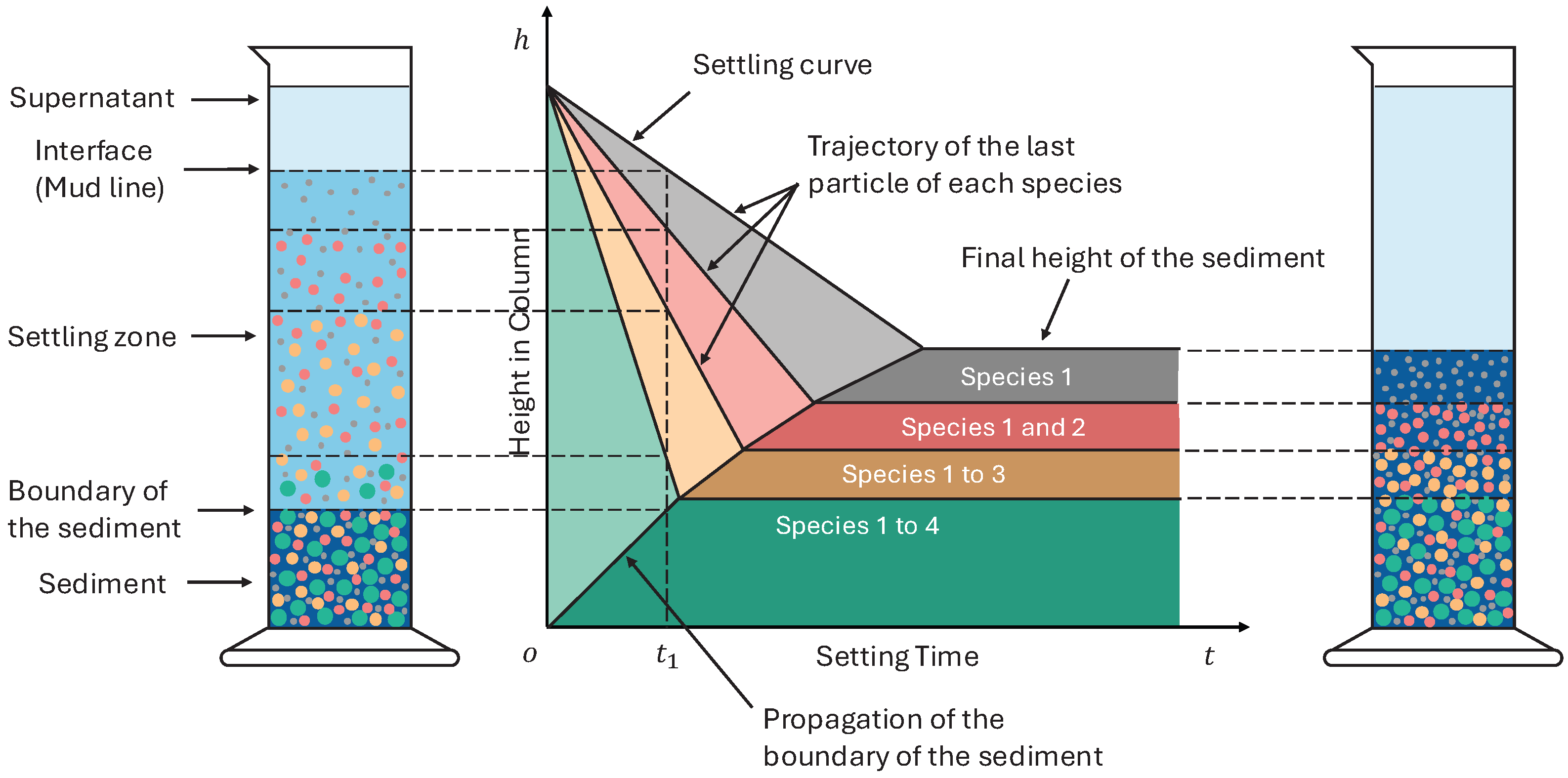
Figure 1. Graphical illustration of the differential settling mode. Reproduced with permission from Li Y. et al., “Powder Technology”, published by Elsevier 2025 [25].
Minerals 16 00594 g001
Figure 2. Zone-formation differential settling model for binary suspension.
Minerals 16 00594 g002
Figure 3. Cumulative and differential PSD curves for the fine copper tailings and coarse silica sands.
Minerals 16 00594 g003
Figure 4. Batch settling tests of fine copper tailings at different initial concentrations.
Minerals 16 00594 g004
Figure 5. (a) Customized settling column. (b) Batch settling test of the binary suspension.
Minerals 16 00594 g005
Figure 6. Settling curves of fine copper tailings in batch settling test.
Minerals 16 00594 g006
Figure 7. Determination of the parameters for the Richardson–Zaki velocity model.
Minerals 16 00594 g007
Figure 8. Trajectories of the observed interfaces in the batch settling test of silica sands.
Minerals 16 00594 g008
Figure 9. Trajectories of the observed interfaces in the binary batch settling test.
Minerals 16 00594 g009
Figure 10. The experimental result and the theoretical prediction of the ascending velocity of the sediment boundary.
Minerals 16 00594 g010
Disclaimer/Publisher’s Note: The statements, opinions and data contained in all publications are solely those of the individual author(s) and contributor(s) and not of MDPI and/or the editor(s). MDPI and/or the editor(s) disclaim responsibility for any injury to people or property resulting from any ideas, methods, instructions or products referred to in the content.