Review

A Review of Urease-Based Biomineralization: MICP and EICP


1
Shandong Key Laboratory of Eco-Environmental Science for the Yellow River Delta, Shandong University of Aeronautics, Binzhou 256603, China
2
College of Energy and Mining Engineering, Shandong University of Science and Technology, Qingdao 266590, China
3
Department of Chemical Engineering, Jiangsu Union Technical Institute Taixing Branch, Taixing 225400, China
*
Authors to whom correspondence should be addressed.
Minerals 2026, 16(6), 588; https://doi.org/10.3390/min16060588
Submission received: 11 April 2026 / Revised: 27 May 2026 / Accepted: 28 May 2026 / Published: 1 June 2026
(This article belongs to the Section Biomineralization and Biominerals)

Abstract

Microbial-induced calcite precipitation (MICP) and enzyme-induced calcite precipitation (EICP) have emerged as research hotspots in recent years at the intersection of geotechnical engineering, environmental engineering, and materials engineering. Compared with traditional grouting reinforcement and repair methods, these methods exhibit greater environmental benignity, higher calcium carbonate precipitation yield, and more significant improvement in mechanical properties of repaired materials. The urease activity in the urease-based MICP and EICP techniques lies at the core of rock fracture repair, soil reinforcement, and concrete crack remediation. This paper presents a systematic review of urease-based MICP and EICP repair technologies, focusing on repair principles, environmental influencing factors, research methods, and application approaches, including microbial cultivation, enzyme activity determination, preparation of cementing solutions, selection of carriers, injection methods, and repair cycles. It also compares the advantages and disadvantages of MICP and EICP. This review clarifies the intrinsic similarities and differences between the two technologies in mineralization mechanism, crystal characteristics and engineering applicability, and constructs a complete technical system of urease-based biomineralization. Additionally, this paper discusses current macroscopic and microscopic evaluation methods for biomineralization repair effects, synthesizes existing mineralization repair systems, and assesses the challenges of self-healing biomaterials, including long-term microbial durability, repair strength stability, and the overall cost of widespread application. It includes long-term microbial durability, repair strength stability, enzyme activity retention, and the overall cost of widespread application, which are key issues to be solved for engineering implementation. The aim of this study is to provide a theoretical and practical reference for the theoretical improvement and engineering application of EICP and MICP technologies.

1. Introduction

In recent years, with the increasing emphasis on ecological and environmental protection in engineering construction, green and sustainable remediation technologies have become a research hotspot across geotechnical, environmental and materials engineering. As typical urease-based biomineralization technologies, MICP and EICP have shown unique advantages in terms of soil reinforcement, concrete crack self-healing, rock fracture remediation and antiseepage engineering compared with traditional grouting reinforcement methods, which are costly, cause secondary pollution and damage the original material structure [1,2]. From the perspective of calcium precipitation yield, compared with other biomineralization technologies (such as carbonate precipitation induced by sulfate-reducing bacteria), ureolytic mineralization can efficiently convert urea into carbonate ions under the catalysis of urease, which rapidly combines with calcium ions in the system to form stable calcium carbonate precipitates; relevant studies have shown that the calcium precipitation rate of ureolytic mineralization can reach 80%~95% under optimal reaction conditions, which is significantly higher than that of other biological mineralization pathways [3,4]. In terms of the improvement of mechanical properties of treated materials, ureolytic mineralization can fill the pores, cracks and defects of the treated materials through the generated calcium carbonate precipitates, form a dense structural network, and thus significantly improve the mechanical properties such as compressive strength, tensile strength and shear strength of the materials. For example, in soil reinforcement engineering, after ureolytic mineralization treatment, the unconfined compressive strength of sandy soil can be increased by 2~10 times, and the shear strength parameters (cohesion and internal friction angle) can be improved by 30%~60% [5,6]; in concrete crack self-healing, the compressive strength recovery rate of cracked concrete after urease-based biomineralization repair can reach more than 70%, and the impermeability can be significantly enhanced [7]. Owing to its mild reaction conditions, controllable mineralization rate, good compatibility with cement-based materials and easily accessible substrates, urease-based biomineralization has become an important alternative to traditional engineering remediation technologies and has attracted widespread attention [3,4,5,6].
MICP was first proposed as an engineering concept for biomass cement in 2004 [1], and urease-based EICP was applied to sand solidification experiments in 2015 [2], laying the foundation for engineering applications of urease-based biomineralization. Existing studies have focused on mineralization mechanisms, single-parameter optimization and laboratory repair effect verification, with some reviews summarizing the basic principles and partial application scenarios of MICP or EICP separately. However, there is a lack of systematic and comprehensive comparative analyses of urease-based MICP and EICP methods from the perspective of the entire technical system; integrated research on mineralization mechanisms, key influencing factors, detection methods and engineering application optimization is superficial. Moreover, existing summaries of the associated technical challenges and development directions are scattered, and an in-depth discussion of the synergistic application potential and environmental risk control of these two technologies is lacking.
To address these research gaps, this paper takes urease-based MICP and EICP as the core research objects and systematically sorts their technical systems from four aspects: mineralization mechanism, core organisms and urease activity regulation, key influencing factors of self-healing efficiency, and reaction effect detection and characterization methods. To clarify the intrinsic differences and similarities between MICP and EICP in terms of mineralization characteristics, crystal formation and technical applicability, this paper compares their advantages and disadvantages in engineering applications and summarizes the mainstream repair methods, suitable materials and cycle design of urease-based biomineralization. The innovation lies in constructing a complete urease-based biomineralization system by integrating and comparing MICP and EICP, realizing cross-linking analysis of microscopic mechanisms and macroscopic engineering applications, and proposing targeted improvement strategies for technical and environmental challenges to provide systematic theoretical and practical references for the theoretical improvement and standardized engineering application of urease-based biomineralization technologies.
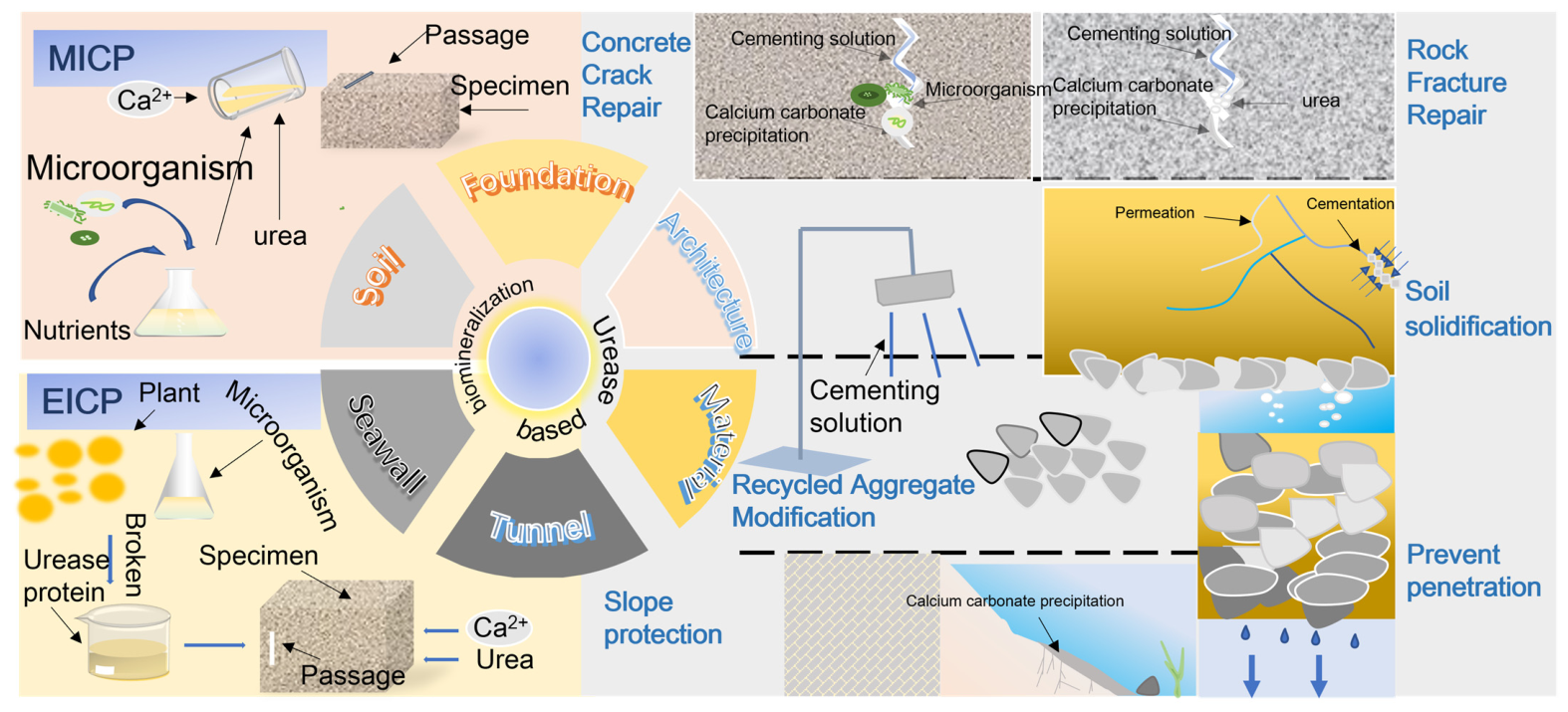
Figure 1 shows the research progress and typical application scenarios of urease-based biomineralization, including soil reinforcement, concrete crack repair, rock fracture repair and slope protection, which visually presents the engineering application scope of MICP and EICP technologies.

2. Mechanisms of Mineralization

2.1. Urease-Based MICP Mechanism

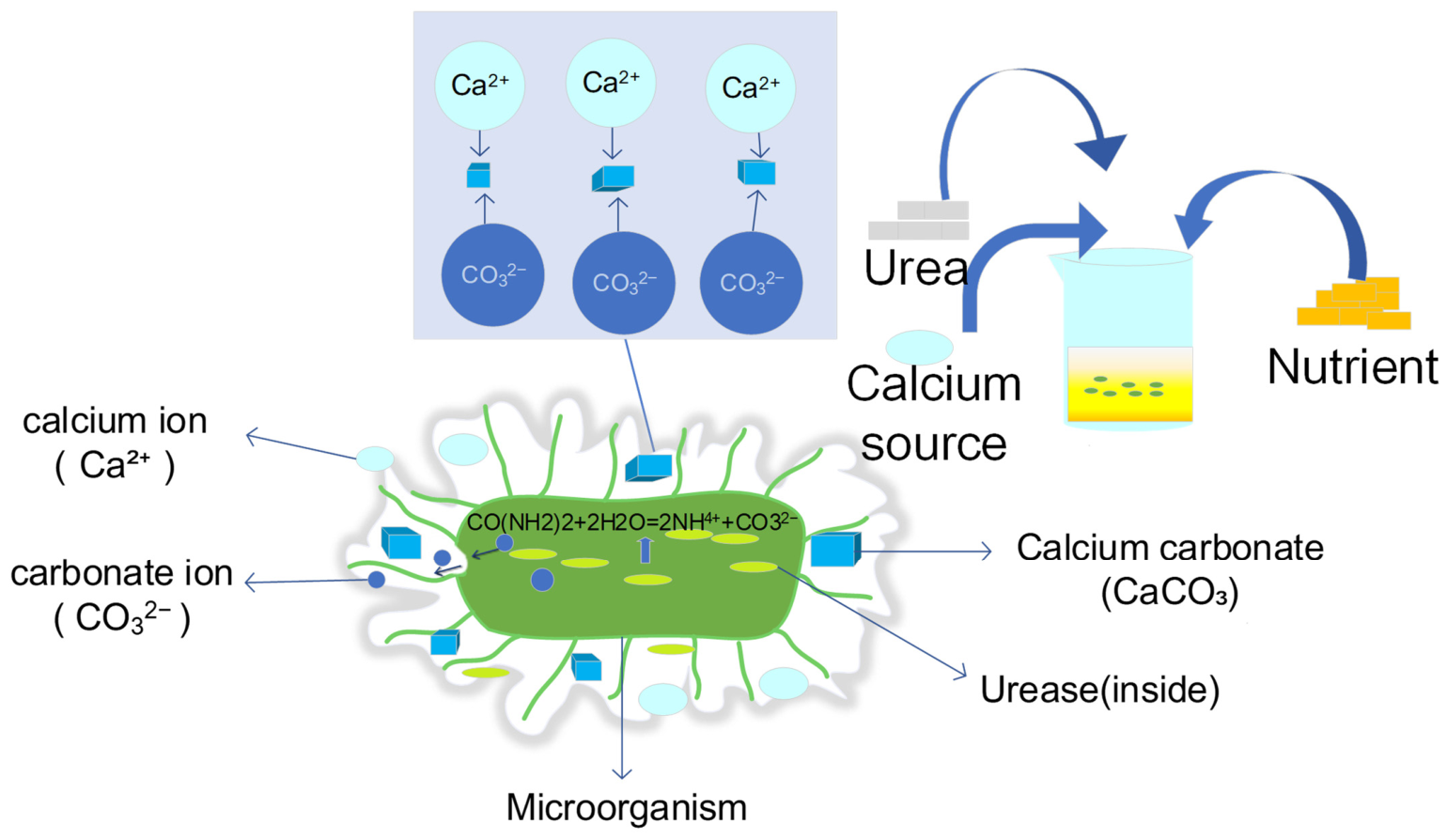
The full name of MICP is microbially induced carbonate precipitation. In urease-based MICP, urease-producing microorganisms are added to the reactants. The generated urease catalyzes the hydrolysis of urea to form carbonate, which combines with free calcium ions to form precipitates to achieve remediation. Urease-producing bacteria decompose urea via intracellular urease and ureolytic activity can occur in both intracellular and extracellular environments to produce carbamate and ammonia outside the cell. The release of ammonia increases the pH of the surrounding environment, creates an alkaline environment, and creates conditions conducive to the subsequent precipitation of calcium carbonate. The carbamate outside the cell is further hydrolyzed to carbonate ions in the alkaline environment and finally precipitates with calcium ions outside the cell to produce calcium carbonate. Microbial cells act as nucleation sites for CaCO3 precipitation, and calcium ions can be adsorbed on the surface of microbial cell walls. The chemical reaction formula of urea hydrolysis catalyzed by microbial differential ureases is as follows [8]:
C O ( N H 2 ) 2 + H 2 O urease N H 2 C O O H + N H 3
N H 2 C O O H + H 2 O H 2 C O 3 + N H 3
H 2 C O 3 H C O 3 + H +
H C O 3 + O H C O 3 2 + H 2 O
C O 3 2 + C a 2 + C a C O 3
Figure 2 clearly shows the MICP mechanism, including microbial urease catalysis, intracellular and extracellular ureolytic processes, calcium ion adsorption on microbial cell walls, and calcium carbonate nucleation and precipitation processes.
Microorganisms can rapidly produce urease but require strict environmental pH and nutrient conditions and generally survive only in weakly alkaline environments. Different strains exhibit distinct urease activities; Sun et al. [9] acclimatized Bacillus megaterium to achieve mineralization at low temperatures, and the acclimatized strain presented greater urease activity and calcium carbonate yield than did the non-acclimatized strain. Urea provides nutrients for microorganisms, while its hydrolysis byproduct, NH3, is continuously enriched to shift the solution pH from acidic to weakly alkaline. In MICP, bacteria serve as calcium carbonate nucleation sites, and composite materials can act as filling and cementation materials for cracks > 1 mm via calcium carbonate precipitation.
Whiffin et al. [8] adopted single-phase injection in sand column experiments and coinjected a substrate solution and Sporosarcina pasteurii suspension into 5 m sand columns at low pressure without blockage; the strength of the treated sand column significantly increased, with greater strength at the top than at the bottom. A low flow rate causes excessive reagent retention at the injection end and insufficient reagent at the bottom due to unbalanced urea hydrolysis and reagent migration rates, which can be optimized by increasing the flow rate and reducing the hydrolysis rate. A decrease in urease activity may result from a reduced pore size, precipitation-induced diffusion barriers, and bacterial activity degradation under cementation conditions. MICP-reinforced soil has rock-like mechanical properties, depending on the integrity of calcium carbonate cementation, which should be protected in engineering.
Nain et al. [10] added MICP bacteria to concrete before solidification; after 24 h of demolding and 7 or 28 days of water curing, the bacterial-modified concrete exhibited significantly greater compressive and splitting tensile strengths than did ordinary concrete, with a strain-dependent strengthening effect. SEM observations indicated that the strength improvement was due mainly to bacterium-induced calcium carbonate filling of the pores and microcracks in the concrete, and an increased CaO content further increased the structural strength. However, urease-producing microorganisms are larger than free urease, potentially blocking reaction channels, and may lose activity due to concrete expansion-induced extrusion in repair applications.

2.2. Urease-Based EICP Mechanism

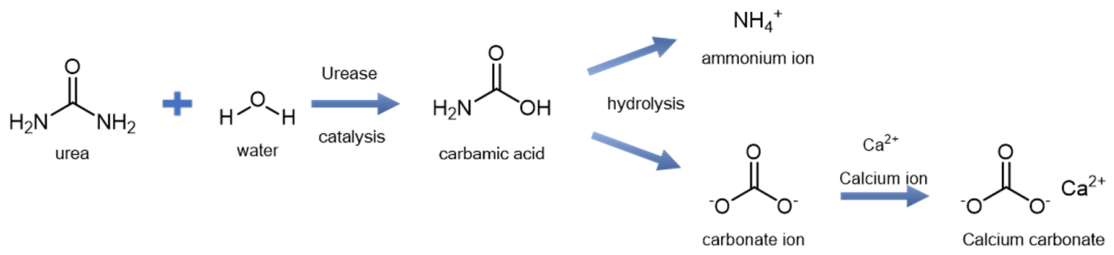
EICP stands for enzymatically induced carbonate precipitation. The core of this technology involves pre-extracting urease from microorganisms or plants, which catalyzes urea hydrolysis to produce carbonate ions. Carbonate ions then react with free calcium ions in the system to form calcium carbonate via precipitation. The reaction mechanism of EICP is similar to that of MICP, the core reaction of urea hydrolysis is a common reaction of MICP and EICP [11].
By analyzing the high-resolution crystal structure of the urease–urea complex, Luca Mazzei et al. [12] proposed the dual-nickel-ion core reaction mechanism of urease-catalyzed urea hydrolysis: after the urea substrate enters the urease active center, it chelates with the binuclear Ni(II) cluster and forms the electron-deficient carbonyl carbon reaction center; subsequently, the conformational closure of the flexible flap of the urease active center creates an exclusive microenvironment for the catalytic reaction; the bridged hydroxyl(OH) of the active center acts as a nucleophilic reagent to launch a nucleophilic attack on the electron-deficient carbonyl carbon of urea; and the conserved amino acid residue α his323 on the α subunit of urease mediates the directional transfer of protons (H+) of bridged hydroxyl groups to the distal amide nitrogen atom of urea. Under the synergistic effect of nucleophilic attack and proton transfer, the C–N bond of the urea molecule is selectively broken, and the first ammonia molecule (NH3) and carbamate are generated. Thus, the enzymatic reaction stage catalyzed by urease is completed. This study clarified the core micromechanism of urea hydrolysis catalyzed by urease, a typical nickel-based metalloenzyme, at the microstructure level.
Figure 3 shows the EICP mechanism, including free urease catalysis, urea hydrolysis and calcium carbonate precipitation process, which clearly explains the catalytic principle of EICP technology.
As a protein, urease activity significantly decreases after one week of room-temperature storage [13]. In the EICP reaction, urease acts as one of the calcium carbonate nucleation sites; other studies have also introduced composite materials or protein impurities in crude soybean urease solutions as nucleation sites [14]. EICP and MICP share similar mechanisms, and both can improve treatment performance by incorporating composite materials in geotechnical remediation, seepage control, and ground improvement. Although urease is nanometer-sized (smaller than micrometer-scale bacterial cells), impurities in crude soybean urease extracts tend to clog reaction channels during field grouting, impairing process performance.
Weng Y. et al. [15] systematically studied sand cementation via soybean urease-mediated EICP. An equimolar calcium salt–urea cementation solution (initial concentration: 1.5 mol/L) was prepared and mixed with homemade crude soybean urease solution at a 2:1 volume ratio to form the biological treatment solution, which was injected into sand columns for EICP treatment. The results revealed that the calcium carbonate content in the sand columns increased steadily with an increasing number of injection cycles; precipitates were deposited at the contacts and pores of the sand particles, achieving effective cementation. The unconfined compressive strength of the sand columns also significantly improved with increasing calcium carbonate content, confirming the effectiveness of EICP for sand reinforcement.

2.3. Differences in Mineralization Between EICP and MICP

2.3.1. Differences in Calcium Carbonate Crystal Size

MICP relies on urease within micron-sized microbial cells, whereas EICP adopts free urease at the nanoscale [16]. To characterize the fundamental differences in size dimensions between the MICP and EICP systems quantitatively, the particle sizes of the core functional components and the resulting calcium carbonate crystals are summarized in Table 1. As shown in the table, the two technologies exhibit significant differences in both the catalytic carrier size and the crystal growth characteristics: MICP relies on micron-scale microbial cells (0.5–5 μm) as the catalytic carrier, which induce the formation of large calcite crystals (approximately 50 μm); in contrast, EICP uses nanoscale free urease (12 nm) as the direct catalyst, resulting in smaller and more dispersed aragonite crystals (10–20 μm). This size discrepancy directly leads to differences in mass transfer performance, pore penetration ability, and cementation uniformity between the two technologies, which is a key basis for analyzing their respective application scenarios and optimization directions.
Although both EICP and MICP produce substrate precipitation through urease hydrolysis, the crystal structures of calcium carbonate are different from each other. Nafisi, A. reported that the sand particles of samples treated with EICP were coated with smaller and more dispersed crystals and that the CaCO3 content of the materials treated with EICP was lower than that of the materials treated with MICP. In this experiment, the type of calcium carbonate crystal generated by EICP was aragonite, and spherical crystals with irregular and disordered structures were widely observed, whereas the type of calcium carbonate generated by MICP was calcite with cubic and polygonal plate crystals [20]. The main reason is that the microorganisms in MICP produce urease through their own physiological metabolism to decompose urea in the cell and adsorb calcium ions in the gap of the material through the negative electricity on the cell surface, whereas EICP directly uses the extracted urease to induce the formation of calcium carbonate crystals in the free environment and has no adsorption effect on calcium ions in the soil pores [21]. Van et al. reported that EICP has a higher hydrolysis rate and precipitation rate of urea than MICP does, which directly affects the crystal morphology and mineral type [22]. Hoang et al. [23] used urease isolated from bacteria to carry out EICP cementation of coarse sand and compared the effect with that of MICP cementation of coarse sand. They reported that the unconfined compressive strength of EICP-treated samples was greater than that of control samples at the same calcium carbonate content.

2.3.2. Crystal Morphology Differences

During microbial metabolism, carbonate ions are generated and combine with system calcium ions to form calcium carbonate (CaCO3) via precipitation [24,25]. The calcium source type directly regulates the CaCO3 crystal morphology, further affecting its microstructure and appearance, which is also influenced by the calcium source used in EICP and MICP technologies during nucleation. CaCO3 has three main crystal polymorphs, calcite, aragonite, and vaterite, with stability in the order of calcite > aragonite > vaterite. Calcite, a trigonal crystal system, is the most stable under normal temperature and pressure and typically presents as rhombohedra or blocks. Aragonite (orthorhombic crystal system) is metastable and commonly occurs as needle-like or columnar crystals.
Vaterite (hexagonal crystal system), the least stable, usually exists as spherical particles that easily transform into aragonite or calcite. Despite its lower stability, vaterite has superior pore-filling capacity and particle bonding performance compared with coarse, dense calcite, which is attributed to its larger specific surface area and finer particle size [26]. The formation and transformation of these three polymorphs are significantly regulated by system pH, calcium source type, microorganisms, and the enzymatic environment [27]. Among these influencing factors, the calcium source species not only dominates the nucleation driving force but also changes the local supersaturation at the crystal growth interface. The relationships between the calcium sources and crystal types are shown in the Table 2 and Table 3.
In the MICP system, the polymorphism of calcium carbonate crystals is significantly regulated by the pH or temperature of the system. In experiments conducted by Fan et al. [7] using Sporosarcina pasteurii with calcium acetate as the calcium source, the timing of the addition of the calcium source affected the crystal morphology. When the calcium source was added prior to urea decomposition, Sporosarcina pasteurii cultured at pH 7–8 produced approximately 90% aragonite, while vaterite was the dominant product under strongly acidic and strongly alkaline conditions. In contrast, when calcium acetate was added to the Sporosarcina pasteurii suspension after urea decomposition, the product was almost exclusively vaterite. For experiments in which calcium chloride was used as the calcium source and soybean urease was used as the catalyst, calcite was the main polymorph of calcium carbonate under different pH conditions, and the resulting crystal polymorphs remained consistent regardless of whether the calcium source was added before or after urea decomposition.
The authors speculated that this phenomenon may be related to the influence and even the inhibitory effect of acidic and alkaline environments on microbial metabolic activity and enzymatic processes. The effect of the timing of the addition of a calcium source on crystal polymorphism is calcium source dependent, and microbial metabolism and enzymatic systems are more strongly regulated than are pure enzyme systems. The Sporosarcina pasteurii system can induce various polymorphs, such as aragonite and vaterite, through pH and the timing of calcium addition, whereas the soybean urease-catalyzed system tends to generate stable calcite with lower tunability of crystal forms. Overall, the crystal form of calcium carbonate is not determined by pH alone but results from the combined effects of the microbial/enzyme system, calcium source type, pH, calcium source addition timing, and other factors. Changes in environmental alkalinity and nucleation timing collectively determine the crystal growth pathway.

3. Core Organism and Urease Activity

3.1. MICP Urease

3.1.1. MICP Urease Source

In natural ecosystems, a variety of urease-producing microorganisms are widely distributed, covering multiple groups, such as fungi, bacteria, and cyanobacteria. There are certain differences in the characteristics and application potential of urease-producing microorganisms from different groups, as shown in the following table. Among these microorganisms, the vast majority of strains are non-pathogenic to humans and have stable urease synthesis and secretion capabilities. These materials can serve as core functional materials for MICP technology, providing important microbial resource support for the application of this technology in fields such as environmental remediation and geotechnical reinforcement, bacterial strains are shown in Table 4.

3.1.2. Microbial Culture

Microbial culture is the core prerequisite of the entire MICP technology system. Its culture parameters directly determine the urease activity of the strain and the subsequent biomineralization efficiency, and it is not a conventional bacterial culture process. MICP microbial culture includes the solid activation of strains suitable for mineralization applications, enrichment culture, and the preparation of high-concentration bacterial suspensions. In the system, urea is specifically added as the exclusive catalytic substrate for urease to meet the reaction requirements of MICP. The suitable growth temperature range for the dominant urease-producing strain is 20 to 30 degrees Celsius, and this strain is suitable for survival in a weakly alkaline environment, which is crucial for maintaining the high urease secretion activity required for MICP. During the culture process, the pH value of the culture system needs to be stably maintained at around 8 in a weakly alkaline range by adjusting the buffer system or correcting the pH value in stages, to ensure the continuous survival and metabolic activity of the strain and meet the long-term mineralization requirements of MICP. The culture medium needs to be reasonably proportioned with nitrogen sources, carbon sources, and inorganic mineral elements; the conventional microbial nutrient components such as yeast extract and peptone need to be optimized to promote the synthesis of urease by the strain and increase the calcium carbonate production of MICP. In the later stage of culture, contamination by miscellaneous bacteria must be strictly prevented, as such contamination can inhibit the activity of urease-producing bacteria, disrupt the MICP reaction system, and thereby weaken the soil reinforcement and crack repair effects [26].

3.2. EICP Urease

Urease is a nickel-containing oligomeric enzyme that is present in microorganisms, plants and microalgae. Crude urease can be obtained from these organisms via cell disruption, and purified urease with high purity can be prepared through fractional distillation and multistage precipitation. Urease is widely distributed in most plant species, with particularly high contents in leguminous plants [30]. Nam et al. [31] extracted crude urease from jack beans and conducted calcite precipitation experiments in a phosphate buffer system containing urea and calcium chloride. They reported that the calcite production induced by crude jack bean urease over 72 h was not significantly different from that induced by commercially available urease and that the total enzyme activity of crude urease was even greater than that of commercial products. During the extraction of crude urease, cell disruption is a key step, and chemical reactions, osmotic pressure, electrolytes, ultrasound, or mechanical forces act as external forces or conditions to cause cells to decompose or be destroyed [32].
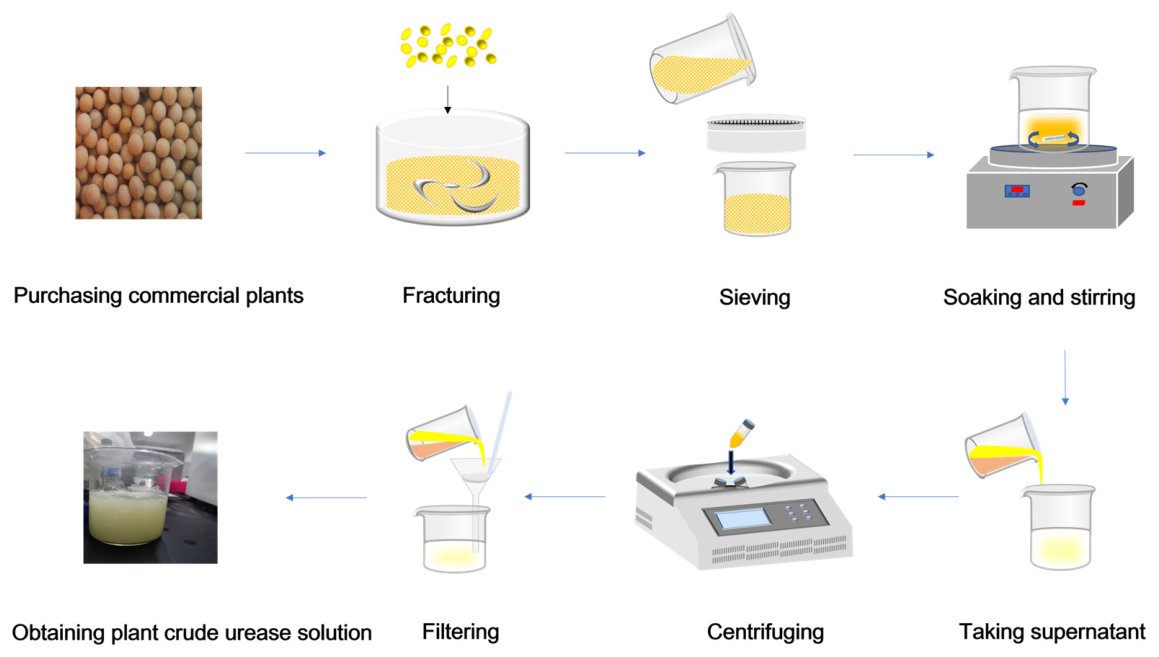
For the extraction of plant-derived crude urease, a certain quantity of soybeans was dried, ground into powder, and sieved through a 60–80 mesh screen to remove coarse particles. The powder was then mixed with water, stirred at room temperature for 30 min, centrifuged at 4000 rpm for 15 min, and filtered. The supernatant was collected to obtain the crude soybean urease solution [13]. Note that crude plant-derived urease should be stored at 4 degrees Celsius to maintain good urease activity for more than a week.
Figure 4 shows the complete extraction process of plant-derived urease, including raw material pretreatment, crushing, stirring, centrifugation and filtration, which clearly presents the technical points of plant urease extraction.
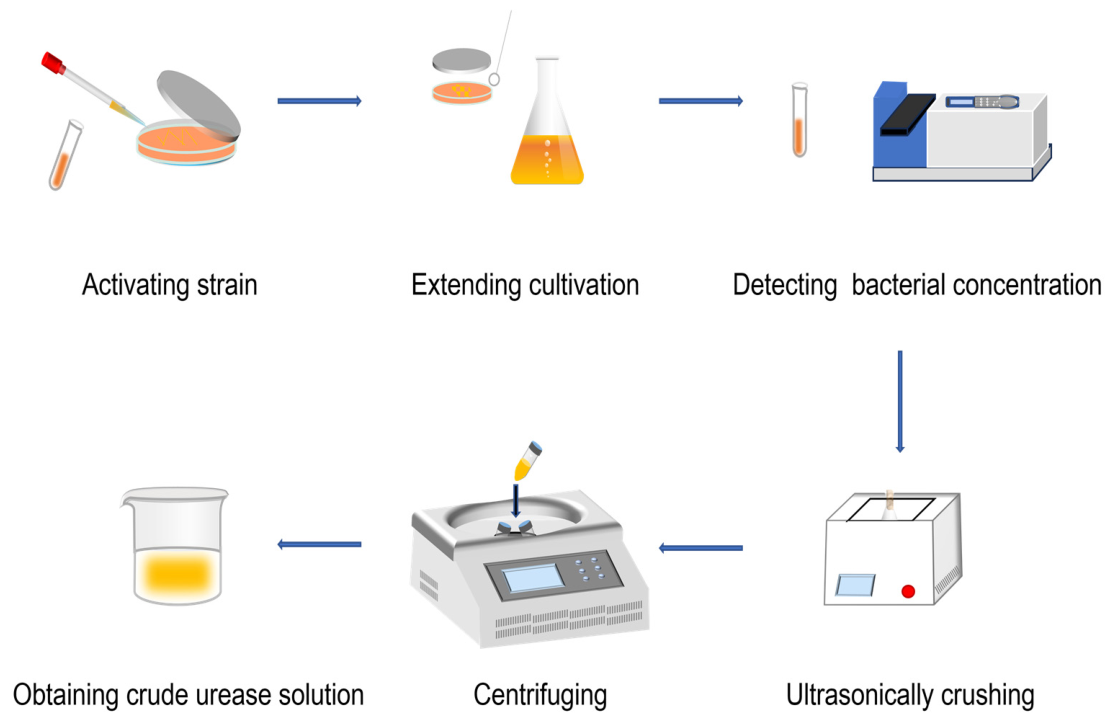
Ultrasonic disruption combined with centrifugation can be used for the extraction of microbial urease, enabling the effective separation and acquisition of intracellular and extracellular urease. In a study on the extraction of intracellular urease from Sporosarcina pasteurii, Lai, H.J. et al. [33] employed ultrasonic disruption to obtain urease from a Sporosarcina pasteurii suspension with an OD600 value of 2.2. By precisely controlling the maximum temperature at 50 °C during ultrasonication and adopting a continuous ice-water bath cooling strategy, they achieved positive utilization of the ultrasonic thermal effect: a moderate temperature increase was used to promote bacterial cell disruption efficiency, whereas real-time cooling via an ice-water bath inhibited the thermal denaturation and inactivation of urease, thereby significantly improving the extraction efficiency of microbial urease. Alternatively, microbial urease can be extracted via chemical, mechanical, and osmotic pressure methods, each of which is suitable for different microbial strains and extraction requirements.
Figure 5 shows the extraction process of microbial urease, including strain activation, ultrasonic crushing and centrifugation, which clearly distinguishes the extraction difference between microbial urease and plant urease.

3.3. Differences in Urease Activity and Carrier Action

The U value is a macro indicator of catalytic efficiency, which is defined as the amount of enzyme that catalyzes the conversion of 1 μmol of urea per unit time under specific conditions. The unit is usually expressed as μmol/min [34]. In the mineralization process of MICP/EICP, urease activity directly controls the hydrolysis rate of urea and then affects the formation rate, deposition morphology and cementation effect of calcium carbonate, which is an important basis for optimizing the reaction system and regulating the mineralization process [35], the urease activities determined for different sources are presented in Table 5.
Moreover, the reaction rate of an enzyme can also be described by the Michaelis–Menten kinetic constant. The Michaelis–Menten kinetic constant is the core parameter used to describe the relationship between the enzymatic reaction rate and substrate concentration. The core includes the Michaelis–Menten constant (Km) and maximum reaction rate (Vmax), which are defined by the Michaelis–Menten equation and are the key indicators used to characterize the interaction between the enzyme and substrate and the catalytic efficiency. The Michaelis constant is defined as the substrate concentration at which the reaction rate reaches half of the maximum reaction rate. It depends only on environmental conditions such as pH and temperature and is independent of the urease concentration; the km of free urease is 43.21 mM [34]. The method for calculating the reaction rate V is based on Formula (6).
V = v max s k m + s
where V is the instantaneous rate of the enzymatic reaction (μmol/mg/min); V max is the maximum reaction rate when the enzyme is saturated by the substrate (μmol/mg/min); and K m is the Michaelis constant, which is defined as the substrate concentration at which the reaction rate reaches half of the maximum rate (mM), S is the concentration of the substrate (mM).
During the MICP process, ureolytic microorganisms produce urease intracellularly via metabolism. Urease activity is strongly correlated with the microbial growth cycle. [39]. Microbial cells not only act as sources of urease but also serve as natural nucleation sites for calcium carbonate, promoting crystal nucleation and growth through surface electrostatic adsorption. Other materials can be added as auxiliary nucleation sites to regulate crystal growth. To improve the environmental tolerance and long-term activity of microorganisms, microbial encapsulation technology (microbial capsules) is commonly adopted to protect bacteria and extend the service life of urease. For the protection of microorganisms in MICP, owing to the expansion of concrete, some microorganisms lose their activity due to the reduction in the number of concrete pores to 1 micron, and materials are required to make them biological capsules to improve their survival time and response sensitivity to cracks [24].
In EICP, urease activity is derived from directly extracted free urease. The urease molecules act as nucleation sites for calcium carbonate, and immobilized urease technology can be applied to improve the binding between the enzyme and substrate. Additionally, other materials can be added as auxiliary nucleation sites to regulate crystal growth, although this may also affect urease activity [40].

4. Key Factors Influencing Self-Healing Efficiency

The previous chapter systematically summarized the core functional microorganisms for MICP and the urease sources of EICP, as well as the intrinsic differences in urease activity, carrier characteristics and mineralization mechanisms between the two biomineralization technologies. As the core catalytic substance driving urea hydrolysis and calcium carbonate precipitation, urease activity directly determines the mineralization reaction rate, crystal morphology, precipitation yield and uniformity of cementation, which further dominates the overall self-healing efficiency of rock and concrete cracks as well as soil reinforcement performance [41]. For MICP technology, microbial growth, metabolic activity and urease synthesis capacity are highly susceptible to external environmental conditions and substrate parameters [42]; for EICP technology, the structural stability and catalytic efficiency of free urease also vary significantly with reaction circumstances [43,44]. A variety of internal and external variables, including microbial strain characteristics, pH, temperature, urea and calcium substrate concentration, as well as trace metal ions, can regulate urease activity at the microbial metabolic level or molecular structure level, thereby changing the mineralization process and final repair effectiveness [45,46,47]. Therefore, this chapter categorically sorts out the key influencing factors dominating the self-healing efficiency of MICP and EICP, deeply analyzes their action mechanisms on urease activity and mineralization behavior, and clarifies the difference in sensitivity of the two technologies to various controlling factors. The research summary aims to provide theoretical support for parameter optimization, process regulation and practical engineering application of urease-based biomineralization remediation technology.

4.1. Factors Influencing MICP Mineralization

4.1.1. Microbial Effects

Microbial effects are a key factor governing the efficiency of MICP and its engineering performance. Different bacterial strains exhibit significant differences in urease activity, metabolic stability, environmental adaptability, and precipitation-regulating capability, which leads to considerable variation in mineralization efficiency and final treatment outcomes. Sporosarcina pasteurii is generally recognized as a typical non-pathogenic, highly ureolytic strain and is widely used in biomineralization studies because of its strong calcium carbonate precipitation capacity and favorable environmental adaptability [20]. The synergistic effect among different strains is not always significant. For example, studies on Bacillus subtilis, Bacillus megaterium, and their mixed culture have shown that all three treatments can markedly improve material mechanical properties, but no clear synergistic enhancement was observed. Specifically, Bacillus megaterium was more effective in improving compressive strength, whereas Bacillus subtilis showed a greater effect on tensile strength. The performance of the mixed culture lay between those of the two single strains, indicating that strain combination does not necessarily lead to higher mineralization efficiency or superior macroscopic performance [10].
At the microscopic level, the microbial species not only determines urease activity, but also influences the nucleation rate, crystal polymorph, particle size distribution, and deposition location of calcium carbonate, thereby controlling the reinforcement, sealing, or repair performance of the mineralization products. Therefore, in practical applications, bacterial selection should be based on the target scenario, with priority given to strains exhibiting high urease activity, strong alkalinity tolerance, good environmental stability, and biosafety, rather than simply increasing the number of bacterial species.
In summary, the essence of microbial effects lies in the fact that the strain determines the mineralization capacity, while the environment controls how that capacity is expressed. Therefore, the key to MICP-related research is not the indiscriminate use of multiple strains, but the selection of advantageous strains with high mineralization efficiency, strong environmental adaptability, and practical engineering operability according to specific application requirements.

4.1.2. pH in MICP

MICP is a biomineralization process mediated by microorganisms. Urease-producing bacteria, including Sporosarcina pasteurii and Bacillus subtilis, decompose urea into ammonia (NH3) and carbon dioxide (CO2) under the catalysis of urease. As a key environmental factor, pH not only affects the metabolic activity of urease-producing bacteria and the catalytic efficiency of urease but also affects the chemical equilibrium of the MICP system, thereby exerting a comprehensive and critical influence on the entire MICP process, including the precipitation rate, precipitation yield, crystal morphology and stability of precipitates [39,48].
On the one hand, strong acids and strong bases can damage microbial structures and impair their activity; on the other hand, they inhibit the chemical equilibrium involved in urease hydrolysis, leading to changes in the crystal type of calcium carbonate. In general, urease-producing microorganisms can survive in the weakly alkaline environment of the reaction. Even in weakly acidic or neutral environments, they can alter the external microenvironment through self-regulating mechanisms, which facilitates a smooth and rapid transition from the lag phase to the logarithmic growth phase. Studies on microbial cultivation at different pH values have shown that, for Sporosarcina pasteurii, relatively high urease activity and microbial concentration can be achieved at pH 8, and the highest calcium carbonate conversion rate is obtained at this pH [49].

4.1.3. Temperature

Temperature affects the growth and metabolic activity of urease-producing bacteria; moreover, the structural stability of urease is affected by temperature. Moreover, temperature can influence the equilibrium constants of various reactions and the diffusion rates of substances in the reaction system, thereby affecting the contact efficiency of reactants, resulting in a slow change in the pH value of the system, causing reaction disorders, indirectly regulating the formation of calcium carbonate precipitates, affecting the formation rate and quantity of calcium carbonate precipitates, and regulating the crystal structure of the precipitates.
For Sporosarcina pasteurii, studies have shown that the urease activity of bacterial suspensions preserved at approximately 10 °C can be maintained for a relatively long period of time. When the storage temperature exceeds 30 °C, the urease activity decreases sharply with increasing storage time, the urease activity is highest at 30 °C, so 30 °C is adopted as the temperature for expanded cultivation in routine culture [1]. The thermal stability of urease can be effectively modified by the addition of 20% glycerol as a protective agent at high temperatures [50].

4.1.4. Substrates and Nutrients

  • Urea concentration: Urea as a substrate affects the reaction rate. Xiaohao Sun et al. [9] investigated the effect of urea on the calcium carbonate conversion rate using Bacillus megaterium and reported that higher urea concentrations led to higher reaction yields but reduced microbial biomass and urease activity, resulting in a lower conversion efficiency. In experiments with different urea substrate concentrations conducted on Sporosarcina pasteurii, researchers reported that increasing the urea concentration increasingly inhibited microbial growth, and urease activity peaked at 0.5 mol/L before decreasing with further increases in the urea concentration [7].
  • Calcium source type and concentration: Increasing the calcium ion concentration can promote product formation, but the presence of calcium ions also inhibits microbial activity and reduces the rate of urea hydrolysis. An excessively high calcium ion concentration decreases the conversion rate of calcium carbonate [9]. The addition sequence of calcium ions also influences the reaction progress. The addition of calcium ions before or after urease-catalyzed urea hydrolysis affects the crystal morphology of the formed calcium carbonate. The authors of [7] conducted experiments on calcium carbonate yield with early versus late addition of calcium ions, and the group with calcium ions added later achieved higher calcium carbonate yields under different pH conditions.
  • Metal ions: As key cofactors of microbial urease, nickel ions significantly activate urease activity. Studies have shown that a nickel ion dosage of 10 μmol/L can increase urease activity nearly four-fold [7]. In addition, trace metal ions such as Mg2+ and Mn2+ can also positively promote microbial urease activity [51].
  • Nutrients and inoculation amount: In the MICP experiment for achieving autonomous crack healing of alkali-activated slag composites using Sporosarcina pasteurii immobilized by polymers, the bacterial suspension had a viable cell concentration of 107 CFU/mL, and 450 g of the suspension was vacuum-impregnated into 450 g of expanded glass (EG), corresponding to an EG-to-bacterial suspension mass ratio of 1:1 [26]. The higher the strain concentration is, the greater the urease activity. In terms of the effect of flora synergy on other bacteria, because few bacteria have urea or ammonium ions as nutrients in nature, other strains have little effect on urease-producing bacteria in the external nonsterile environment. Lei V. Zhang et al. [26] inoculated 107 CFU/mL as the microbial concentration into concrete samples in their experiment, whereas Mokhtar et al. [27] used a 1 × 10⁹ cells/mL bacterial suspension as the inoculation dose for concrete repair. Considering the requirement of MICP technology for obtaining nutrients, microorganisms cannot survive for long periods without forming spores. Therefore, studying the urease activity produced by different strains at different inoculation amounts, as well as the required nutrients and survival time, is very important.

4.2. Factors Influencing EICP Mineralization

4.2.1. pH in EICP

The peak value of urease activity occurred at the appropriate pH value. Some scholars have measured the urease activity of soybean urease at different pH values. A greater activity can be obtained when the pH is 7, and the urease activity tends to first increase but then decrease [7]. Compared with MICP, which can regulate the pH value of the environment, EICP soybean urease has a higher calcium carbonate conversion rate at pH values of 6 and 7. The experiments of Chen, Y. et al. [52] also revealed that when the pH increased from 5.0 to 11.0, the urease activity first increased linearly but then decreased. When the pH is 8.0, the amount of urea hydrolyzed per minute reaches the maximum value, which is 3.55 mM/min.; when the solution environment is too acidic or too alkaline, ionization or deionization of the acid group in the active center of the enzyme protein occurs, and the enzymatic reaction is inhibited and thus reduces enzyme activity. A pH value of 6–9 should be adopted to achieve increased urease activity [53].

4.2.2. Temperature

Urease has a typical protein molecular structure; temperature has a great influence on its activity. In the range of 10~50 °C, urease activity gradually increased with increasing temperature [52]; at lower temperatures, the urease activity increased. In experiments on different soybean urease activities, scholars have shown that 4 °C can be used as the appropriate temperature for the preservation of urease. The results revealed that urease activity decreased with increasing storage time; the higher the storage temperature was, the shorter the inactivation time of urease activity. Stored at 4 °C for 28 days (close to 30 days), the residual activity of urease remained at approximately 60%–80%; the enzyme activity stayed relatively stable within 10 days with a retention rate above 95% [54]. Moreover, soybean urease can maintain high activity below 50 °C [52]. The thermal stability of urease can be effectively modified by the addition of 20% glycerol as a protective agent at high temperatures [50]. After the crude urease extract was lyophilized into powder form, dextran and sucrose were applied as lyoprotectants. The combined use of these two protectants enabled the urease to retain almost full enzymatic activity within one year of storage [55].

4.2.3. Substrate Concentration

1.
Urease concentration: For soybean urease, scholars have shown that the crude urease activity extracted from unit weight soybean is the highest at 40 g/L. The higher the quality of soybean urease used for extraction is, the greater the amount of urease obtained, and the greater the transformation activity [52]. Cui et al. [56] investigated the extraction of soybean powder at concentrations ranging from 10 g/L to 120 g/L. These results demonstrated that higher soybean concentrations led to increased urease activity and a higher calcium carbonate precipitation rate. In the sand solidification experiment conducted by Sun, X. H. et al. [57], stable calcite is mainly formed at low urease concentrations, while vaterite and amorphous calcium carbonate tend to form at high urease concentrations, resulting in reduced crystal stability.
2.
Urea concentration: Because EICP technology uses direct urease, urea has a linear inhibitory effect on urease activity. Fan et al. [7] tested the inhibitory effect of urea on soybean urease activity. Excessively high urea concentration tends to over occupy the dinickel active sites and peripheral hydrogen-bonding domains of urease, inducing steric hindrance that impedes normal substrate binding and product desorption [58].
Therefore, the urea concentration of the reaction substrate should be between 0.5 M and 1.5 M [53].
3.
Type and concentration of the calcium source: Ca2+ as a reaction substrate inhibits urease activity. Chen et al. reported that for the same concentration of chemical mixture, different calcium sources affect the pH value of the solution and then affect the concentration of Ca2+ after precipitation. Among these calcium sources, CaCl2 has the highest consumption of Ca2+, followed by Ca(NO3)2, and CaAc2 has the lowest consumption [52]. Weng y. et al. [15] extracted crude soybean urease solution (with an activity of approximately 3.9 mmol/L/min), selected 0.425–0.6 mm medium sand as the matrix, and prepared a biological treatment solution containing 1 mol/L calcium salt and urea for experiments. The results revealed that the calcium carbonate content (CCC) of the sand column increased with increasing treatment time and that the CCC of the (CH3COO)2Ca group was greater than that of the CaCl2 group with the same treatment time. However, the unconfined compressive strength (maximum 1680 kPa) of the sand column in the CaCl2 group was significantly greater than that in the (CH3COO)2Ca group (approximately 1000 kPa), and there was no significant difference in the biological plugging effect. Ca2+ and anions could inhibit the urease activity of coarse soybean, and the inhibitory effect of NO3 was significantly stronger than that of CH3COO and Cl. In the Ca(NO3)2 group, urease was completely inactivated after 0.5 h of reaction due to the synergistic inhibition of Ca2+ and NO3. In view of the damage caused by chloride ions in concrete samples, calcium chloride is recommended for use as a calcium source in sand experiments, and calcium acetate is recommended for use as a calcium source in concrete repair experiments. In the experimental study of Sun, X. H. et al. [57], the calcium carbonate yield of EICP first increases and then decreases with the rise of urea concentration, and the optimal calcium ion concentration is 0.5 mol/L. Excessively high calcium ion concentration inhibits urease activity, thereby reducing the mineralization productivity. Under the same conditions, calcium acetate, as a calcium source, exhibits a higher calcium carbonate yield and better soil solidification strength than calcium chloride.
4.
Trace elements and nutrients: Because EICP uses urease directly, nutrients are not needed. Ming Juan cui et al. [13] used seawater as a cementation solution and reported that the substances present in it affect urease activity and reduce production. However, the soybean urease extracted from seawater is purer, which is not easy to block, and has a better cementation effect on sandy soil, with the strength nearly doubled [59]. With respect to the effect of Ni2+ on urease activity, because EICP technology uses urease directly, it does not need to provide nutrients as microorganisms do. According to previous studies, nickel ions can increase the urease activity of Bacillus pasteurei but inhibit the growth of microorganisms. The microbial concentration (OD600) decreases linearly with increasing Ni2+ ion content, and it inhibits the activity of the extracted soybean urease [53].

4.3. Comparative Analysis of Self-Healing Evolution Processes of MICP and EICP

The previous sections have discussed various influencing factors on the mineralization efficiency of MICP and EICP, including pH value, temperature, substrate concentration and urease activity characteristics, which laid the foundation for understanding the basic reaction conditions of these two techniques. On this basis, this section focuses on the crack self-healing evolution process of MICP and EICP. It systematically compares the differences in nucleation and growth, calcium carbonate deposition, pore filling and interface cementation during the self-healing process and further clarifies how the above-mentioned environmental and material factors regulate the self-healing process.

4.3.1. Self-Healing Method

In the laboratory, the repaired test pieces can be repaired in a variety of ways, such as via the single-phase method: the bacterial solution or urease solution is mixed and directly injected into the test pieces [33]; the two-phase grouting method: the bacterial solution and reaction solution are separately injected through the grouting hole and mixed freely in the crack; the filling method: for large cracks, the cementation solution can be injected after the material is filled in advance; and the immersion method: the test piece can be directly immersed in the cementation solution. According to the comprehensive results of the comparison of microbial mineralization and rock fracture repair methods by Zhao et al. [60], the effects of the two-phase grouting method and rock powder filling method in rock fracture repair are the best. Arpajirakul, S. et al. [6] premixed soil and bacterial suspensions followed by gradual injection of cementation medium, and the treated soil experienced no local damage. Alternatively, a calcium source can be added before the concrete solidifies in advance [24]. Qian, C. et al. [61] proposed that the sand feeding port should be manually added during feeding, which would have the least interference with the existing concrete production line. After the 0.2 mm and 0.5 mm onsite cracks are cured by spraying water for 4 h, the water seepage stops at 41 days, the cracks are completely closed within 60 days, the ultrasonic wave velocity increases significantly, and the waveform recovers to near the sine wave. Detailed remediation procedures for specimens are presented in Table 6.

4.3.2. Self-Healing Materials

The repair effect is related to the crack width. Bioremediation has been proven to be effective in repairing cracks with widths of less than 1 mm. Larger cracks need to be filled with other materials. The smaller the crack is, the greater the repair efficiency [9], and more than 1 mm cracks need to be filled with material as aggregates to improve the repair effect.
Different added materials affect the repair effect. Y. Wang et al. [4] used lignin fibers, basalt fibers, polypropylene fibers and silty fine sand as crack-filling materials to repair 1–2 mm cracks in concrete via EICP. The addition of polypropylene fibers most significantly improved the mechanical properties of the cracked mortar samples. When polypropylene fibers are used as the filling material, the Unconfined Compressive Strength (UCS) increase percentages of the mortar samples with crack widths of 1, 1.5 and 2 mm are 18.62%, 17.78% and 32.2%, respectively. When the width is 2 mm, the strength increase rates of polypropylene fibers, lignin fibers, fine sand fibers and basalt fibers are 32.2%, 19.23%, 15.7% and 9.21%, respectively. Wang et al. used lignin fibers, sludge fibers and polypropylene fibers as filling materials. Under dry–wet cycling, the effect of using lignin fibers is the best. Owing to the differences in the cementation effect, particle size and material adaptability between MICP and EICP, different technical measures should be taken according to specific engineering requirements. The following table presents typical application cases of MICP and EICP technologies, as well as the selection of supporting filling materials. Different types of filling materials are listed in Table 7.

4.3.3. Self-Healing Cycle

Different repair materials and repair processes correspond to different repair cycles. The EICP reaction rate is relatively fast. Under the conditions of an appropriate substrate concentration, most of the urea hydrolysis process can be completed within 2 h, and the mineralization precipitation reaction can essentially be completed within 2 days after the reaction substrate is added [3]. In contrast, MICP has a longer reaction cycle, and its overall process is mainly controlled by the growth and metabolism of urease-producing microorganisms and the urease activity level. Bacillus spores mixed with cement paste can survive for up to 4 months [24]. Zhang M. et al. [3] changed the reaction mixture once every two days and took 6 days as a soaking cycle. When the number of reinforcement rounds increased from 1 to 7, the peak load increased by 12.03 times. Wang et al. [5] set a 14-day drip for the repair of concrete samples. The electrical fluxes of all the narrow crack repair samples after 0, 30, 60 and 90 days of dry–wet cycling were lower than 4000 °C, and the impermeability grade was moderate, which improved the stability and resistance to chloride ion penetration. Yu X. et al. [59] used seawater to cement sandy soil for 4 days, which is twice as strong as the use of a pure water–sand column. Sun X et al. [63] injected Al2O3 pretreated with a bacterial suspension, 0.5 M urea and 0.5 M calcium acetate cement into a crack through a peristaltic pump at a rate of 1 mL/min once a day, with a repair cycle of 9 days. The repair effect of a 1.0 mm narrow crack is the best, and a 2.0 mm wide crack can still achieve a strength recovery rate of 44.89%, which is suitable for the repair of medium- and narrow-width cracks in concrete.

4.3.4. Self-Healing Performance Evaluation and Comparative Analysis

Significant differences exist in the mineralization rate between MICP and EICP. MICP depends on bacterial metabolic activity and requires an obvious activation lag after grouting, yet its repair solution possesses favorable diffusion capability. Bacterial immobilization and microencapsulation can prolong microbial activity and guarantee sustained mineralization. By contrast, EICP triggers urea hydrolysis instantly once free urease mixes with cementation solution, but it shows a shorter effective diffusion distance. Impurities in crude urease may gradually block flow channels and hinder deep fracture penetration after multiple treatment cycles. Three typical calcium carbonate polymorphs (calcite, aragonite and vaterite) are formed in biomineralization, with obvious crystal type distinctions and varied precipitation yields between MICP and EICP. Nevertheless, both technologies share the same essential function of utilizing calcium carbonate cementation to seal cracks and reinforce engineering media.
Bundur, Z. et al. [65] indicated that the mineralization process presents a three-stage characteristic: rapid growth in the early stage, stable efficiency in the middle stage, and long-term slow mineralization in the later stage. The mortar system exhibits a longer mineralization duration and significantly higher mineralization efficiency than pure cement paste. The 7-day age corresponds to the peak of high-efficiency mineralization; major pore optimization and strength restoration are completed at 28 days, and sustained mineralization potential still remains at 33 days. In the short-term stage (1–7 days), the initially inoculated bacteria are almost all vegetative cells with vigorous urease metabolism. This stage features the fastest mineralization rate and concentrated calcium carbonate precipitation, which rapidly fills large pores and micro-defects in the aggregate interfacial transition zone. In the middle stage (7–28 days), the number of viable bacteria decreases slowly, while a high proportion of vegetative cells is still maintained in mortar. At 28 d, the proportion of vegetative cells reaches 82% in mortar and 54% in pure cement paste. Although the mineralization rate slows down, the mineralization proceeds continuously and stably, which continuously refines micropores and repairs internal microcracks, serving as the dominant stage for strength recovery and gradual pore reduction. In the long-term stable stage (28–33 days), part of the bacteria transforms into dormant spores, while 48% of the cells remain active vegetative cells. Without additional nutrient supply in the later period, low-rate and long-term mineralization can be maintained. Metabolic mineralization capacity still exists even at 330 days, enabling long-term microcrack sealing and pore structure optimization. After the self-healing process, the period of 7–35 days is the dominant self-healing mineralization cycle. Complete recovery of compressive strength can be achieved under intermittent nutrient spray curing. The strength reduction reaches 17% at 7 days and a total reduction of 24% at 28 days.
Zhang, G. Z. et al. [66] systematically studied the effects of coral sand serving as a bacterial carrier and the coupling action of seawater and basalt fiber on the morphology of MICP-mineralized products as well as the crack repair mechanism of marine mortar. At the curing age of 3 d, rapid early mineralization took place, white calcium carbonate precipitates gradually appeared at the crack edges, and the surface microcracks were preliminarily sealed; at 7 d, the mineralization process was continuously accelerated with an obvious increase in crack filling content and a substantial improvement in crack healing rate; at 28 d, the mineralization tended to be stable and fully completed, and the cracks were completely filled by microbial mineralized products combined with seawater-derived substances, realizing full surface closure and dense internal repair, which serves as the critical curing age for evaluating the final mineralization performance.
Hommel et al. [67] indicated that the enzyme-catalyzed mineralization of EICP has no bacterial activation lag phase, and the reaction starts immediately after the mixing of raw materials, with the mineralization rate following the first-order kinetics and Arrhenius temperature effect. A temperature of 60 °C is the optimal compromise balancing ureolysis rate and enzyme stability; although bacteria are inactivated under high temperature, the residual urease can still maintain high catalytic efficiency. The EICP mineralization reaction mainly concentrates within the initial static period of 2 h. Crude urease is prone to irreversible adsorption on the medium skeleton, and the reaction activity gradually declines with successive treatment cycles without exogenous supplementation. Increasing the concentrations of urea and calcium ions can enhance the initial mineralization rate, whereas it accelerates urease deactivation and easily causes excessive precipitation at the inlet end as well as pore channel blockage, thereby reducing the repair uniformity in deep fractures. The actual calcium carbonate conversion rate in tests is far lower than the theoretical value, and part of the precipitates cannot effectively seal pores due to seepage erosion.
In the sand solidification experiment conducted by Sun, X. et al. [57], along the infiltration direction of the sand column, the calcium carbonate content gradually decreased, while the porosity slightly increased along the path; the calcium carbonate deposition was more uniform in fine-grained sand, indicating that EICP is more suitable for the repair of fine fractures and fine-grained media. The mineralization rate of EICP is jointly regulated by the concentration of urea/calcium ions, temperature, pH value, and calcium source type, and the production rate increases first and then decreases with the increase of substrate concentration. Compared with MICP, EICP has stronger low-temperature adaptability and is more suitable for alkaline environments. In terms of reaction time, the calcium chloride system can still undergo slow mineralization in the later stage, while the calcium acetate system mainly concentrates the reaction within the first 4 days, so it is suggested that the optimal engineering curing period is 4 days. The particle size has a significant impact on the EICP repair effect: due to the lack of nucleation sites and easy loss of calcium carbonate, coarse-grained media are difficult to solidify, while well-graded fine-grained sand has uniform calcium carbonate deposition and good pore filling effect. At a lower urease concentration, EICP mainly produces stable calcite; high urease concentration tends to generate vaterite and amorphous calcium carbonate, resulting in decreased crystal stability, and the mineralization rate of EICP decays exponentially with time.

5. Detection and Characterization of the Reaction Rate and Effect of EICP and MICP

5.1. Reaction Rate Detection

5.1.1. Conductivity Method

Urease catalyzes the hydrolysis of urea to produce NH4+ and CO32− as well as other conductive ions. The conductivity of the solution increases with increasing hydrolysis. The rate of change in conductivity is positively correlated with urease activity (the faster the conductivity changes, the greater the urease activity). Harkes et al. [11] used the conductivity method as a conventional method for urease activity measurement. Specifically, in their experimental procedure, urease activity was quantified by monitoring the rate of electrical conductivity increase caused by urea hydrolysis. The measurement was performed at a constant ambient temperature of 20 °C, with the urea concentration in the reaction system maintained at 1 M. A certain volume of bacterial suspension was mixed with urea solution, and the change in conductivity was continuously recorded over 5 min to calculate the conductivity variation rate in mS/min. They established a fixed conversion relationship that 1 mS/min corresponds to a urea hydrolysis rate of 11 mM per minute. Moreover, the measurement was conducted in a calcium-free environment to avoid the formation of calcium carbonate precipitate, which would otherwise interfere with the conductivity reading and affect the accuracy of urease activity evaluation. Owing to its simplicity, rapidity and stable operability, this conductivity-based protocol has since become a classic routine method adopted widely in subsequent MICP experimental research for determining bacterial urease activity.
Urease activity was measured immediately after sampling. In the absence of calcium ions, urease activity (μm/min/mL) = 11.1 × dilution multiple × conductivity change per minute (ms/min). Within the measured activity range, 1 ms/min corresponds to a urea hydrolysis activity of 11.1 μm/min [1,11,59]. In the MICP conductivity measurement, the conductivity was stable after disorder in the early stage. In EICP, the initial reaction rate of soybean urease was the highest, then decreased and stabilized after 30 h.

5.1.2. Determination of Microbial Concentration

This method is an indirect characterization approach. Under certain conditions, the OD600 value of a microbial solution is positively correlated with the microbial content. This can be indirectly reflected by detecting the optical density (OD600) during the microbial culture process, Wang, Y. Z. et al. [68] measured the optical density value and the content of the bacterial suspension of Sporosarcina pasteurii and obtained an approximate curve. The value was maintained at OD600 = 1.0, corresponding to a cell concentration of approximately 4 × 10⁸ cells/mL of Sporosarcina pasteurii.
Different scholars have adopted different optical density values to prepare the bacterial suspension before injection into the specimens, thereby using bacterial solutions of different concentrations and activities. As a concentration index for cultured bacteria, Lai, H. [33] used Sporosarcina pasteurii CGMCC 1.3687 as a urease-producing bacteria. The OD600 value of the cultured bacterial suspension used for ultrasonic extraction was 2.2 ± 0.2, and the initial urease activity was 11 ± 1 mM/min [33]. Sun X. [63] used Sporosarcina pasteurii ATCC 11859 as a urease-producing bacteria and cultured it in LB media. The initial OD600 value of the initial bacterial suspension was 0.871. There were also bacterial suspensions with an OD600 value of 2.5 without dilution [9]. The bacterial concentration and activity of the osmotic solution were also taken as measurement data.

5.1.3. Determination of Ammonium Ion Concentration

The titrimetric method was used for the determination of ammonium ions. This method is a qualitative and semiquantitative method. Urease hydrolyzes urea to produce NH3, which increases the pH of the solution and increases its alkalinity. When the pH was ≥ 8.2, the phenolphthalein indicator changed from colorless to red. The color development speed and color depth can be used to preliminarily judge urease activity. Moreover, because the NH4+ generated by urease hydrolysis of urea can neutralize with acid, the residual alkalinity is titrated with a standard acid solution, and the amount of urea hydrolysis is calculated by the amount of acid consumed to characterize urease activity.
Liu et al. [35] quantitatively investigated ammonium and ammonia released from urea hydrolysis catalyzed by soybean urease by systematically adopting and comparing three detection methods: the pH increment method, acid–base titration method, and Nash reagent spectrophotometric method. All approaches indirectly evaluate urease activity based on ammonia production from urease-mediated urea decomposition, while they differ substantially in detection principle, experimental procedure, quantitative unit, and final numerical results. The pH increment method indirectly reflects ammonia generation by determining the pH difference between the sample and blank solutions, which is simple to operate and suitable for rapid field detection. The titration method quantifies ammonia nitrogen content by back-titrating the residual hydrochloric acid after neutralizing the generated ammonia with excess acid, providing reliable quantitative data. In contrast, the Nash reagent method enables sensitive spectrophotometric quantification relying on the chromogenic reaction between ammonia and Nessler’s reagent to form a yellow complex, where absorbance is linearly proportional to ammonia concentration; this method yielded the highest urease activity values among the three analytical approaches. In this absorbance method, the hydrolysate of urease reacts with a specific reagent to produce colored compounds, and the concentration of the product is quantified by absorbance to indirectly reflect urease activity (such as by detecting the amount of NH4+). Nessler’s reagent method involves ammonium reacting with Nessler’s reagent, determining the absorbance via spectrophotometry, and then converting the ammonium concentration [8].

5.1.4. Determination of the Calcium Ion Concentration

As one of the core substrates and key elements in the MICP and EICP reaction system, the calcium source acts as the fundamental substance sustaining the smooth progression of the entire mineralization reaction. Under laboratory tests and microscopic mechanism investigation, the progression and extent of the reaction can be characterized via two approaches: liquid-phase detection and solid-phase quantification. On the one hand, the real-time concentration of calcium ions in the supernatant and pore solution of the reaction system can be measured at regular intervals to track the consumption and attenuation pattern of free Ca2+ over time, which directly reflects the rate of urea hydrolysis and calcium carbonate nucleation and precipitation [67]. On the other hand, the crystalline calcium carbonate content in solid products and soil cementing substances generated after the reaction can be quantitatively determined [69]. Based on the production yield, crystal quantity and morphological distribution characteristics of solid-phase calcium carbonate, the progression degree, precipitation efficiency and completion level of microbial mineralization can be indirectly deduced. A higher consumption of calcium ions and greater production of calcium carbonate in the system indicate a more sufficient MICP and EICP mineralization reaction. This index can be adopted as an important quantitative indicator to evaluate the influences of bacterial activity, bacterial suspension concentration, reaction ratio and environmental conditions on mineralization performance.
Calcium carbonate content: At the same time, the efficiency and rate of the EICP and MICP reactions can also be determined by measuring the calcium ion content. Chen, Y. et al. [52] measured the calcium ion concentration through EDTA. Commercial colorimetry: the concentration of calcium ions (Ca2+) is determined [8]. The test pieces were weighed before and after the reaction via the weight difference method, and the calcium carbonate yield was calculated [9]. For the repaired samples, the generated calcium carbonate crystals can be obtained via physical exfoliation; for experimental materials preadded into the mixed materials, the target product can also be subjected to leaching and separation through chemical methods to obtain calcium carbonate crystals.

5.2. Multi-Scale Characterization and Comprehensive Performance Testing

5.2.1. Microscopic Detection Method

Both MICP and EICP rely on urea hydrolysis catalyzed by urease as the core pathway to generate calcium carbonate (CaCO3), thereby achieving particle cementation, soil reinforcement, and other functions. Microscopic detection methods are critical for revealing their mineralization mechanisms, crystal evolution, interfacial interactions, and engineering performance regulation. Through multiscale and multidimensional observations and characterization, the differences, advantages, and limitations of MICP and EICP can be analyzed at the microscopic level, providing a direct basis for technical optimization and engineering applications. Commonly used microscopic techniques include scanning electron microscopy (SEM), X-ray diffraction (XRD), and Fourier transform infrared spectroscopy (FTIR). SEM enables direct visualization of the surface morphology and distribution of calcium carbonate crystals in the repaired zone. XRD and FTIR analyses were used to accurately identify the crystal phase and chemical composition of the mineralized products.
In MICP/EICP fracture repair, advanced techniques characterize CaCO3 products’ composition, structure, morphology and restoration quality to evaluate effectiveness.
Energy Dispersive X-ray Spectroscopy (EDX) combined with Raman Spectroscopy is a powerful combination for comprehensive analysis of CaCO3 products and restoration regions. EDX enables rapid qualitative and semi-quantitative analysis of elemental distribution and composition, which can clearly identify the spatial distribution of calcium (Ca), carbon (C), oxygen (O) and other related elements in the mineralized products and restoration interfaces, providing direct evidence for the formation and uniform distribution of CaCO3. Raman Spectroscopy, with its high spectral resolution, can further characterize the molecular structure and crystal phase of CaCO3, helping to distinguish different crystal forms (e.g., calcite, aragonite, vaterite) and verify the purity of mineralized products. Together, these two techniques complement each other to comprehensively evaluate the composition and distribution characteristics of CaCO3 products and restoration effects, as reported in relevant studies [26]. Scanning electron microscopy (SEM) is widely used for observing the surface morphology and microstructure of CaCO3 mineralized products. By providing high-resolution images at the micro-nano scale, SEM can clearly display the shape, size, and aggregation state of CaCO3 crystals, as well as the bonding interface between mineralized products and the matrix (e.g., rock, concrete). This technique is essential for analyzing the growth characteristics of CaCO3 crystals and evaluating the compactness and bonding degree of the restoration layer, which directly reflects the cementation effect of biomineralization processes [53].
Energy Dispersive Spectroscopy (EDS), similar to EDX but often coupled with SEM, is mainly used for the qualitative and quantitative analysis of the elemental composition of CaCO3 products and restoration interfaces. It can accurately determine the content of major elements (Ca, C, O) and trace impurities in the mineralized products, which is important for evaluating the purity of CaCO3 and the completeness of the biomineralization reaction. EDS analysis can also provide reliable data support for optimizing the reaction conditions of biomineralization to improve the quality of CaCO3 products [53]. X-ray diffraction (XRD) is a key technique for the phase composition analysis of CaCO3 mineralized products. By analyzing the XRD diffraction peaks, the crystal phase of CaCO3 (e.g., calcite, aragonite) can be accurately identified, and the relative content of each crystal phase can be quantitatively calculated. Since different crystal phases of CaCO3 have different mechanical properties and stability, XRD analysis is of great significance for evaluating the mechanical performance and long-term durability of CaCO3 products in the restoration system. This technique has been widely applied in the phase characterization of CaCO3 in biomineralization repair studies [52].
In summary, EDX-Raman Spectroscopy, SEM, EDS, and XRD are complementary characterization techniques that play an indispensable role in the research of biomineralization repair. These techniques jointly realize the comprehensive evaluation of CaCO3 products from elemental composition, phase structure to surface morphology, providing a scientific basis for the optimization of biomineralization technologies and the improvement of restoration effects.

5.2.2. Detection of Macromechanical Properties

Macroscopic mechanical property testing focuses on the overall mechanical response of mineralized products. Through quantitative measurement of key indicators such as strength, stiffness and deformation resistance, the reinforcement effect, applicable scope and process optimization direction of MICP and EICP technologies can be clarified, providing a scientific basis for engineering design and field application.
Macroscopic mechanical property testing mainly covers four categories of indicators, namely, strength, stiffness, deformation resistance and durability, with different testing methods corresponding to different indicators.
With the increase of MICP/EICP treatment cycles from 1 to 7, continuous calcium carbonate precipitation was induced inside the matrix pores and microcracks, which gradually filled internal defects, bonded loose particles, and formed a dense and integrated cementation network. Correspondingly, the three-point bending test results showed that the peak load was enhanced by 12.03 times. This demonstrates that cyclic MICP and EICP treatment can effectively improve the compactness, fracture resistance and flexural bearing capacity of the treated materials, and the mechanical reinforcement effect presents an obvious cycle-dependent enhancement characteristic [3]. Shear test results revealed that the shear modulus increased by 177% after cyclic MICP/EICP treatment. Multiple rounds of calcium carbonate precipitation continuously filled internal pores and intergranular voids, effectively cementing particle contacts and restraining relative sliding between matrix particles. The formation of a stable carbonate cementation network greatly enhanced the interfacial bonding strength and shear deformation resistance, thereby achieving a significant improvement in shear stiffness and shear modulus of the treated specimens [6].
Triaxial compression tests indicated that the peak deviatoric stress rose remarkably with the increasing number of MICP/EICP treatment cycles and eventually reached twice the value of the untreated soil specimen. Repeated calcium carbonate precipitation filled internal pores and interparticle voids, formed a stable cementation skeleton, and constrained particle rearrangement and shear slip under confining pressure. Such microstructural modification effectively improved the soil strength and bearing capacity, which well explained the continuous enhancement of peak deviatoric stress after multiple rounds of biomineralization reinforcement [32]. Infinite side compressive strength tests showed that the strength recovery rate of concrete cracks with widths ranging from 0.1 mm to 0.5 mm was approximately 8% after MICP/EICP mineralization healing. The precipitated calcium carbonate crystals partially filled the internal crack voids and repaired the damaged concrete interface, whereas limited deposition efficiency and incomplete crack closure restricted the overall strength restoration effect, resulting in a relatively low recovery rate for cracks of 0.1–0.5 mm width [9].
Hardness test results demonstrated that the surface hardness of recycled aggregate was elevated by approximately 8.7% after EICP modification. The calcium carbonate crystals induced by EICP uniformly precipitated and adhered to the surface pores and micro-defects of recycled aggregate, forming a dense and hard mineralized layer. This surface cementation layer effectively reduced surface roughness, filled surface microcracks, and enhanced the surface wear resistance and structural compactness, thereby achieving a noticeable improvement in the surface hardness of recycled aggregate [52]. Crushing index tests showed that the crushing index of the specimens increased after seven days of EICP treatment. The continuous precipitation of calcium carbonate crystals induced by EICP gradually filled the internal pores and microcracks of the material, enhanced the interfacial bonding between particles, and improved the structural integrity and load-bearing capacity. As a result, the material exhibited higher resistance to crushing under pressure, leading to a noticeable increase in the crushing index after seven days of curing [52]. Elastic modulus tests showed that the elastic modulus of the EICP-modified specimens reached 15.2 MPa, which was 10 times that of the untreated ones. The continuous calcium carbonate precipitation induced by EICP formed a stable and dense cementation network inside the material, which effectively reduced internal porosity and enhanced the interfacial bonding strength between particles. This microstructural optimization significantly improved the material’s ability to resist elastic deformation under external load, thus leading to a substantial increase in elastic modulus—achieving a 10-fold enhancement compared with the untreated specimens [70]. Cohesion test results demonstrated that the cohesion of EICP-reinforced specimens reached 48.9 kPa, which was four times that of the untreated group. EICP-induced calcium carbonate crystals precipitated and accumulated at interparticle contacts and internal voids, forming a robust cementation bridge among soil or aggregate particles. This mineralized bonding effect remarkably strengthened the interfacial interlocking and adhesion performance, thereby greatly improving the shear cohesion of the treated matrix [70].

5.2.3. Testing of Other Properties

In the performance evaluation system of MICP and EICP, in addition to core macroscopic mechanical property and microscopic morphology testing, ultrasonic testing, permeability testing, and other auxiliary detection methods serve as important supports for supplementing and improving mineralization effect evaluation, revealing mineralization mechanisms and engineering applicability. These methods focus on the physical properties, internal state, and mass transfer characteristics of mineralized materials. Cooperating with macroscopic mechanical testing and microscopic testing, these methods enable comprehensive and multidimensional evaluation of the mineralization effects of MICP and EICP, providing more complete scientific evidence for process optimization and engineering applications.
The Table 8 presents the multidimensional property testing results of mineralized samples.

6. Challenges and Prospects of Urea-Based Bioremediation

6.1. Integration of Multiple Mineralization Technologies

At present, research on the joint application of EICP and MICP methods is still relatively limited, and systematic experiments and investigations of multiple strain collaborative mineralization methods are not sufficient. In terms of strain improvement, urease-producing strains can be directionally modified by mutation breeding, genetic engineering and other means to improve their urease activity, environmental tolerance and toxicity resistance and enhance their mineralization efficiency at complex sites. Optimization of the remediation process: multiple composite remediation technologies, such as urea-based microbial mineralization combined with chemical regulation and phytoremediation, should be developed; the substrate concentration ratio, slurry injection method and reaction sequence should be optimized; and the overall remediation effect and uniformity should be further improved. Focusing on the stability of urease activity, especially the effects of temperature, pH, heavy metal toxicity, and other environmental factors on urease inhibition, can help overcome the insufficient adaptability of free enzymes and engineered strains in complex geological environments. In the future, urease mineralization can be combined with nitrifying bacteria- and sulfate-reducing bacteria-mediated mineralization pathways to construct a multichannel collaborative mineralization system. Further research on the coupling technology of MICP and EICP was carried out to expand the theory and application boundaries of green and efficient bioremediation. Moreover, in situ monitoring and real-time evaluation systems should be established to track mineralization products, structural strength and pollutant fixation efficiency dynamically during field applications [71,72,73].

6.2. Research on the Response Mechanism

At this stage, we should focus on the dynamic response mechanism of the formation of biological gelation, the interface response mechanism of the modification of porous media, and the structure–activity response mechanism of the regulation of functional properties to promote the application of biomineralization technology from basic research to engineering and functional applications. Carrier immobilization and microcapsule encapsulation technology were further used to achieve stable loading of bacteria, effectively prolong the survival cycle of bacteria [74], and improve the hydrolysis rate of urea and the sustainability of the mineralization reaction. Bioceramic or biocapsule bacterial spores play a self-healing role only in the early stage (7 days) of concrete, but in the later stage, they are extruded and inactivated due to pore refinement and cannot repair large cracks (>1 mm) [24]. The powder-type (particle size of 65–120 μm) and capsule-type (particle size of 3.2–4.0 mm) microbial remediation agents were developed by Qian, C. et al. [61]. The calcium source accelerates the hydration of cement, improves the fluidity of fresh concrete, and the early compressive strength of hardened concrete is slightly greater than that of ordinary concrete. Because the capsule strength is lower than that of sand, the 28 days pressure resistance of concrete is slightly lower than that of ordinary concrete (43.8 MPa vs. 45.6 MPa), and the decline is within the acceptable range of the project. The apparent density also slightly decreases due to the lower capsule density. Sahin, B. et al. [34] immobilized urease via various polyethylene materials, thereby improving the affinity of the enzyme for the substrate. However, the maximum reaction rate of the enzyme decreased after immobilization.
Many scholars have employed microfluidic chips to investigate the reaction mechanisms and visualize the microscopic processes of MICP and EICP at the pore scale. Nevertheless, this approach still faces several inherent challenges, including difficulties in biomimicking the real pore structure and in situ soil environments, substantial discrepancies in material interfacial properties compared with natural soils, limitations in regulating microscale fluid flow and environmental parameters, crystal growth-induced clogging and poor long-term observation sustainability, scale effects and challenges in the upscaling of experimental results, characterization uncertainties and quantitative errors in bacterial or enzyme behaviors, insufficient standardization and repeatability of microfluidic tests, as well as difficulties in reproducing the actual multi-field coupling mechanisms of natural soil strata [75].

6.3. Effects of Microbial Mineralization on the Environment

Biomineralization is used for the solidification of heavy metal radionuclides. Calcium carbonate and heavy metals (such as Pb, Cd, Mn, and Cr) are coprecipitated to transform them into a stable carbonate-bound state, reduce their biological availability and leaching toxicity, and repair contaminated soil/groundwater [76]. Zhang, L. [25] did not add any exogenous urea in the experimental design but only inoculated the mixture with Bacillus pasteurei or a calcium source, but the results revealed that the exchangeable Cd2+ and Pb2+ in the soil decreased significantly, i.e., by 23.65% and 12.76%, respectively. Green materials: Zhang, L. [25] showed that experimental eggshells and oyster shells, as agricultural and aquaculture wastes, are low cost and easy to obtain. Instead of traditional chemical calcium sources (such as CaCl2), they not only avoid the damage of chloride ions to the soil pore structure but also realize the resource utilization of wastes. At the same time, the remediation scheme does not need exogenous urea, reduces the input of chemical reagents, and further improves the ecological security of the remediation process. This study verified that soil endogenous nitrogen can replace exogenous urea to drive MICP and clarified the key role and mechanism of biological calcium in strengthening the fixation of heavy metals, providing a new scheme for the green remediation of heavy metal-contaminated soil [77,78,79,80,81].
As eco-friendly mineralization strategies, MICP and EICP demonstrate excellent application potential in biological carbon sequestration within mining engineering. Both technologies can convert carbon dioxide from the atmosphere and industrial flue gas into stable calcium carbonate precipitates. Meanwhile, mineral carbon sequestration can also be achieved through multiple reaction pathways, including denitrification, iron reduction, and sulfate reduction. Both techniques realize long-term carbon sequestration via carbonation reactions and simultaneously fulfill multiple engineering functions such as tailings solidification, heavy metal immobilization, slope reinforcement, and resource utilization of mine wastes. They share the advantages of slight in situ environmental disturbance and low carbon emissions during construction [82].
As urease-mediated biomineralization technologies, MICP and EICP can induce calcium carbonate precipitation to realize multiple functions including geotechnical reinforcement, geological CO2 sequestration, and soil organic carbon sequestration. Both technologies demonstrate superior carbon footprint performance and carbon sequestration benefits compared with traditional Portland cement, while obvious differences exist in their environmental behaviors and application scenarios. Life cycle assessment studies have shown that EICP can reduce the abiotic depletion potential by nearly 90% and global warming potential by 3% compared with cement-based soil stabilization, and its raw material transportation volume is only one-third of that of Portland cement. Controlling on-site emissions and adopting waste non-fat milk instead of fresh raw materials can further lower the carbon footprint of EICP to 37% of cement’s level. Under the condition of unconfined compressive strength ≤ 1.5 MPa, EICP presents better low-carbon performance than MICP and Portland cement; nevertheless, its carbon emission increases exponentially with the rise of design strength, gradually weakening its environmental advantage [83]. EICP treatment can effectively optimize the structural characteristics of purple soil, remarkably promoting the conversion of microaggregates to macroaggregates. More than 50% of the total increment in aggregate stability and organic carbon retention can be completed within one day of curing, and the overall performance tends to stabilize within 7 days. By virtue of mineral cementation and pore blocking effects, EICP significantly improves soil organic carbon sequestration capacity, showing good application potential for ecological carbon fixation in the Three Gorges Reservoir area [84]. High temperature, high pressure and supercritical CO2 environments impose an evident inhibitory effect on the MICP mineralization process, resulting in an approximately 35% reduction in calcium carbonate precipitation compared with atmospheric conditions [3]. Setting the optimal temperature of 45 °C, CO2 pressure of 7.5 MPa and cementation solution concentration of 0.5–0.75 mol/L, as well as appropriately increasing bacterial suspension concentration, can effectively mitigate the inhibition induced by supercritical CO2, providing theoretical basis for MICP application in geological CO2 storage and fracture sealing [85].
For abandoned wells and other dominant leakage paths in deep saline aquifers, optimized MICP biochemical injection strategies can effectively plug near-field and far-field leakage passages and greatly reduce CO2 migration rate. Cost analysis reveals that MICP technology has acceptable application cost, superior long-term stability and low-carbon characteristics compared with traditional cement plugging, which can serve as a reliable technical scheme for leakage control in geological carbon sequestration projects [86]. In general, EICP is more applicable to shallow soil stabilization, ecological carbon sequestration and low-bearing-capacity engineering projects, while MICP exhibits greater application advantages in deep high-temperature and high-pressure geological storage and rock fracture sealing [1,3]. Nevertheless, both techniques inevitably cause acidification and eutrophication risks due to ammonia nitrogen byproducts, and further process optimization and emission control are still required in practical engineering.
However, the ammonia nitrogen produced by urea hydrolysis may lead to soil/groundwater alkalization and water eutrophication and the potential environmental risk of ammonia nitrogen. Control: developing ammonia nitrogen adsorption and transformation technology, reducing the environmental risk of urea hydrolysis byproducts, strengthening microbial safety evaluations, considering the ecological compatibility of inoculated strains, and reducing the potential risk of disturbance and biological invasion to the local microbial community structure. It is necessary to promote the large-scale engineering application of MICP and EICP in the fields of green mine remediation and long-term biological carbon sequestration [87,88,89].

6.4. Construction Application Optimization of Biomineralization

At the level of the engineering application of biomineralization, the monitoring technology of onsite inoculation, substrate transportation and remediation processes is not mature enough, and construction is difficult. At this stage, more experiments have focused on the laboratory environment, and few large-scale applications have been conducted. Moreover, few simulation and prediction models exist for bioremediation. Zhelyazov, T. [90] used a finite element model based on continuous damage mechanics to simulate the damage deterioration and self-healing process of concrete effectively and can express the whole process of crack initiation, propagation and seal repair without an additional calculation scheme. The simulation results can better restore the mechanical response of the original sample.
The large-scale application of biomineralization technology remains restricted by economic costs. Traditional MICP involves high expenses for strain cultivation, nutrient preparation, and continuous addition of urea and calcium sources, making it economically unfeasible for engineering. In contrast, EICP using plant-derived crude urease can greatly lower enzyme production costs and has better economic potential but still faces bottlenecks in terms of large-scale reaction control, uniform cementation, and long-term stability.
MICP and EICP technology has emerged as a sustainable and eco-friendly bio-cementation strategy for geotechnical reinforcement, building material fabrication, and environmental remediation, yet the high production cost of traditional microbial culture media, purified urease reagents, and raw material consumption severely restricts its large-scale engineering application. To address the cost bottleneck of production, numerous studies have focused on the optimization of cultivation systems, raw material substitution, byproduct treatment, and industrial waste recycling to realize the low-cost and high-efficiency preparation of bio-based cementitious materials. Early research optimized the conventional culture medium for Sporosarcina pasteuri, the core ureolytic bacterium for MICP, and verified that modified low-cost medium can effectively support bacterial growth and biocalcification performance, laying a foundation for the industrialization of microbial mineralization technology [91,92]. Further breakthroughs have been made in enzyme-based bio-cementation, where crude urease extract has been proven to replace commercial purified urease to catalyze carbonate precipitation, significantly reducing the reagent cost of enzyme-induced cementation while maintaining favorable cementation effects [93].
In addition to medium and enzyme optimization, the exploration of alternative low-cost raw materials and waste resource recycling has become a mainstream research direction in recent years. Human urine, as a natural and readily available nitrogen-rich raw material, can be used for the preparation of microbial bio-bricks, realizing the resource utilization of domestic waste and further reducing the raw material cost of bio-cement [94]. Industrial solid waste represented by steel slag has also been successfully applied to bio-cement production, which not only consumes industrial byproducts but also endows bio-cement with excellent mechanical properties, achieving dual benefits of environmental protection and cost reduction [95]. Meanwhile, the environmental risks caused by ammonium byproducts generated during ureolytic bio-cementation have attracted increasing attention, and a two-stage treatment process has been proposed to effectively manage ammonium pollutants, improving the environmental compatibility of MICP and EICP technology [96,97]. Overall, the continuous optimization of raw material systems, production processes and pollutant control schemes has greatly promoted the practical application of MICP and EICP technology, and future research should focus on balancing cost, performance and environmental safety to realize large-scale engineering promotion.

7. Conclusions

This review focuses on two types of biomineralization technologies: urease-mediated microbially induced calcium carbonate precipitation (MICP) and enzyme-induced calcium carbonate precipitation (EICP). It systematically summarizes their mineralization mechanisms, urease sources and activity regulation, key influencing factors of self-healing efficiency, repair methods and materials, and multi-scale characterization and detection methods. Furthermore, it analyzes the existing bottlenecks, environmental effects, and engineering application prospects of the technologies, constructing a complete theoretical and technical system of urease-based biomineralization.
  • Commonalities and Differences in Mechanisms: Both MICP and EICP are centered on urease-catalyzed urea hydrolysis to generate calcium carbonate precipitation with calcium ions. However, they differ significantly in catalytic carrier size, calcium carbonate crystal particle size/crystal form, and nucleation mode. MICP relies on micron-sized urease-producing bacteria to generate large-sized calcite, while EICP uses nano-sized free urease to produce small and dispersed aragonite/vaterite. These differences directly determine their permeability, cementation uniformity, and engineering adaptation scenarios.
  • Urease Sources and Activity Regulation: MICP uses non-pathogenic bacteria such as Bacillus megaterium and Sporosarcina pasteurii as functional strains, which require strict control of temperature, pH, and nutrient substrates. In contrast, EICP can extract crude urease from plants (e.g., soybeans, jack beans) and microorganisms with a low-cost and easily available sources. Urease activity is jointly regulated by pH, temperature, substrate concentration, and metal ions, which is a core parameter determining mineralization rate and repair effect.
  • Influencing Factors and Self-Healing Process: Strain type, environmental temperature and pH, urea/calcium source concentration, and curing period are the key factors regulating the self-healing efficiency of MICP/EICP. EICP has a fast reaction initiation and short cycle, while MICP relies on microbial metabolism and has a longer cycle. Repair processes such as single/double-phase grouting, powder filling, and premixing, combined with filling and encapsulation materials such as fibers, nano-silica, and alginate capsules, can adapt to different crack widths and geotechnical repair scenarios.
  • Characterization and Evaluation System: A multi-scale evaluation system of macro-mechanics + micro-morphology + physical-chemical indicators has been established, including rate detection methods such as conductivity measurement and ion concentration titration, micro-characterization techniques such as SEM/XRD/FTIR/EDX-Raman, and macro-performance tests such as compressive strength, shear strength, permeability, and ultrasonic non-destructive testing.
  • Existing Challenges and Development Directions: Current challenges include insufficient long-term durability of microorganisms, easy attenuation of urease activity, high engineering application cost, environmental risks caused by ammonia nitrogen byproducts, and immature large-scale construction processes. In the future, efforts should be made to carry out strain modification and enzyme immobilization, multi-technology coupling, cost reduction using solid waste as alternative raw materials, environmental risk control, and interdisciplinary theoretical integration, so as to promote the transformation of the technology from laboratory research to standardized engineering application.

Author Contributions

Conceptualization, J.L.; methodology, Y.H.; validation, Y.H.; formal analysis, J.S.; investigation, Y.X.; resources, W.L.; data curation, J.L.; writing—original draft preparation, J.L.; writing—review and editing, Y.H.; supervision, J.S.; project administration, J.S.; funding acquisition, Y.H. All authors have read and agreed to the published version of the manuscript.

Funding

This work was funded by the National Natural Science Foundation of China (Grant No. 51904032), the National Natural Science Foundation of China (Grant No. 51874192), the Research Start-up Project for Doctoral Personnel of Shandong University of Aeronautics (Grant No. 2023Y40, 2024Y33), and the Innovation Fund for Master’s Students of Shandong University of Aeronautics (Grant Nos. SHSYCX07 and SHSYCX2507).

Data Availability Statement

No new data were created or analyzed in this study. Data sharing is not applicable to this article.

Conflicts of Interest

The authors declare no conflicts of interest.

References

  1. Whiffin, V.S. Microbial CaCO3 Precipitation for the Production of Biocement. Ph.D. Thesis, Murdoch University, Murdoch, Australia, 2004. Available online: https://researchportal.murdoch.edu.au/esploro/outputs/doctoral/Microbial-CaCO3-precipitation-for-the-production/991005540291407891 (accessed on 20 May 2026).
  2. Hamdan, N.; Kavazanjian, E. Enzyme Induced Carbonate Precipitation (EICP) for Soil Improvement. In Proceedings of the ASCE, Geo-Congress 2015: Sustainable Infrastructure and Systems 2015, San Antonio, TX, USA, 17–21 March 2015; pp. 102–111. [Google Scholar] [CrossRef]
  3. Zhang, M.; Zhang, S.; Zheng, J.; Song, Y.; Li, J. Study on the fracture toughness of fractured rock mass reinforced by MICP/EICP with different calcium sources. Theor. Appl. Fract. Mech. 2025, 140, 105188. [Google Scholar] [CrossRef]
  4. Wang, Y.; Chen, Y.; Marchelina, N. Crack repairing performance by soybean urease induced calcium carbonate precipitation (SICP) combined with fibers and lightweight aggregates. Constr. Build. Mater. 2025, 458, 139678. [Google Scholar] [CrossRef]
  5. Wang, Y.; Ma, B.; Song, L.; Li, Y.; Zhang, L.; Chen, Y. Sustainable repair of cementitious cracks using soybean urease-induced carbonate precipitation: Impermeability and durability assessment. Eng. Struct. 2026, 346, 121616. [Google Scholar] [CrossRef]
  6. Arpajirakul, S.; Pungrasmi, W.; Likitlersuang, S. Efficiency of microbially induced calcite precipitation in natural clays for ground improvement. Constr. Build. Mater. 2021, 282, 122722. [Google Scholar] [CrossRef]
  7. Fan, Y.N. Study on Mechanism and Multiscale Performance of Biomineralization for Repairing Fire Damage of Concrete. Doctoral Dissertation, Taiyuan University of Technology, Taiyuan, China, 2022. [Google Scholar] [CrossRef]
  8. Whiffin, V.S.; van Paassen, L.A.; Harkes, M.P. Microbial carbonate precipitation as a soil improvement technique. Geomicrobiol. J. 2007, 24, 417–423. [Google Scholar] [CrossRef]
  9. Sun, X.; Miao, L. Application of bioremediation with Bacillus megaterium for crack repair at low temperature. J. Adv. Concr. Technol. 2020, 18, 307–319. [Google Scholar] [CrossRef]
  10. Nain, N.; Surabhi, R.; Yathish, N.V.; Krishnamurthy, V.; Deepa, T.; Tharannum, S. Enhancement in strength parameters of concrete by application of Bacillus bacteria. Constr. Build. Mater. 2019, 202, 904–908. [Google Scholar] [CrossRef]
  11. Harkes, M.P.; Van Paassen, L.A.; Booster, J.L.; Whiffin, V.S.; Van Loosdrecht, M.C. Fixation and distribution of bacterial activity in sand to induce carbonate precipitation for ground reinforcement. Ecol. Eng. 2010, 36, 112–117. [Google Scholar] [CrossRef]
  12. Mazzei, L.; Cianci, M.; Benini, S.; Ciurli, S. The structure of the elusive urease-urea complex unveils a paradigmatic case of metalloenzyme catalysis. Angew. Chem. Int. Ed. 2019, 58, 7415–7419. [Google Scholar] [CrossRef]
  13. Cui, M.J.; Zhou, J.N.; Lai, H.J.; Zheng, J.J.; Huang, M.; Zhang, Z.C. Seawater-based soybean urease for calcareous sand biomineralization. Acta Geotech. 2024, 19, 6643–6659. [Google Scholar] [CrossRef]
  14. Neupane, D.; Yasuhara, H.; Kinoshita, N.; Unno, T. Applicability of enzymatic calcium carbonate precipitation as a soil-strengthening technique. J. Geotech. Geoenviron. Eng. 2013, 139, 2201–2211. [Google Scholar] [CrossRef]
  15. Weng, Y.; Zheng, J.; Lai, H.; Cui, M.; Ding, X. Biomineralization of soil with crude soybean urease using different calcium salts. J. Rock Mech. Geotech. Eng. 2024, 16, 1788–1798. [Google Scholar] [CrossRef]
  16. Erickson, H.P. Size and shape of protein molecules at the nanometer level determined by sedimentation, Gel Filtration, and Electron Microscopy. Biol. Proced. Online 2009, 11, 32–51. [Google Scholar] [CrossRef]
  17. Ran, D.; Kawasaki, S. Effective use of plant-derived urease in the field of geoenvironmental/geotechnical engineering. J. Civ. Environ. Eng. 2016, 6, 1000207. [Google Scholar] [CrossRef]
  18. Xie, D.; Zhang, R.; Wang, J. The influence of environmental factors and precipitation precursors on enzyme-induced carbonate precipitation (EICP) process and its application on modification of recycled concrete aggregates. J. Clean. Prod. 2023, 395, 136444. [Google Scholar] [CrossRef]
  19. Blakeley, R.L.; Zerner, B. Jack bean urease: The first nickel enzyme. J. Mol. Catal. 1984, 23, 263–292. [Google Scholar] [CrossRef]
  20. Nafisi, A.; Safavizadeh, S.; Montoya, B.M. Influence of microbe and enzyme-induced treatments on cemented sand shear response. J. Geotech. Geoenviron. Eng. 2019, 145, 06019008. [Google Scholar] [CrossRef]
  21. Wang, L.; Wang, B.; Liu, Z.Q.; Chang, X.H. Advances of Soil Cemented by Enzyme Induced Calcium Carbonate Precipitation. Ind. Constr. 2022, 52, 57–66. [Google Scholar] [CrossRef]
  22. Van Paassen, L.A. Biogrout, Ground Improvement by Microbial Induced Carbonate Precipitation. Delft Univ. 2009. Available online: https://research.tudelft.nl/en/publications/biogrout-ground-improvement-by-microbially-induced-carbonate-prec/ (accessed on 27 May 2026).
  23. Hoang, T.; Alleman, J.; Cetin, B.; Choi, S.-G. Engineering properties of biocementation coarse-and fine-grained sand catalyzed by bacterial cells and bacterial enzyme. J. Mater. Civ. Eng. 2020, 32, 04020030. [Google Scholar] [CrossRef]
  24. Jonkers, H.M.; Thijssen, A.; Muyzer, G.; Copuroglu, O.; Schlangen, E. Application of bacteria as self-healing agent for the development of sustainable concrete. Ecol. Eng. 2008, 36, 230–235. [Google Scholar] [CrossRef]
  25. Zhang, L.; Wang, W.; Yue, C.; Si, Y. Biogenic calcium improved Cd2+ and Pb2+ immobilization in soil using the ureolytic bacteria Bacillus pasteurii. Sci. Total. Environ. 2024, 921, 171060. [Google Scholar] [CrossRef]
  26. Zhang, L.V.; Suleiman, A.R.; Mehdizadeh Allaf, M.; Marani, A.; Tuyan, M.; Nehdi, M.L. Crack self-healing in alkali-activated slag composites incorporating immobilized bacteria. Constr. Build. Mater. 2022, 326, 126842. [Google Scholar] [CrossRef]
  27. Mokhtar, N.; Johari, M.A.M.; Tajarudin, H.A.; Al-Gheethi, A.A.; Algaifi, H.A. A sustainable enhancement of biocement using immobilized Bacillus sphaericus: Optimization, microstructural properties, and techno-economic analysis for a cleaner production of biocementitious mortars. J. Clean. Prod. 2021, 318, 128470. [Google Scholar] [CrossRef]
  28. Zheng, T.; Qian, C.; Su, Y. Influences of different calcium sources on the early age cracks of self-healing cementitious mortar. Biochem. Eng. J. 2021, 166, 107849. [Google Scholar] [CrossRef]
  29. Nur, M.M.A.; Dewi, R.N. Opportunities and challenges of microalgae in biocement production and self-repair mechanisms. Biocatal. Agric. Biotechnol. 2024, 56, 103048. [Google Scholar] [CrossRef]
  30. Das, N.; Kayastha, A.M.; Srivastava, P.K. Purification and characterization of urease from dehusked pigeonpea (Cajanus cajan L.) seeds. Phytochemistry 2002, 61, 513–521. [Google Scholar] [CrossRef] [PubMed]
  31. Nam, I.-H.; Chon, C.-M.; Jung, K.-Y.; Choi, S.-G.; Choi, H.; Park, S.-S. Calcite precipitation by ureolytic plant (Canavalia ensiformis) extracts as effective biomaterials. KSCE J. Civ. Eng. 2014, 19, 1620–1625. [Google Scholar] [CrossRef]
  32. Gao, Y.; He, J.; Tang, X.; Chu, J. Calcium carbonate precipitation catalyzed by soybean urease as an improvement method for fine-grained soil. Soils Found. 2019, 59, 1631–1637. [Google Scholar] [CrossRef]
  33. Lai, H.J.; Chen, Y.W.; Cui, M.J.; Zheng, J.; Chen, Z. Extraction of high activity bacterial urease and its application to biomineralization of soil. J. Rock Mech. Geotech. Eng. 2025, 17, 1847–1861. [Google Scholar] [CrossRef]
  34. Sahin, B.; Ozbey-Unal, B.; Dizge, N.; Keskinler, B.; Balcik, C. Optimization of immobilized urease enzyme on porous polymer for enhancing the stability, reusability and enzymatic kinetics using response surface methodology. Colloids Surf. B Biointerfaces 2024, 240, 113986. [Google Scholar] [CrossRef]
  35. Liu, F.H.; Cheng, X.H.; Miu, J.; Li, X.J.; Yin, R.Y.; Wang, J.H.; Qu, Y.P. Application of different methods to determine urease activity in enzyme engineering experiment and production. E3S Web Conf. 2021, 251, 02057. [Google Scholar] [CrossRef]
  36. Javadi, N.; Khodadadi, H.; Hamdan, N.; Kavazanjian, E. EICP treatment of soil by using urease enzyme extracted from watermelon seeds. In Innovations in Ground Improvements for Soils, Pavements and Subgrades 2018; Stuedlein, A.W., Ed.; ASCE: Reston, VA, USA, 2018; pp. 115–124. [Google Scholar] [CrossRef]
  37. Almajed, A.; Khodadadi Tirkolaei, H.; Kavazanjian, E. Baseline investigation on enzyme-induced calcium carbonate precipitation. J. Geotech. Geoenviron. Eng. 2018, 144, 04018081. [Google Scholar] [CrossRef]
  38. Zusfair, Z.; Ningsih, D.R.; Putri, D.; Fatoni, A. Partial purification and characterization of urease from black-eyed pea (Vigna unguiculata ssp unguiculata L.). J. Fundam. Appl. Sci. 2018, 14, 20–24. Available online: https://mjfas.utm.my/index.php/mjfas/article/view/749 (accessed on 27 May 2026).
  39. Yi, H.H.; Zheng, T.W.; Jia, Z.R.; Su, T.; Wang, C.G. Study on the influencing factors and mechanism of calcium carbonate precipitation induced by urease bacteria. J. Cryst. Growth 2021, 564, 126113. [Google Scholar] [CrossRef]
  40. Almajed, A.; Khodadadi Tirkolaei, H.; Kavazanjian, E., Jr.; Hamdan, N. Enzyme induced biocementated sand with high strength at low carbonate conten. Sci. Rep. 2019, 9, 1135. [Google Scholar] [CrossRef]
  41. Elgendy, I.M.; E Elkaliny, N.; Saleh, H.M.; O Darwish, G.; Almostafa, M.M.; Metwally, K.; Yahya, G.; Mahmoud, Y.A.-G. Bacteria-powered self-healing concrete: Breakthroughs, challenges, and future prospects. Buildings 2022, 12, 1799. [Google Scholar] [CrossRef]
  42. Konstantinou, C.; Wang, Y. Unlocking the Potential of Microbially Induced Calcium Carbonate Precipitation (MICP) for Hydrological Applications: A Review of Opportunities, Challenges, and Environmental Considerations. Hydrology 2023, 10, 178. [Google Scholar] [CrossRef]
  43. Ahenkorah, I.; Rahman, M.; Karim, R.; Beecham, S. Optimisation of chemical constituents on enzyme-induced carbonate precipitation in test-tube and soil. Geotechnique 2022, 72, 701–712. [Google Scholar] [CrossRef]
  44. Omarov, K.; Alarifi, S.A.; Mahmoud, M.; Kamal, M.S.; Murtaza, M.; Humam, A.; AlAhmari, M.M. Sand consolidation using enzyme-induced carbonate precipitation: New insights on temperature and particle size effects. J. Mater. Civ. Eng. 2023, 35, 04023087. [Google Scholar] [CrossRef]
  45. Bao, J.; Xu, W.; Zhou, D. Operational thresholds of urease-mediated microbial cementation: Multivariate optimization and field validation in ambient groundwater environments. PLoS ONE 2025, 20, e0330481. [Google Scholar] [CrossRef]
  46. Zhang, Q.; Zheng, Y.; Huang, M.; Shen, X.; Wu, L.; Zhang, Z. Experimental and Computational Investigation of pH-Dependent Urease Conformational Dynamics and Its Impact on MICP Efficiency. Chin. J. Biochem. Mol. Biol. 2025, 41, 1071–1081. [Google Scholar] [CrossRef]
  47. Zhang, W.; Zhang, H.; Xu, R.; Qin, H.; Liu, H.; Zhao, K. Heavy metal bioremediation using microbially induced carbonate precipitation: Key factors and enhancement strategies. Sci. Total Environ. 2024, 898, 165432. [Google Scholar] [CrossRef] [PubMed]
  48. Parastegari, N.; Mostofinejad, D.; Poursina, D. Use of bacteria to improve electrical resistivity and chloride penetration of air-entrained concrete. Constr. Build. Mater. 2019, 210, 588–595. [Google Scholar] [CrossRef]
  49. Reeksting, B.J.; Hoffmann, T.D.; Tan, L.Z.; Paine, K.; Gebhard, S. In-depth profiling of calcite precipitation by environmental bacteria reveals fundamental mechanistic differences with relevance to application. Appl. Environ. Microbiol. 2020, 86, e02739-19. [Google Scholar] [CrossRef]
  50. Xu, Y.B.; Qian, C.X.; Lu, Z.W. Enhancing urease thermostability of Bacillus pasteurii by glycerol. J. Southeast Univ. Nat. Sci. Ed. 2013, 43, 147–151. [Google Scholar] [CrossRef]
  51. Luo, S.; Liu, B.; Zhang, J.L.; Li, Q.W.; Deng, X. Optimization of sporulation and germination of self-healing bacterium Bacillus sp. for concrete crack. J. Shenzhen Univ. Sci. Eng. 2020, 37, 25–32. [Google Scholar] [CrossRef]
  52. Chen, Y.; Tian, A.; Luo, X.; Zhou, Y.; Tang, Q.; Kawasaki, S. Enhancing the physical and mechanical properties of recycled aggregates through enzyme-induced carbonate precipitation. Soils Found. 2023, 63, 101394. [Google Scholar] [CrossRef]
  53. Fan, Y.; Du, H.; Wei, H.; Zhao, T. Experimental study on urease activity and cementation characteristics of soybean. J. Wuhan Univ. Technol. Sci. Ed. 2022, 37, 636–644. [Google Scholar] [CrossRef]
  54. Tüzüner, B.A.; Tunali, S.; Yanardag, R.; Yarat, A. Influence of storage time and temperature on the activity of urease. Bulg. Chem. Commun. 2019, 51, 159–163. [Google Scholar] [CrossRef]
  55. Javadi, N.; Khodadadi Tirkolaei, H.; Hamdan, N.; Kavazanjian, E., Jr. Longevity of raw and lyophilized crude urease extracts. Sustain. Chem. 2021, 2, 325–334. [Google Scholar] [CrossRef]
  56. Cui, M.; Fu, X.; Zheng, J.; Lü, S.; Xiong, H.; Zeng, C.; Han, S. Multivariate experimental study on soybean urease induced calcium carbonate precipitation. Rock Soil Mech. 2021, 43, 3027–3035. [Google Scholar] [CrossRef]
  57. Sun, X.H.; Miao, L.C.; Wu, L.Y. Applicability and theoretical calculation of enzymatic calcium carbonate precipitation for sand improvement. Geomicrobiol. J. 2020, 37, 295–306. [Google Scholar] [CrossRef]
  58. Mazzei, L.; Musiani, F.; Ciurli, S. The Structure-Based Reaction Mechanism of Urease, a Nickel Dependent Enzyme: Tale of a Long Debate. J. Biol. Inorg. Chem. 2020, 25, 829–845. [Google Scholar] [CrossRef] [PubMed]
  59. Yu, X.; Pan, X. One-phase improvement of sandy soil using seawater-based soybean-induced carbonate precipitation. J. Sustain. Cem. Mater. 2023, 12, 962–971. [Google Scholar] [CrossRef]
  60. Zhao, H.H.; Zhao, Z.H.; Yang, X.; Wu, H.; Zhang, J.; Sun, G.; Liu, S.; Liu, H.; Xiong, J. Comparative study on biomineralization repair schemes for rock fractures. J. Civ. Environ. Eng. 2026, 1–9. [Google Scholar] [CrossRef]
  61. Qian, C.; Zheng, T.; Zhang, X.; Su, Y. Application of microbial self-healing concrete: Case study. Constr. Build. Mater. 2021, 290, 123226. [Google Scholar] [CrossRef]
  62. Xu, F.; Wang, D.; Xu, X.; Xiao, Z. Strengthening effect of nano-SiO2 on microbial induced carbonate precipitation (MICP) solidified sediment: Macro- and microanalysis. Geomech. Energy Environ. 2024, 38, 100555. [Google Scholar] [CrossRef]
  63. Sun, X.; Miao, L.; Chen, R. Adding aluminum oxide to improve the repairing effect of cracks based on bioremediation. J. Adv. Concr. Technol. 2019, 17, 177–187. [Google Scholar] [CrossRef]
  64. Khaneghahi, M.H.; Kamireddi, D.; Rahmaninezhad, S.A.; Sadighi, A.; Schauer, C.L.; Sales, C.M.; Najafi, A.R.; Cotton, A.; Street, R.; Farnam, Y. Development of a nature-inspired polymeric fiber (BioFiber) for advanced delivery of self-healing agents into concrete. Constr. Build. Mater. 2023, 408, 133765. [Google Scholar] [CrossRef]
  65. Başaran Bundur, Z.; Bae, S.; Kirisits, M.J.; Ferron, R.D. Biomineralization in self-healing cement-based materials: Investigating the temporal evolution of microbial metabolic state and material porosity. J. Mater. Civ. Eng. 2017, 29, 04017079. [Google Scholar] [CrossRef]
  66. Zhang, G.Z.; Liu, C.; Zhang, J.Y.; Wang, H.G.; Liu, J.Z. Enhanced MICP efficacy for cracks repair of marine mortar with coral sand: Coupled effects of seawater and basalt fiber on products morphology. Constr. Build. Mater. 2025, 470, 140647. [Google Scholar] [CrossRef]
  67. Hommel, J.; Akyel, A.; Frieling, Z.; Phillips, A.J.; Gerlach, R.; Cunningham, A.B.; Class, H. A numerical model for enzymatically induced calcium carbonate precipitation. Appl. Sci. 2020, 10, 4538. [Google Scholar] [CrossRef]
  68. Wang, Y.Z.; Soga, K.; DeJong, J.T.; Kabla, A.J. Effects of bacterial density on growth rate and characteristics of microbial-induced calcium carbonate precipitates: Particle-scale experimental study. J. Geotech. Geoenviron. Eng. 2021, 147, 04021036. [Google Scholar] [CrossRef]
  69. Al Qabany, A.; Soga, K.; Santamarina, C. Factors affecting efficiency of microbially induced calcite precipitation. J. Geotech. Geoenviron. Eng. 2012, 138, 992–1001. [Google Scholar] [CrossRef]
  70. Zhang, J.; Wang, X.; Shi, L.; Yin, Y. Enzyme-induced carbonate precipitation (EICP) combined with lignin to solidify silt in the Yellow River flood area. Constr. Build. Mater. 2022, 339, 127792. [Google Scholar] [CrossRef]
  71. Zhang, M.; Liu, S.; An, Y.; Zhang, D.; Tan, J.; Wang, L.; Li, Y.; Jiang, M.; Wu, H.; Tong, S. Exogenous nitrogen enhances aboveground plant phosphorus accumulation through soil moisture and organic carbon in semi-arid grazed wetlands. Agric. Ecosyst. Environ. 2025, 388, 109635. [Google Scholar] [CrossRef]
  72. Zhang, Z.; Wang, Y.; Dai, Z.; Liu, T.; Qin, Y.; Sun, D.; Liu, C.; Li, S. Ecological niche and environmental adaptability of denitrifiers in the yellow river estuary. Mar. Pollut. Bull. 2025, 213, 117693. [Google Scholar] [CrossRef] [PubMed]
  73. Wang, F.; Guo, N.; Ma, Y.; Yuan, Z.; Qin, X.; Jia, Y.; Chen, G.; Yu, H.; Wang, P.; Fu, Z. Calcium-Modified Coal-Based Humin Waste Residue: Enhanced Cadmium Remediation in Combined Soil–Plant Systems. Sustainability 2026, 18, 1103. [Google Scholar] [CrossRef]
  74. Shi, B.; Liu, C.; Wang, J.; Du, Z.; Hou, K.; Wang, J.; Wang, J.; Li, B.; Zhu, L. 3,6-Dibromocarbazole Have a Significant Effect on Diversity, Community and Function of Soil Microorganisms. J. Hazard. Mater. 2025, 495, 138962. [Google Scholar] [CrossRef]
  75. Xiao, Y.; Zhao, C.; Cui, H.; Chen, Y.; Wu, B.Y.; Liu, H.L. Microscale insights into enzyme-induced carbonate precipitation in rock-based microfluidic chips. Géotechnique 2025, 75, 846–860. [Google Scholar] [CrossRef]
  76. Soltmann, U.; Raff, J.; Selenska-Pobell, S.; Matys, S.; Pompe, W.; Böttcher, H. Biosorption of heavy metals by sol-gel immobilized Bacillus sphaericus cells, spores and S-layers. J. Sol-Gel Sci. Technol. 2003, 26, 1209–1212. [Google Scholar] [CrossRef]
  77. Peng, L.; Song, A.Y.; Ma, J.Z.; Dong, L.; Li, Q.; Li, G.; Li, H. Effects of soil salinity and nitrogen fertilizer application on the photosynthetic characteristics and sucrose metabolism of winter jujube. Appl. Ecol. Environ. Res. 2025, 23, 11093–11111. [Google Scholar] [CrossRef]
  78. Zhang, D.; Liu, X.; Gao, S.; Liu, C.; Xin, Y.; Wang, T.; Zhang, M.; Tong, S. Ecological and photosynthetic characteristics of Carex schmidtii with respect to hydrological fluctuations. J. Freshw. Ecol. 2023, 38, 2271502. [Google Scholar] [CrossRef]
  79. Sun, J.; Chi, Y.; Fu, Z.; Li, T.; Dong, K. Spatio temporal variation of plant diversity under a unique estuarine wetland gradient system in the Yellow River Delta, China. Chin. Geogr. Sci. 2020, 30, 217–232. [Google Scholar] [CrossRef]
  80. Yue, X.Y.; Yue, W.; Zhang, Z.W.; Zhao, W.; Dong, K. The response of functional traits and aboveground biomass of Phragmites Australis to habitat changes in the Yellow River Delta, China. Appl. Ecol. Environ. Res. 2025, 23, 7347–7357. [Google Scholar] [CrossRef]
  81. Liu, Y.; Wang, L.; Xia, J.; Guo, H.; Wang, J. Ozone enrichment and drought stress have more negative effects on invasive leguminous woody species than co-occurring native species. Environ. Exp. Bot. 2024, 217, 7. [Google Scholar] [CrossRef]
  82. Liu, Y.; Hu, K.; Pan, M.; Dong, W.; Wang, X.; Zhu, X. Research and application of green technology based on microbially induced carbonate precipitation (MICP) in mining: A review. Sustainability 2025, 17, 7587. [Google Scholar] [CrossRef]
  83. Alotaibi, E.; Arab, M.G.; Abdallah, M.; Nassif, N. Life cycle assessment of biocemented sands using enzyme induced carbonate precipitation (EICP) for soil stabilization applications. Sci. Rep. 2022, 12, 6032. [Google Scholar] [CrossRef] [PubMed]
  84. Liu, D.Y.; Xiang, R.; Zhang, L.; Xia, Z.Y.; Gao, F.; Xiao, H. Effects of EICP treatment on aggregate stability and organic carbon sequestration capacity of purple soil. Trans. Chin. Soc. Agric. Eng. 2026, 42, 149–157. [Google Scholar] [CrossRef]
  85. Song, Z.; Wu, C.; Shen, D.; He, M.; Zhang, F. Microbially induced carbonate precipitation under high temperature and high pressure: Implications for geological CO2 storage. J. Rock Mech. Geotech. Eng. 2025, 17, 3872–3882. [Google Scholar] [CrossRef]
  86. Bhukya, P.K.; Adla, N.; Arnepalli, D.N. Numerical optimisation of microbially induced calcite precipitation (MICP) injection strategies for sealing the aquifer’s leakage paths for CO2 geosequestration application. Adv. Water Resour. 2024, 193, 104800. [Google Scholar] [CrossRef]
  87. Gao, F.L.; Roiloa, S.; Xia, J.; Ren, J.; Zou, M.; Zhao, X.; Yu, F.H. Effects of native species richness on reproduction of invasive Bidens pilosa vary with nutrient supply. Ecol. Process. 2024, 13, 46. [Google Scholar] [CrossRef]
  88. Qi, X.; Qu, Z.; Zhang, J.; Liu, Y.; Zhao, Y.; Li, C. Applying Different Organic Amendments Optimizes Soil Nitrogen Management and Increases Greenhouse Tomato Yield. Water Air Soil Pollut. 2024, 235, 291. [Google Scholar] [CrossRef]
  89. Zhang, M.; Liu, S.; Wang, G.; An, Y.; Jiang, M.; Zhang, D.; Cui, G.; Yan, L.; Tong, S. Precision water recharge facilitates spikelet development and seed growth in Carex schmidtii: Implications for near-natural restoration of degraded semi-arid wetlands. J. Environ. Manag. 2025, 375, 124338. [Google Scholar] [CrossRef]
  90. Zhelyazov, T. Numerical simulation of the response of concrete structural elements containing a self-healing agent. Materials 2022, 15, 1233. [Google Scholar] [CrossRef]
  91. Yoosathaporn, S.; Tiangburanatham, P.; Bovonsombut, S.; Chaipanich, A.; Pathom-Aree, W. A cost effective cultivation medium for biocalcification of Bacillus pasteurii KCTC 3558 and its effect on cement cubes properties. Microbiol. Res. 2016, 186, 132–138. [Google Scholar] [CrossRef]
  92. Cuzman, O.A.; Richter, K.; Wittig, L.; Tiano, P. Alternative nutrient sources for biotechnological use of Sporosarcina pasteurii. World J. Microbiol. Biotechnol. 2015, 31, 897–906. [Google Scholar] [CrossRef] [PubMed]
  93. Tirkolaei, H.K.; Javadi, N.; Krishnan, V.; Hamdan, N.; Kavazanjian, E. Crude urease extract for Biocementation. J. Mater. Civ. Eng. 2020, 32, 04020374. [Google Scholar] [CrossRef]
  94. Lambert, S.E.; Randall, D.G. Manufacturing bio-bricks using microbial induced calcium carbonate precipitation and human urine. Water Res. 2019, 160, 158–166. [Google Scholar] [CrossRef]
  95. Yu, X.; Chu, J.; Yang, Y.; Qian, C. Reduction of ammonia production in the biocementation process for sand using a new biocement. J. Clean. Prod. 2021, 286, 124928. [Google Scholar] [CrossRef]
  96. Mohsenzadeh, A.; Aflaki, E.; Gowthaman, S.; Nakashima, K.; Kawasaki, S.; Ebadi, T. A two-stage treatment process for the management of produced ammonium by-products in ureolytic bio-cementation process. Int. J. Environ. Sci. Technol. 2022, 19, 449–462. [Google Scholar] [CrossRef]
  97. Yan, Z.; Gowthaman, S.; Nakashima, K.; Kawasaki, S. Polymerassisted enzyme induced carbonate precipitation for non-ammonia emission soil stabilization. Sci. Rep. 2022, 12, 8821. [Google Scholar] [CrossRef]
Figure 1. Research progress on the application of urease-based biomineralization.
Minerals 16 00588 g001
Figure 2. MICP mechanism.
Minerals 16 00588 g002
Figure 3. EICP mechanism.
Minerals 16 00588 g003
Figure 4. Extraction methods of plant urease.
Minerals 16 00588 g004
Figure 5. Method for extracting microbial urease.
Minerals 16 00588 g005
Table 1. Size differences between the EICP and MICP systems.
ExperimentalSizeReferences
MICP microorganisms0.5~5 μm[17]
MICP crystal size50 μm[18]
EICP urease12 nm[19]
EICP crystal size10–20 μm[18]
Table 2. MICP calcium sources and mineralized crystal types.
Calcium Source TypeMain Crystal Types Produced by ReactionReferences
Calcium chloride
(CaCl2)
calcite[1,3]
Calcium phthalate monohydrate (C6H6O4Ca·H2O)vaterite[3]
Calcium acetate
(Ca(CH3COO)2)
vaterite[9]
Calcium lactate
(C6H10CaO6)
calcite[24]
Biomass calcium sources (e.g., shell materials)calcite[25]
Table 3. EICP calcium sources and mineralized crystal types.
Calcium Source TypeMain Crystal Types Produced by ReactionReferences
Calcium chloride
(CaCl2)
calcite[3]
Calcium nitrate anhydrous
(Ca(NO3)2)
calcite[18]
Calcium lactate monohydrate
(C6H10CaO6·H2O)
vaterite[9]
Calcium acetate
(Ca(CH3COO)2)
calcite[5,15]
Table 4. Microbial species.
Microbial SpeciesImprovementSupplementReferences
Bacillus subtilisOrdinary concrete has a compressive strength of 3.28MPa, while the Bacillus subtilis group has a compressive strength of 4.11 MPa, an increase of 25.3%.Add bacterial solution before concrete solidification and cure for 7 days.[10]
Bacillus megateriumOrdinary concrete has a compressive strength of 38.08 MPa, while the Bacillus subtilis group has a compressive strength of 46.68 MPa (an increase of 22.58%).Add bacterial solution before concrete solidification and cure and repair the entire process at a low temperature of 10 °C for 12 days.[10]
Bacillus cohniiAfter surviving for 28 days, the pores shrink to 0.01~0.1 μm, and the spores are squeezed and inactivated.Self-healing with internal mixing method. High concentration spores (6 × 10⁸/cm3) were mixed into the concrete mixing water for 28 days.[24]
Bacillus aeriusUnder the use of calcium lactate as the calcium source, the 3- and 7-day maintenance intensity was basically the same as the control group, with a slight increase in 28 days maintenance intensity.Self-healing with internal mixing method. High concentration spores (6 × 10⁸/cm3) were mixed into the concrete mixing water for 28 days.[24]
Sporosarcina pasteurii12% increase in compressive strength.Soak in calcium chloride as the calcium source for 14 days.[26]
Bacillus sphaericusThe compressive strength of the repaired mortar specimen is 40–54 MPa.Using calcium nitrate as the calcium source, repair and maintain for 90 days.[27]
Bacillus alcalophilusThe 28 days compressive strength increased by 5.8% compared to the benchmark group, the flexural strength increased by 5.3%, and the change in permeability coefficient decreased by one order of magnitude compared to the unrepaired group.The total repair period through artificial fissure infusion is 28 days.[28]
Emiliania huxleyiRepair cracks within 0.26 mm.14 days closure rate 75%–80%.[29]
Table 5. EICP urease sources.
CategoryUrease ActivityReferences
Soybean (Glycine max)13.2 mM/min (130 g/L)[13,32]
Watermelon seeds (Citrullus lanatus)48.4 U/mg[36]
Sword bean (Canavalia gladiata)3.5 U/mg[37]
Pea (Pisum sativum)198 U/mg[38]
Pigeonpea (Cajanus cajan)32 U/mg[30]
Jackbean (Canavalia ensiformis)41.8 U/mg[31]
Microbial derived urease11.1 mM/min[33]
Commercial urease43.57 U/mg[14,31]
Table 6. Microbial crack repair methods.
Repair MethodConstruction Process
Single-phase grouting method [60]All reaction components for biomineralization (bacterial suspension/urease solution, calcium source, urea, etc.) are pre-mixed into a single homogeneous slurry, and calcium carbonate precipitation is induced by in situ reaction in fractures to cement fracture surfaces.
Two-phase Grouting Method [60]The biomineralization system is divided into two independent slurries (bioactive phase: bacterial suspension/urease solution; reaction phase: calcium salt and urea solution). Carbonate precipitation is induced by sequential injections to avoid premature reaction.
Rock Powder Nucleation Method [60]Rock powder (consistent with surrounding rock composition) is added into the grouting slurry as heterogeneous nucleation sites, reducing the nucleation energy barrier of calcium carbonate and enhancing interface bonding.
Rock Powder Filling Method [60]Rock powder is filled into fractures as a skeleton first, and then MICP/EICP mineralization slurry is injected to cement the rock powder into an integral consolidated body.
Microbial Slurry Method [60]Based on MICP technology, bacterial suspension (e.g., Bacillus) is used as the main raw material, combined with calcium source and urea to prepare microbial mineralization slurry, and calcium carbonate precipitation is induced by microbial metabolism to cement fractures.
Premixing Method [4]Urease/bacterial agent, calcium source and matrix materials are pre-mixed into mortar/concrete matrix, and in situ biomineralization is used to realize self-healing of cracks without post-grouting.
Table 7. Filling and encapsulating materials.
MaterialTechnologyReferences
Rock fiberEICP[4]
Lignin fiberEICP[5]
SiltEICP[5]
Polypropylene fiber (PP fiber)EICP[5]
NanosilicaMICP[62]
Aluminum oxideMICP[63]
Sodium alginate hydrogel-encapsulated sporesMICP[64]
Polystyrene/polylactic acid blend shellMICP[64]
Table 8. Multidimensional property testing of mineralized samples.
Testing InstrumentTest ContentSignificance
Ultrasonic time value detection [4,9]Through the sound time value of the repaired specimen, the repair effect is evaluated and the sound time value is significantly reduced compared with the unrepaired mortar specimen.It can reflect the internal compactness and defect degree of the repaired material, providing an intuitive, rapid and non-destructive evaluation index for the repair effect of cracks.
Manometer method [8]The U-tube pressure gauge method, which belongs to the indirect gas volume method, is used to measure the carbon dioxide (CO2) generated by the reaction between calcium carbonate and acid using the acid dissolution core.It can quantitatively characterize the content and distribution of newly formed calcium carbonate precipitates and provide a direct basis for evaluating the mineralization degree and repair efficiency of bio-cementation technology.
Permeability test [15]After 8 rounds of treatment, the permeability decreased by two orders of magnitude, and the pore sealing effect was significant.It directly reflects the improvement in the impermeability of the material after treatment and quantitatively verifies the effectiveness of the pore and crack sealing performance of the bio-cementation technology.
Mercury intrusion method [24]Analyze the pore size distribution.It can quantitatively characterize the changes in pore structure (e.g., pore size, porosity, and pore distribution) before and after treatment, revealing the microscopic mechanism of pore plugging and densification induced by calcium carbonate precipitation.
Color difference [60]Determine the repair effect by measuring the color difference between the crack and the original specimen.It provides a visual and quantitative evaluation index for the surface repair effect, which can reflect the degree of color recovery of the crack area and the consistency with the original material surface and is conducive to evaluating the aesthetic repair performance.
Electric flux test [5,48]Judging the damage degree of the test piece through the chloride ion penetration resistance test chloride ion erosion is the deterioration of cement-based materials.It can characterize the improvement of the anti-chloride ion penetration performance of the material after repair, which is of great significance for evaluating the long-term durability and corrosion resistance of cement-based structures in chloride-containing environments.
Water absorption [53]Fan y. et al. tested the water absorption of the repaired coagulation chart and found that the water absorption of the repaired coagulation chart specimen could be reduced by 80%.It directly reflects the improvement of the surface hydrophobicity and pore filling degree of the material after treatment and is an important index to evaluate the water-proof and anti-permeability effect of the repair technology.
Disclaimer/Publisher’s Note: The statements, opinions and data contained in all publications are solely those of the individual author(s) and contributor(s) and not of MDPI and/or the editor(s). MDPI and/or the editor(s) disclaim responsibility for any injury to people or property resulting from any ideas, methods, instructions or products referred to in the content.